|
Related FAQs: Characid/Tetra Fishes
Related Articles: Characiform Fishes,
To Subfamilies of Characids:
Alestiine Characid
Fishes, Characinine/Tetra
Fishes, Piranhas and
Relatives, subfamily Serrasalminae, Tetragonopterine/Tetra Fishes,
Cardinal Tetras, Neon Tetras,
/The Conscientious
Aquarist, /A Diversity of Aquatic Life
The
Characid/Tetra Fishes, family Characidae, In
Aquariums
|
|
|
Bob Fenner
|
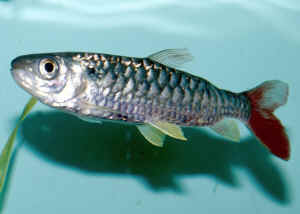
Chalceus erythrurus
|
Freshwater "tetras" of southwestern Texas, Mexico, Central
and South America, and Africa. This assemblage includes the large and
dangerous piranhas all the way to the innocuous little tetras of
aquariums. All freshwater.
| Subfamily Alestiinae,
the African tetras. |
18 genera, including Alestes (= Brycinus),
Hydrocynus, Micralestes, Phenacogrammus and
Rhabdalestes. About 109 species.
|
| Subfamily Characinae, |
An artificial assemblage of small and medium-size
South American tetras. Includes the genera: Acestrorhynchus
(Pike Characins), Charax, Cynodo, Hydrolycus, Priocharax,
Rhaphiodon, Roeboides. |
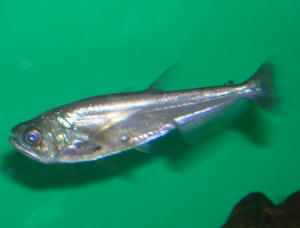
Rhaphiodon vulpinus Agassiz 1829, Biara.
To 80 cm., 2,100 gm.s. Sometimes imported as an ornamental, but
better as a toothy fishing prize!
Photo by NealeM.
http://www.fishbase.org/summary/species
summary.php?id=8697 |
|
| Subfamily Tetragonopterinae, |
Small characin fishes of southern U.S. and South
America. Example genera: Astyanax, Byconamericus, Bryconops,
Cheirodon, Gymnocorymbus, Hemibrycon, Hemigrammus, Hyphessobrycon,
Inpaichthys, Megalamphodus, Moenkhausia, Oligosarcus,
Paracheirodon, Rachoviscus, Tetragonopterus,
Tyttobrycon. |
| Subfamily Iguanodectinae, |
South American. Two genera (Iguanodectes,
Piabucus), of about 6 species. |
| Subfamily Glandulocaudinae, |
South American. Name derived from possession of
pheromone-pumping organ in caudal area. Sixteen genera. |
|
(Excerpted from: Extreme Characins Part 2: Wolves, vampires, and other
horrors by Neale Monks)
Sidebar: Little jewels -- small but
fascinating oddball characins
There are lots of small oddball characins as
well. Among the most interesting is the swordtail
characin, Corynopoma riisei (4.8 cm/1.9"). This
characin is unique in practising internal fertilisation; the eggs
of all other characins are fertilised externally, with the male
shedding milt over the eggs as they are deposited on the
substrate or among plants. Female swordtail characins carry the
fertilised eggs for more than 24 hours after mating, and so are
able select the site where the eggs are deposited more carefully.
Swordtail characin males live up to their name by having greatly
extended fin rays on the lower half of the tail fin. Though not
brightly coloured, these fish are lively and attractive, and make
excellent community tank residents. They are schooling fish and
very gently in temperament, and are best kept with other small
characins, Corydoras, and peaceful dwarf cichlids.
Swordtail characins have a reputation for being delicate
immediately after import, but once settled in adapt readily to
aquarium life and have proven to be long-lived and fairly hardy
animals.
The darter characins of the genus
Characidium are splendid little oddballs for the community
aquarium. Several species are traded, but they're all pretty
similar and retailers rarely distinguish them. Characidium
fasciatum and Characidium ranchovii are perhaps the
two most widely sold, and at first either could be mistaken for a
sucking loach or Siamese algae eater. Characidium
fasciatum (10 cm/4") can be distinguished by a
criss-cross pattern of short vertical bands set against a thick
horizontal stripe running along the flanks. Characidium
ranchovii (7.5 cm/3") on the other hand, is mostly
unmarked except for a think dark band that runs along its
midline. Unlike most characins, these are benthic fish that scoot
about the bottom of the tank foraging for small invertebrates
such as bloodworms. In aquaria, they are peaceful,
non-territorial fish that adapt quickly to dry and frozen foods
of suitable size. In terms of water chemistry, these fish prefer
soft, slightly acidic water, and most critically the water should
be clean and well oxygenated.
While a little larger than the other small
oddballs mentioned here, Exodon paradoxus is at least
regularly traded, lively, and very attractive. Known as the
bucktooth tetra in the hobby, this characin is highly
carnivorous and will eat small tankmates. Wild specimens are
supposed to reach around 15 cm/6" in length, but aquarium
specimens tend to be much smaller, typically 10 cm/4" or
less. Maintenance with large community fish is complicated by the
fact that these fish not only eat whole small fish but also the
fins and scales of larger fish as well. So while some people have
had luck combining them with robust fish such as Plecs, the best
way to keep them is in their own aquarium. These are intensely
hierarchical schooling fish, and if kept in small groups the
dominant individuals tends to bully the others, to the point
where weaker are damaged or even killed. A dozen or more
specimens may be an expensive investment, but only then will the
aquarist get to watch their most famous behavioural trait: the
feeding frenzy! Pretty much anything meaty is eaten, from flake
and pellets through to frozen bloodworms and lancefish.
|
| Subfamily Serrasalminae, Pacus, Silver Dollars,
Piranhas |
South American. 13 genera, including Catoprion,
Colossoma, Metynnis, Myleus, Pygocentrus, Serrasalmus and 60
species. |
| Subfamily Rhodasiinae, |
Costa Rica to Ecuador. 3 genera (Carlana,
Rhoadsia, Parastremma) |
| Subfamily Crenuchinae, |
Northern South America. 2 genera (Crenuchus,
Poecilocharax), 3 species. |
| Subfamily Characidiinae, |
South American (South American Darters). 8 genera
and about 61 species. |
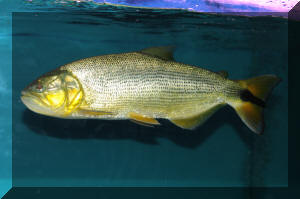
Salminus brasiliensis (Cuvier 1816), Jaw
Characin... of uncertain subfamily status currently. To a meter (!)
in length... and more than 30 kg.s! S. America. This one at
Singapore's largest fish farm.
http://www.fishbase.org/Summary/
SpeciesSummary.php?id=56329 |
 |
Bibliography/Further Reading:
Piranhas, Silver Dollars, Pacus
Brandy, George and Douglas Campbell. 1984. Some notes on spawning
and rearing the Red-Bellied Piranha. FAMA 7/84.
Dunker, Toni. 1960. Catoprion mento, the Wimple Piranha. TFH
1/60.
Jennings, Ron. 1978. How to live with the Red Piranha. FAMA
6/78.
Meegaskumbura, Madhava P.B. 1999. Breeding and caring for Silver
Dollars. TFH 9/99.
Neal, Tom. The Pacu- A friendly giant. TFH 8/98.
Nico, Leo G. and Donald C. Taphorn. 1986. Those bitin' fish from
South America. TFH 2/86.
Quinn, John R. 1992. Piranhas. Fact and Fiction. T.F.H.
Publications, NJ. 128pp.
Schleser, David M. 1999. Piranhas. A bum rap. Finding the truth
about the misconceptions. AFM 3/99.
Schultz, Harald. 1960. Piranhas- Fact and fiction. TFH 9/60.
Vorderwinkler, William. 1960. The Piranha- a menace? TFH 2/60.
Walker, Braz. 1970. The colossal creampuff. The Aquarium
1&7/70.
|
|

