|
FAQs on
the Chocolate
Gouramis, Genus Sphaerichthys
Related Articles:
Anabantoids/Gouramis &
Relatives, Genera Ctenopoma &
Microctenopoma, Betta splendens/Siamese
Fighting Fish,
Related FAQs: Gouramis 1, Gourami Identification, Gourami Behavior, Gourami Compatibility, Gourami Selection, Gourami Systems, Gourami Feeding, Gourami Disease, Gourami Reproduction,
Betta splendens/Siamese
Fighting Fish,
|
|
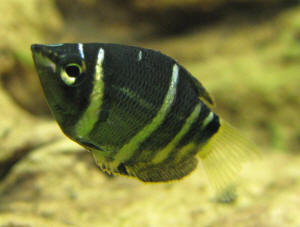
Chocolate Dwarf Gouramis... sel., sys.
2/3/10
Hi!
<Hello,>
First off I want to say I'm a little disappointed about my
chocolate Gouramis. I had read a bit about them but until now I
didn't know how sensitive of a fish they were.
<I'm surprised you didn't realise this from your reading.
Every aquarium book ever written says that Sphaerichthys spp are
incredibly delicate fish not for community tanks. What books did you
read?>
I was looking for something colorful to add to my 20 gallon tank that
wouldn't take up to much of the "inch per gallon" type
rule for my space.
<Definitely not the right choice here. And do remember, the
"inch per gallon" so-called rule applies only to very small
fish, like Neons. As I've described a few times this last week, the
bigger the fish, the less relevant this rule. A Great White Shark has
the same "inches" as 150 Neon tetras, but do you suppose
they'd both work out in a 150 gallon tank? No, obviously not. I do
wish the "inch per gallon" rule would just die.>
Anyways, I've been trying to read about the regular behaviour of
these fish and I'm having a hard time. They physically look well
(no spots, damage, lethargy, laboured breathing, etc..) but sometime
their behaviour seems odd.
I'll tell you briefly about my tank and their behaviour.
<Well, the first thing is to ensure appropriate conditions. Outside
of these conditions, they never last more than a few months. In short,
you need extremely soft water (less than 5 degrees dH) and a low pH
(5-6).
Biological filtration may not work properly at this low pH, so very low
stocking is essential, and the use of Zeolite to remove ammonia
directly is standard. Fairly high temperatures are also required,
between 25 and 30 C.
In short, it's a classic blackwater fish. At higher pH that it
likes, bacteria counts in the water rise, and it hasn't evolved an
immune system able to cope. So sooner or later it becomes infected with
some random bacterial infection and dies.>
Tank: 20g, 5 threadfin rainbow fish, two chocolate Gouramis, BioWheel
filter, and airstone. Tank has been running since the summer, I got the
rainbows about a month ago, waiting about 2.5 weeks, go the two
chocolates, had them for about a 7 days. Day after I brought them home,
noticed two holes in a rainbows tail and three tiny spots on his body.
Slowly raised the temp to 84, treated with salt for ich, and Maracyn
(sp?) for fungus.
Cleared up in about 3 days, now day 6, no signs on any other fish.
Continuing Maracyn treatment for a couple more days.
<Hmm...>
Water: ph 7,
<Too high.>
ammonia 0 (always), nitrites? (next one in the cycle) is 0, and the
last one is a little high at 30-40.
<Not in itself lethal, but nitrates this level do imply
overstocking, at least so far as Sphaerichthys spp. are concerned.
Standard practise with these fish is to keep pairs by themselves in 10
gallon tanks; they really are super-sensitive.>
Usually I don't let it go that high, I'd like to do a water
change, but not sure if I can or when because of the medicine. I empty
powder packets once a day.
<Over-medicating will cause problems, too.>
I know the Gouramis don't like a strong current but I have the
airstone on as I have read that higher temps have lower oxygen and
I'm worried about my rainbows.
<Rainbows aren't really blackwater fish, and it's hard to
see how the two species could be kept together with both doing
well.>
As for the Gouramis themselves, the first odd thing I noticed is
sometime I notice their colour is a dark rich brown, (usually when I
first turn the lights on when it's been dark) and other times they
seem more pale.
<May be social behaviour. Colour changes with mood. But do be aware
that lack of colour can also imply stress and incipient
sickness.>
They also like two spots, they like to hang around my heater, or the
top corner of my tank by the thermometer. They don't hide in the
cave (small clay pot with gravel) or the plants very often.
<They need floating plants, like Indian Fern.>
They will also run around sticking out one of their thread things
running it along the glass. Today, I notice one was going around the
tank running into things. The glass, the clay pot, and right into the
bubbles from the airstone! Right now she is sitting on the ground next
to the plant and the other is there slightly above her. She seems to be
breathing through her mouth a little and maybe leaning slightly into
the plant. The sitting on the ground they've done before.
<To be fair, these aren't terribly active fish. Mostly they hang
around looking bored. But they shouldn't be leaning against things.
Check the current isn't too strong.>
Is there anything I should be watching for? Is she possible sick? Or is
this normal?
<Difficult to say without seeing the fish. As I've outlined
already, you aren't keeping them in the sort of environment where
they might do well. The track record of Sphaerichthys in community
tanks is dismal. At best, they could be mixed with a few surface water
schooling fish from blackwater habitats, perhaps Cardinals or
Rasboras.>
Any help would be appreciated. I'm quite disappointed because now I
don't want to get attached since there's a good chance
they'll end up dying :(
Does the inch per rule apply to the regular sized goramis?
<Not as such, no. In any event, once pH is kept at or below 6, as it
should be when keeping Sphaerichthys spp., stocking must be far lower
than at basic pH levels. That's because filter bacteria are
happiest around pH 7.5 to 8, and in acidic water become unhappy, and
even stop working around pH 6. Cheers, Neale.>
Sphaerichthys spp Chocolate Gouramis... sel. --
08/26/09
Hi Bob,
<Hello Nathan, Neale standing in for Bob.>
A few years ago I kept chocolate Gourami and had reasonably good
success in keeping them alive.
<One of the few. While there's a UK association devoted to these
fish and their relatives, the Anabantoid Association of Great Britain,
there's nothing comparable in the US so far as I know.>
Since that time I haven't had any luck finding more of them. Now I
live in north FL and local aqua shops just look at me like 'what is
that' when I mention chocolates.
<They aren't widely traded in the US or indeed the UK because of
their poor survival record. That said, some shops do get them, and
provided you can offer the very soft, very acidic water the various
Sphaerichthys species can be kept successfully. The problem is, as
I'm sure you know, that at any pH high enough for biological
filtration to work, the lack of acidity allows bacteria to survive and
overwhelm these blackwater fish. So you need to use zeolite to
chemically filter the water rather than a biological filter. When
housed in most retail aquaria, these fish are exposed to pathogens and
don't last long.>
Do you have a reliable source for this fish that you'd share, that
is if you don't sell them yourself ?
<One store in Florida that impressed me was Aqualand Aquarium in
Stuart; the time I visited they had a good selection of unusual fish.
Definitely worth a visit. Otherwise, contacting other advanced
labyrinth fish collectors will probably be the way forward.>
Thanks for any help or suggestions.
Nathan
<Cheers, Neale.>
Re: Sphaerichthys spp Chocolate Gouramis --
08/26/09
Thanks, Neale...
<Hello Nathan,>
That was some good advice, I'll try Aqualand. Those years ago that
I worked w/ Chocolate Gouramis (over 15 years now) I had to order them
from NY then to get any quantity. Of course, you know that of the 100
or so that I ordered almost 1/2 were DOA. Our water here is warm,
fairly soft and it can be 'peaty', so that helps.
<The peat may or may not help, but the thing certainly seems to be
acidity.>
The zoolite filter is a new item for me as I kept these fish for
(genetic) research purposes. The study was of several Anabantid
species, Bettas too, any of these 'air breathing' fish were of
interest in the degree program I was assigned to work on. I could
extract the eggs by manipulating the body of an obviously pregnant
chocolate female, but never got the eggs to hatch, or the fish to
actually breed bc/ it's so different w/ them vs. regular gouramis,
as you know.
<Indeed, and this mouthbrooding behaviour is fairly unusual among
labyrinth fish. Apparently evolved multiple times, perhaps under
different selection pressures: fast-water Bettas, Pikeheads in acid
swamps, and a few Gouramis including the Chocolate Gourami and its
relatives in the genus Sphaerichthys.>
When the males died (them more than females) they were dissected. Male
testes were almost non-existent looking compared w/ those of other
gouramis - I kept Trichogaster, Osphronemus, and some others.
<Animals in acidic habitats have to get by on very little food,
given the trivially low levels of productivity in such places. Perhaps
the males develop and then degenerate their gonads as required?>
The 'giant' Osphronemus were kept in an outdoor pool w/ the koi
we had then. They became so 'tame' we could hand catch them to
draw blood for studying ! I can tell you that the genetic chromosome
structure of Sphaerichthys is really 'whacked out' when
comparing them to that of the other species in the Anabantid
family.
<Interesting.>
Most other Anabantids had bet. 36-50 chromosomes, what's normally
expected for them, but Chocolates only had between 10-16
chromosomes!
<Bizarre, but reminiscent of at least some Pufferfish, where a
similar compact genome has been observed, if I recall correctly.
Genomics was never my thing, and by the time I did my PhD, I was firmly
into the ecological side of biology.>
With fish, the chromosome # can vary... but the results for chocolates
was sort of interesting. It almost seems as if they're going
through evolution in reverse and could be the reason for their many
challenging peculiarities.
<"Evolution in reverse" is a phrase that should spark
lively debate in a coffee room full of biologists!>
They should probably be considered an 'endangered species', not
bc/ of what people are doing to them, but bc/ of their own chromosomes
are dictating such a narrow niche for their existence.
<Certainly very specialised. A lot of acidic habitat organisms, from
fish to Venus' Fly Traps, are having problems because of a
combination of limited geographical range and threats to those bogs and
marshes where they live.>
Well, I guess you didn't ask for all of that.
<Always nice to learn something.>
So, I'll be trying to find someone who could help me purchase some
of the 'little guys' just to keep for 'old times sake'.
Guess I have a 'soft spot' for them after all.
<Oh, they have their fans. A related species, Sphaerichthys
vaillanti, has been making the rounds in the UK, though along with
Ctenops nobilis, it's one of the tougher labyrinth fish to keep
successfully. Anyway, these fish are in the trade, and with luck, you
should be able to get hold of some.>
Cheers, Nathan
<Good luck, Neale.>

