|
|
| Home | Marine Aquariums |
Freshwater Aquariums |
Planted Aquariums |
Brackish Systems |
Ponds,
lakes & fountains |
Turtles & Amphibians |
Aquatic Business |
Aquatic Science |
Ask the WWM Crew a Question |
| Please visit our Sponsors | ||||
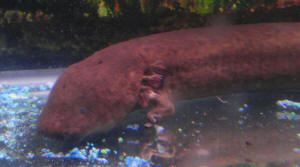
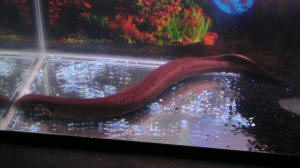
Identification Frog ID And Care 1/3/07 Hi really hope you can help. I am totally new to keeping a tropical fish tank and I have recently bought, what was labeled up as a Congo frog. When I do a search on the net it points me to your website and African Dwarf frogs, are these the same with just different names? < Do a google search on the African Dwarf Frog. If it looks anything close then that is what it is.> The thing is I have had my frog for a couple of weeks and when I first put him in my tank he didn't seem to move to much and just kept laying spread out face down. I got him out of my tank into one on his own as I was unsure if he was ill and if so did not want to spread it around my tank. He is still alive but still not very active and his usual position is face down and he doesn't move for ages. When I go to where I bought him and other places the assistants just don't seem to know anything so you are my only hope, I don't want to be unintentionally killing the frog and also can you tell me what is best to feed him on too. Thanks for your help, I'm sorry I'm a complete novice. Jo < These frogs, as are most, are ambush predators. They wait for prey to come by and then suck it into their mouths. If they move too much then larger predators may eat them. Make sure some small worms make their way down to him.-Chuck> Toads and a Dead Turtle 07/04/06 I caught a bunch of nickel sized toads. at least I think they're toads, they don't have webbed feet. They're brownish with orangey red bumps on its back and a white underbelly. I found them in my lawn while I mowed it. What kind of toads are they and what should I feed them? <Sorry, I need to know where you are from to help you ID a toad. generally that are terrestrial and eat all kinds of insects. They are great for the garden and eat lots of destructive pests.> While I'm at it I also have a red eared slider turtle that died, it was just so weak and it opened its mouth and sometimes made a kind of croaking noises, it was all limp and just laid around in his tank before he died. What was wrong with him and what should I do to prevent it from happening to my other turtles? William < Your turtle had a respiratory infection from being too cold. The basking spot should be at least 85 F. Turtles need to heat up to fight infections.-Chuck> "She turned me into a" newt or other water "lizard", ID 4/14/06 Hello all, Your saltwater site has helped me through lots of tough spots. Thanks very much. Now I have jumped into freshwater "critters" with both feet. Oops. My work associate gave me a "Leopard Water Gecko" for my son. There is no such animal. She gave me very specific instructions in care which I will follow to the letter. But I thought I would see if there was anything I was missing. Now I'm stumped as to what type of critter I have. Please help. He does not seem to have gills but he lives under shallow water. He can and does come out of water. The water temp is around 70 and he seems fine with that. He resembles a firebelly newt in basic head and body shape. Even his tail is shaped like a water animal. His belly is yellow and his top is brown (similar to the color of a river bottom) and he has black spots all over him. I have not gotten a pic yet. <Would help...> I was hoping I could get a possible ID on description. Thanks very much, Beth <Perhaps a yellow-bellied salamander... a commonly kept species. Please see here: http://www.caudata.org Bob Fenner> Water Dog Information Sought Have you heard of a freshwater fish named a water dog and can you tell me where i can get information on this fish <Not a fish... but an axolotl... an amphibian... something between the fishes and reptiles... Like a salamander. Here is a nice site that describes them, their captive husbandry: http://www.icomm.ca/dragon/salmndr.htm <Bob Fenner> Connie A Toad by any other name Hi my name is Mitchell and i have a question have you ever herd of a sernan toad <Surinam Toad my friend, Pipa pipa. My fave site: http://www.scz.org/animals/t/surtoad2.html> it's a toad that live completely under water like the clawed frog and it gives birth to its young out of its back and i was wandering if you know where i can find info in this kind of toad thanks Mitchell <Please try inserting the common or scientific name above in your computer's search engine/s... You will find a wealth of information and images of this amphibian on the Internet. Bob Fenner> A Caecilian by any other name Salutations Dr. Fenner! <Just Bob please> After visiting your website, I have found it to be extremely helpful and concluded that you're probably the only one that can help me! I stumbled upon it during my futile search for information on an unusual species (eel? snake? worm???) I bought on Saturday. I keep it together with a 12cm fire eel and 27 neon tetras. I bought it from a fish farm in Singapore and it was in a huge tank together with many ghost fishes and some fire eels. Let me describe it in detail: It looks like a worm/snake and is almost 30cm with a girth roughly the size of a man's middle finger. The body is like an earthworm's in that it is VERY smooth. Its skin creases when it moves (it moves like a snake!) a and actually forms folds. It reminds me of the kind of skin a newborn hamster or rat has. It is a dark grayish blue and has stripes on the lower half of its body (which is of a lighter color) when viewed from the side. The morning after I bought it, I noticed that it had shed a layer of its skin. The skin was snagged onto the wood in my tank and was billowing in the current caused by my filter pump. Then 2 days later it shed another layer but this time I did not remove the dead skin from the tank. When I looked closely at its body, I did not observe any breaks in its skin. It looked perfectly normal. It does not have any fins at all. Another feature of this funny creature is that its head and tail look very similar! When it is not moving, I get confused sometimes trying to differentiate where its head is! I assume that this is supposed to confuse predators? It looks as though it likes to burrow but my gravel is not fine enough and too heavy for it to hide under. It constantly tries to stick its nose into the gravel but is never successful. In relation to its body, its head seems pretty small and I doubt if a medium sized tetra would fit. I am mentioning this 'because I thought of feeding it small fish initially but that didn't work out. Its head is exactly like a snake's in respect to how the eyes and nose are placed. But the placement of the mouth is slightly different. Its mouth is below the head and looks pretty much like when you put your hand into a sock and pretend to make it 'talk' (I hope you understand my description). It also does not like the light at all. When I turned on the tank light initially it immediately reacted by trying to find a place to hide. But 2 days later it seemed more tolerant. It gets on fine with my fire eel and is totally oblivious to the tetras. It looks as though it has VERY poor eyesight (practically blind) and I can't say much for its sense of smell either! This is based on my experience trying to feed it some live blood worms yesterday. When I dropped the worms into one corner of the tank, it initially did not seem to be aware of them at all. Then it suddenly got pretty excited (this was the first time I fed it. 2 days after purchase) and soon it gobbled one worm up pretty violently. It also hustled my fire eel for the same worm. The thing I noticed is this. It did not seem as though it located the worms by sight or smell at all but rather by ...... chance! Its obvious that the fire eel and the tetras locate the worms by sight first before moving in for the kill. But it looks as though this creature is blind even though it has eyes. Firstly, the worms had to be on the gravel bed before it could eat them. After chomping on his very first worm, even though the worms were RIGHT in front of him, he still didn't seem to see them! And even if the worms touched his mouth or wriggled just beside his face, he was still excitedly pushing at the gravel with his nose looking as if he wanted to burrow??? <Likely so> Then its as if he suddenly realized (or maybe randomly) there was a worm nearby and he suddenly opened his mouth and violently chomped on it. Its quite comical actually! It also looks like it would rather eat worms that are partially rooted in the gravel (it'll rip the worms out VERY violently) compared to those that are wriggling freely. He also seems to have a slightly more successful chance on grabbing a worm when the lights are dimmed (could be my imagination though). I have thought of buying it some very fine sand but then some people have advised me not to. Someone said that since my fire eel is a freshwater species the introduction of sand would alter the PH of my water drastically. I am not sure if there exists fine marine sand or fine freshwater sand. Someone else also said that the fire eel's skin would be scratched or irritated if it burrowed into the fine sand. I really don't know who to believe. Any comments on whether I should get fine sand? <Mmm, I would do so... and probably move this animal (an amphibian) to a separate system> But I am quite sure that this snakelike creature I bought would be most happy if it could burrow and hide in fine sand. Something like desert snakes that burrow underneath sand and lie in wait of insects and such? The documentary I saw about this particular desert snake mentioned that its skin was very sensitive to vibrations and detected insects crawling on the surface in such a manner while it lay in wait underneath the sand. Could this creature be like that? <Yes> I am just speculating based on its physical appearance 'because I am really curious! But I can guarantee that it not a common loach, ropefish or Bichir. I submit my humble observations to you Dr Fenner and look forward to your favourable reply. Yours Faithfully, Leonard Emmanuel Tan <What you describe so well, behaviorally and structurally is almost w/o doubt a Caecilian (http://www.caecilian.org/) in the trade in the West most often called a "Rubber Eel". Please take a look through the Net re this group, its practical husbandry. Thank you for writing. Bob Fenner> Dwarf African Frogs What is the difference between HYMENOCHIRUS BOETTGERI AND CURTIPES? <Well... from what I have learned from some google searches, not much. Apparently they look similar and are often confused. http://www.pipidae.net/david/Page2.htm#genus > Also why would new jersey list the former as an exotic species and require a permit? <Ya got me there, I might ask the folks who told you would need a permit, or whoever is in charge of supplying the permits. -Gage> thanks for any help you can supply. Confused, poor grammar/spelling, and frogs how do I know the difference between an African clawed frog and dwarf frog? <Size, shape... that your other livestock are missing! Please read here: http://www.wetwebmedia.com/FWSubWebIndex/amphibfaqs.htm> also when they are small like an inch, do they grow bigger? <What? The Xenopus definitely do> if so how big? I'm looking on info on a dwarf, I had a clawed, I had to get another tank for it. <I'll bet... Learn to capitalize proper nouns, use spaces, write in sentences, please. Bob Fenner> |
|

|
Features: |
|
| Featured Sponsors: |