|
FAQs on Community Tank Freshwater
Livestocking
Related Articles: Stocking 5, 10 & 20
Gallon Freshwater Aquariums by Neale Monks, Freshwater Livestock, The Ethical Aquarist; Freshwater
Fishes to Avoid by Judy Helfrich Acclimation of New Freshwater Livestock by Bob
Fenner, Fishes, Amphibians, Turtles,
Related FAQs: Mis-stocking issues
(incompatibility behaviorally and/or environmentally),
FW Livestock 1, FW Livestock 2, FW Livestock 3, Freshwater Livestock
Selection,
|
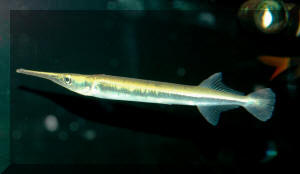
Xenentodon... Odon? Teef!
|
Community tank; FW, stkg. 8/16/15
Hi there! I have a 55 gal tank with 4 small angels, 6 platys, 3 Molly's, 3
guppies and 2 Kuhli loaches. My question is: Would I be overcrowding the
tank if I added 4 more loaches, and 1 or 2 Plecos?
<Four more Kuhli Loaches absolutely not a problem. You could also add a couple
of Bristlenose Plecs as well. But regular/common Plecs, the ones sold as "Plecs"
or "Plecos" the world over... NO. Do not add. Would ruin what I'm sure it a
lovely clean tank. Too messy, too much solid waste... your tank would look
horrible after a while. They grow massive, 20 cm/8 inches within one year, and
over 30 cm/12 inches by the end of the second, and full size specimens can be
even bigger.>
I know the angels will get bigger so I want to plan for that. Also, what other
types of fish could I put in with the angels? My hubby wants me to get rid of
the guppies, Molly's and platys and try a more peaceful type of gourami (sp?) Or
any other type of fancy shmancy freshwater fish.
<Gouramis are good, and would mix well with the Angels, if you chose the right
species. Lace or Pearl Gouramis are normally good, and so are Moonlight
Gouramis. Male Three-Spot Gouramis (sold as Blue Gouramis, Gold Gouramis, Lilac
Gouramis and other Trichogaster trichopterus species) have a tendency to become
aggressive with age so I wouldn't get those. Dwarf Gouramis are a total waste of
money because they're absolutely plagued with disease. Honey Gouramis too small,
delicate and shy to be useful in a tank like this.>
I keep trying to explain that due to the angels needs most other fish are bad
tankmates hence the fish I have already.
<Understood. Angels are fairly tolerant, just avoid fish that are small enough
to eat (Neons for example) or species prone to nipping their fins (such as Tiger
Barbs, Serpae Tetras). They work surprisingly well with peaceful predators; one
such is Ctenopoma acutirostre, which won't view the Angels as good, and both
species prefer to skulk about peacefully. They
also eat the same frozen food to some extent, bloodworms, brine shrimps and so
on, though Ctenopoma (usually) have no interest in flake or pellets. So if you
and your husband to a bit of thinking about what you'd like, maybe you can find
some pretty fish and some interesting fish that'll all live together. On the
other hand, Angels are classic tankmates for South
American catfish up to about 15 cm/6 inches in length, including things like
Corydoras sterbai (the warm-water Cory), smaller L-numbers, Whiptails, Jaguar
Catfish, Driftwood Cats, Centromochlus perugiae, and so on.>
Any suggestions would be appreciated.
Bre
<Hope this helps, Neale.>
Re: Community tank 8/16/15
Thank you so very much. I now have another issue. I researched all the fish I
have and originally found that Molly's do just fine in straight freshwater....
Reading your page I have found that they need salt.
<Not quite. Mollies can live in freshwater tanks if the water is hard, alkaline,
and of very good quality (including low nitrate, not just zero ammonia and
nitrite). However, Mollies are disease-prone in freshwater of these stringent
requirements aren't met, and to some degree, genetics plays a role too.
Basically, if your Mollies are thriving now, I'd not lose any sleep, but on the
other hand I wouldn't recommend rushing out to buy some more. The contrast with
this is that in brackish and marine systems Mollies are hardier and less
disease-prone. In short, you don't have to add salt for the Mollies, but if you
were setting up a tank for Mollies and wanted them to be easy to keep, adding
salt is the best thing you can do. Make sense?>
They seem fine now, but its only been a week. I previously had goldfish.
So I am extremely new to the warm water fishes.
<Tropicals are generally less demanding than Goldfish, and in a nice big tank, a
good selection of community fish should be a piece of cake to keep.>
Could I add salt to the tank with the angels, guppies, platys and Kuhli loaches?
<No, yes, yes, no.>
Or should I remove the Molly's to a friends brackish tank?
<No need if they're happy now. But see what happens.>
I thought goldfish were difficult fish to keep in tanks.. Those water change
habits are well developed. If I add salt to the tank how does that affect the
current 25% weekly changes and weekly vacuum routine?
<Nope.>
Thanks again.
<Welcome. Neale.>
Re: Community tank 8/16/15
Fantastic. I will keep an eye on things. Thanks so much for your time.
I've made your page #1 for future issues. Nowhere else have I found the in depth
information needed to be a good fish owner. ~Bre
<Thanks for the kind words. Cheers, Neale.>
Hard water stocking questions 5/13/15
Dear Crew at WWM,
<Hello Amy,>
I’m in the process of setting up my first freshwater aquarium. While I was
initially confident about my stocking plan, the slow growth of my
nitrite-digesting bacteria gave me time for extensive research. Predictably, I
am now extremely confused.
<Oh.>
My goal is a peaceful community tank with a low rate of dying fish. Actually,
I’d like to have no fish death - but that seems unrealistic.
<Not completely. If you pick some species, such as livebearers or easy
egg-layers, you can actually end up with a situation where deaths and births
balance out, and your tank becomes self-sufficient across the years.>
My tank is 29 gallons (12” wide by 30” long) and currently running a filter
rated for 40 gallons, though it sounds like I may need to supplement this for
pretty much any fish.
<The "suitable for X gallons" on the filter packaging really means "suitable for
X gallons if you moderately stock the tank with small fish". So provided you
choose fish in the 1-2 inch size bracket, and keep, say, 20 of them in the tank
to start with, your filter may well be just fine.>
I’d like to try a planted tank, so I’m thinking about adding a canister filter.
Right now the tank houses only bacteria.
<Adding some fish food to feed the bacteria, or ammonia for the same purpose?>
I’m in South Dakota, where the water is hard (18 degrees GH) and alkaline (pH of
9).
<Really pH 9? That's positively caustic! Try leaving the water in a glass or
bucket overnight then check the pH. Is it still pH 9? I would really try to
lower the pH down to 8, even if you choose hard water species.>
So no neon tetras for me, much to my boyfriend’s sorrow.
<Indeed. But if not Neons, then various other tetras might be selected: X-ray
Tetras, "False" Penguin Tetras (actually the commonest species), even Emperor
Tetras are all possibilities up to 20 degrees dH, pH 8.>
My initial plan was to have a school of white cloud mountain minnows and a
school of peppered cories in an unheated tank. I find peppered cories a little
drab (I suspect this is extremely unfair of me), but I love watching them play.
So I was pretty stoked about this plan.
<You can substitute pretty much any farmed, hardy Corydoras for a low-end
tropical tank at 2-20 degrees dH, pH 6-8, temperature 22-25 degrees C/72-77 F.>
But then I found more information about my water (http://denr.sd.gov/des/dw/PDF/pwshandbook/0342hbk.pdf).
The untreated water has a hardness dominated by carbonate (500 mg/L) and by
calcium (200 mg/L). The treated water has much less carbonate (40 mg/L), less
calcium (80 mg/L), and more sodium (160 mg/L). The conductance is high - 1300 uS/cm.
Since some plants start objecting to the salinity of water at 700 uS/cm, I began
wondering if my water is slightly brackish.
<Certainly sounds as if it's mineral-rich, at least. Brackish species might be
an option. Or for that matter, desert fish (such as the Australian Desert Goby,
Chlamydogobius eremius, or the Persian Killifish, Aphanius mento). Desert fish
are often very well adapted to extremely mineral-rich water.>
Some of the brackish fish seem like they might do well in my hard-water,
kinda-small tank. Particularly appealing are Rainbowfish and gobies. Even though
Celebes Rainbowfish aren’t brackish-water fish, it sounds like they tend to do
well in mildly brackish tanks. Gobies sound like they can be difficult to feed,
but flakes are out, anyway - I have celiac.
<Celiac disease really prevents you from handling fish flake? Zipping over to
the Mayo Clinic website, there's a medical doctor there who states that
Celiac
sufferers can use gluten-containing skin products just fine (of course, some
people can have an entirely different allergy to touching wheat, but that isn't
Celiac and not related to it in any way). Do read:
http://www.mayoclinic.org/diseases-conditions/celiac-disease/expert-answers/celiac-disease/faq-20057879
So I'd reckon that unless you eat the fish flake, a pot of flake food shouldn't
pose any risk at all. Consult with your doctor though!>
And I suspect I could watch gobies for hours. Another option you’ve mentioned at
WWM is livebearers. I’m not hard over on having a school of fish, but aggression
stresses me out: so maybe Limia?
<Nice fish.>
For a bottom-dweller, rainbow darters seem cool - mainly because they seem a bit
like gobies.
<They are indeed, but almost entirely specialists to flowing water that isn't
too warm; really need a biotope tank.>
So I’m wondering: could all these fish tolerate the very-occasional
two-week-long absence?
<Yes.>
Or would water quality and/or feeding needs make that iffy?
<Most fish are fine without food for a couple weeks.>
Is my water essentially brackish, and suitable for salt-tolerant fishes only? Or
are my salt levels basically unnoticeable for most fish?
<If it's potable water, it isn't brackish. Not saying whether it tastes nice to
drink, but if offered as drinkable water, then no, it won't have enough salt to
be brackish. You'd need to add marine salt mix.>
Are these even the right questions to be asking, or should I start cracking open
the books on fish biology?
<I'd focus instead on water chemistry issues. pH much too high. Seems off to me.
Have it checked with another test kit, perhaps at your local retailer if
necessary.>
Thanks so much for your time,
Amy
<Welcome, Neale.>
Re: hard water stocking questions 5/15/15
Hello!
Thanks so much for responding to my question.
<You're welcome.>
You’re certainly right that the problem for most celiacs (including me) is
ingesting gluten. The problem with flakes is that there’s often dust - something
that reliably gets me sick. Then, too, is the wish to avoid second-guessing
sources of contamination. Keeping known sources of gluten out of my apartment
makes it easier to introduce new foods. Plus, it’s more relaxing :)
<Do consider using micro pellets or wafers then, for example the excellent ones
from Hikari. Neither should produce much by way of dust since you don't crumble
them.>
My plan was to feed the fish with Repashy and maybe the occasional frozen bug.
Repashy is gluten free, and I like that it’s a prepared food - seems more likely
to have what’s actually needed for fish than whatever I’d manage to make.
<Repashy doesn't appear to be a fish food but a reptile food. Please try and use
a fish food as your staple. Reptile food isn't actually all that good for many
reptiles, and probably hopeless for fish. Prepared fish foods have
micronutrients (vitamins and minerals) that tend to be difficult to supply if
you use just frozen or live foods, so unless you're an expert fishkeeper, it's
just easier to stick with prepared foods (flakes, pellets, wafers, etc.). You
certainly don't have to use flakes, that's true; livebearers for example
can/will thrive on a diet of sinking Hikari algae wafers alone. But at the same
time I wouldn't recommend just feeding them frozen bloodworms, which are kind of
the equivalent of popcorn chicken. Easy to eat, and popular, but not necessarily
a balanced diet in themselves.>
On feeding my bacteria - I’ve been adding ammonia solution. I wasn’t able to
find any ammonia locally without lemon scent, so I got some Dr. Tim’s.
<Understood.>
My water is definitely potable - it tastes pretty nice, actually. When I test
the pH after letting it sit overnight, I get a pH near 8.2. Our local water,
pre-treatment, has a pH near 7.3 - but it comes out of the treatment plant at 9!
I suppose I can fill up some buckets with water the night before a water change.
Would pH 8.2 be comfortable for some fish?
<Yes. Ideal for livebearers, Killies such as Florida Flagfish, most of the
Ricefish and of course brackish water and desert fish, and probably tolerated by
the hardier community tropicals such as Zebra Danios and Peppered Corydoras.>
Desert fish are a pretty amazing class of fish. Would fish like the desert goby
or Aphanius Mento be best in a single-species setup?
<Tend to be, yes. Desert Gobies are relatively short-lived by breed readily, so
the ideal situation is to get a half dozen, let them settle in and breed so you
have a stable population. Male Aphanius mento are rather aggressive, so best
kept in harems (one male, multiple females) unless the tank is big enough for
several males (not 2 or 3) to spread themselves out among the rock work. There
are some other desert fish out there, including some wonderful native species in
the US, Spain and elsewhere, but all too often these fish are threatened with
extinction so trade is limited/non-existent. Your national Killifish club may be
able to provide some tips on these additional species.>
For some reason I’ve been thinking of a tank with top-dwellers and
substrate-dwellers, but I can move on to a different plan.
<Do also take some time to look into the family Goodeidae, such as the two
fairly regularly traded species Xenotoca eiseni and Ameca splendens. While
"nippy" and not suited to community tanks, Ameca splendens is very pretty (males
have yellow-edged fins and are pale to dark blue with metallic spots, depending
on their social status) and work rather well in groups. Eminently breedable, and
more or less herbivorous (they'll thrive on algae, lettuce, cooked spinach, and
floating Indian Fern) they will thoroughly enjoy hard water and an unheated tank
at around room temperature. Big groups are stunning! Xenotoca eiseni is a little
less nippy and perhaps a little less showy, but still a nice-looking fish with
shades of blue, black and orange on its body. Goodeids occupy all levels,
feeding from the top as readily as grazing algae from the rockwork.>
Thanks again,
Amy
<Cheers, Neale.>
Re: hard water stocking questions
5/16/15
Hello,
I’ll be sure to find some fish food that’s legit fish food. I’ll look into
Hikari; “wafers” sounds much better than “flakes.”
<Indeed.>
Livebearers sound ideal - I’ll see what I can find in my area, and look for
Ameca Splendens. They look really lovely, and perhaps my LFS would be interested
in occasionally taking a few. My tank is 30” long; would a group of eight or so,
with a 2:1 or 3:1 female: male ratio be likely to be successful?
<Yes.>
I’d like to avoid overly-harassed fish.
<Wise indeed. Female Ameca splendens are pretty big, but yes, it's best for them
to outnumber the males.>
Are there any livebearers that would work well with gobies? I’m wondering about
guppies (Endler’s or swordtail or swamp) and bumblebee gobies - but I’m curious
if any of the freshwater or brackish gobies can flourish with the kind
of-aggressive-sounding livebearers.
<Enders would be fine; ditto Micropoecilia parae for example, or Micropoecilia
picta.>
I’ll definitely save the cories for some other watershed.
<Wise.>
It sounds like livebearers in general appreciate good cover, plant and
otherwise, as well as algae. I was planning on having a planted tank, but I
don’t have much light in my apartment. So perhaps I should add some decent
lighting to my system and let some algae grow in? The LFS mentioned they use RO
water specifically because the tap water supports algae growth far too well for
their show tanks. I haven’t had any algae show up yet, but perhaps light is the
missing ingredient.
<Sounds plausible. You need reasonably bright light for the diatoms and green
algae that livebearers eat; lower light levels tends to end up with brush algae
and blue-green algae that livebearers ignore. That said, Ameca splendens
notoriously eats them all!>
Thank you again for taking the time to answer. If it weren’t for WWM, I’d have a
ten-gallon tank, dead German Rams, and a few sickly tetras right now.
<Oh!>
I’m sure you guys have web people, but if they have any tedious tasks that need
offloading, I’d be happy to help out - I speak html, JavaScript, and css as well
as some SQL. Anyway, if there’s something in that department that needs doing,
I’d love to be able to give some of my time.
<That's very kind. I'll be sure to pass this on to Bob.>
Amy
<Cheers, Neale.>
Re: hard water stocking questions
5/17/15
Thank you for your offer of help Amy... Will keep your email about... as I often
have CSS questions, issues... that Darrel Lantera has been able to solve thus
far; but sometimes he's been busy. As to other help; who knows? BobF
Community tanks + temperature 7/9/14
Hello again Neale. I have a problem that I hope you can help with. I
just finished cycling (fishless) a 38 gallon Nuvo tank. It has been
decorated and ready to go but with no fish yet. I was waiting for a
couple of days from now when my LFS has a sale. Last night I just looked
at my tank to make sure everything looked OK and that the pump was doing
well. Then I looked at the thermometer and it was about 81 degrees!
<Toasty warm.>
I have been running a UV sterilizer and did not know that they could put
off heat until I did some research, so I have unplugged it.
<Which is fine. You don't need to run a UV steriliser at all, unless
treating a specific problem for which they're a help. Unlike marine
aquaria, freshwater aquaria don't really benefit from UV sterilisers
running 365 days of the year.>
I don't know how much difference it will make.
<Minimal except within specific situations. Specifically, UV is a good
way to combat algal blooms (such as diatoms) and to reduce (though
rarely cure) problems from parasites with mobile larvae (such as
Whitespot). They don't do anything to improve healthy tanks, and won't
help treat Finrot, Fungus, etc.>
Anyway, I cannot afford a chiller and I was looking on line and found
something called a zoo med aqua cooling fan. It is inexpensive and has
good reviews. I read from some of the reviews that their temp went down
about 2 degrees.
<Pretty much any fan will do this via evaporation. Cools the tank as
water evaporates (like sweating) but of course that means you need to do
frequent top ups with (ideally distilled) water (if you top up with hard
tap water, then hardness will rise between water changes since
evaporation takes away water but leaves behind the minerals). Some folks
use ordinary fans blowing across open-topped aquaria; others make
home-brew solutions by installing cheap PC fans into their hoods.>
But before I order it I wanted to know if you knew of any community
freshwater fish easy to keep that can tolerate higher temps.
<Many.>
If so do you have any suggestions?
<The obvious choices from South America are things like Angels, Discus
and Cardinals, all of which like balmy conditions, and from Southeast
Asia, the Gouramis, many of which are specifically adapted to sluggish,
overheated water, hence their air-breathing knack.>
Should I stop using my UV sterilizer or maybe just use it part time in
the summer? And lastly, have you ever heard of the cooling fan I spoke
of?
<Yes. Does of course require an open-topped tank, which is risky for
"jumpy" species liable to end up as carpet jerky.>
I hate that I have spent all this money and have this happen. If worse
comes to worse I can at least sit and watch the tank with my LED lights
causing the water to shimmer. Thanks and God Bless!!
James
<You are most welcome! Neale.>
Re: Community tanks + temperature... as it relates to stkg.
7/10/14
Thank you for the information Neale. The fish that you mentioned that
could handle higher temps......how much temperature can they stand
before it is dangerous for them?
<Cardinals are fine up to 28 C/82 F; Angels and Discus at least that,
easily 30 C/86 F for extended periods, even indefinitely if oxygenation
is excellent. Gouramis quite possibly a degree or two higher on a daily
basis assuming the water cooled down a bit at night, since that's the
sort of situation some at least will find themselves in. Only a very few
fish are explicitly adapted to substantially warmer water for long
periods, such as the notorious Pupfish of North America.>
Also, can any livebearers or cories handle higher temps?
<Livebearers, yes, Guppies and Mollies to some degree (28 C/82 F);
Corydoras, almost none of them do well above 25 C/77 F, with the main
exception of Corydoras sterbai, which is perfectly happy in the 24-28
C/75-82 F range. Above that, you'd probably want to go with something
more immediately robust, like Hoplosternum littorale.>
Thanks again for all you do.
<Most welcome.>
James
Re: Community tanks + temperature 7/10/14
Thank you again Neale. At least that gives me several choices that I had
already planned on stocking. I was hoping to have platies and swords but
I guess not.
<Definitely not. Platies and Swordtails are cooler water fish, 22-25
C/72-77 F; Variatus Platies prefer even cooler conditions, and even in
the UK are best kept as coldwater fish at room temperature, i.e., around
18-20 C/64-68 F. The thing about Swordtails we often forget is that
they're from fast flowing streams and creeks, that's why they're so
streamlined, hyperactive and jumpy. Bear this in mind and creating the
right tank for them -- one where they aren't difficult to keep and don't
harass their tankmates -- becomes a lot easier.>
I have been looking on the web to hopefully find a screen cover if I can
find one to replace the glass one thinking this might help some.
<Just visit your local glazier and have them cut some glass to size.
They will even grind down the edges to make the glass safer to handle.
Acrylic is good too, but often bends or sags a bit if too thin. But it's
durable, cheap and easy to drill ventilation holes into should you want
to.>
Also, in the past I have always used fluorescent bulbs for lighting, but
now I have LED lights - (RGB & 6500K White LED light fixture for
freshwater aquariums). There are several moonlight settings I can use
for nighttime use, but was wondering how many hours during the day I
should use a regular bright light in addition to the night moon light. I
have no live plants and my tank is 19 inches deep.
<With live plants, 8-10 hours is recommended; without the plants,
whatever you want. The fish don't care so long as there is an obvious
day/night cycle that keeps their circadian rhythms working. So use the
bright and blue lights as much as you want up to, say, 14 hours total,
but allow the fish around 10 hours of genuine darkness so they can
sleep. It will also encourage nocturnal animals like catfish and loaches
to do their thing.>
Thank you again for your patience and help. You have been a lifesaver.
James
<Thanks for the kind words. Neale.>
Re: Community tanks + temperature 7/13/14
Thank you, so as far as the lighting goes, during the day when there is
light in the house, I should still have bright lights for part of the
day and then night lights for the rest for a total of 14 hours? Should I
try
to get as close to 7 and 7 as possible?
<Not sure I understand. Do you mean you want a "siesta" period in the
middle of the day where the lights go off for a couple hours? This is
often done, works fine, and yes, 5-7 hours either side of the siesta is
correct.
If you have no live plants, it matters not whether you're using the
day-simulating bright lights or the blue moonlight lights. The fish
won't care so long as there's enough daylight during the day for them to
feed and
behave normally. If it's too dim in there, and they're obviously in a
sleeping mode (e.g., Neons hiding among plants, Dwarf Cichlids in caves,
etc.) then reassess things, and ensure you have bright lights in the
tank for at least 6 hours a day.>
And then at bedtime I turn off the lights completely until the next
morning?
<Yes.>
I guess I have always made a mistake with all the past aquariums I have
had because I never had a light that simulated nighttime, just a bright
bulb for full time use except at night when they were in complete
darkness.
<This approach is fine, too.>
Also I know you had mentioned to me that cardinal tetras are more suited
for soft water and mine here is hard. But you said they could possibly
adapt I think.
<Not seen much evidence of this to be honest. They don't die
immediately, but they don't necessarily live very long either. They're
okay in moderate hardness to be sure, maybe around 12 degrees dH, pH
7.5. No problems at all. But if you have liquid rock like me, 20 degrees
dH, pH 8, then Cardinals aren't a sensible choice at all. Numerous
better alternatives such as Neon Rainbows, Daisy Ricefish or even red or
blue metallic Platies.>
Since my tank is only two feet wide and they are schooling fish and need
about 10 in a group should I not consider them because of the lack of
space?
<Wouldn't be my first choice, no.>
Thanks and have a blessed day.
<Thank you.>
James
<Neale.>
Re: Community tanks + temperature 7/13/14
Thanks again Neale, two more questions, please (I'm really
sorry). If the room I have the tank in gets a fair amount of lighting
during the day could I go without lighting or no?
<Possibly. Use your own judgment. If the tank is light enough the fish
can swim about, find food, interact with each other... you don't need
extra lighting.>
Also would you rule out ALL schooling fishes because of the size of the
tank or were you just talking about the cardinal tetras?
<The latter; Ricefish for example are hard water fish and schooling
fish, and ideally suited to small tanks. The same holds true for
Celestial Danios, though they're a bit more demanding. Female
livebearers of all
types tend to be schooling fish, though males rarely so under aquarium
conditions.>
Thank you again.
James
<Cheers, Neale.>
Tropical Community Compatibility
11/3/13
Good morning,
<Hello,>
I have a 55 gallon moderately planted community tank
that has been running for about 7 months now. The tank has the following
parameters:
Temperature: 25C/77F
pH: 7.6
dH: 10
<All sounds good.>
The tank is currently stocked with 12 Zebra Danios (Danio Rerio, which I
plan to add 4 more today), 4 Upside-Down Catfish (Synodontis
Nigriventris) and 3 Zebra Nerite Snails (Neritina Natalensis).
<A good mix of livestock, though do watch the Synodontis; very
occasionally they become fin-nibblers. Otherwise good community fish,
but be careful combining with fish that have unusually long fins, e.g.,
veil-tail Angels, fancy Guppies, farmed Bettas, etc.>
I would like to add a medium (4-5") specimen fish to
the tank that will get along with the current inhabitants and use the
top or middle of the tank.
<Gouramis occupy the middle and upper levels, so a good starting point.>
I was thinking of adding either a single Angel Cichlid or a female Blue
Gourami variant. Both of these fish seem to do well in this sort of
water quality.
<Correct.>
Do you have any thoughts on which would work better here, or perhaps
another suggestion?
<I suspect Gouramis would be the safest and easiest. Blue Gouramis (and
other varieties of Trichogaster trichopterus) are very hardy but the
males can be a bit aggressive towards each other. Pearl and Moonlight
Gouramis are generally milder. Don't overlook Thick-Lip and Banded
Gouramis; nice colours, robust but not aggressive personalities, and
much hardier than the commonly traded Dwarf Gourami. If you could, by
chance, get good quality Dwarf Gouramis they could work too, but even at
the best of times they're quite shy fish that tend to stay at the bottom
of the tank. On the cichlid front, yes, Angels might work (but see
warning above) but you might also consider a singleton Keyhole Cichlid
or a pair of Flag Acaras, though both these species are shy.
Alternatively, if you wanted something out of left field, an oddball
characin such as Anostomus Anostomus might work (these are terrific
personality fish that work either singly or in large groups).
I keep my Anostomus with Dwarf Upside Down Catfish, and they get along
fine.>
Thank you in advance for your help! I do very much enjoy this website
and it has helped me several times in the past.
Joel
<Hope this helps, Neale.>
Appropriate for a Beginner? FW livstkg. for a very hesitant
aquarist - 01/27/2013
Hello! First I want to say thank you so much for providing such a
wonderful resource! I'm writing because I need a little bit of advice,
and quite honestly your site is the only place I know that I trust
enough to ask.
<Glad we're here>
So, it's been a lifelong dream of mine to have an aquarium. I don't know
why, but fish always have always had this remarkable ability to make me
happy, or feel calm when I'm upset, like everything is going to be
alright.
About a year ago I decided I was finally ready to make this dream a
reality--I spent a great deal of time doing a lot of research
(particularly on your site!), and was planning a 30 gallon community
tank. I had narrowed down my livestock options a bit and felt I'd
learned a lot about setting up a system, and purchased a used tank and
stand that came with some accessories (filter, heater, etc), knowing I
might still have to replace/upgrade some of the accessories. The problem
is that unfortunately I have some serious problems with depression and
anxiety, and as I got deeper into the specifics and it came time to make
my final livestock choices and purchase the rest of my supplies, I got
completely overwhelmed.
It suddenly felt like my
brain was snapping in half and I just couldn't do it anymore. I panicked
horribly over the entire idea, completely terrified that I would fail,
and my animals would die, and it would all be my fault.
<Best to reduce all the steps to just this... one at a time>
The thing is, though, I couldn't bring myself to actually get rid of the
tank and give up my dream. I want really badly to try again, and I think
I may finally be ready? But I'm apprehensive about attempting anything
too complicated, for fear of overwhelming myself again. It's not that
I'm too worried about maintaining a tank, once I have it set up, if I
have clear enough instructions and guidelines?
<Not hard to do>
It's mostly the setting up of the system and selecting livestock that
are so intimidating, since there are just SO many choices, and so much
information to digest and compare. It doesn't help that most people
available to ask for advice or help are unreliable, like pet shop
employees.
<Mmm; a good idea to find local help that you can trust>
My questions are these: First, do you think perhaps it would be a good
idea to "start smaller"? Obviously a larger tank is usually easier
overall, but I've found myself interested in the idea of a small (maybe
about 3-5 gallons?)
<No; a thirty gallon is better by far. More stable, easier to maintain,
stock>
freshwater shrimp-exclusive tank. I know the water quality is harder to
maintain in a small system, but something small with a single species
also sounds much less intimidating, and it even sounds like some shrimp
(cherry shrimp I believe were one mentioned in the "Stocking 5, 10, & 20
Gallon Freshwater Aquariums" article) don't require a heater if the
house is kept at an appropriate temperature?
<Can be done>
Which knocks one thing off my "stuff to worry about" list. The idea of
starting smaller and simpler to learn the basics before attempting to
tackle the 30g certainly sounds appealing. Do you think a small
freshwater shrimp tank would be plausible or even appropriate for a
beginner? Or is it more complex/delicate than I'm inferring?
<Easier to go w/ slowly stocking the 30 gal. community>
Second, if I were to jump right in and attempt the 30g tank (or when it
comes time), do you have some good beginner fish to recommend?
<Yes; gone over on WWM... platies, small danios, Rasboras... depending
on your local water quality characteristics...>
I know this is a really big question, and pretty dependent on personal
taste usually, so I 100% understand if it's too much to ask. I've read
everything I can find on your site about freshwater community stocking,
and what might be good for beginners, but it still seems so
overwhelming...I feel like I'd be best maybe starting with just 1-4
kind(s) of fish, if this is doable, to keep compatibility issues to a
minimum...if you have just a couple things you can recommend, either one
variety I might start with, or a couple that would be good together?
<Start w/ one species of Danio, Rasbora...>
I know you must get this kind of question all the time, but I feel like my
brain just breaks every time I try to tackle this by myself. I know that
I do like fish that are a little on the larger side, hopefully 2-3"+,
and color isn't too important to me? I mostly just like fish in general,
so I'm not too picky. I'd honestly be pretty okay with either a simple
community with a couple kinds of fish, or just a tank with only one kind
of fish (provided I like that kind of fish enough, haha). Again, so
sorry to ask so much of you, and feel free to disregard this question. I
just feel like I need someone to just tell me what to do.
<No worries>
Thank you so much, and sorry I tend to ramble! I'm just so nervous and
kind of afraid to ask for advice. :(
-Rowan
<Again, "every journey... continues w/ one step after the last".... Take
your time... get the small school of minnow fishes and see how you like
them for a few weeks. Bob Fenner>
Re-evaluating stock list
1/9/13
Hi guys & gals,
<Hello Kim,>
I've had my 75 gallon planted community tank running
for a bit over a year and just recently went through a Columnaris
outbreak that wiped out over half my stock... The water parameters have
always been great (0 ammonia, 0 nitrites, never above 15 nitrates, 6.5
ph), so I suspect it was from incompatible stock (just recently realized
that Neon Tetras & Black Neon Tetras like things cooler than the 76-78 I
keep the tank at).
<Can be a factor. Keeping the tank a couple degrees too warm or cool
isn't usually a reason fish populations are wiped out overnight, but
over the long term can shorten lives of things like Neons from 4-5 years
to 1-2 years.>
I'm taking this time as an opportunity to re-evaluate my stocking list
to avoid setting myself up for another outbreak in the future. My
current survivors are a Betta male (one of the giant boys Petco has been
calling "King Bettas"), 5 Gourami (2 Blue girls, 2 Opaline girls, 1
Pearl male), 4 male Guppies, 2 Neon Tetras, 3 Black Neon Tetras, 2 adult
African Dwarf Frogs (they're target fed to ensure they aren't
out-competed at feeding time), 2 Otos, 1 Red Tail Black Shark,
<A risky species at times, but your tank is nice and big.>
a giant mess of snails (MTS, Ramshorn, and Pond types) that multiplied
after hitchhiking in on the plants, 6 relatively newly added Assassin
Snails (to combat the pest snails), and a colony of Blackworms living in
the gravel/eco-complete substrate.
<An interesting mix. Not textbook for sure, but if it works for you…>
Even when fully stocked, none of my stock cared about the other tank
species outside of the occasional, half-hearted shooing, and the only
fin damage on my Guppies has come from the occasional notches from all
the boys being typical male Guppies. The tank is densely planted in back
and on the sides, with open swimming area in the middle center, and lots
of caves, logs, and driftwood hidey holes/territories.
<Sounds good.>
So now to the restocking plan... I know the Tetras will need re-homing
due to needing cooler water, and I recently found out that livebearers
like my Guppies do best in alkaline water... I keep getting conflicting
information though, some say Guppies are fine from 5.5-8.5, while others
say 7.0-8.5... Which is right?
<Basically, keep the pH above 7 and the hardness level above 10 degrees
dH and you should be fine. As a matter of course, Guppies don't normally
do well in tanks optimised for soft water fish such as Neons. To some
degree the reverse is true, but for one reason or another, soft water
fish seem to tolerate moderately hard water quite well, whereas fish
that need moderately hard to very hard water rarely do well in soft
water.>
I've struggled to maintain my bachelor group in the past and I'm not
sure if it's because of my 6.5 pH or if it's because of having too few
or too many in my group of boys... I usually try to keep 8+ to diffuse
squabbling, but every so often I'll have one boy sit away from the group
and hover at the surface for a day or two, then vanish without a trace.
They always look undamaged, healthy, and eat well before they go, and
it's never the one that's most commonly on the receiving end of the
"male attentions" as it were. The remaining 4 Guppies have lots of
uncontested space and they still stay together as a group doing their
usual "male" thing, so I don't think dropping their numbers would help.
I'd love to keep Guppies in my restocking plan since they have such
color and wonderful activity, but I just can't justify it if I can't
figure out why I keep losing them…
<If your pH is below 7, chances are you have soft water. Soft water
isn't always the same thing as acidic water, but they usually are. In
any case, if the pH is below 7 (i.e., acidic) and the hardness is low
(i.e., you have soft water) then Guppies won't do well.>
Outside of the Guppies issue, I'm thinking of aiming for the following
eventual fish stock list: 1 King Betta, 6 Gourami (same Blues &
Opalines, but swap my male Pearl for 2 females since the male tends to
bully the others into hiding), 1 Red Tail Black Shark, 3 Otos, 2 African
Dwarf Frogs, 10 Dwarf Chain Loaches (Yasuhikotakia Sidthimunki, used to
have a school before the Columnaris and they never bothered anyone's
fins), 1 pair German Blue Rams (or would a group be less shy?),
<I would not bother with these. They are notoriously disease-prone and
do need very warm water, 28-30C/82-86F to do well in the long term. They
also need very soft and acidic water. Two infinitely better species to
consider are the Bolivian Ram (colours aren't quite so nice, but much
easier to keep) and the Cockatoo Cichlid (Apistogramma cacatuoides). The
Cockatoo Cichlid is small and pretty, and there are lots of artificially
bred forms such as "Double Red" that appeal to those who prefer their
fish on the vivid side of colourful.>
and then either the bachelor group of Guppies or a school of Cardinal
Tetras for dither fish.
<Cardinals make lousy dither fish. Remember, the point of dither fish is
that they are bold and swim about in the open, preferably towards the
top of the tank. In the wild such fish (typically things like minnows)
will be looking out for predators, so if these small fish are swimming
about happily, it must mean there are no predators about. This in turn
reassures bottom-dwellers like dwarf cichlids. If you choose a shy,
retiring species like Cardinals that hide all the time, the dwarf
cichlids will "read into this" that the Cardinals are scared and hiding!
Obviously not what you want. Choose something that will always be out
and about. X-Ray Tetras, Diamond Tetras, Bleeding Heart Tetras,
Rasboras, Danios, Dwarf Rainbowfish, Threadfin Rainbowfish and Cherry
Barbs would all be good options. Cherry Barbs are among my very
favourite fish. Females are peachy-pink and swim about in schools, while
males are cherry-red (when mature) and hold mini-territories around
plants, scooting away other males. Keep good numbers of both sexes for
best effect, and you'll get LOTS of fun watching these active and
amusing little fish. Bleeding Heart Tetras are another outstanding
choice, especially for somewhat large communities. They get quite big,
their colours are lovely, and though they are occasionally nippy if not
kept in sufficient numbers, they're basically peaceful fish.>
I'd also up the temp a little to the 78-80 range since I know the Rams
would need things a touch warmer than my old stock list did.
<See above. Still too cold.>
Do you see any potential issues with this plan?
<See above.>
My goal is to have a very active, colorful, and diverse tank, but I
don't want to be setting myself up for a stress induced Columnaris
outbreak down the line. Thank you so much for your time and all the
wonderful work you do on helping the aquarium community!
~Kim
<Thanks for the kind words. Cheers, Neale.>
Re-evaluating stock list 1/11/13
Thanks Neale!
<Most welcome, Kim.>
I think you probably hit the nail on the head about my water being too
soft for the Guppies. I haven't ever tested my water's hardness before,
but my area has notoriously soft water.
<I see. No point keeping the common livebearers then.>
I'll grab a testing kit and some crushed coral for my canister to see if
I can bump it up to 10 dH like you mentioned.
<Why bother? Why not choose genuine soft water fish?>
I'll also swap the German Blue Rams for the Bolivian Rams in my plan,
since those parameters the Germans need are way more specialized than I
thought they needed.
<Wise. Bolivian Rams are robust fish and generally work well in
community tanks.>
I had no idea the Cardinal Tetras were so shy; they were one of the most
commonly recommended species I heard when I asked around my usual fish
forums for colorful dither fish!
<Many people misunderstand what dither fish do, and assume dither fish
are simply schooling fish. They're not.>
Of the alternatives you listed, I think I like the Threadfin Rainbowfish
and Cherry Barbs best.
<Have both these species in one of my tanks, and they seem to work well
together.>
Danios have always held a special spot in my heart, but my favorites
(the various Danio Rerio morphs) all want cooler water than the Bolivian
Rams would need…
<Not especially true. At 25 C/77 F, both should be happy.>
My only concern about the Cherry Barbs is that I keep reading that
they're prone to fin-nipping.
<I was worried about that too, but they haven't bothered the Threadfin
Rainbows. Only a few barbs are "nippers". Most are actually pretty good
fish if kept in sufficient numbers. Since you have 75 gallons, I'd be
tempted to get ten males and twelve females, and you should find they
spend all their time with each other. Likewise the Threadfins work
really well in big groups, preferably more females than males, and the
males spend a lot of time displaying, which means they show the best
colours. Again, with a big aquarium, keep a decent number, at least a
dozen.>
Wouldn't this be a problem for my other fish? Or is there a minimum
number I should keep them in so they don't nip (thinking 6-8 or so)?
<This does seem true with many fish, not just barbs; even tetras and
danios can be nippy if they get bored. Keep good numbers and most fish
settle down. Only very few fish -- Serpae Tetras are examples -- are
genuinely programmed to eat fins and scales, and these will be nippy
almost no matter what you do. Most other species, even Tiger Barbs, nip
because they're bored.>
I know my Dwarf Chain Loaches are supposedly nippy, but they never gave
me problems because I always had a good number of them.
<Correct.>
Are the Cherries the same way? I'd like to give my bachelor Guppy group
another shot with the fixed water hardness and I believe I have room for
both the Guppies and the Cherry Barbs.
<Honestly, I'd set up a 10 gallon tank for the Guppies, use coral sand
for the substrate, maybe add some seashells and fake corals for decor,
and if needs be, a teaspoon of salt (roughly 6 grams) for every 5
gallons of water during water changes. Enjoy them like that. They'll
thrive. Your 75-gallon tank has the potential to be a stunning planted
community tank with rainforest fish -- why jinx it by adding a needless
complication in the form of water chemistry management?>
I don't want to fix the water chemistry for them and then lose them to
fin nipping! I figure it's always better to ask before I find out first
hand with them already in the tank!
~Kim
<Cheers, Neale.>
Community tank stocking advice 9/20/12
Hello crew! <Marya> Love the info from you guys, the only site I use
now.
I need some stocking advice. I used to keep a freshwater tropical tank
10 or so years ago. Admittedly my ex did most of the setup/maintenance.
2 months ago I ended up "rescuing" a Betta from a small bowl that my
neighbor didn't want. Trying to make a bad situation better I ran out
and purchased an Aqueon 2.5 gallon system which included the filter and
hood. I knew the parameters would be off while cycling but figured it
was better than a bowl and would keep a close eye on it. Incidentally in
the process I ended up with an ADF.
<Control the impulse buys when stocking a new tank. The 2.5 is still a
little small for a Betta. You can make it work, though the filtration
might produce too much current for him.>
Well the Betta died the first night, my kids were devastated:
<Too bad.>
(... So without the Betta and with my husband finally on board I decided
to get a larger tank and keep fish again. <How big?>So to keep the tank
cycling purchased 3 zebra danios. Lost one with bad water parameters due
to cycling.
So I currently have the 2.5 gallon, fully cycled, with 2 zebra danios
and the ADF.
<Way too small for danios. They are extremely active fish and need a lot
of space to move around.>
I am fishless cycling a 20 gal low to upgrade everyone.
<20-gallon long? This would be a good size for a few zebra danios.>
I have a Marineland Penguin BioWheel 150 filter and no heater yet as I
live in Miami and the tank maintains a temp of 77.
<Winter is coming.>
I have hard water, ph of 7.2-7.6. I intend to purchase 4 more zebra
danios to create a school and intend to purchase another ADF. My
question is should I have more than 2 ADFs? I am partial to them and
will be very careful about feeding and making sure they are not going
hungry.
<Should be okay. Might have to use a turkey baster to put food close to
the frogs. For more than two you might consider getting them their own
tank.>
I am interested in pearl danios, are they compatible with zebras, will
they school together or is this too many surface dwellers?
<Pearl danios like water a little cooler than zebras, 77F is the upper
end of their preferred range.>
Also my kids/husband want something colorful. They like guppies but I am
concerned that they won't do well with my hard water (I'm not a huge
platy fan).
<Guppies are hard water fishes, so they will work fine, but you are
going to overstock this tank if you aren't careful.>
My ultimate goal is a peaceful community tank, any and all
recommendations would be greatly appreciated.
<The animals you mentioned can all coexist at around 75-77F.>
Thanks so much, you all are amazing.
Marya
<Welcome. - Rick>
Re happy tank, FW lvstkg. 7/25/12
Thanks Neale!
thanks to your guidance I have now a happy community tank:
2 Angelfish
2 Striped Raphael Catfish
5 Bleeding Heart Tetras
6 Cherry Barbs
in my 55 gallon tank
thanks for all your help --
Lorena.
<Sounds good. Hope it all works out well! Cheers, Neale.>
Stocking community tank with Congo Tetras 6/11/12
Hi guys,
It's been a while since I've had to call on you. And here you are
reliable as always. I have many questions…
<I can see…>
I recently set up a 45 gallon tank. Started new - Eheim for 65
gallons, Eco-complete substrate, aged bogwood and a few immature clumps
of Jungle Val., Corkscrew Val, Cryptocoryne, Wendtii and a little
Anubias on the driftwood. Nice enough, but still quite sparse.
The tank cycled for about a month. Ammonia, nitrate and nitrate
are "0". pH is around 7.8. Temp maintained at 79-80 degrees.
25% weekly water changes for the past two weeks. Dosing weekly
with Seachem Excel and Iron for the plants. Lights on timer for 12
hrs/day. Do you have a preference fro Seachem Stability or Hagen
Cycle?
<Both are as good as each other -- which isn't saying much. None of the
products marketed as "jump starting" biological filters work especially
well or reliably. I wouldn't trust them. Use them by all means, but if
you want to save your money, do so, and you won't see much difference.
The plants would have brought in starter cultures of bacteria, and if
you're adding ammonia and been running the tank for a month, the filter
should be well established. There's absolutely no need to "top up"
biological filters with new bacteria each time you do a water change,
whatever the manufacturers of these filter supplements might suggest.>
I thought I was going to make it a South American biotope with Emperor
Tetras, Angels, etc., until I went shopping a week ago. My
reliable LFS is going strictly saltwater and is having a fire sale on
all freshwater livestock. He had three beautiful Emperors - I got
them a week ago. 1 male and 2 females. My 8 yr-old daughter
fell in love with the Congo Tetras. We got 5 - I think we have 1
male for sure, maybe 2 (some are young). I wanted to see how they
got along with the Emperors before adding more. They are fine
together.
<They should be fine; while the Congo Tetras are much bigger, they're
not an aggressive species and prefer open water. Emperor Tetras mostly
hang around the plants.>
Since the Congos are very skittish, would more plants help?
<Possibly, but it's more about the size of the group -- they're very
social.>
It's in quite a high traffic area - around the corner from the kitchen.
Would they do better in a larger group?
<Yes.>
I'd like to add a few more to total 7 or 9, but I wonder if the tank is
too small (not long enough for them to cruise). Any thoughts?
Or would it be best to exchange the fish for something else?
<Your tank is a bit small for Congo Tetras, yes. How long is the tank?
I'd recommend at minimum 120 cm/4 ft. Depth is less critical.>
I'd like to add 6 Ember Tetras - that's all LFS has left. Would
the Congos see them as a snack?
<Quite possibly.>
I realize my water may be more alkaline than recommended for these, but
it's the same pH as in the LFS and in our general area and they seemed
fine in the shop, so far.
<Often tetras seem to adapt to hard water, but their longevity is
noticeably less.>
It would be nice to have some good movement at the upper levels of the
tank. Would a shoal of Silvertip Tetras be a good addition here -
12+ or so? What's the maximum number you would advise?
<A school of 10-12 would be a good choice for a tank like this.>
Would either or both of these tend to harass the Congos?
<Silvertips are usually peaceful if kept in a large group. They're not
nearly as persistent fin-nippers as, say, Serpae Tetras.>
So depending on what you advise, I might add a few more Congos, and some
Embers and/or Silvertips, OR get rid of the Congos (really don't want to
do this) and add the Embers and Silvertips.
<Congo Tetras, Silvertips and Emperor Tetras should all get along. Ember
Tetras are very much "nano" fish to keep with similarly small
tankmates.>
I'll add some Java Moss to the mix next week. I've always had good
luck growing moss on wood, but I've recently seen some as groundcover
and can't figure it out. Can you tell me how this is done?
<Tie some to a weighty object like a bit of driftwood, and as it grows,
it spreads and sticks to the gravel. Once done, cut away the weight, and
off you go!>
Would it be a good idea to add a few Otos or Cherry Shrimp or not?
Am I overstocking at this point?
<Shrimps work well with small tetras like Ember Tetras, but I wouldn't
keep them with much bigger species. As for Otocinclus, I'm not a huge
fan because they need quite cool, oxygen-rich water to thrive, but what
the heck…>
Another question, if I may… The lighting is quite bright.
Would the fish be happier with more subdued lighting?
<Yes; or at least, a mix of shady and open areas.>
I may try to find some Hydrocotyle so when it matures, it would minimize
the lights somewhat.
You've never steered me wrong.
Sincerely,
Sandy
<Cheers, Neale.>
I have a few questions about stocking my community tank, FW
5/25/12
Hello,
I have a few questions about stocking my community tank. I have a
33g tank with 8 pygmy cories. It's been running for about 6 months and
the PH is 7, Temperature: 75 F, Ammonia:0, Nitrite:0,
Nitrate<5ppm. It is heavily planted with fine sand for the cories.
<Good>
Ideally I would eventually like to have emerald dwarf danios (my absolute
favorite fish :) ), pygmy cories and an all female platy group in the
tank. Would these work together?
<Should, yes... get the platies while still small lest they have sperm
stored in their tracts>
Some sites seem to say the emerald dwarfs need harder water, while others
place them in the same range as the platies and cories?
<They should be fine together in terms of water quality>
What would be numbers for each of these species?
<... see Fishbase.org re... dependable data... though their values are
for species sampled in the wild. Captive-produced stocks almost always
have much wider tolerance>
My thought to have maybe 4-6 female platies, the 8 pygmies, and 8-12
emerald dwarves. Would this work?
<Yes>
My other question is about platy behavior and my quarantine
tank. I purchased two female MM platys today, and currently have them in
my 5 gallon quarantine. It has the same specifications as the 33, but
has plastic plants and gravel. They seem extraordinarily healthy, and I
never have any problems with my LFS, but I don't want to take any
chances with my precious pygmies. I do worry about them though because
5g is tiny! (though for adding my Corys and my other nano fish it seemed
adequate) What is the minimum amount of time I should quarantine them
for before adding them to my 33g?
<Two weeks>
Also, while the platies seem healthy, there is some odd behavior.
Usually when I get new fish, they seem nervous/hide for a day or two.
These girls don't seem nervous exactly, they aren't shimmying/flashing,
and they don't hide when they see me. Instead they freeze completely in
plain sight until I look away, and then they move again (I can sneakily
watch them out of the corner of my eye). It's like we're playing a very
odd version of red
light green light! Why is their behavior so different from my other
fish?
<A guess... that this is some sort of survival value behavior...
allowing for the fish to avoid predator detection... Baby
chickens/chicks do this "stopped" behavior if/when exposed to something
"snake-like", though never having seen a snake...>
Is this just a nervous platy thing? What can I do to make them feel more
at home.
<Not to worry. Bob Fenner>
Centrepiece fish for community tank - Angels?
Pearl Gourami? 3/12/12
Hi crew,
<Susie>
I see that WWM remains the best resource for all things
fishy....I've not harangued Neale for a while, but I see you are
all keeping up the sterling work!
<He's escaped (temporarily) for now>
Having succeeded in my quest to forge a pairing of Bolivian Rams and
get them spawning last year, I bred three batches of fry and only
recently gave away my last surviving juvies to the LFS. I thoroughly
enjoyed the experience, however, time is now very much at a premium
(and raising fry is a time-consuming pastime of course), plus, the pair
are now just a bad-tempered bickering old couple who no longer share
the same tank space.
In fact the male is very much guilty of domestic violence.
I closed down the breeding and grow out tanks leaving just my main
tank, re-homed all the existing fish and replaced them with 12 five
banded barbs, 6 rummy-nose tetras, and a couple of swordtails (impulse
purchase). The quarrelling Ram pair are still in situ (as are the
female Ancistrus and a few Amano shrimps), but now I'm interested
in re-homing the rams and getting a different centre-piece fish,
something largish and impressive perhaps - and there-in lies the
dilemma.
<And opportunity>
The barb and tetra combo are proving very lively and entertaining, but
I suspect that will limit my options in terms of a centrepiece
fish.....I'd have a Betta, or even a pair, in a heartbeat, but I
fear the boisterousness of the community would be too stressful (and
the tank too large) for fighters. Would that be fair to say?
<Could be>
I'm intrigued by the idea of Angels, but my WWM reading indicates
that keeping a singleton is fraught with the risk of it wiping out my
entire tank, but the 20 gal tall (ish) set-up is too small for a pair
given the rest of the community. Would you agree?
<Could have a trio... till too likely pairing, breeding>
The only thing I keep coming back to is the pearl gourami, Trichogaster
Leeri. Definitely mileage in that........but, do you have any other
suggestions for a stand-out centrepiece in a fast-swimming community of
this compact size?
<Other mid-sized gouramis... gone over in short detail on
WWM>
I'm happy to spend time reading and researching, but I'm
stuck for ideas to get me started! I'd be very grateful for some
input, in order that I don't condemn any fish to an unpleasant
existence......
<Okay, here: http://www.wetwebmedia.com/FWSubWebIndex/fwlvstkind2.htm
from the top>
Incidentally, for the first time since I have been keeping fish, I have
a breakout of white spot in the tank. It cropped up a week after adding
the rummy-nose tetras (no I didn't quarantine, and yes I'm a
foolish woman),
<But, to your credit, a literate one>
and quickly spread to the barbs, but none of the other fish
succumbed.
Thanks to feverishly studying WWM, I took swift action and added salt
(slowly) at a concentration of 6g per litre, increased the temp to 30c
(this is the max I seem to be able to achieve with two heaters turned
up to 32c.....hope 30c will do),
<Should>
and the white spots disappeared within 5-6 days. I need to keep
the salinity and temp up for a minimum of 14 days don't I - is that
14 days after starting, or 14 days after the cysts burst?
<About right>
Thanks so much for casting an expert eye over my email, look forward to
your candid comments as always.
Susie
<Welcome. Bob Fenner>
Re: Centrepiece fish for community tank - Angels? Pearl
Gourami?
3/13/12
Thank you Bob, particularly the link to the info. Will make a start on
that later - who knew there were so many species of gourami, I had no
idea.
<Quite a few in the genera Colisa and Trichogaster to
consider>
Pleased for Neale that he is taking a break, hope he is penning another
book.
<He's always busy, productive>
In the meantime I'm intrigued by your comment re Angels - are you
saying that I could start with 3 and hope for a pairing (I've been
through this twice previously with the rams of course)? Is there enough
room in this set up to do this though - its 20 gallons, but just 60cm
in length/45cm in depth. Plus I have non-aggressive but
boisterous/lively stock already in there.....?
<The pair would eventually brutalize all else...>
I would be delighted to have a pair of Angels, I had assumed they were
a bit beyond my current set-up. Will revert to gouramis if so......
And re the white spot, thanks for being so generous about my failings
as an aquarist - we can but learn.
Thanks again
Susie
<Myself; I'd go w/ the gouramis. Cheers,
BobF>
Looking for suitable options to a community
tank
2/23/12
Greetings and salutations to you wonderful people! I've spent hours
on your site, and have learned so much here. Thank you for providing a
much-needed stockpile of trustworthy information on our underwater
friends. It seems to be very difficult to find consistent
answers...
<Can be>
First, I know that my tank is not quite ideal for the occupants that
live inside of it. I fell into the trap that many others have, and got
into this on the whim of my two toddlers whilst at the petstore
purchasing chow for the resident cat and dogs. However, I've since
been doing everything in my power to learn as much as possible, and fix
as many of the problems as I am able to on a limited budget. So far my
fish folk are doing very well! I have already made a million changes,
(including rehoming a goldfish and Pleco due to size/temperature
incompatibility), but my tank is unfortunately still in the
'cycling' stage. I am not planning to make ANY changes AT THIS
TIME. Until I get the water levels stable (doing very frequent water
changes to keep conditions as good as possible, and feeding every other
day to minimize waste), I'm afraid to introduce any new life into
this mess I've already created.
<Good>
However, I am fairly determined at this point to create a thriving and
beautiful aquarium (ESPECIALLY after all the time and money I've
invested, and knowledge I've gained). So I am trying to get
information for a few months - even years down the road, so that I can
consider what might be possible (considering all current occupants
survive) to do to make this tank as nice as we all want it to be.
<Outstanding>
Let me tell you what's going on so far. . . I have a 29
gallon tall tank (started with a 10 gal that I was assured would be
FINE, and upgraded to a hand-me-down), with two filters, one rated for
a 10g (because it had already started cycling on the 10g tank -
didn't want to lose anything and restart this baby cycle) and one
rated for a 30-45 (purchased for the 29g tank). I have
a heater, but it rarely kicks in - the water is right around 76/77.
Right now, my tank is stocked with 2 Dalmatian mollies (one male and
one female by sheer coincidence - adding 1-2 females to their
number is on my huge to-do list - after the water is more hospitable),
a school of 5 neon tetras (thinking about bumping this up to 9 in the
future - we lost a few initially) one lone female guppy (her tankmates
died in my initial ignorance, and again - I don't want to stock
ANYTHING until I knew it could live. Soon to become a small school, or
rehome the lone guppy girl. This is still up in the air, as I can
easily find her a new home, if none of the others) I also have an
African Dwarf Frog and two Apple (mystery) Snails. There are SO many
problems with this set-up, Mollies like brackish water, neons like
soft, the tank is too high for the frog who shouldn't be in a
community tank to begin with (if he starts having problems, I'll
get him a tiny 3 gallon all to himself). . . the list goes on and
on.
<Ah yes; as am glad to find you're aware>
But there they are, and they're all doing VERY well. Froggy has had
no problems getting to the surface (I have put in Anacharis and
Hornwort plants to provide him with shelter, give him a bit of help
getting to the surface should he need it, and also help remove
impurities from the water), and is already trained to go to a specific
sheltered spot for food while his tank-mates are being fed elsewhere.
Nobody is bothering him, and he is frequently found doing his Zen thing
both at the top and bottom of the tank, and has a few favorite
hang-outs where we can usually find him. The Mollies actually are very
playful, the male more so, but he doesn't seem to be harassing the
female (yet), and the guppy tends to hang around with them -
they're very active in the tank. The neons just school around,
seemingly content. Obviously I am very inexperienced as to what to look
for in stressed out fish, but these guys seem more or less tranquil to
me :)
FINALLY onto my question. . . My husband doesn't really like our
tank.
He says, aside from the neons, that it isn't colorful enough. His
requests are for some type of shrimp, a Kuhli Loach (I told him that
loaches should be in groups of 6, but he insists that he had only 1
living fine in his community tank for years as a kid), some type of
smaller (possibly schooling) fish that is very colorful, and one
larger-than-mollies (but not too big for the tank)
'centerpiece' fish - which he also wants to be brightly
colored. I don't want to overstock the tank, but I DO want my
husband to be happy with it. I ALSO want the inhabitants to be okay
with their possible eventual new neighbors. It does seem to be a
problem finding colorful peaceful fish - especially larger sized ones
that can happily live in a 29g with all these species.
And. . . since none of these critters are technically SUPPOSED to be
together in the first place, I'm having a really tough time trying
to figure out where we might be able to go from here without just
waiting for everyone to die and start over. (I can't find new homes
for anyone other than the guppy, and the fish store won't let me
bring them back with or without refund)
So I'm seeking advice from the fish gurus! I will be looking
forward to any advice you have to offer in this tricky situation, and
if you managed to get through it - thanks for reading my
'book'!
<For the satisfying centerpiece fish/es, I'd look to one of the
larger, though peaceful species in the groups of fishes called Gouramis
and Rainbowfishes... Do please read re these on WWM, elsewhere>
Thanks a million!
- Jes
<Thank you for writing so well, thoroughly. You have indeed restored
(this AM) my faith in new fish-keepers. I only can wish and hope that
many more possess your thoughtfulness. Bob Fenner>
Re: Looking for suitable options to a community tank. Simply cycling
issues, rdg. 2/25/12
Thank you for taking the time to read all of that and give me some
ideas, I really appreciate the effort you all go through, and have
found your site just about the ONLY one that is consistent. On the
subject of consistency, can you recommend any online links that can
give me accurate information on freshwater fish (plus snails and frogs
would be good, too!).
<I like Dr.s Foster & Smith's commercial site for general
info.... there are many good, more-specialised ones, e.g. Planet
Catfish (.com)...>
I'm looking for honest information on what it is they need to
thrive. I'm finding different numbers regarding ph, water
temperature, quality, etc. with every new place I look. I want to do
what's best for everyone involved, and in order to do that, I need
answers! Also, do you have any suggestions for any good, fairly
all-encompassing books regarding fresh/brackish water species and their
needs? The aquarium section in my library is a bit lacking, but I
don't have much money to spend on multiple book purchases right
now.
<Please see Neale's list here:
http://www.wetwebmedia.com/FWSubWebIndex/bksfwbrneale.htm
The night before last, as I was heading to bed, I checked in on my
African Dwarf Frog to see how he was doing. I try to observe him
several hours after lights-out to get a better idea of how he's
doing, as he's nocturnal. The lights remained off, but I noticed
that 2 of my neon tetras had lost their color and were floating
miserably. Obviously I attributed this to the poor water conditions in
my cycling tank, but also fearing disease I set up a 10 gallon (on my
dining table, as I have nowhere else to put it) and quarantined all 5
that were in the tank. To some extent they were all showing signs of
stress. In the morning, they were fine, so I know it was the water.
However the 10g is just beginning it's cycle, while the 30 gallon,
while also in it's beginning stages) is a week in. I've kept
them where they are for now, but I'm unsure how to proceed.
<Read here: http://www.wetwebmedia.com/FWSubWebIndex/fwestcycling.htm
and the linked files above... look to providing useful bacteria as
detailed in the article and FAQs files... Dr. Tim's "One and
Only" is a fave>
The idea of setting up a hospital/introduction tank is a good
one, and I can possibly find room for it in my bedroom, but for the
time I'm not sure what to do with the neons. Introducing them into
the 30g will kill them, keeping them in a fully uncycled 10g is also
not a good idea. I have nobody to take them, and the fish store
doesn't want them.
My questions concerning this are a bit scattered, and I'm looking
for clarification.
<Learn to/use the search tool, indices on WWM. The segments are laid
out in a logical fashion...>
Obviously, as a brand-new fish keeper (water keeper is more
appropriate), it would be easiest for me to keep all of them together
for the time being, so I can only worry about one tank. Should I do
small, frequent water changes in the 10g with the more-established
water from the 30g to slowly acclimate the neons to the conditions in
the larger tank? Or should I just leave them in the 10g?
<Test for nitrogenous wastes, read, act appropriately...>
If I leave them (which I somewhat think will be best for them
considering the conditions they prefer as opposed to the mollies that
live in the 30g - EXCEPT for the part about the cycle), conditions in
the 10g tank will, by sometime next week, deteriorate to the point the
30g was when I 'rescued' the neons in the first place. I
don't want to just give up and let them die, but I really don't
know. . . how or what will fix this mess! I just multiplied the problem
in my knee-jerk reaction upon noticing the fish were failing.
<... the bacteria addition... through used media, substrate,
plants... commercial product>
I've been doing daily 30% water changes on both tanks. As of
yesterday afternoon the water in the 10g was testing:
.125ppm ammonia, 2.5ppm nitrAte, and 0ppm nitrIte (remember, this
tank was set up at 2am that morning.)
The 30g was reading 0.5ppm ammonia, 15ppm nitrAte, and 1.0ppm
nitrIte
<Stop feeding for now>
(these numbers didn't change after a 30% water change. I only got
my testing kit 2 days ago, and am not sure if this is normal. I would
expect a change when clean water was introduced)
Water on both tanks (and direct from the tap) has a ph of 7.6, and tap
water tested clear of ammonia, nitrAte, and nitrIte
An additional question (as if all this wasn't enough): 2 days ago I
switched from a simple de-chlorinator to PRIME brand that removes
ammonia, chloramine, and chlorine, and also DETOXIFIES nitrIte and
nitrAte,
<Actually, won't continue to remove nitrogenous
materials...>
and provides a slime coat. Upon further research, the company says that
the nitrIte and nitrAte are only 'bound' for 24 hours before
reverting to their natural state.
<Ah yes>
I'm fully convince that the neons dramatic change in health was due
to these becoming 'unbound,' as it happened roughly 5 hours
after the 24-hour mark of the previous water change. This raises MANY
questions, the main being: Is this a good product to use?!!
<It is for what it's intended for>
I've found it highly recommended by many, but MY fish are
unfortunately living through the cycling of a new tank.
<Had you known, am sure you would have gone the fish-less cycling
route>
They, having started with clean water, have slowly built up a sort of
tolerance to the current conditions in the water. Adding something that
is bouncing them from a 'clean' environment back to the full
level of the tank CAN NOT be good for them - right?
<Is not good for them>
So... if that is true, what do I do?
<... again? Read where you've been referred>
Additionally, though it is toxic to fish, ammonia is necessary in the
cycling process. If I'm taking it down to nothing, isn't that
going to prolong the cycling?
<Ah yes...>
I'm only adding it to the clean water during changing right now,
but my theory is that, since none of these toxins are in the tap water,
it is 'fixing' the dirty water in the tank.
So. . . do I discontinue using this product entirely, if so, should I
put my fish through a 'detox' period in which I slowly stop
using it, to prevent them from going from 0-100, so to speak? Or should
I dose the tank every 24 hours to keep these levels low?
<Just w/ new water added>
Another thing I don't like about this product is that the
toxins still show up on the testing kit - bound or not. This makes it
impossible for me to have ANY idea of what the true conditions my fish
are experiencing in the water. So then why should I even bother
testing!?
<Good question>
Last question for you, then I promise I'll leave you alone for a
bit. . .
Is it possible for me to cycle a tank without adding fish by putting
the dirty water from my 30gallon into a clean tank during water
changes?
<Ahh! Yes...>
I really don't want to put any creatures through this
process, and from what I've read fishless cycling doesn't
really work.
<Mmm, not so... does work, given time, a source of simple
protein>
I intend to get a small 5 gallon tank to house my frog in, as I know he
really isn't suited to be in a community tank (eventually, if he
lives through this - I'm too confused right now to even ATTEMPT
another tank!). I AM wondering if I can start to cycle it now, so that
it will be a hospitable environment for him when the time comes.
I think that's it for now. A huge thanks to you if you managed to
get through all that - again! I sincerely appreciate your advice and
will be looking forward to any insight you can provide me with!
- Jes
<Cheers, BobF>
Hi,
I would like to ask for some advice about setting up a very small fish
community. 12/14/11
My 5 year old daughter is very keen on having pet fish, but we want to
set up a tank with pets that we can all enjoy!
<Good>
We are complete beginners and would like a nice little hobby that we
can run easily and successfully - so no complicated fish to look
after. We have purchased an Interpet 40 fish pod - which is 48
litres.
We would like to get 2-4 variatus platy (mixed sex), 6-ish schooling
fish (which would you recommend to go with the Platy?).
<Small Danios, Rasboras...>
We would also like to add a few shrimp and an apple snail into the
mix. Will these all go together?
<Mmm, yes; though the snail may prove problematical in a longer
term>
Do you foresee any difficulties?
<Do see (the search tool) re the snail on WWM>
After reading on a few sites and forums I am a bit worried about
whether they will all 'fit' and be happy and healthy in a 48
litre tank...
<Well, the platies can be rambunctious... You may want to get
two females... that may end up having babies just the same>
Furthermore, do you have any tips you can share about setting up the
tank?
<Mmm, yes... please read here:
http://www.wetwebmedia.com/FWSubWebIndex/fwset-up.htm
and the linked files above>
Which fish should we start with? Which should we add
later? Any recommended plants to buy or other things we will need
to provide (like shelter)?
Thank you,
<Plants are good to add first... DO take your time, have yourself,
daughter enjoy/appreciate the process. Feel free to write us re your
questions,
concerns. Bob Fenner>
Tracey Jones
Re: setting up a very small fish community.
12/14/11
Good, clear advice many thanks!
<As many welcomes. BobF>
Stocking plans for my first 38g
freshwater community tank. 12/1/11
Hello crew,
<Hello Richard,>
So after about 3 weeks worth of extensive research on numerous aquaria
forums and articles I decided to start my very first freshwater
community tank. I ended up going with a 38g tank because that was the
biggest I had space for. Would have loved to get at least a 55g but not
enough space for one... It has tan sand substrate, a few pieces of
Malaysian driftwood, a few fake plants, Marineland Emperor 400 HOB
filter w/ ceramic rings in the extra media trays, a Whisper air pump
model 60 w/ airstone and a Aqueon 150 watt heater that I'm going to
switch to a Eheim Jager 200 watt since it's getting very cold here
in Connecticut.
I stared the tank somewhere around Sept. 25 of this year and even after
all the research I did I decided to go with a fish in cycle because I
really didn't want a decorated tank with no fish sitting in my
living room even though it probably would have been for the better... I
know that is frowned upon. Even now at about 2 months later it's
still cycling and it's been in the nitrites phase for about 3 weeks
now. I've been testing the water and doing pwc 10-15 gallons every
single day depending on how high the nitrites are. (my
fiancé© is a little upset at me for this saying that I love
the fish more than her. Lol) I try my best to keep nitrites below 1.0
ppm. ammonia is 0ppm and nitrates are still 0ppm and ph is around
6.8-7.0 can't really tell.
At any rate, bought 6 Zebra Danio to start cycling my tank and on
impulse also bought 3 Ghost Shrimp because they were ridiculously cheap
and super adorable. But I did also read in a few forum threads these
shrimp were very hardy and can be used to cycle tanks with caution.
<Correct. Or at least, if fed very modestly, they're good
livestock to get the filter maturing at a low level for a few weeks
before adding some small, hardy fish. On the other hand, shrimps are
quickly killed by copper and some of the other medications used to
treat Whitespot, one of the most commonly encountered diseases when
setting up new fish tanks. So in that sense, they're a bad
choice.>
If I'm wrong please let me know even though there isn't much I
can do about that at this point. For the past 2 months since I've
added them the fish and shrimp are all very much alive, very active,
looking very well and all 3 shrimp have molted at least once (even
though I can't seem to find one of my shrimp that just randomly
disappeared 2 days ago).
So here is what I would love to stock my tank with on top of what I
have already.
7 Cherry Barbs (2 male 5 female)
6 Julii Corydoras
<Don't keep these too warm; 22-25 C/72-77 F is optimal, as it is
for Platies and Cherry Shrimps, so choose tankmates
accordingly.>
6 Platys (all female)
<These do need at least moderately hard water and dislike
excessively warm water, so be careful when choosing tankmates. Since
your pH is just below 7.0, that suggests your water is soft, and soft
water isn't healthy for Platies.>
1 Clown Pleco
<Panaque maccus? These are wood-eaters, or at least, need access to
bogwood. They do not eat algae in any meaningful quantity. Instead,
they need a mostly vegetable-based diet -- sweet potato, courgette,
cooked peas -- as well as the odd algae wafer and catfish
pellet.>
4 Cherry Shrimp
4 Amano Shrimp
3-4 Malaysian Trumpet Snails
<Will soon be in the thousands! I like these snails, and they do
useful work, but do understand that they will turn organic matter you
don't clean out into baby snails. If you can, add a few Clea helena
as well, to keep a lit on snail populations.>
I know from what I've read that's really kind of pushing it and
will probably be overstocked for the space I have but if it can work
that'd be awesome! I won't be adding anything until my tank is
finished cycling and will add them slowly over the course of a few
months. Is everything on the list compatible with each other?
They're all peaceful and have the same water parameter
requirements. If there is anything I should remove to keep the stocking
level fair please tell me.
<You should be fine in 30-40 gallons.>
Also I was wondering with the platys seeing as they're social with
their own species and need a group. Do I have to get them all the same
color or can I get one of each color and they'll be fine? I was
thinking for example 1 red, 1 red wag, 1 twin bar, 1 sunset, 1 Mickey
mouse, and 1 bumble bee platy. Would that work and they would school/be
social and happy or should I get all one color.
<Platies of all varieties are basically the same hybrid
"species" and get along just fine with one another. Of
course, if you have males, they'll crossbred too, and you end up
with a mish-mash brood that look more like wild-type Platies.>
I know this was really really long and I'm sorry but I wanted to
give as much information as possible to get the best possible answers
to my questions. Thank you soo soo much in advance for your time and
help. Any advice and help will be very much appreciated.
<Hope this helps, Neale.>
community tank options; hard water;
species 11/23/11
Hi,
<Salve!>
I am not very new to this site, I have been researching different
things on this great site for a while. I've had a medium black
skirt tetra tank and medium goldfish tank before so I know the basics
in tank maintenance. This time I want a more advanced community tank, I
want to get my dream 75-90 gal.
<A nice size. Perfect for a big collection of small fish, ideally a
few really big schools of fish, so each species looks its best.>
It will have Eco-Complete substrate with low to medium light plants
with medium lighting. With the fish, there are some problems.
<Indeed.>
One is compatibility.
<Correct. And also temperature, water chemistry, and water current
differences.>
For the species I like, some are compatible with some, but for the
rest, I have either not found any information at all or completely
different info each time.
<Actually surprised by this last statement. For most of these
species, their requirements are actually pretty clear.>
I know for sure I want platies and Cory catfish.
<An excellent combination. Both are low-end tropicals best between
22-25 C/72-77 F, and Corydoras usually tolerate the moderately hard
water Platies demand. So no real issues here.>
Here is a list of possible fish-the ones with * are my favorites-and I
know several WILL be ruled out:
<Quite so.>
-*All male or female Platies (don't want 100s of fry taking over my
tank with livebearers)
- All male Swordtails
<I would keep one species or the other. Platies dislike strong
currents; Swordtails prefer strong currents. Look at their body shapes!
One is stocky and dumpy-looking, the other streamlined and capable of
swimming very fast.
Plus, Swordtails do tend to be aggressive, so if you keep them,
it's best to build your community around species able to avoid
trouble or at least not cause trouble. Platies do neither, being
slow-moving fish that look so like Swordtails that male Swordtails
treat them as either threats (males) or potential mates
(females).>
-*3-4 species of Cories (Some combo of Leopard, Albino, Bronze, Bandit,
Sterba's, Panda, Peppered)
<Of these, Corydoras sterbai is exceptional in being a
"hothouse flower" best kept between 25-28 C/77-82 F. So if
you go for the low-end tropical situation that you'd probably find
best for most of your fish, I'd leave it out the mix. On the other
hand, Leopard, Peppered, Bronze and Panda Corydoras make a nice
selection of fish with similar requirements.
Honestly, I'd leave out the Albino versions because they look so
unnatural, so why include them in a big, planted tank you're taking
such care to design properly? Do also check any substrate choices.
CaribSea generally don't recommend Eco Complete or Tahitian Moon
Sand with "soft bellied" fish such as Corydoras that are
prone to having their barbels damaged. Some folks have kept Corydoras
in tanks with these substrates just fine. But I'd never recommend
it, especially when there are cheaper, safer alternatives like smooth
silver sand ('pool filter sand') that work so well. So far as
plants are concerned, it doesn't matter what sort of sand you use
really; any sand is better than gravel, and if your use a liquid or
pellet fertiliser, all sand types can work just fine.>
-*Black neon Tetras
<A nice fish.>
- Silver tip Tetras
<Another excellent fish, but can occasionally be nippy, so be
careful with really stupid slow-moving fish like Bettas and
Guppies.>
-*3 pearl Gouramis (1 male/2 female)
<An excellent species, but like all gouramis, does prefer slightly
warmer than average conditions, at least 25 C/77 F.>
-*1 or 3 Honey Gouramis (don't know if to put 1 m/f or 1 m/2f with
Pearls)
<I'd skip these; very shy, so you wouldn't see them, and
likely to be bullied by the Pearl Gouramis. Can be fussy about water
chemistry, too.>
-*Harlequin Rasboras
<A good species, fairly adaptable, but dislikes hard water.>
- White Cloud Minnow
-*Gold White Cloud Minnow
<These both do best at the low-end of the temperature range, like
the Corydoras and Platies, so choose tankmates accordingly. On the
other hand, a school of 30 specimens in a tank this size would be
lovely! Look out for the STUNNING Vietnamese Cardinal Minnow, a sister
species of the White Cloud, but with even BETTER colours. Again, a
subtropical fish that shouldn't be kept too warm.>
- 1 or 2 species of Danio (Leopard, Celestial Pearl, Zebra, Gold
Zebra)
<Don't keep Zebra and other large Danios with White Clouds, as
the poor White Clouds will be harassed to death. Celestials should be
okay, but they're questionable community fish given their tiny
size, and I wouldn't bother in a tank this big.>
- Several male fancy Guppies (to prevent fighting)
<Nope, I honestly don't think these would be a wise choice here.
Delicate, often introduce diseases, prone to damage from other fish,
and easily nipped even by generally harmless species like Danios and
Silvertips.>
- 8 Tiger Barbs (likely to get ruled out)
-*Gold Barbs (not much info on compatibility)
<Agree, both these barbs would be outstanding choices if the only
schooling fish, and perhaps alongside Zebra Danios and Silvertips, but
they're otherwise too pushy and aggressive to keep with smaller
fish (like the Minnows) or slow-moving fish (like the Guppies and
Gouramis).>
-*All male Endler's Livebearer
<See above. Truly, a species for the single-species set up, or else
with certain hard water bottom dwellers, like Shell-Dweller Tanganyikan
cichlids.>
- Serpae tetra
<Serpae Tetras are notorious fin-nippers.>
- Flame Tetra
<Not normally a fin-nipper, but approach any Hyphessobrycon species
with caution when choosing community tank residents. A gorgeous fish
though, and looks AMAZING in shady, well-planted soft water
set-ups.>
- Lemon tetra (very nice, but not much info on them)
<A lovely species, and very colourful in shady tanks with soft,
slightly acidic water, but often lacklustre in generic community tanks
where the water chemistry is wrong and there's too much overhead
lighting.>
- Marbled Hatchet (I know about them jumping)
<They're also rather delicate and small, and can be difficult to
feed if kept with fast-moving surface fish such as Zebra Danios. The
bigger Silver Hatchetfish is to some degree a better community fish,
but I'd still get them settled in first, and perhaps avoid any
surface-swimming fish except the slowest, most docile types.>
- Ghost or Cherry Shrimp (more optional)
<With very small fish, like the White Clouds, as well as Corydoras,
Cherry Shrimps can work exceptionally well, even breeding. But in more
boisterous set-ups, they may end up hiding, damaged, or simply
eaten.>
- Trumpet Snail or 2 (to aerate substrate)
<I'd skip these if you can get something that breeds more
slowly, for example Tylomelania snails or Clea helena "assassin
snails". Both of these do just as good a job, but breed at a
fraction of the speed. The Tylomelania also get rather big, 10 cm/4
inches in the case of some species, making them impressive pet animals
in their own right.>
Tetras, Barbs, Guppies, Hatchets, Minnows, Danios, and Cories will be
kept in >7 schools if they make the list. Which ones don't
belong in this list because of compatibility, water requirements,
aggression/nippiness, etc?
For Tiger Barbs, I know it depends on their personality, but in a
med-large school with a large tank and many plants, could they be
OK. Same for Danios?
<See above.>
My second problem is that i live in San Diego with its "liquid
rock" tap water as many sites say. I feel discouraged to set up a
tank because I've read that many of these fish prefer and thrive in
soft/acidic water.
<Indeed. Some of your fish are hard water fish anyway, e.g.,
Platies.
Others are largely indifferent, e.g., Minnows and Corydoras. Relatively
few tetras are able to do really well in hard water, but Silvertips are
among them. Here are some further thoughts and options:
http://www.wetwebmedia.com/fwsubwebindex/HardWatrCommTkStkMonks.htm
For the most part, your fish will adapt to hard water, but as stated
above, Harlequins, Honey Gouramis, and Lemon Tetras are fish that may
survive but rarely look their best in hard water.>
Many LFS's here have RO water, which is not an option for me right
now, nor is buying gallons of it at LFS's. I've read about
acclimating fish, but I don't know if this water is too extreme for
more delicate fish like Cories,
<Not delicate at all.>
Celestial Pearl Danio,
<Doesn't mind hard water much.>
some Tetras and Guppies. Do you think it's possible to do this?
Also, I don't want to "experiment" with fish and see if
they will work out- I'd rather leave them perfectly fine at the
store. Many sites suggest setting up a Malawi Lake cichlid tank, though
they are beautiful, I don't think I'd be able to handle their
care and aggression.
<Indeed, and they'll wreck plants so don't make for
"pretty" community tanks. On the other hand, it IS possible
to mix some Tanganyikan cichlids into planted community tanks.
Julidochromis ornatus for example is a lovely, if shy, Tanganyikan
cichlid that doesn't damage plants. It can get along well with
midwater community fish, though it can sometimes be a bit hard on
Corydoras and other bottom-dwellers if it feels threatened. Given space
though, and a few caves to call home, it'd be a definite
option.>
What do you think I should do or put into my tank? Sorry for the long
message, I tried to make it short as possible.
Thanks so much in advance!,
Tanya
<Cheers, Neale.>
|
stocking a 20 gallon community tank.
10/2/11
I just wanted to get your opinion on my stocking ideas for my 20
gallon tall tank. I have a Aqueon quiet flow 20 filter, for up to
30 gallons. I am currently cycling the tank with two female
Mickey mouse platy.
<A hard water fish that prefers coolish water; 10+ degrees dH
hardness, pH 7-8, temperature 22-25 degrees C.>
I am doing 25% water changes every other day to keep ammonia at
.25
<Still quite high, so don't add any more fish until this
stays resolutely at 0 for a week. Cycling with a fish takes 4-6
weeks.>
My aquarium has lots of artificial plants for fish to hide
in.
<Some floating plants like Indian Fern (Water Sprite) will be
extremely helpful, if only because it removes nitrate and (to a
substantial degree) prevents algae. Plastic plants are
appreciated by the fish, but have no impact on algae.>
Mostly small and medium plants in the back with lots of swimming
room in the middle and front of the tank, and 3 small caves. I
keep the tank at 77F.
<77 F is 25 C, and right at the maximum for Platies and indeed
many other fish. To stock according to temperature as well as
water chemistry for best results.>
I have researched a lot on different types of fish and this is
what I have come up with for stocking. I already have 2 Mickey
mouse platy, more fish will be added slowly after the tank is
completely cycled. in addition: 1 dwarf Gourami,
<Worthless, frankly; avoid.>
4 false Julii Corys,
<Good with Platies; also needs the same cool water, as well as
a wide water chemistry tolerance, 2-20 degrees dH, pH
6-8.>
5 lemon tetra, 7 harlequin Rasboras.
<Both of these need soft water, especially the Lemon Tetras
which will not show their proper colours in hard water. Aim for
2-10 degrees dH, pH 6-7.5.
Not really good companions for Platies. In the soft water these
need, the Platies will be sickly and prone to things like
bloating and Finrot.>
I really want to have a center piece fish,
<In theory, that's the Gourami, but Dwarf Gouramis are so
disease-prone I no longer recommend them. A single female
Kribensis might be a much better bet. Colourful, busy, and on its
own, unlikely to bother the other fish. A pair would be
territorial and breed all the time, which is annoying.>
I need the bottom dwellers, and I really want to have two
different kinds of schooling fish. Are these compatible? is it
overstocked? I know it is basically at capacity with this many
fish, if I keep up great cleaning maintenance will that help?
thanks, to keep it similar to this I was thinking a change could
be taking out a Rasbora and possibly a Cory.
Thanks!
<Cheers, Neale.>
Re: stocking a 20 gallon community tank.
10/2/11
thanks! How can I check the hardness of my water?
<Buy a 'general hardness test kit' or have your
retailer do the test for you. Likewise for the carbonate
hardness.>
Where can I find a test kit for that? My PH stays pretty high I
think about 8.2 I tried lowering it with PH down, but it only
lowers it to about 8 and then it is 8.2 again the next day.
<Never, EVER change the pH directly. Instead, determine your
water chemistry in terms of its hardness or softness, and choose
fish accordingly. Got soft water? Then choose tetras and barbs.
Got hard water?
Then livebearers and Rainbowfish would be better. Simple as
that!>
I just checked the PH in our tap water and then the water that
goes through and R.O. system. the tap water is at 7.4 and the
R.O. water is 6.4PH. why is it so high in the tank then?
<Don't know and can't tell without general hardness
and carbonate hardness values.>
will this get better and stabilize once the tank is cycled? Also
in response to what you said about the lemon tetras and harlequin
Rasboras not going so great with the platys and Corys because of
water hardness, do you have any other suggestions for schooling
fish?
<Most small tetras and barbs will work, assuming they share
the same temperature. Cherry Barbs would make a nice addition.
Males are red, females more peach-coloured, so three of each sex
would make a nice mix. The males are mildly territorial, so
you'll see the females school about while the males try to
attract their attention while they hang out individually at a
favoured plant or other location in the tank.>
also instead of a dwarf Gourami for center piece fish, do you
think a male Betta would be compatible at all?
<Can work, but Bettas are easy targets for fin-nipping, and
even the best schooling fish can become nippers if overly
tempted. Female Bettas are a rather better bet. In soft water,
the Honey Gourami isn't a bad choice, but not bulletproof, so
wait a few months before buying one.>
I have read different opinions on the Betta working out in a
community tank.
<Quite so.>
What about angel fish?
<If you have 20-25 gallons, a singleton could work, but they
will eat bite-sized fish, and occasional specimens become
bullies. Pairs are territorial and can cause problems when
breeding, and because you can't sex them, you can end up with
two males who fight all the time.>
I looked up the Kribensis and it says they get big and need a big
tank.
<Female Kribs get to about 6-7 cm, males maybe 8 cm. So
they're quite small cichlids. Pairs are trouble in community
tanks, but a single female is usually harmless towards midwater
fish. Cheers, Neale.>
Re: stocking a 20 gallon community tank.
10/2/11
the honey Gourami only gets to be about 2 inches correct?
<Yes.>
so is the honey Gourami similar to the dwarf Gourami in that it
commonly gets the bacterial infection?
<It doesn't get the *viral* infection that is so common
among Dwarf Gouramis, no. But it is touchy about water chemistry,
and will be sickly in hard water and unlikely to live its full
4-5 year lifespan.>
or is it completely different.
<Honey Gouramis, Colisa chuna, are a different species. Some
retailers will sell yellowy-red Dwarf Gourami varieties as
"Robin Gouramis" or "Flame Gouramis" and
other such things, and these might be confused with Honey
Gouramis.>
my pet store doesn't have the Kribs, the only cichlid it had
that was small was the convict.
<Not a community fish! Completely psychotic when it comes to
territorial aggression.>
do these small cichlids need any special care or salt, different
then how I feed or care for all the other community fish?
<Do not, DO NOT buy Convicts for a mixed species community
tank. They are Central American cichlids meant for their own
aquarium or maintenance alongside other, usually larger, Central
American cichlids. Thankfully, here in the UK Convicts are not
widely sold, but in the US they remain widely traded, I think
because they're so easy to breed so retailers end up with the
unwanted fry. Be under no illusions about just how bad a fish
this can be for community situations. Cheers, Neale.>
|
|
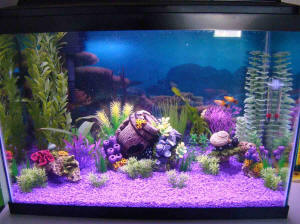
|
|
Re: stocking a 20 gallon community
tank.
10/3/11
Makes sense! I truly appreciate your help. All I do is keep
reading and reading, especially this site because it is legit!
But of course the more I read the more questions I have! The good
news is I am in no rush since my tank is still cycling.
<Good>
I realized the other day that my two platy are rubbing, or
"flashing" the live plant in the tank. I thought out
was funny, but now I think I'm finding that out may not be a
good sign. These fish act completely happy, constantly swimming
together all over the tank and they also like to hang out
together in the one barrel cave. They love to eat and gobble as
much as they can.
The one had a few fry when we first got them home last week, but
they died after a few days. She still looks pregnant. it's
like I can see her ribs and she is kind of see through so I can
see black in there and she also still has a rounded belly. Maybe
she will have more fry in a few weeks even though there are no
males in the tank.
<Happens>
I have been concerned she has been having thin white poo the post
few days, I have read that can mean bad things.
So my plan is over the next few weeks while my tank is still
cycling, is to add a good mixture of RO water when I do water
changes. I want to see if I can get more of a neutral pH and
hardness. I ordered the AP general and carbonate hardness
(GH/KHP) test kit. Once I see where I can keep my water stable
at, then I can see about what fish I can add.
On a completely unrelated subject I had a question about my
filter. It's an Aqueon quite flow 20 for up to 30 gallons. It
came with my tank and hood/light. It says it has four stages, 1.
Dense floss removes particles and debris. 2. Activated carbon
removes toxins, odors, and discoloration. 3.
Patented bio holster removes toxic ammonia and nitrites. 4.
Diffuser grid removes additional toxins while adding oxygen for
more active fish. I know
carbon is useless. Is this filter good to establish good
biological media?
<Is fine>
Is there something I can add to it? Thanks!
<Could add a "starter" bacteria culture like Dr.
Tim's "One and Only">
-Lauren Jerry
<Welcome. BobF>
|
Freshwater Community Stocking 9/4/11
Hello Crew,
<Hello Andrew,>
I must begin by giving you all praise for providing this wonderful and
informative resource. I am not currently a fishkeeper, and yet have
still managed to spend countless hours poring over articles and FAQs
here for quite some time. I am writing today regarding a possible
smallish (20 - 30 gallon) freshwater tank I may be setting up for my
wife's classroom (she teaches preschool). I have several years
experience keeping freshwater tanks, but it has been many years since
my last one and I have realized through research here that I was not as
successful as I believed at the time. While I have this experience, I
am viewing myself now as a beginner and want to learn the proper and
conscientious way to plan systems and also "un-learn" my old
ways.
<I see.>
Which brings me to my current query. As alluded to earlier my wife is a
teacher and looking to add a "class pet." Knowing my interest
in fish-keeping, she has asked me if I could set up a tank in her
classroom.
I have read Neale's great piece on Freshwater Livestock and have
some questions based on my thoughts/ideas after reading it. Should I go
forward with doing this, I would like to choose fish that are both
compatible and hardy. Congo tetras (Phenacogrammus interruptus) are
referenced in Neale's piece as being fish that will tolerate a
broad range of conditions water chemistry-wise, but are omitted from
the list of those recommended for beginners.
<Yes. They are a bit bigger than the average tetra for a start, a
good specimen being something like 8 cm/3 inches in length, and
consequently desirous of rather more space than many beginners have at
their disposal.
Certainly a tank will need to be around the 1.2 m/4 ft length to
satisfy them; they are rather active fish and don't do well in
cramped conditions.
Diamond Tetras (Moenkhausia pittieri) make very good alternative for
smaller tanks. While Diamond Tetras are basically adaptable fish, they
dislike very hard water and can be sensitive immediately after import;
aim for 2-15 degrees dH, pH 6-7.5.>
I must admit that they are amongst the ones I am most interested in
including, but will leave them out if they are believed to be more
suited for experts. Ideally, I was hoping to have a small school
(perhaps six or eight) of the Congos with maybe another small school of
tetras (Neale seems to sincerely recommend the X-ray Tetra, Pristella
maxillaris), Danios or White Cloud Mountain Minnows (Tanichthys
albonubes),
<Do note that WCMMs are subtropical fish and don't do well in
tropical tanks; they're also bullied by larger fish, most
notoriously Danios.>
and also possibly including a small grouping of Corydoras and one
Bristlenose catfish (Ancistrus sp.). Based on my interpretation of
Neale's article, this seems possibly feasible though the biggest
question mark revolves around those Congo tetras. Are they considered
good beginner fish, and if they are to be
included would they work in even a 30 gallon aquarium?
<Can be kept by beginners in large tanks, once the tank is cycled;
but wouldn't recommend in 30 gallons.>
If not, I would certainly consider the X-rays anyway, and/or would love
to include a small school of Cardinal tetras (Paracheirodon axelrodi)
but would like to learn more about their being listed as delicate.
<Actually not delicate; they simply need very warm, very soft water,
and so won't work with Corydoras, Danios, Neons and other species
normally kept at the 22-25 C/72-77 F range. If you want Cardinals,
you're aiming for 2-10 degrees dH, pH 6-7, 26-28 C/79-82 F; kept
thus, they're actually MUCH more reliable than Neons. I'd steer
clear of most Neons, to be honest.>
In all honesty, I feel like a healthy, well-adapted community of Congo
and Cardinal tetras would look great but I do understand if this is
simply not a good idea. Should I simply steer clear of the Cardinals
(and perhaps the Congos as well)?
<Would look at Diamond Tetras before doing anything else.>
I also would like a little clarification regarding water change
frequency.
I have noted Neale's recommendation of a 25-50% water change every
week and this is probably what has me the most concerned. While my
wife's school is not terribly far from our home, the thought of
having to carve out time every weekend to go there and perform a water
change is one I do not relish. My reasons are several, but revolve
mainly around a) my own laziness, b) the fact that football season is
upon us and I would like to have this time free to enjoy a few beers
and watch the games at my discretion, and c) the fact that what has had
me researching as much information as possible here for literally the
last couple years or so is that I hope to someday soon begin venturing
on my own "first-time" marine system(s) here at home and
would like this to become my main "free time" fish-related
focus once/if established. So, what I am asking is how stead-fast is
this weekly water change rule?
<It's a recommendation; best practise, if you will. On occasion,
like school holidays, you can skip water changes for a month or even 6
weeks, provided the tank is lightly stocked and the fish are not fed
too much.
Indeed, for vacations of 7-10 days, it's often best not to feed
small fish at all. Stocking with live plants, especially Indian Fern
(Water Sprite) makes a huge difference; besides removing waste from the
water, Indian Fern is palatable, and fish will nibble on the stuff when
hungry.>
In reading some of the FAQs it appears many perform them much less
frequently, but I have had a difficult time sensing whether or not this
is considered acceptable practice.
<Every tank is different, and to be honest, beginners benefit from
doing more water changes because they're less able to detect when
things are going wrong. By doing weekly or every-other-weekly water
changes, beginners will remove nitrate and dilute acids (tannins, etc.)
before these affect the quality of the water in the aquarium. Call it
preemptive maintenance, if you will. Experienced fishkeepers may feed
their fish less food, and under stock their tanks, and install bigger,
better filters, and manage water chemistry more aggressively, all of
which means that their tanks can tolerate "neglect" for
longer periods. Also, experienced aquarists can do 50 or 75% water
changes once a month, but keep the water chemistry and temperature the
same as the old water, so the fish aren't stressed. If a beginner
tried that, there's a good chance pH and hardness and temperature
would flail about wildly! But when all is said and done, weekly water
changes are definitely the aim, and a tank that receives weekly water
changes through most of the year will be better than one that
doesn't. Of course the great thing with fish is that you can leave
the tank for weeks if needs be, and provided the tank is sensible
stocked and adequately filtered, a few weeks of no water changes will
do no serious harm.>
Any specific guidance here would be greatly appreciated, and again,
thank you all so much for everything you do. With regard to my own
marine aspirations, I have to say that I have learned so much and am so
appreciative to have this reference available - it has both given me
great confidence to continue pursuing my dreams and also taught me that
the more I learn in advance of starting, the better off I will be in
the long run.
Sincerely,
Andy
<Hope this helps. Cheers, Neale.>
Question on freshwater tank. FW Comm.
stkg. 7/10/11
Namaste,
hope you doing good.
<Not bad. How 'bout you?>
first of all thanks a lot. I have learned so much about marine
aquariums from your site, which helped me maintain it effectively.
<Cool.>
So now, I have set up a new 86 gallon freshwater tank.
its up and running, done with the 36 day cycle.
<Good.>
I had planted few plants in the tank, and also kept 10 red-eye tetras
(after the 36 day cycle).
<Moenkhausia sanctaefilomenae; an excellent species, very hardy, but
sometimes nippy. Choose tankmates with care.>
I wanted to know if I can add the following fish to
it;
- Cardinal Tetras
<Possibly, but these need warm, soft, acidic water; 25-28 C, 2-10
degrees dH, pH 6-7.5.>
- Neon Tetras
<Not with Cardinals; they need cooler water; 22-24 C, 2-15 degrees
dH, pH 6-7.5.>
- Angel fish
<Will eat Neons; will likely be nipped by the Red-Eye
Tetras.>
- Rummy nose tetras.
<An excellent species but delicate; need similar conditions to
Cardinals.>
Also, before adding the red eyes I also had 12-15 red shrimps to the
planted tank. They suddenly started disappearing after the re-eye came
in.!
<Probably hiding, but I suppose the tetras might eat the small
males.>
Filtration: Eheim classic canister.
--
Thanks,
Varun Vaid.
<Cheers, Neale.>
Community Tank, stkg. /Neale
6/9/11
Hello! My name is Jess and I just had some quick questions for you. I
just recently bought a 29 gallon tank and would love to have a very
diverse community tank. I would like to incorporate Rosy Barbs,
<These get big and will sometimes nip at other fish. They're
also subtropical fish; aim for 18 C, slightly warmer in summer if you
wish.>
Neon Tetras,
<Need coolish water, 22-24 C.>
Rummy Nose Tetras,
<Need warmer water than the Neons.>
Mollies,
<Need hard, alkaline water, ideally with a bit of salt
added.>
Platys and Danios.
<Both these need coolish water, like the Neons, and the Platies also
need hard water, so won't do well in tanks where Neons and
Rummynose Tetras will do well.>
All of the sites that I have read say that the Tetras and Danios need
to be in schools of at least 6.
<Correct.>
Is there any way that I can incorporate all of these fish comfortably
or do I have to cut some out?
<Your community won't work for all sorts of reasons, as outlined
above.
Choose one schooling species with water temperature and chemistry
requirements that match what you will provide in your tank. I'd
recommend Platies for a low-end tropical tank with hard water, or
Danios for a low-end tropical tank with soft to moderately hard water.
I'd skip Neons because they're quite delicate, and if you
happen to have soft, acidic water, recommend instead Cardinals for a
high-end tropical (26-28 C) tank because Cardinals tend to be hardier,
at least, if kept properly. Mollies are too easily killed by ignorance;
they need very, VERY specific things to do well. Both Mollies and
Platies can be aggressive, so you need at least two females per male,
and keep either a single male or at least three -- two males never
settle down and end up chasing each other all the time.
Whatever species you choose, get a big group of one species. Trust me
on this -- you'll have a much more impressive "look" when
12 schooling fish are swimming neatly together.>
Also is it worth it for me to get a Pleco? I heard that they get
large?
<Yes, 45 cm/18 inches. Instead, look at Nerite snails for algae
control, or failing that, a Bristlenose Catfish, Ancistrus sp.>
Any feedback would be much appreciated, thank you for your time!
<Do read: http://www.wetwebmedia.com/FWSubWebIndex/fwlivestk.htm
Cheers, Neale.>
Community Tank /RMF 6/9/11
Hello! My name is Jess and I just had some quick questions for you. I
just recently bought a 29 gallon tank and would love to have a very
diverse community tank. I would like to incorporate Rosy Barbs, Neon
Tetras,
<Mmm, not compatible... need different water quality and the barbs
are too aggressive for the tetras... My suggestion is to make a list of
all these species, look on the Net, books re their requirements in
terms of environment and compatibility... THEN see which can go w/
which>
Rummy Nose Tetras, Mollies,
<Not compatible w/ tetras either>
Platys and Danios. All of the sites that I have read say that the
Tetras and Danios need to be in schools of at least 6.
<This is so>
Is there any way that I can incorporate all of these fish comfortably
or do I have to cut some out?
<You do>
Also is it worth it for me to get a Pleco?
<Not this genus, but there are other Loricariids, e.g. the genus
Ancistrus, of use>
I heard that they get large? Any feedback would be much appreciated,
thank you for your time!
<Please learn to/use the search tool/indices on WWM... For this
last, read
here: http://wetwebmedia.com/FWSubWebIndex/loricariids.htm
and the linked files above. Bob Fenner>
Can a community tank include Black Ghost Knife & Clown
Loaches? 5/5/11
Hi team,
<Jodie>
Today sadly I had to euthanise my large Oranda Wolfgang, I'd had
him since he was a tiny baby, I'm not sure what happened to him,
his Wen grew so big it covered his eyes but he was still happy, he was
always a little top-heavy
A couple of months ago he just started lying on his side & not
moving much, I thought (seeing all the water parameters were fine) that
it was just because he couldn't see & was unsure of what to do,
he'd still right himself to eat & swim around the bottom. The
past week he's been really bad, barely moving except for dinner
& he was starting to get thin & get pressure sores on his sides
from lying down, so sadly, the time came, he's now buried under the
hibiscus with Yolky his longtime Ranchu friend
What I was wondering now was, I have a 4' x 2' x 2' tank
that's just got a peppermint Bristlenose in it & so I was
wondering what to put in the tank.
<Many possibilities>
When I first got into fish keeping about 25 years ago my Mum bought me
a Black Ghost Knife fish, he was only tiny when she got him & over
the 8 years that I had him, he grew to over a foot in length. Poor Moo
though taught me the valuable lesson of having a back-up heater in the
tank as one day in winter he started fitting & it turned out that
the tank was cold as the heater had blown up. It was such a loss to
fish-kind.
We then went onto the community type tank with clown loaches, Corys,
glass cats, various large tetras & a butterfly fish.
I do like the clown loaches, they've got a lot of personality &
I would dearly love to have another black ghost knife. Would they
co-exist?
<Mmm, can, yes>
I was thinking 1 black ghost knife & maybe 6 clown loaches, maybe
some sort of Corys, the glass cats & what about Congo tetras?
<These two would add colour, motion to the mid-water area>
I know that I can't have small fish in with the ghost knife (Moo
ate Mum's beautiful guppies when they had to move into his tank for
awhile) & I vaguely remember that you can't have Plecos with
knife fish but would those others mentioned be ok?
<Yes. Do see/read on WWM re the water quality, nutritional needs of
all you list here>
Also, what about salt in the water?
<Not a good idea generally. Read here:
http://wetwebmedia.com/FWSubWebIndex/SaltUseFWArtNeale.htm
I always used to put some conditioning salts in with Wolfgang &
Yolky, it was a mix of pool salt, Epsom salts, bicarb & Melafix as
well as Prime & Stability.
<Shortened their life times>
It's been awhile since I've had tropical fish as after I lost
Moo I went into marine fish for about a decade but then swapped to the
Orandas 'cause I thought that they would be easier to look after
(give me back my marine tanks any day!)
Sorry about the long winded waffle but I really wasn't sure & I
would like to start off on the right foot again.
Also, in terms of cleaning the tank out, it's warm anyway as
Wolfgang liked it a little warmer, should I do a full water change or
just a % & clean out the filter? It should be good bacteria wise as
it's been running for years.
<I would change out most all, vacuuming the gravel>
Thanks in advance for any advice & thanks also for reading.
Cheers,
Jodie
<And you, Bob Fenner>
help choosing fish for a 55 gallon community
4/20/11
Greetings crew!
<Hello,>
Thanks for answering my filter questions so quickly. You have brought
up some questions about the fish I was hoping to stock in my up coming
55 gallon tank this summer. Since it's likely I
will not get the same person responding I will recap what I was
planning to stock and the WWM response. The issues was mainly
temperature compatibility. So I did some research on recommended
temperatures for all the fish I was interested in to try and find a
good temperature goal. One problem I'm having is it seems that
everyone has different recommendations, so how do I know what actual
temperatures is best when everyone says something different!?! I think
it may be important for you to know as well that I've managed to
find a supplier with all of the fishes im interested in and all the
fish are tank bred in there facility in the US, im not sure if this
effects anything .
<Doesn't affect much, no; in a few cases, e.g., Angels and
Discus, farmed specimens are hardier and generally better bets than
wild caught. But most fish are either not changed much by farming, or
else noticeably weaker or less colourful than the wild specimens.
Guppies and Neons are the two classic examples of the latter
situation.>
I do not buy wild caught fish or fish from massive farms. I will just
list the fish in order of lowest to highest recommended temperatures I
found online
<Online sources vary wildly in quality.>
and in books, comments, and we can go from there. I have plenty of time
before my new tank is set-up so I'm taking the time to really learn
about the fish I want before I actually get them so they have a good
healthy home. so here goes'¦.
* = WWM crew advice
fish stock-
Fish Recommended Temp in Fahrenheit
neon Tetra 68-80 *need cooler water compared to rest*
adolfoi Cory 72-79 *need cooler water like the Neons*
Corydoras pygmaeus 72-79 *need cooler water like the Neons*
gardneri killifish 73-79 *middling temperature potentially viable in
bigger tank*
Apistogramma borellii 73-79 *need cooler water like Neons and
cories*
pearl Gourami 74-82 *not compatible with chocolates*
Apisto cacatuoides 75-83 *fairly adaptable and better choice with
pearls*
Samurai Gourami 79-83 *not compatible with pearls or suitable for
community tanks- needs high temp*
chocolate Gourami 80-85 *not compatible with pearls or suitable for
community tanks- needs high temp*
<Indeed.>
If the recommended temps I found and listed seem correct to you, and I
gathered these from numerous sights and books not just one source, they
indicate that with a tank temp of 77-78 they all seem to be mostly
compatible temperature wise with a few exceptions?
<To a degree, yes, 25 C/77 F is a good baseline for a general
community. But for Neons, for example, that's the top end of their
tolerance, rather than their preference. Aim for the middle value in
their temperature range and you can't really go wrong. Choose fish
that share similar requirements. It's really not that hard.>
The exceptions being Neons being on the lower spectrum and samurai and
chocolates being on the higher spectrum. The only information I found
about chocolates and pearl Gourami compatibility is that chocolates do
best in a species tank or kept with other small peaceful fishes and
that pearls should be kept with peaceful fishes, which both are. In a
previous tank I owned I had the two together without any issues.
I'm not trying to correct you, you have way more experience than I,
it was probably just those individual fish were ok together because
they grew up together from juveniles and not the norm of there species
.
<Could well be the case. But as general, 100% reliable advice --
which as you can understand is what I need to share on a site like WWM
-- Chocolate Gouramis are best kept in their own single-species tank or
with very peaceful dither fish such as Marble Hatchetfish.>
The two swam around freely not paying much attention to each other,
they never fought at all, or even competed for food. However, I had
them in a tank with German rams at 84 degrees and that's not my
ideal temp for my next tank it appears.
<Indeed, and the fact is that German Rams seem to rarely live long
in most community tanks anyway, and are hardly worth
recommending.>
Now don't get me wrong I am not passing off your advice and I
greatly appreciate your help in building up a great community tank!
I'm simply just trying to gather more research, advice, and trying
to understand my future fishes more to make the right decisions!
<Do spend some time at sites like SeriouslyFish.com,
PlanetCatfish.com and of course Fishbase to understand the specific
requirements of freshwater fish. Plus, you really should own a copy of
Baensch's Aquarium Atlas -- there's really nothing online that
matches the *reliability* of a good book like that.>
If the recommended temps I have listed are ok by you it does indicate
the Neons, chocolates, and samurai are too outside the comfort zone
that it seems my tank will be. I have crossed them off my possible
list. But the rest of the fish, 77-78 degrees almost seems ideal?
<25 C/77 F rather than anything higher, and with the understanding
that some of your fish may be heat-stressed.>
Now that I've crossed some fish off my list I had a few others I
wouldn't mind some input on and how good they would be as possible
candidates.
Cardinal tetra 78-82 temperature requirements im finding seem to
indicate they prefer higher temps than Neons and a good substitute for
them?
<Yes, an excellent alternative, assuming you don't have hard
water; anything above 10 degrees dH doesn't seem to work
well.>
Ctenopoma acutirostre (leopard fish) 73-82 I don't know much about
this fish but they look rather neat. But it says they get up to 5"
and im not sure if there a good match
<Predatory anyway, and will eat small fish like Neons; but extremely
peaceful otherwise.>
licorice Gourami 74-82g I don't know much about this Gourami. they
look a lot like sparkling Gourami. I've owned those before and were
pretty peaceful..
<Liquorice Gouramis are quite delicate fish, and generally kept in
species tanks rather than communities.>
female beta I know the males are not compatible with well anything
really but females seem peaceful but im unsure towards other
Gourami
<Female Bettas shouldn't be bothered by Pearl Gouramis in a big
aquarium, provided there are plenty of floating plants for the Bettas
to skulk about in.>
Kuhlii loach there really fascinating but there also really small and I
think would get eaten'¦.
<Fine fish in many ways, but you won't see them much, if at all.
Would recommend other loaches in preference, e.g., if the water
isn't too warm, the excellent Cherry-Fin Loach.>
Is there any fish the crew recommends in a soft water tank 77-78 degree
range that I have not considered that might make good candidates?
<Many, many options. Do consider such fish as Cherry Barbs, Bleeding
Heart Tetras, Lemon Tetras, Emperor Tetras, Blue Emperor Tetras, Golden
Pencilfish, Golden Wonder Killifish and Bolivian Ram Cichlid. All of
these are robust, peaceful and colourful. If you don't mind a bit
of a challenge, Ctenopoma ansorgei is a beautiful fish if a bit shy,
and the same holds true for Badis badis, which can be tricky to feed.
Dwarf Upside-down Catfish are very fun fish in schools of three or
more.>
Thanks,
Mike
<Cheers, Neale.>
15 Gallon Stocking question 1/18/11
Is it overstocked?
It has 2 Fluval 2 plus internal filters at opposite sides of the tank.
My heater is set at 71 degrees.
Stocking List:
2 neon tetras
1 golden barb
<Social animals>
1 black skirt tetra
<Can be/come nippy>
4 black neon tetras
3 cherry barbs
3 platys
2 Otos
I know most of my fish are schooling fish but none seem overly
stressed.
The 2 neon tetras seem really close and often school with the 4 black
neon tetras. The black skirt seems to like schooling with the platys
but also does with the other tetras. My cherry barbs (2 female 1 male)
all chase each other and the golden barb hangs with them loosely. All
in all I think it looks like a cool habitat. My tank is 1 year old. The
platys, 1 neon tetra, 4 black tetras, and all 3 cherry barbs have been
there since I started it. I added the rest this weekend and there are
no real aggression issues. I may add one rosy minnow
<Mmm, I would not... too boisterous, odd-large-size for this
setting, other tankmates>
just because I love the look of goldfish but know they are bad to have
in the tank with small tropicals. This way I get the goldfish look
without the bad effects. For the most part they all stick together the
tetra's in one group, the cherry barbs in another group, and they
platys and the golden barb in the last group. All seem to be fine in
their groups. I do have a 35 gallon that is cycling now. Here is a list
fish I would have: Black neon tetras, cherry barbs, golden barbs, black
skirt tetras, neon tetras, platys, Otos, Pleco,
<... what/which species?>
and rosy minnows. What numbers of the fish above could I add to fill
the 35 gallon?
<See WWM re these species>
Thanks!
<Welcome. Bob Fenner>
Can you please look at the my stocking list in my15 and 20 gallon
community tanks? 1/20/11
I bought a 20 gallon to go along with my 15 gallon. I am only adding
one new species to this mix. Can you tell me what you think about these
tanks.
<Sure!>
Here is a list of the fish species I want to have in whatever numbers
are best between the 15 and 20 gallon. Neon tetra, black neon tetra,
black skirt tetra, cherry barb, gold barb, rosy minnow, Oto, platy
Here is what I came up with
15 Gallon (already established and ready to go):
6 neon tetras
3 Cherry barbs (1 male, 2 female)
3 rosy minnows (I've read they can survive up to 85 degrees. My
tanks are set at 76)
<Survive yes, do well, no. They're really coldwater fish. With
that said, Neons and Otocinclus are best kept between 22-24 C/72-75 F,
and Rosy Red Minnows should be okay kept thus. Cherry Barbs will also
do well at this temperature range.>
2 Otos (to help with algae on the rocks)
<Don't bank on it. Most Otocinclus die from starvation within a
few months of purchase. Review the needs of Otocinclus carefully; if
all you want is something to eat a bit of algae, then 3-4 Nerite snails
or a single Ancistrus catfish will work a hundred times better.>
20 gallon (will add objects and filter from my turtle and 15 gallon to
speed cycling):
4 black Neons tetras
<At least 6, otherwise they won't school and won't live
long.>
4 black skirt tetras
<Nippy, I tend to avoid, especially in small tanks. Try the X-ray
tetra instead, Pristella maxillaris, in a group of 6.>
3 gold barbs
<Again, need at least 6 otherwise they'll be unhappy, and in
this case,
will be nippy as well.>
2 platys
2 Otos
<Do review the temperature requirements of your fish. Platies, Gold
Barbs and to a certain extent Otocinclus do better (i.e., don't
randomly get sick) kept quite cool, 22-24 C. By contrast Black Widow
Tetras and Black Neons need more middling water temperatures, around 25
C/77 F being optimal. Furthermore, Platies need hard, basic water, and
Black Neons in particular, and to a lesser degree regular Neons,
won't live long in hard water. Test your water chemistry, and
establish at minimum whether it's "hard" or
"soft". Moderately hard water, around 10 degrees dH, should
be okay for both types of fish. But water that's harder or softer
than that is best taken on its own merits. If you have hard water,
choose hard water fish; if you have soft water, choose soft water
fish.>
Thanks for the help!
<Cheers, Neale.>
Re: Adding fish to my aquarium, FW
1/21/11
Thank you very much, your site is always helpful.
Tina
<Welcome! BobF>
Stocking in my redone 15 and brand new 20 gallon community
aquariums 1/21/11
I just finished the tanks. The 15 gallon was already established
(running with community fish for over 3 years) with 2 filters. I took a
filter, many large ornaments, 50% of the water (to help the fish I was
moving from the 15 to the 20) and put it into the new 20 gallon to help
give the bacteria a kick start.
<Good>
How does these stocking lists sound? When I say old next to the fish
that means it was in the 15 gallon for 3 years. The new fish have been
purchased starting 3 days ago up till today.
15 Gallon:
6 neon tetras (5 new 1 old and twice as large, school closely almost
constantly)
3 cherry barbs (1 male 2 female, all old, school loosely)
2 Otos (new, hangout together almost constantly, adding one more so
there will be 3 if that's alright. One died before arriving
home)
2 platys (1 old male 1 new female) (the male is stunted and doesn't
try to breed with the female platy. He tries with the Neons...)
20 Gallon:
6 black neon tetras (2 new, 4 very old...over 6 years!, schooling very
loosely)
2 gold barbs (new, school really closely)
2 black skirt tetras (new, nippy but only with each other)
1 bristle nose Pleco (new)
You guys have been so helpful!
<I do think these mixes will work... some ranges of the fish species
don't overlap much in the way of water conditions, but keeping pH,
hardness and temperature "about mid-range" should do. Bob
Fenner>
Another community tank stocking
question 1/22/11
I do not want to stress my fish. Here is a list of the fish I have. Can
you guys tell me what fish you would have in what tank? One is 15
gallon and the other is a 20 gallon long. Would it be better to put all
the tetras I have in the 15 and put the barbs and platys I have in the
20? I truly appreciate your input. I can up fish in numbers but I can
not return them to the pet store. I can not return any live animals so
that isn't an
option. I'm trying my best with my limited resources. What fish
would you have in each tank? I can split them up in what ever is best.
The list is below:
2 platys
<Nice fish, just don't keep too warm. Females are best if you
just want two: a male/female pair will end up the male getting
aggressive towards the female, and two males will simply fight. Will do
fine in 15+ gallons.>
3 cherry barbs
<Not especially social, though the females are gregarious. Males
have small "territories" of a sort, so these fish are quite
fun to watch. 15 gallons adequate, but more would be nicer if you want
a group big enough to watch the males spar.>
4 Otos
<Difficult to feed in the long term, so be careful. As an
"easy" algae eater, Ancistrus spp. are much better, and a
single specimen needs about a square foot of space including a
cave.>
6 neon tetras
<Quality is very poor these days; I rend to recommend against, if
you have the choice; does fine in 15 gallons.>
6 black neon tetras
<Can be quite hardy once settled. Okay in 15 gallons.>
2 black skirt tetras
<Not my favourite fish at all.>
1 bristle nose Pleco
<Ancistrus; will compete with Otocinclus, so don't keep together
or the Otocinclus will starve.>
2 gold barbs
<Need quite cool conditions and can get quite big, so 20 gallons
better.
Cheers, Neale.>
Re: Another community tank stocking question
1/22/11
which fish would you put with what?
<Depends on what you have and what you want. If all fish are of
similar size, I find keeping one surface fish for every two midwater
fish and one bottom dweller results in a nice, busy but not cluttered
community tank.>
I also have a 35 gallon with one 1/2 inch Firemouth. I'm thinking I
could put the black skirts in there.
<Wouldn't be my recommendation. But if your Black Widow Tetras
aren't nippy, you might be fine. On the other hand, there's
nothing that ruins a cichlid faster than having its fins nipped to
nothing!>
Here is what I did. I just finished the tanks. A few changes. How does
this sound?
15 Gallon:
6 neon tetras
3 cherry barbs (1 male 2 female)
2 Otos
2 platys (1 male 1 female) (the male is stunted and doesn't try to
breed with the female platy. He tries with the Neons'¦)
<Should work; don't keep too warm though, 22-24 C is
fine.>
20 Gallon:
6 black neon tetras
2 gold barbs
2 black skirt tetras
1 bristle nose Pleco
<Should be fine for now, but the Barbs and Black Widows are nippy
sometimes if kept in insufficient numbers.>
35 Gallon
1 half inch Firemouth cichlid2 (can up the number) black skirt
tetras
<Swordtails or Platies make much more sense, given the water
chemistry requirements of the Firemouth. Cheers, Neale.>
Re: Another community tank stocking question
1/22/11
I can put my 2 platys with the Firemouth.
<Fine.>
That would leave the 15 gallon with 2 Otos, 6 Neons, and 3 cherry
barbs.
Could I put the platys and the 2 black skirts with the Firemouth and
then increase the number of gold barbs in the 20 gallon to 3 or 4
instead of 2?
<Both the tetra and the barb species are only reliable in groups of
six. I don't recommend either for tanks as small as 20 gallons,
partly because of their need for companions of their own kind, and
partly because of their final adult size. Cheers, Neale.>
Re: Another community tank stocking question
1/22/11
I took the 2 platys out of the 15 gallon (as I just told you) and the 2
black skirt tetras out of the 20 gallon. They are all in the 35 gallon
with the 1/2 inch Firemouth.
Here is the current stocking:
15 gallon:
6 Neons
3 cherry barbs (1 male 2 female) all over 3 years old
2 Otos (2 died :( )
Long 20 Gallon:
6 black neons2 gold barbs1 bristle nose Pleco
35 gallon:
1 half inch firemouth2 platys2 black skirt tetra
Now the tanks all seem a little empty which I now know is good! Would
you up the numbers of cherry barbs,
<Not critical.>
gold barbs,
<Worth doing.>
black skirts,
<Also worth doing.>
and or platys?
<Wouldn't keep more than one male in 15 gallons, but you could
easily keep 4-5 females alongside him. Cheers, Neale.>
Re: Another community tank stocking question
1/23/11
The platys are in the 35 with the black skirt and Firemouth. Are my
tanks understocked?
<Once mature an adult Firemouth could be safely kept with 6-8
Platies and 6-8 (non-nippy) Black Widows in a tank this size without
any problems, assuming good water quality and the right water
chemistry. There should be space for a Bristlenose catfish too. Provide
some suitable hiding places
for the catfish and especially the cichlid, so that it doesn't feel
threatened and is also able to hide away if the Black Widows become too
boisterous. Cheers, Neale.>
re: Another community tank stocking question
Would it be better to switch the platys from the 35 gallon to the 20
and
move the gold barbs to the 35. So it would be
20:
6 black neon
2 platys (possibly a few more)
1 Bristlenose Pleco
<These could easily fit in 20 gallons.>
35 gallon:
6 black skirt tetras
4-6 gold barbs
<See previous e-mail.>
1 Bristlenose Pleco (maybe 1 hifin Pleco instead)
<Pterygoplichthys species require at least 55 gallons, and
realistically
75+ gallons unless you want a murky, faeces-ridden aquarium. Cheers,
Neale.>
re: Another community tank stocking question
No Hifin Pleco. I don't see your previous email on the 4-6 barbs in
the 35
gallon tank.
<As stated, the Firemouth, 6 barbs and 6 tetras should be fine in 35
gal.>
Few questions.
15 gallon: 6 neon tetra
3 cherry barb (how many more could I add)
<A couple more if you want.>
2 Oto
<Better in groups. A pretty flimsy species really, and I'd
encourage you to
read up on their needs, e.g., on Planet Catfish.>
20 Gallon:
6 black neon tetras
2 platys (how many more of these can I add)
<3-4 females, easily.>
1 bristle nose Pleco
35 gallon:
2 black skirt tetras (will add 4-6 more eventually)
2 gold barbs (how many more can I add? I didn't see your other
message.)
<Would keep at least 6.>
1/2 inch Firemouth
1 bristle nose Pleco
Maybe a few snails.
<Cheers, Neale.>
re: Another community tank stocking question
I am actually deciding to skip the rosy minnows as I have no
quarantine
tank. I will move the 6 cherry barbs from the 15 to the 35 gallon and
add 6
Glowlight tetras to replace them in the 15. Here us what I hope is
the
final version of my tanks!
Here is the current (and hopefully final) stocking list:
15 gallon:
6 Neon Tetras
6 Glowlight tetras (Don't have these yet but I plan on getting them
soon)
2 Otos (Used to be 4 but 2 died. I'm not replacing them)
<All fine, but as I've stated repeatedly, Otocinclus aren't
easy to keep
and I don't recommend them.>
Long 20 Gallon:
6 black Neons (1 died so I will replace that guy soon)
6 Platys (only have 2 right now but will get 4 more soon)
1 bristle nose Pleco
<Should be fine too.>
35 gallon:
1 half inch Firemouth
6 Gold Barbs (Only have 2 right now. Will get 4 more soon)
6 black skirt tetra (Only have 2 right now. Will get 4 more soon)
6 Cherry Barbs (3 male 3 female) (I only have 3 right now but will get
3 more soon)
1 Bristle nose Pleco
<Cherry Barbs might be a bit small to feel totally happy here, but
if the tank has lots of plants around the edges they should be okay.
Firemouths obviously need sand to dig in -- not gravel! -- but they
don't normally uproot sturdy plants. Vallisneria, Amazon swords,
Java ferns, Anubias, Cryptocoryne wendtii, etc should all do fine. Do
remember that Firemouths have specific water chemistry requirements.
Cheers, Neale. >
New tank setup 8/6/10
Hello,
<Hello,>
I'm planning on setting up a new 75 gallon freshwater
tank. I would like to stock it with Apistogramma cacatuoides,
Chromaphyosemion bitaeniatum 'Lagos', Pseudomugil connieae or
furcatus, and some Glofish. I think the Apistogramma will do fine on
the bottom, but I'm wondering if the rest will be over crowded at
the top as they all inhabit the upper level of the aquarium.
<Indeed. Don't add the Danios. Very, VERY bad idea.>
Can you let me know if these species are compatible with one another
and have similar enough water condition requirements?
<The Apistogramma and the Pseudomugil should get along fine, but in
75 gallons you'd need a lot of both of them to have some impact.
I'd think 2-3 harems of the Apistogramma, plus 30 Pseudomugil would
be about right. The Chromaphyosemion are difficult to keep in community
tanks. They're very shy, and though they do have bright colours, I
can't help but feel they'd vanish in this system. They need
lots of shade and dark, dark substrate to colour up. On the other hand,
if you kept enough of them, sure, they'd work nicely. But you would
have a huge chunk of empty space between the Apistogramma at the bottom
and the killifish and atherines at the top. So rather than Danios,
which need cooler, faster-moving water than any of these other fish,
I'd be thinking about some sort of midwater fish. Perhaps Emperor
Tetras? Gymnochanda filamentosa? Puntius pentazona? Dianema
urostriatum? Something along these lines anyway. Colourful, midwater
swimming, and unlikely to bully either the killifish or the
cichlids.>
Also, ideal populations for each species? My tank currently holds a
9' common Pleco. I'm not sure if I should give away the Pleco
or keep him.
<Well, he'd be harmless enough, but I suspect destructive in a
tank densely planted with vegetation. I'd be after a group of some
kind of Ancistrus instead, something that would breed as well as eat
algae. If you're deep of pocket, Zebra Plecs would work well,
too.>
I'm thinking he may be too destructive in the tank and the
Apistogramma may attack him.
<Yes, he will plough through plants, particularly the feathery ones
that look nicest with tiny fish. On the other hand, the Apistogramma
would have no chance of hurting him.>
Any thoughts? Finally, what type of plants should I add to make
everyone comfortable? I currently only have one 4' fluorescent
light for the tank.
<I'd start with Indian Fern and Amazon Frogbit at the top, and
then thicken out the lower levels with Anubias and Java fern. A single
fluorescent strip isn't much light, and I suspect anything more
demanding will require an upgrade there, especially on a tank this
deep.>
Thanks, Vincent
<Cheers, Neale.>
Re: New tank setup 8/7/10
Why are the Danios such a bad idea? Is it the water conditions they
require?
<Because they're far too boisterous and aggressive. They will
terrorise the killifish, steal their food, and very likely shred their
fins. In every respect, a terrible idea. Plus, the Glofish variety you
want has completely artificial colours. Putting aside the debatable
ethics of transgenic fish for a moment, in terms of sheer practicality,
you'll be placing ridiculously vibrant colours against the more
subtle, natural colours of the killifish; net result: the killifish
will look boring. If you want Disneyland-bright cartoon colours, then
keep your Glofish with some Goldfish in an subtropical aquarium with
bright plastic ornaments. Such a tank will have no pretence of being
subtle, and the Glofish will blend in with all the other vivid colours.
But if you want subtle, natural colours that look beautiful, then you
keep your killifish in a tank with diffuse lighting, floating and stem
plants, a dark substrate, and peaceful, subdued companions. In other
words, keeping Glofish in a tank with subtle, delicately coloured
killifish and atherines is the fishkeeping equivalent of sticking a
garden gnome in a Japanese garden -- it'll stick out like a sore
thumb.>
Not that deep [to afford Zebra Plecs], I'm afraid, but Zebras are
top on my list (once the kids graduate from college)
<OK.>
I really appreciate your feedback, thanks!
<You're welcome. Cheers, Neale.>
Tank stocking question, FW, 20 gal., comm. --
03/24/10
Dear crew,
<Laura>
Thanks for providing such a resource! When my husband was 10 years old,
his father gifted him with a little 10 gallon tank, but never got
around to setting it up and putting fish in it. My husband never forgot
about it though, and we recently realized his childhood aspiration by
purchasing a 20 gallon tank a couple of months ago. It is ridiculous
how excited we are about this tank! We've been careful and
haven't had a single loss, but as we add more fish it is clear that
we know just enough to be dangerous (and the kids working at our LFS
seem only slightly more advanced - we've already received a fair
bit of suspect advice).
<Happens... hence the need/advice to search for answers elsewhere in
addition>
We've compiled a motley crew of fish and I'm realizing now that
they're probably not all compatible. We're at a point where we
really need to choose a "direction" for this tank and return
any mistakenly purchased fish while they're still healthy. Our set
up is a 20G tank with a filter, heater, and hood with a built-in light.
We have cycled and I've had the water tested at the shop several
times (no ammonia, no nitrites, low nitrates, ph of 7 to 7.2 and temp
hovers at 76 to 78 degrees).
Now - here are the fish we have:
1 Swordtail (male)
<Mmm, if you keep, you'll want a couple of females to go
with>
3 Neon Tetras
3 Fancy Guppies (I asked for 3 males but after doing some research
I'm convinced one is female - and I suspect she's pregnant. I
know this ratio isn't a good one).
2 dwarf frogs
1 Bushy-nosed Pleco
2 Tiger Hillstream Loaches ( New purchase - may have been a bad
move)
All I really want is hardy fish that can coexist. I would prefer that
they be colorful, which is why I was attracted to the live bearers, but
I don't want to deal with lots of fry. I was told that keeping an
all-male tank of livebearers like swords and guppies was possible, but
now I'm concerned that they would pick on/kill each other. Maybe
moving in the direction of tetras would be better?
<Or possibly another "direction"...>
I know I jumped uneducated into this - I guess this situation can be
boiled down to two questions: 1) which fish should I return,
considering my skill level, tank size, water temp, etc?
<You could keep all you have now...>
And following up on that: 2) Can you recommend some type(s) of hardy,
colorful fish that can coexist with the remainder of the fish I already
have?
<Smaller species of Danios, Rasboras... perhaps some small group of
Corydoras catfish>
Can we keep an all-male tank of swordtails, platys, and/or guppies or
is that asking for trouble?
<Not the sword... it may well become too aggressive here>
Thank you all SO much for the important work you do to patiently
enlighten and help folks like us. My fish thank you also!
Laura
<Welcome. Might I suggest you read Neale's work re stocking
small volumes:
http://wetwebmedia.com/ca/volume_5/volume_5_3/stocking.htm
and the linked files at bottom.
Bob Fenner>
Starting off a new tank, FW... stkg. --
11/12/09
Hello,
<Hello,>
I'm brand new at this and I just want to make sure I'm doing
everything right. I have a ten Gallon tank with a filter and I'm
getting a heater today or tomorrow. I have gravel in it and some
plants. I also have two river rocks I made into a hide away. I still
need to get a gravel vacuum and I need to test the water.
<All this is good. But don't forget, you need a source of
ammonia. Running the tank just by itself won't do anything other
than get the gravel wet!
One approach is to add pinches of flake food every couple days. Do that
for three weeks, and the filter will be well on the way to being
matured, and you can add some hardy fish and fully expect them to
thrive. Over the succeeding weeks, check the nitrite, and it it's
zero, add more fish.>
The fish I'm planning on getting are six pygmy Hatchetfish, five
(male) Endler's livebearers, and four Venezuelan pygmy Corys (or a
Cory of that sort)
<Carnegiella spp. Hatchetfish are lovely, but they are extremely
delicate. Only add them once the tank is stable and you're happy
water quality stays consistently good. Corydoras hastatus, C. habrosus,
and C. pygmaeus are all good choices for 10 gallon tanks, but keep in
groups of 6 or more. Like all Corydoras, these small species are
gregarious, but they're also super-nervous, and will only "do
their thing" if they're feeling happy.
Endler's are good choices for small tanks, but males are aggressive
towards each other, and don't forget they need hard water
conditions, which Corydoras aren't wild about, and Carnegiella
certainly don't enjoy. I'd swap these guppies for something
more suited to Carnegiella and Corydoras, perhaps a Dwarf Rasbora
(Boraras spp.) or one of the smaller tetras species like Neons
(Cardinals are an option too, but they prefer warmer water to
Corydoras). Do read here:
http://www.wetwebmedia.com/ca/volume_5/volume_5_3/stocking.htm
>
I was informed on another site that these fish were compatible with
each other and the amount should be fine for a ten gallon.
<Yes, but with certain issues as mentioned above.>
I just wanted to double check with someone else about this.
<Cool.>
Thank you for your time!
-Danielle
<Cheers, Neale.>
Adding light, plants, and kubotai loaches to stable 55gal
freshwater community 11/2/2009
Dear WWM crew, I love your site and the information you provide. I want
to be a conscientious aquarium owner!
<Great!>
Two months ago I adopted my first aquarium--a stable 55 gallon
freshwater community aquarium established for about 4 years--from a
friend who lost his job and had to walk away from his mortgage. I
already raise 1 husband, 2 dogs, 80 orchids and hundreds of succulents.
I wanted to help my friend (and his creatures), so I welcomed this new
addition to our family.
It's going great so far. The tank is clean, the fish look happy. I
love them!
<Cool.>
I made one impulsive addition to the community (1 *Botia kubotai *and
then 3 more when I learned they like to shoal in groups), and my
question is whether this stock is sustainable for now.
<Botia kubotai is reasonably good in community tanks, but like all
Botiine loaches, it tends to be on the boisterous side. By no means the
worst in this regard, but still, mixing with nervous or slow-moving
fish might have risks. Furthermore, since it's a stream-dwelling
fish, you need a very strong water current and plenty of oxygen.
I'd be aiming for a turnover rate of at least 6 and preferably 8
times the volume of the tank in turnover per hour. So for a 55 gallon
tank, your filters should total up to 330 - 440 gallons/hour. Turnover
rates will be quoted on the filter pumps and/or packaging.>
Also, I want to upgrade the lights, plants, decorations and substrate
for greater natural equilibrium and beauty, and I have a few questions
about my plan. (I read WWM *Tips *about splitting multiple issue into
separate emails, but the basic, holistic question is, "*Do you see
any big problems with THE PLAN?"*)
SETUP: The tank is 48"L x 15.5"W x 17.5"H. The substrate
is 3.5" of plain washed gravel (1/8" to 1/4" in size).
Decorations are 3"x8" ceramic cave and small, ceramic, fake
coral arches. Filtration is Emperor 400 Power Filter (with 2
bio-wheels, charcoal and mechanical filters) and at the opposite end of
the tank is a Penguin 1140 Powerhead (the outflow is aimed around the
middle level of the tank) for greater flow. The heater is Aqueon TA150
and I have a floating thermometer.
<Sounds fine, but check the turnover rates as mentioned
above.>
FISH STOCK: 4 common Plecos (2 medium 4.5", 2 small 2.5"), 5
serpae tetras, 3 swordtail (2 breeding and 1 female offspring), 4
red-eye tetra, 3 scissortail Rasbora, 1 rainbow platy, and 1
unidentified (livebearer? 1.75"). I know 4 Plecos is probably too
many
<Yes... can be aggressive towards each other.>
--they were combined by their previous owners because of a housing
change a few years ago. In this community tank, they seem to get along
well at this stage. The biggest Pleco runs to his cave whenever I
approach (so he has comfortable retreat), and everyone seems to get
along. I also learned from your FAQs that the serpae tetras can be
fin-biters, but they are kept calm by their numbers (5) and even calmer
since I added more plants.
<Again, don't bank on this... have seen these nasty fish shred
gouramis, angelfish, fancy guppies, etc.>
They like to school low, half-hidden among the midground plants. The
Scissortails and red-eye tetras school high in open water, and the
swordtails range the entire tank--high and low, mostly keeping
together.
<Fine.>
STOCKING QUESTION: I really like the new *Botia kubotai*. Speaking just
of the bottom-dwelling fish, the Plecos are tolerating the Botia just
fine, and the Botia are a joy to watch. But if I have made a mistake
and overstocked this system, I'm willing to trade in or adopt out
some of the other fish, or eventually buy another (or a bigger)
tank.
<Even one adult Plec (up to 45 cm in length!) will overstock a 55
gallon system, so while the other fish aren't really that big of a
deal, the four Plecs certainly will be.>
I added some chunks of red lava to the other fake-coral decoration to
make an ersatz cave for the *Botia*. They like it! However, I have read
that lava can be too hard on Botia mouthparts. THE PLAN is to trade out
for a smoother cave and a medium-large piece of driftwood. (I bet the
Plecos would love some real driftwood, too!)
<They also eat wood, to a degree.>
MAINTENANCE HABITS AND TEST RESULTS: My vacuuming and water changes are
monthly. My ammonia & nitrite are 0 ppm. pH is 7.4. Nitrate is
around 5 ppm. I keep the temperature between 77 and 80, aiming for 78.
I haven't tested hardness.
<pH largely irrelevant, so would check the hardness at some point
soon.>
I *have *added some aquarium salt (a couple teaspoons with the 30%
change).
<Salt is at best useless, at worst a stress factor, for freshwater
aquaria.
You'll notice that the only people telling you to add salt are the
aquarium salt manufacturers; not one aquarium book written in the last
30 years advises it.>
I also add liquid aquarium plant fertilizer with micronutrients. I see
from reading WWM FAQs that for freshwater fish, adding salt might be a
mistake unless I am treating for illness or overly soft water.
<Salt has no effect on water hardness; this is another
misconception. Yes, you use salt for treating Whitespot, and yes,
marine salt mix is used as part of a water hardness recipe (along with
Epsom salt and baking soda).
But in and of itself, salt does nothing to harden water whatsoever.
Repeat after me: salt raises salinity, not hardness.>
So THE PLAN is to stop adding aquarium salt unless it's needed,
right? THE PLAN is to start testing for water hardness and maybe
phosphates, which brings us to the *live plant upgrades.*
LIGHTING: I started with 6 to 8 sad little plants and one old T12 30W
36" tube in an old 48" hood. I decided I wanted more plants
and, after researching, decided that I needed more light, so from
Craigslist I bought a 48" Coralife 4x56W (2 actinic and 2 10,000K
color). I realize this fixture is more for marine & coral, so THE
PLAN is to change out for more visible-only tubes soon.
<Actually, the type of lighting used couldn't matter less. So by
all means use the tubes you have now, and only if the plants are
obviously unhappy swap them for something else. Plants actually adapt
to a wide range of lighting types, what matters more to them is
intensity. In this case, strong lighting used for marine tanks can
promote algae as well as plant growth, so you'd want to add some
fast-growing floating plants to prevent this; Indian Fern and Amazon
Frogbit would be ideal.>
(The seller recommended WetWebMedia, which is how I found you!) I have
been keeping these on about 15 hours per day, but from reading your
FAQs, THE PLAN is now to reduce this to 12 hours per day. Right?
<10 to 12 hours is fine for plants.>
PLANTS: I have steadily added plants until I have about 25 to 28 plants
of various heights, widths, and growth habits. With each purchase, I
have tried to stick to easy-care aquatics compatible with medium light
and no CO2 (for now), such as *Egeria densa. (*I have avoided
non-aquatics from chain pet stores. Heh heh.) HOWEVER, none of the
plants are floating thus far. When any *Anacharis* floats up, I just
stick the sprig back into the gravel.
<Do bear in mind Egeria needs hard water, and this is doubly so when
kept at tropical rather than (its preferred) coldwater conditions. It
can dramatically alter the pH of soft water, and if exposed to soft
water conditions for long, eventually dies. Spend some time reading
through the requirements of aquarium plants. They ARE NOT all the same,
and you need to look through temperature and water chemistry
requirements carefully.>
I see from the WWM FAQs that I should have some floating plants! So THE
PLAN is to add lots more plants (and to replace them as my omnivores
munch them) and to include floating plants in the mix.
<Good.>
FINALLY: I like the gravel substrate just fine, but I would like a
darker color to highlight the fish. So after reading WWM FAQ on plant
substrates, THE PLAN is trade out the 1/8-1/4" natural gravel for
1/8" charcoal-slate or green-slate gravel (or some other small,
natural, dark, mixed gravel), and to mix in Fluorite or some other
plant-oriented solid substrate and solid fertilizer.
<Do bear in mind catfish and loaches like to dig, and the more
coarse/sharp stuff you add, the unhappier they become. Smooth silica
sand is the optimal, with pea gravel being almost as good, and unless
there's a darn good reason to do otherwise, I'd not overlook
those two options.>
Final question about THE PLAN: should I test for phosphates to get a
handle on other limiting factors for plant growth?
<No need.>
How about liquid CO2 supplementation?
<Pointless.>
Maybe someday I'll add gas CO2, but that's not in THE PLAN,
yet.
<Importance of CO2 depends on various factors including the type of
plants, the hardness of the water, and the light intensity. Under very
bright lighting, CO2 can become the limiting factor very
quickly.>
Very best regards and thank you for your work. As I learn, I hope to be
able to give back someday!
<There is indeed a "tip jar" on the front page.>
--DC
<Cheers, Neale.>
Re: Adding light, plants, and kubotai loaches to stable
55gal freshwater community 11/2/2009
PS According to THE PLAN, I also close the venturi on the Penguin 1140
powerhead in the morning and turn it on at night (to boost O2 at night
but leave some CO2 during the day).
<This will make little/no difference.>
I feed 1/8 tsp flakes in the morning and 1/8 tsp granules at night (to
give the Botia a boost). My plants are pearling up slightly for the
first time ever, which I find exciting!
<Indeed!>
Also, regarding charcoal, I think charcoal filtering will remove CO2
which my new plants will need (under their new bright lights).
<Charcoal removes dissolved organics rather than carbon dioxide, so
this isn't really an issue. But that said, in most tanks, most of
the time, charcoal is redundant. Water changes are a much better way to
control the
build up of organic chemicals in the water.>
So should I trade out the charcoal filtering stages in the Emperor 400
Power Filter for Zeolite or some other CO2 neutral stage?
<Zeolite is even more pointless.>
Right now, I traded out the chemical filtration stage with charcoal for
a couple extra mechanical filter pads, but they seem to have charcoal
in them, too. So maybe I should just replace the charcoal in that stage
with
something CO2-neutral and put them back.
<Cheers, Neale.>
Re: Adding light, plants, and kubotai loaches to stable
55gal freshwater community 11/2/2009
PPPS LIGHTING: According to THE PLAN, I also turn keep
2 x 56W actinics (soon to be traded out for visible light tubes) OFF
except during midday (for 4-6 hours). So most of the 12-hours is just 2
x 56W 10,000Kelvin plus the old 40W 36" T12 fluorescent. THE PLAN
is to aim for medium light levels overall since I'm not
supplementing CO2 (particularly for the Pleco's and Botia's
sake--they don't like too much light).
<Floating plants will produce the shade the loaches need, and the
loaches are nocturnal anyway, so if they find the daytime too brightly
lit, they'll just hide. Since you have a very strong lighting
system, I suspect CO2 will be the limiting factor. Floating plants
couldn't care less, since they use CO2 from the air, but submerged
fast-growing species like Vallisneria and Egeria certainly will.
Without CO2, you might elect to stick with floating plants for fast
growth, and for the submerged plants, just slow-growing species that
aren't too fussed, such as Java fern and Anubias and some of the
hardy Cryptocoryne spp. On the other hand, these plants can become
algae-magnets if exposed to strong light but not given adequate
shade.
Cheers, Neale.>
Re: Adding light, plants, and kubotai loaches to stable
55gal freshwater community 11/2/2009
PPPS (last thing, sorry!) SNAILS: I have a bunch of
little pest snails (Ramshorn or dwarf Ramshorn?), but they don't
seem too bad.
<Botia spp. will eat the small ones. Snails generally not that big
of a deal if the plants are otherwise healthy.>
(They seem fewer in number lately. I think the *Botia kubotai* loaches
might be snacking on them--that was part of THE PLAN. The circle of
life!
Heh heh heh.)
<Indeed.>
ALGAE: Algae levels haven't risen yet--even with
the brighter light--which is understandable given the number of algae
eaters in this aquarium!
<Indeed.>
I could probably afford to trade away 2 of the 4 Plecos and still have
no algae problem.
<Sounds promising. Cheers, Neale.>
Freshwater Community Tank 7/4/09
Dear Wet Web Media Crew,
<Hello,>
I find this site very helping and thank you for the same. anyway i
would come to my question straight - I am from eastern part of India
and have a semi-tropical climate (min. 5 degree C in winter and max. 36
degree C in summer). i have a 60 gallon tank which i have got recently
and is under cycle..i hope to get a cycled tank around august end. As a
starter fish i have 5 fancy goldfish which i will return to their owner
after cycling as i wanna
<...I want to...>
make a tropical tank.
<Wouldn't have selected Fancy Goldfish for "cycling" a
new tank...
Now i see in WWM articles that goldfish and tropical fish r
<...are...>
not compatible..but my main doubt is that. all these fancy goldfish AND
angels and guppies and mollies and goramies etc etc are raised and bred
here by local dealers in pond water of SAME TEMPARATURE...
<Quite often the case in the subtropics.>
they use very large concrete tanks as i saw..so in that case may i keep
some tropical fish with my sweet fancy fantail goldfishes. as the
temperature issue seems insignificant here, doesn't it
<...doesn't it...>
plz
<...please...>
tell me if its possible to keep them keeping in mind the aggression
issue only and if yes what species should i keep..
<Since your locally-bred Goldfish will be used to warm water, then
yes, they will do fine at up to, say, 25 degrees C for extended
periods. The lethal temperature for Goldfish is reported as 41 degrees
C at Fishbase, but they do much better at middling temperatures, around
15-24 degrees C, and the warmer the water, the more critical good
filtration and water circulation become. Warm summer temperatures are
tolerated much better if they're accompanied with cooler winter
temperatures, and I'd expect your climate in subtropical India to
be just about perfect. On the other hand, tropical fish don't do
well if the temperature drops below a certain point, typically below 20
degrees C, though this varies. Certain subtropical species such as
Danios, many Barbs, and Peppered and Bronze Corydoras catfish
thoroughly enjoy seasonal variations, and temperatures below 15 degrees
C in winter will cause them no problems at all. Do use a heater though;
if you have a subtropical climate, and try to keep tropical species at
room temperature, you're likely to end up with stressed or sick
fish.
The heater will switch itself off most of the time, but during the
winter, it'll switch on, and keep your fish nice and warm.>
as i learned GF will turn large over time?
<Yes.>
thnx
<...Thanks...>
again for ur kind help :-)
--
Deeptam
<Most welcome. Do please try to avoid English that looks like it was
written by an American teenager; how about copying us British
Imperialists instead? Cheers, Neale.>
Re: Freshwater Community Tank 7/9/09
Dear Neale,
I would like to sincerely thank you again for the suggestion on Serpae
Tetra. I shifted it to a separate tank along with the live plants and
so my main tank is left with artificial plants only, to which the
goldfishes seems to have no objection.
<So long as you give your Goldfish some plant material to eat, they
are fine with plastic plants as decorations. Good green foods include
cooked peas and soft aquatic plants such as Elodea.>
Well the matter I would like to bring to your notice now is that very
recently I noticed circular white spots with a hollow center on the
tank glass pane...5 or 6 of them...with little filamentous
growth..looks like a Rhizopus fungal colony...but I may be wrong.
Anyway I cleaned those but are now worried that if they were actually
fungal colonies...so please tell me if its normal or if not what
adverse symptoms I should look for in fish and the antidote also.
<Could be fungus, if there was organic material on the glass. But
fungus ONLY grow where there's something organic for them to
digest; they don't simply encrust solid objects the way algae or
corals do.>
And will you please tell me about some home made food recipes for
goldfish as I learned that it helps to get them fit. Thank you again
for the help
<Do see here:
http://www.wetwebmedia.com/FWsubwebindex/gldfshmalnut.htm
Cheers, Neale.>
Re: Freshwater Community Tank 7/10/09
Dear Neale,
Thank You very much for the help :-) I'll certainly get back to you
again in case of any problem.
have a nice day....
<Happy to help. Good luck! Neale.>
Mis-stocked 29 gal. FW... swordtail pop. control,
maint... 6/10/09
Hello crew. I would first like to say that I am thrilled to have come
across your site! After checking for several hours, I was unable to
find an a to my q. Though I worked part time in a pet store approx.10
yrs ago, and am familiar with terms and such, I am a noob when it comes
to actually keeping a tank. I set up a 29 gallon tall and let it cycle.
I placed in it 3 Neons that I had in a 10 gallon for a few months, when
the 10 gallon sprung a leak.
<Yikes>
After cycling, the family took a trip to the somewhat local Pet
Smart.
We purchased 2 dwarf Gourami,
<Colisa lalia... an especially problematical species
now-a-years>
I male swordtail, I female swordtail (which I was mistaken in thinking
it was a platy as they were in the same tank with platy), 2 balloon
bellied mollies (unsure of sex), 2 hatchets, 3 x-ray tetra,
<Mmm... the livebearers and tetras "like" very different
water quality/chemistry>
I albino Cory, and a Bala shark.
<Zow~! Gets very large... not suitable here>
Long story short, we now have baby swords swimming around. (I purchased
breeding grass for them to hide out in when needed.) Now that the fry
are 3-4 days old, I am wondering when and how
to vacuum the gravel, especially since they seem to like to hang out
under it. Do I wait until they are bigger?
<Mmm, I'd just be careful re not sucking them up...>
Is that safe for the tank and the rest of the fish?
<I'd stick with weekly maintenance myself>
And also, since the babies are unexpected, will we soon be
overcrowded?
<Perhaps... though "nature will take its course" and many,
most of "too many" young will be consumed... the mix of
fishes you have is untenable in any case...>
And If you have time to address another q, do I need another tank
cleaner such as a snail, another Cory, etc?
<Maybe. Corydoras spp. are very social... need to be kept in groups
to be happy, healthy>
Thank you so much for your time and your help.
Angela
<Please set aside some quiet time when you can gather information re
each of the species you list... their system/water quality needs,
compatibility, ultimate size... Bob Fenner>
Re: Community Tank stocking (following up from Bob's
reply) 6/11/09
Thanks so much for your help! What would you recommend that I do?
<Difficult to say. If you have too many fish, or the wrong fish for
a community tank, then there are really only two solutions: [a] Buy a
bigger tank that will accommodate the species in question; [b] return
or sell the
surplus fish via your tropical fish shop, online forums, or your local
tropical fish club.>
I am quite attached to all of these fish now. I am considering getting
my hands on a much larger tank in the future, though not very near
future.
<Then the risk of problems developing is proportional to the amount
of delay. While the fish are very small, you might be fine for a month
or three, but all too often people don't realise they have a
problem until
something gets sick or dies. So be realistic about this, and either
re-home surplus fish as soon as possible, or get another tank to house
whichever fish need their own quarters.>
How would you disperse all these guys I do have? If the shark does get
too large, I may try to sell him. Especially if he's not compatible
with most of the others.
<Bala Sharks, Balantiocheilos melanopterus, are big, up to 35 cm,
schooling fish with mildly predatory instincts, certainly big enough to
eat Neons.
It's hard to recommend them for tanks below 75 US gallons in size,
to be honest. Kept in groups though, they're stunning, and look
spectacular in well-planted tanks, really very like "proper"
sharks, but without being difficult to keep!>
I'm not particularly interested in killing any of my fish due to my
ignorance.
<Quite. Some of your fish, like X-ray Tetras and Corydoras, if kept
in groups, are superb aquarium fish that will delight you for many
years. In fact X-ray Tetras are one of the species I routinely
recommend because they are exceptionally tolerant and peaceful; keep in
groups of 6-10 specimens for best results. While it isn't always
clear when shopping, having "one of everything" ends up with
a tank that looks a bit of a mess; keep one group of six specimens
though, and the fish school together and look lovely. A 30 US gallon
tank for example would look great with two schools of 6-10 tetras,
perhaps Neons and X-rays, and one group of 5 or more bronze Corydoras.
That's only three species, but the tank would look much better than
you might think, because those three species would all school together,
showing their brightest colours which, despite what we might think,
exist for communicating to their own species, not to look
pretty!>
Unfortunately, I asked 3 different people in 3 different stores how
these guys would go together, and they all seemed to think it would go
fine.
<The thing is that you really should own (or borrow from the
library) an aquarium book before shopping. None of what Bob said
earlier, or I've said here, is news. Since Bob and I both write
aquarium books, we're about as reliable as you're going to get,
but the thing with people who post web pages or say things in shops is
that you have no idea of their experience level. Their work isn't
edited or checked by others. So while you're welcome to write back
and ask us any questions you like, perhaps about a fish you'd like
to buy, you'll probably find it very convenient to have one or more
aquarium books on your bookshelf at home. There are good titles for
under $10, so cost really isn't an issue; for example, my first
book was
'Community Fishes' by Dick Mills, a book still in print!
It's very specifically about small fish for relatively small
community tanks.>
My guess, they just wanted to sell me some fish... Arrgg!
<Quite.>
Thanks again for your time and much needed advice.
<Cheers, Neale.> <<Thank you Neale. RMF>>
|
Filter Slime, FW 12/10/08
Hello All! Just a simple and easy question this time! I have a 60
gallon long tank w/ 2 Whisper 60 filters. I've had the tank
for over a year. Anyways on to the question: I was just curious
... Every time I do a water change and rinse my filters there is
always this brownish slimy gunk on my filter media and in the
intake tubes and on the overflow outlet of the HOB filters.
I've always had it since I first setup my tank. Every time I
pull the filters out to rinse them some of this slime flows into
the tank. I was just wondering what this is and if its harmful to
my fish. Thanks guys (and gals)! - Nick - <No it's not
harmful, and yes, it's quite normal. It's mostly bacteria
with a bit of decomposing organic matter and inorganic silt throw
in for good measure. You can buy bottle-brush type cleaners for
scraping pipes and hoses clean. Fluval, Eheim and all the usual
brands sell them. Never bothered myself. Freshwater waters are
typically laden with silt, and the fish are quite used to it. In
fishkeeping, it's important to remember that it's the
invisible stuff -- ammonia and nitrite -- that harm the fish, not
the stuff you can see -- like silt or solid wastes. So long as
you have good biological filtration and a steady pH, most
everything else looks after itself! Cheers, Neale.>
Slime build up 12/10/08 Btw ...
My tank is a FW tank. Here's a pic of what it looks like now.
And here's my fish list: 2 Bamboo Shrimp 4 Black Neon Tetras
2 Cardinal Tetras 5 Dwarf Golden Puffers 1 Dwarf Gourami 8
Emperor Tetras 4 German Blue Rams 2 Mickey Mouse Platys 10 Neon
Tetras 3 Otocinclus Catfish 3 Peacock Gudgeons 2 Swordtails
<Tank looks nice. Not convinced the Golden Puffers will work
out in the long term: they're notorious biters. It's also
time to beef up some of those groups: two or four tetras does not
a school make! Six of each, at least, please! Peacock gudgeons
are great. Ram cichlids, likely won't work in the long term;
they need MUCH hotter water than Neons or Otocinclus will
tolerate, so either the Rams will get sick and die (weakened
immune system) or the Neons and Otocinclus will become stressed
and die (too warm). There's not much of a happy medium
between what warm water and cool water tetras want; but at about
25 C (77 F) you will be at the MAXIMUM than Neons will take and
the MINIMUM that Cardinals will accept. It's really a case of
choose one, but not both, when it comes to Neons and Cardinals.
Platies and Swordtails also need quite cool conditions,
particularly by contrast with Guppies and Mollies, which thrive
on warmth! Getting the temperature wrong is one of those slow
burning mistakes people make; while the fish don't keel over
at once, you will find fish dying much quicker than they should.
So instead of lasting 2-3 years, as Neons should, you'll find
them dying off, one at a time, every couple of months. By the
way, there is ZERO chance Dario or Badis spp would work in here.
If you want an oddball Perciform, you're much better off
looking at one of the smaller anabantids, perhaps Microctenopoma
fasciolatum or maybe Betta unimaculata, though these larger Betta
species can sometimes be surprisingly predatory. Cheers,
Neale.>
|
 |
| Re: Slime build up
12/10/08 Hey Neale thanks for the quick response as
always. I am writing this in response to the temp comment you sent
me. Here is a list of temps for the fish in my tank that I have
found. As you stated, my tank is currently at 77F. I was
considering turning it up to 80F. (Oxygen is not an issue I would
think bc I have the 2 Whisper 60 filters, 1 Mag drive power head,
and 3 airstones in my tank). Bamboo Shrimp: 70-80 Black Neon
Tetras: 74-80 Cardinal Tetras: 75-84 Dwarf Golden Puffers: 72-82
Dwarf Gourami: 72-82 Emperor Tetras: 72-82 German Blue Rams: 78-85
Mickey Mouse Platys: 68-79 Neon Tetras: 73-79 ; 68-85 (min/max can
tolerate) Otocinclus Catfish: 70-80 Peacock Gudgeons: 72-82
Swordtails: 70-80 As I said in a past email I sent you, I have not
bought up to 6 of each tetra bc the cardinals school with the
tetras, and the black Neons school w/ my emperors so I didn't
see it as an issue. If it still is I will address it. In terms of
the puffers ... YES absolutely they have been nipping at my
emperors BUT I had 2 @ that time. AFTER I added 3 more (to make 5
bc I read on the internet they were less aggressive in groups) my
emperors have shown 0 signs of fin nipping at all. In terms of the
tetras and rams, its possible you are right about the rams; I
won't know till they die, but the rams and Neons are all over a
year old (in my tank age b4 purchase is unknown) I have not had any
die at all. But if you are suggesting that I need to change
something, I have no problem getting all cardinals instead of Neons
and getting rid of the swordtails if that's what I have to do
to raise the temp for the others and be able to purchase the badis
badis. <Nick, the temperature range is informative, but the
place to keep a fish isn't at its extremes but at the centre of
its tolerance range. That's where you'll get best results.
Hence Platies certainly do best around 75 F/24 C, gouramis around
77 F/25 C, cardinals around 82 F/28 C, and so on. In the wild Neons
experience water temperature up to 25 C and down to around 22 C, so
they're very much cool-tropical fish compared with Rams, which
live in shallow, sun baked pools where temperatures between 28-30 C
are typical. Each species evolved for specific conditions, and you
abuse those requirements at your peril. If things are fine, then I
have no problem with that. What I'm trying to say is that
you're not keeping all your fish at their ideal conditions, and
so you're more likely to encounter various health problems or
overall shortness of life. On the whole aquarists tend to keep
their fish too warm, which not only causes problems, but also
wastes money (and increases global warming, I suppose!). Cheers,
Neale.> Re: Slime build up 12/10/08
Also, I'm not too worried about the puffers bc after Christmas
they will b moved to a 30 gallon puffer only tank <Okay. Cheers,
Neale.> |
Various Questions (Community tanks; cichlid selection)
12/01/08 Hello all, Hope things are going well for you there.
I have several questions, please. I start reading and hearing too much
conflicting information about some freshwater aquarium fish (not from
you there) and it starts taking all of the fun out of trying to pick
what tank inhabitants I want. I hope you will help me. I am still in
the process of setting up a 75 gallon fw aquarium and wanted to make
sure that all levels of the water were utilized and also make sure that
I had slow and fast swimmers. For the faster swimming fish I had
thought about rainbow fish. I know they school and stay around the mid
level I think. <Excellent fish; they don't like real soft water,
but beyond that most species are hardy, peaceful and long-lived.> My
choice for the top level was going to be several pairs of pearl
gouramis since I love their color and I know they occupy the top region
of the tank. I also heard that the pearl especially was peaceful. Now I
have read in several different places that gouramis can be aggressive
as they get older, even the pearl. So now I am not sure if I should
forget them or not. <Easily worth the risk in a 75 gallon tank.
Often reports of aggression with gouramis comes from two males in a 20
gallon or smaller tank. In your tank there's really no risk of
trouble.> I had also thought of using angel fish and Severums in
place of the rainbows, but then I read that I should get at least 6
smaller angels at the same time and let them grow up together because
getting 2-4 would cause them to fight. I also read never to buy a large
angel to start with because as a fish gets older it does not acclimate
well to a new surrounding. <A school of Angelfish should be fine;
yes, pairs become territorial when spawning but in large tanks groups
of six or more usually balance out okay. In groups less than six
bullying can occur. Certainly worth the risk.> And as far as the
Severums I read that they got extremely large. <They do get big, and
they're also plant-eaters. Another thing you might consider are
Discus (surprisingly good community tank fish IF you choose tankmates
carefully. Festivum cichlids are nice too, but you might also check out
a pair of Hypselecara temporalis ("Emerald Chocolate
Cichlid"). Kept these before and they're just amazing fish,
with unique colours that constantly change from green to purple to
chocolate brown. Smaller options including Blue Acara and Flag Acara.
African Jewel Cichlids can be an option, though you need to choose
tankmates carefully; I'm fond of Hemichromis lifalili.> Now I am
confused and about ready to just give up and do a species tank so I
don't have to worry about any of this stuff. If you could help me
with correct information and maybe some suggestions I would greatly
appreciate it. And as always, thanks for all you do. James Hall
<Hope this helps, Neale.>
Re: Various Questions (Community tanks;
cichlid selection) 12/01/08 Thank you Neale, I appreciate your
time. <No problems.> Please bare with me on a couple more
questions, please. I know you said that bullying with angels could
occur with less than 6. Do you think I could get by with less, and if
so does it matter whether all male or female? <In theory females
might be fine as a group -- but sexing Angels is impossible.> And is
it OK to put large ones in the tank or does that indeed stress them out
more than buying and moving them when they are younger and smaller?
<It's usually best to get small Angels and rear them together.
Mated pairs are the other ideal -- but often expensive.> Do you
recommend a particular species that is hardier than others that swims
in the upper level of the water column? <Many options here. Would
investigate oddball livebearers such as Limia nigrofasciata or Poecilia
salvatoris if you're interested in algae control. Halfbeaks are
great. Danios are good, but sensitive to very high temperatures above
75 F/24 C. Rainbowfish are an ideal all-around choice. Do also consider
Splashing Tetras, even Congo Tetras.> And as far as pearl gouramis
do you think I could go with more than 2 in a 75 gallon tank and is it
OK to buy all males or should they be paired up? <Best in pairs;
easy to sex, and the males and females are both pretty.> Thank you
again for all your help? James <Cheers, Neale.>
Big fish community (selection), FW
11/20/2008 Hi there, My name is Gail and I am from South
Africa. I have been an avid reader of your website for some time and
have finally gotten the courage to ask for corroboration of what I have
read and possibly some advice. The tank: I have a large freshwater tank
with an 'mixed odd ball community'. The dimensions: 3200cm x
100cm x 70cm. It holds 2500 liters (555 gallons) of water. The sump is
100 (22 gallon) liters with 5 compartments with a 2400 liter (533
gallon) per hour pump. Temp = 25C (77F) and Ph = 6.8-7. The lights are
UV, broad spectrum and LED for moonlight. No live plant, only
synthetic. Ammonia = 0, Nitrite =0, Nitrate = 50 - 75ppm. My current
stock list is as follows: 3 Bala sharks (15cm) 2 royal knife fish
(18cm) 1 Black Ghost Knife fish (21cm) 3 golden gouramis (10cm) 4 blue
Botias (13cm) 2 black & white stripy Botias (10cm) 2 Albino fire
eel (25cm) 3 upside down catfish (14cm) 1 albino tinfoil barb (15cm) 2
rainbow sharks (10cm) 3 tiger barbs (7cm) 1 Ropefish (21cm) 1 bichir
(14cm) 1 tiger shovel nose catfish (I think, but his whiskers are as
long as his body and he is white, silver and grey) 4 rainbow fish (2
boesemanni, 2 red) 9cm These guys have been tank mates for about eight
months and everything seems stable. However any new fish immediately
get chased by everybody and anything under 4 cm.s gets swallowed
immediately by the fire eels and the 2 knife fish. The fire eels
usually eats shrimp pieces, bloodworm and have recently taken to
snapping up pellets floating on the surface. I also feed algae tablets,
veg flakes, wafers, occasionally bits of ox heart and Tubifex. Most of
the chaps are happy to take food from tweezers now and even come to
fetch it. Once a week I do a 20% water change by vacuuming the sand. I
have considered adding some peaceful cichlids but would rather not
upset the balance or endanger the new chaps. I have been researching
mild mannered cichlids that may be suitable and would appreciate any
advice. There are so many conflicting opinions and advice there
regarding who may be suitable to add. I would love to get Archers,
Scats, Mono Angels, and puffers, but I worry that they may need
brackish water. Some say that Scats and Mono Angels can be
acclimatized. Some say they can't. I am keen for a freshwater
moray, but not if he will need some salt in the water or suffer without
it. The majority of opinions are that it will shorten his life. The
same for puffers. I have read about their fin nipping but on the other
hand I have also read that if they are well fed (not overfed), they
settle down. I am aware of the potential size of the Royal knife fish,
Rope Fish and the Bichir and that they may start to eye the other less
fast growing fish at some stage. I do realize that I will need to
separate them, and I am planning another tank. I have also researched
freshwater invertebrates and possibly some frogs, but I don't yet
understand enough about them. Once I do, I may ask for some help if I
may. Any input and or advice you may have for me regarding stocking
will be highly appreciated. Hope to hear from you soon. Kind regards,
Gail <Hi Gail. That sounds like a great aquarium! At some point you
will need to do some "pruning" though. The Rainbowfish are
going to end up being eaten by any of the big predators. So they need
to go. Same for the tiger barbs and the gouramis. Ropefish are
gregarious and a bit shy, and I'd be surprised if a singleton did
well in a community as "rough and tumble" as this one. Tiger
Shovelnose cats may get big enough to consume things like medium-sized
Botia species and Rainbow sharks, so again, there are potential
problems there. Morays, monos, scats and other brackish water fish are
not suitable for this tank. End of story. They cannot be acclimated to
freshwater conditions permanently. The puffers in the trade split
between (most commonly) the brackish water species such as Tetraodon
nigroviridis and Tetraodon fluviatilis, and the (less common) true
freshwater species like Tetraodon lineatus and Tetraodon Mbu. With a
very few exceptions, puffers do not make good community fish, and I
would not add any to this system. The freshwater species big enough to
be safe from predation are all pretty aggressive. Tetraodon lineatus is
a species that gets to about 40 cm in length, but it is legendarily
aggressive, the degree it WILL bite your arm given the chance, let
alone other fish! The two aquatic frogs in the trade are in the genera
Xenopus and Hymenochirus. The "dwarf" species are
Hymenochirus, and these would simply be live food in this tank! Xenopus
is bigger, around 15-20 cm, but it is a subtropical frog from South
Africa and not at all suited to tropical conditions. So no, neither
aquatic frog would work. Hope this helps, Neale.>
Re: help! (Community tank stocking; environment)
11/21/08
Hello Wet Web friends:
I have a new problem/issue. I took your advice and advanced my tank to
7.8 pH...that's as high as I've been able to keep it. The temp
is down to 77, nitrite, nitrates and ammonia all 0 and hardness about
15-20. Everything has been wonderful for about seven weeks, when all of
the sudden I had a Dwarf Gourami die over the course of two days to
clamped fin. I had four of these beauties. Everyone else in the tank
(guppies, tetras...blood fin, Pristella, golden and neon, platys,
cherry shrimp) are doing great, but now two weeks later, a second Dwarf
Gourami is not looking very good. His color is still great, but his
dorsals are clamped, and so is his tail a bit. He's just sitting
near the bottom, and no one is bothering him. I realize this is a trial
and error hobby, but what could I be doing wrong?
I hate the idea of my fish suffering! I'm starting to think maybe
this is not the right thing for me. Boo Hoo! I need to start taking an
antidepressant!
What do you think?
Thanks for taking the time to read and answer my email.
<Greetings. Now, when you say you changed the pH, did you do that by
changing the carbonate hardness? (This is the correct answer.) Or did
you simply add "pH up" type products and hope for the best?
(The wrong answer.)
I'm assuming your hardness is 15-20 degrees dH? While that's a
fine range, you don't want to be varying between those two values.
That would stress some fish excessively, and a stressed fish is a fish
prone to disease. The aim of any water chemistry manipulation is keep
water chemistry stable from week to week. As for the Dwarf Gouramis,
they're rubbish. They are seriously plagued with a virus that leads
through a succession of very recognizable symptoms. If these match
yours, then Dwarf Gourami Iridovirus is what's happening here, and
all your Dwarf Gouramis will have it by now, and will eventually die.
Anyway, the symptoms are these: Loss of appetite, loss of colour. A
tendency to hide a lot. Appearance of white patches on the body; these
turn into bloody sores. Emaciation, swelling, death.
There's not cure, and no treatment. It's 100% fatal, usually
within days of the appearance of the bloody sores. I cannot stress this
point too strongly: unless you can obtain locally-bred, virus-free
stock (which you probably can't unless you're in a fish club)
then avoid Colisa lalia in all its forms LIKE THE PLAGUE! Of course
Dwarf Gouramis can get other stuff:
Finrot, Fungus, etc, so not all sick Dwarf Gouramis are
"goners", but certainly cross-check the symptoms you see now
against the ones outlined above, as well as against Finrot and Fungus
symptoms. Cheers, Neale.>
Re: help! (Community tank stocking; environment)
11/21/08
I obtained my increased pH by adding natural coral to my gravel. Is
that an acceptable method?
<It's absolutely perfect! The coral dissolves, raising the
carbonate hardness, and the pH rises -- and stays there. Over time, the
coral sand will get dirty, and the covering of algae and bacteria will
reduce this effect. So you will need to replace some of the
gravel/coral sand mixture periodically. Put some new mixture in, and
then deep clean the old stuff.
When the time to clean the gravel comes around, you can cycle the
cleaned old stuff back in, and take the new dirty stuff out. And so on.
This is a once a year job, so don't worry about it too much.
Personally, I prefer to stick the coral sand in a media bag (the foot
from an old pair of tights/pantyhose will do) and dump the bag into the
filter. It's then easy to take out and clean the coral sand or
crushed coral as required.>
Yes, these are the standard Dwarf Gourami's, although I don't
know their Latin name. Purchased from a "high end" fish
store, that is supposed to be the best in Dallas. Of course, anyone
that puts a fancy name on their building and marks their prices up can
be called "high end".......alas, these are probably the
plagued Colisa lalia you have mentioned. They have been beautiful and
healthy for more then two months, which makes me sad to know that they
have been probably destined to die from day one.
<It's not the shop's fault, but the breeders. Some 22% of
the Colisa lalia exported from Singapore were found to carry the virus.
The whole thing is very depressing. I recommend other Colisa species
instead, Colisa fasciata and Colisa labiosus in particular. They're
hardy and easy to keep, if a little bigger and a touch less colourful
(though the females are more colourful than female Colisa lalia, so you
come out even Stevens, I guess).>
My hardness is truly about 16. I take it to the aquarium shop to be
tested every time I go in to look at their stock. Usually, this is
about once a week. I go in there when I'm waiting for my husband to
finish at work, usually just to pass the time. I have not bought any
new fish in a couple of months, so I can't think of anything that
could have stressed the fish to cause these problems.
<Wasn't debating the score of "16", merely asking
about the units. If 16 degrees dH ("general hardness") this
is an acceptable level for freshwater fish generally. It's
moderately hard, but that's very useful if you're keeping
livebearers alongside tetras, barbs or whatever.>
Today, the fish is looking better. I honestly expected him to be dead,
but he's swimming with the two sunset gourami's and looking a
wee bit better....finger crossed.
Thank you
<As I said before, there are other reasons Gouramis get sick, and so
it's always worth treating them. If the problem isn't viral,
then you certainly can turn things around. Good luck, Neale.>
|
COMPATIBLE FISH RECOMMENDATIONS, FW comm.
7/20/08 Hello crew, <Hello,> I am hoping you could
advise on some compatible colourful companions for my tropical
125 gallon community tank containing 1 female swordtail, 2 pearl
Gouramis (male and female), 1 queen arabesque Pleco (sex unknown)
and 1 male Betta. I also have 6 Dalmatian mollies (2 male 4
female) and 3 gold ring butterfly loaches (sex unknown) waiting
in quarantine. <Butterfly loaches are Beaufortia and
Sinogastromyzon spp.; subtropical aufwuchs-grazers; tend to be
short lived in tropical community tanks. Need lots of water
current, middling temperature around 22C. Likely to starve to
death in this system -- to much competition for algae (Mollies,
Plec).> My water parameters are PH 7.2, Ammonia 0, Nitrite 0,
Nitrate 5-10, Water - Hard (I live in London), Temp 25 Celsius.
1550 lph filtration. Good circulation via vertical spraybar. Air
curtain fitted for oxygenation. <Sounds fine, except for the
Beaufortia/Sinogastromyzon. Staggered your nitrate level is so
low... my experience of "London tap water" was the
nitrates were anything up to 50 mg/l.> I know livebearers
appreciate salt in the water but would this adversely affect the
other fish?? <Yes, salt is a bad idea in this system. Comes
down to this: Mollies need one set of conditions; tropical
community fish another. Your options are to have two tanks, or
else place the Mollies in the community tank and hope for the
best. Because you have hard water, if your nitrates stay low, you
may be fine. Mollies do like warmth though, which will hammer the
Beaufortia/Sinogastromyzon.> All the fish I currently have are
pretty hardy but salt might cause more problems than it fixes.
<The Beaufortia/Sinogastromyzon aren't even remotely
hardy. Most specimens die within months of import. Easy enough in
a Hillstream tank wit other subtropicals, such as Danios and
Minnows though. Just not suitable for tropical aquaria. As
always: read about a fish *prior* to purchase to avoid these
unpleasant realities.> I would like to get rid of the Betta at
the LFS but it has been in a fight and lost a lot of its dorsal
fin so would probably not be accepted even for free. <Will
grow back. I'd leave it in the tank for now, and see how it
does. Obviously it cannot swim well being a fancy Betta (I
assume) with those great long fins. So keeping it in a Hillstream
system is out of the question. There are Hillstream Bettas, but
Betta splendens isn't one of them.> I like Normans Lamp
Eye (Aplocheilichthys normani) for shoaling fish. <Nice fish.
You'd need a BIG school to have much effect in 125 gallon
system though!> Would Bleeding Heart Tetras (Hyphessobrycon
erythrostigma) be a good choice?? <Lovely fish, but prefer
soft to moderately hard water, and I'd not recommend them for
anything else. Hardy in soft water; not so in hard water. But by
all means give it a whirl. Would tend to look at the Barbs and
Rainbowfish though for London; these fish are generally not
bothered by hard water, and provide good colour, size for these
big tanks.> I've read they can be a bit nippy so the Betta
would have to go and the lamp eyes may get freaked out. <My
specimens are not at all nippy, but then I keep them with
fast-moving tankmates in a pufferfish set-up. I wouldn't risk
mixing Bettas with any kind of tetra, even Neons.> Any
advice/recommendations you may have would be gratefully received!
Many thanks Brian <Hope this helps, Neale.>
Re: COMPATIBLE FISH RECOMMENDATIONS
7/20/08 Thanks for your advice Neale, <You're
welcome.> Looks like I'll have to take back the
Beaufortia. Gutted. They're the most interesting fish
I've seen in years! Shooting about everywhere and floating on
the current on my quarantine tank. <Ah, that's the clue:
they like current.> They've been feeding OK for now as I
crush the flake food into tiny pieces so some of it falls past
the mollies and the loaches get it. <Sounds nice. Why not set
up a tank just for them? Needn't be anything fancy, provided
you observe their environmental needs. A 60-cm aquarium would be
ample.> Also when the mollies are ripping apart the algae
wafers I've been putting in, the loaches pick up the debris.
<Cool.> In the main tank the QE Plec feeds mainly on meaty
stuff so they might be OK if they're managing in the
quarantine tank. The temp is the main problem. Nothing I can do
about that. I Googled them before purchase and it said that they
liked cooler water but I thought 24-25 degrees would be OK. Will
get an exact temperature requirement in future. <Unfortunately
small temperature differences make all the difference in the
world! Average sea temperature at Brighton on the South Coast of
England is about 16 degrees C; average sea temperature of the Red
Sea is 22 degrees C. A mere 6 degrees, and yet one is pretty
nippy, and the other filled with coral reefs. So when aquarium
books say a fish needs slightly cooler or warmer temperatures
than standard tropicals, IT MATTERS! Common mistake in the hobby,
and the result is many fish that die soon after purchase.> The
Nitrate test is quite old. Maybe I should get a new one to be
sure. The tank is very new though with a handful of fish in so
with water changes nitrates should be OK till I can get a test
kit. <Fair enough.> I'm hoping to get 30 Lamp Eyes.
Hopefully that will make a nice school. <Agreed. But this
species is easily bullied, eaten by bigger fish so choose
tankmates with care. Angelfish for example will view them as
food, as will medium sized tetras and barbs.> I love Barbs
(especially tiger barbs) but with the Betta (and possibly the
Gouramis) in the tank most of them are out of the question as
they'll nip. <Correct.> Which barbs would you
recommend? They all seem to be nippers or like soft water from
what I can find!! Hard water tropical aquarists don't have a
huge choice when it comes to selection!! ;o) <Hard water
aquarists are actually very fortunate: many soft water fish will
acclimate to hard water fish, but few hard water fish tolerate
soft water. Among the barbs, I'd tend to go with small
species like Puntius pentazona or Puntius oligolepis as being
species unlikely to nip and very pretty in large groups. Puntius
gelius is lovely, though it needs quite cool conditions to
thrive. Otherwise look at the livebearers and Rainbowfish
especially as yielding many superb species for hard water tanks.
You could even go with Sardine Cichlids from Malawi (Cyprichromis
spp.) as these offer lots of colour and would thrive in
"London Tap" -- though they might well eat the very
small Lampeyes. Glassfish are another good group for hard water
tanks, as are halfbeaks. Do see here:
http://www.wetwebmedia.com/FWsubwebindex/fwhardness.htm Research
species, choose carefully.> Thanks again Brian <Cheers,
Neale
|
Fish compatibility, Freshwater 6/4/08 I'd
love to hear your thoughts on setting up a large community tank. I just
got myself a 55 gallon tank. I'd like to ask your opinion on fish
compatibility. My minnows are doing great in the new tank, and I'm
hoping to start adding more fish. Do you think Siamese algae eaters,
freshwater angelfish, dwarf Gouramis, and a rope fish would get along?
<I would skip the Dwarf Gouramis, they have a terrible survival
record due to Dwarf Gouramis Disease.
http://www.wetwebmedia.com/FWSubWebIndex/dwfgdis.htm . Be aware that
the Angels will eat any fish that can fit into it's mouth. SAEs can
be tricky, mainly due to mistaken identity,
http://www.wetwebmedia.com/FWSubWebindex/saes.htm .> I have no clue
where to find the rope fish, though. Live aquaria doesn't have
them. Do you know where to buy rope fish? <May need to be special
ordered through a local live fish shop, not terrible common, at least
in may little part of the world.> Arlene T. Perricone
<Chris>
Nearing stocking limit, somewhat urgent...
4/16/08 Hello everybody, my name is Jeremy. I want to first and
foremost compliment your site as one of the best fishkeeping websites I
have found, even after extensive searching. I have a bit of a problem.
My tank, (29 gallon with AquaClear 30 gal hang on box filter, separate
sponge, carbon and biomedia with old net attached to intake to protect
fry.) currently has 4 Otos, 3 cories, 4 ghost shrimp, 6 espei Rasbora,
2 adult guppies, three 6-week-old guppies, and about a dozen week-old
babies. I currently am following a schedule of changing 50% of the
water every Saturday. (They seem to enjoy it.) I know that I won't
be able to keep all the guppies , but I am unsure at exactly what point
to start giving them away. So the essence of my question is: How many
adult guppies can this system support with the current water change
schedule? A thousand thanks in advance! <Hello Jeremy; thanks for
the kind words. A good basic rule to start with is that small fish
(like Guppies) can be housed at about one inch of fish per gallon of
water. In practise though filtration and especially water changes can
substantially alter this. Another factor is the buffering capacity of
the water: in very hard, alkaline water the inevitable pH drop that
happens in heavily-stocked tanks is slowed down. So really your task is
to check that nitrite stays zero, pH stays steady, and nitrate stays
relatively low (ideally less than 50 mg/l). Provided you are seeing
these results, your tank is safe, even if it isn't
"optimal" in terms of stocking. Now if you're asking for
a ballpark figure, you can probably keep about 30 up to 1-inch long
Guppies alongside your other fish without having major water quality
problems *assuming* the filtration is good (check nitrite!) and you are
doing at least 50% water changes weekly (ideally more!). Once the fish
are above an inch in length, it's time to move them out. Adult
Guppies pose two problems: males are aggressive, and females are quite
big, up to two inches in length. So the females especially will pull
down water quality, while the males may start nipping the fins of one
another. Cheers, Neale.>
Community stocking scheme: not urgent 10/1/07 My new tank is
41W X 18D X 23H inch, which I make ~70 US gallons. It has a dark,
pea-sized gravel substrate, plastic plants, rocks and a log to make
hiding places. <Sounds nice. 41 x 18 x 23 inches = 16974 cubic
inches = 9.2 cubic feet = 73.3 US gallons.> The first residents will
be 4 blood parrots (I know some would not start here, but I already
have these guys from the days before I knew anything about fishkeeping
and have got attached to them). <Assuming you move across a mature
filter (or at least mature filter media) you can start off with
cichlids. But placing cichlids in an immature aquarium will kill
them.> I plan to add 4 angelfish (Pterophyllum scalare), and a
school of Corydoras catfish (would 6 be too many?) suggestions for
species greatly appreciated) <Nope. Angels and Corydoras should not
be mixed with blood parrots. Blood parrots are hybrids of some
selection of Central American cichlids, perhaps with some Severum
cichlid thrown in. Because they are hybrids, their behaviour is
completely unpredictable. At worst, they can be very aggressive towards
other fish. They are also very large, easily 8" and often 10"
in length. Domesticated angels (also hybrids) rarely exceed 4".
Even a mildly aggressive blood parrot will hammer a small angelfish.
Corydoras simply cannot be mixed with territorial cichlids. Corydoras
evolved to live in open streams and rivers away from the shady
slow-moving riverbanks where cichlids live. They have no ability to
"learn" about territories, and repeatedly blunder into them
as they swim about looking for food. Even Apistogramma and Kribensis
have been known to pluck out the eyes from these little catfish. If you
want catfish for blood parrots, get something robust and/or
semi-aggressive itself. Plecs are ideal, but medium sized Doradidae
(such as Platydoras costatus) and the bigger Callichthyidae (like
Hoplosternum littorale) would be ideal.> From what I have read up, I
don't think there will be incompatibility issues with these
tankmates. <Not sure what you've been reading...> To complete
the community, I my first pick is lemon tetras (Hyphessobrycon
pulchripinnis), but I am also drawn to dwarf gouramis, swordtails
(Xiphophorus hellerii) or Rainbowfish. Any potential problems here,
particular species, or suggestions for better alternatives? <Scratch
Dwarf gouramis from your list. The quality of the commercial stock at
the moment is incredibly low. The people who ignore this are the people
who end up with dead Dwarf gouramis. Rainbows should work acceptably
well with blood parrots, and potentially swordtails too. These are both
fairly large, fast moving fish. In a spacious tank, they should avoid
the worst of the trouble. Lemon tetras would not be my first choice
though. I'd be thinking more along the lines of Silver Dollars or
Tetragonopterus argenteus; something fairly big, schooling, and robust
enough to be able to thrive in a fairly busy aquarium.> I am
wondering which of these might be best to complement the depth and
behaviour habits of the other residents. Also would tetras plus a few
of one of the other choices be overstocking a tank of this size?
<No, the tank you have is a fair size and you have plenty of space
to work with. Four blood parrots, a school of half a dozen silver
dollars, a medium-sized Plec, and a novelty day-active catfish like
Hoplosternum would make quite a nice, reliable community.> Finally,
which if any of the above would be the most suitable fish for cycling
the tank? <None of the fish you suggest is really hardy enough for
this job and suitable for long-term inclusion. Hardy Corydoras, such as
peppered and bronze Corydoras typically do very well during the cycling
stage assuming the whole process is handled delicately (i.e., no
overstocking, lots of water changes). But if you already have a tank,
then just move 50% of the filter media from the old tank to the new
one. This will effectively "instantly" mature the tank so you
can add fish immediately with little risk. Keep an eye on nitrites, and
don't overfeed, and things should go fine. This is called
"cloning a filter". A filter can lose 50% of its media and
not substantially lose filtration capacity, because healthy bacteria
grow back incredibly quickly.> Thanks in advance, and please
don't treat as priority, I'm still waiting to sort out a
problem with my filter setup, so won't actually be going to buy
fish for a few weeks yet. Dave <Good luck, Neale>
Re: Community stocking scheme: food for thought
10/2/07 Hi Neale, <Hello Dave,> Thanks for the very helpful
advice to nudge me a step up the learning curve. <Glad to help.>
I did not think the blood parrots would be such an issue, or grow quite
so big. <A common mistake!> Presently they are only 3" and
quite placid, apart from skirmishing amongst themselves. <They are
juveniles. Aggression becomes more serious as they mature, and it is
the males that are most aggressive.> I do not think I have seen
their true colours as they have been sharing a 25 gallon tank with the
8" Arowana and two angelfish that I inherited from my
brother-in-law, and were probably too scared of the Arowana to bother
the other fish. <Hmm... the colours are more genetic than
mood-related. But it is important to make sure their diet is balanced.
In general, fish develop their best colours when their diet contains
lots of crustaceans (shrimp, krill, daphnia, etc.) AND algae (algae
flakes, Sushi Nori, etc.). It's these too food sources that seem
most closely related to bright colours. Most cichlids feed to some
extent on algae and soft plants, so putting some Sushi Nori in the tank
for them to graze on would be quite useful.> The irony is I got the
blood parrots on the advice of the LFS for fish that could hold their
own against the Arowana, but now have fish that are too aggressive for
gentler species, not to mention the constant gravel rearrangement.
<Blood parrots might well be okay with Arowana. As a rule, South
American Arowana do well with non-aggressive cichlids, such as Oscars.
The Asian Arowanas are usually too aggressive to be kept with anything.
To a degree this depends on the depth of the tank, since Arowanas are
most aggressive towards things that swim at the top of the tank.>
I'm beginning to think that perhaps I may be better off starting my
new tank from scratch with a larger number of smaller fish, including
some of the ones you mentioned, perhaps cycled with hardy Corydoras.
<Mixing Blood Parrots isn't too difficult, but you want to pick
things that can hold their own without actually being aggressive. The
problem is that while Blood Parrots can be aggressive, they're also
too "mutated" to follow through, so if they pick a fight with
another aggressive cichlid, they'll get creamed.> However, if I
do decide to keep the blood parrots I will follow your suggestions re:
rainbows, swordtails, silver dollars and a Plec and see how that goes.
<These would be sorts of fish that should work well.> I now have
my canister filter working, so will clone my filter from the 20 gallon
tank to get that up and running. <Sounds a good plan. Long term, a
20 gallon isn't suitable for a group of Blood Parrots though,
especially if one or more fish turns out to be a territorial male.>
Thanks once again, Dave <Cheers, Neale>
Platys, Mollies, and Plants - Oh my! FW lvstk. sel.
4/13/07 Greetings Crew! <Jen> I currently have a 20 gallon
tank, freshwater with some salt added. <Mmm, why the salt?> The
aquarium contains 4-6 plastic plants, a hollow ornament that the algae
eater <What type, species?> and the clown loach share, and both
an air stone and a "bubble" ornament. Currently
living in it are: 4 platys (I think 2 males and 2 females,
but I'm not sure), <Easy to sex> 5 black sailfin mollies (4
males and 1 female), an algae eater of unknown type (brownish green
with grey spots, about 3.5 inches long) <Do see the Net, WWM re
Gyrinocheilus...> and a clown loach (gender
unknown). After doing a bit of research, I've realized
that I've been very lucky so far. I have had both platy
and molly fry, some of which have survived to adulthood. In
fact, most of my current fish were born in my tank. However, I have had
several mollies die for mysterious reasons over the past few
months. After doing some reading, I am pretty sure these
were females that were harassed to death by the males. My
mollies also suffer regularly with what I think is Ich (white spots on
their sides), which usually clears up fine after some fizzy fungicide
is added to the tank. I know I need more females in order to
save my final female from harassment, but I can't see how to fit in
the 7 or so females needed, and the local pet store is not interested
in taking any of my mollies. <Gift some of the males to
a school... to interested youth whose parents/guardians will allow
this> I'm pretty sure that my tank is at or near capacity
already. <Likely so> I would really like to upgrade to a larger
tank (40 - 50 gallons), and I want to be sure to get things right this
time. I would like to add some live plants, as it
seems these help keep the aquarium healthy. <Yes> I
was also thinking of adding another type of fish (I'd love some
colorful schoolers - tetras look nice, but I'm not sure how they
would get along with all my current fish). <Don't like salt...
Compatibility for all is posted on WWM> Another algae
eater is also needed; I had planned on getting Otos, but luckily did
some reading first and learned that they will not be happy in my
slightly salty tank. <Correct> I really need advice on both fish
and live plants that could be added to my current set-up once I upgrade
to a larger tank. <... Read> I've read that
livebearers get along best with other livebearers, so I know mollies,
platys, and swordtails will do well together, but I was hoping for
something a little more different, and I don't want to take the
chance of my livebearers interbreeding and getting lots of platy/
swordtail "mutts." I am also concerned that my
mollies will get too big and eat my platys. (It turns out my
"Black Mollies" with a max size of 2-3 inches are actually
"Black Sailfin Mollies" with a max size of 6.5
inches.) Please help me figure out what to do. Thank you
very much, Jennifer <Consider the types of water quality all this
life "likes", will tolerate... not much overlap with the
Mollies and Tetras... A bit of reading is in order... Bob
Fenner>
Need suggestions for new fish, FW 3/4/07
<<Hi, Mandy. Tom with you.>> Right now in a twenty gallon
tank I have 3 tiger barbs and 3 Cory catfish. I am getting rid of all
my tiger barbs because they have killed 4 of my other fish. I don't
know who the culprit is so I'm getting rid of all of them.
<<Going to a nice home, I hope. When someone says that he/she is
'getting rid' of fish, it makes me a little nervous. ;)
>> I would like to get some more catfish and an algae eater and
some top and middle swimmers but I don't know what kind or how
many. Please help me. <<Getting more Corys won't
present a problem in a 20-gallon tank. Three or four more would be
fine. As to the 'algae eaters', there are only two varieties
that I would recommend for this size tank. You could go with two or
three Otocinclus (Otos) catfish or a couple of SIAMESE algae eaters.
Please note the emphasis on 'Siamese'. 'Chinese' algae
eaters (you may see these listed as 'Golden' algae eaters)
should not just be avoided, they should be shunned! You may have to do
some hunting to find either of the two species I've mentioned since
they're not always readily available at even high-end fish shops
but they're well-worth the effort. Middle/top dwellers are going to
be pretty easy to find, depending on your tastes. Most any of the Tetra
varieties would do well as would livebearers such as Platys and
Swordtails. Should you decide to go with Platys or Swordtails (avoid
Mollies as these require salt that your catfish won't really
appreciate) make sure you stick with one male per two to three females.
This will keep the stress the male places on the females spread out.
Whatever types of fish you have your eye on, research before you buy.
If you go to the store armed with knowledge about what type of fish
you'd be interested in, you're far less likely to get
'misdirected' by an employee who doesn't care about
anything but a 'sale'. Stick with fish whose adult sizes are
around two-three inches in length and don't add more than a few
fish at a time (not sooner than every two weeks, or so). You don't
want to compromise your water quality by overloading the tank with more
fish than your beneficial bacteria can deal with all at once.>>
Signed, Confused Mandy Leach <<I don't think you're
confused, Mandy, just a little overwhelmed at the number of choices you
have available to you. Be patient and don't purchase a fish that
you know nothing about. One tip on researching fish is to seek out
several, or more, sources of information on them. Once you're
comfortable that three or four different sources have provided similar
information about a fish, you can be confident that you're not
going to make an ill-advised purchase. Best of luck to you.
Tom>>
|
|

