|
FAQs on
Anabantoids
of the Genera Ctenopoma &
Microctenopoma
Related Articles:
Genera Ctenopoma &
Microctenopoma, Ctenopoma
acutirostre by Adam Jackson, Anabantoids/Gouramis &
Relatives, FAQs 2, Gourami Identification,
Gourami Behavior, Gourami Compatibility, Gourami Selection, Gourami Systems, Gourami Feeding, Gourami Disease, Gourami Reproduction, Betta splendens/Siamese
Fighting Fish,
Related FAQs: Betta
System FAQs, Betta Compatibility
FAQs, Betta Feeding FAQs,
Betta Reproduction FAQs,
Betta Disease
FAQs,
|
|
A mix-up of Ctenopomas; comp.
3/8/16
Hello,
<Hello,>
I have a mature planted 36 gallon tank stocked with 2 Cory Cats, 5
Danios, and 5 Rummy-Nose Tetras. I recently ordered 2 Leopard
Ctenopomas (Ctenopoma acutirostre) but accidentally received 2 Banded
Ctenpomas (Ctenopoma fasciolatum) instead.
<Nice fish. Should mix well with the community you have there. Of course
adult Ctenopoma acutirostre can/will consume bite-size fish, so
be careful.>
When I notified the shop of their error, they sent me the 2 Leopard
Ctenopomas also. The Bandeds are a little over an inch long now and the
Leopards are 1/2 to 3/4 of an inch. I've noticed some posturing from the
Bandeds towards the Leopards but no nipping or prolonged chasing. Will
they be compatible in a tank together in the long term or should I
separate them?
<Yes; have kept the two species together. You main issue is ensuring
they all have enough to eat. Both species are mildly territorial,
usually the aggressor "nuzzling" at the flanks of the transgressor. But
provide some floating plants for the Ctenopoma acutirostre, and some
cases for the Ctenopoma fasciolatum, and you should be fine.>
I was prepared to get a larger tank in a year or two when the Leopards
outgrow the 36 gallon but can't really afford to set up a whole new tank
right now just for two fish I didn't actually want. On the other hand, I
don't want the Leopards to be bullied to death and I don't know anyone I
can give the Bandeds to (and I feel like flushing them would be terribly
cruel).
<It would be. Ctenopoma fasciolatum is an outstanding species for
community tanks. Mature fish have beautiful colours, especially the
males. Shouldn't be a problem rehoming.>
Your advice is much appreciated.
Thanks,
Katharine
<Ctenopoma are nice fish. Enjoy! Cheers, Neale.>
|
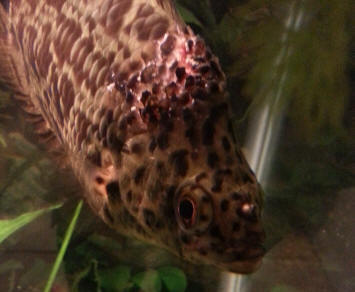
African Leaf fish (Ctenopoma acutirostre) deteriorating scales
4/7/16
Dear WWM team,
<8.5 megs of pix... we're at half of our webmail storage capacity... soon to
bump>
My African Leaf is sick. He lives in a 20 gal tank for about6 years together
with an African butterfly (last two years) and cories. I feed crickets to
both Africans and some flakes and algae pellets to cories. Over the last two
weeks Leaf is developing what you see in the pictures. First, scales raise,
then start to deteriorate leaving open wound. It’s contained to one area,
but the surface has doubled over time. On his nose I see something that
seems like hole-in-the-head, but he’s been getting it over the past year on
and off and didn't seem to care. He acts fine, eats, swims, no scratching,
but apparently has problem opening his mouth as wide as he used to. He could
almost swallow a Betta before, now he hesitates to eat a medium cricket.
<Mmmm; I wouldn't feel like eating if I had such a growth on my back>
Some scales have white ends, some don’t. Those that deteriorated completely
leave open red flesh. I started adding Melafix and Pimafix
<Worse than worthless. Try searching, reading on WWM re these scam products>
two weeks ago, salt –one week ago, water changes - 25%every four days,
carbon removed from the filter. Butterfly doesn’t show any distress, cories
breath heavily (perhaps due to medication). Tank reads ph 7.5, nitrate20,
ammonia and nitrite 0, hardness is high (difficult to say exactly, but
perhaps as much as 1000).
<A thou what?>
I love my Leafy dearly but don’t even know where to begin as nothing I have
read quite exactly matches what he has.
Thank you for any information you can give me.
Anastasiya
<Due to the tank being up so long, the lack of introduction of something
that might transfer/introduce a larger (Protozoan on up) pathogen...
am guessing this is a bacterial infection gone huge... likely resultant from
a mechanical injury. I am dubious whether it can be reversed... but
DO read on WWM re freshwater bacterial matters; and the use of aggressive
antibiotics/microbials. Bob Fenner>
|
 going...
 |
|
spotted African leaf fish; sexing
4/10/15
Hello,
<Jesse>
I have a quick question about the Leopard Ctenopoma (spotted African leaf fish
locally bought from PetSmart). Is there any other way to tell the Sex of the
fish? I have two, bought at the same time, and one of them grew significantly
quicker and remained larger than the other. Does this have anything to do with
telling it is a Male of Female. The spines on the gill, I cannot tell by going
that route.
Thanks for your time!!
Jesse Brand
<I kept Ctenopoma acutirostre years back; was unable to tell the sexes apart...
Am putting your query into Neale's in-box in the hope that he knows more. Bob
Fenner>
Re: spotted African leaf fish 4/10/15
Thanks for your help, much appreciated!
<Certainly welcome. Thank you for reminding me of these fab fish (from back in
the 60's). Had no "luck" breeding them, but they did seem to "pair up". BobF>
Re: spotted African leaf fish 4/10/15
WOW, that's great you guys have awesome reviews on your website. I figured this
would be my best shot. My Ctenopoma acutirostre do rub up on each other a lot
during non-feeding times so I'm very interested to see if I can help them out
anymore!
<Let's see if Neale can offer more! B>
spotted African leaf fish /Neale
4/10/15
Hello,
<Jesse,>
I have a quick question about the Leopard Ctenopoma (spotted African leaf fish
locally bought from PetSmart).
<One of my favourite oddballs. Thrives on frozen bloodworms and other such
foods; despite their reputation, they don't need live foods.>
Is there any other way to tell the Sex of the fish?
<None practical. Supposedly, there's a difference in the texture of the scales
on the flanks. Males have spiny patches behind the pectoral fins and/or close to
the base of the tail. But good luck being sure about this!>
I have two, bought at the same time, and one of them grew significantly quicker
and remained larger than the other. Does this have anything to do with telling
it is a Male of Female. The spines on the gill, I cannot tell by going that
route.
<Nor can anyone else. Presumably the fish themselves know. But if you have two,
and they get along okay, they're probably a pair or else two females.
Two males will sometimes "mouth" each other's flanks in some sort of
antagonistic interaction.>
Thanks for your time!!
<Most welcome.>
Jesse
<Cheers, Neale.>
Re: spotted African leaf fish 4/10/15
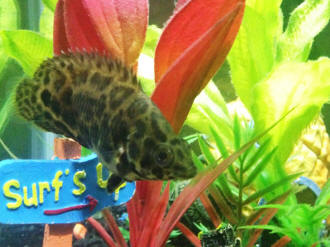
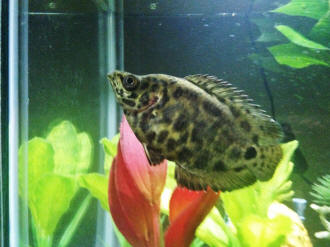
You guys are great. For record I am attaching a few photos. The significantly
larger Ctenopoma has a more extended pointy nose as to the smaller one being
more "flush".
<Don't believe this is a sexual trait.>
This may also be a determination or the larger one may just be a part of an ogre
family.. ;)
<Indeed.>
I will look more closely today as I'm moving them into a bigger home! Both are
about 9 months old.
<Sounds about right. A long-lived, slow-growing species. Mine were some 12 years
old before I passed them on to another fishkeeper.>
Again your time is appreciated!
<Most welcome. Neale.> |
  |
Leopard Ctenopoma compatibility
8/21/14
Just wondering if a Leopard Ctenopoma could live with a single large
angelfish and 4 boesemanni rainbow fish in a 75 gallon?
<Yes.>
I tried to kept one of these fish before and the tetras I had seriously
went after it.
<Angelfish and Leopard Ctenopoma are, in my opinion, South American and
African ecological equivalents. They are stealth predators that (in the
wild) feed primarily on insect larvae and very small fish. They avoid
strong water currents, like floating plants, live in groups as
youngsters but become territorial once sexually mature. So provided the
tank has enough space for them to each have their own "patch" somewhere
calm and shady, they can/do get along well. Rainbowfish prefer open
water, and in a
large tank it should be easy to create some shady, still areas around
the edges while having some open, bright areas for the Rainbows. It is
very rare for Rainbowfish to become "nippy" like tetras; they don't
really have the teeth for it and in any case they're more likely to
harass one another if not kept in sufficient numbers.>
Thank you
<Most welcome, Neale.>
|
Dying Leopard Bushfish 5/7/14
Hello, this is Mariah. I was advised by a friend to contact you guys as
my leopard bushfish (Ctenopoma acutirostre) is dying. I purchased him
recently from PetSmart, about the size of the middle knuckle of my thumb
to the tip of the fingernail.
<So, a couple inches? A baby bushfish, anyway.>
I took him home and put him in a 10g (temporary until a 129g is done
cycling), with 50% water changes every other day.
<Why such big water changes? If there's a filter on this temporary tank,
50% water changes daily for a fish this size is overkill. Not
necessarily bad if you keep water chemistry and temperature constant,
but if you don't, there's a risk of exposing fish to stressful
variations.>
A few days later I noticed one of his gill plates looked like it was
half missing.
<Can happen, not necessarily fatal.>
Then I noticed a white dot on the top of his head. It seemed to get
worse and his belly was larger than what I'd think is normal so I put
him in a 5g to medicate him with Maracyn 2. This was on Thursday 5/1/14,
and his last dose was on Monday 5/5/14.
<I see. While either Maracyn 1 (= Erythromycin) or Maracyn 2 (=
Minocycline) can be useful, they're actually more reliable used
together. The problem is that neither treats all the possible bacteria
out there. Alternatively, if either doesn't work, try something with a
different antibiotic in it, KanaPlex for example (which has Kanamycin in
it).>
On the second day of treatment it looked like the white dot had
disappeared but I think it's coming back, there also appears to be one
under his eye now and his gill plate looks worse. He has been listing to
the side, laying completely on his side, and breathing heavily. Ever
since I got him he has eaten shrimp & Betta pellets & bloodworms (right
away), but today when I
went to feed him he did not pay any attention to the food. I have moved
him back to the 10g since his treatment is done but he is still doing
what I mentioned above, and now he is upside down but still breathing. I
imagine he's on his way out but I want to do everything I can to save
him though so I still am going to send this.
<Do you have some information on the environment? E.g., what's the water
chemistry and temperature? Have you tested for ammonia or nitrite? On
the whole Ctenopoma are extremely resilient fish, and your specimen
doesn't actually look in bad shape. But the listing behaviour is
worrying, as is the lack of appetite, though I'd not feed for a day or
two before trying
again.>
I also have 3 pics that will hopefully show the white dot under his eye,
his messed up gill plate, and his stomach. The orange thing in two of
them is the Betta pellet, and I apologize that the one I have to show
his stomach has me in the background. Thank you and hope to hear from
you soon.
<Well, it's difficult to diagnose this. The basic condition of the fish
looks okay. He doesn't seem starved; if anything, his stomach is a bit
swollen, which could be overeating but could also be constipation, worms
or dropsy. Treating with Epsom Salt alongside the medications (1-3
teaspoons per 5 gallons/20 litres) will help with constipation and
dropsy. Try
switching meds. Make sure the water chemistry is appropriate (anything
between 2-20 degrees dH, pH 6-8 is fine, but it should be stable).
Warmth helps with this species; 26-28 C. Make sure there's no dry or
cold air above the tank (true for all Anabantoids in fact, and a common
cause of problems with them). Obviously zero ammonia and nitrite are
essential, but
this species dislikes strong water currents, so choose filtration
accordingly. Hope this helps, Neale.>
|
  |
Ctenopoma acutirostre with Congos
1/11/14
Hello:
I just got a Ctenopoma acutirostre (African leaf fish) It is in the 75
gallon with 8 Congo tetras and 4 lemons. The Ctenopoma acutirostre is a
juvie and the same length as the largest Congo. Will this not work due
to food issues?? The LFS said a small one may be a bad idea, but those
are the only ones available. At least I have the receipt if it doesn't
work out.
The tetras are ignoring it. Thank you
Judy
<See WWM re this species; it will inhale the smaller characins in
time.
B>
Ctenopoma acutirostre with Congos
1/11/14
Hello:
I just got a Ctenopoma acutirostre (African leaf fish) It is in the 75
gallon with 8 Congo tetras and 4 lemons. The Ctenopoma acutirostre is a
juvie and the same length as the largest Congo. Will this not work due
to
food issues?? The LFS said a small one may be a bad idea, but those are
the
only ones available. At least I have the receipt if it doesn't work out.
The tetras are ignoring it. Thank you
Judy
<See WWM re this species; it will inhale the smaller characins in
time.
B>
<<While Bob is right that Ctenopoma acutirostre will eat bite-sized
characins (such as Neons) and perhaps prey up to the size of Danios,
they
aren't otherwise much of a threat, in my experience preferring "wormy"
foods like bloodworms. They're really only a bit more dangerous than
Angelfish, which are accomplished Neon-eaters but rarely thought of that
way. Aquarium specimens rarely reach the size they're said to get to in
the
wild; I've never seen 20 cm specimens, and even after 10 years my
specimens
were only about 10 cm maybe 12 cm in length. They grow VERY slowly!
Congo
Tetras make excellent companions for them. The Lemon Tetras are a little
more of a gamble, but for the first couple years I doubt you'll have any
issues, particularly if your Ctenopoma is well fed with other,
easier prey
items like bloodworms, chunks of fish and shrimp fillet, and good
quality
pellets such as Hikari Cichlid Gold. I kept Ctenopoma acutirostre with
Nannaethiops unitaeniatus and they're not much bigger than Lemon Tetras.
The flip side to your question, which seems to be about whether *all*
your
fish will get enough to eat, is a bit trickier to answer because it
depends
on the aquarium. If you have some floating plants (or at least leaves)
you
can "lodge" a floating block of bloodworms there, and you'll find the
Ctenopoma will come to the surface and very delicately consume one
bloodworm at a time (much like the way Angelfish feed). Do feedings this
way and everyone should be fine. Do also remember Ctenopoma acutirostre
is
dusk/dawn active, so you can feed with the lights out and you'll
probably
find it does better than more active but day-oriented characins.
Finally,
Ctenopoma acutirostre may be kept singly without problems. It's
difficult
to sex, territorial to a degree, and two males would probably squabble
in
all but the biggest tank, so it's one of those fish best kept singly or
in
a group of at least 3-4 specimens unless you can positively identify
males
and females. Cheers, Neale.>>
re: Ctenopoma acutirostre with Congos
Hello:
I refunded the juvie leaf fish. The tetras went after it. Thank you
re: Ctenopoma acutirostre with Congos
1/12/14
Hello:
I refunded the juvie leaf fish. The tetras went after it. Thank you
<The Congo Tetras? That's really out of character for them. Have kept
them with Leopard Bushfish and not had any problems. To be fair, the
Bushfish was bigger than the Congo Tetras, so perhaps that helped
establish a hierarchy more safely. Cheers, Neale.>
African spotted leaf fish; "lock-jaw"
11/12/13
Hi I have had my fish for about three weeks now and it seems like he
overextended his top lip and can not retract it back. He wasn't eating
when it happened so I'm not sure how it happened. I also have another
African spotted leaf fish that I have had him for 4 months and he is
doing excellent. If you can help me with how I can fix his mouth or what
I can do that would be great.
<Mmm, such "stuck open mouths" on these fish and others are most often
due to physical traumas (overextensions, or getting "something" stuck in
them)... perhaps more allowed by nutritional deficiency over time. You
can try, make that could try rearticulating the jaw mechanism with a
dull wood toothpick, or a Q-tip with the cotton removed; but there is a
risk of further injury. A few folks that have written to us over the
years have had success doing this op. w/ their goldfish... You might
find relief in reading their accounts, searched on WWM. Bob Fenner>
Re: African spotted leaf fish 11/12/13
Thank you so much this is very helpful. I tried looking on the website
for it but I didn't know what kind of keywords to put in. I will check
again.
Thank you again
<Ah good; and I've asked Neale to respond independently. BobF>
Tank overstocked? FW, 50, and Ctenopoma fdg.
8/3/13
Hello! First I wanted to say I love your site and really enjoy your
articles. They've really helped a lot with setting up my tanks and
keeping my fish healthy!
<Ah, good>
I have a 50 gallon tank that is mature, and whose only current resident
is an 8 inch Senegal bichir. My filtration is a penguin BioWheel 300,
PennPlax cascade 200
<Ahh, an important comment: With the use of these two hang-on power
filters there comes a danger of open space near them... that your Bichir
can (and likely will!) leave the tank (onto the floor). Do tape over
most all this space/opening>
and an undergravel filter. I currently have a leopard Ctenopoma
(Ctenopoma acutirostre),
<Neat species... generally need... oh I see this below>
a Bristlenose Pleco and what was labeled a flying fox, but could
possibly be a Siamese algae eater,
<More likely the former... and can become intense bullies>
in a 25 gallon quarantine tank that will be added in later (they're all
babies right now, the largest being 2 inches, and would probably end up
lunch if I put them with the bichir at the moment). I'm looking at
adding 5 or 6 Congo tetras to the 50 gallon in a few weeks - is this too
many fish for this level of filtration? What would be some good
alternatives for this setup if so?
<Will be a very nice mix; and not too much here>
I've also been having a problem feeding the Ctenopoma. He is very picky!
He spits out any cichlid pellets, flake food, and even turns his nose up
at even raw bits of tilapia and salmon, and will only eat dried Gammarus
pulex and bloodworms. Are there any tricks or tips to get him on a wider
variety of foods?
<Yes; live... unfortunately. Rarely are trained onto non-live foods;
though AdamJ:
http://www.wetwebmedia.com/FWSubWebIndex/c_acutirostrea.htm
and see the linked file of FAQs above.
Bob Fenner>
Ctenopoma acutirostre stress, GH/osmoregulation
relationship 3/10/13
Hi Crew
<Sabrina here, belatedly>
I have a couple of questions for you tonight, if someone could oblige my
hungry little mind. One, unfortunately is about a fish that’s not doing
too great.
<Oh no!>
I got 2 Ctenopoma acutirostre yesterday evening and acclimated them as
normal for all my fish, 4x additions of 150ml water to the bag every 15
minutes. One began swimming immediately, exploring, generally doing as
acutirostre do. The second is still struggling with laboured breathing,
hiding but coming up for the odd breath of air. It wasn’t happy from the
beginning. I know they are reclusive and the heavy gilling didn’t really
concern me last night.
<Reclusive, yes, but breathing heavily and not being inquisitive....
definitely not "normal" for this fish.>
I put it down to transfer, having seen other fish doing this and checked
back in with my new arrivals this morning.
<Probably what I would've done.>
Conditions in the receiving tank prior to transfer were 0ppm NH3/NH4+,
0ppm N02, <5ppm NO3, pH 6.4, KH 2, GH 4. I did a 25% water change prior
to picking the fish up.
<All sounds good.>
This morning the stressed fish from last night was parked up on one of
the last floating bits of bogwood, right at the surface, making heavy
use of the labyrinth organ and wavering slightly in the fairly low
current. I didn’t think that looked too great so I rechecked the water.
Usually if I get a gasping fish on transfer they have perked up by
morning. 0ppm on all nitrogen compounds, pH 6,
<From 6.4, in one day? Hmm....>
KH 1, GH 2. Now, pH 6 is the limit of detection on the API kit I’m using
(damn them!) so I’ve no real idea how far it had sunk.
<Ah! Trouble....>
KH 1 is the limit of detection on the API KH test kit, so I’ve no idea
how far that had sunk either. I assumed the worst, given KH and pH at
their LODs, eyed the bogwood in disgust and thought about how to solve
the problem.
<You're going about it all quite well, I think, so far....>
I knew I had to bring them back into their pH range but do it slowly.
So, I quickly removed 25% of the water from the aquarium, followed by
all of the bogwood bar two tiny bits. I had loads in there and I really
should have seen this coming.
<Bogwood is good stuff, and quite good at dropping the pH in a tank.
This can be good or bad, depending. You can counteract it with any
of a number of buffering options.... I like just a bit of
aragonite or crushed coral in a filter sock. A little goes a long,
long way though.>
Judging by the aquarium level after refilling there was a displacement
of about 10-15 litres of wood. I put one 22.5 litre bucket of water
back in, with a quarter dose of Rift Valley salt mix, over half an hour,
let the tank run for another half hour and checked again. There was no
change in levels.
<Yikes. Maybe time to "force" the pH up with sodium bicarbonate,
while you effect a "real" fix (adding an appropriate buffer, keeping out
some/all of the bogwood, or.... lots of options.)>
I did the exactly the same for the second bucket with no change in
levels except a GH of 3.
<That's a start.>
Finally I risked a full dose of salt mix in the last bucket and
registered pH 6.6, GH 5 and KH 2. With faffing about, filling buckets,
testing etc. the change in levels was probably made over about 4 hours
in total.
<Fast, but probably necessary.>
Given the situation at hand, would you have done anything differently?
<Mm, I'd probably have added sodium bicarbonate to get the pH up a bit
(slapping a band-aid over the bleeding wound, basically) and then gone
about deciding upon what to remove, or what to add.... But what
you have done is really quite fine. I see no flaw in your
actions/choices.>
Is there anything I should do to assist the fish, besides wait and see?
<A bit late for it, but no, I would wait and see. I do hope the
little guy has recovered.>
I could kick myself black and blue for the bogwood bungle, but I was
lulled into a false sense of security. The tank had never dropped to pH
6 (or less) before.
<This is the trouble with the kind of tanks I like, and the fish I like,
as well; maintaining a low pH isn't always easy, and is often
recommended against for the very reason of what you've experienced: it's
easy (and quick) to have the pH "crash" as soon as certain criteria fall
into place. I still like and will continue to like these
"precarious" conditions, because the fish I enjoy thrive in low pH -
most notably, some of the more delicate Anabantoids like chocolate
gourami and Betta macrostoma, among many other REALLY cool fish.
The "trick" is in monitoring and maintaining the low pH with suitable
test kits or monitors and suitable buffer(s).>
The wood is now going to the garden pond for a few months and getting
added back bit by bit, over many months.
<A great plan.>
I honestly thought this stuff would be fine, exposed to the elements for
years as it was.
<It may well be. It might always release enough tannin to do this;
consider an appropriate buffer to use in addition. As I said, I
like to have just a bit (like a couple teaspoons) of aragonite sand or
crushed coral in a filter sock, but there are also very easy and very
effective commercial preparations available - Seachem and Kent both make
nice products for maintaining a specific pH, for example.>
Anyway, I’d like to at least treat it as a learning experience and you
guys are the finest teachers.
<Yikes! Or, thanks!>
So that brings me to GH, as I think it could be relative to the gasping
of the Ctenopoma.
<The suddenly low and unknown pH is more likely the culprit.>
Although I also think it more likely to be stress from the rigours of
the last day, it is still a concept I can’t quite get. As I understand
it, GH is basically a measure of the dissolved minerals in the water.
<Yeah.>
Given that the GH of the tank, even when the fish were added, let alone
during the pH crash incident, was below the optimal for the species,
would this make it harder for them to breathe through their gills?
<Actually, I think the heavy gilling was more likely from the low pH,
the acidity causing discomfort, even "burning" the gills a bit.
Just a guess.>
My understanding of it, at the moment, is that the fish is filled with
salts/dissolved compounds and there is a pressure gradient with its
environment that means there is a push for a transfer of molecules/ions
from the fish to the water. If the fish is in an environment that is
lower than its optimal GH, does this in effect make it harder for oxygen
molecules to pass into the bloodstream through the gills?
<Well, I think with the low numbers we're talking about in this
not-so-hard fresh water, it's probably negligible. But I do think
you have the right idea. And some fish are very well equipped to
tolerate sudden and major shifts in water hardness, even; consider large
predator species in, for example, a confluence of a "black" water and
"white" water rivers/streams (where blackwater has low or almost no
hardness, and white water, so called for the opacity coming from all the
"stuff" in the water, has a much, much higher hardness). Often
large predatory catfish (and others) hang out in the places where these
waters mix, waiting for less well-equipped fish to be "stunned" from the
change of one water type to the next, where they are then easy prey
items.... Cool stuff.>
I could have this all wrong, so I’d appreciate it if you could give me
some clarification.
<For clarification, just swim back upstream into the less murky
blackwater environment!>
As always, thanks for any help and guidance you can give.
<Sorry again for my lateness. I do hope the animal has recovered;
you did very well.>
Cheers
Gord
<Best always, -Sabrina>
Ctenopoma, Anomalochromis Compatibility - 10/15/2012
Hi Crew,
<Hi Phill! Sabrina here.>
Just a very quick question regarding an African River setup. Would
Ctenopoma acutirostre be an okay addition to a tank with the following:
Anomalochromis thomasi
Synodontis nigriventris
Phenacogrammus interruptus
My concern here is that there are 4 Thomasi's (2 breeding pair). I don't
want to encourage the Leaf fish to start hunting the fry <He will,
whether you encourage him or not. This fish is a sort of an ambush
predator, and will happily eat anything that will fit in its mouth.
The fry would be snacks. In fact, the Congo tetras will probably
pick them off, too, once they're big enough. With luck, your
parent cichlids will protect a few fry long enough to give them a
fighting chance, but if your "real" goal is to breed the thomasi, it'd
be best done in a breeding tank dedicated to a single breeding pair.>
and then when he gets older have him picking off adult Thomasi's.
<I would also be concerned that the cichlids might possibly kill a young
Ctenopoma that keeps nosing his way into their breeding territory.
They're small, but they're still defensive when they breed.>
I only ask this because I have owned this leaf fish before <Great fish,
aren't they? All of the Ctenopoma are neat.>
but was not able to keep him until adulthood due to a relocation when
the tank was sold. The tank is a 40 breeder that is moderate to heavily
planted with:
Tiger Lotus
<You'll ultimately have trouble keeping this confined in the 40g tank,
as it will insist upon having its leaves at the surface and shadowing
out everything else. While it's small, though, it will certainly
be beautiful.>
Onion plant
Aponogeton ulvaceus
<Aponogeton ulvaceus is my all-time favorite plant, incidentally.
It'll work fine in a 40g, but for best effect, looks gorgeous in taller
tanks.
Beautiful plant.>
Eleocharis Parvula
Various Anubias
Thanks guys!
<Sounds like an attractive tank, Phill.>
Phill
<Best wishes, -Sabrina>
Re African Riverine Biotope
Ctenopoma, Anomalochromis Compatibility - II - 10/18/2012
Thanks Sabrina!
<You're welcome, Phill!>
Your points are well made and will be heeded. I'm not totally bent on
having every fry make it and figured on some fry predation. My goal was
to cut a little slice of the biotope out in my home and have a small
Cichlid that could live in multi-unit family. I have seen this setup
before and it is quite stunning. This is actually the tank that's going
into my self made
entertainment system when it's done.
<Just make sure it's not affected by speakers, etc. As I'm sure
you're aware, sound carries through solids and water far better than
through air.
Don't give your pets headaches *grin*>
I'll send pics when complete.
<I'm excited to see.>
I don't want the leaf fish nor the Thomasi to get hurt so I will forego
that.
<Sounds like a plan. Also sounds like you need another tank,
dedicated to Ctenopoma....>
I also know that lotus will get big. I'm praying that I can "tame" it.
<Good luck. You'll have some success for a while, I'm sure....
and then you can dig a pond, and have even more fun!>
It's so beautiful.
<It is, indeed.>
Phill
<Have fun in the building, planning.... and enjoy! -Sabrina>
|
Sick Ctenopoma 5/29/12
Hello,
I am really hoping you can help me. I have a 44 gallon tank with
one 3" Pantodon buchholzi, one 1.5" Ctenopoma acutirostre, and one 2"
Striped Raphael Catfish (who is just a temporary resident until he grows
out enough to be moved to one of my 75 gallons). Ammonia-0,
Nitrite-0, Nitrate-0, pH-7.4, Temperature-75*F, Water changes-50%
weekly, Filtration-Fluval 305.
I acquired the fish approximately three weeks ago. About a week
after I got the fish I returned to the store and the tank of
Ctenopoma--the batch my little guy had been with--was ravaged with
illness. They were listless, some were bloated, others were
completely missing their operculum and you could see straight into their
throats.
<Yikes... wild-collected>
My guy at home remained active, curious, ate well, and generally seemed to
be doing well. I have not been able to get him to eat prepared
foods yet.
His diet consists of frozen Bloodworms,
<See WWM re>
Tubifex Worms, Plankton, Brine Shrimp, Glass Worms, peas, and live
Blackworms. Last week I thought I saw a tiny fluffy growth on his
mouth.
It wasn't very noticeable, I could only barely make it out at the right
angle in the right light, and I kept changing my mind as to whether
there was actually something there or not. I tested the water
multiple times over the next few days (results consistently same as
above) and did my usual Friday water change. By that time it
seemed to be gone. Tonight, however, he has a pinpoint-sized
petechia just above his mouth, and half of his upper lip on that side
has rotted away. Part of his anal fin is also eaten away.
The fin rays in the affected area look to still be intact.
Currently there is no more fluffy growth as far as I can tell.
(Sorry, I hope the description is enough as I am unable to get a decent
picture for you.) At the moment the other two fish are not showing
any signs. None of this was visible twelve hours ago. He is
still eating and cruising around normally. I would hate to lose
this little guy; he has quite the personality. I'm concerned that
this is progressing rapidly and I would like your advice as to how I
should treat to give him the best chance possible. What
medication(s)? Salt or no salt?
<The "illness" troubles might be simply from the means of capture (a
type of poisoning), poor handling, shipping... and/or some sorts of
pathogens...
I'd treat w/ Metronidazole and Praziquantel... you can search, read re
the rationale, dosing... on WWM>
Should I move him to a quarantine or do I need to treat the whole tank?
If he stays in the main tank, is this safe for the catfish, etc.,
etc...?
<I'd treat all... as they've now all been exposed>
I'm sorry for all the questions. I've been very lucky in my years
of keeping fish in that I have almost never had to deal with disease.
Unfortunately, that also makes me quite clueless and unprepared in this
situation. I am located in the U.S. if that makes a difference as
to which medications are available to me.
<It does indeed>
Thank you,
Kelly
<Welcome; thank you for sharing. Bob Fenner>
Re: Sick Ctenopoma 6/3/12
Thank you for the prompt reply, Mr. Fenner. I followed your advice
and medicated the main tank with Metronidazole (250 mg) and Praziquantel
(75 mg). I dosed the tank on the first day, again 48 hours later,
followed by a water change 48 hours after the last dose per the insert
instructions.
Midway through the treatment the Ctenopoma stopped eating for a day.
<To be expected>
His appetite has since returned but he is still quite "dumpy" most of the
time, only occasionally leaving the bottom to swim around. It has
been 24 hours since the post-medication water change. The erosion on his
fin looks unchanged but the erosion around his mouth looks a little bit
worse. He has some fuzzy growth on his upper lip that was not
there yesterday, and also a piece of... I don't know--flesh
maybe?...hanging down from his mouth. It seems to irritate him as
today he has been frequently doing some unusual opening and closing
movements with his mouth (not gasping). The Pantodon and Raphael
Cat still seem fine. Should I do another course of the
Metronidazole/Praziquantel or try a different medication?
<I would not treat further. The fish/es should improve without>
Also, if you do recommend further treatment, should I again dose the main
tank or move him to a hospital tank this time?
My boyfriend was able to get a halfway decent picture of the Cteno's
mouth.
I don't know if it will help, but I'll send it along anyway.
Thank you for all your help,
Kelly
<Welcome. BobF>
|
[1].JPG) |
|
Re: Sick Ctenopoma 6/5/12
Hi, Mr. Fenner. I'm sorry to bother you again but my Ctenopoma is
getting much worse. The erosion has progressed further up his face
to just in front of his eye. The affected area on his fin has
doubled in size and is completely covered in fuzz. It appears to
be involving the body now, and not just the fin. I don't foresee
this getting better on its own. Do you still recommend that I
should not medicate him any further?
<Mmm, dang! I would double dose (50 mg. per gallon) w/ Nitrofurazone or
any other Furacyn compound you can get your hands on stat! BobF>
|
Questions/interesting observations about FW livestock, Af.
BF, Ctenopoma comp.s 5/14/12
Hi crew,
<Duncan>
I haven't written in a while but am still keeping up with the site - my
queries have been solved using the search tool in the interim.
<Ahh!>
I've a couple of questions if that's O.K., and then what I think is an
interesting observation, about some FW livestock.
1) Will an African Butterfly Fish eat Cardinal Tetras?
<Yes; for sure>
I've done a fair bit of research, have matched what I think will be a
good tank environment and tank-mates to a single individual, and I'm
guessing the butterfly fish won't go near the cardinals given the strata
they occupy (though I'm sure a butterfly fish could fit a cardinal in
its mouth easily!). I just don't want to go ahead and mix the two
species without WWM's sign-off!
2) I have had 2 juvenile (say 3-4cm) Ctenopoma acutirostre and 2
juvenile (4-5cm) Colisa fasciata in an under-stocked community tank
(4ft/250L, ph 7.2, 0 ammonia/nitrite, <20 ppm nitrates, KH 3) for well
over 6 months now.
Food is prepared granules, wet-frozen daphnia/brine shrimp/bloodworms,
algae wafers and the occasional squished frozen pea. Tank-mates are 4x
true Siamese Algae Eaters, 6x Lemon Tetras and 2x Common Kribs. The SAEs
are also juvenile but growing well, while the lemon tetras and kribs are
more or less adult (kribs have bred 3 times and counting). C.
acutirostre are target-fed brine shrimp and bloodworms (they don't go
for any of the other foods really) with a plastic pipette at one end of
the tank, while food dropped at the other end of the tank distracts the
others. The bushfish and gouramis are very active and vigourous eaters,
but I'll swear they've barely increased in size since I got them! They
don't get fed on the weekends (tank is
at the school where I teach), and they've had two stints where they were
only fed once in a fortnight (school holidays). Is this the reason they
haven't really grown (I am aware the bushfish are a slow-growing
species), or am I not doing something correctly?
<Ctenopomas are slow growers... unless fed (really over-fed) on boosted
live foods... very slow>
3) Now, my interesting observation. Being a bit of an African fish nut,
I recently acquired a M. angsorgii for my 63-litre home tank. I believe
it's a fin-nipper!
<They are>
Never while I was watching mind, at least half of my 10x Cardinal tetras
it was put in with were missing chunks of their caudal fins, one almost
completely gone! I know they're predatory, but I thought M.
angsorgii were supposed to be shy, retiring types! The offender
has now been moved to a 68-litre tank in my son's bedroom, which hold 6x
Emperor tetras and 1x Bristlenose catfish, where it more than holds its
own during feeding time.
The cardinals' caudal fins are all growing back nicely. An atypical
individual of the species do you think?
<Not atypical>
Cheers all, keep up the awesome work.
Duncan.
<And you, yours. Bob Fenner>
African leaf fish catastrophe please
help! 2/29/12
Okay so I started a 20 gallon tank a few months ago and the girl at my
lfs recommended this fish which she told me was an African leaf fish
and told me a bit about him.
<Ctenopoma acutirostre. In many ways the African
"Angelfish" in terms of size, personality and diet.>
She told me to feed him Danios which I had done up until about three
weeks ago when i started a smaller 10 gallon Feeder tank and
switched to Red Rosies after some research.
<Research where? This was a terrible idea. These fish do
better on insect larvae and wet-frozen foods of most types, and some
specimens wean onto flake and pellets, which is better still. Feeder
fish introduce parasites, contain Thiaminase, and promote aggressive
and predatory behaviour. Rosy Red Minnows are rich in both Thiaminase
and fat, and together with the dismal care they get at the pet shop,
are among the worst possible foods for any treasured pet.>
About the time i started my 10 gallon tank I had put a 3 inch albino
Bristlenose Pleco in with the leaf fish. I. had asked four different
lfs's staff and was told the Pleco would be fine.
<If sufficiently large, yes, should be. Ctenopoma are opportunistic
and will eat anything they can swallow.>
So i bought him and added him to the 20gallon tank. After roughly a
week of feeding the Pleco just disappeared. Ee thought after a
week of not seeing him and water changes/gravel cleaning and still no
sign of the Pleco that the leaf fish had eaten him. I was saddened but
"buddy" the leaf fish seemed just fine. He is full grown too
so it really hadn't shocked me to awful much. Well somehow the
Pleco was in there and just three hours ago EST my Pleco appeared out
of nowhere and i was ecstatic! I even took a picture to prove it
to my husband whose away working. Well about an hour after he emerged
it was buddy's feeding time so i went in and got three red
roses
<Ugh…>
and took them to put them into his tank and i noticed buddy 's
mouth sticking straight out unable to retract back to its normal state.
I put the Rosies back and immediately tried to see what had happened
and noticed that he had sucked the 2 1/2-3inch Bristlenose Pleco
up.
<Unsurprising. You're teaching the Ctenopoma that live fish are
food. What happened here is totally expected. Would you really think
he'd eat one sort of fish and ignore the other? Catfish are
lockable spines, so when swallowed, the idea is they choke the predator
and hopefully work loose. Sometimes they get stuck like this, and both
predator and catfish die.>
I've got nothing to really aid in removing the Pleco as only a very
small portion of its tail fin is visible and i don't want to over
stress my leaf fish in hopes that he will be able to start digesting
this Pleco.
<Don't bank on it.>
I've searched all over the internet and haven't been able to
find any help! I was wondering Is this Pleco possibly going to poison
him?
<Ancistrus spp. don't have venom. But yes, the fin spines could
damage the throat and allow secondary infections, and yes, this could
kill the Ctenopoma.>
And do you think a full grown 6inch leaf fish could digest a 2-3inch
Pleco?
<Would certainly try to eat any fish that small, whether
successfully or not I cannot say...>
Also, is it possible that the Pleco's disappearance was him going
into some sort of sleep mode?
<No.>
I hope you guys can help I'm so upset because I love this fish to
death, he is a true African leaf fish and a very fun personable
fellow.
<Please, don't use live feeder fish then! This isn't the
right thing to do at all.>
At the moment, about 45 minutes after sucking the Pleco up he's
been laying on his side breathing is heavy and laboring. <I
bet.>
Then he jutted upward and is sitting leaned up sort of in the corner of
my tank with his mouth still open. I test my tank for ammonia,
nitrites, nitrates, gH, kH, and ph weekly and I also do weekly 25%
water changes. I have no ammonia nor nitrites or nitrates. My total
alkalinity has been 40ppms (was told that was low and can lead to my PH
swinging but not sure?)
<Yes.>
and my PH has held steady at 7.4ppm since the tank finished its cycling
a few months ago. Any advice or help would be greatly appreciated!
<Hmm… [a] don't use feeder fish and [b] don't mix
opportunistic predators with small fish.>
Kindest Regards,
Stephanie
<Likewise, best wishes, Neale.>
re: African leaf fish catastrophe please help!
3/1/12
Well, Buddy didn't make it and we buried him and made a little head
stone for him.
<Too bad.>
I'm a bit confused as far as what I had been feeding him and your
advice.
<For some reason, the aquarium trade in the US still promotes the
use of feeder fish. But every single vet and fishkeeping expert who
writes fish health articles and books will tell you that feeder fish
are the worst thing to use. Do read:
http://www.wetwebmedia.com/fwsubwebindex/fdgfdrartneale.htm
http://www.wetwebmedia.com/goldfshfd.htm
>
His total diet consisted of three Danios plus a good helping of Mysis
Shrimp which he loved.
<Quite so. These fish are very like Angelfish, and enjoy the same
sorts of small invertebrates.>
The lady at my LFS who was his previous owner had told me that she had
raised him on "feeder fish" saying she only used Danios.
Which went I went to a PetSmart, Pet Supermarket and a Petco i was told
that using Danios as "feeder fish" was un heard of. Which is
when they had directed me towards Guppies or Rosie Reds.
<Guppies and Minnows are cheaper than Danios, and I can well imagine
the Big Box stores favouring them because of this…>
I had researched feeder guppies on line for a few days and after seeing
the horrid living conditions decided to go with the Rosie Reds
instead.
<Six of one, half a dozen of the other…>
I truly wish that I had contacted you all about his food but I trusted
what the staff had told me. However, I do realize that any yahoo can
get a job and work at any of the big chain fish stores which is why I
always try to Google and research before I do anything.
<Yes.>
What I had read and was told was that since Buddy was an ambush
predator that he would enjoy the live fish more than any other frozen
food.
<Perhaps so, but fish are fish, and an ambush predator doesn't
get that much stimulation by a split-second attack on a live fish. In
the wild they mostly eat mosquito larvae, especially when young, so
there's nothing at all wrong with feeding them small invertebrates.
If you want a live food that's big but safe, try river shrimp or
earthworms, both of which are safe, nutritious, and
parasite-free.>
So I am now left with 8 Red Rosie's and a Rainbow Shark which
I've been calling a Red Tailed shark since he's black with
gorgeous red fins. My substrate is roughly thumb nail sized gravel with
a rock home in the middle of the tank which was were Buddy lived and
then one very large broad leafed plant and then some fake plants like a
sword plant and a few others. I have transferred all 8 of my
Rosies into the 20gl tank with the rainbow shark so they could have
more room. I am not sure now, what fish would do well in my tank.
<What's your water chemistry? A 20-gallon tank doesn't hold
a huge number of fish, and your Rainbow Shark will soon outgrow
it.>
I was looking at the Dwarf Puffer fish which it said they are Fin
Nippers
<Yes.>
and unless they are very well feed they will nip and be aggressive
towards any fish in its tank.
<Fed well or not, they bite other fish.>
I also am thinking about getting another leaf fish, the ones that are
available are less than an inch big, but I don't want to do the
feeder fish again.
<No reason at all do so. I kept mine for over 10 years on frozen
foods, before passing them on to another fishkeeper.>
I read that they can eat bloodworms, Mysis shrimp, and then feeder fish
but that's all, it said they will not eat pellets or flakes.
<Rubbish.>
What would you recommend to put with my 8 Red Rosies, one mystery snail
and one rainbow shark.
<This tank is already overstocked, so are we talking about AFTER
rehoming them? Some ideas:
http://www.wetwebmedia.com/ca/volume_5/volume_5_3/stocking.htm
http://www.wetwebmedia.com/fwsubwebindex/HardWatrCommTkStkMonks.htm
Hmm… many other such articles here; follow the links/FAQs.>
The tank temperature stays at 78 degrees F at all times and my tank is
fully established with little to no nitrates at all. I am a student and
spend nearly all my time at home studying and learning about the fish I
have/had. Anyways, thank you very much for your time I greatly
appreciate it. WWM has been a life saver and I can not express my
gratitude for the advice you all have given me the past few times
I've emailed you all.
Kindest Regards
Stephanie
<Glad to help. Cheers, Neale.>
Thanks and Ctenopoma acutirostre,
stkg./sel. 1/30/12
Hi Neale
Thanks very much for your help with the mains water pH problem.
<Glad to help.>
Both tanks are well on their way to being fine again, with minimal
disruption to the biofilters. The filter in the 60 litre that the
Harlequin Rasboras were in turned over 10mg/l nitrate in 24 hours, so
we're getting back on a level. I've contacted Scottish Water to
find out how long the low pH is going to be occurring and I'm even
getting the honour of a visit from a water officer to discuss the
problem!
<Interesting.>
I have a share and a quick question. Tonight I released 2 Ctenopoma
acutirostre in a 140 litre square tank. They are about
1/2"-3/4" long and unbelievably cute, so tiny in such a vast
space all by themselves. I'd send a picture but all you'd see
is little dots that are the fish. They've settled in wonderfully,
no signs of stress and are lurking away to their tiny little
hearts' content.
I was half thinking about making this a species only tank but I'm
not sure how many specimens I can keep in there. Measurements are 70cm
x 70cm x 30cm. I was thinking about two more Ctenopoma but
I'm not sure if there would be the space. What's your
thoughts?
<Ctenopoma acutirostre do get quite big, 15-20 cm, and they are
territorial, albeit only mildly aggressive. Given the size of your
tank, I'd stick with the two you have. They're very difficult
to sex, impossibly so when small, and even just two males in this sized
tank could squabble.
On the other hand, they grow very slowly, so you shouldn't have any
problems for a year or two.>
Anyway, I hope the thought of those two tiny little guys in the big
tank brings a smile to your face.
Cheers
Gordon
<Cheers, Neale.>
Re: Thanks and Ctenopoma acutirostre
1/31/12
Hi Neale
As you say, it will be done!
<Hah!>
I'll stop at two fish and use it as an excuse for a bigger tank in
a year or so!
I have another question I forgot to ask, actually, and another separate
one, if you would be good enough to help out. I know I've been kind
of plaguing you recently and if I'm ever in your neck of the woods
I'll be dropping off a crate of whatever your tipple is!
<A fair enough offer.>
I was thinking of feeding one blood worm each to the Ctenopoma, per
day.
The intention is to use the forceps method that you've described on
WWM.
Is this amount too much at this stage? I've got a handle on feeding
the community tank now but these guys are a whole new ball game at that
size.
<You will need to feed more than one bloodworm! Young Climbing Perch
have a fair appetite, and being very young, growing fish, they'll
need good square meals at least twice day just to put on weight. A
ballpark estimate that works for me is to offer meals twice the size of
the eyeball.>
Incidentally, you've recently been advising against bloodworm and
I've spent an evening on WWM trying to find out why. Care to
share?
<There are some concerns about [a] the nutritional content and [b]
how clean/safe the water was the bloodworms were grown in. Discus
breeders are nowadays getting a bit leery about using them, and at
least some of the stores I've visited have been downright hostile
towards bloodworms when maintaining Discus and other delicate
fish.>
If they're no good I've got mossie larvae that I should be able
to grab in a pair of tweezers. The other frozen food seems too minced
to pinch and wave enticingly in the water.
<Strips of tilapia should be fine, especially if you along the
grain.>
The other question is on a Trichogaster trichopterus female that is now
in the 60 litre that you helped me with. I've moved the harlequins
back to the community tank and the Gourami had to be taken out of her
140 litre mansion to make way for the Ctenopoma. She'll go back
when they are big enough, unless she misbehaves in there. As of lunch
time today, ammonia 0ppm, nitrite <0.3ppm, nitrate 5ppm. I'm
aware nitrite is high. It has been water changed out.
The tank was drained to the gravel and refilled before adding the
Gourami.
I had based suitability on the stoichiometry of the nitrogen cycle and
as far as I could tell the tank had processed enough ammonia into
nitrate in 24 hours to support one fish of that size (3"). Feeding
was cut out in case of a mistake. I was obviously slightly out in my
assumptions, but not by far. It would actually be quite interesting to
get figures on how much ammonia per kg body weight, depending on
species, is produced. I had to base it on Koi carp at 50-100mg/kg, from
a Koi supplier website and a loose assumption that goldfish produce 3x
the waste of other freshwater fish, from another Koi supplier
website.
<Not sure this is true at all. Goldfish aren't especially active
or fast-growing fish. They stir up the sediment, yes, but they
aren't consuming much protein so therefore not producing vast
amounts of ammonia.>
Wooly, I know, but I thought I'd have wriggle room without feeding.
This was all done yesterday.
<I see.>
It's really difficult to say because the gourami's old home has
no lighting and the 60 litre is in a brighter position. It has a
dedicated light also, so we're seeing her much more clearly. There
seems to be little black spots near her tail, on the muscular part
rather than the fin, that neither my wife or I had noticed before. The
fish is otherwise in good health: inquisitive, same responses to
approaching the tank, no observed flashing or thrashing about. I've
read that there is a snail vectored parasite that lodges underneath the
scales but that seems to cause discomfort and flashing. I've
searched on WWM and found only marine FAQs for "Black
Ich".
<There's also a Black Spot Disease on pond fish.>
There are (or were, now the gourami has arrived) snails in the tank but
they've come from my other tanks and no other fish has these spots.
I also came across a FAQ where you mentioned that it could just be
nerve damage.
I'm a bit perplexed, no emergency I think, but if you've seen
this before and have anything to add that might help it would be
appreciated.
<Would do nothing just yet. Fix/maintain water quality, observe. If
she's otherwise happy and healthy, and there's no sign of
Finrot or similar, leave alone.>
Once again thanks' for your help.
Cheers
Gordon
<Cheers, Neale.>
Ctenopoma acutirostre erratic swimming /
gasping 1/31/12
Hi Neale or whoever else is around.
<Salve!>
Its usually my husband that emails you but thought I'd get a bit
more involved and seek out your help myself.
We got two little Ctenopomas on Sunday and they're such small wee
guys, really cute!
<Yes.>
Anyway they've been behaving as I would expect, bit wary of us but
interested and not overly hiding away. When I came in tonight my
husband said that the lighter one had stayed in one spot all day
whereas the other had been moving about a little more.
<They don't like bright light, remember. They're dawn/dusk
animals (look at their big eyes!). So they need shade and
quiet.>
After looking at the light one, which was resting on the bottom (and
had been mainly doing the same all day) I wondered if it was breathing
too rapidly but I'm not familiar with how quickly they usually
breathe.
<Slowly.>
I tried to find the other as a comparison who was far more active,
swimming quickly around the tank and going from top to bottom very
quickly. After this the darker one drifted to the bottom and lay on its
side breathing very slowly, it actually looked dead. At times it swam
through the water but in a rapid corkscrew manner gulping some air
before returning to rest on its side on the bottom. The breathing
varied from very slow and shallow to rapid.
<Sounds bad. They are tough fish, but rapid changes in water
chemistry and quality can affect them, as with any other fish. If fish
are behaving oddly, a good approach is to do a water change, 25-50%. If
things improve, then that's a clue that something in the water
wasn't right.>
Whats confusing is the parameters seem within a good range. The ph is
7, ammonia 0, nitrite 0 and nitrate 5.
<What's the hardness?>
The only thing we could think of that may have possibly caused a
problem is the bogwood which we removed straight away and did a 25%
water change. As the bogwood was removed we found some white hair
growth on it, some had little blobs on the end. There was a smell of
sulphur which says to me it was rotting at least partially.
<Sort of. Decaying wood shouldn't really cause any serious
problems. But sulphur indicates anaerobic decay, and quite a lot of it,
if you're smelling it. Again, not necessarily bad, indeed, in some
situations it's a good thing. But you might think about whether
this aquarium is being kept properly clean and if there's any
organic matter (e.g., uneaten food) decaying somewhere in/under the
gravel. Check water turnover is adequate, and that your filter is the
right size and properly maintained. Review also potential sources of
toxins, e.g., medications, as well as the tap water (for chloramine,
copper and ammonia).>
Not sure if this would be relevant but there was also a bit of a light
film on the surface, not sure where this has come from.
<It's what we often call "protein", as in what protein
skimmers remove. In reality it's not so much protein as other
molecules produced through the decay of food and other organic
materials.>
After the water change both fish seemed to perk up with the lighter one
exhibiting more normal behaviour, swimming more instead of resting on
the bottom.
<Aha!>
The darker one is now on the verge of leaving us I think but we've
done what we can do try and help.
<Remove the fish to a bucket. Replace all the water. Remove as much
of the gravel as practical, as well as any wood, rocks and plants.
Clean the tank, clean the biological media in the filter. Fill up the
tank with new water.
Acclimate the fish to the new water just as if newly purchased, by
slowly replacing water in the bucket with water from the aquarium. Then
lift the fish out with a net and add to the aquarium. Leave some plants
floating at the surface for shelter, but otherwise leave the tank empty
except perhaps for a flower pot or similar shelter. If all goes well
for the next few days, you can then return some cleaned gravel and
rocks, ensuring there's a good flow of water all around the tank,
with no dead spots behind rocks or whatever.>
We're at a bit of a loss as to why this is happening, the
tank's been running for around 3 months, having previously housed a
gourami that is healthy.
We would really like to be the owners of happy healthy Ctenopomas but
it doesn't seem to be the way its going to go. Not too sure what
has affected the fish so quickly and extremely and also unsure why one
seems to have succumbed while the other seems to have made an
improvement.
Any help you could give us really would be appreciated.
Denise
<Cheers, Neale.>
Re: Thanks and Ctenopoma acutirostre 2/4/12
Hi Neale
<Gordon,>
My wife has emailed you regarding the health of the Ctenopoma recently.
You recommended a complete aquarium strip own. I'm a bit hesitant
to do this, I respect your experience but surely the tank would start
to cycle again if we went for something this drastic?
<Not if you keep the filter running by connecting it up to some
water in a bucket. Alternatively, if you switch the filter off, you can
take the biological media out, put in a bowl or bucket, and cover with
aquarium water. Ideally, add an airstone, but otherwise so long as the
media stays wet, it should be happy for hours, even days. Have removed
filters and preserved them MANY times before; there's no risk if
done properly. Clean the tank down, correct any problems, then fill
with water at the right temperature and water chemistry. Then reconnect
the filter. Easy!>
I've already made the horrible mistake of taking this tank home
with the previously running filter media carefully preserved in
aquarium water, placing the filter media in my 60 litre, boiling and
rinsing the gravel and ornaments, adding the gravel back, filling the
tank, adding 2 gouramis and two Ctenopoma, thinking "Great, a
pre-cycled filter," and then seeing a horrible bacterial
bloom and losing three fish.
<Hmm'¦>
It took about 6 weeks for it to cycle with an unfortunate surviving
gourami living in it. Previous occupant was an 8" cichlid of some
variety, I saw it running, was happy. I'm not up on cichlids, so
couldn't tell you what one.
Filter is a Fluval U2, too small for this tank I know, but will be
upgrading to a U4 shortly and certainly keeping bio-load low until the
tank is able to take it. I seriously doubt that 2 x 3/4" fish
could really place so much of a load on the U2 that one would die.
Maybe I'm missing something, if so please tell me. I'm
highly suspect of the matter that was growing on the bogwood. It looked
like fungus, with sporing heads, and I'm wondering if a mycotoxin
might not be something to consider.
<Not very likely. Have seen fungus on bogwood before, and even
watched Plecs happily eat the stuff. So I don't think it is
normally toxic. But who knows about every single case?>
I'm also fairly sure it was a thiol, not hydrogen sulphide that we
were smelling. H2S is "rotten eggs" and stings the nose but
thiols are more "eggy farts" and make you retch.
<Possibly, but hydrogen sulphide is (said to be!) the standard
end-product of anaerobic decay in aquarium substrates.>
Too much time in the haz waste industry smelling drums full of noxious
nasties!
<Okay.>
I hope the above does not seem like criticism, I am very grateful for
the help you've given us so far, but I have to ask or I won't
learn anything.
<Indeed.>
You asked for hardness - unknown. According to Scottish Water 10-11
mg/l as carbonate, from the tap.
<Extremely low. Could easily be a major problem in itself. Do
read:
http://www.wetwebmedia.com/fwsubwebindex/fwsoftness.htm
http://www.wetwebmedia.com/fwsubwebindex/fwh2oquality.htm
Without adequate buffering, the pH in an aquarium will plunge between
water changes, and this will harm your fish.>
As far as I can tell, there are no carbonaceous materials in the tank.
The full set up in there is: 1 Quartz boulder, two schist
boulders, Pets at Home black gravel over inherited horrible blue
gravel, plastic aqua-safe ornaments and a few crypts/swords, I struggle
to tell the difference between them from photos. Do you know a
reputable online dealer to order a dH kit from?
<Any, all; you're after a standard issue freshwater hardness
test kit. A general hardness kit (degrees dH) is useful, but if you can
only buy one, you should get the carbonate hardness (degrees KH)
because that's the hardness that inhibits pH changes between water
changes.>
I know, "Let me Google That For You", but I'd rather act
on a recommendation from someone than burning myself with a dealer that
is problematic. I won't buy anything from my LFS; Dobbies and Pets
at Home don't sell them.
Anyroads, the other Ctenopoma seems fine. His (her, who knows?)
behaviour has changed though. Instead of popping out of cover every now
and again for a wee swim, he lurks in an ornament and never comes out.
I know that's their nature, but I've had the blinds drawn for
two days, there are no lights on the tank but I don't even see him
come up for air. I know he's alive because if I spend about 10
min.s angling my head the right way I can peer into the ornament and
build up a picture of a fish in normal posture. If I disturb the
ornament he moves in a normal fishy way. I've done my best to
create dusk conditions, and am in danger of becoming pale and Goth-like
from lack of daylight.
<Overkill. Get a block of wet-frozen bloodworms, and place a small
piece in the tank. If he's hungry, he'll eat; if he's not,
then do review possible problems with water chemistry, quality.>
I've got a wee shoal (5) Glowlight tetra and introduced them today.
I have room for them in another tank if anything goes wrong and they
will be removed before Ctenopoma has them for tea. I had thought that
it might just be the Ctenopomas lack of confidence, since there were no
other fish about, that was making him turn hermit-like. He is still in
the ornament.
The problem is I can't feed him if I can't see him, or more
accurately I can drop things in with tweezers or with a syringe but I
can't see if he's eating it. Another concern I have is that
feeding him like this will encourage him to just stay in the ornament.
Would a better approach to be just to let him come out when he's
hungry? I don't want him wasting away though.
<They are shy fish. The schooling tetras may help though.>
Confused Ctenopoma owners say ta.
Gordon and Denise
<Cheers, Neale.>
Stocking question. 1/7/12
Breeding/Maintaining Ctenopoma ocellatum
Hey gang, I have a little 23 gal long tank cycling and I'm toying
with stocking it with Ctenopoma Ocellatum.
The LFS has ordered a bunch and, well there's just something about
bush fish that I really love.
The tank is 36 X 12 X 15 and in a quiet dark corner. It currently has a
good lid but no lights. I'm toying with the idea of no plants,
plenty of roots and red LED lights only, for nighttime viewing. A
grayish colored sand substrate is currently in place. My research is
telling me that:
A. This fish is rarely kept;
< Because of its brown color and diet of smaller fish it is not a
very good community tank fish.>
B. it's care is similar to that of the more commonly observed
Ctenopoma.
< That is pretty much true.>
Certainly fish base had nothing unexpected to report.
My plan is to buy five juveniles a stool and a magnifying glass and try
to get the stock down to the stock down to a male and two females as
they grow out.
Is my plan viable? Breeding is unlikely I know but is it possible? Any
tips to that end?
Am I missing anything? I feel like the tank is the minimum size, is it
too small?
Warm regards. Rob
< These are great ambush predators. They usually get up to 6
inches but can get much larger over time. I would recommend a planted
aquarium with normal lighting to keep the plants going. As the bush
fish hide they will be waiting for smaller fish and shrimp to feed on.
They will thrive on live food so the problem is keeping them well fed.
Feeder fish usually carry parasites that will infect your bush fish, so
the feeders need to be quarantined. Once you have a supply of feeders
try not to over feed them.
They might be trained to eat prepared foods when they get hungry
enough. I have actually had them eat themselves to death. Keep the
water clean and warm with not too much current. Sexing them is
not easy. Patches of spiny scales might be found behind the eyes and at
the base of the tail of the larger males. Breeding accounts are
rare. Good luck.-Chuck>
Re: my fish 9/10/11
Can u tell me about a African spotted leaf fish
Eli
<Ctenopoma acutirostre. Gets to 15 cm, rarely 20 cm
in length. Prefers soft, slightly acidic water but adaptable. Middling
to warm temperatures best; 24-28 C. Peaceful but mildly territorial.
Likes shady, well-planted tanks and peaceful tankmates. Predatory, but
a good community fish with things like Bleeding Heart Tetras and
Corydoras catfish too big to be eaten. Keep away from fin nippers! Easy
to feed: likes bloodworms, earthworms, shrimps. Once settled, happily
takes wet-frozen foods; tilapia fillet makes a good staple, along with
wet-frozen bloodworms. Some specimens take pellets, but not all.
Doesn't need to be fed live fish, and as you hopefully know, feeder
fish would be an extremely dumb choice for
food anyway, for all sorts of reasons. An excellent aquarium fish, all
in all much like an African version of the Angelfish in requirements
and habits, except for being fussier about food. Cheers,
Neale.>
African Labyrinth fish,
sel./stkg. 8/4/11
Hi crew,
A while ago I was in contact with Neale about adding to my 60L
community of 6 fairly rowdy Dwarf Neon Rainbowfish and 2 Atyopsis
shrimp (now 1 shrimp unfortunately) Tank vitals - 27-28 deg C, NH3 = 0,
Nitrite = 0, GH = 4, pH = 7.4).
At the time, Neale recommended either Microctenopoma ansorgii or
Microctenopoma fasciolatum as good (and final) possible additions to
the tank. After much searching around Singapore and waiting, a LFS has
advised me that they have both Microctenopoma ansorgii and
Microctenopoma congicum in stock. I've done a lot of looking around
for info on Microctenopoma congicum on your site and the web but
can't find a lot - to your knowledge are they similar in looks and
requirements to Microctenopoma fasciolatum?
Thanks a lot crew - as always top-notch website (especially the writing
- takes a scientist to know a bunch of scientists!),
Cheers,
Duncan.
<Hello Duncan, and thanks for the kind words. Microctenopoma
congicum and Microctenopoma fasciolatum are identical in terms of care,
so pick whichever is available. They do vary in colouration a bit, and
the Microctenopoma fasciolatum on sale recently are more steel-blue
compared to the reddish-brown of Microctenopoma congicum, but photos on
Google suggest that this distinction may not always hold true. There
are definitely differences between males and females, too. Frankly, I
have a hard time telling these two species apart. Microctenopoma
ansorgii by contrast is somewhat demanding in terms of water chemistry,
and it is also a much shyer fish, so approach that species with care.
It's a lovely fish, but does need the same sort of care you'd
give Apistogramma rather than a standard Ctenopoma. In any event,
there's not much on Ctenopoma published online, but there are some
good books, e.g., Jorg Vierke's excellent 'Bettas, Gouramis and
other Anabantoids'. Cheers, Neale.>
Re: African Labyrinth fish 8/4/11
Thanks a lot for your quick reply Neale,
<No problem.>
Could you please specify what water chemistry parameters ansorgii
require, given that they are fussy in this regard?
<Avoid extremes, but tend towards the soft. So, let's say,
something like 2-10 degrees dH, pH 6.0-7.0. Most of the other Ctenopoma
will be happier across a broader range, even quite hard water.>
Given that my Melanotaenia praecox are fairly nutty at feeding time,
should I just go for the congicum because the ansorgii are likely to be
out-competed at feeding time due to their shyness?
<M. ansorgii certainly won't be happy. They're a lot like
Apistogramma, so what you want are smallish tetras or Rasboras
alongside them. On the other hand, M. congicum shouldn't have too
much trouble picking off bloodworms and whatnot from the
substrate.>
Thanks so much,
Duncan.
<Cheers, Neale.>
Re: African Labyrinth fish 8/4/11
Hey Neale,
<Duncan,>
Just picked up a copy of Jorg Vierke's book that you recommended
for GBP6.00 on eBay - and most of that was postage! Awesome! Don't
know how long it will take to get to Singapore, but I can't wait!
Thanks so much for the tip.
<Glad to help.>
By the way, I'm planning on setting up a 4ft X 2ft X 2ft tank at
the school that I teach at (secondary science teacher).
<Me too.>
I understand keeping different species of Anabantoids in the same tank
may well be a no-no given their territoriality (assumption based on
semi-related FAQs on WWM that I've searched).
<Does vary, but many of the Ctenopoma will get along just
fine.>
I'm not planning on including Trichogaster trichopterus in this
set-up.
Would this assumption hold true for Anabantoids from different
continents?
For example, would keeping M. congicum, M. ansorgii, C. acutirostre
with Trichogaster leeri be asking for trouble?
<That combo should be fine. All these species are fairly easy-going,
and given space, and a few plants to break up territories, they should
keep out of each other's way.>
Or am I wrong and do different species of Anabantoids, even from the
same continent, mix reasonably in the same tank? I know my
newly-purchased book will probably give me the answers I seek, but I
can't resist asking now given the wait that may be involved.
<Really, with labyrinth-fish, the thing is to avoid known
troublemakers, like male T. trichopterus.>
Cheers and thanks for fielding all my questions - promise to not ask
any more for at least the next week,
Duncan.
<Good luck, Neale.>
|
Leopard Bush Fish and Ich
Treatment 6/28/2011
Hi Neale,
Hope you are doing well. May I bend your ear again, please?
<Sure!>
This is in regards to a Leopard African Bush fish I just
acquired. He is a really neat fish.
<Ctenopoma acutirostre, one of my absolute
favourite fish.>
To my dismay, I got some feeder fish at the LFS, one that is
supposed to be better then most, and after having them in his
quarantine tank for a few hours, I noticed they had Ich.
<Par for the course'¦>
Now I know why I have never purchased feeder fish in the past.
Needless to say, I am so upset! I quickly took them out of his
quarantine tank and started the salt, heat treatment, assuming he
will get Ich now. My question is, will this fish be okay using
the heat and salt treatment?
<Yes. Over the short term, Climbing Perch generally are
extremely tolerant and adaptable. Few live in brackish water
(Anabas spp. are the only ones, to the best of my knowledge) but
they will all tolerate the low salt levels used to treat
Ick.>
I researched and can't find any information on how they do
with salt. It is really disturbing to me that I can't find
one fish place in my area that does not have dead or sick fish.
Thank goodness I quarantine my fish! Thanks Neale, for your help,
as always. Cheers, Luanne
<There's no need to feed this predator feeder fish; their
diet is very mixed in the wild, and includes large amounts of
insect larvae such as bloodworms. A few take pellet foods, but
most specimens are easily maintained on a mix of wet-frozen foods
plus chopped seafood and tilapia fillet. Earthworms are a good
treat! Cheers, Neale.>
Re: Leopard Bush Fish and Ich Treatment
6/29/11
Thanks so much Neale, check him out, what a handsome fish!
<Glad to help. Handsome fish indeed! Cheers,
Neale.>
|
|
|
Compatible fish 3/14/11
Hey guys, hope everything is going good. And I want to thank you all
again for always responding and helping.
Right now I have a 55gal tank with only a few fish.
First I have 2 Aqueon 55 gallon filters that hang on the back of the
tank, a 150 watt heater,
<You might want to get/use another of about the same wattage...
should there be exceptionally cold weather, a failure>
a few air stones and plenty of rocks and fake plants and hiding spots.
My pH is at 7.5.
Right now I have 2 Leopard Ctenopoma. Nobody around my
area heard of them and I'm not sure how popular they are.
<I kept this species (C. acutirostre) in my youth. This is still a
popular species>
Other names are spotted bush fish or spotted climbing perch. (don't
know if that may help) Also I have 2 Angelicus Botias, and one
Cyphotilapia Frontosa.
<Mmm... in time, perhaps now, incompatible>
I've had these fish for a few months now and they all seem healthy
and happy. I was looking to add 2 or 3 more fish. Maybe ones that stay
up top like a pair of African butterfly fish. I'd just like to know
if you guys
could give me some good ideas on fish that could work in my tank.
Thanks again!
<I'd remove the Cichlid first... read re the habitat, range of
the Ctenopoma, shoot for organisms, including plants, of similar needs,
dispositions. Bob Fenner>
Leopard Bushfish, Ctenopoma comp.
4/15/10
Hi Crew,
I just have a quick compatibility question due to the lack of
information on the web regarding this specific species. Would a Leopard
Bushfish (African Spotted Leaf Fish) be compatible in a 30 gallon tank
with SA Dwarf Cichlids (cockatoo and borelli) in light of their
predatory nature?
There is also an angelfish and a moonlight Gourami in the tank. Would
he fair better in a 55 tank with a Severum, Firemouth, Festivum, and
Honduran red point or would he be harassed in there? Thanks.
Phill
<Ctenopoma acutirostre is a peaceful species very much like an
Angelfish in terms of habits. I would do well with dwarf cichlids too
large to be eaten. Would not mix it with aggressive cichlids. Ctenopoma
acutirostre is shy and
feeds on live/wet-frozen foods, and only slowly, so would likely lose
out.
Cheers, Neale.>
Ctenopoma acutirostre...? 3/30/09
Hi Crew,
<Hello,>
As always thank you in advance for your very valuable input. I have
recently acquired 4 new little friends (see attached photo). It looks
like a spotted climbing perch to me? i.e. Ctenopoma acutirostre or
Spotted Ctenopoma. Am I correct?
<Yes, though it's just a baby. As it matures, the background
will darken to a sort of wood brown. While less striking perhaps,
they're still very pretty.>
My research has lead me to believe the following. Please will you check
that I am correct. They need to eat bloodworms, shrimp and other meaty
bits.
<Pretty much. Mine lived for 12 years (until I gave them away) on
essentially frozen bloodworms and the odd bit of prawn. Doubtless
earthworms and other small animals will be taken.>
Possibly little crickets?
<Possibly; Ctenopoma acutirostre is -- despite its reputation as a
predator -- essentially an African version of the South American
Angelfish. It has narrow jaws ideally suited to catching soft prey
rather than crushing things with shells. Baby fish are certainly on the
menu, just as with Angels, but it's mostly insect larvae:
bloodworms, mosquito larvae, etc.>
Although they are only about 2-3cm I have read that they will get to
about 15cm, but possibly larger if the conditions are right. They are
currently feasting well on bloodworms.
<15 cm is typical I suspect; mine were that size after 12 years, and
I don't think I've seen any specimens larger than that.
Supposedly 20 cm in the wild.>
I have their water at Am=0, Ni=0 Ph= 7.3, Na=10-20, Temp = 27. The tank
is 6 foot (180cmx 45cm x 45cm) with lots of plants and hiding places.
Tank mates are 8 x 5cm angels, 6 x 3 cm clown loaches, 12 x 2cm
cardinals and 2 leopard Pleco's. The tank is covered and has
several air stones. I have read up about their bevaviour in terms of
posing as a leaf, floating with the tail curled like a leaf. If I am
correct they are fairly peaceful and shy, but remain piscivores?
<Again, they're just like Angels. Basically peaceful, though the
Cardinals may be viewed as food eventually. They are bolder in big
tanks than small. They are nocturnal rather than shy (look at those big
eyes!) so floating plants and big tall Amazon swords will give them the
shade they prefer. All in all, treat much like Angels, except for the
fact they don't (usually) eat flake/pellets.>
Thank you again for a great site with comprehensive and accurate
info!
Gail.
<Happy to help, Neale. PS. You should perhaps make yourself aware of
the native Climbing Perches of South Africa, Sandelia spp.; these are
sadly rare fish (seen them once in an aquarium shop in the UK) but
fascinating animals in their way.> Ctenopoma
compatibility 2/9/06 Good evening, Bob, Sabrina, or
whoever's on duty tonight, Y'all have given
me great advice in the past (thank you!), and my tanks are doing
wonderfully. I have a new question for you, the answer to
which I can't find on WWM anywhere. I have a freshwater planted 55
gallon tank, with three Rosy Barbs, four Julii Cory cats, nine Diamond
Tetras, a Dwarf Powder Blue Gourami, two small (1.25 inch) Botia
striata, and four Otos. Everyone is getting along great, and
the tank looks beautiful. A little while ago, the owner of the LFS
pointed out to me a Leopard or Spotted Ctenopoma (Ctenopoma
acutirostre) in one of his tanks, since he's figured out that
I'm a sucker for the oddball fish that everyone else passes
over. "Hm, that's an interesting one," I said
to myself, and went on my merry way. And found myself
thinking about the fish consistently for the next week and a
half. I went back today, and it's still
there. He claims that it would get along fine with everyone
else in the tank. In researching the little buggers, I can
only find articles on breeding, or reference to them being kept in
species tanks, so I'm looking for a second opinion. What do you
think: yea, or nay? Thanks, Taya <This is one of my fave
species, of a fave genus... I had some years back as a teenager... very
expensive then. The mix you state in a 55 should be fine with the
Ctenopoma... they don't like a lot of commotion, can
"stretch" to a general "middle" water quality...
but it may ingest your tetras... you'll see it "yawn" or
inhale some food sometime (impressive)... Bob Fenner>
Ctenopoma Hello Mr. Fenner I want to breed spotted climbing
perch I need information, how to breed them I need specific information
the way to breed them please email me if you have book how to breed
spotted climbing perch I wanna buy from you thanks <Please take a
look through fishbase.org for information on the genus Ctenopoma... and
read through how to do information searches:
http://www.wetwebmedia.com/litsrchart.htm and the links beyond. Bob
Fenner>
Ctenophora... Ctenopoma... hello Mr. Fenner thank for
you information but I can find your information about fish base genus
Ctenophora can you give me information about breed spotted climbing
perch in my email?? thanks <Please see the previous note... and seek
the references listed on fishbase.org for the species, genus, family.
Bob Fenner>
|
|

