|
|
| Home | Marine Aquariums |
Freshwater Aquariums |
Planted Aquariums |
Brackish Systems |
Ponds,
lakes & fountains |
Turtles & Amphibians |
Aquatic Business |
Aquatic Science |
Ask the WWM Crew a Question |
| Please visit our Sponsors | ||||
a taste of sugar?
12/22/14 Feeding medicated food to
quarantined hatchet fish? (RMF, please
comment)<<>> 1/30/12 Hatchetfish with ich? -
02/08/09 OK...we bought three silver hatchetfish 5 days ago,
they've been in our quarantine tank which only has a few cherry
shrimp and snails in it. They seem vigorous and as of this morning are
still hearty eaters. But two days ago I noticed a few white spots on
the fins of one of the hatchetfish, now he's got about 7-8 spots
and one of the other fish has 2 spots. They look like grains of salt
and I'm pretty sure it's ich. Glad they are in the quarantine
tank. I've read your faqs about ich and the consensus seems to be
that the heat/salt combination is less abrasive and works best, is that
correct? Will my cherry shrimp and snails be ok with the heat and
salinity? I have read snails and shrimp are not susceptible to ich, but
they can carry it on them, correct? What would be the best way to
handle my ich problem given the snails/shrimp are in the tank? Should I
give them a salt dip and move them? Leave them with the hatchetfish and
do salt/heat? Or use something like Ich-X or Rid-Ich? I am hesitant to
use chemicals as they seem very harsh? Thanks, Melissa <Hello
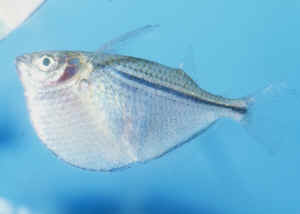
Melissa. Hatchetfish are very prone to Ick/Whitespot, which is why I
recommend quarantining them for at least two weeks before putting them
into a community tank. As you correctly suspect, copper-based
medications that will treat the Ick will also kill shrimps and snails,
so can't be used. (This is, by the way, why you don't add other
livestock to a quarantine tank: doing so defeats the whole object of
the exercise.) But you are where you are, so let's deal with things
as they stand. Salt/heat won't harm shrimps or snails. Snails and
shrimps can indeed carry the free living parasites on the water
"stuck" to their bodies if moved from one tank to another.
The parasites can't live on them shrimps or snails, so you can QT
both by putting them in another tank for a few weeks. This will break
the life cycle as the free living (= juvenile) parasites die if they
cannot find a host within a set period of time (around 24 hours, but
depends on temperature and other factors). Salt dips won't work:
you MUST expose fish, shrimps and snails to the salt/heat combo for the
requisite period of time. Cheers, Neale.> Hi Crew-- I (and my fish) appreciate all the time and work you put into this site. I'd like to know if any of you can answer a question I have about my 55 gallon tank. I just put it back up (was on the porch after its previous inhabitants outgrew it and moved on to a larger tank). I wanted to try an Amazon biotope, so I used "play" sand for my substrate, planted some Amazon swords, and put some wood (bought from fish store) in it. I cycled it with BioZyme and some minnows (I QT minnows for my gars, so I was fairly sure nothing icky was getting introduced to the tank). Filtration is an Aqua Clear 110 with carbon removed and extra media in its place. There's also a Coralia air circulation pump that doesn't produce a really strong current; it just ruffles some of the leaves of the plants. The tank cycled pretty quickly, in about two weeks, and after my levels all returned to zero, I purchased 18 Cardinal Tetras, 8 Swartz's Cory Cats, and 12 Marbled Hatchets. The minnows were removed right before the new fish were done acclimating and added to the tank, so I know the cycle wasn't interrupted. I thought I was safe adding fish since the tank was cycled and the fish were all an inch or smaller --maybe this was my mistake. Since putting the fish in the tank, I have lost one Cory and five hatchets. All the fish have died at night, and we find them the next morning. My levels are: Ammonia - 0, Nitrites - .5, Nitrates - 10, and pH - 6.5. The temperature is 78 degrees, and the light runs on a timer for twelve hours a day. I ordered my fish online, and I expected to lose one or two, but these numbers have me worried. As you can see, my levels went up slightly upon introducing the fish, but nothing has ever gotten higher than the figures I mention above, other than nitrates, which are coming down from 20. The fish never "look" sick, though my Hatchets have never really been the "top swimmers" I expected them to be. They stay more in the middle with the Tetras. I'd really appreciate your opinion on what could be going on here, so that I might save the rest of them in time. If I've missed something on the FAQ's regarding this problem, please direct me to it. Thanks again for all you do. --Melinda <Hello Melinda. A few things may be relevant here. To start with, you probably didn't cycle the new tank properly: two weeks is an awfully short period of time to cycle a new aquarium. BioZyme (and indeed most every "bacteria in a bottle" product") is not nearly as effective as the marketing suggests. In the case of that particular product, my understanding is that it isn't meant to mature filters but to help with nitrate reduction. In any case, a good rule of thumb with bacteria cultures is this: if it isn't kept in a fridge and doesn't have a short shelf life, it's probably useless. Plants have no real effect on the speed at which cycling occurs, though fast growing plants (as opposed to Amazon swords) can consume ammonia directly fast enough that a well planted tank can support a small number of fish without the filter being fully mature. Next up, while the minnows will produce ammonia and are hardy enough to tolerate the cycling process, if the tank was being filtered with these fish, I'd expect cycling to take at least four weeks, perhaps six weeks. Regardless of how long cycling takes to finish, there's a danger period afterwards during which the tank is not completely stable. So delicate fish -- such as Hatchets -- should not be added to the tank for a good two or three months after cycling has finished. What you're concerned about are things like pH instability and short-term spikes in ammonia or nitrite. Since you have a nitrite level of 0.5 mg/l, I'm pretty confident that your filter hasn't completely matured and may well be in the "shaky" post-cycling phase where ammonia and nitrite levels can fluctuate. Now, the next thing I'd be worried about is pH. You mention having a low pH of 6.5, which is great for tetras and Hatchetfish, but you say nothing about hardness. One of the very common mistakes people make is to change the pH (e.g., by adding pH buffers bought from the pet store) without changing water hardness first. Be clear about this: pH doesn't matter, except insofar as it is stable. What fish care about is hardness. Marble Hatchetfish need very soft water to do well, and to be honest they're pretty finicky fish at the best of times, so if you aren't 100% sure about how to soften water and how to stabilise pH in low hardness environments, they're best avoided in favour of the much sturdier Silver Hatchetfish. http://www.wetwebmedia.com/FWSubWebindex/fwsoftness.htm Finally, let me make the point that your shouldn't be feeding minnows to Gar (by which I'm assuming you mean Lepisosteus). Minnows (and Goldfish) are very fatty and contain a chemical called Thiaminase that breaks down vitamin B1. So even putting aside the animal cruelty issue, it's just not a very clever way to keep your fish. Gar will eat just about anything, dead or alive. They will readily take chunky seafood. Frozen foods are good because they're safer: anything sold for human consumption will be safe for your fish. Squid is particularly good because it contains no thiaminase at all, and is not very fatty either. Crustaceans (prawns, etc.) do contain some thiaminase so should be used sparingly. My Gar loved oily fish like mackerel, but these make a complete mess of the tank, so while highly nutritious, use such fish meats sparingly and just before doing a big water change! Among the thiaminase-free white fish are flatfish and gadids (cod, pollack, etc.). If you must use live feeder fish, grow your own livebearers, and gut-load them beforehand with algae-based flake food. These are the ONLY safe feeder fish. Goldfish, minnows and "feeder guppies" from the pet store are nothing other than parasite time bombs. Cheers, Neale.>
Re: Hatchet fish deaths
in 55 gallon 11/14/08 Just A Thanks (Oh, and a question) - 10/06/2007 Hello y'all! I just wanted to drop a quick "thank you" note to you for (generally) having a wonderful site and (specifically) for helping me out with an issue I was having. I have as my centerpiece tank a 60 gallon hex (FW). I really wanted to have angelfish, so after cycling the filter on my established 55, I purchased 6 angels and 4 Cory cats. The cories (Corys?) behaved properly, but the 6 young angels wouldn't come out from their hiding spot behind the driftwood. They wouldn't even come up to eat. This is my first time with cichlids, but I knew that when they aren't going for food, something's wrong. I was getting more and more concerned... so I went to work with the searcher. Dither fish do work, it seems. Three hatchet fish, and now my little angel school is all over the tank, and swimming hungrily to the top, constantly telling me they're starving, and basically brightening my room (and life) for the past week. Thanks again, John <John, thanks for taking the time to write. It's appreciated. The use of dither fish is very useful with dwarf cichlids as you've discovered, and yes, they do help. Hatchetfish are lovely animals, though they seem to have a constant appetite, and perhaps need a little more food than you'd imagine to stay healthy. I find a mix of Spirulina flake and small carnivore pellets does the trick admirably, but once in a while I hand-feed mine with small earthworms and the like. Hatchets are skittish at first, but settle down quickly. But always keep the tank covered, as they love to jump! Cheers, Neale> Getting hatchetfish to stay at the top 9/26/06 Hello Crew <<Hi, Tim. Tom>> I got some hatchetfish primarily to make use of the top area of tank. However, it seems that mine prefer the middle of the tank, where traffic is already quite dense. <<Just what you need. More traffic congestion.>> Any idea on how to improve this situation and actually get them to stay at the top. They do go to the top for feeding and when the lights are out. I presume it's a matter of the amount of light it is comfortable with, is this correct? <<I think you've hit on the answer to your own question, Tim.>> How have others handled this situation, e.g. floating plants (which doesn't seem to have helped), etc. <<Floating plants may help diffuse the light, Tim, but they'll also block the "clear shot" that Hatchetfish want when they hang out near the surface. (Little buggers don't wait for insects to hit the water, they jump out after them. No patience, I suppose.) If possible, lower the lighting levels, which I might assume you've already attempted. I would also feed them foods that don't readily sink such as Daphnia. Floating foods might condition them to stay near the top. Beyond that, I'm at a loss, like you, to offer much of a solution to this. Honestly, I've not heard of Hatchetfish "not" staying at the top of the tank. A new on me.>> Thanks Tim Hatchet Fish Question 30 Jun 2005 Hi Mr. Fenner, <Patty> I was hoping you'd be able to help me with this fish question. My hatchet fish is doing something very strange. For the past few weeks, it has been swimming vertically and looks almost like it's doing a River dance jig. Do you know if it is suffering some kind of ailment? <Possibly... damage to its gas bladder... from a parasite? Maybe from too much dry food...> Once in a blue moon, it'll flop down at the bottom of the tank. The first time, I thought it was dead or dying and was about to scope him up when it flipped back up and started doing it's jig again. It has been eating and seems to be aware of it's surroundings. I personally think it might have hit it's head trying to jump out of the tank or something. <Another possibility, yes> Unfortunately, I think it's freaked out the other two hatchets in the tank, who are swimming normally. Appreciate any thoughts about this. <You might want to add another specimen or two... these are social animals. Keep your tank covered! Bob Fenner> Thank you, Patty Hatchet Fish Hey to all, Got a Q about some hatchetfish, but
first a little background. I bought 4 panda Corys 8 days ago and
dropped them into my quarantine tank. Three died pretty promptly (2-3
days), and #4 is still alive and well. Yesterday, I went back to
the store and cashed in my credit for the corpses. I got one more panda
and 4 marbled hatchets. The pandas are friends and two hatchets are
doing their normal hover-just-below-the-surface thing. This leads to my
question: the other two hatchets are hovering about 3/4 of the way down
the tank (about a 10-inch tall tank). Is this normal acclimation
behavior, or should I be concerned? Data dump: 10 gallon QT, well
cycled by adding water from my display. Temp 77-78F, ammonia and
nitrite zero, nitrate << 10ppm. pH ~6.8. Sponge filter. 50w
heater. Plastic plants and decorations. No substrate, just a little
scattered gravel, covers ~10% of the bottom. I've left half of the
plastic plants floating for the hatchets, and half weighed down for the
Corys. Thanks a lot, Chad <Hatchetfish are schooling fish and like
to be left in groups of at least 6 or more. When kept in smaller groups
they fight among themselves to establish a pecking order. In the wild
their food comes from the surface, so the ones closer to the top are
more dominant and probably keeping the others down. In larger schools
they get tired of chasing the other fish and give up so you see them
all at the surface.-Chuck> Mysterious repeated hatchet fish death I have an ongoing
mysterious death problem with common (silver) hatchet
fish. They are in a 24 gallon 5year old community
tank with congenial tank mates. Temperature is 79 degrees, good top
water agitation, chemistry is consistently within specs (PH between
6.5-7). I buy them from a local store with an excellent
reputation with fish maniacs. <Hee heee! Good so far> The
problem: One by one they just quit working. They show no
signs of damage or disease and everybody else is doing just fine. If I
introduce 4 of them, 1 will die within a week or two, a
month or so later another will go down and so on, leaving 1 survivor.
This process has repeated over years (for a while I just gave up on
them entirely) Obviously I'm missing something they need. Thanks
for your time! Peter <Might be a lack of nutrition... for such
seemingly small, inactive fish/es "gastropelecids" are pretty
high metabolic animals... that eat a lot of insect larvae in the
wild... need a good deal of high protein food, frequent feedings to do
well in captivity... Otherwise, I fully suspect that their internal
parasite fauna (all are wild-collected) are showing themselves in your
mysterious losses... If you and I had a "hatchetfish farm"
and were in dead earnest re keeping our herd alive, I would lace their
food with Metronidazole/Flagyl AND a broad spectrum antibiotic (Tetra
and HBH used to sell foods pre-made with these... but I don't know
if they're still about), and feed the new arrivals for about a
month once a day with same... in an effort to rid them of problems...
BTW, this is a not-so-uncommon source of anomalous mortality in quite a
few groups of non-cultured fish stocks... e.g. "wild" angels,
dwarf South American Cichlids, Discus... Bob Fenner> |
|

|
Features: |
|
| Featured Sponsors: |