|
FAQs on the Molly
Identification
Related Articles: Mollies, & Poeciliids: Guppies, Platies, Swordtails,
Mollies by Neale Monks, Livebearing
Fishes by Bob Fenner,
Related FAQs: Mollies
1, Mollies 2, Mollies 3, Molly
Behavior FAQs, Molly
Compatibility FAQs, Molly
Selection FAQs, Molly System
FAQs, Molly Feeding FAQs,
Molly Disease FAQs, Molly Reproduction FAQs, Livebearers, Guppies, Platies,
Swordtails,
|
|
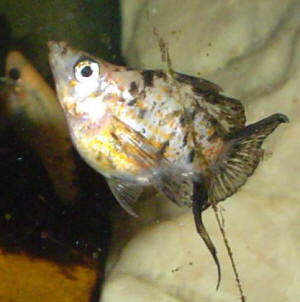
Dalmatian mollies
12/17/10
I was wondering if Dalmatian mollies grow larger than Black
mollies??
At the fish store I was at the Black Mollies were listed as growing up
to 2 1/2 inches and 4 inches for the Dalmatians. Since it was a big box
store I doubted their information, but maybe they were right. Are
Dalmatians related to Sailfins which apparently grow to 6 inches? Also
are female Black Mollies more peaceful than any other molly?? Thank
You!!
<It's difficult to predict precisely how big your Dalmatian
Mollies will get. They're hybrids, so there's a fair bit of
variation. But you can reasonably expect farmed Mollies to get to about
8 cm/3 inches in the case
of shortfin varieties, and 10 cm/4 inches or perhaps slightly more in
the case of Sailfin mollies. The big Giant or Yucatan Sailfin Mollies
(Poecilia velifera) are relatively scarce in the hobby, though they may
be obtained through good aquarium shops and fish clubs. Do read more
about Mollies and their needs here:
http://www.wetwebmedia.com/fwsubwebindex/mollies.htm
Cheers, Neale.>
Re: Tattooed Mollies
09/15/09
I look for an hour to find these fish & understand now why your
were surprised. The two white fish I have are balloon molly's
<Balloon Mollies are some sort of mutated hybrid Poecilia species.
I'm not wild about them, I have to say, but do read my general
comments on Mollies, here:
http://www.wetwebmedia.com/FWSubWebIndex/mollies.htm
>
I was told that they were tattoo for they have purple on one & blue
polka dots.
<Now this is something I'm dead against. The tattooing process
is known to be harmful to fish, and certainly not done in a way
we'd consider humane. Here in the UK, tattooed fish are very rarely
seen, with most fish shops having signed up to a pledge run by one of
the magazines to stop trading them. But elsewhere in the world, you
will sometimes come across tattooed and dyed fish. Please don't buy
them.>
Geez I think the Fish Bowl don't know squat about what they are
selling. Are they okay with the rest?
<Mollies are of variable value as community fish. In theory
they're peaceful herbivores, but they are very sensitive to poor
water conditions when kept in freshwater tanks. They are very sickly if
kept in soft, acidic
water. On the whole, I recommend people keep them with fish that
tolerate slightly brackish conditions, things like Glassfish and
Guppies for example.>
Angels on your pillows, Judy
<Cheers, Neale.>
re: Tattooed Mollies
Thanks for the info & will tell people not to buy them.
<Cool.>
Not a problem here. But they are really playful & (I know its not
true ) but rub against each other & the other fish leave them
alone.
<Yes; Mollies are indeed superb aquarium fish in many ways. One of
the best in fact. But they do have their "quirks" so it's
a good idea to read up on their needs, and act accordingly.>
I did buy a male swordtail he really beautiful but notice the female
are getting aggressive. Anyway Neale I do know your busy & will try
to leave ya alone & will spread the word about the tattoo thing. I
'm hoping that they use a paint brush to do that & not
needles.
<They use needles, hence tattooing.>
will look it up
<The Wikipedia page is accurate and well referenced:
http://en.wikipedia.org/wiki/Painted_fish
>
Hugs
Judy
<Cheers, Neale.>
Giant Sailfin molly
5/1/09
Hey Guys,
I placed a link at the bottom of this email and my related question
is...Is this the Giant Sailfin Molly that was described in the article
about all the live-bearers? They claim the max size is 6.5 inches but
the scientific
name doesn't match the one you stated in your article.
http://www.liveaquaria.com/product/prod_display.cfm?c=830+1101+1022&pcatid=1022
<The true Giant Sailfin Molly is Poecilia velifera (Mollienesia
velifera, according to some authorities). It is virtually absent from
the hobby, and it is 99.9% likely that the fish sold at that pet store
is a hybrid Poecilia of some sort. Giant Sailfin Mollies are traded
through biological supply houses, and some livebearer clubs may auction
them, but in 25 years of fishkeeping, I've seen them in a pet store
just once. Partly, it's unpopular because it comes in just one
colour -- wild-type green -- and is also extremely delicate, requiring
a big, exceptionally well maintained (nitrate-free) aquarium with warm,
slightly brackish water. Cheers, Neale.>
|
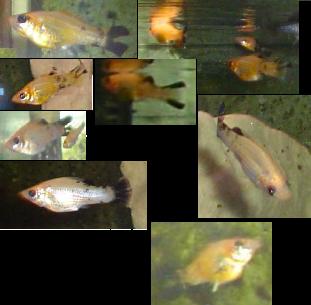
Unusual mollies 11/6/08 Hi, folks-
I have some unusual mollies in my tank. Mother was a large
wild-type, not full velifera, maybe half. Father unknown, as I
only have one male, and he is sterile (fancy white Lyretail
balloon). The mother dropped two nice broods before passing on.
Each brood was made up of about 75% of these unusual fish, with a
few blacks and a few wild-types thrown in. The unusual
mollies here have yellowish translucent bodies with black
spotting especially on dorsal and tailfin. They have black
(rather than silver) pigmentation on the organ cavity lining,
giving them a "black-eyed pea" quality. The
translucence and black interior combines for a very unusual
appearance. The overall appearance is more like a golden wagtail
platy than any molly I have ever seen. In the photo, ignore
the fancy balloon mollies and look at the plain-ish young mollies
behind them. Sorry for the poor photo. Might I have a new
variety here, and what is the likelihood they will breed true?
Ken <Ken, this is clearly some kind of deformed balloon Molly.
Since all balloon Mollies are deformed at some level, seeing
variations on the theme isn't that uncommon. The genetics
will likely be incredibly complicated, and there's no way to
test if the deformity will breed true; only careful
cross-breeding and observation of successive generations will
provide the data you want. I'm not a big fan of Balloon
Mollies I'm afraid. To me they all look absolutely hideous!
So I guess beauty is in the eye of the beholder... Cheers,
Neale.>
More unusual molly pics
11/07/08 A couple of interesting features in these fish,
aside from the black organ sac pigment and translucent
appearance- they all have very black pigmented eyes, and at
half-grown, they show clear lateral segments, as if their flesh
was like the segments of an orange, only horizontally. This is
much more clear in person than in the photos. <Each to their
own I guess! I'm still not a fan of Balloon Mollies, even
unusual ones! There are any number of livebearer clubs around the
world; you might want to get in touch with the serious Poecilia
breeders out there, and see if you've actually come up with
something special. Good luck! Neale.>
|
 |
Wild mollies, ID, sel.
9/27/08
hi
i live in the united kingdom and have kept a few Sailfin mollies. i
would like to have a fool grown molly of about 6" and i feel the
best way for me would be to raise wild mollies as i feel tank bred
mollies may have stunted growth due to cross breeding and
interbreeding.
<Your analysis is correct. The Sailfin Mollies sold in shops are
primarily Poecilia latipinna, but likely hybridised with other species
or else strains developed for colour rather than size. While these
Sailfin Mollies can get to about 10 cm or so, they don't ever seem
to reach the full 15+ cm lengths possible in the wild for either this
species or the related Giant Sailfin Molly (Poecilia velifera).
However, genetics is not the only factor. Mollies have been studied by
scientists because their size is dependent not just on genes but also
the social structure of a population and environmental factors (i.e.,
diet and water quality/chemistry). In other words, it's
complicated. Male body size is smallest in dense populations, in the
wild at least, so keeping a single male alongside a group of females
might work best. Mollies, like all other fish, grow fastest when young,
and while growth slows down as they mature, it doesn't stop. Among
breeders, it is said that male Mollies stunt very easily if overcrowded
when young, so one approach to take might be to rear a new generation
of Mollies at home, and remove some of the males to a very clean,
spacious tank so that stunting couldn't occur. This is likely
related to the observation mentioned above, that in the wild males are
smaller in denser populations.>
can you help me in finding either young wild Sailfin or about 2 pairs
of adult wild Sailfin mollies.
<In the UK, wild-type Poecilia velifera or Poecilia latipinna simply
aren't traded. If you want them, you have two options. The first is
to place a special order with a retailer you can trust. Several stores
handle top quality wild-caught fish, for example Wildwoods in London
(who do mail order as well as being retailers). What you don't want
is a retailer passing on plain Green Sailfin Mollies as wild-caught
fish of either species: Green Sailfin Mollies may look the same, but
they're captive bred and likely won't get so large. Your
alternative is to contact a livebearer special interest group, such as
the British Livebearer Association. This group has auctions at which
you can buy fish carefully bred to ensure they're not hybrids.
These will be cheaper than wild-caught fish, but just as good.>
thank you
<Cheers, Neale.>
WetWebMedia has just sent you $400.00 USD with PayPal, note to
place Neale's work 5/23/07 Bob, Thanks for
the payment! Glad to be of service. If there's anything else
you want from my back catalogue, let me know. <Mmm, likely anything,
all that will fit Neale... in time, when you can use the money, relief
from incessant, repeat questions that your in-print work will inform,
inspire otherwise... Send them on> Curious you still use Mollienesia
for mollies. Haven't kept up with the taxonomy, but I agree
that there seems (to me, a paleontologist) a need for subgenera at
least within Poecilia. The variety within the genus (sensu lato)
strikes me as rather wide. <Mmm, a brief stmt. re: I default to
"the more/most common" scientific "nomena" for
hobby use by and large... With a nod to standard ref. works if this is
warranted... "The medium is the message" as one way states
this succinctly> It's funny what *doesn't* get printed by
magazines. I wrote a piece I thought was rather good on
"stuff not to put in your aquarium", basically review of
non-aquatic plants, amphibious critters, non-essential additives, etc.
Did they want it? No, presumably because "negative"
pieces don't play well with the retailers <Too likely so> --
though I think retailers shouldn't sell stuff that won't
thrive in freshwater tanks. I guess you have the same argument
over coral-eating butterflyfish and fussy nudibranchs. They're
in the trade, but why? <Mmm, simple response: "Because
they're available and they sell"... Not a real reason/cause
per accidens, but is the ultimate rationale. B> Cheers, Neale
| Do I have platy or mollies?
9/4/06 Dear Fish Guy(s), Gals? <A male this time>
For the last three months I've had what were sold
to me as and I *thought* were platy's. After doing some
searching on the web, I found a pic that looks like them (attached
to email) and wondering if instead I have mollies? <These are
mollies> One of them recently had fry, and a couple are still
hiding and alive, my Betta enjoy snacking on the rest. While some
people have told me it's "mean" to let this happen,
<Mmm, anthropomorphisizing...> it keeps the bio-balance of my
tank in order, as I have no place for hundreds of fry to grow up
right now, plus Mr. Betta loves the live snacks in addition to the
rest of the well varied diet all my fish receive. My question, is
if it looks like I've got mollies instead of platys?
<Yes> I'm a new hobbyist to the fish world, and watching
the fry be born was neat, but I think Wal-Mart inadvertently may
have sold me the wrong species, and new me didn't know the
difference. <Happens> I enjoyed watching the birth experience
and the little specs of rice sized babies swimming around, so I
bought a male red-wag platy yesterday - after doing searching
online, reading through your site, etc., I am confident that he is
indeed a red wag male platy. My new guy is quite horny, moving his
"sex fin" (?sp "gonnopium") <Gonopodium>
and going after the females and trying to mate but jabbing it in
them. Obviously I've read the two species (mollies &
platys) are not compatible <Mmm, are compatible usually> but
would like more fry. Right now, I don't have a web cam, so been
doing searching of online pics trying to figure out what I have so
I can either trade or buy either a molly male or trade my current
females for what I know are platys at the local fish store. I
prefer platys both for the beautiful colors, but I have a small 10
gallon tank and may be a couple months off from upgrading to a
larger, starting the new cycle, etc, so right now for fish smaller
is better. I have 4 female unknowns, 1 male platy, 1 four year old
betta, <Wow, old!> 2 dwarf Corydoras, 1 regular size
Corydoras, 1 upside catfish, and 3 (platy or molly) fry who
haven't been eaten. Water changes regularly to keep nitrates
and nitrites at 0 since I'm sort of overstocked. PH is usually
about 7.1 - 7.2, water hardness of 300, alkalinity of approx. 110
(local treated tap water) Thank you for any help on this one.
<... Would be looking into another or larger tank... Bob
Fenner> |
|
|
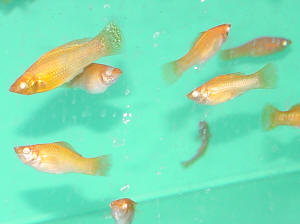
Mollies and Platies and Swords, Oh My! -
04/20/2006 Hello WWM Crew, <Hi, Chad!> I've just spent
much time scrolling through your pages on mollies, platies, and
guppies. Found lots of useful info on breeding, feeding,
treating, what do to with fry, and sexing... but can't find - maybe
I missed it - an answer to my question. Is there a way to
tell a molly from a platy from a female swordtail?
<Sure.... though differences may seem subtle until
you've seen many of all.> I have a Mickey and a twin-bar, both
platies as I believe they're the only ones colored this
way. <Can find some Mickey mouse swords, now, too.> A
few days ago I bought an all-white one and an all-red
one. They were labeled mollies at the pet store, but who
knows if they even know. They are all getting along and all
look similar, if you ask me, except maybe for the fact that the new
ones are slimmer, especially the red one, but it's smaller
altogether. I've seen pictures online of all-red
platies, mollies, and swordtails. Haven't seen an
all-white platy yet. <Hmm, where to start, and how not to make it
more confusing.... Platies and swords have been heavily
hybridized with one another over the years; you will be very
hard-pressed to find a platy that hasn't been crossed with a sword
or vice verse somewhere down the line. Some platies even
develop small "swords" on their tails. Mollies
aren't hybridized with either of these, and are usually very easy
to tell apart. They'll have sort of.... well,
a different body shape.... kinda tough to
describe. I would recommend that you go to a few different
fish stores and look long and hard at some of each of these types of
fishes; you'll develop an eye for it in no time.> Thanks for
your time. <Glad to be of service.> -Chad Soucie <All the best
to you, -Sabrina>
Balloon fishes 2/1/06 Dear Wetwebmedia,
<Ivy> What is the difference between a regular Molly or Ram and
their "Balloon" version? How did this difference come about?
Is one less healthy than the other? Thank you. <The
"Balloon" types are "sports", human-made/allowed
mutations... same species. "Made" by naturally occurring
variation and selection by breeders. Sometimes such mutants are more
"aquarium-hardy" than wild-types, sometimes not. Bob
Fenner>
Sexing Mollies - 10/28/2005 How do I sex the Balloon Bellied
Molly? <Same as with any other molly. If the anal fin is long and
"pointed", it's a male, if the anal fin is rounded and
"fan-shaped", it's a female.> What colors are they
found in? <Mm, I've seen several.> Are there any rare colors?
<I doubt it. They seem pretty readily available.> I'm new at
this. Just got a new tank set up yesterday for freshwater tropicals. I
have 10 Bettas too. I love watching my fish. Please help. <Wishing
you well, -Sabrina>
How do I tell if my Molly is a male or female? Hello to all
at WWM, <Hello to you!> I have a crazy question. <Can't be
as crazy as some of the ones my kids come up with'¦> We
bought 2 marbled mollies and were told that one was male and the other
female. Then while paying someone in line behind us said we
had 2 females. How do I tell the difference (possibly with visual
aid?). I read all through the FAQ's about the differences but I
really need a picture they all look the same to me and I can't seem
to get a clear image in my head about what the males look like vs. the
females. Any help would be most appreciated. <Well, I don't have
a picture to send you but if you look closely at their anal fins you
can tell by the shape. The anal fin on a female will be shaped much
like a fan. On a male it will be thin and pointed. This is the surest
way to tell on livebearers.> Thanks in advance for any help offered.
Amy <You're welcome! Ronni>
Guppy tail mollies: fertile? Hi Ananda, <Hi again!>
Wow! Where do you live? <Chicago area.> I haven't
seen any snow for several years and I miss
it! Consider yourself lucky (if you can stand the
extra work it creates!) <The snow here is minimal compared to what I
grew up with in northeastern Minnesota!> I'm really writing to
answer the question about the two female Mollie's
ages. They were fully matured when I purchased them so I
don't really know their true age. I got them at Pet
Smart, so maybe that would give you some idea of their
ages. They look like they came from the same parents because
they both have extra long tails (not lyre tails). Maybe that
can tell you something about their genealogy too. I was
attracted to them because of their unusually long tails, almost like
male guppies! <I bet you have the so-called
"guppy tail mollies". I've seen those only once, and they
were quite expensive. I've been trying to find out more about the
genetics of them, but they're so new on the market, it seems no one
is talking about that yet. As yours are both balloon-bellied and
guppy-tailed, it's possible they're sterile -- I know the
balloon-bellied mollies are highly inbred, and I suspect the same is
true of the guppy-tailed.> One of the females is also having
"the shimmies." Is that because of the
parasites? <Could be. Usually, thought, when I see my
mollies shimmy, I take that as a sign their tank needs some more salt.
I have ridiculously hard water, so I can keep the mollies in a
freshwater tank, but I've seen that a few individuals are prone to
shimmying or pop-eye unless they are in a brackish tank. I imagine you
might see that sort of thing more frequently in the highly-bred
varieties you have.> What causes the parasites to come from
"nowhere" like that. I mean, I didn't buy new
fish with ich on them or at least I didn't notice any. <That
last bit is the key -- you didn't notice it, but it was quite
possibly there. Ich has multiple stages in its life cycle, one of which
is invisible. And here's a question -- did you let any of the water
from the fish store into your tanks? If you did, that's definitely
something to avoid in the future.> Thanks again, Leslie
<You're quite welcome! --Ananda>

