|
Re: Hoplarchus psittacus not feeding
1/24/19
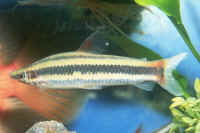
Im send you the link of the Anostomus. They are boisterous among themselves but
are oblivious to any other fish.
<I bet! Anostomus are notoriously cranky in home aquaria. They sometimes chase
similar-looking fish, but otherwise make good aquarium residents with robust
community species.>
They dont look too big in the photo, but they are. Theyve been here for over 4
years. I guess they dont have much longer? :(out of a group of 8 I've only lost
one so far.
<They live a while. My singleton has to be a good 8 years old by now.>
Update on psittacus. I did a deep substrate cleaning ( quite hard to reach every
area in such a densely planted tank). I also remembered what used to happen with
discus and low temperatures. The tank stays at 25 during the day, i raised the
temp to 28 over night. The psittacus has fed all day!
<Nice!>
Not as much as the rest but he's definitely bolder and swallowing food. No
spitting. He has taken tablets and pellets so far. Im making some room to add
driftwood right now. Lets see if he keeps eating.
<Indeed; do watch oxygen levels as you warm the water up.>
In 5-6 years this aquarium has suffered quite a few plagues due to inexperience.
Last two years have been pretty stable. Since its a planted tank it will
naturally tend to accumulate detritus and an increasing amount of decayed mulm.
I guess it would be a good idea to restart the tank?
<Not necessarily. To a degree, fish consume the decaying organic material,
particularly Anostomus, which seem to be as much detritus and algae eaters as
anything else. Rebuilding a tank can make sense, but it's not something to
undertake lightly, and does lead to stress for the fish. Of course the main
thing is that the filter is happy, so keep that running in a bucket of water so
that the bacteria aren't stressed.>
If i miss maintenance for more than 3 weeks fish start to get sick, something
which does not happen in my other tanks which are relatively more stocked. Is
there such a thing as a "sick" substrate? Holding opportunistic pathogens?
<Not really. Pathogenic bacteria are all over the tank already -- Aeromonas in
particular. Mature, deep substrates have anaerobic conditions that hold the
bacteria that get rid of nitrate. That's a good thing. When you rip up the
substrate, most of those bacteria will die, so nitrate can accumulate faster
between water changes. That's a bad thing! Another risk is you suddenly expose
hydrogen sulphide produced by anaerobic decay into the water. Assuming you
remove all the fish first, this shouldn't be a danger to them. But if you leave
the fish in the tank while removing the substrate, it's a potential danger,
especially if water circulation is poor. Cheers, Neale.>
Re: Hoplarchus psittacus not feeding 1/24/19
<These certainly look like Anostomus ternetzi to me! Nice fish, a little smaller
than Anostomus anostomus, and generally a bit less aggressive. Neale.>
<<RMF, have attached the photo.>>
|
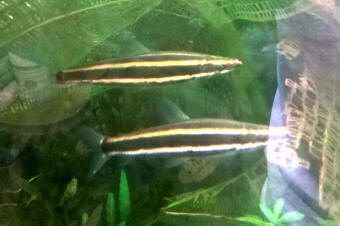 |
Presently own 2 Lepo
11/7/10
<... Leporinus sp.?>
both are over 6 inches in length.
<... likely fasciatus>
Just recently the colour of the back half of the body has turned back
to black and the tail fin is now black as well. Is there any reason
why?
<Neurological damage>
They eat flake food only, temperature of the water is 70 -- 72.There is
a kissing Gourami, a Golden Sevrin
<Ignorant, no>
, tiger and albino barbs in the tank as well.
<... search WWM re the above terms. Likely your Pencilfish
"jumped", damaged itself. Bob Fenner>
Tiger Barbs - would they survive with my current mix of fish
9/24/08
I've corresponded with Neale before, so wouldn't mind making a
shout-out/saying another friendly hello.
<Seems to be on a hiatus today>
What I was wondering is a compatibility question. I have the two banded
Leporinus, now about 8" long. The male is a little bigger and
brighter than the female. Also, two full grown cichlids, one enormous
and lazy plecostomus, a smaller Pleco, puffer fish(he's my
favorite), and what I believe is a peacock eel (approx. 15" in
length).
Everyone gets along good fortunately. What I wondering is if a school
of tiger barbs would survive with the current mix. My main concern is
the size, as the ones at the pet store are teeny tiny. With plenty of
hiding places, do you think the addition of the young tiger barbs would
be survive in my 100 gal tank?
Skye
<Mmm, maybe... though these Leporinus (likely L. fasciatus here) can
be VERY mean/picky, they can't likely catch up with Tiger Barbs in
this setting, and Peacock Spiny Eels rarely eat other fishes. I would
be tempted to try to "grow them up" a bit elsewhere (they do
grow quickly given frequent feedings, water changes) ahead of actual
introduction in your larger system... but I give you good odds of them
getting along here. Bob Fenner>
Re: Tiger Barbs - would they survive with my current mix of
fish 9/24/08 Hi Bob! Thanks for your reply. <Welcome
Skye> My banded Leporinus are VERY mean. <VERY typical for this
species> I didn't know what they were when I got them, but
within a month, they had an expensive meal after devouring all my Bala
sharks - and they(the banded bee looking fish) were only 1" at the
time. <Now that they're larger they won't be quite so easy
to navigate...> On the tiger barbs, I'm going to go with your
advice, and grow them a bit in my hospital tank (while crossing fingers
that no one in the big tank gets sick), before introducing them.
<Ah, good> If I took a picture with my cell phone and emailed it,
would you be able to tell me which variety of Leporinus I have? Thank
you for your other reply. Skye <Mmm, yes... but don't see it
attached here. Take a look under the genus on Fishbase.org or on WWM...
BobF>
|
Gender on my black banded Leporinus
- 6/3/08 Any way I can tell the gender differences on my
black banded Leporinus fish? <No; though like most characins
you can expect females to be (perhaps) a big bigger and (almost
certainly) much more rotund when filled with eggs. Maturity
supposedly comes at lengths of 15 cm (according to Fishbase)
while maximum size is around 30 cm.> I've had luck with
everything else I have bred, but the info on breeding these guys
is far and few between compared to other more common fish.
<Part of the problem with Leporinus fasciatus is that it is
rather an aggressive towards its own kind as well as highly
predatory fish. It is also a notorious fin- and scale-eater. It
may well be a gregarious fish in the wild (most Anostomidae are)
but you'd need a huge tank and at least six specimens for
that to work out in captivity. The end result is that most people
keep them a single specimens in large, rough-and-tumble show
tanks rather than community systems. This makes the demand for
them rather small, so little effort has been put into breeding
them. As far as I know all specimens in the trade are wild
caught. A beautiful fish, but a very challenging one. You might
be better off with Anostomus anostomus, a smaller, less
aggressive species that is easier to keep in groups and has --
very occasionally -- been spawned. According to Baensch vol. 1,
this species spawns like Chilodus punctatus.> Thank you! Skye
<Sincerely, Neale.>
Re: Gender on my black banded
Leporinus - 6/3/08 Neale, Thank you so very much
for a prompt response. <Happy to help.> Right now, the
*only* other tank mates they have are Bala sharks.
<"They"? You have more than one...? Do be very
careful -- Anostomidae generally become intolerant of one another
as they mature. You may be lucky of course and have too females
or whatever... but do keep an eye out for fin damage.> The
Bala's school together and they all seem to leave one another
alone. <Cool. But do watch what happens, and make sure this
tank is big enough for all these animals.> The community tank
is separate (and smaller) since from what I knew, they are
aggressive. <Indeed they can be. Not always, but often.
Cheers, Neale.>
Re: Gender on my black banded Leporinus --
6/4/08 Hello again Neale! <Hello!> The guy who gave me
these said they were attacking his other fish, hence have me the
two black banded Leporinus. The other (freshwater only) fish I
have bred was only done for the fun of it, so I have given many
away on Craigslist, and is the way I meet people and other
enthusiasts. <Fish breeding is great fun. It is also (in my
view) an objective test of your fishkeeping skills: happy,
healthy fish breed; unhappy fish do not. So if you're getting
baby fish, your skills are proven. Of course some fish are more
challenging than others, so it's fun to work up the
difficulty scale as your skills develop.> The origin on these
two I likely will never know. It took a lot of web research to
figure out what they were called. After seeing pictures, I'm
positive on what they are. <Leporinus should be very
distinctive in size, colouration, and also the shape of the
mouth.> They are about 5.5-6 inches in length currently, so in
the 75 gal, I expect they will reach adulthood. Was hoping if
there was a way to sex them, I would be able to find a way to
attempt breeding. <I'm sure its possible, but there's
nothing published on it. Read up on the other Anostomidae first,
and expand outwards from that.> The Bala sharks are all I had
in the one tank, so reason I added the Leporinus in. Didn't
want my tetras eaten. <Indeed not.> Just for prevention, I
have added Melafix and anti-ich to ensure them a good chance at
survival. <Prophylactic treatment is often pointless, and
sometimes risky because things like formalin and copper are, to
some degree, toxic to your fish. Melafix is of questionable value
at the best of times.> So far, no nipping, chasing are mean
behaviors. Luckily the tank is by the computer so I can watch
them VERY close all day. <Very good. I keep pufferfish in the
community tank next to my Mac, and so I get to keep a close eye
on things. That's allowed me to establish which species are
safely mixed with puffers and which are not. People do keep
Leporinus in mixed species tanks, it just isn't something you
can assume will work in every case.> Skye <Good luck,
Neale.>
Leporinus vs. Pleco
6/5/08 I recent wrote and had a nice email exchange with
Neale. I had been given a couple of banded Leporinus' who
date leave my Bala sharks alone. The Leporinus' are about
double the size of the Balas who are only six months old. What
surprises me is that I had to move my plecostomus to a hospital
tank. The Pleco is larger than the Leporinus' and I thought
of all fish, he was last I'd need to move. They kept nipping
and attacking the poor thing! <Absolutely typical for
Leporinus I'm afraid. Providing a deep cave in which the Plec
can hide completely can help, though the catfish will become
completely nocturnal if it feels unsure about swimming about
during the day.> Could they be "immune" to the
Pleco's dorsal stinger - the area where they kept pecking
at)? <Not aware that any of the Loricariidae actually have
stings. While it is true the pectoral and dorsal fin spines are
serrated, I don't think they have venom glands.> The Pleco
doesn't show signs of injury and is in a small 10 gal
recovery tank alone in the interim for his own safety and
relaxation. <If the Plec is a big one, do check water quality:
a 10 gallon tank isn't going to usefully dilute the ammonia
produced by a big catfish.> The Leporinus LOVE to eat peas,
and I thought about dropping some tasty ghost shrimp in to see if
they like those. Either way, they are quite graceful despite
being a larger fish and fun to look at. <Indeed they are
lovely fish, and very opportunistic feeders, and need a mix of
greens and animal foods. I've watched them destroy heads of
curly lettuce, and don't even think about putting them in a
planted tank!> Skye <Cheers, Neale.>
To Neale. I had acquired two banded Leporinus.
07/07/08 I have previously written to Neale. <'Tis
I.> This is just a happy update on my fish. I had acquired two
banded Leporinus. They originally were about the same size as my
Bala sharks. Now that have easily doubled in size, but seem to
like each other. <Lucky! Often these fish become quite
territorial, though they are presumably schooling fish in the
wild.> They've been doing this "kissy" motion on
the lips with each other once in awhile, and will do this
"quiver" looking dance while side by side. One now has
just a slightly more prominent belly. Another behavior I observed
that I haven't seen any other fish do; they will pick up
rocks (the pea sized gravel stuff) from the bottom of the tank,
and in one corner in particular, keep moving the rocks from
there, making a notable dip. <Interesting. Perhaps
nest-building behaviour; they inhabit rocky rapids, and like
other fish from such habitats may make gravel nests to shelter
their eggs.> I put a few of my mollies in the tank now with my
"bumble bee fish" (Leporinus - I think they look like
swimming bees). They leave the mollies alone and couldn't
care less. I leave ample hiding spots and plants in the tank just
in case anything were to happen while I'm asleep so that
things have a chance. A couple of the mollies are very pregnant
and seem perfectly happy, so I'm hoping there will be a
delivery of live fry on the menu real soon. My swimming bees have
also gotten friendly to the point they will swim up and eat food
from my fingers. <You're doing remarkably well! Usually
these fish become aggressive or at least nippy; they are
omnivores in the wild, and apart from their staple plant-based
diet they also eat small fish and the scales/fins of larger
fish.> I'm having a lot of fun with these unique fish, so
hope to have them for years to come. I read somewhere they can
live 35 years! Skye <In the "Baensch Aquarium Atlas"
the authors comment that no-one can call themselves an aquarist
until they've kept Anostomidae, the family to which your
Leporinus belongs. I'm sympathetic to that viewpoint.
Although problematic and challenging in many ways, they are also
exceptionally characterful and offer lots of curious behaviours.
That combination of difficulties and rewards is what makes them
an objective test of one's fishkeeping skills. In any case,
I'm glad you're enjoying your fish, and look forward to
some pictures of their nests and social behaviour! Cheers,
Neale.>
Re: Leporinus; diet, behaviour
7/22/08 Hi Neale! (or whoever intercepts this message, could
you pass along to him please? Thanks!) <It is me.> I've
written about my 2 banded Leporinus. I'm amazed how quickly
they continue to grow! I always keep a vacation feeder tablet or
two in my tanks (and throw any left over, if any, away after 1-2
weeks.) If the fish have not had their fill of flakes, bloodworms
or brine, there is always a treat to peck at. So far, everyone
has stayed plump, healthy and happy. The Pleco who was initially
nipped up has healed, returned to the main tank, and thinks the
tabs are for him. He's growing quite fast as well. <All
sounds great. I'd perhaps skip the "vacation feeder
tablet" as being a waste of money. Stick in a half a head of
lettuce (or cheap aquarium plants like Elodea) and both the
Leporinus and the Plecs will enjoy themselves without any water
quality/chemistry problems. Vacation feeder tablets are mostly
chalk, so all they really do is raise the pH and carbonate
hardness. Do remember that fish don't need to be fed over
breaks less than a week. Fatten them up beforehand, stick some
aquatic plants in the tank for them to graze on, and that's
it! Without (much) protein in the system, you are less likely to
have water quality problems while you're away, and water
changes aren't so important.> The interesting thing I am
writing about is what my banded "bees" are up to. I was
recently out of town for several days, so had a friend watch
after the fish. Just in case any feedings were missed, I
sprinkled multiple 3 day feeder tablets into the tanks. I have
returned to fine the "bees" have picked up the majority
of tablets and moved them to one corner of their tank.
Incidentally, this is the same corner they have done the nesting
behaviors of picking up the gravel rock at the bottom of the tank
and moving it around. I have never seen a fish pick up and hoard
feeder tablets. Would you say this is a nesting, territorial or
hoarding type of behavior? <Absolutely no idea! There are no
reports of breeding behaviour in this species that I'm aware
of. What they are doing does sound like nest building, though
provisioning a nest with food is not something fish tend to do.
My guess would be they simply used the tablets as
"pebbles" and thought no more of it. Hoarding food is
difficult for fish because water currents would tend to empty the
hoard quickly. The closest thing I'm aware of to that is
Damselfish guarding their "farms" of algae, but
that's really a form of territoriality, just concentrated on
a feeding patch rather than a nest. In any even, it would be
great to see some photos of this behaviour.> Hope you are your
fish are well. Skye <Thanks for writing in! All very
interesting! Cheers, Neale.>
|
Picture of the Leporinus
9/27/08
Bob, Neale, crew;
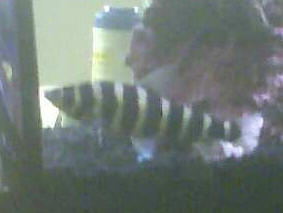
This is a picture of the boy. He is about 6-8 months old.
I'm pretty sure
this is a banded Leporinus.
Skye
<Is a L. fasciatus. BobF>
|
 |
Re: Picture of the
Leporinus
Thank you Bob. I'm glad uploading
the picture worked! As I understand, the
L. fasciatus is the common pet-store variety?
<Yes... the most common, though have seen a handful of
species of this genus, sometimes a dozen or more of the
family/subfamily in older literature, at "more
progressive", larger stores. BobF> |
|
|
Re: Dramatic Fish or Personality Disorder?
Leporinus 12/5/08 Hi Neale! <Hello!>
Nice to hear from you again. Perhaps you don't remember me,
as I'm sure the crew gets inundated with emails on a regular
basis. <Indeed we do!> You've given me a lot of great
advice on these black banded Leporinus fasciatus before. The ill
look they had after cleaning the inside resolved minutes after I
finished siphoning the rocks. They are curious and will get
within a couple inches of the glass to look at me, but any sudden
movement and they swim away. <Sounds typical for the species.
This is indeed typical behaviour with large characins generally:
curious, but nervous.> In the attached picture, my puffer is
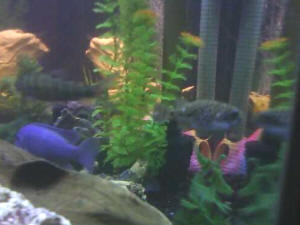
on the right side of the pic. This picture is a little older, as
the banded Leporinus (I have 2) are about double the size now.
The puffer is about 3 years old and one surprisingly docile for a
fish. I had to add hiding spaces, as he was the one the Leporinus
were picking on. He's never pecked at anyone, and
couldn't seem to care less about the other fish. He does puff
as a defense mechanism when chased, which fortunately is not
often. My computer is set up next to the tank, so I'm
literally watching my fish hours per day, turning the lights out
so they have downtime when I go to bed. <Hmm... does look like
a common or garden Tetraodon nigroviridis to me, rather that
Tetraodon cutcutia (the species traditionally called the Emerald
Puffer in the hobby). Tetraodon nigroviridis is an odd species in
some ways: while adults are supposedly freshwater fish in the
wild, with juveniles being found in brackish water, in aquaria
they seem to do better across the board kept in brackish water.
Specimens in brackish water get bigger and live twice as long.
Some folks recommend keeping adults in marine tanks! You may well
be lucky, but if your specimen ever starts showing odd colours,
persistent fungal infections, etc., then it may well be time to
move him to at least slightly brackish conditions.> The cobalt
blue cichlid in the pic (your crew assisted in identification of)
was unfortunately the result of a fatal attack by the Leporinus.
They got his eye, gill and mouth. I put him in a hospital tank,
but his injuries were too much for him. The Plecos like to suck
on the glass on top of the tank (divided in sections of it), and
the Leporinus always chew up the dorsal fins <Leporinus are
indeed "fin biters" and wild fish likely eat small fish
as well, so they're certainly opportunistic predators to some
degree. They're quite fashionable additions to Malawi-type
community tanks here in England, and you'll often see them in
display tanks in department stores and sushi bars, alongside
bright blue Mbuna and so on. But as you're observing,
they're less than trustworthy animals.> My salinity is
probably negligible. 1 tablespoon per 5 gal. <Indeed, doing
little if anything useful or harmful. Do be careful with salt
though: some vets maintain it is a stress factor on Mbuna,
leading to the infamous Malawi Bloat syndrome. Not everyone
agrees, but it's something to consider. When keeping Mbuna,
it's more important to maintain a reasonably high carbonate
hardness; if you do that, everything else "comes out in the
wash" as we say in England. In other words, take care of the
carbonate hardness, and general hardness and pH and pH stability
usually balance out just right all by themselves.> Everyone
seems happy, healthy and active. It was later I read that the
banded guys are native to freshwater, but no "burnt"
looking fins or signs suggestive in an adverse way. Also, they
peck lips, build nests, and are happy. <One tablespoon of salt
is about 18 grammes of salt (one teaspoon is 6 grammes). So
that's about 18 grammes per 18 litres (5 gallons), or a
gramme per litre. Normal seawater is 35 grammes per litre, so you
have one thirty-fifth normal salinity, obviously not much at all.
You could drink that salinity and be fine!> Thank you for your
answer to my other email. You answer my question well in that
they (the Leporinus') are a naturally nervous fish. <There
you go!> Neale, do you have a 'private' or separate
email so I can send you better quality pics sometime, and just
say hello, share what's up with my finned friends? Skye <I
do, and it's on my web site, which you can find by Googling.
But I'd suggest subscribing to the WWM forum, and that'll
allow you to upload links to high resolution images just fine
(there are various free image hosting sites if you need one, such
as Flickr). Give me a heads-up, and I will stop by and comment,
and the advantage is that other folks can take a look and
contribute. Cheers, Neale.>
|
 |
Leporinus fasciatus... Potentially HUGE fish in Small
Tank 8/15/07 Hello again, <Hi, Pufferpunk here> I recently
purchased a Leporinus fasciatus, <Grows to a foot, minimum tank size
70 gallons.> as well as a Pangasius catfish, <Grows to 4 feet!
See: http://www.planetcatfish.com/catalog/image.php?image_id=5186 These
fish do not belong being sold to the general public.> for my 29
gallon tank. They are in there with a small Columbian shark <A
brackish schooling fish that grows to 18".> and a plecostomus.
<Common Plecos grow to 18".> Recently I noticed the
Leporinus has torn skin [a large white/clear piece hanging off one
side]. I caught him in the net to have a closer look, and that piece
fell off as soon as I did. After letting it go, I removed the carbon
from my two filters, and added a dose of Melafix and some StressZyme.
Now there just seems to be these white blotches on that one side.
I'm wondering if maybe the catfish and Leporinus are fighting,
since both seem to like this one corner of the tank. Or maybe there is
something else wrong. I do know that the Leporinus is a brackish fish,
<Not true.> and I do keep the salinity at a constant level.
<Only helpful for the Columbian shark. Most folks assume a
"little aquarium salt" is brackish but this doesn't make
brackish water. None of your other fish will appreciate salt in their
environment. If you're not using marine salt & measuring it
with a hydrometer, it won't make much difference to the shark
anyway. Even low-end brackish water would require around a cup of
salt/5g.> I'm hoping you can shed some light on this problem as
I do not want him/her to go belly up on me anytime soon! Thanks! <My
take on this is: The Leporinus is a very skittish, active fish (needs a
tight-fitting cover, to prevent jumping), that needs a lot of swimming
room, as is the Columbian shark & the Pangasius catfish. I think
they are running into each other trying to swim in a tank that is too
small for them & running into things. Please check into the adult
sizes of the fish you plan on purchasing, before you buy them. I think
you have BIG problems ahead. Until you can return or rehome your fish,
Melafix & water changes should heal the wound. ~PP>
Black Ghost Knife w/ Rainbow Shark? <& Banded
Pencil?> - 05/01/07 Good afternoon! <Christina> I
apologize if you have answered this question before but I have looked
through numerous Internet sites including reading most of your FAQs on
BGK compatibility without finding much of an answer for my specific
concern. Let me start off by saying that I fully realize that within a
couple of years, I will need to purchase a MUCH larger set up and am
already planning for it, I just do not have the floors to handle it at
this time. For now, I have recently set up a 30 gallon aquarium, have
let it cycle, and purchased 2 "diamond" tetras, one honey
dwarf gourami, and a 4-5" BGK. My hopes/plan was to incorporate my
10 gallon fish that have a great need for a larger tank (one 4"
angelfish, one 4" Banded Leporinus and one 4" Rainbow Shark).
<Yikes... this Pencilfish species can be very "nippy"...
the FW minnow shark possibly as well> I started with placing the
Rainbow Shark into the 30 gallon that for the past 24 hours has housed
the gourami, tetras and the BGK. The shark immediately went into the
large ship ornament that housed the ghost Knifefish. <A typical
behaviour... hiding> Both fish started swimming around one another
nipping. I removed the shark and placed him back in the 10 gallon until
I am able to get advice on the situation. <Maybe another such
"ship" or tube...> There are two other ornaments including
a tube in the tank that the fish can swim into to hide. Will the Black
Ghost Knifefish and the Rainbow Shark be OK together (even in a MUCH
larger tank such as 75 gallons or 125 gallons? <Likely so, yes>
Is there a better way to introduce them? Should I first place the angel
and Leporinus in the 30 gallon? <I would not place the Leporinus
here> Thanks for any advice you can provide. ~Christina <There is
a good chance that the Shark may get along if introduced slowly (as in
a floating colander for a few days, the lights off), but not the large
pencil. Bob Fenner>
Sorubim lima 1/11/07... Leporinus
aggression 1/12/06 Can you give me an idea of what to
do? I Just purchased 1/10/07 a Sorubim lima 6" at my local ps. I
have him housed in a 100 gal tank with a 7" Leporinus. As soon as
I put in the catfish the Leporinus has been all over him. <Yes...
some large Pencilfish species, individuals can be pure territorial
terrors> I have had the tank covered with a blanket all day to try
to give the cat time to adjust to the his new surroundings. <I'd
remove, at least physically separate the Pencil> I notice a couple
of small bite marks from the Leporinus near the cat's tail and the
cat has a cloudy eye. Should I treat for ick now? <I would
not...> I see no other signs of ick but I don't want to wait
until it is too late! Should I remove this catfish now? Is there anyway
to get the Leporinus to leave him alone? Please help- Mike <I'd
remove the Leporinus... try re-acquainting them in a few weeks when the
Pimelodid cat is better situated. Bob Fenner> Keeping Cichlids
with L. fasciatus 9/30/06 Hello Crew, Excellent web
site and I look at it a lot. Great work. I am a cichlid lover from
Moscow. I currently have in my 175gal: 1 `6 GT 1 `5 Oscar 2 `3 Cons 1
`3 Pink Con 5 `4 Silver Dollars 1 `7 Pleco 2 `3 Hemichromis bimaculatus
Once upon a time I kept 6 red bellied piranhas in a 120 gallon tank
with Leporinus fasciatus (Picture attached) <Mmm, nope. RMF>. To
my surprise this tiger colour fish (don't know the common name) is
described in many books as a peaceful fish, but I noticed on the
contrary, and its indeed a very aggressive fish to the extent that even
piranhas didn't mess with it. The question is whether I
may keep Leporinus fish again and do not have any idea of whether its a
good thing to do by putting it with my above mentioned cichlids? Any
suggestions will be appreciated. I really want to keep this fish again.
Cheers < Most of the literature refers to smaller fish. Larger
Leporinus can get up to over a foot long and are very fast swimmers.
Your Oscar and green terror are big enough to handle him but not fast
enough to fend him off. The Leporinus will not back down from your
cichlids and may cause problems.-Chuck> Image permission?
- 04/05/2006 Abramites hypselonotus -
Can we borrow this image on www.allfishforums.com? Of course we will
add a note as to whose photo it is, and where to find the original
source. Thanks for your time! <Mmm, you folks appear to
be non-profit... per our Content Policy, you're welcome. Bob
Fenner>
Leporinus fasciatus and (yummy) plants My problem is
maintaining plants in my aquarium. Research has lead me to believe it
is my Leporinus fasciatus. My aquarium is a 44 gal, 36" bowfront
with undergravel filter and a penguin BioWheel 170. Other livestock are
a rainbow shark, 3 glass catfish, 3 Hatchetfish, 3 ghost shrimp, and a
Pleco. No fish additions for about 3-4 years, no fish deaths in about 3
years-all these are 4-6 years in my care. The Leporinus is maybe now 7
inches- initially harassed by the rainbow shark until it outgrew it-now
usually the shark gives in (maybe 5 inches). Tank is 8 years old,
Leporinus was moved in about 4 years ago when it was getting big for a
smaller tank it was in. Single 36" fluorescent. I did okay with
plants (avoiding high light requiring plants) until then. Since then I
cannot maintain decent plantings (I also suspect he may have took out
my snails). Java Fern has done very well and now has patches throughout
the tank, Cryptocoryne wendtii has survived for 2 years but is a little
chewed on. Nothing else have I been able to maintain. I admit I have
quit changing the bulb in the last 2 years as nothing does well anyway,
but prior I changed the bulb every six months with aquarium full
spectrum fluorescents. <Does need to be changed about this often>
I cannot find anywhere on your site compatibility listings, and would
like more options in what I can grow, and am tired of spending money on
plants that don't survive. Are there ones you can suggest that
would survive or do I need to consider finding another home for him. I
really ultimately would like a well planted tank. Thanks for any
suggestions. SMS <It may be that your minnow shark and Pleco are
contributing to your lack of success here as well... as the Pencilfish
and lack of photosynthetic active radiation... Other tough plants like
the Crypts, Anubias... or very fast growing ones like Vallisneria
americana, Crinum species might do... You really need to add more light
and change the lamps for same as well though. Perhaps another system
w/o plant eaters...? Bob Fenner>
Tankmates For Leporinus? Thanks for all of the info, I think
I have the tank, and the Ick, under control for now. Its been about a
week or two since I first contacted you and I took your advice and took
the 3 Bala sharks back, which leaves me with 1 rainbow shark, 1 clown
loach, 1 Pleco, and 2 Leporinus (Leporinus fasciatus), and that
frog. All seems to be well and the fish seem to get along
decently enough. I'm thinking about getting a larger tank (55
gallon) and transferring these fish over to the tank after a while and
using the smaller tank as a community fish tank or something. <A
good idea. You may even want to go larger. I think that you'll find
them much more peaceful in a larger tank!> My question is the
Leporinus seem to be very aggressive and the top dogs of the tank,
(they also seem to be growing very fast), do you have any
recommendations of good tank mates for them once I switch them over to
the 55 gallon tank? <I'd go with some "larger" tetras,
like Lemon Tetras, Serpaes, etc., which are both attractive and capable
of "standing up" to the potential aggression of these
guys...> Also will the Leporinus eat live food (feeder fish) etc?
<Well, I've never heard of them eating feeder fish, but they do
eat live foods, such as black worms, daphnia, and brine shrimp. They
will also nibble on live plants, so think about "tougher"
species if you're gonna go with live plants> You guys are the
best, Thanks, Lonnie <Thanks for the kind
words, Lonnie! I'm glad that we can help you!>
Freshwater Fish problems...and questions Thanks for all of
the info, I think I have the tank, and the Ick, under control for now.
Its been about a week or two since I first contacted you and I took
your advice and took the 3 Bala sharks back, which leaves me with 1
rainbow shark, 1 clown loach, 1 Pleco, and 2 Leporinus (Leporinus
fasciatus), and that frog. All seems to be well and the fish
seem to get along decently enough. I'm thinking about getting a
larger tank (55 gallon) and transferring these fish over to the tank
after a while and using the smaller tank as a community fish tank or
something. <Good idea> My question is the Leporinus seem to be
very aggressive and the top dogs of the tank, (they also seem to be
growing very fast), do you have any recommendations of good tank mates
for them once I switch them over to the 55 gallon tank? <Many
choices possible... have to be fast, aware fishes... like some of the
larger barbs, Danios...> Also will the Leporinus eat live food
(feeder fish) etc? <Not a good idea to offer live fish... these fish
can/do eat their tankmates quite often. Other live foods like
crustaceans, worms, insect larvae are taken with gusto. Bob Fenner>
You guys are the best,
|
|