|
|
| Home | Marine Aquariums |
Freshwater Aquariums |
Planted Aquariums |
Brackish Systems |
Ponds,
lakes & fountains |
Turtles & Amphibians |
Aquatic Business |
Aquatic Science |
Ask the WWM Crew a Question |
| Please visit our Sponsors | ||||
I was recently taken up on the subject of Aquarium Planting and the Aquarium related Web sites helped me a lot to gain valuable knowledge on many basic points. We living in Sri Lanka do not have that much of Aqua related equipment at affordable prices. So I was fascinated reading the article ' CO2 Yeast Reactor ' by Jim Kelly. The CO2 Generator, I made accordingly worked
perfectly to my great satisfaction. Also I came across the fact that if
we can have CO2, contacting with water for a longer time, then even a
bigger Plant tank can be accommodated with the CO2 Yeast
reactor. I have made a Do-it- yourself CO2 Canopy
with the use of clear Plexiglas sheets and clear Silicon Sealant
which can be easily camouflaged by the plants themselves so the beauty
of the Plant tank will not be spoiled. The Plus points of the system are
Your valuable CO2 gas will be in contact with
water more time giving the plants the vital CO2
provision. The Length and the Width of the CO2 Canopy unit
can be customized to dimensions of the Plant tank and to the individual
taste [Ex- To reduce the width and to increase the length
etc.] The number of canopies can be increased or
decreased at the time of the construction according to each
person's requirement. Once the multi unit Canopy is constructed
and in use, if one thinks the CO2 mixture is too rich , one can easily
reduce the number of canopies used for CO2, just by inserting the CO2
outlet plastic tube to a upper order canopy in the canopy
stack. If one wishes to purge the Canopy chambers , an
aerator output can be connected to the in-line socket provided outside
the tank of the CO2 feeding plastic tube for a few
minutes Construction Details
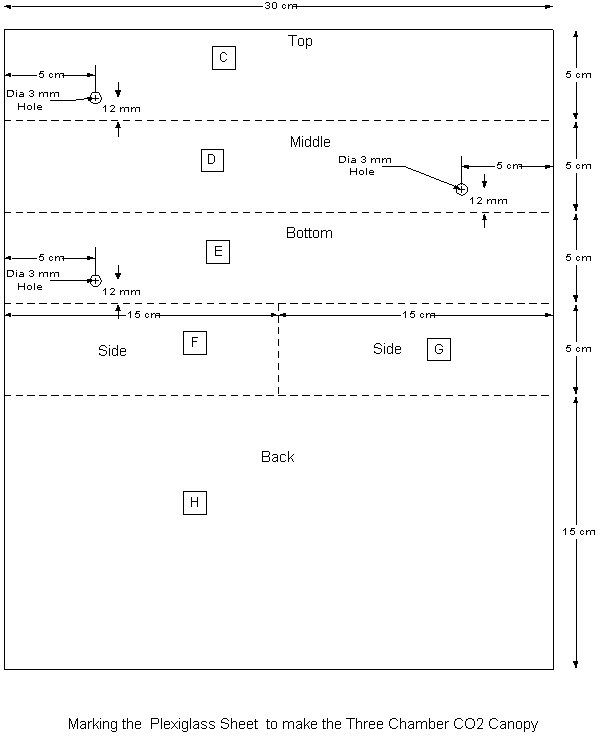
The unit I constructed having three canopies measures 12 in [L] x 6 in [W] x 2 in [D] ( 30 cm x 15 cm x 5 cm). The finished CO2 Canopy
unit was fixed to the center of the inner backside glass of
my 32' x 12' x 12' Glass tank. I thought a sketch would be better than describing
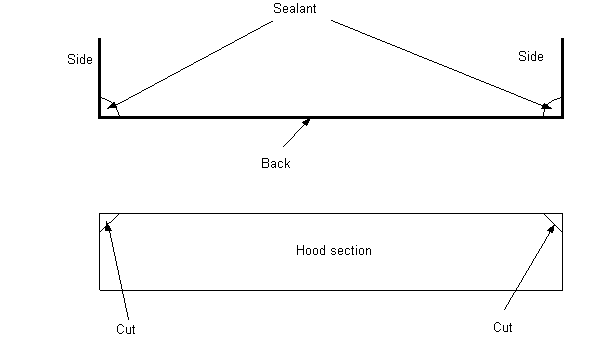
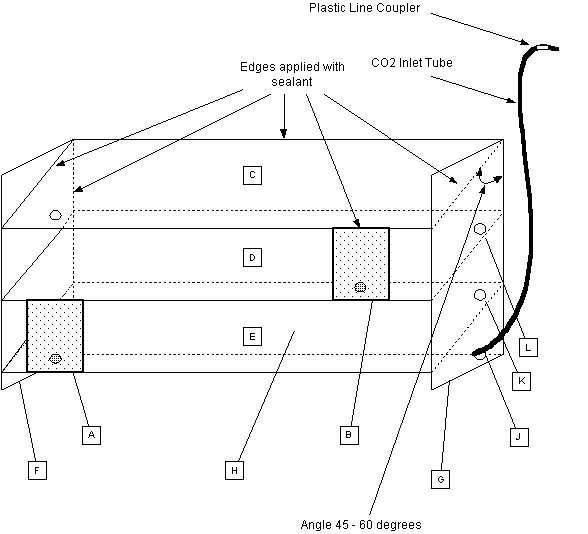
in writing. So kindly refer to sketches provided. Removing small triangular shaped pieces from top ends of Plexiglas hood pieces would make its upper edge contacting the Back Plexiglas piece , if you first finish off the units U shaped section. Once this section is bonded properly , then you can arrange the hood pieces and apply sealant to edges. I found that the slowly accumulating CO2 gas
in the bottom canopy is released to its upper canopy via the hole
provided in series of large bubbles with a force that some gas forced
out of the canopy cover without being trapped in the upper canopy
cover. To overcome this problem, a 5 cm Plexiglass strip was centered
and adhered to slanted canopy hoods in line of Canopy hood holes
to prevent big CO2 bubbles leaking from canopy hoods . The top most
canopy actually does not need a vent hole as it is the last CO2
chamber but I provided one in my design. To be more innovative,
the vent holes were arranged alternatively at sides of each canopy
hood in my design so that separate pieces of Plexiglass had
to be fixed centering each vent hole. If you like a simple method, then
you can have vent holes of all canopy hoods in one side and in one line
so that you can paste one stripe of Plexiglass to slanted canopy hoods
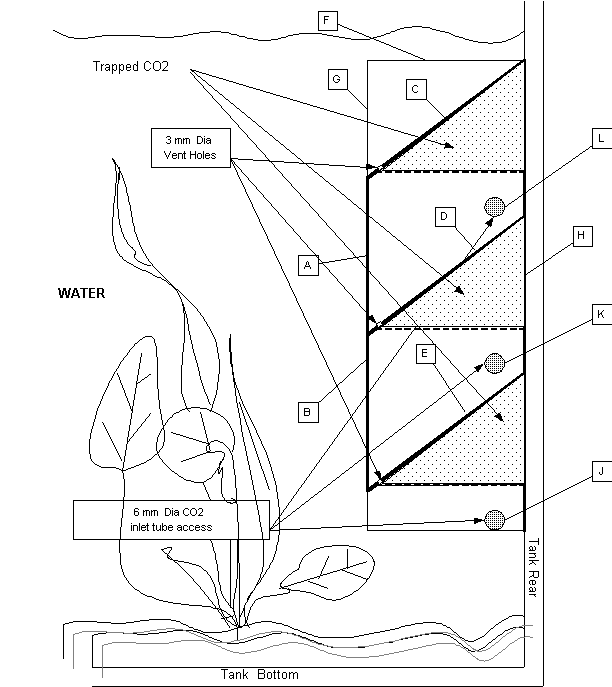
avoiding CO2 Bubble leaking to outside. It is better to leave about
half inch or more from the bottom of a slanted canopy hood to the top
edge of the lower canopy hood. The 6 mm hole can be made in this
portion to insert CO2 inlet plastic tube. Also make sure that you apply
the sealant properly so that there will be no leaks from canopy hoods.
Double check before you install the unit in the Plant tank by inserting
the unit into a water tank and filling the chambers with air --use an
aerator or you simply can blow some air from mouth through a plastic
tube directed under the bottom canopy hood. Once all chambers are
filled with air, stop giving air and watch for leaks . If a
chamber gets filled with water completely, then there is a leak from
the canopy hood. If everything is OK then adhere the unit to back glass
of the Plant tank using sealant. Notes to Take Care
I was using the Yeast reactor to generate CO2 gas for the Canopy. Initially when I was testing the unit, the tank was without any plants but filled with water 2.5 cm from the top. It took nearly 30 minutes for the accumulated CO2 in the bottom canopy to release to the upper canopy in a series of bubble bursts which started a chain reaction releasing CO2 to other canopy and finally through the hole at top canopy to outside. Once I planted my tank fully and using a 20W TFC Fluorescent lamp I noticed that the bottom canopy didn't release the CO2 to upper chamber at all ! The reason I think was the fact that the plants started using dissolved CO2 from the water that the incoming CO2 had been constantly getting dissolved in water so CO2 pressure built-up in the bottom canopy was not being forceful enough to get released to the upper chamber. I reasoned out the following from my
experience. With one 2 Liter CO2 Yeast Reactor, the
number of canopies required for my Plant tank will be a single one. As
the bubbling rate of my unit is about one 3 mm dia bubble every 4
seconds , I thought increasing the bubbling rate would give the
required amount of CO2 to other canopies. Increasing the bubbling rate
by adding some more Yeast just did the trick. Those who have
commercially pressurized CO2 cylinders can easily overcome the problem
I faced but one has to be mindful whether too much of CO2 would then
concentrate the water. It seems CO2 concentration in water makes
changes to the water PH value. So take this fact into
consideration. Hope this would be an interesting project to
Aquarium Plant lovers and I hope one can experiment with the unit to
gain better results. List of Material and Tools needed for the construction of the CO2
Canopy
Clear Plexiglas 2-3 mm
thick Clear Silicon Sealant Sealant Gun Scriber tool to groove the Perspex (aka Plexiglas)
sheet Metal Ruler to guide the scriber tool to make
cuts Drill bits 3 mm and 6 mm
Diameter Adhesive tape/Books etc. to first arrange the
Plexiglas pieces before applying sealant Sketches
I hope the sketches provided below would make it
easy to construct the CO2 Canopy.
|
|

|
Features: |
|
| Featured Sponsors: |