Freshwater Plants 9/2/15
Hi crew,
I apologize if this is not an appropriate topic to ask about, but I'm having
trouble finding an answer and thought I'd run it by you.
<Okay>
I have always lacked a green thumb, to say the least.
<A learned trait>
I have a couple of freshwater tanks and considering my lack of skill, I have had
a bit of beginners luck with my aquatic plants. However in my 29 gallon
community, I have an Amazon sword that appears to be in bad shape. The thing is
that in the same tank, i have another Amazon sword that maintains a richer green
color and lacks the rotting leaves. The lighting is consistent throughout and
there aren't any fish/snails that eat plants in there (not that I know of).
<Could be the plants are of different genetic make-up. Many cultured ones
nowayears are tissue cultured... identical; but some are still wild-cultured;
variable>
I do have some Malaysian trumpet snails for keeping the sand properly aerated,
but I've never seen them on any of my plants. In this tank are cories, kuhli
loaches, white and black skirt tetras and GloFish danios. The tank is newly
cycled with stable parameters for about 2 weeks. The explanation I've come
across is that this can be caused by high nitrates, which doesn't apply(and
should theoretically have the same effect on the other Amazon sword anyhow). If
you have any suggestions I'd appreciate it.
<I would try administering a complete fertilizer... I suspect a simple, local
lack of essential nutrient, perhaps iron. Am a big fan of the SeaChem line
(Flourish)>
I would also like to know if I should remove the plant if this continues.
<Only if it entirely disintegrates. Have seen Echinodorus come back from very
little)>
Thank you. Danielle
<Welcome. Bob Fenner>
|
Very sad plants in established tank /RMF
3/19/15
Hi all!
<Regina>
Firstly thank you for this wonderful resource, I have learned so much from
browsing your site over the years! My current tank is a lovely 75 gal.
I've had this one for a little over two years now, and it has lots of
plants and driftwood and rocks as decor and a booming platy
population (seriously, they keep popping out babies!) along with a few
lonely tetras and a rainbowfish (I know they don't really belong together, I
long ago stopped adding any more fish but they continued to survive so here they
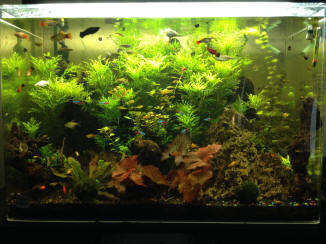
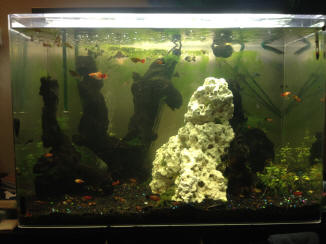
still are!). For most of the two years in this tank, everything was lovely (see
first photo attached). Then a few months ago I had a moderate fish die off and
the plants rapidly declined. I couldn't find anything wrong with water
parameters at the time (or before, or since), with
nitrates/nitrites/chlorine/ammonia registering at or very very near to zero, pH
7.0, dGH a little on the hard side (~100-150 ppm), and dKH rather high (over 200
ppm). Those are the same water chem results I've gotten for the several
years I've lived in this area, using only SeaChem Neutral Regulator with water
changes (usually 10 gal/2 weeks). (I also dose SeaChem Stability regularly, and
have a few times used SeaChem StressGuard and Nutrafin Waste Control. I
had used several of SeaChem's Flourish supplements when I first started with the
plants.)
<With you so far>
The die-off a few months ago was a steady loss of at least 2 fish every day for
a couple of weeks, no signs of illness or distress by any of the fish who died
or those who survived, despite increasingly frequent water changes (I started
changing more water at a time, and then began changing water every few days and
then daily as the loss continued). Water parameters remained steady the whole
time, although by the end it was a little bit softer and less alkaline than
initially, but not by much. Eventually the rate of fish loss slowed dramatically
(although there continues to be a dead fish every couple weeks ever since, but I
am not sure if that indicates anything. The fish who have died most recently
seemed to be thinner (it also looks a bit like they're clamping their fins, but
that could also be perspective because they just look skinnier) before they
died, but still ate enthusiastically and were very active until they one morning
would be belly-up, no wounds or parasites or Finrot etc).
<Mmmm>
Then the plants started dying. Mostly I have stem plants (Ludwigia broadleaf,
Hygrophila difformis, and moneywort), and they all began dying at the stems.
This is what has me really scratching my head, because the leaves will be
perfectly green and solid and happy and budding out but the stem turns brown and
rots from the bottom up, and as it goes the leaves suddenly die or detach. At
first I just kept trimming and replanting the live part, but now I have barely
any plants left. I started dosing
Flourish again a month ago, no difference. Substrate is Eco-Complete (same age
as tank), with a few root tabs scattered about, and DIY CO2 (have never
really had a good sense for how much is actually dispersing into the water, I
have the CO2 connected to a reactor next to the filter). Filter is an Eheim
2215, which has the usual sponges and biomedia as well as SeaChem's Purigen
inside, filter is cleaned out about once every 4-6 weeks (alternating which
sponge gets replaced).
<Yes>
The only things I can think to add are that this time period coincides with when
I started using Nutrafin Cycle instead of SeaChem Stability,
<This shouldn't make a diff.>
but I switched back after a month. Also, I had decided to take advantage of the
sadness of the tank and re-scape things, and removed the rocks and bleached them
and drilled new holes (tunnels!), but they sat out and were well dechlorinated
for several weeks before being reintroduced to the tank. However, they haven't
grown any algae since then, which is weird since the rocks were previously
covered in a lovely natural brownish-green biofilm.
Also, very minimal algae growth on the glass over the past few months.
I have two light fixtures, each with 2 T5 bulbs, all of which have been
changed in the past 6 months (using 6700K bulbs). Biweekly water tests
(using both drops and test strips) continue to show the same water parameter
results as above, although for a few weeks about a month ago the pH was
up a bit to 7.5 but has since dropped back to 7.0.
<This is a good clue>
I can't figure out what's going wrong, PLEASE HELP!!!!
Thanks so much, Regina
<And a timely query it is! Have just finished reading the current issue of
Amazonas Magazine's article on planted tank nutrient deficiencies.... I do think
you may well have a few items astray here; The driftwood and likely potassium
and nitrogen deficiency. I'd remove the driftwood for now.... let it air dry for
now. And I'd do a good gravel vacuuming, remove about half the water; in fact;
likely a third ever few days for a couple weeks... to dilute whatever has been
accumulating in the substrate and water. I'd have you read re PMDD; "Poor Mans
Dupla Drops"; on the Krib is likely the best... Perhaps perusing Diana Walstad's
works.... Am sending this off to Neale Monks here for his independent (and
likely much better) input. Bob Fenner>
Very sad plants in established tank /Neale 3/19/15
Hi all!
<Regina,>
Firstly thank you for this wonderful resource, I have learned so much from
browsing your site over the years! My current tank is a lovely 75 gal.
I've had this one for a little over two years now, and it has lots of plants and
driftwood and rocks as decor and a booming platy population (seriously, they
keep popping out babies!) along with a few lonely tetras and a rainbowfish (I
know they don't really belong together, I long ago stopped adding any more fish
but they continued to survive so here they
still are!). For most of the two years in this tank, everything was lovely (see
first photo attached). Then a few months ago I had a moderate fish die off and
the plants rapidly declined. I couldn't find anything wrong with water
parameters at the time (or before, or since), with
nitrates/nitrites/chlorine/ammonia registering at or very very near to zero, pH
7.0, dGH a little on the hard side (~100-150 ppm), and dKH rather high (over 200
ppm). Those are the same water chem results I've gotten for
the several years I've lived in this area, using only SeaChem Neutral Regulator
with water changes (usually 10 gal/2 weeks). (I also dose SeaChem Stability
regularly, and have a few times used SeaChem StressGuard and Nutrafin Waste
Control. I had used several of SeaChem's Flourish supplements when I first
started with the plants.)
<The real job is to maintain a neutral pH in water that has been softened.
Think of it as somewhat like adding a bottle of acid to water with a lot of
alkalinity. There's a neutralisation reaction that reduces the pH, but that
neutralisation reaction produces salts (in the generic sense, not specifically
NaCl) which raises the amount of total dissolved solids. This in turn affects
the way fish osmoregulate. There's also the risk that adding potions to reduce
pH creates unstable water chemistry. Do understand that if creating acidic
conditions for soft water fish (or plants) was as simple as adding bottles of
chemicals -- we'd all be doing that! Yet no experienced aquarist does this, and
you'll never see it written in tropical fish books. In fact the correct
procedure is first lower the hardness (including carbonate hardness) perhaps by
using RO or rainwater, and only then using a pH buffer to fix the pH at 7, 6.5
or whatever your chosen pH level. As your parents may well have told you, "if
something seems too good to be true, it probably isn't true", and that's 100%
good advice when it comes to water chemistry. Getting soft, acidic water from
hard, alkaline tap water is difficult. There's no cheap way to do this (unless
you collect rainwater, which is what I do). Bottles of chemicals aren't the
solution.>
The die-off a few months ago was a steady loss of at least 2 fish every day for
a couple of weeks, no signs of illness or distress by any of the fish who died
or those who survived, despite increasingly frequent water changes (I started
changing more water at a time, and then began changing water every few days and
then daily as the loss continued). Water parameters remained steady the whole
time, although by the end it was a little bit softer and less alkaline
than initially, but not by much.
<Ah, now, I would be seriously thinking about your use of pH regulator.
Variations in pH, particularly drops in pH, can indicate overall acidification
in the aquarium. Multiple reasons for this. Use/misuse of pH buffers is one. But
others include using up the alkaline reserve (i.e., carbonate minerals) in some
types of substrate and rocks; excessive accumulation of organic matter in the
aquarium and/or filter; and use/misuse of CO2 fertilisation systems.>
Eventually the rate of fish loss slowed dramatically (although there continues
to be a dead fish every couple weeks ever since, but I am not sure if that
indicates anything. The fish who have died most recently seemed to be thinner
(it also looks a bit like they're clamping their fins, but that could also be
perspective because they just look skinnier) before they died, but still ate
enthusiastically and were very active until they one morning would be belly-up,
no wounds or parasites or Finrot etc).
<Curious. Since even small tropical fish (Neons for example) should live 3-4
years in good conditions, if these fish are less than 2 years old it's unlikely
they died of old age. I mention that because sometimes an old tank will
experience a gradual die-off of livestock, but if those fish have been in that
tank for, say, 5 years, it's entirely possibly they're just old and worn out.
So: we're down to environmental stress and/or disease. Often the two go
together. A poor diet (= stress) can lead to a disease (= weakened
immune system). In any case, there's nothing specific that comes to mind from
what you describe, but if a number of fish die across a few weeks, without any
obvious signs of disease, then environmental stress is the most
likely explanation.>
Then the plants started dying. Mostly I have stem plants (Ludwigia broadleaf,
Hygrophila difformis, and moneywort), and they all began dying at the stems.
This is what has me really scratching my head, because the leaves will be
perfectly green and solid and happy and budding out but the stem turns brown and
rots from the bottom up, and as it goes the leaves suddenly die or detach. At
first I just kept trimming and replanting the live part, but now I have barely
any plants left. I started dosing
Flourish again a month ago, no difference. Substrate is Eco-Complete (same age
as tank), with a few root tabs scattered about, and DIY CO2 (have never really
had a good sense for how much is actually dispersing into the water, I have the
CO2 connected to a reactor next to the filter).
<Try switching this off for now. When tanks go "bad", CO2 is a variable you can
safely remove from the equation. Plants will be fine without CO2, even if growth
isn't as good as before. CO2 causes some serious problems if used improperly. It
lowers the pH, but at the same time, because plants use up CO2 at certain times,
the pH can end up very unstable. CO2 at high concentrations can displace oxygen
as well, making it difficult for fish to breathe properly. All sorts of reasons
to be careful about using CO2, and honestly, unless you like diddling about with
gizmos and have all the test kits you need, I strongly recommend using automatic
systems that dose CO2 at safe levels (if set up correctly).>
Filter is an Eheim 2215, which has the usual sponges and biomedia as well as
SeaChem's Purigen inside, filter is cleaned out about once every 4-6 weeks
(alternating which sponge gets replaced).
<Sounds good.>
The only things I can think to add are that this time period coincides with when
I started using Nutrafin Cycle instead of SeaChem Stability, but I switched back
after a month. Also, I had decided to take advantage of the sadness of the tank
and re-scape things, and removed the rocks and bleached them and drilled new
holes (tunnels!), but they sat out and were well
dechlorinated for several weeks before being reintroduced to the tank. However,
they haven't grown any algae since then, which is weird since the rocks were
previously covered in a lovely natural brownish-green biofilm.
Also, very minimal algae growth on the glass over the past few months. I have
two light fixtures, each with 2 T5 bulbs, all of which have been changed in the
past 6 months (using 6700K bulbs). Biweekly water tests (using both drops and
test strips) continue to show the same water parameter results as above,
although for a few weeks about a month ago the pH was up a bit to 7.5
but has since dropped back to 7.0.
<Again, I'm thinking water chemistry instability is part of the problem. Switch
off the CO2. Stop using the pH buffer. Let the tank steady itself at ambient
water chemistry of your tap water. Let the fish get used to that.
If necessary, choose species that enjoy those conditions, but don't buy any more
fish for at least a couple of weeks after the last fish death.>
I can't figure out what's going wrong, PLEASE HELP!!!!
Thanks so much, Regina
<Hope this helps, Neale.> |
 |
|
Re: Very sad plants in established tank
3/21/15
Hi guys, thank you so much for your help. A few clarification questions, if I
may! Neutral Regulator is a dechlorinator, a powdered version of SeaChem's Prime
with some ph regulator.
<That's what I'm afraid of. Anything that promises to create pH neutral
conditions, by definition, is a buffer. It changes the pH.>
I know that adding chem.s is not the way to go (I have a small mountain of
additives and crap that I bought way back when I first started fish keeping,
that now accumulates dust), but since I need to use a dechlorinator anyway I
figured it was good enough. I'm in California, and we have a wicked drought, so
I can't afford to waste any water and there hasn't been any rainwater in far too
long. Is there a better dechlorinator I should use?
<I'm sure many. I'm cheap, and use pond dechlorinator, diluted accordingly. A
bottle literally lasts years!>
Also, I have noticed a lot of powdery precipitate accumulating on the top of the
tank, clearly lots of dissolved something in the water.
<Indeed. As stated before, acid + alkaline = salt + water... because you're
adding a buffer, there's plenty of scope for producing an (insoluble/low
solubility) salt of some kind. In any event, hard water tends to leach out
minerals where evaporation occurs, often around air stones and filter outlets.>
When I first added the driftwood two years ago, I was worried about the
softening acidification and put a piece of cuttlebone in the back of the tank,
as I saw suggested somewhere... It's still sitting there.
<Quite. Cuttlebone is aragonite, an unstable (mineralogically speaking) form of
calcium carbonate (i.e., the "stuff" of carbonate hardness). It will react with
acidity in the aquarium, and will, very slowly, dissolve.
There are better ways to buffer water and raise the carbonate hardness.>
I'm obviously less interested in wrestling for a specific type of water
(soft/acidic or hard/alkaline) so much as stable water that I can easily
maintain with my tap water. I feed the fish once a day a variety of NLS granules
and Hikari wafers, along with a treat of bloodworms or daphnia or Tubifex, etc.
I feed enough that about half gets to the bottom where the fry go after it, and
then the adults clean up once the floating pieces are gone.
So, given the situation, what else should I be doing?
<Do read re: water chemistry on WWM; start perhaps with my "practical approach
to water chemistry" article.>
I will begin doing massive (50%) water changes every couple days for a couple
weeks (probably five or six changes total?)
<Less is more with water changes, or rather, frequent small water changes are
better than occasional giant water changes. 20% a week for a modestly stocked
aquarium is ample.>
I'll remove the driftwood and let it dry in the sun during that time. I will
disconnect the CO2. I will vacuum the bejeebers out of the gravel. I will hope
that everybody survives these shenanigans. Other than adding a dechlorinator and
a biological supplement (Cycle or Stability), is there anything else I should
put in the water? Flourish, NPK? Add laterite to the gravel?
<I would let the tank settle before adding new chemicals to the system. Plain
vanilla plant fertiliser tablets are fine though. Use sparingly.>
What should I do after the next couple weeks? Can I add the driftwood back?
Should I do CO2 again? What can I do to monitor/prevent this in the future?
<Wait and see what happens first. After 6, 8 weeks of normality, then gradually
add extra features, maybe the wood first, the CO2 a few weeks later.>
Thanks again guys!
-Regina
<Most welcome. Neale.> |
Fish Wasting Away /RMF's try 12/10/14
Hello,
<Samuel, greetings>
I've lost a number of fish to something in my tank and I am at a loss
for how to treat it.
<Have scanned this msg. and am going to ask Neale Monks here to respond
separately>
The first symptom seems to be spitting out of food rather than
eating it. Eventually the fish will become lethargic, start hiding and
stop trying to eat at all.
<Good clues. What comes to mind up to this point is either a dire
environmental issue or a microbial to Protozoan issue>
I have been removing to treat or euthanize when I notice the spitting
behavior but new infections continue. A few fish
have recovered from it and it has only, as far as I've noticed, affected
a few species. All of my Celebes rainbowfish have been affected with 66%
mortality of the adults and my Endler's have been dying at a higher rate
than that. Fry/young fish seem more affected as I lost all but 2 of a
batch of ~15 Celebes fry. Species which haven't had any casualties
include Pseudomugil paskai, threadfin rainbowfish, Apistogramma borelli
and a blue ram.
The tank is a 50g acrylic. Heavily planted, CO2 injected and
fertilized (CSM+B, K2HPO4, KNO3 and K2SO4).
<To browsers; always a poss. of issues w/ CO2 use, inorganic fert. use>
NH3/NO2 0ppm and Nitrate varies between 5 and 20ppm. It's been set up
for about 6 months and was an upgrade from a
29g.
The trouble started, as far as I can tell, back in early October with
the addition of 5 Habrosus cories. I had lost 2 during quarantine but I
chalked it up to stress as both were emaciated when I got them and they
died the first couple days. About 3 days after adding the cories I
noticed one of my female Endler's was spitting food out instead of
eating it. I left her in the tank for a few days until I noticed one of
my Celebes and another endler showing the same behavior. The Celebes was
isolated and treated (still died) and both Endler's were euthanized. On
10/13, when I noticed additional infections
<... what came/comes first... the symptoms or cause/s?>
I treated the tank with Metronidazole (3 treatments of 500mg every other
day). At the end I performed a large water change and
added active carbon to help remove any remaining medication.
<Good>
After a few days additional fish showed symptoms and the 2 Celebes I
treated in quarantine showed little signs of improvement (one died
during treatment, the other was still not eating, even when presented
live food). On 10/23 I treated with Kanamycin (3 treatments of 1440mg
every other day). The remaining Celebes seemed to respond well to this
treatment. At this point I introduced a few swordtails from another tank
and the infection decimated them. All were infected and only one
recovered. I continue to euthanize
Endler's that spit food, don't show interest in food or look thin after
a heavy feeding. My best guess was that this is a flagellate but I fear
it might be fish TB (since the Kanamycin seemed to help some fish).
Thanks for any help you can provide and for this great resource you have
available.
<I suspect something simple yet profound is amiss here...
Really, just too little O2, perhaps w/ too much CO2. Do you monitor
hardness? Do you have access to dissolved oxygen test gear? Ask your LFS
re. We will solve this mystery.
Bob Fenner>
Fish Wasting Away /Neale's go
12/11/14
Hello,
I've lost a number of fish to something in my tank and I am at a loss
for how to treat it. The first symptom seems to be spitting out
of food rather than eating it.
<Quite often goes along with some environmental stress.>
Eventually the fish will become lethargic, start hiding and stop trying
to eat at all. I have been removing to treat or euthanize when I notice
the spitting behavior but new infections continue. A few fish have
recovered from it and it has only, as far as I've noticed, affected a
few species.
All of my Celebes rainbowfish have been affected with 66% mortality of
the adults and my Endler's have been dying at a higher rate than that.
Fry/young fish seem more affected as I lost all but 2 of a batch of ~15
Celebes fry.
Species which haven't had any casualties include Pseudomugil paskai,
threadfin rainbowfish, Apistogramma borelli and a blue ram.
The tank is a 50g acrylic. Heavily planted, CO2 injected and fertilized
(CSM+B, K2HPO4, KNO3 and K2SO4). NH3/NO2 0ppm and Nitrate varies between
5 and 20ppm. It's been set up for about 6 months and was an upgrade from
a 29g.
<Switch off the CO2 and fertiliser system. The plants
will be okay for a few days/weeks thusly. Why? Because sometimes CO2 can
be dosed too high, and this will cause serious stress to the fish. It's
easy enough to discount this problem by switching the CO2 system off for
a few days and watching what happens. As plant growth will slow down,
fertiliser will be redundant, so you can switch that off too. Again,
they're a variable that we want to discount before moving onto other
possible issues.>
The trouble started, as far as I can tell, back in early October with
the addition of 5 Habrosus cories. I had lost 2 during quarantine but I
chalked it up to stress as both were emaciated when I got them and they
died the first couple days. About 3 days after adding the cories I
noticed one of my female Endler's was spitting food out instead of
eating it. I left her in the tank for a few days until I noticed one of
my Celebes and another endler showing the same behavior. The Celebes was
isolated and treated (still died) and both Endler's were euthanized. On
10/13, when I noticed additional infections I treated the tank with
Metronidazole (3 treatments of 500mg every other day). At the end I
performed a large water change and added active carbon to help remove
any remaining medication. After a few days additional fish showed
symptoms and the 2 Celebes I treated in quarantine showed little signs
of improvement (one died during treatment, the other was still not
eating, even when presented live food). On 10/23 I treated with
Kanamycin (3 treatments of 1440mg every other day). The remaining
Celebes seemed to respond well to this treatment. At this point I
introduced a few swordtails from another tank and the infection
decimated them. All were infected and only one recovered. I continue to
euthanize Endler's that spit food, don't show interest in food or look
thin after a heavy feeding. My best guess was that this is a flagellate
but I fear it might be fish TB (since the Kanamycin seemed to help some
fish).
<Fish TB is essentially incurable, so medication won't have any great
impact. Wish it did! I'd back off from adding more medications before
checking the environment thoroughly. When many fish die, and they all
shows signs of stress, then the environment is surely the top
possibility to consider. Rapid pH changes (common where CO2 is used
inappropriately) cause many/all of the symptoms you describe. Very rapid
plant growth without considering their oxygen demand at night is another
common factor. What happens is we often minimise water circulation to
avoid driving off the CO2, but during the night plants use up more O2
than they produce (they do
the reverse by day) and they can lower the oxygen content of the water
substantially. This is especially so if organic decay (dead leaves for
example) is present in substantial amounts. So: try minimising CO2 for a
few days as outlined above, whilst also boosting O2 as much as you can,
e.g., with an airstone at each end of the tank. See if the fish perk up.
Look to see if the fish are skittish, moving their gills rapidly, or
staying ostentatiously close to the surface/areas of strong water
movement -- all can be signs that the O2/CO2 balance in the tank isn't
right.
Malayan Livebearing Snails crawling up the glass by day is another
telltale sign -- they're veritable miners' canaries for this! While I'm
not ignoring your idea that disease could be to blame, I'd still
discount environmental stress before anything else. If you've done
antibiotics and anti-Protozoans already to no good effect, then the
"usual suspects" -- Velvet, Whitespot, Finrot, etc. -- can be
discounted, then what's left -- Fish TB and other Mycobacteriosis-like
infections -- are pretty much untreatable. So if that's the situation
here, all you can do is allow the disease to run its course until what's
left are the fish whose immune systems have defeated
the bacteria. But even here, it has to be stated that Mycobacteriosis is
as much environmental as anything else, so it's likely something else is
going on as well, even if a bacterium species is to blame.>
Thanks for any help you can provide and for this great resource you have
available.
<Good luck, Neale.>
Re: Fish Wasting Away 12/20/14
Hey Crew,
<Samuel,>
I took your suggestions and messed around with my CO2/fertilizer
among other things. One good indicator is that my MTS spend all day in
the sand/substrate.
<Indeed. See them up the glass with the lights on, and something is
amiss.
If they're happy in the sand without showing their little faces, then
all is well.>
My Ramshorn also haven't been hanging out around the top of the tank. As
a precaution I dialed my CO2 back a little and refilled my drop checker
(showing greenish blue before and after). I also had my CO2 off during
both medication regimens, which were also sans ferts. Additionally I had
my CO2 off for 4 days during thanksgiving when I was out of town. My CO2
shuts off at the same timer my lights do. To improve dissolved oxygen I
started running an airstone at night. I neglected to mention I also dose
flourish excel at slightly less than the recommended amount.
<So without CO2 did the fish behave differently or better?>
I ceased excel dosing for a week to see if the fish showed any
improvements to no effect. I tested and I do have some day/night pH
swings but not by much. All I've got is an API kit but the difference
looks to be about 0.2 lights off to lights on. The LA tap comes out ~8.2
here and is moderately buffered. I haven't checked the TDS or
conductivity but a local planted tank shop told me that he runs all his
tanks on tap and dosing moderately shouldn't be a problem. The issue
might be related to or exacerbated by organic matter in the tank. I
typically do a pretty good job pruning old growth and removing dead
plant matter, but there have been times where I get busy and let the
tank go a bit. I started pruning old leaves a bit more heavily as a
precaution and have been diligent about removing any dead/dying
material. I also ceased fertilizing for a while,
but started again when some of my plants started showing pinholes on
their leaves. Since restarting I've cut back to 2/3 of what I used to
dose.
<Sounds wise.>
I won't rule out any issue with organics in my tank, as I have soil
capped with sand and a lot of living biological material, but I decided
to check if a sick fish could transmit the condition. I took two
obviously sick Endler's and placed then with 3 swordtails my girlfriend
was culling (1m/1f older adults and one juvenile). Within a week all 3
were spitting food. The
Endler's were removed and euthanized. Both older fish progressed to the
point where they weren't even trying to eat so I euthanized them. The
juvenile eventually recovered. I then set up a new tank and tested to
see if the recovered juvenile could infect a female Betta and a couple
other juveniles. The Betta seemed a bit under the weather and her shape
got a little funky but never stopped eating and was added to the
original infected tank with the survivor swordtail. Both of the new
juveniles were infected and died. My latest suspicion is neon tetra
disease, or some microsporidia.
<Perhaps, but both are difficult to diagnose without a microscope. Some
fish health vets have stated about half supposed "Neon Tetra Disease"
infections are actually Mycobacteriosis. In other words, you can't
distinguish Pleistophora from Mycobacteria by eye. Really do need a
microscope.>
My girlfriend was initially convinced (or just afraid) it was fish TB
but after taking parasitology this quarter she agrees with my initial
suspicion of this probably being protozoan.
<A little knowledge can be a dangerous thing! But since you have access
to a microscope via your girlfriend, why not take a dead fish into the
lab, take smears from the skin, inside the mouth, gill cavity, etc., and
see what you can see. Presumably your university library has Ed Noga's
"Fish Disease: Diagnosis and Treatment". That's the book you need.>
The fact that some species seem more affected is what really makes me
lean that way.
<But isn't conclusive. Trust me. Pleistophora is classically associated
with Neons but has been reported from fish as diverse as Goldfish and
Angels, while Mycobacteria has been reported from just about every fish
someone's made an effort to examine. Very, very few fish infections can
be truly identified to genus level by eye. Whitespot, Velvet, Crypt...
maybe Columnaris, possibly Costia... but not much beyond these.>
One symptom I neglected to mention is that in really sick fish the spine
starts to bend. I've only noticed this in female Endler's, and perhaps
slightly in one Celebes who hung on to life for a long time. The sick
female I used to infect the swordtails was severely deformed by the time
I killed her. I should have taken a picture, but didn't think to at the
time.
Moving forward I fear I'm going to have to euthanize a lot of fish and
hope for the best. That or tear the tank down and start over. My endler
population is now only juveniles, which gives me little hope for any of
them surviving.
<On the contrary, often juveniles survive rather better than the adults
if the problem has been exacerbated by long-term stress or dietary
shortcomings. Definitely worth leaving them be if they're currently
feeding and growing.>
I'm planning on euthanizing all of my Endler's and any currently sick
fish prior to me leaving town for a bit during the holidays. I might try
adding a couple new Celebes after I get back to see if there is any
lingering infection.
<No! If all the fish die, then leave the tank fallow for a few weeks.
That'll break the life cycle of most common parasites. Bacterial
infections are latent in most tanks, even Fish TB/Mycobacteriosis, and
they only become a problem when the fish are stressed, so while you
might run some antibiotics through the tank, there's no real point, and
few work on Mycobacteria spp in particular. Keep the filter happy by
adding a little fish food now and again (the snails will turn this into
ammonia). Then, select fish wisely from the start, adding a few at a
time, choosing species suited to your environmental parameters. If you
have liquid rock water, avoid tetras and other South American fish, but
consider livebearers (particularly the non-fancy varieties with better
health, such as Heterandria, Limia, etc.) as well as Ricefish, some of
the Rainbows, and the hardier/adaptable cyprinids, such as Cherry Barbs
and Danios.>
In a month or so I should know if I've beaten this thing or not.
Thanks again, Samuel
<Cheers, Neale.>
|
Just a few aquarium questions... <20 some Megs...>; residual NH3,
U1 zots, Crypt melt, moving pH 8/7/16
Please re-size and re-send all... Your files are more than an order of
magnitude too large.
Re: Just a few aquarium questions... 8/7/16
Yikes...I was wondering why they were taking so long to upload, didn't even
notice they were that big.
Resized in PS, hope this is a little better!
<Yes; now just need you to delete the carats (<<<<) in the text below and
re-send. BobF>
re: Just a few aquarium questions... 8/7/16
<Oh, found the original text here>
Hello crew! I just started up my old aquarium and I have a fair amount of
questions about water quality, some of my old plants, etc.
My tank is a 10 gallon. Started it up a little over 2 months ago, let it
cycle through, and added a single Betta after the cycle was finished.
The parameters are
pH: 7.5
nitrates: 0
nitrites: 0
ammonia: .12? (it's not exactly at 0 and not at .25 on the test kit, so I'm
assuming it's right in the middle)
<Toxic; and am wondering wherefore/why the residual ammonia here?>
temp: between 74-78 degrees
My first question is about the ammonia. Both in the past and currently, I
cannot keep the ammonia at 0 for the life of me because my tap water has a
small amount of it.
<This should cycle through though... And you should eliminate w/ water
conditioner use ahead of placing it in the tank>
It's not at a terribly dangerous level but it's enough to be worrying,
<Debilitating.>
I've tried using ammonia-removing products, including prime, on the water I
store away for water changes, but the ammonia tests as 0 and then has a huge
spike occurs a few days later. Is there any way to get it down and
stay down?
<Yes... a few ways. Let's have you review here (as I/we have no way of
knowing what you already know):
http://www.wetwebmedia.com/fwsubwebindex/fwammf3.htm
and the linked files above>
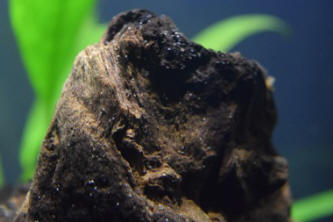
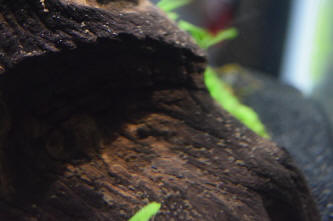
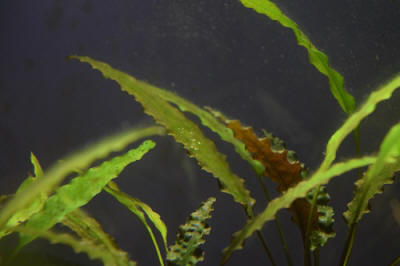
My second question is about this strange white and brown stuff growing on my
driftwood. I'll attach some pictures, some of them I couldn't get to focus
but I hope they're good enough. There are brown chunks of what looks like
fish feces or a kind of fungus, mostly on the bottom half of the driftwood.
It's kind of tough to remove so I had to scrub it off with a
toothbrush, but it just comes back anyway. Along with that are white specs,
mostly on the top of the driftwood.
<This appears to be bits of decomposition... the wood, likely food, feces>
I can't tell you how many pages I've checked trying to find out what these
are. The only answers I come back
with are black beard algae/brown string algae and white fungus/Nerite snail
eggs, but whatever's on my driftwood doesn't look like any of those. The
white specs even look like they're starting to spread to one of my crypts.
My Betta seems to be unaffected by either of them, but I've had a baby
Bristlenose in a hospital tank and I wanted to move him in soon. I'm worried
that this stuff could make him sick if he eats it. Any ideas what either of
them are?
<As stated... you might benefit from more circulation, filtration here>
Third question is about the crypts (also in the pictures) I was growing them
in a large bowl for a while and they were doing very well with API leafzone
and some natural sunlight. They shot out very nice, healthy green leaves,
but when I transferred them to the tank, they started turning a reddish
brown and getting ruffles. I read that this happened to a few
other people that changed the way they were fertilizing their tank, though
they stated that they were still very healthy. Mine are kind of getting this
weird translucent reddish-brown look and a couple of the leaves have
completely melted, but the leaves had been bright green and strong before.
<Crypts are susceptible to this sort of decomp. under stressful and varying
conditions>
I have an LED light strip but others have been able to keep crypts just fine
with them. Is there another reason they're not doing as well?
<Can't tell w/ the data provided. There may well be a nutrient deficiency
going on here... N, P, K, Fe....>
My final question (phew) is about the pH. It's always been at 7.5 (or
higher, not sure if it even shows up on the test kit..) I want to lower it
to around 6.8 or 7,
<I would NOT do this. Leave it as it is... will drop a bit in time. See WWM
re pH and Alkalinity for a bit of background>
but just like the ammonia, I've tried two or three pH altering products and
they drop the pH rapidly and spike it a few days later.
<... yes... alkaline reserve is buffering it back up. Common >
I was thinking I could try Indian almond leaves or wood, but they would
release a lot of tannins and I'm not sure if it would add to the ammonia or
not. Have tried adding distilled water as well and there is no affect (but I
do have 20 empty gallon jugs laying around) Do you have other suggestions of
how to lower it safely?
<Time going by is the very best. Don't fuss w/ pH here, period. 7.5 is fine
for what you have livestock wise>
I'm very sorry this is so long, I was debating on whether I should divvy the
questions up into different emails but I thought it might be more
troublesome to get them each separately. But I thank you very much for your
services. I always go to this site first if I'm having any problems and it
has been extremely helpful and informative! I greatly appreciate any answers
and advice you can offer.
Jenevieve
<Glad to be (hopefully) of assistance. Please DO write back if all is not
clear here after reading. Bob Fenner>
|
  |
Ich, plants & surviving
fish 7/16/09
Hey there,
<Hello,>
I have a 65 gallon freshwater planted tank currently with 0 ammonia, 0
nitrite and 20 nitrate as well as my first case of ich. I'm a
little heartbroken because it's already claimed 5 loaches (2 chain,
3 yo-yo) and I'd had the 3 yo-yos since I started the hobby 3.5
years ago.
<I see. The thing with Ick medications is that they're more
immediately dangerous to certain fish, including loaches, than the Ick
itself! This is why for Loaches we recommend the older heat plus salt
technique rather than Ick medication. Aquarisol contains copper
sulphate, and that's certainly one of the things believed to be
more toxic to loaches than we'd like. Next time, raise the
temperature to 82 degrees, and add 2 to 3 teaspoons of plain aquarium
salt per gallon of water in the tank. I like to mix the salt with some
warm water in a jug first, and then dribble the brine into the tank in
front of the filter outlet; this helps it mix quickly around the
aquarium. Run thus for a week or two, and you should be Ick free. The
salt concentration is too low to harm fish or plants, but usually kills
the free-living Ick parasite stages very quickly.>
I'd treated tank by increasing water temp to 84 degrees and added
Aquarisol. I removed carbon, added an air filter and did 25% water
changes every other day for 6 days. The loaches went fast, but one had
managed to survive and seemed fine until I lowered the water temp back
to 78. Within 24 hours the final loach passed with spots and a thick
slime coat covering it. The other inhabitants of the tank: 8 Congo
tetras, 1 blue emperor tetra and 2 Siamese Algae Easters have all
appeared normal (no spots, no flashing, no change in eating habits)
throughout this process. After I lost the 5th loach I've kept the
water tamp @ 84. After reviewing the articles here I decided the next
course of action is to add salt, a step I'd been reluctant to do
with loaches in the tank.
<Ironically, I think it was the copper that killed the Loaches, not
the Ick, and salt/heat would have been a better option.>
My questions are should I put the carbon back in the filter to remove
the Aquarisol, is the Aquarisol the reason why my jungle Val and java
fern have died and should I remove the wood and moss decorations while
I'm treating the tank?
<Curious; actually, plants usually tolerate medications quite well,
so I'm surprised by this. But it's possible I guess. In any
even, both Java Fern and Vallisneria are tolerant of salt, so again,
salt/heat would have worked well.>
It seems like no matter how often I siphon the tank the moss holds in a
lot of particulates.
<Yep! One reason Java Moss is suited to clean tanks with small fish,
rather than tanks with robust or burrowing fish.>
Thanks, Christine
<Cheers, Neale.>
Plants, hlth.
9/21/08
Hello, it's been awhile since I've needed to contact your site.
This question is about my twenty gallon planted tank. This is my first
planted tank and it has been up for about a month and a half. The
livestock consists of two angelfish, three Otos, and ten Columbian
tetras.
<These latter, Hyphessobrycon colombianus, may be problematic. They
are semi-aggressive, though keeping ten specimens will go a long way to
fixing that. They have been reported to be fin nippers, so watch the
Angels, and also reported to eat certain soft-leaved plants. Amazon
Swords and Vallisneria should be fine, but your Rotala spp. might not
be. Do also be aware Otocinclus are extremely difficult (schooling)
catfish to maintain in immature tanks, and the vast majority of
specimens die within months of import. Have written about this many
times on WWM, so please do review this and act accordingly.>
The plants consist of Amazon swords, rootle, crypt, water sprite, and
corkscrew val. I was just wondering if it is common for plants to have
a kind of initial "die off" before they take root and begin
to grow.
<Yes, some plants will "die off" above ground while being
settled in. The problem is that when uprooted their fine roots are
damaged, and it takes a while for them to put that right. Cryptocoryne
spp. are famous for this (it's called Crypt Rot) but most any
rooted plant species will do the same thing.
Some of my plants, mostly the rootle and the vales lost some of their
lower leaves before starting to seem as if they were growing fine.
<Sounds normal. Vallisneria are prone to losing leaves if their
leaves are damaged -- they don't heal breaks, but instead shed
broken leaves completely. When planting Vallisneria there's a real
art to it: you should never push the "crown" into the
substrate, and it's always better to go "shallow" with
Vallisneria rather than trying to push it right the way in.>
Like I said its my first planted rank so I'm not completely sure if
this is normal.
<I shouldn't worry about the leaves. What I would focus on are
the following: substrate type and light intensity. If you're using
plain gravel rather than something optimised for plant growth, it's
essential to regularly place fertiliser tables in the gravel close to
each clump of plants. While aquatic plants get nitrate and phosphate
from the water, mineral ions such as iron and copper have to come from
the substrate, and plain gravel contains none of that. Secondly,
lighting is make-or-break with most plants. While Cryptocoryne and to
some extent Vallisneria and certain Amazon Swordplant species can adapt
to varying light intensities, Rotala won't, and you're likely
to get leggy, weak growth until the plant dies. Rotala needs upwards of
2.5-3 watts per gallon to even begin to show good growth. Cheers,
Neale.>
Re: Plants 9/21/08
Thanks very much.
<Not a problem.>
As for the Otos, I was surprised that they made it even the first day
but they have become nice and plump, I believe from the Mopani bogwood
and cucumber slices and algae wafers I give them.
<Fingers crossed! It's not that Otocinclus can't be kept in
aquaria -- they can. It's just most people fail with them, for
multiple reasons including lack of food, insufficient numbers, and
keeping them too warm (less than 25 C/77 F). This species is also a
confirmed "mucous sucker", and (perhaps when hungry?) attacks
slow moving fish like cichlids, in the process making the victim prone
to secondary infections. Hence, I simply don't recommend them for
non-expert hobbyists.>
They are doing great. The Columbian tetras haven't been an issue,
as the fins on the angelfish are in fact continuing to grow, while the
tetras are content to swim around as a group, ever so happily.
<Cool.>
The crypt are actually the plants that suffered the least amount of
damage and are doing nicely.
<Ah, this is often the case with domesticated Cryptocoryne wendtii
and Cryptocoryne hybrids. Very robust plants: among my favourites! My
specimens seem happy even in tanks with fairly poor lighting. They
don't grow fast, but they do at least grow. It's with the more
delicate Crypts where "Rot" it is the biggest deal. In any
case, it sounds as if all is well. To some degree, aquarium planting
made simple goes like this: get a bunch of plants. See which ones do
well. Throw out the ones that don't, and keep buying the ones that
thrive.>
As far as fertilizer goes instead of tablets, I saw an iron supplement
that can be added right into the water. Is this ok?
<Not really. The problem with waterborne fertilisers is that plants
accept the "reduced" rather than "oxidised" metal
ions (you'll have to remember back to your High School chemistry).
When the metal ions are added to the water, they soon get oxidised, and
effective become inaccessible to the plants. This is why plants like
deep, relatively anoxic substrates; it's much easier for plants to
get the minerals they need from anoxic substrates (such as sand/soil
mixtures) compared with well oxygenated ones like gravel. Putting
fertiliser tabs in the roots gives the plants immediate access to the
minerals in a form they can use; adding fertiliser to the water has no
such guarantee. It's better than nothing, but only marginally. Do
please read around the topic of planting aquaria: done properly,
it's easy; don't the wrong way and it's often very
frustrating. It doesn't have to be expensive though, and while some
people use specific aquarium substrates, you can get 90% of the results
at 10% of the cost using pond soil mixed with silica sand, and topped
with pea gravel. Cheers, Neale.>
QT procedures for plants
3/17/08 Hi Crew, I bought some java fern and Anubias from a store
that keeps "display only" fish in its plant tank. After
reading your archives and other online sources, I am going to QT these
plants for 4 weeks before putting them in my main tank. Right now they
are all in a 10 gallon tank with a grow light. I have one remaining
question that I haven't been able to answer from my online
research: are there any prophylactic procedures/treatments/medications
I should be using for the plants during the QT period? I should add
that I'm not concerned about snails in this case (I have some fish
who'd be happy to eat them) but I'm very paranoid about
parasites like ich, and I was mostly wondering if I should treat the
plants with ich meds, or if the 4 weeks will be long enough to let any
such parasites die off. Thanks! <Hi Leah. Simply isolating plants
for a period of a week at tropical temperatures should ensure that any
motile Ick or Velvet parasites will die (because they can't find a
host). You can also treat with a standard Ick or Velvet medication: ALL
medications kill the motile parasite (and none, as far as I know, kill
the parasite on the fish itself). So expose the plant to a full course
of Ick or Velvet remedy and you should be fine. For snails and snail
eggs, 10 mg/l potassium permanganate for 10 minutes will do the trick.
Rinse off thoroughly before putting in the aquarium. Cheers, Neale.>
<<RMF is still a giant fan of Alum soaks/baths... old-timey, but
work to eliminate most all snails, their eggs, and
Protozoans...>>
More Light, More Plant Die-off? 2/3/08
I have been reading your site for several years now, and it has been
invaluable to my effort at keeping fishes not just alive, but healthy
and thriving. <Very good!> I have searched your site and Google
and can't find an answer to my question. I have a 55 gallon with a
30 gallon Wet/Dry filter, and HOB dual bio-wheel ( more for mechanical
filtration as it has no wheels. The tank has been running for 8 months.
Substrate is 2:1 crushed coral and pea gravel mix. The water perimeters
are: Nitrite, Ammonia :0 Nitrate: 15 ppm PH: 8.4 Current stock is: 4
brichardi, 2 calvus, 1 peacock ( Aulonocara sp. ), 1 Chinese algae
eater, 3 feeder goldfish. <Quite a curious mix, but if it works for
you, great. I have to say I am NOT a fan of Chinese Algae Eaters,
Gyrinocheilus aymonieri. (Apart from the fact they eat little algae and
don't come from China, a very suitable name!) As they mature these
fish become increasing disruptive. The only time I've seen them
work well is as target fish in big (150+ gallon) Central American and
similar cichlid communities.> I added some plants about 2 months
after initial set-up. At the time I was running a 36" regular
output light strip with one AquaSun bulb. It couldn't have been
more than 54 watts or so. <Here's one problem: not enough light
for good plant growth, or even any plant growth at all if the plants
aren't shade tolerant.> I don't know the names of the plants
aside from the Amazon swords and onion plant. <Both need a lot of
light, around 2 watts per gallon, at least.> All but the swords and
onion plants died. <No surprise.> For the last 6 months these
plants survived, though they certainly did not thrive. <What they
were doing was consuming their starch reserves. Plants will live in
complete darkness for a while. But eventually they have no more starch
reserves, and their attempts at photosynthesis aren't enough to
match their consumption of energy, so they effectively starve.>
After much research I purchased a Nova Extreme ballast with two 54 watt
HO bulbs. <Much better.> 1 week later the plants are browning and
withering. <They would have been dying anyway, and the sudden change
in light intensity would require some period of adaptation, which they
might get through, but there's no guarantee. I'd cut the Crinum
back to the tuber; it'll go into a period of shock but should
recover. As for the Amazon sword, a bit of a gamble, but if the roots
are healthy (i.e., white rather than brown) I'd break off all
the browning leaves right at the base with a sharp knife, and then let
whatever is left re-grow.> I called the LFS and was told that the
new lighting is so much brighter the plants have been " shocked
". <Pretty much. It isn't quite the same as an animal being
in shock, but rather than plants fine tune their physiology to the
environment, and cannot easily change to radically different
conditions.> I was told to decrease the duration of the lighting,
which I have cut back from 12 hours to 7 hours. Is this advice correct?
<Not what I'd do. I'd stick with 12 hours, cut back the
existing plants as indicated, and also install some fast growing plants
to deal with algae. Vallisneria and Hygrophila would be ideal. Neither
Crinum nor Echinodorus will grow fast enough under 2 WPG to deal with
algae. Cheers, Neale.>
Growing water plants... - 05/01/07 hello, I
recently bought Betta plants for my little Betta. However when putting
in the spuds, <? Spuds?> I let them sink and now a few days later
there looks like a white film around the spuds. Is this normal?
<Maybe... are these Aponogeton bulbs?> I've looked all over
the place yet no one has an answer for the white film slime stuff
that's on the spuds. are they bad spuds? will they hurt my Betta?
what's going on? I need help! PLEASE!!! Paul <Do take a look on
the Net re the above genus... likely whatever these plant parts are,
they need to be planted... Perhaps a bit of decomposer populations are
taking advantage... Plant them. Bob Fenner>
Taking the pond smell out of pond-raised plants
3/5/07 Greetings! Thanks so much for taking the time to read my
question. <Welcome> I am wondering if there is anything I can do
mitigate the pond smell in my 15 gallon planted tank. The plants are,
in fact, from a local pond, so it's understandable that they would
smell this way...I was just under the impression that the smell would
dissipate in time. <Mmm, no... as with other sources of odor... this
really depends on the nature of the source. In this case the offense is
likely due to a complement of algae growing on, with the plants
themselves... You need to address the algae itself...> It's
already been a couple of weeks since the plants were introduced.
I've tried pelletized carbon, increasing biological filtration,
vacuuming the substrate, the rocks, and the wood - all to no avail,
except that the water quality itself is optimal, with nitrates testing
0 ppm consistently. I am changing a gallon of water daily, I
haven't tried performing a large water change in one sitting
yet...perhaps that is all that is called for? <Might help...> I
was also wondering your thoughts on using Purigen. Might it be more
effective than carbon? <Might be as well... in limiting nutrient...
in effect "starving" the algae...> I know it is considered
more of a polisher, so I was hesitant to use it in this case. Honestly,
I wouldn't even mind the smell much, except that the 3 Glowlight
tetras (that I've relocated from another tank, to keep things
interesting) can't seem to find their food, and have gone without
eating for a few days now. Their behavior seems lively and nitrogenous
waste doesn't appear to be an issue, so I have been attributing it
to the "richness" of the water overwhelming their sense of
smell and consequently, their awareness of the food. Does that sound
plausible? <The algae are likely involved here as well... toxifying
the water...> Incidentally, these are the only livestock in the tank
for now. For the record, the plants I have in there are: water lettuce,
<Pistia? Not a tropical species> hornwort, two kinds of floating
plants I cannot positively ID (but I strongly suspect they are Duckweed
and Salvinia auriculata) <These two... were grown in cold water?>
and an Echinodorus tenellus which started as one, and became numerous
pygmy chain swords. <Ah, very nice> I have used Hagen's
Nutrafin Plant Gro fertilizer once, and was going to dose again now
that it's been 2 weeks, but have held off on fertilizing just in
case it is related to the issue. <You are wise here> For
filtration, I have a Whisper in-tank filter with its foam, and a mesh
bag of cultured Ehfisubstrat. <Great> I opted not to use the
carbon it came with, since I didn't notice any difference, and
worried that it would only serve to negate the fertilizer. <This
might well be so> Please say so if I am missing something obvious
and/or essential! A test I need to perform - phosphate, perhaps? The
plants seem happy and the fish do too, they must be nibbling at
something in there. Maybe it's nothing to worry about after all.
Thank you again for any observations or advice, Nicole <Mmm... if it
were me, mine, I'd continue with the routine you detail... AND add
something in the way of purposeful algae eaters... Not
Gyrinocheilus/Chinese Algae Eater... but something that will nibble
away at the pest algae... This, coupled with the chemical filtration,
time going by... should ultimately favor the vascular plants...
BobF>
Re: Taking the pond smell out of pond plants
3/5/07 Hi there, Bob, <Nicole> Yes, these plants were all
taken from the same source - the Silver River here in Central FL, one
of the tributaries of the Ocklawaha River. Your reply made me stop and
think...you are right, the hornwort was indeed covered in filamentous
algae. I figured manual extraction would suffice in removing the algae,
but now I can see that I should have left out this specimen in the
planting scheme, or at least picked from a different source. I will be
smarter next time. I can only sincerely hope that the Ocklawaha River
Restoration Project is completed in my lifetime, and the ecological
balance restored to this troubled area. <A worthy wish> I am
sorry to say I haven't done much reading about these plants, except
what I could gather from Peter Hiscock's Encyclopedia which states
the temperature requirements are as follows: water lettuce
(72-77°F) <I did take a look... on the Net re Pistia
stratiotes... and was surprised to find that it does indeed grow in
tropical conditions... though it is considered a temperate
species...> Salvinia (68-75°F) duckweed
(50-86°F) hornwort (64-82°F). The tank is kept at
76 degrees. Is it unusual for these four plants to be co-existing in
the wild? <Mmm... the "new" wild... no...> Hmm...I can
see that some reading is in order for me! <For all of us> On a
side note, I know that many of these plants are invasive and am
absolutely taking precautions to ensure that no part of them ends up in
a waterway! <Thank you for this... and the reminder> The water I
change out feeds the container garden on the porch, and any pruning or
pinching off of plants that I do, the piece of plant gets wrapped in a
shopping bag and thrown in the household trash. <Good practice>
Thank you for clarifying the situation for me, it didn't occur to
me that "algae is everywhere" even when it is out of sight.
<Ah yes... thallophytic spores make their way via the air over the
entire planet> I will take the necessary steps to remedy the
situation. I was hoping to add a small school of harlequin Rasboras
when the tank achieves a balance, we'll see how long until then. We
appreciate all that you do! (The royal we for sure, but also,
undoubtedly, everyone who may read this.) Nicole <Thank you my/our
friend. Bob Fenner>
Unlucky Loricariids, and Why To Quarantine Plants -
02/20/2007 Hi Crew, <Hi, Carmel! Sabrina with you
today.> I have an unusual situation which I have been dealing with
since December. Several tanks all containing assorted catfish. Just
prior to onset of illness (about 3-4 weeks prior) I added a new Longfin
B/N and an Amazon sword plant to one tank. <Quarantine,
even of plants, is essential.... I have always recommended
quarantining or dipping plants, and the one time that I chose not to, I
introduced ich into a well-established
tank.... Sigh! These things do
happen. I hope at least the new fish was quarantined,
yes?> In a nutshell, peppermint b/n were the first to develop
lesions on head and back areas, resulting in death. 4 weeks later the
common b/n's displayed the same lesions. Have worked closely with
LFS & vets, during the last 2 months and in desperation sent
specimens and water to our Dept of Agriculture (who also work for our
Fisheries Dept). They have identified a protozoan, similar
to Chilodonella, but which they cannot positively identify. <Often
protozoan parasites are present even on quite healthy fish; this is
usually not a big deal. It's when the Protozoans
opportunistically "take over" (fish is sick, weak....) and
multiply to virulent quantities that you've got a problem that can
then easily spread to your other healthy fish. Sounds like
this is what happened.> This report came to me today and I am about
to commence treatment of formalin/malachite green in one tank
& Octozin (Waterlife) in another. This still
leaves me with more tanks & I was wondering if you may have any
ideas on a treatment (result of cross-contamination) as we are all as
unsure of the treatment as we are of the outcome. I think I will treat
at the full dose, but gradually add the meds over a few hours.
<Formalin and Malachite Green are toxic, especially to these
scaleless animals.... There is a strong likelihood that even
your healthiest Loricariids will not survive a treatment at "full
dose". I would re-thing this. The Octozin,
provided that it is Metronidazole as I suspect, is fine to use at the
full recommended dose. Try to find out if it is in fact
Metronidazole. Another option might be a salt treatment,
though Loricariids don't "like" salt, it would be much
less dangerous than a full dose of the Formalin/Malachite Green
cocktail. The method I would try, if I did this option, is
detailed here: http://www.aquariumadvice.com/article_view.php?faq=2&fldAuto=32
.> It would seem these fish are doomed otherwise
anyway. Also, any ideas on a positive ID of the invader
would be gratefully received. <If you have any means of
providing us with a microscope photograph of the protozoan, I would
gladly try to identify; I have a fish pathologist friend that would
probably be glad to take a look and tell us what he thinks.>
Regards, -Carmel <Best of luck to you and your
Plecs, -Sabrina>
Planted tank or is it? Collapse of plant life...
nutrient limitation? Chemical (alkaline earth)
imbalance? 02/17/07 Hi Bob and crew Hope you can
help me with the problem I have with my planted tank. I recently moved
and as soon as I set up the tank in a new place all the problems
started. In the old place I had 125 gallon (4'x2'x2')
planted tank with 440W of fluorescent light (3.5W per gallon 6500K ).
PH at 6.7 via pressured CO2 injection and SMS 122 controller.
<Nice> Well water was good so I added it straight into the tank
at a rate of 5% a day ( I hooked up tap water line for fresh water and
overflow box for the drain). I kept some angels, clown loaches,
tetras... The tank was nicely balanced since I never did water changes
manually and tank stayed nice and clean and almost (98%) free of algae.
Tap water and fish waste supplied the plants with enough nutrients, I
just added iron twice a week. This set up worked flawlessly for 5
years. I moved about 6 month ago. I am on a
well water here as well so I duplicated exactly the same set up as I
had in the old place but right away I noticed that the plants stopped
growing. <Mmm> Originally I thought it was just a moving shock
(note that I never pulled the plants out of the substrate during the
move) but later I dismissed that theory because in the matter of weeks
Black Beard algae and hair algae took over the whole tank so I knew
something else was wrong. I tested my well water and found it to be
very high in iron, more than 1.0 mg/l. <Yikes> It made since for
BBA to thrive in these conditions but why hair algae?
<Opportunistic...> I had to treat the tap water for household use
anyway so I just picked up some magnesium based water softener which
changed ph from original 7.6 to 6.2. I also didn't get any iron
readings anymore so I had to use iron additives. That barely changed
anything. I replaced light bulbs for new ones, tried different
fertilizers but nothing seemed to work. After about 5 month I decided
to setup a completely new planted tank as too many uncertainties
surrounded my old setup. So I got new 125 gallon
(6'x18"x2'), 384W of light (12000K), 100% Fluorite
substrate, <Good stuff... is what I use> pressurized CO2
injection, ph 6.8, KH 4, ammonia, nitrate, nitrite all at zero, Seachem
Iron & Flourish Seachem. <No soil?> I used the plants from
the old 125 gallon but they had so much BBA on them so I decided to
give them 1:20 bleach bath. Web site where I got this information
suggested 3-4 min. dip but since I am not familiar with this technique
I just decided to do 1 min dip. That worked ok, BBA turned white and
plants stayed green as nothing happened at all so I moved the into the
new tank. After a few days some kind of slime/hair algae started
appearing and the plants did not show any sings of photosynthesis and
on top of that some of the plants, especially sword and crypts, started
becoming transparent or more like melting. A few days ago I replaced
12000K bulbs to 65000K ones with no effect. On top of all these
problems now I have to figure out what's making the plants to melt.
Is it the bleach dip? <Mmm, not likely, though this could be a minor
sub-factor> Is it the lights? Maybe both? <Doubtful> But that
does not answer the problem with my old 125 tank where I have new
lights and no bleach treated plants. I pulled out Amazon Sword from the
old tank and the roots are 3 times longer than the plant itself. That
tells me that most likely there is no substrate problem. Than what is
it? <This is my best guess as well... "something" missing
or had "run out"... I would suggest (a big job) taking the
tank down, re-setting it up using a soil additive blended into the
lower half of your Fluorite...> Maybe it is magnesium based water
softener that I use to treat the tap water? <Might be... there is a
possibility that this might have caused an imbalance with calcium...
even in freshwater (as compared with marine systems) there needs to be
a "natural" ration of calcium here... these alkaline earth
elements in a good one to two or three relationship (Ca:Mg)> Maybe
it combines with some of the trace elements needed for photosynthesis
making it unavailable for plants? <In some ways, yes, may be> I
have a feeling that the solution for this problem is a simple one but I
have a hard time figuring it out. Any help would be greatly
appreciated. Thanks a lot Vol <I might get/use some simple calcium
and magnesium test kits here... and posit your question on thekrib.com.
Bob Fenner>
Re: Planted tank or is it? 2/20/07 Hi
Bob & I am back First of all want to say that this is the best aqua
site out there I found out about the site not so long ago even though I
have been in the hobby for many years Your suggestion about Mg/Ca
misbalance turned out to be the correct one. <Ahhh!> I had a
feeling there was something wrong with the water and you figured that
right away. <An easy guess, admittedly> I did 50% water change
straight from the tap and the plants started their thing right away
(noticed oxygen baubles within minutes) even though with outrageously
high iron levels. <Mmm, might want to filter this out... a bit. Is
free ferrous ion more than 1-2 ppm.?> There is a long way to go
before the tanks get back to its original stage "the happy
one" but I am sure that I am on the right path. Interesting that I
didn't get that result when I had the tank filled up 100% with tap
water, but again maybe there was just too much iron. Maybe Mg water
softener & excess iron created that balance needed for
photosynthesis. <Mmmmm> Is there such thing as too much iron in
the planted tank. <Yes... is a possibility...> Does excess iron
make plants stop photosynthesis? <Can, yes> Is there an effective
way to chelate the iron that I already have in the tank? <Yes... for
the Net, posting... I would/do encourage you to try just storing the
new water for a few days, a week... likely more than half will
insolubilize/precipitate... Otherwise, simple activated carbon or
Polyfilter use will rid most of it/this... there are other means, but
would rather not post or "plug" them> I have read that
peat moss might do the job but I don't know how effective it is, if
at all. Thanks a lot <Peat is a variable product, though very useful
at times, places... worth trying here if you have other issues...
perhaps would like to try to lower pH, soften your water a mite... Bob
Fenner>
Planted Tank Poisoned - 10/22/06 Hello Crew,
<<Good morning. Tom here.>> I had a 10 gallon very plainly
planted tank that was doing well for quite some time. It contained a
Bolivian ram and 8 neon tetras. Then, the plants started to brown and
the stems became thinner and thinner, so I went out and I got some new
plants. So, I took my fish out and put them in a bucket with
a heater and air stone because I had to take everything apart and I
re-planted everything. I kept about 3 plants from my old setup and the
rest went to the garbage. My question is, can you over-fertilize a
tank? <<The simple answer would be, 'Yes.' Let's
continue, though, because I don't think this was the
problem.>> I put fertilizer tablets in that were made
mostly for pond and outside use because my mom said those
would be fine so I used them. I put about a 1/2 a cube per bunch and
then a few bits and pieces for other lonely stems in my tank. I
probably put about 5-5.5 tablets in total, before I read the
instructions. I came back to show my parents what I had done with my
once beautiful and fulfilling tank, and every single one of my Neons
was upside-down on the bottom of the tank dead! <<Extremely sorry
to hear this!>> One snail was upside-down and was barely moving
at all, not trying to get right side up or anything, and my
ram was all black and lying in a ditch in the
gravel, breathing heavily. I then read the directions on the
fertilizer package because my mom suggested that I poisoned my fish by
over-fertilizing my tank! The directions say that
you should use 1 tablet for every gallon of potting soil.
I don't use any soil but I use gravel and I used almost
6 tablets of fertilizer. Could this have killed my fish???
<<I don't believe so in the sense that too much fertilizer
poisoned them. Actually, what you've provided on your Ram is more
telling. What you've described in the Ram is consistent with
ammonia poisoning. You don't say how long your fish were left in
the bucket during the tank 'renovation' but with only a heater
and air stone, it's possible that there was a severe ammonia spike
during this time. Is it possible that the bucket you used may have
contained remnants of cleaning products such as ammonia? Might also
account for what happened. By way of explanation, over-fertilizing
almost always results in algae blooms/growth. Too many nutrients for
the plants alone to utilize and the algae takes off running. If all
else had been fine, I'd suggest that you'd have observed
something on this order before such a catastrophic die-off of your
pets.>> I am in the process of saving my ram and
getting him acclimated to one of my other tanks. Any advice
would be greatly appreciated!!!!! <<I wish you the best of luck
with your Ram. As you've, no doubt, concluded, it's best to
stick with products that are specifically designed for aquatic plants
where planted tanks are involved. Terrestrial plants derive nutrients
from fertilizers in a different fashion than do aquatic plants and the
formulations can vary.>> Thanks for your wonderful site!
<<And, thank you for the kind words. Good luck in the future.
Tom>>
Platy and Plant problems 9/17/06
Hello WetWebMedia crew! <John> After several months of a
well-established tank, I have developed quite a frustrating and
persistent problem. It began with a stubborn case of fin rot
on a guppy that would not resolve. Consequently I treated
with erythromycin for 5 days and this cleared up the problem with his
tail and he is now on the mend! Nitrites have fallen back to
zero from peaking at about 0.3 ppm and the tank is doing fine in terms
of water quality. Parameters are: Ammonia: 0 ppm Nitrites: 0
ppm Nitrates: 12 ppm pH: 7.5 Temp: 25C The tank is approximately 24
gallons and 40 cm deep with 18W fluorescent lighting (single tube) from
Sylvania that claims to have 10,000K spectrum and the company says is
ideal for growing plants. As the medication damaged some of
my plants, I have removed the dying ones and replaced with some new
ones (soaked for 10-15 min.s in potassium permanganate to remove
unwanted visitors) - similar to Amazon swords, but I only have the
Italian name and not the scientific name. <Both likely
Echinodorus species> The problem with the plants is that they are
turning yellow and developing some brown holes on the established
leaves (veins seem green) even after I purchased them a healthy green
colour from the LFS. I have fertilized with solid pellets
and have also used a pellet that encourages rooting. There
is also some liquid fertilizer in the tank that I add approximately
every three weeks as indicated on the product. Still, I am
not sure what would be causing this. <Mmm... could likely be just
the KMnO3 treatment... permanganate is a powerful oxidizer...
dangerous. But could also easily be a bit of "moving shock"
syndrome... All that can be done is be patient at this point> The
second problem is with a female sailfin platy. I noticed her
with some laboured and rapid breathing. She does not swim as
much and seems lethargic. On closer inspection I could see
fine white filaments (diameter is sub-millimetre, very fine) extruding
from her mouth and also extruding from her gills. Looks like
very fine silk thread. Currently I can see about 4 or 5 of
these maybe 3-4 mm long. Could this be gill worms? <Mmm,
not likely, no> I had thought mouth fungus, but it does
not look "cottony". If worms, then I am not sure
where they came from as the plants I added are not from a tank
containing fish and I even did the potassium permanganate soak, so it
seems improbable that this would be the source. There have
been no new additions and it is even possible that I was seeing these
prior to the addition of the plants. Clearly it is a gill
problem, but I cannot seem to identify it. Would this
possibly result from the erythromycin treatment?? <Likely this is
some bit of mucus from the trials of being present in a non-cycled
system... and will clear on its own> I hope you can offer some
advice as I am not sure what is going on with my tank! Best regards.
<Well... better by far never to actually treat (most fish medicines
are generally bio-cidal in action) in ones main/display tank (but do
elsewhere)... And a need to understand that aquatic time-frames are
different (much more delayed) than our terrestrial impressions...
Some/many things "take time"... Best to learn/practice
patience here. Bob Fenner>
Aquatic caterpillar
12/14/05 Hello I recently bought some aquatic plants and have found
what looks like a white woolly bear caterpillar. Any help would be
appreciated thank you CJ <Good observation... likely a crustacean,
but could be an aquatic insect... even an intermediate stage
(metamorphosis) of a terrestrial insect with an aquatic juvenile phase.
Do keep your eye on this/these... if it gets large, it may become
predaceous... and should be removed. Bob Fenner>
Planty Problems - Imbalance of Nutrients - 08/23/2005
Hello. <Hi.> This is a loaded question.
<Uh-oh.> Hope the answer is here. <Might be a loaded
answer.... <grin>> You've been reliable in the
past. I have a 108 gallon tank up and running for the past 2
months. I put in several species of plants from the start and the tank
is broken in nicely. pH from my tap is about 6.8 but the water in the
tank was about 7.6 which is now about 7.2 and I am trying to get it
down below 7. I attributed the increase in pH to the new gravel (geo
systems brown river) and thought it would decrease and stabilize over
time. I removed all questionable rock and added Fluvals peat
chips to an AquaClear 300. That's all that's in the filter.
<This should help immensely.> I also have two 500 AquaClears with
the ceramic rings and sponges. I removed the carbon as I am using plant
Gro. I also have just added a huge piece of driftwood.
<Also will help.> I have used blackwater extract but am almost
out of it and don't plan on buying anymore (no need I feel.)
<Agreed; the wood and peat will do this for you.> Here's the
problem- My Amazon swords and Anubias nana are gathering a dark green
fuzzy algae around the rims of their leaves. I have 3
Chinese algae eaters and just added 10 Otos and 6 flying fox to keep
algae in check. However nothing is touching this particular algae.
<If possible, you might try "algae-eating" shrimp,
Caridina japonica. Very efficient munchers of algae.> I
do 1/3 water changes every week or so and as I say the water is
crystal. The lights on the tank are two 36" flora Glos and two
36" SunGlo that go the length of the tank. The spectrum is ideal
to look at but are the lights the right spectrum? The plants are
growing nicely. I feel the tank is planted heavily enough, but
wouldn't consider it "heavily planted". Don't really
want to add more plants because of the algae. <More plants will help
outcompete the algae....> As I say the pH seems to be dropping - am
I on the right track regards to pH? <Yes.> Does a high pH
contribute to this particular algae growth? <Unlikely.> Should I
discontinue the plant Gro and put the carbon back in? <I would for
now, unless you start adding CO2.> Will CO2 help? <Quite
possibly.> Do I need more light? - the fixtures are the Hagen
72" that takes two 36" tubes. <Yes, very, very
likely. Those "normal output" bulbs don't do
much for light output. Unless you stick with strictly low
light plants (I don't think the swords will last long in this!), do
NOT add CO2, and cut off all ferts for now, you're going to
continue with algae problems - and difficulties with your
plants. Please look for Peter Hiscock's book
"Encyclopedia of Aquarium Plants", and also the book by Diana
Walstad on low-light, low-tech planted aquaria.... the name
of her book escapes me at the moment.> So I have two fixtures on the
tank. Don't really want the expense of changing that
over. As you can see I have many questions regarding this. <I see
;)> Temperature in the tank is 78-82 degrees depending on humidity.
What should I do? <Just as above.> Is there a fish that would eat
this? <Those that you have may, but you really need to
get to the root of this.... there is probably too much
fertilizer in the tank, vs. not enough light or CO2, so the plants
can't use enough of the fertilizer to inhibit algal growth.>
Please tell me the problem can be solved? <Likely! But it
might be a bumpy road! You'll get there, no worries.>
Thanks again for any and all
help!!! Regards, Craig P. <Wishing you
well, -Sabrina>
Something's eating my plants
7/21/05 I have a 70 gallon planted tank with what seem to be chew
holes and scrapes on my broadleaf Hygros, Anubias nana, misc. crypts,
Amazon swords, and even the java fern. <Mmm, some tough,
and not tasty plants...> My dwarf lily is left alone as well as the
Sagittaria and Vallisneria. <Good clues, information> This is
what I have in my tank: cardinal tetras, Rummynose tetras, turquoise
rainbowfish, ocats, SAE's, Botia striatas, a zebra Danio, a
roseline shark and a Chaetostoma. My system is pressurized
co2, 3.7 watts per gallon, around 78 degrees, pH typically 7.0, KH 7,
ammonia- 0, nitrites- 0, nitrates between 5 and 10
ppm. Weekly water changes of 50%, four drops Dupla plant 24
started this week (previously Flourish once a week). <This will
greatly help in time> Trying to correct this, I started feeding more
veggie matter a few weeks ago (spinach, cucumber on a clip, veggie
flakes) but everything continues to look terrible, with new holes
daily. I'm about to lose plants over this. The tank has
been up about 9 months but it is my first tank. I've
searched extensively on the internet and this site. What is
eating my plants (none of my livestock is supposed to) and what else
can I do? Love the site! Thanks, Stephanie <I would try removing one
of the possible culprits at a time... the shark, Chaetostoma, the Botia
in this order are likely... Hard to catch... use two nets... Bob
Fenner> I forgot to mention in the email I sent a few minutes ago
that I give one algae pellet (Omega One product) per day after
light's out and there are two pieces of driftwood in my
tank. Thanks. Stephanie <Sounds like a very
nice system. Bob Fenner>
Brown/orange coating on leaves, literacy Hi guys.
<Lewis> I've just set up a new 100 litre freshwater tropical
aquarium there are currently two fish in the tank and it has been
running for two weeks. just recently i have noticed a
brown/orange coating on the leaves of my plants, and there have been
several pesky little snails annoying me, is the discolouration caused
by the snails or is it something else (maybe the filter, biological
filter in tank hood)? thanks Lewis <Mmm, hard to tell w/o more
information, perhaps a microscopic examination... perhaps just an algal
growth, maybe evidence of some sort of deterioration of your plants
themselves... from lack of nutrient, lighting...? Bob Fenner>
Plant help Help ! I have a white mold like substance growing
on the bottom of the tank and around the sucker holding the heater (its
slimy and slippery to touch), some fibers also white are growing on the
plants and killing them, it's not doing anything to the fish but
the plant are doing very badly, including some small Java Ferns. how do
I control this and/or eliminate it Thanks, Mark
<Please read here re plant/ed tank algae control: http://www.wetwebmedia.com/PlantedTksSubWebIndex/algcontags.htm
and the linked Related FAQs above. Bob Fenner>
Amazon Sword plants with Black Fungus Hi, folks. <Hello
Dave> My first real question. I went through the plant disease FAQs
but did not see anything that looked like it is related to my question,
so, here goes. <Okay... I do wish we had spiffy pics here... as
there are in good home gardening books... someday> I have what has
been so far a successful 46 gallon freshwater aquarium that I started
around September or so of last year (I'm prepping for a 90 gallon
marine tank and decided to set up the freshwater tank first to get back
into the swing of things)). Anyway, I introduced an Apple and a
Ramshorn snail last year, only to have them devour my three Amazon
Sword plants (live and learn). <Tasty> So, I deleted the snails
and re-planted. Since then, I have been dealing with disposing of
hundreds of small snails by feeding them to the fish as I snare them. I
recently added a pair of clown loaches to help. <Ah, good> The
small snails seem to be less prevalent than they were, and I think I
have them under control. Although there are small snails still present,
the replacement Amazon Swords were doing great until about a month or
two ago, when I noticed that (again) the Amazon leaves were getting
thin and lacy. <Mmm, a nutrient deficiency... likely nitrogen
based> But, in addition, there has developed a solid-black
fungus-looking coating on the edges of the leaves, as well as a more
diffuse covering of the same stuff on the leaves and stems. It looks
like very short algae, but it is jet black, and is destroying the
plants. <Ah, yes... a blue green... sometimes called "beard
algae"... trouble> I have never seen this before. I had lots of
green algae, but a pair of Chinese Algae Eaters and some freshwater
shrimp were doing a great job of controlling that. It does not look
like any of the algae-eating critters that I now have are touching the
black stuff, <Nope> and I am pretty sure that it is not
algae. So, first, do you have any idea of what this black stuff might
be? <Yes...> I have heard that a 19:1 solution of 5% sodium
hypochlorite (e.g., household bleach) and water can be used as a dip to
remove unwanted "stuff" from plants, but I don't know if
that is the right thing to try here or not, and in any case I don't
know how long to dip the plants in this sort of solution. Any help in
identifying and eradicating this stuff would be much appreciated.
<Can be attempted... but I would try a few other means of control
first... Do go, read at "the Krib" (.com) re beard algae...
and on our site: http://www.wetwebmedia.com/PlantedTksSubWebIndex/algcontags.htm
and the Related FAQs: http://www.wetwebmedia.com/PlantedTksSubWebIndex/algcontagfaqs.htm
and consider means to limit nutrient... from the get-go with cleaner
water, and through better filtration...> Thanks (again!) for the
excellent website and for your generous contribution of time to the
questions that come your way. Cheers, Dave Danile <Read on my
brother. Bob Fenner>
Plant decay Hi everyone, Are brown roots dead and therefore
should be cut off? < Brown roots are indeed dead and should be
discarded.> What if the whole root base is like that? < Then none
of the existing roots are good.> Is the plant dead so just throw
away? < I would place the plant in a bucket of water and place it
out side and see if it generates any new white roots.> What does it
mean when the leaves get slimy sort of then when touched disintegrate
in the water? < The plant is no longer alive and is breaking
down.> All new setup, 55g with GE 40W Daylight Ultra, Seachem
flourish < Is this Fluorite?> fertilizer topped w gravel, Natural
Plant System Co2, pond plant fertilizer tabs, no carbon media sponge
filter. Plants are/were as follows: Moneywort Bacopa monnieri <A
stem plant that requires good light and benefits from CO2> Nana
Anubias < You mean Anubias Nana? This is a slow growing plant that
does well in hard water under low light conditions. Roots should be
ties to driftwood and rocks and will rot if buried in the sand.>
Green foxtail < This plant prefers cooler water and I use as a
floating plant under the bright light that it needs.> Wisteria
Hygrophila < I like the floating wisteria. It does well under lots
of different conditions. Hygrophila is a stem plant that requires
bright light and some CO2> Java fern < A slow growing plant that
does well in hard water and low light levels. Tie this one on to rocks
and driftwood too. > Amazon sword < A plant tank staple. Slow to
medium growth depending on the conditions. Bid plants are always
showy.> Ludwigia natans < Same as Bacopa> Sagittaria < Does
well in all kinds of water but prefers bright light. > Several So
what do you think is the cause? <Hopefully you have at least 2
inches of Seachem Fluorite as a substrate. If you have hard water the
co2 is binding with the calcium in the water and turning into calcium
carbonate with no co2 free for the plants. Is your water soft? Hard
water sometimes interferes with the plants ability to uptake nutrients.
How long do you leave your lights on for? One 40w bulb in a deep 55
gallon tank is barely going to cut it. They should be on at least 12
hours a day.> I took them out and they are just sitting
in a container w water right now. < I would let them float in the
aquarium right now under the light. See after a few days which ones are
developing new roots. The Anubias and fern should be tied to something
in the corner away from the light. Plant the ones that look like they
are growing and toss the ones that look like they are dying.> Since
roots are brown so I should just get rid of them? < If the plant is
soft and mushy then it is time to get rid of them before they clog your
filter.> Maybe I should just quit trying to grow plants. Please help
me get to the bottom of this. What is happening? Why does everything
smell funky and dying? < Try some of the easier plants like
Cryptocoryne. They require low light levels and do well in Fluorite.
Stay away from the stem plants unless you soften the water and add
additional light.-Chuck> Please help. Wonderful website and you that
reply to these questions are wonderful people. Thanks for your
reply.
White mold on plant Hello, I'm a novice aquarium
enthusiast and have maintained a fresh water aquarium for about 2 1/2
to 3 years. I have had live plants in my tank and never had any problem
with them. <3 years with a planted tank with no problems... Sounds
to me you should upgrade you "novice" title.> Recently
(about 7 weeks ago), I went from a 10-gallon tank to a 35-gallon tank.
(Fresh water.) Since the change, one of my older, more reliable plants
has what looks like an enormous amount of white mold around it. There
was some of this on the other newer plants (after about 3 weeks), but
siphoning seemed to take care of the mold on the newer plants. <This
is actually a Fungus that is regularly seen in freshwater
aquariums.> My problem is, my old plant keeps getting the mold, no
matter how much siphoning I do. And now, what's worse, it seems to
be spreading out. It is white and flat, sort of like cotton. <That
description really sums up what Fungus looks like, If it was a large
fuzzy look it would be a true fungus. The fungus you have I tend to
find is easier to treat then the true fungus. I have never had a bad
case in any of my planted tanks, the only problems I had were resolved
by me adding some more current to the water and increasing the aeration
(with an airstone and air pump) This seemed to cut down on the fungus
problem. For your case it sounds like it might be a bit sever and
medication should be considered. I would look at products by Jungle,
like their "Fungus Eliminator". Read the package and make
sure that this product won't harm any of the plants you have in
your tank. I was also told that Aquatronics makes a product that helps
with Fungus in the tanks. It's name is "Fungus Plus", and
I haven't personally used it, but was told by multiple people that
it works. I would do a bit more research online and see what you can
find before jumping into it.> I've had food that rotted on the
plants before, and that mold seems to have a "fuzzy" texture
like the question asked in your Q & A section, but this is NOT the
same. <Make sure you don't have extra food in the water, the
extra nutrients can help feed growths like that. And be sure to keep up
with the water changes to ensure the plants and fish stay healthy. I
suggest you look for a rather nice book that was suggested to me for my
planted tank. It's called "Ecology of the Planted Aquarium: A
Practical Manual and Scientific Treatise for the Home Aquarist" by
Diana L. Walstad. I'm sure you can find it at a local book store or
library. If not then there are some rather impressive online forums
specifically dealing with Planted aquariums, such as www.AquaPlant.com.
Do a search online and I'm sure you will find a forum that you will
enjoy. Many of the online forums can also give you suggestions for
books to look up.> Do you know what this is and whether or not I can
correct this, or do I have to trash the plant? And more importantly, is
this mold harmful to my fish (guppies; tetras; white clouds & an
algae eater) ???? <Fish can become infected with Fungus, and other
problems like Columnaris, which is the white slime on their body. If
the conditions are right for this fungus to grow on plants than it can
be able to effect the fish. If you add the medicines to the water it
should help remove the problem.> Thank you so much, Max Lenc
<Good luck. -Magnus>
Fresh Water Plants Hi guys, Is there any other solutions to
be used instead of using aluminium sulfate to eradicate the undesirable
hitchers on the plants. How about dipping into Methylene blue solution
for a few minutes? Thanks. <A few other chemicals have been advanced
for the job... not Methylene Blue. Alum (aluminum sulfate) is the best,
safest yet (as far as I know of course). Bob Fenner>
Medicating a Large Plant Tank Hi, <Howdy> I have a 100
G community setup that is moderately planted and becomes
more so every day. It is also fairly well stocked with
various small tetras (Amber, Cardinal, Rummynose, Costello, Green Fire,
Dwarf Pencils etc), Corys (sterbai, panda, habrosus), a pair of
whiptail cats, a large Farlowella, a gold nugget Pleco, and a few
freshwater shrimp. It is currently filtered by a Eheim 2217,
a Magnum 350, and two Penguin 550 powerheads with sponge filters.
<Sounds Nice, I love the Corydoras sterbai, great choice> I also
do 10-20% water changes every 7-10 days. My problem is
a few of the fish have a what appears to be a case of mild
ich. It affects mainly the Rummynose and the rainbow and
emperor tetra pair. <Rummy Nose Tetras are a great
indicator of developing problems. Sounds like you have a
good water change regime, keep an eye on the test kits, make sure
nothing is out of whack.> A few of the cardinals have it and if you
look you can spot a dot here and there on a few other
sp. The fish seem unaffected and are quite active, feeding,
and no one has died. I have tried QuickCure with minimal
results. I've used copper before with good results but
never in a planted tank. Realizing that the shrimp will
unfortunately die, I am also worried about the plants as I know some
are copper sensitive, such as some sword plants. Below is a
list of what I currently have in this tank. Can you tell me
which ones are or are not copper sensitive? Thanks <I am really not
sure which species are less sensitive to copper, I would not recommend
using copper in the main tank at all. Keep an eye on the
fish with the spots, if they start to get worse start thinking about a
small quarantine tank and brushing up on your fish catching
skills. Meds in the main tank can destroy your biological
filtration, kill your plants and shrimp, it will cost a lot more to
medicate 100 gallons as apposed to 10-20gallons. You can use
our Google search to search for more specific information on the plants
below, AquaBotanic is also a nice plant site. Best Regards,
Gage> Anubias gigantea Aponogeton rigidifolius Barclaya longifolia
Bolbitis heteroclita Crinum thaianum Cryptocoryne usteriana Egeria
najas Hydrocotyle leucocephala Limnophila aquatica Marsilea crenata
Nuphar japonicum Nymphaea maculata Nymphaea stellata Vallisneria
gigantea Vallisneria spiralis
Re: please help i think i have mites
!!!!!!!!!!!?????????? hello I just wondered if you would know I got
a 10 gall. freshwater tank w/ live plants I just noticed tiny red bug i
think they are spider mites but not sure they stay on top where the
water where some of the plants come out .I also had some house plants
around the tank so they might have came off them or the new plants i
put in my tank i cant get rid of them so please if you know anything or
anyway to get them outta there please let me know
w/b Dawn & Louie
<Possibly are mites or even aphids. Try "wicking them out"
by dipping clean, non-printed (white) non-odorized paper towels over
the surface. Dunk the emersed plants... and the "bugs" ought
to stick to the wetted toweling. If this doesn't work we can talk
about other ways to remove them. Bob Fenner>
| Oh no! Odonata! Hi Bob sorry the pics
didn't come through, they are regular .jpg files. <See them
now.> Anyways will try again using this
email. You may not be able to reply since we just
made some changes to our email server last night. If
possible reply to the other address if this one does not
work. One of the pics is of my gravel, I want your
opinion on it for plant growing, I am thinking of mixing some peat
and sand for a 1" layer then a 2" layer above it using
this existing gravel (UG plate under it atm). 2
Maxi Jet 1000 power heads in the tank along with a magnum
350. I am looking forward to ditching the UG
plates and power heads and adding an Eheim canister to go with the
magnum. <A good idea. At least what I would do. What
you have is an Odonatan larva... a dragonfly early life stage... a
ravenous feeder on fishes, tadpoles, other organisms... I would
trap, otherwise catch it out and remove it. Bob Fenner> |
|
|
Tiny Creatures on Glass Hello Bob, <Scott F. at your
service!> I have kept fish tanks for along time (20+ years) and am
still amazed at how amazing they are to watch. <agreed!> I just
started a first time project. I wanted to setup a live plant tank. I
did a lot of research on the subject and have this setup. A 90 gallon
tank with 4" of Fluorite for substrate. Compact Fluorescent
lights(4-96W bulbs 2-5500k and 2 6500k) CO2 injection w/controller to
keep pH at 6.8 for the discus I want to keep. A Fluval canister filter
for filtration. <Sounds nice!> The tank is medium to heavily
planted for about 2 weeks now. I did have some snails that were
introduced with the plants. I will be purchasing a couple of clown
loaches in a week or two to help with that problem. No fish yet. My
question is this I came home this evening and did my usual of looking
over the tank checking some test readings....Amonia-0...Nitrite-0....PH
6.78...1pp/L iron....Gh-3....KH-5. <water parameters sound okay>
I was looking in the tank when I noticed what looked like these whitish
spots on the front glass of the tank. Upon getting out a magnifying
glass I noticed that they are moving on the glass. I also saw a larger
about 1/8 inch long creature on the glass, kinda reminded me of a
parasite I saw but that required a microscope. What are these? Do they
present a problem? Will they hurt the plants or eventual fish I will be
getting and if so how do I eradicate them? <Hard to say from here.
Many possibilities. They could be anything from baby snails to
Planaria, or even hydra. Planaria could present problems for your fish
should they spawn, as they can devour fish eggs. Hydra can ingest fry.
These pests can usually be eradicated through natural measures, such as
predators, like loaches, etc. New plants should be disinfected before
planting and thoroughly inspected for snails. Do some research on
wetwebmedia.com for more information on what these creatures might be
and how to control them. Good luck!> Sorry for being so long winded
but any and all help would be greatly appreciated. Thank you Philip
Tiny creatures Hello Bob, <Hi Philip> I have kept fish
tanks for along time (20+ years) and am still amazed at how amazing
they are to watch. <Me too> I just started a first time project.
I wanted to setup a live plant tank. I did a lot of research on the
subject and have this setup. A 90 gallon tank with 4" of Fluorite
for substrate. Compact Fluorescent lights(4-96W bulbs 2-5500k and 2
6500k) CO2 injection w/controller to keep pH at 6.8 for the discus I
want to keep. A Fluval canister filter for filtration. <Sounds very
nice> The tank is medium to heavily planted for about 2 weeks now. I
did have some snails that were introduced with the plants. I will be
purchasing a couple of clown loaches in a week or two to help with that
problem. <Good choice> No fish yet. My question is this I
came home this evening and did my usual of looking over the tank
checking some test readings....Amonia-0...Nitrite-0....PH 6.78...1pp/L
iron....Gh-3....KH-5. I was looking in the tank when I noticed what
looked like these whitish spots on the front glass of the tank. Upon
getting out a magnifying glass I noticed that they are moving on the
glass. I also saw a larger about 1/8 inch long creature on the glass,
kinda reminded me of a parasite I saw but that required a microscope.
What are these? <Likely some sort of worm... an annelid...> Do
they present a problem? Will they hurt the plants or eventual fish I
will be getting and if so how do I eradicate them? <I would do
nothing... mainly these are transient, common experiences> Sorry for
being so long winded but any and all help would be greatly appreciated.
Thank you Philip <Enjoy the evolution/unfolding of your system. Bob
Fenner>
Re: Tiny creatures Dear Bob: Thank you for your quick
response, I just want to make sure I understand completely. I don't
have to worry this is completely natural and don't do a
thing? <Correct. I would "do" nothing> They will
not hurt the fish? I like the idea that I have successfully created a
natural, evolving biosphere. <I as well> The plants are growing
nicely. I do have very little green hair algae that is growing but not
a problem. I read your article on algae eaters and will be getting some
Otocinclus to help with that. I wont be getting any fish for at least
one more week to allow the plants to thoroughly root themselves and get
established. Thank you again, Philip <You are well... on your way.
Bob F>
The FW bane... Hi guys, <Whassup P-F, Antoine here>
The little desktop tank at work is going fairly well, but I wound up
with that most common of hitchhikers on FW plants, rams horn snails. I
want the buggers gone. Here's the problem though, I know Skunk and
Clown loaches will eat them right up, but will they also eat the
Malaysian Trumpet snails I want in there? <indeed all bets are
off on the small/young at least> Would the little MT's be safe,
or am I looking at letting the Loach cleanup, having the tank sit
fallow of snails for a while, and finding the Loach a new home when I
restock the MT's? <bingo!> Thanks again! P-F
What is this Stuff Growing on my Plants? Hi. <<Hello,
JasonC here filling in for Bob while he is away diving.>> Great
web site. <<Bob will be happy to hear you like it...>> I
have what looks like mold growing and spreading on the live plants in
my 20 gal freshwater aquarium. It looks like tiny little blackish-blue
hairs - almost like a light covering of fur - growing on the leaves and
stems. I've tried algae remover, but no improvement. I've also
tested the water in my tank and it's within specs. These are the
effected plants: - Genus Bacopa - Hornworts -
Ceratopteris Any help would be greatly appreciated as the part-time
teenagers at my local PetSmart and Petco are clueless and I've not
seen any product other than algae remover for aquarium plants.
<<Sounds like Blue/Green Algae, which is a pretty common
affliction. Best removed by hand/gravel vacuum, and perhaps a rinse in
fresh water.>> Jeff Johnson <<Cheers, J -- >>
Melting Plants Hi! I have two aquariums, and have older plats
in one, and newer plants in another. Four days ago, I bought an
Arrowhead, (again) and it has started doing what I term as a
"meltdown". The plant is turning to mush more and more
everyday. This is in a species tank where I keep the water at a 6.4 PH,
and very soft hardness. I have Leaf fish. This is my second attempt at
this beautiful plant, but they both just seem to melt. I also seem to
be getting a little meltdown on my Green Wendth. Do you know causes
this, and what do i do about it? I love my aquariums, and have been a
plant lover for them for a while. I just can't get some species
through this mushy meltdown stuff. please help! Stumped <Could be a
few things at play here... by an Arrowhead, I take it you mean some
species of Sagittaria? One aspect that may be awry here is just the
specimen... it may have been cultured before shipping in emersed
condition... and subsequently just "drowned" by your placing
it immediately underwater (surprised!? it happens). The other notable
fact you mention is the water's pH... at 6.4 it may be low, but
also is likely indicative of a lack of alkaline reserve (among other
potentially lacking materials...) do you have test kits for alkalinity?
Do you utilize soil, other purposeful additives to your system? You
might want to (re)read the sections on the WWM site re setting up and
maintaining planted aquarium systems here. The "Wendth" you
mention, is this a Cryptocoryne sp? They're "melt down"
syndromes are typically due to maintenance issues... and being kept too
long underwater (best to cycle above and below...)... Do get back to me
with responses to the above questions if I may be of service. Bob
Fenner, just back from travel...
|
|

