Using liquid fertilizers with dojo loaches
8/15/14
Hi
I have a question. I have a 20 gallon long tank and have had my two golden Dojos
for a long time. One for two years, one for one year. I recently decided to
change my tank to be planted from the ugly plastic stuff I had before! :) As I
go along, I continue learning about things I need to be doing.
<Ah yes!>
I have a fairly heavily planted tank. I was considering using Seachem
Flourish Comprehensive fertilizer for my plants and wanted to know if this will
hurt my loaches.
<It will not. This, indeed all SeaChem's products are safe to use>
I know they are very fragile in terms of being scaleless and I don't want to do
anything that will harm them.
<Understood>
At the same time, I have a question about filtration in a planted tank.
Right now I have two HOB Aqueon filters, one 20 and one 10. I have no carbon,
only foam and BioMax ceramic rings for biological filtration. The more I read, I
have found that, for planted tanks, less filtration is better. I was considering
removing the Aqueon 10 and just having the 20 on there. Thoughts?
<I like redundancy in filtration, circulation.... Would leave both on here>
Thanks so much!
<Welcome. Bob Fenner>
new planted aquarium, fish stocking sm. sys.
6/29/12
Good evening Crew!
I'm recently coming back to the hobby after a 6 year hiatus. I used to
keep a few salt water tank and decided to come back to the hobby
experimenting with planted aquariums. I'm slowly building a 14
gallon planted biocube with mostly South American fishes. I was
wondering what you guys think of the following stocking list: 3 pairs of
Endler's livebearers, 2 hatchet fishes (Gasteropelecus sternicla), 2
Otocinclus Catfishes (when the tank matures), one Apistogramma
cacatuoides and, if I have space, either 1 or 2 German rams.
They're all small fishes and I plan to add them over months, but I'm not
sure if I would be overstocking it. Any thoughts?
<Many. But your main problems are the small size of the tank (cubic
tanks are relatively deep, so oxygen distribution is poor) and the fact
these fish all have very different temperature and water chemistry
requirements.
In brief, Endler's need hard, alkaline water; Hatchets and Apistogramma
cacatuoides need soft to moderately hard, slightly acidic to neutral
water; Otocinclus need cool, soft to moderately hard, slightly acidic to
neutral water with lots of oxygen and abundant green algae;
Mikrogeophagus ramirezi need very soft, acidic water at a high
temperature as well as near-zero nitrate levels. In all honest,
Mikrogeophagus ramirezi is essentially incompatible with 90% of the fish
sold in tropical fish shops, and it's difficult to keep at the best of
times, and best kept to a single-species set up where you can provide
the 1-3 degrees hardness, pH 5.5-6.5, 28-30 degrees C conditions it
needs. Unlike marines, which largely have identical requirements,
freshwater fish come a wide variety of environments, and you really do
need to ensure a given list of species has enough overlap to make
maintenance together viable.>
Thanks a ton!
Robert
<Most welcome, Neale.>
Re: new planted aquarium 6/30/12
Thanks for your quick reply! I'll clean up the list and stick to fishes
more compatible with Hatchets and Apistogramma cacatuoides.
<Of which there are many. If you're sticking to South America and you
have water that isn't too hard (i.e., 1-12 degrees dH, pH 6.5-7.5) then
think about Lemon Tetras, Ember Tetras and Golden Pencilfish. These
latter are very quirky and much easier to keep than other Pencilfish.
Because it's quite bold but not aggressive or hyperactive, it's an
outstanding good "dither fish" for Apistogramma. It also does well at
the same middling temperatures, 24-26 C.>
I didn't know that about biocubes! I thought the extra light would help
the plants.
<Yes and no. The deeper the tank, the easier it is to decorate, and the
resulting view can be very dramatic. On the downside, there's less
surface area to absorb oxygen from the air and less surface area in the
hood for your lights. So deep but narrow tanks tend to be harder to get
working properly than shallow tanks of equivalent volume. Not
impossible, but harder.>
Would it help to add an air pump?
<Won't hurt, but adding air bubbles drives off CO2, and that will be
unhelpful if you're serious about plants. I'd suggest going the easy
route: get some Anubias and Cryptocoryne to decorate the bottom of the
tank (neither cares too much about light or CO2) and then install
floating Indian Fern at the top for bright greenery and shade. Floating
plants are close to the light and CO2 so are easier to grow that plants
further down the water column. This combination of plants is
tried-and-true, and while it's not "South American", it's important to
remember that South American rivers and streams are basically
plant-free, and the so-called Amazon Swords usually don't come from the
Amazon! They're marsh plants, so sticking them in your slice of the
Amazon is pretty much make-believe anyway, so you may as well go with
easier species.>
Or should I be thinking of fishes that can handle oxygen poor set ups,
like gourami's etc?
<If you want, but see above, you have options. Actually, mixing Gouramis
and Cichlids isn't normally a good idea because they're both pretty
territorial. Better to choose one or the other, and stock accordingly.>
Thanks!
Robertino
<Cheers, Neale.>
Planted Tank, fish stkg.
3/24/12
Dear WWM,
I have a 20 gallon planted tank. It has a weird mix of plants, Java
Fern, Amazon Sword, Micro Sword, and another type of Sword. I also has
several successfully bred/breeding Ghost Shrimp, and an Apple Snail. Is
there a type of Danio, Tetra, Barb, that could go into the tank? I was
thinking Neon Tetras, but I do want a school and would rather not over
stock. I also am looking for something that would not require a great
deal of care as I built the tank with self sufficiency in mind. If it
would eat random Nematoda, Crustacea, and plant life that would be
great. I also don't want to upset this already strange ecosystem.
The temp is kept around 78 degrees F. It is lit via a regular light and
the sun. Thanks!
Bryce
<Neons would be a good choice, but they do prefer cooler conditions,
22-24 C/72-75 F, so you'd have to turn down the heater a bit. Among
the other commonly traded species suitable for soft to slightly hard
water you might also look at Cherry Barbs, Pentazona Barbs, Glowlight
Danios, Blue Tetras, Cardinals, Golden Pencilfish and Emperor Tetras.
Again, there's some variability among these in terms of
temperature, so do review their requirements in this regard as well as
water chemistry. X-Ray tetras will do well in both hard and soft water,
and they're a particularly hardy and easy to keep species that make
a refreshing change from the usual delicate Neons many of us have
encountered! If you have hard water, better bets might be Endler's
Guppies, Limia nigrofasciata, "Blue" Limia melanogaster, or
even Platies, though the bright colours of the non-wild-type Platies
may or many not compliment your plants depending on your aesthetic
point of view.
Again, some of these prefer cooler water to the others, so act
accordingly.
The livebearers in particular would nibble some algae, but otherwise
all of these should be harmless towards your plants. Any fish will eat
a baby shrimp should it find one, but if you have lots of plants and
rocks, a few shrimps should survive. Cheers, Neale.>
|
Stocking plan for FW 2ft 15 gallon planted tank
1/8/12
Hey crew,
Thanks always for a rip-snorter of a website.
<Glad you're enjoying.>
I've a small 2ft, 15 gallon FW aquarium that I've been
using as a quarantine/acclimation tank for my FW 4ft, 55 gallon
main tank up until now. The 2-footer has been established since
March 2011. I've attached a picture for your reference.
The 4-footer is now completely stocked, and I want to now use the
2-footer in anger. After much reading, especially of the related
articles and FAQs on WWM, I was thinking 10-15 Paracheirodon
axelrodi, plus a pair/trio of appropriate Apistogramma species
that would agree with the Cardinals' water requirements. I
know I can at least get A. agassizi - haven't searched for
other species yet.
Would this work, given the tank stats below?
<Yes.>
Plants: Vallisneria spiralis (all plantlets from main tank),
Hygrophila difformis and Egeria densa have been in for the last
3-5 weeks and are spreading nicely, if not super-quickly (one 15W
fluoro tube).
<Lighting is the limiting factor, but the twist will be that
Egeria removes carbonate hardness when it photosynthesizes, so
under bright light it can have a strong impact on pH. It's
not a good choice for soft water aquaria, but a few bits
mightn't do any harm. Vallisneria doesn't always do well
in soft water for similar reasons though it's less sensitive
and less likely to affect pH (though it can). In this tank
I'd be looking at true soft water specialists that don't
need a lot of light; Java fern, Anubias, Java moss, and
especially Cryptocoryne species like C. wendtii.>
Temp: unheated, 29-30 deg C (room temp in Singapore!).
pH: 7.2-7.6 - a bit high, especially given GH/KH (see below)?
Although WWM often states this is not as important as stability
and GH/KH, thought I should still check.
<pH is indeed less of an issue than hardness.>
GH: 4
KH: 3
<Sounds fine for the fish species mentioned.>
Filtration: 3.5W, 300L/h max (not sure about this claim!) baby
internal power filter with sponge and six ceramic noodles plus
spray bar. Current is not fire-hydrant-esque.
NH4, NO2 obviously 0, NO3 around 10 ppm.
Cheers and thanks all,
Duncan.
<Have fun with this tank; it sounds promising. Cheers,
Neale.>
|
|
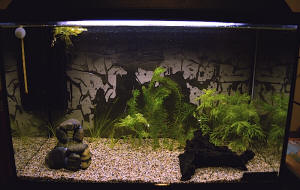
|
65 gallon stocking. Fish in planted sys.
11/28/11
Hey there folks, I'm back again with a question pertaining to
stocking my 65 gallon planted tank!
I've sent an email before regarding Archer fish identification and
how many Toxotes microlepis to keep in my tank. So here is what I have
so far in terms of ideas.
1. 5-6 Toxotes microlepis
2. Some sort of spiny eel (what species might you recommend? I
don't particularly care for the peacocks but i know fire eels are
out of the question with this tank size and water requirements)
<Yes, can work; one of the Tyre-Track Eels should be okay, but do
also look out for Macrognathus aral, the One-Stripe Spiny Eel, an
attractive fresh and brackish water species that would allow you
considerable flexibility should you decide to keep the tank slightly
brackish to allow other oddball
fish.>
3. Would some sort of knife fish work? I was looking at some info on
the African Knife fish, Xenomystus nigri I believe? If i kept the water
chemistry stable and a pH that is fairly basic might this work?
<Yes, that's a good species. Hardy, adaptable, and quite
peaceful.>
If not any other recommendations are welcome! I really love oddballs
when it comes to fish!
<Would get the Spiny Eel first, get it feeding, and then introduce
the Knifefish if you want to keep that species as well. These two
compete for the same sort of food, so getting them both feeding
properly may be tricky.>
-John
<Cheers, Neale.>
Planted Aquarium Issues... set-up, op.... Mis-fish-stocking
10/4/11
I have a 75 gallon Planted Tank
Lights
6X65watt T5 florescent (5.2 watts/gal) 1hr dusk morn/even 12 hours
light.
Filtration
Marineland 360 Canister Filter
Marineland course foam, bio balls, ceramic, RENA 30 foam, RENA Micro
foam, RENA Super Micro foam, Marineland polishing pad 40 watt Emperor
Aquatics Smart UV Sterilizer
Marineland Tidepool sump
2 sets of Marineland filters, bio-wheel, filled with bio balls
CPR Continuous Overflow Box with lifter pump and foam filter
Fluval G3 Fine Filter connected to 180 gal/hr pump
25 watt Emperor Aquatics Smart UV Sterilizer
2/200 watt inline heaters (81°F)
CO2 Reactor supplied by pressurized CO2 controlled by Pinpoint pH
controller (6.8 � 6.9), which also controls dual
supply air pump (6.7 � 6.8)
Fluval G3 Fine Filter connected to 230 gal/hr pump
HOB Refugium with Water Sprite (harvested bi-weekly)
20 watt T8 lighting
<All sounds great!>
Fish
5 Discus (4-6 inches)
1 Electric Blue Jack Dempsey
3 Denison Barbs
8 Fox SAE
3 Clown Loaches (3 inches)
5 Boesemanni Rainbows
6 Madagascan Rainbows
1 Bristlenose
1 Pleco
<An interesting mix, by which I mean unlikely to work in the long
term. Denison Barbs are subtropical fish and aren't happy above 25
C/77 F, i.e., they're much shorter lived. Ideally, you'd keep
them much cooler, around the 20-22 C/68-72 F mark. Discus, by contrast,
are high-end tropical fish that need to be kept at 28 C/82 F.
Furthermore, Clown Loaches are plant eaters, and as they get bigger,
they'll not only eat your plants, they'll uproot them too. Jack
Dempseys have absolutely no place in this aquarium at all.>
Plants
Anacharis, Madagascar Lace, Moneywort, moss ball, Red Rubin, Temple
Narrow Leaf, Wisteria, Anubias Nana, Balansae, Java Fern, Water
Sprite
(Plants pearling nicely, looks like soda pop)
Chemistry (All tests done daily with API test kits, except O2 which
is
measured by Pinpoint Dissolved O2 Monitor and FE which uses a Seachem
kit)
O2 5.5 � 6.3
GH 6 dGH
KH 3 dKH
NH3/4 <Minimum Detectable
NO2 <Minimum Detectable
NO3 10 ppm
PO4 1 ppm
FE <Minimum Detectable
Water is RO/DI, 25% (Assuming a total water volume of 100 gal.) water
changes done weekly.
Chemical Additives (Usually added to sump)
Seachem Flourish Excel
Seachem Flourish FE
Seachem Flourish P
Seachem Flourish N
Seachem Flourish K
Seachem Flourish Trace
Seachem Equilibrium
Seachem Acid Buffer
Seachem Alkaline Buffer
Water is crystal clear and there is minor green algae, weekly
mechanical removal.
I have 3 potential problems.
<Excluding the fish!>
First is that I add FE and there is not a corresponding increase in
iron levels when tested.
<May well be being used up quickly, or reacting with something else
in the aquarium, either chemical or biological. If the plants
aren't showing signs of iron (Fe) deficiency, then you might not
need to worry either way. But if they are showing symptoms like
Chlorosis, you may want to up the dosage by, say, 50%, and see what
happens.>
I have added as much as 40ml and sample within 10 min, sump and
aquarium, the FE is <Minimum Detectable. I have done a reference
test and it indicated properly. It doesn't seem that the uptake of
FE by the plants could happen so quickly. I don't have any Carbon,
Chemipure or Purigen (I did previously) in any of the filters.
<But bacteria and algae can use up iron.>
Second there is something else buffering the pH. Before I started the
CO2 injection, pH increased over time. With the continuous CO2
injection either CO2 flow has to be increased or acid buffer has to be
added to allow the CO2 to control pH in the band. Any ideas?
<How much is the pH varying by? And are there any signs of problems
with the plants or the fish? If all looks good, and the plants are
growing, then why worry? Don't obsess over the numbers. Biology
isn't a bunch of chemical reactions. Or rather, it is, but such
complex reactions that something as crude as a pH test tells you
virtually nothing of significance. In itself pH is a remarkably
unimportant measurement, and pH levels in natural streams and ponds
vary much more than people imagine, and by different amounts on
different days. So roll with it for now, unless there's something
obviously not right about your tank.>
Third is that it took ¾ of a bottle of P to raise the
phosphate level to 1 ppm. Much more than calculated. Any ideas why?
<Does sound odd, but if that's what it takes, then that's
what it takes. Do bear in mind your hobbyist test kit is far less
accurate than anything scientific, so the margin of error is really
quite wide. Once again, if the plants are healthy, and you're
seeing good growth and lots of new shoots and leaves, then why worry?
To a degree, phosphate will be produced by the biological filter and
recycled around the tank.>
Thanks for your help.
Mark
<Cheers, Neale.>
Stocking a planted large community tank 3/29/11
First, let me thank you for this great site and because English is not
my first language I do apologize for any grammatical and dictation
errors.
<Don't worry about it! Your English is much better than my
Farsi!>
Currently in my office I have a rather large tank with the capacity of
280 US gallon. Its length is 4m and its width is 40cm and its height is
70cm.
<Sounds fabulous.>
It has a 40 gal sump and the filter turnover is nearly 1000 gallon per
hour.
<Nice.>
I am going to convert it to a community tank and plant it heavily and
use pea size gravel in it.
<Okay.>
The local tap water's ph is 7.2 and the water hardness is 10
degrees.
<That sounds lovely. Not too hard, not too soft; nice middling pH.
In short, virtually everything should do well. About the only obvious
things that wouldn't do well would be those species that need very
hard water (e.g., Mollies) or very soft water (e.g., Ram Cichlids). But
virtually all barbs, tetras, Danios, catfish, etc. should be
fine.>
please help me choose a workable stocklist from the following. My
favorite fish (based upon availability in Iran) are:
1 catfishes -- Asian glass catfish, Raphael catfish, Pictus catfish,
jaguar catfish, upside down catfish and Bristlenose catfish.
<All these would do well here. Some of these are more or less
predatory, e.g., Jaguar Catfish and Pictus Catfish. Asian Glassfish do
need to be kept in schools of 6+ specimens, and Dwarf Upside Down
Catfish are also gregarious, so if you want to see them, keep 3 or
more.>
2 tetras -- Bloodfin tetra, X ray tetra, garnet tetra, lemon tetra,
Congo tetra and blue tetra.
<Of these, X-ray Tetras and Bloodfin Tetras (Aphyocharax anisitsi, I
assume) are two of the hardiest and easiest to keep. Of these, X-ray
Tetras are 100% peaceful, but the Bloodfin Tetras are sometimes nippy
to slow-moving fish, so don't mix with slow-moving or long-finned
fish, e.g., Angelfish. Lemon Tetras are 100% peaceful but a tiny bit
more delicate than these other tetras. Garnet Tetras are usually
peaceful, but shy. Congo Tetras are SUPERB fish, but because they have
long-fins they are sometimes nipped by some barbs and tetras.>
3 cichlids -- angel, Severum, and rams.
<Would not bother with Ram Cichlids (Mikrogeophagus ramirezi). Needs
very warm, very soft, very acidic water. Doesn't work in community
tanks.
Bolivian Rams (Mikrogeophagus altispinosus) are much, MUCH better
community fish. Do also try Apistogramma cacatuoides, a fairly common
dwarf cichlid that works well in peaceful communities. Severums and
Angels are easy enough to keep, but pairs can be aggressive, and Angels
will be nipped by nippy fish. Severums eat plants, so can't be kept
in planted tanks.>
4 barbs -- tiger barb, tinfoil barb, green emerald barb and if it is a
barb silver sharks.
<Tinfoil Barbs eat plants, so they're not an option! Green
Emerald (Moss?)
Barbs and Tiger Barbs are both varieties of Puntius tetrazona, and
these are nippy fish, so can't be kept with slow-moving or
long-finned fish. If you want a barb, there are better species for this
sort of aquarium:
Puntius pentazona look fabulous in schools of 20+ specimens, which you
have plenty enough space for. Another good choice is the Cherry Barb
(Puntius titteya). I like Checkerboard Barbs (Barbus oligolepis), a
small, understated species with delicate colours that looks lovely in
planted tanks. Silver Sharks might be an option, but they are rather
big, need to be kept in groups of 3+ specimens, and are potentially
predatory towards very small fish.>
5 gouramis -- honey Gourami, pearl Gourami and moonlight Gourami.
<All should work, but Honey Gouramis are small and delicate, so
might not be worth the bother. Pearl and Moonlight Gouramis are fine
choices. Also look at Colisa labiosa and Colisa fasciata, both of which
are commonly traded, very hardy, and fairly peaceful. All Gouramis will
be nipped by nippy tankmates!>
5 others -- silver dollar, rainbow shark, glassfish and clown
loach.
<Silver Dollars eat plants, so not an option. A single Rainbow Shark
(Epalzeorhynchos frenatum) should be fine. Glassfish would do well, but
they won't eat flake or pellet foods, only live and wet-frozen
foods (including small bits of white fish fillet, prawns) so aren't
easy to keep.
Clown Loaches can do well in planted tanks, but they will eat soft
leaves and uproot small plants, so might not be worth the bother. Botia
striata and Botia almorhae are infinitely better choices.>
Also please suggest a suitable temperature for the suggested
stocklist.
<25 C/77 F should be fine.>
Due to contrasting and confusing information that I have received in
last days I quite at sea. Your suggestions will be appreciated
Vahid
<Do hope this helps. Cheers, Neale.>
Re: Stocking a planted large community tank 3/29/11
Thanks for the quick reply, as I understand your message I should omit
Severums
<Yes; eat plants.>
and rams,
<Yes; difficult to keep alive.>
dollars
<Yes; eat plants.>
and honey gouramis
<Yes; shy, sensitive, don't do well in community tanks with
bigger or more active fish.>
and choose a stock list from the other fish. How this sounds? 6 Asian
glass catfish,
<Yes.>
3 Raphael catfish,
<Yes.>
1 jaguar catfish,
<Yes, or more than 1, they like company.>
2 Bristlenose,
<Yes.>
20 X ray tetra, 20 garnet tetra, 20 Congo tetra,
<Yes and yes to the first two; yes to the last species on its own.
But do you realise than 60 X-Ray or Garnet Tetras would look amazing?
Or else, just the 20 Congo tetras, because these are much bigger and
will take up more space in the aquarium.>
20 barb (still undecided about the kind of it)
<Wouldn't bother; the Tetras will be more than enough.>
3 pair of pearl and 3 pair of moonlight Gourami,
<Hmm'¦ Gouramis don't really form "pairs",
and the males can be aggressive. But these species are usually
peaceful.>
3 pair of angel,
<If you want.>
1 rainbow shark
<Yes.>
and 6 zebra loach,
<Yes.>
making the total number 117 fish.
Will be my tank overstocked?
<In 280 gallons, you should be fine.>
Your suggested gouramis are very similar to dwarf Gourami and the
reputation of this kind of fish is terrible here.
<My suggested Gouramis are MUCH better ALTERNATIVES to the Dwarf
Gourami. Colisa fasciata and Colisa labiosa are both peaceful and
hardy.>
Are these 2 types of Gourami better than dwarf ones?
<Yes!!!>
and currently there are 2 other kind of barbs available here which are
more pricy than other barbs; Panda barb
<Puntius melanampyx; basically peaceful, but can get quite big,
around 10 cm, and may eat very soft plants.>
and redline barb and especially the redline one is very pretty.
<Yes, Puntius denisonii is expensive here in England, too! Does
prefer quite cool water, and won't live for long in a warm tropical
tank. 22 C/72 F is probably the optimal, a little cooler in winter
perhaps. In tropical tanks tends only to live for a couple of years
unless there is lots of water current and LOTS of oxygen. The necessary
water flow and turbulence (bubbles) will drive off CO2, so won't be
what you want in a planted tank. Better for a hill stream
aquarium.>
Given the high price of them is including them in this community
possible and safe?
<See above.>
And lastly I think with this stock list the top level of tank will be
rather empty, if it is correct what should I do?
<Oh, the tetras and barbs will swim up there at times. Otherwise,
good choices are Danio species that stick to the top few cm.>
Thanks again and be sure I should come back and will ask a billion
questions.
<Do read this web site for more! Cheers, Neale.>
90 gal. FW, planted set-up and stkg. mostly
9/16/10
Hello crew!!
<Hello Laurie,>
I bought a 90 gal with an Eheim 2217
<Excellent filter. Will be working quite hard on a tank this size,
so be careful with the fish you add. You have a turnover rate about 3
times the volume of the tank per hour, the 2217 being rated at 1000
litres/hour, about 265 US gal/hour. You won't have any problems
with things like Neons and Corydoras, but bigger and/or messier fish
can cause problems with water clarity especially, i.e., you get a lot
of debris on the substrate and trapped among feathery plant
leaves.>
and I plan on trying a planted tank.
<Okay.>
I've been reading everything'¦ and I find so much
contradiction'¦ even on WetWeb (no offense), now I am
thoroughly confused.
<Oh dear!>
My substrate will be Fluorite by SeaChem and I definitely would like 6
angels of various colors.
<Okay. But do remember Angels aren't simply schooling fish once
mature, and tend to become territorial while spawning. Often a mated
pair works best. Plus, do have a look at "real" Angels as
opposed to the artificially bred varieties. Wild-caught (or at least
pure-bred) Scalare Angels, "Peru" Altum Angels, and true
Altum Angels are stunning fish.>
I was thinking a few albino Bristlenose for tidying up'¦
<Hmm'¦ stop thinking this way. Catfish don't clean up
anything. By definition, adding a fish makes your aquarium messier.
Yes, an Ancistrus catfish will help remove algae from solid surfaces
including the glass walls of the tank -- though they have little impact
on algae growing on plants -- and while they eat some leftover fish
food they also need regular supplies of their own catfish food and
fresh vegetables. Ancistrus catfish certainly do have a place in a
South American community tank, but as part of the community, not as
mere janitors. By the way, if you're worrying about producing an
authentic mix of South American fish, albino catfish certainly
don't belong! Such fish would look kind of goofy in a nicely
planted biotope aquarium. Why not get a "real" Bristlenose or
two, or perhaps a group of the small but beautiful Hypancistrus species
such as Hypancistrus inspector? To be sure, Hypancistrus are *not*
algae eaters and mostly feed on catfish pellets, algae wafers and small
meaty foods like bloodworms, but they're worth the effort.>
and maybe a very large school of Cardinal tetras...18 or so.
<Can be excellent companions for Angels, provided the size
difference isn't too great -- big Angels will eat small Cardinals,
though mature Cardinals should be okay. Cardinals are finicky fish in
terms of water chemistry, so don't bother with them if your
hardness is much about 10 degrees dH (don't make the mistake of
focusing on pH, it's hardness that matters!). In fact most South
American fish will do fine between 3-10 degrees dH, pH 6.5-7.5.>
I'd planned on putting the cardinals in first'¦ give
them some grow time'¦
<Not necessary if you add the Angels as juveniles, which you really
should. Not teeny-tiny Angels, as those tend to be delicate, but 5 cm/2
inches across is about right.>
and also to add the most aggressive (angels)'¦ last. I'd
like another mid-range fish from the South American bio-type.
<Lots of options. But do understand Cardinals need quite warm water
to do well, 26-28 C/79-82 F, and that's a bit warmer than some of
the tetras enjoy. Choose carefully.>
I've seen Zebra Danios mentioned many times'¦ aren't
they more of a colder/Asian type fish?
<Yes. Would not be my recommendation here.>
In the carp family?
<Yes, the Cyprinidae.>
I'd prefer fish from the particular region simply because I'd
rather have fish that evolution put there 'and not the
"can tolerate different temps/Ph"..etc.
<Well, there are swings and roundabouts. Congo Tetras for example
look spectacular in planted tanks with Angels, as do Boesemanni
Rainbowfish from New Guinea. But yes, it's often intellectually
appealing to create a community of fish from the same basic
environment, though tropical South America is a vast area, and some of
these South American tetras will be coming from places 1500 or 2000
miles apart, which is the distance between London and North
Africa!>
Thanks very much for your time, I've read countless articles here
on WetWeb and I have been helped many a time...keep up the excellent
work!!!
Many thanks,
Laurie
<Among the species I'd look at are these: Rummynose Tetras
(Hemigrammus bleheri); the hardier of the two Penguin Tetras (i.e.,
Thayeria boehlkei); the Emperor Tetra (Nematobrycon palmeri); the
Diamond Tetra (Moenkhausia pittieri); and the Bleeding Heart Tetra
(Hyphessobrycon erythrostigma). All of these will do well in the
slightly warmer than usual conditions Cardinals and to some extent
Angelfish enjoy. The Emperor Tetra is unusual in that the males are
territorial, so they're great fun to watch in a large tank as males
flirt with passing schools of females. The Rainbow Emperor Tetra
(Nematobrycon lacortei) is a bit more delicate but also worthwhile.
Blue Emperor Tetras (Inpaichthys kerri) are nice but a bit smaller and
shyer, so wouldn't be quite so good here. The Common Hatchetfish
(Gasteropelecus sternicla) can look amazing when kept in large groups,
but it will fly out of open-topped tanks, so may not be appropriate in
a planted tank. I hope this helps. Cheers, Neale.>
Re: (no subject) 9/16/10
Thank you Neale,
<Happy to help.>
Maybe I'll scrap the Bristlenose and perhaps add 6 or 7 Dwarf
Rainbows instead?
<No need to ditch the Ancistrus catfish; in fact they're
excellent catfish that generally do little damage in planted tanks,
something that cannot be said for all the Loricariidae. I happen to
love Whiptail catfish, so take a peek at those. Half a dozen
Rineloricaria parva would be lots of fun, and if you were very lucky
they might even breed in this tank. Not in the same way as guppies, but
you could easily find one or two young catfish in the tank simply
because the fathers look after the eggs so well, and the juveniles hide
a lot and eat algae and detritus, allowing them to survive in planted
tanks quite well. Ancistrus also breed in community tanks, and
sometimes people find the odd baby catfish in their planted
aquarium.
Melanotaenia praecox is a superb aquarium fish and highly recommended.
It needs moderately hard to hard, neutral to slightly basic water
conditions, so it's a good choice for aquarists with hard, alkaline
water conditions.
If you have soft water, I'd actually plumb for the Diamond Tetra
instead, an utterly gorgeous fish with exquisite colours. As its name
suggests, the body is iridescent and shiny like diamonds, but the fins
are smokey-purple, the males having longer fins than the females, and
using them for displays within the group. Keep 8-10 of these fish and
you won't regret it! Photos don't do them justice at all, so
try and find some mature specimens in a shady aquarium to look
at.>
Also should I supplement the Eheim with something else?
<Depends. If you're sticking with small fish like tetras, plus a
couple of angels and a few small catfish, the Eheim 2217 should be
fine. It's a darn good filter: my dad used one back in 80s, and I
use one now, and the design hasn't changed in 30 years precisely
because it's so good. You'll find practically every experienced
aquarist considers Eheim filters the best you can buy. The thing with
planted tanks is too much water splashing at the surface drives off
carbon dioxide, and the more rapidly the water moves
around the tank, the more often water is brought to the surface where
it can lose even more carbon dioxide. That's great for fish, but
it's bad for plants. If you're using plants that aren't
fussed about carbon dioxide, which basically anything considered
"easy" like Amazon swords, Vallisneria, Crypts, Java ferns,
Anubias, etc, then don't worry about it. But if you plan on growing
plants that need bright light and supplemental carbon dioxide
fertilisations, which are usually plants that are either stems (like
Rotala and Bacopa) or bushy (like Cabomba) or have red leaves (again,
like Rotala, but also various other plants) then you made need to trade
off filtration against the need for high carbon dioxide levels. This is
why all
those Amano tanks you see with lots of plants have rather few fish, and
small fish at that. What suits fish doesn't suit delicate plants,
and vice versa. I'd urge you to read about this topic a bit before
jumping one way or the other. As it happens, I have an article about
this topic in the upcoming WWM Digital Magazine on this web site, and
if you subscribe at the link below, we'll tell you when it's
up, which should be in the next few days.
http://wetwebmedia.info/newsletter/?p=subscribe&id=2
Anyway, my point is that if you want to try adding CO2 to your aquarium
because you're growing demanding plants, then you may as well stick
with the filtration you have and see what happens. If on the other hand
you're going with easy plants and want a busy aquarium with lots of
fish, then adding a second filter wouldn't be a bad idea. At least,
you could keep the option open, and if you find you have problems
keeping ammonia and nitrite at zero, then yes, adding a second filter
would be worth doing. Needn't be
anything fancy, and anything rated around 90 gallons/hour should do the
trick nicely, upping your overall turnover rate to 90 + 265 = 355
gallons/hour, which is about four times your aquarium's volume --
90
gallons -- per hour, an ideal amount for a community of small tropical
fish.>
My fish load would be light and I plan on experimenting with plants. As
I understood it or perhaps not canister filters work best for planted
aquariums.
<See above; the type of filter doesn't matter greatly, provided
splashing is minimised, and turnover rates are relatively low.>
I'm trying to find that balance a serene beautiful tank that
actually houses fish, not mere afterthoughts.
<You've hit the nail on the head. The fancy-pants planted tanks
you see in magazines are designed around the plants, and the fish are
indeed added purely as "icing on the cake". Indeed, in some
cases the fish aren't even that happy, as you can tell when the
fish are tightly schooled together, a classic sign the fish feel
nervous -- compare how Neon Tetras behave when just hanging out
together compared to what they do when you start chasing them with a
net. One other thing about planted tanks that you see in magazines is
that they're built for photographs. They are not built to last.
Takashi Amano for example is a photographer, and his goal is to create
an aquarium over several months that grows towards a beautiful
image. It's sort of like flower arranging. An art, yes, but not the
same thing as creating a garden that stays basically the same way for
several years. After the photograph is taken, the "Nature
Aquarium" is taken apart, and then something new built from
scratch. Creating a planted tank that lasts for 10 years and decorates
your home is something very different.
This isn't to say you can't use Amano principles to create a
planted community tank, of course you can. But at the same time you
need to understand that what works in the short term might not work
over many
years. So just as you say, it's a good idea to choose your fish,
choose the biotope you want to mimic, and then choose the plants and
decorations that help you fulfill that aim. There's a nice book
called 'The Complete Aquarium' by Peter Scott that's been
out of print for years but can be bought online for pennies. It
presents lots of different community tanks each with a geographical
theme, and while it has its flaws, the concept is informative and
inspirational.>
Should I buy a bigger canister? I apologise I think its a case of
sensory over-load, but I truly want to do the proper thing for the fish
I choose.
Thanks so much;
Laurie
<Hope this helps. Cheers, Neale.>
Re 90gal planted tank, fish stkg. 09/29/10
Hello Neale,
<Laurie,>
I sent you an email about 2 weeks ago...I was starting up a 90gal
planted tank. I took a peek at whiptails..and you are 100%
correct...very cool fish.
<Indeed they are.>
I've decided to give the Diamond tetras a try;
<Another superb fish.>
I hounded my water company and my hardness ranges from 41 to 112ppm. So
I did the math'¦x .056..and according to my numbers, my
water should be fine for tetras. Please correct me if I'm
wrong.
<We're talking General Hardness here? If so, yes, should be
fine.>
Also, I got an excellent deal on 3 Eheim filters, I already have a
2217, my wonderful find is another 2217, a 2215 and a 2227, plus a load
of "stuff" for $250.00. The fish Gods were kind to
me..haha.
<I'll say!>
In any event, I plan to keep the second 2217 for parts,
<Really? Eheim spares are pretty easy to obtain, and from eBay and
the like shouldn't even be expensive. Can you not sell on the
surplus 2217?>
and was contemplating adding the 2215 to my 90 gal.
<The 2215 is rated at 164 gallons/hour, and the 2217 at 264
gallons/hour, so together that's 428 gallons/hour. For a 90 gallon
tank that's a turnover of about 4.8 times per hour (i.e., 428/90).
That's not a huge amount. I have a 48-gallon aquarium with a Fluval
104 and Eheim 2217, which together offer about 364 gallons/hour, a
turnover rate of about 7.5 times per hour. Do the fish mind? No, not at
all, and this includes some fish not normally thought of as fast water
fish, such as Ameca splendens and Bleeding Heart Tetras. Oh, I should
note that the turnover rates manufacturers advertise tend to be
optimistic, which is why I tend towards providing more turnover than I
think I'll need rather than "just enough". By the time
you've added a spray bar and some biological media, turnover rates
will be much lower than advertised, perhaps only half. That's not a
big deal if you bought a generously sized filter from the start, but if
you got a filter only just big enough, you may find yourself having to
clean the media very frequently just to keep the filter working at all.
I'm sure you've noticed how a brand new canister filter seems
to have the force of a raging torrent, but after a couple of months the
flow drops to a mere trickle. Building a little extra capacity into
your system by buying more rather than less filtration means you
don't have to worry about this. I'm one of those folks who puts
off cleaning his filters as far as possible, in the case of external
canisters, often not cleaning them for 3-6 months at a time!>
Is it possible to have too much filtration?
<Not filtration, no. But you can have too much turnover. As a broad
rule, small fish like Neons and Guppies are happy with turnover rates
around 4 times the volume of the tank per hour. Bigger fish that
produce more mess, such as cichlids, should be given a turnover about 6
times per hour. Fast-water fish that need conditions like a mountain
stream, for example loaches and some of the Danios, appreciate water
turnover rates upwards of 8 times per hour. These are ballpark values
though, and the main thing is the turnover rate is high enough water
quality is good, but not so high the fish are buffeted around the tank.
If the fish are happy, the water is clear, the nitrite and ammonia
levels are zero -- then you have adequate filtration!>
I've yet to add fish, I'm doing a fishless cycle and going very
slowly'¦would the 2217 and the 2215 be too much?
<No, probably not. Depends on the fish, but assuming medium-sized
tetras and catfish, 4-6 times the volume of the tank in turnover per
hour will be just fine.>
Thanks so much for your help as always,
Laurie
<Glad to help. Cheers, Neale.>
Planting and fish 10/25/2009
First, to recap, we have a long (as opposed to tall) 30 gallon aquarium
currently stocked with about a half dozen Neon Dwarf Rainbows and 1
Bolivian Ram. Ammonia and nitrites are 0, nitrates reached about 20 ppm
just prior to our biweekly water change. General hardness is about 50
ppm and alkalinity is under 80. PH is about 6.9 to 7.1 depending on
which test we use.
<OK.>
We have gravel substrate and plastic plants. Is it too late to plant
our aquarium or should we not disrupt our system as it seems to be
stable now?
<Depends on what you mean by "plant". If you've set
the tank up nicely, and don't want to mess about with a fancy
substrate, then opt for epiphytic plants and floating plants instead.
Epiphytes grow attached to bogwood and lava rock, examples being
Anubias, Java fern, Java moss, and Bolbitis.
Between them, these extremely hardy and long-lived plants provide ample
scope for an attractive display. Simply buy them ready-attached and add
them to the tank, or else buy them loose and tie them to the bogwood
you have using black cotton. Floating plants including things like
Indian Fern and Amazon Frogbit. Since these plants grow quickly, they
provide excellent algae-control. They also fill the top few inches of
the water column, adding colour and interest.>
If you advise that we plant our aquarium, how should we go about it in
order to avoid unbalancing our chemistry? We have the Eclipse filter
which I understand is considered low light. What plants would be best
for our aquarium?
<Both floating plants and epiphytes tend to do well under low to
middling light levels. Add a few of both for best results, since by
themselves epiphytes can become covered with thread and hair
algae.>
We'd like to add more fish. Do we have room for more? How many? My
wife is interested in either Neon Tetras or Dwarf Honey Gouramis.
<I'd skip Neons, since they need relatively cool water (22-24 C)
and farmed fish are notoriously problematic, dying off in their droves
for reasons not altogether clear. Honey Gouramis are lovely fish, but
small, and might be bullied by the Bolivian Ram. I'd instead look
for something small and colourful that stayed near the top of the tank.
The result would be a less cluttered aquarium: you'd have the
Bolivian Ram at the bottom, the Rainbows in the middle, and something
else at the top. Platies are good choices, but your water is a bit soft
for them. Half a dozen Danios or Silver Hatchetfish might make a better
soft water alternative. If you can find them, Splashing Tetras (Copella
arnoldi) or Eye-spot Rasboras (Rasbora dorsiocellata) are active and
interesting options for community tanks. You might even try a female
Betta. These do need floating plants though, otherwise they tend not to
thrive.>
Would either of these be compatible with our current stock? Which would
be better? Would you please recommend something else if these
aren't suitable.
Thanks,
Jeff
<Cheers, Neale.>
Re: 180 litre tank set up, planted -- 08/04/09
Hi there, I've got one more question.
<Go ahead.>
Will my tank be overstocked if I just have the Juwel filter?
<I have this precise aquarium, and after a while, I got fed up
removing dead plant material from the filter and having to siphon out
mulm from the bottom of the tank the filter didn't remove. The
Compact H filter in the Rio tanks is a good filter in terms of
biological filtration, but a poor filter when it comes to mechanical
filtration. Most hobbyists with demanding set-ups using Rio tanks
invariably add one or more additional filters as well. By all means try
things without, and see what happens. You aren't going to put any
fish at risk since these Compact H filters handle ammonia and nitrite
well, but I suspect you will, like me, get fed up with the decaying
organic material all over the place. So keep my advice in the back of
your mind, even if you choose not follow it right now.>
Because people from forums and fish stores all commented that the tank
will be fine with just one filter as long as I do weekly water
changes.
<You will be doing weekly water changes anyway, and water changes
are not connected to filtration capacity. Filtration removes ammonia
and nitrite, eventually converting them to nitrate. Now, water changes
are about diluting nitrate and offsetting the background acidification
that happens between water changes. Hence, the two things are
completely unrelated.>
Also what ratio of SAE and Otos should fit reasonably well in my
tank?
<I wouldn't mix them. Otocinclus are almost entirely dependent
on green algae, though they take algae wafers and small bloodworms as
well. If forced to compete with more aggressive fish feeding on the
same foods, the Otocinclus stand a good chance of starving. Any catfish
book or expert will tell you the survival rate of Otocinclus in
captivity isn't very good, so to stand any chance of maintaining
them for their full lifespan, you need to optimise conditions to suit
them.>
I can't get Nerites or shrimps here in New Zealand because nobody
sells them. I have a problem too. Today when I added the Fluorite and
silica sand, the sand formed a barrier between the Fluorite and water.
What should I do?
<Depends what you're trying to do. All substrates will, over
time, segregate out. So if you have a mix of sand and gravel,
eventually the sand will drift downwards leaving the top of the
substrate mostly gravel. A gravel tidy (or any similar non-toxic
plastic mesh) can be used to slow this down, and that's how I set
up my planted tanks, with different combinations of substrate above and
below the mesh, which I bought from a garden centre. Otherwise, if one
particular substrate provides advantages you need, then use that one in
its entirety.>
thanks.
<Cheers, Neale.>
130 gallon tank 6/1/2009
Hello,
I just purchased a 130 gallon tank that I am going to set up as
a freshwater planted aquarium.
<That's a nice size for such a project!>
It didn't come with any filters, heaters, etc. I am planning on
keeping guppies, mollies, and platies.
<Platies do prefer slightly cooler water to Mollies, and Fancy
Guppies at least also like fairly warm water. The ideal for Platies is
around 24 C, whereas Mollies and Fancy Guppies will do best around
26-28 C. So with that said, you might elect to keep one sort or the
other. Alternatively, be aware that the Platies will be heat stressed
at the higher temperature, and ensure circulation is adequate, so they
get enough oxygen. Mollies may do well in very hard water, but they are
prone to disease, and invariably do better in slightly brackish
conditions. Only a subset of plants thrive in very hard water, and
fewer still appreciate brackish water. So again, you may want to
consider more carefully your options here. Most aquarists who
are serious about plants choose a water chemistry and temperature
suitable for the plants they want (factoring in CO2 fertilisation) and
then choose fish that thrive under such conditions. Livebearers are
rarely seen in "serious" planted tanks because their needs
don't overlap much with those of the (mostly) soft water plants
from Asia and South America. It may well be that tetras, barbs and
rainbowfish will make much more sense.>
It is just a hobby, but I enjoy breeding them.
<So do I! I keep the livebearer Limia nigrofasciata in a small
planted tank and they're terrific fun. They eat some of the green
algae too. But this isn't a "serious" planted tank, just
hardy plants like Anubias, Crypts,
Hygrophila, and various floating plants. If you're after something
like an Amano Nature Aquarium, then livebearers might not be the best
choice.>
I would like to know the ideal set up (brands and any other info
necessary)
<A big question...! I suggest you read some of the articles here at
WWM first, here:
http://www.wetwebmedia.com/PlantedTksSubWebIndex/AquariumGardenSubWebIndex.html
In particular review lighting, substrates and CO2 fertilisation, as
these are the make-or-break issues. There are numerous books on the
topic, but a couple I strongly recommend are listed here, one outlining
different
"habitats" and the other listing the needs of numerous
species and the hardware required to keep them:
http://www.wetwebmedia.com/FWSubWebIndex/bksfwbrneale.htm
When you have more specific things you want to discuss, get back in
touch and we'll do our best. Cheers, Neale.>
FW 130 gallon tank Planted Tank: Stocking
6/1/2009
Hello,
<Hi Brittney.>
I recently asked a question about a 130 gallon tank that I just
purchased (Neale responded to it).
<I shall leave a copy of this in his inbox to see if he has anything
to add.>
I am not going to heavily plant my tank because that would take a lot
of work considering the size.
<Agreed. If you want to try a planted tank, you can add some live
plants and some fake ones. As your skills or desire for more plants
grow, you can add more real and remove some of the fake.>
I am going to put a few plants that I have already began to grow in a
10 gallon tank. I bought them as bulbs and they are doing fine.
<Very good.>
Neale told me that platys don't like heat like mollies and guppies
do.
<I agree.>
So now my plans are to do a lightly planted freshwater tank with
mollies and guppies.
<I'm not a fan of mollies in general, they really do better
under brackish conditions.>
Are there any other non livebearers that could add interest to the
tank?
<I'm biased because I have a school of them in my 75 gallon
planted tank, but Rainbowfish would serve you well here. They are
colorful, very hardy, and peaceful.>
<You can read more about them here:
http://www.wetwebmedia.com/FWSubWebindex/rainbows.htm >
And what are the best brands/types of filters, heaters, and air pumps
that I should use?
<This is a matter of personal preference, as everyone has
differing
opinions. I'll give you my preferences, as all of these products
have served me well for years.>
<Hang on back filters: Eheim or Marineland Emperor filters
<Canister filters: Eheim, The XP series made by Rena is a close
second.>
<Submersible Heaters: Jaeger or Marineland>
<Air Pumps: Tetra makes some nice ones.>
<MikeV>
Re: 130 gallon tank... stocking, FW 06/02/09
Hi Neale,
You had originally helped her, I responded, just forwarding a copy if
you had anything to add.
MikeV
<Hi Mike, Brittney. Nope, nothing much I'd add. Like you Mike,
I'd strongly recommend against Mollies for freshwater aquaria; they
just don't do that well. I think your suggestion of Rainbowfish is
a very good one: Melanotaenia praecox, Melanotaenia herbertaxelrodi,
Melanotaenia boesemanni and Glossolepis incisus all look superb in
large planted tanks, especially when kept in big schools of equal
numbers males/females. Brittney - if you go with Rainbows, don't
make the mistake of just buying males, because they won't colour up
properly, and be aware juvenile Rainbows can look a bit drab. In big
schools, they're stunning once mature! Cheers, Neale.>
Live Plants with Silver Dollars? 3/21/08
Hello. I have a 55-gallon community tank with two silver dollars. I
also have a Pangasius cat, a rainbow shark, two giant Danios, a striped
African glass cat, two dwarf gouramis and a small Pleco, I have plastic
plants in the tank and the fish seem to avoid them and treat them
almost like an obstacle when swimming. They occasionally use them for
shelter.
<Hmm... you *are* overstocked, in particular because of the
Pangasius. On the flip side, African Glass Cats are schooling fish, and
they'd be happier if you kept 6+ specimens.>
I'd like to switch to live plants that can provide some habitat but
I know that silver dollars are vegetarians. Are there any live plants
with sufficient foliage, etc. that silver dollars will not consume?
<Not many! Very sturdy species including Java ferns, Anubias,
"giant" Vallisneria, Crinum thaianum and some of the hardier
Crypts such as Cryptocoryne ciliata are species that sprint to mind.
Floating plants
usually do well with vegetarians, in the sense they grow rapidly enough
to offset being eaten, particularly under bright light. So Amazon
Frogbit, Indian fern, etc might be options.>
Thanks.
Sal F.
P.S. On another note, I know that the Pangasius catfish will grow
huge.
<Huge is an understatement!>
It's already grown like gang busters to four inches very quickly.
(the big chain pet store description said 6" max [wrong!]). I
already have a store that will adopt it when it outgrows my tank.
<Good. While the 1.3 metre specimens aren't common in aquaria,
Pangasius hypophthalmus easily get to 60 cm+ under aquarium conditions.
Lovely fish if you have the space, but they're schooling, nervous
fish that easily damage themselves when kept singly, particularly often
damaging, even losing, their eyes. So be realistic about when it needs
to go; I'd say that once it tops 15 cm/6 inches, it's too big
for a 55 gallon system. Cheers, Neale.>
Planted tank and livestock compatibility ~ 01/09/09
Hello to the WWM crew! After much reading/research, I have compiled a
desired stocking list for my planted tank. I've gone through a lot
of the FAQs and articles on your site, visited several of the LFS, and
asked questions among some local hobbyists. I have been trying to find
a good balance between the plants and livestock (i.e. what fish are
less likely to destroy my plants, and what fish will have the best
chance of getting along with one another). <Ah good> If you
don't mind, I'd like to run my stocking list by you before I
finally consider it "final". First, here is some basic
information about my setup and current plants/inhabitants: 29 gallon
tank, 70/30 mix of Fluorite/aquatic soil with half-inch layer of
natural dark gravel on top, approx. 4 watts/gal of 6700K PC lighting,
parameters (last checked a couple of days ago) were...0ppm ammonia,
0ppm nitrite, 20ppm nitrate, pH 7.6, temperature of 78 degrees F. For
fish, only have 7 zebra Danios; they are doing quite well, very active,
etc. Tank was set up about 4 months ago. For plants, I have (several of
each of these) Hygrophila deformis, Cryptocoryne wendtii, Crinum
thianum and java fern. All are doing well. Have been using Flourish as
well as the Flourish tabs. 11 hours of light per day. Doing one 10%
water change on Wednesdays, and one 25% water change on Saturdays.
<Good plant choices... the Hygro and Crinum will grow very quickly,
the Crypt and Fern not...> As of now, my plan is to (over the next 6
months) add the following: -7 cherry barbs -1 Colisa fasciata <A
fave Gourami species... may prove too aggressive, but you should be
able to discern this as time goes along> -1 "real" SAE -1
cherry shrimp <Mmm, I'd get more SAEs and Shrimps... they're
social species... and much more active, interesting in groups... and
you have room for them here> I will also be adding quite a few more
plants. I know that the barbs may pick at the plants a bit, but
especially with the Hygro, I'm seeing rapid growth and feel that
they can probably "keep up" with whatever the barbs might
eat/pick off of them. <I do agree> I guess this is more of a
"sanity check"...in terms of the plants, and selection of
livestock, does it seem like I'm going in the right direction?
Thanks! -Matt <I'd say so! Thank you for sharing. Bob
Fenner>
Compatibility-FW, planted 5/24/08 Hi there
<Hello,> We have recently bought a 200l tank (100cm x 40cm x
50cm). It has bog wood, planted bog wood, and various plants in it,
including some very cool moss/algae balls :o). <Those are in fact
balls of algae, Cladophora aegagrophila. Some folks find them difficult
to keep. They need very clean water with plenty of water movement to
stop them getting clogged up with silt. Bright light is also very
important.> It is heated and is set at 25 degrees, has a Fluval 205
external filter and an air stone. <All sounds fine.> Water stats
using a liquid tester are - Nitrate 40 (this unfortunately is our tap
water's base amount); Ammonia / Nitrite 0; pH 8 GH/KH top end of
the scale - we have hard water. <All fine for standard community
tropicals. Avoid stuff that expressly needs soft water to do well, like
Ram Cichlids (Mikrogeophagus ramirezi) and you'll be fine.>
Substrate is pea gravel (varies in size some is 2mm up to the largest
few bits being about 8mm) and a finer gravel (about 2mm) in the central
area of the tank. There is a little salt left in the water - we treated
a case of ich on our first Tetra - they are fine now - Salt should be
gone after this week's water change. I am tempted to keep a little
in the water though for its general first aid property - would that be
ok? <Phase out salt entirely. There's no need to keep adding it,
regardless of its (widely misunderstood) "first air"
properties. Think of it this way: does a doctor keep you on a saline
drip? Or smother you with antiseptic cream day after day? Some things
are good in the short term, but pointless, even harmful, in the long
term. Most freshwater fish come from habitats with no salt in the
water, and so they haven't evolved to deal with salt. For a while
they can "make do", but in the long term you're stressing
them. While there's little hard-and-fast evidence about what is or
isn't a "safe" level of salt, there's good evidence
that exposure to salt can prompt things like dropsy in some freshwater
cichlids.> Inhabitants - 7 Ghost shrimp - fantastic little
creatures. 5 Amano shrimp 6 (originally 8 but Ich in the first few days
that we got them claimed 2) Glowlight Tetra. <The tetras certainly
won't appreciate salt in the water.> We have 3 female and 1 male
guppy in the Q tank (it is 35l with internal filter, air stone, heating
and lighting) - they are due to move into the main tank in 10 days
providing there are no problems. They had fry the day after we got them
- much excitement there! and a mad dash to get a small 12 l tank set up
for the fry. There appears to be 25 of them with no deformed ones, they
are doing well and have grown so much. <!> query/question 1 We
have a snail problem in the main tank - pointy pond snails and curly
flat type ones as well - they are even in the filter sponge!!
<Snails are best dealt with by manual removal in the first instance,
and then careful maintenance of the tank afterwards. Understand this:
snails CANNOT break the laws of physics. They can only multiply as
quickly as they can find food. For them, the prime food source is
uneaten fish food, and to a lesser degree algae. Fish food is rich in
protein, and that's why snail populations increase rapidly in
aquaria. So review carefully how much food you are putting in the tank
and how well you are removing wastes, including uneaten food, feces,
dead plant leaves, and algae. Since snails can breed inside filters,
you will likely need to clean the filter media regularly, too. But in
any event, the only way to control snail populations safely and
reliably is this: keep the tank clean.> Obviously can't put
anything in to get rid of them because of the shrimp. So we were
thinking of getting a Horseface loach - I read somewhere that they eat
the eggs? Can't find it again now though! Will it get on with our
shrimp? <More than possible.> There can be no chances that they
will get eaten as they are the reason we ended up with a huge tank in
the first place. Does a Horseface Loach help with snail problems?
<Possibly, but in a "dirty" tank (i.e., one with lots of
food for snails) you may be disappointed because the snails will keep
breeding where the loach can't get them, e.g., in the canister
filter.> If not can you suggest a fish that will get on with our
community and suit the current water conditions? <Any snail-eating
fish will also view small shrimps as food, too.> We are probably
going to get 6 Otos and maybe a shoal of Cardinal Tetra (8 max) as well
- but it depends on space, we don't want the tank to look busy it
is actually lovely with just the shrimp and 6 tetra :o) <Do think
very, VERY carefully about Otocinclus. The vast majority die within
months. They eat ONLY one thing with any enthusiasm: green algae. Not
brown algae, not hair algae, not red algae, not blue green algae. Only
the bright green fluffy algae that grows in strongly illuminated
aquaria. In tanks without this algae, these catfish usually starve to
death. I consider these fish completely unsuitable for community tanks
and only worth keeping if you are an extremely experienced
aquarist.> query/question 2 Will the extremely busy Guppies upset
our peaceful Tetra? <Possibly.> and also the Guppies seem to be
very hungry all the time, I have fed them little and often and they
clear all the food - they eat so much more than the Tetra do - is it
possible to over feed them (not with food left in the tank - food they
have eaten)? <Let them eat green algae. Livebearers are omnivores,
and in the wild consume both insect larvae and green algae. The green
algae is bulky and fills them up. In the aquarium we give them highly
concentrated flake food. This may provide them all the nutrients they
need, but it doesn't fill them up. Hence, they seem ravenous. Let
green algae grow on some of the ornaments or plastic plants, and the
Guppies will nibble away at that. (And yes, there is a contradiction
between letting algae grow for the fish, and keeping it trimmed to
avoid problems with snails; unless the snails are damaging your live
plants, I'd recommend ignoring them. Snails are harmless, and some
species, like Melanoides tuberculata are in fact beneficial,
particularly if you manually remove any excess snails periodically.>
We read up to make sure that we were getting peaceful fish for the
community but they are mad, bombing around, digging in the gravel doing
their Guppy thing sorting out who is boss - the male is the lowest in
the pecking order and stays out of the females' way - he is more
interested in getting himself on the top of a floating leaf than
courting his harem. <Odd.> Thanks in advance for your help, I
hope I have given you enough information. <Indeed so.> Lynn
<Good luck, Neale.>
Fresh water plants, avoiding being eaten by fishes,
3/22/08 Dear WetWeb My name is samer and i am from Lebanon I have a
fresh water aquarium and i need to ask u what is the best way to
prevent fish from eating the plants i have in the aquarium Thank you
for all the help samer <Hello there Samer. The choices to go here
are three... Either select for fishes that don't have much of a
liking for aquatic plants... yes to small Tetras, no to Silver Dollars
for instance... Or select plants with low palatability... yes to
Hornwort/Ceratophyllum, no to Elodea/Anacharis... Or somehow keep the
two separated... Either in different tanks altogether, or with a
partition (like a pane of glass with the plant-eating fishes on one
side, the plants on the other. Bob Fenner>
Heavily stocked and planted 90 gal. FW tank
3/12/08 I am wondering what input you can give me, I have read
through the other correspondences and not quite sure if what I read
holds true for my situation. I have a 90 gal. heavily stocked tank;
both with fish and with plants. I am running a CO2 injector for the
plants, a pro clear 75 wet/dry sump with a 900 GPH pump and a Fluval
405 canister filter with a 18 watt gamma UV sterilizer. The tank is an
all glass with overflow. My problem is that I am having to change the
wet/dry prefilter floss above the bio balls about 2 times a week.
<Not uncommon in planted tanks or tanks with a high bioload. Either
deal with it, or reduce the number of fish. The more fish, the more
solid waste, and the more frequently plants shed their leaves (because
the fish damage them, I suppose). Algae also causes problems by killing
leaves and matting together silt, so you end up with all that stuff in
the pre-filter too.> I don't seem to have time to enjoy this
aquarium as I am always maintaining it. My water quality is good and
clear, and for the most part my fish seem happy and healthy. What
should I do to cut down on the amount of time I spend cleaning the
filters? <Remove some fish; if you look at planted tanks in books
and magazines, they contain hardly any fish. There's a reason for
that! Add anything bigger than a Neon tetra, and planted tanks become
increasingly difficult to maintain. Simple as that.> What I read in
the other conversations and on the web is that wet/dry's have no
place in planted aquariums and also that the filtration should be
double the capacity of my tank, i.e.: 180gal. Thanks for your help in
advance-Dave <The argument against wet-and-dry filters in planted
tanks is that the splashing drives off CO2, reducing the rate at which
plants can photosynthesise. Again, this is why planted tanks have so
few fish: it allows them to run with filtration systems that create
minimal turbulence. Cheers, Neale.>
|
Arowana and Silver dollars in a big planted
tank, sys. 2/29/08 Hi, I have a question that has many
different angles to be looked at. I have been reading your
website for the past 2 or 3 years and have scoured about 50% of
the freshwater info as I have found it invaluable. First off, I
have a pretty big L shaped aquarium, 8 ft long, 45 degree angle
of 4 feet, then another 45 degree angle of 8 feet with the tank
being 2 feet deep and 2.5 feet tall acrylic tank (about 900
gallons +/- 50 from evaporation etc.). Ammonia and nitrites are
of course zero, nitrates are between 20 and 40ppm (attributed to
nitrate factory type trickle Bioball sump), pH at a steady 6.8
attributed to the large pieces of driftwood I have in their and
their tannin releasing ways, hardness is at 80ppm. Temperature
ranges from 74 to 76F in the mid to upper levels, 72-75F in the
lower levels, due to lighting I guess. Filtration turns the tank
over about 5-6 times an hour, though with cloggy filters, maybe
only 3 times an hour. <Does sound like you need to upgrade the
filtration a bit; in all honesty jumbo fish need all the turnover
you can get. I'd be looking at 6x turnover minimum, and
likely 8-10. If water quality is basically sound, you can perhaps
get away with just adding a powerhead or two into the tank to
keep the circulation of the water even.> It currently houses a
foot long silver Arowana and a school of 11 silver dollars (the
smaller 5-6" ones, not the red hooks). I also have 4 fairly
young (only 1 foot tall, about 20 leaves) Amazon swords planted
in 2 inches of gravel, and a whole bunch of Anacharis that's
growing like a weed (for the silver dollars munching pleasures)
though it is growing much faster than the fish are eating them.
<Sounds great!> I also have some powerful full spectrum
lighting across the two 8 foot lengths of the tank, nothing in
the middle of the L. My more concerning question, or more likely,
situation, is that my Arowana (I've had it since it was
around 5") recently started taking dives at my silver
dollars as they swim on their merry way beneath him. Is this a
show of territoriality or is he trying to eat the silver dollars
or both? <Either. Both. Arowanas are territorial and object to
anything in "their" zone of operations. This varies
with species, and Silver Arowanas are very much at the mild end
compared with, say, Scleropages jardini. But on the other hand
that doesn't make them friendly community fish! If the
Arowana is sufficiently big, it may be trying to eat them, or at
least "sample" them to see if they're edible. A
6" Silver Dollar is borderline when it comes to safety with
an adult Arowana. Some people have mixed them fine, I know; but
look at how big the mouth of an Arowana can get! I wouldn't
be 100% comfortable with this combo.> The silver dollars are
way faster than him though so I have not yet scene what happens
when he catches them. He is usually just silently sitting beneath
a carpet of Anacharis during the day and only moves when fed
(Hikari Arowana pellets plus weekly beef heart, plus whatever
flakes, crumbles, bloodworms I feed the silver dollars) or when
the lights are off. Also, I read that Arowanas generally
leisurely patrol the aquarium all day and I figured now that I
finally built my uber aquarium (oh that's right, self made...
20% of the retailers price... plus several cases of beer and
pizza for friends who assisted in heavy lifting. <Ha!> Is
it possible that my lights are too bright and the Arowana
doesn't feel safe or its hurting his eyes, though he did just
swim around normally for about a month until he started to
"hide"? They are power compact fluorescents, 525 watts
per light fixture, 4 total fixtures. This is a major concern to
me as I have been keeping fish for the better part of a decade
wanting an Arowana but refusing to get one until I could house it
properly and now he just sits there. At night I have moonlighting
and he does then move around quite a bit, this is why I suspect
the lighting, but I never thought they were nocturnal... more
diurnal from what I read. <Difficult to say on this one.
Arowanas are noted for being photophobic, though most fish prefer
shade to bright light. Do all the lights come on at the same
time? Sometimes fish get alarmed by that, and having the lights
come on across an hour makes a big difference. It does sound like
he doesn't like the light. Is adding an understory of plastic
plants (there are some great 3' plastic plants available now)
an option? Something that could drape across the surface and cast
some more shade? I suppose the experiment would be to unplug one
light fixture for a day or two, and see if the Arowana prefers
that end of the tank.> My next question has to do with the
silver dollars and them seeming to enjoy eating the Amazon swords
more so than the anarachis. Is there some other large show plant
that does well under high lighting that the silver dollars wont
want to eat? <I'd perhaps look at Crinum spp., e.g., C.
calamistratum, as these do seem to be left alone by herbivores.
They're big and generally hardy. Java fern will do great
under bright light, though it does tend to become an algae
magnet. Anubias even more so.> Also, my swords aren't
exactly growing as well as they had in past tanks with 4-5 inches
of gravel. Does the gravel depth make that much of a difference?
<Yes; also the quality/composition of the substrate.> I
have something like a thousand Malaysian trumpet snails aerating
the gravel and what not but am concerned that if I add more, the
snails just wont be able to irrigate and aerate all that gravel,
and the last thing I want is some anaerobic environment
unreachable by plant roots or snail burrowing releasing poisonous
hydrogen sulfide and the likes into my tank, plus stinking up my
fish room. <Just doesn't happen. The "anaerobic
decay" thing is largely a myth. Happens naturally in ponds
and in marine tanks (inside living rock) and no-one fusses. So by
all means ramp up the depth of substrate to what worked before.
Do also check first that the substrate is adequate though --
Amazon swords want a nice rich soil or laterite enriched
substrate, and plain washed gravel just won't work for
them.> Should I consider ditching the silver dollars for a
school of tinfoil barbs? They don't eat plants at all do
they? <Tinfoil Barbs can, will eat plants.> And lastly, as
you may have guessed it, I want to add more fish to this tank as
it seems fairly empty... Im thinking black ghost knife? <In
theory fine, but you'll be hard pressed finding an adult
large enough for this community. Mostly you only see baby
Apteronotus for sale.> I first filled up the tank about 8
months ago, filling it with something like 100 Malaysian trumpet
snails and about 20 mystery snails for my tank cycling. I over
fed the snails for 3 months in order to obtain the current
population explosion of snails I now have, <Consider adding a
group of Clown Loaches or thorny catfishes (Doradidae). These
will eat the snails, if sufficiently hungry.> at the end of
month one I added the sword plants, then I added the silver
dollars at the end of month 3, all at about the size of, well,
silver dollars. They mostly hid in the center decor castles of my
tank for the first two weeks but then began to sprint (if you
will) from one end of the tank to the center and back (they
seemed to never travel into the leftward portion). After having
them in there for 2 months, they had grown to about 3" in
diameter each and I added my Arowana at 5". After only
another 3 months the Arowana (from what I could tell) doubled in
size, which I attributed to it having so much space to swim.
<Or simply good maintenance. Arowanas grow quickly if kept
well.> Now I added the anarachis about 2 weeks after the
Arowana was added and it was generally ignored by all but a
couple of snails. Then a month ago (beginning of month 7) is when
the Arowana began to just sit under the anarachis. So yeah, back
to the black ghost knife... I want to buy two of these guys (i
figure the tanks big enough) and I put two PVC condos with 15
pipes of 2" diameter and 1' length in there, one in each
8' portion. Should I be concerned about the Arowana eating
them as I often find the knife fish around 4-5 inches in length
max, and it will be some time before they grow to their 2'
potential where the Arowana wont (hopefully) eat them. Are the
black ghosts fast enough to evade the Arowana if pursued? <No;
sooner or later, if they're small enough to swallow,
they'll be eaten. The Arowana only has to get lucky once!>
And for the record, despite clown knives growing huge and not
being swallowable by my Arowana, they will probably eat my silver
dollars and knock over my plants, and just grow too big for my
taste, so that options out. <I agree.> Well, that's all
for now. I literally read all over the web for months and
abstained from just writing you guys since I know how annoying it
can be to be asked simple questions that have their answers
everywhere... but I just cannot find anything like this Arowana
diving at silver dollars thing while not swimming anywhere else.
I am a student of the sciences, my job being that of a
biochemist, therefore I was cocky, stubborn, and reluctant to ask
for help (a character flaw repeatedly pointed out by many over
the years)... but there are just some things you cannot learn in
books. I'll likely have another question or comment in a
couple of months after the knife fish are added... if they are
compatible. Thanks in advance for any advice you can provide.
With Best Regards, Matt <Hope this helps, Neale.>
Re: Arowana and Silver dollars in a big planted tank (RMF,
please comment) 2/29/08 Well It looks like Im going to
be upgrading my sump pumps using some pond pumps to get that
water flowing up to the 10 times over level. I currently have
four overflow filters going into four 55 gallon tanks... I guess
I will just have 4 extra pumps to sell on aquabid.com as I
replace them with the pond pumps. The pumps I have looked at are
reporting 1800 gallons an hour (Danner Supreme Mag Drive Aquatic
pumps, I currently own the 1200 gph pumps)... am I going to need
larger sumps or will this push through the 55 gallon tanks just
fine? <No idea; RMF, any thoughts?><<I would
definitely be reading, making careful choices here... There is
much to be saved in the way of electrical cost, pump noise, waste
heat, service life, by making good decisions re pumps... The
Sequence series/Baldor motored lines are some faves for the size,
application here. Other fractional horsepower pumps are ably
reviewed here on WWM: http://wetwebmedia.com/pumpselmar.htm and the linked
files above. RMF>> This company also sells a 5000,
specifically designed for large ponds and waterfall displays
which reports 5000 an hour. Is that overkill or should I add one
or two of those in too? I guess two 1800 and two 5000 gives me
13600 gallons an hour claiming about 15 times an hour for the
whole tank... realistically maybe 11-12 times an hour turnover?
<Probably overkill. 8-10 times turnover should be
adequate.> As for the silver dollars not being fully
compatible, I will look into giving them a new home. I have just
been keeping silver dollars for 7 years now and figured I was
pretty good at it. My last batch of 7 didn't die, with the
oldest being 5 years old starting in a 55 gallon and moving up to
a 120 gallon for the remainder. I just gave them to the LFS
before I moved halfway across the country for the job that would
allow me to have such a lavish aquarium. What other fish come to
mind, that would be an attractive school of 15-20, that could be
raised in one 8 foot section (separated by a divider) until large
enough to not be eaten by the Arowana? Im thinking Bala sharks?
<A good choice. But also Semaprochilodus taeniurus look
amazing in large groups, and are nice Amazonian fish.> I read
they get to 12-15" and from my limited experience, are very
fast. <Oh yes.> Do they eat plants because I cannot find
info saying that they do, but then again, I was wrong about the
tinfoil barbs. <Balantiocheilos melanopterus generally ignores
plants. It eats green algae and invertebrates, and may nibble on
tender shoots, but that's about it.> Maybe 6 months
separated, grown to 7-8 inches then set to survive with the
Arowana? <You may also be able to get adults via Fish Forums,
fish clubs, etc. Lots of people buy them, and then have to rehome
them when they get too big.> Are their any other fish you
could recommend as I have limited experience with large schooling
fish. <There are a lot of nice big barbs. Severums would also
look quite nice, and occupy the midwater. They're territorial
when spawning, but your tank is big enough that shouldn't be
a problem. What about catfish? Sorubim lima is a nice big (45
cm/18") schooling catfish. It's very peaceful, pretty,
and quite easy to obtain. It famously likes to swim vertically
leaning against plants and rocks, so is definitely fun.> As
for the lighting, the timer IS set to go on all at once come 10am
and turn off at 8pm. Some sunlight does come through the one
window and glass door to wake the fish up, but I guess that is
nothing compared to a full 2000+ watts blazing into their eyes
all at once. I can turn on the actinics at 10 am, then 2 of the
other full spectrums on at 11, and the rest at 12... and then
shut them off in the same manner (off to Home depot again for
more electric timers). I assume this will still be ample light
for the anarachis and Amazon swords. <Should be. Try it, and
see what happens!> And I do have two 3 foot plastic plants
draping across the top of my tank which cover an area of maybe
4-5 square feet each. They are located in between the Amazon
swords as to not rob them of light. I don't really want to
put much more over the plants, but there are still many other
places in the tank to add another 4 to 5 of those 3 footers
without disrupting light to the live plants. I will give them a
try since they are cheap and fairly realistic looking. As for the
other plants, I do have an Anubias growing on a piece of
driftwood, though the plant is 3 years old, started as 3 leaves,
has maybe 30 now, and has only moved about 1 foot across the
driftwood (3 foot long driftwood). It used to be house with a
Pleco so perhaps his constant sucking of the driftwood would
constantly cull the Anubias... or maybe the thick film of algae
growing on its leaves is inhibiting it? <I've tried
Anubias with my Panaque, and it gets turned into a Swiss Cheese
Plant, so I agree with you here!> Ill try out the C.
calamistratum when I find it. If nothing else the LFS can order
it for me. <Mail order plant distributors abound, and this is
a fairly common species, at least here in the UK.> I do have a
Sailfin Pleco in there too. He's only about 8 inches long
though so he is having a problems stopping all the algae as of
yet, though I have faith in him (or her, I cant tell yet).
<Once they mature they aren't really algae eaters, so
don't hold too much store by this. Plecs generally are
omnivores, and algae is only a part of their diet.> As for my
substrate, it is just painted black artificial gravel. I add
trace minerals for the plants, but I guess that's just not
gonna cut it. <Indeed.> It will take some time to clean all
200+ lbs of gravel out, but I would say in half a years time I
should have 4 inches of laterite enriched substrate in there.
<Can't begin to tell you how much I sympathise! Anyone who
has grown aquarium plants (or tried, at least) will have been
through the mill of changing substrates.> I guess I wont be
getting the black ghost knife anytime soon, if ever, aw well.
<Again, look out for "second hand" specimens.>
Maybe I'll get some water in my 120 and raise him in there
until he's big enough for the show tank. <Quite.> And
perhaps I misspoke about the snails as a pest, as I want them in
their. I have never been able to keep a tank as clean as I do
when I have snails in their. <I wonder if Apple Snails would
help on the algae front?> I once had a tank with 4 yoyo
Loaches in there that cleaned out the snail population, there was
a gradual decline in water quality, and an increase in detritus
and algae that I fought for a year... I removed the loaches to
the LFS and my tank recovered to crystal clarity in 3 months
time. <Not impossible.> Therefore, largely based on this
single experience ( I know, that's poor scientific form) I
like to always have snails. And despite the appearance of (now
about 100 mystery snails) snails crawling all over my tank with
about 1 snail on every 4 square feet of glass (or I guess
acrylic), I find it more peaceful and artful than an eyesore.
<Indeed.> It looks to me as though your experience in the
trade has done it again. Thank you very much for your assistance.
Matt <Good luck, Neale.>
|
29G planted tank, aeration, stkg... 8/22/07 Hello.
I have acquired a great deal of information from your website over the
past few years, and would first like to thank you all for the amount of
work you put into enlightening the masses. As your time is precious, I
will try to keep this short and to the point. <Appreciate this> I
currently have, among other tanks, a 29 gallon planted aquarium with a
pair of 1.5" Corydoras trilineatus catfish and one golden angel.
The tank was cycled before any creatures were added, and the water
quality (with routine water changes) has tested with flying colors. The
plants are java ferns (4), water wisteria (7), and moneywort (5).
Without any injected CO2, aside from the fishes' respiration, the
plants are growing well. I currently use an airstone at night when the
plants are sucking up the oxygen instead of producing it, <Good
technique> but I wonder if leaving it off during the day is
jeopardizing the fish. <Mmm, doubtful> Should I keep the airstone
running at all times, or would that drive out too much of the CO2, and
stunt/kill the plants that I feel are so beautifully balancing my
ecosystem? <Perhaps try this and see... there are folks who in
recent times have poo-pooed the idea of CO2 being driven off
thus...> Secondly, I've been adding fish slowly, and I wonder if
I can or even should add any other fish. <The Angel may go after
most anything new...> The three fish get along very well. The two
cories are inseparable, and swim all over the place. The angel swims
around like he owns the place, <Does> practically eats from my
hand, and will also nibble at the sinking wafers right alongside the
cories without any chasing or harassing. I am content with just letting
this tank grow and flourish without adding any other life forms, but I
am wondering if keeping only 2 cories is keeping them from the
schooling on which they thrive, and if my angel gets lonely, as hard as
that is to type, haha. <Does not get lonely I assure you... You are
its company> I apologize if this email seems like I'm fretting
without cause, but I truly love all of the fish I keep, and want to
make their lives as pleasurable as they make mine. Thanks again! Thomas
<Ahhh! Perhaps another Corydoras or two of the same species... they
may spawn... Bob Fenner>
FW Planted Tank Set Up 7/28/06 Hi WWM Crew, First
I would like to say thanks for having such a great and knowledgeable
site open to the public. My question is about setting up an freshwater
community planted aquarium, here a my plans. A 30 gallon tank,
substrate would be 2 inches of EcoComplete (for the plants), the
filtration would be a Rena xp3 canister filter, as for fish I'm
thinking 3 angels, 2 German blue rams, and maybe 4-6 true Rummynose
tetras, as for plants I was going to get the drfosterandsmiths standard
plant pack. I just wanted to know if this was an ok setup equipment
wise, and if the fish are compatible for a community planted aquarium,
any recommendations, or suggestions would be greatly appreciated.
Thanks love the site. --SBatiste < As long as the rummy nose tetras
are big enough not to be eaten by the angels the fish set up looks OK.
Rams like it on the warm side around 82 F and this may be a little warm
for some plants. Stem plants usually do better with CO2 and lots of
light. Plants like Cryptocorynes, Amazon swords, Anubias and java fern
are very easy to grow and don't require strong light. Try the other
types and see how they do.-Chuck>
Plant sticks / golden apple snails / feeding...
Synodontis comp., fdg. 7/5/06 Hallo. I think before I purchased
three golden apple snails my plants were looking a little eaten / worn
- some more than others. All I currently have is two Synodontis
nigriventris which I feed every other day with one to two pinches of
flakes (morning and evening for example). <This small African
Catfish species can make plants ragged... chew small holes. Generally
at night> To add variety I include frozen bloodworm / peas and
greens. I think that I am feeding them enough, better to give too
little than too much? <Hard to so... Mochokid catfishes are so
active that they seem to "swim off" any excess food> I
have three plant sticks embedded in the sand - should I stick one
underneath each plant, if that's the case then I had better use the
others as I have around eleven plants in my 18.6 gallon. <Mmm, worth
trying... though it may be that you have "too many foxes, too few
hens"... that the catfish will still be too much for the volume of
plant material present> I expect the snails will accelerate the
plant munching though one of the reasons I chose them was because I was
informed that they weren't a major problem in this respect.
<Mmm, generally not... though Pomacea/Ampullaria species are
individualistic...> Please advise me. Many thanks team. Steve.
<Best to keep your eyes on all, consider moving the Synodontis. Bob
Fenner>
Discus Compatibility in Planted Tanks - 04/22/2006
Dear Person <Sabrina with you today.> I have 5feet long tank
which is full of plants. I have Amazon Swords, Java Moss, Java Fern,
Cryptocorynes, Anubias, Cabomba, Ambulia and Foxtail. I have some nice
clown loaches and Widow Tetra also in my tank now I intend to keep
Discus fish. Can you please tell me what are the compatible fishes with
discus? <Oh, there are MANY. I, personally, like the look of a large
school of cardinal tetras, green neon tetras, or green "fire"
tetras, with discus; they make a nice dither fish and are very
attractive. I also like Hatchetfish. Corydoras catfishes would be great
tankmates and help clean up the substrate of leftover food. Otocinclus
are excellent consumers of algae that will also enjoy the planted tank.
Remember, though, that these smaller tetras and Otos may become snacks
when the discus grow quite large.> Moreover can you please tell me
the method of placing Java Moss on the drift wood. <Oh sure,
it's simple. Just use some black cotton thread and tie the moss
on.... You can place the moss however you like and wrap the thread
around the moss and the wood, just enough to keep it firmly in place.
Before long, the moss will grow onto the wood quite well.> Thanks
and Regards, -Ahmed <All the best to you, -Sabrina>
More FW crustacean stocking - 04/20/2006 Hello WWM
Crew!! <Hello, Don!!> I've been reading (and enjoying) the
copious information on your website and I'm very grateful that
there are people such as yourselves that take the time to further (and
better) the aquarium keeping hobby. <Thank you very, very much for
these kind words.> Now that I've gotten the accolades out of the
way, on to the questions. First off, Hi! I'm Don! <Hi! I'm
Sabrina!> My partner, Richard and I, are in the process of losing
our freshwater, planted aquarium-keeping virginity. <Oooooh,
exciting!> So.... we have a 37 gallon, bow-front, acrylic tank that
currently houses: 6 fancy guppies 6 Rasbora tetras 6 Penguin tetras 10
Neon Tetras 6 freshwater clams (I suppose they're there, I've
never seen them!) <These actually fare very, very poorly in
aquariums.... They need copious amounts of free-floating algae and
other micro foods to stay alive.... if they're not gone now, they
will be soon, I'm afraid. I heartily advise against getting these
again.> 2 Flower Shrimp (one passed) <Sorry to hear this! Shrimp
are my fave....> 3 (I think, but I've only seen 2 as of late)
Cherry Shrimp <The third's probably in there somewhere.> 3
Japonica shrimp 6 Otocinclus catfish (they've been miracle workers
when it comes to clearing out all algae growth in our tank!!) and
various snails (I believe there are 3 Ramshorns, 3 black mystery and 6
zebra) we have 2 medium sized pieces of natural driftwood, adorned with
java moss (that has yet to take root but has been tied/anchored with
peat moss) and many many live plants. <So far, so good, aside from
that shrimp....> Our water has a pH of 7.6 out of the tap, and in
the last few days we have had a measurable ammonia concentration of
approx. .25 ppm. <Disconcerting, but not "deadly" as
yet.... do please try to bring this to zero.> Nitrates and Nitrites
remain at 0. <Yikes! Still cycling??> Herein lies the issue.
I've learned from reading on this site about the cycling process
that one should endure when setting up a new system. We have not
followed those guidelines, unfortunately, and are now likely
experiencing the fallout from such rash behavior. <Yup. But
you're learning.... and I'm very happy for that.> Needless
to say, we have overstocked our tank (a sign of our eagerness to house
and grow live aquaria) <Mm, I wouldn't say you're
overstocked, but stocked too much too quickly.> and after becoming
attached to our inhabitants, are doing our best to ensure their ongoing
well-being. So here's where I need a little guidance in the
process. Since the damage is pretty much done and we've overstocked
our new, un-cycled tank, what measures are required to keep the aquaria
we're currently housing, relatively healthy and un-dead, for lack
of better terminology. From what I've read on this wonderful site,
water changes are pretty much par for the course and we're doing
those (approx. 5 gallons a day, sometimes twice a day depending on the
ammonia concentration) to keep our inhabitants as happy and healthy
(not to mention un-dead) as possible. <Perfect.> We have also
used Marineland Bio-Spira (last weekend) and are currently using
Fritz-zyme Turbo 700 to hasten the cycling process and as a stop gag
measure to stave off any further loss of life. <Perfect again.>
We had a blue crawfish (Procambarus sp.) <Yeeeeeee-ikes! Not with
the shrimp, please, nor with any slow-moving or bottom-dwelling fish -
they'll all become snacks.> and one of our japnionca shrimp
recently pass on (not sure if this was due to the un-cycled-ness of our
tank or the trauma suffered during shipping). <I hate to say it, but
be glad for the lack of the Cray. Crays are GREAT, but really ought to
be with critters that they can't or won't hurt. The shrimp and
Otos are not in this category.> So I suppose my formal question is:
Should we be doing as many/as frequent water changes as we are doing,
in lieu of the cycling process not being completed, even though
we've used the previously mentioned products (Bio-Spira/Fritz-Zyme
Turbo Start)? <I would, yes.> I guess I could/should make that a
little clearer... Are we doing more harm than good by changing the
water so often, or should we allow the ammonia to build to a level,
just shy of tolerable for our tank inhabitants in order to promote
bacterial growth, or should we continue with the water changes to keep
the ammonia concentration at a less-than-lethal level for our overly
stocked tank? <Though it will prolong the cycling process, keep up
with the water changes.... The cycle will establish, it'll just
take a little longer.> Other issues we're grappling with are
whether or not the 3" fluorite substrate has a negative affect on
our invertebrate aquaria (after-all we did lose 2, I've read about
copper being adverse to their livelihood and I'm not sure if
fluorite is detrimental to their well-being) <If it helps any,
I've used fluorite in plenty of shrimp-containing tanks with no
apparent negative results. I would not be concerned here. In all
honesty, freshwater shrimp are not always cared for properly at stores
and wholesalers; these animals may have been doomed prior to purchase.
When you buy shrimps and crays, you should look for a certain quality
of "clarity".... Hard to describe, but once you've
seen/recognized what I mean, you'll understand. "Cloudy"
shrimp should be avoided. This "clear" vs. "cloudy"
can be seen even in totally colored shrimp, like wood/fan/Singapore
shrimp.... again, it's tough to explain.> and does iodine (added
as a supplement to aide our invertebrates) have any affect on the fish
we're keeping? <Nope, not a problem at all - and of vital
importance to the inverts.> We do plan on getting another blue
crayfish (Procambarus sp.) to replace our recently deceased <I
recommend strongly against this.> and we'd like to add a few
more fish (probably compatible tetras or another species you'd
recommend that's compatible with the above mentioned, currently
housed aquaria and more shrimp (they're too cute to resist)). <I
bet you'd really delight in the antics of a handful of small
Corydoras cats, or if you fear outbreaks of undesirable snails, a few
Botia striata....> Thanks in advance for your informative response
<Glad to be of service!> and sincere thanks for providing a forum
for all of the unlearned yet eager novices (such as myself) new to the
'trade'. <And again, thank you VERY much for these kind
words.> Don Anderson <All the best to you, Richard, and your new
tank! -Sabrina Fullhart>
125g Plant Tank, Inhabitants, Compatibilities - 10/22/2005 -
Sabrina Learns Hawaiian - 10/23/05 Hi, <Aloha! Sabrina with
you today, soon to be leaving Hawai'i to head back home....>
Thanks for all your help in the past in assisting me with my F/W
Planted Discus aquarium. It has been set up now for about three months
and has been doing well. I just have a few short questions. First
I'll give you the tank specs. * 125 Gallon tank- glass * 1 -Rena
XP3 Canister Filter * 1 -48" Coralife Double Bulb Compact
Fluorescent Light * 1- 24" All-Glass Double Bulb fluorescent Light
* 100-150 Assorted Live Plants * 2- Large Pieces of Driftwood *
3-4" of a Mix of Fluorite and Eco-Complete Planted Aquarium
Substrate * 2- 300 Watt Via Aqua Steel Thermometers * 6- Small/Medium
Discus- about 3-4" * 6- Lemon Tetras * 20- Cardinal Tetras * 6-
"Golden Wonder" Killies- about 2" * 20- Grass Shrimp *
50 Small Snails- I tried to keep them out of the tank! * 2-Large Common
Plecos- 6" * 1- Small Common Pleco * 2-Clown Plecos * 6- Assorted
Small Corydoras Cats (Julii, Emerald, Panda) * 6- Dwarf African Frogs *
12- "Oto" Cats * pH- 7 * Nitrate- 20ppm * Nitrite- 0ppm *
Ammonia- 0ppm * 30% Water Change every Saturday So, my questions are
these: Can I add six German Blue Rams to the mix? <Mm, in all
honesty, I would not.> Also, can I add six more Corydoras Cats and
two more "Bushy Nose" Plecos? <The Corys, yes, but the
Plecs I would be a bit concerned about, since you already have several
of two species. If you add these, do so with extreme caution and be
prepared to remove immediately.> What is the best way to remove a
green mat algae- I think it's Cyanobacteria? <Mostly just
nutrient control.... In your case, you might want to explore the amount
of light, needs of your plants, amount of CO2
and fertilization you use.... I heartily recommend a book called
"Encyclopedia of Aquarium Plants" by (don't laugh) Peter
Hiscock (I love that name, really I do!). You can likely gain a lot
from this book. Aside from that, it's a pleasant read.> Thanks,
-Anthony <Ahuiho! -Sabrina>
Fish For a New Planted Tank I have a 125 Gallon tank with 9
bags of eco- complete gravel and 6 bags fluorite. The tank has an XP3
Filstar canister filter and two 300 watt via aqua heaters. It also has
a 48" Coralife double bulb compact florescent light. I wanted to
put medium to large Plecos, German rams, cardinal tetras, and of
course, Discus. So my questions are as follows: Are these all
compatible? < All these fish come from the same geographical area
and have similar water chemistry requirements.> How many of each can
I have? < Lots. Depends what you want to do. Get at least 6 rams and
6 discus to almost guarantee that you will have a spawning pair. Once
they breed they will chase all the other fish away from the spawn. You
need to get at least a dozen cardinals. They are a schooling fish and
are more comfortable in a group.> What type(s) of Pleco(s) do you
recommend? < Small types like Otocinclus, Farlowella and whiptail
cats. Go to planetcatfish.com to check out all the different Pleco
types.> Do Discus destroy plants? < Not really. They are not big
diggers and usually leave plants alone.> What types of plants do
best in this situation? < Amazon swords, Cryptocorynes Val.s and
sag's. Stay away from single stemmed plants unless you have very
good lighting and CO2.> What temperature should I keep the tank?
< Around 80 F. The rams and discus would like it a little higher but
the plants start to break down if you get much higher that this.>
Which of these fish should I use to cycle the tank? Thanks, Anthony
< Probably the rams. Just because these dwarf cichlids will be busy
picking at the bottom for food. The others may not and the left over
food will cause an ammonia spike.-Chuck>
Stocking a Planted Tank with Fish Hello; I've had a
planted, 29 gallon tank running for a couple of years now. At this
point it only contains three Corydoras schwartzi. This is a heavily
planted tank (some would probably say VERY heavily planted), containing
a large Amazon sword, Anubias barberi and nana, java fern, and
Hygrophila polysperma. I keep it at about 77 degrees, pH 6.8, KH 4 dH,
GH 8 - 11 (varies throughout the year). I use 65 watts PC lighting.
I'm looking for recommendations for compatible species of fish that
prefer a heavily planted environment. When I ask hobbyists for
recommendations, the response is usually something "LOTS of
different species of fish can live in that kind of tank," but
I'm looking for fish that would normally prefer a planted
environment in the wild. Thanks! <Aquatic plants are usually found
in very shallow water. This makes sense because the deeper you go under
water the less light that penetrates and is available for the plants.
Look at small characins and Rasboras. These fish appreciate the plant
cover as long as they are in schools. I especially like fish with red
in them like cardinals, neons, green fire tetras and rummy nose tetras.
-Chuck>
Question About my New Puffers, and Who's Eating all
my Plants? I love your website, and all the info you have there,
it's all really helpful. I absolutely love puffers, and keep mostly
them. I still have a few questions regarding my fishies and their tank
though. If you could reply I would really appreciate it. How to
start... Don't know. Sorry if start rambling, I'm a bit sleepy. 20
gallon tank, Whisper filter w/ bio filter-sponge thingy, submersible
heater, 76-78 degrees F, live plants (flat leaf and grass), and a rock
bottom (hope I don't hit it with the new fishies), and I can
usually keep it at 7.0-7.2 pH, 0 ammonia, 0, NO2 with weekly 30% water changes. They lived as fresh water
fish for 2 mo after I bought them until I learned the puffers are
brackish, so now they have some sea salt mixed in. I started with: 2
figure 8 puffers, 2 red skirt tetras, 1 Cory catfish and something they
said was an upside-down catfish but isn't (I think it was an angel
cat?) I have had 2 Bala sharks and 3 iridescent Cat fish that have died
over the past 5 mo. I assume that is due to the new brackish
environment? < Could be but difficult to tell.> Who is eating my
plants? < Probably the Synodontis (upside down catfish).> I have
gone through over a hundred bucks replacing them. I thought it was the
angel cat (since he's grown the about 2 inches in the past 6 mo) so
I returned him, got new plants and they are still being eaten (though
not as much). Is it the Cory cat? < Corydoras catfish are not plant
eaters. I would suspect the Bala sharks.> Why do they eat the
plants? < Bala sharks get big and have big appetites.> At dinner
time all the fish swarm the brine shrimp, and are all fat. They all
"lost the weight" by the next morning. Which brings me to my
next question. One of my favorite puffers is always fat, he is the
aggressive one that usually gets all the food and I figured that is
why, so I net him and let the others eat before he gets dibs. I think
it works? when he eats, he is so fat he is almost a sphere...he looks
so silly. The next morning he is normal at his head (not fat anymore)
but has "saddle bags" at his rear...really fat and getting
fatter. Can fish get small bowel obstructions or constipated? <
Absolutely.> And how do I fix him? < Smaller more frequent
feedings scattered over the tank.> He seems happy as usual. but I
never see him poop...I usually see the other fish going. and What is a
better diet, brine shrimp or bloodworms? One store raised them on
brine, another on shrimp. < A varied diet on flake, pellets, live
and frozen is best. Brine shrimp is not very good for them because it
is nutritionally low. The bloodworms can actually be too rich and cause
problems too.> Well, I just got 2 new green spotted puffers, and
their tails are pretty well beat up... one won't use his right
pectoral fin because it is close to being gone, like his ventral fin.
Both of their dorsal fins are kind of chewed, and their tail fins look
horrible, some how they can swim normally. My original figure 8s looked
like that, but the grew back beautifully. How long does it take to grow
back? Anything I can do to help them grow back faster? How did that
happen? do figure 8s and spotteds mix well socially? < Puffers
really don't get along too well with other puffers. They all have
teeth and don't hesitate to use them on one another. Warm clean
water will help the healing process.> And I have a question about
our goldfish tank too (this is a separate tank from the
brackish)...they all died, why?!?!? they were all feeder fish, and grew
about an inch since I got them 8 mo ago. Everyday one has died until
now. I am left with the smallest 2. They all looked healthy... no
spots, ick or cloudiness etc. on them until I found them floating or
wrapped around the filter. Except the last fish...he had spots eating
his fins away and flaky cloud looking eyes. So I tried medicating them
for fin rot. Water tests were all ok too. Does this mean death if I buy
my son more goldfish? He (4 yrs old) is devastated that he lost 12
goldfish already. < The ammonia and nitrites should have been zero.
The nitrates should be under 25 ppm. If the fish are overfed this would
cause internal problems that would be difficult to detect. All the fish
food should be gone in two minutes once each day.-Chuck>
What fish destroy live plants? Hi, I have just got a 55
gallon tank, and I'm planning on getting a lot of plants for it.
What fish cannot be put in a tank with live plants? I'm interested
in getting smarter fish (like fish that recognize and interact with
their owner). I am also looking for fish that are interesting to watch.
Are there fish that have all of these features? I have experience with
schooling fish in my 20 gallon tank. < To protect your plants stay
away from silver dollar type tetras and Uarus. They will eat all you
plants down to nothing in a heart beat. Large central American cichlids
would be exactly the fish you are looking for except that they will eat
some plants and definitely uproot the plants as they move the gravel
around rearranging their tank. Dwarf cichlids are usually far to shy to
get the reaction you are seeking. I would recommend that you set up
your plant tank as you want and soon your community tank fish will
recognize you as they are being feed. If you have the money and arte
very good with your water then I think discus and angelfish might be
the perfect choice. Keep in mind that they are still cichlids and may
eat smaller tankmates.-Chuck>
Plants being eaten Hi, Folks.
Let me again express my amazement at the vast amount of information and
the willingness of the "crew" to share. I have looked through
the FAQs and have not been able to find an answer to my question, so
here it is: I am in the process of setting up a 90 gal marine aquarium,
and since that is going to take awhile, I recently brought up a 46
gallon freshwater system. Everything seems to be going well, except
that one or more of the critters has apparently taken a liking to my
carefully-planted plants, primarily the broad leaf sword plants (that
is what the dealer calls the plants). Every morning when I check the
aquarium, the plants show evidence of having provided food for
something. This morning, the last of the plants were gone. SO ... I am
trying to figure out which critter is doing this. I have - tiger barbs
- green barbs - blue tetras - serpae tetras - neon tetras - Corydoras -
banjo cats - 1 apple snail - one other snail whose name I don't
know. I suspect the apple snail because I have seen it riding the sword
plants often. Thanks in advance for your help! Thanks Dave Daniel
<Hi Dave, Don here. The only thing on your list that would eat a
plant to the root are the snails. But you seem to imply that this is
happening pretty quickly. I don't think two snails could do that.
Have you ever turned on the lights at night? Trumpet snails will hide
in the gravel all day, then emerge enmasse at night.>
Planted Tank Questions & Suggestions Hi Crew, I've
been reading over the FAQ sections for days and they're all
extremely helpful...great website! It's been about 12 years since
my last FW aquarium and things have changed a bit or maybe I was just
to young to understand all this stuff back then. Anyway, I just set-up
a 30G long tank and stocked it with: Green Cabomba; Water Wisteria;
Hairgrass; A broadleaf type of grass (don't know the name of
it-it's a fore-ground plant though); Green Shale; Some limestone
type rocks for buffering (fish store said it would buffer the water
like limestone) and 2 pieces of driftwood (which is why I needed to add
the buffering rock) All my plants are doing very well, thanks to a drop
every other day of "plant 24" by Dupla. I currently have an
Emperor 280 filter with two loads of carbon and a bio wheel. My pH is
at a low 6-6.2, about 4dH KH and very soft water (I live in NYC) and
about 83 degrees. I currently have 2 blue gouramis (2 inches each) in
the tank for cycling which are both very healthy and playful. I feed
them very little once a day. I have 2 questions: 1-Cycling isn't
going too well. I have no ammonia, no nitrites or anything. So I have
no idea if I'm doing it right. < So far so good. In an acidic pH
the ammonia is attached to an extra hydrogen ion and so you get
ammonium instead of ammonia. Your plants are probably absorbing all
forms of nitrite and nitrate. As long as the plants are doing well I
would add another couple of fish.> 2-Based on the info above what
fish can I stock once I'm done cycling (if I ever finish)? You
could probably keep anything except for African rift lake cichlids and
brackish water fish.> I've been doing some research and have
come up with certain types of tetras, barbs and Gouramis as good
candidates based on my water chemistry, but I'm unsure if they
would make good companions. Can you suggest anything? < The barbs
are fast moving fish and can be fin nippers, especially on the long
streamline ventrals of the gouramis.> If you feel that my water is
too acidic I'm all for changing it, except, I don't want to use
chemicals to alter it and would rather just use dechlorinated tap water
when I do my water changes. Any advice would be greatly appreciated.
Thank you in advance. < I would add fish slowly after a lengthy
quarantine period in a separate tank. Treating disease in a planted
tank is really a pain. Try to get fish that are around the same size
and don't get too big.-Chuck>
Medicating Large Plant Tank Gage, Thanks. I guess maybe
I'll up the water change regime and I'm going to add a Biowheel
330 as well. I'll let you know how it goes. Steve Thornton <Hey
Steve, I just deleted the last message, if I recall you do have a bunch
of filters on the tank already. I do like the magnum 330s for the price
and the bio wheels. If you are supplementing CO2, or plan to in the
future, surface disturbance should be a consideration. Are you
adjusting the temperature of the water change water? A little
temperature shock could bring about some Ich. Let us know how it turns
out, Gage>
Planted aquarium with Large Messy Fish Hi i have a 75 gallon
freshwater planted aquarium with aggressive fish, i have a big Oscar a
big jack Dempsey , green terror, and a green Severum.<These fish
need a larger aquarium and should not be placed in a planted
aquarium> Now i know you shouldn't have aggressive fish with
plants but they have never done much damage to them but im thinking
about just getting smaller fish and a heavily planted aquarium.<In
actuality they are doing damage, not by eating the plants but by
polluting the water with waste> My plants never have grown to well
the tank is about 2 years old but my plants never show much sign of
growing and after awhile they just start to lose there color and die,
they never spread or anything.<Do read more about freshwater plants
and aquariums on WetWebMedia.com> I have a 48" PowerGlow and a
48" AquaGlo and a 24" cheaper aquarium bulb (a no name brand)
and i have tried the chemical flora-pride but it didn't seem to
work. Do you have any suggestions on lighting or supplements, I am also
poor and only 18 years old : ).<My first suggestion is get rid of
the Oscar, jack Dempsey, green terror and the Severum and start over
with smaller more appropriate fish for this 75 gallon plant aquarium,
my second suggestion is to read our FAQ's and Information on WWM
about plant aquariums and fish that can live in these type
aquariums> Thanks, Chris
Freshwater Shark and Algae Eater I'm looking to get a
small shark and an algae eater of some kind. Are there any of these
types of fish that can get along? I have a 60 gallon tank and I'm
getting ready to add plants and other hiding places. <The shark is
going to be a problem to your live plants. Most of the freshwater fish
we call sharks are related to carp or catfish and can be destructive to
plants. There are many excellent algae eaters available. Take a look at
the following: http://www.wetwebmedia.com/PlantedTksSubWebIndex/otosags.htm
http://www.wetwebmedia.com/PlantedTksSubWebIndex/saesags.htm
http://www.wetwebmedia.com/FWSubWebIndex/loricariids.htm>
Thanks, Mike Hodges <You are welcome. -Steven Pro>
Algae Eater for a Plant Tank Hello, and thank you in advance
for your time. <You are welcome.> I have a 75 gallon aquarium
that I has been set up for a month now. It is planted (not too
heavily). I plan on this being a discus tank. My question is, there is
already a lot of algae accumulation on the glass of the tank. What kind
of algae eater can I get for this type of set up? I know I need a fish
that can withstand temp. from 80 to 84 degrees because of the discus
and something that will not eat my plants. To be honest I don't
really know what kind of plants I have but I know they are not the
tough leaf variety. I have some grass and something called moneywort?
And some very tall fuzzy pine looking ones that grow almost like weeds.
Any help you could give me would be greatly appreciated. <Many plant
keepers use Otocinclus catfish, Siamese algae eaters, or Amano shrimp.
Take a look at the following links. -Steven Pro>
http://www.wetwebmedia.com/shrimpfw.htm
http://www.wetwebmedia.com/otosagb.htm Raya McMann
|
|

