 |
Aquatic Gardens
Ponds, Streams, Waterfalls & Fountains:
Volume 1. Design & Construction
Volume 2. Maintenance, Stocking, Examples
V. 1
Print and
eBook on Amazon
V. 2
Print and
eBook on Amazon
by Robert (Bob) Fenner |
 |
Ceratophyllum demersum
11/26/14
Happy Holidays Crew, What are thoughts on any negative effects of
Hornwort on phytoplankton blooms, if any? I'm having second thoughts on
using this plant in my fry tanks. Thanks in advance. Aloha Brandon
<Ceratophyllum, under suitable light, will inhibit the growth of many
(but not all) types of algae according to the scientific literature. But
as is usually the case with allelopathy, the impact is variable and
depends upon the macrophyte (i.e., the plant) being in good health and
growing quickly (i.e., receiving lots of light). Ceratophyllum is a
common choice for fry tanks, not so much for algae control (it probably
doesn't do a huge amount of this under indifferent lighting) but because
it provides shelter and the fine leaves trap organic food particles
where Protozoans can prosper, and these in turn are excellent food for
baby fish. Cheers, Neale.>
Lighting question... nebulous
5/17/14
Hello. I have a 29 gallon glass aquarium. My lighting system is
a 30"
Single Fluorescent Aqueon Aquarium Strip-Light
It takes t-5 bulbs.
My question is as follows:
Is a 24", 24 watt, 6,700k
Current T5 High Output TrueLumen 6700k Aquarium Flora Bulb
Too strong for my lighting system?
<Not likely too strong for anything... Have you read on WWM re
whatever you're illuminating here? Do so. BobF>
Re: Lighting question 5/18/14
Thank you.
<Welcome>
Light Bulb replacement question 5/20/14
I am planning to add north American hornwort (Coontail)
to my aquarium. I hear it can tolerate low light levels.
<In cold water and ponds yes; but in tropical tanks needs better light.
Not necessarily strong, but fair, 1 watt per gallon upwards. Think about
it this way: the higher the temperature, the faster its metabolism will
be; the faster its metabolism, the more food it will need; the more food
it needs, the faster photosynthesis will have to run; the faster the
rate of photosynthesis needs to be, the stronger the light intensity
must be.>
I already have 1 Anubias petite plant in my aquarium, which likes very
low light levels.
<Indeed; or more precisely, in bright tanks needs to be a shady spot.>
I have a 29 gallon long tank. It is about 18" high, 3 ft. long. I have a
30" standard fluorescent lighting system. The single bulb currently in
my system is a 24" standard fluorescent bulb of about 1" in diameter. Can
I replace this bulb with a 24" t-5 high output bulb of 24" ?
<You cannot normally swap T8 and T5 tubes. T5 tubes have specific "caps"
that fit on each end on the tube. But many modern hoods can be adapted
to fit/use either type of light. Refer to your manufacturer or retailer
for specific advice. Cheers, Neale.>
Re: Light Bulb replacement question
5/20/14
Thank you Neale.
<Most welcome.>
|
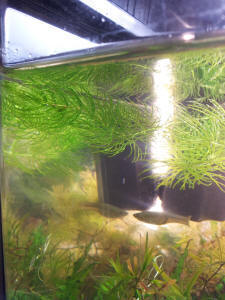
Re: How often do you feed cherry shrimp? - 12/18/2012
Neale,
Hope this works.
<Yes!>
The one at the top.
<Is Hornwort.>
(That lime green endler female also pictured was so big when I got her...and
she'd faded white from stress. I thought she was another type of fish
until her green coloration came back. The guy assured me the fish
hadn't been mixed. Who would have thought with the male endlers so
tiny.
They're neon size!)
Jill
<Real good. Cheers, Neale.>
Re: How often do you feed cherry shrimp? Hornwort... - 12/18/2012
It's hard to believe that this beautiful plant:
http://www.aquariumdomain.com/viewFreshwaterPlantSpecies.php?plant_freshwater_id=19
<A short-term planting of Hornwort on the substrate… usually doesn't last
long there.>
is really the same plant family as this pond like messy looking plant,
though it is:
http://www.animal-image.com/FreshwaterFish/Aquarium%20Plants/Stem%20Plants/Hornwort/index.php
<Same plant.>
One has good manners and a delicate form, and the other sheds all over the
substrate and flops on all of the aquarium furniture.
<Hmm… I think it has something to do with where the Hornwort was collected,
and whether it's been kept under intense lighting, hard or soft water, at
tropical or coldwater temperatures.>
oh well, the fry need to hide low as well as high.
Thanks Neale!
Jill
<Look up the words "ecophenotypic variation". Plants are modular and vary
their appearance (and to some degree physiology) depending on where they are
and how well they can grow. Cheers, Neale.>
Re: How often do you feed cherry shrimp?
- 12/19/2012
Cool.
<Indeed. Neale.>
|
 |
Snail success story.....re: Snail mug shots
thanks again!! Snail control f' 12/11/12
Well Neale....I stumbled upon a snail trick that works, and feel I ought
to share this for other folks with similar issues. This didn't get
them all but it thinned them to more manageable proportions.
<Ah, this is often the case, and if you fix the underlying problems with
your tank that allowed a snail "plague" to develop, may be all you need
to do.>
If you recall I was going to tear down and clean up as snails were even
eating the java ferns. I'd found a substrate I liked at the local
small business garden shop to replace my snail infested batch.
Tiny dark river pebble mix, well worth waiting for. But, it never
came in!
Then the local fish store gave me free hornwort as they'd promised the
same weekend that the substrate didn't arrive. But rather than it
being the lightweight, attractive floating type that holds together
nicely that I'd expected, it was the coarse, scruffy dog, flop to the
bottom and crawl on the decorations and shed all over the place type.
I threw it in, as it was meant to be a temporary fix anyway...I needed
something, and I couldn't wait on the substrate.
This ended up being a good decision, because the snails were no longer
so visible on the glass the day after. I had to clean and vacuum
more frequently, and I would pull the hornwort (aka: snail
magnet) out and rinse it and remove tiny snails.
I discovered that coarse hornwort that falls to the bottom apparently is
a perfect snail bait, and you can rinse them off resulting in a quickly
reduced snail population. It is worth having to clean the gravel
an extra time or two. And it starts to grow on you, though I'll be
glad when I can build up stock in other more elegant plants. I do
have Indian fern now, and my Anubias is slowly sprouting and one of the
crypts is somewhat recovering from her meltdown.
I did read that hornwort is a heavy feeder so I'll feed lightly to help
the other plants.
<I don't find it does terribly well in tropical tanks without intense
lighting, lasting at best 6 months or so, but your own experiences may
be different.>
I also saw a cute thing on the virtues of hornwort here:
http://www.aqualandpetsplus.com/Plant,%20Hornwort.htm
They suggest swirling a net around to stir up the drop-off and scooping
it out. I vacuumed again anyway, but using the net after the
vacuum when things were stirred up proved the most effective way to
remove stray hornwort fur.
Thanks again. It may not be the best option (don't get snails in
the first place and stock new tanks with assassin snails), but it looks
like I've been saved some work. It is the best snail trap I've
found yet....it works like beer in a capful in your flowerbed to trap
earthbound slugs. And it's shedding less and seems to be
adjusting.
Jill
<Thanks for sharing. Cheers, Neale.>
Re Snail control f' 12/11/12
Neale,
<Jill,>
I agree, the hornwort definitely won't last! It never did with the
Betta tanks which have incandescent light near by and super thriving
java plants which do like that environment, and I gave up on it a long
time ago for Bettas because I hate when it sheds and dirties the water
(as Anacharis unfortunately does as well).
<Indeed. The problem with keeping coldwater plants in tropical tanks is
that they grow really fast at first, using their stored energy, but
eventually need really strong lighting otherwise they "starve" and then
start rotting.>
I'm just glad it was free this time and he gave me so much of it too,
and it finally gave me a way to remove snails easier than trying to
catch them off the glass in paper towel.
Have a nice week.
<So far, so good! Neale.>
|
Freshwater object ID: Looks like a seedpod\sporophyte.
2/20/2010
Crew,
<Hi Evan.>
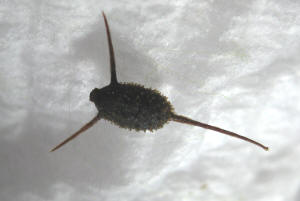
I found this in my freshwater invertebrate planted tank.
<Cool.>
It was in a clump of Hornwort. I'm pretty sure this is a
Hornwort seedpod.
Any idea how I might grow it?
<It doesn't look like a hornwort sporophyte: See here:
http://botit.botany.wisc.edu/images/130/Bryophytes/Anthocerophyta/Hornwort_w_sporophytes.html
It does look like a seed pod of some sort, but nothing I
recognize I'm afraid.>
Thanks,
<Try setting it on the bottom of your tank and see what
happens.>
Evan
<MikeV>
|
 |
|
Re: Freshwater object ID
2/20/10
Mike/crew,
Thank you for your reply. I followed the link you provided, it
was for a Bryophyte called hornwort (Bryophytes have neither
flowers or seeds). I was referring to Ceratophyllum demersum in
my original email. I have not been successful in Googling up a
picture of Ceratophyllum demersum seeds/seedpod. I thought
perhaps someone at WWM has had hornwort reproduce in their
aquarium and could ID my image.
Thanks for your help,
Evan
<Is a Ceratophyllum demersum fruit. Forgive my brevity; bit
short of time, but wanted to give you a quick answer. Cheers,
Neale.>
|
Abstract Questions from a Freshwater
Aquarist 7/31/09
Hello.
<Hi,>
I just have a couple of questions that I couldn't seem to place
under the same category (hence the name). Okay, my first question is
can ph kill fish?
<Yes. Rapid changes alters blood pH, and this turn affects the
ability of the blood to carry oxygen and carbon dioxide around the
body. The wrong pH will severely stress, eventually kill, those fish
adapted to particular pH levels. A Rift Valley cichlid for example will
not do well at pH 6, and will become much more prone to opportunistic
infections than otherwise.>
I recently bought 5 goldfish for my aquarium, I set the bags in the
water for 15 minutes, then netted the fish and put them in my aquarium.
Three hours later (literally) they all died. I checked my water
chemistry soon
after, and the only offending thing I could see was a ph below the
charts (anywhere from 5-5.4, judging by the color) Nitrate: 40 Nitrite:
0 Ammonia: 45-ish Hardness: Moderate Temperature: about 76 at time of
death.
<Goldfish will tolerate pH values across a broad range, at least for
a while, but they do best at basic pH levels between 7 and 8. If your
pH really was as low as 5, then [a] biological filtration wouldn't
be working,
and [b] that low pH could easily have shocked or killed the Goldfish
outright.>
My second question: are store-bought fancy guppies of poor (I
mean very poor) quality?
<Can be. Essentially the question is the same as this: which are
hardier and more long lived, pedigree dogs or mongrels? The answer is
of course mongrels, which, on average, consistently outlive their
pedigree cousins.
Guppy breeders select in favour of certain traits, such as tails of a
certain length, or particular patterns on the body. But they don't
select in favour of hardiness or longevity By contrast, evolution
selects in favour of "fitness", the ability to survive and
breed. There's actually good experimental evidence that supports
this. Fancy Guppies cannot be acclimated to living in seawater, whereas
wild Guppies and "feeder" Guppies
both can. In other words, when breeders create Fancy Guppies, they seem
to throw away some of the genes that made Guppies hardy in the first
place. Now, there are differences in quality of Guppies just as there
are differences in the quality of pedigree dogs. The Guppies you buy
from a pet store were bred to a price, not a quality, and often fish
farms use antibiotics to "support" their fish so that they
can stock lots of them in breeding ponds without being too worried
about healthcare. By contrast, breeders at fish clubs will be taking
more care, selecting the best fish, and looking after each group of
fish carefully, as a labour of love. None of this gets away from the
fact that Fancy Strains are often very inbred, with father-daughter,
mother-son crosses being very common, so even under the best of
circumstances, Fancy Guppies are genetically "weak". But
there is a difference between good quality fish and mass produced
fish.>
I've heard that the guppy is supposed to be the easiest and most
enjoyable fish in the hobby, and yet I've also had experience (and
read on other sites) that suggests otherwise, mostly due to inbreeding
and the breeders only selling low-quality fish to pet stores.
<Pretty much. Wild Guppies are astonishingly adaptable, and
that's why they became popular in the first place. Fancy Guppies,
like fancy varieties of most aquarium fish, are much less
adaptable.>
My third question is if I breed natural (feeder) guppies with Fancy
guppies, will (some of) the fry be fancy and hardy?
<No; they'll all be "feeder" Guppies, or at least,
mongrel Guppies with a mish-mash of colours. To my eyes, such Guppies
are lovely, resembling the wild-type fish, which are wonderfully
variable. The old name for Guppies, Millionsfish, referred to the fact
that there were so many of them, and every one was different.>
My last question is that I've heard (on this site and others) that
Hornwort is an amazing and under-appreciated plant.
That it eats up Nitrates and Ammonia, looks good, reduces water
hardness, sucks up CO2, puts in O2, increases water ph, and is easy to
keep. How many (if any) of those things are true?
<Like high-fibre breakfast cereals, while it certain does some good,
it isn't a magic bullet that will cure all life's ills!
Hornwort, or equivalent floating plants such as Floating/Indian Fern or
Amazon Frogbit, are great additions to tanks with livebearers. Your
Guppies will nibble at them directly, and also peck away at algae
growing on the roots. Yes, they absorb some nitrate (and even ammonia)
at a rate depending on light
intensity (i.e., growth rate) and yes, floating plants provide
excellent hiding places for newborn fry. I strongly recommend them, but
I would expect them to replace your standard protocols for water
quality and water
chemistry management.>
I'm looking for a beneficial plant to re-place my withering ones
(might help those plants if I turned off/down my air-stones), and then
stumbled across the Hornwort.
<Hornwort does need strong lighting at tropical temperatures.
It's less demanding in coldwater tanks and ponds. In tropical
tanks, sometimes wastes away if the lighting is poor to moderate.
Indian Fern and Amazon Frogbit are, in my experience, a bit more
forgiving.>
Hope I wasn't any trouble!
-Koda
<Cheers, Neale.>
Plant Basics - 10/21/2006 Hi, <Hello.> I
just bought some hornwort for my 29 gal aquarium. I have about 1 tbsp
per 5 gallons for my Mollies and Patties. <I assume that
you mean 1 Tbsp of "salt" per 5 gallons.> How do I take
care of the plant? I mean do I need to fertilize or anything
else? <Likely not. This plant, if left
floating, is typically very easy to care for, but can "fall
apart" without enough light, especially if you try to get it to
root.> Is this considered a brackish water aquarium?
<Mm, probably not, but many plants will not like that much
salt. Hornwort should do okay, though.> I shut off my air
pump because I read it will hinder plant growth, is this
true? <Well, yes, in a way. Aeration can
allow more CO2 out of the water than you might desire, since plants
consume CO2. But for just some hornwort, you'll be fine
to leave your aerator running.> I was hoping I could get some
answers; every where I look I can't seem to get the answers I'm
looking for. <Try "Encyclopedia of Aquarium
Plants" by Peter Hiscock. This is a GREAT book for
someone who really wants to get into plants and is just starting out
with them.> I like the look of the real plants and the idea of
having a aquarium that is as natural as possible. <Yup,
you'll love that book.> Hope you can
help! Thanks, -B.C. <All the best to
you, -Sabrina>
Hornwort as a Water Softener? Hello WWM Crew, An
uncharacteristically brief questions from me, this time. I have read in
a few places that hornwort will soften water. Is this true? If so,
should I remove it from my cichlid tanks? Thanks, Ben < This is
really an amazing plant that doesn't get enough credit. I saw
hornwort all over the bays and inlets in Zambia while diving in Lake
Tanganyika a few years ago. It looked like little wire brushes. When I
returned I read up on this plant and found out that it actually gets
its carbon dioxide from breaking down the bicarbonate in the water.
Pretty amazing. During the process CO2 is removed and you get a calcium
carbonate that actually increases the pH. Since coming back I have
added hornwort to all my African tanks because they can handle the hard
water and do a great job absorbing nitrates from the water.-Chuck>
Growing (or not) hornwort I must be the only person that
can't grow hornwort!! I read the bit on people trying to eradicate
it and had a laugh. Does it need high levels of nitrate?? Since my
vals, hygros, java ferns and anubias have become established in my
tanks, the hornwort is struggling. It gets lots of light and I
fertilize weekly with Hagen Plant pro as well as use Jobes spikes under
the gravel for the vals and Hygro. When the tanks were cycling the
hornwort grew so fast I had to toss out scads of it. Alas no more. Is
it a lack of nitrates?? < Could be a couple of things. Hornwort is
found all over the world and adapts to different conditions. I found
some in Lake Tanganyika in Africa. First question is how old are your
light bulbs. Lights loose intensity over time. Any bulbs over 6-12
months old should be replaced. Second is the other plants are now
competing with your hornwort for nutrients and they are probably better
adapted to absorb nitrates then the hornwort. Based on what you have
stated it sounds like the hornwort likes ammonia created during the
cycling stage better than the nitrates in the established tank.
Sometimes the variety of hornwort we commonly get in the aquarium trade
does not do well in warm water tanks.-Chuck> Thanks Julie Riley
Hornwort and salt Hi from New Zealand <Hello from sunny
Southern California> We (the Department of Conservation) are
contemplating using salt to eliminate Ceratophyllum demersum
(hornwort). <Mmm, this is Bob (Robert) Fenner... a long time pest
control applicator and advisor licensee... someone had to qualify for
our company's service division... and past member of Aquatic Plant
Management Society, et al. organizations... involved in Hydrilla
eradication programs here... and an all-round pet-fish sort of guy...
who has cultured, sold large amounts of this plant (aka Coontail to
folks here in the States). Not easily controlled with salt... we
can/should talk over other control mechanisms... including commercial
herbicides.> Hornwort is presently New Zealand's most invasive
exotic macrophyte. Although hornwort has been present in the North
Island since the 1960s, it has only recently made it to the South
Island. <This stuff "really gets around"... like many
other pest macrophytes via fishing gear, waterfowl... even ornamental
aquatics mis-use (release to the wild)> Hornwort is a multi-million
dollar pest for North Island hydro-electric power generators,
principally because it causes blockages in dam turbines (the scope for
disruptions to South Island HEP schemes is potentially even
greater). Hornwort is also capable of displacing the
majority of our native macrophyte species and even some of our most
invasive introduced macrophytes including Egeria, Elodea,
Lagarosiphon. <Does so in the U.S. as well>
Fortunately eradication a still a realistic option (in the South
Island) because of the limited extent of the present
infestation. A number of control options are being
evaluated, the most promising of which is soil sterilization using salt
(i.e. sterilizing the streambed substrate). We have been
able to desiccate the majority of the plant the floating-above ground
component) using the contact herbicide reglone (a form of diquat).
<Really... this is the product category (teratogens) I was going to
describe... can you related the treatment protocol? Are you using a
spreader-sticker? Need to know water temperatures, if you're
spraying emergent material...> However, there is still the
possibility of buried propagules withstanding a herbicide treatment
hence, we need a soil sterilent that is inert (when in contact with
organic matter) and which has a residual action such that it would
saturate the streambed and eliminate any remaining viable buried
fragments. <Mmm, yes... but a systemic might likely prove more
effective...> Salt appears ideal in this respect particularly as
trials have shown free-floating hornwort will perish if immersed in
water of sufficiently high salinities. <Yes... but for how long, how
high a standing salinity... what about the residual salt?> I was
alarmed to learn that hornwort is included amongst a list of
macrophytes that are suitable for brackish aquaria. <Yes, exactly...
it is> Do you consider that it is realistic to expect that, if
applied at sufficiently high salinities, salt will also successfully
eliminate buried propagules (given hornwort's tolerance of brackish
water)? If so at what concentrations (parts per thousand) should salt
be applied? <Obviously, the only treatment regime I would trust is
one that was tested out by assay... I would do a few experiments
here... Unfortunately I know Ceratophyllum can be almost instantly
placed from fresh to water of a spg. of 1.005... likely higher salt
concentrations, w/o suffering apparently.> I really appreciate your
help. Kind regards Matt Bloxham Biosecurity Contractor Department of
Conservation Motueka Area Office New Zealand 00 64 3 528 1810 <Do
try a few test plots... Again, I would utilize the Diquat (but can
suggest other products...) with an oil... on emersed portions at
standard dosage... during mid-day to afternoons, at temperatures of 55
F. or higher... Much to discuss re the allowance of other economic
poisons in NZ, and concerns re run-off, toxicity issues... Am
interested (parenthetically) if you've considered triploid carp
species as bio-controls? Bob Fenner>
Hornwort eradication options Hi Bob, Thanks for such a prompt
reply, couldn't believe it when I got back from lunch to find your
message. <We aim to please... and must need reply ASAP or get
hopelessly buried> We used a spray contractor to apply the
reglone. He used an Aquagel formulation which was
administered in 600mm wide strips (with 1m spacings) across the stream.
<At about 1 gallon per...? Surface area.> At the time hornwort
was at maximum biomass. Smaller infestations amongst willows were spot
sprayed. Temperatures were in excess of 15 degrees Celsius (i.e. above
the recommended minimum operating temp forreglone) and spraying
commenced in the morning to avoid problems with thermoclines. <Mmm,
I am not so much inclined to be influenced by the last... more
important that the weed be active metabolically... late morning to mid
afternoon on sunny days> The worst affected stream section has
significantly reduced flow with large areas of standing water (i.e.
plenty of herbicide contact time) and was not at all turbid. It has
been nine months since the Aquagel was administered and there is still
no sign of hornwort regrowth. <Good> We are just coming into
summer and in New Zealand, hornwort typically reaches maximum biomass
in Autumn. <Yes, same here... late summer into mid-autumn> The
contractor believes that the reglone will eliminate the hornwort
completely but we have reservations because of the issue of buried
fragments which the reglone is unlikely to
touch. Unfortunately there are no systemic aquatic
herbicides presently registered for use in New Zealand. <Ahhh... a
shame. Shortsighted... more pollution, trouble from their lack of
availability, use.> We have certainly thought about using triploid
grass carp, but decided against for the following reasons: This control
option would involve significant habitat manipulation. For example,
shallow areas of Moutere Stream would need to be deepened. <Really?
Have seen the big three species used in very shallow waters... even
have some footage of a Ctenopharyngodon "going terrestrial"!
to get at shoreline growth.> If this control method were to prove
unsuccessful, deepening stream sections may increase the suitability of
these areas for further hornwort infestation (by slowing flow and
increasing the rate of mud deposition). <Possibly> * Use of grass
carp would rule out the option of simultaneously treating Moutere
Stream's hornwort and pest fish populations (using the same
methods). Grass carp could only be introduced into Moutere
Stream after attempts to eradicate pest fish had been
concluded. Any pest fish eradication attempt would ideally
involve significantly dropping the water level (in addition to applying
a piscicide) which would benefit other hornwort eradication options but
not the grass carp control option. * We understand that Grass carp are
inefficient digesters of food; half of the weed eaten may pass through
the gut undigested. Hence, there are doubts over whether
grass carp are able to digest/process hornwort sufficiently to
neutralize any viable propagules. The widespread dissemination
downstream of partially digested vegetative matter/propagules is
undesirable in a running water system such as Moutere Stream. <Would
only establish a predator-prey equilibrium/dynamic> * The
introduction of yet another exotic fish species to this stream: runs
counter to the Department's objective of minimizing impacts from
introduced freshwater fish species in the Nelson region as the stream
already contains a significant biomass of tench and Gambusia. We
intended dewatering the affected stream section using a weir and
pumping to land so that the salt could be applied directly to exposed
streambed, as we figured this would help maintain salt in its most
concentrated form. We will certainly look at testing the salt by assay.
<Only way to assess practicality, effectiveness.> Meanwhile, if
you can think of any other way of eliminating the hornwort outright
(including the buried component), we would certainly love to hear back
from you (it is unfortunate that systemic herbicides are not an option
for us). <Well... is the area involved absolutely huge? Have you
done any testing re how deep the propagules are/might be? Another
possibility (has been used for Hydrilla verticillata infestations in
areas in excess of 50 hectares...) is to de-water, Vapam with cover
(optional), scrape and remove sediment... to waste, fill areas... even
to the sea... Expensive, drastic... but another possibility. Bob
Fenner> Thanks again for your help Bob. Kind regards, Matt
Bloxham
Looking for Hornwort/Coontail/Ceratophyllum demersum... I
would like to know if you can buy the Coontail/hornwort at a store. If
not, is there any way to grow this plant? please send a reply.
<Ceratophyllums grow very well in most any type of hard, alkaline
water with sufficient light. This is a popular genus of aquatic plant
in many places around the world. Bob Fenner>
|
|
Aquatic Gardens
Ponds, Streams, Waterfalls & Fountains:
Volume 1. Design & Construction
Volume 2. Maintenance, Stocking, Examples
V. 1
Print and
eBook on Amazon
V. 2
Print and
eBook on Amazon
by Robert (Bob) Fenner |
|
|
|

