|
FAQs on Water
Lilies
Related Articles Waterlilies,
Related FAQs:
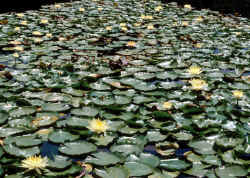
A field of Chromatella marliacea lilies.
|
|
 |
Aquatic Gardens
Ponds, Streams, Waterfalls & Fountains:
Volume 1. Design & Construction
Volume 2. Maintenance, Stocking, Examples
V. 1
Print and
eBook on Amazon
V. 2
Print and
eBook on Amazon
by Robert (Bob) Fenner |
 |
|
Algae Growth on Water Lilies... New pond, and ponder
5/19/17
Greetings, Crew!
<Fuz>
It's Fuzzi here, again, with a question I can't find answered on WWM, or
anywhere on the web, so I decided to ask!
I installed a 100 gallon preformed pond this April, adding water on
April 16th, then adding filtration a week later, on April 23rd.
<So; just a month back>
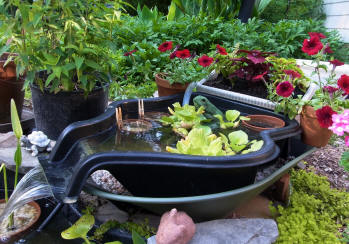
I'm running a 330gph submersible pump, a skimmer with basket and filter pad,
and the waterfall is full of floating plants doing their best to filter out
the less-than-clear water, see photos. It is not noticeably green
until you collect some in a jar, when a slight yellow/green coloration is
evident.
<Happens... a sign of life... not to worry>
Since I added filtration, I have been steadily adding plants in pots, as
well as floating plants (water lettuce and hyacinth), and then two hardy
water lilies about two weeks ago. The weather has remained cool until
recently.
No fish have been added.
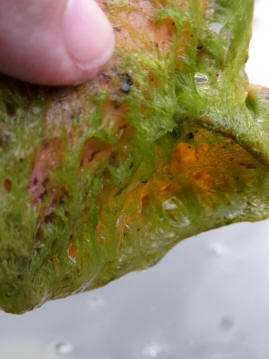
I noticed that the water lilies have a green slimy algae-type of growth on
their stems and under the pads (see photo).
<See this>
The water tests as uncycled, high (above 7.6) pH, ammonia, nitrites, and
nitrates as zero.
<Uncycled... these should be some nitrogen present>
I believe the algae growth is due to new pond syndrome, but would love your
input:
1. If the algae growth is part of new pond syndrome, will it pass once the
water cycles?
<Maybe>
2. Will it hurt the water lilies?
<It will not>
3. If it will hurt the water lilies, what can I do about it?
<Patience at this point. Your pond may well "green out" for a while... best
to shade a good part of it>>
The lilies are planted in clay dirt in plastic baskets, with paper lining
the inside and pea gravel on top to keep the dirt from leeching out. Each
lily has one fertilizer stick shoved down deep in the pot, on the side away
from the rhizome.
<Good>
Thanks for your advice and thoughts on the algae situation.
Fuzzi (Lor)
<Don't get desperate and chemically treat... algicides are toxic; directly
and in their effects. Bob Fenner>
|
 |
Deer Vs, Water Lily
3/18/17
Greeting WetWebMedia Crew, I'm currently moving to a new property and am
transporting a fairly water lily collection over. I've been told by previous
owner they have a fair amount of axis deer moving thru property.
Do have any predictions on how the water lilies will fair. The house actually
has 2 in-ground ponds and I'm moving some above ground stock tanks over. Do you
think the deer will be very attracted to the water lilies or do they have a
chance of co-existing without netting and/or fencing?
Thank You
<Mmm; Axis deer will eat water lilies. Whether yours are attractive to this
particular bunch though remains to be seen. You'll definitely notice in both
cases. Bob Fenner>
Re: Deer Vs, Water Lily 3/19/17
Thank you for reply Bob. I actually dropped off a few stock tanks with water
lilies yesterday and wont be back for a few days. I'm hoping once my dogs move
onto property they should keep the deer away but in the mean
time, I'm a bit worried. I'll keep you posted with any developments. Thanks for
the great site.
<Am with you. Had the local deer eating my Avocado tree leaves... tried the wolf
pee product, shiny ornaments... Finally fashioned four by welded wire (for
driveways) around them. Then the price of water quadrupled!!! BobF>
Re: Floating islands on dam after killing some waterlilies
Many thanks Bob!
<Welcome. I had many such "mistakes" w/ glyphosate use over the years w/
lilies... due to overspray incidents. Unless yours got a high dose, they should
come back. Bob Fenner>
Water Lily vs. Lotus 9/1/15
Greetings Crew, I've noticed my lilies tend to do fairly well but my lotus seems
to barely hang on. Do all lotus sleep during the winter months in the tropics
<Yes; as far as I'm aware>
Can you tell the difference in cultivation techniques, mainly in regard to
fertilization but any tips would be appreciated. Thanks
<Do you use fertilizer (tabs are best?); I'd feed heavily in Spring and Fall.
Bob Fenner>
Re: Water Lily vs. Lotus 9/1/15
Thank you Bob. Yes, I'm using tabs but it seems the lotus shows slight
fertilizer burn along edges of pads.
<Burn.... yellow like chlorosis? You may have a deficiency syndrome here.
Does the water have any Fe2 or 3?; What's the pH and hardness measures like?>
The lilies just seem to want to feed and out compete the lotus. Thanks
<I'd have these in different/separate pots/containers. BobF>
Re: Water Lily vs. Lotus 9/1/15
I don't think its a deficiency. It's in a separate planter from the lilies with
Bacopa monnieri and the Bacopa is thriving nicely, almost growing aggressively.
I'm currently using a complete fert with cal/Mag but will try to switch brands
of fert. Can you recommend a good book on water lily/lotus? Thanks Brandon
<I have a few faves (ducks around the other side of his office...); the classic
by Perry Slocum comes to mind:
Waterlilies and Lotuses: Species, Cultivars, and New Hybrids
B>
Koi and Water Lilies 8/31/15
Greetings Crew,
<Brandon>
I’m revamping my pond and wondering aside from creating a separate grow bed, what
are the best ways to prevent my Koi from bothering my lilies.
<A plastic (Naltex is a fave brand) corral to keep them entirely away>
I’m using potted lilies and covering them with rocks, which works to an extent.
I don't like the idea of floating rings for ascetic reasons.
<The Naltex poly is a neutral black>
Also what are the best planter boxes for larger lilies or multiply lilies. What
are your ideas.
Thanks
<Welcome. Bob Fenner>
Re: Koi and Water Lilies; now floating plants for ponds
8/31/15
Thank you Bob. What would be your suggestion on adding floating plants like
Azolla, Salvinia or duckweed or should I stick to just lilies?
Thanks again Brandon
<Our business (service) stocked these and other "grasses" as posted on WWM's
pond section... again, within floating barriers if there were plant-eating
fishes, turtles present. BobF>
Re: Koi and Water Lilies
Thanks for the fast reply. My concern with the smaller floating plants/ferns, it
seems I'm always scooping out or getting covered in duckweed and etc. when
working in pond. I like the look, just wasn't sure about the maintenance. Thanks
<Most all species of what is sold/considered duckweed are delicious to fishes.
Not to worry. B>
Re: Koi and Water Lilies 8/31/15
I can't thank you enough.
<Ah; welcome>
Nymphaeaceae Repotting Question 11/23/14
Greetings Crew,
I was wondering if I could repot some water lilies by simply
transferring existing containers (2gal pot) to a larger grow bed,
opposed to removing old pots.
<Yes; can be done; though better to re-pot, cut away old/dead parts...>
The lilies are sending out runners thru drain holes in pots. The new
grow bed is loaded with fertile soil. Just wondering if the smaller pots
will stunt growth or will plants escape from pots just fine?
<I'd remove the Lilies from their existing pots>
Ideally I would like the lilies to grow as large as possible. Thanks for
the great site. Aloha Brandon
<Cheers, Bob Fenner>
Tropical water lilies grown indoors
1/16/14
Hi Crew!
<Jonathan,>
I've been researching growing tropical lilies indoors for some time, and
can't find as much info as I'd like. Perhaps it's just simpler
than I'm making it out to be?
<Is indeed. Just add bright light, and bingo!>
Or not reasonably feasible? Or maybe no interest? Anyway, my
intention is to grow a Pygmy tropical lily in a tank branded "aquaplantarium"
which is set up with water and air portions so that the lilies can
emerge out of the water.
<Have done in a windowsill aquarium... is easy.>
I have a group of Pantodon buchholzi in a 55g tank, they are happy and
healthy, but not well presented in such a tank.
<And will jump out of any aquarium without a cover.>
I figure they would do quite well in the "aquaplantarium" with the lily,
plus a few other tropical emergent plants (do you have any suggestions?
I was thinking parrots feather?).
<Pretty much all plants will do well, even better, in an open-topped
aquarium or pond. Less so nowadays, but in the 1980s it was standard
practise for "Dutch" style planted tanks to be open topped with a large
set of lights suspended 30 cm or so above the aquarium. It was necessary
then because such high output lights (metal halides for example) were
either too big or produced too much heat to be fitted inside a hood. So
long as you chose non-jumpy species, e.g., Neons, Angelfish, etc., this
approach worked well. Under such conditions many plants will grow above
the waterline, and things like Hygrophila look very different went they
do this, become the marsh plants they really are, and even produce
pretty purple flowers!>
My specific questions are: what lighting would I need for the
lily?
<Something good and strong. Ambient daylight could work if the tank is
by a windowsill, but otherwise several strong fluorescent lights or
better.>
The tank comes with a strip light with cfl's, maybe four in a row.
Another two strips could be added, I think.
<Likely so.>
Would this be enough for such a high light loving plant?
<Can be. While the "Watts per gallon" measurement has its flaws, it
gives a reasonably good indication of where to start from in terms of
buying, installing fluorescents. Four T5 tubes running the length of the
tank will be a good start. Basically, if the hood/lights were enough for
corals, they'd be fine for even the most demanding plants.>
If I had to get a more powerful light, like a metal halide or mercury
vapor, is the glass on the top of the tank a problem?
<Yes, too warm, and likely to crack. Do research, buy, use hoods
designed specifically for high output lamps.>
Does the bulb need to be open to the air underneath?
<With high output lamps, yes, otherwise overheating is a real risk.
Again, research particular hood and lamp combinations. LEDs are cooler,
but more expensive.>
I'm not well versed in plant lights, been trying to research it, but am
thoroughly confused. Any help you could offer would be highly
appreciated!
<Hope this helps. Many good books out there!>
Do you know of any articles of growing lilies indoors.
<Nothing specific.>
I'm looking for specifics, how long to cycle the lights each day, what
fertilizer to use, how to coax them to bloom, etc.
<Do understand they are basically pond plants. Strong water currents
tangle up their floating leaves. In aquaria it is traditional to remove
these floating leaves, so the submerged leaves are the only ones you
see. That's fine for a while, but typically the "bulb" doesn't do well
indefinitely like this, so is often replaced every year or so. If you
want a pond-like appearance with lily pads and flowers, you'll want a
very gentle water current, perhaps even air-powered.>
Thank you for taking time to help, I appreciate it!
Jon
<Most welcome, Neale.>
Re: Lily Question 9/15/12
would a 4"w x 3"h pot be large enough to plant a Nymphaea 'Pygmaea
helvola' in?
<I'd go w/ something larger... six by... B>
would a 4"w x 3"h pot be large enough to plant a Nymphaea 'Pygmaea ' in?
<Cam, you can try it and be ready to transplant if the root ball gets
too big. Basically, you have to make sure the roots don't get choked,
just like a plant in the soil.
Read this report on the plant from University of Florida:
http://hort.ifas.ufl.edu/database/documents/pdf/shrub_fact_sheets/nymspph.pdf
By the way, are you aware of the Arizona Aquatic Plant Association? It
was started by Rhonda Wilson, who writes the regular planted tank column
in Tropical Fish Hobbyist Magazine.
The club has a good number of members in both Phoenix and Tucson who are
familiar with keeping plants in our harsh climate, and a very active
online forum.
http://www.azaquaticplants.com/
- Rick>
Re: Lily Question 9/16/12
would a pot that is 7.5" wide x 5" deep work in a 6 gallon pond that is
16"w x 16"d x 7"h?
<At some point, you just have to bite the bullet and go for it. By the
way, 16x16x7 is almost 8 gallons, not 6. Still awfully small for the
climate. Maybe keep it indoors during summer and take it outside in late
September, using a 25-watt heater in the winter. - Rick>
|
Worm that is eating my water lily
8/14/12
Hi,
Many thanks for considering this. My water lily is full of holes and, on
inspection, I saw thin white worms (almost invisible) on both pad
surfaces.
I also noticed them crawling around the edges of the pond close to the
surface of my half-barrel pond. They appear to hide in the gaps between
the boards of the barrel. They crawl surprisingly quickly.
<Mmm, insect larvae of some sort... are there any adults flying about?>
They are up to 1/4 cm in length. On closer inspection they have forked
'tails' that they appear to paddle with. They have dark heads (possibly
red) and a pattern in the same colour on midsection of the upper surface
of their white bodies.
I have attached a couple of photos.
I'm very curious to know what they are and what to do to protect my
water lilies from being destroyed (over 2/3 of the pads have been
eaten).
Many thanks
Mark Allen
<The safest approach is simply to rely on blasting them off early
mornings with garden hose/water... and relying on fishes in your system
to eat them (platies, American Flagfish, smaller goldfish, Koi)... Up
from this are oil (only) sprays like Volck... Search WWM re. Bob Fenner>
|
.JPG)
.JPG) crops
crops |
Re: Worm that is eating my water lily
8/14/12
I have found it impossible to identify a curious floating entity on my pond.
They float around the pond edge, at the base of my reed mace and around the
edges of lily pads. They resemble miniature, grey curling leaves.
<Pupae cocoons... after the flies have flown>
On closer inspection they are segmented. When I looked into the pond last
night with a torch I was surprised to find white ones floating on the pond
(or were they reflecting the light? I'll have to check that one out).
<White ones are newer, still have larvae in them>
I have never seen them change. They crumble or break up if touched.
Perhaps they are clusters of eggs? There is nothing I can find online about
these but I have lots of them.
Any ideas?
Thanks
Mark
<Same resp. as last time. BobF> |
.JPG)
.JPG) and
and |
small pond with water lily leaf damage
5/3/12
Hello! I have a 150 gallon pond in Houston area. We have 10 goldfish and
a water lily. There is also a ribbon snake, about 12 inches long. The
water lily leaves are torn apart and separated from the plant. I s this
the work on the ribbon snake?
<Mmm, doubtful>
This happened last year and we lost the lily. Also, last year we had 40
fish so has the snake been feasting? How do I get rid of him and move
him to another pond? Thank you, Fran
<Likely the damage was caused by another predator... a bird, perhaps a
mammal... Read here re all:
http://wetwebmedia.com/PondSubWebIndex/pdpestspreds.htm
and the linked files above. Bob Fenner>
water lily leaves 7/18/2010
Dear Sir
Can you please tell me how, ( the process by which), water lily leaves
turn back up the right way after my Koi have turned them upside
down.
Thank you
Stan Reed
<Gosh, I don't know... other than to concur w/ you that they
indeed do...
IF not flipped all the way over. Is it water tension on the
"bottom" surface, and a lack of this on the upper waxy one?
Perhaps a quirk/property of the cellulose in the leaves exerting a
"this end up" spring tension? Bob Fenner>
Lilies d'Amour or lilies no more? 9/27/05 We have
frontage on a fresh water lake. The lily pads have overtaken the water.
We can't swim, boat etc. We've tried pulling them out by hand
and with implements but it is evident we are losing the battle. Any
ideas? <Mmm, a few... there are chemical herbicides that one can
utilize... but these are pretty non-specific... and I don't know
what your neighbors might think if you killed their lilies... And
there's the issue of legality... where the water might go...
irrigation, watering of livestock... There are biological controls, but
these might posit the same issues... and then there is/are the manual
side... it may come as a "happy surprise" to you to find that
there are companies willing to buy your lilies... I would check your
phone directories for pond service companies in the region re... and in
turn, cast your net further, contact the national pond livestock
suppliers (these are listed on WWM)... the cooler weather is upon us...
so the lilies will die back... next year? Perhaps a combination scuba
training/weed removal classroom....? Bob Fenner>
Water Lily
Control Question We have a pond proximately 55 feet by 75 feet,
with a depth of approximately one foot around the edges to
approximately 7 to 8 feet at the center (it is shaped like a bowl).
<How nice!> We landscaped it with some cat tail on
two sides, as well as other pond flowers, and we put a fountain in the
center that works from early spring until late fall.
<Okay> Three to four years ago we made a big mistake in planting
water lilies on the back/far side of the pond, directly in the ground
in the water. During the first two years the pond looked
beautiful with the lilies blooming all summer long in small yellow
flowers. However, last year the water lilies somehow
multiplied (perhaps the fountain pump in the center sucked in the seeds
and sprayed them out all over) but the lilies spread and covered al of
the pond surface area with thick pads of leaves during the
summer. Although this is good for the fish we have in the
pond, it gives them shade and food, the pond does not look like what we
want it to look like. You hardly see any water anymore, just
the lily pads and leaves. <I see> We try to clean the pond three
times during the summer but it I very difficult to do because the water
is very deep in the center, it comes above your head, and the only way
to clean the pond is to float on a raft and pull out the lilies by
hand, which takes a long time and is very hard to do on a hot sunny
day. <Have spent MANY hours doing this myself> Do you have any
advice for us as to how to put this lily problem under control, perhaps
trim or prune them or even destroy them? Can we use any
tools you can think of to cut them 5 to 10 inches under water easily
because they come back within a few days and the stem is 6 to 7 feet
long under water from the bottom. Do you know of any company
that produces any tools (like weed eaters or grass cutters) that can
work under water? Also, do you know if we don't let them
grow above the water and reproduce seeds, would it be possible to
prevent them from growing the next season? Or is there
anything you know of (or can direct us to someone who may know) that we
can do to put them under control without destroying the life and the
fish that are in the pond? <There are gardening hand tools like
"Hula Hoes" that can be adapted (longer handles) to cut the
lily pad and flower stems near the bottom... and a possibility of
diving to hand-remove the tubers... and chemical means (a bit dangerous
to all livestock if too much is killed off all at once)... that can be
broadcast via sprayer or pellets... even biological control means in
some places (triploid carps of a few species)... nothing to just slow
down for a season> I would greatly appreciate any assistance you
could provide. Thank you in advance, Blagoj Panovski
<Having worked in water feature design, construction, maintenance
for several years... I am given to suggest, if the problem is
"that bad" that you drain the basin, let dry, and use a power
tool (back hoe, skip loader...) to scrape the area clean, start again,
with either blind potting the lilies or building berms... likely wire
and re-bar, with some concrete/shotcrete... possibly a liner... to
control their further expansion. Bob Fenner>
Shade tolerant Water
Lilies Are there varieties that will tolerate five hours of a 12
hour sunshine day in the shade? <Yes, most hardies do fine in this
arrangement... and a few tropicals... they won't blossom as often
or long, but will do so nonetheless> I have a pond with a large old
Oak and am told it must go. But I really don't want to lose such an
old tree. <Me neither... I would just regularly remove the leaf
litter from your oak. This is the real source of possible trouble. Net
out the leaves once a week and you should be fine> Do you have any
ideas as to where I can find varieties like this? Thanks Bill Richards
San Angelo, Texas <Yes. Most all of the mail-order water garden
suppliers carry shade-tolerant Nymphaeaceans... Van Ness, Lilypons...
use your search engines with the terms: "water garden
supplies". Bob Fenner>
Waterlily? I grow a plant in a pot, which in our
country is referred to as 'Waterlily'. I am sure it is not, but
I can find neither its Latin name nor its common name. It has
very large roundish leaves and produces one flower a year growing on a
long stalk. Can you please suggest its name? <Perhaps it
is a Nymphaea species... very likely a member of the family
Nymphaeaceae... Take a look on the Net with these terms. Bob
Fenner>
|
|
Aquatic Gardens
Ponds, Streams, Waterfalls & Fountains:
Volume 1. Design & Construction
Volume 2. Maintenance, Stocking, Examples
V. 1
Print and
eBook on Amazon
V. 2
Print and
eBook on Amazon
by Robert (Bob) Fenner |
|
|
|

