|
|
| Home | Marine Aquariums |
Freshwater Aquariums |
Planted Aquariums |
Brackish Systems |
Ponds,
lakes & fountains |
Turtles & Amphibians |
Aquatic Business |
Aquatic Science |
Ask the WWM Crew a Question |
| Please visit our Sponsors | ||||
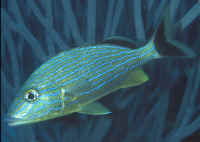
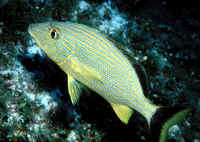
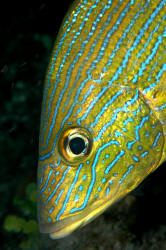
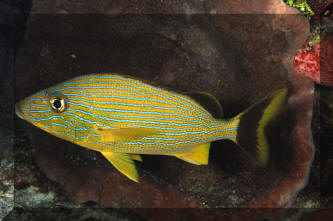
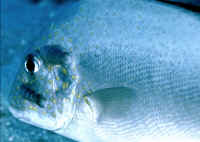
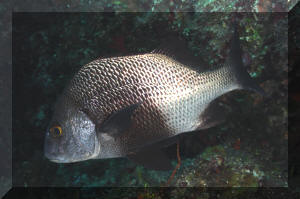
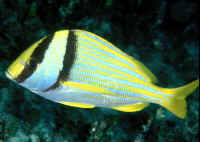
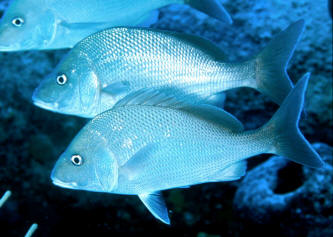
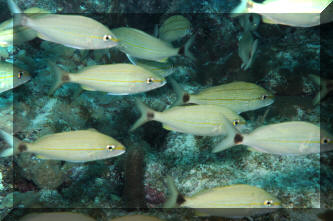
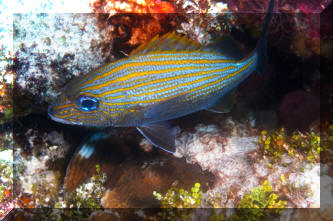
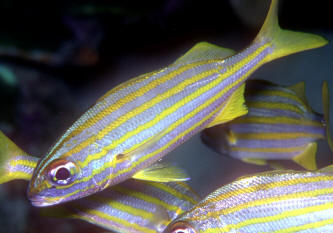
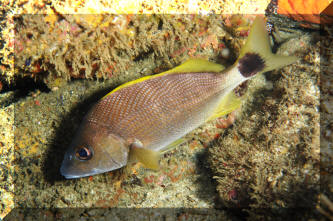
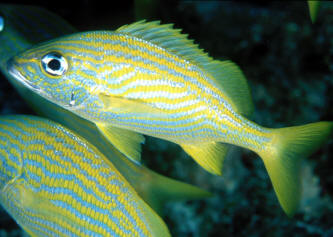
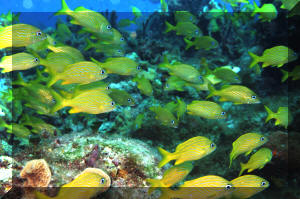
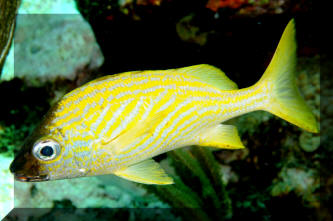
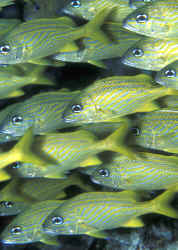
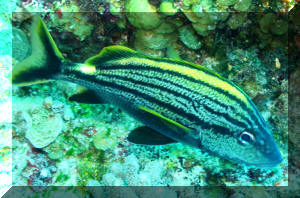
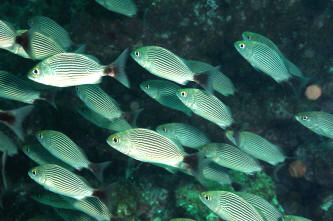
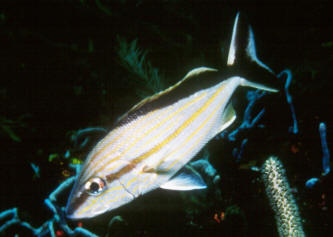
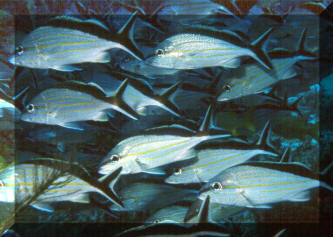
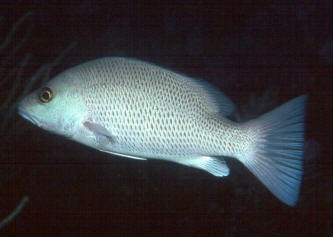
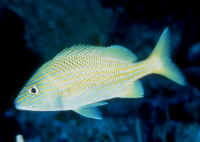
The various species of the genus Plectorhinchus (a subfamily of the Grunts, the Plectorhynchinae) offered in the western part of the trade as "Sweetlips" or "Gaterins" and "Mojarra" are the most familiar members of the grunt family, Haemulidae (formerly Pomadasyidae). For the most part these have proven to be poor aquarium choices, with few individuals rarely surviving more than a few days to weeks. In this family review I will make an argument for the family's more suitable members, some of the many other Grunts. Classification: Taxonomy, Relation With Other Groups, Example Species: Grunts (the name we'll use for all haemulids) are closely related to the true Snappers, family Lutjanidae. They appear similar but may be distinguished from them by the lack of canine and vomerine teeth and the presence of a series of chin pits. The family common name is assigned on the basis of characteristic grunting noise they produce audibly below and above water. Haemulids are distributed circum-tropically with 17 genera and @126 species. Twelve species in two genera in the Caribbean, thirteen in five genera in the Sea of Cortez, none in Hawaii. Genus Anisotremus:
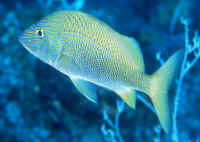
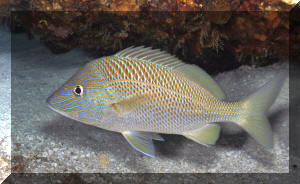
Genus Haemulon:
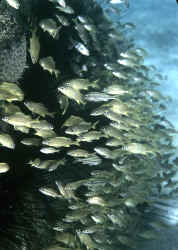
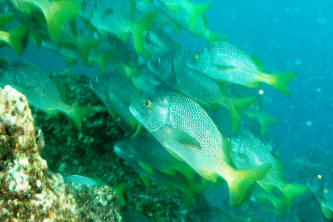
Link to: Sweetlips, Subfamily Plectorhynchinae: The Heartbreaking Grunts that are Sweetlips: Selection: General to Specific Unfortunately for the hobby/trade few collections are available in these species ranges. Hopefully this will change with 1) commercial demand for livestock from the vicinity. 2) Ancillary effects of major trade agreements with and between the nations concerned. 3) Realization by indigenous peoples and their industries that such sustainable harvesting is economically practical and profitable. If I may digress (oh no, not again!), as a youth in the Philippines we used to capture many "miscellaneous" Butterflyfish (among other families) species that seemed to adapt well to captivity, only to have them "tipped overboard" as not being identified as saleable to the brokers in Manila. They were "not on the list". There are many aquatic organisms that fit this category. I have captured any number of these fishes with barrier nets, fish traps and hook and line with barb-less small feather jigs (aka Lucky Joes). Many are beautiful; and they are tough. Environmental: Conditions Habitat Most grunt species aggregate in schools swarming over rocky reefs by day and shoal over sandy bottoms to feed at night. They are shy and retiring in captivity, preferring darkened areas until well acclimated. Chemical/Physical Any good general water quality seems to work. I have brought back many specimens via "bait receivers" with crude heat maintenance and recirculation gear from Mexico, through rough storms, power shutdowns, thermal shocking, mass pollution... with impunity. Display Once again, when kept in small groups and offered meaty fresh and/or prepared foods near "dark-hours" these fishes do well. The absolute minimum size system I would attempt them in is fifty gallons for three specimens. Behavior: Territoriality Seemingly non-aggressive toward themselves or other tank mate species. Introduction/Acclimation: As per other advanced-bony fishes a freshwater dip with or without chemical therapeutics is endorsed. I have yet to find reference to easy disease susceptibility for this group. Predator/Prey Relations: Grunts as a whole appear to be common forage prey for basses, snappers, sharks, sea birds, etc. In the wild they get along with all fishes not large enough to eat them or for them to swallow. Reproduction: See Young's account of artificial propagation. No physical, color differences between the sexes. Feeding/Foods/Nutrition: Types, Frequency, Amount, Wastes Stomach contents analysis of wild caught specimens reveals that grunts feed primarily on a mix of benthic marine invertebrates; shrimp, other crustaceans, clams and polychaete worms. Disease: Infectious, Parasitic They have been observed in the wild with isopod parasites, but little to no problem in captivity. Their relatives, the Sweetlips are either alive and "seem fine" until abruptly keeling over dead. Stoehr makes a strong point for offering live food (brine shrimp nauplii in his case) on initially acclimating new specimens, and similarly remarks on their hardiness.
Summary: I'd like to reiterate two main points regarding the keeping of non-Sweetlips, Gaterins, Mojarras (which always die) members of this family and the dearth of success to date. 1) They are schooling fishes in the wild; they should be kept in small groups in captivity. 2) They are crepuscular to nocturnal feeders on meaty (mainly crustaceans, then mollusks, worms) foods. I suspect they would fare better if offered similar circumstances in captive systems. Bibliography/Further Reading: Fenner, Bob. 2000. Who you calling a Grunt? Family Haemulidae. FAMA 8/00. Michael, Scott. 1995. It's a sweetlips; they're very nice, but only if they eat. AFM 6/95. Stoehr, H. 1975. Raising a Sweetlips. Aquarium Digest International. 2 (1): 75. Thomson, D.A., Findley L.T. & A.N. Kerstitch. 1979. Reef Fishes of the Sea of Cortez. Wiley-Interscience Publication. N.Y. Young, Forrest A. 1995. The porkfish: it's life history, ecology, breeding and rearing in captivity. FAMA 4/95.
|
|

|
Features: |
|
| Featured Sponsors: |
.JPG)
%20MD.JPG)
%20MD.JPG)
MD.JPG)
MD.JPG)
%20MD.JPG)
MD.JPG)
%20MD.JPG)
.JPG)
MD.JPG)
MD.JPG)
%20MD.JPG)
%20MD.JPG)
MD.JPG)