|
FAQs about Hermit, Anomuran Crab Identification
3
Related Articles: Hermit
Crabs, Crabs, Marine Scavengers, Fresh to
Brackish Crabs,
Related FAQs: Hermit ID 1, Hermit IDs 2, Hermit IDs 4, & Hermit Crabs
1, Hermit Crabs 2,
Hermit Crabs 3, Hermit Behavior, Hermit Compatibility, Hermit Selection, Hermit Systems, Hermit Feeding, Hermit Reproduction, Hermit Disease/Health,
FAQs: By species: Calcinus laevimanus (Zebra, Left-handed
Hermit), Clibanarius tricolor
(Blue-Legs), Clibanarius vittatus (a
common Gulf of Mexico hermit crab), Dardanus megistos
(Shell-Breaking Reef, White-spot, Fuzzy
Leg Hermit Crab), Paguristes cadenati (Scarlet, Red-Legged),
Petrochirus diogenes
(a and other Giant Hermit Crabs), & Anemone Hermits,
Sponge/Staghorn/Coral house
Hermits, Unknown/Wild-collected,
& Land Hermit Crabs, Squat Lobsters, Micro-Crustaceans, Amphipods, Copepods, Mysids, Hermit
Crabs, Shrimps,
Cleaner
Shrimps, Banded Coral
Shrimp, Mantis
Shrimp, Anemone
Eating Shrimp, Marine Scavengers,
Crustacean
Identification, Crustacean
Selection, Crustacean
Behavior, Crustacean
Compatibility, Crustacean
Systems, Crustacean Feeding,
Crustacean Disease, Crustacean Reproduction,
|
 Ever feel that
the weight of the world is upon your shoulders? Me
too. Ever feel that
the weight of the world is upon your shoulders? Me
too.
|
Marine hermit crab ID 9/2/08
Hello! <Hi there> With the help of all this wonder information
you have here, I have set up and cycled my 14 gallon BioCube, and this
weekend (after it cycled and the levels were right) I added some
hermits. The problem is, I've run into a wall trying to ID a couple
of them. The resources here led me to ID the majority of the crabs (p.
cadenati, c. tricolor, s. seurati, and c. vittatus). But searching here
and elsewhere on the net hasn't yielded results for a few of my
guys. I want to know the species to know how to research them and
possibly get some idea of how the may act and how large they might
grow. I think that perhaps Mercury could be a c. snelliusu? the
coloring is similar but not exact. He is beautiful (and my favorite):
http://i134.photobucket.com/albums/q114/lili_acb/DSCN3778.jpg
<Perhaps this Clibanarius...> Megara looks exactly like my c.
vittatus except his stripes are brown/white, not black/white. Is this a
variety of c. vittatus or is he something different, such as c. rhabdodactylus perhaps? Sorry the picture is not excellent, he is very
tiny:, solo in pic #1, the top in #2:
http://i134.photobucket.com/albums/q114/lili_acb/DSCN3745.jpg
http://i134.photobucket.com/albums/q114/lili_acb/DSCN3728.jpg <Maybe
C. zebra...> Lastly I'm drawing a complete blank for my largest,
Osmium. Perhaps one of the Dardanus? I am especially interested by the
black/white stripped antennae and the red dots down the front of the
pinchers:
http://i134.photobucket.com/albums/q114/lili_acb/DSCN3720.jpg
<Mmm, a Diogenid of some sort... will likely consume all the others
in time> Thank you very much for taking the time to read this!
Caroline <Welcome. Bob Fenner>
| Strange Crustacean: Need More Information -
7/11/08 Hi. My name's Brian, <Hi Brian, Lynn here this
afternoon.> ..and I recently went to South Padre for the second
time, <What a great place that is!> ..and once again I caught
this strange crustacean. I caught one on my first trip to SP and
spent days trying to identify it on the internet but never found
anything, and the same thing this time...I Googled "sand
flea", "sea lice", South Padre crustaceans",
but could never find what I was looking for. <Yep, that's
frustrating.> It surely can't be a new species because I saw
several of them and I can't be the only one who's come
across one. But anyways, the crustacean looked somewhat similar to
a horseshoe crab. It was about 1 inch long with a thin tail that
was a couple of inches long. It was a pale white color, had several
overlapping segments to its carapace, and I couldn't find any
eyes on it. On the bottom it had, I believe six legs, and each leg
was like a small crab pincher. Please help me identify this
creature...I really really REALLY wanna know what it is! <Me
too! In all the years I've been going to the Texas coast,
I've never seen anything quite like what you've described.
I looked around, did some research and finally asked a nice fellow
from the Natural History Museum in Los Angeles for some help.
Unfortunately, he needed more information. He said that what you
saw could be anything from a dead Mole crab with its thin abdomen
extended out behind it, to a large isopod of some sort. Here's
a link that shows a bit more regarding Mole crabs (Emerita spp.):
http://www.diatribune.com/marine-life-series-mole-crabs . The
creature also sounds a bit like a Cumacean, but I've never
heard of one that large and besides, they have more than 6 legs.
Here's a link with more information regarding Cumaceans:
http://en.wikipedia.org/wiki/Cumacea. Unfortunately, at this point,
I'd really need a good close-up photo in order to have any
chance at getting an ID for you.> I wasn't able to get a
very decent picture, the one we got is blurry, and my step-dad
isn't letting me have it for some reason. <Well Brian, the
next time you go back to Padre Island be sure to look around for
more of the little critters. You might want to see if your camera
has a 'Macro' mode/setting, usually indicated by a small
flower or daisy-like icon. In macro mode, you should be able to get
some good shots. At that time, please do send them along. I'd
love to solve this little mystery! Take care, -Lynn> |
|
Re: Strange Crustacean: Likely Mole Crab -
7/11/08 Hello again. <Hi Brian!> So this time I've
included a picture, it's still blurry but it was the best one
out of five, and in conjunction with my description you can see a
little better what I was talking about. <Yep, thanks for
sending that along. It makes all the difference.> I looked up
more pictures of both of your suggestions, and I think the
creature I caught was likely some kind of mole crab <I agree.
It definitely looks like a Mole or Sand crab of some sort --
something in the Superfamily Hippoidea, possibly in the Family
Albuneidae.> ..(although it wasn't dead, because it was
crawling around in my hand), the only difference was that most of
the pictures I found of mole crabs didn't have the long thin
tail I described (which you can make out in my photo).
<Interestingly enough, I've seen Mole crabs that look very
similar. The only difference is that what looks like a tail is
actually a pair of antennae on the head. Take a look at this
photo:
http://www.dnr.sc.gov/marine/sertc/images/photo%20gallery/Albunea.jpg
. At first glance, it looks like the narrower end on the right
*should* be the head, but it's not. It fools the eye a bit.
Here's another link with more information on Mole crabs in
this Family:
http://www.crustacea.net/crustace/anomura/www/albunei.htm.
They're neat looking little critters, aren't they!>
But for now, I'm going to assume that I caught a mole
crab....but let me know if you have any other opinions. <I
think we've got it!> Thanks for the help. <You're
very welcome and thanks again for sending in the photo! Take
care, -Lynn>
|
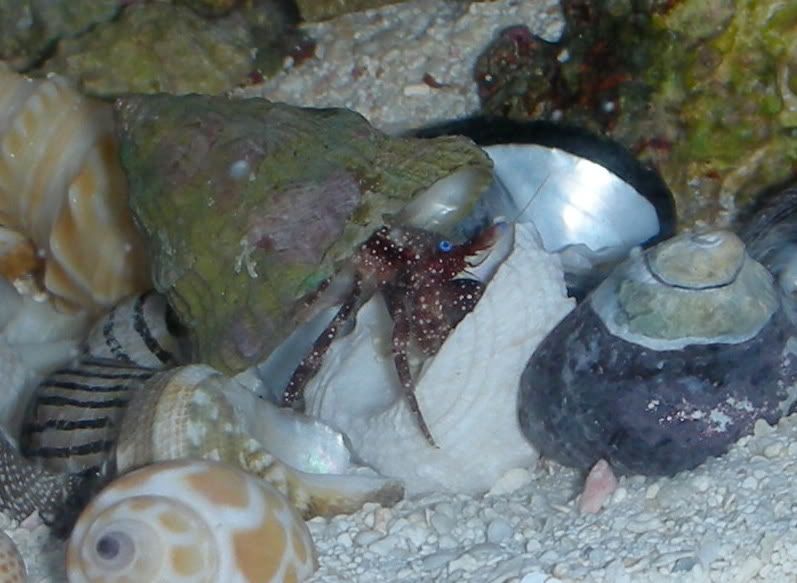
Dardanus venosus in my tank!??! Maybe - 5/2/08 Dear
WetWebMedia crew, Hello again. <Hello Sherry> I'm not
sure how this hermit got in my tank, but is it Dardanus venosus,
the Starry-eyed Hermit Crab, which grows 3-5 inches? <I'm
sorry, but I can't see the details well enough to make that
determination. Did it hitchhike in on rock from Florida, the
Bahamas, or the Caribbean?> It has blue eyes, <Do these have
the distinctive star patterned (pseudo-)pupils?> ..lavender
claws and it is bristly. Currently it is about 1" from claw to
claw, or leg to leg, however you measure. If it is a starry-eyed
hermit, how long may I expect it to stay small and relatively
harmless? <Growth rate will depend on water parameters and how
well it's fed. How harmless it is, depends on what you
have/value within your system. It's also related to the
relative size, speed, and accessibility of its potential prey
items. If you have a tank loaded with very small fish and snails it
could already be of a threatening size. If, however, it's in a
tank with very large fish, it wouldn't be too much of an issue.
If it is indeed Dardanus venosus, it should only be in large,
fish-only systems.> My son saw it pinch a Zoanthid polyp, but
besides that it is a good scavenger. <I bet it is!> Best
Sherry
<Take care, -Lynn> |
  |
| Re: Dardanus venosus in my tank!??! Maybe -
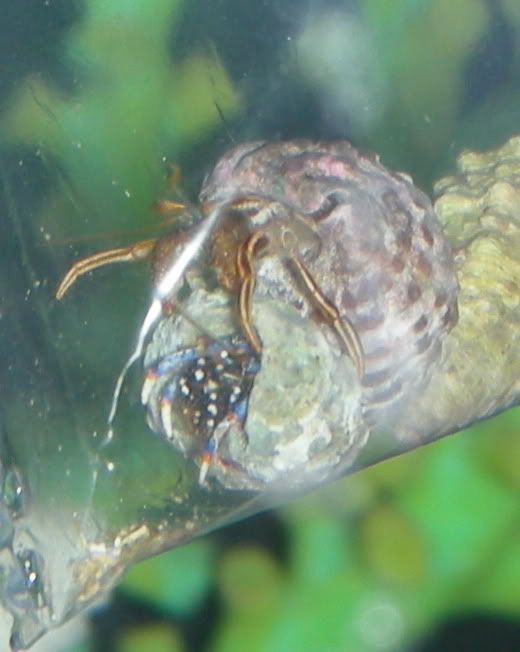
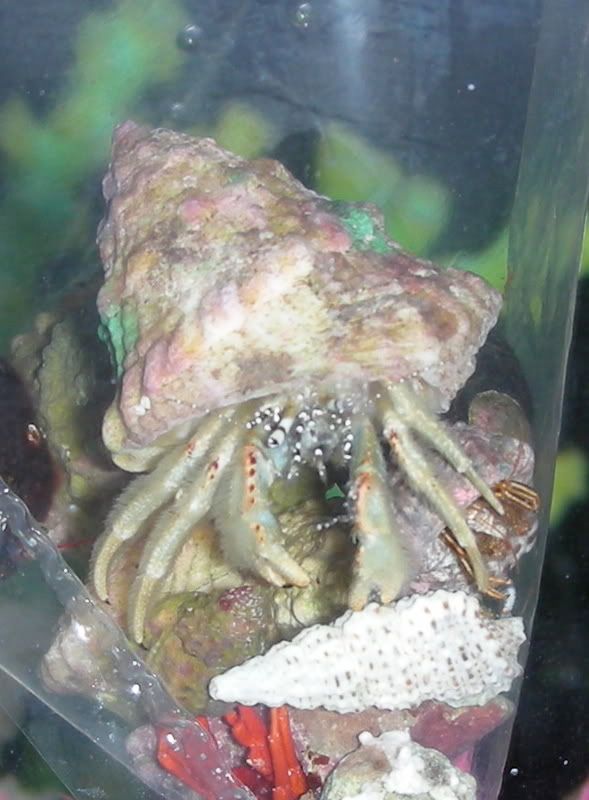
5/2/08 Hello, <Hi Sherry> I just wrote to you about
this crab, and then he was nice enough to walk across the sand so
I could take a couple of more pictures. These are my three best
pictures of him. It's hard to get a good picture, but I think
you can see the leg colors, blue eyes, etc... Any idea what it
is? <Unfortunately, there are many possibilities. Without
being able to see more detail or know where it came from, I
really couldn't tell you with any certainty. My best
recommendation is to look through the photos at the links below
for comparison. I'd also recommend that you keep a sharp eye
on the little fellow if you decide to keep it. The important
thing about hermits is that even those that are generally
considered harmless have the potential to prey on/pick at some of
the favorable biodiversity within a system, including snails.
They're also quite bold when it comes to removing/robbing
food from corals - sometimes to the point of the coral's
decline. Hermits are neat, but opportunistic little creatures
whose threat potential increases with size, crowding, and lack of
sufficient food. Keeping them well fed can help deter predation
to some degree, but the potential risk is still there. Here are
the links I mentioned earlier:
http://www.wetwebmedia.com/marine/inverts/arthropoda/crabs/hermitcrabs.htm
This link is in French, but it has some excellent photos with
species names included. http://www.recif.be/article/hermit.htm
> -Sherry <Take care, -Lynn> |
| Elegant Hermit Crab, coral abrasion
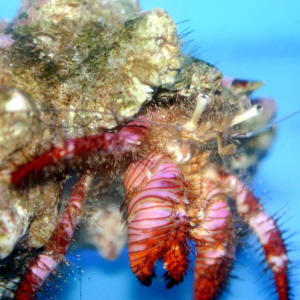
4/19/08 Hello Guys, <Scott> I just bought a beautiful
hermit crab which I believe to be Aniculus elegans, the elegant
hermit crab. This ID is based solely on looking at photos on the
web and noting that most, but not all, of the sites identify him
thusly. A few think he is a Hairy Hermit Crab, Dardanus Sp.,
including my LFS where I bought it, That Fish Place. The crab's
colors match EXACTLY the pink and maroon coralline algae on its
shell, and the tips of his hairs are turquoise. The crab is very
beefy, i.e., all the outside legs are thick and strong looking,
which doesn't come through at all on any photo I have seen. My
questions: 1. Is he Aniculus elegans; or can you point me to some
web resource that will help me identify him - that does not appear
when you google "Aniculus elegans" OR ("A.
elegans" AND Aniculus)? <I do think this ID is correct>
2. How often should I give him some fish or chicken? <No
chicken... too fatty, hard to digest...> I am concerned that he
is not getting enough food (due to his exoskeleton, I cannot see if
he is skinny). He is rather lethargic compared to all my other
hermit crabs (three thin striped plus lots of reef janitors). He
grabs and eats VERY sloppily the fish and chicken I give him, but I
would expect him to be scouring my rocks looking for coral. <I
would offer this animal aquatic-based proteinaceous food purposely
2-3 times a week. Maybe via tongs...> From the book, *Life and
Death of Coral Reefs* Edited by Charles Birkeland, chapter 4,
*Bioerosion and Coral-Reef Growth: A Dynamic Balance*, by Peter W.
Glynn, Page 79: Two species of hermit crabs that feed on live coral
produce large amounts of calcareous sediment when they scrape
corals to remove soft tissues (Fig. 4-1). The average mass of coral
abraded by a small hermit crab (*Trizopagurus magnificus*
[Bouvier]) was about 10 mg ind.
day, and for a large hermit crab (*Aniculus
elegans* Stimpson) about 1 g ind.
day (Glynn et al., 1972). Relating hermit
crab population densities and erosion rates, it was found that
*Trizopagurus* and *Aniculus* respectively were responsible for the
generation of about 1 and 0.1 metric tons of coral sediment per
hectare per year on a fringing reef in Panama (Table 4-2). Since
this rate of coral abrasion by hermit crabs has not been reported
elsewhere, it is possible that these high levels of erosion are
unique to the eastern Pacific. <Wow!> Grace and Peace, Scott
<I would keep an eye on this (and all other hermits, true
crabs...) vis a vis your stony corals. Cheers, Bob Fenner> |
|
|
Dardanus deformis, Hermit ID 3/30/08
Hello, <<Hi Mike.>> I love your web site, its helped me
a lot in the past. <<Glad to hear it.>> I bought what I
thought was three blue legged hermit crabs from my LFS a couple
days ago and I thought that one of the hermits had just lost some
color. Today I really checked the one out and he is definitely not
a blue leg. He has white legs with tan marks and white claws. I
read through the hermit ID page and I think there was one that may
match him, you called it a "Rock Hermit Crab". Will he
bother my corals (Xenia, Caulerpa, and some button polyps), inverts
Feather Dusters, Flame Scallop, multiple Brittlestars, Blue Tuxedo
Urchin, Banded Coral Shrimp, and a pink/green sea cucumber), or my
fish (Fire Dartfish, Yellow Tang, Ocellaris Clownfish, and a Starry
Dragonet). Should I take him back to the LFS? I also have a tank
with a Yellow Banded Pipe Fish, a black Brittlestar, and a Sexy
Anemone shrimp. There are no corals in this tank. Would he be
better suited for this tank? <<Okay Mike after seeing the
photo, which I'll say as a disclaimer is not the best way to
ID, I am in agreement that your specimen does resemble a Dardanus
deformis aka 'Rock Hermit Crab.' As far as safety goes, you
do have some sensitive critters in there and Dardanus deformis does
get to be on the rather large size'¦as with all hermit
keep that old phrase in mind'¦opportunistic omnivore.
Perhaps returning him before he gets to large would be the wise
choice. >> Thank you for all your help! -Mike A.
<<Adam J.>> |
|
|
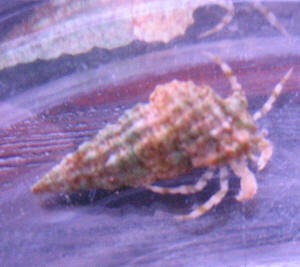
| Hermit Crab ID -- Family: Paguridae -
2/26/08 Hello! <Hi Laurie!> If you would be able to
answer a question about a hermit crab ID that would be great.
<I'll sure try!> One of my coworkers brought it to me
after a mini-scuba diving trip this weekend. <Mmmmm, not such a
good thing to do. These are better left in the wild. Not to mention
that it might very well be illegal!> It is currently in a fish
only set up with 3 other pretty peaceful crabs of the same size
(2-3 inches). The only reason I am inquiring about this crab is
because of the color (red), and a past experience with a crab I
bought from a LFS that told me how "peaceful" the crab
was. Only to find it trying to catch fish mid-swim to eat it
(successful once before he was returned). <Yikes!> That one I
have come to figure the "scarlet hermit crab" as it was
sold to me as, was actually a "white spotted hermit
crab". <Double yikes! Dardanus megistos can grow to a very
large size and is a definite threat to fish. It's an
attractive, but aggressive hermit.> So getting back to my main
question, would you be able to ID the crab in the photo, <Heeee!
I wish I had a penny for every reddish/brownish hermit out there!
Complicating matters is that I don't know where this hermit is
from, or if it was taken from the ocean, or the beach. Location can
make all the difference in identification. The shell it's in
looks very much like Strombus pugilis or Strombus alatus, aka the
Fighting Conch from Florida/Gulf of Mexico, but I could be wrong.
Please see this link for comparison (note the degree of variation
within the species): http://www.jaxshells.org/strombss.htm
Unfortunately, there are just too many possibilities to give you an
ID to species level. The best I can do is tell you that since it
appears that the right claw is larger than the left, then it's
likely in the family Paguridae.> ..and if so, the common
temperament of this crab? In my tank I have a Diamond Goby, pair of
False Percula Clowns, and Chalk Basslet whom I'd really like to
keep alive in that tank and not worry every night they might become
dinner to this newcomer. <Understandable. One thing I can tell
you from personal experience is that I don't trust large
hermits. They tend to be opportunistic creatures with voracious
appetites. Keeping them well fed could help deter possible
predation issues, but there are no guarantees. Please see this link
and those at the top of the page for more information and photo
comparison:
http://www.wetwebmedia.com/marine/inverts/arthropoda/crabs/hermitcrabs.htm
> Thanks Again! Laurie <You're very welcome, and good
luck! Take care, -Lynn> |
|
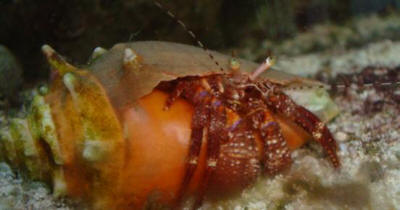
Hermit Crabs, ID...
02/01/2008 Hi! <<Hello, Andrew today>> I bought 3
hermit crabs from the LFS. I think they might be the Coral Hermit
Crab (D. tinctor). Blue eyes, body is not bristly like the Starry
eyed, so I'm pretty sure its not that. They are quite large,
about 3-4 inches in shell length. Anyways, my question is about
the 4th one I got (The guy at the LFS thought it was an empty
shell and gave it to me.. much to my surprise, it was gone from
where I place it the night before and lo and behold! It was a
crab!) <<A nice surprise>> Went back to the LFS, paid
for it, and thought all was well. Well, all is well, kind of. It
looks like a C. vittatus hermit crab. <<An attached photo
would of enabled us to confirm>> The other 3 have been
happily climbing around everywhere, munching on algae, picking up
the crushed coral and doing what I can only describe as, scraping
off particulates. However, this C. vittatus is not moving around
a lot. It tends to like to burrow into the substrate next to my
LR. I'm afraid its not eating and it will starve. Any advice?
<<If it is the C. vittatus, it should be fine. These act in
much the same manner as other algae eating crabs and as such, I
would not be concerned for its well fare. Keep a close eye on
it.. Read more here about half way down..
http://wetwebmedia.com/marine/inverts/arthropoda/crabs/hermitcrabs.htm
>> Regards, Brian <<Thanks for the questions. A
Nixon>>
|
Hermit crab of Thailand traveled to
Holland... ID, care -- 08/27/07 L.S., 17 august
our son took with him a nice, empty (so we thought) shell.
We were on holiday in Thailand. He found the shell at the
beach at the island Ko Pha Ngan in the Gulf of Thailand.
After more than 24 hours of traveling we exposed the shell
at home on a table and had a look at it once in a while
(dreaming about Ko Pha Ngan). Saturday evening (25 august)
we looked at it again and saw it walking! The shell
obviously was not so empty as we thought. We think it is a
marine hermit crab. The shell is about 7 cm long. The crab
has dark brown paws with little hair and blue stripes. I
asked my son and he told me he found the shell at the
beach, near the coral, but within the range of tide. I
would have loved to bring back the poor animal.
Unfortunately, Thailand is so far away. So I called the Zoo
of Rotterdam and asked them if they could take care of our
new pet. They will!!! We brought it yesterday to the zoo.
They will investigate which kind of hermit crab it is but I
am not sure if they succeed (they have so many animals to
take care of.). So I looked on Internet to see if I can
learn more about hermit crabs. At that moment I found your
marvelous site. I hope you or the forum could help me in
identifying the creature. Attached you'll find a
picture of the crab. Maybe one glance at it is enough to
identify the animal? If so, I can inform the Zoo so they
can take even better care of the crab. We hope you will
have a look at the picture. I tried to post this message on
the forum but unfortunately this was not possible (the
sign-in process was the problem). Thanks a lot for
answering, Best regards Annemarij <Hallo Annemarij! The
crab looks like a Clibanarius sp. hermit crab. These are
quite common in the aquarium trade. They are very hardy
animals and easy to keep. There are many species, some
found in freshwater, brackish, and marine environments.
Many species are intertidal animals, adapted to quite
extreme changes in temperature and salinity. This is
probably why they do so well in aquaria! The feed mostly on
algae and organic detritus. Marine aquarists usually keep
Clibanarius tricolor, a marine/brackish water species;
freshwater aquarists may sometimes be offered Clibanarius
africanus. Assuming you found your specimen on a saltwater
beach, then you should keep the hermit crab in a tropical
marine aquarium. Generally these hermit crabs are
unproblematic. The only issue when keeping hermit crabs is
they need access to empty shells as they grow. I hope this
helps, Neale>
Re: hermit crab of Thailand traveled to
Holland 8/28/07 Dear Neale, Thanks a lot for answering
my mail! It certainly help me. I'll inform the Zoo
Blijdorp of Rotterdam and hope that 'our' crab will
have a happy and long life. Again, many thanks. Best
regards, Annemarij <You're most welcome, and I'm
glad the little crab is going to have a pleasant life at
such a nice zoo. Cheers, Neale>
|
|
|
|
|
|