|
Related FAQs: Fishes of
Hawai'i, Articles on: The Best
Butterflyfishes of Hawai'i, Triggerfishes of
Hawai'i,
Related Articles: Introduction to Fishwatcher's Guide
Series Pieces/Sections, Scott's Trip to
Maui/Hawai'i, Holualoa property,
A Fishwatcher's Guide to the
Marine Fishes of Hawai'i
Part 3 of 5, To: Part 1,
Part 2, Part
4, Part 5
|
|
|
Bob Fenner
|
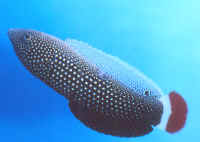
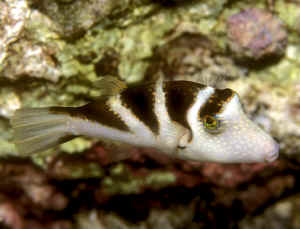
Canthigaster coronata
|
Goatfishes, Family Mullidae. There a handful of
Hawaiian Goatfish species that would do well for aquarium use; being
hardy, good looking, disease resistant, and accepting all types of
foods. The reason few do come in has to do with two common human
"problems", not the fish's. First off, having done a bit
of collecting in Hawaii myself, I can tell you there are times (always)
when a school of goatfishes tearing into and through your fence net are
unappreciated. Secondly, Goats are not demanded much by hobbyists,
dealers, wholesalers, all the way up the supply line so they are
regularly let out of barrier fish nets, let alone not fished for. This
situation would be changed by end-user awareness of the groups
desirability, and the utilization of less large, smaller mesh,
shallower nets, such as those employed for "wrasse
collection".
Most places offer Mullids from here as "Misc.",
"Hawaiian" or "Red" Goatfish. The commonest species
is Parapeneus bifasciatus (1) (though other reddish species are
involved). It's a shame the wide-ranging Yellowfin
(Mulloidichthys vanicolensis)(2) and Blue (Parupeneus
cyclostomus)(1) Goatfishes aren't utilized more from Hawaiian
waters.
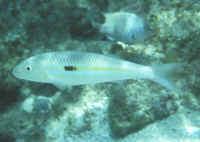
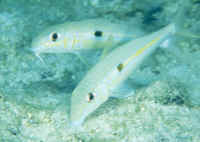
| Mulloidichthys flavolineatus (Lacepede
1801), the Yellowstripe Goatfish. Indo-Pacific, Red Sea over to the
Hawaiian Islands. To a maximum of seventeen inches in
length. Below: the first one a juvenile off Two-Step, Kona,
the second in Maui, and a small pair in the Cooks. |
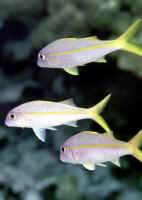
| Mulloidichthys vanicolensis (Valenciennes
1831), the Yellowfin Goatfish. Indo-Pacific, Red Sea to
Hawai'i. To fifteen inches in length. |
|
| Parupeneus bifasciatus (Lacepede 1801), the
Double-Bar Goatfish. Indo-Pacific, including Hawai'i. To
fourteen inches in length. Pulau Redang, Malaysia, N. Sulawesi
photos. |
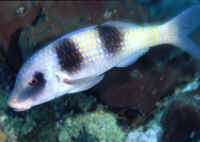
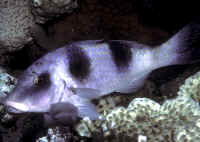
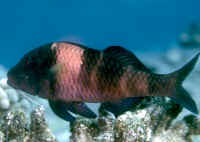
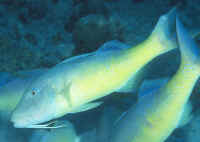
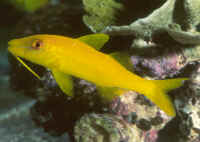
| Parupeneus cyclostomus (Lacepede 1801), the
Goldsaddle Goatfish. Indo-Pacific out to Hawai'i, including the
Red Sea. To twenty inches in length. Yellow form not found in
Hawai'i. Pictured, a group in the Red Sea, and a yellow
individual in captivity. |
|
| Parupeneus multifasciatus (Quoy &
Gaimard 1824), the Manybar Goatfish. Indo-Pacific, including
Hawai'i. To a foot in length. A good looker. Here are specimens
from Fiji and Hawai'i during the day and at night. |
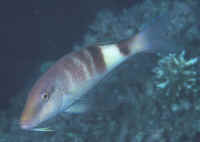
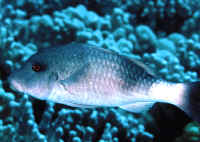
| Parupeneus pleurostigma (Bennett 1830), the
Sidespot Goatfish. Dark spot on body at rear of first dorsal fin;
white one at base of second. Indo-Pacific. To thirteen inches in
length. This one off of Kailua-Kona, Hawai'i. |
|
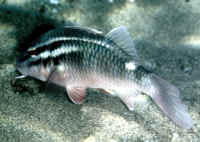
| Parupeneus porphyreus (Jenkins 1902),
another Whitesaddle Goatfish. This one confined to the central
Pacific which is the Hawaiian Islands. to eighteen inches in
length. Image made in Maui. |
|
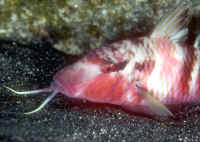
Ecotype: Goatfishes utilize their jaw barbels to root around in the
bottom sand/gravel for food in rubble and shallow reef areas.
Sea Chubs, Family Kyphosidae. <To do: add for HI
U/W>
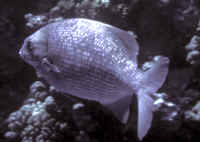
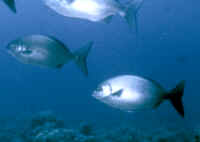
| Kyphosus cinerascens (Forsskal 1775), the
Blue Sea Chub. Indo-Pacific; Red Sea to the Hawaiian Islands. To 50
cm. overall length. Hawai'i images. |
|
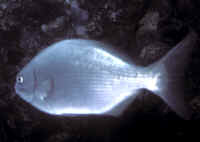
| Kyphosus vaigensis (Quoy & Gaimard
1825), the Brassy Chub. Indo-Pacific; Red Sea to the Hawaiian
Islands. To 76 cm. Red Sea image |
|
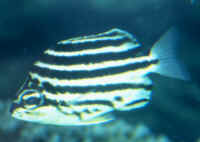
The Stripey, Family Microcanthidae. Formerly classified with
the Butterflyfishes, the Stripey, Microcanthus strigatus (1), is
sometimes shipped out of the Islands. This is a hardy aquarium species
that deserves more attention. Similar in habits and behavior to the
brackish to marine Scats (Family Scatophagidae), this fish gets to know
its owners so well it will take food by hand.
| Microcanthus strigosus (Cuvier 1831), the
Stripey. Sporadically distributed in western and eastern Australian
waters, Japan, Taiwan, Hawai'i. To six inches in length. Often
placed in its own family Microcanthidae. |
|
Hawaiian Butterflyfishes, family Chaetodontidae
|
Hawaiian Butterflyfishes, family
Chaetodontidae. Hawai'i is Butterflyfish
Heaven and Hell, supporting a large number (24!) of
aquarium-suitable and terrible species. On the highest side of
survivability... actually on the other hand, they're so many,
please go to the separate piece on the Butterflyfishes of
Hawai'i.
|
|
Pomacanthidae, Marine Angelfishes. Hawaii's angels are
problematical for aquarists. The two best species are deeper water,
scarce and difficult to catch (the dwarf Fisher's Angel,
Centropyge fisheri (1) and Flame Angelfish, C.
loricula)(1), and the most common angel, the Potter's, C.
potteri (3) and Bandit, Apolemichthys (Desmoholacanthus)
arcuatus (3) do poorly in captivity. I know I'm going to catch
some heat for my opinions on the last two, but my collector friends
don't realize just how few Potter's and "Holos" are
alive more than a month after they've brought them up. Very few.
These should only be tried in "reefs". Two other angelfish
species are found in the upper Hawaiian Island chain but not in the
trade.
Ecotype: Definite territories on patch and contiguous reefs,
defended against others of their kind and similar-appearing fishes.
|
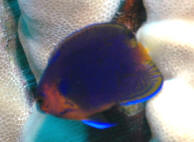
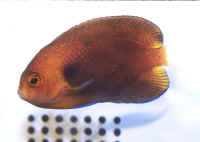
Centropyge fisheri (Snyder
1904), Fisher's Dwarf Angel (3), is one of the many Hawaiian
endemics. This is a "dwarf" Dwarf Angel, usually no
more than two inches in length. Closely related to Centropge
flavicauda. Hawaii and Johnston Atoll distribution only. A
juvenile off of Kona and a more typical adult in
captivity.
|
|
|
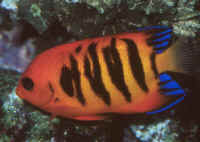
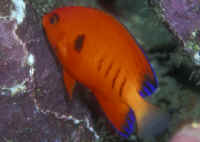
Centropyge
loricula (Gunter 1874), the Flame Angel (1), is a staple
in the ornamental marine trade, with some 5,000 individuals
collected and sold worldwide every week. Western to central
Pacific Ocean. Shown: An aquarium specimen (likely Marshall
Islands) and one in Nuka Hiva, Marquesas, Polynesia where they
typically show just one body band.
|
|
|
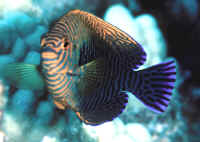
Centropyge potteri Jordan
& Metz 1912, Potter's Dwarf Angel (3), is another fish
found only in Hawai'i. When picking one of these out for use,
make sure to acquire a well-adjusted individual; I'd wait
till it was in captivity a good two weeks. And only try this
species in a very well-established reef tank, with peaceful
tankmates, AFTER you've become an "advanced"
aquarist. Kailua-Kona photograph.
|
|
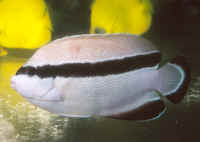
| Apolemichthys arcuatus Gray 1831, The
Bandit, Black-Banded Angelfish, Holo-holo... A beauty and
heartbreaker... this angel is so "friendly" it can be
caught literally by hand... without a net... but rarely lives for
any period of time in captivity. Here's an image of one
starting to break down (note brown spot on its flank). Imported
from its limited range in Hawai'i. Dr. Randall lists in the
genus Desmoholacanthus and fishbase.org in Apolemichthys... |
|
|
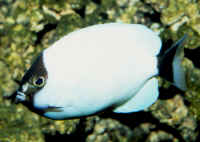
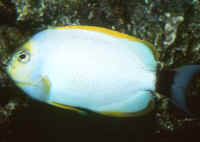
Genicanthus personatus
Randall 1975, the Masked Angelfish (1). Northwestern Hawaiian
Islands. Rare and cooler water animals, but can live in tropical
systems. Shy, need plenty of rock cover. To eight inches total
length. Male and female shown from Waikiki Aquarium.
|
|
The Damselfishes, Family Pomacentridae. Due to the vagaries
of economics more than anything else, few of the damselfishes found in
Hawai'i are collected for our use. The several species found there
fit the general mix of some good looking and hardy enough
to be of use, the rest too large, gaudy and/or territorial. About
all you find, and that only on occasion from the truly avant-garde LFS
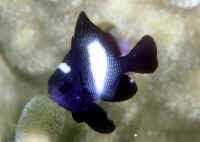
(Livestock Fish Stores) are the ill-tempered Hawaiian Dascyllus, D.
albisella; soulmates with the all-too similar Domino or Three-Spot,
D. trimaculatus. Secondarily, a few wholesalers will carry
"misc." Hawaiian Chromis (when collectors sneak them into an
order). Of the several Chromis spp. from Hawai'i these are mainly
Blackfin (C. vanderbilti) and Agile (C. agilus)
Chromis.
Unless the public becomes willing to pay a few bucks more than they
do for the "usual suspects" damsel species from the
Indo-Pacific they'll continue to miss out on the not two, but count
'em, three species of Sergeant Majors that come from here. The
endemic Abudefduf abdominalis, the "dirty" Blackspot
Sergeant, A. sordidus, or the very wide-ranging Oceania to
Indo-Pacific to Indian Ocean and Red Sea, A. vaigensis.
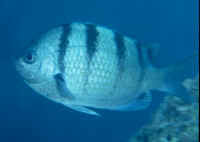
| Abudefduf abdominalis (Quoy & Gaimard
1825), the Green Damselfish, or Maomao if you're in
Hawai'i. Central Pacific, Hawaii to Polynesia. To eight inches
in length in the wild. Here's one in Hawai'i. |
|
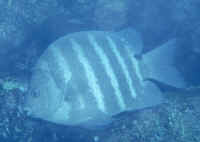
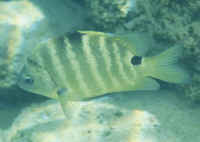
| Abudefduf sordidus (Forsskal 1775), The
Black-Spot Sergeant or Dirty Damsel. Indo-Pacific, including
Hawai'i. Lives in high surge areas. To almost seven inches in
length. Only occasionally imported as a pet-fish. These images from
the Maldives and Hawai'i. |
|
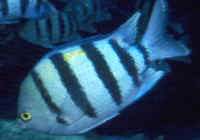
| Abudefduf vaigiensis (Quoy & Gaimard
1825), the Indo-Pacific Sergeant Major. Eastern coast of Africa and
Red Sea (where this picture was taken), out to the Line and Tuamotu
Islands. To six inches long. Fourth black body bar originates after
hard dorsal fin. |
|
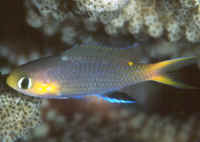
| Chromis acares Randall & Swerdloff 1973,
the Midget Chromis. Pacific Plate; Mariana Is. to Hawaiian, Society
Islands. To one and three quarter inches in length. This one in
Roratonga, Cook Islands. |
|
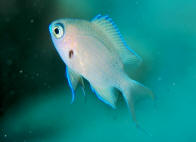
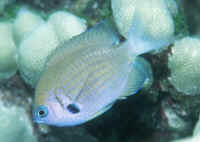
| Chromis agilis Smith 1960, the Reef Chromis.
Widespread in the Indo-west Pacific, including Hawaiian Islands
where this species is most frequently gathered for the aquarium
trade. To three inches in length. A good species for reef tanks.
Hawai'i images of a juvenile and adult. |
|
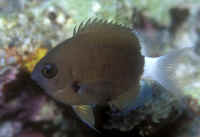
| Chromis hanui Randall & Sverdluff 1973,
the Chocolate-Dip Chromis. Abrupt white on caudal, dorsal and anal
regions. Hawaiian island endemic, 6-165 feet. To 3.5 inches in
length. Kona pix. |
|
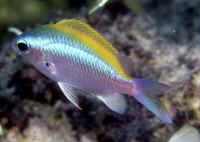
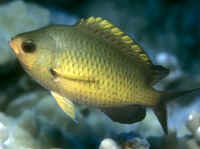
| Chromis ovalis (Steindachner 1900), the Oval
Chromis. Hawaiian Island endemic. Lives in groups as adults.
Zoo-plankton feeder. Adult greenish with dark fin edges. Sub-adults
yellow-bodied with blue streak over eye. Juveniles (shown,
photographed off of Honaunau on the Big Island) brilliant blue with
yellow dorsal surface, and a more somber adult elsewhere off of
Kona. |
|
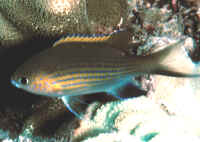
| Chromis vanderbilti (Fowler 1941),
Vanderbilt's Chromis. A small beauty (to two inches) of the
Central and West Pacific. This one in the Cook Islands. A rare
import best kept in a small school in a peaceful setting. |
|
| Chromis verator Jordan & Mertz 1932, the
Threespot Chromis. Hawaiian endemic, found in deep water, generally
below 60 feet to 600 feet. To eight inches long. Can brighten/dim
white spots. Kona pix. |
|
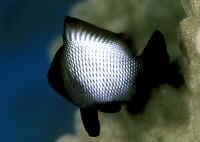
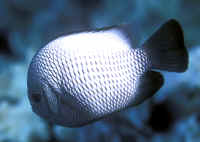
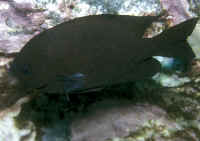
| Dascyllus albisella Gill
1862, the Hawaiian Dascyllus. Central Pacific: Hawaiian and
Johnston Islands. To five inches. A poor shipper, and as nasty a
biter as the similar Three-Spot, Domino, Dascyllus
trimaculatus. Hawai'i pix of very small (1/2"),
younger (2"), older (3") individuals. |
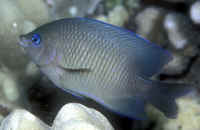
| Plectroglyphidodon johnstonianus (Fowler
& Ball 1924), the Johnston Island Damsel. Despite its common
name this species is found in the Indo-Pacific, eastern Africa to
Hawai'i (where this image is from). To two and a half inches
long. |
|
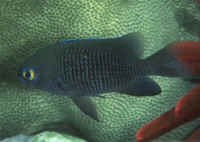
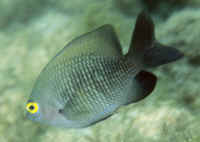
| Stegastes fasciolatus (Ogilby 1889), the
Pacific Gregory. Indo-west Pacific. Not a great beauty and at up to
six inches in length, a handful. But an interesting, intelligent
addition to a rougher aquarium setting. These images of
younger and older individuals in Hawai'i. |
|
Wrasses, Labridae. Hawai'i is
"Wrasse-Land". The most speciose family of fishes here by
with 43 species. You'll have some wrasses in view almost always
when diving. Aquarists use a dozen or so of the Hawaiian wrasse
species. Counting them down alphabetically by genera, these are:
Anampses chrysocephalus, the Psyche Head or Psychedelic
Wrasse (2) common names apply to the male of the species, with Redtail
Wrasse often labeling the female. Like most of the family these fish
are eventually both (if they live so long); first females, becoming
males. Starting with small individuals (3-4") is best. Larger
ones, especially males, adapt poorly, and they all are excellent
jumpers.
|
Anampses chrysocephalus Randall 1958, whose
females are typically sold as Red Tail and males as Psychedelic
or Psych-Head Wrasses. Gorgeous, but a radical swimmer and jumper
that frequently "just dies" overnight. Only found in
the Hawaiian Island chain. Juvenile off of Puako, Big Island
Female in captivity and male underwater.
|
A. cuvier, the Pearl Wrasse is seen occasionally. Named in
honor of the famous French Paleozoologist (and superb ichthyologist),
Georges Cuvier, this is a fish-only species that fits in much as the
more common wrasses of the genus Coris. To 13 inches.
|
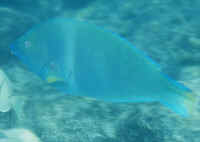
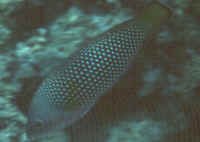
Anampses cuvier Quoy & Gaimard 1824,
the Flag or Pearl Wrasse named in honor of Georges Cuvier is
amongst the heartiest species of the genus, but still rates a
dismal for survivability. This fish readily consumes fresh or
prepared meaty foods, but must also regularly have natural
greens. Male and female in Hawai'i shown.
|
|
Bodianus bilunulatus, the Hawaiian Hogfish (1), one of two
species of hog-wrasses found in the Islands, is as hardy as it's
other namesake species; but does grow to 20 inches.
|
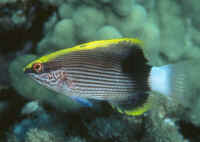
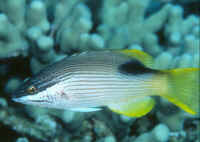
Bodianus bilunulatus (Lacepede 1801), the
Black Spot Hogfish or Tarry Hogfish to science, is often offered
retail. Punctuated distribution in the Indo-west Pacific
including Hawai'i, where these images were taken. Three inch
juvenile and six inch sub-adults shown. Grows to twenty two
inches in length in the wild.
|
|
|
Found only in Hawaii, the Neon Wrasse Bodianus
sanguineus (Jordan and Evermann 1903) is a small Hog (5-6
inches), of deeper water (generally 200 feet plus) putting it way
beyond the commercial collector's realm. But it is
gorgeous.
|
No pic
|
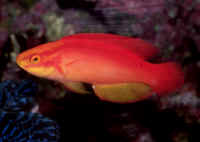
Cirrhilabrus jordani, the Flame Wrasse (1), like other
members of its genus, gorgeous, hardy and tremendous escape artists.
Two words of caution re this endemic Hawaiian species; take care to
pick out well-acclimated specimens (they come in beat up from
collection), and keep your tank well covered.
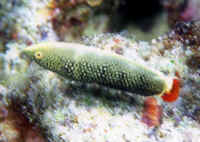
| Cirrhilabrus jordani Snyder 1904, the Flame
Wrasse. Hawaiian endemic. To four inches in length. One of the
hardiest and most beautiful of the genus. Aquarium photo of a
male. |
|
|
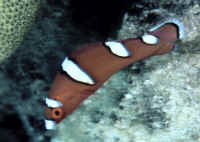
Coris
gaimard (2), the Red or Yellowstriped Coris, a beauty as
young and adults, but very active in swimming, digging, bothering
tankmates and jumping out. A juvenile shown.
|
|
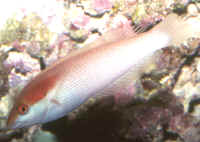
| Coris ballieui Vaillant & Sauvage 1875,
the Sand Wrasse. Known from Hawaii's islands in the central
Pacific. To thirteen inches. Rarely imported and this is a great
shame. A good-looking smaller member of the genus that would
probably do well for aquarists. This one photographed at the
Waikiki Aquarium. |
|
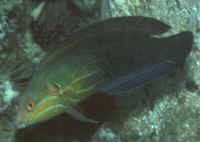
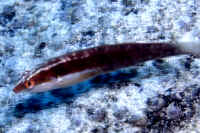
| Coris venusta Vaillant &
Sauvage 1875, the Elegant Coris. Hawaiian endemic. To about seven
inches in length. Yet another Hawaiian Coris that could/should be
used in our interest. A hardy beauty that can be found in good
numbers in shallow rocky settings. A terminal/male one in
Shark's Bay in Oahu and a juvenile off of the Big Island. |
|
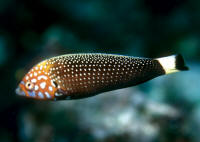
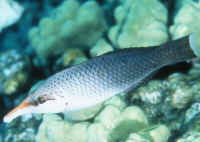
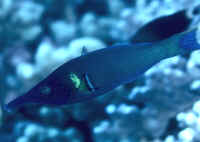
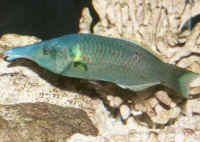
Gomphosus varius, (1) the Bird, or by the sex, Black Bird
(females) and Green Bird Wrasses, are neither common enough, and the
cost of living relatively high such that they're mainly collected
out of Micronesia and the Indian Ocean for the trade. A great fish-only
system species. To one foot in length.
|
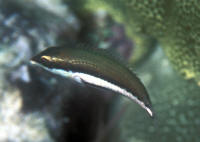
Gomphosus varius Lacepede 1801, is the much
more common Bird Wrasse (1) in the west. Its males are lighter
green over-all, and females transversely white to black front to
back, with an orangish upper "beak". The common Bird
Wrasse is found in Hawai'i to the tropical western Pacific
and eastern Indian Ocean. At right a juvenile. Below: Female in
Hawai'i, male there and in captivity.
|
|
Halichoeres ornatissimus, the Ornate or Christmas (Xmas) Wrasse
(2). In the right (i.e. peaceful) setting, this fish can live for
years; most are bullied into starvation. Readily accept meaty foods; in
the wild, crustaceans and mollusks.
|
Halichoeres ornatissimus (Garrett 1863) is
(one of) the three " Christmas Wrasses" (2), aka the
Ornate Wrasse to science. This can be a very hardy fish should
you secure an initially healthy specimen. Unfortunately, way to
many are doomed from the trauma of rough handling through the
collection process. To six inches. Below: Juvenile and adult
Hawai'i and Aquarium photos. Indo-Pacific to Hawai'i,
where it is best imported from.
|
Labroides phthirophagus, the Hawaiian Cleaner Wrasse (3). The
hardiest member of the genus IMO, but still too delicate for captivity,
and needed-useful in the wild for servicing tropicals and pelagics,
removing parasites and necrotic tissue from other fishes.
|
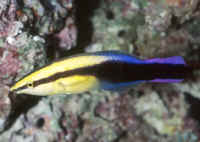
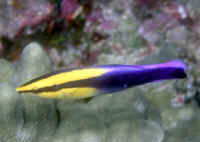
The endemic, Labroides phthirophagus
Randall 1958, Hawaiian Cleaner Wrasse (3). To nearly five inches
in length. A beauty, but fares no better than other members of
the genus and should be left in the islands to do its cleaning,
and live. Aquarium and Hawai'i pix.
|
|
Part 3 of 5, To: Part 1, Part 2, Part 4,
|
|


.JPG)