|
Related FAQs: Batfishes,
Related Articles: Spadefishes,
/Fishwatcher's Guide
Series
Spadefishes Found In Indonesia, Family,
Ephippidae
|
|
| Bob Fenner |
|
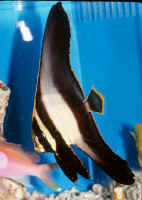
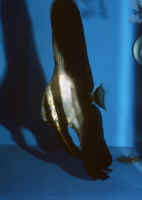
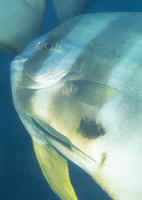
| Platax batavianus Cuvier
1831, the Humpback (science) or Zebra Batfish. Indo-West Pacific;
Madagascar to Indonesia. To twenty inches in height. Occasionally
offered in the trade. Should you be fortunate to chance upon a
specimen Platax batavianus it's a real striker as young,
with alternating black and white banding covering it's entire
body surface. Juvenile pix (three inches tall) in N. Sulawesi and
six inch tall specimen Aquarium image. |
|
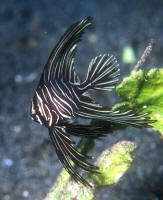
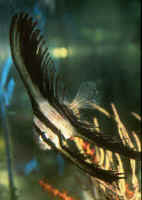
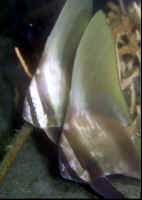
| Platax boersi Bleeker 1852, Boer's
Batfish. Indonesia, New Guinea, Philippines. To sixteen inches in
length. Some sub-adults in N. Sulawesi and an adult off of Mabul,
Malaysia. |
|
|
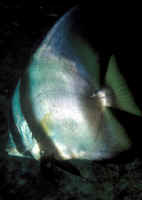
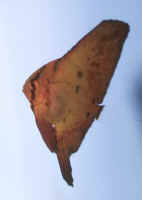
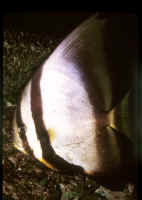
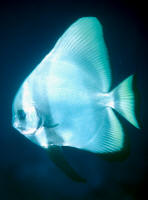
Platax
orbicularis (Forsskal, 1775),
the Orbiculated, or Round Batfish is the
"ugly-duckling" of the genus as young, being very plain
brown and the least tall as a juvenile. At right, aquarium
specimens of a four inch tall juvenile, a ten inch high
sub-adult, a twelve inch high intermediate off of
Queensland, Australia, and one about sixteen inches tall in N.
Sulawesi.
|
|
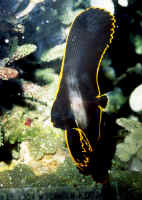
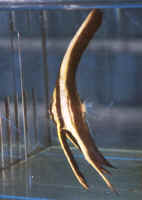
| Platax pinnatus (Linnaeus
11758), the Pinnatus, Red-Stripe or Shaded or Dusky Batfish
proves almost impossible to keep alive, generally refusing all
food. This species is secretive in the wild, found hiding in wrecks
and other dark spots, and should be left there. In my estimation,
less than one hundredth of pinnatus bats live more than a month in
captivity. I can hear it now; "Oh Bob, I know of a guy who
kept a pinnatus for years, in low specific gravity, feeding it
banana chips...". There are very few of these success stories,
I'll warrant. the pinnatus, red-stripe or shaded batfish proves
almost impossible to keep alive, generally refusing all food. This
species is secretive in the wild, found hiding in wrecks and other
dark spots, and should be left there. In my estimation, less than
one hundredth of pinnatus bats live more than a month in captivity.
I can hear it now; "Oh Bob, I know of a guy who kept a
pinnatus for years, in low specific gravity, feeding it banana
chips...". There are very few of these success stories,
I'll warrant. Juvenile image on the FAQ's page. Below: a
series of ages, sizes: Two juveniles in captivity (for a short
time), sub-adult in captivity, and an older individual off of
Queensland, Australia. |
|
|