|
Related FAQs: Triggerfishes
in General, Triggerfish: Identification,
Selection, Selection 2,
Compatibility,
Behavior, Systems,
Feeding,
Diseases,
Triggerfish Health
2, Reproduction,
Related Articles: Triggerfishes (Family Balistidae), Red Sea Triggerfishes, Triggers of the Cook
Islands,
/The Best Livestock for A Marine Aquarium
(Series)
Triggerfishes of the Genus
Balistes
|
|
| Bob Fenner |
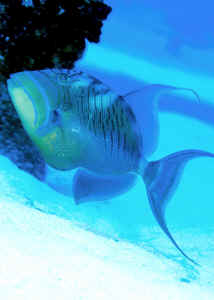
The Queen in her court
|
Triggerfishes for Marine Aquariums
Diversity, Selection & Care
New eBook on Amazon: Available here
New Print Book on Create Space: Available
here
by Robert (Bob) Fenner
|
 |
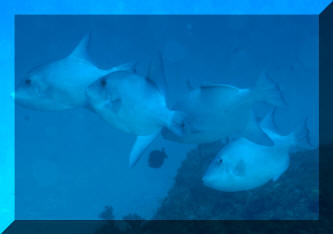
The genus Balistes: four or five species.
Bigger PIX:
The images in this table are linked
to large (desktop size) copies. Click on "framed" images
to go to the larger size. |
|
|
|
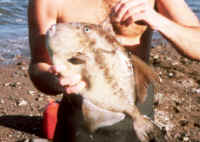
Sometimes the plain-Jane Finescale Trigger, Balistes
polylepis Steindachner 1876, comes into the trade out of the
tropical eastern Pacific, but it is ugly and grows to two
feet. My old roomie Gary Okonowski holds up "the
catch" before making la sopa in the Sea of Cortez, and a pic
down in the Galapagos.
|
|
Bigger PIX:
The images in this table are linked to large
(desktop size) copies. Click on "framed" images to go to
the larger size. |
|
|
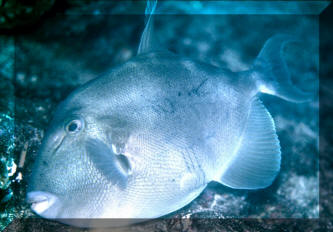
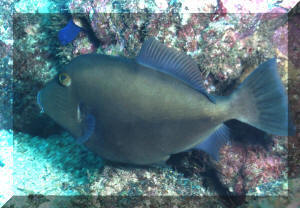
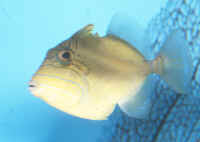
| Balistes punctatus Gmelin 1789, the
Blue-Spotted Triggerfish. Eastern Atlantic. To two feet long. Feeds
on crustaceans and bivalves. Juv. pic by RMF at TFP in PA. Adult photo courtesy of Scott Chase. |
.JPG) 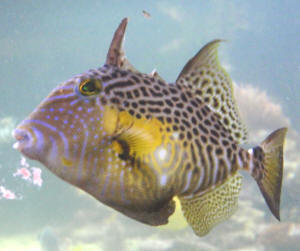 |
Bigger PIX:
The images in this table are linked
to large (desktop size) copies. Click on "framed" images
to go to the larger size. |
|
%20MD.JPG)
|
|
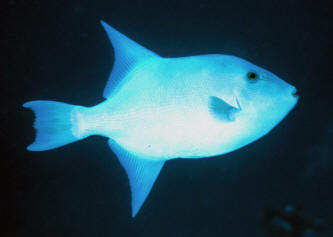
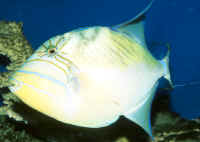
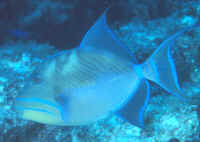
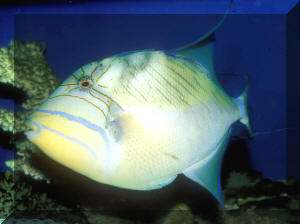
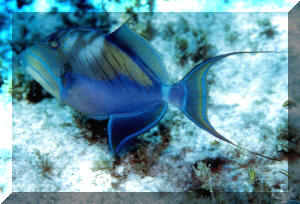
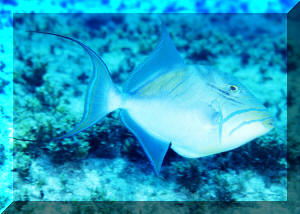
Much more beautiful but the embodiment of aggression in a
marine tropical is the Queen Triggerfish, Balistes vetula
Linnaeus 1758, from the Atlantic. This is a MEAN fish,
biting machine that must be kept with basses, puffers and other
animals too unpalatable to bite or mean and smart enough to bite
back. To two feet in length. Pictured below: A two inch
"tiny" specimen, a fifteen inch monster in captivity,
and a foot long beauty in the Bahamas.
|
Quick Question Bob, I have two quick questions
for you the first is Under the Balistes section the West African
Triggerfish is not listed. Is there a reason why? Second, do you know
where I might be able to obtain some of the larger triggerfish that you
don't commonly see, such as the Blunthead, or Ocean
Triggerfish. Thanks for all the information. Mike
Striegel <Good questions all... Of the four assured species of
the genus Balistes (do you recognize B. capriscus here? Make that
five), about all the trade sees is the Queen (B. vetula)... and though
I really enjoy this group all the way around (intended at one point to
make their systematics my academic life's work), don't have
much information or image work on many species that have little
use/brush with the ornamental aquatics trade... Will gladly insert
information if you can direct me to source... and even more gladly haul
out, go diving with you and make images for insertion on the site! For
the odder, larger species about two approaches come to mind to secure
specimens. Consort with your suppliers (as collectors are very
susceptible to their requests... and triggers of all sizes are easily
caught... where they can be found... mainly by barbless hook and line),
and secondly, to travel to their ranges, and gather your own. See my
note above re traveling with!!! Bob Fenner, in sunny Southern
California, but wishing he was in warm clear water elsewhere>
Triggerfishes for Marine Aquariums
Diversity, Selection & Care
New eBook on Amazon: Available here
New Print Book on Create Space: Available
here
by Robert (Bob) Fenner
|
|


%20MD.JPG)