|
|
| Home | Marine Aquariums |
Freshwater Aquariums |
Planted Aquariums |
Brackish Systems |
Ponds,
lakes & fountains |
Turtles & Amphibians |
Aquatic Business |
Aquatic Science |
Ask the WWM Crew a Question |
| Please visit our Sponsors | ||||
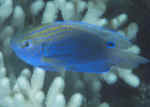
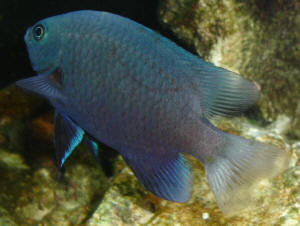
Chromis ID 4/20/14Hi Bob (or whoever I get! :D)! First I wanted to say thank you many times over for all of the times you've answered panicky questions about our poor fish (rabbit in a dire way). You and everyone else on WetWebMedia are, quite frankly, our heroes just in terms of helping us retain our sanity over the years. Today I actually just have a simple question. Our tank is doing well (yay!), our fish are all fat, happy, healthy, and getting along (with one exception and he is now living in the sump until he can be rehomed into our upcoming non-fowlr tank). We acquired two very pretty Chromis (identified as yellow Chromis) <Not this genus> and a sergeant major damsel. All three beautiful fish, all three aggressive enough to survive our tank (until the larger Chromis decided the smaller was easy pickings so the littlest guy is in the sump happily getting fat). The problem is, I don't think these guys are actually yellow Chromis. I can't find a picture anywhere online that actually looks like them. The darker color variant of the yellow does look similar but not really close enough, in my opinion. They are a purplish-brown with a deep yellow-orange anal fin and rear belly area. The caudal fin and dorsal fins are not yellow. They also have a dot of yellow at the base of their pectoral fins. Thing one (the larger) is probably about 3 1/2" and growing. Thing two is about an inch smaller but otherwise identical. I have only seen Chromis that looked like them one other time and that was in the Wild Reef at the Shedd Aquarium in Chicago. Unfortunately it was one of the only fish they didn't have listed and it was in one of the "big" tanks. I've included a video (he won't hold still for a not-blurry picture, the little booger). Thanks!! Carole :) <Try looking (and clicking on) the members of the family on Fishbase.org: http://www.fishbase.us/identification/specieslist.php?famcode=350&areacode= Bob Fenner> Re: Chromis ID 4/21/14 Thanks Bob. I have searched FishBase (it's one of my go-to sources when I'm trying to identify fish) and I'm not seeing anything that really looks like my guys. The closest is the *Chromis atripes (* http://www.fishbase.us/Photos/ThumbnailsSummary.php?ID=4982) and as mine don't have that distinctive dark edging on their fins I'm thinking that's not it either (though the yellow spots at the pectoral fins is kinda "fishy"). I think my next step will be to wander into the Shedd (I work a few miles north of the Shedd and am also a member so it's not a big "out of the way" trip) and see if I can't hunt down someone who can tell me. I love FishBase though I'm very sad I can't find what I'm looking for on there. It also just occurred to me that the video may not work on a regular computer (it doesn't on my work computer) so I'll see if I can't get Thing One to sit still long enough for a better picture. :) Thanks! Carole <Strange; but I didn't find a good match either... The genus Amblyglyphidodon is the closest I'm at currently. Please do send on any further ID. BobF> Re: Chromis ID 4/27/14 Hi Bob!! <Hey Carole> I'm sorry it took so long to get back with this. Today's the first day I had time to stop in at the Shedd. So, my little guys are in FishBase after all. The reason we had a hard time is because they are a different color morph than what appears in FishBase. They are Neoglyphidodon nigroris (sorry about the lack of italics - I haven't figured out if the iPhone can do them yet). When I look at them in FishBase I can see it. I just overlooked them previously because the colors didn't match. Being a different color morph makes sense. Here's a link to their page on FishBase. http://www.fishbase.us/summary/Neoglyphidodon-nigroris.html <Really? Am looking at your post on WWM: http://wetwebmedia.com/damselidfaqs.htm Mmm, Okay> Thanks for your help as always!! Carole <Thank you for this follow-up. BobF>
Question about Neoglyphidodon melas, beh. 8/24/06 Hello, <Hi there> Thank you so much for your WONDERFUL website. We have a 55 gal tank that we've had up and running for 17 years now. <Neat> Currently in the tank is a geriatric (in age, not attitude) percula, 2 domino damsels and a Neoglyphidodon melas (found out what it was thanks to your site - LFS said it was a green Chromis, NOT). We'd been down to just the perc for a while and decided to get some friends. We added the N. melas, then a week later the 2 dominoes. <This last species can be a bug-a-boo... mean> When we got the N. melas at the LFS, it had the juvenile coloring. In the car on the way home, he was darker, I figured just freaked out about being fished out of the tank and plopped in a bag, well, he never went back to white. Upon entering the tank, he ate well and is showing no signs of stress. In fact, he seems to have made himself top dog. <For a while... till the Dascyllus grow...> The perc seems to be tolerating him, they do the shimmy thing at each other, but no nipping and seem to have separate 'territories'. The dominoes came later and are smaller. <... for now> This is my question: Could the N. melas have gone thru puberty in minutes like that? <!?> I mean, he was white in the store, dusky in the car and dark blue/black by the time we hung the bag in the tank! Possible? Mimi K <Sort of... the colors expressed can/do change in terms of the fishs perceived status... Bob Fenner> Re: Question about Neoglyphidodon melas, beh. 8/25/06 Thanks so much. We're aware of the feistiness of the Dominoes. We've had them before and really wanted to get another after losing our Slider after 9 years. He was full of attitude but that really made him the star of the tank. <O...kay...> Surprisingly (or maybe not to you), he and the Perc got on quite well. <Happens> I'm hoping it'll be that way again. <Me too> The perc did ram a tomato clown till he went blind, so no more clowns for us. On the N. melas, we've had him for about a week now and he's stayed dark. So interesting. A first for us. We've had a tank for a long time, but tend to stick to the beginner fish. Twin toddler and an infant REALLY take time away from the hobbies... Thanks again. <I can only imagine. Cheers, BobF> Not so Black Damselfish Why is this damsel fish called a black damsel when nothing on this fish is black? <Tis the juvenile coloration of the Neoglyphidodon melas, someone should tell him he looks better as a juvi. See here http://www.wetwebmedia.com/neoglyphidodon.htm Like it is not hard enough to keep track of them already, now they are changing colors on us. Best Regards, Gage>
Neoglyphidodon melas Hello. I have seen this fish at LFS from time to time, and see how the color changes from juvenile to adult. I like both of the color patterns. That aside, how aggressive are these fish? Would one be suitable for a 55g reef that is peaceful/ moderately aggressive, with clowns, fairy wrasse, possibly gobies in the future, etc Thanks again. <Should be fine with all but the "gobies" listed if these are very passive, or the system too crowded. Please see WetWebMedia.com under the genus name. Bob Fenner> Damselfish I have a new 95 gal. marine tank with live rock, four snails, and one pink smith damselfish. My question, Can I put a different type of damsel with the species I current own e.g., bowtie (Neoglyphidodon melanopus), or azure? Reason being that I can't seem to find more pink damsels to add to my tank. Thanks, Jeff <Should get "along" okay in such a size, shape system... though if/when they meet, some modicum of tussling (yet no damage) should be expected. Bob Fenner> Color loss in Cross's Damsels Dear Bob, Several months
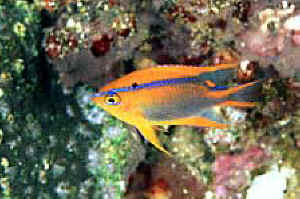
ago I came across about 11 or 12 Cross's Damsels (Neoglyphidodon
crossi) at the store. I don't know how familiar you are with
Cross's Damsels, but they are rather striking. So I bought them, 10
of them because I figured damsel aggression within a larger group would
be less of a problem. For the most part, I think that I was right with
that conclusion. My problem is that these fish were bright red when I
got them, having an electric blue stripe from tail to nose, and
brightly orange fins that stick down from their abdomens, and now they
have faded. The red has become a dull purple in comparison (similar to
coralline algae purple), and the rest has dulled as well. I have
considered other tank (fish) inhabitants, and I have actually removed
them. So I think that I can rule that one out. I have thought that it
was possibly age, but the age in these fish varies and even the largest
ones are duller than ones that I had seen in the store at the time,
which were as bright as the juveniles that I ended up buying. For the
most part only the alpha male displays any color, which as I have said
is dull in comparison. The others are just "dark". They live
in a soft coral reef, the water quality is very good, and alternate
Spirulina flake, live brine, frozen brine, and other frozen
"seafood buffet" cubes that we buy in the stores. The best
that I can come up with is that they are blending in with their
surroundings. The next thing I might try is moving a few of them into
another tank with bright red decor. I am puzzled, and I wonder if this
sounds at all familiar and if you might be able to share any thoughts
that you might have. Thank you, Brian Algren >> Well related. Do
know the species... have seen/collected juveniles and adults in
northeastern Sulawesi (Bunaken/Manado/Indonesia)... and what you
describe is typical... this species, in fact all members of the genus
Neoglyphidodon do about what you describe... as they grow, age, are
crowded (live solitarily in the wild)... Don't think this is
anything either-influenced... i.e. nutritional,
chemical-stress/environmental, disease as in infectious or parasitic...
and not reversible. Bob Fenner |
|

|
Features: |
|
| Featured Sponsors: |