Though they look sluggish, primitive, these are specialized animals,
well-adapted to their soft sediment based lives. Like icebergs you are
only seeing part of the story when observing them, for another part
other than the "above ground" rachis, the feeding mechanism,
exists below... the muscular peduncle, anchoring the colonial animal to
the sea bottom.
Sea Pansies:
| Renilla koellikeri in the Sea of Cortez;
L.A. Bay. |

|
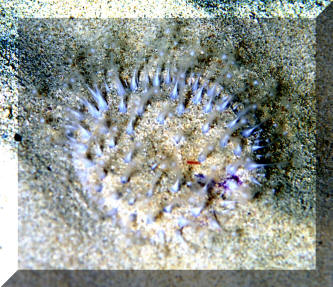
| Renilla reniformisi in Bonaire, night dive. |
|
Sea Pens:
The majority of sea pens are comprised of a
singular stalk, incorporating calcium carbonate sclerites for
structure, with varying polyps, branches that may be evidenced only
when these animals are actively feeding. Many are nocturnal.
Genus Cavernularia: Cylindrical, sausage shaped;
with large polyps around the entire rachis (upper end)
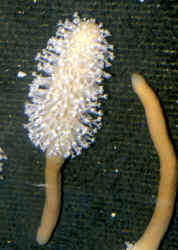
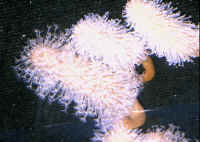
| Cavernularia cf. obesa Valenciennes
in Milne Edwards & Haime 1850. Sausage-shaped overall. Large
polyps extend all around rachis. India to Eastern Pacific. Possibly
14 species in this genus, some photosynthetic and open during the
day, others nocturnal. Aquarium pix at a marine livestock
wholesaler. |
|
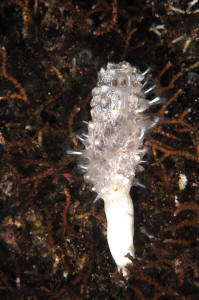
| Cavernularia sp. Sausage-shaped overall. Large
polyps extend radially around rachis. To 15 cm. W. Pacific. Bali 2014 |
%20vert%20MD.JPG)
|
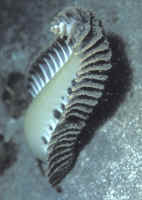
| Pteroides sp. A large (up to 60 cm. tall),
stiff species, with brush-like lateral branching. Often found with
the commensal crab Porcellanella
picta in association. Twenty five plus valid species. Europe;
Mediterranean, Indo-West Pacific; Africa to Japan. N. Sulawesi
pic. |
|
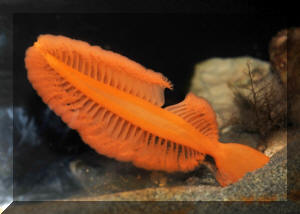
| Ptylosarcus gurneyi (J. E. Gray), the
Fleshy/Orange Sea Pen. Here at the Shaw Centre, Victoria, B.C.,
Canada 2010 |
|
Genus Virgularia:
| Virgularia sp. 1 A white and purple wide feather-like
species. To 8-60 cm. in height. Indo-West-Pacific; Bali 2014 |
%20MD.JPG)
|
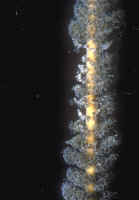
| Virgularia sp. 2 A tan feather-like species.
To about 25 cm. in height. West-Pacific; Philippines. N.
Sulawesi pic. |
|
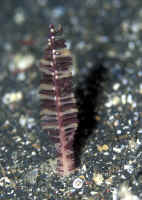
| Virgularia sp. 3 A red and tan feather-like
species. To about 10 cm. in height. Nocturnal. West-Pacific;
Philippines. N. Sulawesi pic. |
|