|
|
| Home | Marine Aquariums |
Freshwater Aquariums |
Planted Aquariums |
Brackish Systems |
Ponds,
lakes & fountains |
Turtles & Amphibians |
Aquatic Business |
Aquatic Science |
Ask the WWM Crew a Question |
| Please visit our Sponsors | ||||
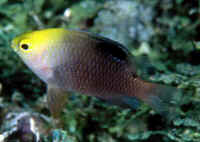
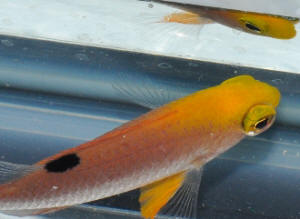
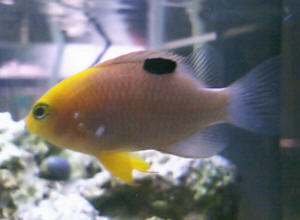
Re: More re: Chrysiptera talboti--corals for biotope? 1/16/08 Thank you very much, everyone. I actually did read the article on WWM beforehand, which is what inspired me to get C. talboti, since they were recommended so highly. The article said to allow at least 15 gallons per damsel, so I hoped 6 might be OK. I've provided lots of live rock for hiding places and they seem to be co-existing peacefully so far...I will keep an eye on them for any developing territorial conflicts. <Ah, good... Is a delightful little fish for sure!> Re the Sarcophyton elegans, the specimens I have were fragged from a wild-collected specimen about 6 or 8 months ago. <Ahh! Much better chance for survival than wild-collected> So far they seem to be doing well, at least as far as my inexpert eyes can see--polyps out and they've grown larger--but I will monitor them carefully. If I decide to go with a biotope I'll find them another home, since SPS and Alcyoniidae are probably not a safe mix. <If done... by mixing/introduction... blending water during acclimation/isolation over a period of weeks... starting with small specimens/colonies, widely spaced... the use of GAC, perhaps ozone... can be done> Thanks so much for the information on the C. talboti habitat. That's exactly what I was looking for. Cheers, and enjoy the long weekend! <Thank you. Bob Fenner> "> <<Mmm, I've (RMF) seen them this Chrysiptera sp. many times throughout its range... and wrote a survey article re its use that is posted on WWM... Does live solitarily... principally amongst arborose Pocilloporids and Acropora spp. mostly on shallow reef slopes... I don't think six of these are going to fit comfortably in a s 75 gallon system.>> > > Hi, folks. I've recently acquired six gorgeous little Talbot's damsels and have been looking for information on how to set up my 75G reef tank as a biotope for them. The only problem is, I can't find any specific information on the kind of habitat they're found in. The sources I've consulted say, at the most, that they are found among SPS and LPS corals and "coral-rich areas", but don't say *which* corals those are. > I'm hoping that one of you kind people here has seen C. talboti while diving--in Fiji especially--and can tell me what their habitat looks like. > I've checked Flickr, Photobucket, and YouTube, and done countless image searches, but all the images I can find are close-ups of the fish themselves, without revealing much about their surroundings. I have several nice frags of Sarcophyton elegans in the tank right now; would these be accurate, do you think (I know they're not stony corals)? Thanks for helping a slightly obsessive biotoper with her research! > K. Gabriel" Talbot damsel bully <Hi Nicole, Mich here.> We just purchased our two damsels to cycle our 20 gallon tank. We had our tank up and running for a couple weeks with live sand, had all the correct levels for the water quality, added live rock before the damsels, made lots of hiding places, then put the damsels in after letting them get used to the temperature. <It is not enough to just acclimate for temperature. Please read here: http://www.wetwebmedia.com/acclimat.htm> My boyfriend and I tried to pick the healthiest, liveliest damsels from the store...and it would appear that the one I picked is perhaps a bit too lively. She's taken to completely bullying the other fish- to the point where she's taken over basically the entire tank. Which probably isn't that hard considering it's only 20 gallons. <Yes, too small for two fish of this species. This species should only be kept together if a much larger system.> The staff at the store told me to turn off the lights, rearrange the rocks and destroy the existing territories, and I did that and it seemed to help a bit, temporarily. Now there are more hiding spaces and the smaller damsel has a "home" of it's own...but the bigger damsel (even though she has her own little spot that she likes) still sometimes rushes out and just chases the other damsel for no reason! <Yes as previous noted your tank is too small.> I'm quite concerned- we were told to get two damsels of the same type and I'm starting to think that maybe wasn't the best idea. <No.> Should we take the bully back? I hate to give up on her but I really don't want the other fish to suffer. <Should get rid of one.> What could we get as an alternative? <Many options, but you don't have room in your system for many fish so you should do a good deal of research before making your final choices.> The little damsel seems quite good natured but could just be completely terrorized. Also, my boyfriend is referring to the bully as "my fish" so naturally, this is my fault. I didn't realize how much this would make us into "parents"! <Ah! The joys!> Thanks so much, <Welcome! -Mich> Nicole
Valentini Puffer & Talbot's Damsel 9/27/05 Hi! <Hi There!> I have a Valentini Puffer. We've had him (or her) for about 2 weeks. He lives in a 90L (Sorry I'm from Australia!! I have no idea what it is in gallons... maybe near 30 - 40g??) The tank is @ 24 degrees Celsius (again no idea ... actually wait I converted it online and its 75.2F) The ammonia levels are a little high (but we're doing water changes every 3 - 4 days to correct it and it's lowering pretty well) We take the water for a weekly water check at the LFS and they told us the water is great. (Better than theirs), except the carbonate hardiness is too low, so we are using Coral Success to fix this up). <The ammonia should be zero, so a little high would not be considered great water quality. I would like to see daily water changes until the ammonia is 0.> He is kept with a Pajama Cardinal, Ocellaris Clown, Banded Damsel, Domino Damsel, Green Chromis and 2 Talbot Damsels. He's very peaceful and just seems to pick at the rocks very often, no worry to me, I don't mind him doing it. We feed him a multi-vitamin frozen food and sometimes frozen brine. He also gets fed live brine. <He needs a variety of meaty seafood as well as some greens.> I have read your Puffer dentistry article and could not see anything specific about Valentini Puffer teeth. I have printed out your General Puffer info but I haven't read it yet. (I will after writing this but its 17 pages long!!) I was wondering how am I supposed to know when his teeth get too big? <It would be preferable to prevent his teeth from over growing by feeding him some seafood in the shell so he can keep them in check himself.> I read your other responses about Puffers and couldn't see anything specific to the Canthigaster Valentini. <The information should be similar and applicable to your puffer.> Also I read that some people are concerned about the size of their puffers stomach. <Their bellies do have quite a capacity for expansion, which can be witnessed after a good meal.> My puffer has got a bit of a big tummy, but since we've had him he's only puffed up once and eats all day long. <Most of them do like to eat.> (The tank has only been set up with fish for about 4-6 weeks) How will I know if its a fat stomach or an air filled stomach? <If he has taken air into his stomach you may notice the pocket of air as a bulge and his orientation in the water will be off, in other words he most likely will be off balance and have difficulty remaining in his normal swimming position. The area containing the air will be directed towards the surface and he may possibly even be floating near the surface if there is a good amount of air trapped. This is often referred to as positive buoyancy.> Also he's very hard to catch and the tank has a lot of live rock and coral that all the fishes have hiding-holes and caves to jump in as soon as my hand goes in the tank. So I can't really grab him to touch his stomach, (like you've told others to do) how else would I know? And wouldn't it hurt him if I were to press on his stomach? <This is really not necessary unless you suspect that there is a problem. It is preferable to keep your hands out of the tank and off the fish. Every time you touch your fish you disturb their slime coat which serves a protective function for the skin.> My puffer is so beautiful and loves to make faces at the glass and run up and down to show off to me. <Yes they are very pretty and have quite endearing personalities. I find them irresistible to say the least. Puffers are one of my favorites.> Thanks for all the great info, I've learned a lot about him, just by reading some Q&A's on your site. <That's great keep up the reading. Educating yourself is one of the best things you can do for your fish!> Also I have 2 Talbot Damsels in the tank, they are pretty aggressive towards all the other fish (except the Pajama Cardinal and Valentini puffer, I think because they're bigger than the Talbot's) <Very possibly. I am not familiar with that particular Damsel species but the family as a whole is fairly aggressive. The PJ Cardinalfish should really be kept in a peaceful community tank. The Damsels and Puffer are really not appropriate tankmates. Please do keep a close eye on these fish for any signs of harassing the Cardinalfish.> If I took one of them out (if I can catch them) would this fix the problem? <No I don't think so.> My LFS said that if I keep my tank around 34C (75F) then it will stop them being so aggressive because it will keep their metabolism low, making them less hungry. Is this true? <In theory I guess it is a possibility but my best guess is that it would not work to your advantage. If it were my tank and fish I would not want to wait to find out. I would remove the aggressors as soon as possible. The fish that are being harassed are at risk for an injury and are definitely being stressed. Stress is a precursor to disease. Elevated ammonia levels are also stressful. Add the stress of being harassed to the increased ammonia levels and you have a recipe for sick fish. Please do consider removing the Talbot Damsels as well as doing more frequent water changes. > Thanks for your help. Sincerely, Sarah <You're most welcome! Best of luck with your fish. HTH, Leslie> Aggression and Compatibility 9/24/05 <Adam J with you.> Two quick questions. <Ok go for it.> We've got a 120 Gal FOWLR with a purple tang, dwarf zebra lion, H. ornatissimus wrasse, Forcipiger BF, and three or four small asst. damsels. Water parameters are great. The issue is between the purple tang and the BF. They got along great when they were introduced. About a week or two later, the tang started following around the BF and occasionally nipping. <The purple tang and others in the Zebrasoma genus can be quite territorial.> This calmed down quite a bit in a day or two. That was a few weeks ago. All of a sudden, I noticed this morning that most of the BF's beautiful tail was shredded! Must have been the tang -- it was also suddenly chasing around the damsels, too (never seen that before). Could it just be hungry? It attacked the Nori I put in, and seemed to calm down a bit. Any suggestions? We love that tang. <There are many methods suggested to quell fighting amongst tank mates, and you can find those here on the FAQ's at WWM, my favorite one is rearranging rockwork and thus creating a new territory. However these methods are still not guaranteed and it may be necessary to remove the victim or aggressor permanently.> Also, I was wondering if Talbot's damsel was "calm" enough to keep with two clown gobies (yellow and green) in an 11 gal nano reef (15 lbs of live rock, lots of hiding places). I had a C. hemicyanea in They're previously, and had to remove it because it made the gobies "nervous". Sounds like Talbot's is a more placid fish. <They are much more social than most of their Damsel cousins, however they too can be quite territorial at times. To increase your chances of pulling this off I would add the gobies first (if you don't already have them) allow them get established before adding the damsel.> Thanks, Dan <Anytime, Adam J.> Re: Chrysiptera talboti Hi guys I just saw your article and think its very informative. But just as with any fish, sometimes you can get one that is a little bugger. <Agreed> I use to have a Talbot's that I have since gotten rid of. He would pester other fish such as clownfish in my tank and dig non-stop. While I am sure not all Talbot's are like that I would just like to let everyone be aware of that caveat. In general great fish though. |
|

|
Features: |
|
| Featured Sponsors: |