|
Related FAQs: Surgeons In General, Selection, Compatibility, Systems, Feeding, Disease,
Related Articles: Surgeonfishes, Acanthurus, Ctenochaetus, Naso,
Zebrasoma,
Marine Aquarium Use of the
Cooks' Surgeons, Tangs and Doctorfishes
|
|
| Bob Fenner |
Manini
|
Surgeonfishes: Tangs for Marine Aquariums
Diversity, Selection & Care
New eBook on Amazon: Available here
New Print Book on Create Space: Available
here
by Robert (Bob) Fenner |
 |
Acanthuridae, Surgeons, Doctorfishes, Tangs. There are
twenty-seven species of acanthurids that occur in the Cooks, including
some of the most popular "good" and "bad" ones. Of
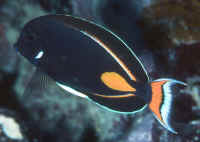
the sixteen Acanthurus the Achilles (Acanthurus
achilles) can be found in shallow waters (waist high and less)
around most islands. It's a little hardier here than from Hawaii
where it is typically collected but still an undesirable aquarium
species… too easily damaged (soft-bodied) and prone to
"bring in" disease.
| Acanthurus. achilles Shaw
1803, Achilles tang. Widely distributed from Hawaii westward
through Micronesia and Melanesia, an area called Oceania. Though
the best specimens do hail from U.S.'s 50th State success with
this species can only be had by securing a healthy specimen,
providing a large well-established living space, with high,
consistent specific gravity and oxygen
concentration. |
|
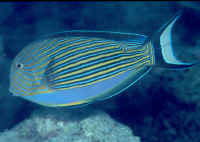
Variously known as the Lined, Oriental or Pajama Surgeon,
Acanthurus lineatus will be caught elsewhere where it is more
plentiful and cheaper to collect.
|
Acanthurus lineatus
(Linnaeus 1758), the Clown, Pajama, or Oriental Surgeon is a bad
fish for something in addition to lack of feeding and high
mortality; its territoriality. This fish can become an unholy
terror towards its tankmates, getting progressively worse with
growth.
|
|
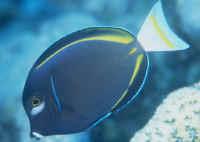
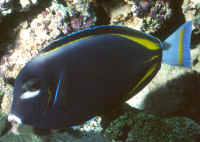
The Powder Brown (Cat Tang in Hawaii), Acanthurus nigricans,
is also found here, though in limited numbers and is likewise easily
lost. (Image)
| Acanthurus
(glaucopareius) nigricans (Linnaeus 1958), the Powder
Brown or Gold-Rimmed Surgeon. The corrected scientific name of this
species is A. nigricans (per Randall, 1988); a revision no
doubt as unpopular to some as my labeling the species as
"bad". The very similar A. japonicus is a far
better aquarium fish; A. nigricans rarely lives for more
than a few months in captivity. A juvenile in the Cooks and adult
in captivity shown. |
|
Of species that could be used but aren't much from anywhere,
Acanthurus dussumieri, the Eyestripe Surgeonfish, Acanthurus
pyroferus, the Chocolate Surgeonfish and all its mimics,
Thompson's (here with a white caudal/tail fin), Acanthurus
thompsoni, and Convict or Manini, (Acanthurus triostegus)
ought to enjoy more popularity in the aquarium interest. There are
several other species in the genus found here that are either too large
for any but public aquarium use or unattractive color/pattern wise.
|
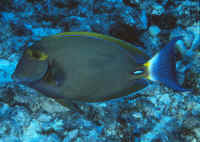
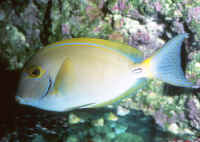
Acanthurus dussumieri
Valenciennes 1835, the Eyestripe or Dussumier's Surgeonfish.
This is a highly variably colored fish. Some are drab gray,
whereas some I've seen from Hawai'i sported brilliant
yellow around their body margin with beautiful royal purple
highlights. This surgeon is more like the genus Ctenochaetus in
its feeding habits, sifting sand and detritus in addition to
algae scraping. Specimens off Maui and in an a hobbyist tank. To
eighteen inches long in the wild.
|
|
|
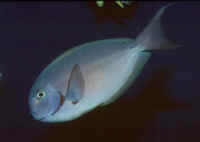
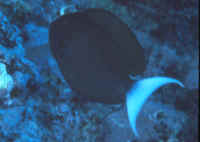
Acanthurus thompsoni (Fowler 1923), the
White-Tailed Surgeonfish, a good name for this species except for
its populations in Hawaii which bear no white on their tail
areas. Another name for this planktivore is Thompson's
Surgeonfish. Though not a striking beauty, this Whitetail tang is
a good feeder and stays moderate small (to ten inches). Rarely
imported into the trade. A Hawaiian specimen and one from the
Cooks pictured.
|
|
|
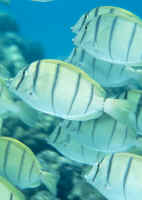
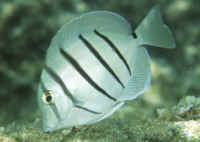
Acanthurus triostegus (Linnaeus 1758),
(manini) Convict Tang or Manini (Hawaiian). One of the best
Acanthurus for use in reef tanks for its size, easy going
temperament and habit of consuming fine, filamentous algae.
Reserved for native Hawaiian use in Hawai'i, but available
from elsewhere. Juvenile in Hawai'i and a marauding school on
the prowl in the Cooks.
|
|
The Bristle-Mouth Tangs, genus Ctenochaetus are excellent
from everywhere they are found. Three species are found here, all
favorites of marine aquarists who utilize them for diatom and
filamentous algae control. The higher priced, beautiful Chevron,
Ctenochaetus hawaiiensis is found here, as are the more
inexpensive Kole or Yellow Eye, Ctenochaetus strigosus and
Striped, Ctenochaetus striatus.
|
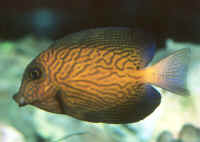
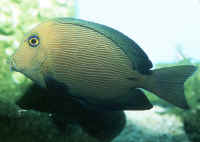
Ctenochaetus hawaiiensis
(Chevron Tang); All Ctenochaetus species change color with
age but the chevron is most striking. Ctenochaetus
hawaiiensis young are unforgettable; bold orange bodied
covered with variegated lines of electric blue. Adults shift to a
deeper orange red base covered with darkish blue uneven
horizontal lines, ultimately to almost black. Juvenile and adult
specimens at right, in aquariums.
|
|
 |
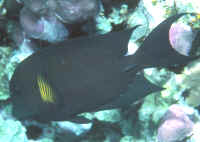
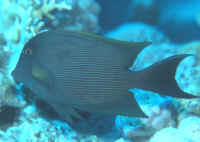
| Ctenochaetus striatus (Quoy
& Gaimard 1828) the Striped Bristletooth, is the one member of
the genus found extending into the Red Sea (but also found in the
Indo-Pacific to Oceania and the I.O.); it is the most frequently
imported species in Europe. It's body color is overall drab
olive sporting wavy blue lines. Small orange dots are sprinkled on
the head. Here are specimens in Fiji and the Red Sea. |
|
 |
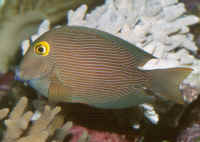
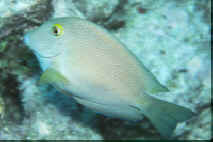
| Ctenochaetus
strigosus Bennett 1828, the Yellow-eyed
or Kole Tang; since this and the Chevron Tangs range encompass the
principal islands of Hawaii they are the principal species utilized
in the West (though the Kole is found from all the way over in the
Indian Ocean). The kole ("coal-ay") is more shallow
water, surface to sixty feet or so, and the chevron is generally
collected in fifty feet plus. |
|
 |
The five Naso Tang species include the usual mix of ones that
get way too big and/or are way too ugly to attract aquarist eyes and
dollars. Every now and then the Spotted (aka the Shortnose at
times/places in the trade) Naso brevirostris will be imported
(from elsewhere), as well as the Bluespine (Naso unicornis) Unicornfish
and Vlamingi or Bignose Unicornfish, Naso vlamingii, those these
get quite large in the wild. THE Naso to many, Naso lituratus is
found here, though not as commonly and in good numbers as the Aloha
State.
|
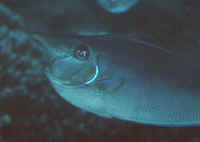
Naso brevirostris (Valenciennes
1835), sometimes called the Shortnose Unicorn Tang, is
mis-named both scientifically and colloquially; it has a long
nose as an adult. There are Naso species with much
shorter, even absent the "horn" on the head. This
grayish-green bodied fish is occasionally imported from Hawaii
and the Indo-Pacific.
|
|
|
|
|
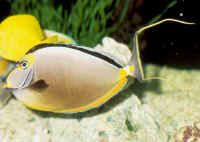
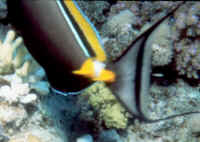
Naso lituratus (Forster 1801) the naso tang to most aquarists; it is also known as
the tricolor or lipstick tang. There are some who claim that
"blonde" and "streamer" versions are
different species; they're all Naso lituratus. To
eighteen inches in the wild.
|
|
A Naso in an aquarium
|
The business end of a Naso in Hawai'i
|
|
|
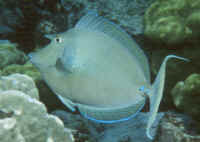
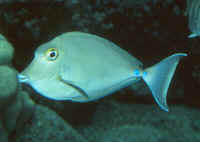
Naso unicornis (Forsskal 1775), the
Bluespine, Large or Bignose Unicornfish, is a deep-bodied species
that develops a prominent rostral horn starting at about five
inches length. The body is light olive to gray with yellowish
highlights on the abdomen; to more than two feet. Adult and
juvenile shown.
|
|
|
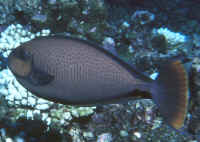
Naso vlamingi (Valenciennes 1835),
Vlaming's unicornfish has naught but a convex nose bump for a
horn. Adult males are especially beautiful with bright blue and
white highlights over a dark blue body.
|
|
Surgeonfishes: Tangs for Marine Aquariums
Diversity, Selection & Care
New eBook on Amazon: Available here
New Print Book on Create Space: Available
here
by Robert (Bob) Fenner |
|

