Scorpionfishes: Lionfishes & Much More for Marine
Aquariums
Diversity, Selection & Care
New eBook on Amazon: Available
here
New Print Book on Create Space: Available
here
by Robert (Bob) Fenner |
 |
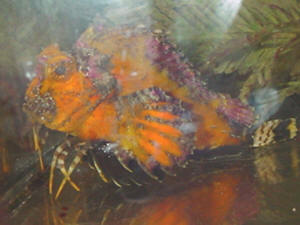
| Unusual fish id help requested. Bob, (Joe Anderson here
of OKC)... <Howdy> was in a shop yesterday and the owner had
got in the (attached fish) and was curious if I could help her ID
it... the closest thing I found was a sort of "rock" fish
(most likely poisonous) w/ common name devil fish... but it was
labeled "sea robin" and of course it is not.. <Is a
sea robin species... a Triglid for sure. Please see here: http://www.fishbase.org/Summary/FamilySummary.cfm?ID=266>
I tried to keep pic as close to real colors as possible only
adjusting lighting on image so that it wasn't too dark... She
does not want to sell it if it is something endangered or
particularly delicate and wont let it go at all to just anyone..
(that not being me.. <Not dangerous or endangered and relatively
hardy> beautiful fish but I'd end up killing it and that
would be a complete shame).. She said it came in a shipment from
Sri Lanka just before the tsunami The closest image I
could find at WWW is Scorpaenopsis venosa. If you can ID this one
what would u think she should retail it for (if at all) and any
ideas on care?? <Not a family commonly kept... a hundred teen
species...> Thanks so much for your help - and everyone else
there at WWW (here and of course on the site!) Joe Anderson <Bob
Fenner> Longest Running Aquarium Club in Oklahoma - Since 1949!
Oklahoma City Aquarium Association http://petsforum.com/okcaa/
http://groups.yahoo.com/group/OK-AquariumAssociation/ |
|
|
Sea Robins (actually Gurnards) I hope you don't think
I'm picking on you by sending emails when I see mistakes! It's
just that next year I'm moving and am going to get a 250 gallon
tank, so I am constantly surfing to see what my options are, fishwise.
The more planning the better, including with regards to order of
specimen introduction. That said, I humbly point out that the photo you
have in the new Sea Robin section is of the fairly closely related
_Flying_ Gurnard, Dactylopterus volitans (often confused with D.
orientalis in the trade). The regular gurnards and flying are both
hardy, but unfortunately the well-named flying gurnards like to go
carpet surfing. (One specimen got all the way from the living room to
the kitchen one time, found it only after spending an hour looking for
the body). (http://www.wetwebmedia.com/searobins.htm) Regards, Michael
Krechmer <Mmm, so, what is your correction, addition? That
dactylopterids are escape artists? Or the id? Will check on the morrow.
Bob Fenner>
Sea Robins Hey Robert, Love your site. I spend most of my
time reading everything you have to offer about anything marine
related. <Yikes... most of your time? It takes me hours a day to
produce it...> I have a question regarding Sea Robins that I'm
hoping you can answer. I cannot find very much information about this
specific fish ANYWHERE. <Try fishbase.org on the Net for scientific
info. on the family, species comprising the Triglidae.> Do you know
why this is? <What I call the founder (flounder?) effect... not a
commonly used group of fishes/livestock, therefore not requested of
collector/divers, therefore not sold on the market, therefore not a
commonly used group of fishes/livestock...> From what I can tell it
is a pretty common fish in the ocean, but apparently not so in the
hobby. <Mmm, not common in the wild (as far as I know, have
heard, seen), and almost absent from the trade> My LFS has a very
nice (4 inch) Sea Robin that has very bright light blue edges around
the 'wings'. I am not sure on the exact species, and even if I
was I'm still sure I couldn't find good information about it. I
am very impressed with this fish, and would love to bring it home.
Normally I will read 500 things about any fish I am considering, and
then decide. In this case, I cannot find enough information about this
fish to make an informed decision. Can you please tell me the basic
info regarding this fish? (Size, Compatibility, History, why it's
not popular, eating habits) I have a very aggressive tank, puffers,
triggers, wrasse. It's a 100G tank, the only thing I've
gathered is these Sea Robins may get large. <Mmm, looking over my
otherwise enormous Scorpaeniform (the order that includes Sea Robins)
files, I find just one pet-fish piece: by Aaron Norman (yes, same great
aquarium photographer), run in Marine Aquarist Magazine in 1976
(7:3)... reading through this and my scant knowledge of when our stores
carried such exotics, and chatting with public aquarium workers (these
are current darlings)... I can say little with confidence. Look for
initially undamaged/healthy specimens that are feeding... make sure the
ones you're considering don't get too big (check on FishBase
here at species level, likely the genus Prionotus)... and make sure the
fish/s/es are getting enough to eat. Sea Robins, aka Gurnards, Tubfish
are good feeders, but you have a tankful of competitors. Bob Fenner>
Thanks for your time.
Travis Brodeen
Scorpionfishes: Lionfishes & Much More for Marine
Aquariums
Diversity, Selection & Care
New eBook on Amazon: Available
here
New Print Book on Create Space: Available
here
by Robert (Bob) Fenner |
|

