|
|
| Home | Marine Aquariums |
Freshwater Aquariums |
Planted Aquariums |
Brackish Systems |
Ponds,
lakes & fountains |
Turtles & Amphibians |
Aquatic Business |
Aquatic Science |
Ask the WWM Crew a Question |
| Please visit our Sponsors | ||||
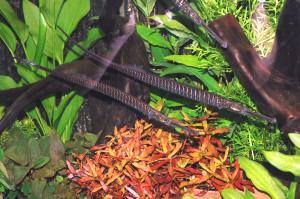
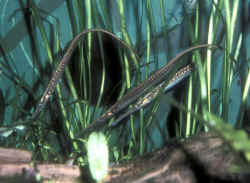
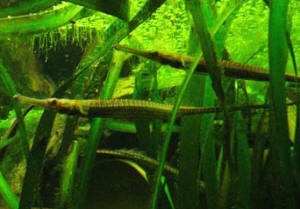
Of course these semi-seawater to freshwater "Pipes" are part of the same family as the Seahorses, Pipefishes found in tropical and subtropical oceans (Syngnathidae), and subfamily Syngnathinae. Often lost due to a lack of understanding, practice in providing them with small, appropriate live foods on a frequent basis, as much as too little cover for them to hide, feel comfortable in and too-rambunctious a mix of tankmates, some public aquariums and commercial concerns have "closed the loop" with these species, raising their young and in turn spawning, rearing progeny in turn from this generation. Species of Use to Aquarists:
Selection
Environment Habitat: Not too vigorous or linear water movement, darkened/not over-illuminated, with similar "grass like" (Zostera, Phyllospadix spp. for example) live or faux plant cover. Foods/Feeding/Nutrition: At least three times daily (continuous is ideal as with a sump, automated feeding device) with live foods of small-enough size (some authors have utilized freshly hatched out Brine Shrimp supplemented or not) to fit the adult fishes mouths. Juveniles need much smaller food items. |
|

|
Features: |
|
| Featured Sponsors: |