|
Related
FAQs: Seahorses & their
Relatives, Seahorses & their Relatives 2, Seahorse Identification, Seahorse Behavior, Seahorse Compatibility, Seahorse Selection, Seahorse Systems, Seahorse Systems 2, Seahorse Feeding, Seahorse Disease, Seahorse Disease 2, Seahorse Reproduction,
Related Articles: Seahorse Care Guide, Color
in Hippocampus, Part I, by Pete
Giwojna and Ben GiwojnaFresh
to Brackish Water Pipefishes, Solenostomidae (Ghost
Pipefishes),
/The Conscientious Aquarist
Of Leafy Dragons, Pipefishes,
Seahorses; Family Syngnathidae, pt. 1
Part 2
|

|
|
By Bob Fenner
|
Phallopteryx taeniolatus
|
|

|

|
|
Atlantic Trumpetfish, Aulostomus
maculatus
|
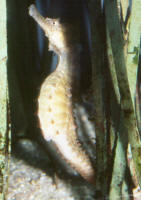
Longsnout Seahorse, Hippocampus
reidi
|
"Bizarre, non-fish-like, is that a living
thing?" These are some of the more common statements folks make
when encountering the tube-mouthed fishes, family Syngnathidae
("sin-nath-id-ee") for the first time. And they are indeed
strange. Relying on cryptic coloring and body shapes, hiding in
obscurity, propelled along with their undulating dorsal fins, they are
the original "equal-sex" reproducers. Males celebratedly
carry and "give birth" to young providing storage and
protection for their developing progeny.
As captive specimens, Pipefishes, seahorses and Leafy
Dragons have proven less than sterling in their longevity. The vast
majority die within days of wild-collecting from poor handling,
starvation, physical trauma and disease. Hence this warning; only
undertake the care of these fishes knowingly, understanding their
demanding requirements and low survivability.
The three requisite criteria for the successful
maintenance of these fishes: selecting healthy stock, provision of
adequate foodstuffs, in a stable, suitable environment. All to be
revealed and detailed below.
Classification: Taxonomy, Relation With Other
Groups
The Pipefishes and Seahorses, including the strange Sea
or Leafy Dragons comprise the Family Syngnathidae, the aptly named
tube-mouthed fishes.
|
According to Nelson (1994) the syngnathids form a
larger group, the Superfamily Syngnathoidea with the another
family sometimes labeled as seahorses as well as Ghost
Pipefishes, the otherworldly family Solenostomidae (whose five species have
the females brooding their young in pouches).
Solenostomus paradoxus, the Harlequin
Ghost Pipefish in Manado, Sulawesi, Indonesia.
|

|
A notch higher in taxonomic schemes we find more
fish families that are easily identifiable as tube-mouths; the Seamoths
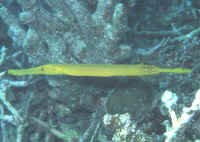
(Pegasidae), Trumpetfishes (Aulostomidae), Cornetfishes (Fistularidae),
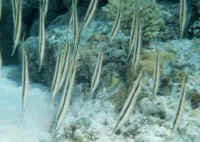
and virtual knife-like headstanders, the Shrimpfishes (Centriscidae).
Unfortunately for aquarists, these related groups fare as poorly in
captivity as the Pipefishes and Seahorses.
|

|

|

|
|
Aulostomus chinensis, Trumpetfish
|
Fistularia commersoni, Cornetfish
|
Aeoliscus strigatus, Shrimpfish
|
Some splitting-type classifiers break the family
Syngnathidae itself into two or more sub-units; for Nelson, the
subfamilies Syngnathinae (Pipefishes) and Hippocampinae (Seahorses and
Seadragons, see below). Whichever way you splice them they are
unmistakable; elongate bodies encased in hard bony ring series, small
gill openings, a lack of pelvic fins and caudals, anals, dorsals and/or
pectorals in some. The seahorses utilize their modified lower-body
"tails" for "hitching up" as it were; and some
pipes are so modified the virtually crawl along the bottom rather than
swim.
Syngnathids are celebratedly "libbers" with the
males rearing their eggs in a ventral brood area or pouch.
This diverse assemblage of two subfamilies includes 52
genera and about 215 described species.
Distribution
Most syngnathids are marines, but there are a few
brackish (about 35 species) and even freshwater forms (maybe 17
species). The majority are found in shallow seas of the Atlantic,
Indian and Pacific Oceans.
Species of Use/Availability to
Aquarists:
At times, erratic and seasonal, a few species of pipes,
horses and dragons make their way in to the marine livestock offerings.
Although all are about the same non-hardiness, we will list the most
commonly offered.
Seahorses
Proper:
Hippocampus (meaning "horse caterpillar"),
comprising the 35 species of seahorses, are collected for the aquarium
trade principally out of the Indo-Pacific, mainly Indonesia and the
Philippines; and to a lesser extent, the Caribbean.
Western Atlantics include H. reidi, the
slender seahorse, H. erectus (frequently mislabeled as H.
hudsonius and . punctulatus), the northern seahorse, and the
dwarf H. zosterae of the shameful mail order trade of the
past.
| Hippocampus erectus Perry, 1810, the Lined
Seahorse. To 19 cm. in height. Numerous lines on head, possibly
down nape, body. Western Atlantic: Nova Scotia to Panama. Found in
Zostera beds and on gorgonians, even floating Sargassum. SIO
Aquarium and Jamaica photos. |

|
Bigger PIX:
The images in this table are linked to large (desktop size) copies.
Click on "framed" images to go to the larger size. |
|
%20MD.jpg)
|
| Hippocampus zosterae Jordan & Gilbert,
1882, the Dwarf Seahorse. To 5 cm. in height. Very short snouts.
Western Atlantic: Bermuda, southern Florida (USA), Bahamas and the
entire Gulf of Mexico. Found in Zostera beds near shore. THE dwarf
seahorse of past comic book fame... only lives a year. Aquarium
images. |
 
|
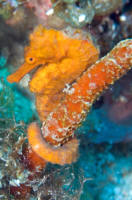
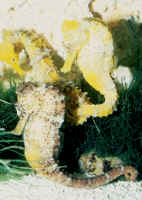
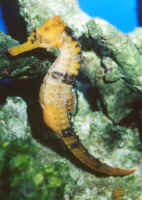
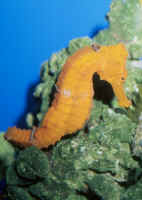
Indo-Pacific Horses: The Yellow Seahorse, H.
kuda is regularly offered in the trade out of the Indo-Pacific
(rarely from Hawaii), especially the Philippines. Less seen are the
tougher, mainly Japanese seahorses, H. japonicus and H.
coronatus. If you can find them, a still hardier species out of Sri
Lanka is the dark H. fuscus.
|
Hippocampus abdominalis Lesson 1827, the Big-Belly
Seahorse. Southwest Pacific; Australia and New Zealand. To a foot
in length. Now cultured in good numbers by OMLAS Pty Ltd
(Seahorse Australia) in Tasmania for the aquarium trade. www.seahorseaquaculture.com.au
Aquarium pix.
|
 
|
| Hippocampus barbouri Jordan &
Richardson, 1908, Barbour's Seahorse. Western Central Pacific:
southern Sulu Sea of the Philippines and Malaysia. To nearly six
inches tall. White, brown, yellow w/ reddish dots. Radiating lines
on snout. Popular spiny seahorse in aquarium trade and
"Chinese medicine". Aquarium pic. |

|
| Hippocampus capensis Boulenger 1900, the
Knysna Seahorse. Southeast Atlantic; South Africa endemic. To three
inches in height typically. Here is a juvenile of about an inch, in
captivity at the Birch Aquarium, San Diego, CA. USA. |

|
| Bigger PIX: The images in this table are linked
to large (desktop size) copies. Click on "framed" images
to go to the larger size. |

%20MD.jpg) |
Bigger PIX:
The images in this table are linked to large (desktop size) copies.
Click on "framed" images to go to the larger size. |
|
%20MD.JPG)
|
| Hippocampus kuda Bleeker 1852, the Common or
Spotted Seahorse. Indo-Pacific; Pakistan, India, to Hawai'i,
Society Islands. To a foot in length (stretched out). Found in calm
waters amongst algae, seagrass. N. Sulawesi images at right,
captive ones below. |

|
| Hippocampus moluccensis, considered
by Fishbase.org as a nomen nudum for H. kuda. To 6.5 inches.
Variable in color, browns, black to warm pastels. Knobby crown on
head, sometimes with filaments. Solitary on open sand settings N.
Sulawesi image. |
%20MD.JPG)
|
In Europe this assemblage is augmented by the
common H. hippocampus, the regal Mediterranean seahorse, H.
ramulosus and the short-snouted Hippocampus
brevirostris.
| Hippocampus guttulatus Cuvier 1829, the
Long-Snouted Seahorse. Eastern Atlantic; British Isles to Morocco,
Canary Islands. To six inches in length/height. SIO Aquarium
photo. |

|
Sea Dragons:
Leafy Seadragons are infrequently offered from their
restricted ranges around Australia (where they are protected by law);
they have a notoriously poor record of survivability in shipping and
short lives if at all in aquariums. If you must try them, the two
species least prone to die in my opinion are the Leafy Seadragon,
Phycodurus eques and the common Seadragon, Phyllopteryx
taeniolatus. These should be collected and attempted only as
subadults, about half maximum size.
|
Phycodurus eques (Gunther 1865), the Leafy
Seadragon. Southeastern Indian Ocean; South and Southwestern
Australia. To fourteen inches in length.
|
 
|
| Bigger PIX: The images in this table are
linked to large (desktop size) copies. Click on "framed"
images to go to the larger size. |
 |
|
Phallopteryx taeniolatus (Lacepede 1804),
the Common Seadragon. Indo-West Pacific; southwestern
Australia. To eighteen inches in length.
|

|
| Bigger PIX: The images in this table are
linked to large (desktop size) copies. Click on "framed"
images to go to the larger size. |
%20MD.jpg) |