|
FAQs About Dojos, Weatherfishes 1
Related Articles: Dojo Use
in Ornamental Ponds, Loaches,
A New Look At
Loaches By Neale Monks,
Related FAQs: Dojos/Weatherfishes 2, & FAQs on: Dojos/Weatherfishes Identification, Dojos/Weatherfishes Behavior, Dojos/Weatherfishes Compatibility, Dojos/Weatherfishes Stocking/Selection,
Dojos/Weatherfishes Systems, Dojos/Weatherfishes Feeding, Dojos/Weatherfishes Health, Dojos/Weatherfishes Reproduction, &
Loaches 1, Clownloaches, & Loach Identification, Loach Behavior, Loach Compatibility, Loach Selection, Loach Systems, Loach Feeding, Loach Disease, Loach Reproduction,
|
|
Dojo/Weather loach, is he dying?
9/2/2009
Hello again if it's Neale and simply hello if it isn't
<BobF this time>
I have a question about my Weather Loach. I bought a tank with one
Golden Dojo in it, reading that they prefer to be in groups I got it a
friend, the golden one however would have nothing to do with it even
though the regular loach (half the golden's size) was constantly
trying to play (perhaps harass) with the golden. Feeling bad for the
second loach I then got it a friend (loach 3). Well loach 3 became
inseparable to the golden one now leaving out loach 2. They would
ignore him and any time he came to hang out with them they would avoid
him and the golden even charged him a few times.
Well I got another one and now have two groups of two, they have paired
up and ignore each other. This has all taken place in the last 4
weeks.
<Give these Misgurnis time... likely will "pal around" in
a few weeks more>
However for the last week the golden loach is almost completely
sedentary, it just lays still, even it's gills don't move
often. I can see no damage to the loach all fins appear normal (his
pectoral fins have always been quite thin and close together more foot
like than fin like (always been that way). His "whiskers" are
kind of droopy but intact (new). There is no swelling apparent and I
have searched him repeatedly for ich and see no signs of it. The other
fish will move the golden around. Both the loaches, the Pleco (though
it is much smaller) even the platies root around under the golden
loach. he doesn't try to get away if my hand is near him and
doesn't try to avoid the net or any other object. He occasionally
roots for food but not often and it is often stolen from him. I keep
thinking he is dead just laying there showing no response to any
stimulus and then he will finally move out of the other fishes way. The
ph 7.2 ammonia is 0 nitrite 0 don't know the nitrate but it is a
moderately planted tank and I do weekly water changes of 30%, and
gravel vacuuming (the pet store said I should only do it biweekly due
to all my plants, is that right?).
<Should be fine>
I think the tank is under stocked as is. Can you think what might help
this guy I can see NO strange physical alteration or problem but he is
completely listless. I was planning my whole tank around this guy and I
am
very worried about him . Any help you guys/gals could provide would be
greatly appreciated.
Safe Journeys and a pleasant evening/morning to you.
KJ
<Well, Dojos/Weatherfish can be very sedentary by nature, and this
system/livestock are all still quite new. I would not be concerned at
this point. Bob Fenner>
Dojo/Weather loach, is he dying?
9/2/2009
Hello again if it's Neale and simply hello if
it isn't
<It is indeed me, Neale.>
I have a question about my Weather Loach. I bought a tank with one
Golden Dojo in it, reading that they prefer to be in groups I got it a
friend, the golden one however would have nothing to do with it even
though the regular loach (half the golden's size) was constantly
trying to play (perhaps harass) with the golden.
<All loaches are more or less boisterous, with the exception perhaps
of things like Kuhli Loaches. So while Weather Loaches are definitely
best kept in groups, this doesn't mean they won't bicker! The
point is that
they're more outgoing, less likely to hide, and generally healthier
if given company of their own kind. With most loaches, groups of 5+
work best, and in smaller groups, results can be a little
unpredictable.>
Feeling bad for the second loach I then got it a friend (loach 3). Well
loach 3 became inseparable to the golden one now leaving out loach 2.
They would ignore him and any time he came to hang out with them they
would avoid him and the golden even charged him a few times. Well I got
another one and now have two groups of two, they have paired up and
ignore each other.
<Well, you've done what you can. Unless the tank is big enough
adding a fifth specimen is viable, I wouldn't worry too
much.>
This has all taken place in the last 4 weeks. However for the last week
the golden loach is almost completely sedentary, it just lays still,
even it's gills don't move often. I can see no damage to the
loach all fins appear normal (his pectoral fins have always been quite
thin and close together more foot like than fin like (always been that
way).
<Doesn't sound promising.>
His "whiskers" are kind of droopy but intact (new).
<Loaches whiskers *should* be intact; if your loaches have short
whiskers, it doesn't mean they're growing and falling off
naturally, it means the gravel is too sharp or the substrate so dirty
bacterial infections are
occurring!>
There is no swelling apparent and I have searched him repeatedly for
ich and see no signs of it.
<Good.>
The other fish will move the golden around. Both the loaches, the Pleco
(though it is much smaller) even the platies root around under the
golden loach. he doesn't try to get away if my hand is near him and
doesn't try to avoid the net or any other object.
<Very odd. Do you have a quarantine tank? If you do, even a 10
gallon would be fine, try putting this fish on its own in cool (around
15-20 degrees C water) with lots of oxygen and a suitable cave (such as
flower pot).>
He occasionally roots for food but not often and it is often stolen
from him. I keep thinking he is dead just laying there showing no
response to any stimulus and then he will finally move out of the other
fishes way.
<I'd net the fish out, if you can, and have a look at the fish
more closely. Does he seem emaciated? Are there any signs of redness or
dead skin on his belly? Are the fins whole or do they show signs of
raggedness?>
The ph 7.2 ammonia is 0 nitrite 0 don't know the nitrate but it is
a moderately planted tank and I do weekly water changes of 30%, and
gravel vacuuming (the pet store said I should only do it biweekly due
to all my
plants, is that right?).
<You can clean the substrate as often as you want by siphoning up
the detritus as you do water changes. A little agitation of the
substrate won't do any harm either. But yes, it is indeed the case
the constantly churning
the substrate will make your plants unhappy. Essentially, clean the
gravel however you want, just leave their roots alone! In practise, in
a tank with healthy, fast-growing plants, the substrate shouldn't
need any cleaning
beyond weekly siphoning up any detritus from the surface.>
I think the tank is under stocked as is. Can you think what might help
this guy I can see NO strange physical alteration or problem but he is
completely listless. I was planning my whole tank around this guy and I
am
very worried about him . Any help you guys/gals could provide would be
greatly appreciated.
<Not entirely clear to me, either.>
Safe Journeys and a pleasant evening/morning to you, KJ
<Feels like morning, actually mid afternoon: I'm jet lagged!
Cheers, Neale.>
Re: Dojo/Weather loach, is he dying?
9/5/09
Hello crew
temp 22C, ammonia 0, nitrite 0 no nitrate test ph 7.2
Thank-you Neale for your earlier response.
<RMF here>
Hello to whoever this reaches. I have quarantined my loach for the last
two days. This morning on inspection I noticed that he appears to have
pooling blood at the base of his tail before his fins and on the plate
of his gills. This seems to match the descriptions of a bacterial
infection and I am planning of treating it as such
<... please read here:
http://wetwebmedia.com/ca/volume_6/volume_6_2/mycobactera.htm
and the linked FW infectious disease files at bottom. I would be very
careful re administering an antimicrobial/antibiotic. Most such issues
resolve themselves without>
*crossing my fingers*, though I have looked him ALL over and there
appears to be NO tearing of the skin anywhere to have precipitated it.
My question is should I be doing daily %50 water changes to my main
tank to avoid the other residents of my 90G tank from contracting
whatever it is that has effected my weather loach?
<I would not change this much water, this frequently, unless there
was some very compelling reason... I.e., a markedly poor
environment>
My previous comment about his droopy *whiskers* was that the droopy was
new not the barbels he has always had them but they stuck straight out
now they aren't as .... sticky outy as they once were.
In regards to the suggestion of having 5 loaches*
It is a 90G tank with
*4dojo loaches (one quarantined)
*4 Platies (need to get 2 more females)
*3 turquoise rainbows (plan on getting 1-2 more)
*1 dwarf Gourami
*5 white cloud minnows (plan on having a school of 15)
* 1 bristle nose Pleco
* 1 common Pleco (growing him for someone else/ not a permanent
resident)
Adding the 5th weather loach shouldn't be a problem should it?
<I would hold off on adding any new livestock while/if you perceive
there is a health issue present. Bob Fenner>
Re: Dojo/Weather loach, is he dying? PLEASE HELP
9/5/09
Hello all
<Hello,>
I have unintentionally added possibly diseased wood to my aquarium,
<Hmm... wood itself should be safe, but if transferred from a tank
with a parasite outbreak, any wet object can carry the free-living
stages, and so contaminate another tank.>
the person I got it from just told me that they have a serious ich
outbreak.
<I see.>
I now have 3 questions, Could my Weather loach have it without showing
signs of the white spots?
<Yes; these parasites sometimes attack the gills first, and some
fish, because of their particular skin structure, mucous production, or
whatever don't ever show Ick on their fins and bodies.>
2)The Golden Weather loach has the blood pooling at the base of his
tail before the fins and on his gill plate... is it to late for the
treatment has it most likely gone septic?
<Doesn't sound like Ick is the problem here. Blood tends to clog
where the tissues are infected, and this in turn suggests a bacterial
rather than protozoan infection. In particular, Finrot. Try a suitable
antibiotic. Do
bear in mind the boundary between Finrot and Septicaemia is a narrow
one, and Septicaemia is difficult to treat. So prompt action is
important.>
3) I have White cloud minnows, platies, weather loaches dwarf Gourami,
Pleco, Bristlenose Pleco, and turquoise rainbows can I start the heat
and salt method before I see the white spots (I've read that the
Loaches are very intolerant of salt and that the minnows are very
intolerant of heat)?
<At the doses and temperatures required, neither your Minnows nor
your Loaches will be unduly affected. Indeed, the Salt/Heat method is
by far the safer treatment for Loaches than copper-based Ick
medications. Cheers, Neale.>
Thank-you Neale RE: Dojo/Weather loach, is he
dying? PLEASE HELP 9/21/09
Thank-you for your help Neale.
<My pleasure.>
I treated the Golden loach with anti-biotic and the tank with the salt
and heat method all residents are well and appear content the loaches
are all having fun playing king of the loach pile (was worried that
they wouldn't all get along -previous post).
<Sounds like good news!>
No fatalities and no obvious lingering effects. So specific thanks to
Neale and broader thanks to everyone on the crew. Hope you all have a
pleasant day and safe travels.
Sincerely KJ Cahoon
<So glad everything worked out well in the end. Happy fishkeeping!
Cheers, Neale.>
Re: emergency - dojo loach not well with blood in
whiskers.... -- 08/04/09
Hello again,
<Hi,>
I am so hoping you can help me. I can't imagine you have time to
reply to everyone's emails about problems, but maybe I'll be
one of the lucky ones (and if not, I completely understand).
<Well, it's an hour a day on my part!>
I am attaching the previous message below so you have all the info in
one place. This message is also posted on the bulletin board under
Disease Emergency, and I have tried to post a picture to this board,
but it doesn't seem to be loading.
<Have seen the image, here:
http://bb.wetwebmedia.com/viewtopic.php?f=20&t=2310#p22397
>
I'm sorry if I should not be emailing you (I am new to this forum
as of last night) with my problem, but I am sure to have this problem
all over again with my second loach. The first one died and I've
attached a picture of his body so you can see these red spots. There
are many more now than there were last night when I sent this. If there
is any way you can help, I'd be so grateful! This second loach now
has blood spots at the base of his front fins and isn't eating. I
hope it's not too late to save him.
<It looks like a systemic bacterial infection, and frankly, curing
it as this point is unlikely. The small red spots are blockages in the
bloodstream where bacteria have clogged the blood vessels. Now, most
bacterial infections are opportunistic in nature. These are typically
caused by water quality issues, though other factors, such as diet, can
be relevant. However, a few bacterial infections are cause by things
like Mycobacterium spp., and these are usually difficult or impossible
to treat.
Do see here:
http://www.wetwebmedia.com/ca/volume_6/volume_6_2/mycobactera.htm
>
I am of course attached to the loaches and truly want to save him if I
can.
Thank you for your time.
<At this point, euthanasia is probably the only sensible, humane
approach:
http://www.wetwebmedia.com/euthanasia.htm
Would not add similar fish for a while, and would actually leave the
population of fish "as is" for a good couple of months, and
monitor what happens.>
~Hilary
<Cheers, Neale.>
Am I simply thinking doom and gloom? Re Dojo
hlth. 7/30/09
Hello this is KJ
<Hello,>
I have managed to do more research and have solved my stocking problem
and have realized a few changes (including needing a covered set up
with dojo loaches, perhaps adding a connected rice paddy) need to be
implemented I however still have a few questions; I am obviously
keeping the dojo loach and getting it some friends, however is it
possible to use a finer gravel/sand in part of the tank and the
original gravel in the other areas of the tank?
<You can try, but realistically, it'll all get mixed up
eventually. Unless you have plants with roots, then simply use some
plain vanilla smooth silica sand along the bottom to a depth of maybe
2.5 cm/1 inch. This will be enough to shore up bogwood and rocks,
without being so deep it's difficult to keep clean. Plants will
roots obviously won't like a substrate this shallow, but floating
plants and epiphytes (such as Java fern and Anubias) couldn't care
less.>
Will this create a area were he will burrow and an area that he will
not, or just make it so he hurts himself/herself is some parts of the
tank and is fine in others?
<They do like sand, and will dig right into it! Smooth gravel
doesn't do too much harm, but avoid anything obviously jagged or
abrasive.>
Also is lava rock safe for Dojo loaches or will they cut themselves on
it?
<Wouldn't recommend it.>
Can you recommend any particularly good biotope books/web sites for
Asia (if you don't know any off hand don't worry about it)?
<There's a book called "The Complete Aquarium" by
Peter Scott you'll probably find very helpful. It's got a
series of biotope tanks detailing all the bits and pieces you need to
build them. It's been out of print for a while, but you can pick up
used copies very inexpensively.>
Thank you for your time
Kjersti
P.S. This is one of the best sites I have found for clear concise
information. It is the least contradictory and is quite easy to
navigate.
Congratulations on having a fabulous site.
<Bob will be gratified to hear this. Thank you. Cheers, Neale.>
<<I am. RMF>>
Opps I forgot... Rocks, Dojo
sys. 7/30/09
I am terribly sorry to bother you again, I asked some questions earlier
but forgot to ask? If you see no problem in my keeping the dojo with
some new dojo tank mates will lava rocks be to abrasive and give them
some nasty scratches?
<Lava rock is abrasive and, despite the marketing, it does seem to
affect water chemistry. At the very least it gives the water a red tint
over time, and some aquarists have found that it slightly acidifies the
water as well.
I'm not wild about using lava rock in tanks with smooth-skinned
fish such as loaches, eels, pufferfish, etc. Visit your local garden
centre and pick up some "pond safe" rocks such as slate and
granite. Cobbles are great for a water-worn stream bed look, while
craggy granite chunks are good for taller, three-dimensional mountains
of rock. Cheers, Neale.>
Gold Dojo Demise. -- 07/17/09
Hello WWM Crew,
<Hello Elizabeth,>
I have used your website as a source for all of my fresh and saltwater
needs! I cannot thank you enough for the mass amount of information you
provide to the public, thanks again.
<Glad you've found us helpful.>
This is my first time writing, as I was unable to find an answer to a
horrible and very sad situation that occurred yesterday. I bought my
best friend a Gold Dojo Loach about 2 years ago, and he thrived in a 10
gallon tank along with 2 tiger barbs and a clown loach.
<Ten gallons really isn't enough space for these fish; Tiger
Barbs should be kept in groups of 6+ specimens in a 20 gallon or larger
tank, and Clown Loaches should also be kept in groups, and as adults
(which can be up to 30
cm/12 inches long) need very big aquaria, more than 55 gallons. So
whatever else might be going on in your tank, we can't disregard
simple overcrowding. The thing with overcrowding is that it gets worse
with time.
When you buy the fish as babies, a small tank might be fine. But as
they grow, they get bigger, they need more oxygen, and they place more
of a demand on the filter. Eventually they reach a cut-off point where
the fish are now too big for the small aquarium, water quality suffers,
and one or more fish sickens and dies. In other words, saying the fish
were fine for X years and then suddenly died is precisely what
you'd see in an overcrowded tank, especially if you weren't
looking for the early-warning signs like fish gulping air more often
than usual, or ammonia/nitrite levels that were
not zero, or pH levels that drop rapidly between water changes.>
The Dojo was named Fidel and he became an instant favorite of ours. He
was always happy and healthy, with a great appetite (He was fed live
Tubifex & sinking pellets) up until yesterday afternoon. I got a
call from my friend, she said that Fidel was swimming like mad across
the surface of the water and she wanted me to check on him when I got
home. About 2 hours later, I get home from work to find Fidel
listlessly swimming at the surface of the water. I noticed a spot on
the base of his side fin that was white & pink in color.
<Among other things, frenetic swimming and signs of
inflammation/incipient Finrot are precisely and absolutely the sorts of
things you see in overcrowded tanks about to crash. While these
symptoms can *also* be caused by other problems, because your tank is
too small for the fish you have, we can't be sure it's one
thing or the other.>
It also looked like his skin was peeling, so I dosed the tank with
Melafix in hopes that it would help.
<Largely useless.>
I left for roller derby practice and came home two hours later to find
him on the bottom of the tank, barely moving. I then noticed he had a
very red, swelling anus and he looked emaciated and pale along the back
end of his
body. I added some aquarium salt into the tank, but he stayed fairly
motionless through the rest of the night. I was unable to check on him
this morning (the tank is in my friends room) But I assume he
didn't make it. He really was a great fish and he died before we
could really do anything to help him. What could I have done?
<Always keep fish in a tank big enough for their needs. Good
aquarium books, like the Baensch Aquarium Atlas, will quote minimum
tank sizes. In the case of the Dojo Loach (Misgurnus anguillicaudatus)
you're looking at something upwards of 20 gallons. Anything less
simply won't be viable, if only because small problems that might
be easy to fix instead cascade into big problems that kill your fish
very quickly.>
Here's the catch:
One drunken night about 2-3 weeks ago, my friend brings home a bag of 3
carnie (carnival) goldfish home and just dumps them in her tank without
QT.
They thrive, but Fidel dies...
<Because your tank is now far overstocked. Three Goldfish would
need, at least, a 30 gallon tank. Given your selection of fish, even a
55 gallon tank would be overcrowded once these fish are all mature.
Even assuming they're baby Goldfish a couple of inches long
doesn't let you off the hook, because by themselves three juvenile
Goldfish would overstock a 10 gallon tank. Just to be clear, a 10
gallon tank is practically worthless, and only suitable for very small,
sedentary fishes, things like Neons and Sparkling Gouramis. Anything
that's active or mature at more than an inch or so in length is too
big for these tanks, even Danios!>
I know nothing of her water parameters, but I know she is diligent at
keeping her tank clean and does regular water changes. Do you think the
carnie fish were the culprit?
<Sort of; by adding additional fish, you so egregiously overstocked
the tank that "something had to give". Your Weather Loach
died to "make space" for the other fish, and as time goes on,
more fish will die, until the aquarium is stocked with the right size
and amount of fish for its capacity. Have you done the idea of
"carrying capacity" at school or college? Fish tanks have a
carrying capacity, and anything you add above that level causes a
die-back until carrying capacity is reached once more.
Science is not flexible about these things!>
I'm sorry if this question was answered in a previous e-mail, but I
just couldn't seem to find anything that fit right. I also just
need some peace of mind...thank you in advance for any information you
can provide.
It is a very sad day...
~Elizabeth
<Cheers, Neale.>
Injured Golden Dojo - HELP!
7/10/09
My 5 year old golden dojo cut himself (1/8" or smaller circular
injury mid-body on one side) and has swollen up badly in the last 24
hours.
<Fish rarely, if ever, cut themselves. Their lateral line system
means that they can "feel" pressure waves caused by solid
objects all around themselves. If a fish gets cut, it wasn't an
accident, but a sign something happened: for example aggression; failed
attempts at predation; or the use (by the aquarist) of an abrasive
substrate in a tank with burrowing fish. Review, and act accordingly,
understanding that this was no accident.>
He has air bubbles emitting from a swollen anus anytime he finds energy
to swim around. Mostly he flips upside down and his tail floats above
his head. He looks like he's dying and suffering. Do you have any
advice?
Thank you in advance. -Mike
<Doesn't sound good. If the wound is small and confined to
muscle or skin tissue, then treatment, ideally in a hospital tank, with
a reliable antibiotic such as Maracyn would stand a good chance of
working. If the wound is severe, and in particular if the body cavity
is punctured, then I'd have to suggest euthanasia. See here:
http://www.wetwebmedia.com/euthanasia.htm
Cheers, Neale.>
Re: Injured Golden Dojo - HELP!
7/11/09
Thank you, Neale. I didn't know of the dojo's needs for sand
substrate before this injury. There is also two rocks in the tank that
would qualify as hazardous. I'm surprised he wasn't injured
before this. :/
<I see.>
There is a large plecostomus in the tank that could have shown
aggression I suppose, as they are similar size (in length anyway).
<Plecs (you probably have Pterygoplichthys sp. rather than
Hypostomus plecostomus) are generally fine with loaches.>
This morning the dojo
(Gordie) was prone in the tank, no visible gill movement. I lifted him
and he was very stiff but wiggled a little bit against the stiffness -
last stage of life?? No gill movement at all, so I'm not sure what
was going on but obviously not good. I prepared a side container,
transferred him, then introduced the emulsified clove oil. Since there
was no apparent gill movement, I just made sure there was plenty of it
and let him rest in it for a while. No movement whatsoever during that
period (eyes, gills, tails, nothing). Then I introduced vodka to make
sure he would pass (if he hadn't already).
<Although often mentioned by aquarists, nothing written by *vets*
mentions the use of alcohol in euthanising fish, and I'd therefore
recommend it; the article I linked to last time was based on
*veterinary* advice rather than aquaristic hear-say, which I think is
important when we're taking about pain relief, sedation and
painless destruction of animals.>
Very sad, he was a character, so much so he reminded me of a dolphin. I
learned a valuable lesson and will do more studying on the type of fish
I take on before bringing them home.
Thank you for your help.
Mike
<Sorry things didn't turn out any better. Cheers, Neale.>
Dojo loach eel and ich
6/18/2009
Hello Crew,
It's been yrs since I last emailed you guys for help & I am
happy to report I have spent my teens & early 20s researching &
gaining experience w/ my fish.
<Cool.>
Sadly I made a beginners mistake by only QTing my new mollies for a
week & noticing a few small spots 2 days later that I assumed to be
ich.
<Do review the needs of Mollies:
http://www.wetwebmedia.com/FWSubWebIndex/mollies.htm
Contrary to popular misconception, they aren't especially good
additions to freshwater tanks, and are invariably hardier and easier to
keep in brackish water conditions. Since the free-living stage of the
Ick parasite is not able to live in brackish water, Mollies under such
conditions aren't bothered by this disease.>
So I pulled the 2 with spots out & put them back in QT & dosed
them with quICK cure, set up my 20 gallon & pulled my fire eel
& dojo loach from the main tank & then treated my main tank
also. This was 2 days ago and the spots on the mollies in QT are gone
& no one else has shown any signs although I will continue
treatment for another 3 days.
<With Loaches and Fire Eels, it's perfectly viable to treat your
fish for Ick all at the same time, using the old salt/heat
combination.>
My problem is that I am unsure what to do about the dojo & eel?
They have shown no signs of ich and the temp in the 20g is 81 which I
assumed would speed up the life cycle of ich & the fish would be
showing some signs so I could know whether or not to treat them?
<Since these fish were exposed to the Ick-ridden Mollies, they
should be treated accordingly. Make a brine solution in a jug
containing warm water into which you add 2 to 3 teaspoons of salt per
US gallon of water in the aquarium. Once dissolved, pour into the
outflow of the filter so it quickly mixes. Leave at the high
temperature you have for about 2 weeks. This should kill any
free-living parasites. The salinity is actually very low, and won't
harm fish, plants or filter bacteria.>
There is so much conflicting information on ich & the life cycle,
how long it can survive & at what temps & I have spent
countless hours reading only leaving myself more confused! Should I
leave the dojo & eel alone & watch them, or should I treat them
with Coppersafe in the 20g then and them back to the main tank in a
week after the quICK cure has been filtered out? I have never lost a
fish to ich & I certainly don't want my fire eel to be my
first.
<Spiny Eels and Loaches are both notoriously sensitive to some
medications, so where possible, use salt plus heat method instead of
copper- and formalin-based medications.>
I would like to get them in the main tank as soon as possible as I am
currently maintaining 7 tanks. I cant give you any specifics on water
quality as I do not test my water anymore. I do change 40-50% each week
as the main tank is heavily stocked (7 female Bettas, 4 platy, 8
mollies, 2 swordtails, 2 Bala sharks, 1 Gourami, & before this the
dojo loach & the eel 9" & fat as a garden hose!) a lot in
a 50g & I did test for the 1st few months, things were stable w/ my
water changes & I had no problems until this, which was caused by
the new fish.
<Quite the mix.>
I would just also I to state that I got the Balas, eel, dojo, Gourami,
and a 30g tank stuffed full of several other fish (2 black skirts
tetras, a serpae, a glow light tetra, 3 Kuhlis, 2 big unidentified
loaches, a killifish, 2 true SAE's, another Gourami, a beautiful
but fairly aggressive male electric yellow cichlid and 9 of his off
spring!) so you can see why some ended up in my main tank! Also I have
been trying unsuccessfully to find suitable homes for the Bala sharks
& the cichlids for nearly 2 months.
But the closet big city is Vegas & it is 90 miles away so I
don't know what to do! I myself would never had bought the Balas as
I know how big they get, however I have grown a bit fond of there
peaceful nature & clicking sounds. (0: They are about 6 inches for
nose to tail. Anyways this was a long email but this is really the only
place I could look for help on what and not to do w/ the eel and dojo.
And PLEASE if you know anyone who wants some fish send them my way!
(0=
<Your best bet here is to join an online forum that includes members
from your country; most have "buy, sell and swap" sections,
through which members trade fish. The popular Tropical Fish Forums one
for example has sections of this type for both UK and US hobbyists.
Being a Brit myself, I really don't keep up to date with the fish
swapping scene in the US, I'm afraid!>
Thanks for the help, Jenny
<Cheers, Neale.>
Re: dojo loach eel and ich 6/18/09
thanks for the advice! I had originally started a salt, heat mix for
the dojo and the eel. I had 21 teaspoons in my 20g so far and then I
started feeling bad for my dojo as it was breathing rapidly so I took
half the salt
out.
<The salt was unlikely to be the reason the loach was breathing
heavily; because Ick and Velvet parasites readily (perhaps
preferentially?) attack the gill filaments, it's often the case
that fish find it difficult to
breathe long before you see the tell-tale white cysts on the body of
the fish.>
Also, I do keep salt in my main aquarium, though not to the point of
brackish, 30 teaspoons in my 50 gallon.
<Unless you're keeping brackish water fish, there is absolutely
no point to adding salt to a freshwater aquarium on a permanent basis.
This is "old school" fishkeeping, where salt was used to
detoxify nitrite and nitrate, which were often at high levels in
aquaria through to the 1970s because of inadequate filtration and
infrequent water changes. Like activated carbon, salt is redundant in
freshwater aquaria run along modern principles: lots of filtration and
weekly water changes of 25-50%. On the other hand, if you insist on
keeping Mollies with freshwater fish, raising carbonate hardness and
ensuring a stable pH around 7.5 to 8.0 will significantly help things,
and because Mollies are so sensitive to nitrate, the use of small
amounts of sodium chloride might be useful. But to be honest, I
recommend against Mollies in community tanks; we get so many letters
about sick Mollies, it's beyond a joke!>
I have never had any deaths besides of fry being eaten, they really
have no chance with all the Bettas.
<I imagine your success with fish has more to do with good
fishkeeping than the use of salt!>
So anyways I will try the salt/heat combo again. Do I need to keep the
salt in the tank for a full 2 weeks?
<Yes; salt doesn't kill the Ick you see on the fish, but the
free-living "babies" that emerge when the Ick cysts burst.
Those cysts take a few days to a week to burst at tropical
temperatures, so it's usual to run the tank
with salt in it for two weeks to minimise the chances of [a] any cysts
not having burst; and [b] any free-living stages still being in the
water.>
Thanks, Jenny
<Cheers, Neale.>
Dojo Loach, hlth. 4/9/09
So today I was cleaning my tank, and I noticed that Jimmy the Exploder,
my year and a half old Dojo Loach had some strange bumps on her body,
and her normally rounded tail was pointed, and there seemed to be
something sharp sticking out of her tail.
<Mmm, the former are indication... oh, see the link below. The
last... maybe Anchorworm... see WWM, the Net re>
I keep the PH and everything at a normal level, and they are fed once a
day. I give them algae pellets, though they seem to ignore those at
first and go for the bloodworms that the beta gets. There are two other
loaches in there with her so she isn't lonely, but she seems to be
the only one sick. Her scales are hard to see, though she does NOT look
like a pine-cone, so I know it isn't Dropsy.
Any Advice?
Jacie
<Read here: http://wetwebmedia.com/FWSubWebIndex/dojofaqs.htm
Bob Fenner>
Bumpy Dojo Loach 4/10/09
I looked at the illnesses inquired about before, but none of them
seemed to match quite right. And I may have worded the tail problem
wrong. It's not Anchorworm, as that like, hangs from the body,
right?
<Not really hanging. The stage folks see is like twin
"sticks" protruding from the body, sometimes the beginnings
like a red single pimple. See here:
http://wetwebmedia.com/FWSubWebIndex/anchorwrmfaqs.htm
and the Net re "Lernaea">
This is just a spike UNDER her skin that protrudes sideways, without
actually breaking the barrier of skin.
<Oh... might be something else>
As for the bumps, there are two of them, one close to her head, and one
by her behind, so I don't think it's digestion issues, because
then there shouldn't be one by her head, or so I think.
<Well... again, Misgurnis are given to such "bumpiness"
with age, growth in captivity. We have photos/examples of such on WWM.
Not necessarily fatal or even apparently debilitating. I would not
treat for it per se. Bob Fenner>
™ ĵ α Ä- ı
Ñ"
[ Ñ' Ñ Î± v ı Å¡ ]
™«
Re: Bumpy Dojo Loach --
04/12/09
Well... she hasn't died yet. She's
only a little less active now, but she's eating fine. The bumps
aren't going away (so says my sister, whom I've called every
night about the fish for the past few days, since I'm out of town
until tomorrow), but I'm going to check again tomorrow. Hopefully
the swelling has gone down some. I got a new filter, and fixed up any
PH, etc. problems there COULD have been.
™ ĵ α Ä- ı
Ñ"
[ Ñ' Ñ Î± v ı Å¡ ]
™«
<Maybe... as stated, this issue is quite common in older, larger
Misgurnis in captivity... and not often apparently debilitating,
definitely not lethal. BobF>
Weather Loach, beh., sys., including goldfish --
04/07/09
Hi,
Looking for your advise please.
<And advice>
Sometime ago, I adopted a friends fish as she was moving overseas. They
were added to my tank. There were 2 goldfish and 1 weather loach. I
already had shubunkin and a goldfish. At the time, I did not know what
the weather loach was, as my friend was told it was a Plec (I knew it
wasn't, as I have had these
before).I went into my local fish (expert), with a photograph, and he
advised me it was a weather loach. He also advised me to buy another
one, as they live better in pairs. I did this.
One of the loach is now swimming upside down(while turning, looks like
somersaults), and when resting, laying upside down.
<Mmm, well... some of this is natural>
After reading information about them, I understand erratic swimming can
be normal, but this sort of
behaviour is not normal for him.
<Yes... considered to be "living barometers"... Changes in
air pressure seem to trigger this sort of movements>
I am concerned he is unwell, as he seems to be resting more than usual.
All the other fish are doing well, and displaying no problems.
My tank is only 2ft*1ft*1ft I believe this is (12g(U.K)),
<Oooh, way too small for this many goldfishes>
and after reading many articles on the internet, I am led to believe
this is too small for weather loach.
<This loach can be crowded... is a facultative aerial respirator and
quite tolerant to metabolite accumulation, but yes... All need more
volume>
Unfortunately, I cannot accommodate a tank any bigger. do I need to
find another home for my weather loach, or can they live in tanks this
small??
Many Thanks
Linzi
<I'd be doing a bit more reading. Here to start:
http://wetwebmedia.com/FWSubWebIndex/goldfish101art.htm
and the linked files above... Perhaps looking into trading some of the
goldfish out, now... at least investing in test kits and their use,
along with regular water changing... Bob Fenner>
Dojo Loach digestion issues...? 3-4-09 Hi, I've
had my 15 gallon tank set up since the beginning of '06. My dojo
loach has been in the tank since the beginning and is 6.5 inches long
and thick as my finger, <That's a big boy!> he has lots of
caves and hiding places and the tank's well-planted. I noticed
yesterday, when he pooped, he twitched a lot and this green/brown cloud
starting coming out of him... some sort of fish-diarrhea followed by a
chunk of what looks like an algae wafer. It happened again today.
Afterwards, he just kept swimming like nothing happened. He gets a
mixed diet of algae wafers, sometimes sinking shrimp pellets, and
occasionally freeze-dried blood worms, plus bits of flake food that
fall to the bottom. He's kept with 3 fancy guppies and a red wag
platy, all have been living together for +/- 1 year. My water is fine.
Ammonia and nitrites at 0. I do weekly water changes of 10%. I
couldn't find any other forums/discussions about fish-diarrhea lol
so hopefully you can help. -Dillon <Mmm, I don't think you have
a problem here... I would not be concerned. Bob Fenner>
Re: Dojo Loach digestion issues...? 03/04/09
Awesome. It's just unusual and I've never seen this happen with
any other fish I've kept. I've grown quite fond of him over the
years and I'd be pretty sad if he died. He's got quite a
personality. Thanks Bob. <Welcome Dillon... I really like Dojos...
had many as a youngster when I lived in Japan (my father was a Navy
lifer)... Do have very distinct personalities as you say. Cheers,
BobF>
Black Spots on golden dojo loach
12/15/08 Hello, I had two golden dojo loaches and four
goldfish in a 55 gallon tank, well first I noticed that one golden dojo
loaches got a black spot and then another and then about five. My
goldfish which I tried to save desperately all died with black spots on
them and the on dojo that was left seems fine no spots then I went and
got another dojo loach so the one would not be lonely ,well the new
one, I noticed, had one of them black spots under his eye is this some
kind of disease that they get that possibly spread to the goldfish
because I had the goldfish for five years and then when I got the
dojo's this all started taking place. Now my new dojo has the same
black spot under his eye which was already there but I did not notice
it till I got home. Every thing I find on the net says ammonia burns on
fish, or black spot disease and they don't tell you how to treat
black spot disease or could this be some kind of parasite. I would
appreciate any advice you could give me. Right now all I have in my 55
gallon tank is two dojo loaches. They appear to be ok except the one
with the black spot under his eye. What kind of fish could I put with
dojo loaches later on. I don't want no more goldfish hard to keep
tank clean. Thanks A lot for any information given, Patricia <Hello
Patricia. Black spots are actually not caused by any one specific
thing. Among pond fish, or fish bred outdoors but then kept indoors,
they are usually caused by worm-like parasites such as
Posthodiplostomum. These parasites have a two-stage life cycle that
involves a fish and a bird, and because aquaria aren't visited by
water birds, the parasite quickly dies out under aquarium conditions.
So you sometimes see black spots on fish farmed outdoors but sold in
pet shops, and provided they're otherwise healthy, the black spots
eventually die out without causing too much harm (though the wounds can
be focus points for Finrot and the like). These black spots are
typically circular, slightly raised, and around the size of a pin head.
There's no actual treatment as such; just like whitespot, you
can't kill the cysts, only the free-living parasite stages, and
those die out anyway in aquaria. The other reason for black spots is a
reaction to high concentrations of ammonia. Such spots are irregular in
shape, sometimes small, sometimes whole patches. Fish tend to react to
high levels of ammonia in other ways too, often breathing heavily,
darting about the tank nervously, and not showing their normal interest
in food. Ammonia is dealt with by improving water quality, specifically
by reducing food levels, doing big water changes, and checking the
filter is adequate to the needs of the livestock. Goldfish are messy
and big, and I'd recommend a filter rated at a turnover of 6 times
the volume of the tank or more; in your case 6 x 55 = 330 gallons per
hour. More is fine unless you have very delicate fancy varieties (such
as Celestials). An external canister filter is the ideal, but if
you're on a budget, undergravel filters work great too.
Hang-on-the-back filters tend to be overwhelmed by Goldfish, so I would
not recommend using them in this situation. In any event, do an ammonia
or nitrite test to check on water quality, and if you detect either at
levels other than zero, then this is very likely the problem. Cheers,
Neale.>
Misgurnus; Finrot? 12/9/08 Hi, I'm hoping
you can help me, I purchased a gold weather loach around a year ago,
and just recently it has developed 'blisters' all over its
body. It covers the whole body of the fish apart from the fins and the
head. It almost looks as though a top layer of skin has 'puffed
up'. It is kept with two goldfish that do not seem to have any
symptoms; it is a cold water tank and has no heater. I also change the
water regularly. <Ah, you may change the water, but do you filter it
adequately? Seemingly not; what you are describing sounds like Finrot
and/or Fungus, both almost always indicators of poor water quality.
Check you have zero ammonia/nitrite levels in the tank, and if not, act
to remedy this by beefing up filtration, reducing stocking density, or
reducing food input. Regardless, treat with a reliable anti-Finrot
medication, such as Maracyn or eSHa 2000. Not salt, and not
Melafix!> The fish seem to have outgrown their current tank and I am
in the process of buying them a much larger one. Could this skin
inflammation be a sign of not getting enough exercise? <No. Cheers,
Neale.> Re: Misgurnus; Finrot? Thank you very much
for your advice, it is very much appreciated! Kind Regards, Kath
<Happy to help. Good luck, Neale.>
Unwell Japanese weather loach... English and reading, as
usual 8/26/08 thanks for replying about the puffer
fish, I have taken them out of the tank. Our loach has bitten fins,
breathing fast and laying on his side we have put him in a bowl with
disease safe is there anything else we can do? Is it best to leave him
in his bowl or put him back in the tank which we have added fungus and
Finrot? <... don't live in bowls...> He is a Japanese weather
loach and is about 3 yrs old. thanks <... No data of use here: Read:
http://wetwebmedia.com/FWSubWebIndex/dojofaqs.htm and the linked files
above. Bob Fenner>
|
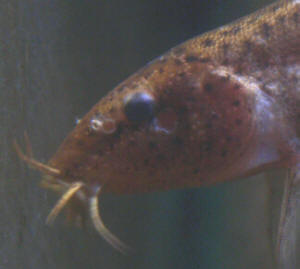
Sick Dojo Loach and Swordtail with Tumor -- 03/10/08 Dear
WWM Crew, <Angela> I currently have a 10 gallon tropical
aquarium, with a dojo loach and a swordtail. The tank has been
running for several years now and the water quality has always
been good, but nitrate levels have gone up in the past two weeks
after my dojo loach got sick. <Interesting... is this all that
changed?> I've been changing the water weekly to try to
keep things clean. <Mmmm, hopefully not too much at a time>
The dojo loach is usually very lively and eats a lot, but about
two weeks ago I noticed that she wasn't eating as much as
usual. The problem has gotten worse, and I haven't seen her
eat anything in the last week. Within the last week, her anus has
become abnormally large with a swollen protrusion (I've
attached a photo for your convenience). <I see this> She
also continually goes up to the surface for air and floats there,
only coming down again after farting. In addition, I noticed that
around the same time she first started showing signs of illness,
she developed two shallow holes in her head. There is one under
her eye, and one closer to her nostril. They are only on one side
of her head. I'm not sure if these are related to the rest of
her symptoms. <I do think all is inter-related> I've
tried treating her with Maracyn and Maracyn II, but they
don't seem to have had any effect. I'm planning on giving
her a treatment of Epsom salt - do you think this will help?
<Mmmm, maybe...> Also, I've noticed that my swordtail
has been growing a white, fleshy protrusion on his side. I'm
thinking it is probably a tumor, but I'm not quite sure.
He's about 4 years old, and the area the tumor is growing
from has been missing a few scales for around a year. It
doesn't seem to bother him, but is there anything I can do
about it? <This, and the pits on the Loach's head and
possibly the other anal complaint of the loach are possibly
pathogenic, infectious... bacterial... but what triggered,
brought in this complaint? Live food, some newly purchased
livestock? That the fine two gram positive and negative Mardel
products didn't cure this is not too surprising... No mix or
single antibiotic/anti-microbial can do... But perhaps the use of
a Furan compound will help here... and not further disturb your
biofiltration. I would try this with the Epsom... Please read
here: http://wetwebmedia.com/FWSubWebIndex/fwantibiofaqs.htm Bob
Fenner> Thank you very much for your time! Angela
Re: Sick Dojo Loach and
Swordtail with Tumor 3/17/08 Dear WWM Crew,
<Angela> I'm not sure what triggered the illness. The
tank has been running as usual, no new kinds of food or new
livestock. I feed them a combination of shrimp pellets and flake
food. <I see> We have been trying the Furan treatment as
prescribed, but it seems like it hasn't helped. The loach has
become much worse - in the past week, she's developed ulcers
all over her body, mostly on her belly. She's gotten very
skinny and spends most of her time floating on her side now. I
don't know how long she has left, but is there anything I
could try to save her? <Sometimes Epsom Salt addition seems to
have a cathartic effect here... Read:
http://wetwebmedia.com/FWSubWebIndex/saltusefaqs.htm> Thanks
for your help, Angela <Welcome. BobF>
|
|
 .JPG)
.JPG)
|
|
Sick geriatric dojo loach,
reading 2/26/08 Hi there, <Ho there>
I am very concerned about my Dojo Loach. She is around eight
years old <Neat!> and I'm guessing that she is dealing
with old age. She has had a large bump on one side of her lower
body for several months now. Perhaps a tumor? <Perhaps> She
had only the tumor for awhile and then I noticed red around her
fins and tail rot. I treated her with medicine for tail rot
<Mmmm, see WWM re> and it never really went away
completely. Now this morning, I see that she has a large grayish
patch in her lower body as well. It looks like a fungus. So now,
if I¹m correct, she has a tumor, a bacterial infection
and a fungus. Is this what happens when they begin to die of old
age? I am very attached to her, and part of me wants to treat
again, but I also don¹t want her to suffer, if
she¹s in pain or uncomfortable. Is there anything I
can do? Thank you, Rozalynd <Please read here:
http://wetwebmedia.com/FWSubWebIndex/dojofaqs.htm Bob
Fenner>
Re: Sick geriatric dojo loach 2/27/08 Hi
Bob, <Roz> Thank you for your speedy response. From reading
the link you sent, it seems like I may be able to keep her a few
more years, if I figure out what to treat her with. <I do hope
so> I apologize for having not found the WWM info prior ... I
only managed to find the page with all illnesses lumped together
(no pun intended!). I see that you recommended treating an
internal bacterial infection with Metronidazole and tail rot with
Nitrofuranace and then BioSpira. <Okay> I'm not sure
where to begin though. Any further advice would be greatly
appreciated. I'd love to keep her around a bit longer if
possible. Thanks again, Rozalynd <I would try the Furan cpd.
first... 250 mg./10 gal.s of water... as proscribed. BobF>
Re: Sick geriatric dojo loach 2/27/08 Thanks
so much. Hopefully I can round up this medicine and get her back
up to snuff. I'm in the US and went out on a futile run today
to find the other medicines I thought I would need from reading
your website. So fingers crossed finding Furan cpd. I really
appreciate your help and fabulous informative website. I really
learned a lot. <Ahhh! A pleasure to serve. Life to you my
friend. BobF>
|
Golden Dojo/Mumps 1/15/08 Hello to the Crew, I
have three golden Dojos. <Misgurnus anguillicaudatus; nice fish.>
Two boys and one girl. I have had them approximately one year. They are
in a 125 gal. community tank. <Tropical or coldwater? These fish are
technically subtropical fish, and their health in tropical tanks is
compromised. Certainly keep no more than 25C, and ideally below 22C,
with a definite cold period during winter at around 18C. This is fine
for other subtropicals like Danios and of course Goldfish.> The girl
started looking puffy Just below the head all the way to the end of her
tail. Within a couple of days she looked as though she has the mumps.
<Which I can categorically assure you she doesn't.> The are
directly on top of her oblong Indentations behind the gills. I have
spent many hrs. researching signs and symptoms of weather loaches and
can find nothing referring to swollen areas that look like she has the
mumps. Her entire Body is swollen now including her Dorsal fin. The
mumps are more pronounced that the rest of the body. Her head is normal
size. She eats normal and swims fine. <Difficult to say precisely
what's going on here without seeing a photo. Localised swelling on
fish can be caused by a variety of things, from injuries to tumours,
but for a fish to swell up all over is not at all common except in the
case of 'Dropsy'. This is oedema, where fluid builds up inside
a fish. It isn't one single disease, and there's no sure-fire
cure. But what it does indicate is that the fish has suffered organ
failure of some sort, though the causes vary wildly from the use of
aquarium salt in freshwater tanks at one end to bacterial or viral
infections at the other. Dropsy typically causes the scales to become
erect, giving fish a distinctive pine-cone appearance, but because
loaches have very small scales, this won't be obvious.> Water
Quality, Ammonia 0ppm, Nitrite 0ppm, Nitrate 0ppm, High Range ph7.4 Low
Range 7.0. tank well established. Please Help!!! Thank You Karen <Do
send a photo. Cheers, Neale.>
Misgurnis... lumpy 01/14/2008 Hey
guys, I'm hoping you can answer my question ASAP. I looked on your
FAQs and the only things about lumps I saw were about lumps on the
body, but my weather loach recently developed a lump on the top of his
whiskers. He won't eat and if the water is disturbed [I was putting
baby plants in the tank] He started swimming sideways and spiraling. I
had to quickly close the lid to my 33 gallon tank as he tried to jump
out. This swimming continues for about 30 seconds, then he goes to the
bottom of the tank and just sits. I've had him [or her] about 2
months and this is not normal behavior. He used to eat all day, or pick
through the rocks but now all he does is sit. The lump isn't very
big, but it looks like something white in his mouth and even when I
caught him, I couldn't see anything in it. I'm worried because
he hasn't eaten for 2 days and his swimming seems to be tiring him
out even more!! PLEASE help? <Greetings. It's difficult to be
100% sure of what's going on here. If the "lumps" look
like warts, that is, off-white, textured structures clearly distinct
from the skin or body, then the chances are your Loach has either Fish
Pox or Lymphocystis. These are viral complaints apparently brought on
by poor water quality or things like heavy metal poisoning. Neither are
really curable as such, but if a fish is kept healthy, they do
eventually go away over a period of time (often many months). HOWEVER,
from the position of these lumps, I'd SERIOUSLY consider Mouth
Fungus (= Columnaris), a bacterial infection similar to Fin Rot. Like
Fin Rot, it's caused by chronically poor water quality. Various
off-the-shelf treatments will fix it such as Maracyn or eSHa 2000.
I'd personally steer clear from Melafix or Pimafix, at least as the
sole treatment. Obviously you also need to make sure the water (and
perhaps also the substrate) are clean for any cure to work. Also do
remember to remove carbon from the filter (if used) while treating.
Cheers, Neale.>
Sick weather loach, English... not following
directions. 11/19/07 hi we have a 4yr old female weather
loach 6 days ago she started acting strange she lies on her side or
back, doesn't move she's turned a rusty color, and slimy she
hasn't eaten, and looks like she's gasping for air we have a3yr
old male weather loach, and 3 other types of loaches they are all fine
and so are their other tank mates, she's the only one sick, she
looks like she's suffering please help to what it maybe thanks
anita&pat <... Please... you didn't follow instructions re
looking on WWM, nor fixing your language... Read here:
http://wetwebmedia.com/FWSubWebIndex/dojofaqs.htm Bob Fenner>
| Weather Loach Bump 6/6/07 Hello, <Hi
there> I've had my weather loach for 11 yrs now and he is
about 6 inches long. <Neat! And likely as chubby as a Ball Park
Frank!> I just noticed the other day that he has a large lump
starting to form near his head/gill area. He doesn't seem to be
as active as he used to be and I don't think he is eating as
much as he used to either. <Yikes...> We haven't added
any fish for about a year now and nothing else is new to the 30
gallon tank. The water quality is fine as well. I've attached a
picture so you can see what the lump looks like. Is this a tumor?
<Maybe...> Is there anything I can do to help? <Mmm, other
than good nutrition, water quality... some folks, times suggest the
use of "aquarium salt" if your other livestock can handle
its addition.> How long does he have? <Perhaps years...>
I've become fairly attached to the fish since I have had it now
for so long. Any advice would be greatly appreciated!! Thank you,
SuAnn <I really like this species... and do hope yours rallies.
Bob Fenner> |
|
|
| Re: Weather Loach Bump 9/30/07 My
weather loach has been hanging on since June. I started to think
that maybe he had a bacterial infection so I have treated with 2
treatments of Maracyn-2 antibiotics. This doesn't seem to have
helped any. He now is starting to loose <Lose> weight and has
difficulty eating since it is hard for him to move his head due to
the bump. I have to try to get the food right in front of his head
for him to eat. Is there anything else I can try to help treat the
fish??? Do you think Erythromycin would work? <Mmm, not
likely> I've reattached the picture for your review (you can
see the lump towards his head/gill). It has gotten a little bit
bigger since before and his gill is blown out on that side. <Not
much hope for remission... You might try Epsom Salt... Read here:
http://www.wetwebmedia.com/FWSubWebIndex/saltusefaqs.htm
BobF> |
|
|
Dojo Loach Lump 2/7/06 I have two dojo loaches, I
bought them both at the same time but one of them developed
a lump on his side. <Have seen this/these more and more...> He
has a hard time swimming and he won't eat unless I put
the food right in front of his mouth, he mostly lays on his
other side with his head in the air. The other one seems fine.
He has been like this for a while and it hasn't killed
him but he doesn't seem very happy. Do you have any
suggestions of what this may be and how I can get rid of it?
<You might try the inexpensive use of Epsom Salt here (covered on
WWM), but am not of a positive notion here... I suspect the origin/s of
these lumps are developmental... exposure to poor water quality of some
sort... tumorous in nature... and the fish either have and perish or
not. Bob Fenner>
Weather Loach Not Evolving -
05/22/2006 Hi, I have 3 loaches in my tank 2 of which are the
golden variety (pink). One has befriended the grey loach and the other
is acting very strangely, it spends most of it's time resting on
top of the pump almost out of the surface of the water, and has
recently found its way onto a rock which is completely out of the
water. When he then re-enters the water it seems to be in a
state of panic splashing around franticly. I was told by an
assistant in a pet shop that he could be evolving ? < Not evolving.
May just be responding to changes in the atmospheric pressures. That is
why they are called weather loaches.-Chuck>
Growths on Weather Loach 11/22/06 <Hi Angie,
Pufferpunk here> I just stumbled onto your site while looking for
information on my weather loach, Gollum. We have had him for a year
now, he eats well and is active with the weather changes and in the
evening. About a month ago we noticed little round growths on the end
of his "whiskers" (sorry I'm not sure what they are
really called) and tonight I was watching him and noticed a lump under
his skin (again round) and then on the other side of his body a larger
roundish worm looking thing under his skin. The one on his left side
looks different from the other growths in the way that it doesn't
really bump out like the others do. He is in a tank with 2 Zebra
danios, 2 rummy nose, an aquatic frog, a snail and a tire eel. Our tank
size is (sorry not specific) around 50 Gallons. The temp. stays at 25
degrees C. and has for the past year with no complaints/odd behavior
from the fish. We are stumped as to what is going on with him. We do
partial water changes and have an excellent filtration system... No new
fish/plants have entered the tank in the past 6 months. There are no
other signs of sickness, he doesn't really have a tail fin anymore
as it was gone when we got him, he is about 5 inches long and about the
size of a hot dog around. He eats fish flakes, frozen blood worms and
some times eats algae pellets. I have to admit my knowledge is very
limited with my fish and now that a problem has arrived I'm not
sure what to do. I've read most of the FAQ's on your site
(wonderful site btw) but not sure anything on there is the same thing
he has. Any information would be greatly appreciated. <From his size
& those tumors, it sounds to me like he's a lot older than you
thought. This is a sign of old age. I had mine
for about 8 years, by the time this happened. I always try
to buy my fish small/young so they will have the best care throughout
their lives & I have them longer. Just make sure no one
starts picking on the old fella. ~PP> Thank you,
Angie
Locating Gold Dojo Loaches hi Robert, <<Bob has gone
diving, JasonC here standing in.>> my name is Jim Brilliant and I
want to know if you could help me find these loaches and who sells
them. I would like to purchase many gold dojo loaches and albino's,
too. thank you for any assistance you can provide <<I would try a
couple of things, one check our discussion forum which has a diverse
group of kind folk who just might have the answer. http://talk.wetwebfotos.com/ I
would also use Google or your favorite search engine and just pop that
subject in there "gold dojo loaches" - I just did and it
turned up four pages of possibilities. The Internet is your oyster.
Cheers, J -- >>
Sexing Dojos, Weatherfish Loaches Hello, I was wondering if I
could get some advice on how I to tell the difference between a male
and female dojo. Is there a way? Thanks, Terry <Hey
Terry, from what I have found, the difference is in the pectoral
fins. The males have larger pectoral fins than the females,
and the two first spines are stronger than the rest hope this
helps. Best Regards, Gage>
Do Dojo loach's eat other fish ? <Well... big fish do
eat little fish, but in the case of the dojo loach, I highly doubt they
would eat another fish.>
Golden Dojo in a pond Hi, <Hello> I'm a little
confused about the difference (as far as temperature) between the
Spotted Dojo and the Golden Dojo. On your site it says "The
Spotted Dojo or Weatherfish is less tolerant to temperature change and
range", so that would mean that the Golden Dojo is MORE tolerant
of temperature change and range? <No, though Misgurnis
anguillicaudata is both the common and the xanthic variety of Dojo or
Weatherfish, the "normal" condition seems to be hardier>
My thinking is more used to goldfish, so I would think the fancier the
fish the less hardy they are. <You are correct> So I'm
guessing it's just a typo. <The Spotted Dojo is another
species... Cobitis taenia I believe> I just want to be prepared so
that when I go to get a couple Dojos if they happen to have a Golden
one I would like to get that for visibility. Also, I was wondering how
many would be good. I have a 1000 gallon pond with 18 fish (comets,
shubunkins, fantails, and a Sarasa) with 3 small koi about to join
them. I would definitely want to get at least 2, at most 4, but would 4
be too much? <Not too many> I'm also a little worried about
them getting out of the pond. I've read that they have a tendency
to jump out of aquariums and sometimes crawl on the floor. <Not
really a common problem in ponds> Any other tips for Dojos in ponds
would be appreciated. Thanks, Mike <Bob Fenner>
Looking for a Dojo Loach
I was considering a Dojo Loach (possibly gold) for a 29g and have seen
some widely ranging information on these in regards to their
size. I have seen postings stating their max aquarium size
anywhere from 15cm upwards of 20inches. In a
"typical" aquarium what size should I expect one of these to
grow, and would it outgrow a 29g and if so in how long? < Generally
Dojo's are bottom loving catfish that spend all their time sifting
through fine sand for something to eat. Fine well rounded sand is best
because coarse materials will be abrasive to the mouth and eyes. Go to
planetcatfish.com and see all the Dojo's that are out there. Many
species are referred to as Dojo's. Most in the hobby only get
around 8 inches while the gold variety is smaller around 4 inches.>
Also I have read that they like to burrow and bury
themselves. I am concerned about this as I have a crushed
coral substrate which would not be good. I read they like
sandy bottoms which would go with the burrowing. I do have
lots of cover and live plants so at least the layout should be
acceptable. < Fine sand is the only way to go or else you will
become an expert in wound control.-Chuck> Patrick
Lumpy weather loach Hi, Wonder if you can help, no one else
seems to be able. I have a weather loach who is about
3 yrs old. he developed a lump near his rear end months ago
which split the skin, the lump seemed to go down after treating him
for bacteria (as the skin had come inflamed). Since then the lump
seems to go bigger then shrink. Over the last weeks he has
developed lots of lumps and has started to raise his rear as
though it is full of air. I know this might be daft but
I had an Oranda that did similar and she had constipation,
could it be this. I have tried peas and spinach with the
loach just in case, but he doesn't like it much. Is it
safe to use Epsom salts on weather loaches as I am a bit
worried about medicating as they are quite sensitive because
they lack scales. He (I think actually he may be a she) is
swimming and eating as though nothing is wrong and shows no
illness besides a very swollen stomach/anal area and lots
of stretch marks. Any help would be much appreciated. The
loach is in a 180litre cold water tank with several goldfish
comets Orandas and best friend another larger weather loach.
water testing showed tank as it should be and no other sign
of disease in fish. < Sounds like an internal bacterial infection
caused by stress and the wrong kind of food. Isolate the fish and treat
with Metronidazole as per the directions on the package.-Chuck>
Thanks in anticipation of any help. Kind Regards Tricia
Not so Golden Dojos Hi, <Hello> A week ago, I had 3
golden dojo loaches. Today, I have 1 left. I
believe they have fin rot as their dorsal fins have progressively
disintegrated over the course of the week and then it appears to spread
in a lighter colored saddle shape across the back, with swelling and
then death. The first one died, then the second one started
with the fin disintegration and when it died, my third one started.
<Unusual... and frightening... This sport, species is usually very
tough> I am new to aquaria and am not sure how to proceed...do I
increase tank temp (currently 80deg), add salt (how much, it's a
150 gallon tank), and/or medicate (with what). <Am (as usual) first
curious as to your water quality... and the history of your having
these fish...> This is a young community tank, with 6 cichlids,
clown loaches, shovelnose cats, peacock eel, clown
knife. Everyone else seems fine and everyone gets along.
<Thus far... don't see the species of cichlid posted, but the
Clown Knife will get large enough to eat all if the cars are Sorubim
lima...> I have tested pH (7.4-7.8), ammonia (0),
nitrite (0), nitrate (40ppm). <The last a bit high... by about
twice.> I have done 2 partial water changes of 25% since the onset
of the disease, with gravel vacuuming. My nitrates have not
lowered and they are not naturally occurring in the tap water.
<Beyond EPA limit for source waters> Any assistance is greatly
appreciated, as I really like the Dojos and want to figure out what the
management problem is so that I can keep them alive. Thanks, Tara
<Mmm, well... from the information you've well-provided, it is
not easy to see that the Misgurnis loaches likely had some sort of
infectious (though possibly internal parasitic) disease... And they are
inappropriate with the Knife and Cats... If you have another tank (with
smaller tankmates), you might try some Gold Dojos there... I'd
check with your dealer to make sure they had no problem with this
"batch", and hold off on others until they've had them on
hand for a week or two. Bob Fenner>
Golden Dojos/Weatherfish Thank you so much for your advice.
<Welcome> I will not get any more Dojos! <I see> The tank
was given to me by a friend who moved and could no longer keep it. He
gave me no instruction on caring for it other than to feed the fish, as
he figured he would come by to do the maintenance (which didn't
happen) and when I went away on a 1 month trip, everyone died (the tank
was beyond disgustingly filthy when I returned), so, I started over and
researched how to maintain a tank on the net. However, at
the local fish store, I was never informed as to the size the knifes
would get, but since I like them so much, I will move them to their own
tank when they get bigger. <...> The cichlids I have are 2
electric blue cichlids, 2 Neolamprologus sexfasciatus gold, 2 tiger
Oscars. Since the Knifes will need their own tank eventually
and the Oscars will too, would they work in their own tank together?
<For a short while perhaps (months)> Both the Oscars and the
Knifes are my favorites. <These two could live together... but the
Africans, no> Since the Dojos are fine and everyone else is happy
and healthy, I guess my main question is now, how do I lower my
nitrates if the water changes aren't doing the trick? <A few
ways... the simplest is by regular good-sized water changes... like 20%
a week... but using live plants, deep, large gravel, chemical
filtrants... and careful feeding should help> You have a great site,
and are very generous with your time in answering everyone's
questions. Thank you again! Tara <Again, you're very
welcome. Excelsior! Bob Fenner>
Dying Weather Loaches Hi, I have a 29 gallon tank and I had a
dojo that got sick lost almost all of his tail fin and started to loose
scales on the back half of his tail. We thought one of my other fish
was eating him so we moved him out of that tank and put him in a 10
gallon. Well the next day we came in and he was dying. He had blood in
his front fins and in his whiskers. Not know what was wrong my husband
reached it to see if he was already gone, and he gave one final frantic
swim and then sank to the bottom of the tank on his back and died. Very
upset because JOJO was my favorite fish out of all that I have. I
jumped up and went back to the pets store and got 4 more. Now I have 3
left from that 4 and 2 of the 3 look like they have fin rot. Well my
husband and I got to looking really close to our tank and found these
little worms swimming every where. But they would only come out when
the rocks in our tank had been stirred up. We have no clue where they
came from, what they are or how to get rid of them. I have read several
different articles on your website and I am just not sure which one is
right. Please Help. We have had this tank for about 2 months but
all of my fish are at least a 1 year old. (except for the 3 new ones).
I don't want to loose any more of my fish. We have moved all of the
fish to a 10 gallon and they are quite cramped. I am not sure if the
parasite moved with them or not. We have treated the water with
parasite clear and fungus clear. We did that for 2 days and it looks
really clear now. So we stirred up the rocks and hear came the worms.
What can we do? Thank you for your help. Shannon < To get rid of the
worms (which are probably plant leaches) use Fluke-Tabs. To get rid of
the tail rot ,which is actually a bacterial infection, you need to do a
few things. First change 30% of the water, vacuum the gravel and clean
the filter. If your sand is coarse and abrasive then you may need to
change it for a smoother less abrasive material. The rough sand erodes
the skin of the fish and then it gets infected. Once the water and the
tank are clean you need to treat the tank with Nitrofuranace. This
medication may affect the good bacteria that breaks down the fish waste
so after treating you may need to add BioSpira from Marineland to get
the good bacteria going again.-Chuck>
Swollen gold dojo I have 2 gold dojo loaches and have a
concern about one of them. I have noticed that although they both
continue to be active and have no problems eating, one seems to have
become thicker than the other and somewhat swollen. Its tail also seems
to constantly float upward, <Not good> it will usually tuck
its tail under a plant when resting. I have seen my dojo eliminate
waste so I don't think it's constipated. Have any ideas
what's going on? Thank you for your time. -Shell <I do hope this
is something simple... like an "egg blockage" that will cure
itself. If your other livestock can tolerate such, I'd add a level
teaspoon of Epsom Salt per ten gallons of actual system water here. Bob
Fenner>
Re: Swollen Golden Dojo a Go Hi, <Hello> I just wanted
to say thank you for your advice. I did add the Epsom salt, also gave
them some peas. Both Dojo's are doing very well, no more floating
tails. Aloha, Shell <Ahh, thank you for this update of your success.
A hui ho. Bob Fenner>
Dojo Loach resuscitation/Heimlich on a fish??
7/12/05 Hi all at WWM, <Howdy Ter> The strangest thing
happened to me yesterday with my Gold Dojo loach, and I just wanted to
share it with you guys, and see if you had come across anything like it
before! He is my absolute favorite fish, such a character, so yesterday
was a total fiasco. <Oh?> I was feeding my small tank (consisting
of a female Betta, 2 silvertip tetras, and a Gold Dojo loach, and an
Oto) as normal yesterday, when I noticed my Gold Dojo was going after a
large broken off chunk of Sinking wafer. He usually nibbles on these
things, but today he seems to try to swallow the whole thing. <I get
the same way around pizzas> Anyways, as soon as the too
big-piece-of-food fit into his mouth, it seemed like trouble. He was
chomping wildly at first, and then I noticed his body started
convulsing a bit, like I'd never seen him before. I thought he
might be choking, but then he swam away fine, like nothing happened.
All of a sudden, 2 minutes later, he started darting madly across and
up and down the tank, faster and crazier than I had ever seen. He was
spiraling out of control, never stopping, unless he hit a rock or the
substrate, and then he would land on his back, belly up. He did this a
few times, and then went still, belly up on the bottom of the tank,
rapidly losing his color. Now I've heard that they go nuts before
the weather changes, but this didn't seem like the case, he was
doing the same thing as my guppy when he died. So, by now my girlfriend
and I are in panic, we reach in to the tank and pull him out by hand,
and place him in a cut off Arrowhead jug that I had just filled with
tap water and I threw some Bio-Coat in a hurry in hopes of conditioning
it. By now he is pretty much unresponsive, limp, but occasionally
twitching in my hand. I start doing everything I learned in CPR class,
but for a fish!: rubbing his belly back and forth, trying to open up
his gills, pinching his throat lightly in hopes I can maybe expel the
food. I even tried blowing in to his mouth getting it to open up!!! All
this time, he is getting more and more limp, taking maybe one or two
breaths. This goes on for maybe about 5 minutes (in my panic I really
don't know though) when I had basically given up hope and thought
he was dead. He was laying belly up in my hand, totally limp. Then, my
girlfriend yells at me to try putting him in the water, so not knowing
a better alternative, I put my hand in the jug, and suddenly, I noticed
he turned on his side, and he starts breathing!!! Totally to our
surprise and unconfirmed relief, he gradually gets upright by himself
and keeps on breathing in our quarantine jug. <Yay!> So we keep
watch over him for the next hour, and he just lays there still,
continually breathing, just resting on the bottom. Little bubbles even
occasionally pop out of his gills. We are so ecstatic by now that we
cut the bottom out of another jug, poke holes in it and stick it in our
main tank as a temporary makeshift sanctuary for him. By the time we
put him back in the tank, he has started squirming a bit more. Now, its
the next morning, and I see him making his way around the sanctuary
jug, swimming up to the surface, and hobbling around. Anyways, I know
this is probably just the beginning of the battle, because he must have
endured an amazing amount of stress from the whole ordeal and possibly
some internal damage from me rubbing his stomach and gills. He seems to
be getting more and more energetic, but I put a dose of Melafix into
the tank after this happened to stave off any strange infections, and I
also had a dose of Bio-Coat and Amquel+ that I put in the day before
doing a regular 25% water change. Is there anything else I can do for
him during this time?? <Mmm, nothing more I would do> Would
aquarium salt be a good addition to help the healing process???
<Actually no... the Tetras and Oto don't "like it">
(and would this be ok for a tank with Tetras, a female Betta, live
plants, an Oto, and a couple ghost shrimp??) This is
definitely one of the weirdest things to happen to my fish, so I just
wanted to share this experience with you guys and see if you had come
across anything like it before! Also if you had any advice as to what
else I can do for him, and when I can put him back along with his
fellow tankmates. Ill definitely keep a close eye on him for the next
couple days. Take care, Terry <I'd return the fish to the main
tank... likely better water quality there. Bob Fenner>
Dojo Loach Question... sel. 7/24/06
Hello, <Hi there> I have a 25 gallon tank with 3 goldfish and I
want to get a dojo loach. However, I am not sure as to whether I should
get one or two. <Mmm, could have two... and they are more active...
more outgoing/comical with more than one... are social animals...> I
read that they like to have another one of their kind, but I also
don't want to overcrowd. <Mmm, well, this 25 will be overcrowded
in time with just the three goldfish...> Another thing is that I
have underground filtering. I know the dojo likes to burrow... I'm
not sure how underground filtering works, will it get sucked
up? -Ashley <Not sucked up, but can scoot down the
"stand-pipes" and live underneath the plates... A good idea
to look into having some outside power filter redundancy here:
http://wetwebmedia.com/FWSubWebIndex/gldfshsystems.htm
Enjoy those Dojos! Bob Fenner>
Please help my sick dojo 9/29/05
Hi. I've enjoyed your website for several
years. I have an established 55 gallon freshwater tank with
a male and a female dojo loach, 8 Otocinclus, 3 honey Gouramis, 6 black
phantom tetras, 4 black neon tetras, and a snail who rode in on one of
my plants. <Sounds very nice> My water quality is great, and my
fish have been happy and healthy for quite some time, and I have not
added anything new to the tank in the last six
months. Unfortunately, something is wrong with my female
dojo loach, who I am very attached to. She has not eaten for
three days. She sits still most of the time, but when she
does swim, she lists to one side, sometimes even laying on her right
side. I know other people have reported this as normal
behavior, but it is not normal for my fish, and I live in Seattle,
where there have been no significant barometric pressure changes.
<Ahh!> After recovering from laying on her side, she
writhes around, often pressing her face in the corner of the
tank. There are none of the usual signs of fish disease that
I know of. None of the other fish are
affected. She let me catch her in a net without issue,
probably because she is weak from not eating, and maybe she knows I
want to help her. I put her in an established 20 gallon
hospital tank with a few grains of aquarium salt, and started her on
Maracyn2, because I don't know what else to do.
<This is what I would have done... with the addition of two level
teaspoons of Epsom Salt in addition> Could she have swallowed a
pebble or something? <Possible, but not likely> Is
something wrong with her swim bladder? <Most
unlikely> I am desperate to help her, and her mate is waiting for
her to return to the 55 gallon. Any advice you could offer
would be greatly appreciated. Thanks for your time and
efforts. Emily <Do try the Epsom... as a general cathartic this may
be your best choice. Dojos do "go into funks" at times,
particularly when kept in tropical temperatures... they're cool
water animals... I do hope yours rallies. Bob Fenner>
Fish Questions?? Dojo repro. 2/26/07 Hey I was
wondering what a dojo's eggs look like? <Mmm, small (about 1 mm.
in diameter), round, light brown...> Mine are male and female I
think. And they have been swimming and curling around
each other. I think my female has had babies but I am
not sure. We found a whitish gold pod in our tank. It is
short and round. Thanks, Serenity Strong <Mmm, this pod is "not
it"... Please read here: http://www.google.com/search?hl=en&rls=com.microsoft:en-us:IE-Address&rlz=1I7PCTA&sa=X&oi=spell&resnum=0&ct=result&cd=1&q=misgurnus+reproduction&spell=1
Bob Fenner>
| Dojo not healing 2/19/07
Hi. Thank you for offering expert advice. I
have a well established 55 gallon tank with tetras, otos, and two
dojo loaches. <I see the one excellent specimen> about three
months ago, I notices that my female dojo had a white patch near
her tail, and that she was starting to get another one on her other
side, also near her tail. <Yes... likely started from mechanical
injury...> She didn't seem particularly bothered
by it, but I treated with Maracyn anyway and it went
away. Her scales in the affected areas, turned dark, and
I assumed that this was just part of the healing process, like kind
of a scab (similar to the post at
www.wetwebmedia.com/clnfshdisfaq8.htm ).
<Yes, also likely> However, the
spots are persisting, and maybe even getting worse, as now the area
between the scales is also dark. Is there something I
can do to help her heal? Water quality is good, I
dechlorinate with stress coat, and I added a small amount of salt
to the water this morning, after she was not excited to see a piece
of zucchini and seaweed (a clear warning sign that she may be going
downhill). I've attached a couple of pictures of one
of the spots if that helps.
<Mmm... yes... I see you have some rather
sharp and calcareous objects in this system... these really should
be removed....> By the way, you helped to save this
very same loach in 'Please help my sick
dojo 9/29/05', from what I guess was a stroke or the
like. She had to relearn how to turn right, left, stay
upright, etc. You encouragement was very
helpful. Thanks for your time and
expertise. Emily <Ahh! Please take
a read here: http://fishbase.sinica.edu.tw/Summary/speciesSummary.php?ID=3016&genusname=Misgurnus&speciesname=anguillicaudatus
This species really needs rather softer, more acidic settings...
and a dearth of sharp material... If you had another system that
had more this sort of setting, I would move them. Bob
Fenner> |
| Re: dojo not healing 2/20/07
Hi. actually, the objects in the picture are
polypropylene replicas of coral, made specifically for aquarium
use. <Ahh, thank you for this> I removed the
sharp rock after this dojo appeared with a gash on her head about
four years ago. <Good> I felt like a criminal,
and am now very careful. Their eyesight is poor, and
they tend to flail around, often crashing into things. <Yes>
Good advice though. So do you think there is
anything I can do for her persisting damaged spots? <Well...
there is a trade-off with "treatment/s" and manipulation
period here... almost everywhere ("Life is a series of
compromises" or such)... I would try the "internal"
approach here, with supplementing (vitamins, HUFAs...) this animals
foods... soaking them in a commercial prep.. Such are available for
pet-fish... Bob Fenner> |
|
.jpg)
|

