|
FAQs on Aquatic Insects and Freshwater
Aquariums 1
Related Articles: Invertebrates in Freshwater Aquariums,
Invertebrates for Freshwater
Aquariums by Neale Monks,
FAQs on Aquatic Insects:
Aquatic Insects 1,
Aquatic Insects 2,
Aquatic Insects 3,
Aquatic Insects 4,
Aquatic Insect Identification,
Aquatic Insect Control
FAQs on Aquatic Insects by Group:
Beetles, Dragonflies,
Flies in General (Caddis, Gnats,
Midges...), Freshwater Mites,
Mosquitos/Mozzies and much more!
|
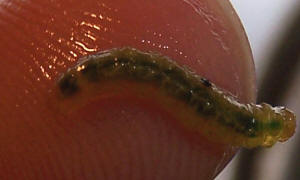
May look like a worm, but this is an insect
larvae.
|
Spiders in my silver dollar tank 5/8/2009
Hi guys,
I have Googled till I'm cross-eyed, but still can't find any
advice on a creature I've found in my tank when vacuuming.
It looks like a silver grey spider, body about 5 mm long, 3 mm wide, 6
legs, and is quite active. The total leg span would be about 1.5cm.
<Well, if it has six legs, it's an insect. My guess would be a
Damselfly larva; these are quite commonly seen in fish tanks, coming in
with aquatic plants and portions of live food. They are predatory, but
beyond fish fry, it's hard to imagine them causing real
harm.>
It was cleaning the muck off its feet in the bottom of the bucket and
is quite cute. I'm reluctant to kill it or to put it back incase
it's a parasite and my harm my large silver dollars.
<Damsel- and Dragonfly larvae are indeed fascinating animals, and
easy enough to rear in floating breeding traps. They can be hand-fed
live or (wet) frozen bloodworms using forceps.>
I know they're not in the right tank, I have a large bio-orb, which
is actually difficult to clean as the filter sits in the bottom of the
orb and is quite small, but they grew so quickly, I'll need to buy
another tank.
<I'll say! Just as an aside, BiOrb tanks may look good, but in
terms of fishkeeping, they're very poor value for a whole host of
reasons. Stick to traditional long, rectangular shapes. Avoid anything
tall, round, or otherwise odd in shape.>
My local aquarium isn't much assistance, they couldn't identify
the leech, red thread worms, or little white flea like creatures.
Still, thanks for your advice.
<Happy to help.>
I'm loving owning fish and there's so much to learn. I now have
5 tanks!
Started from one, but fish grew, bred, had personality issues....
I'd better learn quickly.
Cheers,
Lauris
<Cheers, Neale.>
Identify Worm 11/23/08
I live in coastal SC and I kept my turtle tank outside during the
summer and fall. I just brought it in for routine cleaning and because
of cold weather. The tank had some strange "worms" that
looked a little like "naked caterpillars with long string-like
tails." The ones that were moving were a fleshy tan color. There
were also some that were black or dark brown and very hard. Some of
them were in the water but some were attached together by the
"strings" and hanging off of a rock in the tank. I have
looked on many sites and tried many different search terms but am not
coming up with an answer. Please help me identify this strange little
creature. Brandi <Hello Brandi. What you're describing is almost
certainly a "rat-tailed maggot", a distinctive fly larva that
inhabits stagnant water. The long "tail" is a breathing tube.
They're pretty much harmless, and in England at least very common
in small, unfiltered ponds. Fish (and likely turtles) don't seem to
eat them, or at least my fish don't! Cheers, Neale.>
|
Strange Creatures in FW tank 9/20/08
Hi people
On performing a water change earlier today, i noticed a couple of
odd creatures which came from within the gravel of my goldfish
tank. Any idea whether these be friend or foe. Actual size is
around 12mm (½?) in length...
http://fixpix.zoomshare.com/:tools:album?go=proxy:album/Fish/images/661bec64bccf1ba5007686aec62ba640_12218337380/image.jpg
Thanks in advance J
<Hello! This URL asks for a log-in and password. How about
just sending a small (max, 500 k) attachment? That's what
most folks do, and we thank them for it. In the meantime, most
small bugs and worms in fish tanks are harmless. Cheers,
Neale.>
Strange Creatures in FW tank
Hi Neale
On performing a water change earlier today, i noticed a couple of
odd creatures which came from within the gravel of my goldfish
tank. Any idea whether these be friend or foe. Actual size is
around 12mm (½?) in length...
Brad
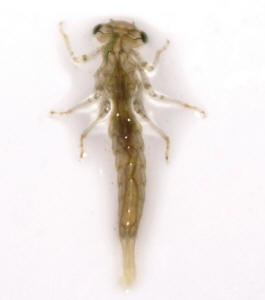
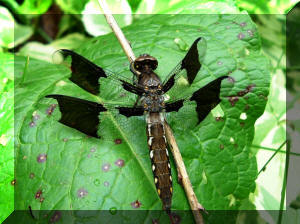
<Hi Brad. This is, I believe, a Damselfly larvae; looks like a
Dragonfly nymph, but the give-away is the "tail" made
from three filaments. Dragonfly larvae are bigger, have more
robust jaws, and a stubby "tail". Damselfly nymphs are
predatory, but only sufficiently large to take small fish,
perhaps livebearer fry. Otherwise they're fish food! Quite
fun to rear yourself, they can be hand fed bloodworms with
forceps, and it's rather fun to watch their bizarre mouths
anatomy in action. Dragonfly larvae are much more dangerous to
fish, some varieties being anything up to around 8 cm/3"
long (at least here in England) and more than capable of eating
things like minnows. In any case, almost certainly came in with
live plants that were grown outdoors, though possibly in batches
of things like Daphnia. Does rather stretch the imagination to
assume either a Damselfly or Dragonfly flew into your home and
laid its eggs there, but it's possible I suppose! Cheers,
Neale.>
|
  |
|
Re: Strange Creatures in FW tank 9/21/08
Hi Neale
Thank you for the response. Since I only have large-ish goldfish
in the tank, looks like they will not be a problem. I do buy live
plants for my fish to snack on, so I guess that was the ticket in
for the larvae.
Thanks again
Brad :)
<Hi Brad. Those Damselfly larvae should cause no harm to your
Goldfish; in fact I'm surprised they haven't been eaten
yet! Cheers, Neale.>
|
Fly Larvae in Turtle Tank, shoo fly,
shoo 6/29/2011
Dear Crew,
<Hiya! Darrel here>
I have a problem with larvae getting into the filters.
<I hate when that happens>
I know there's been questions like this asked but normally they
describe white circles or worms that swim around in the water and are
parasites.
<A parasite swimming around in the water sounds more like my
brother-in-law on vacation in Hawaii>
I know that the larvae grow up to be some type of flying insect, not
sure what kind but they look almost like fruit flies. So here's the
deal:
<OK>
I have a year 1/2 old Red Eared Slider who resides in a 20 gallon
aquarium with a waterfall type filter and a real log.
<Real wood gets really waterlogged and grows real fungus eventually.
An alternative might be some sort of rock or plasticized wood often
sold in aquarium stores for tank decoration>
There have been dark black-brown worm-like larvae crawling on the
filters when I clean the tank every week 1/2 - 2 weeks. I'm not
sure when they start to develop but by the week 1/2 point there is
normally one or two types of flies surrounding the tank;
<Sounds attractive, huh?>
While some may be getting in from outside and being attracted to the
heat lamp, the larvae have been growing on the filters for a couple
months and the filters have been replaced every time I've cleaned
them. Do you know what this could be caused by?
<Yes>
He eats Omega One Adult Turtle Sticks and the filters seem to have a
type of rock in them and are white rectangles.
<Ceramic cells that encourage bio-filtration>
I'm not sure of the brand at this time.
<Many brands '¦ same stuff>
He was found in a pipeline in a steel mill and rescued by my
half-sister's dad who gave him to us.
<Thanks, Dad!! That was really nice of you.>
Thanks for your help, and sorry if this has been asked already!
<No apologies necessary, Courtney. It happens all the time>
<The answer is most likely that you've never fully killed the
eggs, so some hatch and pupate before you even notice and in turn
mature and lay new eggs.>
<So here's what I'd do: Take Piper ('cuz you'd name
a turtle from a pipe Piper, right?) out of the tank and find him a new
place to live for a few days. Someplace warm and DRY. We're going
to keep him out of water except for 15 minutes a day when you put him
in a shallow container of water with a bit of food. He'll eat &
drink and hopefully he'll poop. If he poops in the container water,
which you're flushing - any eggs in his digestive tract will be
eliminated from the cycle. If he poops in his dry box, the eggs will
likely not hatch anyway, but you're still cleaning that up
daily.>
<Meanwhile, leave his tank intact. Water to the regular
"full" level and maybe even an inch more. Add 1 cup of
chlorine bleach per approximate gallon of water. Even a bit more is OK
as long as you can ventilate the room so no one breathes the fumes.
It's important that you leave the filters on and running during
this process. What we want to do is kill the larvae and eggs everywhere
-- inside the tubes, down in the impeller -- all the places you'd
never reach with even the most thorough cleaning. After 24 hours, you
can drain the water, break the system down and clean everything. Rinse,
use soap and water, rinse again & then set it back up.>
<Let it run clean & sterile for another 3 days, then put Piper
back in. Chances are that you'll have broken the larvae
cycle>
<How was THAT as an answer on a scale of 1 to 10???>
... English? Shrimp... Odonatans...
1/11/11
okay in my shrimp tank I have some kind of dragonfly naiad(I think
that's whats its called) It has six legs black in color( i seen a pic on
one web site but it didn't have a name they just called it a dragonfly
naiad-- and you have to have permission to use the pic.)
<Yes>
I need to know if they would eat my shrimp.(Ghost & Cherry)
<Yes>
altho I have lost about 14 (combined) of them. I wrote before about
some kind of worm/snail that Ive been taking out when i see one, and
they will not live out of the water. usually about 30 sec or so they
dry up. they are very soft body, slimy feel, black in color (Looks
white inside on glass) long bodied but can move like a snail but it
only attaches with the head on the glass. head is traingle when
streched out. is this part of the dragon fly i found and could there be
more since i found this big one in the tank.
unfornately the tank is filthy but cant clean it due to the thousands
of (ihope )baby shrimp
need help with that also anyway anything on the creatures would be nice
and if you want i could send actual samples of these creatures.
<Uh, no... see below... need to be removed likely>
Thanks
Judy Potts
<Judy, please run your writing through a spelling and grammar check
before sending. See Net re how to do this if unfamiliar.
And read here: the http://wetwebmedia.com/FWSubWebIndex/fwaqinsectfaqs.htm
Bob Fenner>
re: 1/11/11
Okay so sorry for the misspelling here. I went and saw what the
creature was and a gentleman named Neale said it was a Odonata.(on the
website)
<Okay>
Since that what it is,What do the larve look like?
<? Look up via your search engine/s... Dragonfly Nymphs...>
Is it best to take out the grown shrimp and just clean the tank?
<... read where you were referred. B>
What should I do? I also notice white creatures round body with two
little white dots following the round body.(Magnafing glass helps) The
others look like the baby shrimp I thought they were,but not growing at
all. They have the long body and really look like shrimp. I apologize
for not being more informal on the topic, but Neale has helped me so
many times that I trust you with the info that is provided on your
website. Again I hope I did a better spelling than before.LOL
Judy Potts
Ftn. leeches?? 12/17/10
I have found small red worms that strongly resemble ones discussed on
these two pages
http://www.wetwebmedia.com/fwsubwebindex/tapewmfwf.htm
http://www.viaquaria.com/forum/showthread.php?1679-Callamanus-worms-%28red-worms-from-fish-s-anus%29-Problem-Solution
in a freshwater outdoor water fountain (with no fish). When I go to
change the water every other day or so they float up and are swept out
of the fountain and into the flowerbed. Birds use the fountain to drink
and I imagine that mammals use it at night. I have red wriggler
earthworms and decollet snails in the yard also,
but never find them in the water fountain.
My questions are;
Are they harmful to birds, cats or skunks etc?
<Can't tell with the information presented... All Leeches are
parasitic...
can't/don't live long w/o hosts. Do yours show segmentation,
suckers?>
If they are harmful how do I eliminate them?
<Simple bleach>
Is it possible to 'dose' the water to prevent their return?
<Depends on the source...>
I don't currently have a pet but when I did she did drink out of
the fountain, when I get another will I have to prevent it from doing
this?
<Doubtful>
Thanks, Pam Kelso
<Welcome. Bob Fenner>
Re: leeches?? 12/18/10
Thank you for the reply. In rummaging around the internet after I sent
this to you I think that I have identified the culprits. They are midge
fly larvae, bloodworms.
<Ahh! Quite common to have such insects w/ aquatic larval stages
using water features opportunistically. And not a disease issue>
Because I clean out the fountain every few days I never saw them at
maturity and they were always small and non-segmented. I know that we
have midge flies so I think that solves it. Thank you for getting back
to me so quickly.
Pam Kelso
<Welcome. BobF>
Damselfly nymph 10/10/10
Greetings!
I have a 20g long shrimp only tank with a medium-fine gravel substrate,
planted with Sagittaria, hornwort, java fern (medium density). 2x 18w
bulbs, nothing out of the ordinary. Housing maybe 20 RCS, 15% water
change weekly. pH ~ 7.6, all chemistries 0. I have found myself a
damselfly nymph (am led to believe is this, and not dragonfly, due to
longer, more slender body). Question is, are they detrimental to RCS
population? I have removed one I saw (is roughly 1' long), do not
see others. Is this a 'keep eyes open for more and take out as
needed' deal, or something more drastic? I don't want to break
this tank down for this. Any advice appreciated.
Brandon
<Brandon, Damselfly nymphs are predators, and they will eat very
small animals of all types, including fish fry. Whether they can
actually kill an adult shrimp is questionable, but they might take
juveniles. Of course Damselfly nymphs do need to eat *something*, so
unless you're providing suitable live or wet-frozen food for them
-- they suck the juices out using their jaws -- it's probably best
to move the nymph to a pond nearby. They're neat animals, and the
adults are beautiful and in some cases endangered. One last thing,
Damselfly nymphs are distinct from Dragonfly nymphs in having three
breathing tubes at the tail-end of their abdomen, structures that
Dragonfly nymphs lack. Cheers, Neale.>
Re: Damselfly nymph 10/10/10
Indeed a damselfly nymph then.
<Good.>
I have moved said nymph to another location, but in the absence of
naked-eye visible ones, is it likely there are more?
<Unlikely. This is indoors? Unless you have damselflies flying
around your home, it's most likely this one came via plants or live
food, both of which can be cultivated outdoors or in large glasshouses
where damselflies might be buzzing about.>
I suppose it's just a keep watch, remove as needed affair?
<Yep.>
Probably half my shrimp are berried at various stages, so I don't
believe population-wise the nymphs will pose an issue, unless they
appear in large numbers. Just keep eyes open and remove PRN?
<Pretty much. They're such neat animals, you might even choose
to keep one as a pet. Some remain in their nymph form for months, even
a couple of years, depending on water temperature. I've used
forceps to feed them wet-frozen bloodworms, and various small live
foods such as glassworms will be taken, so they aren't difficult to
maintain. Cheers, Neale.>
identity of small black wriggly worms/larvae
9/17/10
Hi! We're currently residing in Manila, Philippines. It's
happened twice already wherein we found more than a dozen thin black
wriggly larvae on the countertop of our bathroom sink. It seems like
they just magically appear out of nowhere.
<Almost certainly some sort of Dipteran larvae.>
They wriggle their heads and tail ends from side to side. Really
gross!
<Nothing in nature is "gross", merely different.>
I'm afraid they're harmful parasites.
<Very unlikely.>
I'm worried for my kids.
<Don't be.>
Help! What are they? And how do we prevent them from reappearing.
<Dipterans tend to be attracted to moist, warm places with organic
matter on which they can feed. There are many types of Dipteran,
including things like house-flies and mosquitoes through to more
obscure species. Dipterans dislike dry houses with nothing for them to
eat, and the are eaten by spiders and carnivorous plants. So there are
some clues there about what you can do to minimise problems with
Dipterans.>
Thanks so much for your help!
<Please understand we aren't environmental health consultants;
we're fishkeepers. If you're concerned about pest animals
inside your home, you need to speak to genuine experts. Only your
doctor will be able to tell you if these organisms are a threat to your
health, and only pest control professionals will be able to determine
why these animals are getting into your home. So take my diagnosis for
what it is, speculation on the part of a non-expert. In no way is
WetWebMedia liable for any health or other problems caused by these
larvae or your subsequent actions. Cheers, Neale.>
|
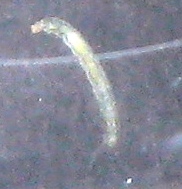
Worm Identification 8/30/10
Hello,
I found a worm in my drinking glass this morning. I assume it
came in through my tap water. Could you help me identify it?
Thank you.
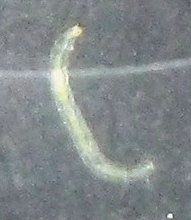
<It's not a worm; it's an insect. Some sort of
Dipteran larvae, e.g., a midge. Harmless, and an excellent fish
food! Cheers, Neale.>
|
  |
Mysterious white worms (in a freshwater tank)
3/10/10
Good morning!
I am a first time WWM email user. And I find your website tons of help!
I have a question. This morning I cleaned my fish tank and I saw tiny
white worm-like creatures on the glass of the fish tank.
<Likely free-living nematodes and planarians. Not in themselves
dangerous, but a sign that this tank gets too much food and not enough
cleaning, since they feed on uneaten fish food (among other things). In
most tanks you might find a few, but not enough to notice. If there are
obviously lots and lots of them, then you have a problem.>
Also while I was using my siphon I stirred the gravel a little bit and
1-2 inch white worms and my angelfish and guppies started to have a
feast, when I looked in my bucket I saw 50 maybe 100 of them and
I'm worried. They swim in kind of a S shape and when they stick to
the glass they move kind of like an inch worm. Kind of creepy.
<Just nature mopping up the mess you're making. Like cockroaches
in a kitchen.>
I also tried a parasite med. But. I don't think that worked ;(
<Why would it? These aren't parasites. More significantly,
trying to kill a bunch of animals in your aquarium means you're
going to end up with lots of decay, and that means poor water quality.
Imagine if you killed off a nest of rats with rat poison, but just left
the bodies to rot. Bad. The correct approach here is to ignore the
worms, and instead control their numbers so the population dies back
over time. How do you do that? By limiting the amount of food they get
to eat. Feed in sensible amounts, don't overstock your tanks, and
remove uneaten food at once.>
Thank you for your time helping me!
<Cheers, Neale.>
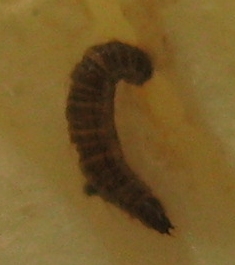
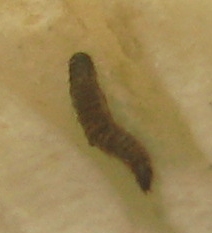
Worms 09/04/2008 Hi I have a 29 gallon
freshwater tank it is a fairly new tank only been up for about 7
weeks.. I just got done battling ick on my swordtail fry and then
today I noticed these brown worm looking things on the glass of the
tank near the top ,but they were not in the water at the time I
found them they were actually just above the surface.. I wiped them
off but not sure if they are a worm or some type of insect larvae..
I have attached 2 photos, not the best because they are very
small.. I tried looking it up myself but all I can find is
references to white worms which these are not white.. Are they
harmful? I already did a 20% water change while vacuuming the
gravel today.. Thanks Trish <Hello Trish. The "worm"
in question appears to be an insect larva. Certainly to my eyes it
seems to be segmented and possesses small appendages of various
types. In other words, a maggot. No immediate threat to the fish,
but a good sign that there's a lot of decaying organic material
somewhere in or around the tank. Otherwise the parent fly (or
whatever) wouldn't have laid its eggs here. So time for an
early spring clean! Cheers, Neale.>
Re: worms
09/04/2008 Thank You.. I did vacuum the gravel out today
after finding the worm like things.. and there was a lot of food in
the gravel.. I didn't realize I was overfeeding , I only feed
them once a day but I guess I need to cut down on the amount I am
giving each day.. Thanks so much for your speedy response. Trish
<Hi Trish. Overfeeding is easy to do, and much more difficult
than to under-feed! Remember the two golden rules: Firstly, little
but often. Snacking is better than gorging. The fish are more
likely to eat all the food, and they'll also extract more
nutrition with less wastage. Secondly, use the minimum quantity,
and it should all be gone within a minute (for the average greedy
community fish). Remove anything leftover; a turkey baster is a
great tool for this, allowing you to pipette out stuff without
buckets or getting your hands wet. Cheers, Neale.> |
 |
|
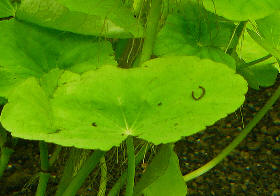
PLANTED TANK WORMS - 7/24/08 I spotted
this tiny brown worm on three of my freshwater aquarium plants
this morning. Some are so small they look like dust. I removed
them all with a turkey baster. My research didn't turn up
anything. Can you identify them by the attached photo? Should I
be concerned? Thanks for any help you can give me. You guys do a
great job. Bob <Hi Bob. The photo is a bit small to say
anything sensible, but my guess (and that's all it is) is
that this is nothing more serious than some sort of insect larva.
Common enough in freshwater habitats, but usually get eaten by
fish if they end up in aquaria! In any event, very, very unlikely
to cause any harm. If you're concerned, remove them and feed
them to your fish. I'd be tempted to rear them in a small
container of water just to see what they turned into. They
aren't mosquitoes or anything noxious like that. Cheers,
Neale.>
Re: PLANTED TANK WORMS Thanks Neale! <You're welcome,
Bob.>
|
|
|
|
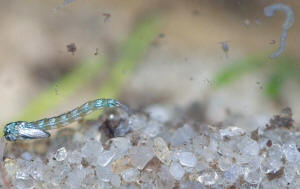
George in Greece... worms, copepod... ID
03/16/08 Dear Bob, As you can see in the photo there are two
types of worms and one type of copepod (freshwater). <Can
barely make these out> We are extremely interested in finding
out the following: a) species and if not, genus or even family.
b) are they harmful to fish (esp. fry) Your response will be
greatly appreciated. George & Marina <The blue thing is
obviously some sort of dipteran larva; the red things perhaps
small oligochaetes, but it's difficult to say. In either case
they're fish food rather than a problem! Fish fry *might* be
harmed -- I've lost baby Corydoras to planarians, for
example. But I suspect that the usual problem is that if the
water (or substrate) are "dirty" (bacteria-laden)
enough to support these small life forms, newly-hatched fish are
at greater risk of fungal infections. So in my case at least, the
planarians didn't kill the Corydoras fry, but simply attacked
the moribund ones. That'd be my guess, anyway. Cheers,
Neale>
|
|
|
|
Stranger (damselfly naiad) in my community tank
-03/13/08 Hey guys. This morning I noticed a strange-looking
bug in my 10 gallon community tank, which houses 3 guppies
(tuxedo, sunrise, and fancy), 2 Hatchetfish, and 1-2 Otocinclus
(there should be two, but I haven't seen them both at once in
a long time, though I haven't seen any bodies...) After doing
some research, I determined that the bug in my tank is a
damselfly naiad. I think it must have come in on the live plants
I ordered from Drs. Foster and Smith. In my research, I also
learned that the damselfly is carnivorous, and will eat small
fish, which, obviously, includes my guppies and Otos. I don't
really want to kill the bug, but I also don't want to run the
risk that it'll eat my little guys in there if I leave it be.
Do you think this is a risk I should be concerned about? Would it
be better to try to net the bug and transfer it to my 55 gallon
cichlid tank? I feel fairly confident that the cichlids can fend
for themselves against a carnivorous bug. I'm just always
wary of adding contaminants to any tank. Any thoughts? I'd
like to keep the bug just because I think it'd be really neat
to watch it go through its 2 year metamorphosis, and also because
the idea of a semi-complete ecosystem is so darn cool. Thanks for
your input! Micah <Hello Micah. Damselfly larvae are quite
distinctive thanks to their big bug eyes, long bodies, and three
"tails" at the end of the abdomen. They are relatively
easy to maintain. Yes, they will eat small fish. But bigger fish
will eat the damselfly larvae! Set up its own aquarium using
anything that holds a couple gallons of water; even a goldfish
bowl will do. If you can, add a simple air-powered sponge filter,
but that's not essential. Fill with water from your aquarium,
cooled down to room temperature. Add some hornwort, and then some
live daphnia and pond snails. Voila! Your very own safe indoor
pond. Put somewhere sunny but not in strong direct sunlight (you
don't want it to overheat!). Sit back and enjoy. The larva
will eat daphnia but they also enjoy bloodworms, live or frozen.
To get them to eat frozen bloodworms, use forceps to dangle the
food enticingly. Damselfly larvae are quite common in shipments
of coldwater and pond plants, but most people don't notice
because the fish eat them. Cheers, Neale.>
Re: Stranger (damselfly naiad) in my community
tank -03/13/08 haha, thanks Neale! <No problems.> I
have a simple question that I feel foolish asking... Where on
earth do I get live daphnia? Internet only? I found a site that
sells a "daphnia instant culture kit" at
http://www.hometrainingtools.com/catalog/life-science-biology/ocean-water-life/p_lm-insdaph.html
but that site does also sell live daphnia for substantially more
(shipping costs and whatnot). <Usually sold in pet stores to
feed fish. If not, don't worry about it. You can look after
this beastie with nothing more than frozen bloodworms and frozen
mosquito larvae. Daphnia can usually be found in garden ponds,
especially once it warms up. A fish net is fine for catching
them. I get all mine from me neighbour's pond!> I actually
do have a 10 gallon tank that I'm currently not using, which
I could fill halfway and gleefully transfer any number of the
common pond snails that have taken up residence in my little
community tank. <Very good.> I'm excited for this small
indoor pond of mine (though, it will have to have a lid, as my
cats are not the timid sort). <Likely not a problem. Cats show
little interest in small aquatic invertebrates. They may choose
to drink the water, but that won't do any harm. As you
probably know, cats can't bear the chlorinated water we use,
and aquarium water is considered by them much more toothsome!>
Thanks again! Micah <Cheers, Neale.>
|
Please Help Get Rid of my Flies!!!!(My last resort)
2/10/08 Hello I have scoured The net looking for a question and my
LFS recommended this site, so here we go. First of I am running a 65
gallon fresh water tank. Two HOB Bio Wheels. Heater etc. . My
temperature is usually aprox 77/78 deg. There are two prismatic lens
covers on my aquarium. The transparent kind you see under fluorescents
in stores/ schools. With aprox 6 inch square of open space on each one.
There are 4 Platys 1 Sail Fin Pleco (2.5-3inc) <A what...?> and 12
harlequin Rasboras. The nature of my problem are tiny green flies. They
first appeared on the surface of my water as see threw shells. Within a
day they "fly away" and get stuck under my lid. My LFS said
they could not be actually flies on the water surface and must be a
aquarium pest. Where as since then, I have definably seen them fly
away. When they Grow wings and get bigger aprox 1/2 mm they change into
a fluorescent green. They are located around my filters , and are
reproducing fast. Some one suggested they are coming from my filter
pads. Whereas they are under water. Dose that make sense. The only new
addition to the tank was a batch of aquarium moss. Which has since been
removed. Where as the flies still reproduce and cause me a large head
ache. I clean the inside of the lids every two days now and there are
between 30 and 100 every time. They are so small that when on the water
surface my fish cant see them as such cant eat them either. That is all
I know. Presently I am syphoning water from the surface at my water
changes to attempt to rid them of my tank. Like I said removed all new
additions and am maintaining a regular water change schedule 10/15%
every 2/3 days. Any help would be great. Ps have no photos where as I
can try and resend the email towards the end of the week If need be
with new photos. Just email me and ask thank you ever so much. You are
my last resort. <Well, not precisely sure what these
"flies" are, but I also doubt they are actually true flies,
i.e., Diptera. Fish usually DEVOUR dipteran larvae, and there's not
much chance a population of mosquitoes or some other (semi-) aquatic
fly could actually maintain a population in a fish tank. It is much
more likely you have thrips or some other insect that walks on the
surface of the water. Now, there are two key things to known. Firstly,
they don't do any harm. Most freshwater tanks have played host to
these at some point. They don't carry diseases and they don't
harm your fish. The second thing is that they don't break the laws
of physics: if they're multiplying, its because they're finding
something to eat, most likely decaying fish food. You don't see
these insects in clean tanks with strong water currents. You see them
in tanks with variable levels of cleanliness and filters insufficient
for the tank/population of fish. Even adjusting the filters so that
there is more water circulation will make a difference. In any case,
these insects migrate into the tank from the rest of the house.
They'll come from other warm, moist places. You can't
exterminate them so either make the tank less attractive for them, or
simply ignore them. Cheers, Neale.>
Strange critters in my tank(s), FW aquatic insects
2/1/08 After several days of scouring the web for answers, I'm
still no closer to identifying this critter. So far I have found 3 -
two very tiny, and one that's now about 3/4 inch long. When I saw
them swimming I observed that they moved with a sort of eel-like
motion, but they are definitely not worms (as I thought when I had only
seen the tiny ones). These have 6 jointed legs (looking much like a
spider's legs) at the "head" end, no legs on the bright
green body (which looks to be segmented, but since it is so small
it's hard to tell). It's about as thick as a pencil lead and at
the other end is a sort of finned tail with 3 distinct "fins"
which, unlike the body, are marked with dark bands. When resting
right-side-up, this critter uses the two outer "fins" to hold
up its tail end, and the middle "fin" stands straight up.
When swimming the "fins" are folded and look like a darker
extension of the body. When the critter (presumably) sleeps, the fins
are also folded together and the 3 separate appendages can't be
distinguished. I found the first of these when I was doing a water
change in the large tank (200 liter) and the second and third while
doing a water change in the fry tank. The first two were less than 1/4
inch long and the colors were not apparent at that stage. They just
looked like short, very thin wiggly things with larger heads and I
first assumed they were some type of worm. However, given the 6 legs
and fin-like tail sections I realize they're totally un-wormlike.
Not knowing what they were, I put the largest of the 3 in a small glass
of water and he's been there now for a couple of weeks. In that
time he hasn't gotten any bigger, and crumbs of fish food went
untouched. A few days ago I put in some dried and fresh bits of various
leaves to see if he would eat them. Until then he had stayed at the
bottom of the glass, supporting himself on his legs and the two outer
"fins" - but the first day he somehow noticed the floating
vegetation (I say "somehow" because before then I had never
seen him move from the bottom, do any exploring, etc.) and has now
relocated himself to the underside of a floating bit of (dried) leaf,
folded his "fins" and settled in at his new location.
It's just not possible to get a good photo of him - though I did
try - so that his head, legs and "fins" are visible. The fry
tank sits on a low table beside a medium-sized potted Sheffler which
from time to time gets infested with those tiny pesky gnat-things that
crawl around on the surface of the potting medium. Not whiteflies, but
I don't know what they're called. However, I've never seen
the gnats look anything like this in any stage of their development,
and there are no other plants/pests in the immediate vicinity of the
tank. The little table is, however, next to the balcony door (which I
tend to leave open when the weather is nice, though that doesn't
happen often here) and on the balcony I have probably 60 or 70 plants
of different types, none of which have had any pests aside from the
occasional snail. I considered the possibility that my critters came in
from the outside and from there to the fry tank, possibly transferred
to the main tank on a communal net or something. But that's quite a
bit of guesswork, and I'd like to know for sure what this is and
what (if anything) I should do about it. My partner thinks they're
mosquitoes. However, we have had sub-freezing and inhospitable weather
this winter, and I can't imagine that mosquito larvae would be
already hatching. It hasn't gone above 8 C. for at least two
months. In addition, this mystery critter is already bigger than any
mosquito I've ever seen - even in southern Louisiana. :P Does
anyone have any ideas? Please? Hopefully, Erin <Erin, without a
photo difficult to say, but if the thing has three filaments (actually
gills) coming from the tail-end, then it's mostly like a damselfly
larva (Order: Odonata; Suborder Zygoptera). Quite common in ponds, and
they sometimes get into aquaria with live food or on plants. They are
predatory, and eat things like smaller insects as well as fish fry.
They won't (likely can't) eat dried food. Cheers,
Neale.>
|
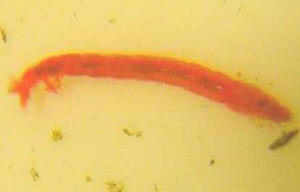
Red Worm ID (Royal Plec) 11/19/07 I've
had a 3 1/2" Olive Royal Plec alone in quarantine for 10
days or so. I dewormed with Praziquantel last week at the
recommend dosage (76 mg/10 g) as I know they're wild caught
and don't want to pass anything onto my own fish. He went
into a 20 gal tank with new aged water and a fully cycled Penguin
280 bio-wheel filter from another tank. I did his 25% water
change today (after leaving the Praziquantel in 5 days) and found
these live red worms (pic attached) in the water I syphoned off
the bottom of the tank. Pretty wiggly and entertaining under the
microscope but I can't figure out what they are via the
FAQ's. If they weren't alive I'd have thought they
were frozen bloodworms. I'm hoping it's a harmless worm
that can be treated as the Plec is eventually going in with my
much loved Severum. I promise not to bother you anymore, but
maybe the picture will help others. Mitzi <Looks like a
chironomid larva (a.k.a. midge larva or bloodworm) to me.
Probably got in with some live food. Usually get eaten by fish,
so not common in aquaria. But if this tank was empty for a while,
then it's possible a midge laid some eggs there. In any case,
harmless. Cheers, Neale.>
Re: Red Worm ID (Royal Plec) 11/19/07
Thanks, Neale. I feel stupid then but thankfully that's good
news. I never feed live food, but the driftwood in his tank had
been soaking for a month in a large kiddie pool outside. I rinsed
it off real well but I bet that's where the bloodworms came
from. (The tank had been empty and stored before he went in it).
What a relief! Mitzi <Mitzi, Glad we have a happy ending here!
Cheers, Neale.>
|
|
|
Worms in fresh water aquarium
11/29/07 Hi WWM My sister has a fresh water Aquarium which she just
cleaned out on the weekend, and a few days later we have noticed these
worm like creatures in the filter tubes no where else but in them. They
have small legs and are hatching out of these things that look like
cocoons and if you look carefully at them they have small mouths. There
very disturbing to look at and gross us out. There's so many of
them please help! Jessica <Hello Jessica. Without a photo its
impossible to say what they are. But given they have obvious limbs and
mouthparts, one must assume they are some sort of insect. Aquatic
insects vary in their danger to aquarium fish: most are simply
fish-food, but a few, particularly dragonfly (Odonata) and beetle
(Coleoptera) larvae, can turn the tables and will catch and eat small
fish. If you can send a picture, we can try and identify your visitors
with a bit more precision. Cheers, Neale.>
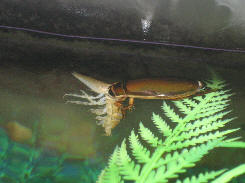
| Re: Alaskan Isopod! One Id down, now on to the
Water Beetle! 11/16/07 <Hi Jack!> Thanks for identifying
the isopod for us. <You're very welcome!> It is known
locally by Inupiat Eskimos as a "toe biter". I doubted
they had the ability to bite toes, but perhaps they actually do.
<I would imagine so. Those isopods can get relatively large -
around 3'. I sure wouldn't want one grabbing hold of my
toe!> We have a large(3 cm) water beetle living in the same
aquarium as our specimens of Saduria entomon. It preyed upon our
snails and is now preying upon the S. entomon. <Ah yes, I see.
The predator becomes the prey!> I have had trouble identifying
it and hope that you can help. <Hope so> It breathes with
head down and stores a large air bubble in its tail region.
<Typical> It is quite buoyant and uses a lot of energy to
dive. <I've seen videos of this. It looks extremely awkward,
and reminds me of trying to see how deep/far I could swim with an
inner tube around me as a kid! LOL I didn't do as well as these
insects, and I'm very thankful that there are no existing
videos to prove it! Regarding identification, unfortunately,
insects are not my strong point. What I can tell you is that since
it's a predacious diving beetle, it's most likely in the
family Dytiscidae. This family, though, has many, many genera and
species in it. The good news is that I found the following link
that supplies a list, for Alaska, that narrows it down
considerably:
http://www.uaf.edu/museum/ento/Insect_Omnibus/Dytiscidae/ The next,
tedious, step would be to go through that list and look up each
specie on the internet. If you do a search based on images, it goes
a lot quicker! I looked through about a third of those listed, and
saw one that appeared similar - Dytiscus circumcinctus. Here's
the link that shows this specie:
http://www.hlasek.com/dytiscus_circumcinctus_ac7200.html Problem
is, while it looks like yours does have something of a light border
around the anterior edges, it doesn't look like it extends all
the way around as is shown at the link. If this is indeed the case,
then it's back to old drawing board - or in this case: the
search engine!> Thanks for any help that you can provide.
<You're very welcome, I just wish I could have given you a
definitive answer!> Jack Adams White Mountain High School We are
located on the Seward Peninsula in Northwestern Alaska. <Indeed
a beautiful area, that's a fact! Take care --Lynn> |
|
|
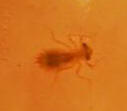
| Water Bug? -- 10/18/07 I'm not sure what
it is or how it got into my tank. Is it potentially dangerous to my
fish? Could there be more? It's a little less than half an
inch. My apologies for the bad picture. <It's almost
certainly a dragonfly (order Odonata) larva of some type; and yes,
they're predatory. Absolutely fascinating animals to keep in
their own aquarium or bowl, but not safe with fishes. Easy to keep,
and you can even hand-feed them bloodworms using forceps or
similar. Take many months to mature in some cases. Impressive jaws,
and if anything these insects are even more interesting than the
fish we commonly keep. (Rather like mantis shrimps, which are *far*
more interesting than the average coral, despite being viewed as
pests!) Usually these things get into tanks with live food or
aquarium plants. The parents lay the eggs directly in the water,
and the aquatic larvae can't fly from one pond to another. So
it got into your tank because you put it there, albeit
unintentionally. Cheers, Neale.> |
|
|
Wiggly worms and Scary Fish Questions! Insect larvae... plus
bizarre Macropodus obs. -- 09/29/07 About a month ago I started up
a 10 gallon freshwater tank. In the tank I have 2 gala <Heee! Likely
Bala... Balantiocheilus... needs much more room than here> sharks,
two tiger barbs, <Keep your eye on... nippy> and 2 blue paradise
fish. I set up the tank with an under gravel filter. A few days ago I
went to replace the under gravel filter for a regular power filter
because the tubes that contain the air stones in the under gravel were
clogged with a brownish algae. That's when I noticed these tiny
white worms wiggling all over the lid. They didn't seem to want to
be IN the water although the lid stays very wet. What could have caused
these worms? <Likely terrestrial insects... larvae. Can just wipe
away...> (A fruit fly laying eggs because of the algae in the tubing
above the water is what someone told me?) my second concern is about
one of my paradise fish. All of the fish in my tank are pretty mellow
(not because they are unhealthy) but occasionally one of my paradise
fish does this strange thing with its mouth. Its upper lip moves away
from its head and exposes this thin "nose-like" membrane. It
swims around like that for a while and then it will suck its lip back
in and look normal. What is that all about?! <Got me... can you send
a pic?> Please Help!! thanks, Sammy <BobbyF>
My fishes are bloated!!! HELP! 10/14/07 I emailed
you about a month ago about some tiny white worms that were crawling
all over my 10 gallon tanks lid. you suggested that they may just be
terrestrial but? I was wondering if these could be parasites of some
kind. <Mmm, no. Some terrestrial insects do have larval forms that
are predaceous on aquatic life though...> They have little black
heads and a little black tip on the end of their tails. They are REALLY
tiny like almost unseen unless you know they are there? and live in
what looks like food splashed on to the lid from the tank. I feed the
fish at night and wipe the tank lid clean every morning but still
notice these little worms. Also, about two days ago one of my blue
paradise fish died. Its stomach looked swollen and it just floated
around bumping into things? at bottom of the tank until it died. Now
both of my tiger barbs and one of my gala sharks are bloated looking!?
I still have one paradise fish and another? shark that aren't
affected? yet.)? is there anything that i can do to get rid of these
worms and keep my fish from dying!? please help! Sammy <Mmmmm, well,
the fishes might be consuming this life... and this might be
mal-affecting them... I would try taking the top off... cleaning it
thoroughly, wiping under the rim of the tank... to see if you can
eradicate whatever this is for good. Bob Fenner>
Tiny white bugs/crustaceans, FW... 8/29/07 Hi.
Hope you can help me with this one! <Will try.> I have a 5 gallon
freshwater aquarium with a betta fish in it. A few months ago I noticed
a few things: 1) tiny white bugs, barely visible to the naked eye, that
swim/jump through the water and sometimes scoot along the surface of
the glass <Those are very small insects or insect-like animals.
Thrips, collembolans, mites, and so on. Harmless.> 2) tiny things
that stick to the glass and plants. They remind me of barnacles more
than anything else. They are scale-like, flat, transparent beige in
color, and have a small red-orange colored center. They start out as
specks on the glass and progressively grow bigger, to about the size of
a pin-head. They have a hard outer "shell"....I know because
I've been killing them off as best I can ("crunch"), but
they continue to multiply. <Sounds like snails of some sort.
Basically harmless.> 3) tiny red-orange bugs that jump/scoot on the
surface of the water, which remind me of mites or water spiders or
chiggers. <Again, some sort of harmless arthropod. Quite possible
red mites.> I have no idea what any of these are, and my internet
research thus far has not helped. I'm wondering it is it possibly a
single organism that I am witnessing at different points in it's
life growth cycle?? <No, not really. Aquaria become ecosystems of a
sort, and animals in house attracted to warm, damp places congregate on
them. Hence you find the same sorts of things on the aquarium as
you'll find in the bathroom.> A few weeks ago I did a major
overhaul of my tank. I boiled the gravel, driftwood, and filtration
components. I threw away all the plants. I replaced all but about 10%
of the water. Two weeks later, there are tons more of the white bugs,
and I'm seeing more and more of the "scale" looking
things on the glass everyday. <You can't get rid of them. Remove
them, and more will move in from your house. I'm guessing your tank
doesn't have a proper filter; these little arthropods don't
tend to be such a pest where the surface of the water is agitated by a
filter. In "bowl" type situations, the still water surface is
a perfect habitat for them. Furthermore, in betta bowls the water tends
to have lots of nitrate and organic material in it because the volume
is so small, and this encourages the growth of algae and molds. It is
these that the little arthropods are feeding on. In bigger tanks with
proper filtration, there's less of this stuff, and so the
arthropods are less of a big deal.> These critters are such an
EYE-SORE and NUISANCE in my Betta's home. Can you please help me
diagnose this infestation and how I can get rid of them? <You
can't. Learn to love them.> With gratitude, Shawna B. <Hope
this helps, Neale>
Re: Loach ID 7/26/07 Wow, thanks for such a quick
response. You nailed it: Misgurnus anguillicaudatus, Dojo Loach/Weather
Loach. About the nymph, a goldfish bowl is sufficient? And do I need
real pondweed or would fake plants suffice? And I figure he'd eat
just about any bug I throw in or do they have to be water bugs? I'm
very excited about what you told me and not having to get rid of him.
Should be very interesting! Thanks again -John <Hi John. Weather
loach is a lovely fish. One of the nicest. Hardy, cute, fun to watch,
hyperactive, and totally peaceful. Just for once, a "mystery
fish" story has a happy ending. Anyway, yep, the nymph will be
fine in a bowl. Change some of the water every couple of days just to
keep things sweet. But damselfly nymphs especially live in still water
and aren't fussy. (To tell the difference: damselfly larvae have
three "feathers" at the tail end, used for breathing;
dragonfly larvae are a little bigger and more robust, and they
don't have those feathers.) Obviously a 5 gallon tank with a
air-powered sponge filter would be even better. And yes, they eat
pretty much anything. Soft prey are preferred (like midge larvae). The
only thing that matters is there's something floating at the
surface the larvae can crawl about on. They need to breathe air
periodically. Good luck. Cheers, Neale.>
Re: Loach ID, now an Odonatan! 7/28/07 Hey Neale,
thanks again. He's definitely a Dragonfly Nymph. Over an inch and
he has 3 spikes on his end instead of feathers. I got him the biggest
bowl I could find, 2 gallons and he's got some artificial plants to
crawl on. Should I stick an airstone or sponge filter in there? I have
both but they aren't in use. I threw a small feeder Guppy in there
to see what happens, hopefully he can catch him. I just don't know
where to find or what kind of food, live or prepared, to feed him. Any
suggestions? I live in suburban Atlanta with a lot of woods but not
many ponds or anything to speak of. Oh, and I noticed him sticking his
tail out of the water just like you said, pretty cool. Thank you in
advance. All the best, -John <Hi John. If you have a little sponge
filter, then by all means add it to the tank. As you have learned, this
nymphs breathe air, and this allows them to live in pretty swampy
environments. But keeping the water clean will certainly help. In terms
of food, they will eat very small fish. Potentially a guppy, though
typically they feed on fry rather than adult fish. Otherwise, they will
eat a variety of things. I've fed them using frozen bloodworms held
in front of them with tweezers. If you have a garden or balcony,
nothing beats setting up a "water feature" to grow your own
live food. This is a good time of year to start one up, if you're
so minded. Mine is a plastic tub that looks like a half barrel, and I
stuck some sand and aquatic plants in there, plus the result of a few
sweepings of the net in another pond. It now has daphnia, ostracods,
freshwater amphipods, leeches, hydra, Tubifex worms, snails and all
sorts of other small beasts. Many of these are useful and safe live
foods for things like pufferfish and baby fish that are otherwise
difficult to feed. Even if you don't have access to any real ponds,
adding a couple bags of daphnia from the shops will get things started,
and a lot of things, like insect larvae, will just arrive by
themselves. I've even kept some tropical fish (peppered Corydoras)
in there over summer, despite the lack of a filter. They not only did
well, they bred as soon as I brought them indoors. So what I'm
saying is that even if you don't have a pond, if you're finding
keeping just the nymph fun, consider scaling things up to a "mini
pond"! Cheers, Neale.>
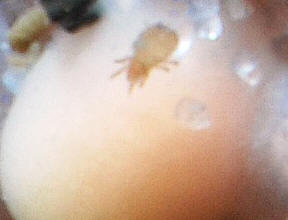
| FW Copepod? -- 05/16/07 Hi Bob, <Hello
George!> Just found this beauty in one of my tanks and I was
wondering if you know whether it is a parasitic copepod or not.
Mind you, it was found in a freshwater tank. Thanks a lot for your
help !! All the best, George J. Reclos <It does appear to be an
aquatic Acarinan... not a Copepod, but might be deleterious...
BobF> |
|
|
| Hi Bob, Thanks for your instant response. Do you
know of any ways to get rid of it ? George <Mmm, yes. In the
absence of other arthropod life, the use of an organophosphate like
DTHP/Masoten/Trichlorfon... or Dimilin. Please read here re:
http://www.wetwebmedia.com/PondSubWebIndex/contrpdparasit.htm
BobF> |
Bugs in tank 4/27/07 I have a
50 gallon tank that we fill to about 47 gallons because we have a
fire-bellied toad. Recently, I have seen tons of extremely small darker
colored bugs jumping along the surface and sitting on the tops of our
lily pads. <These aren't bugs (i.e., not Hemiptera) but some
other type of insect, most likely collembolans or some other very
primitive, moisture-loving insect.> The problem is that they seem to
really be bothering our toad because he tries to stay in the water most
of the time now. <Sounds very unlikely. Collembolans eat decaying
plant matter, and pose no threat to a toad. This is a case of two
things happening at the same time, but not actually being related.
Check water quality, humidity, whether they have enough land, scary
things like loud noises, etc.> What can I do to get rid of these
things so he will not be so miserable and what could they be. <You
can't get rid of them any more than ridding your garden of ants.
They're harmless so don't worry too much. If you truly have a
plague of them, then consider what they're eating: if there's
lots of food for them, they'll multiply; if the tank is kept clean,
they will die off or move elsewhere to find food. You have populations
of these collembolans all over the house, particularly the kitchen and
bathrooms, where it is warm and damp. At night especially they
"spring" about looking for new resources, and it sounds like
your toad-arium has just what they want.> Any help would be greatly
appreciated. Thanks, Kimberly Boling <Cheers, Neale>
Very Tiny Bugs on Water Surface 2/13/07
Hello, <Danielle> I have a 120G Amazonian community tank. It has been set up for
about a year now and is doing well. I have noticed something curious when I do a
water change: there are quite a few (30-50) tiny bugs that hop around on the
surface of the water. <Neat> These bugs are very, very, very small (less than
half a millimeter, I would guess), so small that I can barely see them and too
small to photograph for you (I tried!) - and much too small for even my smallest
fish to notice. I have attempted to catch one and look at it under my
microscope, but have been unsuccessful. <Ahh, at least a "B" for trying> I only
notice them during a water change when the surface is more than 2" below its
full level, the water is still, and my four 65W compact fluorescents are on - I
would not be able to see them otherwise. The bugs do not seem to be swimming or
in the water column. They do not walk on the surface; they just hop (and hop
quite high). <Some lessons in water tension now!> Their shape is that of
a new-model VW Bug, flat on the bottom and a slightly slanted semi-circle on
top. They have a distinct pair of antennae set at about 70 degrees from their
body; one antenna is set at about 90 degrees to the other. At first I
thought they might be dust mites, but dust mites do not have antennae. <Correct>
They are much smaller than fleas (which do not have distinct antennae either).
Have you noticed these in your tank(s)? What are they? Thank you, Danielle
<There are a few groups of "water riding" insects other than the well-known
striders (Hemiptera, Gerridae)... however... what you have here is likely
juveniles of this family... do take a look-see re... These very likely "came in"
with some of your plants... and will cause no harm. Bob Fenner> Sorry - in the
third-to-last sentence, I meant "They are much smaller than fleas..", not "much
bigger". Thank you! I greatly appreciate your efforts! Danielle <Ahh, will
amend. Thank you, BobF>
Worms In The Aquarium/Flies In The House 1/8/07
Hello, I am a fan of your site and have always been able to figure out
what was going on in my aquarium by looking at your pages but I'm
now having an issue that I can't find any info on. I seem to have
tiny worms growing in my aquarium, which eventually mature into tiny
flies. Do Planaria do this? I don't think so. I have looked around
on the web and cannot seem to find any info. A friend of mine has
noticed white spots on her aquarium, which I would imagine to be
Planaria, but she says she also has noticed tiny flies around her
apartment. I do not have white spots in my aquarium and the worms
themselves are not white, but more of a reddish brown colour. I have
already begun daily water changes and gravel vacuuming as suggested for
removing Planaria. I have also cut back feeding. Just wondering if any
of you could offer any suggestions as to what these little creatures
might be. I have actually witnessed the transformation from tiny worm,
to tiny tadpolish thing to finally a tiny fly sitting on top of the
water right before my very eyes. Any ideas would be appreciated. Thank
you for your time. Amy < There are many insects that have an aquatic
stage to their life cycle. They could have come in with the gravel,
plants or the food. The aquatic stages can all be killed with
Fluke-Tabs. This medication will kill all the invertebrates in the
tank.-Chuck>
Oscar question... insects on light lid 12/29/06
Hi, <Greetings> My name is Nicole I ran across your site while
searching for an answer for something going on in my Oscar tank. I have
two Oscars, they are both around 7 inches, I've had them for
several months. They are also in a 75 gallon tank with a bottom feeder.
The past month I have been noticing little bugs on the light lid,
inside of their tank. All of their levels are fine, I change their
water weekly sometime bi-weekly. Both of them are healthy, they eat
plenty they love each other. I just can't seem to figure out what
are these bugs, how are they there, why are they there, and how to get
rid of them. I don't want my fish to get sick. Please help me!
~Nicole M <Mmm, likely an "outside" insect... I would
simply wipe these off with a damp, plain paper towel when you see
them... They should "go" with such maintenance in a short
period of time. Bob Fenner>
Fresh water - centipede 6/10/06
I've got 35 gallons of freshwater - only a few tetras while the
tank is cycling. We had some major problems with a Molly (from a local
pet store - ugh) and we're rebuilding our tank. I've got fake
plants, no "live" rock - the substrate is a mix of aquarium
rock and river rock (long ago cleaned, boiled, soaked in water for
weeks on end, etc, etc, etc) Everything is settling down and looking
good - then I notice this centipede in the middle of my fake plants.
<!> I don't think it was a bristle worm - after looking at
all the pics of both - it really didn't resemble a bristle worm, it
looked exactly like a centipede (that and I've seen centipedes
before...) <Likely some sort of insect larvae... does it have many
legs?> It was about 1 1/2 inches long - curled up on the plants.
Colors kind of orange and dark brown or black. When I pulled it out, it
was still moving around, had the legs, head and tail of a centipede.
Tossed him out and gave a good look through my tank - no sign of any
other uninvited critter. <Good> So, where would this thing have
come from? <Might have been "laid" there... fallen in,
perhaps came as a juvenile in food..> And does it mean my tank is
not ready for new fish? Help? <Shouldn't be a factor if removed,
the system is cycled. Bob Fenner> Thanks! Rochelle
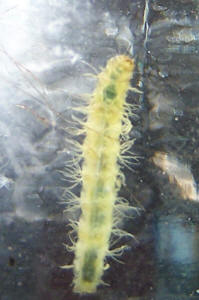
| Freshwater Sea Monster, in Miniature -
04/05/2006 Hi Guys, <Sabrina today, not much guy-like,
really> I have a freshwater tank, 175 litres of water, tropical
setup. We recently purchased a new plant and discovered that I
believe, is a bristle worm. <I.... don't think there *are*
freshwater bristleworms. I could be wrong.> <<There are
some FW polychaetes... not prominent, large, many... RMF>> I
have attached two pictures to aid in identifying this little fella.
I have read much on saltwater bristle worms but very little on
fresh water ones. I know some worms are beneficial. However I
wanted to make sure that this worm was not toxic to my fish
(Platies and angels) as they did try to eat it. The brave little
worm but up a fight and wiggled free, then I rescued him. I would
not mind him staying in tank if I could be sure that he was not
poisonous. <I've got no guarantee there, but I rather doubt
that he is.> Also the worm is approximately 2 cm by 3-4mm. Any
help in this matter would be appreciated. <This looks to me to
be an insect larva of some sort - and very cool lookin' at
that. Were it me, I'd keep him for sure. There is a minor
possibility that, as he grows, he may become slightly predatory on
very small fish (fry, etc.). I think he's just awesome enough
to be willing to wager the minor risk!> Thanks Roni & Ruth
(Geelong, Victoria, Australia) <Congrats on the very neat find!
-Sabrina, in the Santa Cruz mountains of California, USA>
<<RMF also sees these as insect larvae... may well be
predatory.>> |
|
|
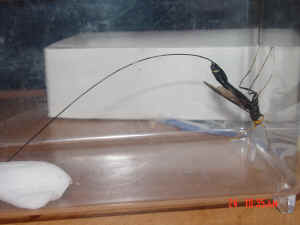
| Insect ID Hello, we don't know the name
(scientific or common) of this insect and would like to do some
research into exactly what it is. Do any of you WWM Crew know what
the scientific or common name of this is so we can study up on it?
We have never seen anything like it until we found this where we
work. The head and front legs are bright yellow and the rest of it
is dark purple. The tail is at least 4-5" long. I am sending a
picture. Thanks for any help, Jeff <Nice pic. Does appear to be
a species of Mud Dauber Wasp (Hymenoptera: Sphecidae). You can
"look up" much info., other pix with these names on the
Net. Bob Fenner> |
| Re: Insect ID Hello again, it is a wasp
then with stinger as well? <Not necessarily> I assume the
extremely long tail thing is not the stinger but is in the rear of
the insect? <Yes> I entered the name you sent in your e-mail
in ask Jeeves but am only coming up with pics of the common mud
dauber that you mention and that I am familiar with. Any more clues
that would point me to better pics with description on the web?
Thanks ever so much again, Jeff <Do try Google... and words like
"flying insect/s" and your State, general geographical
area. Bob Fenner> |
|
|
Not Mosquito larvae but what???????? are these things?
I'm clueless. I inherited a 50 gal fresh water tank with Mollies,
Gouramis, danios, tiger barbs and Corys. I've had it four years. I
had no experience and fish have survived thru no fault of my own.
Several months ago, fish store had water hyacinths. Being clueless, I
bought one. Ended up with snails but learned they are a mixed blessing,
can be controlled and no big deal. <Good> HOWEVER, the last few
times I've done water changes, I noticed the water looks like it is
snowing - hadn't seen anything like it before but attributed it to
stirred up sediment. After the 2nd or 3rd time, it just looked too
strange so I got a magnifying glass. Along with the normal gunk, I saw
these things, about 1/8" to 1/4" long and there was one today
that was 1/2". They look like white thread and snap around like
mosquito larvae but they are not. With stronger magnification, it looks
like they have razor scales along their body and some sort of head at
one end. Does any one know what these critters are? Are they a problem
for the fishes (and/or me since I've had my hands in there)? Thanks
to who ever has info to share. <I hope these are just one of a few
possible aquatic insect larvae that are harmless (look up the word
"chironomid" on the Net with Google, look at images), and not
small Odonatans/dragonflies... Here's a fave: http://insects.ummz.lsa.umich.edu:16080/~ethanbr/chiro/
Bob Fenner>
Re: chironomid-think you hit it THANK YOU for the help.
Picture I saw looks exactly what I see in my tank with magnifying
glass. <Ahh> I am ill right now so unable to read all the info,
however skimming thru it learned they are used as bait by fishermen and
thereby harmless? (Can't help wondering how they get those little
things on a hook? <Yes, harmless. In fact, often used as fish food
in places. Be well. Bob Fenner>
Chironomid-last thought and then 'over and out'
Don't try eradication, let them be and save on fish food? <I
would> Didn't know enough to think it germane mentioning 50 gal
indoor led to 600 gal outdoor. <Hee hee, this happens> Plants I
bought were grown outdoors and purchased for outdoor pool. Clueless me
took a small one and put it in house tank which explains how this type
critter got inside. <Also not uncommon... I've done this on
(from the Old English meaning "many") several times...>
Thanks again for helping me put the pieces together! <A pleasure to
share. Bob Fenner>
Tiny jumping spiders Hi, I have a weird question. I have a 48
gallon tank with 8 cichlids in there. Tetratec300 power filter, all the
water specs seem ok, but I noticed the fish seem very scared and stick
close to the bottom, they rarely swim all the way up if at all. They do
if they're really hungry and it seems they do it really quickly,
meaning, they swim up quickly to pick up the food and swim back down
quickly. Now the question is, I see some weird tiny white (clear?)
spiders, they are maybe 1mm in length, hard to say whether they're
spiders or something else but seeing one very up close I noticed it has
about 8 legs. in the beginning I thought it was just air bubbles in the
aquarium but now I'm beginning to think it's them! there's
a couple dozen of them on the surface of the water and they seem to be
jumping up and down! now if they "are" the bubbles in the
aquarium, then I have hundreds of them!!! I turned the filter off for a
little while to make sure it wasn't the water splashing and I was
right, it's tiny little white thingies jumping around!!! How do I
get rid of this, I do partial water changes every week but I guess that
didn't do anything... help me!!! < These are little springtails
and are harmless to the fish. They feed off the fish food when you feed
the fish. If you decide to switch to a wet dry filter with a surface
skimmer then they will be sucked into the skimmer.-Chuck>
Small black flies Hi, I have a 55 gallon tank with only a few
fish in it. About 2 months ago, I started seeing these little worms in
the filter when I changed it. Then I started seeing these small black
flies all around my fish tank. They were coming out of the filters!
What is this and how do I get rid of it? < Usually invertebrates are
quickly eaten by fish. If you obtained any sand, rocks or plants from
nearby waterways then the contaminants could have come from these
sources. Clean your filter often, change 30% of the water weekly and do
not overfeed your fish. A clean aquarium will usually take care of most
of these little critters. If you want to medicate the yank then try
Parasite-Clear or Fluke Tabs.-Chuck>
Gnats in the Aquarium, Mystery Answerer? I am writing you for
my mom, She is having a whole lot of trouble with gnats in her fish
tank and it is driving her crazy, she cleans her tank and even changes
the gravel very often, and nothing seems to work. She loves her fish
but she says if she can't get rid of the gnats she will have to get
rid of the fish and that is the last thing she wants to do. She has 3
cichlids in her 29 gallon tank, she has tried parasite tablets and that
hasn't worked either. Can you help? Thanks, Rachel Please reply
ASAP. < Insects in the aquarium are pretty rare. I don't thinks
the gnats actually come from the aquarium because I don't think
they have a larval stage and cichlids are pretty good at eating any
sort of insect life. If any insect/snail or worm are found in an
aquarium then Fluke-Tabs will get rid of them. >
Larvae 9/30/05 Hello again, Everything is going
well with my tanks and my Oscars, but today I found small black
wormlike larvae (it looks like) at the top of my filter cartridges,
they are at the edge of the water not really down in the water. Can you
tell me if these are harmful and if there is anything I can do with
them. I changed the cartridges, although they weren't that dirty.
They didn't seem to be anywhere else as of now. Thanks for your
time. J <Likely not harmful... and very possibly of terrestrial (out
of the tank) origin... some insect reproducing... I would do as you
have done and just rinse, clean your cartridges and remove them. Bob
Fenner> Hello again, I just wrote to you about the little black worm
like things and I just noticed some in the substrate so I guess they
are in the water. anyhow, can't wait to hear what this is. J
<Mmm, again, I would siphon these out and not be overly concerned.
No matter what their origin, it is highly unlikely they are dangerous
to your Oscars. Bob Fenner>
Strange Bugs In The Tank 12/1/05 I just cleaned
my fish tank and noticed these little silver-ish color worm type
things. I have also noticed little flying bugs by my lights. Anyways I
caught like five and put them in a container with a lid. I opened it a
hour later and there was two of the flying bugs in there what are they
and how do I get rid of them. Thanks Lindsay < There may be a
correlation between the two. The lights may be attracting the insects
that lay eggs in the water and hatch into the wormlike creatures you
are now seeing. Normally I think the fish would eat these. Add Fluke
-Tabs to the water and that will kill any invertebrates and insect
larvae and hopefully both problems will go away.-Chuck>
I know you've heard the phrase "tiny bugs" a
million times... - 03/09/2006 But I have "tiny bugs" with
oval-shaped bodies and a circular head (*maybe* 1mm in length and 1/3mm
wide - at the most!) that are either brown or black in color, have 6
(maybe 8) legs and 2 antennae (I only know because I got out a
magnifying glass), and they can't swim but they love to be on the
sides of the tank above the water and to bask in the light under the
hood and on my breeding net. <A great description - and could be
many different things. If there are any floating plants, or plants that
break the surface of the water even a bit, involved, I might guess that
these could be Aphids. Lots of possibilities, though.> They
don't look like insect larvae, though. I have a 10 gallon FW tank
with 5 adult guppies, a Pleco, 40-some guppy fry that are only a few
days old, and some small brown snails (I don't know what species of
snail, but I don't really care much either as long as they behave).
<Heh, they won't, but that's probably okay. Do be cautious
about letting them stick around.> At first I thought they were baby
snails as my snails have laid eggs, but they crawl too fast and after
using the magnifying glass and my knowledge that snails don't have
legs, <I certainly hope not!> I realized they were not in fact
the cute baby snails I thought they were. My question is what these
bugs are <Tough one> and how I can get rid of them. <Not quite
so tough.> I read pages of FAQ's on the website and you
mentioned Parasite-Clear and Fluke Tabs, but would either of these work
on insects that aren't IN the water, <Highly unlikely.> or
could either of them harm the fry? <Yes, quite possibly. I would not
risk it. These little buggies are likely of no threat to your fish or
tank. They're feasting on something (flake food particles stuck to
the sides of the tank, plants, or something else) that is keeping the
population sustained. If you can isolate whatever it is that they are
feeding on and reduce or eliminate it, you will be able to reduce or
eliminate the buggies. Um, you could also try rinsing or wiping them
into the water as munchies for your guppies.> Thank you for your
time!! <You bet!> -Jessica, South Dakota <Wishing you well,
-Sabrina, of the Santa Cruz mountains in California.>
Little Bugs At the Top of The Water 7/28/06 Hello
I have a 55-gallon community tank w/all plastic plants, angels, a
Pleco, clown loaches, and a few other community fish. Today I was doing
a water change and noticed tiny brown bugs crawling around on my
artificial lily pads. I checked and saw them jumping around on the
surface of the water. There are quite a few of them, but I never would
have noticed them because they are so small that I cannot make out
their appearance. Do you have any idea what they are, are they harmful,
Should I get rid of them and how? Thank you. Ben Berube < These
little springtails are completely harmless and usually come in with
plants or fish. They feed on the little bits of leftover
food.-Chuck>
|
|


.jpg)
.jpg)
.jpg) crop
crop