|
FAQs on Biological Filtration in Freshwater
Systems
Related Articles: Establishing Cycling, Freshwater Filtration, Know Your Filter Media, A
Concise Guide to Your Options by Neale Monks,
Freshwater Deep Sand Beds
Work by Deirdre Kylie, Setting up a
Freshwater Aquarium, Tips for
Beginners, Water Quality
and Freshwater Aquariums,
Related FAQs: Establishing Cycling 1, Cycling Products,
Freshwater Filtration, Freshwater Environmental
Disease, Nitrates in Freshwater Aquariums,
Ammonia, FW Nitrites, FW
Nitrates, Chemical Filtrants,
|
|
I need to understand Biofilm
5/18/18
Hello Crew!
<Renee!>
I think I mentioned in one of my previous posts that I was turning my 55
gallon tank into an "Eel Tank." That's done and the eels (Macrognathus
pancalus according to the supplier) are doing well. I don't know if its
because they are the only fish in the tank or if this is consistent with
this species, but they are rarely under the sand (only when I do "scary"
things like water changes - and sometimes not even then).
<Indeed; and floating plants even encourage them to hang out at the
surface. Spiny Eels do vary in temperament of course, but when care for
properly, they're not especially shy.>
They are constantly swimming around the tank and are a lot of fun. And I
don't want that to change, but I need something in that tank to eat
algae.
<I would stick with invertebrates, perhaps Nerites. Something that won't
compete for food, at least.>
The tank is older and has some scratches which seems to accumulate algae
that spreads out from there. But I don't want to put in an algae eater
for fear of it frightening the eels and driving them permanently under
the sand.
<Agreed, and again, Nerites are great at keeping glass and things like
rocks clean. They're less good for clearing plants.>
So I've been doing some research and came across a fish called a
"Rainbow Goby" aka "White Cheek Goby" (my aquarium store has one and
they're "holding" it for me until I make my decision).
<This is Rhinogobius duospilus, a temperate to subtropical species from
China. Not really suitable for tropical tanks. More a mountain stream
biotope tank.>
I read that this fish feeds on "biofilm" and my research on biofilm
defines it as "...a thin film on the surface of aquarium water, caused
by the build up of protein from organic waste material. It is the
structure bacteria build to support themselves growing on the surface
where they get access to oxygen and the material...". Is this the type
of biofilm this fish feeds on?
<Possibly. They're easily fed with bloodworms and the like, and aren't
at all fussy. Most failures will come from overheating them.>
Does this fish feed at the surface?
<Nope.>
Because the filter on this tank produces a moderate current and I don't
see how the fish will be able to eat in that current when it only gets 2
inches long.
<Oh, gobies are fantastically well adapted to living in strong water
currents.>
Will the tank ornaments and/or the sides off the tank accumulate enough
off this biofilm for this fish to feed on? The Internet says this fish
will "sometimes" accept bloodworms and such, but if I need to provide it
with biofilm that's what I want to do. I don't want to get this fish and
watch it starve to death so any information you can provide will be, as
always, greatly appreciated.
<In this instance, biofilm probably means the same thing as 'aufwuchs',
the combination of green algae and tiny invertebrates that develops on
rocks in fast-flowing habitats such as mountain streams and rocky reefs.
A combination of algae wafers, brine shrimps, bloodworms, and so on will
satisfy Rhinogobius spp., and my specimens were really rather greedy!
Cheers, Neale.>
Re: I need to understand Biofilm 5/19/18
I'm sorry, I should have been specific - the supplier lists this
fish as Stiphodon ornatus. Or is that a subspecies o
Rhinogobius spp (the Internet doesn't reference beyond Stiphodon)?
<Not heard of Stiphodon ornatus as "White Cheek Goby", but it is sold as
the "Rainbow Goby". All Stiphodon are Hillstream specialists native to
coastal streams and offshore islands around the Indo Pacific region,
used to cool, clean water with plenty of oxygen. While freshwater fish
as adults, they have a marine stage as juveniles, which means they're
difficult to breed in captivity. Most, if not all, are wild-caught.
Together these facts mean they're relatively demanding fish. They do
poorly in the average community tank, but will thrive in a steam setting
alongside midwater fish (such as Danios or White Cloud Mountain Minnows)
that aren't competing for food. Avoid mixing with benthic fish such as
loaches that tend to cause problems either by stealing food or else
becoming territorial and harming the gobies. Diet isn't a major issue
provided the tank is sufficiently brightly lit there's a decent amount
of green algae growing.
Together with green algae, they'll happily take the sorts of frozen
foods offered to marine grazers (such as tangs and angelfish) that
include Spirulina algae alongside, for example, brine shrimp. They may
take algae wafers and Spirulina flake as well. Cheers, Neale.>
Re: I need to understand Biofilm 5/20/18
Thank you!
<Most welcome. Neale.>
query in regards to filtration; FW, bio.
11/18/17
Dear sir, I got your email id from your website and request your advise
on the following I wanted to know whether biological bacteria which are
on substrate enough for my aquarium if my filter fails for any reason ?
I am asking this as I am planning to install a top filter which is kept
above the tank as I have read that it provides a better biological
filtration in comparison to sponge filters ( which I have in my tank )
due to air contact . But only thing that worries me is that in case of
current failure or power head failure the Media may dry up in couple of
hrs and my tank may lose all BB .Kindly suggest Thanking you Regards,
Raj
<Hello Raj! Thanks for writing, and for what's a really useful question.
The short answer is that in a freshwater aquarium, the gravel or sand by
itself WILL NOT provide enough biological filtration except in a very
lightly loaded tank with plenty of fast-growing plants. By lightly
loaded,
I'm talking about six Guppies in 200 litres or something like that!
Almost nobody keeps an aquarium like that, hence the answer is, 99.9% of
the time, "no". The reason is that bacteria live in and on surfaces with
lots of oxygenated water. Only the very top of the gravel, the first few
mm really, have that sort of environment. So while bacteria on the
surface of the gravel will do some filtration, it's not enough by
itself. Inside filters we have honeycomb-like sponges and things that
provide much more surface for the bacteria, and the pump ensures it all
gets lots of oxygenated water. That's why we need filters! Now, the
filter bacteria are delicate in some ways, but tough in others. If the
pump stops and the media dries out, the bacteria will stop working
almost at once. Some writers suggest as little as 20 minutes without
oxygenated water is enough for this to happen.
If the pump stops, it's a good idea to remove the media and place in a
bucket of water simply so that it stays wet, and stir and splash
periodically to ensure the water doesn't become 'stale'. This will keep
the bacteria alive just fine. Even if the media dries out, the bacteria
become dormant, and will spring back to life once they're wet. Not
immediately of course, but in less time than the typical "new tank
cycle" of 6 weeks. Hope this helps. Cheers, Neale.>
New platys... beh. in an uncycled
sys. 1/2/12
Hello I hope you can help, I have recently bought two ten gallon tanks
with gravel, filters etc... We have put the same water in and treated
it. Then left the filters on for five days before buying the platys
three for each tank, two females one male per tank. The one tank they
swim around and are active, the other all hide in the tank behind
arches and other items. We rarely see them swim even when food is put
in the tank they don't move when were about. On occasion if were
out the room and come back one may have ventured out but then
immediately hides away. Can you help any ideas or suggestion would be
greatly appreciated, we are looking forward to see the platys swimming
around. Thank you.
<Hello Tim. Hard to explain the differences here. But 10 gallons is
below what I'd recommend for Platies, and they may well simply feel
cramped. When that happens, fish act nervously, as if trapped in a
puddle too small for them. However, my money would be on a water
quality problem. How did you cycle the filters? Understand this:
switching a filter on and leaving it running in an empty tank does
NOTHING other than make it wet. There MUST be a source of ammonia for
filter bacteria to use. If you didn't use an ammonia source for 3-4
weeks before adding the fish, then BOTH of these tanks are cycling with
fish in them, and that's hardly ideal. So, you can probably assume
non-zero ammonia and nitrite levels, and these can and do make fish act
nervously. They feel themselves being "burned" by the
ammonia, but can't explain or understand what's happening
beyond the fact they feel pain. So they hide away, hoping the
"enemy" will go away. Grab a nitrite test kit, and see what
the nitrite level is. If it isn't zero, then that's your
problem. If you must cycle with fish in place, you need to do 20-25%
water changes every 1-2 days for the next 3 weeks. Feed minimally, no
more than once every 2-3 days. Only when you register 0 levels of
ammonia and nitrite for several days in a row can you switch to normal
feeding and weekly water changes. Cheers, Neale.>
Re: New platys 1/2/12
Hi Neale, thanks for your help, I added a bioactive tap safe as per the
directions.
<Yes. This removes chlorine, chloramine, copper (and other heavy
metals) and tap water ammonia (as distinct from the ammonia that comes
from your fish). This product makes tap water safe. That's
all.>
Is this what you mean when referring to ammonia?
<No. Ammonia is the stuff filter bacteria "eat". In a
mature aquarium, they consume ammonia at the rate the fish excrete it,
so the aquarium stays healthy, with a zero level of ammonia. But for
the first 4-6 weeks there aren't enough filter bacteria, so you
need to cycle (or mature) the aquarium by providing ammonia for filter
bacteria to eat. Over time, the populations of bacteria grow. With me
so far? Plain tap water contains no ammonia (usually) so we add an
ammonia source. Some aquarists add household ammonia, but a simpler
approach is to add tiny pinches of flake food, just as if there were
fish there, and as the flake decays, it releases ammonia.
Now, you have fish in the tank already, and they're producing
ammonia all the time, the same way we produce urea (which ends up in
the urine). Unless and until the filter bacteria population is big
enough to use it up as quickly as it is made, you'll have ammonia
collecting in the water. Daily water changes will dilute this, and
feeding fish less will lower levels still further. An ammonia level of
1 mg/l is lethal, and even 0.5 mg/l is enough to cause disease. Feed
less, and do more water changes, for around 3-4 weeks and you should
find the filter matures without your fish being seriously
harmed.>
I have a local pet shop which had offered to test my water
tomorrow.
Hopefully this will shed some light on the issue. Then I can start to
sort the water as per your directions, thanks
<Cheers, Neale.>
Bio-wheel from a Penguin 150 filter and persistent yellow
water in 55G FW 1/3/11
Hello WWM Crew and Happy New Year,
<Thanks!>
I have a question I would like to submit to you:
How can I preserve a mature bio-wheel from a Penguin 150 filter?
<Not hard.>
I used to have a 20-gallon FW aquarium with the
Penguin, but I upgraded to a 55G with a Cascade 700. I am temporarily
keeping the bio-wheel in a container with some aquarium water. I do not
have the capacity of keeping both tanks up, but I would love to keep
the bio-wheel alive as back up for 'hospital or QT' situations.
Should I put the bio-wheel in the 55 g aquarium as
'decoration'?
<Yes, this will work. Anywhere that keeps the media wet, oxygenated,
and exposed to an ammonia source -- e.g., fish -- will work just fine
and dandy.>
Also, my aquarium water is always yellow.
<Quite normal. Comes from bogwood mostly, and to a much smaller
degree to organic decay of plant material, faeces, etc. Activated
carbon will remove yellowing, as will regular substantial water changes
-- 25% weekly is the standard recommendation. Do remember that carbon
needs to be replaced at least every 2 weeks, and the space it takes up
in the filter isn't doing biological filtration. Under most
situations, carbon is useless, so it's best to leave the filter to
biological media, and control yellowing via water changes and/or
removal of some or all of the bogwood.>
I have Flo-Max and natural color gravel as substrate for the following
plants; Anacharis bunches, Amazon swords, Anubias, a Cabomba; 15
platys, 6 Pristella, 7 Neon Tetras, and 2 Yoyo Botia Loaches. I also
found 5 platy fries. I have several natural rocks, light brown in
color, some are petrified wood and coming from the 20 G tank
(established in November). I do a 10% water change weekly, and scrub
the walls gently; I try not to be aggressive in my cleanings. When I
test the water with Quick Dip strips these are the levels --
(approximate values as they are on a color chart):
Nitrates within 20,
Nitrites between .5 and 1
<Not good; will eventually stress, kill your fish. Must be zero! The
tank is overstocked, under-filtered (perhaps a poor balance of
biological media vs. chemical media), and/or the fish are over-fed.
Review and act accordingly.>
Ammonia is 0
Chlorine is 0
PH is between 7.8 and 8.4,
GH is 300
KH is 300 also.
I plan on using these strips up and buy the big kit from API, I am not
sure I can trust the accuracy of these strips, but the local PetSmart
assistant said the were reliable.
<They're good enough. Not as accurate as liquid kits, but easier
to use, and if sliced vertically to make two strips from one, very
economical. When it comes to nitrite and ammonia, anything above zero
is bad, so the precise value doesn't matter too much.>
Any advise?
Many thanks in advance for your input. I really appreciate your time
and input.
Sincerely Francesca B
<Cheers, Neale.>
Re: Bio-wheel from a Penguin 150 filter and persistent yellow water in
55G FW 1/5/11
Hi Neale, Thank you for your prompt reply.
<No problem!>
I suspect I tend to over-feed.
<Naughty, naughty'¦>
I will correct that and do 25% water changes instead of 10%.I also want
to compliment you and everyone at WWM for the excellent website, the
wealth of information, and the time and patience you "guys"
have for "us" newbies!
<We're happy to help. Cheers, Neale.>
|
Sharing information, FW veg. filter input, poss.
art.! 4/10/10
Crew,
You've helped me many times by providing good answers very
quickly so I thought I would share a couple things I've done
with my aquariums.
I published the pictures I have on Picasa web to save space (your
welcome to use them if you like).
<I've put the link at the end of this e-mail.>
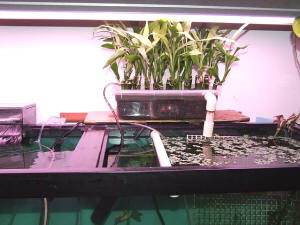
The pictures of the plants are lucky Bamboo in a little plastic
tub on the back of the tank. I cut a hole in the tub and made a
drain using PVC, potted the plants in aquarium rocks and found a
cheap little 20gph pump ($15) that pumps water to the tub through
plastic airline. I clean it about every six months by pulling out
the plants and cleaning all the algae out of the rocks and after
two years these plants are still doing quite well. I've read
that Lucky Bamboo, which isn't really Bamboo, likes nitrates
but even if it that's not true it still looks pretty cool.
Lucky
Bamboo, at least in my area, is usually expensive but I found a
web site and got everything you see delivered to my door for
$20.
<Essentially what you've created is a vegetable filter,
quite widely used to clean ponds. Fast-growing plants do indeed
absorb nitrate as well as ammonia, so they can do a good job
keeping water clean.>
The other pictures are of a common whole house filter ($20)
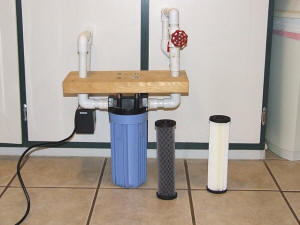
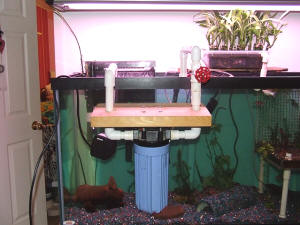
mounted on a 2x6 with a couple bicycle hooks, PVC pipe and an
adapter so I can attach and remove a 500gph pond pump ($40). I
hang this over the tank, put a 20
micron pleated filter ($1) in it and stir up the tank and let it
filter out the particles. If I have an algae bloom, rather than
using chemicals I perform a 20-30% water change and put a carbon
filter in the canister ($5) and it clears out the tank in about
an hour.
<A cheap alternative to a diatom filter, by the sounds of
it.>
Tim
http://picasaweb.google.com/bachmant/AquariumIdeas?authkey=Gv1sRgCPC82fO7oIT60QE&feat=email%3E#
<Do consider putting together a more step-by-step article on
these two ideas for 'Conscientious Aquarist'. Take a look
at these examples, here:
http://www.wetwebmedia.com/ca/volume_6/volume_6_1/algae.htm
http://www.wetwebmedia.com/ca/volume_6/volume_6_3/refugiums.html
http://www.wetwebmedia.com/ca/volume_7/volume_7_1/dsb.html
Instructions and what we pay are here:
http://www.wetwebmedia.com/ca/volume_6/volume_6_1/Author_Inst.htm
Cheers, Neale>
|
  |
|
Re: Sharing information 4/11/10
I will probably give it a shot.
<Cool.>
One of the articles was about fresh water sand beds and I'm
curious you guys think this is a good idea?
<It can work, certainly.>
I'm trying to come up with a way to lower nitrates without
water changes and before this sand bed idea I was thinking of
creating my own canister filter using a low flow rate and Seachem
Matrix.
<Can't see this working. Water flow wouldn't be slow
enough, in my opinion.
The point of deep sand beds is that water movement is extremely
slow, essentially marginally above diffusion rates.>
I'd love to your thoughts on these and any other ideas for
removing nitrates.
<In freshwater tanks fast-growing plants, especially floating
plants, are the easiest approach. In some cases a DSB may be
relevant. But in most cases simply doing more water changes is
the most cost effective approach.
Unlike the case with saltwater tanks, making water for freshwater
tanks isn't expensive, and exposure to small water chemistry
changes aren't as big of a deal, so water changes are cheap,
safe and easy.>
Thanks,
Tim
<Cheers, Neale.>
Re: Sharing information, FW filtr. art. poss. --
4/12/10
Now I'm wondering if a DIY coil denitrator is a good way to
go. The main problem is the amount of different information about
them.
<Do read here:
http://www.wetwebmedia.com/denitrification_erfaqs.htm
While this is about saltwater applications, the basics are the
same for a freshwater version.>
They seem pretty simple to make but I don't know if they need
to be feed at all and is there a danger of it going bad and
poisoning the tank.
<Not if built, operated, and maintained correctly.>
I know I can keep doing water changes but it's fun trying to
see if I can make a system that will complete the whole nitrogen
cycle itself.
<Not really practical so wouldn't think this way. Water
changes *are* the way to control nitrate in freshwater systems.
Fast-growing plants can also make dramatic reductions in nitrate
level by direct absorption. Asking for
ideas "outside" of water changes and plants is rather
like saying other
than eating less and doing more exercise, how can I lose
weight?>
So outside of recommending water changes which (if any) system
for removing nitrates do you think would be the best and the
safest, deep sand bed, Denitrator or something else.
<DSBs and porous rocks -- what are called live rock in marine
tanks -- have been proven again and again to be the easiest and
most cost-effective ways to close the nitrogen cycle in marine
tanks. But even there, water changes
are essential. Plus, don't forget that nitrate removal is
only part of water changes are about. Water changes also restore
carbonate hardness, dilute organic acids, remove tannins, reduce
phosphate, and supply trace minerals. If you want to spend your
money on something, then consider reducing the nitrate content of
the water going into the tank.
This can be an RO system for example, or a rainwater butts under
the gutters to collect mineral-free water at zero cost. Either
way, mixing nitrate-free water 50/50 with hard tap water is a
great way to create water ideal for a wide variety of fish
species. I use rainwater mixed with tap water in precisely this
way.>
If you happen to recommend something and know of a good DIY link
that would help a lot.
Thanks again for being out there to help us amateurs
Tim
<Cheers, Neale.>
Re: Sharing information -- 4/12/10
Thank you. I still expect to do water changes but a little less
often.
<With freshwater tanks, you're likely to find the
cost/benefit ratio makes little sense.>
I live outside the city water supply and am lucky to have a well
with 0 nitrates and no other chemicals added. I think I will work
on a coil denitrator and more plants.
<Fast-growing plants, or better still algae, can work
extremely well for "closed" systems. Do see for example
'Dynamic Aquaria' for discussion of algae scrubbers. In
theory and to some extent in practise, you can create
lightly stocked aquaria where the only thing you do is add water
to compensate for evaporation. In general though, such tanks are
so expensive to set up, and contain so few fish, that they're
worthless to hobbyists.
With that said, the benefits to be gained from a clump of Indian
Fern growing rapidly under bright lights is substantial, and a
sump that turned into an algae scrubber would be even better. Do
see the marine literature on the use on these items, for example
here:
http://www.wetwebmedia.com/ca/volume_6/volume_6_1/algae.htm
http://www.wetwebmedia.com/nutrientcontrol.htm
>
Thank you again,
Tim
<Cheers, Neale.>
|
pH effect on nitrifying bacteria 3/28/09
I'm setting up a Malawi cichlid aquarium.
<Very nice!>
I intend to inoculate the tank with sponge filter media from a
friend's aquarium to begin the cycling process.
<Excellent idea.>
My friend keeps South American cichlids, and his aquarium pH is about
7. My aquarium water (tap water) is about 7.8 and is hard.
<Nothing to worry about.>
I've read that the bacteria may not survive substantial changes in
pH when transferred from one system to another.
<Yes, this is true, but if you acclimate the media just as you'd
acclimate fish, you'll be fine. In other words, put the media in a
bucket and just-cover with water from the South American aquarium. Over
the next, say, 30-40 minutes, add a cup or two of water every 5-10
minutes until the bucket is filled. When it's done, that's it!
Move the media into your filter, and off you go. As ever though, do
take care to check nitrite or ammonia in the days thereafter, and stock
the tank slowly, taking care not to overfeed.>
Should this be a concern for me? If so, can you suggest how I could
handle the transition? (I don't know anyone with an African tank
who could help me.)
Many thanks.
Les
<Good luck, Neale.>
Bacillus Bacteria filtration? 9/27/08 Hello
crew, I was reading the following article http://www.wallaquariums.com/cycling.htm
and they strongly encourage the use of something called Fritz Zyme #360
Gravel Cleaner. I've done some research on this product and the
bacillus bacteria, and I was hoping to get an opinion from a trusted
source. I'm brand new to this, and I'd prefer not to get
"taken" if I can help it. I have a 55g FW tank that is
currently home to 4 apple snails. Soon, I will be adding 5 Xenopus
froglets. (I will have 7 froglets but two of them will be in their own
20g tank). Anyway, as you are probably already aware, both the snails
and the frogs. well..poop. A LOT. In the interest of maintaining a
healthy environment where all life can thrive I've tried to
incorporate many layers of filtration. Right now I have a Lustar IV
Hydro Sponge filter in the tank, and an Aquaclear 70 HOB filter on it.
My plan is to, once the tank is stable (it's still cycling), remove
the Aquaclear, and just have the sponge filter running (I'll be
stacking it, though, so I'll have an extra sponge in case I need a
Q Tank at some point). I also have some plants coming that I will be
adding to the tank. I will have driftwood planted with Anubias, and
Limnobium spongia floating at the surface. I have a gravel vac and do
the regular recommended weekly vacuuming and water changes. I was just
wondering if a product like this would help me in keeping the water
quality in check between weekly cleanings. I really hope this isn't
addressed already, I used the search feature on your site and
couldn't find anything. Also, I really would appreciate an opinion
from the crew. Dr. Monks and Mr. Fenner have already been so helpful,
and this site is such a wonderful source for impartial information.
Thanks so much. Laura <Laura, by all means experiment with
filtration methods. All that really matters is that you have a system
offering upwards of 4 times the volume of the tank in turnover per
hour. That's the key factor as far as nitrogenous wastes are
concerned (ammonia, nitrite). Solid wastes are different. Solid waste
(faeces, dead plant leaves, general debris) aren't toxic as such,
and removal is more a question of maximising water flow through
mechanical media. For that, the best approach is to use some type of
canister filter; air-powered devices lack the "suck" to do
the job adequately. Virtually everything else offered -- sludge
removers, gravel cleaners, filter aids -- are pretty much snake-oil
remedies for problems that wouldn't exist in tanks where adequate
mechanical filtration was installed to begin with. In a tank with
strong water current, all the solid waste will either go into the
filter or else collect in one corner where the substrate is
deliberately kept lower than the rest of the tank (usually at the
front). During a water change, you just suck out this debris, and of
course clean out the mechanical media in the filter every few weeks.
Properly maintained, the gravel in an aquarium should honestly go years
without needing cleaning, particularly if you install some Malayan
livebearing snails to circulate the substrate and break down organic
wastes. For what it's worth, in the tank where I keep a Panaque
catfish -- a species that eats wood and produces sawdust as its waste
product -- I have filters running at 8-10 times the volume of the tank
in turnover per hour. Cheers, Neale.>
Re: Bacillus Bacteria filtration? Thanks so much for the tips, and I'll
check into those snails and canister filter. Laura <Most welcome. Cheers,
Neale.>
Re: Bacillus Bacteria filtration? Follow up
questions.. 9/27/08 So, I'm a little confused..
Should I use a canister in addition to the sponge filters in the 55g
tank? <If you are concerned about solid wastes, then sure. But does
all rather depend on how messy these frogs are. In a 55 gallon system I
can't imagine half a dozen frogs will be a big deal really. Slope
the substrate, and with luck detritus will collect at the bottom of the
slope. Siphon out waste as required (or even use a turkey baster as a
pipette.> (not very attractive in my tank) :-( .. But I know that
the frogs are sensitive to turbulence, so I thought if sponge filters
would do the work and minimize the turbulence, so much the better...
BUT if a canister filter will do all that then... This is tough.
<No, not really. Set the thing up with the frogs and the sponges.
See how things go. If it doesn't work out, add a suitable
canister.> On the one hand I want to create an environment that will
make for happy, healthy, and thriving, plants and animals. On the other
hand, there are budgetary and space considerations. And along those
lines, a giant sponge filter in my tank definitely cuts down on the
swim room available for my frogs. <Agreed; does depend on your aims.
As stated, I'd go with the sponges or even an undergravel filter if
budget is tight.> But a canister filter, definitely cuts down on the
room in my budget. How are canister filters in terms of turbulence?
<Depends on the size of the filter!> What do you think? Thanks.
Laura <Cheers, Neale.>
Re: Bacillus Bacteria filtration? Follow up questions.. --
09/27/08 Thanks for simplifying. <Happy to help.> One of
the tads got an ARM today. <Ooh!> Too exciting! <In a Gary
Larson sort of way, yes, I guess sprouting an arm would be... Cheers,
Neale.>
BGK Problem... FW over and mis-stocking issues, no
reading -08/25/08 We have a 55 gallon freshwater tank that has been
set up for about three months. We have 3 discus, 4 swordtails,
<Mmmm, "like" very different water conditions...> 4
clown loaches, 1 Pleco, 6 balloon belly tetras, 6 t-bone tetras, 1
elephant nose and 1 black ghost knife. <Not generally a good idea to
mix weakly electrogenic fish species> The BGK and elephant nose were
purchased together and were the first fish introduced. The BGK was
about 3" when purchased and he is about 5" now. We added the
other fish gradually. We do a 25% water change weekly. We are figuring
out the feeding thing, and know we've been feeding too much,
because of the water levels. Before we did the water change yesterday
the levels were: PH 6.8, Ammonia 0.10, Nitrite 0.10, <These are
toxic...> Nitrate .40. <Likely you've misplaced the
decimal... forty ppm... is way too much> Last week when we took our
water sample to the fish store, we were told the water levels were
fine, except the ammonia was a little high. <Any ammonia is reason
for immediate action. Debilitating to deadly poisonous> That, also,
was before the water change. All of the fish have been doing well,
except for swordtails, which were dying, one each day, for no apparent
reason. <... do some reading... the "reason" is
obvious.> It looked as though they were being picked on by other
fish, because their fins looked very ragged. 8 have died. 4 remain, so
we are done with swordtails for now (replaced them with the clown
loaches). The BGK was doing fine until a few days ago, when I noticed
that the white stripe on his head was pink. The next day it seemed even
pinker, but he was still eating aggressively and chasing other fish if
they came too close to his "house". Today I noticed that he
has a worm-like thing hanging from his chin/throat underneath. It looks
like a Tubifex worm. He isn't eating much, and is pretty much
staying in his house when we feed them. However, his pink stripe is
lighter, looks like it is turning back to normal color. We give the
fish live Tubifex worms, frozen brine shrimp and frozen blood worms.
Pretty much worms every day and alternate with the shrimp and blood
worms. We sometimes give them flake food. Can you help diagnose the BGK
or tell me how to help him? Thanks so much... Jere <All you need to
know is archived on the WWM site... Your system is dangerously
over-stocked... Start reading on WWM re Nitrogenous issues:
http://wetwebmedia.com/FWSubWebIndex/fwmaintindex.htm the third tray
down... Acting on this knowledge should save most of your livestock...
Then read re each species/groups needs ("Systems")... Then
we'll chat. Bob Fenner>
Re: BGK Problem 8/26/08 I guess you can tell
I'm a novice, huh? After the water change, the ammonia was down to
zero. <Ah, good> Today the BGK looks back to almost normal. The
white stripe is a little off-color, but that weird worm-thing is gone
and he has resumed eating. We haven't had any fishy deaths for
almost two weeks, and the only ones that died were swordtails. <Mmm,
you really need a much larger system... actually two...> I really
appreciate your answer, and I plan to keep reading your Web site. I
have been all over the Internet searching sites on aquariums and fish.
I found so much conflicting information, that I was at my wits end.
Then I found your site, which seemed much more consistent and extremely
informative. I will continue my research in your archives. >Very
good< The fish store where we bought the fish will buy back fish as
long as they are healthy. We sold them four beautiful silver dollar
fish when we bought the discus, because they told us the two didn't
mix. The discus are still small, so we'll probably sell back more
of our fish as they grow. I am in love with this hobby and my fish. I
don't want to kill any more fish! Thanks again for your answer.
I'm impressed with your expertise. <And I with your apparent
even-mindedness. Cheers, BobF>
Maracyn Treated Tank 7/22/06 Hello...
<Hi> I have added Maracyn to cure a supposed gill disease in my
29 g fw tank. I pulled out the carbon, and noticed my water
is getting foggy. Is this common for this broad spectrum.
antibiotic? Thanks! Jenn Tony <The tank is getting
cloudy because it is recycling. Most likely the Maracyn
nuked your biological filtration. The cloudiness comes from
the unprocessed biological materials and to some degree the
recolonizing bacteria.> <Chris>
Biological
Filtration - 2/21/2006 Please confirm I am correct here, for
biological filtration I only need a piece of seasoned sponge ?. <
No, a seasoned sponge filter like Hydrosponge.> Can this float on
top, or do I need some weight to have it on the bottom of the tank?
< The Hydrosponge filter is hooked up to an airstone and is already
weighted in the bottom. Just hook it up to an airline and you are ready
to go. Place it in an already established tank for a month and pull it
out and place it in the QT tank when adding new fish.> This would
suggest there is nothing else in the tank, except some PVC pipe and a
sponge. < A sponge filter and a heater.> The reason I thought the
internal filter was suitable is because it provides mechanical,
biological filtration, and also good water movement for airflow. <
By definition, any filter placed in an aquarium is an internal filter.
It can be as simple as a sponge filter or as complicated an internal
powerfilter. For QT tanks I think the simpler the better.> What is
the difference between a outside power filter, please can you quote me
a manufacturer and model #, and a canister filter? <An
outside power filter would be like an Emperor that hangs on the back of
the tank by Marineland. A canister would be like a Magnum 350 by
Marineland. It goes under the tank and is connected to the aquarium
through a couple of hoses.-Chuck> Regards Alan Dalgarno
Question about rinsing bio filter media with tap water
8/29/05 I have a question. I set up my 29 gal tank almost 4 weeks
ago. I have 3 albino Corydoras and 3 blood fin tetras. All of them seem
to be doing fine so far (have had them for about 2 and 3 weeks
respectively). I did not know at the time, but I had what seemed as an
excess of calcium, so besides doing a water change, I rinsed my bio
filter under tap water (slightly) because it was all covered with this
white stuff (that was all over the water, ornaments, etc). I read later
not to do that because it kills the good bacteria. <Mmm, yes... at
least not to do "so thoroughly", particularly in a newly
set-up system> I asked somebody at Petco and they told me this
bacteria should build back on. I want to know if this is true and how
long it should take more or less. <Is so, a few weeks> I also
have a carbon filter of course. I have had ammonia levels of 1.0 ppm
pretty much since I set it up. <Dangerous> My nitrates were
pretty low, almost zero since set up, as well as nitrites. I tested
today (had not tested for about 5-6 days) and my ammonia is the same
still, but my nitrites went up as well as nitrates, although nitrates
are in the safe level still. I want to hear your insight about this,
about the cycling of my FW tank, and so on. <Please read here:
http://www.wetwebmedia.com/FWSubWebIndex/fwestcycling.htm and
the linked files above> I feed my fish very little twice a day, but
I am going to start feeding them just once do to the spike in nitrites
as well now. Please let me know, I am not sure where and when to look
for my answer. I had written an email a few weeks ago but can't
seem to find the answer for it anywhere in the website. It was about RO
water among other things. Thank you for your time.
- Zeke - <Read on my young
friend. Your good, discerning mind will see you through. Bob Fenner>
Powerless FW Tank in Australia 7/27/05 Hi from Australia.
I'm sorry if my questions have been answer in previous submissions
(I tried to use the search tool but couldn't find one that
matched). I have a 60L (15 Gallon) tank that was going great guns until
Monday when we had a power outage. I now have levels of Nitrite that
are off the chart, I understand that my tank now has to be cycled but I
don't know how to go about it with a tank full of
fish. I have 4 Bristlenose catfish and 7 Corydoras
trilineatus. I am fairly new to keeping fish (I have only had fish for
8 weeks) but I have since learnt that while cycling I should do
frequent water changes but leave the gravel alone as the good bacteria
can live in the gravel.. Is this correct.? <The bacteria that break
down the fish waste require oxygen. Many times after a power outage the
oxygen level drops and fish/bacteria suffer. When power is returned it
may take awhile to get the aquarium to recover.> and how often
should I do the water changes? < Check the water for ammonia and
nitrites. Both should be zero. If you are getting readings then you
need to reduce the concentrations by diluting the water or by adding
BIO-Spira from Marineland. Nitrates are less toxic and can go up to 25
ppm before a water change is required. But the tolerance to nitrates is
dependant on the species.> After the power outage I have since done
the following washed out the filter, done 2 20% water changes, removed
the plants and when I do the water changes I add cycle (promotes
bacteria) and Tetra Aqua Safe which removes Chlorine, Chloramine and
heavy metals. Is there anything else I should be doing? < The plants
absorb fish waste. keep them in the tank under good lighting to help
reduce nitrates, etc...> Thank you very much in advance for your
help :) Tash P.S I have since invested in a battery backup air pump.
< You have become a smarter aquarist already.-Chuck>
NNR in freshwater? Hi Bob. <Hello Gustavo> I wonder if
somebody already used the principle behind NNR in freshwater systems. I
mean deep sand bed (1-2 mm size), good water flow etc. <Does
work> The thing is I am reading and learning before setting my first
freshwater system, planted with discus and a few other compatible
fishes, but I own a reef system that really works very well with NNR
plus heavy skimming. Do you have information about it? Thanks in
advance Gustavo <Will, would take me some time to look up actual
supporting data, but natural hypoxic/anaerobic nitrate reduction does
indeed occur in such conditions in freshwater habitats. Bob
Fenner>
Too Much Bio Filtration?? Hello crew, I have a freshwater
setup 55 gallons. I have a Fluval 404 but I don't need or use
carbon in the system (it is a planted tank). I'm wondering if there
is such a thing as too much biological filtration? In other words if I
fill the 4 trays with only biological media, will this have an adverse
effect on the bacteria colonies. Will they out-compete themselves for
ammonia/nitrates and meet their demise? Thanks <You can never have
too much bio filtration. The size of each of your colonies will adjust
up and down to your bio load. It's a great thing to have the amount
of ammonia/nitrite be the limiting factor in their size. Four small
colonies will adjust up very quickly should an ammonia spike happen.
Don>
Cleaning Bio Media/Vacation Feeding Hi. I have
some questions about cleaning the biological filter material. Am I
supposed to wash the biomedia every once in a while? When should I
replace the old media with new one? I have two Firemouths (1.5
inch) and a gibbiceps (2 inches). I am about to leave for 5 days and I
can't get anybody to take care of my fish. I don't know how to
get my fish fed during my absence. If I use a feeder, much of the
food would sink to the bottom, as the Firemouths can consume only 1
pellet at a time. Moreover I would not be able to set the feeder up, so
that a proper dose is distributed each time. It always happens that the
Pleco's pellets drop all at the beginning (and polluting the water)
or clog the feeder's exit, leaving no food to pass through. In
every way feeders have many serious drawbacks, according to my
experience. Should I use those food tablets that last for a week and
dissolve slowly in the water, or would it pollute the water a lot? Is
it too much to leave the fish without any food at all? <You should
never clean or replace the bio media. If this is a sponge that gets
clogged, swish it around in some old tank water after a change. Never
rinse under the tap. The chlorine will kill the bacteria. To replace or
clean it would require you to recycle the tank. For a five day trip I
would just feed them well for a day or two before hand and not worry
about it. They will be hungry, but alive and healthy, when you get
home. Don>
Bouncing Bio Wheel Here I am resending this email.
Oh and by the by, all my ammonia issues have finally resolved
themselves! <Great. Probably the number one killer of fish. Bio
filtration is very important> Greetings, and my deepest thanks for
ANYTHING you can help me out with. Ok, so here's my issue, but
first, I'm sure you will want to know all about my tanks, and such,
(although that isn't terribly pertinent to my question). I have two
ten gallons (I'm 16 and I baby-sit, so my income is hilarious,
otherwise I'd have 55 gallon tanks or something) one of the tens is
filtered with a penguin bio wheel mini, and the other, has two of these
absolutely dirt cheap box filter thingy deals. And up until recently
the cheapo filters had run for a year, with no fish killing
problems. One of the tens, houses about 10 or 15 Dalmatian lyre
tail molly fry, which are almost a month old. And to be brutally
honest, I have no idea why they are still alive, and apparently
thriving. Crazy ammonia levels have forced me to perform water changes
just about every other day, which I fear is only sending the
ammonia/nitrate/nitrite cycle dealy even more out of whack. <Your
work at water changes are why the fry are alive. Water changes will
slow, but not stop, the establishment of the bacteria needed to cycle.
I would suggest a simple change here. Replace the boxes with sponge
filters. Since there is no floss to replace, bacteria will continue to
thrive in the filter rather them be thrown away when you service the
box. There is no real need for particle (floss) or chemical (charcoal)
filtration if you do partial water changes as needed.> You'd
think that would be my problem, but it isn't. Moving along to the
OTHER tank, all of ITS issues started, when I started switching the
filter's around in the different tanks. I moved the bio-wheel from
the now-molly fry tank, to what I christened the Death Tank, so that
the babies wouldn't all get sucked up into it. This of course, left
the fry tank filter-less, so I put the two box filters in there.
Well, unfortunately, in the past week or so, I've switched them
around again, because the fry are big enough to NOT get sucked up and I
want them to have the nicer filter because they are oh-so endearing.
Gosh, I'm really sorry to whoever is reading this, I realize
it's long and confusing but please bear with me. So, here's
where the question comes in: Because my death tank seems to have
un-cycled itself (and by that I mean, the ammonia which had previously
been flawless, is high, and who the heck knows what the nitrate and
nitrite are even doing?!)... <You should be testing for nitrite and
nitrate, not just ammonia. Very important> ...fish have been
succumbing to these stresses and developing illnesses. A week ago, one
of my cherry barbs (which I've had for a year-ish) decided to get
dropsy. He looked hilarious, but it ended sadly, when after treating
with some Jungle Fungus stuff in conjunction with Jungle Parasite
stuff. (I'd read it could be either, although I'm not sure my
diagnosis was correct.) He died. Yesterday, I started treating my death
tank for Ick. <Most bloating is caused by an internal bacterial
infection. Fungus and parasite meds would be of little use. A medicated
anti bacterial flake food may have been a better choice. Even a good
wide spectrum antibiotic in the water may have been better. And why are
you treating for Ich? First, you make no mention of white spots on the
fish. Second, you already treated for parasites. Do not treat unless
you need to> Here's the part that I simply don't
understand: For all of these medicine's I've been using to
treat my cursed tank, they say to discontinue carbon filtration, which
with my set-up, is all the mechanical filtration I've got. So what
I've been doing, is putting the box filters into the fry tank,
which has remained untreated, putting the bio-wheel filter into the
death tank, which I first take the filter pad out of, because of
course, it contains carbon. No wonder my tank is so screwed up!
Can the bio-wheel alone handle the filtration of 1 female Betta, two
adult mollies, and two barbs? I sort of doubt it. <There are three
types of filtration. Particle filtration simply removes any junk
floating in the water. Any waste or old food that hits the bottom will
usually stay there until removed with a gravel vac during water
changes. This is less important than most people think. A good water
change schedule removes far more junk than even the best filters. The
second type of filtration is chemical. Usually done by adding charcoal.
You only need chemical filtration if you are trying to remove a
chemical, such as at the end of a med treatment. You can simply cut the
black plastic cage on the filter insert and shake out most of the
charcoal. The third, and by far the most important, is bio filtration.
This is establishing a bacterial colony to convert the ammonia produced
by the fish into nitrite, then finally nitrate. Most of the bacteria in
your system lives on that bio wheel. It must be considered as if, and
treated like, it was alive. In fact it is, with millions of lives
working to keep your fish alive. When you start moving bio wheels
around you may stress or kill the colony. Also, antibacterial meds will
nuke the colony. That's what causes the ammonia to spike. Please
read here on establishing FW cycling. http://www.wetwebmedia.com/FWSubWebIndex/fwestcycling.htm>
Could you possibly tell me how in the world I'm supposed to keep
the tank clean, while medicating it? Any light you can shed on this
would be greatly appreciated. <Stop all treatments and work towards
re establishing your bio filtration. If you do treat you must do water
changes to correct ammonia or nitrite spikes, replacing the med with
each> Thank you so much again, I'm sorry this is so long. <No
problem. Don>

