|
FAQs on Freshwater Aquarium Water
Hardness/Softness
Related Articles:
Water Hardness by Neale Monks,
Water Softness by Neale Monks,
A practical approach to freshwater aquarium water chemistry by Neale Monks,
pH, Alkalinity, Acidity & You! by Bob Fenner,
Treating Tap Water,
Freshwater Maintenance,
Frequent Partial Water Changes,
Establishing
Cycling, Freshwater
Filtration, Setting up a Freshwater
Aquarium, Tips for
Beginners,
Related FAQs:
Rift Valley Salt Mix,
Freshwater pH, alkalinity, acidity,
pH, Alkalinity, Acidity 2,
pH, Alkalinity 3, pH, Alkalinity 4, & FAQs on:
FW pH/Alkalinity Science, pH/Alkalinity Measure, pH/Alkalinity Adjustment, pH/Alkalinity Products, pH/Alkalinity Anomalies/Fixing, FW H2O Quality 1, FW H2O Quality 2, Aquarium Maintenance, Treating Tap Water for Aquarium Use,
pH, Alkalinity, Acidity, Nitrogen Cycling, Establishing Cycling 1, Ammonia, Nitrite,
Nitrate, Freshwater Algae Control, Algae Control, Foods, Feeding, Aquatic Nutrition, Disease,
|
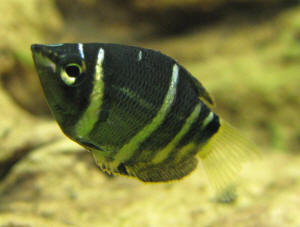 Some livestock really appreciates softer water.
Sphaerichthys osphromenoides pic by Sabrina Fullhart.
Some livestock really appreciates softer water.
Sphaerichthys osphromenoides pic by Sabrina Fullhart.
|
High ph and low kh 12/23/19
My tap water is ph 9.6, the official listed value on
the water department website is 9-9.5. It's buffered to this
level by soda ash.
<? Am wondering why the pH is raised so high by your municipal dept. And
using sodium carbonate for the purpose. Do you know?>
The kh is low, 4 degrees on a liquid kh test and .2 on a conductivity
meter.
<... am surprised that the agency wouldn't use/avail themselves of
calcium compounds... to save their plumbing?>
Is there any way to raise the kh without raising the ph?
<Yes; you can/could simple sodium bicarbonate (Arm & Hammer and such
baking soda will do) along/WITH an acid buffer (DO THIS outside the
aquarium; i.e. pre-mix and store such made up water in advance of
introduction/use in biological systems). Alternatively... oh, I see you
ask below>
The water is intended for Tanganyikan cichlids.
Is 100% RO water with buffer and salt the only option to make this water
usable?
<THIS is one way; and perhaps the preferred for your use... Have you
read Neale Monk's piece on making/using "Rift Lake Salts" on WWM?:
http://www.wetwebmedia.com/fwsubwebindex/fwh2oquality.htm
Do please do so.>
Or is there some mix of tap and ro water plus buffer that will work?
<Would depend on other ionic make up in your source water. Definitely
worth investigating, trying out various Calcium and Carbonate,
Bicarbonate buffers IF you're using a bunch of water. IF only a few tens
of gallons a month, I'd mix the RO and Neale's salt-blend>
Thanks for any information.
<Glad to share. Bob Fenner>
Re: High ph and low kh 12/23/19
The water department website says the ph is raised to prevent leeching
from old (lead) pipes.
<Ah yes; then they should be working on switching them out>
I will try the buffer method, the tank is 65 gallons and I would like to
change 25 gallons per week.
Seems like a lot of ro water but I dont know, maybe that is a reasonable
amount to have to use weekly.
<Some folks advocate for smaller amounts more frequently. I change out
20-25% of my freshwater in my systems weekly. BobF>
Re: High ph and low kh 12/24/19
I've heard that high kh water will crash and then rebound back up if you
try to lower its ph, but dont remove its kh.
<Mmm; well; depends on what (chemical species) are elevating pH... once
buffering at a given (pH) level is diminished/reduced, pH may drop
(precipitously)>
If I use ph down along with the ph and kh increasing buffer will the ph
hold?
<Likely so... you could ask the chemical composition from your municipal
supplier, or have it checked out by an independent lab... or do a
"assay" yourself (which is what I'd do), and mix up all, let stand for a
few days (in a chemically inert container).>
I want to lower the ph from 9.6 to 8.5, not just keep it from going past
9.6.
<I understand the first, and barring the addition of something w/ a
higher pH, it should not go higher. BobF>
Re: New rainbow fish won't eat... Now GH, test kit
11/3/19
Hi again Neale, The gh test kit just doesn't work. It only goes to
yellowy then orange and will not go to green. I dont know why
<Not sure I can help you here! Consult with the manufacturer, maybe?
I've already suggested the JBL Easy Test 6-in-1 test strips as cheap
and easy to use, and they're the ones I tend to recommend. Cheers,
Neale.>
Re: New rainbow fish won't eat 11/3/19
I added 50 drops and it just stayed this orange color so the gh must
be really high right?
<I don't know; I don't know your test kit or how it works. Read the
instructions, and go with those.>
Though the test strip on the other one didn't really change. Kinda
feels like im wasting money at this point because I keep buying
different stuff to test it and nothing works.
<Perhaps, but fishkeeping is an imperfect science. Identifying
diseases by email is tough, and you wouldn't expect a vet or doctor
to work that way.
Test kits are generally reliable enough to give ballpark answers,
but if used incorrectly they won't be so useful. Medicines will
treat the diseases they are designed for, but random usage is
unlikely to work out well, and they do nothing for a misdiagnosed
disease. Fish mostly stick to the descriptions in fish books, but
some specimens will be more or less hardy than suggested, just as
they may be more or less aggressive.>
The other strips seemed like it was between 0 and 25
<As we have discussed before, general hardness needs to be in the
"moderate" to "high" range for Guppies (and Rainbowfish) to stay
healthy.
Deviations from this will lead to sickness and failures. Cheers,
Neale.>
Re: New rainbow fish won't eat 11/3/19
Hi again Neale, I was wondering what it means if the gh test started
yellow then went more orange and stayed orangey after 50 drops? (I
gave up) is that really gh? Or defective tester? I think its new tho
<I know nothing about your test kit. What I would suggest, simply
because it's the easiest approach, is to take a water sample to your
local aquarium shop. Bring your test kit with you, if you want. Have
them test the water (ideally, using your test kit) so you can see
what happens. Any decent aquarium shop would be happy to do this.
Cheers, Neale.>
Re: New rainbow fish won't eat 11/3/19
<<But by way of a PS; don't ask them to diddle around with test kits
during peak business hours for them (e.g., Saturday mornings) but
during more quieter times when they have staff to spare. Neale>>
Water softened by potassium chloride safe?
2/18/18
Hi guys!
Is water that has been softened by a water softener system that uses
potassium chloride safe for a light to moderately planted freshwater
tank?
<Mmm; depends; mostly on how "softened" the water has been, with the
exchange, addition of sodium here. What is the make up (GH, KH) of your
source/tap water?>
Presently I've been using water from my RO system and remineralizing
with SeaChem Equilibrium to bring the gH up to around 7 degrees and
buffer it to pH of 6.6. I have Columbian tetras and other softer water
fish. It's a
rather tedious process making up water for water changes using my
kitchen's RO system which is painfully slow. I have heard conflicting
information on safety of using water softened with potassium chloride
and was curious
what your thoughts were on the topic. It would make collecting water for
water changes so much faster since I could take it from the tap but I'm
all about keeping my fish healthy.
Susan
<You can either get/use a sodium test kit (which will give you a
value for K conc.), have someone else test for...
or do the bio-assay bit of just trying/using the softened water. Bob
Fenner>
Re: Water softened by potassium chloride safe? 2/19/18
Hi Bob!
<Hey Sus>
My source water from my tap (believe it or not) is basically RO with
Chloramine added.
<... where is the hardness coming from?>
That is the purification process our small water treatment plant uses
now.
<Wow; nice>
Previously they used another method of purification and the tap water
was quite hard and alkaline, thus the RO system in kitchen and whole
house water softener system. They switched to RO because our water comes
from a
nearby river that is brackish. It connects to the Gulf of Mexico.
<I see>
My house water softener uses potassium chloride, not sodium.
<Much better>
So, sodium is not a concern here.
Too difficult to bypass the water softener and just use tap.
My question is about the safety of the additional or residual potassium
chloride in the softened water through my tap. Would it be good or bad
for soft water fish? I'm guessing my plants would enjoy it.
<I doubt you'll have a problem here. Not much ion exchange likely going
on period>
Thanks again Bob!
Susan
<Welcome. BobF>
water quality and a Pleco behavior questions
2/15/18
Hi all, I have a newish 20 gal FW tank (cycled, planted (Anubias, J.
fern, A. sword), sand, cholla wood, and 2 BN Plecos). I'm running an
80gph pump through two socks and two sponge filters, no aeration. (I
haven't cleaned
any of that yet - I'm paranoid about washing away my good bacteria!).
<Ah yes; cleanliness is not biological sterility>
My tap water and tank water is measuring about 8.2 ph, KH 230ppm, but my
GH is almost nil. I used my last API strip test to measure, which was
verified by my API drops tests for other parameters (nitrates-0,
nitrites-0,
ammonia-.1 and ph->8). I had a pack of 5 of those strip tests and was
only using them to gauge the hardness after verifying it matched the
other parameters measured by drops, or was close. The numbers on the
hardness have not changed in the 6 weeks since I started the tank.
<Interesting; the KH should decrease with/in time>
My understanding is the KH (I measured that using a swimming pool test
kit for alkalinity, which the pool test booklet says measures calcium
carbonate and matches the strip test KH number)
<Yes; the "K" is from the German, "Kalk" for Calcium>
is good to hold pH steady, and that seems to be the case. I have 2 BN
Plecos doing pretty good (except for behavior question below) in the
tank. I have 8 Harlequin rasboras in QT, and 5 Nerite snails and 5
cherry shrimp on the way. Do I need to ratchet up that GH? Epsom salts?
What won't raise the pH?
<Depending on what you might add to raise GH it might raise the pH or
not.
For instance, sodium bicarbonate (baking soda) would raise GH, but not
elevate pH here. I would not add anything myself>
"Thing 1" (the Pleco) has started this behavior: he's stationary on a
smooth rock, then he's either burping or farting, hard to say which but
there's a big bubble, and he immediately races up to the surface and
then back down to
his place on the rock.
<Many South American/Amazonian fishes are facultative aerial
respirators... Able to gulp air. No worries>
I don't think "Thing 2" is doing this (the other Pleco), and it is
happening sporadically - if I stand and watch, he may do it once, but
I've seen him do it about 5 times altogether, over the past 3-4 days.
I've given them a couple Pleco wafers every other day or 2, except the
day I gave them a zucchini. What's up (literally) with the Pleco?
<Nada; no need for concern>
I've had them for about a week now.
THANKS!
<Welcome Barbara. Bob Fenner>
LFS is doing a huge import... opinions? Hard/soft water on
wild collected fishes 11/4/17
Hello crew, I hope you are doing well.
<Thank you Roberto; yes>
As the title implies, a lfs is doing a huge import of south American
fish. The list consists of more than 40 species of fish.
<Neat!>
I, as the enthusiast that I am, want to get my hands on some fish, but,
judging by past experiences with soft water fish kept in hard water (my
water is normally 10 GH, 9 KH, ph anything from 7.5 to 7.9). Decided to
ask you first on input on whether the species I plan to get can adapt in
this kind of water. After all, some soft water fish do adapt to
moderately hard water, but a lot don't.
<Yes; agreed. Tienes razon>
There is not much information online on these fish. I do not know if
these fish are wild specimens or captive bred, and the lfs is not to
trust with this information (they claim their altums were bred and
raised in alkaline water...., even simple concepts like ph get tangled
in their lies).
The list of fish I am interested in are:
1- Biotodoma Cupido
2-Geophagus pellegrini
3-a few, rare Corydoras species like concolor (well, those are a first
here!)
4- Panda Uarus (I find this hard to believe)
5-Pterophyllum leopoldi
6-dicrossus filamentosus
7-axelrodia riesei
8-Moenkhausia copei
9-heterocharax virgulatus
10-Bunocephalus verrocosus
11-Hoplarchus psittacus
<The cichlids of #s 4,5,6 coming from soft/native waters concern me...
The others I have seen/occasioned in harder waters. ALL I'd leave at the
dealers for a few weeks to assure they're going to live>
I am sorry to put you through this, but you are probably the only safe
source of information. I obviously wouldn't get all these fish even if I
could, and I run several tanks for each of them (planted tanks for the
tetras and cories... cichlid tanks for the cichlids... and so). I'm
mostly concerned about the whole hard water adaptability.
Thanks again, crew.
Roberto.
<Welcome. Bob Fenner>
Stocking soft water tank 9/17/17
Hi there,
I've been reading lots of your FAQs this afternoon, but still feel I need to run
my questions by you. I have a 109 litre bow front tank (24" long, 19"
deep), with a deep layer of soil and sand substrate growing low light
plants without CO2.
<Sounds nice.>
We have naturally soft acidic tap water and I keep it at 80F. Obviously not a
huge tank, but I just want some peaceful living fish to watch in my retirement
with no plans of expansion. I have tried a number of Amazonian
fish, with some but not complete success. I've had some losses due to water
quality, but I think I've corrected some of my mistakes.
<Understood. In fact, Amazonian fish can be relatively adaptable if you choose
the right species and avoid the known troublemakers! While some communities of
fish will be exposed to very soft, very acidic water all the
time, other communities are in more variable areas>
At the moment I have only one Corydoras paleatus (lost two), and four Emperor
Tetras (one male, three female). I did have a school of ten, but I did not
realize they could be bullies, and I've lost about three males and six females.
My surviving male is still bullying the others, and I'd like to trade them in,
leaving an empty tank but for my Cory.
<Unusual for things to get this bad, though yes, the males are mildly
territorial. It may be that your tank was too small for them, or the initial
ratio of males to females was off. A single male alongside three females should
be fine, so I'm a bit surprised you're still have problems. This species is
usually quite good.>
Don't want to overstock the tank, but I want to replace the Cories. Should I
stick with the same kind or would it be ok to switch to Dwarf Cories, for the
sake of space? Or switch to Corydoras sterbai because of the warm
water?
<I'd avoid the teeny-tiny Corydoras such as Corydoras habrosus and Corydoras
hastatus as these are best kept on their own or alongside nano species like
Ember Tetras. But otherwise Corydoras do mix reasonably well, so if you have 3-4
of one species, you certainly can add some others, and they'll coexist happily
enough. That said, a single species in a large group is probably the best
option. Corydoras sterbai is the classic hothouse flower among them, and will be
much happier in warm (28-30 C/82-86 F) conditions.>
I wanted to try a couple of Angels, but from what I'm reading, my tank is too
small for the minimum six. I hate to buy just one, but would one be happy on his
own and is it risky to put two in the tank?
<A singleton Angel will be fine, and assuredly the best option for a tank this
size.>
I've always liked to stick with one biotope, i.e.. Amazonia, but now I'm
thinking maybe I should forget about that and get a couple of Pearl Gouramis
instead of the Angel(s). Remember my main objective now is peace!
<A single Angel will usually be peaceful, friendly, even entertaining, as they
are intelligent and learn quickly to recognise their owner.>
I've tried Frogbit a number of times (for the Gouramis), but it doesn't survive
- could it be because I use a hanging over-the-back filter?
<Possibly, but normally the problem is water droplets on the leaves (because of
too much splashing or humidity) alongside the heat produced by the lights (in
which case the leaves burn). Ensuring adequate ventilation, while turning down
any water flow so there isn't much/any splashing will help. Do also check nobody
is eating their roots! This is a great species for reproducing Amazonian pond
conditions, and since most of the fish you want to keep prefer slow or still
water conditions, that'll suit them too.>
Last, I'd still like to have a school of tetras and my two absolute favourites
are Rummynose and Cardinals. Choosing one or the other, could I still have the
Angel or Gouramis, and have a school of ten tetras?
<Yes. Both species are excellent companions for either species. Rummynoses do
tend to be a bit more expensive, but in large groups look stunning.>
I love the Rummies because of the way they swim together, but I have a feeling
you will tell me the Cardinals are the better option.
<Not really. Both are regularly kept alongside Discus, which are very similar to
Angels in terms of requirements.>
I'd really like to make the right choices this time and let this tank go into a
long-term phase of maintenance only. Please be brutally honest and thanks for
your advice!
<Hope this helps!>
Christine
<Cheers, Neale.>
Re: Stocking soft water tank 9/17/17
That's a great help, Neale; thank you!
<Welcome.>
I'm going to go with the single angel, and hold off on the rummies or cardinals
until I see if the emperors will finally settle down.
<Sounds wise.>
I'll add a few Corydoras sterbai, and give the frog bit another go; maybe if I
keep it in a 2 gal. tank on its own to see if it will establish, then move it
into the community tank.
<Definitely. I've found this plant very easy to grow in some tanks, but where it
gets pecked or nibbled, it eventually peters away to nothing.>
You guys provide an unparalleled service to us amateur aquarists!
<We're all volunteers here, and appreciate your kind words.>
Christine
<Cheers, Neale.>
Is my water source safe to use, KCl softened, for FW
6/29/17
Hi Crew,
I'm setting up a 20 gallon low tech planted freshwater aquarium. I've had
smaller tanks the past 4 years and have always used remineralized R/O water.
It's going to be expensive to use for 25% pwc weekly so I was going to switch to
tap water.
<Likely fine... freshwater (actually all aquatic life) needs/uses some "solids"
(and gasses, liquids of course) from the water about it.>
The problem is this. The whole house is on water softener system that uses
potassium chloride instead of salt. I've read somewhere that the charged
particles created by water softener may interfere with fish's mineral
absorption. Is this true?
<Yes; strictly speaking. I would use a good deal of water from "outside the
house" (a garden spigot) and warm this up w/ some of the indoor tap, or better,
store the change out water and heat it up during this time in the house>
The water softener service rep said the bigger problem is the chlorine (I'm
assuming he means from the potassium chloride).
<Mmm; likely he's referring to the sanitizer... not chlorine in the USA for
decades. Now chloramines are utilized almost exclusively. The KCl, won't convert
to chlorine here>
Is there a way to remove this?
<Mmm; yes; but "not practically". Again, I would do as stated above>
I have Prime on hand to remove Chloramine. I did find a way to bypass the unit
but I have to flush the lines in the house of softened water every time I want
water for the tank.
My only other option is to go back to R/O. Life is so complicated.
Susan
<Glad to see/find that you are aware of your choices here. I have RO in the
house (a separate tap) for potable, cooking uses, but utilize our "liquid rock"
Tapwater for all hard, alkaline organisms, systems. Softer water tanks are
serviced with RO with "some" Tapwater added. Cheers, Bob Fenner>
Re: Is my water source safe to use 6/29/17
Hi Bob,
<Hey Suse>
By heating the water, do you mean bring it to a boil?
<Oh; no; sorry re... just to "aquarium temp.">
For how long? Would this affect my kH which is on the lower side 3-4 dkH).
<Mmm; just theoretical, but might lower it a bit>
My gH out of the tap is 7 and I'm aiming for a pH of 7 (thinking dilute with R/O
or use SeaChem's Acid Balance). The species of fish I want to add to my tank are
Harlequin Rasboras, Panda or Julii Cory catfish, and a female placket Betta. I'm
stocking to 70% capacity to be on safe side.
Thanks again Bob. I have your Betta book and its my go to reference.
Susan
<Ahh! These fishes will do well with your Tapwater. Unless you get involved with
wild-collected Corydoras all should be fine here. I'd just save up the change
water week to week, and heat it up with an aquarium heater or mixing
some hot softened water... and use; sans any chemical water treatment. Bob
Fenner>
Super soft water... in FLA!
5/19/17
Good day! I could really use some help. I keep and breed show
quality Bettas as a hobby. I have a good grasp on basic fish
care. I have run into trouble in my new home. I'm not even sure how it's
possible because I live in Florida but the pH is 6 and hardness
is zero.
<Strange... all the times, places I've visited FLA, the water was hard
and alkaline...>
Doesn't even register with KH or GH tests. My fish simply don't thrive
in this new water and I can't keep plants alive either.
<Not surprising... there's likely nitrification issues w/ a total lack
of hardness and such low pH. Do you add... oh, I see this
below>
I didn't realize the importance of water hardness keeping water stable
until now. I currently add baking soda to my fish water to a hardness of
4-5 with the API test kit.
<Good>
Can you point me in the right direction as to the best way to keep such
soft water stable?
<Yes; please read over Neale's article here:
http://www.wetwebmedia.com/fwsubwebindex/fwh2oquality.htm
and consider making up his "Malawi mix">
I'm very careful to quarantine all new arrivals, I do regular water
changes and feed only quality food yet my fish constantly get fin rot,
dropsy, velvet, etc etc etc. never had many issues until the new water��
Thanks in advance!
Amanda
<Hope this helps. Bob Fenner>
Re: Super soft water 5/19/17
Thanks!
I forgot to add that I use 1 tbsp of salt per 5 gallons. I will switch
that for the marine salt with the Malawi mix recipe.
<Good; there are many salts... simple table/NaCl is of little use>
Yeah, this water is from my irrigation well. My house water has .1
ammonia straight out of the tap but all other parameters were good for
Betta. It wasn't working out very well in the fish room either so I
switched to the well water.
I thought it was really strange when I started using the well water that
I didn't have to scrape white crust off the glass anymore, lol. Now I
know why. I thought my API test was possibly faulty so I took the water
sample to my LFS and they confirmed the super soft water. It's a shallow
well under a massive oak tree.
I have ordered a TDS meter as well. I'm sure there is going to be a
learning curve to this, lol.
<Perhaps your source water is RO filtered...? Would be quite expensive>
The article was very helpful. I didn't realize bacteria for the nitrogen
cycle doesn't function well in my water. That explains a lot.
<Ah yes>
Well, hopefully my fish will recover.
Thanks so much!
Amanda
<Certainly welcome Amanda. BobF>
Re: Super soft water 5/20/17
Ok. My water parameters after using the rift salt mix at 25%
are:
pH 7
GH 8
KH 2
<Ahh! Much better>
I'm thinking add a tad more baking soda and a little less Epsom salt.
I'm thinking the salt mix I bought may have a little more magnesium than
other brands.
Thoughts?
<I think you're right on here. Bob Fenner>
Re: Super soft water 5/21/17
Just one more thing. To raise the GH-where is the calcium coming from
with the rift salt mix? From the marine salt? If so, is that sufficient?
<Epsom salt raises general hardness; bicarb raises the carbonate
hardness.
The marine salt adds a bit of both, plus a few extra ions that round out
the mix so it's more "natural" in its range of ions. Cheers, Neale.>
Re: Super soft water 5/23/17
Just got my TDS meter today. 315TDS after adding the rift mix to my well
water (60ish TDS).
All my tanks were well over 1000 TDS so I immediately did 50% WC and
will continue that daily until the number is closer to the pre tank
water.
<Good>
My question is how high TDS is too high knowing now what the TDS of the
clean water is?
<Mmm; depends on what the "total dissolved solids" are made up of; and
what livestock you are keeping, and to some extent, what you're trying
to do with it... For a general mix of aquatic life, a few hundred ppm
TDS is
'about right'... 60 ppm is too small for most all other than
wild-collected organisms from very soft water (much of the Amazon
e.g.)... 1000 ppm and thereabouts in Lake Malawi, Tanganyika type
water...>
Thanks!
<Welcome. Bob Fenner>
Re: Super soft water /Neale 5/23/17
Just got my TDS meter today. 315TDS after adding the rift mix to my well
water (60ish TDS).
All my tanks were well over 1000 TDS so I immediately did 50% WC and
will continue that daily until the number is closer to the pre tank
water. My question is how high TDS is too high knowing now what the TDS
of the clean water is?
Thanks!
<The exact upper limit will vary with the species. Livebearers and
Central American cichlids for example would enjoy much more hardness
than, say, Neon Tetras and Angels. I'm not familiar with the "TDS" scale
as you quote it. Normally, hardness is described in mg/l or
parts-per-thousand/parts-per-million. Anything that approximates to
"medium hardness" should be about right for the average mix of community
species.
Cheers, Neale.>
Re: Super soft water 7/23/17
Hi again.
I'm experiencing pH swings. 7.2 in my mixed aged pre tank water after
adding a small amount of rift mix and allowing it to sit overnight.
After adding the water, the pH goes up steadily over a few days to 8.2.
GH is 8
KH is 8 ammonia is 0, nitrite is 0 and nitrate is less than 20 in
filtered tanks.
TDS is roughly 100 over what it is before it goes in. Generally around
380.
some tanks are bare bottom, some are small bare containers, some are 3
gallon bare containers. A few have either planted tank substrate or
sand.
Some have matten filters, some have canisters and some have sponge
filters.
Small containers have no filtration.
What can be causing these massive pH swings?
Thanks!
<Hi Amanda. Two things come to my mind here. Firstly, be sure all the
minerals used in the Rift Valley Salt Mix are thoroughly mixed in.
Leaving overnight should do that, but check. Secondly, if pH goes up too
much for your needs, reduce (maybe half) the sodium bicarbonate, because
that's the bit that affects pH the most. The recipe isn't perfect, and
will depend a lot on how big your spoons are, so some experimentation is
necessary. One other thing -- if pH goes up in an aquarium, there's
often two reasons. The first, and most common, is something calcareous
is inside the tank, dissolving slowing, raising the pH. Coral sand,
seashells, and limestone rocks are all possibilities. The second is very
rapid photosynthesis, which will remove CO2 (which acidifies water)
raising the pH. If you compare day and night pH levels, or better yet,
before the tank lights come on compared with just before they go off,
any pH change will likely be down to plants.
Cheers, Neale.>
Re: Super soft water 7/25/17
Ah. Ok. So it's the baking soda action that continues to raise the pH
over several days?
<Not if dissolved properly, no, the pH of a bucket of Rift Valley salt
mix aquarium water should be relatively stable. But if it's added to a
tank with a low pH because of background acidification, a certain amount
of pH
increase is not impossible while the sodium bicarbonate neutralises
those acids.>
I just assumed it stopped after it was mixed in.
<In a bucket of water, yes, it should more or less be stable. But an
aquarium is a dynamic system, with acids being created all the time
(which lower pH, of course) while calcareous materials (like seashells)
will raise the pH as they slowly dissolve. Within reason, small pH
changes are normal and not a problem. Moving, say, 0.5 on the pH scale
(e.g., from 7 to 6.5) across a week is no big deal for most fish. But
larger swings across a few hours or a day are more worrisome.>
I will reduce the baking soda. Is there a more stable product that can
take the place of baking soda in raising KH?
<Nope. Almost by definition, carbonate hardness is what raises the pH of
an aquarium because carbonate and bicarbonate ions are the principle
chemicals that neutralise acid chemicals.>
Perhaps a mix of calcium carbonate and bi carbonate?
<Possibly, but personally I would not experiment here. Merely reduce the
sodium bicarbonate and see what happens.>
Thanks again for all your help.
Amanda
<Most welcome. Neale.>
Rams, Cryptocorynes, soft water and dosing
2/19/15
Dear WWM,
Thanks a lot for the fantastic service you render for this hobby.
<Thanks for the kind words.>
I have browsed the archived FAQs on related topics, but failed to find
something that answers my query closely enough. If I have missed it,
request you to kindly help me with the link.
My 24 gallon soft water tank with German Rams (mass produced variety),
Cardinals, Rummynoses, Sterbai cories and a single Angel, has a temp of
29 degrees C, TDS 70, KH 3 and pH 7.4. I prepare the water for weekly
changes (20%) by 'cutting' my tap water (TDS 300) with commercial RO. I
do not have a GH kit. I started with duckweed, Anubias and Java fern and
never dosed any fertilizers. Tank has bog wood and almond leaves.
<Cool.>
I had to pull out several overgrown Cryptocoryne wendtii from my other
(planted) tank as it was turning into an underwater jungle. I did not
have the heart to throw them out, so planted them in one corner in the
ram tank.
I put a CFL to shine on them and inserted root tabs into the pool sand
substrate near their roots. Now the queries:
This soft water is mineral poor. If I dose it weekly with Flourish
Comprehensive, Potassium (Sulphate) and Iron even in half does, would
that throw my water 'softness' off?
<Nope.>
Or will it be doable as long as my Ca and Mg hardness, the GH, is low
enough?
<Yes.>
The Rams are my priority. I am worried about their osmoregulation and if
it might be affected by a higher TDS water.
<The amount of minerals in sensibly-dosed plant fertiliser will be
trivial.>
Or do I keep away from water column dosing altogether and depend on new
water (the tap part), root tabs, fish food and waste to supply the
necessary fertilizing?
<C. wendtii is very adaptable, and mine thrive even without
fertilisation. I've even got some floating about in a barely-heated
8-gallon aquarium stocked with Dwarf Mosquitofish illuminated by a very
crummy 11W fluorescent lamp. Are the plants bothered? Nope. Like you, I
had surplus plants and nowhere to put them, so dumped them into this
tank as better than the compost heap. Like all Crypts, there's a risk
they'll go into shock when moved, but healthy roots have an astonishing
ability to come back to life, even if the leaves melt away.>
I have floaters, epiphytes and rooted plants and that's why I am in this
quandary.
Thanks again for all you do. We are much obliged.
Regards
Devakalpa
<And to you, likewise. Neale.>
Re: Rams, Cryptocorynes, soft water and dosing
2/19/15
Dear Neale,
<Devakalpa,>
Thanks a lot for the fast and clarifying reply. I shall wait, watch and
try to react rationally, I try to be not a 'chaser for numbers' but
rather a 'keep it simple around what works' type.
<By far the easiest approach with plants. I tend to buy a variety of
plants, see which ones work for me, and keep buying/growing those. Now
and again I'll try something new, but if it doesn't do well, I don't go
out of my way to change things in the aquarium. After all, those plants
that like your water conditions and substrate type are the ones that
will do the best for the least money and the minimum of fuss. Best way
to enjoy fishkeeping is doing it cheap 'n' easy! Want to spend insane
amounts of money? May was well keep marines...!>
Regarding the tank you refer to, were some webpages on your personal
aquariums available on the interweb in the past?
<Still are... on my personal website, which has moved since Apple
dropped hosting "dot Mac" websites...
http://brackishfaq.webspace.virginmedia.com
If you look at the Freshwater Reef Tank in the Projects section, you'll
see a previous version of this 8-gallon aquarium. The tank itself is
something like 20 years old, and in its time it's been a reef tank, a
coldwater tank, a planted tropical tank, and now a subtropical tank for
Heterandria formosa and about a million Cherry Shrimps!>
I have a vague recollection of coming across a site/blog that most
probably talked about your interests in ammonites, sky watching and
aquatic life.
Regards
Devakalpa
<That would indeed be me... erstwhile science teacher, occasional
astronomer, former palaeontologist and verbose fishkeeper! Cheers,
Neale.> Question on GH & KH
12/1/16
It seems the more I learn in my quest to keep a healthy Betta, the more
questions I have! I’m pretty sure I killed my last Betta, Elwood, by
ignorantly using water from our tap (after water softener) and distilled
water - didn’t realize the pH was skyrocketing to very high levels over
time.
<Ah, yes; should never drink, nor use in aquaria, water from domestic
water softeners. Such water is for washing and for appliances only. For
humans, the sodium ions aren't good; for fish, the unstable pH is the
problem.>
Here’s my current setup (no fish yet): 5.5 gallon heated, filtered tank
(biggest I can get in my space).
<More than adequate.>
Temperature almost steady at 77 degrees.
<Excellent.>
Very healthy bacteria colony that can convert 2-4 ppm ammonia to 0 ppm
in less than 24 hours.
<Fab.>
(I aim for 1ppm when I add ammonia drops, but over did it a time or
two.) Nitrite readings consistently 0. Nitrates running just over 20ppm
when I checked yesterday, but I plan a 50% water change to bring it down
before I add a fish.
<All sounds great.>
I am now using RO water, treated with Seachem Replenish (no other
treatment or buffer except Catappa leaves mentioned later). The RO water
I buy (at 25 cents a gallon!) reads about 5.4 pH when I pour in in a
holding tank to age, and only rises to less than 6.
<Understood. A bit lower than needed for domesticated Bettas, but
unlikely to cause harm either -- wild fish will certainly be living in
water at pH 6 in parts of their range.>
Since my aquarium stabilized about 6.8 to 7 pH, I added - 1 drop at a
time - some API pH Up to bring my “extra” water for water changes to
match the aquarium.
<Exactly what you should be doing. As we're understanding here, stable
pH is rather more important than the precise value.>
I bought some Catappa leaves and SLOWLY introduced those. 2 in the
aquarium and 1 in the extra water tank. After an initial dip with the
leaves, my pH came back up and seems to be holding steady.
<Good.>
I’ve been measuring 2 or 3 (usually 3) times a day for more than a week,
with the times varying from 9 am until after midnight. Fluctuations
staying within 0.2 within 24 hours, always between 6.8 and 7.2, usually
around 6.9.
<Fine.>
My tank is planted, although not heavily. Then, just to make sure I
wasn’t missing something, I ordered an API kit to test GH and KH (drop
test). It came today. My aquarium and both my “extra” bowls measure
consistently on the GH and KH. If I understand the API chart correctly
(which seems to give only 1 chart for both GH and KH, just read the
number of drops for each to get the ppm for that hardness measurement)
my GH is about 125.3 ppm (which I think is OK), but my KH is only 17.9
to 35.8 ppm (which I think may be too low and risk pH fluctuations
although I haven’t seen them).
<In a modestly stocked tank, with weekly water changes, this should
actually work out okay, especially with the pH-up chemicals added.>
The KH range of 17.9 to 35.8 ppm is caused by the difference between 1
drop and 2 drops of test solution - my water seems to be right on the
cusp. My pH has seemed steady, although extremely sensitive to any
change such as even a single Catappa leaf or single drop of API pH Up.
<Ah-ha! You see now the importance of buffering here. Without buffering,
pH can be, as you say, balanced on a knife-edge, and doesn't take much
to go down or up.>
Do I need to add some additional buffering agent to raise the KH?
<No; I think the pH-up product should be enough.>
Would a few more drops of Replenish help? A tiny bit of baking soda?
<I would not do either for now. I'd install the Betta, and test the pH
every day. Make a note. After a week, just before the water change, see
what has happened. If the pH has dropped just a tiny little bit, like
from 7.0 to 6.8, then I think you're fine, and that's all you'll need to
do. If pH drops too much, like from 7 to 6 within a couple days, then
yes, we need to think about additional buffering. I'd be either using a
tiny bit of baking soda (enough to go to, say, 50-75 mg/l KH on your
test kit) or else a commercial discus buffer.>
At this point I would appreciate any help. I don’t want to kill the next
Betta. I thought I had this all set, but the KH reading has me worried.
<Understood. Buffering is important, but don't overthink this. Some pH
change is normal. There are numerous solutions, as we've discussed, so
stabilising against big changes in pH should not be a major problem. Do
understand many people keep soft water tanks with minimal KH readings,
and instead rely on minimal stocking, careful feeding, and frequent
(even daily) water changes to "dilute" the acids produced each day so
that any such pH changes per day are minimal. While it's a hassle, for
some types of small tanks, changing a couple cups (5-10% volume) of
water per day is actually an easier way to manage the system than
anything more sophisticated. Cheers, Neale.>
Guppy tank too soft
8/24/16
Hello Crew!
I have been a frequent reader for years and have learned much over that
time, your efforts are much appreciated.
I have researched extensively and I think I'm on the right track but
would appreciate some input, apologies if it's been covered.
I have a 20 gallon long tank, it has been up and running for about 6
years with a few ups and downs along the way. Needless to say it is
mature and pretty much maintains itself with semi frequent water
changes.
I waited a long while to change my stock as I had the original danios in
there and was looking to go a different direction. The last Danio died
and left behind a tank with a few merits snails and a small army of
cherry shrimp.
I was living in a house with hard water. I moved recently close by and
upon the death of my danios I decided to go with an all male guppy
population in addition to the shrimp and snails. I purchased 6 guppies
and after acclimation they were doing ok.
I have prepared myself for the occasional guppy demise due to the poor
quality of the live eaters these days but I was feeling optimistic.
They seemed to be boisterous but happy to be about, no obvious bullying.
It's only been a few days and they all started hiding. I immediately got
out my strips and checked and lo and behold in the new house, a few
blocks from the old, the water is soft.
Nitrates-10
Nitrites-0
Ph 6.5
KH-40
Gh-60
Temp 78
A lot of plants and obstacles to keep the eyeline blocked.
These are only strips so not as detailed as Id like, the GH color is a
bit mysterious-hovering between 60 and 120, but I suspect on the soft
side due to the low ph.
Over the years my cherry shrimp population has done well and sometimes
not so well, so I tend to view them as a bit of a bellwether. That said,
they are quite happy and numerous so I know my environment is not toxic.
During the day when I'm around the guppies tend to be out and swimming.
When I leave for a few hours and return they are all huddled together
hiding. No bullies. I have cats but they are very old and completely
disinterested.
So....is the ph affecting them? After research I decided to add salt to
the tank, I have not done so yet as I was nervous with the shrimp
although from what I've read it seems ok. I'd like some advice as I've
never really had to tamper with my ph or hardness before, additionally,
when I went to the store for the salt, all they had on hand other than
generic aquarium salt was reef salt. This is what I purchased.
So....is the reef salt correct? Will the shrimp be ok? And, is this the
proper next step?
Sorry for all the info, hope you can advise.
Thank you so much for your time in advance.
Marya
<Hello Marya. If the only fish are Guppies, then yes, adding salt is an
option. Within reason salt doesn't seem to harm shrimps, but in my
limited experience, adding salt slowed down the rate at which the
shrimps bred.
That said, Guppies will eat baby Cherry Shrimps anyway, so maybe
breeding isn't an issue for you. In any case, a specific gravity of
1.002 (just under 5 grams salt/litre water at 25 C) will optimise water
chemistry for your Guppies and should ensure their perfect health. While
Guppies don't need salt, it does make them easier to keep in soft water.
Now, you might simply choose to raise the hardness! Just as easy as
adding salt, but without the risk to your shrimps or plants that salt
might pose! To each 5 gallons/20 litres of water, adding something like
0.5 to 1 *tablespoon* Epsom salt and 0.5 to 1 *teaspoon* baking soda
will raise the hardness significantly. This will be extremely cheap to
do, reliable, and easy! Let
me have you read here for more:
http://www.wetwebmedia.com/fwsubwebindex/fwh2oquality.htm
Hope this helps, Neale.>
Soft water fish in hardwater - reference
6/16/16
Hi folks,
Re: "Dissection of neon and cardinal tetras has revealed damaged kidneys in
specimens kept in hard water aquaria."
From :http://www.wetwebmedia.com/FWSubWebIndex/fwhardness.htm
Do you happen to have a reference for this? I'd love to read more.
<It's an old observation... trying to remember where I'd come across it first,
just did a quick look, and apparently not in Innes, and not in Sterba; but it is
mentioned in Baensch Aquarium Atlas entry for the Cardinal, and in the section
on water hardness (p. 46) in the Interpet Manual of Fish Health. Basically the
idea that calciferous deposits formed inside the kidneys of fish kept in water
that was too hard for them.>
People often seem to act as if a few generations of captive breeding suddenly
changes the fundamental biology of soft water fish, but I can't see that being
the case.
Thanks!
Adam
<I very much agree that a couple of generations won't magically make
inconvenient water chemistry preferences vanish! On the other hand, there
certainly will be selection pressure in favour of those fish able to spawn in
ambient local water chemistry, and some fish, like Discus, are demonstrably less
fussy now than they were, say, 40 years ago. Plus, there are numerous issues
running parallel with water chemistry that are often ignored. The relationship
between bacteria and pH for one, both usefully (fewer pathogenic bacteria in
acid water) and harmfully (less biological
filtration bacteria). pH is probably less of a factor than hardness is many
cases, but then again, pH can determine things like the sex ratio of offspring
even where it doesn't harm the adults. Complex stuff. Cheers, Neale.>
Re: Soft water fish in hardwater - reference
6/17/16
Hi Neale,
<Adam,>
Thanks much for the quick response. I'll check into those books, though it's
really just good to have mention of something I've come to believe in my own
limited experience.
<Understood.>
I know that in particular the use of RO was important to get my Otos into
breeding condition at home, and why I had more limited success just keeping
cardinals in the Canadian Rocky Mountain water in my work tank. I'm sure there's
certainly more to it than just the one parameter, but I've no doubt it
contributes to susceptibility to disease etc and overall stress levels as well.
<No doubt pH is relevant, but in the order of things, I'd put it after "total
dissolved solids", and I'd put that after water quality and temperature, if that
makes sense. But just because something is less important that doesn't make it
unimportant!>
I did want to extend my thanks for your earlier help in ultimately getting to
the point of seeing Oto fry for the first time; thanks very much! Long road, but
an enjoyable one.
<I would imagine. Breeding those fish is definitely a challenge.>
Cheers,
Adam
<Most welcome, Neale.>
The Soft Water Aquarium: Risks and Benefits
3/8/16
Hi,
I finished reading the following article you referred to me in a
previous email:
http://www.wetwebmedia.com/fwsubwebindex/fwsoftness.htm
I have a few questions regarding the article.
It said that domestic water softeners should not be used at all. What
are the names of some domestic water softeners?
<Many and various. But any ion exchange resin system that softens water
for your house. Almost all domestic water softeners are of this sort.
Usually they need to be topped up with salt at some point, and there's
usually a
drinking water tap (with water that isn't softened) in the kitchen.>
What about using something like this:
http://smile.amazon.com/Seachem-67102460-Acid-Buffer-300gram/dp/B00029PO6Y/ref=sr_1_1?ie=UTF8&qid=1460097314&sr=8-1&keywords=acid+buffer
Is this considered a domestic water softener?
<Nope. All this is a pot of acid. It reacts with carbonate hardness (KH)
and, if you remember from school, acid plus carbonate makes a salt,
water, and carbon dioxide. If you read the packaging it even tells you
this, that CO2 is produced. General hardness is not reduced, and total
dissolved solids may go up if the salt produced is soluble (I'm using
salt here in the chemical sense of an anion and a Cation, not salt in
the cooking sense). So at best, you'll reduce KH. If the bulk of your
hardness is general hardness, measured in degrees dH, then nothing will
happen of any
great use. Just to be clear, carbonate hardness is relevant because it
provides pH stability in the basic range, i.e., upwards of 7.0. This
product is an acid buffer, stabilising pH in the acid range, i.e., below
7.0. Very useful in certain types of tanks. But please understand that
there are no "just add a spoonful" ways to make soft water. If there
were,
we'd all be using them. Acid buffers are actually of use where you've
already softened the water using some physical method (like RO or
dilution with rainwater) and because there's little/no carbonate
hardness left, pH
is prone to drop. Biological filtration almost stops below pH 6.0, so
most community tanks of soft water fish are maintained at pH 6.5 or pH
7.0, which is perfect for these species. That's the irony of these acid
buffers.
Less experienced aquarists assume they're a way to create soft water.
They're not. They're something you use once you've softened the water!>
The article said that blackwater extract can be used to provide trace
elements the fish require to do well. However, blackwater extract can
also change the color of the water- which is something I'm not sure I
want.
<Actually helps with many fish: Neons, Head-and-tail-Light Tetras,
Cardinals, Rummynose Tetras, Lemon Tetras are just some of the fish that
are beautiful in shady, tea-coloured water but can be washed out in
brightly lit, colourless water. Fish evolved those luminous pigments for
communication in tea-coloured water, and fade them in ordinary water to
make themselves less conspicuous to predators.>
What can I use instead to provide trace elements to my fish?
<Regular fish food. Blackwater extract is 100% optional, and at most, a
cosmetic addition to the tank. Doesn't provide anything your fish need.
Some folks use coir (coconut fibre alternative to peat) to create a
substrate that leaches pigments into the water, and this is a much more
environment-friendly approach than the old school technique of using
peat.>
I found this item, but it is a bit expensive:
http://smile.amazon.com/Seachem-116071307-Fresh-Trace-500ml/dp/B000256958/ref=sr_1_10?ie=UTF8&qid=1460096646&sr=8-10&keywords=trace+elements+for+aquarium+fish
Could you recommend something a bit more affordable?
<Coir. Cheap as chips. Sold in dried blocks for use with frogs, lizards,
etc. Or environmentally-friendly peat alternatives such as Moorland
Gold; these are much more expensive than coir but will colour the water
more
quickly and it might provide some acidification and a slight reduction
in carbonate hardness. Avoid actual peat though. Even more threatened
than rainforests and coral reefs! Ironic some aquarists still use the
stuff, but
that's a story for another day...>
Thanks,
Jason
<Most welcome. Neale.>
Re: The Soft Water Aquarium: Risks and Benefits 4/9/16
So both Coir and Moorland Gold will color the water?
<Yes, though Moorland Gold the faster.>
How long will it take for the color to go away for each of these
products?
<Depends on the frequency of water changes and/or whether you use carbon
(which removes tannins and other colourants).>
Some of my tanks don't have very colorful fish so the coloring of the
water wouldn't serve any or much purpose in bringing out their colors.
<I think you'd be surprised; yet to meet a freshwater fish that doesn't
look better in tannin-stained water. But if you want "white" water, then
use activated carbon. Cheers, Neale.>
Could low KH/GH be making my fish sick? Yes
1/13/16
I seem to be having some trouble, or maybe it's just coincidence, with my
fish tank.
The tank is:
- 220l,
- planted quite heavily with mostly stem plants,
- filtered with a Fluval external (about 7 years old: I've forgotten the
model) that's rated for a bigger tank.
- lit with T5 lighting (the current bulbs are meant to be "good for
plants"
- I replaced one recently but the other may be up to a couple of years
old)
- temperature 26 degrees
- nitrate level very consistently 10-20ppm
- pH 6.6
- KH and GH so low they are hard to measure
<Not good.... esp. w/ such a low pH. Does your source water just have
no/appreciable hardness? You need to ADD it>
- stocked with 13, soon-to-be 12, Congo tetras, about 8 kuhli loaches,
about 8 Corydoras trilineatus, now only one Corydoras panda, and now only
one Siamese algae eater (Crossocheilus siamensis), plus a heap of cherry
shrimp.
I do water changes of 20-30% every week to 10 days. I aim for every week,
but it's been a busy year so I've gotten slacker lately.
<Do it every week. Sunday's are my day>
The most recent addition to the tank were the kuhli loaches, in December
2012. I'm not doing much with the tank recently because we're hoping to
move sometime soon, so I've been resisting the temptation to add any new
fish lately.
Anyway, I seem to be losing fish. I lost one of a pair of long-surviving
panda Corys sometime in the last few months. I didn't see them both
together very often anyway, so I'm not sure when one disappeared, but I'm
now pretty sure one is gone because I've looked carefully and not spotted
two at once. They were old: maybe 10 or 11 years old, so I'm happy to put
it down to natural causes.
I also lost the larger of my Siamese algae eaters this week. He had been
swimming increasingly poorly in the last couple of months - clearly had a
problem with balance, so I figured it was old age too (the fish was
probably 8 or so, I'm not certain).
But now one of the Congo tetras is sick: pale and pineconed. I've only
had
those since March 2012, so I wouldn't think it would be old age with her.
So given that I seem to be about to lose two fish in a week after years of
the tank being very stable, I'm worried that something is wrong with the
water.
<Indeed>
So I did my water tests (don't do this very often recently) and found that
everything was pretty normal, but the pH was lower than usual (it's
normally 6.8, measured 6.6), and the KH and GH were so low I wasn't sure
if
I was measuring anything at all. Usually they would be KH or about 2
degrees and GH of about 3 degrees. Them being so low is plausible - the
tap water here in Melbourne is extremely soft, and it's been ages since I
put anything like sea shells or eggshells into the tank to buffer it up a
bit.
<No to these sources.... too insoluble and too little useful material. USE
baking soda; or better make your own mix, buy a commercial prep. READ
Neale's piece here:
http://www.wetwebmedia.com/fwsubwebindex/fwh2oquality.htm
and the linked files above>
Assuming the GH and KH have been very low for some time, would that make
these species of fish sick?
<Yes>
My understanding is that all my fish prefer
soft water and that a pH of 6.6 isn't anything to worry about.
<Need more/measurable hardness>
I've added in some seashells to gradually dissolve, and will add eggshells
too when I have some. I've hunted unsuccessfully for a jar of "rift lake
salt" I used to have but must have thrown out.
<Forget these>
I do have some Epsom salt
and bicarb soda - are either of those useful to add to the tank, in small
quantities?
<READ>
I know that bicarb will increase the KH, but don't remember
what Epsom salt is useful for in aquariums.
What do you think? Could this just be bad luck? Am I right to aim to
slowly increase the KH and GH? Or do I need to look further for a cause
of
the problem.
Thanks very much for your time and advice.
Helen
<Ah, welcome. Bob Fenner>
Re: could low KH/GH be making my fish sick?
Thanks very much Bob.
I'll read and act.
<Excellent Helen. B>
Helen
Hard water stocking questions 5/13/15
Dear Crew at WWM,
<Hello Amy,>
I’m in the process of setting up my first freshwater aquarium. While I was
initially confident about my stocking plan, the slow growth of my
nitrite-digesting bacteria gave me time for extensive research. Predictably, I
am now extremely confused.
<Oh.>
My goal is a peaceful community tank with a low rate of dying fish. Actually,
I’d like to have no fish death - but that seems unrealistic.
<Not completely. If you pick some species, such as livebearers or easy
egg-layers, you can actually end up with a situation where deaths and births
balance out, and your tank becomes self-sufficient across the years.>
My tank is 29 gallons (12” wide by 30” long) and currently running a filter
rated for 40 gallons, though it sounds like I may need to supplement this for
pretty much any fish.
<The "suitable for X gallons" on the filter packaging really means "suitable for
X gallons if you moderately stock the tank with small fish". So provided you
choose fish in the 1-2 inch size bracket, and keep, say, 20 of them in the tank
to start with, your filter may well be just fine.>
I’d like to try a planted tank, so I’m thinking about adding a canister filter.
Right now the tank houses only bacteria.
<Adding some fish food to feed the bacteria, or ammonia for the same purpose?>
I’m in South Dakota, where the water is hard (18 degrees GH) and alkaline (pH of
9).
<Really pH 9? That's positively caustic! Try leaving the water in a glass or
bucket overnight then check the pH. Is it still pH 9? I would really try to
lower the pH down to 8, even if you choose hard water species.>
So no neon tetras for me, much to my boyfriend’s sorrow.
<Indeed. But if not Neons, then various other tetras might be selected: X-ray
Tetras, "False" Penguin Tetras (actually the commonest species), even Emperor
Tetras are all possibilities up to 20 degrees dH, pH 8.>
My initial plan was to have a school of white cloud mountain minnows and a
school of peppered cories in an unheated tank. I find peppered cories a little
drab (I suspect this is extremely unfair of me), but I love watching them play.
So I was pretty stoked about this plan.
<You can substitute pretty much any farmed, hardy Corydoras for a low-end
tropical tank at 2-20 degrees dH, pH 6-8, temperature 22-25 degrees C/72-77 F.>
But then I found more information about my water (http://denr.sd.gov/des/dw/PDF/pwshandbook/0342hbk.pdf).
The untreated water has a hardness dominated by carbonate (500 mg/L) and by
calcium (200 mg/L). The treated water has much less carbonate (40 mg/L), less
calcium (80 mg/L), and more sodium (160 mg/L). The conductance is high - 1300 uS/cm.
Since some plants start objecting to the salinity of water at 700 uS/cm, I began
wondering if my water is slightly brackish.
<Certainly sounds as if it's mineral-rich, at least. Brackish species might be
an option. Or for that matter, desert fish (such as the Australian Desert Goby,
Chlamydogobius eremius, or the Persian Killifish, Aphanius mento). Desert fish
are often very well adapted to extremely mineral-rich water.>
Some of the brackish fish seem like they might do well in my hard-water,
kinda-small tank. Particularly appealing are rainbowfish and gobies. Even though
Celebes Rainbowfish aren’t brackish-water fish, it sounds like they tend to do
well in mildly brackish tanks. Gobies sound like they can be difficult to feed,
but flakes are out, anyway - I have celiac.
<Coeliac disease really prevents you from handling fish flake? Zipping over to
the Mayo Clinic website, there's a medical doctor there who states that Coeliac
sufferers can use gluten-containing skin products just fine (of course, some
people can have an entirely different allergy to touching wheat, but that isn't
Coeliac and not related to it in any way). Do read:
http://www.mayoclinic.org/diseases-conditions/celiac-disease/expert-answers/celiac-disease/faq-20057879
So I'd reckon that unless you eat the fish flake, a pot of flake food shouldn't
pose any risk at all. Consult with your doctor though!>
And I suspect I could watch gobies for hours. Another option you’ve mentioned at
WWM is livebearers. I’m not hard over on having a school of fish, but aggression
stresses me out: so maybe Limia?
<Nice fish.>
For a bottom-dweller, rainbow darters seem cool - mainly because they seem a bit
like gobies.
<They are indeed, but almost entirely specialists to flowing water that isn't
too warm; really need a biotope tank.>
So I’m wondering: could all these fish tolerate the very-occasional
two-week-long absence?
<Yes.>
Or would water quality and/or feeding needs make that iffy?
<Most fish are fine without food for a couple weeks.>
Is my water essentially brackish, and suitable for salt-tolerant fishes only? Or
are my salt levels basically unnoticeable for most fish?
<If it's potable water, it isn't brackish. Not saying whether it tastes nice to
drink, but if offered as drinkable water, then no, it won't have enough salt to
be brackish. You'd need to add marine salt mix.>
Are these even the right questions to be asking, or should I start cracking open
the books on fish biology?
<I'd focus instead on water chemistry issues. pH much too high. Seems off to me.
Have it checked with another test kit, perhaps at your local retailer if
necessary.>
Thanks so much for your time,
Amy
<Welcome, Neale.>
Re: hard water stocking questions 5/15/15
Hello!
Thanks so much for responding to my question.
<You're welcome.>
You’re certainly right that the problem for most celiacs (including me) is
ingesting gluten. The problem with flakes is that there’s often dust - something
that reliably gets me sick. Then, too, is the wish to avoid second-guessing
sources of contamination. Keeping known sources of gluten out of my apartment
makes it easier to introduce new foods. Plus, it’s more relaxing :)
<Do consider using micro pellets or wafers then, for example the excellent ones
from Hikari. Neither should produce much by way of dust since you don't crumble
them.>
My plan was to feed the fish with Repashy and maybe the occasional frozen bug.
Repashy is gluten free, and I like that it’s a prepared food - seems more likely
to have what’s actually needed for fish than whatever I’d manage to make.
<Repashy doesn't appear to be a fish food but a reptile food. Please try and use
a fish food as your staple. Reptile food isn't actually all that good for many
reptiles, and probably hopeless for fish. Prepared fish foods have
micronutrients (vitamins and minerals) that tend to be difficult to supply if
you use just frozen or live foods, so unless you're an expert fishkeeper, it's
just easier to stick with prepared foods (flakes, pellets, wafers, etc.). You
certainly don't have to use flakes, that's true; livebearers for example
can/will thrive on a diet of sinking Hikari algae wafers alone. But at the same
time I wouldn't recommend just feeding them frozen bloodworms, which are kind of
the equivalent of popcorn chicken. Easy to eat, and popular, but not necessarily
a balanced diet in themselves.>
On feeding my bacteria - I’ve been adding ammonia solution. I wasn’t able to
find any ammonia locally without lemon scent, so I got some Dr. Tim’s.
<Understood.>
My water is definitely potable - it tastes pretty nice, actually. When I test
the pH after letting it sit overnight, I get a pH near 8.2. Our local water,
pre-treatment, has a pH near 7.3 - but it comes out of the treatment plant at 9!
I suppose I can fill up some buckets with water the night before a water change.
Would pH 8.2 be comfortable for some fish?
<Yes. Ideal for livebearers, Killies such as Florida Flagfish, most of the
ricefish and of course brackish water and desert fish, and probably tolerated by
the hardier community tropicals such as Zebra Danios and Peppered Corydoras.>
Desert fish are a pretty amazing class of fish. Would fish like the desert goby
or Aphanius Mento be best in a single-species setup?
<Tend to be, yes. Desert Gobies are relatively short-lived by breed readily, so
the ideal situation is to get a half dozen, let them settle in and breed so you
have a stable population. Male Aphanius mento are rather aggressive, so best
kept in harems (one male, multiple females) unless the tank is big enough for
several males (not 2 or 3) to spread themselves out among the rock work. There
are some other desert fish out there, including some wonderful native species in
the US, Spain and elsewhere, but all too often these fish are threatened with
extinction so trade is limited/non-existent. Your national Killifish club may be
able to provide some tips on these additional species.>
For some reason I’ve been thinking of a tank with top-dwellers and
substrate-dwellers, but I can move on to a different plan.
<Do also take some time to look into the family Goodeidae, such as the two
fairly regularly traded species Xenotoca eiseni and Ameca splendens. While
"nippy" and not suited to community tanks, Ameca splendens is very pretty (males
have yellow-edged fins and are pale to dark blue with metallic spots, depending
on their social status) and work rather well in groups. Eminently breedable, and
more or less herbivorous (they'll thrive on algae, lettuce, cooked spinach, and
floating Indian Fern) they will thoroughly enjoy hard water and an unheated tank
at around room temperature. Big groups are stunning! Xenotoca eiseni is a little
less nippy and perhaps a little less showy, but still a nice-looking fish with
shades of blue, black and orange on its body. Goodeids occupy all levels,
feeding from the top as readily as grazing algae from the rockwork.>
Thanks again,
Amy
<Cheers, Neale.>
Re: hard water stocking questions
5/16/15
Hello,
I’ll be sure to find some fish food that’s legit fish food. I’ll look into
Hikari; “wafers” sounds much better than “flakes.”
<Indeed.>
Livebearers sound ideal - I’ll see what I can find in my area, and look for
Ameca Splendens. They look really lovely, and perhaps my LFS would be interested
in occasionally taking a few. My tank is 30” long; would a group of eight or so,
with a 2:1 or 3:1 female: male ratio be likely to be successful?
<Yes.>
I’d like to avoid overly-harassed fish.
<Wise indeed. Female Ameca splendens are pretty big, but yes, it's best for them
to outnumber the males.>
Are there any livebearers that would work well with gobies? I’m wondering about
guppies (Endler’s or swordtail or swamp) and bumblebee gobies - but I’m curious
if any of the freshwater or brackish gobies can flourish with the kind
of-aggressive-sounding livebearers.
<Enders would be fine; ditto Micropoecilia parae for example, or Micropoecilia
picta.>
I’ll definitely save the cories for some other watershed.
<Wise.>
It sounds like livebearers in general appreciate good cover, plant and
otherwise, as well as algae. I was planning on having a planted tank, but I
don’t have much light in my apartment. So perhaps I should add some decent
lighting to my system and let some algae grow in? The LFS mentioned they use RO
water specifically because the tap water supports algae growth far too well for
their show tanks. I haven’t had any algae show up yet, but perhaps light is the
missing ingredient.
<Sounds plausible. You need reasonably bright light for the diatoms and green
algae that livebearers eat; lower light levels tends to end up with brush algae
and blue-green algae that livebearers ignore. That said, Ameca splendens
notoriously eats them all!>
Thank you again for taking the time to answer. If it weren’t for WWM, I’d have a
ten-gallon tank, dead German Rams, and a few sickly tetras right now.
<Oh!>
I’m sure you guys have web people, but if they have any tedious tasks that need
offloading, I’d be happy to help out - I speak html, JavaScript, and css as well
as some SQL. Anyway, if there’s something in that department that needs doing,
I’d love to be able to give some of my time.
<That's very kind. I'll be sure to pass this on to Bob.>
Amy
<Cheers, Neale.>
Re: hard water stocking questions
5/17/15
Thank you for your offer of help Amy... Will keep your email about... as I often
have CSS questions, issues... that Darrel Lantera has been able to solve thus
far; but sometimes he's been busy. As to other help; who knows? BobF
Safely raising KH and GH in a Neocaridina tank?
3/22/15
Hello,
<Abby,>
I keep small planted, cycled tanks (under 6 gallons each) and have been
successfully keeping mature colonies of Neocaridina for about three years, with
enough shrimp to sell regularly. These colonies see weekly water changes (with
Prime and no other additives) and are fed sparingly of Ken's sinking sticks with
calcium, pure Spirulina powder, and dried/blanched leafy greens.
<Sounds good. I keep Red Cherry Shrimps much the same way, getting little direct
food but plenty of kitchen leftovers, from cooked peas and old salad through to
rice noodles and hard boiled egg yolk. They seem to thrive on this sort of diet.
No real need to fork out for expensive foods, though some calcium and iodine
rich foods should be used periodically, I think.>
Recently I've noticed the colony dwindling and that several females (across all
tanks) have molted prematurely and dropped their eggs - each time I was able to
save most of the little guys by fashioning a tumbler out of a fish net, using
the flow of the filter (with the net at a distance) to keep them fresh but not
buffeted. These shrimplets survived but a few days and then seemed to disappear
one by one.
I tested yesterday:
0 Ammonia
0 Nitrite
5 Nitrate
*pH 7.8*
*GH 2*
*KH 4*
*TDS 70*
And out of the tap, TDS is 40.
The pH had always been 7.2, the GH 8, and the KH 6, with very little variation.
The TDS meter is new, so I have no prior values for that.
<Understood.>
As I understand it, the KH being higher than GH can indicate use of a water
softener.
<No, not normally. Standard domestic water softeners are all about lowering the
"fur" and "limescale" minerals present in hard water. They do this in various
ways, though ion exchange resins are the norm in the UK. The result is water
that doesn't contain the limescale minerals, but it's more swapping minerals
than removing them, so you aren't producing anything
"soft" in the aquarium sense, which is water that has a low total dissolved
solids. The corresponding negatively charged ions (carbonate, bicarbonate,
sulphate, etc.) are all still there. Indeed, because more sodium ions are
present (this is used to replace the calcium and magnesium ions removed) it's
arguable that the water is less "natural" than most fish would experience, so
isn't widely recommended for use in fishkeeping.>
In any case I imagine those low parameters are the reason the shrimp are having
such a rough time, as nothing in my maintenance routine has changed since the
birth of the tanks.
<Possibly. As tanks age, they tend to become more acidic. In short, organic
material builds up in the gravel, filter sponges, etc., and these tend towards
decaying in a way that produces nitrate, tannins, and other pH-lowering acids.
These will, of course, react with any dissolved alkaline substances in the water
such as carbonate salts, in what I'm sure you remember from school as
neutralisation reactions. It's very common for tanks to thrive on benign neglect
for many years, but they suddenly go into a crisis of some sort, with the pH
dropping and fish, plants and shrimps ceasing to thrive. Alongside a decent
water change, a thorough clean of the tank is called for, the aim being to
remove as much organic muck as possible from the substrate and filter without
upsetting the happy filter bacteria that have been keeping the tank alive for so
long. Make sense?>
I'm not having luck in finding any cases that are particularly similar to my
own. Is there a way that I can raise GH and KH without raising pH to the point
that it will kill the shrimp? How should I proceed?
<Raising the carbonate hardness directly with sodium bicarbonate (baking soda)
is doable. But I'd suggest raising the entire hardness spectrum a little using
the old Rift Valley Salt Mix, perhaps at one-quarter the recommended dosage to
start with. Read here:
http://www.wetwebmedia.com/fwsubwebindex/fwh2oquality.htm
Add to each batch of new water, check the pH and hardness of the tank, observe
the livestock over the following week, and if all goes well, keep this as part
of your ongoing maintenance process. Rift Valley Salt Mix is cheap as chips, and
you can tweak the three ingredients up and down as needed; some folks leave out
the marine salt entirely, though I wouldn't, as it provides some useful iodine
and other trace elements that many organisms need. Lower the Epsom salt quota to
lower general hardness, lower the baking soda quota to lower carbonate hardness.
Easy peasy.>
I appreciate your time,
Abby
<Glad to help. Cheers, Neale.>
Increasing the KH / General Advice Please.
3/4/15
Hello Crew,
I've read Neale's very interesting article on 'A Practical Approach to
Freshwater Aquarium Water Chemistry', and would just like to get some feedback.
<Sure.>
Problem : I've started experiencing a steady number of dead fish relatively
recently. So far, I've lost 9 cherry barbs, and now 1 bronze Cory is listless /
swims very lethargically / 'appears' to be dying but seems to keep on going.
It's been like that for a couple / few weeks. I wondered if the KH was too low,
though the article suggests that it should be just about adequate.
<Okay. Now, unless you see the pH fluctuating up and down, there's no reason to
worry about KH. Let's be clear about this, the fish you're keeping come from
very soft water. KH in those habitats would be close to zero. So they don't need
high levels of dissolved carbonate to do well.
What we as aquarists like about carbonate hardness is that it minimises pH drops
between water changes (aquaria tend to acidify over time) and that is good for
aquarium fish. But if the pH today is the same as the pH a week from now, then
your KH is probably sufficient.>
Some of the cherry barbs that have died clearly had dropsy, while others could
have been body flukes (I have seen on occasion some of the cherry's and Cory's
trying to flick their bodies against an object as if to get to that itch). No
other signs or symptoms at all. Are cherry's sensitive to nitrates?
<A great question! They're not specifically sensitive in the same way as, say,
Tanganyikan cichlids or Mollies kept in freshwater. But nitrate is a toxin to
all fish, and moreover, high nitrate levels can indicate other problems, such as
overfeeding and insufficient water changes.>
Action so far : raising temps to 28 / 29C for approx 1 week + Epsom salts.
<Do also increase aeration at this temperature, especially if your tank is
generously stocked. Dropsy in community fish tends to be commonest in a "perfect
storm" of conditions -- overstocking, lack of oxygen, infrequent water changes,
high temperatures, and yes, high nitrate levels.>
Certainly seemed to buy the fish 'time', though ultimately death still occurred.
Bought SeaChem's ParaGuard, though I must embarrassingly confess that I didn't
realize just how 'much' the treatment would be negated by the Purigen in my
filter.
<Ah, yes!>
Have re-ordered ParaGuard, and will take Purigen out before administering.
<Likewise, remove carbon and any other chemical media from your filter.>
If KH does need increasing, what would be ideal, something like this?
http://www.charterhouse-aquatics.co.uk/seachem-acid-buffer-300g-p-138.html
Or, potassium carbonate?
Parameters :
Tank = UK measurement 210 litres / 46 gal (quite heavily planted / Colombo peat
Florabase substrate / 1 x external filter + 1 x internal = 10 x flow
rate per hour / 12 hours light per day).
Time up & running = 8 - 9 months (problem began around 6 - 7 month mark)
Temps = first thing 24.5 to 25 C, reaching a maximum temp of around 26 - 26.5
Occupants : 2 x Bristlenose Plecs // 7 x bronze Corydoras // relatively large
shoal of cherry barbs (15 - 20 left)
Ammonia = 0
Nitrite = 0
Nitrate = API test kit says 10 - 15 // Salifert says 10 - 25. I've always been
careful when feeding, though I'm being especially tight with food at present to
lower nitrates. A part of me still wonders how little food fish actually need,
and if I'm being cruel by not feeding them for two or three days?
pH = API says 7.2 or slightly lower (I'm testing this again tomorrow before I
switch the lights on to get a more accurate reading)
KH = 3 (I think I might need to up this to around 4 - 5?)
GH = 7 (aiming for moderately soft water, so 3 - 6) Will add minerals once
GH drops too low (3 - 4)
Thanks for your input.
Kind Regards, Stephen.
<Your water sounds fine for these fish. Bad luck might be some explanation, but
I'd also be doing more water changes and, crucially, checking the filter is
delivering the turnover you think it is, especially the bottom layer of water.
Adding an airstone or powerhead might help, but so too might removing some of
the media from the filter if the flow rate isn't that brisk. Do you use a spray
bar? Lots of splashing ruffles the surface which increases the surface area
where air and water meet. If you have a lot of plants, that can also cause
problems. Very rich substrates become biologically active, using up oxygen from
the water. Again, fish may lose out here, becoming lethargic, perhaps clustering
around filter outlets, and ultimately dying. Barbs like brisk, clear, often
rather cool water. Try lowering temperature to, say, 24 C tonight, and 22 C
after a day or two. Do
the fish perk up? If they do, then oxygen content of the water may be your
problem. Barbs, Corydoras and Ancistrus all appreciate lower temperatures, so
this isn't going to cause problems with them. Cheers, Neale.>
Re: Increasing the KH / General Advice Please.
3/6/15
Hello Neale,
I just wanted to say thank you for the advice you gave.
Much appreciated.
Regards, Stephen. :)
<Most welcome and good luck. Neale.> Rams, Cryptocorynes, soft water and dosing
2/19/15
Dear WWM,
Thanks a lot for the fantastic service you render for this hobby.
<Thanks for the kind words.>
I have browsed the archived FAQs on related topics, but failed to find
something that answers my query closely enough. If I have missed it,
request you to kindly help me with the link.
My 24 gallon soft water tank with German Rams (mass produced variety),
Cardinals, Rummynoses, Sterbai cories and a single Angel, has a temp of
29 degrees C, TDS 70, KH 3 and pH 7.4. I prepare the water for weekly
changes (20%) by 'cutting' my tap water (TDS 300) with commercial RO. I
do not have a GH kit. I started with duckweed, Anubias and Java fern and
never dosed any fertilizers. Tank has bog wood and almond leaves.
<Cool.>
I had to pull out several overgrown Cryptocoryne wendtii from my other
(planted) tank as it was turning into an underwater jungle. I did not
have the heart to throw them out, so planted them in one corner in the
ram tank.
I put a CFL to shine on them and inserted root tabs into the pool sand
substrate near their roots. Now the queries:
This soft water is mineral poor. If I dose it weekly with Flourish
Comprehensive, Potassium (Sulphate) and Iron even in half does, would
that throw my water 'softness' off?
<Nope.>
Or will it be doable as long as my Ca and Mg hardness, the GH, is low
enough?
<Yes.>
The Rams are my priority. I am worried about their osmoregulation and if
it might be affected by a higher TDS water.
<The amount of minerals in sensibly-dosed plant fertiliser will be
trivial.>
Or do I keep away from water column dosing altogether and depend on new
water (the tap part), root tabs, fish food and waste to supply the
necessary fertilizing?
<C. wendtii is very adaptable, and mine thrive even without
fertilisation. I've even got some floating about in a barely-heated
8-gallon aquarium stocked with Dwarf Mosquitofish illuminated by a very
crummy 11W fluorescent lamp. Are the plants bothered? Nope. Like you, I
had surplus plants and nowhere to put them, so dumped them into this
tank as better than the compost heap. Like all Crypts, there's a risk
they'll go into shock when moved, but healthy roots have an astonishing
ability to come back to life, even if the leaves melt away.>
I have floaters, epiphytes and rooted plants and that's why I am in this
quandary.
Thanks again for all you do. We are much obliged.
Regards
Devakalpa
<And to you, likewise. Neale.>
Re: Rams, Cryptocorynes, soft water and dosing
2/19/15
Dear Neale,
<Devakalpa,>
Thanks a lot for the fast and clarifying reply. I shall wait, watch and
try to react rationally, I try to be not a 'chaser for numbers' but
rather a 'keep it simple around what works' type.
<By far the easiest approach with plants. I tend to buy a variety of
plants, see which ones work for me, and keep buying/growing those. Now
and again I'll try something new, but if it doesn't do well, I don't go
out of my way to change things in the aquarium. After all, those plants
that like your water conditions and substrate type are the ones that
will do the best for the least money and the minimum of fuss. Best way
to enjoy fishkeeping is doing it cheap 'n' easy! Want to spend insane
amounts of money? May was well keep marines...!>
Regarding the tank you refer to, were some webpages on your personal
aquariums available on the interweb in the past?
<Still are... on my personal website, which has moved since Apple
dropped hosting "dot Mac" websites...
http://brackishfaq.webspace.virginmedia.com
If you look at the Freshwater Reef Tank in the Projects section, you'll
see a previous version of this 8-gallon aquarium. The tank itself is
something like 20 years old, and in its time it's been a reef tank, a
coldwater tank, a planted tropical tank, and now a subtropical tank for
Heterandria formosa and about a million Cherry Shrimps!>
I have a vague recollection of coming across a site/blog that most
probably talked about your interests in ammonites, sky watching and
aquatic life.
Regards
Devakalpa
<That would indeed be me... erstwhile science teacher, occasional
astronomer, former palaeontologist and verbose fishkeeper! Cheers,
Neale.> Soft water (water) aquarium 1/8/15
Hi,
<Hello... to you>
Your article about the soft water aquarium contains a number of
inaccurate statements and omissions regarding naturally soft water
versus softened water and also the difference between reverse osmosis
water and softened water. If you want to correct these inaccuracies,
please let me know and I will be happy to assist.
<Umm; thanks. Please send on and I'll add. Bob Fenner; off to Neale>
Re: Soft water aquarium 1/8/15
By all means, open to discussion with this vendor/supplier of domestic
water softening equipment. Do appreciate that science of water softening
may have changed/may be different to the British equivalents
(traditionally ion-exchange resins) that replace Ca, Mg hardness ions
for Na ions.
Cheers, Neale
Re: Soft water aquarium 1/9/15
Gentlemen,
Thanks for your reply. I did not mean to get anyone's hackles up.
My only questions about this article, that may require clarification are
as follows:
It seems from my reading of the article that
1. You believe naturally soft water and water softened by a
water softener are identical. They are not. They usually are
very different.
2. You believe that RO water equals soft water and soft water
equals RO water. They do not. Naturally soft water, or water
softened via a water softener, and RO water usually are very different.
3. You deal only with "hardness" or "softness" and ignore other
parameters which can be affected by water softening and RO such as TDS,
radioactive compounds, organic compounds, synthetic compounds and
dissolved gases.
4. You ignore the source of the "raw" water that is being softened by a
water softener or treated by RO which does affect the end quality of the
softened water and the resulting RO water.
So maybe these differences do not actually matter for your purposes, in
which case there is no need to discuss further, other than being
generally more accurate in your descriptions of the various types of
water. However, it seemed to me that in your explanation of what happens
chemically in the aquarium, they might make a difference?
So the reason I Googled and found your website in the first place is
that a customer of mine on municipally treated water in Houston, Texas,
USA recently purchased a whole house water softener with a whole house
activated carbon filter and an RO from us for his home. He thinks that
his fish seem to go "a bit crazy" every time he changes the aquarium
water using the water that has been softened and filtered through the
carbon filter (he is NOT using RO water) and he asked me if I knew why?
I have no idea what type of fish he has, or his procedures. I have dealt
with near 10,000 customers over the past almost 25 years, and I have
never had this question before. In fact, all of the customers with
aquariums were delighted.
Please advise.
David A. Davies, President
TCEQ Water Treatment Specialist License Class III WT0002382
AQUA GENERAL, INC. - Member TWQA, WQA, GHBA, NAHB, TAB, TCEQ Licensed
Residential and Commercial Water Conditioning Systems, Reverse Osmosis
Systems, Bottle-Less Filtered Water & Ice Coolers, Carbon Filters
We have thousands of satisfied customers in the greater Houston area on
installations since 1982.
Web: www.aquageneral.com Email: info@aquageneral.com
2026 Naomi Street
Houston, Texas 77054-3821
<<RMF's dos centavos. I do NOT consider (really do understand) that
ion-exchange "water softeners", water from same is identical to RO
(Reverse Osmosis), nor collected rain water, nor naturally softer water
sources. My input re is elsewhere on WWM, in articles and books I've
penned>>
Re: Soft water aquarium /Neale
1/9/15
Hello David,
Thanks for your message and the extra information provided. I appreciate
your professional insight and effort.
Addressing your points in turn:
(1) I hope my article does not state that domestic water
softeners produce the equivalent of naturally soft water! I
will have to check that. Whenever this comes up, I do try to make the
point as clearly as possible that domestic water softeners exist to
soften water in the sense of reducing limescale in appliances, but not
in the sense of creating mineral-poor water similar to the Amazon River
or Scottish Highlands. At least in the UK, domestic water
softeners are more about exchanging dissolved minerals than removing
them.
(2) For aquarists, RO water is about as close to naturally soft
water as they can manufacturer at home. I’m not an expert
chemist, and if you tell me that RO water has a different chemical
make-up to condensed steam, rainwater, or the River Amazon I’m happy to
accept that. But for aquarium purposes, RO water is a practical (if
expensive) substrate from which to make up soft, acidic water — or for
that matter, artificial seawater.
(3) For the freshwater hobby, all that really matters is pH,
general hardness and carbonate hardness. Total dissolved solids
and conductivity are sometimes mentioned by the seriously dedicated
aquarists, but in almost all freshwater aquarium situations, they simply
don’t matter. You need to adjust general hardness up or down for certain
types of fish, and carbonate hardness is important for pH stability in
hard water aquaria. Occasionally dissolved gases are important where
water has wildly varying pH levels between being drawn from the tap and,
say, 24 hours later. But again, that’s a pretty rare scenario.
(4) In the UK, and I assume the US, the source of your raw water for an
RO filter is going to be tap water. The manufacturer will usually give
information on what’s needed here in terms of pre-filters (such as
carbon) and the lifespan of the RO filter components when used in water
of particular hardness levels. But beyond that, what the RO filter
produces (if used correctly) should be more than adequate for freshwater
aquaria.
All these said, I have no problem with Bob Fenner adding your comments
to the article though, if you and he feel such extra information would
be timely and useful.
<<Not I; will place this corr. in the FAQs file, but it is not my
opinion that it adds further understanding. RMF>>
Perhaps the two of you can write an addendum or make edits as you both
see fit.
It is generally stated that water from domestic water softeners should
not be used in freshwater aquaria. The assumption (at least with UK
water softeners) is that raising the sodium and chloride ion
concentration, while lowering the calcium/magnesium ion concentration
and the carbonate hardness, creates water chemistry that isn’t “natural”
in the sense that tropical fish aren’t used to it. If you have “liquid
rock” water — water with high general and/or carbonate hardness — it’s
generally easiest to keep hard water fish. If you want to keep soft
water fish, then either an RO filter or rainwater can be used to dilute
the tap water, producing something more mellow. I used a 50/50 mix of
liquid rock tap water and rainwater, and the resulting mix is about pH
7.5, 10-12 degrees dH, and that’s fine for most community fish.
I’d suggest your friend use the tap that supplied unsoftened water, and
then choose species suited to whatever his particular tap water
chemistry values might be.
Does this help or clarify my meaning any?
Regards,
Neale
Fresh/Soft water disc., ongoing
1/14/15
<<Thanks for the extra comments. (Neale)
> (1) This seems correct, it's just that I got the impression when I
read your article that there is no difference between naturally soft
water and softened water and perhaps if pH and TDS don't matter, as far
as the fish are concerned maybe then there isn’t.
<<I shall have another look at the article and make this/these points
clearer. Broadly speaking pH is a secondary issue in freshwater
fishkeeping behind hardness, and personally, I try to discourage
aquarists from manipulating pH directly. pH can be important for things
like sex ratios when breeding certain egg-laying fish, but otherwise
aquarists should focus on the relative hardness of their water.
> (2) It's just that we as water treatment professionals never call RO
water "soft" water, we call it RO water. RO water will have a somewhat
acidic pH and the TDS will be about 90 to 95% reduced from what the feed
water TDS is, depending on the exact elements, concentration,
temperature and pressure.
<<It would indeed make sense to distinguish RO water from soft water as
found in the River Amazon. But from a practical perspective in
freshwater fishkeeping, the differences between them are relatively
unimportant. Water that lacks dissolved minerals is, for freshwater
fishkeeping purposes, soft water.
> (3) So for my friend it really depends on the type of fish and what he
was doing before. One of the variables you seem to be missing is that
municipally treated raw tap water contains chlorine and or chloramines
or some other disinfectant and also disinfection by products which are
known carcinogens and other contaminants that I am sure must be harmful
to fish. Perhaps there are chemicals the fish enthusiast adds to counter
these contaminants, but they are just aren't even mentioned in your
article.
<<Yes, aquarists always add water conditioner that neutralises chlorine,
chloramine, ammonia and copper. This is for sure discussed elsewhere on
WWM; aquarists adjusting soft water would certainly be doing this
already.
> (4) Again the RO water quality will vary depending on the source water
so all RO water is not identical. It may be similar enough for fish
though.
<<Quite so. Unlike the marine environment, where water chemistry
stability is typical, freshwater habitats are very variable, even ones
that seem rather uniform (like large lakes and rivers). With very few
exceptions, tropical fish will have some ability to adapt to a range of
values. So provided water chemistry is broadly appropriate, they’ll be
fine. The are essentially soft water fish, hard water fish, and those
that adapt to a range provided the extremes at each end are avoided.
Cardinal Tetras are from the first group, Guppies from the second, and
Danios from the third.
> The sodium goes up equivalent to the TDS of the positively charged
ions that were exchanged, but as no negative ions are exchanged, I am
trying to find some corroboration that the chloride ion content is
actually raised in the softened water itself? Can you point me to a
source on this please?)
<<No idea! I may well be wrong here...
http://www.scientificamerican.com/article/how-do-water-softeners-wo/
> (Yes but then he will get 1-2 PPM Free chlorine as well as some
ammonia in the chloramine here in Houston.)
<<For sure, and your water conditioner will take care of this.
Cheers, Neale Driftwood as a water softener? 12/3/14
Will adding driftwood to my freshwater tank make the water soft by lowering the
dh? I read on another site tannins can be used to soften the water. Driftwood,
Catappa leaf, peat and black water extract. Do any of these lower dh?
<Not appreciably, no. Organic decay releases tannins and other acids that react
with carbonate hardness (KH). This is a neutralization reaction, like the acid +
alkali = salt + water one you probably learned at school. Once all the carbonate
hardness (the alkali) is used up, pH will start to drop.
But general hardness (dH) is not affected much, if at all, by the presence of
tannins. Yours is a common misunderstanding is that peat can be used to soften
water. While it can reduce carbonate hardness and potentially lower pH, it
doesn't do much to the general hardness. Blackwater extract is largely a
cosmetic tool made to create the dark tea-coloured water enjoyed by many fish.
It has little/no impact on water chemistry, at least, not if you're starting
with hard water. To recap/refresh (I think we've had this discussion before)
there are two ways to create soft water conditions. The first is to use an RO
system to produce mineral-free water from your tap water supply. The second is
to collect rainwater. The first method is very expensive and wasteful, the
second not always practical and carries a small risk of collecting airborne
pollution. In both cases you need to manage water chemistry, most easily through
the addition of Discus Buffer that fixes the pH at the desired level, otherwise
very soft water tends to be unstable and unhealthy. Beyond these two methods,
there aren't any other accessible methods or people would have been using them
by now! In short, if anyone recommends a cheap way to soften water that doesn't
involve collecting rainwater, they're misleading you. Cheers, Neale.>
Re: Driftwood as a water softener? 12/3/14
I thought it sounded a bit sketchy. Thank goodness I checked with you first.
Thank you so much Neal! :)
<Welcome.>
In regards to the discuss buffer you mentioned one more question for
clarification there. If half the water in a tank was treated with discuss buffer
and the other was not, would that work to lower dh? Thank you.
<Let's suppose you had a 10 gallon aquarium. If you filled it with RO (or
rainwater) only, you'd need to add 10 gallons' worth of Discus Buffer (let's
say, for the sake of argument, that means 1 teaspoon per gallon of water, so 10
teaspoons for 10 gallons). Each time you changed 2 gallons of water, you'd add 2
gallons of new RO water with 2 teaspoons of Discus Buffer. However, suppose you
fill the tank with 5 gallons RO and 5 gallons hard tap water. Normally the hard
tap water would have enough carbonate hardness (let's say it's 10 degrees
general hardness, 8 degrees carbonate hardness tap water). So diluting the tap
water 50/50 with RO water should result in a the aquarium water having half the
hardness of the tap water, i.e., 5 degrees general hardness and 4 degrees
carbonate hardness. Such water could well be alkaline (carbonate hard) enough to
resist pH drops, so you wouldn't need to add buffer. But the more RO water you
use and the less hard tap water, you might get to a point (measured with your
test kit) where the carbonate hardness is so low pH becomes unstable (let's say,
carbonate hardness less than 3 degrees KH) in which case using Discus Buffer
would be useful. It's really hard to predict without measuring your tap water.
But broadly: 50/50 RO and tap, Discus Buffer not needed; less than 50% tap
water, you might want to use Discus Buffer depending on how carbonate hardness
poor your water is. Cheers, Neale.>
Re: Driftwood as a water softener?
Thank you Neale! :)
<Most welcome.>
Kh, GH, FW 10/8/14
Hello,
When I'm determining whether my water chemistry is suitable for an
intended fish (in terms of hardness), is basing my decision on KH
correct?
<Mmm; this is fine; or general (GH) hardness for almost all fishes,
settings.
I'll refer you (for reading) to Neale's piece on water hardness and
freshwater aquariums:
http://wetwebmedia.com/FWSubWebIndex/fwsoftness.htm
and the linked files above for background>
Thanks.
Kind Regards,
Stephen.
<Welcome. Bob Fenner>
Soft Water / freshwater aquarium.
8/31/14
Dear Crew / Neale,
<Stephen,>
I recently was advised by Neale to use a pH buffer since my water is very soft :
'given how soft your water is, I would definitely use a pH buffer for pH 7.5 or
pH 7.0'. To be honest, I'm not sure I really understand what he means.
<Out of context, nor do I.>
The water parameters for then were : ammonia 0 nitrite 0 nitrate 20 pH 7.6
(around that) GH 1 (as soft as it can go on the API test reading) KH around 4. A
few weeks on, the water parameters are the same as the above with the exception
of the KH, which is now about 8 - 9. Could you please advise me / suggest what
article of yours to study.
<Have you added a source of carbonate hardness? Such as bicarb? That would
explain the carbonate hardness (= KH) rise.>
Incidentally, with reference to the above, as I thought the water might be tad
too soft, I decided to substitute one of the buckets of softened water in my
water change for one bucket of hard water from the tap outside (treated with
Aquacare water conditioner as is the softened water).
<A-ha!>
Of course, I didn't expect to see much of a change after just one 15 litre
bucket, though the pH does look to be close to around 8.0 now. I also thought
that adding a little hard water would be good for the plants re : minerals, &
would help to raise the GH should we decide to add, for example, guppies or
platys which, if I recall correctly, according to your website want more than
1GH (around 10?).
<Correct.>
Should I be adding minerals to the water by way of a powder or solution instead
(I already add a plant nutrient liquid 'TNC Lite' once a week)?
<Difficult to say without knowing that fish you want to get/keep. If you decide
to stick with soft water fish (tetras, barbs, South American catfish) then doing
80-90% soft water with 10-20% hard tap water will work fine. Easy to remember,
easy to do. Perhaps the best approach, so forget about hard water species for
now. Do bear in mind some test kits are inaccurate, especially testing strips
(the ones with drops are usually better). So in my mind, I find it easy to just
do 50/50 rainwater and tap water without worrying too much about the test kit
values. I know my tap water is hard, I know rainwater has no hardness at all, so
I know a 50/50 mix will be medium hard, good community tank water. If was
keeping just soft water fish, then one part tap water to, say, 5 parts rainwater
would serve just as well. Stability is more important than test kit numbers.>
Neale has been very helpful, and I would just like to add that I've followed his
advice from my aquarium's first weeks of operation. The bronze Corydoras he
recommended have been excellent; I recently added two Bristlenose Plecs, and
these have been outstanding.
<Aren't they lovely? Why pet shops still sell Common Plecs remains a mystery to
me.>
I've never seen such a ludicrously competent algae eating fish. They're actually
almost too good. :)
Many thanks (& making a donation right now).
<Thank you.>
Kind Regards,
Stephen.
<Cheers, Neale.>
Urgent: Sudden gH change upward
8/25/14
Hi,
<Hello Amy,>
I made a stupid mistake and I hope my fish are still alive by the time
you get back to me. I have 3 koi (~ 3.5" ea.) and 2 goldfish (~2.5”
each) in a 26 gallon tank.
<Adequate for the Goldfish, but I do hope you realise far too small for
Koi except in the shortest of time frames.>
I my tap water is ph7.2, dKH 3 and dGH 4. I’ve been amending it with
baking soda and salt and Epsom salt since I started the tank, about a
year ago.
<Good.>
I also have a planted tank where I recently lost a Boesemanni Rainbow. I
started reading to try to figure out what happened so I can better serve
my other fish and I decided that buffering and raising gH would be
better accomplished with Seachem Equilibrium and Buffers.
<Perhaps, but these are largely the same thing as the time-honoured
"Rift Valley salt mix" described elsewhere on the WWM site, and probably
the one you're using if you're using baking soda, marine aquarium salt
and Epsom salt. Of course they're more expensive and more convenient,
but they aren't actually better (if the cheap mix is mixed correctly).>
In order to change parameters slowly, I decided to do a series of 20%
water changes amending the tap water up to the desired kH and gH with my
new Seachem products figuring the change wouldn’t be too great. The
problem is that I didn’t notice that the Seachem calculator is for meg/l
not dKH/dGH. Long story short, I added way too much Equilibrium and
changed the tank dGH from 5.3 to 10. Ouch!
<Indeed.>
I figured it out pretty quickly and within 25” I did another 20% water
change with nothing added but a little Stress Coat, which only lowered
the dGH to 9 (the pKh is ok). I’m afraid to do another water change
because their nitrates were getting up there and I don’t want to change
that parameter too quickly.
<I would encourage a series of small (20-30%) water changes once or
twice per day in almost all situations except one: rocketing ammonia and
nitrite levels. So in this instance, the big chance in hardness might
have caused the fish stress, but "undoing" this would have caused a
second stress. It's different with a high ammonia level (0.5 or more
mg/l) because ammonia is lethal in the short term, so something like a
50% water change is the lesser of two evils. But water chemistry
stresses usually aren't immediately lethal, and it's the change that
causes problems rather than the absolute value. So back off the desire
to "undo" things. You can't. Stick with small water chemistry changes,
even when you're trying to "improve" things. The laboratory work
suggests it actually takes some fish many days to adjust to water
chemistry changes, so at best, aquarists are only able to soften the
blow a bit by doing small, daily water changes. As a rule of thumb, if
the fishes are still alive after a mistake like this, they're probably
unhappy but the worst has passed, so patience is needed rather that
instant action that would only expose them to yet another stress.>
I’m afraid that I’m sending them into osmotic shock and they’ll all be
dead by morning. It’s now been 4 hours and 4 are gilling a little more
rapidly than usual, but look pretty much ok.
<Indeed. The clue here is the breathing, and you can do quite a bit of
good here by adding an airstone (or lowering the water level/lifting the
spray bar so there's more splashing from the filter).>
But, the smaller goldfish is gilling *really* fast and seems a bit
dazed. I’d appreciate any advice you can offer.
Regards,
Amy
<Good luck, Neale.>
Re: Urgent: Sudden gH change upward
8/26/14
Hi Neale,
<Amy,>
Thanks so much for your prompt reply and your good advice. I’m afraid
the distressed goldfish didn’t make it, but as of now the koi and the
other goldfish are swimming around looking for food like nothing ever
happened.
<Sorry to hear this hasn't worked out.>
I had been using the rift valley salt mix in the koi tank and in the
planted tank, but was having trouble with skyrocketing GH levels. I
posted on the Aquatic Plant Central “El Natural” forum and got some very
thoughtful replies back, including one from Diana Walstad, who thought I
was using way too much Epsom salt for a planted tank and was worried
that the sulfate would build up in the water and enter the soil. It was
a pretty interesting discussion, other than a brief high jacking in the
middle. You can read it at:
http://www.aquaticplantcentral.com/forumapc/el-natural/90099-adjusting-softwater-2.html
<I do see Diana W's point, but the amount of salt in the Rift Valley
salt mix is trivially low, not nearly brackish. How best to explain?
Visualise a full teaspoon of salt (6 gram salt). Now imagine six of them
(36 gram) because 36 gram/litre is about the salinity of standard
seawater ("normal marine"). That's how much salt is in 1 litre of water
(in US gallons, it's actually about 22 teaspoons of salt!). So multiply
upwards for your 5 gallon batches of water, that's 5 x 22 = 110
teaspoons. Can you now see that adding 1 teaspoon of marine aquarium mix
(which is only about ~80% salt anyway) isn't anywhere near brackish?
It's less than 1% of the salinity of the sea. Oh, and this is using the
full recipe, not the half recipe suggested for community tanks with low
hardness problems, in which case you'd half everything and get a
salinity less than 0.5% that of the sea! A bottle of Perrier water
probably has more salt in it! Since you replace water at each water
change, salt shouldn't accumulate in the aquarium because it's so
soluble and will be diluted at the same time it's been topped up.
Likewise the amounts of Epsom salt and bicarbonate: these are very small
amounts, hardly likely to cause long term problems. That said, it's a
rough-and-ready mix, and you're positively encouraged to tweak up or
down the amounts until you get test kit results closer to what you're
aiming for. Too much general hardness? Reduce the Epsom salt. Too much
carbonate hardness? Reduce the bicarb.>
Being a bit of a perfectionist, I had planned to get a source of calcium
and of magnesium and mix them carefully to appropriate levels, but after
chasing down sources for a little bit it never happened and I let the GH
in the tanks slide down too far.
<I see.>
I got sick of trying to figure out what to do, so I decided to go the
Seachem route. The Seachem products are definitely more money than DIY,
but at this point it’s worth the time savings and the peace of mind I
get from just being able to use the Seachem calculator and dump the
stuff into the fresh water at water changes. At least it will be now
that I’m using the calculator correctly.
<Cool.>
As for the Koi tank, I never intended to have koi until my husband
surprised me with them. Surprise! We were both newbies and had no idea
how dirty they are. I wanted to give them away, but my husband fell in
love with them and promised to take care of them (you can guess how
that’s gone).
<Indeed. You can keep Koi indoors, but it is heavy lifting, and since
these fish get ginormous, 60 cm/2 ft without problems, that's
practically a demand for a jumbo aquarium, something measured in
hundreds of gallons. Not really practical for me, but your mileage may
vary.>
Of course, this whole thing started because my husband built a little
pond in the herb garden last summer. When I told him it would attract
mosquitos, he put a couple of gold fish in it. Then winter came and we
needed to bring them inside, which is how we got started with the 26
gallon tank. Then Hubby came home with the koi and the next thing you
know we had a tank full of nitrates and were doing water changes like
mad. I knew we needed a bigger tank, so I found a nice used 50 gallon on
Craig’s List.
<A good start.>
Then I found out about low maintenance planted tanks and i thought “that
will save some time and fuss”. So, I dutifully filled the 50 gallon tank
up with dirt and relatively tough plants figuring I’d move the Koi and
goldfish into it. That was before I found out what koi do to plants and
substrate.
<Highly destructive. In fact the Koi carp species, i.e., the Common
Carp, is one of the most destructive animals on the planet. It's been
introduced all around the world, including into the UK, where it wrecks
rivers by uprooting plants, stirring mud, and turning what was once a
clear river murky. Result: all the plants diet, then all the animals
that depended on the plants die, and all you have left are Carp and
those organisms that tolerate muddy conditions, like snails. Fun trivia:
Carp were introduced into Europe in medieval times where they were eaten
on feast days because, according to the Catholic church, they weren't
meat, so you could eat them even when nominally fasting!>
By the time I found out what Koi and goldfish do to plants and
substrate, I had this big tank full of dirt and thriving plants and it
looked so pretty I didn’t want to tear it down. That’s when I decided to
stock it with rainbows and live bearers.
<Cool. Both of these enjoy hard water, and the old Rift Valley salt mix
shouldn't cause them the least problems, and the fancy-pants
store-bought mix will be even better!>
Oy! Now we’re doing water changes on the koi/goldfish tank 3 times a
week and have a second tank to boot. There's a big time savings!
<Yikes.>
But, it’s ok in the end because I’ve fallen in love with fish keeping.
Now if I can just continue to keep them alive with a minimum of fuss,
I’ll be happy. I think….
Regards,
Amy
<Cheers, Neale.>
Hay I was wondering if some dead beech or catappa leaves
would placed in my tank help improve the colors of my fish.
4/29/14
<In and of themselves, no, leaves don't magically make fish prettier.
But if they create shade, darken the substrate of the tank, and release
tannins into the water, then yes, fish may change their colours because
the tank is overall darker. Generally, Amazonian, West African and
Southeast Asian fish prefer darker tanks, and their colours are more
intense under such conditions.>
I keep a 36 L 20 H and 18 w
tank with the following livestock.
2 keyhole cichlids
2 Bolivian rams
2 south American bumblebee catfish
11 red eye tetras
With the current fish am I overstocked?
<No; the tank is busy, but not overstocked. If water quality is good,
then all is well.>
I could move the rams if needed. I do large 80% changes biweekly of
water.
my ph is 7 without the leaves. I have never used them before do they
float or sink are they necessary?
<They may float for a while, but should sink quickly. If you're
concerned, soak them overnight before use. Cheers, Neale.>
Book confusion; mixing hard/er, softer water fishes, FW
9/24/13
Dear friends,
Thank you for your service!. I have been reading and
reading as you have suggested. I also purchased
the book b David Boruchowitz, The Simple Guide to Freshwater
Aquariums, one of the ones WWM recommends.
Now in this book, a beginner doesn't need
to check the hardness of the water. "providing a steady
water chemistry is in most cases preferable to providing a
particular chemistry" He stresses most failures are
because of stocking issues and not water
chemistry. There are then quite a
few stocking suggestions for a 29 gallon
tank and a 50 gallon tank. Here is the
confusion.. The first suggestion is for
platies, danios, tetras and Cory cats. (numbers
for the amounts of fish are given).
Now from reading WWM , tetras and platies
have opposite hardness requirements. Another
suggestion is for swordtails, Cory cats and
angelfish. Same issue with the angelfish
and swordtails. What do you think? (My tap water
and aquarium water consistently tests at 80ppm for
KH.)
Thank you so much!
Jijy
<David is right in some ways, but I'd argue wrong in others. He is quite
right that beginners more often kill new fish by exposing them to
non-zero ammonia and nitrite levels than anything else. But he is wrong
that water chemistry can be ignored. Rather, it is better to say that
unless water chemistry is very hard or very soft, you can probably keep
most community fish species. A beginner should find out what their water
chemistry is, and use that as a guide for choosing appropriate species.
If you have middling water chemistry, say, 5-15 degrees dH and pH
6.5-7.5, then you can keep most community fish without problems (note: I
doubt David is saying you can ignore water chemistry when it comes to
Rift Valley cichlids, blackwater fish, and other specialist species).
The main exceptions among community fish will be livebearers, including
Swordtails, which will NOT do well in soft water, so do need at least 10
degrees dH general hardness, pH 7. At 80 mg/l carbonate hardness, your
water seems to be relatively soft (a general hardness measurement would
be more useful, to be honest) so you would be unwise to keep
livebearers. But most other community fish, including most tetras,
barbs, catfish and loaches, should do fine in your aquarium.
Cheers, Neale.>
Re: Book confusion 9/24/13
Thank you so much.
<Welcome.>
He does say that mollies and cichlids and
a number of other fish are not for
beginners.
<Quite so. Mollies are demanding unless kept in brackish water, while
many/most cichlids are challenging in various ways, from behavioural
problems through to damaging plants or needing specific water chemistry.
That said, Angels are cichlids in good standing, and can be easily kept
by ambitious beginners.>
Please help convert the KH to a dH. The
tetra strips I bought have only the ppm
KH.
<Do read here:
http://www.wetwebmedia.com/fwsubwebindex/fwh2oquality.htm
There are some useful tables that should/will help.>
When you say general hardness measure what do you mean
and what should I purchase to test for that?
<Carbonate hardness is useful, and if you have the pH as well, you can
get a good idea of your water chemistry without testing for general
hardness.
In short, if you have low carbonate hardness and a pH between 6 and 7.5,
then you probably have "soft" water suitable for most community fish
except livebearers and many of the rainbowfish. If, on the other hand,
you have high carbonate hardness and a pH of 7-8.5, then you probably
have "hard" water and would do well with livebearers, many rainbowfish,
and some of the ostensibly soft water species that tolerate hard water
(such as Corydoras, Ancistrus, X-Ray Tetras and Cherry Barbs).>
Thanks again for the invaluable info.
Jijy
<Most welcome. Neale.>
A matter of pH. Effects of this and hardness on fishes
8/21/13
Dear crew,
Something that I have always wondered is what exactly does the
prolonged exposure to an incorrect pH or hardness do to fish? I
have always read to keep fish in a pH similar to their wild habitat
(such as rift lake cichlids in hard alkaline water and discus in soft
acidic water), yet I have consistently seen or heard of people "breaking
the rules", with discus and Mbuna alike in our Indiana (roughly 7.8-8.2
pH, fairly hard) tap water. I have even seen a local "cichlid guru" try
to tell people that clown and yoyo loaches are suitable tankmates for
their Mbuna communities, which seems unsuitable from a water chemistry
standpoint, to say nothing of aggression issues. At the root of the
matter, the question is what is the harm?
<Multiple, but the simplest to explain is how changes in pH affect the
ease with which oxygen is absorbed at the gills and transported in the
blood. A given fish species will be optimised for a certain pH range,
and outside that pH range proper uptake and transport of oxygen becomes
difficult.>
Does being kept in the "wrong" pH of water do lasting, albeit slow
damage, as I have always suspected?
<Yes, but the degree to which it causes harm, and the speed, will depend
on many factors.>
Or am I just looking too far into it? I am an employee at an lfs and
always recommend to customers to keep their fish in pH similar to their
wild habitats, but I am hoping there is scientific backing for that, and
not just wishful thinking.
<It's good advice. But at the same time, it's risky having inexperienced
aquarists mess about with pH because pH changes done too quickly are
more stressful for fish than being kept at stable but (slightly) wrong
pH levels. In other words, either choose species with wide pH tolerances
(such as Corydoras, pH 6-8) or else choose species happy at your local
tap water pH.>
Grateful as always,
CL
<Welcome, Neale.>
Re: A matter of pH. 8/22/13
Ah, so the damage is not primarily to the kidneys, as I had previously
hypothesized.
<Au contraire, there may well be damage to the kidneys, just as you
think; it's just that the most immediate problem to a fish dumped in
"the wrong pH" would be oxygen transport issues. But subsequent to that
there may well be stress to other organs and internal processes. I
remember old aquarium books describing abnormalities to the kidneys of
Neons and other small tetras when kept in hard water, and the author
relating these to pH and hardness issues.>
Good to know that my concern was not misplaced.
<For sure.>
With fish that have been captive reared for generations, such as neon
tetras, "fancy" discus, and freshwater angels is the potential damage
lessened due to their being out of their natural water for so many
generations at this point?
<In some cases yes. Certainly farmed Angels and to a lesser degree
Discus are much less demanding than they once were. To some degree
Angels have always been the hardier of the two fish given they occupy a
wider range of habitats in the wild. But even farmed Discus today will
live and even breed in moderately hard and alkaline water. I'm less
convinced Neons are any better. More likely they're much cheaper because
they're farmed, so people don't mind replacing them every 12 months,
which seems (to me) about the average lifespan for a farmed Neon. I
haven't seen any evidence that Neons are any easier to keep, and indeed,
problems with disease may well mean they're less easy to keep than they
once were.>
I have been told that the vast majority of discus and angels at least
are probably hybrids, and that that lessens their need for natural water
conditions.
<Certainly a likely scenario, yes. At least some purebred Angels (like
Altum Angels) remain rather touchy fish best kept by expert fishkeepers,
whereas the Common Angelfish sold in most pet stores is very likely a
hybrid based on Pterophyllum scalare but not genetically identical to
it, and it certainly seems a robust, durable fish. On the flip side, it
doesn't get very big (10 cm/4 inches seems the max, compared to 15 cm/6
inches for at least some wild Angels) and it is a much worse parent,
seemingly incapable of looking after its eggs! With all this said,
artificial breeding can stretch the genes too far, and some hybrids and
varieties are so inbred that they're weaker than their parent species;
that's demonstrably the case with fancy Guppies for example, which under
lab conditions show (much) higher mortality in seawater than wild-caught
or even "mongrel" feeder Guppies.>
Thank you again,
CL
<Always fun to chat about fish biology! Cheers, Neale.>
Re: A matter of pH. 8/22/13
A pleasure for sure. Thank you again, this has been immeasurably helpful
and has answered a question that has been plaguing me for years. As I
said, I had always suspected damage was occurring, but it is hard to
convince fellow fish keepers when their fish appear fine.
<The tricky bit. Perhaps focus on the obvious: in the right conditions
fish look better, have brighter colours, live longer, and require less
medicine than if not kept appropriately. I always recommend folks buy
fish that like their water chemistry; that way, your life gets a lot
easier. Water changes are cheap and easy, the fish are happy, everyone
wins!>
Grateful as always,
CL
<Best of luck with your work, Neale.>
The Missing Cycle, GH 8/4/13
Hi,
I need some help diagnosing why I can't get a Betta tank to produce even
a hint of nitrates even though I have detectable amounts of ammonia.
<Mmm... first thing that comes to mind is cycle isn't complete; that and
defective test kits, procedure>
Sometimes it is as high as 4+ ppm after a few days and for whatever
reason, it seemed to have zero effect on the fish (more on that later).
I have started up and broken down a bunch of fresh and salt water tanks
so I more or less have a basic understanding of how it all works. The
tank I'm working on now is the smallest I've done. It's an Aqueon Evolve
4 which is four gallons (go figure). It's actually a pretty well
done tank aside from having to isolate the pump to reduce the noise and
putting some foam around the output to diffuse the flow. I have
had this tank almost four months now. I figured I would do a
few 25-50% water changes a week and that should more or less keep things
reasonably healthy.
I use tap water and a conditioner.
<Might I ask what brand, label? Some have ingredients that yield false
positives for ammonia>
I was wrong. Things are not healthy. I feed the fish once per day
around 5 flakes.
<Try pellets instead... more nutritious, discrete>
If one happens to sink, I'll leave it there for the day and if it is still
there at night, I'll get it with the turkey baster and get some poo if I
happen to see some as well. After a month or so of not detecting
any nitrates, I started thinking something was not right. I know
the bacteria are not floating around the house telling all their friends
to stay out of the four gallon tank
<Heeee!>
because it's too small according to the Internet for Betta fish and to
instead check out the 55 in the living room or maybe the 28 or 20 in the
dining room. My temperature was at 72 degrees which I learned was much
too low for Betta fish so I turned up the heater and now it's at 80
degrees.
<Good>
I understand that temperature makes a difference in how bacteria grow and
perform so i hoped that the heater would help.
<Indeed>
The fish was more active but still no nitrates. I know the test kit works
because my other tanks all have various levels of nitrates when I test
them. The next thing I tried was adding some ceramic rings but
that did not help and was a bit of a silly thing to try. I then
decided there was something in the tank (the water is crystal clear) so
I broke it down, cleaned it and pushed the reset button.
And....I'm back where I started.
Our Betta is cranking out ammonia but the cycle just won't start.
So back to the Internet I go and I stumbled on how dechlorinators work
and how you end up with ammonia after all the atoms and electrons finish
up their business so I decided to test the treated water for ammonia
thinking we may have a high level of chloramine and there is too much
for the conditioner to handle the resulting ammonia.
<A good guess/speculation>
This was not the case so the water I'm adding does not have ammonia in
it. I also started doubling the dose under the guess that maybe
there was still chloramine in the water and that was killing off the
bacteria.
<Ditto>
Again, still no cycle. So back to the fish that looked none wiser
for the wear. I learned on that horrid Internet that ammonia can grab an
extra hydrogen atom in low pH settings which makes ammonium which
apparently is harmless.
<An order of magnitude or so less>
So I looked on the test kit and it does not differentiate between the
two so I guessed my pH may be really low. I bought a fresh water
pH kit because the one I have is high range for the salt water tanks
and....my pH was 6 or maybe lower because that is as low as the test
goes. I then test the tap water and it's 7. So my theory is
that ammonia turned to ammonium which gobbled up all the hydrogen.
<Well; kind of the chicken/egg sort of thing here... The lower/ed-ing pH
drives the change in NH4/NH3 change/conc.>
My pH drops to the floor so all the ammonia is really ammonium and its
pulling the pH down.
<More the pH is dropping (need to find out why and counter a bit) and
this is driving the change of ammonia to ionized ammonium>
I read that low pH can inhibit or even stop the nitrifying bacteria so
perhaps this is my problem?
<Yes>
I've had high ammonia so perhaps this killed off the bacteria according
to some (doubt it, have you seen ammonia readings curing live rock)?
<Again; a very real possibility>
I then read yet another explanation of the nitrogen cycle and they point
out how much oxygen you need along the way. I just got an air
stone to agitate the surface more thinking that would help if there was
not enough oxygen.
<Nah; very doubtful>
Or, maybe there is something in the tank like the fish (no comment) that
is competing not leaving enough left over for nitrification?
<Mmm, much more likely the/your water is alkalinity deficient, and
there's naught IN the system to offer same... As in natural gravel,
stones, a cuttlebone (not a joke)>
Am I missing something obvious?
<Just a/the source (of mostly) bicarbonate, carbonate... perhaps
accompanying biomineral (calcium, magnesium...). Easily remedied>
I have the right temperature. I'm putting in water that has a pH of 7
that has no ammonia and presumably no chloramine. I'm agitating
the surface thinking it will increase the dissolved oxygen levels. The
bubbler is the last thing I added a few days ago so I don't know what
impact that will have. I'm not addressing the pH because that is
probably going to kill the fish if it rises and things go back to
ammonia.
<Yes; like steering a large ship w/ a small rudder you want to
change/alter this slowly (over days)>
I don't do 100% water changes so there is a steady supply of ammonia.
What am doing wrong? Paul
<The (apparent) "missing link" is the/se aspects of water quality (GH,
KH)... to buffer the pH upward, and supply chemicals for sustaining
nitrification... A few possible courses of action: In the short term,
the addition of a "pinch" (some science now!) of baking soda (sodium
bicarbonate) to the change out water (a gallon or so is all I'd change
any given day)... to register pH to more than 6.0... Are you using
tapwater/RO/drinking specialized source water? In the longer term,
adding a source of "hardness"... some coral sand, crushed shells,
commercial prep. in a filter "bag/sock" in the tank or filter... And/or
just adding the Arm & Hammer or aquarium-equivalent product (see
SeaChem's excellent line) to the new/change out water will "solve this
mystery"... Or far better, add even more questions to your sensitive,
curious mind (which I greatly approve of BTW). Bob Fenner>
Re: The Missing Cycle
8/5/13
Hi, Thanks for the response. For conditioner, I started out using
API's Stress Coat+ but switched to SeaChem Prime which I like better.
<Is a much better product>
I use regular tap water. I have raised the pH to 6.2 and will go
slowly from there and keep up with Prime.
<Ah, good>
I think you are right that this is a water quality/buffering issue.
<Oh yes; am quite sure. You can see my brief bio. posted on WWM; I've
"done" the aquarium business for quite a few decades; and did teach H.S.
level chemistry, physics, bio. classes>
I downloaded our water companies annual report looking for clues (50
million gallons per day and they use fast and slow sand filters.... will
resist the urge to see how the water company works for now). I
looked over the different tables (calcium, sodium and on and on) but
then, there it was, total alkalinity. The average was 16ppm and
the range was 3.5-23 ppm over their different test sites for the year.
I believe these are very low numbers and my fish could stand having any
number of your suggestions implemented.
<Yes; these values are "low"... not a worry>
It also listed copper statistics from their testing. We have
copper pipes so I found an old copper test kit from API used during a
salt water Ich battle and tested my tap water that had been in the pipes
for 6 hours but nothing showed up.
<Yes; the operative word/modifier you state is "old"... again, no
problem>
The Betta tank gets water from a tap that almost never gets used and I
was not really expecting to find anything. I figured I'd put
enough time into this that I may as well cover all the possibilities no
matter how remote they are. There you have it.
So, I will send an update in a few weeks figuring you probably want to
know what happens in the end. Cheers and enjoy! Paul
<I thank you, BobF>
tapwater readings... anomalous for tap/China, Neotrop.
Cichlid use 5/24/13
Hi Crew.
<Henk>
I've moved recently, and am a bit confused by current tapwater readings:
pH 8.7-8.8
<Whoa, high! Though ours here in San Diego is generally 8.2-8.4>
(electronically measured but drip test gives similar readings of pH8-9),
KH 0-1, GH 0-3. Not sure if it matters, but I live in
China, and I have no idea what chemicals/processes are used to treat the
tapwater.
<Strange... something not registering (much) as general or carbonate
hardness... I'd use a standardized solution or two to check you meter>
If I store the water for one or more days pH remains stable and does not
decrease. If I add baking soda pH seems to go up and then come down to
basically the same level as the tapwater, i.e. around 8.7-8.8.
Currently I add Epsom salts and baking soda, to increase KH and GH,
while aerating the water for a minimum of 24 hours, and I add Seachem
Prime to the stored water just before I make the water change.
I've tried SeachemMarine Buffer hoping this would stabilize pH around
8.3 but instead pH exceeds 9 after addition of this product.
<Mmm, yes>
I am keeping Central American Cichlids (Nicaragua Cichlids and
Thorichthys Maculipinnis) so it's not that I need to get my pH down to 7
or so...but still, I am not sure if a steady pH of 8.8 isn't a bit over
the top here.
<Could well be... I'd get/use a reverse osmosis device to mix water for
your neotropical Cichlids and your potable uses>
Is a steady pH of 8.8 acceptable for these fish?
<Too high>
Is there any (simple) way I can increase hardness and lower pH?
<Not as far as I'm aware. There is something anomalous here... You need
to check your checkers... and look into RO>
Thanks.
Henk Naert
<Welcome. Bob Fenner>
Re: tapwater readings; parsimony rules
5/24/13
Hello Bob,
<Henk>
Thanks for your speedy response. Just wanted to let you know that indeed
the simplest explanation (unfortunately often overlooked) is most often
correct. Just put a spare Tetra test kit to use, and my tap water tests
7.5 out of the faucet (will test again tomorrow after aerating 24
hours),
<Ah!>
tank water tests at 8 (which I assume seems to be correct considering I
add baking soda to the water I prepare for water changes). Tap water
currently KH1, GH4; tank water KH4, GH8. I assume these values make more
sense.
<Yes>
Would you further increase KH and GH or is it fine as it is now ?
<Mmm, I'd leave as is... and make substantial water changes weekly... a
third of volume perhaps... vacuuming the bottom>
(I have been a bit conservative adding baking soda and Epsom salts not
understanding very well what was off with the pH value). I guess
electronic meter needs to be recalibrated or is not functioning
properly.
<Quite common>
Thanks for your help!
Henk Naert
<Thank you, BobF>
Water softener for Discus 11/10/12
Hi crew,
<Mark>
I keep fish for a long time and consider myself as a knowledgeable
hobbyist. About year ago, my friend came to me, he saw my tank and got
obsessed with aquarium fishes. He has a well and his water is yellowish,
with a lot of iron and other heavy metals. So he is using water
softener. I told him that it is impossible to keep fish with water
softener (his pH is 7.2, carbonate hardness is 1, and general
hardness is 150 after water softener).
<Still high for "softened"; what type of softener is this?... I would
encourage him to get/use a reverse osmosis device for his potable and
petfish uses... adding a bit of buffer for the last>
He did not listen. He bought 150 gallon tank, good filter, set water
temperature to 86F and after cycling added 12 (twelve!) adult discus
(about $150 each),
<Yikes!>
5 Bristlenose Plecos and 10 bleeding heart tetras. He did water change
twice per week, but he never added any carbonate to the water.
<You state above that there is some in his "softened water">
I thought its complete waste of money and all fish is going to die. No.
No deaths at all.
During the hurricane Sandy, he lost power and attached aquarium to
generator, but was not able to change water and feed fishes for 9 days.
Anybody dies? No. After 9th day 2 different pairs of discus laid eggs.
<Heeeeee!>
Can you please explain, what is going on? Every single book and your
website state that you can't use water softener.
Thanks,
Mark
<Depends on the "softener", what sort of recharge/exchange mechanism is
employed, and the subsequent make-up of the softened water... As you
state, the water here is not "totally" softened. Bob Fenner>
Article suggestion: How to stock a freshwater tank for water
that's "in the middle" 10/18/12
I greatly enjoy your site and have been reading the articles on it for
over a year now.
<Great.>
I especially like the article "In Praise of Hard Water".
<I thank you!>
So anyway, my water is 9 degrees GH, 6 degrees KH, 7.5 pH out of the
tap.
<Almost perfect water for many sorts of tropical fish.>
I have a tank right now full of livebearers to which I have added
limestone to raise the hardness.
<Okay. Nonetheless, while most livebearers should be okay with your tap
water, Mollies in particular may struggle. Adding limestone may help
with the Mollies, but isn't necessary for Guppies, Platies or
Swordtails, which should be okay with your tap water.>
I got this idea after reading articles on your site. I also add CO2,
bringing the pH down to 6.8 or so.
<Ah now, this is something you don't want to do with livebearers. Most
do poorly in acidic conditions. There are some exceptions, but they tend
to be the specialist livebearers, such as Halfbeaks.>
I do worry, after reading a lot on your site, if this is too acidic for
my livebearers.
<May well be. Why lower the pH so far down? No real advantage that I can
see, either for plants or tropical fish. Your water isn't excessively
hard, a pH of 7.5 is easily tolerated by all but the most sensitive
tetras and barbs, and messing about with water chemistry can be tricky.>
I'm thinking of selling them off and starting over with fish better
adapted to softer water and lower pH. I was hoping your site would have
an article for ppl like me who don't have "extreme" water who are
looking for new suggestions for tank stocking. Just a thought.
<And it's a good thought. But the reality is that if you have water
around 10 degrees dH (i.e., general hardness) and a pH around 7-7.5, you
have water that's "in the middle" and a comfortable middle ground for
most of the popular community fish. Angels, Neons, Tiger Barbs and
Danios would do just as well as Guppies and Platies. Catfish and
Rainbowfish, enjoying water that isn't extreme either way, should thrive
too. Basically, avoid stuff that must have very soft water (Ram Cichlids
for example) and avoid the stuff that needs rock hard water (such as
Mollies). Make sense? Cheers, Neale.>
Re: Article suggestion: How to stock a freshwater tank
for water that's "in the middle"
10/19/12
Thanks for the response!
<Most welcome.>
My livebearers now are platies and wild-type guppies ("Japanese blues")
hybridized with Endler's. I have some panda cories in the too, and many
snails, a few shrimp. Water temp is 76 degrees F/24.4 degrees C. I love
the fish, but the main focus of my tank and my interest with the tank is
really the plants/aquascape.
<I see.>
Note that I'm *not* deliberately trying to get pH low; the acidic pH has
been a side effect of me bubbling in CO2 from a yeast-based system into
my tank (about 25 gallons). The CO2 I had going in there creates so much
carbonic (I think?) acid the pH just drops.
<By definition, any CO2 dissolved water forms carbonic acid.>
I hate the idea of giving up on the added CO2, though, because the
plants just adore it! I had been using a fine mist airstone diffuser to
diffuse the CO2 that was being supplied by two separate 2-L
yeast-and-sugar-solution bottles. I was getting so much wonderful plant
growth, the fish were doing fine, so I didn't bother with testing my
water for a very long time. Then one day I did decide to test, and was
shocked at what I found -- pH of 6!
<But if the fish you have are fine, then don't worry. I wouldn't go out
of my way to buy more livebearers, but if the ones you have are okay,
why not just leave them be for now?>
Now I have cut back to half of the amount of yeast & sugar solution I use
(still have two bottles), and I use a bubble ladder rather than airstone
to dissolve the CO2. At night I also run an air pump bubble off some of
the excess CO2 while the plants can't use it. I'm getting a pH steadily
around 7 now, which I think everyone likes. But I am going to switch to
a larger tank soon and remove my hunk of limestone, so the pH may drop
again when the buffering capacity provided by the rock decoration is
removed. Not sure what will happen. I may then have to reconsider
cutting back once more to try to keep a steady pH of 7. I will miss my
dynamic plant growth, though!
<I like the idea of scaling back slowly. Maybe try half the dosage, and
see what happens?>
About acidic water hurting livebearers: well, I can tell you that for
over a year, I only had Endler's in my planted tank with lots of CO2
going into it (DIY from yeast and sugar; same setup I described in first
paragraph).
Tested for pH one day after it had been running for about a year or so
with these conditions. To my surprise, the pH was around 6! But the
Endler's, despite being in very acidic water, had been thriving, having
babies, doing well.
<All sounds good. Do see above. It's not textbook, and I don't recommend
keeping livebearers at pH 6, but if yours are happy, stick with it.>
No diseases, ever. No Ich, nothing. I'm thinking the tougher,
closer-to-wild-type guppies can tolerate an acidic pH pretty well. Also,
I never had platies, mollies or fancy guppies in my tank during this
period.
Just the Endler's. That being said, I don't want the pH to drop so low
again, though, just because I know the filter bacteria do better at pH >
6.6. That's why I cut back on the amount of CO2 going into the tank and
bought a nice limestone "holey rock" centerpiece to replace the
driftwood that had been the previous tank centerpiece.
I will take your advice and continue to avoid mollies. I had a few, but
recently gave them away, because I found out through your site that
mollies can hybridize with guppies/Endler's, which I was not aware of.
<It isn't common, to be fair.>
I'm pretty certain I will give away or sell off the trio of platies.
They are cute and doing well, but are poop factories. Seeing their large
strings of poop everywhere isn't aesthetically pleasing to me. I'm
thinking of getting more cories and a few Daisy's rice fish (Oryzias
woworae).
<Lovely fish. I keep Oryzias melastigma, and they're charming animals,
easy to breed and very peaceful. Ricefish are ideal for use in planted
tanks.
Cheers, Neale.>
Re: Article suggestion: How to stock a freshwater tank for water that's
"in the middle" 10/19/12
Thank you for everything. I do have a tank more around neutral now --
6.8 to 7.0 pH due to the addition of CO2. As long as I continue to have
Endler's/wild guppies, I won't let the pH drop below 6.8 again.
<Wise.>
Oh, and some more info I learned from your site: that platies and
Corydoras need cooler water.
<For optimal health and maximum lifespan, yes. But they're adaptable
species, and provided oxygen levels are high they can do well in
averagely warm water up to 26 C/79 F or so. But they're not good choices
for tanks maintained at super-warm temperatures for things like Discus,
Ram Cichlids, Cardinals or some of the Gouramis.>
The local fish store (not a chain store, btw) told me they'd be fine at
78 deg F (25.5 deg C).
<Indeed. Not ideal, but acceptable for the farmed varieties anyway. I'd
be more cautious with wild-caught Platies and Corydoras, especially the
less bullet-proof (and more expensive) rare Corydoras species. Corydoras
sterbai is the notable exception, doing well up to around 28 C/82 F.>
I'm so glad I found out the truth by reading your site! Take care, and I
will definitely keep reading, thank you.
<Glad to help and thanks for the kind words. Cheers, Neale.
Re: Article suggestion: How to stock a freshwater tank for
water that's "in the middle" 10/31/12
Hi Neale and WWW Crew,
<Hello,>
You've been so kind in answering my questions thus far. Now I have a new
one. I hope you don't mind me consulting you again, please!
<Go ahead.>
I'm setting up a new planted tank -- 20" x 20" by 20", 34 US gallons.
Yes, I know the footprint isn't optimal as far as fish are concerned--
it's more for human aesthetics. But I'm planning to only keep small fish
in it and watch my stocking levels.
<Then it'll be fine.>
So, my current plans to stock it in my middle-of-the-road hard water: 12
Daisy's rice fish/Oryzias woworae,
<An excellent choice.>
5-6 peacock gudgeons (Tateurndina ocellicauda; planning on the same
number
of or more females than males),
<Should work well.>
and about 12 Corydoras pygmaeus.
<Again, should work, but do watch for aggression between the gobies and
the catfish.>
Will keep at 77 degrees F/25 degrees C with minimal current, 25% per
week water changes, lots of plants. I plan to feed mostly with frozen
foods, but I am also going to try culturing Daphnia moina to
occasionally supplement them with live food.
<All good.>
So, I read everything on your site that you had about the Peacock
Gudgeon, which I have never kept before. I realize they like softer
water, so I plan to do regularly do 25% RO for their water. I also read
that they might be stressed by other bottom dwellers that are larger and
active, so Neale (I think) recommended only keeping them with dwarf
cories.
<Yes. Peacock Gudgeons are shy but not especially delicate. I've kept
them with Corydoras without problems, but the males are territorial, so
you will need space for the gobies as well as space for the catfish. In
a 30-odd gallon tank this shouldn't be a problem, and in any case, the
"pygmy" Corydoras species tend to be more midwater fish than anything
else, especially if kept in a good-sized group.>
So I currently have 6 Corydoras panda. I was planning on selling my C.
pandas and getting C. pygmaeus in keeping with that advice. I realize C.
pygmaeus are as much midwater dwellers as bottom dwellers. The Corydoras
panda are basically bottom dwellers, from what I've seen. BUT, the C.
pandas just spawned in my tank! So they like the conditions I'm keeping
them in, obviously.
<Quite so.>
So are the C. pandas small enough that they would be OK with the Peacock
Gudgeons?
<Yes, in a tank this size.>
Or would their high activity level confined mostly to the bottom stress
the Gudgeons out too much?
<Should be fine. Certainly worth trying. Cheers, Neale.>
Re: Article suggestion: How to stock a freshwater tank for water that's
"in the middle" 10/31/12
Thanks again. Actually, after reading a lot online about gudgeons and
possible aggressions, I am going to only plan to keep 3-4 peacock
gudgeons at most, with at most two males. They will have plenty of
plants and caves to hide in, though.
<Real good. I kept mine in a "freshwater reef tank" with various shrimps
and snails, and they worked out great. Have fun! Neale.>
A question for Mr. Neale Monks, Cardinal Tetras sys. (hard
water) (Bob F., maybe you know better?) <<>>
8/29/12
Dear Mr. Monks,
I have been reading up your article about hard water in freshwater
tanks:
http://www.wetwebmedia.com/fwsubwebindex/fwhardness.htm
This following passage caught my attention: "Dissection of neon and
cardinal tetras has revealed damaged kidneys in specimens kept in hard
water aquaria."
That cardinals and neons do best in soft water was part of my "basic
knowledge set" of aquarium keeping, but an online forum I have stumbled
across recently have very "respected" posters claiming that because they
have managed to keep cardinals alive for 6 years in hard water showing
nice colours, it proves that cardinal tetras do just fine in hard water.
<<Eugene; what is stated as "hard" water... alkalinity, GH, KH...?>>
This of course goes contrary to much of the advice given and data that
is often thrown around in literature, online or otherwise.
Could you perhaps help me out in this discussion by citing the source of
the findings of the dissection? It would be of great interest to me to
dig deeper and enrich the admittedly superficial knowledge I have as an
"ordinary" aquarist.
Best regards
Eugene
<Hello Eugene. I read the mentioning of the kidney problems in Cardinals
and Neons from an aquarium encyclopaedia of the 80s, but I can't
remember which one! I'm on vacation at the moment so can't look at my
collection of books to try to find the quote. But a quick look on Google
Books reveals a few mentions of the "calcium salts in the kidney"
problem with regard to Neons and Cardinals, for example in Baensch's
Aquarium Atlas 1 and a copy of Tropical Fish Hobbyist magazine from the
mid 80s (vol. 35, but can't tell which issue). This latter suggests the
calcium salts were spotted by one biologist who dissected the fish (the
source is mentioned as one "Dr Schubert" there) and then informed the
author of the TFH magazine article.
I don't have this magazine so can't read the whole article. Likely this
"factoid" has been repeated by other writers thereafter, as in
Freshwater Aquarium Models by John Tullock, first published in 2006. I
haven't been able to find anything specifically about this problem in
the modern scientific literature, though I haven't spent much time look
either! But with that said, a little time spent using the search terms
"Paracheirodon" and "hardness" on Google Scholar reveals some
interesting papers, such as a short paper called "The red neon,
Paracheirodon axelrodi (Schultz, 1956), is able to survive in distilled
water" that reports not only that the Cardinal can survive in pure water
for significant periods of time but breeds best when spawning takes
place in pure water! In any case, I believe that the poor survival rates
of Neons these days has less to do with water chemistry and more to do
with their poor quality and often poor care at all steps in the retail
and hobby chain. Neons can certainly do well at moderate hardness around
the 10-12 degree dH mark, which would be about pH 7-7.5 in most cases.
But Neons are bred to a price rather than a quality, overstocked on
farms and retail tanks, sold as beginners fish, and usually kept much
too warm all along the chain (they prefer cool water, 22-24 C/72-75 F).
Neon Tetra Disease may be a real threat in many cases -- it certainly
spreads very rapidly if infected fish are not immediately removed -- but
many sick fish seem to be suffering from opportunistic bacteria rather
than the Pleistophora parasite, in which case environmental stress is
surely a major factor. To be honest, I stopped recommending Neons many
years ago. On the other hand, Cardinals are largely wild-caught,
<<Considerable numbers are now captive produced... have seen many
millions in Singapore>>
and if kept in warm, soft, acidic water are not difficult to keep and
should live for 3-4 years without any problems at all. Hope this helps,
Neale.>
Re: Question and comment re A question for Mr. Neale Monks (Bob F.,
maybe you know better?) Cardinals, hard water 8/31/12
Thank you both for your help.
<Welcome Gene>
<<Eugene; what is stated as "hard" water... alkalinity, GH, KH...?>>
The claims come from somebody who kept Cardinals in KH 6, GH 14
water.
<Mmm, moderate...>
He keeps telling me because they lived for 6 years, the conclusion is
that they do fine in hard water.
<I'd agree>
The magazine Mr. Monks makes mention of "captive bred strains" of P.
axelrodi in the USSR, that they seem to be more resilient in this
regard.
<And to this. Those bred/reared and shipped through Singapore appear to
be fine in harder water>
I am in Berlin, Germany, and the ex-East Bloc is just a stone's throw
away, literally (Berlin wall and so on) - my local fish dealer told me
that he gets his Cardinals from the Czech Republic, but is not sure if
they are wild-caught imports or captive-bred.
<I want to make the comment that the last 10--20 years shows at
Nuremberg/Nurnberg, have shown many fishes, plants, live foods cultured
in the Czech Republic>
Could it be that the Czechs are carrying on the "tradition" of
successfully breeding Cardinals?
<I would not be surprised at all. In fact there are some Net reports of
such:
http://www.seriouslyfish.com/species/paracheirodon-axelrodi/
http://www.aquaticquotient.com/forum/showthread.php/59249-Wild-Cardinal-Tetra>
Best regards,
Eugene
<And you, Bob Fenner>
Finally got a GH/KH kit and got readings
8/22/12
Hello:
<Judy,>
I finally got the GH/KH test kit from the LFS.
<Which one? Or does the test kit include testers for both?>
They had to order it in as all aquarium shops around here just have the
ph kits. Our tap water is low GH due to the water softener,
<Not sure it works like that. Doesn't a water softener remove carbonate
hardness? I.e., the stuff that forms limescale.>
but the KH read 125.3ppm after 7 drops which, I believe is the DH.
<General hardness is measured in either degrees dH (note the lowercase
"d")
or mg/l (or ppm) of calcium oxide (sometimes calcium carbonate).>
The test kit said that was fine for platies, mollies and swordtails.
<Correct. High general hardness and high carbonate hardness (which is
measured in degrees KH or mg/l (ppm) calcium carbonate) are both
excellent for livebearers.>
Is a KH with that reading too high for farmed angels.
<Do read here:
http://www.wetwebmedia.com/fwsubwebindex/fwh2oquality.htm
Compare the values for your test kits -- and make sure you're using the
right one -- with the tables shown for general hardness and carbonate
hardness.>
I just found out about peat moss balls and they are at one of the LF
stores here, so maybe that is an option.
<Not really. Usually ineffective, unpredictable, expensive. There are no
quick, easy ways to soften water, otherwise we'd all be using them
instead of rainwater or RO water!>
I wonder why the stores usually do not sell the GH/KH when that is the
important one?
<All three kits -- pH kits, general hardness and carbonate hardness test
kits -- are widely sold here in England. Dip-strips that do all three at
once (albeit not very accurately) are particularly popular.>
Thank You!!
<Cheers, Neale.>
Re: Finally got a GH/KH kit and got readings - 8/24/12
Hello:
The test includes testers for both GH and KH. I think the water softener
only lowers GH. I do notice a kind of mineral buildup on kettles here
around the spout.
<Further reading suggests that domestic water softeners are about
replacing calcium and magnesium ions with sodium ions, so yes, your
observations are right, it's the general hardness that will go down
rather than the carbonate hardness. Guess I misunderstood that one!
Cheers, Neale.>
rainwater to lower ph (Bob, US roofing safe?)<<>>
8/19/20
<<Not all, and often worse, the collective physical/chemical residues
that wash down... w/ the new/er seasonal rains... by and large I do NOT
trust rain water for aquarium use in much of the US. RMF>>
Hello:
<Judy,>
I am collecting rainwater outside to slowly lower the ph of my 46 gallon
which the two angelfish.
<Again, can be stress something here. You are NOT aiming to change the
pH. Please get this idea out of you head! Angelfish prefer soft water,
so your aim is to soften the water. If the pH goes down a bit, that's
great. But it isn't the aim. Hmm… what's an analogy? Debt and deficit!
Lots of people think these are the same things, and governments go out
of their way to confuse things by using these terms interchangeably when
discussing the present economic recession. They talk about cutting the
deficit, which sounds like they're reducing the debt, but even halving
the deficit will still mean debt increases month by month. They're
related concepts, but not the same thing. Make sense?>
The pH is about 8.3. My husband backed the buckets close to the house to
get the water spilling of the asphalt shingled roof.
<Ah now, this is a problem.>
The house was built in 1999 and my husband thinks there would be no
problem with chemicals concerning the roof.
<I'm not so sure.>
I assumed that is true, but I thought I would ask you guy's first,
<I've only collected rainwater from tile and slate roofs. These are
simply baked clay or thin rocks, so shouldn't contaminate the rainwater
at all. I'm not sure about asphalt at all. It's not much used in the UK
so I can't vouch for its safety or otherwise. The fact its an organic
material that gets sticky and smelly in hot sunshine suggests it
releases at least some volatile and potentially toxic chemicals. These
might be removed using good-quality carbon filtration, but I can't be
sure. I've asked Bob for his opinion here. You may also want to find
your local aquarium club, and ask for advice. There will doubtless be
members there dealing with hard water issues, and they may well have a
range of options you could follow up.>
plus what would be the maximum water change I could make in a day with
the rainwater??
<You don't change the water with rainwater, but with a MIX of rainwater
and tap water. A 50/50 mix works well, and should result in moderately
hard water (around 10-15 degrees dH) with a pH around 7.5. That's fine
for farmed Angels and keeps enough hardness in the system for pH
stability. So if you take out two buckets of water, you'd replace them
with one bucket of rainwater and one bucket of tap water. Or if you
prefer, if you have a 3-gallon bucket and take that much water out,
replace that water with a 3-gallon bucket half filled with rainwater and
the rest tap water. In any case, don't change more than 20-30% at any
one time, especially if you're altering water chemistry, and it's best
to leave at least a couple days between each such water change.
Dramatically changing water chemistry (hardness, pH) even towards better
values can be stressful (or fatal) to fish if done quickly. Think of how
someone which hypothermia isn't simply plonked in a hot bath, but
instead slowly warmed up by removing wet clothes, hugging them, putting
a blanket on them, giving warm drinks, etc. Just the same with fish --
small changes are much better than big ones.>
I am thinking no more than 5 gallons in 24 hours?
<Sounds about right. Naturally, don't do a second water change if the
fish seem "out of sorts". Make sure they're all there, happily feeding,
etc.>
We do have an RO system under the sink for drinking also
<Okay, you may well find this a better method for softer water than the
rainwater. Even a mix of 25% RO water with 75% hard tap water might be
enough to take the "edge" off your water chemistry, benefitting the
Angels significantly. That said, if you are at all uncertain about water
chemistry, don't change anything. Farmed Angels are pretty adaptable.>
Thank you
<Welcome, Neale.>
Re: rainwater to lower ph (Bob, US roofing safe?) Neale follow-up
8/21/12
<<Not all, and often worse, the collective physical/chemical residues
that wash down... w/ the new/er seasonal rains... by and large I do NOT
trust rain water for aquarium use in much of the US. RMF>>
<<<Fair enough, Bob. I do accept that rainwater may be contaminated with
airborne pollution, but surely nothing like as much as tap water?
Copper, nitrate, phosphate to name but three contaminants commonly found
in tap water. What's usually said here in England is that rainwater near
factories or busy roads may be seriously contaminated, but away from
these rainwater is relatively clean (thanks to Clean Air acts and
similar). If rainwater is safe enough in ponds (and it is) then it's
presumably safe enough in freshwater aquaria, provided sensible
precautions are taken to harden the mineral content and stabilise the pH
as required? Cheers, Neale.>>>
<Thank you for this further elucidation Neale. BobF>
Honey Dwarf Gouramis and water hardness adjustments 4/15/12
Howdy Crew,
I was thrust into this wonderful hobby because a neighbor was being transferred
overseas and he convinced my kids that they needed his aquarium. As a result, I
now have an 80 gallon planted tank with 6 Honey Dwarf Gouramis - Colisa labiosa
(3 males and 3 females), a herd of eight angelfish, 1 bristle nose Pleco, and
despite the warmer than ideal temps an ever increasing population of Panda Cory
cats (last count 13). I have had the tank for almost a year. My question is with
water hardness. When I took over the aquarium I followed the previous owner's
instructions and performed weekly 25% water change outs using 50% rainwater and
50% tap water. That was also at the beginning of the Texas draught. When the
rainwater ran out, I bought RO water for a while and then due to budget
constraints, I slowly phased out the RO water and used 100% tap. After a year of
no rain, it has started to rain again and my rain barrel is beginning to fill
up. Here is my question, do I go back to mixing in the rain water or do I just
keep things the same using 100% tap water? The Honey Dwarf Gouramis seem fine;
the males are busy with their bubble nests and courting the females. The tank
has been on 100% tap water for about 5 months with the following parameters:
Ammonia: 0
Nitrate: 15 - 20
Nitrite: 0
Hardness: 150 - 200 ppm (dH 8 - 12)
PH: 7.8
Temp: 80 deg F
%25 water change outs - weekly or whenever the Panda Corys start repeatedly
swimming to the surface (sometime increasing water change out frequency to every
5 days).
Thanks for your insight and your wonderful website,
Elaine
<I wouldn't make any massive changes here, but if you can do water changes over
the next few weeks to lower the hardness a bit, that'd be a plus. The ideal
hardness for Colisa chuna is around 5-10 degrees dH. In other words, because
your tap water is only moderately hard, about one-third rainwater and two-thirds
tap should be about right. I use rainwater when I can, but yes, there are months
in summer where I have to ration rainwater carefully, and so long as the water
changes each weekend are not too big (say, 20%) then no harm seems to be done
using plain hard tap water for a few weeks.
Cheers, Neale.>
Soft water, and GF sys. use
f's (Bob, please do double check for
errors!)<<Excellent as always>>
4/10/12
Hello, I am thinking about my goldfish tank with 12 yr old goldfish in
it, I have always used the water from my tap which comes from a
softener we have in basement, I was reading about it and it says it
takes out all the minerals, I cant understand how they lived this long
if your never to use softened water.
<Hmm… no: unless you use a reverse osmosis system, your domestic
water softeners DOES NOT remove minerals from the water. What it does
is REPLACE the minerals that form limescale (what we call
"temporary hardness") with minerals that do not form
limescale, typically sodium salts. This is why you need to top-up or
recharge these filters with salt. Furthermore, these standard domestic
water softeners don't much affect the "permanent
hardness", the minerals that don't form limescale. Such
systems are therefore not producing what aquarists call soft water,
which is why aquarists spend all that money on reverse osmosis systems
costing hundreds of dollars to buy and maintain over a year. You can
see this is much more expensive than the pennies per week domestic
water softener!>
I always do water test and they all come back in the good range, with
exception to ones I do not understand
KH is 180-240 and GH is 0, Ph is 8
<Okay, the carbonate hardness is the temporary hardness, the stuff
that buffers pH upwards. It is stuff like calcium carbonate. General
hardness is the permanent hardness and the stuff that has little effect
on pH but does affect osmoregulation of the fish. An example is
magnesium sulphate.
http://www.wetwebmedia.com/fwsubwebindex/fwh2oquality.htm
Now, having said all this, this seems opposite to what I just said
above about domestic water softeners! All very odd.>
can you explain this and what it will do to the fish, they are fine ,
they eat, swim etc. but with them being so old should I change anything
I change 2-3 gallons out every 4 days, should I change this to longer
or shorter intervals? I have wonder shells that have minerals in them
but they say the fish will be stressed for a bit until they get used to
the improved water??
<Wonder Shells are nothing more than lumps of calcium carbonate.
They add carbonate hardness (KH) to the water. Whether this is a good
thing or not depends on the situation, and spending money on these
shells seems a bit silly if baking soda does the same thing!>
they have some problems but have for 2-3 yrs now, one with white
PopEye, does fine, and one sits at top of tank in horizontal position ,
I give him a pea and then he is fine
what do you think?
<I would not use the water from the domestic water softener but from
the drinking water tap (which should bypass this softener). Check water
chemistry of drawn water at once and then 24 hours after being drawn,
and if it varies much, do leave to stand for 24-48 hours before water
changes, ideally using an aerator to churn it up a bit. Some types of
water (e.g., well water) contain unstable components like CO2 that come
out of the water within that time and dramatically affect its pH. If
necessary, use the Rift Valley salt mix described in the linked
article, maybe at 50% the quoted dose. Best of all, keep water changes
smaller and frequent, perhaps 10% 2-3 times weekly rather than big
water changes every couple of weeks.>
Thanks
Cathy
<Cheers, Neale.>
Re: Soft water 4/10/12
Thank you for the reply, I was confused a bit but with reading it over
I can understand most of it!! However one part that suggest I don’t
use water from softener and use it from tap is a problem for me as all
the water sources are from the softener, I do take the water for
changes and sit I out for 24 hrs, will this help?? Since I cant do as
suggested and worry of to drastic a change for these old guys, should I
do something else or leave as is?? Can I add something to help with
osmoregulation of fish? How have they lived this long with no changes?
Thanks again your advice is priceless!
Cathy
<Do go by the numbers, just like a scientist or medic would do when
faced things that seem odd. If the carbonate hardness test kit is high,
but the general hardness is low, then what you need to add (if using
the Rift Valley salt mix) is general hardness, i.e., Epsom salt, rather
than carbonate hardness. Play around with a bucket of water until you
get something that seems right for the species you have. In almost all
cases, middling general and carbonate hardness values are fine, as is a
pH between 7 and 7.5. As for the survival of your fish, fish can adapt
to all sorts of seemingly harmful sets of conditions if exposed to them
gradually -- and if you're going to make changes to the water
chemistry, make them gradually, replacing 10-20% of the water in the
aquarium at any one time, and doing the overall water chemistry change
over weeks or months rather than just one day. If the fish are fine
now, don't worry too much. Ideal values are important for long-term
health, but in the short term, there's no rush, so don't make
sudden changes. Cheers, Neale.>
Re: Soft water 4/10/12
I was reading the article you sent me, I wondered since my kH is
already high if I didn’t use the baking soda and just the Epsom salt
if it would cause any problems, and possibly help the water to NOT be
so soft? It looks as though my kH according to the test strip is in
good range, but need something to increase the 0 reading on the gH?? If
I just used the Epsom salt and not the baking soda or rift salt would
there be a harm or drastic change that would cause problems, even later
on if I kept doing it?
<Do see previous reply. If KH is fine, but GH low, add a
little Epsom salt. I'd start with half a tablespoon per 5
US gallons and see what you get. As/when you create "good"
water, replace the water in your aquarium in small batches, maybe 10%
every 3-4 days, until your aquarium is fully converted to the new water
chemistry. No mileage at all in rushing into things. Cheers,
Neale.>
Re: Soft water 4/12/12
Thank you again, you’re a kind man! I like talking with you! It
helps me a lot
<Glad to help, and thanks for the kind words. Neale.>
Quick question about GH 3/13/12
Hi,
Thanks in advance for answering my question. I've searched your
site several times but I couldn't find what I was looking for. I
believe one point on the site you've said that pH level is far less
important than pH stability,
<By and large, yes>
and that most captive bred fish should generally be able to
tolerate a relatively large range of pH, provided levels don't
fluctuate. Does this hold true for hardness as well?
<To about the same "degree", yes. Best to have moderate
levels of both, and have not fluctuate "too much" (a few tens
of percent...) Note: pH is a base 10 logarithm... a change in one whole
point is an order of magnitude different.>
Thanks
<Welcome. Bob Fenner>
Re: freshwater angelfish compatibility, water hardness,
testing, changing 2/29/12
I have tap water that is hard (tested around 250 GH total hardness with
test strip) I don't understand or know about tests for dH
degrees.
<Strictly speaking, 10 mg/l calcium oxide = 1 degree dH. But many
test kits, particularly in the US, give the result for general hardness
in mg/l calcium carbonate (which isn't the right way to do this,
but is done anyway). In that case, 17.8 mg/l calcium carbonate = 1
degree dH.>
The pH tests at 8.2 I'd really like to have cardinal tetras as you
suggested, but would of coarse hate losing them even more. Can I soften
and change the pH of our water? Is it too complicated or time
consuming?
<Read:
http://www.wetwebmedia.com/fwsubwebindex/fwh2oquality.htm
All the questions you're asking are there! You cannot soften water
without access to either RO water or rainwater. You must not change the
pH directly, and domestic water softeners will not produce acceptable
water for tropical fish. Sounds like you have very hard, very alkaline
water, so you should choose fish species accordingly.
http://www.wetwebmedia.com/fwsubwebindex/HardWatrCommTkStkMonks.htm
Cheers, Neale.>
Moving to an area with significantly higher KH
12/15/11
Dear Crew, Long-term reader of the site here, hoping you can help me
out with a quick question. Before I start, let me thank you very much
for WWM; it's been a total lifesaver on many occasions and I really
appreciate all the work you volunteers put in. It would be great to
have your advice now, if possible. I'll be moving to a new area in
the next couple of weeks, along with my goldfish. I've read your
very helpful article on moving, which has made my preparations a lot
simpler, but I have one question I'd like some help with if
possible. I've just tested a sample of the local water to find that
although the pH matches the current tank water perfectly (7.5), the KH
value is around 7.2 (as opposed to 4.5 in the current water).
Although the new value sounds great for goldfish in the long term,
I'm concerned about the impact of such a dramatic change. As noted
in the relevant WWM article, I'm going to keep the goldfish in
their buckets and very slowly acclimatise them to the new water over
several hours on arrival. However, would you also advise raising the KH
value in the current tanks with Malawi salts before moving to reduce
the difference between the two?
<Mmm, no; I wouldn't do this. The difference and present and new
KHs will be fine. Your goldfish will easily make this transition in one
go>
And if I were to try this, how much would you say I could safely raise
the KH by over the couple of weeks before moving? And what should I
ideally be aiming for to reduce the shock on arrival? Many thanks as
always for your time and help, and for the amazing site. Kind regards,
Sarah
<Again, I would not attempt to modify the hardness of either your
present water or that of where you're headed to. You may notice
some added tendency for algal growth in the new setting, but your fish
will be fine.
Oh! Please read here on the excellent site Goldfish Connection re:
http://www.goldfishconnection.com/articles/details.php?articleId=135&parentId=13
Cheers, Bob Fenner>
Re: Moving to an area with significantly higher KH
12/16/11
Hello Bob, Thank you very much for your reply, it was a big help (as
was the article on Goldfish Connections).
<Welcome Sarah>
I always thought pH shock occurred when there was a dramatic
change up or down
<Mmm... w/ some (small mostly, w/o integumentary mechanisms...)
organisms... Not so much w/ anything but larval fishes really>
- ah well, you learn something new every day.
<Me most every few minutes...>
I appreciate your time and thanks very much again. Sarah
<A pleasure. BobF>
Need help with figuring the amount of crushed coral.
10/07/11
GF Sys., loss, lack of alkalinity
Hello Wet Web Media, I hope things are going well for all of you.
I've written for information and direction from your sight before
and loved every treasonable pearl of information and insight that
I've received actually applied. I want to say thank you in
advance.
Here is what I have now:
The first tank is a 75 gallon tank
Filtration = 1 Penn Plex canister (265 gph) and a Marineland Penguin
Biowheel 300.
I also have an Aqua Euro USA 1/10 Max Chiller.
Temporarily stocked with:
2- Black Moore <Moors>, one telescoped each are 1 and a ½
inches long from mouth to tail. (This is there <their> permanent
home)
3- Fantails each are 1 and ½ inches long from mouth to tail. (Moving
to the 240gallon)
3-Ruyunkin each are 1 and ½ inches long from mouth to tail. (Moving
to the 240gallon)
2-Blue Oranda each are 1 and ½ inches long long from mouth to tail.
(Moving to the 240gallon)
Ammonia = 0.ppm
Nitrites= 0.ppm
Nitrates = 20.00ppm
Ph= 7.6 when I do a 25% water change about every 2-3days, however this
will quickly drop down to 6.0 within 8 hours.
<?! You NEED to bolster the alkalinity here. READ: http://wetwebmedia.com/FWSubWebIndex/fwhardness.htm
and http://wetwebmedia.com/FWSubWebIndex/fwph,alk.htm
And at least use a commercial buffering product, perhaps Neale's
mix to kick up your alkaline reserve. Too-low pH and too
quickly/vacillating can be real trouble>
I've actually tested to see what the water was doing every hour and
watched my ph levels drop down so low.
I also have a 240 gallon tank (96"x24"x24") that I'm
still setting up. I plan to have only 18 Goldies in this oneI also have
a 10 gallon qt tank
<Good>
I've read that to buffer the water so that it will stay stable at
7.2 or 7.6 you can use crushed coral. Now I've tried just using a
mesh bag full of crushed coral however that wasn't enough.
<Mmm, no; wouldn't be>
My ph levels would just drop so rapidly down to 6.2 as though there was
something gulping it down with a very wide mouth asking for more and
laughing at my efforts.
<A lack of buffering capacity. Again, do STOP placing life/livestock
till you understand, have solved this issue>
I toke liberty to clean and then mix some of the crush coral with my
river rock substrate. Now, 1st: would this be okay to do. If so how
much would you advise for me to use in this 75 gallon tank and
anticipating having this same problem in my 240 gallon tank how much
would I use in this one as well. I'm not concerned about the price
because I have a 40lbd bag of crushed coral that I got from my lfs for
$25. 2ndly, if this isn't good then please enlighten me with your
valuable treasure of information so that my Goldies can thrive and live
long healthy happy lives.
<Well... Am not a fan of the use of such gravel/substrate w/ fancy
goldfish... Too sharp for their mouths, bodies when seeking food,
flashing against the bottom... PLEASE look into additives you can
place/mix in w/ your new water during change-outs... OR water that you
have thereabouts that isn't run through a/the filtration process
that is removing nearly all mineral. Do you understand?
Mmm, read here as well: http://wetwebmedia.com/FWSubWebIndex/GldfshH2OF.htm
Particularly the bits on GH and KH.
Bob Fenner>
Thank you for your time and insight; it's much appreciated by both
me and my Goldies. Dedra
Re: Please help me save my babies; GF sys... water quality
10/10/11
Hello Neale;
<Dedra,>
I guest that I should have addressed my issue to you because I just
don't understand what the last individual had said to me.
<That appears to be Bob Fenner, owner of this site.>
I've corresponded with you before in the past and had no problems
understanding what you have instructed me to do.
<Good to know.>
Yes it is so obvious that I need to bolster the alkalinity.
<Well, only "obvious" if the pH drops down between water
changes. If the pH is more or less stable, then leave it alone! Doing
two water changes per week instead of one may be the best way to arrest
small pH drops. Remember, pH drops in fish tanks because of the water
pollutants accumulate over time. With each water change these are
removed, so a water change is a bit like hitting a "reset"
button. If you do two water changes in a week instead of one, you reset
the tank twice, each time resetting the tank after a smaller pH drop.
Now, alkalinity is the property of water that prevents pH drops. The
more alkalinity, the less the pH can drop.
Freshwater aquarists hardly ever talk about alkalinity though; instead
they talk about carbonate hardness. The two things are the same in
terms of what they do, but the chemistry is looked at in very slightly
different ways.>
I need to know with what being that I haven't a clue on what to
use.
<My recommendation is simple. Use the Rift Valley salt mix described
on the following page, but at only one-half the dosage recommended.
http://www.wetwebmedia.com/fwsubwebindex/fwh2oquality.htm
Where you see level teaspoon or tablespoon measurements per 5 US
gallons, use half teaspoon or tablespoon amounts. The resulting mixture
should create hard, alkaline water of the sort Goldfish love. You
should find the pH somewhere between 7.5 and 8, and that it doesn't
vary much between water changes, even if you happen to skip a week by
accident.>
Could you please help me and instruct me through this faze.
The crushed coral is lying underneath the river rock so that my Goldie
babies will not get hurt buy it.
<I would not use crushed coral in a Goldfish tank. Goldfish like
digging, and plain smooth silica sand (sold in the US as pool filter
sand) is the best thing, or else fine gravel. Coarse gravel is often
used by sometimes they swallow pieces and it gets stuck in their
throats. In any event, you can carry on using what you have, but do be
aware that crushed coral in the aquarium or filter gets covered with
bacteria, algae and dirt, and eventually stops buffering the water. So
while it's useful in marine aquaria, even there it isn't relied
upon to help with water chemistry.>
Thank you,
Dedra
<Cheers, Neale.>
Re: Please help me save my babies; 10/11/11
Thank you so much Neale :). I understand now and will use the Rift
Valley salt mix you recommend.
<Glad to help.>
Once again I've learned something from you and am very please and
satisfied. Hope you've enjoyed your vacation.
Cheers, Dedra
<Thanks for the kind words. Best of luck, Neale.>
Wonder shells
10/6/11
Hello, will wonder shells, those mineral blocks alter my ph or kH? I
don't want to lower my ph or kH but do want to add some minerals as
my gH is 0. I had replenish in tanks, they don't seem to like it!!
Freshwater with comet goldfish, they acted funny and stressed, I have
water that is softened through a tank in basement, have always used it
but wonder if it would be good to add some mineral, have any other
suggestions if you don't recommend wonder shells, I did a small
water change so if wonder shells are ok can I add them if there should
be some remaining replenish In water?
Thanks for all you help
Nice to have someone to ask
Cathy
<Yes will affect pH and carbonate hardness. Pointless products. Do
read:
http://www.wetwebmedia.com/fwsubwebindex/goldfish101art.htm
http://www.wetwebmedia.com/fwsubwebindex/fwh2oquality.htm
Cheers, Neale.>
Re: Wonder shells 10/6.5/11
Thank you, I am a bit confused now, it does tell about water softeners
and how they remove what is needed for goldfish, I have no other source
and you say the replenish and wonder shells are pointless , what can I
do to help with the water quality for fish health and still keep my ph
and kH the same, I read one part says I have hard water at the range I
have kH?? My kH is 180 using test strip, so maybe I am getting the
minerals they need or at least have some hardness to my water??
<Your water is probably fine for Goldfish. 180 mg/l calcium
carbonate is fairly (carbonate!) hard water, and should buffer the pH
adequately between water changes. If you want, you could add some Epsom
salt for general hardness, perhaps a teaspoon per 5 US gallons, but
there's no overwhelming need if the pH stays around 7.5 and the
fish are all happy. Cheers, Neale.>
Re: Brewing Water
Do you have a recipe for a DIY Discus Buffer? - 9/20/11
<Afraid not. It's a difficult and potentially dangerous mix to
make because it uses weak acids. Get it wrong and you'll dissolve
your fish! So this is one time you want to buy the ready-made stuff.
Cheers, Neale.
Water Chemistry and safety of
fish 8/5/11
Hi Neale,
Hope you are well. A while back the site taught me how to make my soft
water hard and buffered using Epsom Salt, Baking Powder, and Marine
Salt.
I just purchased my 125 gallon and plan on using it mainly for
gouramis, clown loaches, my handsome African Bush, and my frog Pleco.
My water is slightly softer (I read ) then loaches like. My PH is good
at 7.2, however my KH is low at 4 and my GH is low at 6. I read the
loaches prefer 8 to 12 GH. So I wanted to bump my KH and GH up just a
tad using the baking powder and Epsom salt, and not use the marine
salt. My question is, in the long term, is it safe to use these
ingredients with the loaches, since they are a delicate species? I just
read on the all experts site they would not recommend using the Epsom
salt with the clown loaches. Thanks, and have a great day. Sincerely,
Lu
<Hello Lu. The short answer is yes, the Rift Valley salt mix, used
at a low to medium dosage, is perfectly safe with Loaches of all types.
Epsom salt is simply one mineral that makes up General Hardness, and
baking soda one of the things that makes up Carbonate Hardness. The
marine salt, at such minimal concentrations, is simply a source of
trace elements that fish may or many not absorb from the water as
opposed to their food (this aspect of their biology remains unclear).
Yes, you can tweak the proportions up or down until you get the General
Hardness and Carbonate Hardness levels you want; indeed, I'd
recommend you do so, experimenting with perhaps half gallons of water
until you find a ratio that works for you. Make a note, and then do
that for each subsequent water change. There's a difference in the
Epsom salt concentration used here, and the amount used when medicating
fish with Epsom salt, as you'd do with Popeye or Dropsy. Let's
say you use one-third the Rift Valley concentration, that'd be one
third a tablespoon (1 teaspoon) per 5 US gallons. When medicating with
Epsom salt, you're using about a tablespoon (3 teaspoons) per 5 US
gallons, perhaps more, *on top of* the background level of General
Hardness. In any event, Epsom salt is nothing other than [a] General
Hardness and [b] a mild muscle relaxant when used therapeutically, and
so unlikely to cause harm. By all means watch your fish, and if it acts
unusually, try reducing the amount of Epsom salt through a water
change. Alternatively, use a commercial Discus Buffer product instead
of the Rift Valley salt mix. Cheers, Neale.>
Re: Water Chemistry and safety of fish (Cory sand/sys.)
8/15/11
Hi Neale,
Thanks. Of course, I have a couple more questions. We discussed how
Marble Veil Angel's fins are never perfect, due to their immune
system and the normal bacteria found in their tank water. Well, I have
to accept this, even though I find it horrible. However, even so, is
there anything I can use in the water to help the fins? I do a 30%
water change every week, sometimes I notice the small roundish spots of
fungus that eat the fin, then disappear. There is only a very small
amount of fin gone, and looking at pictures of marbles, my fish seems
to be doing better then most.
Last question, I have always used in my first tank, Aqua Terra Natural
Sand over plant substrate. I have Cory cats in this tank, and have had
them in there for at least four years, with no problems. With
better
maintenance, no more lost barbels, as you suggested. I recently read
that this sand is 100% acrylic coated, but has no dyes and chemicals.
Is this coating bad for the Corys, in the long term? I also recently
bought Estes Marine White Sand, which is supposed to be safe for
freshwater and not raise PH, is this sand safe for Corys? I have now
used one five pound bag of the Estes Marine and the rest was the Aqua
Terra Natural, which is only an inch thick, over plant substrate, in my
new 125 gallon tank. Both sands
seem to be fine and soft. It's the acrylic coating on the Aqua
Terra that really concerns me. Oh I can't wait for my 125 gallon to
cycle, it is taking a long time. Patience is a Virtue! Thanks so much
Neale, and have a
pleasant day. Sincerely, Lu
<Hello Lu. I haven't used either Estes Marine White Sand or Aqua
Terra Natural Sand personally, but if they are chemically inert they
shouldn't harm the water chemistry. As for the Corydoras, well, the
main thing is whether a sand feels velvet smooth or scratchy like
sandpaper. If it's smooth, then it should be fine. Grab a hand lens
and take a look at some. Are the grains like mini gravel chips and nice
and rounded? Or do you see glassy, sharp edges like little flints?
Acrylic coatings should be harmless; after all, aquaria can be made
from acrylic, as are numerous aquarium ornaments and accessories. So
provided the Aqua Terra Natural Sand is sold as fish tank-safe, then
you're good to go! By the way, a really big tank like a 125-gallon
one should be safe to use within 3-4 weeks, and quite possibly sooner,
in the sense of being big enough to dilute any ammonia from a handful
of small fish. I'd have no qualms about adding 3-4 Corydoras
paleatus for example to a 125-gallon tank right from Day 1, and I'd
use them to cycle the tank, though keeping a close eye on ammonia and
doing daily water changes and minimal feeding. I also tend to add
plants to new tanks as well: they remove ammonia directly, and also
carry the bacteria that "seed" the biological filter, jump
starting the whole process. Cheers, Neale.>
Re: Water Chemistry and safety of fish 8/15/11
Hi Neale,
Oh, great news. I called the company on the Aqua Terra was informed
that the acrylic is good for life, and won't come off or harm the
fish.
<Cool.>
I researched more on the Estes and, as told by the person whom sold it
to me, it is inert, and from reading, a lot of people prefer to use it,
as it does not raise PH and is very nice and fine. I also am gonna get
some Caribsea sunset sand, I love the color and read on WetWeb, that it
is safe for soft belly fish.
<Good to know.>
I have had tank running for about three weeks now, using ammonia to
cycle.
My ammonia level is at 0, but my Nitrites are still at about .50.
<Ammonia cycling can take a while. If ammonia is zero, but nitrite
at 0.5 mg/l, chances are things are well advanced and should be done
within a week or two.>
I am so glad I can put plants in now, cause of course, I am like a
little kid, and cant wait to put them in.
<Is actually an excellent approach: gives the plants time to
establish themselves without fish uprooting them.>
As a paranoid mommy, I am afraid to harm the fish, but I trust your
knowledge, and will probably put those little Corys in! I will send you
a picture of both tanks when I get them situated.
<Sure thing!>
You and WetWeb deserve a lot of credit for keeping me in the fish
hobby, so I would love to share my tank photos with you!!!
<Why not start a thread over at the WWM forum? http://wetwebmediaforum.com/
Some folks like to create "journals" for new tanks, adding
updates over the weeks so people can comment on them and provide
ideas.>
Thank goodness for WetWeb and you!!! Have a splendid day. Cheers Lu
<Most welcome, Neale.>
P.S I checked out planted tanks on You Tube, and if your interested in
seeing some breathtaking set ups here is the link:
http://www.youtube.com/watch?v=Mg8TQUUETcc
If you put in search area and hit search it takes you right to
it....enjoy!!!!
<Some real nice tanks there. Cheers, Neale.>
Questions regarding plants, in bottled
("Spring") water 7/15/11
Hello:
<Hi there Suzy>
I am turning to you after my web searches have provided me with so many
conflicting results that I am completely confused and unsure of how to
proceed. My first impression of your site is that your advice is very
much sought after and extremely helpful. Therefore, I have decided to
bounce my problems off your experts in the hope of resolving my
planting issues.
<Okay>
I have four Betta tanks � each tank has one male Betta and one
mystery snail. The tanks are 2.5 gallon Aqueon Mini-Bows. Lighting is
provided with 10 watt fluorescent lamps. I have the lights on
approximately 12 hours each day. Water quality: GH � 0 to 20; KH
� 0 to 20;
<Not much mineral content>
pH � 7.0; nitrite and nitrate � 0;
<Really, zero?>
ammonia � 0. Water temperature is 79 degrees in all the tanks.
I feed the Bettas pellets and frozen bloodworms. I feed these one at a
time by hand so very few fall to the bottom. I feed the snails
zucchini, cucumbers, spinach and algae pellets. Sometimes, I remove the
snails from the tanks to feed them, especially the pellets. I do 50%
water changes every Sunday. I use bottled spring water
<Mmm, an unknown... highly variable product. Not likely of much use
in supporting live plants>
and add Aqueon BettaBowl Plus water conditioner � 1 tsp. per
gallon; API Aquarium Salt ½ tsp per gallon (making certain salt is
fully dissolved before adding water to tank);
<Mmm, the plants don't like salt; neither the snails>
and four drops Seachem Flourish per gallon.
Tanks #1, #2 and #3 each have one Wisteria plant. Tanks #1, #2 and #4
each have one Rotala wallichii. I haven't given Tank #3 another
plant because of the difficulties I have been having. Each tank also
has a Marimo moss ball all about the size of a golf ball. I replace
plants that are dead/dying once weekly with my water changes as I
don't like messing about in the tanks too frequently.
<Good>
I do remove dead portions daily with tongs. I buy my plants in bunches
from PetSmart. I rinse the plants several times in the water I remove
from the tanks for the water change. I have homemade anchors comprised
of medium-sized substrate stones adhered together with aquarium
silicone � these have a hole in the center. I put the entire bunch
into the hole and let it sink to the bottom. If it doesn't land
quite where I like, I move it but I do not push it down into the
substrate, which is small gravel in Tanks #1 and #4 and pea-sized
gravel in Tanks #2 and #3. I am having two issues. The first issue I am
having is that in Tank #1 and Tank #3, the filter is very quickly
covered in a very dark green slime.
<Likely a Blue Green "algae">
I have to change the filter at least every Sunday, sometimes more
often. I have tried to wash the filter with the water I remove for the
water change, but I can't get them clean enough where I am
comfortable placing them back into the filter.
The other issue is that my plants don't survive more than two or
three months.
<Mmm, easily understood. There's insufficient biomineral content
in your water and no essential nutrient likely>
They do well for awhile and then the leaves start to become
see-through. If I don't get the portions of the plant that are
waning out quick enough, they �melt� when I try to get them.
This, of course, makes my snails happy but my plants look �under
the weather.�
Any suggestions you have regarding possible variations of plants that
may do better in my setups or plant care would be greatly appreciated.
Thank you for your time in reading my e-mail.
Sincerely,
Suzanna
<I'd have you read Neale's work: http://wetwebmedia.com/FWSubWebIndex/fwhardness.htm
and the linked files above; particularly Rift Valley...
You'd do better to use other water... the bottled if you have
issues w/ your tap quality, but adding the "Rift" mix to make
it more suitable for your fish, snails and plants>
P.S. This is a little off the track but if you could answer another
question � I have read recently that snails need a calcium
supplement.
<IF their water, system otherwise doesn't provide this (is the
principal biomineral alluded to above)>
I have never provided that for my guys. What is the best way to give
them what they require without jeopardizing the Bettas?
<See the above reading. Calcium et al. can be added by way of foods,
substrates...>
Also, when I am watching these
little guys, it seems to me they eat the healthy parts of the plants as
well as the decaying portions. Is that common?
<For these species, yes>
Again, I thank you for helping me
out.
<Welcome! Bob Fenner>
Softened water or not? 4/5/11
My water comes from a well in my yard and goes through an iron filter
and a water softener.
<Mmm, is the latter a "resin-type" that is
regenerated/renewed with/via salt? These are generally not a good idea
due to excess sodium>
The ph tests at the far end of the tester at 7.6 but it may be a little
higher. Nitrates are 0
I've had several setups going for many years without issue and no
crashes but after reading more about softened water I wonder if I
should bypass the water softener when I do water changes?
<At least partly... In other words, I'd do so... for maybe 50%
of the water, unless the organisms you keep "enjoy" the
softness>
I've thought about using water even before the iron filter but
that's actually rust colored so probably too much iron.
<I agree. There are other means of reducing the Fe content, but
these are likely not practical for you>
I've had a few minor algae blooms but nothing to serious and it was
probably my fault for over feeding.
Thank you,
Tim Bachman
<And you for sharing. Bob Fenner>
Re: Softened water or not? 4/5/11
How about using potassium chloride instead of salt in the softener?
<Mmm, no. Read here: http://wetwebmedia.com/FWSubWebIndex/fwhardness.htm
and the linked files above>
BTW is a ph of 7.6 a decent level?
<For most all types of FW systems, organisms and purposes this is
fine. BobF>
Thanks,
Tim
Re: Softened water or not? 4/6/11
Okay so to add to this <?> I measured the KH which came out to
almost 300/ppm
before and after the softener.
is this number anything to worry about?
I do have lots of plants and I've read hard water may be a little
tough on them.
Should I also measure the GH?
<A good idea>
Should I look at doing 50/50 hard and soft or can I slowly switch to
all water before the softener?
<Depends... on the make up of your water, the needs of the mix of
livestock, what you're trying to accomplish...>
Should I worry at all about the hardness of the water?
<Only if it is adverse to the above criteria/desires. B>
Thank you,
Tim
Re: water hardness and high pH
3/17/11
Hi doc, I re-did the water hardness test - did a bit of research and
reading first (thanks for the links) to understand what the hell it all
meant, and ultimately got a reading of "5" (the JBL test
appears to depict KH, and measures the number of drops it takes to
change the solution from blue to orange).....so does that equate to 5
degrees of general hardness, or 89 ppm? Which is actually soft, is it
not?
<The JBL carbonate hardness test kit is the green/yellow one. The
JBL general hardness test kit is the reddish-brown one. Remember,
general and carbonate hardness are complementary things. You cannot
simply convert one into the other. You can, in theory, have water with
high carbonate hardness and low general hardness, or vice versa. A
carbonate hardness of 5 degrees KH is not a particularly high level of
carbonate hardness, but without knowing the general hardness as well,
it's impossible to say if the water is "soft" or
"hard". If for example you lived in Southern England, chances
would be good you have hard, alkaline water -- in other words,
you'd have a general hardness between 15-20 degrees dH, and a
carbonate hardness between 5-10 degrees KH. Such water typically has a
pH of about 7.5 to 8.5, depending on the carbonate hardness more than
anything else.>
Assuming I've understood it correctly, I seem to have soft,
slightly alkaline water. Now I'm really confused, I thought high pH
and hard water went hand in hand.
<Not at all. Bleach has a high pH but no hardness at all. Yes, water
with a high carbonate hardness ("alkalinity") does indeed
usually have a high pH, usually around 8, give or take a bit. But
general hardness effects pH much less so, so you have high general
hardness with a low carbonate hardness, and end up with a weakly basic
pH, say 7.2 to 7.5.>
But in any event, soft water appears to be more unstable and more
likely to suffer broad fluctuations in pH.
<Yes, but I don't think that's what you have here. In any
event, 5 degrees KH should inhibit pH changes extremely well.>
I have no idea what to do with that information now......does it affect
any of the existing community fish, any part of my regular maintenance
routine, or scupper my plan to have a couple of Bolivian Rams?
<If your general hardness is 10 degrees dH, and your carbonate
hardness is 5 degrees dH, you should be able to have a good mix of fish
including Bolivian Rams, hard water tolerant tetras like X-Ray Tetras,
Corydoras catfish, Cherry Shrimps, and even some of the less fussy
livebearers such as Platies.>
Ta v much
Susie
<Cheers, Neale.>
Re: water hardness and high pH - 3/22/11
Hi Neale,
<Susie,>
Ok, thanks, I'm getting there now on my understanding of carbonate
hardness and general hardness. Perhaps best thing to do would be to
take a sample to MA and get them to do a definitive test on pH and
water hardness, so I know for sure.
<Cool.>
Whilst my mini-cycle was extremely short-lived and nitrite went back to
zero after 2 water changes, I also thought you might be interested to
know that I have moved out the last of the Loaches (de-planting the
whole tank in the process of catching them, again) and all of the
Gouramis. The weak panda Corydoras appeared to spring to life within
hours of the loaches being gone, and was feeding voraciously on
anything he could get his barbels on and then whizzing around the tank
with the others. Let's hope he's now properly on the road to
recovery.
<Interesting. Corydoras are easily bullied, and a singleton even
more so.>
I also have some new residents. I know I know, I was supposed to hold
off for a few weeks, but a pair of Bolivian Rams appeared at my local
MA branch! I saw them last weekend but resisted until I'd removed
the other stock as you recommended, then I just had to reserve
them......there were none at any of the other branches, and none
expected in either.
I picked them up on Sunday and they've been settling in.....what
very beautiful, captivating fish they are, I am instantly smitten.
They're very shy, I don't see much of them at the moment!
Hopefully they'll settle in in time and grow bolder - there is
plenty of plant cover, I have bogwood breaking up portions of the tank,
and they have been creeping out for food. They are wary of the bossy
Ancistrus, but unfazed by the Corydoras fluttering all over them.
<They will settle down. These fish are quite outgoing in a happy
tank.>
I gather that they are difficult to sex, the LFS suspected that they
are both males. From the little I've seen, they are more or less
similar in size (2.5 inches) and appearance and colouring, although one
definitely has a more intensely yellow chest/shoulders than the other.
They have been doing some very mild chasing, but no lip-locking, and
they have been seen to cruise the tank and feed as a pair. I'll
have to observe them for a few more days/weeks and see what transpires.
Once they are bolder I'll try to get pics!
<As always with cichlids, look at the spawning tube, also called the
genital papilla. This is the thing that sticks out just ahead of the
anal fin, close to the anus. In males it is often visible even when not
spawning, and looks like a sharp pointed tip. On females it is
sometimes not visible, but when it is, it looks blunter, thicker and
more rounded at the end. As you'd expect, one is for squirting out
a jet of sperm, and the other for squeezing out eggs one at a
time.>
That's all, really.......thanks for all the help you've
provided, invaluable as always. Any hints and tips for the Rams
appreciated, you know me, always learning..
Susie
<Glad to help, Neale.>
soft water with high pH? 2/27/11
Hello,
I live in San Francisco and I'm setting up a tank for Fire Red
shrimp, the selectively bred red cherry shrimp. My problem is that the
pH of my tanks (and tap) is 8.6-8.8, although the kH and GH are 3 and 4
degrees... it could be the other way around as I'm not at home to
check... but it was soft. I've read that pH does not matter as much
as kH and GH, is this true?
What would you recommend I do? Thanks!
*Lenee*
<Hello Lenee. The problem is that pH is a measure of how acidic or
basic the water is, rather than a test of water hardness. So while hard
water tends to be basic, while soft water tends to be acidic, there are
indeed exceptions. Ammonia, for example, will raise pH, even though it
isn't adding anything to either general or carbonate hardness. As a
rule, if your fish and/or shrimps look happy, and the pH itself is
stable between water changes, and the water quality is good, I would
not worry too much. Get some Cherry Shrimps or Fire Shrimps, leave them
in the tank, and see what happens! Cheers, Neale.>
Question about water hardness 2/11/11
Hi, I am trying to experiment with soft water. My tap water comes out
with a pH of 7.8, GH of 6 and KH of 6/7.
<Pretty good for a broad mix of community tank species.>
Right now in my experiment tank, I have six neon tetras, and I have
been changing 10% of the water daily with RO water until I got the GH
and KH down to 3. The neon tetras seem to all be doing fine, and I am
wondering mainly, how sharp of a decrease in hardness is bad for
fish?
<In general, you want to avoid big changes, but precisely what
"big" actually means is hard to say. A good approach is
simply to do small water changes, perhaps 10-20% just like you've
done, wait a day or two to see how the fish react, and if they look
happy and the pH is stable at some expected value, do the same thing
again. In real terms fish will have different tolerances depending on
their species. A brackish water fish or a desert pool fish will have
far greater tolerance for change than one that comes from a Rift Valley
lake or the open sea.>
I know it would be ideal to let fish adapt to local water conditions,
but I have noticed some of my softer water fish tend to be more prone
to illness and disease than my hard water fish when they are all kept
in hard water.
<Yes, soft water tends to have fewer bacteria in it than hard water
-- including filter bacteria as it happens -- and so fish that evolved
for soft water conditions often have weaker immune systems than
you'd hope.
Wild-caught Discus are the classic examples of this.>
Also, is it true that some fish need soft water?
<Absolutely! But most will do okay in moderately hard water up to
around 10 degrees dH, pH 7.5. That includes most of the common tetras
such as Neons, X-ray Tetras, Glowlight tetras and so on.>
I talked to a licorice Gourami breeder who claimed that their gouramis
died off once the hardness reached about 4-5.
<Liquorice Gouramis are among the select group of fish that
ABSOLUTELY MUST have soft water and a low pH to stay healthy. Others
include the Common Ram Cichlid (Mikrogeophagus ramirezi), the Pikehead,
the Chocolate Gourami, and halfbeaks in the genus
Hemirhamphodon.>
I tried to keep them myself in water that was at 6/7 and a few died off
quickly, and the rest just got sickly and stressed and died in about
two weeks. Do you guys think this was just a coincidence?
<Nope, it's entirely predictable. In hard water, your best
gouramis are either Trichogaster species like Moonlight and Pearl
Gouramis, or the hardy Colisa species Colisa fasciata and Colisa
labiosa. All the other Gouramis, include Dwarf and Honey Gouramis, are
challenging species in various ways, including a need for soft
water.>
Thanks for your help, you guys have the best advice!
-Tyler
<Glad to help. Cheers, Neale.>
moving, FW, water quality/softened use
1/7/11
Hi gang,
I have some questions regarding moving. We are moving about 40 minutes
away. I have had my 40 gallon tank set up for a couple years. My tank
contains couple Corys, a gold Gourami, Opaline Gourami, some brilliant
Rasboras, a Hillstream loach and a 4 inch black ghost .
<This last isn't two years old I hope/trust>
I use tap water with Prime for the chlorine and Chloramine. Where I am
moving to they use water softeners
<Mmm, skip this water and get yours from outside... will need to be
warmed somehow... but you don't want the extra sodium from the salt
regeneration of the soft>
and when my dad was living in that area he always used bottled water in
his aquarium. They never drank the water there as years ago there was a
Burmite plant that some chemicals leach into the water supply but
that's been along time ago. Though my fish has been brought up in
treated tap water can I use bottled water straight off the bat?
<Mmm, depends on "what's in" the bottled water. These
are highly variable.
But for the fishes you list... you really should be able to use the
(outdoors) tap>
If so should I use drinking or distilled?
<The drinking, never the distilled>
My plans for moving is to drain most of the water leaving just enough
for the Corys and the hill stream loach(hopefully the couple of guys
that are helping can carry the tank, they are high school varsity
football
players).and bagging the other fish in plastic bag and putting them in
Styrofoam igloos. I am almost thinking of putting the black ghost in a
separate igloo with some old aquarium water.
How many flaws do you see in my plans?
<None thus far, but please read over my MO here:
http://wetwebmedia.com/movingaq.htm
and the linked files above>
The tank is acrylic hope its ok to move a tank with a bit of water and
gravel. Or when I move do I need to put 100 percent of new water. I am
thinking about the beneficial bacteria.
<You can leave the gravel and some water (just to keep moist) in the
tank>
My filter is an Emperor 400 with the two bio wheels. Can those be
submerge red or do that have to spin?
<Can>
or if I put it in the igloo I would imagine it would float and free
spin.
<Not a problem>
Would love to have input from one of the awesome WWM crew members. And
any other suggestions or input for a successful move.
Thanks
Joe
<Joe, do get a copy of your water analysis (from the co. on your
water bill)... and send along the pertinent make-up. IF the water is
safe for potable purposes, it will be fine (once warmed,
dechloraminated) for the
fish species you list. Bob Fenner>
Re: moving, FW, water issues 1/7/11
Hello thanks for the reply. I got a read out of the water report
the......
ph...........................in units. "typical reading" is
7.45 with lows of 7.26 and high of 7.63.
hardness as CaCO3 in mg/L "typical reading". is 407 with lows
of 228 and high of 457
Alkalinity as CaCO3 in mg/L "typical reading" is 314 with
lows of 291 and high of 344
Nitrate (as NO3 ) in mg/L "typical reading" is 21 with lows
of 12 and high of 32
<Wow... hard water... and the Nitrate coming out of the tap this
high! I would definitely look into, get and use an RO device for your
potable (drinking, cooking) purposes, and mix some (likely about half)
of this in
with your tap for petfish uses>
not sure if couple of these are pertinent so I forward it and not sure
what else would be considered pertinent as there is a whole page list
of info and didn't know how to send the entire thing.
<No worries. This snapshot/glimpse gives me good enough background
to urge you as above>
Another question I forgot to ask, and have already moved it is a male
Betta of my moms into my tank. then I read be cautious of cichlids and
Gourami everything else said compatible on the chart except didn't
have anything on the black ghost compatible with the Betta.
<Can be problematical if the Knifefish gets hungry, is large... but
your 4 inch specimen is likely fine>
Do I need to worry about the gouramis attacking the Betta
<Can be trouble in some cases, but if there's room, not so much
likelihood>
or vice versa and same with my ram cichlid
<Rams like much warmer, softer and more acidic water than the other
fishes you list. You'd do well to maintain them in a separate
system, giving them what they need. Read here: http://wetwebmedia.com/FWSubWebIndex/rams.htm
and the linked files above, esp. re Systems>
if a problem which would be the aggressor. And then again the black
ghost will there be a problem and if so which is aggressor I can only
imagine on that one.
Thanks again
take care
Joe
<And you, BobF>
Re: moving 1/7/11
LOL my mistake my black ghost is 9 inches.
<Ahh! You'll recall my statement re its size for age>
Sorry bad typing fingers and I didn't catch it in my re-read. And I
guess the Betta is full size. Last reply on this thread for my ... I
promise :-)
Joe
<No worries. BobF>
Tank move (Bob, comments on glass tanks; Culligan
filters?)<<>>
Hi Neale,
<Phill,>
Been a while since I last wrote you. My tank has been amazing and
thriving (or as thriving as you get in Western Illinois bedrock water).
As previously discussed I am somewhat over stocked (not yet over
stocked but will be once they grow out) but will be upgrading within
the next year. I was going to upgrade to a 75 gallon from my 55 for the
larger footprint.
However I saw a posting online for custom aquarium builds. What is your
impression of the 70 wide (48" x 24" x 13")? Is that too
shallow for the Severum or Angelfish?
<Both these species need a good 30 cm/12" of water depth to be
truly happy, though farmed Angels rarely get particularly large so
they're marginally less fussy, and should be okay in, say, 25
cm/10" of water. You might find longer, shallower cichlids better
bets, such as the Acaras or perhaps something from Lake Tanganyika more
doable. For example, Julidochromis ornatus, like most of the
Julidochromis, do just fine in hard water community tanks. They're
predatory, yes, so will eat anything too small, but otherwise tend to
stick close to the substrate and don't harass fish too big to be
eaten. Conversely, they're large enough to be worthwhile
personality fish.>
They would be the tallest fish I have and the rest I am not worried
about.
<A good approach is to divide a tank into three layers: the surface
inch or two, the bottom inch or two, and then everything in between.
Choose fish species to occupy each layer without overlapping the
others. I'd further recommend two "inches" of fish at the
middle for every inch at the surface and inch at the bottom. In other
words, for every Danio at the top and Corydoras at the bottom, have two
middle water fish such as Diamond Tetras.
This way the fish don't look like a jumble, their territorial
behaviours don't interfere with each other, and the aquarium looks
busy at each level rather than crowded at just one level.>
Also I typically build my own furniture. Any real concerns for a
48" x 24" glass bottom that large in terms of support under
it? The builder gives the option for tempered glass; good idea?
<I'm going to ask Bob about this. I personally don't
recommend people build their own tanks because of the effort and risks
involved. By my reckoning, a good value off-the-shelf tank is generally
more cost-effective.>
Also I was going to move to a Culligan water filter on the main line in
the house. This would be a move from my current water at pH 8.0 and
hardness of over 300 ppm. Obviously I ran a risk with the fish I have
but have done better research since and mine appear to be doing well.
Would the filter be a huge issue since they are now acclimated to hard
water?
<Again, I'd like Bob to chime in here. I don't know Culligan
filters at all. But let me just make three points. Firstly, filters
that simply use carbon to remove impurities are fine, and the resulting
water *can* be used
in aquaria. On the other hand, filters that use salt to
"soften" water don't so much soften the water as replace
carbonate hardness with sodium salts, and the water they produce
*should not* be used in aquaria. Finally, RO filters make near-100%
pure water, and this *can* be used in aquaria, provided suitable salt
mixes are added afterwards, either Discus Salts in the case of soft
water communities, or Rift Valley Salts for moderately hard to hard
water communities. As a very broad rule, wise fishkeepers
choose fish adapted to their unsoftened, untreated tap water, and then
merely use water conditioner to remove chlorine, Chloramine and
ammonia. Only aquarists that FULLY understand water chemistry should
EVER mess around with water chemistry.>
If I do go with the water softener I was entertaining the idea of
Apistos again. Just can't seem to forget about them haha.
<Do please understand that most domestic water softeners replace
carbonate hardness with sodium salts. If the Culligan filter uses salt
rather than an RO membrane, what it's producing will STILL have
high general hardness, but instead of carbonate hardness to buffer
against pH changes, it now has sodium salts in the water. This is
NOTHING LIKE the water in the Amazon, and should not be used for
keeping soft water cichlids.>
Obviously my glaring concern would be the Blue Acara and my 2 Striped
Raphael Cats. Any thoughts on that?
<Both are adaptable, though questionable companions for Apistogramma
given their size and in the case of Acara their temperament.>
Thanks in advance for your support Neale. I'll be sure to send you
pics of the new tank once it's up and grown out. Hoping my plants
will thrive if I get that softener.
<Again, let me please stress that domestic water softeners do not
produce soft water. All they do is remove the stuff that forms
limescale. Only an RO filter removes general hardness. That's why
people who need soft water use either rainwater or RO filters.>
Phill
<Cheers, Neale.><<Most residential "Culligan"
water filtration/softener units are salt-recharged resins... and
sources of sodium as Neale states. http://www.culligan.com/en/products/
BobF>>
Re: Tank move (Bob, comments on glass tanks; Culligan
filters?) 12/29/10
Thanks Neale. Culligan does in fact use salt so that will not be an
option.
<Indeed.>
I just wanted to clarify with the furniture build. I built the stand on
my 55 myself. It is plum level and very sturdy. It was built using
4x4's and 3/4" particle board and molding stained almond. I
was thinking the same thing for the larger tank. What I had found was a
website that lists various tank sizes that they commonly build. I was
just curious if the 70 wide could be ok with standard stand support
since it is 24" wide instead of 13" like the 55 gallon. And I
believe that the bottom panel of glass in a 55 is tempered so do you
think the 70 wide bottom would also require that?
<As I said, that's something for Bob to comment on, so I'd
e-mail him via WWM separately. I know little about DIY aquarium
furniture and never recommend it.>
A standard 75 at 48"x18" would probably work fine but I
thought it would be a good investment to get the extra 6". It
costs $282 and I can typically find $1/gallon sales at my local LFS so
I could get a good 75 for $75 so you are correct about the price
difference.
<I see.>
I guess the real question is that I know cichlids like ample
territory.
<Yes, but surface area is typically the key, rather than volume. A
lot depends on the cichlids you're after, but dwarf species will
typically claim a patch of area at least 15 cm/6 inches radius around
their cave or
nesting site, and larger species proportionally more. Rock-dwellers can
be somewhat different, particularly if there is a big, tall mound of
complex rockwork along the back of the tank. On the other hand,
overcrowding some cichlids works well because it prevents any fish
claiming a territory, though the debit site of the equation is the
resulting instability of water quality and water chemistry. Do read
Mary Bailey's piece, as an example on how this can work:
http://www.wetwebmedia.com/ca/volume_5/volume_5_2/malawian_cichlids.htm
>
Thus do you think the 70 wide is worth the price and do you think it is
a solid tank? Thanks Neale.
<Certainly 70 gallons is better than 55 gallons, but the difference
may not be that significant in real terms. Compare the cost of scaling
up to 100 gallons and act accordingly.>
Phill
<Cheers, Neale.>
pH and KH query (re. goldfish) - FAO Neale if possible,
thanks! 11/18/2010
Dear Crew,
I have a question which I hope you can help me out with. I've
recently been getting to grips with the complexities of pH and KH for
my goldfish, thanks to the helpful articles on your site. However,
I've run into a problem which I haven't been able to solve by
reading. The tank pH is presently 7.6-7.8 and the KH is approximately 5
(raised from very soft, acidic city water over the past few months) and
my problem is that the KH is still too low. From my reading, I
understand that it should be around 6-7. However, raising the KH any
further with the Malawi salts I've been using will also raise the
pH again (and it's already borderline too high). I've read a
lot on WWM, but while I've found a great deal on lowering pH,
it's usually to achieve a pH of around 6 (which is of course too
low for goldfish). How can I raise the KH while fixing the pH at 7.5 or
thereabouts?
I'd really appreciate any advice from you, and thank you very much
in advance for your time. I know you get this a lot, but WWM is my
Bible!
Best wishes,
Sarah
<Hello Sarah, and thanks for the kind words. The Malawi salt mix can
be tweaked up and down as required. Reduce the Epsom salt to lower
general hardness, and reduce the sodium bicarbonate to lower carbonate
hardness.
Reduce or skip the marine salt mix to reduce both general and carbonate
hardness slightly. Now, note that carbonate hardness is important
primarily in how it steadies the pH. If you have a pH of 7.6-7.8, and
it stays there from one week to the next, then there's no need to
raise the carbonate hardness further. In an aquarium, you can't
easily raise pH without raising carbonate hardness. Furthermore,
there's a complex relationship between pH, carbonate hardness, and
carbon dioxide concentration. So pinning down
precise values is tricky. Instead, just go by the "feel" of
the thing -- if the pH is steady between 7.5 and 8, and the carbonate
hardness is within the tolerances of the species being kept, then
you've created the hard, basic water conditions goldfish,
livebearers and other fish like these enjoy! Cheers, Neale.>
Re: pH and KH query (re. goldfish) - FAO Neale if
possible, 11/18/2010
thanks!
Dear Neale,
Thank you very much for your quick reply; it's much appreciated. It
sounds as if it'd be best to keep things stable, then; pH and KH
are both within acceptable limits, and I've finally achieved pH
stability with water
changes, so it's all good. As it happens, I buy pre-mixed Malawi
salts at present (taking heed of the note in the WWM article that
beginners should avoid mixing their own at first) - however, I'll
save your email for future reference as that's very handy.
Many thanks again for your help, and enjoy your weekend!
Sarah
<Glad to help, Sarah. Yes: provided the pH is stable, you don't
need to worry about the precise carbonate hardness, assuming the water
is broadly within the tolerances of the fish being kept. Have a good
weekend yourself, Neale.>
Goldfish care advice please 10/4/10
Dear Crew,
<Greetings,>
I hope you'll extend your usual kindness and patience to an
unusually idiotic reader today.
<Will try my best!>
The back-story: I completely neglected to attend to the KH
needs of my goldfish, having wrongly believed that a pH of 7.5
meant that the KH was right too (horrible wrong assumption). I recently
found that the tank KH was 2.5, obviously appalling, and am gradually
raising it with Malawi salts. It's up to 4.2 now and I'm making
very gradual changes, given how long these conditions have been in
place.
<Good. Yes, KH is a commonly overlooked aspect of fishkeeping. If
you live somewhere with hard water coming out of a chalk aquifer, as is
the case across London and Southern England, you never need worry about
KH in your life. But if your water is soft, or else has high general
hardness but low carbonate hardness, then you can find pH drops
substantially lot between water changes. With all this said, Goldfish
aren't particularly fussy about KH, and provided the pH stays
stable, ideally around 7.5, you're fine.>
I want to make sure that I'm not inadvertently neglecting any other
aspects of my fishes' care, and was hoping you might check this for
me. Finrot has been a recurring concern of late, and while I suspect
this is probably KH-related, I just want to be sure that I'm not
ignorantly harming my fish in any other way.
<KH itself is unlikely to cause sickness. Why KH matters is almost
entirely down to pH stability. KH is the "carbonate reserve"
that neutralises the acids formed between water changes. The higher the
KH, the less pH drops between water changes.>
I regularly test for pH (7.5), ammonia (0), nitrate (<5mg/l),
nitrite (0) and now KH as well (which I believe should end up around 10
degrees when I'm finished, is that right?).
<That's a bit high, though Goldfish won't mind it. Certainly
should be at least 5 degrees KH otherwise you'll find pH drops
noticeably. If you have soft water, a 25-50% dose of the Rift Valley
salt mix should do the trick nicely. I'd use the 25% dose, then see
how things go. If the pH stays fairly steady, then you're fine
sticking at that dosage.>
I have one four-inch goldfish in a 26 UK gallon tank, and two others
(around two inches or a little less) in a 28 gallon tank. Both are
maintained at 18-20 degrees C, both have filtration for 8x the tank
volume.
<OK.>
I always use dechlorinator when changing water. I feed small amounts of
peas and spirulina flakes (gone within seconds of feeding), and have
some elodea which is destined for their tanks post-quarantine.
<Excellent.>
If there are any glaring concerns in the above, I'd really
appreciate it if you would point them out.
<All sounds promising.>
Thank you very much for your time, and I hope you don't mind
helping me.
Kind regards,
Sarah
<Glad to help. Cheers, Neale.>
Re: Goldfish care advice please 10/4/10
Dear Neale,
Many thanks for your assistance; you've helped to set my mind at
ease. I really appreciate your time and advice. Enjoy the rest of your
evening!
Best wishes,
Sarah
<Glad to help. Good luck, Neale.>
Re: Salt and heat treatment of Ich... Now water hardness,
measures 7/11/10
Great, my main 52 gal has 11 GH (or moderately hard per test kit),
<Do you mean 11 degrees dH?>
KH associated with a low ph (40 mg/L),
<No, you misunderstand the test kit. KH isn't
"associated" with pH; what carbonate hardness does is buffer
pH, i.e., keep it stable, normally in the basic range, between 7 and
8.5 depending on the amount, which is what you
measure in KH units. The higher the KH, the more stable a basic pH will
be.
40 mg/l is about 2 degrees KH, which is quite low, so pH isn't
going to be stable. In other words, depending on how much acidification
is going on in your aquarium, pH will likely drop between water
changes.>
and a PH of 7.4. However, my temp runs around 80 due to the light I
leave on during the day for my live plants. I know Loach fish like
subdued lighting but they have plenty of shade from dense plants and
hid holes. I cant seem to get my temp lower.
<Then choose fish that tolerate such warm conditions. Chronic
overheating will dramatically shorten the lives of low-end tropical and
subtropical fish: Corydoras, Neons, Platies, etc. all need relatively
cool conditions.>
My second tank, 29 gal, is just for an Angelfish and is at PH 7, GH 7
(a little high, however I have had her for 3 years and she seems ok),
KH same as above.
<Perfect conditions for Angels, assuming you can keep the pH
stable.>
My treated tap water runs at around PH of 7, GH of 2.24,
<2.24 what? 2.24 degrees dH general hardness is far more accurate
what your test kit could measure. If instead you measured a general
hardness of 224 mg/l, well, that's fairly hard water.>
and KH same as above. How I got my Angelfish tank and my 52 gal at a
higher GH then the original tap, I have no idea, maybe the sand
substrate I used?
<Depends on what the sand is made from.>
So, when I set up my new 90 Gallon (HA HA, already got approval), which
I would like to be for the clowns, and probably only them. I only plan
on having three, hope this is big enough for three, and maybe a few
small fish. What do you recommend I use to get this tank at the optimal
range in PH and GH?
<I don't. I recommend you choose fish that will be happy in your
tap water's pH, general hardness and carbonate hardness.>
Obviously, my tap GH is too low for them, as is, so I would need to
bump it up a little without raising the PH. Again, buffering or KH in
both tanks is ideal for low ph, per test kit. This gets confusing.
<It's only confusing if you [a] don't understand the units
and [b] don't understand what you're testing. Test your tap
water, write down the units, then write back to me with those results.
I'll then be able to help you understand what your water chemistry
is. From there you can choose the right fish for the water chemistry
and temperature. In the meantime, read here:
http://www.wetwebmedia.com/fwsubwebindex/fwh2oquality.htm
http://www.wetwebmedia.com/FWSubWebIndex/fwlivestk.htm
>
I am amazed I have not killed any fish, only those few in initial
quarantine, due to travel stress, Ich, and secondary bacterial
infection from Ich. I am sorry to bother you again, and I so much
appreciate your help. Happy fish keeping. Lu
<Cheers, Neale.>
Re: Salt and heat treatment of Ich 7/13/10
Neale,
Thanks so much for your patience.
<Happy to help.>
This time I wrote everything down carefully! I am reading articles
next. Also, I do water changes once a week 20%. I will work on
decreasing temp.
<Cool.>
Ok here are the results, drum roll please...
TAP: PH: 7
GH: (# drops x 20) = 60 x 0.056 = 3.36 dh
<3 to 4 degrees dH general hardness is very low.>
KH (# drops x 10 (buffer) = 40 mg/L
<Again, this is very low, about 2 and a bit degrees KH. Do note that
"KH" is the units, from the German word
"Karbonathärte">
52 gal planted:
PH 7.4
GH: 180 x 0.056 = 10.08 dh, different then yesterday, must of gotten
numbers jumbled in head.
<Moderately hard.>
KH: same as above
So this is not good for the swordtail, huh? Site I bought fish from
says Platy hardness range 10-25, swordtail 12-30
<Indeed. Both Platies and Swordtails need moderately hard to hard,
basic water.>
29 gal (with angel)
PH: 7.0
GH: 140 x 0.056 = 7.84 dh
<Slightly on the soft side.>
KH: same as above
Since my KH is low (buffer) do you recommend I buffer my tap?
<If you intend to keep livebearers, then yes. See here:
http://www.wetwebmedia.com/fwsubwebindex/fwh2oquality.htm
It's all there: what the numbers mean, what certain fish want, how
to create those conditions.>
I treat in a 20 gal garbage can with prime. If I have to get the GH to
11 in 52 gal, so I can put the swordtail in it, what do you recommend?
When clowns are big enough to be moved into 90 gal, due to 52 gal being
too small, I am going to have to mess with water perimeters to make
them comfortable.
<The key thing is that you buy fish suited to your water chemistry.
If you have soft water with low carbonate hardness as well, then your
best bet is to choose soft water fish: tetras, Rasboras, Corydoras,
etc. This is why we tell people to read a book before they buy their
fish, since the requirements for each fish species will be laid out
fair and square.>
That stinks, and upsets me because I read the minimum gal for them was
50. I would have never gotten them had I known this was not
correct.
<Hence the need for books.>
Goodness! Last, and hopefully least, this is the worse quarantine I
have ever experienced..I have treated the swords and platys in the
salt/heat solution for a week, and today I noticed one sword
flashing/scratching. I see no signs of Ich, fungus, or bacteria, and I
lost another platy which had heavy breathing and red gills.
<Likely a water chemistry issue.>
Today, I changed water and added back the appropriate amount of
salt.
<Tonic salt doesn't raise hardness, carbonate hardness, or pH.
Marine salt mix will, used in sufficient quantity, but it will stress
non-brackish water species used that way. Do read the article linked to
above.>
I haven't a clue what to do next. Should I put Melafix and Pimafix
in with this salt solution.
<Why?>
I have no idea what I am treating cause I see nothing on fish. The 14
gal quarantine PH is 7.8. GH 6.72 dh (low for them I now know) and KH
70 mg/L, higher because I have a small amount of coral in this to
buffer, since I knew my KH was low, and was worried about ph
fluctuation in the smaller volume of water. No ammonia no nitrites.
There are three Hi Fin Blood Red swords and two very small platy in
this quarantine.
<Read. You need hard, basic, alkaline water for Platies and
Swordtails. Provide those conditions, and they should do well. If you
aim for about 10 degrees dH, 5-6 degrees KH, and a pH around 7.5, you
should find livebearers and most tetras get along fine. Use the
"Rift Valley salt mix" described on the linked article,
starting with just one bucket of water, tweaking the amounts of Epsom
salt and baking soda up or down until you get the precise ratio you
need. I'd guess about one-quarter to one-half the recommend dose
for cichlids should work fine in this case.>
Oh yes, the sand I used in the 52 gal and 29 gal was given to me by LFS
and was not supposed to mess with PH, I mixed it with a plant substrate
in 52 gal, plants sure seem to be happy, and so do the fish. Thanks
again Neale. Sincerely, Lu
<Cheers, Neale.>
Re: Salt and heat treatment of Ich 7/13/10
Again, thanks for the time you have taken to help me. I have great
knowledge on butterfly gardens,
<Cool!>
if you ever need help there, ha. Yes, I will admit, I am guilty as
charged, for getting the fish then reading and realizing there was so
much more to fish keeping then just keeping the water clean and
filtered.
<Much like your butterflies, no doubt, each with its own preference
for flowers, places to lay eggs, temperatures, and so on.>
All they ever tell you to worry about is the PH, what a shame.
<In fact the pH is relatively unimportant. General hardness
(measured in degrees dH) is really the thing to worry about first, and
carbonate hardness (measured in degrees KH) is the thing that tells you
how stable the pH will be. But the actual pH itself is not usually a
big deal if you get those two right.>
At least in the end I have not done too bad, somehow I got both tanks
good for the fish that are in it at this moment. I just have to make it
better for the swords and platys now, and buffer up. The temp was even
perfect, until I added the light for plants and the extra Magnum
Canister filter (I also have wet/dry filter with bio balls). More
filtration is better then less aye.
<Yes, but with the provisos that [a] not all fish want lots of
current; and [b] driving off CO2 will slow down plant growth
rates.>
This extra filter with light seemed to have boosted the temp up a few
degrees. I will find a solution to this!
<Can be a problem. Floating a big litre-size chunk of ice can help,
and so can encouraging evaporation by using a small fan.>
Hope you have a wonderful day. Be well. Lu
<Thank you and likewise. Cheers, Neale.>
Re: Salt and heat treatment of Ich... water chem., hardness
7/13/10
Hi again, Neale,
<Hello,>
I have your recipe from site. My last question is, I know I promised
before I would not ask anymore. Since my PH 52 gal 7.4, and my dh or
general hardness is 10, which is good for the community I have. I am
afraid if I use all the ingredients my PH will rise, and then be too
high for the fish I have in the tank, such as the Cory; clown loach,
leopard Pleco (max size 4 inches) these fish seem to have a maximum PH
of 7.5. So should I only add the baking soda, which is the buffer,
<Sure, you can either Epsom salt or baking soda alone if you only
want to change only general hardness or carbonate hardness
respectively. But test it out on a bucket of tap water, and then do
water changes to alter water
chemistry. DO NOT add Epsom salt or baking soda directly to the
aquarium.>
since this is the main concern, that my KH is too low for stable PH.
The general hardness of 10 seems ok for swords, as I have just read on
the site. You are the best, and such a kind person to help us all.
Lu
<Happy to help. Cheers, Neale.>
Re: Salt and heat treatment of Ich... Water chem./FW DH,
chatting re Corydoras repro. 7/14/10
Hi Neale,
<Hello Lu,>
Oh great, my other half mentioned adding a few small pieces of ice in
the back overflow part of tank, carefully watching the temp.
<It's fine to do this, and you don't need to be paranoid
about water temperature. Provided the block of ice is some small
fraction of the volume of the tank, less than, say, one-twentieth, the
overall water temperature change will be small. The fish will usually
dart in and out of the cold, sinking water under the block of ice, and
in many cases seem to very much enjoy the sensation. Danios and
Corydoras are two fish types that enjoy this sort of thing.>
Too funny. Yes, on the current and species issue. Cool, so glad about
the hardness recipe, can't wait to play the weird scientist and
mess with this in a five gallon bucket. I promise, I sure won't add
to tank directly.
<Excellent. It is fun, and once you've made a recipe that works,
you're set for life.>
I don't know if you have ever experienced this, but I thought it
was so neat. My Cory cats are mating, and the females clean the glass,
carry the eggs between their bottom fins, and place the eggs on the
walls of tank, and the plants. I was blown away, so darn cute.
<It is very cute, and yes, I have bred Corydoras. Some notes and
photos here:
http://www.wetwebmedia.com/fwsubwebindex/coryreproart.htm
One of the great mysteries is how the sperm and eggs get together.
Males shed their sperm in front of the female, but how she gets the
sperm to the eggs is unknown, though one theory is she swallows the
sperm, passes it quickly along her gut, and then sheds the sperm onto
the clutch of eggs in her pelvic fins a few at a time. Pretty weird, I
think you'll agree.
Corydoras catfish are among the most interesting fish hobbyists can
keep, and yet so undemanding.>
Of course, after all that hard work, they eat them later, what a
hoot.
<Do try rolling the eggs off the glass into a breeding trap. The fry
are very easy to rear, by the standards of egg-laying fish at least. I
have three generations of them living in one of my community tanks by
doing precisely this. Sure, I only rear a few "kittens"
successfully, but that's enough if you're just doing it for
fun.>
I don't mind, as this keeps fish population down. I feel bad for
two of the Cory cats because even though I have provided them with fine
sand, two of them have lost their whiskers, it is as though they have
no lips at all, poor babies. They seem ok and still eat, they just look
pathetic.
<Will soon grow back given good conditions. Technically, it's
bacterial decay rather than the gravel that causes erosion of the
whiskers. It's just that gravel tends to be dirtier than sand --
contrary to what you'd expect -- and the decaying organic matter on
gravel coupled with physical damage to the whiskers means the whiskers
erode rather than heal normally.>
Indeed, you are so correct about the butterflies. Again, Neale, it is
such a pleasure to email with you, thanks so much and as always happy
fish keeping. Be well. Lu
<Good to talk. Have fun! Neale.>
Buffering RO with decor. 6/22/10
Hi guys (Neale?)
<Yep!>
I didn't get a response to my last email a week ago perhaps due to
my poor grammar or am I being impatient?
<Funnily enough, yesterday someone else mentioned -- actually,
complained loudly! -- the lack of response. Possibly more than one
message didn't arrive?>
Electronics is my subject so I hope you can excuse my below average
English skills.
<Will do my best.>
I recently asked some questions about hard plumbing a 570 liter fresh
water divider tank with a canister filter and it's now complete and
just starting to cycle.
<Cool. Nice size tank, by the way; for our US readers, about 150 of
their Earth gallons.>
The problem is the local water quality here is pretty dire so I have
invested in an RO filter which actually worked out cheaper both
initially and long term than a DI filter.
<Can well be, though does depend on your usage. In your case yes, an
RO filter may well pay for itself. If you only have a small aquarium,
rainwater can often be collected adequately well to supply your
needs.
That's what I do, and mixed 50/50 with tap water, is enough for
about 250 litres' worth of aquaria.>
The local water we have (Jersey Channel Islands) peaks at over 70
Nitrate with a very high TDS content and contains low levels of Ammonia
straight from the tap.
<I see. Again, not a killer, but I can see how you'd want to
avoid processing this into aquarium water.>
I am using the RO water straight at this stage (no fish yet) which is
still at 10 ppm TDS after filtering.
<Do make sure the RO filter is operating properly. Among other
things, you tend to need at least one carbon pre-filter and often more
than one RO filter canister. Do read here:
http://www.wetwebmedia.com/ca/volume_2/cav2i4/RO_systems/reverse_osmosis.htm
>
Then I am adding Microbe-Lift R/O Water Conditioner to replace missing
elements.
<OK, but in and of itself this may not be adequate for the fish
you're keeping. Do research the fish you want to keep, and add
minerals accordingly. For a general mixed community of tropical fish,
the ideal water chemistry is about 10 degrees dH general hardness, and
a pH between 7 and 7.5. I'd recommend using the Rift Valley salt
mix, at perhaps 1/4 to 1/2 the stated dose. Tweak the proportions a
little if you need to: the Epsom salt raises the general hardness,
while the sodium bicarbonate raises the carbonate hardness and
therefore the pH. The marine salt mix adds a little of both, plus some
other minerals of importance to your fish. Use your test kits, and once
you get the hardness and pH you want, make a note of what proportions
of each you used, and bingo, you'll have very cheap, very effective
buffering chemicals.
http://www.wetwebmedia.com/FWSubWebIndex/fwsoftness.htm
http://www.wetwebmedia.com/FWSubWebIndex/fwh2oquality.htm
>
For decoration I was hoping to use the dead rock (coral) which is
available from my LFS. Will using this rock in the fresh water system
as well as the above conditioner effectively buffer the water?
<Yes it can, to a degree, but I'd recommend against it. For one
thing, using coral this way is unpredictable, and the rate at which it
adjusts the pH will vary with time. The more algae and bacteria on the
rock, the less effectively it can dissolve. Plus, it has a time-delayed
effect on new water you add, so there will always be water chemistry
variations when you do water changes.>
I'm hoping that if the pH tries to drop the decorative rock will
buffer the water to prevent any drastic fluctuation.
<Yes and no.>
Is this a realistic expectation?
<Not really. If you need hard water, it's much better to
incorporate a small bag of crushed coral in the canister filter,
adjusting the amount up or down as required. It's very difficult to
say how much you need.>
I don't really want to mix RO and tap water as even from a brand
new filter Nitrate is already 10.
<For most community fish, this really isn't an issue. Provided
nitrate is less than 50, you're fine, and below 20 will suit
"sensitive" fish like dwarf cichlids.>
The only information I have found regarding using coral as a fresh
water buffer on the net and various other sources is that it may make
the water slightly cloudy?
<Can do, but that's purely the effect of silt on coral
sand/rubble that wasn't cleaned. On the other hand, varying water
chemistry favours diatom blooms.>
Water changes will be 25 liters/5% a week with RO and added
conditioner. I was hoping changing this small amount would not effect
the tank pH too much and give the coral time to buffer the added water?
After previous advice you have provided we were looking at keeping
Gourami's and Rainbows.
<Indeed, and neither of these needs particularly soft water; most
rainbows actually want moderately hard, around neutral water. Hardy
gouramis -- Moonlights, Pearls, Three-spots, Thick-lipped, and Banded
-- will be fine either way. As ever, avoid Dwarf and Honey
gouramis.>
Thanks in advance and best regards
Ben
<Cheers, Neale.>
Re: Buffering RO with decor.
Hi Neale,
<Ben,>
Thanks again for your fantastic advice. The RO filter is a good quality
3 stage and I have had similar (actually worse) results using another
RO filter when I was considering making artificial sea water for my
marine system.
<I see.>
Is 10ppm really too high?
<10 ppm what? Nitrate? Calcium carbonate? Calcium oxide? Just to set
your mind at ease, in all three cases the answer would be "not too
high at all" and in fact in terms of calcium oxide/carbonate very
low indeed.>
pH of the RO water is 7 by the way.
<Rainbowfish will do fine at this, provided any drift is upwards,
not down; on the whole, the common Rainbowfish species dislike acidic
water, though there's some variation.>
Unfortunately I now have a slight problem... The original email you
didn't receive was written a week ago and the one you received
today was mainly a cut and paste. Unfortunately I have already
progressed (in this case not a good thing) and added the Coral.
<Oh.>
No problem just remove it right?
<None. The rate at which it dissolves is very slow -- it's
limestone after all -- and the impact a single chunk of coral has on
aquarium chemistry is relatively small. Naturally, the more acidic the
water, the faster the lime dissolves. But I can't imagine this
being a big deal.>
Well the condensation lids and frame work have now been fitted around
the tank very permanently. The problem is the biggest piece is too big
to remove without hacking it to pieces.
<Oh dear.>
This is possible but I'm worried about scratching the tank in the
process.
<Yes, certainly can happen, though limestone is softer than glass,
and less likely to scratch glass than, say, silica sand.>
Could I just use the Epsom salts to increase the general hardness and
use less Sodium Bicarbonate and marine salt to try and get the
balance?
<Certainly. But bear in mind that with the coral in there, the pH is
unlikely do drop below pH 7.5, since when it does become acidic, the
coral will react at a rate proportional to the surface area of coral
exposed to the water. If you're keeping hard water fish, then
that's fine.
Rainbowfish, livebearers, wrestling halfbeaks, etc. will all thrive in
such conditions. Hardy gouramis should tolerate such conditions,
too.>
The pH is currently at 7.8 but the tank is still at the Nitrite stage
so I don't know if this result is meaningful yet. I will take a
hardness test once I locate my test kit which has temporarily gone MIA.
I will break and remove the Coral if necessary. I wish I'd been
more patient but had almost given up on getting a reply :-(
<Ah, well, these things happen. Do try and understand what coral
does, and what the limits are. Surface area dictates dissolution rate,
which is why pulverised coral rubble works better than big chunks. pH
further determines dissolution rate, and above about pH 8, dissolution
rate is practically nil, while acidification below 7.5 will speed up
dissolution, cancelling out any attempts to lower the pH -- probably
not an issue here, but worth understanding should you decide to keep
soft water fish such as tetras.
Over time algae and bacteria cover coral and coral rubble, acting like
a layer of insulation, slowing down dissolution further. If the coral
or coral rubble aren't cleaned, there's the potential for
acidification of the aquarium to proceed faster than the coral
dissolves, leading to pH drops.
This can, does happen in neglected hard water tanks where you can find
below-6 pH levels despite the use of coral or limestone.>
Many thanks
Ben
<Cheers, Neale.>
Re: Buffering RO with decor.
Thanks Neale
<Hello Ben,>
I will endeavor to keep the tank and Coral spotlessly clean and avoid
soft water fish. The wrestling halfbeaks look very interesting and are
not something I've come across before.
<They are indeed very interesting, and among my personal
favourites.
http://homepage.mac.com/nmonks/Projects/Halfbeaks/halfbeaks.html
>
I will promptly and happily make a donation to Wet web media although I
believe the information you guys give on this site is ultimately
priceless.
<Nice of you to say so.>
I have received great guidance on several occasions now and only wish I
could return the favor.
Kindest regards
Ben
<Glad to help! Cheers, Neale.>
Temperature and hardness - 6/6/10
Hi Neale
<Patrick,>
Thank you so much!
<My pleasure.>
Regarding temperature and water hardness though, both tanks are
currently around 80F (27C) due to the hot weather and drop over a
couple of days to about 25C. Is this ok for a tank of guppies, tetras,
Platies and shrimps?
<Set the heater down to about 23 C. Summer time rises are fine. But
at night it'll cool down, and outside of summer the temperature
will be much healthier.>
I am leaving the lid open to cool the water and the heater is off
currently.
<Can help, but some fish jump out, so be careful.>
The water hardness GH is 180ppm (which is common throughout London
UK).
<Correct.>
The carbonate hardness KH is 240ppm (pH fluctuates around 8). Is this
appropriate?
<Ideal for Platies and Guppies, as well as various hard water fish.
But not so much Neons. If they last a year without at least a few
fatalities, I'd be surprised.>
The shop told me it is as all the fish were bred in the same type of
water (London).
<Baloney. Neons are bred in extremely soft water and an acidic pH.
The pet shop will tell you any old thing, really. Many are very
unreliable. There are some hard water tetras, of which the best is
Pristella maxillaris, sold as the X-ray tetra or Pristella tetra. But
most tetras prefer/demand soft water.>
Kindest regards
Patrick
<Do read:
http://www.wetwebmedia.com/fwsubwebindex/fwhardness.htm
Cheers, Neale.>
Re: Freshwater tanks, possibly poisoned
5/16/2010
Hi Neale,
<Gina,>
I thought I'd update you.
<Cool.>
This issue was caused by my water hardness not poisoning.
<Indeed?>
You know the pH thing you mentioned half a dozen times during this
conversation. Yeah, that.
<I see...>
This is where you say, I told you so. :) Apparently the marine salt
that I use for the mix to fix my carbonate and general hardness was
compromised or old and all I had to do was purchase new salt and the
issue resolved.
<How odd. Kept cool and dry, marine salt mix should stay stable for
a very long time.>
Amazing how critical thinking skills go out the window when you
panic.
Everything became a confirmation bias that is *was* poisoning and so
why check the hardness. Gosh.
<Indeed.>
Thanks for all your help. I'm just relieved that the issue is
resolved now.
<As am I.>
Gina
<Take care, Neale.>
Help ! More from "Weird water
Chemistry" 3/20/10
Hi Crew
<Hello again,>
Neale helped me a couple of weeks ago with my bizarre tap water when I
was cycling a 55. The tank is cycled and stable and I also have two
other aquariums with similar parameters. I am doing everything I know
to do and everything that has been suggested and I still have unhappy
fish. I am hoping someone can look over my specs one more time and
perhaps also look at my city water site and see what I am missing.
my city water site is
http://topeka.org/publicworks/water_analysis.shtml
<That's certainly rock hard water.>
My 8 week cycled 55 G has three fancy 3.5" fish in it.
<Goldfish?>
Filtered with Filstar Rena XP3 (with Nitrazorb) an Emperor 280, Top Fin
40 and a submersible water pump for surface gas exchange. I vacuum
thoroughly every 4th day and top off. I use water that has been aerated
for 5 days ( this drops the tap PH of 9.5 to 8.4) I keep the Ph at 8.4
in all three of my tanks. I use Rift Valley salts to keep PH and KH
stable ( KH at 120) My dechlorinator is KoiRX Detox Plus. Water temp is
70.
Change water is matched in temperature and PH at 8.4.
<OK.>
The fish mostly bottom sit, motionless.
<Not a good sign.>
They wake up and are lively when I feed them. After feeding or 15-20%
water change, one fish returns to bottom sitting, one exhibits swim
bladder problems and one floats gulping at the surface. They all yawn
excessively.
I am feeding cooked, shelled green peas and cooked spinach,
occasionally with blood worms. While the tank was cycling, I fed
ProGold and they looked great for a few weeks.
<OK.>
I have Nitrazorb in the 55 and this holds the nitrate at 10 (the
resident amount of nitrate in my city water) between 4th day water
change.
<Should be fine.>
My 20 G with two small fish exhibits the same symptoms. My 40 gallon
has three comets who eat well but one floats nose down and the white
one is losing the orange spot on his head. I've had this fish 3
years and just this week, the color is rapidly fading. There has been
no fluctuation in PH. I do not have Nitrazorb in the 20 and 40 and
Nitrates test at 20 between 4th day changes. I cannot get them lower
with water changes, only Nitrazorb will lower Nitrates.
<I don't think nitrates are the issue here.>
this week I purchased a GH test and have gotten some very strange
readings.
I am assuming these are false high readings. I use API test.
Change water after aeration is 10 drops, 179
40 gallon tank 16 drops before it turns green
55 gallon (running 8 weeks) 30 drops before turning green
20 gallon (running 3 years) 45 drops and still orange..... I gave up at
this point.
<As would I. The point is that the water is very, very hard.>
I have diatom problems in every tank which I try to keep cleaned away.
I assume because the silica is high in my tap water. I added a
Phosphate/silica pillow in the 40 last week, but no improvement
yet.
<Diatoms will generally do well in aquaria anyways, and only things
like snails make much impact on them. If you have some fast-growing
plants then their growth is slow, but even then, I still need to clean
diatoms from my tanks once every couple of months.>
If anyone can see what I am missing or unaware of...what mistakes I am
making.... Please help !
I work very hard to keep my lovely fish healthy and well and this city
water is incredibly frustrating !
Many thanks for your time.
Amy
<Amy, my gut feeling here is you have two options. The first is to
use a certain amount of RO (or rain) water to create softer water. A
50/50 mix of RO and tap water would probably create something well
within the tolerances of Goldfish and indeed most community tropical
fish. This is precisely how I maintain most of my fish, using
rainwater, which in England at least is almost "on tap"! In
the continental United States rainwater may not be so abundant, but RO
water is convenient if expensive. The second option is to keep just
fish adapted to these very hard water conditions. Livebearers,
Goodeids, Rift Valley cichlids, Central American cichlids and (with a
bit of salt) brackish water fishes would all thrive under such
conditions. A tank of orange Sailfin Mollies for example would make a
nice alternative to Goldfish, and there are even some very nifty Koi
Swordtails on the market as well. Another thing you might do is get in
touch with a local aquarium club. I don't know if there is one on
Topeka, but there are certainly clubs in Wichita, KS, and in
Independence, MO. Both may well have online resources such as bulletin
boards or forums, and you could find out from people in your local area
precisely what fish do well and which ones don't.
Hope this helps, Neale.>
Re: Help ! More from "Weird water Chemistry" (RMF,
any additional input?)<<>>
Neale
Thank you much for your fast reply. I have a variety of fancy Goldfish
that I adore and I very much appreciate your help and thanks for
hanging in there with me. Others that I have consulted simply disappear
after a couple of email exchanges.
<<Mmm>>
I can purchase water at my LFS until I can get an RO installed.
<<Have just re-read your prev. posts. I would blend such water
about half with your tap/source... Let "stand" for a day or
more before using>
I am thinking a unit that produces 50 G a day would suffice.
<More than enough for your pet-fish and potable uses>
Is there anything I need to know before buying one?
<Mmm... some basics re storing, using... These can be searched,
found on WWM>
If I use 50/50 with tap water, are there any changes that I need to
make in testing or additives required that I need to be prepared
for?
<<There are, but I don't think you will need any for your
purposes>>
Many many thanks.
Amy
<<Welcome. BobF>>
Re: Help ! More from "Weird water Chemistry",
lowering GH with RO 3/28/10
I am getting an RO this week. How fast can I lower the GH with 50/50
tap/RO water without stressing them? They are losing their color.
Many thanks !!!
A
<I wouldn't change more than 25% per week. Cheers,
Neale.>
Re: Discus care, sys. 3/12/10
Thank you so much for the link you supplied. It has wonderful
information!
<Glad you found it useful.>
I was also wondering about the role of peat in a discus
aquarium. I don't know anything about it or what it's
use/purpose.
<Peat is of limited value these days, but it was widely used in the
hobby through to about the late 1970s. It serves two purposes. Firstly
it softens water, to a certain degree. Secondly, it adds tannic acids
that lower the pH. In neither of these regards is peat predictable,
which is why it isn't much used anymore. It doesn't soften
water very well, so things like RO filters and rainwater are much
better. As for acidifying the water, commercial pH buffers are much
more useful for this. On top of all this, peat isn't minded in a
very sustainable manner, and ecologists generally argue that it
shouldn't be extracted at all. So in short, it's not
particularly useful and isn't ecologically sound to use anyway.
Cheers, Neale.>
Empire State of Mind - FW, NY tap/source water qual...
Dealing w/ soft water 1/27/10
Crew: I have the questionable honor of living in Manhattan, and as
therefore am forced to deal with problematic tap water
(http://www.nyc.gov/html/dep/pdf/wsstate08.pdf). Basically, we have no
hardness (what is the opposite of "liquid rock?" "Liquid
paper?") - my LFS granted me 2 degrees KH, but I think they were
trying to be generous; my own kit basically gets no reading), but the
pH is pretty close to neutral (unsurprisingly at this kind of softness,
the readings vary a bit here).
<Sounds ideal. Tabula rasa. Just add the appropriate minerals, and
you can create all kinds of water chemistry conditions!>
Now, I have always been a firm believer in choosing fish to fit your
water rather than constantly trying to tweak things (why try to bring
the mountain to the prophet?).
<Wise.>
I would be willing to resign to keeping a bath water warm acid pool
with a bunch of happy German Rams (hey, I could be the one guy in this
country who actually manages to keep these brilliant but terrible
quality fish alive!), but even that doesn't seem to be a good
option given my pH.
<Actually, the very soft water is rather good for Mikrogeophagus
ramirezi generally; and while a pH around 5-6 is what they'd
experience in the wild, the main thing is they have warm, soft
water.>
As far as I know, there are few if any fish that thrive in extremely
soft water with a pH of 7.2, and even if there were, the inherent
instability of a system like that will likely stress me almost as much
as the fish.
<The pH and hardness thing isn't set in stone. Generally, soft
water fish will do just fine at this near-neutral pH.>
Therefore, I am leaning towards the "old school" RMF method
of adding baking soda to the weekly change water (I do about 20% a
week, my nitrate is always between 5-10) and test said water to get to
6 degrees KH, and
after a while get the level in the tank up to that level). Do you agree
with that approach?
<I'd modify slightly, and use something like a Rift Valley Salt
Mix to balance out the range of minerals a bit, as here:
http://www.wetwebmedia.com/FWsubwebindex/fwh2oquality.htm
Maybe a 25-50% dose will be all you need. Experiment a little. For
general communities with mixtures of livebearers, tetras, barbs, and
catfish, something around 10 degrees dH, 3-5 degrees KH, and pH 7.5
works extremely well.>
I am worried that I will elevate my pH too much. (according to WWW,
there is no chemical way to raise KH without also raising pH:
"What chemical should I add to increase carbonate hardness? Are
there any products
available that raise KH and not pH? Any help would be appreciated.
<Indeed. Of course, ammonia raises pH without alternating carbonate
hardness, but virtually everything else aquarists are concerned with is
"alkalinity", i.e., carbonate and bicarbonate salts.>
Cheers,
Adam,
Australia
Would a "combination therapy" make sense (e.g., add baking
soda and use some crushed coral in a panty hose bag in the tank)?
<Hassle. Plus, crushed coral gets covered with bacteria and algae,
so over time, its ability to react with passing water diminishes.
Adding minerals to tap water is generally easier and more
predictable.>
I have spent quite a bit of time researching the subject on WWW (tip
for other WWW users: make sure you change the search button from
"Web" to "www.WetWebMedia.com" when searching for
"increase hardness" lest you get some unwanted search
results), but I am still worried that I will go from "somewhat
fluctuating pH" to "wildly fluctuating hardness".
<Precisely. By adding minerals to the water, you know precisely what
you have from the get-go, and by doing water changes, you maintain that
fairly steadily.>
As always, any help will be greatly appreciated. It's difficult to
express how nice it is of you guys to volunteer your time to help
others out. John P.S. I started out by trying to keep livebearers
(I know, I know...somehow, even the better New York LFS have no problem
selling '10 for $10' guppy specials as "beginner
fish" into this market), now I have 5 Boesemanni, a pair of
Bolivian rams, a candy stripe Pleco in a planted 37G..all seem to be
doing well, but I would rather solve this issue now than wait till
problems arise)
<Good luck, Neale.>
Re: Empire State of Mind - FW, hardness disc.
1/27/10
Neale:
thank you so much for the speedy reply!
<Pleasure.>
I shall start adding away, and am already dreaming of a world of
healthier plants and fish..
<Good oh!>
I admit that your sentence "this DIY approach is probably not a
good idea for inexperienced aquarists" scares me a little,
<As it should. While altering water chemistry isn't difficult,
if done carelessly it can create more problems than it solves. But with
that said, adjusting water to make it slightly harder is very safe,
because raising carbonate hardness makes water chemistry more stable.
It's the reverse, softening water, that usually causes problems.
Provided you measure out and add the appropriate minerals carefully,
there's very little scope for fish-killing disasters.>
but when I go through the list of Seachem's products, I am a little
confused about which one is the closest equivalent to your
home-brew.
<The home-brew mix is essentially just the African cichlid salt mix
you buy from pet stores. It isn't a replacement for pH buffers that
come in bottles. These are either of use for stabilising low pH levels,
typically using weak acids, in tanks with very low carbonate hardness,
e.g., a Discus aquarium; or else for raising alkalinity or some other
property of marine aquaria. I personally don't see any point to
using pH buffer potions in moderately hard or hard freshwater aquaria,
since mineral salt mixes do the job just as well.>
Should I just go ahead and fearlessly mix away, as long as I test the
new water's hardness and pH?
<Well, experiment with a litre of water in a bucket first, before
you start messing around with the fish. But seriously, at one-fourth to
one-half the dose required for an Rift Valley cichlid aquarium, you
shouldn't have any problems. Adjust the proportions of the three
minerals up or down if you want. Try leaving a bucket overnight to see
if the water chemistry changes any; it may well do if you didn't
stir the minerals in properly, so that they only dissolved properly
across a few hours. You're aiming for about 10 degrees dH, 3-6
degrees KH, and a pH around 7.5. That'll suit virtually all
community fish, from South American tetras through to Mexican
livebearers.>
And if I create a bucket with, say, 6 degrees KH and a pH of 7.5,
should I fearlessly add that to my 7.0 pH/1 degree KH tank?
<Add the hardened water in stages, across a normal water change
regime. In other words, make up enough hardened water for your usual
20-25% water change this weekend. Then do the same next weekend. And so
on. That way, you'll expose your fish to slow changes in water
chemistry.>
Thanks a lot!
John
<Have fun! Cheers, Neale.>
Re: Empire State of Mind - FW soft/hardness, and HPO4,
algae... 2/1/2010
Thanks a lot for your input, Neale!
<Happy to help.>
After a lot of tinkering, I have created my own cichlid salt mix where
one teaspoon added to a 5 gallon bucket of de-chlorinated tap water
creates water with 3-4 KH, 8 dh a PH of about 7.4.
<Fine.>
I would have liked to get the KH slightly higher, but adding relatively
more baking soda to the mix increases my pH too much (I don't want
to go above 7.5 for the kinds of fish I currently have/ will have in
the future).
<I agree.>
After doing more reading on water chemistry, I became more aware of the
importance of phosphates.
<No importance at all, in freshwater systems anyway. Why are you
worried?>
I don't own a phosphate kit yet (ordered one, but I also read that
many kits only test for organic phosphates, anyway), but the New York
water utility states that our tap water contains about 2 mg/l (Ortho-)
Phosphates, described as "Water additive for corrosion
control". I have battled green algae blooms in the past, but after
leaving the lights off for a week and then adding more fast growing
plants, I seem to reached an uneasy equilibrium (water definitely looks
more greenish than in my quarantine tank, but I don't get
full-blown blooms).
<There's little evidence phosphates have anything to do with
algal problems. Do read here:
http://www.wetwebmedia.com/ca/volume_6/volume_6_3/fwalgae.html
Most algal problems come down to lack of fast-growing plants and the
wrong type/amount of light.>
So here is my question: Assuming that my water does contain 2 ppm,
would the (Ortho-) Phosphate act as a buffer in my still close to 0 KH
water?
<Irrelevant.>
I tried to find more info on phosphate based buffers, but couldn't
determine the answer for certain. My worry is that if I start
aggressively removing phosphates in an effort to get extra-clear water,
my pH might crash. What do you think?
<Above pH 7, the effects of phosphate acids are unimportant;
it's really down to carbonate and bicarbonate.>
Thank you so much!
John
P.S. I did read the FAQ's on phosphate in fresh water etc, but
didn't seem to find the answer.
<Because no-one cares! Cheers, Neale.>
Re: Empire State of Mind - FW, HOP4, algae
2/1/10
Neale:
sounds good. I was worried about phosphates because I read in numerous
places (incl. WWW) that phosphate levels at 2 ppm or higher often
result in algae problems.
<In the past this was often supposed. Indeed, even now, the precise
causes of algae "problems" remain obscure, and mostly you
hear opinions rather than fact. At face value, yes, in the WILD,
eutrophication of water bodies,
i.e., rapid increases of nitrate and phosphate levels, does usually
lead to algae blooms. Sometimes these are natural, as in upwelling
areas of the sea, and sometimes man-made, as when agricultural run-off
gets into lakes and rivers. But broadly, yes, there is a connection.
However, the problem with applying this to aquarium conditions is that
an aquarium isn't a comparable system. There are plenty of
aquarists with tanks that have high nitrate and phosphate levels, and
yet no algae problems of any kind.
Conversely, some people constantly wrestle with algae problems despite
very low nitrate and phosphate levels. So there are other factors at
play. What the whole Amano trend towards planted aquaria has revealed
is that fast
growing plants do, somehow, prevent algae problems. Some argue it's
about nutrient uptake, others the plants cut out light, and yet others
that there are allelopathic effects between plants and algae. It may be
a combination of all three. But certainly, stick a big clump of Indian
Fern in a messy cichlid or catfish tank, and algae stops being a
problem, assuming light intensity is sufficiently bright for the Indian
Fern to grow fast.>
I am getting close to upgrade to a 75g with real lighting (have an
Eclipse system now, which makes it tough add enough lighting), but
wanted to iron out all my water issues before I do. If you think that
that my current
latent algae issues are not going to become a full-blown problem once I
am using at least 3W/gallon of 10000/6700 light (provided I include
enough fast growing plants), I am happy and shall leave my 2 ppm of
phosphate alone.
<I agree. Provided you choose your plants carefully, you
shouldn't have problems. Floating plants are easy in this regard
because you just chuck 'em and let them do their thing, but they
can look a bit messy! If you're going with "pretty"
plants, then you need to look at things like Hygrophila, Vallisneria
and so on. Essentially anything that grows like a weed should do the
trick. These tend to be the species adapted to environments with lots
of light, and also seem to be the ones that evolved mechanisms to deal
with algae that might smother them. Algae magnet species, like Anubias
and Java fern, are obviously of no use at all.>
Thanks a lot!
John
<Cheers, Neale.>
Buffering tank, adding hardness 08/02/09
Hi there.
<Hello,>
Let me start off by giving you a couple details on my tank. I am about
to leave for college, and the largest size tank we can have in our dorm
is a 10 gallon, unfortunately. I just started a 10 gallon tank last
week for
this purpose (upgraded from the 5 gal. I had last year). In it I have 1
Firemouth, 2 rams, 1 keyhole cichlid, and 1 upside down catfish. All
are around 1.5-2.5" in length.
<For now. Apart from the Rams, none of these species belong in a
tank this small. Furthermore, Ram cichlids need much hotter and softer
water than all the others, so they're basically incompatible. Ram
cichlids (Mikrogeophagus ramirezi) require very soft (less than 5
degrees dH) water that is acidic (pH 5 to 6.5) and very warm (around
28-30 C). Even putting aside the fact the commercially available stock
is inbred and incredibly poor quality, these fish don't belong in
community tanks.
http://www.wetwebmedia.com/FWSubWebindex/ramdisfaqs.htm
Firemouth cichlids by contrast need cooler, harder, more basic water,
and like all Central American cichlids are noted for being aggressive
when they mature. Perhaps not so waspish as Convicts, but hardly
friendly fish either! So, some bad choices, and the best thing you can
do is take these fish back. Some ideas on suitable fish are here:
http://www.wetwebmedia.com/ca/volume_5/volume_5_3/stocking.htm
>
I've just finished reading a couple "beginner's
guides" to freshwater aquariums to hopefully provide me with some
knowledge to provide the cichlids with ideal conditions (as ideal as
possible for a 10 gal setup at
least).
<Well, there's the rub.>
Both books mentioned that it's better to buffer your tank to the
correct pH rather than using pH up or down.
<Most modern books recommend the opposite approach, and some
magazines, like TFH Magazine, actually discourage discussion of
changing water chemistry! The reason is that inexperienced hobbyists
are more likely to cause problems than avoid them. So, instead of
adjusting water chemistry, determine your local water chemistry, and
choose fish accordingly. If you have hard water, then things like
Tanganyikan Shell Dwellers would be worthwhile cichlids. In soft water,
you might favour one of the hardier
Apistogramma, such as Apistogramma cacatuoides.>
I saw a couple products on the Drs. Foster and Smith website that claim
to buffer your freshwater aquarium to a specific pH. Do you know
anything about this type product? Are they a good thing to use or are
they
worthless?
<Best avoided.>
If worthless, what alternative would you recommend or would you
recommend not even bothering with buffering?
<On the contrary, water chemistry is very important. But instead of
trying to change it, go along with it. Your mix of fish includes hard
water species and soft water species, so whatever you did, you'd
end up with sick fish.>
Also, the books mentioned that for some fish, the water should be kept
at varying degrees of hardness. What can I "use" to up the
hardness of my water? I tested my tap water and it is very soft. From
what I looked up most of these fish need moderately hard water to
thrive.
<Rams and Keyholes need soft water, Firemouths need hard. Synodontis
catfish are adaptable to both.>
Lastly, I would like to have a "mini school" I guess you
could say of fish in the tank. I was thinking of getting something like
3 Danios or Rasboras.
<Three isn't a school; it's a sad looking group of fish that
won't school and will likely stand about looking unhappy. For a 10
gallon tank, a school of 10 Neons would certainly be viable, but these
need cool water (around 23-24 C) so despite enjoying soft water would
be incompatible with your Rams. They would work with Keyholes, but
Keyholes need more space than a 10 gallon tank, and if kept in a
too-small tank these cichlids (indeed, all cramped cichlids) will be
prone to Hexamita and Hole-in-the-Head.>
Considering the fish I've already got in there, do you think that
would be too much of an overload even if I do weekly water changes?
<You do weekly water changes anyway, so this is beside the by. Your
choice of fish was very poor, and nothing much I can recommend will
avoid the problems. Running through what's going to happen, by
prediction is this:
First, in soft water, the Firemouth will start getting ragged fins,
Finrot, and Fungus. You'll be dumping medications in on a regular
basis. At some near point it'll probably die, but if not, it'll
become an aggressive
menace once mature. The Rams will probably die anyway because most are
rubbish, and you'll soon see signs of Hexamita infections thanks to
the too-low water temperature. You could raise the temperature, but
then the other cichlids would get stressed. The Keyhole might do okay
for a while, but once it gets too big for the tank, Hexamita infections
are likely.>
When some of the fish get too large (like the keyhole or Firemouth) I
will be able to transport them to my dad's 75 gallon tank, so
long-term space shouldn't be too much of a consideration.
<Why buy fish you can house for just a few months? Seems
pointless.>
-Nick P.
<Hope this helps, Neale.>
Re: Buffering tank, adding hardness 08/02/09
Hope that helps!? I guess I might as well just pitch the whole damn
tank out the back window! I asked for advice about how I might improve
the situation.
<Nick, I am sorry if you were offended or put off. I think you might
have misunderstood Neale's tone. He did give you a lot of good
advice. Basically he's telling you that you need to pick one type
of fish that prefers soft water. A lot of people don't want to hear
that they can't keep 4 different types of fish in one small tank,
but that's just the way it goes for small tanks. The smaller the
tank, the fewer different species of fish you can keep. In a tank of
only 10g, even keeping 2 different types of fish can be pushing it.
Also, I don't know of any cichlid you could keep well in a 10g tank
for more than a month or two.>
Giving away a couple fish or something like that is doable. However,
I'm obviously not going to be able to take my whole tank back. I
stated that I've had it going for about a week. You basically let
me know I'm the stupidest person imaginable.
<Ah no, if that were the case, he would likely not have given you
such a long/thoughtful response.>
Yes, this is my first time with cichlids. I have much more to learn.
That's why I asked for advice. However, I didn't just walk into
the LFS and pick out some fish. I read the profiles on all of these in
my aquarium book and they all were said to have a similar pH preference
as well as hardness. In the past I have received excellent advice from
this site. 100% of the time, in fact. Until now. If not for my sake, do
other people getting into the aquarium hobby a favor and let someone
else respond to their questions.
There's not much more discouraging to someone trying to get into
the hobby than a rebuke like that.
<Neale is our most knowledgeable crew member when it comes to FW
fish.
Unfortunately, we all occasionally come across as gruff when we
don't mean to be.
Best,
Sara M.>
Re: Buffering tank, adding hardness 08/02/09
Sara,
<Neale here.>
Thanks much for your concern. You are right of course. Neale had some
very practical advice and I would ask that you please offer him my
apologies if I offended him; I guess I picked up an insinuation he
wasn't intending, which was easy to do after coming home from a
rough day.
<No problems. Glad the information was useful, and my apologies if
the presentation wasn't what you needed after a bad day.>
I have actually found a solution to my problem- my cousin has a 75
gallon mixed cichlid tank that would be much more suitable for the
large-growing, more aggressive cichlids I bought. He also has a large
freshwater setup with many small fish (most of which he would be
willing to trade) that would be much better suited to go in my 10
gallon tank I am taking to college. Once again, my apologies; the
advice I was given was sound and I was simply in a bad predisposition
receiving it.
<No harm done.>
Sincerely,
Nick Peterson
<Good luck, Neale.>
Re: Buffering tank, ...Conundrum re
stkg. 08/02/09
Howdy.
<Aloha Nick>
I emailed early and have established that something about my 10 gallon
tank is going to have to change (I set it up last week).
I've got several options but don't know what's
best...I'm taking this 10 gallon aquarium to my college dorm in a
couple weeks (this is our max size allowed unfortunately). What
I've got in there now is not compatible. I'm giving a couple
cichlids which will grow too large to my cousin. There are two fish
that I really like and would like to keep one of, but don't know if
either is really a viable option. One is a ram and the other is a
2-2.5" Firemouth, which I hear have quite different requirements.
The ram is a more appropriate size, but they are supposed to be
difficult to keep (I haven't been able to find anyplace that states
why). The Firemouth has a max size of 6", which is also a
problem
What might work?
1. Keep the Firemouth, buy another the same size and keep just the pair
in the tank for the next school year
<They might grow too large for this tank before the year is
up.>
2. Keep the ram, and find something else to go with it. If I do this,
what other fish would go well with this ram?
<Likely, the best fish to keep with a ram in a 10g tank is another
ram.
You might be able to get away with keeping them with some kinds of
Tetra, or perhaps a small Barb (might be risky though if it grows
larger and more aggressive). Personally, if it were me, I'd make
this a species tank for the rams. That way you can focus on their needs
and not have to worry about other fish. Rams like plants too,
btw.>
3. Do something different altogether (still in the 10 gallon). If
neither of the above worked I thought about making a tank with 5 tiger
barbs or so.
<The Tiger barbs could work. Whatever you do though, I would
strongly suggest keeping *one* type of fish. You might be able to
"get away" with a few types of fish, but if you want to do
this "right," your best bet is to set up a species tank. Your
fish will be happier and you'll have a much easier time focusing
and catering to the needs of one species of fish.>
Would this work? If so, what other fish might go well with this school
and not prove too much of a load for the tank?
I would prefer one of the first two options but fear the third might be
necessary. Any suggestions?
<Again, I think you could keep a pair of the rams (maybe even 3 or
4) in this tank if you made the tank a species tank, added some plants,
and catered to their needs (made sure to keep the water quality high
and
all).>
Thanks,
Nick P.
<De nada,
Sara M.>
Mixing naturally hard well water with softened well water FW
System: Water Quality 5/22/2009
Hi!
<Hello, I must apologize in advance for the delay in responding.
Things have been a bit crazy here in FL>
I have a 10 gallon, well cycled, freshwater tank, holding several neon
Tetras, a couple of small Mollies, a Dwarf Gourami, a Powder Blue
Gourami, and a small Pleco.
<Very overstocked for a 10 gallon.>
It has been running on our tap water, fresh well water, for years. It
used to house my sons goldfish but 2 months ago I replaced them, now,
very large goldfish with the fish mentioned above. (The goldfish is now
happily in a pond) The water is off-the-charts hard and so is high in
alkaline, but otherwise the water was testing safe for nitrites,
nitrates, and no ammonia. I vacuum the gravel once a week and do a 30%
water change at that time.
<Very Good>
My fish have been healthy (except for a case of Ich) and their color
has been beautiful. I had to treat for Ich about 3 weeks ago which
I'm assuming resulted from a new live plant addition, water and
all;
<That, and over crowded conditions helped it to spread.>
I know better now not to add the water when adding fish, etc. It
cleared up in about a week, after which I changed the filter.
About a week ago we had a water softener system installed because our
water is so hard. Four days ago I set up my second aquarium, a 29
gallon tank. We filled it with the tap water, now softened well
water.
<Softened water is very bad for aquariums. Do read here:
http://www.wetwebmedia.com/FWSubWebIndex/fwh2oquality.htm >
I used about a gallon of water from my old tank in the new tank to help
kick start the cycling and after 24 hours I added two of my small
mollies.
<The mollies would have been happier in the higher pH hard
water.
http://www.wetwebmedia.com/FWSubWebIndex/mollies.htm >
The ammonia immediately elevated slightly but has not exceeded the
alert stage and has remained stable at slightly elevated.
<Ammonia levels of anything greater than 0 are bad.>
The PH is in "the red" but not at max on the test kit
(it's a dip strip kit).
<Dip strips are not very accurate.>
Alkaline is low, in the very soft range. Nitrites and Nitrates are
safe. Water is a little cloudy but clearing. I have several live
plants, and some seashells and a very old conch shell, all of which
were boiled for 10 minutes and scrubbed with plain water and a
toothbrush before going in the tank. I also have a white lace rock in
there, (Won't the shells and the rock help to elevate the
alkalinity some?)
<A little bit.>
and natural aquarium gravel, and your average aquarium decorations.
After 48 hours I put the Powder Blue in there because he was getting
harassed by the Dwarf and I thought there might be less stress in a new
cycling tank than being
harassed in a crowded tank.
<Between being picked on or living in toxic water, I would take
getting picked on.>
He's hanging in there.
<good.>
My problem is with the water. I still have access to the original hard
well water and I obviously have access to softened water. Thinking that
the softened water would be better than the hard water, I have been
slowly adding the new softened water to the old tank as it evaporates,
and after I removed some for the new tank, and now the Dwarf is losing
some of his color and becoming listless. For hours I have been
researching on the internet the benefits and pitfalls of hard water
versus soft water, the effects of seashells and rocks, and peat, and
extra filters, and on and on...I think if my fish are bright and
healthy regardless of the high PH and Alkalinity, I should continue
using the original natural well water.
<Much better than anything coming out of the softener. Read
here:
http://www.wetwebmedia.com/FWSubWebindex/fwsoftness.htm>
How do I, or should I, switch the new cycling tank from the softened to
the natural water?
<Water changes, a gallon or two at a time.>
Or, my final option, if I mix my reserve gallons with half hard/half
softened and let them sit to use for water changes, would that give me
my best choice of water?
<No, anything coming out of a softener is not good for fish.>
Thanks!
<Mike>
FW Chemistry - GH & KH, pH shift of tap water.
5/20/2009
Hello, Neale (or whoever is present)
<Hello, Mike here.>
It seems I am about to trouble you again with an entirely different
problem. At least I want to know whether or not it may become a
problem. I haven't tested my tap water source for a couple of years
because it was always the same (except for a spike in nitrates one
autumn two or three years ago).
<If you are using tap (mains) water for your aquarium, you should
get into the habit of checking it before you add it to the tank. Tap
water can vary daily depending on weather, seasons, etc. I learned this
the hard way when the tap water I added had 1ppm of ammonia in it out
of the tap.>
Otherwise, it was hard : pH 8.4 or 8.5 and both GH and KH requiring 18
or 19 drops using the Hagen liquid test kit. All I really understood
from that is that I had a very high mineral content including carbonate
hardness which would keep conditions stable once fish were adapted to
the water but might pose a problem for species that required soft water
for breeding purposes or were not sufficiently flexible to adjust to
these readings.
<This is correct.>
This spring, my tapwater reads pH 7.2 to 7.4 (different days). GH
(Hagen) requires 20 drops but KH requires 1 or 2 drops. (Apparently we
are
receiving water from a different source.)
<Unlikely, probably changed something at the water treatment
plant.>
In other words, I have a very significant drop in pH, general hardness
remains about the same (very hard) but virtually 0 carbonate
hardness.
Now what? Should I be taking steps to stabilize this water?
<Depends on what it is you are trying to accomplish. - what is in
the tank? You now have hard water with little buffering ability, which
can make your
Ph unstable.>
Interestingly, although I have been doing water changes with this
water, my newly set up tank has a pH of 7.4 but an old established
tank is holding at 8.2 although it's KH is in the same range as the
tap water. Am I about to face a radical change here? If so, can/should
I
prevent it from happening?
<Again, it depends on what is in your tank. Your livestock may
actually prefer a pH of 7.4. Without knowing what you have, it is
impossible to
tell. Do read here for some hints:
http://www.wetwebmedia.com/FWsubwebindex/fwh2oquality.htm >
I don't know whether this is pertinent or not but perhaps I should
mention that the nitrate level of this water is also at absolute 0.
Heretofore, that is in past years, nitrates varied a lot but never were
they 0.
<Not really pertinent, but nitrate free tap water is uncommon and
welcomed.>
Possibly some part of my confusion stems from the fact that I can
envisage the origin of hard, basic water with high mineral content or
soft, neutral water with few minerals or even acidic water with tannins
or whatever but I cannot conceive of how this water came to be or what
it can mean to the stability of my aquariums.
<If you are trying to keep the pH up and stable, you will need to
add some sort of buffer. Please see the page I referred you to and the
linked pages
at the top.>
Rosemarie
<Mike>
Re: Water Chemistry - GH & KH, pH shift of tap water.
5/21/2009
Hi Mike:
<Hi Rosemarie>
I had already read that before I wrote. I couldn't tell whether any
part of it applied to me or not. My fish are various freshwater
tropicals- tetras, swords, Botias, barbs, rainbows, Farlowellas,
angelfish, guppies, Corys, gouramis,
shrimps, banjo cats, Plecos, etc.
<So an average pH of 7.x would be better overall.>
In both some old established aquaria and a couple of new ones. Many of
them are hybrid varieties bred and raised in the water as it was - not
as it is now.
<Bringing the pH down slowly will be fine.>
I think I will be checking more regularly from now on.
<Is always best to regularly check your source water.>
Should I have been doing 40% water changes with so radically different
a chemistry?
<I wouldn't, but since you already have, and there appear to
have been no ill effects, I wouldn't worry too much.>
What is the likelihood of a 'pH crash' with concomitant loss of
fish?
<With regular maintenance and water changes, not at all.>
Would regular water changes be sufficient to prevent it from
happening?
<Yes>
Having read about this but never experienced it, I have no idea of the
degree of risk to my own tanks.
<Minimal with good maintenance.>
Should I attempt to boost carbonate hardness - maybe with baking soda
but minus the Epsom salts and marine mix since other general hardness
remains already extreme?
<That or add some crushed coral to your tank. Will accomplish the
same thing.>
Or would I need to use all three. If so, what ratio would be best to
begin with?
It does sound more like something created in the water treatment
plant.
Are there any other minerals that it could be significant here - either
too high or too low; questions I should ask the water supplier,
perhaps.
<Personally, I would be surprised if they noticed the
change.>
Not sure how there can be such heavy mineral content and low pH. Where
do all the ions go?
<Ahhh... depends on the ions. Hard water does not always mean high
pH.>
Would prefer to keep pH in the 7.5 range as this is more acceptable to
a wider variety of fish but really want the dependability of stable
water.
<7.5 with the right KH and GH will be very stable. I keep my planted
FW tank between 7.5 and 7.8>
<Mike>
Re: FW Chemistry - GH & KH, pH shift of tap water.
5/21/2009
Mike:
<Hi Rosemarie>
Perhaps my questions sound rather inane or the result of carelessness
on my part. My apologies if so.
<No apologies are necessary>
I appreciate WWM and the information it provides and have read your
articles analyzing the good or ill of various types of water
<On behalf of Bob and the rest of us, thank you.>
But, you see, we have lived in this area for over 45 years with no
appreciable change in water - always infamously hard and basic but
dependably consistent and I have no idea how this sort of abrupt change
would impact on established planted tanks or what sorts of changes I
should make in maintaining tanks, new or old, with this sort of water
chemistry.
<Your concerns are understandable. It always amuses me how aware
people who keep aquariums are of what is coming out of their tap as
opposed to those who don't. My neighbors wonder why their shower
heads get filled with crud. I KNOW why, down to the parts per
million.>
If I am over-reacting, please feel free to tell me so.
<Not at all, no worries!>
<Mike>
Re: mixing hard and softened water Now stocking. FW
Stocking. 5/22/2009
Hello again,
<Hi.>
Coming from a different e-mail address, I know. Today I have actual
test result numbers and a couple more questions. Hope you update
soon.
<Ahh... very good.>
I vacuumed the 10 gallon tank and added 1 ½ gallons of the natural
hard well water. My Dwarf Gourami seems to be doing well again. The PH
is now 8.4, Alkalinity above 300 (which is normal for this tank) 0
Chlorine, very hard at 300 (also normal), 0 Nitrites, Nitrates up a bit
at 30. ) Ammonia at safe as always. Tank is a little crowded but
everyone is getting along well. Hope to move the Dwarf into the 29
gallon soon.
<Sounds good, things will get a little better once you give everyone
some space. Your pH is still a bit high, you may want to mix it with
some reverse osmosis water to bring the pH down a bit.>
Day 5 on the new 29 gallon softened water tank. (want to be clear that
it is not a soft water tank)
<Got it.>
PH is 8.2, Alkalinity at 120, 0 Chlorine, soft at 75ppm, Nitrites 0,
Nitrates at 10, (hoping the live plants will help with this) Ammonia
down slightly from .05 to .03. Mollies and Powder Blue Gourami doing
well.
<Any ammonia is toxic to fish.>
I am obviously new at this so I would like your input on my fish
choices for the 29 gallon (after I get the hard/softened issue
resolved). I am going for the look of saltwater fish without the
expense and difficulty of the tank, hence the Powder Blue and Dwarf.
I'd like 2 Powder Blues, a Dwarf, 2 gold Mickey Mollies, and 1
Creamsicle Lyretail Mollie to start.
<I must confess I am not a fan of Mollies in an all FW system. They
typically do much better in a brackish water or even a saltwater
tank. That said, your water is essentially liquid rock, which is
likely why you are having success with them.>
I love the color and flowy fins in Congo tetras, and I really would
like a large school of something silver (I love the silver dollars, but
out of the question; perhaps I'll have to settle for Black Neon
Tetras)and I like Silver Hatchet fish. The problem with the Congos and
Hatchets is a minimum of 6 each is recommended and there goes what
space I have! Do you think that 5 Congos and 3 Hatchets would be
content?
<Likely so.>
The other problem is that these are all mid to top dwellers. I also
want to put some Ghost Shrimp in, and will probably need a Pleco or
some other Algae Eater. I'd love to have a Violet Goby Dragon
curled up under my driftwood decoration. I also saw a Blue Rainbowfish
and I really love the color but am afraid he won't get along with
my gentler choices, and he also sucks up 4 inches all by himself,
<All I have in my FW tank is rainbows - They are actually quite
peaceful, but need room to swim.>
although I like the interest that the larger fish would add. Have also
considered Opal or Blue Gourami for this. Given these preferences, what
do you think would give me the result I'm looking for, and how many
of these choices can I fit, considering 7 inches of fish will be
Labyrinths. (Doesn't that make a difference?)
<No, seven inches of fish is still seven inches, regardless of how
they breathe.>
I want to choose wisely because I want to enjoy the full beauty and
de-stressing benefit of my tank. (mollies have dirty waste habits
I'm not fond of and little things like that will make or break a
choice).
<Smaller, peaceful, schooling fish would do better here.>
I think that's it for now. I love that I found this site, and you
guys are great to do this. So much info it's overwhelming. 'A
little knowledge' you know what they say. Maybe for me less is
more.
<Never, keep reading and learning. Try to learn something new every
day.>
Thank you.
<My pleasure>
D in Pittsburgh PA
<MikeV, currently in Montreal Canada>
Water Chemistry, FW, bewared home water softeners!
5/5/09
I have well water that has a PH of 8.2, however, I have my water for my
house on a softening system.
<Do not ever use water from a domestic water softener in a fish
tank. Most reputable water softener installers will tell you this,
alongside also telling you not do drink the softened water. Domestic
water softeners don't "soften" the water in the way
aquarists mean it; all they do is replace the limescale-causing salts
with sodium, and the resulting sort-of-soft but saline water is just
horrible for fish.>
Thus the problem is that I have a high PH but soft (GH/KH) water.
<Use the drinking water tap, which should be unsoftened. If your
water is "liquid rock", there's really nothing wrong with
that. Sure, you can't keep Neons, Ram cichlids and other soft water
fish -- but there are plenty of fish that *prefer* rock-hard water!
Start with the Livebearers, either the regular kinds (Guppies, Platies,
etc.) or the more unusual ones if you need a challenge (Limia, Ameca
splendens, Xenotoca, etc.). Rift Valley cichlids as well as all Central
American fish (including cichlids and Central American characins, such
as Cave Tetras) thrive in very hard water, as do Goldfish and many of
the European/West Asian killifish. So there are plenty of options; see
here:
http://www.wetwebmedia.com/FWSubWebIndex/fwlivestk.htm
>
Is this even possible, is it because of the softening system?
<Yes.>
Can I put fish that prefer a high PH with hard water into my tank that
is a high PH with soft water?
<No. Fish don't feel pH; it's actually trivial. Aquarists
tend to talk about pH because it's an easy, High School concept
they're familiar with, and much of the time it describes water
chemistry adequately well: hard water has a high pH, soft water a low
pH. But the fish really don't care; what they worry about is
hardness, both General and Carbonate. Do see here about water
chemistry:
http://www.wetwebmedia.com/FWSubWebIndex/fwh2oquality.htm
>
Thanks for your expert advice. Sincerely,
Wanny
<Cheers, Neale.>
Re: Water Chemistry 05/09/09
Hello again, sorry, but I am a little confused. I have always had the
fish in this softened water for many years now, and they have done
fine.
<Until now. Hence my point. If you put fish in the wrong water
chemistry, it might not kill them immediately, but it will make them
weaker over time, and eventually you can end up with problems.>
I have a 72 gallon with two pictus catfish, one pearl Gourami, some
fancy tail guppies, some Royal Black Tetras and two tin foil barbs, one
of which I have had for six years. Therefore, I don't understand
how this water is
bad for the fish.
<Guppies may tolerate soft water for a while, but it isn't good
for them, and mostly, they get sick. There's a saying that playing
Russian Roulette once and surviving doesn't mean it's a safe
game. Apart from the Guppies, all the other fish here come from soft
water habitats.>
Also, my drinking tap water is the same softened water, and the
softener company never told me not to drink it.
<Ask your MD instead. Or see, for example the CDC, here:
http://www.cdc.gov/nasd/docs/d000001-d000100/d000009/d000009.html
>
I was under the assumption that most important with PH was to keep it
stable.
<Within reason, but the pH has to be within the safe zone for a
given fish.
Corydoras will be happy between pH 6 and pH 8, but the pH should be
stable within that range. Likewise, Guppies are happy between 7.0 and
8.5, but again, it needs to be stable.>
My brother has a new, cycled 29 gallon tank with one marble angelfish,
and can't seem to keep the water PH consistent. He has soft water
with a PH of 6.8, that just keeps dropping once water is in tank, drops
to 5.0 PH.
<Obviously has little/no carbonate hardness.>
He has used Seachem Neutralizer to make the water a consistent 7.0 PH,
but it only worked for one month and now won't work.
<Do see here for why water chemistry matters and how to regulate it
easily:
http://www.wetwebmedia.com/FWsubwebindex/fwh2oquality.htm
Also see here for the problems associated with soft water:
http://www.wetwebmedia.com/FWsubwebindex/fwsoftness.htm
>
In research he has read to use "Crushed Coral" to buffer the
water so that the PH stays constant, use a little at a time in a
stocking, until you reach the desired PH, but now will that also make
the water harder which is not good for the angelfish?
<No, this method isn't applicable here. Read the first of the
two articles, and in particular the "Rift Valley Cichlid Salt
Mix". Added to each bucket of water at one-fourth to one-third the
dosage used in Rift Valley cichlid tanks, you'll probably find the
Rift Valley Cichlid Salt Mix a cheap and easy way to control water
chemistry.>
Now that you tell me the PH does not matter and only the hard or
softness of the water does, should my brother not worry about
stabilizing the PH in his Angelfish tank?
<Your brother needs to worry about both; drops from pH 6.8 to 5
within a week is just not acceptable. Whatever fish you get,
they'll be severely stressed.>
How far can the PH drop?
<Meaning how much variation is safe? Not much. Let's say the pH
was 6.8 today, and a week later it was pH 6.7 or 6.6, that would be
okay (and in fact not uncommon).>
Thanks for your help, and I am sorry if I seem ignorant, but I have
read constantly about the water chemistry and you are the only person
that I have come across that says the PH does not matter, and softened
water is bad for the fish.
<You're misunderstanding what I'm saying. Let's spell it
out again just to be crystal clear: [1] All fish can adapt to a range
of water chemistry values, meaning hardness and pH. For example,
Corydoras are happy between 5-20 degrees dH, and between pH 6 to 8. [2]
No fish tolerates rapid changes in pH. So even if your Corydoras are
happy *between* pH 6 and 8, if the pH drops from 8 to 6 across a week,
that will stress them. If the pH change is
really fast, it'll kill them. [3] Provided the pH is within the
range of tolerance, it doesn't much matter what the value is, so
long as it is steady from week to week. [4] Water from a domestic water
IS NOT soft water like you find in the Amazon. It retains high general
hardness but zero carbonate hardness, and that means it is subject to
rapid pH changes. It also contains significant amounts of sodium, well
above what freshwater fish would normally experience. Some freshwater
fish react badly to this, becoming more prone to things like Dropsy. It
is absolutely standard in the
UK at least for the drinking water tap to bypass the domestic water
softener. In other parts of the world I cannot say. But if you have
unsoftened water, that's the one to use for your aquarium fish.
Find out the pH and hardness of the unsoftened water, and then choose
fish that enjoy it.>
I will also read as you have suggested with your links. Thanks
again.
Wanny
<Cheers, Neale.>
Re: Water Chemistry 05/09/09
I have just read your information on water chemistry, I do have the R/O
unit with my water softener, so that explains why I drink from the tap,
which is where I fill the water for the fish.
<Sorry, I'm confused a bit here. An RO unit -- a reverse-osmosis
unit -- isn't the same thing as a domestic water softener. Water
from an RO filter is NEVER used in fish tanks "as is". It is
too pure. Usually, it is mixed
with some tap water or a mineral mix of some kind. For my community
tanks, I mix 50/50 rainwater (essentially the same thing as RO water)
with the hard tap water I have.>
However, my readings are GH Soft, like 0, and my KH is very high around
300.
<Are you sure about this? Domestic water softeners remove carbonate
hardness (measured with the KH) not general hardness. We measure
carbonate hardness with a KH test kit, and the scale is either mg/l
calcium carbonate or degrees KH.>
My PH is 8.2. So this is really difficult, I am amazed my fish have
survived...any suggestions? I have sand substrate which was not
supposed to affect the PH, per the guy at the fish store, however, I
have an idea that this is why my PH is 8.2, and my KH is 300.<If
it's an inert sand, like silica sand, it shouldn't alter
water
chemistry.>
Thanks again.
<Cheers, Neale.>
Re: Water Chemistry 5/11/09
Hello Again, thanks so much for your patience.
<Happy to help.>
I have a R/O on my sink and a softener for the well water that comes
into my house, for showering, washing dishes, etc.
<You drink RO water, and use a domestic water softener for
everything else, right? OK. Water from the drinking water tap can be
used with aquarium fish, but not directly. RO water by itself is far
too soft for aquarium fish, even softwater fish. I'm surprised
you're drinking it to be honest, because while there's some
debate about whether RO (or Deionised) water is actually harmful, the
vast majority of medics and dentists maintain that mineralised is
better for you, providing not just fluoride for the teeth but also
traces of magnesium, calcium, etc used elsewhere. In any event, you
can't use this "as is" for any aquarium fish. As a
baseline, I'd mix 50% RO water with 50% hard tap water, and then
see what you got. If the pH was around 7.0-7.5, and the hardness
"moderate" by whatever scale you're using, that should be
perfect for a vast range of community tropicals.>
The only water if I purchase from store without any nitrites is the
Purified Water. I have checked all water...drinking, Spring, all have
something not good, usually Nitrites.
<Ammonia and nitrite in drinking water is not uncommon. Do remember
your filter will remove these quickly. The difference between the
ammonia and nitrite from water, and the ammonia and nitrite from your
fish, is that fish constantly make the ammonia that becomes nitrite.
Once the ammonia and nitrite in the new water is neutralised by the
filter (and the water conditioner, if you choose one that removes
ammonia) then it's gone. Your fish, by contrast, are producing the
stuff all the time, and that's the danger!>
The Purified water is too pure, just like you say with the R/O.
Therefore, I am unsure which water to use now. I thought as long as it
had no Ammonia, or Nitrites, or chlorine, it was okay.
<It's really very simple. Whatever water you add to the aquarium
should be about neutral in pH (slightly above or below is fine) and
around 10 degrees dH in terms of hardness. There should be no ammonia
in it, and that's removed using dechlorinators such as AmQuel that
remove ammonia as well as chlorine/Chloramine. Now, I've said this
is "simple", and it really is provided you understand that
what is in the water is as important as what isn't. If you live
somewhere the water comes from a chalk aquifer, like I
do, you end up with what we Brits call "Liquid Rock", water
with a very high pH and hardness: typically 8 to 8.2, 20-25 degrees dH.
Lots of fish will adapt to this, and livebearers plus numerous cichlids
absolutely love it. But if you want to keep soft water fish like
Angels, there's an argument to be made in favour of softening the
water a bit. I mix 50/50 tap water and rainwater, and I get around pH
7.5, 10 degrees dH. Perfect!
There's no brain power involved at all: when I change the water, I
take out buckets in pairs, so I can add one bucket of rainwater for
every one bucket of tap water. Piece of cake. What I suggest you do is
find the bypass tap (faucet) that gives you access to the water as
supplied. Check the water chemistry (or have your pet store do it).
Give me the pH and the hardness, ideally the carbonate hardness but the
general hardness will do too. If you have liquid rock like I do, mixing
50/50 with the RO water would be the way to go!>
I use Prime with each water change any how. Please advise on the
Crushed Coral to buffer my brother's angelfish tank, should I use
this in a stocking, like suggested until the PH is stabilized to around
7.0 PH? I
don't want him to keep using liquids to adjust PH, as we know this
is expensive, unstable, etc. You are the BEST! I can't thank you
enough for your help.
<Hope this helps. Cheers, Neale.>
Re: Water Chemistry 5/12/09
Helps Bunches...yes the water using the dip test strip shows
"0" ppm on the GH and I know this does not make sense but
seems to show the color of "300" ppm for the KH, unless the
color does not match any on the chart, but it seems to be bluish dark
green and match the "300", as stated above.
This is why I thought it was the sand that raised the KH and my PH to a
constant 8.2.
<It is what it is...>
Cause sand is basically the carbonate, correct, which buffers PH,
right?
<Silica sand is silica, and doesn't alter pH at all. Coral sand
is calcareous, and yes, it will raise the pH and buffer against pH
changes. So it depends on the sand you use.>
I have to see if I can find the by pass to get the water directly from
my well, and test that. Thanks so much on clarifying the store
purchased water and ammonia and nitrites found in it, that was so
frustrating and why I moved over to the "Purified".
Interesting, very interesting, who knew?
<Indeed.>
Thanks so much, this can be annoying, and once again, I am amazed my
fish have survived using the softened water. Also, be aware, that the
salt in the softening system only back flushes the filter system when
it becomes clogged, and does not actually get into the water, so the
salt in the water as you mentioned which is bad for the fish, I am not
sure this is applicable in my case.
<This may vary between some systems, but some sodium *does* get into
drinking water from domestic water softeners. See, for example, this at
the Mayo Clinic:
http://www.mayoclinic.com/health/sodium/AN00317
The harder your water to begin with, the more sodium that ends up in
the softened water. I'm assuming your RO water filter at the
kitchen water tap was installed for precisely this purposes, to remove
the sodium from the softened water used for drinking.>
One last question, you mentioned purchasing the "Rift Valley
Cichlid Salt Mix" to buffer my brother's Angelfish tank, is
the salt bad or good, confused, or is this just special stuff?
<It's not "salt", it's "mineral salts"
plural. That's important to understand. Cichlid salt mix raises
both general hardness (which affects osmoregulation) and carbonate
hardness (which affects pH stability). It doesn't much alter
salinity. So the simple answer is, yes, it's "special
stuff".>
Why are you against using the "crushed coral" to buffer in a
freshwater tank, as others have suggested?
<Firstly, because crushed coral dissolves into the water over time,
so when you do water changes, it takes hours/days for the water
chemistry to re-adjust to where it should be. Secondly, the rate at
which the crushed coral dissolves depends on how much water flows past
it. If the crushed coral is just sitting at the bottom of the tank, the
reaction occurs very slowly because little water moves past it. If the
crushed coral is part of an undergravel filter, where water is passing
through it all the time, the reaction is faster. Thirdly, once the
crushed coral is covered with bacteria and algae, it stops reacting
with the water. So you can suddenly find the pH changing, seemingly for
"no apparent reason". All told, it's an unpredictable,
fiddly method that doesn't work very well.>
Okay, that's two more questions, sorry! Have a nice day. Thanks so
much again. Wanny
<Cheers, Neale.>
Re: Water Chemistry 5/14/09
Again. Thanks.
<You're welcome.>
I am learning so much, and finding a lot of different information on
fish keeping. However, you do make sense, and the "crushed
coral" idea...forget about it!!! I will get the other stuff. Your
help is truly deeply appreciated. Have a lovely day. Wanny
<Glad it's all making sense now! Good luck, Neale.>
Re: Water Chemistry 5/15/09
Hello Neale,
I am unable to find exactly the "Rift Valley Cichlid Salt
Mix" so I am going to try your homemade recipe on the site...the
Ocean Marine Salt, Baking Soda, and Epsom Salt mix.
<Ah, "Rift Valley Cichlid Salt mix" isn't a brand or
product name... it's just what I call the stuff. Mention this to a
decent retailer and they'll know what you're after, and realise
you want something different to either [a] marine salt mix or [b]
generic aquarium tonic salt. That said, the recipe I describe has been
used for decades, and works well. It costs very little to make,
too.>
I am going to use the calculations per 20 gallons for a 29 gallon tank,
which is what my brother's angelfish is in. Hopefully this dosage
will put the PH stable at around 7.0. My understanding is to add more
of this mixture as you do water changes, correct?
<You add the Salt Mix to each bucket of water. Let's say you
have a 5 gallon bucket, and you're doing a water change of two
buckets. Take out two buckets from the tank and pour down the drain (on
the garden plants, or whatever). Next up, put 5 gallons of new water in
your 5 gallon water. Add the right amount of salt mix *for this bucket
of water, not the whole tank*. In other words, if you were keeping
Malawi cichlids, you'd add one level tablespoon Epsom salt, one
level teaspoon each of baking soda and marine salt mix. Stir well,
dechlorinate, add to the tank. Repeat this for the second bucket. For
other types of fish, such as your Angelfish, you'd reduce the
amount of each "ingredient" as required; I'd suggest
using one-quarter to one-half the amount, depending on your
circumstances.>
Therefore, if I was changing approximately 6 gallons per week, I should
use even less of these ingredients with the six gallon water change?
How can I figure out the dosage per gallon?
<Let's say 6 gallons in 5 gallons for now; the difference is
trivial. For each bucket, add about one-quarter a level tablespoon
Epsom salt, and one-quarter a level teaspoon Epsom salt and Marine salt
mix. When you've mixed them in, check the pH and hardness. So long
as you get a pH around 7-7.5, and a hardness somewhere in the
"medium" range on your test kits, you're fine.>
That would be easier during water changes as to not overdose...I
don't want the water getting hard, or too high in PH, as you know
Angelfish like the water soft and slightly acidic.
<This is true, though to be fair, modern domesticated Angels are
very adaptable.>
Also, my brother tells me the PH is staying stable at around 6.4 using
the Seachem Buffer right now. It seems this is an okay PH for the
Angelfish, however, I am aware that the beneficial bacteria prefer a PH
of 7.0 and up to survive happily, if not for that I would just tell him
to keep using the Seachem Buffer because it is keeping PH stable at
this time, in a range the angelfish like.
<If everything is working, your brother may want to carry on with
what he's doing. There's no burning need to change the water
chemistry if it's stable; the point to the salt mix we discussed
above is that it's useful *when water chemistry isn't stable*
and the pH bounces around between water changes.>
Your suggestions are much appreciated. Oh please, one more thing, what
a pain I am...I have had my first experience with "Ich". I
have tetras in a Quarantine tank that have come down with this disease.
I am currently treating with "Quick Cure" and have read about
the cycle of the disease, etc. If the fish make it, and I get rid of
the disease, can it come back when I add them to my main tank?
<It will not come back *unless* you add more un-quarantined fish.
Ick medication works (provided you're not using carbon in the
filter, a common mistake!) by killing NOT the white spots but the
free-living "baby" parasites. This is why it takes a few days
to work, you have to wait for the white spot "adults" to turn
into the free-living parasites. Anyway, the Ick medication kills these,
and stops the cycle of re-infection. People invariably get Ick because
they've added new fish; it doesn't appear out of
nowhere.>
I am so afraid now to keep these fish and add to my main tank when
illness seems to be gone, just in case they are carriers and it comes
back in my main tank? Any ideas on that one? I plan on keeping these
fish in quarantine for at least five months now, and just might not add
them to my main tank.
<Five months is overkill! 2-4 weeks should work just fine.>
Again, you are so kind to help me. Happy Fish!
Wanny
<Happy to help. Cheers, Neale.>
Re: Water Chemistry 5/15/09
Howdy,
<Hi,>
Thanks for the quick response. I will have him leave his water as is
for now, and make him check PH everyday.
<Good plan.>
In the beginning of using the Seachem treatment, it kept it at 7.0 for
more than a month. However, in the last week it has lowered it to the
6.4, so I was worried it would keep dropping, and if it does, I am all
too excited to use your "Ancient Chinese Secret" (Hee
Hee).
<Sounds as if the buffer he's using isn't sufficient by
itself; do be aware all aquaria tend to become acidic over time, and
some things (e.g., bogwood) will accelerate this.>
Good to know about the Ick. I had read that fish could just carry the
disease with no signs, but I suppose if I get that neurotic about it, I
might as well just give up fish keeping all together. These diseases
give me the creeps! Have a pleasant day. Thank you for everything.
Wanny
<Cheers, Neale.>
Torgo the Betta update, sys., reading
3-4-09 Hello crew! <Elspeth> This weekend I
managed to scrape together sufficient funds to buy Torgo a 6 US Gallon
tank with a nice BioWheel filter (with adjustable flow so it's nice
and gentle) and a heater. I have it cycling and it is staying around 77
degrees Fahrenheit. In the meantime, I am continuing to change 25% of
Torgo's water with a turkey baster every day and am giving him a
~100% water change once a week-- all with unfiltered, treated
(dechlorinated) water. One question: There are so many products out
there that say they will harden my water (it is oh, so soft at my
house). <Really? How soft is soft? Not water that is "run"
through a residential water softener I hope/trust... if so, I'd
"go outside", use the tap from a spigot, warm up and use it
instead> What is your favorite product/method to add some minerals
to your water? <Just exposure to natural carbonate material...>
Thanks for all your help and patience! -Elspeth <Read here re:
http://wetwebmedia.com/FWSubWebIndex/fwhardnessfaqs.htm and the linked
files above. Bob Fenner>
Re: Torgo the Betta update - 03/06/09 Oh my gosh! I
got a reply from Bob, himself! Hello again crew! <Hi!> I think
you'll be happy to know that don't treat our water and the
hardness is the same from the tap as it is from the hose: 4dKH and
17.9ppm I used the API Aquarium Pharmaceuticals KH/GH test. From what
I've read around, Bettas like "moderate hardness" and I
don't think that my water qualifies. <Bettas will adapt to a
wide range of conditions, and in the wild, will be living in fairly
soft water, as is common for most (though certainly not all) Southeast
Asian fish. However, it is true to say that soft water aquaria can be
less difficult to maintain than hard water aquaria, so by default,
it's usually best to aim for neutral, moderately hard water
conditions if you have the option. This won't harm soft water fish
at all, but will resist pH changes much better than soft water
will.> Soft water certainly gives a lovely lather in the shower, but
I'm not so sure Torgo will like it. <It's unlikely to be an
issue provided you can ensure pH stays stable; that's usually the
problem with soft water aquaria.> On the FAQs I read that adding
baking soda may be useful. How much per gallon would you recommend?
<I wouldn't recommend adding just baking soda by itself.
Instead, I'd use some Rift Valley salt mix, which you can either
buy ready made or mix yourself very inexpensively. A classic Rift
Valley mix, per 5 gallons (20 litres) is as follows: 1 teaspoon baking
soda (sodium bicarbonate) 1 tablespoon Epsom salt (magnesium sulfate) 1
teaspoon marine salt mix (sodium chloride + trace elements) Since
you're not keeping a hard water fish as such, I'd actually
start by using one-quarter the amount, stir well, test the water, and
see what your water chemistry test kits say. It should be adequate, but
if not, perhaps use one-half the amount.> I also read that someone
was adding a chunk o' coral to his freshwater tank-- which was ok
by Neale-- since his water needed to be hard and alkaline. <Crushed
coral, as opposed to a dead coral, can be used to buffer the water, but
only within certain limits. Firstly, water has to be flowing past the
crushed coral, so you have to put the coral inside the filter, often an
undergravel or canister filter. Secondly, it's difficult to predict
how quickly and how effectively crushed coral will work, which is why
it's usually used in large amounts (so it's quick) and in
systems where a high pH/hardness is required (so there's no danger
of "overdosing"). A Malawi cichlid aquarium is the classic
situation. Thirdly, crushed coral has to be regularly cleaned or
replaced, else it loses its efficacy. In short, in a small Betta tank,
sticking a head of coral in the aquarium is not going to create
precise, manageable conditions of the sort you're after. I'd
also add that the trade in dead corals is generally considered
unsustainable and is illegal in some areas, e.g., Europe, so unless you
have access to dead corals from (unsuccessful!) marine fishkeepers, I
can't in all honesty recommend anyone use them. Faux corals are
just as good looking, don't affect water chemistry, and are not
expensive.> Would this be a possible solution, or is it likely to
make the water too hard for a Betta? <Wouldn't use coral in this
system.> (and how would it go for tetras? My sister has a tank of
cute little neon and cardinal tetras over at her place, so I'm
curious.) I guess it would depend on the size of the coral chunk, eh?
<Repeat after me: corals do not belong in a freshwater aquarium. If
you want corals, either get faux ones, or set up a marine aquarium and
keep live ones! There's really no ethically or practically
acceptable use for dead coral skeletons in freshwater tanks.>
Ultimately, I think I should look into having a soft water tank after
Torgo goes to that big fish tank (or rice field) in the sky, in a few
years (since Bettas have fairly short lifespans). If I've got soft
water, I may as well use it to my advantage, right? (your Soft Water
Aquarium page gave me some food for thought.) <This is consistently
my advice: Learn your water conditions, and choose fish that enjoy
them. In soft water areas your challenge is pH stability, so that
invariably means using as big a tank as you can afford, and to tend
towards understocking it to prevent excessive amounts of decay.>
Thank you for your patience and advice! Sincerely, -Elspeth <Cheers,
Neale.>
Hardness question, African Cichlid Sys.
3-4-09 Hello all, <Jim> I recently had the pleasure of
stumbling upon your site and have been greatly impressed with the
wealth of information found here. I have a 265 gallon all-male hap and
peacock African cichlid tank. My question concerns the level of
hardness as I believe mine is a little low. My water parameters are as
follows: Temp= 80 <Mmm, I'd allow to be lower... will reduce
aggression appreciably... as I see you intend to add a good deal more
fishes> pH= 8.0 Ammonia= 0 Nitrites= 0 Nitrates= 10 KH= 5 degrees
GH= 10 degrees <Mmmm> Water out of the tap measures as: ph= 7.6
KH= 6 degrees GH= 8 degrees My substrate and tank decor consists of
Aragonite sand, lace rock and about twenty onion plants. <Sounds
very nice> Filtration is provided by a Fluval FX5 and an Eheim 2217
with an additional FX5 to be added within the next week. The tank is
very lightly stocked at the moment, containing twelve 3.5 to 5 inch
fish. I plan on adding about 25- 30 more for a total of around 40 adult
fish. I change about 25- 30% of the water every 3- 4 days as I
can't stand the waste buildup on the sand. <A very good
practice> I have always adhered to the philosophy of keeping things
simple. In my opinion, the more water changes and the less chemical
tinkering the better. <I am in total agreement> Basically,
keeping water parameters consistent at a slightly less than ideal level
is better than creating a chemical soup trying to find the
"perfect" environment. However, if there is a simple solution
to keep my hardness levels in a more acceptable range, I would
definitely be willing to give it a try. I have read on here about
adding crushed coral to my filters which seems easy enough. I had
mistakenly thought that the Aragonite sand would sufficiently buffer
the water but it makes sense that a constant flow through the media
would be needed instead. What I am trying to avoid is having to add
anything to the water when I do water changes. How unacceptable do you
think my current hardness levels are? <They are fine> If I just
add the crushed coral to my filter, will I create too much of a
difference in the hardness between the water in my tank and the water
coming from my tap and stress the fish with the constant fluctuations?
<It would (initially) raise both the GH and KH... but...> Or
should I leave well enough alone? Thanks for your help, Jim McGunnigle
<If it were me/mine I would very likely leave well enough alone here
Jim... It reads as if you have a very nice system, a good maintenance
protocol, and a very good handle/understanding on basic aquarium
husbandry... You are very likely a very reasonable/strong instigator of
others getting into our hobby/interest. I thank you for sharing. Bob
Fenner>
pH/Ammonia Issue, barb sys., env.
dis. 1/6/09 I have a 26 gallon
bow front tank with 7 different types of barbs (Rosey, long finned
Rosey, ruby, Odessa) and 1 rainbow shark. I have a whisper filter and
an undergravel filter. The temp is set at 78 degrees. This tank used to
be for goldfish but has only had the barbs for about three months. When
I first started up I slowly added the fish and everything checked out.
After awhile the water was somewhat cloudy and the fish were swimming
near the bottom and not really eating which I think resulted in over
feeding since I kept feeding them. <Do understand that
"overfeeding" in itself isn't the issue. When you put
food in the tank, it pollutes the water. It doesn't matter much
whether it goes through the digestive system of a fish or not. The
point is that if the tank is too small, the filter flow too weak, or
the biological filter media insufficiently mature, the food ends up as
ammonia. That ammonia stresses the fish, and commonly this reveals
itself as fish that are lethargic, nervous, poorly coloured, or sick.
Prolonged exposure invariably leads to disease and ultimately
death.> I took my water to a local pet shop and they tested it and
said everything was ok (I never asked for the actual numbers). After
talking with a friend he suggested I buy a PH kit and test that since
he thought the water might be too acidic. It turned out to be very
acidic and he told me to add 3/4 teaspoon baking soda every four hours.
I did that and got the PH up. <the pH of the water is generally not
a factor in keeping freshwater fish except insofar as the pH is stable
from week to week. All the fish you list will be fine between pH 6 and
pH 8. Adding baking soda (sodium bicarbonate) will raise the carbonate
hardness of the water and that in turn raises and stabilises the pH.
But it is critically important not to change the water chemistry
rapidly. I'd actually investigate a couple other issues before
adding baking soda. Firstly, are you using water from a domestic water
softener? A very common mistake is to do this! Secondly, how often do
you change the water? Your tank is extremely heavily stocked for its
size, assuming you have sensible numbers (5-6 specimens) of each
species of barb. My guess is that you're in a soft water area,
which is fine by itself, but because the tank is overstocked, the pH is
unstable. Do see here:
http://www.wetwebmedia.com/FWSubWebindex/fwsoftness.htm> However the
water stayed somewhat cloudy and the fish started dying. This time I
went and bought my own water test kits. The nitrate and nitrate were 0
but the ammonia was high. I did a partial water change and got the
ammonia down. However then the PH went back down so I added more baking
soda and the cycle continued. All the while I was losing fish.
<Again, my assumption is not that the pH or hardness are
"wrong" as such, though they may be relatively low, let's
say pH 6 to 7, 5-10 degrees dH, right out the tap. The sheer biological
loading on the tank means that the water volume just can't buffer
against acidification.> After reading different things on the
internet I am very confused as everyone I talked to or everything I
read keeps giving me different information. At present the ammonia is
0.25 and the PH is 6.6. I have been doing 25% water changes every other
day and adding BioZyme every day. <Water changes a good remedy for
situations like this, but clearly not something you want to do in the
long term.> So far the fish are ok, although I am expecting to lose
one of my Odessa barbs anytime since its stomach is bloated and its
scales are sticking out which seems to be dropsy. Everything I read
indicates there is nothing I can do to save my fish and it will die.
<Indeed.> Please advise me on what to do with my tank. I need
advice on the ammonia and the Ph in keeping them stable and getting my
water to clear. Anything at this point will help. Kelly <Rosy Barbs
(Puntius conchonius) don't belong in tropical tanks anyway
(they're subtropical fish) and get too big (15 cm/6 inches) for
this aquarium. The Odessa Barb (Puntius padamya) are a bit smaller
(8-10 cm/3-4 inches) and a group of six or so would be borderline
acceptable in this tank. Ruby Barbs (Puntius nigrofasciatus) are
smaller still (5 cm/2 inches) and a group of 6 would be ideal additions
to this tank, though they are very feisty and best kept only with other
barbs and not with anything long-finned, slow, or nervous. In other
words, start by bringing us some actual numbers about the water from
the tap: pH and general hardness. Then think about which barbs you want
to keep. Stock the tank slowly, taking care not to overfeed, and to be
honest, feeding once every other day would be ample while the tank is
unstable. Cheers, Neale.>
Re: pH/Ammonia Issue 1/6/09 You
indicated that you wanted the PH and hardness of the tap water. When I
tested the PH of the tap water it came out to be 7.6. I waited about an
hour and tested it again without adding anything and it was still 7.6.
I do not believe I have soft water as I do not have a water softener.
<From the pH, it does sound as if you probably have moderately hard,
basic water. When writing pH, note the lower case "p", upper
case "H".> Also, I get water from the city sewer system.
<Eh? How/why do you put sewage into your aquarium? Mains water --
i.e., drinking water -- is just fine and dandy for most aquarium fish.
Except in very specific situations, you usually don't need to add
or alter anything beyond adding a good dechlorinator/water
conditioner.> Is there a way to test the hardness of the water so I
can give you those numbers? <I'd heartily recommend getting a
carbonate hardness (or KH) test kit. Some test kits come as paper
strips, sometimes with multiple different tests per strip, so that each
strip does pH, carbonate hardness, general hardness, nitrite, and
nitrate. Such test kits are usually inexpensive and easy to use.> If
so, please suggest specific tests. I guess I was not very clear when I
said I have 7 different types of barbs, I meant 7 total fish. I have 2
Odessa Barbs (one on its way to death), 2 rosy barbs, 1 ruby barb, 2
tico barbs, and 1 rainbow shark. <Remember when you were reading
aquarium books and they mentioned how barbs become aggressive
sometimes, and nip other fish? This is how. They are schooling fish.
That means their whole psychology works around groups. Six is the
minimum number PER SPECIES. Keep less than that and they'll either
be terrified or psychotic. Barbs are wonderful fish, but you have to
get the fundamentals right. Stocking an aquarium isn't like putting
a bunch of different cut flowers in a vase. You can't just choose
shapes and colours you like. You have to understand the needs of each
animal (yes, fish are animals) and work around them. Generally
fishkeeping is a very easy hobby if you do things correctly (i.e.,
exactly as a good book or expert fishkeeper like me tells you!). But
try to go it alone, and things often get messy...> I was told with
my 26 gallon I could have about 20 barbs at some point if I can get
things stable. <Not a chance. For a start, "barbs" covers
a variety of species from one-inch dwarfs to giant barbs bigger than a
dog. So obviously "twenty barbs" has to be mediated by the
size of the barb species concerned. Since you need six of each species,
at least, twenty barbs would be, at most, three different species
(seven of one, seven of another, and six of a third). While you could
keep twenty dwarf species like Puntius gelius or Puntius vittatus,
bigger species like Puntius conchonius (the Rosy Barb) are right
out.> However I have never been able to add more because the water
has been unstable. You also asked how often I change the water and I
normally change 25% of the water once every 7-10 days and change the
carbon filter once a month. However with the ammonia spikes I have been
doing it every other day or so because it has been getting so high.
<The tank is almost certainly overstocked relative to the maturity
of the filter. If I were you, I'd return all the barbs except the
Ruby Barbs, since they're the only species that make sense in this
tank. Let the tank settle down. After 2-3 weeks of careful management
I'd fully expect the filter to mature safely and the pH to
stabilise. You can then add some more Ruby Barbs to bring the school up
to a sensible size. I'd make sure to keep six of them, three males
to three females. While females aren't so strongly coloured, they
help the males settle in and dilute the aggression. They also encourage
the males to acquire their breeding colours as they mature, in which
condition the males are extremely handsome. Ruby Barbs are pretty
aggressive fish though, so don't expect to keep anything dainty or
long-finned like Guppies or Angelfish -- just isn't going to
happen! The Rainbow Shark Minnow should be returned too, though you
could try keeping it if you felt like a challenge. Shark Minnows are
aggressive and very territorial once mature, and my assumption would be
it will become a bit of a terror in a tank this small! But that's
your choice. All the other fish should go, period.> So, I guess I
still need advice on how to stabilize the ammonia and PH and once I get
all that situated I will need to know which barbs can go together since
I was told all barbs can go together. <No they can't.> I will
be happy to provide all the information I can so you can provide me
with the most accurate solutions as all the advice I have been given so
far has not helped me. Kelly <Do also check your filter is
appropriate to your needs. Don't waste your time with "ammonia
remover" or carbon media; what you need is biological and
mechanical media, a good mix of sponge and/or ceramic noodles. Choose a
filter with a turnover of NOT LESS than four times the volume of the
tank per hour (in your case, at least 4 x 26 = 104 gallons per hour).
The more filtration, the better. If budget is an issue, it's hard
to beat an undergravel filter. Otherwise any decent internal or
external canister filter should do the trick nicely. Read the
instructions carefully, but don't get distracted by sales pitches
that involve replacing sachets of carbon and what not every month!
Carbon is pretty useless in a tank like yours, and mostly a way for
manufacturers to make money. Read up on what each filter medium type
does, and choose accordingly. Take it from me: biological media is what
makes or breaks your aquarium! Hope this helps. Cheers, Neale.>
Re: pH/Ammonia Issue First off I want to thank you
for taking the time to help me. <Happy to help.> This whole
process has been so frustrating as the people at the pet stores seem to
know little to nothing about fish. I spoke with the store where I
purchased the fish and they will not take them back (even for free). I
explained it was their bad advice but they still would not take them. I
also called several other stores but none of them have the types of
barbs I have and won't take them. They have a few have tiger barbs
but not the other varieties so they won't take them. So far it does
not look like I am going to be able to get rid of the fish and just
keep the one ruby like you suggested. Any thoughts on this? <I wish
I had some magic solution to this. But there isn't one. Without
"getting on your case" too much, the lesson here is that it
always pays to research the fish first, and then buy them, rather than
buy them first, and then find out about them afterwards. Since
you're stuck with these fish for the time being at least, you can
always hope for the best. But at the end of the day, the biology of
each fish species will be working against you, so there's no
guarantees I can give you that all will work out. Things might, but I
just can't say for sure.> In terms of filtration...I have a
Whisper power filter for up to 30 gallons. According to the packaging
it has mechanical, chemical, and biological filtration components and a
turnover rate of 150 gallons per hour. I also have a Perfect-A-Flo
undergravel filter that is powered by an air pump and air stones.
<All sounds fine. The undergravel filter will be doing most of the
work in terms of biological filtration.> I also left work and
purchased a water test kit and went home and tested the water. I tested
both the current aquarium water and the tap water without any chemicals
added to it. (I stated before I got the water out of the sewage
system...haha, I meant the city tap. That would be gross). The results
are as follows: Aquarium Water: Tap Water: Nitrate - 0 Nitrate - 0
Nitrite - 0.5 Nitrite - 0 Total Hardness (GH) - 300 ppm GH - 300 ppm
Chlorine - 0 Chlorine - 0 Total Alkalinity (KH) - 40 ppm KH - 180 ppm
pH- 6.2 pH - 8.4 <Ah, very interesting. Firstly, nitrite is going
up, which implies one of three things: [a] the filter isn't mature
(or isn't being maintained properly); [b] the fish are being
overfed; or [c] there are too many (or too big) fish for the
tank/filter provided. Secondly, the carbonate hardness (that's the
KH measurement) goes down. Carbonate hardness is the stuff that
prevents acidification. In brief, all tanks tend to become acidic over
time for a variety of reasons. Decaying organic matter produces acids,
bogwood leaches acids, nitrate dissociates into nitric acid, and so on.
In a hard water tank there is usually enough carbonate hardness that
this process is so inhibited that any acidification (i.e., pH drop) is
minimal between water changes. Hence, while aquarists often bemoan hard
water because it's so different to the soft water of the Amazon, in
reality it is something of a blessing! Now, since your carbonate
hardness is being dramatically "used up" (i.e., goes from 180
ppm [10 degrees KH] to 40 ppm [2.2 degrees KH]) between water changes,
this means one of two things: [a] you aren't doing enough water
changes to keep topping up the carbonate hardness; or [b] there's
an AWFUL lot of acidification going on in your aquarium. By default, do
25-50% water changes weekly, and make sure that there isn't any
organic matter in the tank likely to lower pH (bogwood, dead plants,
uneaten food, etc.). If the aquarium is honestly going from pH 8.4 to
6.2 between water changes, that is more than enough by itself to kill
your fish. In all honesty I can't imagine what's happening to
cause such dramatic pH changes, as water with carbonate hardness of 180
ppm is essentially liquid chalk! You certainly shouldn't need to be
using buffering chemicals or potions. But one possible result is loss
of biological filtration: the filter media bacteria are sensitive to
pH, and prefer a pH above 7.0; as the pH drops below 7.0, they work
less and less happily, stopping entirely around pH 6.0.> I also used
a separate test kit to get the current ammonia levels of the aquarium
and the result was 0.25. <These low levels of ammonia and nitrite
are pretty typical of tanks through their cycling phase; by gut feeling
is that this tank is either not fully cycled or else dramatically
overstocked. Some of your fish have the potential to get pretty big:
how big are they now? I've been assuming they're all babies
under 5 cm/2 inches.> I don't know what this all means except
that my tank water is not of good quality for the fish which I already
knew. <Your tap water is actually pretty good. It's on the hard
side, but as mentioned, that's not a bad thing. Barbs don't
care about hardness really, and this water would be perfect for
livebearers as well as most catfish and cichlids.> Seeing as I can
not return the fish I am not sure what you will suggest next, but I am
willing to try anything. Is there any possible way to stabilize the
water with the current fish in the tank? <Here's what I'd
do. Put the fish in a bucket, filled with water from the tank. Drape a
towel over it to stop them jumping. Switch off the heater and filters.
Remove the electric filter, and at the least place its biological media
(sponge/ceramic noodles) in a shallow basin of aquarium water so it
stays wet but well oxygenated. (Dry media is dead media!) Empty the
tank of water down to an inch above the gravel, all the while giving
the gravel a really good clean to wash away any detritus. Once
you're happy the tank is spotlessly clean, add fresh water from the
tap, with dechlorinator of course. Put the heaters and filters back,
and switch them on. Check everything looks good, in particular the
temperature is where it should be, around 24-25 C/75-77 F for barbs.
Now, slowly replace the water in the bucket with water from the tank.
The idea is to slowly introduce the barbs to the "new" water
conditions one small change at a time. I'd recommend changing one
litre (about the size of an ice cream carton) every ten minutes. So
after an hour or two, your barbs should be completely converted to the
new conditions. Using a net, move the barbs to the new tank. Don't
put any old water from the bucket into the tank! Over the next week, do
a pH change each day. Don't feed your fish more than one small
pinch of food per day! (A small pinch is just that, and all the food
should be gone within 30 seconds. Each barb only needs a single flake
to do just fine.) You might decide not to feed them at all this week.
In any case, check the pH daily, and with luck, the pH will not drop
dramatically. After seven days, change 25-50%; the smaller amount is
fine if you find pH is steady and nitrite/ammonia are at zero.> By
the way when I do water changes I add NovAqua plus and AmQuel plus,
both Kordon products. One other note, I get an accumulation of crusty
white stuff around the edges of the outside of the tank hood. I am
assuming this is cause by something from the tank, some sort of deposit
buildup, perhaps you know what it is? <The white stuff is likely
just lime. Harmless. Can be brushed off. A little lemon juice or
vinegar can be used to safely work away at stubborn patches, but try
not to get too much of these into the water! Hope this helps,
Neale.>
Re: pH/Ammonia Issue Yes, all the fish are smaller,
I think the Ticto Barbs are the biggest and may be slightly over the 2
inches but not by much. I am going to try your suggestion of draining
out the water. One thing you mentioned in your suggestion was
"Over the next week, do a pH change each day". Did you mean
do a pH check every day? <Oops. Yes, "check" or
"test" was precisely what I meant.> Hopefully this will
work and I just have too much acidification going on, perhaps from
overfeeding in the past and it not getting properly cleaned thus
causing this problem. I have been very careful about feedings lately so
I now at least with the past two weeks I have not been overfeeding. I
also know it can not be due to lack of water changes because I have
been doing them every other to every two days for the past several
weeks and once a week before that. I am going to make sure I take out
all the plants and decorations when cleaning this time. If the pH
happens to crash I will email you right away. I guess all I need
confirmed is that you meant a pH check not change. Thanks again!
<Happy to help, Neale.>
Re: pH/Ammonia
Issue
1/7/08 It seems your suggestion has
worked at least for the time being. We will see in the long run.
<Indeed!> So far the water parameters in the aquarium are what I
reported for my tap water (Nitrate - 0, Nitrate - 0, Total Hardness
(GH) - 300 ppm, Chlorine - 0, Total Alkalinity (KH) - 180 ppm, pH -
8.4). <All sounds fine. The pH is on the high side, but nothing
dangerous.> I will check the pH daily as advised and let you know of
any major changes. I do have one question though, the current level of
my pH is 8.4 according to the all-in-one test (it has a range of
6.2-8.4). I also have an API test but that only goes up to 7.6 (range
of 6.0-7.6). If my water stays that high at 8.4 is there anything I am
going to need to do lower it? <One battle at a time. Adjusting pH
isn't something to worry about unless you're an experienced
fishkeeper. You see, what kills fish is variations in pH within short
periods of time. Broadly speaking, most fish will adapt to a wide pH
range, provided that pH is stable. While it would be worth lowering the
pH a bit, to around 7.5-8.0 eventually, I'd rather you focused on
keeping a steady pH and good water quality for now. If, after a month,
you find the nitrite stays at zero and the pH stays stable from week to
week, then get back in touch and we'll talk about some of the
options. But right here, right now, one thing at a time! Cheers,
Neale.>
Re: pH/Ammonia Issue
(RMF, never come across this, any ideas?)
01/09/09 Well, the tank was stable for a day and a
half! <Good stuff!> Today when I tested there was an ammonia
spike. It went from 0 to 1.0. (I could tell right away something was
wrong because the water was slightly cloudy). I checked the pH and it
is 7.6. I originally told you it was 8.4 but when I checked it
yesterday it was 7.8. <Much more typical.> I didn't know if
it dropped or I read the strip wrong <<Strip type tests are
notoriously imprecise and inaccurate. RMF>> so I checked the tap
water again and the tap water is closer to 7.8. (The strips I got can
be tricky to read and when I first read it, it was at night and when I
read it during the day with natural sunlight, it was a bit easier to
read). At any rate the pH has dropped a little from 7.8 to 7.6. The kH
also went from 180 ppm to 40 ppm. <Something is -- very rapidly --
consuming carbonate hardness. For the life of me, I can't think
what would do this in the space of 24 hours short of pouring in a bunch
of acids! My suspicion is that the water you have is
"unstable" prior to use, and that the test kits are giving
misleading results. Try this: put a bucket of water out overnight, and
test the hardness and pH immediately after you fill the bucket and then
12-24 hours later. If you can, add an airstone to keep the water
turning over, otherwise just stir every once in a while. I wonder if
your water is actually rather soft after the minerals or whatever in
the freshly drawn tap water have broken down. If that's the case,
you'll need to treat or store your water prior to use.> Nitrate,
Nitrite, are at 0. Last night I did give the fish a very tiny pinch of
TetraColor fish flakes. There was about 6 flakes total that I put in
the tank. I am not feeding today. So, I guess I am at a loss. I have no
idea what could be happening in my tank, but maybe you can shed some
light this situation. <I'm confused too, and asking Bob for
advice.> <<I concur... something is anomalous here... Does
this tank have a very large amount of live plant material? Driftwood?
RMF>> Is there something I should do to get the kH/pH stable?
<Certainly, a stable pH is what you want.> <<Yes... I would
use a commercial buffering product myself, or advise it here... If this
were a store setting, we'd likely add a source of carbonate in the
recirculating water flow path... Perhaps dump in some baking soda on a
regular (maybe daily) basis. RMF>> Is there something I should do
for the ammonia spike or will that take care of itself if I get the
kH/pH under control? <Ammonia should settle down once water
chemistry settles down. I'm guessing that variations in water
chemistry are stressing the filter bacteria, making it difficult for
them to work properly. Cheers, Neale.> <<I would make sure and
have zero ammonia BEFORE fooling with pH or alkalinity here... Too high
in all these areas is synergistically very toxic.
RMF>>
Re: pH/Ammonia Issue
(RMF, never come across this, any
ideas?)01/09/09 I will definitely test the
tap water over the weekend. <Cool.> When I emailed you last night
I said there was a drop in pH, but now I am not so sure. The strips I
have to test kH and gH (as well as nitrite and nitrate) are hard to
read the pH readings. The kH and gH are easy to read, but not the pH.
<Ah, would suggest buying a liquid test kit for pH.> They are all
a shade of pink. When I test the tap water and compare it to my current
water they look the same, right around 7.6 and 7.8. When I use another
pH only test kit and test the tap water and the tank water they also
read the same about 7.6 (however that test only goes to 7.6). But at
least the shades are the same. <OK.> So now, I do not think the
pH is really dropping, but there was a definite drop in kH and a
definite ammonia spike. The pH was stable this morning around 7.6-7.8
and the kH was still around 40. The ammonia is around .50 to 1.0 when I
test. I have not added anything to the water and I did not feed
yesterday and probably won't feed today. I will email over the
weekend and let you know the results of the tap water experiment. I do
have an extra air stone to add so I will do that. <Starting to
suspect a tap water issue: will see what Bob says.> <<Are you
adding anything to this water period, before testing it... a
conditioner perhaps? A few of the common dechloraminating products will
give a false positive for ammonia. Otherwise there should be NO
detectable ammonia in mains/tapwater. Test just the raw source water.
RMF>> Since I do not think the pH is dropping anymore is there a
chance my tank is recycling? <Quite possible the ammonia comes in
the tap water. Or alternatively, your dechlorinator doesn't treat
Chloramine (check!) and if this is the case, produces free ammonia when
it breaks the Chloramine down.> I know this would cause an ammonia
spike, but would it cause a decline in the kH as well? <Ammonia and
carbonate can react, yes.> This is the only thing I can think of,
but my knowledge is not as good as yours, but I thought I would throw
that out there. <I'm in the dark, too!> I will continue to
check the water daily to see if there is a major drop in pH and if
there is a spike in nitrite or nitrates (they are currently at 0). If
it is recycling there after the ammonia spike there will be a spike in
nitrite then nitrate, correct? <In theory. But if the ammonia comes
in the tap water, then the nitrite produced by the filter will likely
be used up quickly, without being detectable.> Thanks again for all
your help. If you have any other thoughts or ideas, let me know. I will
try anything at this point. <Cheers, Neale.>
Re: pH/Ammonia Issue (RMF,
never come across this, any ideas?) 01/10/09 Alright so here is the
result of the tests I did on the tap water. First off, I did get a new
test kit that is easier to read. <<Ah, good. RMF>> This
test showed different results from the original tap water results I had
given you. Namely the first time I told you the kH was 180 ppm but this
test shows that it starts off at 120 ppm. Anyway here are all the stats
of the tap water immediately out of the tap without any chemicals
added: Ammonia=0 Nitrate=0 Nitrite=0 gH=150 ppm Chlorine=0 kH=120
pH=7.6 (keep in mind the test kit only goes to 7.6, the other strip
test was between the 7.6 and 7.8 but closer to 7.6) After about 18
hours of the tap water being in the bucket with an air stone the
results were the following: Ammonia=0 Nitrate=0 Nitrite=0 gH=150 ppm
Chlorine=0 kH=80 ppm pH=7.6 So basically the kH dropped off from 120 to
80 in less than 24 hours. <<Mmm, these test results are
"fine", much more easily accounted for... the
"loss" of KH here may well be due to precipitation of
material/s added by your water supplier (flocculant and temporary
hardness) to improve (low) water supply on their end, protect pipes et
al. in their plants and distally... Not uncommon more and more...
RMF>> Now, I keep my fish tank in the basement of our house,
which is finished off and very nice. But I dump the old aquarium water
out in the wash basin where the wash machine flows into. There are two
sides to the basin and I make sure when filling the bucket with tap
water that is to go into the aquarium I use the side the wash machine
does not dump into. My husband made a point of saying that the pipes
down there are very old and he suggested using water from the bathroom
where the pipes are more new. I was leaving the water run in the sink a
bit when using the old faucet, but he said it might make a difference.
<<It may...>> So I tested the water straight from the tap
from a newer faucet and all the numbers were the same except the kH
came out to be 80 ppm, right out of the tap. I guess I am thinking that
this water might be more stable, if this even makes sense. I put this
water in a bucket and do the same 12-24 hour test to see if it changes.
Right now the current kH of the aquarium has dropped is closer to 80
ppm. But there is still a lot of ammonia in the water. <<Am
thinking this is spurious... do you have a DPD test kit, or someone
about who does... maybe someone with a pool or spa nearby... Something
is up here.>> But I am surprised to see the pH staying steady. Is
it possible that the ammonia level spiked because the kH dropped from
120 to 80 in the course of 24 hours? <<No>> By the way I
use Amquel plus to dechlorinate my water and it says that it takes care
of both the chlorine and Chloramine. <<This fine Kordon product
can/does yield a false positive for ammonia with many types of test
kits... Nessler's rgt. Again, you aren't adding this
ahead/before testing for ammonia I take it. RMF>> Let me know
what your thoughts are on all this. <Apart from the carbonate
hardness issue, your tap water is otherwise very good. Zero ammonia is
obviously what you want when doing water changes, and the moderate
level of general hardness (GH) suits a goodly range of tropicals
including barbs, tetras, catfish and South American cichlids. It's
a bit low for livebearers and species from hardwater habitats like
Mbuna, but otherwise this water is good. Because the carbonate hardness
varies -- for now obvious reason to me -- I think I'd concur with
Bob's comment that adding some type of buffer to each batch of
water would be beneficial. If you're keeping mixed community
tropicals, then any standard buffering potion that fixes the pH at 6.5,
7.0, or 7.5 would be ideal. There's not much to choose between any
one pH value in terms of community fish, so going for 7.5 would
probably be the easiest option in terms of usage, cost and usefulness.
If you fish are skewed towards hardwater species like livebearers
(Guppies, Platies, Swordtails, Mollies, etc.) I'd actually not use
a buffer but instead use a Malawi (African cichlid) salt mix. This will
both steady pH and raise carbonate hardness. You can buy Malawi salt
mix from an aquarium shop, or else make your own for pennies per water
change. Per 5 gallons/20 litres, stir in: 1 teaspoon baking soda
(sodium bicarbonate) 1 tablespoon Epsom salt (magnesium sulfate) 1
teaspoon marine salt mix (sodium chloride + trace elements) Once done,
test the water chemistry of the bucket of water to confirm everything
is as it should be. If all your fish are hardwater species, then use
this "hardened" water entirely; if you have a mix of
hardwater and regular species, a 50/50 mix of hardened water with tap
water should do the trick. Hope this helps, Neale.>
Coral in my Freshwater Tank, H2O chem. f' 12/5/08
Hello, I've read many, many of the articles on your site and others
about using dead coral in a freshwater tank. I see that the prevailing
advice is don't do it! But, I'm stubborn. I lugged this huge
(about 10 - 15 pounds) piece of coral home from Cuba (along with a
smattering of other rocks, most of which I think are nonporous) for the
purpose of putting in our new 55 gallon tank (which I haven't set
up yet). The simple question I have is this: is there a way to seal
this thing with clear epoxy or something to keep it from depositing
calcium into the water and messing up the pH? Right now, the plan is to
move the fish from our smaller tank and add others. We currently have 3
guppies, 1 molly, 1 platy, 3 silvertip tetras and 2 Oto cats. Thanks --
and sorry if the answer is out there and I didn't find it ... Rick
<There's absolutely nothing wrong with using coral in a tank
where the water is (needs to be) hard and alkaline. So by all means use
coral in a tank with Platies, Guppies and Mollies. But inevitably the
carbonate hardness and pH will go up if you place it in anything with a
low pH or carbonate hardness, and this will stress your Otocinclus and
tetras. I'd heartily recommend thinking carefully about what
you're trying to do. If you want a hardwater tank with fish and
plants that like such conditions, by all means add the coral.
Otherwise, leave it out. Covering the things with non-toxic sealant
will be tricky given the rugose surface, and even if you did, it would
eventually abrade away if you add any fish that like to scrape at
things (such as Plecs). On the flip side, a dead coral can look great
in a hardwater or brackish water tank. Cheers, Neale.>
Re: Coral in my Freshwater Tank
12/9/08 Neale: I set up this tank on Saturday. I went ahead
and put the coral in it, along with the other rocks I had picked up. I
boiled them all for quite awhile on Friday night to make sure there was
nothing living in them (although they had been beached for a while). I
planted the aquarium with about 15 plants. It looks great... Can't
wait to put the fish in in January. I added tap water conditioner and
some aquarium water clarifier. I tested the water and the pH is about
7.2, the hardness was about 11 degrees. Sunday morning, I got up and
there is a layer of white granules (too big to be called a powder) on
the plants and rocks. It is more predominant at one end of the tank. Is
this something to be concerned about or should I just vacuum it out and
see if comes back? Thanks! Rick <Hello Rick. The white stuff could
be bicarbonate precipitating out of the water, but to be honest I
don't think that's likely given the pH. It's more likely
surely that the white stuff is just silt of some sort. I'd siphon
the stuff away, and see what happens. Providing water chemistry stays
sensible, I'd not worry too much. Your comment on hardness being
"11 degrees" is cryptic though -- 11 degrees dH (General
hardness) is fine, but 11 degrees KH (Carbonate hardness) would be
extremely high. While absolutely fine for livebearers -- in fact the
harder the better for them -- carbonate hardness levels above about 7
degrees KH tend to be a bit tough on generic community fish. Cheers,
Neale.> Re: Coral in my Freshwater Tank Neale: Thanks! It is dH!
Rick <Then you should be fine! Cheers, Neale.>
Acidic and hard water - What fish to buy?
11/25/08
Hello,
I have a 30 hexagon and I don't know what to put in it. My tap
water PH = 7.8 and its very hard.
<Sounds fine for hardwater fish. Livebearers, many killifish, New
Guinean Rainbowfish, various small Rift Valley cichlids such as
Shell-dwellers would all be appropriate. More broadly, you'll find
most barbs and many tetras will also do well.>
Once its in the tanks, the PH would eventually drop to 7.0 or
lower.
<Ah, now this is interesting. It suggests that you have high general
hardness but low carbonate hardness, and hence the standard
acidification processes in all aquaria get to run amok! I'd
recommending adding some crushed coral or crushed oyster shell to your
filter. Most canister filters have enough space for a media bag filled
with such stuff. If you're using an undergravel filter, just
incorporate some coral sand into the gravel. Either way, keep testing
pH every few weeks, because after a few months the calcareous media
will be so covered with algae and gunk it'll stop buffering the
water. In the case of a canister filter, you just take out the old
calcareous media, and either replace or thoroughly clean under piping
hot water. Because hang-on-the-back filters don't have the option
for adding buffering media in this cheap and easy way, this is YET
ANOTHER reason I find them a total waste of money!>
I used a liquid KH test kit and it takes only 2 drops to change in
color from blue to yellow.
<Proof positive!>
I use to keep mollies in this tank, and crushed coral was mixed in the
natural gravel to keep the PH stable at 7.6. The KH was always within
acceptable range. This tank is too small to place two separate filters
on it (one main filter and one for the crushed coral). I refuse to put
the crushed coral in the gravel again. Because of the deep tank,
cleaning up after the crushed coral "blooms" was a mess. I
also don't want to use the crushed coral in the main filter because
I fear that it could compromise the beneficial bacteria in it.
<Your concerns about "compromising" an external or
internal canister filter are misguided. If you found crushed coral
"messy" (and I can't think why) then do try alternatives,
such as crushed mussel/oyster shells, which can be very decorative.
Adding calcareous media to the substrate is only really effective when
used with an undergravel filter, and if you just mixed the stuff into a
plain vanilla gravel substrate, then that wouldn't work
particularly well because of the lack of water flow, though it would be
better than nothing.>
Are there any freshwater fish that like hard and acidic water and can
live in a hexagon?
<No fish will do well in hard/acidic water. The real problem
isn't the acidity, but the rapid pH change between water changes,
where it's going from 7.8 (quite basic) to below 7.0 (slightly
acidic). This sort of fluctuation is very bad. Now, tell me, do you
happen to use water from a domestic water softener? A lot of beginners
make this mistake: you should only ever take the water from the
drinking (non-softened) tap.>
Audra
<Cheers, Neale.>
Re: Acidic and hard water - What fish to buy?
11/25/08
Thanks Neale for your feedback. I use nonsoftened
tap water for my water changes. It usually takes about 2-3 days for the
pH to drop. The water is changed about every 2-3 days. Can using a
holey Texas rock (limestone) help buffer the tank with my water
alkalinity?
<Will have a marginal effect, and as with anything else, once
covered with algae and bacteria, will work less and less
effectively.>
Do you know if there is a lot of pH fluctuation using this type of
method for buffering?
<The only 100% effective approaches use either [a] the addition of
Malawi salt (or even marine salt mix, if the fish are salt-tolerant) to
raise the carbonate hardness of each bucket of new water; or [b] the
placing of crushed coral within the filter (whether undergravel or
canister).>
Once I get the tank's pH to at least neutral, do you have
recommendations for fish that will do okay in a hexagon?
<If this was me, I'd be looking at Shell Dwellers, such as
Neolamprologus brevis or Neolamprologus multifasciatus. These fish are
incredibly pretty and lively, and because they're cichlids, they
offer up lots of fun behaviours. They don't need much swimming
space, but they do need lots and lots of empty shells (apple snail
shells are often used, but those snail shells sold with cans of
escargot to the trick brilliantly as well). They rarely move more than
a few inches from the substrate, so you add a few Endler guppies to the
top of the tank for a bit of colour. Tanganyikans need very hard (20
degrees dH, 7+ degrees KH) water with a high pH (around 8 to 8.2) as
well as perfect water quality, so I wouldn't recommend these fish
for beginners. But if you have some experience, providing and
maintaining these conditions shouldn't be difficult. A fun,
rewarding hardwater system that will work well in a "tall"
tank.>
Audra
<Cheers, Neale.>
Peat moss to induce breeding? 10/6/08
Hi -
I have some Rasboras, some black Neons and some cherry barbs, all of
which at one time or another seemed like they were ready to breed (as
evidenced by males chasing the females around, and especially the
Rasboras turning upside down on a leaf).
<Certainly seems possible; that said, the tricky bit is getting the
females in "condition", i.e., ripe with eggs.>
However nothing has really happened or any eggs I may have missed have
been eaten. I bought a small 2 gallon tank with some marbles on the
bottom to put a small pair of fish to see if maybe they would mate and
then could be removed quickly. I have not added any pairs yet to the
tank. what would you recommend to induce mating?
<No single formula for all possible species. But in the case of
Harlequin Rasboras (Trigonostigma heteromorpha) breeding is quite
difficult. You need extremely soft water around 2 degrees dH (here in
southern England where the water has a hardness of 20 degrees dH,
that's one part tap water to nine parts rain (or RO) water. You
also need to ensure the pH is stable, possibly by doing large water
changes frequently, but more than likely by using a pH buffer to fix
the pH at the required 5.5 or so. You also need to raise the
temperature to around 26-28 C, and then make sure the tank is
positioned somewhere it gets morning sunlight. The water also needs to
be filtered through peat or treated with blackwater extract, and not
too deep, around 20 cm. Assuming all these things are provided, they
should spawn eventually, laying their eggs underneath broad leaves
(such as Cryptocorynes). Your 2 gallon tank is way too small for
breeding fish; look for a standard breeder tank at least 30 litres in
capacity and 60 cm long. Spawning is often a frenetic process with much
chasing, and you'll frequently need to maintain the adult fish in
the breeding tank a fair while, and of course provide decent water
quality for the developing fry, something impossible in bucket-size
tanks.>
I hear adding peat moss to filter, raising temperature, may help.
thanks, bob
<Do spend time with Baensch's Aquarium Atlas and the like,
researching the species you're interested in. Cheers, Neale.>
Hard/alkaline Water 9/18/09
Hello,
<Ave,>
I have a 55 gallon tank and have had some hit and miss results with
some fish, I have been finding it hard to keep some fish alive for more
than six months, right now I have 5 flame tetras, a black molly,
striped Raphael catfish, clown Pleco, 3 Otocinclus catfish, and a zebra
Botia. They have done fairly well, but the molly is the last of about 6
that I had purchase at one time. the rest just slowly died off of the
course of a month or two.
<Mollies, contrary to popular belief, are not "easy" fish.
They always do better in slightly brackish water, and in addition are
very intolerant of nitrogenous wastes, including Nitrate. Best kept in
a tank designed for their specific needs; in such tanks they are
actually quite hardy and easily kept.>
I have tried many fish in the tank, i.e.. Corys, Elephantnose, African
butterfly fish, marble hatchet, angels, clown loaches, Gourami, and
various other normal tropical fish, but none have lasted as long as I
would like.
<Not all of these are "normal". Elephantnoses are very
difficult to keep: they need a soft substrate of sand (not gravel) and
copious quantities of frozen or live foods such as bloodworms. They
can't be mixed with other bottom feeders because they'll
starve. African Butterflyfish are difficult to feed and rarely mix well
with tetras because they often get nipped, allowing infections to set
in. But if you're losing something like 50% of the fish you're
trying to keep, then the problems may run deeper than this. Review in
particular water quality; this is by far the commonest explanation for
"mass deaths".>
I have hard/alkaline water, calcium carbonate at 200+, ph of around
8.0, I just have the test strips that test all the major qualities of
water, those plus of course the hardness are of the charts for my test
strip.
<In itself hard water isn't bad, but it does make life easier if
you choose species adapted to such conditions. There are plenty of
options:
http://www.wetwebmedia.com/FWsubwebindex/fwhardness.htm
In particular I'd commend to you the livebearers, the Rainbowfish,
the gobies, the halfbeaks, and the glassfish. If you're a bit more
ambitious, Tanganyikan and Malawian cichlids will also do well, and a
small number of these can (just about) be considered community fish, if
mixed with appropriate species. Shell-dwelling Lamprologus for example
mix great with surface-swimming livebearers.>
Being that I don't want to have to go through the work of lowering
the ph and constantly monitoring the water quality, or purchase a
reverse osmosis filter and just go with the flow I was wondering what
types of fish and plants I could put in there that I can enjoy for more
years without having to replace them. I do regular water changes and
vacuum the gravel as well as use stress coat with all water changes and
addition of fish as well as aquarium salt (1 tblsp/5 gallons).
<Adding salt is a waste of time in a mixed community tank, and may
indeed be one factor behind your unfortunate experience. Contrary to
popular myth, adding salt isn't essential and doesn't make the
tank better in some mysterious way inexplicable to science. Lots of
freshwater fish have a low tolerance of salt, and even quite small
amounts will stress them in the long term. I'd heartily suggest
concentrating on water quality and choosing fish adjusted to your water
chemistry. Trust me on this: do things this way, and it's a lot
easier.>
Any advice would be much appreciated so I can enjoy seeing the same
fish everyday.
Thank You,
Matt
<Cheers, Neale.>
|
Cichlid TDS and PH, Africans
8/17/08 Hello All, Great site, Thank you for all the helpful
information. <Kind of you to say so!> I would like ask a
question on TDS and PH levels in my tank and the possible effects
on my Lamprologus Multifasciatus breeding pair. <OK.> First
some background information on my system. The tank is 80 litres
with a fine crushed coral substrate; I use an Eheim 2213 canister
filter and additional air stone for aero ration. A Lamprologus
Multifasciatus breeding pair is the tanks only inhabitants.
<Sounds nice.> When doing water changes I use a mix of 20
litres of tap water to which I add a mix of. * 1 teaspoon baking
soda (sodium bicarbonate) * 1 tablespoon Epsom salt (magnesium
sulphate) * 1 teaspoon marine salt mix (sodium chloride + trace
elements). <OK.> My tank readings are as follows Nitrates:
1-2ppm Ammonia: 0.1ppm <Here's your problem: this is
dangerously high for cichlids generally, and Tanganyikans
especially. You're either overstocked, underfiltered, or
overfeeding.> Nitrite: 0ppm PH: 8.8 -9.4 <Probably a bit
high; try reducing the mineral salt mix by 25% and see how things
go. If it's still high, try reducing by 50%. A pH around 8.0
is ample, and you're really more interested in the carbonate
hardness and general hardness, which should both be
"hard" on whatever scales you're using. For
example, I'd be aiming for 7+ degrees KH and 20+ degrees
dH.> Now to the problem with the tank, my pair of multi's
had recently breed 4-5 weeks ago all seemed to be well until
quite recently the male started to lose appetite, followed
shortly by what appears to be heavy breathing. As the levels
seemed to be OK, I talked to my LFS for suggestions. Their
response was that my water mix was wrong and that the TDS would
be too high for the fish causing the heavy breathing, so to go
home do a 40% water change with a dose of 20ml Bactonex. <The
ammonia... the ammonia...> Well I followed that direction and
needless to say my male died 1-2hr later. What I would like to
ask is could excessive TDS levels cause this or is it more likely
the high ph cause have caused the difficulties in breathing?
<The pH is a trifle high for these fish, and reducing the salt
mix will help. As I say, reduce by 25% first and see what
happens. In other words, if you change 20 litres, add 0.75
teaspoons or 0.75 tablespoons of the various salts per 20 litres
and see how you go. Use your pH and carbonate hardness (KH) test
kit to keep track of things.> The second part to the story is
that after the male died I watched the female closely for a week
that appeared fine, did water change 30% and purchased new fish.
These consisted of a breeding pair, single male, additional two
females and two fry (came free in shell). <Hmm...> Well all
hell broke loose with the original female fighting and lip
locking with the new largest female, the males started to follow
suit to the point the next day one male was dead, the original
female injured herself fighting and died two days later. From
there on in a fish died each two days to the point of the only
the one smallest fry has survived. <Not uncommon. Adding new
fish to a small tank with an established cichlid population is
always difficult.> As this was occurring I tested the water
each time and found the only spike was a rise in Nitrates so I
did water change 30% and dose of Stability to the water.
<Nitrates tend not to kill cichlids outright; rather, what
happens is their immune system weakens, and things like
Hexamita/Hole-in-the-Head become more common.> Can you suggest
any possible causes or what may have happened to the fish? Could
the deaths of the new fish be stress from settling in even if
they appeared to be breathing heavy like the original male who
died? Or could the joker from the LFS have a point? Thank you in
advance for any advice. Regards, Darren <Not sure what the
"joker" in your local fish shop said, so can't
comment there! But there are two things going on here: ammonia
toxicity, and aggression between established and new fish. To fix
the first, review filtration/stocking/feeding. For the second,
there's no guaranteed solution, but moving the rocks about to
break up territories, leaving the lights off for the rest of the
day when introducing the new fish, and praying to the Fish Gods
can help when done together. Cheers, Neale.>
Re: Cichlid TDS and PH 8/18/08
Hello All, Thank you Neale for your prompt and helpful advice.
<No problem.> I would like to ask further questions on
Ammonia please. My tap water is reading between 0ppm and 0.1ppm
to start with, so I age the water and treat with
"Prime" which claims to detoxify Ammonia. <Correct.
But as ever, if one product doesn't work for you, do try
another!> My question is there a better product for removing
the Ammonia? Or should I be encouraging my good bacteria to grow
through sound tank conditions so as to deal with this level on
its own? <A little from Column A, a little from Column B.
I'd certainly try another product, and I'd also check my
dechlorinator removed Chloramine as well as chlorine, as using
the wrong product can yield ammonia from the improper breakdown
of Chloramine. And yes, if you have a healthy biological filter,
it should remove small amounts of tap water ammonia quite
briskly. If this was a persistent problem, I'd make this
recommendation: do frequent, small water changes, say 10% every
2-3 days. That way you're only adding small amounts of new
ammonia, and giving the filter sufficient time to remove that
small amount before it harms the fish. Doing 25-50% every week
would be dumping a big pile of ammonia in the tank.> The
second question relates to my filter and overfeeding. I have
always found it difficult to feed small amounts as the canister
moves a large quantity of water and the food blasts around. <A
common problem. Some aquarists recommending switching off the
canister filter for a couple minutes while feeding. You can also
use a turkey baster to "blast" small amounts of
food-laden water right into the cichlids' patch of
ground.> Could the prime be working on the ammonia but my
overfeeding because of excessive water movement causing the
problem? <Overfeeding certainly is one possibility here.
Here's the test: check the ammonia level before feeding, and
then 30 minutes later.> Is turning the filter down at feed
times the solution? <If you do this, be careful: leaving the
filter off "suffocates" the bacteria quite quickly. No
more than a couple minutes is safe, in my opinion, though up to
20 minutes is said not to do irreversible harm.> Once again
thank you for any advice and keep up the great work your saving
countless little fish lives each day!! <Happy to help,
Neale.>
Re: Cichlid TDS and PH 08/18/2008
Hello all, Thanks for the great advice and information, I shall
try to put it to good practice. Keep up the great work , Thanks
again Darren. <Glad we could help, and good luck!
Neale.>
|
TDS vs. PMDD 7/30/08 Dear Benjamin, <Hans>
I'm using pea gravel for my substrate. I did vinegar test for my
substrate, and I think it is fine. The rocks are not bubbling. Recently
I tested some of the pea gravel to a bucket and left it for 3 days and
did not show any changes in ph and kH. <Good> I also have few bog
woods in the tank. And yes, you are right!.. I tested the water and it
has a TDS value of 593! By the way, I've recently bought an RO unit
for my tank and a TDS meter. <A good choice, given your trouble>
Thus, currently I have got ph=7; and kH=8, which according to the table
shows a desirable co2 level. Since I have got a good read-out from the
ph-kh-co2; I think it is time to move on to fertilizing the plants.
Judging from the last read-out (TDS=593), I have done 2 water changes.
and now, ph=7;kh=8;CO2=??(should be OK according to the tables) but I
still have a TDS value of 467. I know that a TDS meter measure total
dissolved solid, but I do not know what or which solids does it refer
to.. Does it means that I have enough macro and/or micro elements in
the water? <Hard to say...in your case, probably a lot of
carbonates, metals...> Does it also means that I do not have to add
fertilizer such as PMDD? I would assume that by adding PMDD dose would
increase TDS. <With RO you will need to add buffers and fertilizers,
but I would wait to fertilize until you have the KH under control- keep
your variables limited. Once your hardness and pH are both in their
proper places, begin to tinker with other factors> Many Thanks..
Hans. <No trouble!> (I'm new to fresh water planted aquaria.
Unlike most people I guess.. I'm started off with marine and has
had great success with my tank with the help of your crew!!, thus I
really mean MANY MANY thanks to you all!) But I still think fresh water
planted aquaria is more challenging than marine. It is the growth rate
that fascinates me. <Understood...truly beautiful, often
under-appreciated or unknown ecosystems. Best wishes for your tank,
Benjamin>
|
New Discus/hard water (Neale?) 6/12/08 I
seem to go in phases as to how much I 'need' the helpful
advice of your Crew. I just got four 3"-4" Discus that
are in a 65 gal tank (ordered online). I've read Discus
FAQ's on your sight for days trying to learn more, I hope my
question is simple. The confusion lies in that different
volunteers have different answers to the same question. (Help me,
Neale-I hope you get his). <I'm here!> I have hard
water of 8 pH and KH is 14. <Oh.> Meaning it takes 14 drops
of the KH solution (API liquid tests) to turn the water from blue
to yellow. GH is high also, around 300 ppm. I mixed close to 50%
RO water with my tap water and got a KH of 8, that's what the
Discus are in right now. Does that sound right to have to mix
THAT much RO water to tap water? <Sure. I keep my community
tank at 50% hard water and 50% rainwater. A similar ratio here
would work fine for your Discus.> Is there something I'm
missing in my understanding? If this is the case I sense an RO
unit in my near future. I don't feel comfortable keeping the
Discus in my hard water even though the LFS does. <With
Discus, the question is whether they're wild-caught or
tank-bred. Wild Discus are very picky about water chemistry. But
tank-bred fish far less so. What they care about is *steady*
water quality and water chemistry; the precise pH and hardness
isn't at all critical. If you have medium hard, neutral
water, that's just fine for tank-bred Discus (in other words,
around 8-12 degrees dH, 3-6 degrees KH pH 6.5-7.5).> I know
fish don't 'feel' pH but they do feel the total
dissolved solids. <Indeed. But what most species feel most
strongly about is *changes* because the total dissolved solids
are all about osmoregulation, i.e., how rapidly water seeps into
their bodies and how difficult it is for them conserve salts.
Once they've tweaked their osmoregulatory systems just so, if
you change it, they spend a while off-balance until the reset
their systems. The more you do this, the more stressful it
is.> I religiously keep my Oscar tank nitrates below 5. I
always said if it was good enough for Discus it's good enough
for my Oscars :-) So I have no problem whatsoever in keeping
Discus water quality perfect, that's a given with all my
fish. It's the KH I'm concerned with. <The KH for
Discus should ideally be 5 or less; because of the acidification
problem, I'd not take it below 2 unless I had some very good
reason to do so, and either way I'd monitor pH over a week to
see if the addition of a buffering agent is called for.> I
stupidly thought I understood all this but didn't realize
I'd need 50% RO water (which is fine, I'll deal with it
if I need to). <Tank-bred Discus are very adaptable, so
don't fixate too strongly on the hardness, though I agree
some softening would be a good thing. It's things like
nitrates and pH fluctuations that cause the problems with
Discus.> As a side note-I read Neale's comments about
keeping a minimum of 6 Discus but I'd already ordered only 4.
I plan on getting 2 more in the next few wks because of his
comments. <If they're youngsters, they may be fine. But
these are cichlids, and once mature become territorial. My
impression from other hobbyists is "the more the
better" if you want a group, with 6 being a safe number.>
I am so sorry for bothering your generous crew with what's
possibly a silly question. Mitzi <Happy to help!
Neale.>
Re: New Discus/hard water (Neale?) 6/12/08
THANK you, Neale! I had every intention of collecting rainwater,
my 55 gal drums are sitting awaiting the downpour we're
supposed to get tonight :-) <Very good. There's some
concern rainwater in urban areas close to factories might not be
clean, but out in the suburbs or country you should be fine.
Filtering through carbon is also recommended. To do that, stick
some carbon in a filter of some sort, a bubble-up air filter is
fine, dump in the water, and let it circulate for half an hour or
so. Alternatively, pour the rainwater through carbon from one
bucket to another. I don't bother with any of this, but in
the interests of full disclosure, that's what you're
*meant* to do.> I remember you mentioning rainwater in many
FAQ's, otherwise I doubt it would've ever occurred to me.
Not sure how I'm going to store the rainwater though...
<Using rainwater is "old school" and how people kept
and bred killifish and Discus before we had RO systems. While
there's potentially a risk of pollutants, in practise
I've yet to hear of anyone have problems with rainwater,
especially when properly filtered through carbon and treated with
conditioner.> I believe it will need aerated continuously,
I'm not sure I can store it in sealed containers without it
getting slimy. I'll find out! <My rainwater mostly sits
outdoors in the butt or else in 5 gallon tubs (with lids) in the
kitchen. Seems fine for many weeks either way. Yes, there's
sometimes a bit of leaf litter in the outdoor butt, but heck, all
that produces is the tannic acid we add using blackwater extract
or peat!> Yes, these are tank-bred Discus. I sure didn't
need the worries of wild caught Discus. <No one does.> Ok,
it's sounding like I need around 60-75% RO water then, I can
do it. <I'd honestly start with tap water for now, and see
how you do. If they're feeding and fattening up nicely,
problem solved. If you find their colours aren't what
you'd like, or they seem slow to feed or lacking in
sprightliness, then by all means gradually soften the water at
each water change. But why create work for yourself right from
the word 'go'?> I'm stubborn enough to move
mountains, my problem is knowing which mountain to move.
You've answered my questions fully and I appreciate you
taking so much of your time with me. Lord, but you're
wonderful. <How sweet!> Mitzi <Cheers, Neale.>
Re: New Discus/hard water (Neale?) 6/13/08 Ok, it's
sounding like I need around 60-75% RO water then, I can do it.
<I'd honestly start with tap water for now, and see how
you do. If they're feeding and fattening up nicely, problem
solved. If you find their colours aren't what you'd like,
or they seem slow to feed or lacking in sprightliness, then by
all means gradually soften the water at each water change. But
why create work for yourself right from the word
'go'?>" As far as the above comment-do I dare do
that? These particular Discus although tank bred, were raised in
6.9 pH. I won't "kill" them by keeping them in my
liquid rock...? I'm scared to do that.....although my trust
of what you say overrides my fears, to be honest. I'll give
it some serious thought, I'm just worried about making them
sick. Thank you kindly, sir! Mitzi <Hi Mitzi, you mentioned
initially that the fish are in local tap water and feeding
happily. Taking that at face value, I'd simply install them
in your home aquarium with local tap water and see how they go.
The safest approach with most fish, and certainly tank-bred
Discus, is to minimise changes in water chemistry between their
holding tank and your home aquarium. See how that works out. You
won't be putting the Discus at any risk. Over the next few
weeks, see what happens re: appetite, colours, etc. You can then
decide whether to soften the water or not. Cheers, Neale.>
|
Hardness... FW?
6/12/08 Hi ya'll <Jay> I've had my 37 gal. tank setup
for about 3 weeks now. I am using Jungle Quick Dip 5 test strips.
<Such assays are notoriously inaccurate and imprecise...>
Everything shows fine except the hardiness pad. On the box, the color
is a dark grey for a good reading, on my test strip, the color is vivid
blue. Now my question is, is this high or low? <Got me> I cant
find anywhere, where it has the colors for a low reading or high
reading. Can you guys help me out, if I need to adjust the hardiness, I
need to know which way to go (up or down). Thanks and any and all help
would be greatly appreciated. Thanks again Jay <For... what purpose?
That is, what sorts of organisms are you hoping to keep, do what with?
Your pH may well give you a good approximation of hardness
"range"... but likely you don't need or want to be
adjusting this factor. Please read here:
http://wetwebmedia.com/FWSubWebIndex/fwhardness.htm and the linked
files above. Bob Fenner>
|
Goldfish
sys. - 06/08/2007 Good afternoon WetWeb! <Hello
again Oliver,> I have previously contacted you regarding my
goldfishes, and thank you very much for your advice in the past.
I only have a couple of quick questions today; I have recently
purchased some crushed coral which I mean to use in my goldfish
tank to raise the pH (currently about 6 (terrible), since I have
just moved to an area with frankly rubbish water for goldies).
I'm afraid I cannot provide the kH reading (a new test is on
its way to me and has been for a fortnight...), but hopefully you
can help me anyway. I was wondering if you could kindly advise me
on two points; <Hmm...?> 1) Whether the crushed coral I
have is suitable for a goldfish tank. The brand is CaribSea
Arag-Alive, which I had recommended to me by another
goldfish-keeper. However, since the packet refers to use in all
types of system EXCEPT freshwater, I wanted to check with you
first whether this would in fact be safe to use for goldfish. The
coral is in water at the moment, if that bears any relevance to
your advice. <Coral is aragonite, a relatively unstable form
of calcium carbonate. It will dissolve slowly in water, and is
perfectly safe to use for this sort of thing. The reason the
packet says NOT to use it is that you wouldn't use this as a
decorative sand in the typical freshwater tank. Tetras, barbs and
so on wouldn't like the resulting hard, alkaline water. But
we're using only a small amount, and the Goldfish will be
much happier in hard water than soft.> 2) How I should go
about adding the coral. I mean to place it inside the filter in a
filter media bag, since my research found this to be the best
method. My concern, however, is with how quickly the crushed
coral will raise the tank pH (the tank itself is 125 litres). I
really want to raise the pH with great care (since of course a
quick change could cause more harm than good) but I don't
know what the best method is to do this, since I can't find
any specific detail online regarding how quickly change will
occur or how much coral is needed per litre/gallon to achieve a
higher pH (the pack I have states that it can raise pH to 8.2).
As you can probably tell, I am very confused! <Place the
crushed coral into a "media bag". These are basically
inert nylon nets with plastic fasteners. You can buy them from
aquarium stores. In the old days, people used to use the
"feet" from nylon stockings. Either way, all the bag is
doing is keeping the coral in one place so you can remove and
clean it easily. Start off with a small amount, perhaps half a
cup. Put into the media bag, rinse under a tap to wash off the
dust, and then place in the filter. Over the next two weeks,
measure the pH every few days. What you should see is that the pH
gradually climbs up and then levels off around 7.5 to 8.2. If the
pH doesn't rise quickly enough, add a bit more coral. But do
remember that you're losing biological filtration inside your
filter, so don't go mad. I'd not fill a filter with more
than 1/3rd chemical media of any type, including coral. Each time
you do a filter clean (maybe once every 4-6 weeks) take out the
old coral and replace with some new coral. Put back in the
filter. Clean the old coral thoroughly under a hot tap, and leave
it somewhere to dry. This will get rid of the bacteria and muck
that coats the coral particles preventing it from buffering the
water. You can now alternate between the dirty and clean batches
of coral as required.> I really hope you can help me and any
advice or recommendations will be very gratefully received! Many
thanks to all the WetWeb volunteers for all your terrific help in
the past, and I hope you are all having a good weekend, Oliver
<Hope this helps, Neale.>
Re: using coral to harden
aquarium water 6/9/08 Hi Neale, Thank you very much for
your extremely helpful advice (once again - I don't know what
I'd do without WetWeb). I'll get the coral in there
tomorrow and am looking forward to seeing some improvement soon,
am sure the goldfish will be very grateful! Thank you very much
again for all your help, Oliver <Glad we could help. Good
luck! Neale.>
|
Need help with ph and hardness
5/15/08 Hi, I am a little confused with what is happening with
my tank. Hoping you guys can shed some light. <Will try.> I have
a 28 gallon freshwater tank, penguin bio-wheel 150 filter, keeping it
at 80 degrees. Its planted with a fair number of plants. I have
eco-complete substrate with a layer of CaribSea "peace river"
gravel on top. As far as decor I have a fake stump and two decent sized
pieces of sandstone. Im trying to get the tank conditions perfect for
the 4 Bolivian Rams I have, hoping to see some spawning. 5 months ago
when the tank was first set up, before the rams, I was using 100% tap
water and conditioning it. My tap conditions according to test strips I
have are GH 200 ppm, KH 140 ppm, and pH about 8. So a few weeks after
set-up I started using RO water in attempt to lower ph and hardness.
<A good investment.> At that time I also started using Seachem
acid buffer, not really knowing what I was doing. Used acid buffer for
about a week and it dropped KH pretty low, lowered pH a little also. I
got worried about that stuff and stopped using it. I slowly moved into
doing 100% RO water changes to see what would happen. I did that for 2
months and no change in ph and no change in hardness. I cant seem to
understand how despite consistently adding water with 0 minerals to my
tank, the GH wouldnt budge. <Agreed, it should.> pH either for
that matter. These were 5 gallon water changes. So after all my plants
started dying off and realizing that pure RO is bad, I have begun doing
5 gallon water changes of about 80% RO and 20% tap. I also fertilize my
plants twice a week now with Flourish and have a DIY CO2 system that
runs into a Rio powerhead. Plants are doing amazing now, pH lowered
immediately to about 7.5. I have about 1 bubble per second into the
powerhead, maybe slightly faster. This method seems to be working great
for plants and algae, everything looks good. <Good.> But I still
have hard water. I was worried maybe the sandstone rocks in the tank
were doing it, but I put one of the rocks in a bucket of RO water for a
week and the water still measured 0 GH. <Hmm, sandstone can have
solubles in it that can raise the hardness of the water. One piece may
not, another may.> So I assume the rocks arent a problem. <In all
likelihood they are.> Was considering getting real driftwood, would
that help out a lot? <Not much, certainly nowhere near using RO
water.> How long does it work for? <It can benefit your system
for quite a while, at a slow rate.> Or maybe peat. But do these
things lower pH and GH? <Yes.> As of now Im at GH 200 ppm, KH 50
ppm, and pH 7.5. Any ideas? Thanks, Danny. <Danny, I would remove
the sandstone for a while to see if there is a difference. Using RO
water should be lowering your hardness, it is leaching in somewhere and
the sandstone is likely the culprit. Do read the following articles
regarding soft water use. Once you get your problem under control you
will likely want a ph buffer to keep you ph stable. Good luck, Scott
V.> http://www.wetwebmedia.com/FWsubwebindex/fwsoftness.htm http://www.wetwebmedia.com/FWsubwebindex/fwh2oquality.htm
|
Starting a soft water tank,
need help on choosing inhabitants, order of addition 4/15/08
I am working with my wife to set up a soft water tank. It is a 55
gallon tank. I am mixing RO/DI water with dechlorinated tap
water. There are plenty of artificial plants as well as driftwood
and some rocks. The centerpiece will be dwarf rams. We also plan
to have some Cory cats and a schooling fish. <Hmm... be
careful: Mikrogeophagus ramirezi require warmer water than most
Corydoras species, and warmer water than many tetras appreciate.
If you keep these other fish at the required 28-30 degrees C,
they will be stressed and potentially experience a much shorter
lifespan. Among the Corydoras, Corydoras sterbai is the only
common species that does *really* well in warm water aquaria, and
is routinely kept with Discus. Do also remember Mikrogeophagus
have been reported to bite the eyes from Corydoras catfish; they
are not a recommended combination. My experience of Corydoras is
that they are absolutely hopeless at learning about territories,
and this makes them difficult to keep with territorial
cichlids.> We are trying to decide on what schooling fish to
keep . . . Neons, cardinals, or zebra Danios. Reading over the
site, it looks like the Neons prefer cooler water than the rams,
and carry the risk of neon tetra disease. How significant is that
risk? <Danios and Neons definitely need cooler water than
Rams; around 20 C is ideal for Danios, and around 22 C for Neons.
So neither is a viable option. Cardinals do well as 28 C, so make
the ideal choice. Another good choice would be the Lambchop
Rasbora Trigonostigma espei (as opposed to the cooler water
Harlequin Rasbora Trigonostigma heteromorpha). Finally, consider
the Marbled Hatchetfish Carnegiella strigata, which also enjoys
quite warm water.> On the other hand, reading about cardinals,
it seems they tend to be difficult to get acclimated, but they
are hardy once successfully introduced. Is that a correct
impression? If so, what are your suggestions for successful
acclimation? I believe the article on your site recommends a drip
acclimation. Is that recommended? <Cardinals are generally
hardier than Neons once acclimated, and a thousand times easier
to keep than the terribly poor quality Rams on the market these
days. So I'd worry more about the Rams than the Cardinals! In
any case, if you are adjusting fish from maintenance in hard
water aquaria (e.g., at the shop) to soft water in your home
aquarium, then yes, a drip method acclimating the fish across an
hour or so would work. Even better would be keeping the tank
medium hard, neutral pH while you stock it, and then soften it
across a week or two using water changes once you're done. A
month or so as a medium hard water aquarium would do your fish no
harm, especially if the temperature and water quality are
optimal.> If the cardinals and tetras are too likely to
perish, we will probably go with the zebra Danios instead.
<Not a good choice at all; Danios come from fast, cool water
environments.> What do you recommend for stocking? I was
thinking 8 Corys, 12 schooling fish, 6 rams. Could we or should
we add more of the schooling fish or Cory cats? Are odd numbers
or even numbers preferable for any of the fish we plan to keep?
<Numbers sound fine. Corydoras and most schooling fish behave
themselves impeccably once decent numbers are kept, so don't
worry too much about odd/even numbers. As for the Rams, do try
and keep more females than males, but failing that, don't
overcrowd and ensure everyone has their own hiding place.>
Finally, is there a preferred order of addition? I was
considering schooling fish, followed by the Cory cats, with the
rams added last (after I know I can maintain the water at the
appropriate conditions). <Sounds fine.> Thanks in advance
for the help. Rick <Cheers,
Neale.>
Re:
starting a soft water tank, need help on choosing inhabitants,
order of addition 4/17/08 Thank you for your response.
We have plenty to think about. <You're welcome.> I have
some more questions, now related to water quality, not stocking.
<Okay.> As mentioned, I am using a mixture of RO/DI water
and tap water. The blend has a hardness of 6 KH, but the pH is
above 7.6 (the upper limit of my low-range test kit). What is the
best way to lower the pH? Should I use a buffer? Should I
consider peat? I am targeting a pH of 6.5. <6 degrees KH is
fairly hard water; don't try messing about with pH unless you
can lower the carbonate hardness. I simply cannot make this
clearer: your job is NOT to change the pH, but to stabilise it,
and instead you should use more softened water and less tap water
until the carbonate hardness drops to around 3-4 degrees KH. At
that point, the pH should be around 7, and you can safely use
peat to lower the pH by adding organic acids, and then a pH
buffer to "stabilise" the pH between water changes.>
Today, I am going to see what the parameters of the LFS water
are, and will adjust accordingly. However, for my final
parameters, if I stock with the Rams, Corys, and Cardinals, are
pH 6.5 and 6 KH hardness good? <The carbonate hardness is
still to high for what you're after.> Also, you mentioned
the difficulty in finding quality rams. Any suggestions on
where/how to get good stock, other than being looking carefully
before I purchase them? <Mikrogeophagus ramirezi simply
isn't worth buying retail. These cichlids need very warm
(28-30 C) for their health to remain solid. Specifically, their
immune system weakens as temperature drops. So in the standard
issue retail aquarium around 25 C, they are "chilled"
and pick up every disease going around. Some bacterial infections
and protozoan infections (such as Hexamita) may be latent and not
causing any harm for weeks or months after the fish catches them.
But sooner or later, the fish sickens and dies. Here in the UK,
there are mail order companies specialising in dwarf cichlids.
These maintain wild-caught Mikrogeophagus ramirezi in the warm,
soft water they need, ensuring very high quality stock. I'd
suggest locating a similar outfit in your corner of the world.
Failing that, a local breeder is another option; your local fish
club may be able to put you in touch with the relevant person.
The attrition rate of mass-produced Mikrogeophagus ramirezi is
simply so high I find it difficult to recommend them. They are a
total and utter waste of money. You might (wisely!) opt for
another dwarf cichlid such as Apistogramma spp., many of which
thrive in similar conditions but don't need so much warmth.
Apistogramma spp. therefore "travel" better than
Mikrogeophagus, and assuming they're in reasonable condition
when you get them, can be quarantined and fattened up without too
much fuss. Cheers, Neale.>
|
|
Wood (sic) it be possible... FW softening...
naturally 3/26/08 Best Crew, Living in the
western US we have notoriously "hard" water. <Not a
bad thing. Select hard water (or hard water tolerant) fish, and
enjoy the benefits of rock solid water chemistry. Soft water is
FAR more of a problem in fishkeeping than hard water. See here:
http://www.wetwebmedia.com/FWSubWebIndex/fwhardness.htm
http://wetwebmedia.com/FWSubWebIndex/fwsoftness.htm > Hardness
testing shows at the extreme end of the (tester) strip. We use
some "soft" water from a local store, but hesitate to
use too much, as we would like our fish acclimated to what we
have readily available, besides quite a few were born/raised in
the same conditions that come from our tap anyhow. <Sensible.
Always choose fish adapted to your water chemistry where
possible. Life is a lot easier that way. Do always remember
domestic water "softeners" do nothing of the sort as
far as fish are concerned, replacing lime with sodium salts.>
As hard water can contribute to low sperm counts (thx 4 info Bob)
and we have breeding FW angels and Severums (on second attempt
now, handful of viable eggs!) I am always interested in natural
solutions to natural problems, naturally! <Fuzzy thinking
really. What matters is [a] does it work and [b] are the side
effects acceptable in terms of cost or environmental impact. I
use rainwater to created medium-hard, neutral water in my tanks.
Cheap and effective.> So, 1- Are the Asian and African woods
for sale really helping to soften water effectively or is this
another attempt to bilch us out of hard earned money? <Yes,
bogwood will soften water, but the degree to which it will do so
depends on your initial hardness. If you have high levels of
carbonate hardness (that's the test kit with the KH scale)
impact of the wood will be minimal, especially if you do regular
water changes. You'll still get yellowy water, but the water
chemistry itself will be basically unchanged.> 2- Which is
more effective (local gal says African, but then all her African
pieces seemed twice as dense as her Asian ones, hence, two times
as pricey!) <Neither will do what I suspect you're after,
which is turn 20 degree dH, 10 degree KH water into soft
Amazonian water. At least, not fast enough to be economically
viable.> Thanks, Clint <Cheers,
Neale.>
Re: Wood... 03/26/2008 Best Crew, As usual your
suggestions (got to read more!) provided results! How about this
for a possible solution: Alternate 20% water changes with
hard/tap water and soft store bought water (tested to be sure it
is soft). <Don't recommend swinging the water chemistry
about each week. Much better to mix hard and soft water 50:50,
and do each water change using the results.> Add bogwood for
it's source of natural softeners. <No. Won't work this
way. At best it'll slightly acidify the water over time, and
quite quickly (weeks) turn the water yellow. But that's about
it. The surface area of wood relative to the volume of water is
simply too low.> Add some water softener plants (types
suggested by Neale, thx) <Arghhh!!! No. Biogenic
decalcification is something to work around, not use. Put another
way: it's unpredictable. It depends on the CO2 in the water
as well as other factors like seasonality. In soft water, rapidly
growing Vallisneria and the like can dramatically soften the
water further, leading to wild swings in pH between day (when CO2
used up through photosynthesis) and night (when plants are net
CO2 producers). You don't want a piece of this, trust me.>
A lot of extra work...could be worth it................ or... How
'bout I do the it easy way! Take the conch shell out of the
Severums tank! <D'oh!> Take the PIECE OF MARBLE out of
the angels tank, as this is what they were LAYING EGGS ON!
<Replace with slate.> DUH! I'm a knowledgeable rock
hound, no less!!!(Both are massive sources of calcium carbonate,
or natural water hardeners, when dissolved in liquid) <Again,
like the wood, this is easily overstated, because once the rock
is covered with bacteria and algae the rate of dissolution is
massively reduced. So the odd sea shell in a near-neutral pH,
moderately hard aquarium will have little tangible effect.
Especially once you allow for water changes and the background
rate of acidification.> Funny how the simplest solutions are
right in front of you, yet it takes a prod from a friend (or two)
to see them!! Never would have realized without you, Best Crew!
Thanks, Clintonite <Glad to have helped,
Neale.>
|
Re: Ick, planted aquaria 3/26/08 Hello
All, I have a well established FW Live Plant & reef aquarium both
of which I started with RO/DI water years ago, and adding the
appropriate additives daily. Water changes with RO/DI as well. I want
to start another, live planted aquarium. If I started with
de-chlorinated tap water would this be a problem, or should I utilize
RO/DI? Thanks, Matt <Depends on the plants of course but few aquatic
plants want very soft water. In general, 5-15 degrees dH general
hardness suits most aquatic plants. You also want to have at least some
carbonate hardness (3+ degrees KH) simply to moderate against pH swings
through biological activities, including photosynthesis. On top of this
you will need to check the pH and carbonate hardness so that you can
measure the CO2 fertilisation correctly. In other words, you're
going to need to mix tap water and RO water to get the right sort of
water your fish and plants want. Cheers, Neale.>
API GH Test Results... FW, cichlids of some sort
sys. 2/22/08 I plan on using well water for a new 30
gallon cichlid tank due to the alkalinity of the water being 12 with a
PH of 7.8. <Uhh, what sort of cichlids? Some groups like hard,
alkaline water... and what is the chemistry of the well water?> The
only problem is that when I tested the water for GH it took 48 drops of
reagent to turn the test tube from orange to green. Can someone tell me
what this means as it does not compute in the conversion chart supplied
with the test kit. <Need to make an extrapolation... that is,
continue the curve for the chart...> Also, since it seems that my
well water is suitable for cichlids, would there be a need to use the
Eco Complete Cichlid Substrate or would that raise the levels of KH, GH
and PH combined with the well water. Thank you. <... Please read
here: http://wetwebmedia.com/FWSubWebIndex/fwlvstkind2.htm scroll down
to the area on Cichlids... see the various groups? Read re their
Systems... And here:
http://wetwebmedia.com/FWSubWebIndex/fwmaintindex.htm the articles,
FAQs files on water quality... Understanding what your options are,
reality is... now, will save you many problems later, and reciprocally,
increase your enjoyment, appreciation. Cheers, Bob Fenner>
|
Mbuna Carbonate Hardness & Guppy Death.
2/21/08 Hi there. <Lisa... is that you dancing?>
I'd appreciate your advice on a couple of issues please?
<Sure!> Concern 1: I've been raising the hardness of
soft water in a Mbuna tank with Kent Cichlid Chemistry. I've
obtained a Total Dissolved Meter to monitor the results. My tank
currently reads 1485. Could you confirm that this is 148.5?
<Mmm, very likely so... the order of magnitude reading would
be very high for TDS> The Africans should range from
200-400ppm so I still have a bit to go to raise the hardness -
albeit on a very slow basis... (I've also attempted to raise
the hardness with aragonite with little results - and crushed
coral makes a mess and I have to vacuum it to keep it clean.)
<Ah, yes... can be done... with stored, recirculated water...
but some particulates are still likely> Concern 2: In general,
if a tank is overcrowded however the water quality is very good,
could this lead to loss of fish? <Mmm, yes... from a few root
causes... Mainly aggression... as in most commonly. But limit of
oxygen, metabolite poisoning, other problems can arise from
overcrowding as well> I have a 30 gallon populated with 11
assorted cats (2 Plecos, 5 Corys, 4 S. American bumblebees)
<Mmm... do see the Net, part. Planet Catfish re these...
likely...> and 11 guppies. I've lost 7 guppies within the
last month (mysteriously). <These cats?...
http://www.planetcatfish.com/cotm/cotm.php?article_id=91 I do
weekly 10% water changes - nitrates 0; ammonia 0; nitrates
5-10ppm, pH a bit high around 7.4. The guppies did real well for
a long time then suddenly began to die. <Mmm... perhaps
Chondrococcus... Please read here re:
http://wetwebmedia.com/FWSubWebIndex/guppydisfaqs.htm and the
linked files above> I realize this is A LOT of fish for 30
gallons...I could only surmise that this is overcrowding
problem... there are no signs of disease. <The bodies are not
beaten up I take it... Read on the above citation> Looking
forward to hearing from you! Thank you. Lisa <Welcome. Bob
Fenner>
Re:
Mbuna Carbonate Hardness & Guppy Death. 2/21/08 Hi Bob.
Yes, it's me one of the Boston Ballet's principle
dancers. Aged 43, fifty pounds overweight and a Mbuna fanatic!
<Mmm, well... at least you can still dance! I'm a bit
heftier still... older... but still an aquatics fanatic!>
Regarding the Mbuna carbonate hardness. I am truly at a loss
here. Kent Marine instructed me to buy a TDS meter to receive
accurate readings for water hardness (because I didn't trust
the API kit). <Mmm, well... I would look to another bit of
test gear... TDS is not necessarily all that directly related to
hardness... Have you read Neale's excellent piece here:
http://wetwebmedia.com/FWSubWebIndex/fwhardness.htm and the
articles and related FAQs files above?> As I reported to you
earlier, something is off. When I read your note, I caught an
early train home remarking to my coworkers "I am going home
to rescue my fish from me." Yes, my fish regularly wince as
I approach their tank. I have been so diligent about my
fishkeeping. Gone to great expense as you would imagine. It is an
addictive hobby - I love it. Anyway, upon arriving home, I opened
up my Mbuna log - a log I keep based on your recommendation in
The Marine Aquarist (!). (I actually keep 5 logs.) With the TDS
meter I took five readings from five separate tanks. This
particular TDS meter's detection range is 0-1999ppm per the
documentation. <I see> Mbuna: TDS shows 1534ppm; API 5ml
liquid drop test shows 4dH or 1dH x 17.9 =72ppm (this water is
treated with Kent Cichlid Chemistry) Mbuna2: TDS shows 1592ppm
(treated for hardness) Community: TDS shows 648ppm (not treated
for hardness) Community2: TDS shows 642ppm (not treated for
hardness) Goldfish: 636ppm TDS (not treated for hardness) Aged
tap: TDS 390ppm; 3dh or 54ppm API 5ml liquid drop test
<Well... these readings are possible... and the high readings
for the African Cichlids are not really "that" high...
in terms of what their native/natural waters are...> What can
we derive from these numbers? Aged untreated tap shows a TDS of
390ppm OR... 54ppm. Which is it? (rhetorical) <Ours here, in
S. Cal. is about 800 in even numbers... there are places around
the world (not commonly in the U.S., but possible) that have
softer water, less TDS than this... and much more...> I
imagine the water chemistry (nitrification?) affects the water
once it's in the community tanks? <Mmm, not so much in the
way of TDS... does go more acidic, less hard with time... though
a good deal of solids are added vis a vis foods/feeding...> Is
my TDS meter incorrect? <Did you calibrate it? These readings
may be accurate> You would think the Mbuna would be literally
petrified if the hardness is 1534ppm? <Nope> Floating
fossils? Swimming in limestone? Shall I become a paletologist?
What the heck is going on here - how can the two types of test be
so skewed? <Heee! We do have a paleontologist amongst the
Crew... Neale Monks works for real for the British Museum of
Natural History...> I am paralyzed. What do you recommend? A
new ($70+) TDS meter? Looking forward to your response! Lisa.
<I'd check the calibration, and go forward with what you
have. No worries. Bob Fenner>
|
|
Hardness......again (crushed coral)
2/19/08 Hello, I was just wondering, does putting a bag of
crushed coral in your power filter make your water hardness rise?
<Yes, but only while the crushed coral is fairly clean. The
more it gets covered with gunk, the less quickly it dissolves,
and there's a risk your tank could acidify faster than the
coral dissolves. So you need to clean the crushed coral every
month or so. I'd suggest buying twice as much as you need,
and fill two "media bags" (nylon nets sold for this
purpose). While one is in the filter, you can thoroughly clean
the other with hot water, and rotate as required.> If so, how
much should I add and how much will it raise the hardness?
<Depends entirely on what you're after and how soft your
water is to start with. As a ball-park figure, it's normal to
fill one-third of the canister filter with chemical media. But
you can adjust this up or down depending on the softness of the
water and how hard you want to make it.> Also, you mentioned
using calcareous instead of gravel for your undergravel filter.
What does this mean? <In tanks with undergravel filters it is
normal to use plain vanilla gravel to a depth of about 8 cm or
so. In marine tanks and African cichlid tanks especially, the
gravel is replaced with a layer of crushed coral and on top a
layer of coral sand, the two layers being separated by a
"gravel tidy" (again, sold in aquarium shops, but
basically nylon mesh). Calcareous media is simply anything rich
in calcium carbonate, traditionally coral sand and crushed coral,
but also crushed oyster shells and other things like that.>
Thanks for your help once again. <Cheers,
Neale.>
shells and water chemistry
2/19/08 Hi Neale . Sorry to bother you once more as I know
you are very busy. But I couldn't find this question on your
site. However, if someone asked it already, I apologize in
advance. Well here it is, does adding a sea shell to your tank
increase the hardness? Not crushed though one like from the
beach. Will this be safe for some cichlids? I am trying to get my
dH to about 8-9. Thanks once more. Sorry to bother you.
<Greetings. Seashells can raise the hardness, particularly the
carbonate hardness, of an aquarium -- but in proportion to the
amount used. One or two whelk shells will have next to no effect,
as water changes will offset their slow dissolution. You need a
lot of shells, ideally pulverized to increase the surface area,
and *placed in a strong water flow* i.e., in an undergravel or
canister filter. Just sitting in the water doesn't raise the
hardness much because the shell only influences whatever water
moves past it. So: if your cichlids are hard water species (i.e.,
Central Americans or Rift Valley cichlids) then by all means add
whatever seashells you want, but don't imagine that they
will, by themselves, buffer the water effectively. Conversely, if
you're keeping soft water cichlids like South Americans or
West Africans, one or two shells won't matter much, but
because dissolution increases as pH drops, the more acidic the
water, the faster the shells will dissolve. This will, in turn,
harden the water and raise the pH. Cheers,
Neale.>
last question.... Not following directions,
nor using WWM FW Water Chem.
-02/20/08 Hello. I promise. last question. I am going to use
crushed coral but I do not know how much to use, you said one
third of my filter should be filled with chemical media. Is
chemical media the crushed coral? Also, I want to raise my
hardness about 2-3 KH level higher. How much should I use for
this? Thanks again. And I promise this will be my final question
for you. Thanks so much. <... Where is the prev. corr.? I am
the one who "puts away" all responses... So, I know
this is in regards to FW chem. Read here:
http://wetwebmedia.com/FWSubWebIndex/fwmaintindex.htm the second
tray... On Water Chem., Soft, Hard Water... the articles and FAQs
files. BobF> Sorry again. I have a really bad habit of not
asking gin one question. Anyway, When I do water changes,
won't this ruin my ph and hardness again since my tap water
will have a different hardness and ph and cause stress on my
fishes? Should I add baking soda? Thanks. last question) <Keep
reading>
|
Water hardness, Discus
2/17/08 Hi. how are you? It's me again. I just wanted to know
what is the approximate hardness for discus. Your articles said about
10 degrees GH. Is this the same as 10 degrees dh? Thank you for your
help. <Please read this article before you do anything else:
http://www.wetwebmedia.com/FWSubWebIndex/fwh2oquality.htm If you
don't 100% understand water chemistry, then don't start
adjusting the water chemistry in your aquarium. Instead, do a water
test on your tap water, and then choose fish that are adapted to those
conditions. If your local water is hard, then stick with hard water
fish. In any event, there's no such thing as "10 degrees
GH" which is why I'm warning you to be careful. I'm
guessing you mean "10 degrees dH" which is sometimes referred
to as the 'General Hardness', hence 'GH'. But the scale
itself is in units dH, which stands for Deutsche Haerte, or 'German
Hardness'. Discus vary in their optimal water hardness
requirements. Wild-caught fish will need water that is quite soft,
ideally 3-10 degrees dH. Tank-bred fish are less fussy, and will do
well at up to 15 degrees dH, maybe even slightly more. But regardless
of the water hardness, the Discus need water chemistry stability, and
that means that you understand -- and can manage -- the Carbonate
Hardness of the water (measured in degrees KH). Cheers, Neale.>
Soft Water Tank-- Which Water Is Okay
2/15/08 Hello! <Hi there Mich> I was wondering if you could
help me out. I have set up a soft water tank for cardinals and Corys
and such and mix my hard Los Angeles tap water with the RO water.
<Good technique> My RO unit filter has sprung a leak, and after a
lot of phone calls and taking time off of work to be home for it to be
fixed... no one has been able to fix it. <Mmm, try to find the
actual manufacturer... should be written, embossed on the
component/s... and contact them (the Net), looking for the replacement
part/s> This is starting to look like it will take awhile to sort
out since no has been able to fix it and my work schedule is so high I
can't put any more time into searching for someone to repair it
right now. <If it's very old (one of mine was recently...) it
may be best/time to replace it entirely> My question is, which water
is safe to buy from the supermarket to mix with my water. I know when
you go down the bottle watered aisle some are okay to use, and some are
not. <The simple, cheapest (likely outdoor vending machine) RO or RO
blend> I don't want my fish to be negatively affected while I am
working out the RO situation. Thanks for your help! Michelle
<Welcome. Bob Fenner>
Adapting, FW, fish, water cond.s... e.g. Discus and
hard water 2-9-08 Hi again. I just wanted to know, is
it possible for a fish to adapt to a certain water condition? For
example, a discus adapting to a slightly hard water. Thank you. <Up
to a point, yes, fish will adapt to a range of water chemistry
conditions. But the degree to which this is true depends profoundly on
the species in question. Guppies won't adapt to soft/acid water,
for example, even though they will do well in hard water, brackish
water, and if acclimated carefully, even seawater. Wild-caught Discus
simply must be kept in at least somewhat soft, slightly acidic water
(i.e., pH 6-6.5, 3-5 degrees dH). Tank-bred Discus are a bit more
amenable to harder water, and will do well at pH 7, 10 degrees dH.
Given that Discus need much warmer water than most other tropical fish,
and are also that bit more sensitive to bullying and nitrate poisoning,
there's no point keeping Discus in a "community" setting,
so you may as well set up the one tank just for them with precisely
controlled water chemistry. Cheers, Neale.>
Re: water hardness
2/16/08 Hi, I am sooo sorry to bother you once more. My fiancée
and I had to do something. Anyway, I wanted to know, is gH 4 considered
hard or soft? I am so sorry to bother you Dr. Fenner and everyone else.
Please forgive me. Thank you once again. <Please read this article:
http://www.wetwebmedia.com/FWSubWebIndex/fwh2oquality.htm In the
section 'General hardness: the dH scale' you'll see a table
where you can translate 4 degrees dH (which is surely what you mean by
"gH 4") into a subjective statement of hardness. In your
case, the water is quite soft. Do make sure you understand that
hardness matters, and you won't be able to keep all tropical fish
at this particular water hardness. Livebearers, for example, will do
badly in soft water. Cheers, Neale.>
Re: water hardness
2/16/08 Hi again, I just wanted to know, what are some methods of
lowering water hardness? Do driftwood and plants lower hardness?
<No. Please do read this article:
http://www.wetwebmedia.com/FWSubWebIndex/fwh2oquality.htm Questions of
this sort indicate that your understanding of water chemistry is
extremely hazy. Inexperienced aquarists should NEVER alter water
chemistry. Instead, buy fish suited to your ambient water chemistry.
Since you have no idea how water chemistry works or how to change it,
any changes you make will likely be unstable and rapid, which will
cause problems for your fish. Cheers, Neale.>
African Cichlid GH Too High 12/12/07 Hello
Neale. Sorry for bothering you again. I am still in the first week of
cycling my Mbuna tank. My water parameters are (Test Kits from NT Labs
UK) - pH 8.1, KH 9, GH 25, NO2 1, NO3 5, NH3 0. How can I lower my GH?
Should I use RO/DI water? Thanks you Ghulam <Hi Ghulam. Don't
bother... GH 25, KH 9 is perfect for Rift Valley cichlids. They will
love it. The nitrite is still a bit high though, so be diligent with
water changes, and don't add to many fish too quickly! Cheers,
Neale.>
Re: Cichlids GH Too High, Africans
12/20/07 Hi Again Neale. I am now in my 18th day of cycling my
Malawi Cichlids tank (Mbuna) and last week my GH was 25, now its 28. I
tested my tap water and its 7 GH. Is it still ok for my future fish?
Will they breed in these conditions? What can I do if I need to lower
it? Help Thanks in advance :-) Ghulam <Greetings. Malawi cichlids
are fine at 25 degrees dH general hardness. On the other hand, if your
tap water has a hardness of 7 degrees dH and that rockets up to 25
degrees in the aquarium, then you don't have much water chemistry
stability. While it is fine to use calcium-rich substrates in a tank to
harden the water, if you're going to go down that avenue, it's
best to perform small but frequent water changes. Perhaps two 25% water
changes each week. So test the hardness before the water change,
immediately after the water change, and then seven days after the water
change. If the hardness variation is small (say, between 20 and 25 dH)
then don't worry too much. But if the variation is between 10 and
25 dH, that's less good, and you'll want to do smaller water
changes but more often. With Malawi cichlids, hardness and pH don't
matter too much in terms of exact values, but what does matter is
stability. By the way, note "GH" is what you're
measuring, General Hardness, and not the scale used, which is
"dH", or "Deutsche Härte", literally
"German Hardness" in German. One other thing I'd remind
you: carbonate hardness ( degrees KH) is somewhat more important with
Malawi cichlids than most other aquarium fish. You want a consistent KH
of at least 7 degrees and ideally more than 10 degrees KH. Carbonate
hardness is the thing that keeps pH steady. Again, anything between 7.5
and 8.5 will suit these fish in absolute terms, but what they hate is
dramatic variation, so if you run the tank at pH 8.0 (a good number)
then you want to keep variations small, say between 7.8 and 8.2. The
tendency will be for the pH to drop across the week, and the water
changes will bring the pH back up. A high carbonate hardness inhibits
this pH drop; the higher the KH value, the smaller the pH fluctuation.
Do also remember if you plan on breeding your Malawi cichlids, then you
have to ensure none of the fish can hybridise, and that there are
enough females per male to prevent bullying: when groups of one male
and one female are kept, the female can be battered to death long
before she has any babies! Cheers, Neale.>
Very soft water and Neutral Regulator?
12/07/2007 Hello, <Ave!> First time emailing you, but a long
time reader. <I feel like a host on drive-time radio: "First
time caller!".> I have to say, your site has got to be the best
and most comprehensive aquaria site on the web. It's awesome plain
and simple. <Glad you like.> I've read all the FAQs and think
I pretty much understand the roles of buffers and PH in the water. I do
still have one question though. The water here in my area of Georgia is
very soft. Out of the tap and after sitting a little while, it has PH
of 6.8 and the KH and GH both read as 1dh. <Definitely on the soft
side. While great for a lot of fish in terms of matching "the
wild", you will need to raise the KH a bit just to get stable
conditions.> I set up a 30 gallon community tank with (1 small Bala
to be moved into a 90 gal soon, 1 dwarf Gourami, 2 small silver
dollars, and a few Neons) a couple of months ago and started just using
dechlorinated tap water during the cycling. Making about 1/3 tank water
changes almost daily I still noticed the PH in the tank kept dropping
lower so I bought some SeaChem Neutral Regulator and started using it
by doctoring the tank (bad Idea as it made the PH jump from 6.5ish to
7.0 in seconds) and then doctoring each batch of new water going into
the tank. <Yes, do always treat water first, then add to tank.>
Once the tank cycled I started watching the Nitrates and not doing as
frequent of water changes but still doing about 1/3 each weekend. The
PH was staying right at about 7.0, KH was about 4 and GH was about 6 so
I was happy enough. <All sounds good.> After a trip caused me to
miss one of my weekend water changes and still having very low nitrates
I decided to see what the tank would be like, nitrate wise, after two
weeks. After the two weeks the Nitrates were still low but I checked
the PH and it was down around 6.0. My test kit only goes to 6.0 so
I'm not sure if it might have actually been lower. <Ah, a pH
crash. All tanks become acidic over time, but the rate depends (mostly)
on the carbonate hardness (KH) because that's the prime source of
alkalinity, i.e., stuff that neutralises acids.> Now that may be too
much background for this simple question, but I really like the posts
from people that include a lot of background because I find it easier
to apply to my situation. So, on to the question. <Yep...?> Do
buffers like SeaChem Neutral Regular dissipate or become less effective
over a small amount of time? <All, repeat all, alkalinity gets used
up in an aquarium. What matters is how rapidly the tank is acidifying,
and how much alkalinity you are adding. Think of alkalinity as money in
your bank account, and acidity as how much you spend, and water changes
as your salary that tops up your bank account at fixed intervals. If
your bank account contains only a little cash, your expenses will
quickly exhaust your savings before pay day. But if you have lots of
credit in the bank account, then your expenses won't reduce it to
zero before pay day. Likewise, if you have a heavily stocked tank with
a low level of alkalinity (e.g., a KH of 3 degrees) then the acids will
quickly "use up" the alkalinity in the water, and once that
happens, the pH will start dropping until you do a water change to
raise the alkalinity back up again. If you're somewhere like
Southern England where the KH of the water can be 15 degrees right out
the tap, then the alkalinity is so high that even in a heavily stocked
tank, the acidity will never get a chance to use up that alkalinity
between water changes. Aquarists in Southern England might not have the
perfect pH for soft water fish (it's around 8.0) but that pH is at
least very, very stable. On the whole, fish care rather more about
STABILITY than the precise pH, so finding a way to keep the pH stable
is more important that trying to pick some arbitrary value you think
might be better, only to have it bounce up and down between water
changes.> I use a gravel vac at each water change and have an UGF so
I can look up at the bottom of the tank with a flashlight and
there's no accumulation of detritus at this point. There's
nothing in the tank that should be lowering the PH as I have fake rocks
and plants. There is a piece of driftwood but it has been in a tank for
the better part of 10 years so I wouldn't expect that to be the
problem, would it? <Wood can easily reduce pH, even after 10 years.
Partly, it's simply decay of organic material, and not just the
better known "tannins" produce by wood (the stuff that makes
water brown). Try this experiment: put the wood in a bucket of water
overnight. If the water is brown the next day, it's still producing
tannins. Nitrate is another source of acidity (turning into nitric acid
in water). There's really lots of sources of acidity in aquaria.
Focusing on any one source is a bit of waste of time. Instead, take an
holistic approach, monitor the pH changes, and raise the alkalinity (by
raising the KH) to keep the pH stable.> At this point I was
considering adding some seashells or crushed coral to my canister to
see if that along with the NR would help. <Yep, this works well. If
you raise the pH to 7.5, and the KH to 5 degrees or so, your standard
issue aquarium fish will be fine. Even Neons! More Neons die from Neon
Tetra Disease, heat exhaustion, or being eaten by Angelfish than ever
die from hard water, and yet everyone thinks they need very soft water
to thrive. To breed, yes, but simply to school about happily,
they're fine in most anything.> I also read about using plaster
of Paris pucks as long as they were only limestone and gypsum, but
wasn't sure about that approach. <Don't like this at all. Go
with crushed oyster shells or crushed coral. Half a cupful in a
canister filter should work fine. Place in a media bag (or even the
foot from an old pair of pantyhose). Monitor the pH and KH over the
next few weeks, and then add or remove the shell/coral as required.
It's a bit trial and error because in part it depends on how much
you crush the shell/coral, but it is at least cheap and effective. Do
also remember that once covered in slime, this media will stop
dissolving, so regular cleaning is important. Maybe replace the stuff
every 6-12 months, too.> I tried adding some baking soda to a
separate container just to experiment, but the PH in that container
shot way up to around 8.2-ish. Didn't want to use that in my tank.
<You can use a home-brew Malawi salt mix for precisely this thing. A
common Rift Valley salt mix is as follows. For 5 gallons/20 litres of
Malawi-like water, the mix is: * 1 teaspoon baking soda (sodium
bicarbonate) * 1 tablespoon Epsom salt (magnesium sulfate) * 1 teaspoon
marine salt mix (sodium chloride + trace elements) Stir in the bucket,
and then when dissolved, add to the aquarium. Since you don't want
the full strength stuff, maybe use only a 25% dosage (i.e., cut the
amounts down to one-quarter the listed amounts). Always remember to do
water chemistry changes slowly. In this case, water change 25% of the
tank with the hardened water and see what happens. Do another 25% a few
days later if all is well. What you're aiming for is something with
a reasonable amount of KH and a pH that stays stable from week to week.
The precise pH doesn't matter, so long as it is somewhere between 6
and 8. What must happen is that it stays there. If the pH drops from 7
to 6 in a week, that's not good. But if it 7.5 on Monday and 7.5
the following Sunday, that's very good, even if the pH sounds
"too high" for your fish (it isn't).> I guess I'm
just trying to figure out the longevity of something like Neutral
Regulator in my tank and maybe an additional and less expensive way of
supplementing that. I'd like to get the 30gallon worked out before
I set up my 90gallon. <I suspect once you've hit on how much of
the Malawi Salt mix to use, or how much oyster shell to leave in the
filter, you'll be laughing.> Thanks in advance for any insight
you may have and see you around the FAQs. Lynn <Good luck,
Neale.>
Re: My story and questions... FW Hardness...
expl. 11/28/2007 Howdy Neale, <Andrew,> I'm
very sorry to bother you again, but I got a few things on my mind.
Since the last time we talked, I have added two new internal power
filters to my 55 gallon tank, and relocated a lot of my fish to new
homes. <Cool. I'm sure this is the right thing to do.>
Anyhow, I remembered you asking me what my water harness was due to it
directly relating to osmoregulation. I was reading on the article about
PH and water hardness from Bob Fenner on WWM and it got me kinda
confused. <Oh?> From what my understanding is, plain and simple
English, KH is the waters capability of buffering and maintaining a
stable PH. Is this correct? <Yes and no. Let's start with the
terminology. "KH" is the scale, like "Celsius" or
"metres". KH is used as a scale for carbonate hardness. One
degree of KH means there are as many carbonate and bicarbonate ions in
the water as if there was 17.8 milligrams of Calcium carbonate
dissolved into the water. So, KH is a scale used to describe the amount
of carbonate and bicarbonate in the water, as opposed to general
hardness (measured in degrees dH) which is calcium oxide concentration,
and salinity, which is sodium chloride concentration. They're all
similar but different. All three describe the mineral content of water,
but only the carbonate/bicarbonate ions have a substantial impact on
pH. That's why you need to measure KH when you're looking to
stabilise the pH. Salinity doesn't buffer the aquarium at all, and
general hardness salts to only a very limited degree.> As for GH,
this is the value for the amount of minerals in the water. Seems ok or
am I wrong? <Nope. As mentioned above, general hardness (measured
with the dH scale) is simply a measurement of a different group of
minerals than the ones measured by carbonate hardness.> Anyhoo, got
me a GH & KH test kit from API today and started testing out my
waters. If you remember, I had performed a complete substrate swap from
crushed coral to natural gravel/pebble from Kordon. Please also note my
tank consist of a few pieces of driftwood. I tested my tank water and
these were my results. PH: 7.4. Ammonia: 0. Nitrite: 0. Nitrate: around
35ppm. Degrees dKH: 4. Degrees dGH: 14 (off the conversion chart that
the kit included, 12 was max). <In this case 4 degrees KH is
relatively low carbonate hardness, while 14 degrees dH is a moderately
high level of general hardness. A not uncommon situation. This simply
means the water here has a fair amount of mineral content, but the
carbonate/bicarbonate content if fairly low.> I then tested my tap
water (what I'm using to perform the water changes with). dKH: 8
and dGH: 10. <Very different. Here we have quite a high level of
carbonate hardness and only a moderate level of general hardness. Quite
possibly the water is coming from a limestone or chalk aquifer where
almost all of the mineral content coming into the water is
carbonate/bicarbonate salts.> Now, when mentioning fish's
preference of water hardness and stating a value, we are going with my
dGH reading. Is that correct? <Most books tend to quote the general
hardness (degrees dH) range, but do also note that high levels of
carbonate hardness become more critical for hard water fish like
Tanganyikans, livebearers, etc.> If so, should I be mixing my tap
water with purified drinking to be able to bring down the dGH value
since it is so high? <No. It's not that high. Unless you're
keeping Cardinal tetras or Apistogramma, your tap water is well within
the margins for most standard freshwater fish. The high level of
carbonate hardness is actually quite beneficial because it means the pH
will be very stable. As a rule, the bigger the fish, the less fussed it
is about water chemistry. Since you seem to have a taste for large
fish, don't worry about it too much. Acclimate new livestock to
your aquarium conditions and then simply use large (50%) water changes
on a weekly basis to keep the aquarium water chemistry the same as the
tap water chemistry.> Is my tank water's dGH value higher than
my tap water due to the crushed coral that I had previously? <If
there is still some limestone or coral in the tank, then yes, more than
possible. A small amount won't make much difference either way, but
if there's a lot still lying about, you may want to remove it.>
Is my dKH value from the tank water lower than my tap due to the
driftwood? <Possible. Driftwood releases tannins and these are acids
that combine with carbonate and bicarbonate ions. It all depends on the
quantity of driftwood. In any case, doing big water changes will
minimise this effect.> I always thought that monitoring PH, Ammonia,
Nitrite, and Nitrate was enough to be able to keep fresh water fish and
I completely got that idea hands down and how the nitrogen cycle works.
Now this hardness is getting me confused. <Don't let it confuse
you. A hard water, freshwater aquarium is about the easiest tank there
is to maintain. The carbonate hardness will control pH, and all you
need to do is replenish this "alkalinity reserve" by doing
large, regular water changes. Easy peasy.> Please help me if you
can. My goal was to have one Jardinei and one Scarlet Pleco in the 170
gallon tank. Are my conditions way off at this point? <They're
fine.> If so, what further steps should I take? Please advise. Thank
you so very much for your time and patience. Andy. <I hope this
helps. Do read the article on water chemistry, here: http://www.wetwebmedia.com/FWSubWebIndex/fwh2oquality.htm
. Cheers, Neale.>
pH and KH lowering, FW 11/26/07
hello! I have been struggling with PH and KH problems for 2 years now.
I used to keep African cichlids so lowering Ph and KH was never a
problem-until I decided to get tropical fish instead. <Oh?> In my
29 gallon tank, the PH rests at about 8.5 and the KH at 17. Something
that shocked me was that the GH tested at 2. (could high PH and soft
water exist?) <Ah, you're getting your wires crossed here. A
general hardness test kit measures calcium oxide. Some test kits
translate the results into the equivalent hardness in calcium carbonate
for historical reasons (I believe this is primarily in the US, but
could be wrong). Regardless, the chemicals involved are measuring
calcium oxide. So, a general hardness reading of 2 degrees dH means
there is a low concentration of calcium oxide. Nothing more, nothing
less. A carbonate hardness test kit measures carbonate and bicarbonate
salts, and gives the result in a scale based on concentration of
calcium carbonate. So, a carbonate hardness of 17 degrees KH means
there is a very high concentration of carbonate and bicarbonate salts.
Yes, you can have these two things happening at the same time. Imagine
a glass of water into which you'd added some salt and some sugar.
One test kit might measure salt, the other sugar. Simply because one
was high wouldn't mean the other would have to be low, because
they're independent variables. While it is *often* true that water
with a high carbonate hardness often has a high general hardness as
well, there's no natural law that says it has to be so. It's
merely something that tends to happen for various geological
reasons.> I also decided to test my tap water. The PH was a perfect
7, KH at 17 and GH at 2. I suspect my high KH to be altering the PH.
<Carbonate hardness does tend to raise pH, yes. But so too will
ammonia, so check that.> I used to have rocks in my 29, but I took
them out about a week ago. They were boiled prior to, but I highly
doubt this has anything to do with the problem. <Boiling calcareous
rocks (such as tufa rock) will have precisely zero effect on whether or
not they raise the carbonate hardness.> I have searched online a
bit, and one recommendation was to mix water with Hydrochloric Acid...
sounds incredibly risky and dangerous, but could be worth it. <No,
no, no. There's no point forcing the pH downwards if the carbonate
hardness is high. Try to understand this critical fact: pH doesn't
matter, hardness does. Fish (mostly) don't feel pH (though they
certainly don't like rapid pH changes). What directly affects them
is hardness, because this controls [a] osmoregulation and [b] the pH
stability. Hard water, whether we're talking about high general or
carbonate hardness, is not intrinsically a bad thing, either.> I
understand that once the KH is at a stable level, the PH will lower and
not bounce back. <No, quite the reverse. The lower the carbonate
hardness, the less stable pH becomes. That's why marine aquarists
worry about carbonate hardness so much. It's the "alkalinity
reserve" that fixes pH. All tanks have a net tendency towards
acidification; tanks with a high carbonate hardness tend to resist this
extremely well between water changes, making the fish happy. Tanks with
low carbonate hardness experience rapid pH drops, and this makes fish
very unhappy. The art of soft water aquaria is finding ways to
stabilise pH without relying on carbonate hardness. This is not easy to
do! For all practical purposes, community freshwater tanks should be
maintained at around 10 degrees dH and upwards of 5 degrees KH where
possible.> Is there any product/chemical/other method you could
recommend? <None. First get a better understanding of your water
chemistry and the environment in your tank. For example, are the rocks
calcareous? Is the substrate? Then decide if there's really any
point changing the hardness, given hard water tanks are more stable
environments. Livebearers (Poeciliids and Goodeids!), Central American
cichlids, Rift Valley cichlids, Rainbowfish, Goldfish, Pufferfish,
gobies and brackish water fish will all prefer hard water conditions.
The majority of barbs and catfish couldn't care less, and do fine
in hard water, including things like Corydoras, plecs, and most hardy
Asian Puntius spp. Choosing fish from this list gives you masses of
scope for fun, colourful, weird, and challenging species. Since you
won't be messing with water chemistry, your life is much easier,
and you can do big water changes to optimise environmental conditions
in the tank. A win/win situation.> PS: RO/DI water is not really an
option... <Collecting rainwater works well if you want to keep a
soft water tank. Cheap and easy, and very 'green'.> Thanks
in advance -Jon <Cheers, Neale.>
GH/KH concern with new Betta 10/28/07 Hello :),
I have a 6 gallon tank in my office with a heater (80 degree water), an
internal filter stuffed with filter floss (for low current), a few Java
Ferns, an Anubias, and some Vals. <Nice> I mixed 3/4 R/O water
with 1/4 Spring water, and I have had a PH level of 7.2 for a week now.
(Without the mixture of water, the PH of my tap water was pretty high
at above 8. <Wow. Liquid rock> Even the Spring water with the
lowest PH reading I found, 7.0, jumped to over 8 in my filtered tank.)
My GH and KH readings are at about 53.7ppm (if I'm understanding
the API test kit.) Some of the articles on the internet seem to
indicate that these GH/KH levels are fine, and others would seem to
suggest a raising of the GH. <Mmmm> I understand that there are
products like Kent R/O right and GH Botanica plus from your website.
But I know that Bettas like somewhat soft water, and I'd rather not
affect my PH if I don't have to, so I'm wondering if I can
leave this alone, or if that would be harmful to my new friend over
time? Thank you, Patricia P.S. I will be cycling with Bio-Spira, and
Thanks for keeping up such a great website! <Thank you... and I
think you are fine here with the calcium and general hardness... for
the plants, Betta... I would not change your stated protocol for mixing
water. Cheers, Bob Fenner>
Re: GH/KH concern with new Betta 10/30/2007
Hello, Thank you so much for your quick response :). It's a scary
moment, when you think after weeks of research, you may have actually
made things worse for your fish! Thank you for sharing so much of your
time with those of us who need it :) Thanks again :), Patricia <Am
very pleased to help you, others to improve their experience, the lives
to the life in their care. Cheers, Bob Fenner>
Stealth Cat Shadows Corys 9/24/07 Hi there Neale, <Hello
Lisa,> Hope you are well. <Likewise.> A couple of weeks ago, I
installed lunar lights into one of my communities tanks so I could
observe nocturnal behavior. Very interesting! <Indeed...?> Last
evening one of the two Microglanis iheringi made an appearance. When it
does appear, it quickly scales the length of the large piece of
driftwood and dashes about the substrate chasing everyone off. He is
quite the character. His behavior last night was unusual in that he was
literally shadowing one Cory at a time - as if he were trying to latch
onto to their bellies in a horizontal position (his dorsal fin to their
bellies). The Corys didn't like it naturally - they raced about the
tank until the bumblebee gave it up. The bumblebee tried this on 2 or 3
Corys within a 10 minute timeframe. <Hmm... more likely schooling
behaviour. Microglanis iheringi is a social species, and some small
catfish will form mixed schools if conspecifics aren't available. I
bet if you added two or four more Microglanis iheringi, you'd find
them schooling together and ignoring the Corydoras.> I woke up at
4am and gazed into the tank and the bumblebee cat was exhibiting the
same behavior. <OK.> Do you suppose this is about aggression?
Territoriality? Mating?! <None of the above. Microglanis iheringi is
completely peaceful (except of course to small fish it can eat!).>
And may I please ask you a question pertaining to the Mbunas and
stabilizing their pH at 8.0-8.2 and appropriate kH? <Feel free.>
For the past couple of months, I've incorporated crushed coral and
shells into the filtration and tank however the highest I can raise the
pH with this method is 7.8. I've been able to elevate the kH only
about "5 notches" which isn't close to ideal level.
Should I begin to add a chemical buffer to necessitate the ideal
levels? <What's the precise value? One of the misunderstandings
in the hobby is the idea Lakes Malawi and Tanganyika are incredibly
hard, with massively high levels of carbonate hardness. While they
certainly are comparatively hard compared with, say, the Amazon River,
the general hardness (dH) values of the two lakes aren't incredibly
high, around 6-10 degrees dH for Malawi and 10-12 degrees dH for
Tanganyika. My local tap water, drawn from a chalk aquifer, is harder
than this, around 18-20 degrees dH! What makes the two lakes special is
the composition of the salts in them, in particular their relatively
high levels of carbonate hardness. The salts in Tanganyika are about
2/3rds carbonates, and in Malawi about 4/5ths carbonates. This has a
particular effect: while the waters in these lakes might not be
phenomenally hard, they are extremely stable in terms of changes in
water chemistry such as pH. Anything about 8 degrees KH should fulfill
this criterion comfortably. Higher levels simply provide more
stability, but up to a point Malawian cichlids are fairly adaptable
(Tanganyikan cichlids tend to be less so). Because coral sand and
crushed shells dissolve slowly, there's an argument for doing small
water changes more frequently if you find the pH and hardness
fluctuates too much between water changes (i.e., if your local water is
quite soft). In this case, doing 25% water changes instead of 50% ones
might make sense.> Thank you and look forward to hearing from you!
<Hope this helps!> Lisa. <Neale>
Re: Stealth Cat Shadows Corys 09/25/07 Thank you for your
response Neale and the detailed information. <Not a problem.>
With the crushed coral, I've essentially taken the Mbunas (Lake
Malawi) from extremely soft water to a level to about 107.4 kH or 5
degrees dH which falls below the ideal 8 degrees dH you mentioned.
<Does not compute... does not compute! There's no such thing as
107.4 degrees KH. That would be a solid piece of limestone! The KH
scale as far as aquarium water goes runs from 0 at the soft end to over
20 degrees KH, which would be very hard water. Each degree KH is about
17.9 milligrams per litre calcium carbonate, so 107.4 mg/l CaCO3 would
be about 6 degrees KH. That is fairly low, and a bit short of what you
want for Mbuna.> The pH holds at 7.8. I change 25% of the water
every other week. With this notable incompatibility, shall I hold my
current position or in fact introduce a buffer/hardener? <You have
two ways forward, each with its pros and cons. You could improve the
chemical filtration in the system. If the KH is staying too low, that
means the water isn't passing through enough crushed coral. An
undergravel filter is the classic way to fix this: a substrate of coral
sand on top of a gravel tidy on top of coral rubble will comfortably
buffer the water to a nice high pH. This is the system that has been
used in marine and Rift Valley cichlid aquaria for generations. On the
plus side, this works well and is cheap and easy to set up. On the down
side, it requires a bit of maintenance, particularly if the undergravel
filter *is not* part of a reverse flow filtration system. The problem
is undergravel filters suck up the dirt, so the substrate needs
cleaning periodically (typically a good stir once a month, and a deep
clean once every year or two). The second approach is to add Malawi
salts. These are, in my opinion, more effective and economical than
buffering liquids. Since you're "halfway there" in terms
of providing the right water conditions, you probably won't need a
full dose of the salts to get a nice high KH. So mix a half dose into
the next water change, and see what happens. Obviously avoid doing a
rapid change in water chemistry -- changes to the better, if too rapid,
can still be damaging to fish. So do a 25% water change with the
hardened water, and then another next week, and so on until the water
is completely replaced.> The Microglanis iheringi are rather tough
to find... <Funnily enough, a local pet store in London I visited
yesterday, Wholesale Tropicals had some! So anyone in the UK interested
in these lovely fish... that's where to go!> I so much enjoy
watching the catfishes' behavior - the Plecos (they finally took to
the lettuce!), the Corys and these bumblebees. <Ah, the joys of
catfish. Addictive, aren't they?> I NEED bigger tanks for more
fish! I am experiencing what Joyce Wilkerson calls a "marine
décor explosion." !! (Clowns will be next adventure.) <Tell
me about it! Fishkeeping, once you're on a roll, is bad for the
bank balance. But it's like having your own personal zoo, with
fascinating critters from all four corners of the Earth. It's a
great hobby.> Thank you very much for your help Neale! Lisa
<Well, hope this helps, Neale>
Water Chemistry, FW... hardness, pH 9/7/07
Hello to whoever answers, <That would be me.> I am very new to
this and apologies for my unsophisticated questions. I did a test on
the current water in my five gallon tank. Everything was great except
for the nitrates being a bit high and the tank is due tomorrow for
cleaning so that may fix that reading but the alkalinity of the water
is out of sight at 300. <Please understand that isn't
"high" in a general sense. It is high relative to what soft
water fish like tetras and angelfish enjoy. But it is just perfect for
hard water fish such as livebearers and African lake cichlids.> I
have a water softener but do have an outside faucet that has only
hardwater. I looked at ph adjusters but the instructions were very
vague. <Don't ever used water from a domestic water softener in
a fish tank. It is very screwy in terms of dissolved chemicals. It IS
NOT the same thing as soft water. All domestic water softeners do is
replace one kind of mineral (the sort that furs up pipes) with another
kind (which doesn't). As far as the fish are concerned, it's
just really strange water with far too much sodium and not enough
calcium salts.] Always use the unsoftened water from the drinking water
tap.> I have Chuck the Betta and four platys. They look fine but as
I failed with a Betta in another tank, I know that can change quickly.
<Platies will thrive in hard water. If you have "liquid
rock" as we call hard water here in England, just stick with
fishes that like hard water. Apart from platies, the other livebearers
will do well, as will Rainbowfish, gobies, glassfish, and various
cichlids. Five gallons is, of course, way too small for anything other
than a single Betta. It is absolutely not acceptable for platies, which
need at least 10 gallons. They are active, social fish than need
swimming room. The males are also somewhat aggressive, so having some
swimming space helps here, too.> My questions are how much ph
reducer is safe to get the ph down to 120? <Please don't. Until
you completely understand how water chemistry works, don't try and
change it. Since pH isn't measured on any scale that includes 120,
you clearly don't understand how water chemistry works yet. So
leave well enough alone. Buy fish that like hard, alkaline water. Use
the unsoftened water. Do frequent water changes. That's plenty
enough to master just now.> Is the hardwater preferable? <99
times out 100, yes, it's better to buy fish that match your ambient
water conditions. They will be healthier and breed more readily.
Moreover, you can do big, regular water changes (50% weekly is ideal)
without worrying about changes in water chemistry or the expense of
softening water.> Is this a reason for the sudden mess of algae?
<No.> I also need to warm the water but is there any heater safe
for such a small tank? <You don't have a heater yet? Go, now,
buy one.> I got one with the tank and it is a 25 watt Slim-Tech.
<Sounds fine.> Thank you very much, <You're welcome>
Linda <Neale>
Water Chemistry II... pH 9/7/07 Thanks Neale,
<Hello Linda,> I got the PH reducer number of 120 off the test
strip bottle.....Quick Dip. <Does not compute... does not compute...
The pH scale runs from 0 to 14. There's no 120. I suspect you are
reading something else by mistake, perhaps general or carbonate
hardness (both of which could be 120 mg/l).> I have done book and
internet research but everyone seems to have answers that vary just
enough that I get more confused than informed. I am glad I found WWM. I
promise not to become a permanent feature. <Hah!> I do have to
throw in how disappointing it is how little correct information comes
from the places where you get these poor fish. <Indeed. But you have
to remember the motives. Pet stores want you to keep coming back to buy
stuff. They want you to have just enough success to stay interested.
But they have no vested interest in your fish staying healthy provided
you keep buying more fish from them. People like us here at WWM
don't get paid for what we're doing, we do it because we want
you to enjoy your hobby and your fish to stay healthy. Who you going to
trust?> I will switch to the untreated source of water and test it
to see what it is like too. <Good.> Will the platies do ok until
next month when I am rich again and can get a larger tank? <Yes.>
And cycle a new tank. I have the 5 gallon tank on a regular sturdy
table. Will a ten gallon tank need more support? <Quote possibly.
Depends on the table of course. If it's strong and well built,
could be fine. If it's a rickety thing, then don't bank on it.
I have a 10 gallon tank on a cheap chipboard TV stand thing, and that
works fine. So there are plenty of budget options out there. Just buy
something designed to support serious weight. TVs are heavy, hence the
TV stand was a good choice.> Are four platies too many for ten
gallons? <Four will be fine in there, you could probably keep twice
that many without problems, provided you kept on top of water changes
and didn't overfeed them.> Is the 25 watt heater sufficient for
ten gallons? <Depends on your air temperature. If your home is
centrally heated and never gets that cold, should be fine. If the tank
is in an unheated room, might not be so effective. But my guess is
you'll be fine.> Sorry I wasn't using it but I was afraid of
"cooking" the poor things. <That's what a thermometer
is for. Get a cheap sticky LCD one (costs about $1) and stick it on the
tank.> I need to move their tank as it is too close to a door and in
the winter may be too drafty. <Quite possibly.> When I clean the
tank today, I am going to clean the algae off their rocks and plants
with a new toothbrush and just plain water. Is that ok? <Leave the
algae: your platies will be eating it, and it's very good for them.
They are vegetarians in the wild, and 50% of their diet in aquaria
should be algae-based, either algae itself or "livebearer"
flake food that is made from algae. The only place algae needs to be
removed is the front glass. I leave it everywhere else, because it
looks nice and the fish like it. Also, I don't like creating work
for myself.> I have read that turning their light on less will help
with regrowth. <No, doesn't work that way. Instead of green
algae, which the platies eat, you end up with low-light diatoms, which
platies don't eat. Algae is harmless. Sit back, and learn to ignore
it. I'm sure you have lots of other projects you could be doing.
Scraping off algae is not one of them.> I have seen Magnets for sale
for algae and have no idea if that is workable. Anything else I can do?
<I use a plastic fuzzy kitchen scourer thing for cleaning algae.
Cheap and cheerful.> When I prepare the new tank, is it better to
use bottle bacterial preparations or water from the current tank?
<Take some of the filter media from the old tank (30-50%) and stick
into the new tank. Much better than bottles, and a million times better
than water.> How will I know when the bacteria is where it is
supposed to be? <Do what I say above, and it's a sure thing.>
I knew nothing about cycling with the five gallon tank and was lucky
all of them survived and want to make a move better for them this time.
<Very good.> I really enjoy my fish and intend to get better at
this. My fish and I thank you for improving their world. Linda <Glad
to help. Enjoy your hobby. Neale>
Re: Fantails - pH and Hardness 08/17/07 Hi
Neale, Sorry to be a pest. Just want to check in with you regarding the
hardness and pH status of the fantails tank. The crushed coral has
brought the pH to nearly 8.0. This exceeds their range of 7.6
(obviously) and the hardness has not increased from very soft. Am I
endangering the fantails with this pH level? They are happy however I
want to make sure this is the right thing. Thanks Neale. You are great.
:) Lisa. <A pH of 8.0 is fine for goldfish. Here in England the pH
of our very chalky water can get to 8.2, if not more, and goldfish
positively thrive in it. It's important not to fixate on pH;
it's the total dissolved solids that actually matter biologically,
the pH is simply a useful first-pass approximation. Anyway, the calcium
carbonate should be raising the carbonate hardness (that's the KH
test kit). The dH test kit is measuring calcium oxide, which crushed
coral doesn't contain so much of. The main thing here is that the
dissolution of coral into freshwater is slow. If you're doing a 50%
weekly water change, there will be only a modest increase in pH and
hardness over time. The main reason for adding the crushed coral is to
act as a buffer; if the water becomes acidic (which is normal in
aquaria) the coral will prevent it. Dissolution is faster in soft/acid
water than hard/alkaline water. So it's more an insurance policy
than anything else. Bottom line, if the fish are happy, and the pH
stays between 7.5 and 8, and the KH is around 5-15, and the dH around
10-20, your goldfish will be thriving. Cheers, Neale>
Re: Increasing Water Hardness, for Mbuna
f's 8/13/07 Hi Neale, <Lisa,> The pH in the
Mbunas tank is beginning to rise with the use of the crushed coral as
you prescribed. <Very good.> Strangely, the water hardness
remains extremely soft with no change. Is this unusual? <Yes,
unusual. Crushed coral consists almost entirely of a mineral called
aragonite, a variety of calcium carbonate. Aragonite is
"unstable" in geological terms and dissolves readily, in
doing so, the concentration of calcium ions and carbonate ions will go
up. This is what is making the water's pH rise. You should also see
an increase in general hardness (which measures, among other things,
calcium ions) and carbonate ions (which measures, alongside
bicarbonate, carbonate ions). Anything else doesn't really fit the
science (at least as I understand it). Regardless, don't worry
about it too much. Crushed coral is self-buffering (if that's such
a term) meaning it won't raise the pH beyond about 8.2, however
much you add. This is well within the preferred zone for Mbuna, so
you're laughing. The main thing is watch the fish, and check their
behaviour is normal; if it is, assume the water chemistry is fine.
Provided you do regular water changes, and perhaps once a month clean
out the crushed coral, maybe changing 50% of it and hot-water cleaning
the rest, everything should happen nicely in the background.>
Looking forward to hearing from you! Thank you. Lisa. <Cheers,
Neale.>
High pH but soft water Hi Crew,
<Ave. I've been reading through your FAQ pages on water
chemistry and have found a lot of info so far - thanks for all your
efforts! I had an additional question or three (or four) that I
didn't see the answer to. <OK.> A little background: we have
two 55-gallon freshwater tanks. One holds a single full-size Oscar, and
the other is a community tank with cherry barbs, gold barbs, platys,
neon tetras, Cory cats, and several healthy live plants and some real
wood mixed in with the plastic plants. Oh, the Oscar tank also has a
large piece of real wood. Both receive excellent filtration (Fluval
canister filters as well as HOB filters), steady heat, regular
maintenance, and weekly partial water changes. Ammonia and nitrite = 0,
nitrates < 10 ppm. <All sounds fine.> So... Our water has a pH
in the range of 8.4 - 8.8 right out of the tap - I read elsewhere the
FAQs that apparently the water in Massachusetts is purposely adjusted
this way to protect the pipes. However, the water also happens to be
very soft - only about 1 dGH and 2-3 dKH. This high pH, soft water is a
less-than-usual combo as I understand it, but not impossible to get.
Perhaps the city is also adding a softener to the water. <High pH
and low hardness can come about in multiple ways. Sometimes its an
artifact of the test kit being used: if your water has a high permanent
hardness (chlorides etc.) but a low temporary hardness (carbonates
etc.) a General Hardness (dH) test kit will register "high"
hardness but a Carbonate Hardness (KH) kit will register a
"low" hardness. Soft water with high levels of ammonia can
also register a high pH, because ammonia raises pH even though it
doesn't make water hard. Domestic water softeners also mess around
with water chemistry in ways producing something not really suitable
for fishkeeping. In any event, the water you have isn't acceptable.
At the very least, I'd be added a carbonate substrate to the
aquarium and/or adding "Malawi" salts to the water to raise
the KH so that the water will be much better buffered than it is now.
I'd then be selecting hard water fishes such as livebearers or
Tanganyikans or Rainbowfish that will thrive in the resulting water
conditions. By doing this, the mechanics becomes a no-brainer and I can
forget about water chemistry.> Anyway, Question #1: My first main
question is about the softness of the water. I understand about low KH
and the risks of rapidly dropping pH if there is no buffering capacity
in the water. But is there anything INHERENTLY harmful to fish about
very soft water with low GH? If soft water is bad for other reasons,
what are those reasons? And is it worse to have low GH or low KH?
<Not if the fish have adapted to it. Don't expect the fish to
breed readily, but who knows?> I'm asking because in both our
tanks, the water ends up being about 7.4 - 7.7, and I have tested the
pH regularly and have never observed a crash or even a significant
change in it from week to week, even with all the wood in the tanks.
<Indeed, the wood is acidifying the water, and if you're going
from pH 8-point something to 7.4 between water changes, that's
really not good. Raising the ambient KH should prevent this.> So
either my test strips showing low hardness/alkalinity are wrong
(although they're new), or the system is simply stable enough
week-to-week by itself to hold its pH steady. <Large water changes
"temporally buffer" chemistry changes by diluting them.
Whether you consider this stable or not depends on your point of
view.> However, we have had some untimely demises in our community
tank, and I'm wondering if it's because the low GH of the
water. <Probably a factor, yes.> I really can't think of
anything else, since as I mentioned before, all the other water
chemistry parameters are pretty good except for this low GH/KH thing.
If the softness of the water is not inherently harmful, then I'd
rather not mess with it by adding buffers, for fear of raising the
already-kind-of-high pH, you know? <Raising pH/KH hardness is
usually easy. Add coral sand to the tank, and then a reduced dose of
Lake Malawi salts to each water change. Experiment to see how much of
these salts you need each time. But since high KH water is inherently
chemically stable, once you've cross this bridge, it's pretty
much idiot-proof. Going brackish water, i.e., adding marine salt mix,
does the same thing, and in this case you could keep salt-tolerant
things like mollies, guppies, gobies, etc. as well as standard brackish
water fare.> However, if soft water damages the fish in some way,
then I'll gladly add something to change it. What do you think?
(The one thing I have read about soft water is that some fish are more
likely to breed at certain hardness levels, but we're not breeding
fish right now so that's not really a concern.) <Soft water only
"harms" fishes that need high levels of hardness
(livebearers, goldfish, etc.) But soft water is also like balancing
spinning plates on a pole, you have to keep testing and adjusting stuff
all the time. Fish hate rapid changes in pH and hardness far more that
they dislike being stuck at something suboptimal on a permanent basis.
For example, you can have a tank of cardinal tetras in hard (20dH)
alkaline (pH 8) water for years and they'll be fine. But suddenly
reduce the hardness to the optimal values for breeding (~2-3dH, pH 6)
and they'll die even though those conditions are
"better". In fishkeeping, focusing on stability is always
better than focusing on the numbers.> Question #2: Regarding the pH
range that I mentioned, most of the advice from the WWM crew that
I've read on other pages here seems to strongly lean toward leaving
it alone rather than trying to add pH adjusters to bring it down. It
seems like it's on the high side, but not too terrible, and fish
should be able to adjust to it. Is this also your recommendation for
me? <Up to a point, yes. Because you have a very low KH, I just
don't think your tank will be stable in the long term. I've
seen pH crashes in tanks too often to be comfortable recommending this
as a way forward. It's do-able, but it isn't easy or
reliable.> Question #3: More broadly, I have a question about using
something like pH Down in the first place. It seems to me that the
whole point of having an alkaline buffer in your water is to prevent
shifts in pH, right? <Well, "point" is perhaps not the
right word. Water with high carbonate hardness has a high (= basic
rather than acidic) pH, i.e., something over 7. The problem is in
common speech we treat "alkalinity" and "high pH"
as synonyms, which they're not.> So oftentimes you hear about
somebody adding pH Down (which I think is basically just acid) to their
tank and it doesn't do anything, because the acid is just being
buffered. <Correct. It's almost always a waste of time and money
unless you've softened the water. Acid buffers are useful when you
have a soft water aquarium (say, around 5 dH) and the acid buffer stops
the water pH dropping below, say, pH 6.> So, if someone adds enough
pH Down to finally "overcome" the buffer and actually change
the pH, won't they be exposing the tank to further, more rapid
shifts in pH, because now the buffer's been all used up? <Yes.
This is buffering capacity. Roughly speaking, water at 6 KH has twice
the ability to neutralise acid as water at 3 KH.> Wouldn't this
kind of defeat the whole purpose of having a buffer to begin with?
<Buffers work both ways. You can have buffers that fix the pH at
acidic values or neutral values as well as basic values. So it depends
on what you're after. If you're keeping Malawi cichlids, a
buffer that "fixes" the tank at pH 8 is ideal, but if
you're breeding Apistogramma, you want something that fixes the
tank at pH 6. It's horses for courses.> Not to mention the fact
that by adding all these chemicals, the osmotic pressure in the tank
has now been raised way up and stress has been put on the fish that
wouldn't normally have been there? So correct me if any of this is
wrong, but if that's the case then it seems like using something
like pH Down should be done only in an emergency. Thoughts? <Water
chemistry changes SHOULD NEVER be done in response to an emergency.
Water chemistry changes are something you do slowly and deliberately to
create conditions for certain things, like breeding fish. Otherwise
water chemistry STABILITY is what matters.> Okay, one more. Question
#4: Now, if you do think that some kind of buffer is warranted for my
tanks to raise the hardness of the water (my first thought would be
crushed coral in the canister filter), it seems all but certain that it
will also raise the pH, correct? I'm afraid that since the pH
already high, adding something this could do more harm than good. It
would require using pH Down or something - and see my above questions
about concerns over that. <Coral sand is a buffering agent, because
it adds calcium carbonate (among other things) to the water. You can
add 5 tonnes of the stuff to the aquarium and the pH will only rise to
around 8 and then stop. Buffers *resist changes in both directions*,
they don't force changes constantly upwards (or downwards). This is
why the pH in a Lake Malawi aquarium is steady: the KH in the water is
actually fixing it and stopping it from either going up or down. In
your case, creating a tank with a high KH and a pH around 8 would be
great, because you'd have a beautifully stable aquarium in which
you could keep all sorts of hard water fishes. Have a read of this:
http://www.wetwebmedia.com/FWSubWebIndex/fwhardness.htm and then this:
http://www.wetwebmedia.com/FWSubWebIndex/fwh2oquality.htm .> This is
a lot to be asking at once, I know, but I've seen that you folks
prefer it when people ask all the related questions they have in a
single email. So, there it is. Any info you have would be greatly
appreciated. Thanks so much and talk to you soon. - Chris <Hope this
helps. Good luck! Neale>
High pH and Hard Water 07/18/07 Dear
WWM crew, The information I have been reading from the site is really
very helpful. <Cool.> I have 38 gallon freshwater tank, only 3.5
months old, with10 mollies (about 1" long) and 150 fries, 12
plants and 2 driftwoods in it. Recently I tested my water and found the
PH is far too high, about 8.7 <That's quite high, but should be
within the range for Mollies. Since yours are breeding like rabbits,
you obviously must be doing something right.> I read lots of
information and realized top-off water may have caused the PH to
increase as our water is very hard. (Our tap water: close to PH 8.0 /
alkalinity 300 ppm) <pH 8.0 and alkalinity 300 ppm is close to
paradise for Mollies. Add some marine salt mix (around 6 grammes per
litre) and your Mollies will wet their underpants with joy.> Test
results: Nitrate: 40 ppm (Kind of high) Nitrite: 0 ppm Ammonia: 0 ppm
Total hardness: 250 ppm Total alkalinity: above 300 ppm PH: 8.7 (I
added Seachem Life Bearer Salt to the tank water.) <Life Bearer Salt
is expensive for what it is. Just use plain vanilla marine salt mix,
which you can buy in nice big boxes and tubs to get the most
economy.> I would like to lower PH to 7.6~8.0 safely and try to
avoid using chemicals if possible. I am setting up an RO/DI unit.
However, I do not know what the correct way is to use RO water to
correct the situation here. Hope your great knowledge and opinions can
help me. <Adding RO water will reduce the pH and hardness. But just
so we're clear here, RO water isn't the same as softened water
from a domestic water softener (a lot of folks get the two confused).
You'll need to do some trial and error to see what works, but as a
first-pass, mix 25% RO to 75% tap water and see what you get. All this
said, unless your Mollies are clearly unhappy, I wouldn't be overly
concerned about it. I'm a bit confused about why your aquarium has
such a high pH though. If you're doing 50% water changes each week,
and your tap water has pH 8.0 when fresh, then I'd expect the pH in
the tank to be around 8.0. Driftwood sometimes lowers the water pH. I
can't for the life of me understand why the pH would go up so high.
Let's cross off one possibility though -- you *are* using a
dechlorinator that removes Chloramine as well? If you're in an area
where Chloramine is used to treat water, failure to do so leads to
ammonia in the water, and this raises the pH.> I know this
correction should be carried out gradually. A few questions I
couldn't find answers on this site, as most information on RO unit
seems to be about Marine tank. <pH and hardness changes should be
done gradually, yes, but Mollies are true euryhaline fish meaning they
adapt almost instantly. So do a 25% water change one day and then
another 25% water change the next and you'll be fine. I've
adapted Mollies between seawater and freshwater *within an hour*.> *
Do I need to add anything to RO water before pouring in the tank? (For
top-offs, it is okay to use directly in the tank. Am I right? What
about water changes?) <RO should be safe. Tap water should be
treated.> * Water change using RO water - What's the safest
amount I should try each time? <Never ever add RO water straight to
the aquarium *except* when making good small losses from evaporation.
Mix the RO water with the tap water, and add *that* to the tank. I
personally like to do 10-15% water changes every day or two on some
tanks, but other times as much as 50% a week. There's really no
maximum amount provided the water going into the tank has roughly the
same pH and hardness of the water taken out.> * What's the ideal
alkalinity I should try to achieve? <For Mollies, the harder the
better. They don't care.> Anything else I should be aware about
using RO/DI water to reduce the alkalinity and PH? <Not that I can
think of. Just mix it with tap water first, and test the result to see
it's something good for mollies. Around pH 8, 20 dH, SG 1.003-1.005
is just about perfect for them.> Thanks a lot for your help in
advance! Kathy <Good luck, Neale>
Re: High PH and Hard Water
07/18/07 Dear Neale, <Hello Kathy,> Thanks so much for your
very detailed reply. I understand why you are confused about my tank
water PH going up so high if my tap water PH is only 8.0. In May I went
back to Taiwan visiting my family and found an aquarium product, which
is an ecosystem machine. The company claims that this machine along
with the filter I am using will create a natural environment in the
tank. So, there shouldn't be any water changes needed except for
top-offs. <Ah, well, it sounds as if this machine isn't real
helpful. I'm *very* dubious about these machines that promise to
remove the need for water changes. If you want to carry on using, then
go ahead, but I'd still be doing 50% water changes each week simply
to keep the pH and hardness at healthy levels. If the machine is
removing some nitrate in the background, so much the better, but I
personally wouldn't consider any machine an alternative to water
changes.> I set up this machine on June 1 and haven't really
made any "reasonable" water changes. I started my first tank
in February and now I have 3 tanks... (still thinking about getting one
more, just can't stop... love to watch fish swimming) I read lots
of books, magazines and information on website to help me, as I am very
new in this. I know regular water change is important, so while I am
testing this machine I bought in Taiwan, I am still concerned about not
making any water change at all. Therefore, instead of vacuuming gravel
and making water changes, I used power vacuum to clean the gravel only,
which took out the debris from the tank without taking any water out.
<The debris at the bottom of the tank is harmless. It looks messy,
which is why we remove it, but it's the "end" of the food
chain, and doesn't affect water quality either way. It's the
*invisible* dirt that causes problems, the nitrate, nitrite, ammonia,
phosphate, etc. in the water. These are things water changes remove. I
just don't trust a machine to do this. So please, go back to doing
water changes. It will make life easier for everyone.> Since the
machine was set up, everything has seemed to work fine until I found
the PH has been continuously going up. I started to search some answers
and information from books or website. What I was told is "Top-off
water" would continuously add more and more minerals to my tank
and cause PH to increase if my tap water is very hard. That is why I
started to think "our hard water" is the cause and wanted to
use a safe way to correct the problem. <I think your analysis is
sound. In "the wild" calcium carbonate is removed from the
water in a variety of ways, for example by plankton turning it into
what (eventually) becomes limestone. Some gets converted in CO2 gas as
well. But in the closed system of an aquarium these "sinks"
as they're called don't exist. The calcium carbonate will keep
accumulating. Water changes keep the calcium carbonate level fixed,
because the water going out is matches by the water going in. But if
you're adding calcium carbonate in the top-up water while never
removing any through water changes, then that calcium carbonate will
just accumulate. Whatever the mechanism, I don't like this at all.
Do the water changes!> I still make water changes for the other 2
tanks, so the PH isn't that high like the 38 gallon one which has
the special eco machine set-up. What I want to do is try to bring the
PH back down to 8.0 by making some gradual small water changes using
mixed RO and tap water. Once PH is 8.0 and stable, perhaps top-off
water can be 100% RO water? <See, you have experimental data! I
think the "eco machine" sounds a fun toy to play with, but
I'd be doing water changes as well to find a "happy
medium" where I get good water quality *and* the right pH/hardness
levels. I just don't believe -- at all -- any aquarium can be safe
without *any* water changes. If such things worked, we'd all be
using them. I'm not saying it's a con or dangerous, but I think
you should use some common sense. It clearly is causing a problem here,
and the fix is nothing more difficult than a water change. So do water
changes... see what happens, and change your maintenance regime
accordingly.> The aquarium store in Taiwan I visited has several big
tanks with eco machine in them. Water is very clear and tanks have been
more than 4 years old. They did not make any water changes at all.
That's what made me so interested in giving it a try... as if no
water change is needed and fish can really live in a very natural
environment; it's certainly a very relaxing/enjoyable thing to keep
as many tanks as I like. <Fish will adapt to all kinds of
environments, given time. I read a story in an old TFH book about some
marine fishes (Sweetlips, I think) that had been placed in an outdoor
pond filled with salt water. This pond was somewhat neglected, and
eventually rain had made the water so dilute in the pond that things
like water lilies were growing. And how were the marine fish?
Apparently just fine! They'd grown to a large size and were
thriving and happy pets. Does this mean people should keep marine fish
in freshwater ponds? Of course not, but it's an example of how fish
can adapt given time. Your mollies have clearly adapted well to the
'eco machine' tank you're running, and since they're
breeding happily, no harm seems to have been done. But if this was me,
I'd be doing the water changes.> Hope I cleared your questions
in your mind... and the path I am going is right for my fish's
well-being. Mollies are very "inexpensive", but I love them
and want to make them happiest mollies if I can. I started with 3
mollies... now I have more than 160 in total. (Never managed to count
them one by one though...) <Mollies are excellent fish, among my
favourites, and I'm glad you're enjoying them. They've been
massively mistreated by the hobby in some ways, and too often I hear
stories about sick mollies or aggressive mollies or mollies in
too-small tanks.> Thanks for your help and time in sharing your
experience with me. Kathy <Well, good luck with it all. I heartily
recommend doing a bit of experimentation with water changes to see if
that helps. Cheers, Neale>
Hard Water Options - 01/27/2007 I have very hard water,
350ppm. <Pretty hard indeed.> I have tried to lower it with
aquarium salts but it's not coming down. <Total hardness is a
measure of all of the dissolved solids in the water - thus *adding*
more dissolved solids (salt, in this case) will not bring that count
down - rather, it will raise it. Also, some fish aren't
too pleased about a great deal of salt. In fact, some are
downright intolerant of it. A bit, say, one to two
tablespoons per ten gallons, is perfectly fine, though.> So my next
question is what are the best tropical fish for hard water. <Lots of
options available to you.... I'd recommend avoiding most
tetras and other sensitive, soft water fishes. There are a
few fishes that are very commonly bred in captivity, like angelfish and
Gourami, which would be okay with the hardness, though they'd
prefer softer water. Most livebearers (platies, swordtails,
mollies, guppies) would love the hardness. Or, if the tank
is large, east African cichlids from lakes Malawi, Tanganyika, or
Victoria would be well worth looking into; some of them are very, very
beautiful, and they actually *need* hard water with a high
pH. There really are tons of options for
you! Wishing you well, -Sabrina>
Hard Water With High Phosphates Won't Soften 9/6/06
I've spent a good deal of my morning reading through www FAQ pages
as well as any other source I can find online to help with my high
phosphates. Here's the deal, I have two 55 gallon tanks,
one is a planted discus tank, the other, a nice little reef
tank. I've managed to keep the water quality on my reef
tank at optimal levels by introducing Chaeto to my refug. Works like a
charm. The freshwater tank is another story all
together. I have about half the 55 gallon planted, DIY CO2,
4 various sized discus, 10 cardinal tetras, 5 Glo-lights, 5 black
Neons, and 3 Cory cats. I am currently using PhosGuard (SeaChem) and it
works very well, but the problem is my source water, everything out of
my tap runs phosphate, ammonia, and pH off the charts (literally),
because of the poor water I bought an RO/DI unit, the phosphates and
ammonia still come out off the charts. I've thought about
purchasing a better membrane but seeing how I have to replace current
filter cartridges every 2 months to keep them working, I'm looking
for alternatives. I could always purchase water from a LFS
but I'd rather have access to my own source in those times where we
need a lot of water quickly. I'm open for any ideas you guys might
have for me this time. Thanks! <You need to do some detective work
here. Run your water quality tests on the following: 1)Distilled water.
You know that this water is distilled from the store and has no
minerals in it. The phosphates and ammonia should be zero. The pH
should be close to 7.0 but can vary depending on what it can pick up in
the air. If your tests show anything then you know the test kits are
bad and need to get a new kit with fresh reagents. Powdered reagents
work best for me. 2)Now that you know how the test kits are performing
then you need to check your tap water. Many areas of the country have
high phosphates in their tap water. This is a naturally occurring
mineral that come from sand in the aquifers from which well water is
pumped out. High nitrates can come from some minerals, but much of it
comes from the agricultural practices of using high nitrogen
fertilizers. If your tap water still reads high then we now
know that the numbers are accurate. 3)Check the R/O water. The readings
should be very close to the distilled water (O ppm). If they are not
then replace the R/O cartridge. Measure the R/O water weekly. It should
start out at zero ppm for both. See how many gallons needs
to flow through before the readings start to climb. As they start to
climb you may need to back flush your R/O unit more often. If you
don't have a back flush valve then the membranes won't last too
long. You could try getting a bigger R/O unit. If you have
a 5 gallon per day unit then a 50 gallon per day unit would
take longer to clog just by simple increased surface area. Check out
the different R/O units for sale online. 4) Check the tank. These are
the most important readings. If the water going in, is pure and the
nitrates and phosphates are going up, then the source of the phosphates
and nitrates are from the tank itself. The nitrates are from the fish
and the phosphates could be from the rocks or sand. Put the rock or
sand in a container with distilled water. Check the water in the
container in a couple of weeks and compare the test readings. If
phosphates show up in the water then you know they are from the rock or
sand. Remove the problem materials and replace with inert materials
like Fluorite. Do more water changes to dilute the
nitrates.-Chuck>
|
|

