|
Press Release - Vibra-Bites 10/13/18
Attached – please include in next issue or post
Chris Clevers
President/COO
Hikari Sales USA, Inc.
Offering Hikari®, Bio-Pure®, Bio-Pure® FD, Aquarium Solutions®, Pond Solutions®,
Reptile Solutions® & Takara Products
www.hikariusa.com<http://www.hikariusa.com/>
www.facebook.com/hikariusa<http://www.facebook.com/hikariusa>
www.youtube.com/allfishlovehikari<http://www.youtube.com/allfishlovehikari>
www.google.com/+Hikariusa-aquatic-diets<http://www.google.com/+Hikariusa-aquatic-diets>
twitter.com/fishlovehikari<http://twitter.com/fishlovehikari>
PRESS RELEASE – For immediate publication
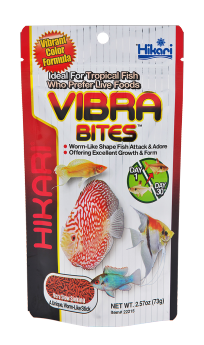
Hikari Vibra-Bites™
Hikari® is please to introduce its newest addition to its extremely popular line
of tropical diets, Vibra-Bites™. Great for all types of tropical fish, this
flavorful nutrient mix offers many unique benefits. From the pellet design,
which mimics a blood worm moving through the water, to the incredible color
enhancing ability which will help your fish glow with a flood of color, to the
exacting nutrient balancing through extensive feeding trials that helps us offer
growth and form you won’t believe, this is truly a new generation aquatic diet.
The oxygen barrier package helps maintain the quality and perfection consumers
have come to expect from the leader in aquatic nutrition worldwide. For more
information contact us Hikari Sales USA, Inc. at fish@hikariusa.com or (800)
621-5619. You can also see more information on this item at www.hikariusa.com
|
 |
|
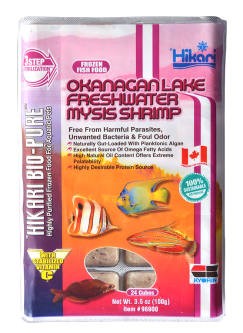
Press Release - Canadian Lake Okanagan Freshwater Mysis
Shrimp Cubes 10/16/18
Attached – please include in next issue or post
Chris Clevers
President/COO
Hikari Sales USA, Inc.
Offering Hikari®, Bio-Pure®, Bio-Pure® FD, Aquarium Solutions®, Pond
Solutions®, Reptile Solutions® & Takara Products
2804 McCone Avenue
Hayward, CA 94545-1663
www.hikariusa.com<http://www.hikariusa.com/>
|
 |
Aquarium problems; overfed FW 8/21/18
I have recently been on holiday and left the fish with an auto feeder but
come back to a very over fed tank I have done my best to remove as much of
the food asap with a water change and will do another in a few days along
with a filter clean, is there anything else you can recommend doing.
<Yes! TEST your water for ammonia and nitrite, and do NOT feed if either is
present. DO mix up some replacement water (in advance) in case there is a
need for a large water change>
Another question is my fish specifically the dwarf rainbow fish that has for
a wile and the dwarf cichlid have been opening as if gasping but not at the
surface of the water the tank flow is slow but here are many plants so a bit
stuck on what is wrong can’t find anything online any ideas are appreciated
thank you.
<Other water quality issues. Some mentioned above>
On a lighter note I did come back to one of the dwarf fry about 5mm long and
looking healthy probably enjoyed the extra food.
Thank you for your help
From Josh
<Do please keep us informed. Bob Fenner>
Mineralized water fish compatibility
8/12/17
Bob-
<Rob>
Can you tell me if there's a food fish that will live in a mineralized
solution of potassium, calcium, and magnesium? And at a specific gravity of
1.011.
I can get mollies to live in it, but they don't offer much in the way of food
production.
<Artemia should... I'd feed these for a few days ahead of offering... to
boost their nutritive value. What else? Neale, your input please. Bob
Fenner>
Thanks,
Rob Gunnett
Mineralized water fish compatibility /Neale
8/12/17
Bob-
Can you tell me if there's a food fish that will live in a mineralized solution
of potassium, calcium, and magnesium? And at a specific gravity of 1.011.
I can get mollies to live in it, but they don't offer much in the way of food
production.
Thanks,
Rob
<As Bob says, brine shrimp are surely the way to go if you must use such an
oddball water solution! The usual reminder does need to be made that while brine
shrimp nauplii are nutritious, adult brine shrimp are "empty
calories" and don't make a good staple diet as they come (frozen brine shrimp
are often boosted with Spirulina and the like to improve their nutritional
value). There are probably some Mysids that would work, but the
extent to which they are breedable under aquarium conditions is unknown to me.
Can I ask why you want to grow fish or invertebrates in a non-saline mineral
solution? You might experiment with things like Soda Cichlids or
even the hardier Tilapia if this was a research project, and there are certainly
killifish (such as North American Pupfish of different kinds and some of the
West Asian Killies) adapted to mineralised but not saline waters. How easy these
will be to obtain I cannot say, but in the UK at least a few, such as Aphanius
mento, that do get traded periodically. These are often adapted to produce small
broods of large fry, so might be less useful than Tilapiines, which are highly
productive, but their spiny fry aren't safe foods for those fish not adapted to
consuming perciformes.
Cheers, Neale.>
Re: Mineralized water fish compatibility
8/13/17
Thanks for the answers, but I'm looking for a species like trout, catfish?
Tilapia, perch- a definite food fish.
I need the mineralized water for another purpose as well and it can't be
changed. The plan is to use 250000 mollies in 30000 gallons. The fish are a
necessary part and I think it would be great to produce food stock instead of
ornamentals.
<Mmm; well... I'd try other Cyprinodontiform fishes... poss. Killies (estuarine
species) as Neale has mentioned; Gambusia, Heterandria can likely be acclimated
to this water. Neale, any more input? BobF>
Re: Mineralized water fish compatibility /Neale
8/13/17
Thanks for the answers, but I'm looking for a species like trout, catfish?
<There is a HUGE scientific literature available on the maintenance of
Salmonids, particularly Atlantic Salmon and Rainbow Trout; DO access these
online/via your local academic library and peruse -- determining optimal water
chemistry and temperature for these will not be hard. Obviously these are not
tropical and invariably require cool/cold water to do well. As for catfish,
Ictalurus and Pangasius catfish widely farmed and their requirements are, again,
well documented in the scientific literature. I am not aware of any ornamental
species that want, simultaneously, room to tropical temperatures; specific
gravity equivalent to half-strength seawater; no sodium; but high mineral
content of other anion/cation combinations. One I'd experiment with before
others would be Mystus gulio,
a brackish and freshwater species from India, but it's a big catfish traded more
as food than as an ornamental. Like other bagrids, it's a predator with tasty
flesh, but unlike most other bagrids, inhabits estuaries and even the sea, so
should have a broad tolerance for mineralised water. The Ariidae might also be
worth a shot, but they are not particularly esteemed as food fish, though they
are certainly edible provided you can avoid being stung!>
Tilapia, perch- a definite food fish.
<Wide tolerance for oddball water chemistry, so definitely worth a shot.
Sarotherodon melanotheron for example should handle highly mineralised water
well, and is edible, if not particularly large. Tilapia rendalli would be
another good choice, as well as Oreochromis mossambicus that will live in
virtually anything wet and warm.>
I need the mineralized water for another purpose as well and it can't be
changed. The plan is to use 250000 mollies in 30000 gallons. The fish are a
necessary part and I think it would be great to produce food stock instead of
ornamentals.
<DO review the literature on doing this. Stocking fish in "closed" systems
allows certain toxins, metals and pathogens to accumulate, which means
particular care is needed for fish farming this way. Modern fish pond techniques
of fish culture may be relevant; do ensure you are aware of the food production
standards relevant in your country. One of the things I like to remind people
about fish farming is this -- if it was easy, everyone would be doing it!
Raising fish, whether for pets or for food, is difficult, and by no means
guaranteed to pay for itself. On a smaller scale, farming ornamentals is
probably easier and has fewer legal or public health issues associated with it.>
There's no sodium in the water
<Probably an issue for brackish water fishes, but experimentation may pay
dividends. Cheers, Neale.>
Fish Eggs for Freshwater Fish (food)
6/21/17
Hello Crew! Hello Neale! Last time we talked about the elephant nose and getting
some weight on him, I shared my idea of fish eggs instead of lobster eggs (which
are not available in my area). I'd like to share what I've discovered to
hopefully spare someone else from the disaster I created.
While I believe this is an excellent product, I do not believe it to be the best
choice for the average freshwater aquarium keeper, and never the best choice to
fatten up one fish in the tank and here's why - there is a staggering amount of
eggs in each cube. Even though I cut off a piece as small as I could get it,
defrosted it in tank water, and looked at what was in my cup before I put it in,
I was unable to see just how much food was in there. Next, while my fish did
seem to pick at the eggs, they didn't like the eggs enough to do more than pick
at a few pieces and certainly came no where close to eating all I had
inadvertently put in the tank. Also, this stuff stuck to anything and everything
in the tank - decorations, plants, the heater, the spray bar, and it completely
clogged the filter intake. I
worked at it for hours, but getting the extra food out was nearly impossible.
The next morning I woke up to a slightly cloudy tank and an expression on the
faces of my rope fish that clearly said "help!" I did a vacuuming of all the
eggs I could see and replaced the water (about 10 gallons). When I got back, the
eggs were much easier to spot as the ones I could see had grown white "fur." I
tested the water and found the nitrates had climbed to nearly 20 ppm (no ammonia
or nitrite as this is a well cycled tank), so I did a 30% water change and
vacuumed as many eggs as
I could find (and/or dislodge from plants, decor, etc.). When I did this water
change I noticed that the bubbles created by the spray bar were not going away,
so I scooped those bubbles out with a plastic pitcher. The following morning the
water was still cloudy, the fish still seemed distressed (the elephant nose was
hiding), and there were eggs still visible in the tank - only now the
white "fur" they had grown was longer and a greenish black at the ends.
So I pulled the everything out of the tank (and I do mean everything - except
the fish) and wiped all the eggs off the best I could. I got a net and did my
best to scoop up every egg visible in the water. I tested the water and the
nitrates were still lingering around 20 ppm (orange, but not dark enough to be
higher than 20 - and no red in the test tube). So I did another 30% (still had
bubbles which I scooped) water change and put the decor, etc., back in. As of
tonight, the nitrates are down (a more translucent orange) to around 10. There
are still some eggs floating around but not many and when I see them I'm getting
them out with the net. The water is no longer cloudy and the fish seem normal
(the elephant nose is still hiding). I still have bubbles, but not so many and
I'm scooping them out with a spoon. I'll keep testing and taking appropriate
action to what I find. But if anyone ever asks you about using fish eggs in
their freshwater tank, you can refer them to my experience. All I can say is
that while the package says the eggs are also for freshwater fish, I believe
ideally this product should be reserved for marine fish and coral where a
protein skimmer is also in use in the tank.
If someone still wants to use this product in a freshwater tank, do so with
EXTREME caution.
<Thanks for sharing your firsthand experience of this product, Renee.
Lobster eggs are what I recommend, but even then, only the tiniest amounts.
A good approach is to defrost inside a plastic cup of some sort, with a bit of
aquarium water in there. Then, using an eye-dropper or similar pipette to direct
small amounts at the fish (for example, I used them for newborn Halfbeaks).
Indeed, there's a good argument for *always* defrosting frozen foods outside the
tank, and then using a pipette, tweezers, or whatever to introduce carefully
controlled portions of the solids while keeping the "juice" in the plastic cup.
Your observation of water quality problems, while extreme, is certainly a risk
if cubes of frozen food are simply
lobbed into aquaria without further thought. Cheers, Neale.>
Hand feeding 8/19/15
Hi crew
Stingray is doing great and now has its own tank. Won it at a raffle, a 150
gallon.
<Won a Stingray at a raffle? Weird.><<The tank. B>>
I now have a new tank. My large cichlid set up show tank. /toothy terror tank
busters. I think I have prepped the tank to where these guys cant break it. I
hope. I have a metal brace on the rims and smash boards installed. I
accidentally built it out of 1/4 so I put in 1/3 glass on the inside. Then 1/8
so if they break any glass its the 1/8 and not the actual tank
This is a long wide and not tall tank. Its 5' x 2' x 2'. About 125.
The stocking is:
1 female jaguar cichlid
<Nice fish.>
1 male red terror. (Complete wuss, got beaten by a pictus cat at 16")
<C. festae? Can be psychotic, so watch out.>
1 florida gar
2 peacock bass
<Short-term residents presumably? These things get massive and are active
swimmers. Bit cruel to keep them cooped up.>
3 lima shovelnose catfish
<Nice fish as well.>
3 Senegal bichirs
<These bichirs don't belong here. I've seen Yellow Labs strip the fins from
them.>
My question is about hand feeding
<Yes, worth doing.>
I want to teach these guys to hand feed and jump feed but cant find any info on
how to do so. I don't have to worry about them jumping out as the tank has 2
hinged acrylic pieces screwed and siliconed to open and close smoothly like
doors on the top. These dead bolt and have two locks on either side so even when
chasing the minnows I bred and crayfish and frogs
and bugs and such, they cant take a trip onto the floor.
How do I do this?
<Your only risky fish is the Gar, which can bite you. But basically, you need
long forceps. Aquatic gardeners use them, fishermen use them, I dare say even
doctors use them. eBay and similar places will sell them. Cheap plastic ones are
fine, though stainless steel ones look better. Visual predators are attracted by
silvery flashes, so what you want to do is
wiggle something like whitebait in the current, maybe 15-20 cm away from the
fish in question. You may need to drop one or two bits of food to start with so
they realise forceps = food. Try doing this when they're hungry, even skip a day
or two before attempting. Gar move extremely quickly, and have poor eyesight in
terms of distinguishing fingertips from food, which
is why they're dangerous to your fingers. No way you can feed them by hand, and
you'd be an idiot to try. But even the Peacock Bass could do some harm. Anyway,
nothing terribly difficult, have done this, and my Gar was certainly tame enough
to take food from forceps, and I routinely train things like puffers and Hujeta
Gar to feed this way because it helps to
make their life more interesting. Hand feeding fish is a good way to get them to
associate you with food.>
I am having a party in 2 weeks I want to show this off.
<Don't overfeed them. This is a very heavily stocked tank, and the line between
success and failure is very thin; a bunch of drunk teen or 20-something "dudes"
wanting to hand-feed everything that swims is a recipe for disaster. There's a
hell of a lot more status that comes from restraint and long-term success.>
Please help me out.
Thanks
<Welcome. Neale.>
Re: Hand feeding 8/20/15
Id be the only one feeding them.
<Indeed, but still, resist the urge to overfeed.>
Is it possible to do this with pellets?
<Possible, but never bothered trying this myself.>
Massivore and sinking carnivore? My gar when he was much smaller hand fed.
I stopped as he grew to avoid losing a finger.
<Quite so!>
He is still very tame and follows me around my room
<They're nice fish.>
I didn't have a large enough tank for him so I built a series of aquarium
bridges to go from to tank and he swims through them and follows me.
<Now that sounds very cool!>
So if Senegal bichirs wont work, will my delhezi, or endlicherii?
<Better bets in terms of life with large carnivores (Gars, Siamese Tigers,
Cichla spp., and so on) but do remember that being a predatory fish doesn't make
a fish immune to attacks from territorial fish. Indeed, a bit of fish psychology
for you: stealth predators survive by not making a fuss and blending into the
background, so they tend to be relatively peaceful fish
that aren't designed for rough and tumble situations. Herbivorous fish are often
much more aggressive because their food doesn't run away, so there's no need for
them to be discrete. Mbuna are the absolute classic examples, fighting all the
time with a vigour that would make a predatory cichlid pass out from exhaustion
just by watching! So basically, the more
specialist the predatory fish, the more careful you need to be about adding
tankmates.>
Or bichirs as a whole just wont.
<They're okay with Oscars and Severums, that sort of thing. But most Central
American, West African and Rift Valley cichlids are a risk.>
Yes the bass are temporary. When they leave can an Oscar go in here?
<Sounds good.>
Thanks
<Welcome, Neale.>
Re: Hand feeding.... stkg. Wolf fish, Erythrinidae f'
8/20/15
So I finally got my stocking set up.
1 jag cichlid
1 florida gar
1 azul peacock bass
1 orinocensis peacock bass
1 festae cichlid (female)
1 lima shovelnose catfish
My friend just kicked in my door bearing a gift. A finned toothy gift. A 14"
wolf fish. Can he go into this tank?
<In 125 gallons? Assuming this is a Hoplerythrinus species,
these can cohabit with docile fish of similar size but are nervous around larger
or more aggressive fish, and conversely, are intolerant of their own kind and
similar looking fish. Frankly, your 125 gallon tank is chock-a-block already,
and adding more predators sounds iffy. Have you joined Monster
Fish Keepers? I really do think that's the place to go for chatting about
stocking.>
I am always getting drop off fish because I have the largest tank in my area and
run an exotic fish store. They want a fish, I find it, get it and sell it to
them once I see the tank its going to. Just for my local aqua circle of friends.
<Understood.>
If he cant go into this tank, should I just put him in my monster tank? A
2.5k gallon pool with an African tiger fish 4.5 foot, a 6.7 foot alligator
gar and a stingray and a mess of rtc and tsn and a Paroon shark. All over 4
foot. My guess is that he will be eaten here
<Indeed. He won't be happy. These fish are much happier kept on their own in a
quiet, dark aquarium. They aren't active, and 75 US gallons is ample.>
Thanks
<Cheers, Neale.>
Supplements.
1/2/15
Hi bob,
<BH>
I work in a vitamin store, and was just wondering of the garlic avail for
people is same used in garlic power in fish store?
<It is the same... as are chemically all other vitamins, supplements sold for
human use>
If so it is much cheaper to buy it here than a lfs.
Off hand , any other human vitamins that could be used to improve fish health?
<See WWM re; yes is the definite answer>
Thanks
<Welcome. Bob Fenner>
feeding (FW)
10/31/14
Good afternoon Crew,
<Phill>
This will hopefully be a quick and easy question. I have a South
American biotope with a few medium cichlids
(angel, keyhole, Severum) and some red-eye and
rummy nose tetras. The other is an Asian biotope (Betta, ghost
cats, harlequin Rasboras). Both tanks are healthy and heavily planted
without issue.
I have been doing a 2 day feeding cycle for six days a week with Sunday
being a fasting day. Day one is a micro sized spectrum pellet.
Day 2 is frozen baby brine shrimp. I have been
doing some research and have heard that the
baby brine shrimp have very low nutritional density
<Variable>
and of course every other opinion from every Joe that's owned a carnival
goldfish. In your years of fish husbandry what
could you recommend?
<If what you're doing currently works for you, your livestock, to
continue it>
My fish have beautiful color and I am not
breeding so no concern there. I would like a
healthy frozen food that will best meet their nutritional requirements
for a long healthy life.
<There are many choices here; including mixes/blends... by several
makers>
Let me also add that I tried the omega one cichlid cube. Not a fan. It
floats frozen and slowly dissolves into a...you guessed
it...mess.
<Bad>
I prefer to manually feed my fish to monitor
healthy and consumption to avoid messes or
over eating. Also I have a wicked bloodworm allergy so we'll
rule those
out now.
<Am not a fan of these sewer worm larvae>
No I'm not opposed to live foods either but am fairly naive in
that area at this point.
<Not to worry. Much posted on WWM re Cichlid feeding. Try the search
tool>
Thank you very much for any guidance you can offer.
Regards,
Phill
<And you; Bob Fenner>
feeding /Neale's go 10/31/14
Good afternoon Crew,
<Phill,>
This will hopefully be a quick and easy question. I have a South
American biotope with a few medium cichlids (angel, keyhole, Severum)
and some red-eye and rummy nose tetras. The other is an
Asian biotope (Betta, ghost cats, harlequin Rasboras). Both
tanks are healthy and heavily planted without issue.
I have been doing a 2 day feeding cycle for six days a week with Sunday
being a fasting day. Day one is a micro sized spectrum pellet. Day 2 is
frozen baby brine shrimp. I have been doing some research and have heard
that the baby brine shrimp have very low nutritional density and of
course every other opinion from every Joe that's owned a carnival
goldfish. In your years of fish husbandry what could you recommend? My
fish have beautiful color and I am not breeding so no concern there. I
would like a healthy frozen food that will best meet their nutritional
requirements for a long healthy life.
<Brine shrimp nauplii actually have a pretty good quantity of nutrients
-- otherwise baby fish wouldn't wax fat upon them -- but it's the adults
that are mostly roughage. Luckily, frozen adult brine shrimp are
augmented with all sorts of additional nutrients such as Spirulina. So
while you wouldn't use them as an exclusive food, they're pretty good as
a fibre-rich supplement alongside flake foods. Going back to
newly-hatched shrimp nauplii, while there's some discussion as to the
nutritional profile of nauplii from one producer compared to another,
they're all good, and any differences are trivially small in most
situations. You won't often see me
link to a marine aquarium journal, but this article at Advanced Aquarist
sums things up nicely:
http://www.advancedaquarist.com/2004/1/inverts
Both nauplii and adults can be improved by feeding, but for someone
dealing with frozen foods, that's irrelevant. You can go out and buy
fortified adult brine shrimp, frozen and ready to use!>
Let me also add that I tried the omega one cichlid cube. Not a fan. It
floats frozen and slowly dissolves into a...you guessed it...mess. I
prefer to manually feed my fish to monitor healthy and consumption to
avoid messes or over eating. Also I have a wicked bloodworm allergy so
we'll rule those out now. No I'm not opposed to live foods either but am
fairly naive in that area at this point.
<Fortified brine shrimp are probably what you're after. For larger fish,
mysis and krill can be good. As a rule of thumb, marine (or hypersaline
foods like brine shrimp) have essentially zero chance of introducing
parasites to your freshwater fish, which makes them a very safe option.
Indeed, a marine variety pack of frozen foods might be worth trying,
though I have usually found some of the "plankton" foods in these packs
far too small for my fish, so rather wasteful.>
Thank you very much for any guidance you can offer.
Regards,
Phill
<Cheers, Neale.>
Re: feeding 10/31/14
Thank you very much Neale. I appreciate your insightful wisdom.
Happy Halloween.
<Glad to help. Cheers, Neale.>
Dear Crew I have few Question on CR6 & CR8... Searching for
color-enhancing ingredients in fish food 9/16/13
Dear Crew,
I am a discus lover and hobbyist. I have question on CR6 & CR8. those
product manufactured by White Crane Aqua Thailand.
<Can't make out much that's useful on their site re:
http://www.whitecranev88.com/en/shop/product/features/10
But I want to know what Basic Color enhancer they use in those two
product?
<They might tell you if you contact them; but I don't see MSDS sheets or
such re their lines>
Carophyll Red & Carophyll Yellow these two Color enhancing Substance
they used in their product or any other chemicalized formula or Hormone.
<Claim these are sex hormone free. Likely so... as powders... expensive>
Please let me know about the Product composition. And if there is any
Other color enhancing element expt ASTAXANTHIN. CAROPHYLL. please let
me know pn that too.
<Sorry; you'll have to contact the manufacturer re. Or better time
spent, search (computer) out your own bibliography. Some notes re how
here:
http://www.wetwebmedia.com/litsrchart.htm
<I would search for Symphysodon color enhancers, foods>
Bob Fenner>
Sm. FW stkg. 7/22/13
Hello,
I expect it's a no go, but I was wondering if I had no other fish in the
tank except for around five Kuhli loaches, would that be ok? If
suitable, I certainly wouldn't add them until the tank has matured since
I know that they like an established environment.
Sorry, forgot to include information about the tank : Marina 360
Nano tank (10litres).
Thanks.
Regards,
Steve.
<Hello Steve. Do start by reading here:
http://www.wetwebmedia.com/ca/volume_5/volume_5_3/stocking.htm
Your 10-litre aquarium is 2.1 Imperial gallons (about 2.6 US gallons).
As one aquarist I respect likes to say, "that's not an aquarium, it's a
bucket". The whole nano aquarium phenomenon is a minefield for
inexperienced aquarists who imagine small tanks are cheap and easy.
They're not. In fact they're almost entirely useless unless your prime
focus is plants. This sort of tank could be easily decorated with tiny
plants (such as Java Moss) and stocked with a small number of
crustaceans, such as
Bumblebee Shrimps, that wouldn't be viable (except as live food!) kept
in larger quarters with bigger animals. Are there any fish that can live
in 10 litres/2-ish gallons of water? Basically no. I dare say you could
keep a Betta in there, but that's pretty much it, and even Bettas are
easier to keep -- i.e., healthier and less disease-prone -- in bigger
systems around the 20 litre/5 gallon mark. So bottom line, your 10-litre
tank is useless for fishkeeping, but might have some value with plants
and shrimps, if you're prepared to make the effort, and spend the money
on lighting, necessary for long term success. Kuhli Loaches need,
minimum, 45 litres/10 gallons; anything smaller just doesn't make any
sense in terms of space for the numbers that need to be kept (at least
5) alongside any day-active fish you want swimming about in midwater
(don't kid yourself you'll see your
Kuhli Loaches, you won't, and they may as well not be in the tank 99% of
the time you're looking at the aquarium -- they're very shy and
nocturnal, especially immediately after purchase). Cheers, Neale.>
Re: sm. FW stkg. 7/23/13
Hi Neale,
Thanks very much for your informative message.
<Most welcome.>
As 2.1 UK gallons is too small for even a Betta,
<Yes.>
I have decided to explore the wonders of plants and shrimps instead. As
it happens, I purchased the Colombo flora base just for the purpose of
plants, so this could still be a lovely little gem to gaze at in the
evenings.
<Quite so; much written on this subject, plus a nice (free) leaflet from
JBL:
http://www.jbl.de/?lang=en&mod=files&func=show&id=9065
Lots of stuff about species, requirements, diet, etc.>
It makes me very sad to think of people out there keeping Bettas in even
smaller containers.
<For sure.>
Anyway, cheers for now.
Regards,
Steve.
<Cheers, Neale.>
Feeding Fish Flies 7/17/13
One of the members of my household has been swatting small flies and
feeding the bodies to my comet goldfish. The fish really seems to enjoy
them. So far the fish looks ok. Is it ok for the fish to eat flies?
Thank you.
<Yes; as long as these flies haven't been sprayed/exposed to pesticides
they should be fine as food. Bob Fenner>
freezing pellet foods 3/23/13
Dear WWM crew,
<Hi Emilie!>
Hello! I was hoping for your input on freezing pelleted fish foods. I
only have one fish, so it takes quite a long time to go through a
typical tin of fish pellets, especially considering that the good
quality ones don't come in small sizes!
<Ah yes>
In order to keep them fresh, I keep the tins sealed in their containers
in the freezer, only taking a small amount out at a time (about a
month's worth) and keeping them in an airtight vitamin dispenser. How
long do you think they will stay fresh? I've had them almost a year and
I'm worried all the vitamins are gone.
<This is an excellent practice. You are correct that foods, including
pellets, do lose their nutritive value w/ time, warmer temperature>
Thank you for your time and have a good weekend!
Emilie
<Thank you, Bob Fenner>
Algae Wafer Content 10/25/12
Dear Crew,
<Attz>
I have been feeding my Ancistrus and Gibbiceps catfish
a mixture of New Life Spectrum and Hikari algae wafers as well as
several mixed vegetables.
<Good choices in my estimation>
I recently purchased a pack of 'Tetra Veggie Xtreme' and noticed at the
end of the ingredients list something I was unsure of. It says 'Color:
Blue No.
2 Lake, Yellow No 5 Lake, Yellow No 6 Lake. Ethoxyquinas as a
preservative.'
<Yes>
My question is what are these colour ingredients and are these
particular wafers safe for my catfish?
<Yes; they are fine. In fact these artificial colorants and preservative
(a quinoline-based antioxidant ) are extensively used in human foods and
spices>
I don't want to feed them any kind of dangerous hormone foods that
supposedly bring out more colour but with negative
effects on their health so I thought it would be best to check in with
you regarding this matter.
<These are not hormones>
Thank you very much for your time,
Attz
<Welcome. Bob Fenner>
|
Re: Another check in 7/13/12
Hello Neale and crew,
<BobF here now>
Thank you so much for such a speedy response last time! I got some African
Frogbit and it's doing well in my tank. I've got my Nitrates down even lower
to under 5 ppm. My Plecs though have been having white stringy feces, I know
probably from having higher Nitrates in the past; not so great water quality
and an overcrowded tank. My Jack also seems to have a bloated tummy. All the
fish have been acting normally and eating regularly, no signs yet of any
behavioral changes. I researched and found that soaking food with
Metronidazole is my best bet, especially at an early stage. Is this correct?
<Mmm, depends on the root cause/s here... IF protozoal, bacterial to some
extent, yes... IF worm-based, a vermifuge like Praziquantel... these can be
administered at the same time... BUT the only way to accurately assess what
is really going on is through sampling (and/or necropsy) and microscopic
examination. Please read here:
http://www.wetwebmedia.com/metranidazole.htm
and the linked files above>
I've been feeding them soaked food for three days now and the Plec feces is
looking much more normal, so I believe it's working. I do want to make sure
I'm feeding them the right dosage though. I have packets of 250mg Metro with
75mg Praziquantel (API General Cure here in the States). My LFS said one
packet would treat enough food to fill up a baking sheet. True?
<Depends on the size of the baking sheet and food...>
Also they said that the antibiotic is only good in the food for about 3
days.
<Keep the food refrigerated>
Any more specific information would be helpful in treating my food/fish.
Also, should I just feed them the food until it subsides?
<Yes I would>
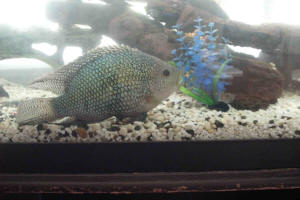
I've read that this can take weeks. I included a pic of my Jack, hopefully
the size is small enough and doesn't cram up the inbox! Thanks so much again
in advance. Best to you, Craig
<And you, Bob Fenner>
|
 |
|
Re: Another check in
Medicating Cichlid Food 7/15/12
Hello Neale and crew,
Thank you so much for such a speedy response last time! I got some African
Frogbit and it's doing well in my tank. I've got my Nitrates down even lower
to under 5 ppm. My Plecos though have been having white stringy feces, I
know probably from having higher Nitrates in the past; not so great water
quality and an overcrowded tank. My Jack also seems to have a bloated tummy.
All the fish have been acting normally and eating regularly, no signs yet of
any behavioral changes. I researched and found that soaking food with
Metronidazole is my best bet, especially at an early stage. Is this correct?
I've been feeding them soaked food for three days now and the Pleco feces is
looking much more normal, so I believe it's working. I do want to make sure
I'm feeding them the right dosage though. I have packets of 250mg Metro with
75mg Praziquantel (API General Cure here in the States). My LFS said one
packet would treat enough food to fill up a baking sheet. True? Also they
said that the antibiotic is only good in the food for about 3 days. Any more
specific information would be helpful in treating my food/fish. Also, should
I just feed them the food until it subsides? I've read that this can take
weeks. I included a pic of my Jack, hopefully the size is small enough and
doesn't cram up the inbox! Thanks so much again in advance. Best to you,
Craig
< For internal protozoa infections I have used 1/2 tsp of Metronidazole to 4
oz of fish food for 10 days with good results on discus . I am sure it will
work for your jack Dempsey too in the early stages.-Chuck>
Cichlid Food II 7/15/12
And thank you Chuck! I was having a hard time finding smaller
recommendations for dosages as the medicated food loses it's potency after a
few days, even when refrigerated. For precautionary sake, if my fish don't
improve after ten days is a microscopic identification and water/feces
sample my next move? Thanks for additional response Chuck! -
Craig
< The medication is in a dry form. I think as long as the food container is
moisture proof it should be OK for the duration of the treatment when
refrigerated. An examination of the fecal matter would give a better
diagnosis.-Chuck.>
Re: Another check in, FW 7/15/12
Thank you Bob! I got the Praziquantel yesterday, am doing a big water change
and starting treatment today along with the medicated food. Happy weekend :)
- Craig
<And you. Please do follow up w/ your observations. BobF>
|
Medicated food source 9/19/11
Bob,
<Hey Rick>
I just wanted to call this website to your attention. If you click on
the antibiotic or parasite treatment links, this place sells medicated
flake food.
<? Oh, am thinking this is a "Google thing"... w/ them
selling ads at the tops of their search results. It's not a
re-direct from an actual WWM link I hope/trust. Have checked>
I wonder if I had been feeding my mollies the food medicated with
Praziquantel if the outcome of my Camallanus worm infestation might
have had a better outcome.
<Maybe>
http://www.angelsplus.com/Meds.htm
<Ah yes. BobF>
Rick Novy
Hi Neale - Are sea urchins safe to feed
freshwater fish? 8/1/11
Hi Neale,
<Michelle,>
How are you? I hope everything is going well!
<Yes, but it's pretty darn hot today! Maybe not by US standards,
though.>
Would this marine frozen formulated food be safe to feed freshwater
herbivore/omnivores?
Ingredients: Sea algae, sea urchin, plankton, krill, shrimp, squid, sea
worms, Spirulina.
Guaranteed Analysis:
Crude Protein 12.0% min
Crude Fat 1.5% min
Crude Fiber 10.0% max
The sea urchin and sea worms are kinda throwing me. I would use this
food to feed platies if you thought it was safe.
<Yes, should be fine. The sea urchin and sea worm tags are a bit
surprising, but I assume this simply means it's ground up seafood
left over from processing stuff for the human food market. In any
event, harmless. I wouldn't use this food all the time, but a
couple times per week should be welcomed by your fish as a tasty
addition to their diet.>
Thanks for your thoughts!
Michelle
<As a broad rule, anything sold for marine fish will be safe for
freshwater fish. The only exception I can think of would be foods
containing sponges, as these are formulated specifically for
sponge-eating marine Angels.
Cheers, Neale.>
discus question, fdg./nutr.
6/21/11
HI
Crew
I am a beginner to the discuss fishkeeping. I would like to know
whether I have to keep discus in odd or even numbers. I hope you will
enlighten me on this query.
<Some argue odd numbers are best; I'd argue so long as you have
six or more, they should be happy. In smaller groups, aggression is
more common.>
Also my discus eat Tetrabits but every time I try to feed them Nutrafin
max they are not ready to eat it. What could be the reason.,
<Discus often decide to eat just one thing! Try starving them for a
few
days. Appetite makes the best sauce! Cheers,
Neale.><<Actually, the NutraFin product is neither nutritious,
nor palatable/attractive to Symphysodon. Read here: http://wetwebmedia.com/FWSubWebIndex/discusfdgfaqs.htm
Get rid of the Hagen product.
Bob Fenner>>
Feeding questions
5/21/11
Hi guys. I've got a couple of feeding questions that I've been
researching and haven't been able to find answers to.
<Fire away.>
First off, I read online that flake food shouldn't be kept
all that long after being opened, and within 6 months has lost
most of its nutritional value. Is that true?
<Yes.>
Is that true of other forms of food, like pellet food?
<Yes.>
And if true, are there any ways to extend the food life, like keeping
it in the freezer?
<This will indeed extend the life of dried foods, though not
indefinitely, any more than frozen human foods shouldn't be kept
more than six months or so.>
Secondly, I read on your site that Corydoras are mostly carnivorous in
what they eat. I am setting up a new 29 gallon tank, and had been
planning to put my three 2-inch Platies and one Ancistrus catfish in
it, as well as some mollies (most likely the balloon variety)
<Would not keep Mollies in here. The Platies, Corydoras and
Ancistrus all need the same thing -- coolish freshwater around 22-24
C/72-75 F. The Mollies need warmer water and often brackish water to
stay healthy, so adding them to this community would be just making
things less easy and potentially stressful for one or other species. So
why bother?>
I was planning on buying. I also wanted to put a school of 5-6 Cory
cats on the bottom, but all the other fish in the tank are complete
herbivores. If I start having to throw in higher protein food for the
Cory cats, how will I keep these herbivores from gorging on it and
getting intestinal blockages?
<Not a problem here. Hikari Algae Wafers for example make an
excellent staple for both Ancistrus and Corydoras, and the Platies will
nibble on them during the day without any harm coming to them. If you
put some standard catfish pellets or wafers in at night, the Ancistrus
and Corydoras will eat them while the Platies are sleeping.>
Should I just forget about the corries and put in a pair of moonlight
or pearl gouramis, or some other fish that is more veggie oriented?
<Again, I'd skip the Gouramis. The Platies, Corydoras and
Ancistrus make a trio of beautifully compatible, low-end tropical
species.>
One last non-feeding question as long as I'm writing. My tap water
here in Minneapolis comes out of the tap with a pH of 8 and 15 degrees
KH. (GH would normally be very hard also, but is soft due to an
industrial water softener in our apartment building, and I typically
raise it to about 8 degrees of hardness using SeaChem replenish).
<Should not cause problems for any of these fish. Ancistrus and
farmed Corydoras are very adaptable.>
Those pH and KH levels are perfect for Livebearers, especially Mollies,
but is that going to cause a problem for the Cory cats?
<Would skip the Mollies. And no, standard Corydoras species like
Corydoras aeneus and Corydoras paleatus will handle such water
chemistry without problems. There are some fussier Corydoras species,
but you a site like Planet Catfish will set you straight on the needs
of individual species.>
I've read they naturally are found in softer, more acidic water,
but that they also are pretty hardy and adaptable.
<Yes, they mostly come from soft water, but yes, the hardy, common
species are very adaptable indeed.>
Would it cause any problems for a pair of gouramis if I got them
instead?
If neither gouramis or Corydoras are suitable, do you have any other
suggestions for this setup?
<Some midwater tetras or barbs might be appropriate, and of the ones
widely sold, X-Ray Tetras would be absolutely ideal, being happy in
hard water and doing well at the low-end temperatures the other fish
enjoy.>
Thanks for your time!
Jasen
<Cheers, Neale.>
Re: Feeding questions 5/22/11
Thanks Neale! That was really good information.
<Glad to help.>
I have just one follow-up question. I'll forget about the mollies
as you suggest, but could I replace them with the small praecox
rainbowfish?
<Worth a shot, so long as the tank wasn't too cool. 24 C/75 F
would be about right for all concerned.>
To refresh your memory, here is the information about the setup I am
creating: 29 gallon tank, pH 8.0, KH 15, (both those first two
parameters come from my Tapwater). GH probably 8.0, but can be varied
to anything I want, since the water starts out soft due to a water
softener and I can raise hardness with SeaChem Replenish.
<Hmm'¦ do remember a domestic water softener doesn't
produce "soft" water suitable for fishkeeping -- it merely
replaces carbonate hardness with sodium salts, and leaves general
hardness behind. Hard, alkaline water is ideal for Platies and
Rainbows, and acceptable for Corydoras and Ancistrus, so I wouldn't
faff around with water chemistry at all. An ideal water chemistry for
this mix would be about 15 degrees dH, pH 7.5, but a bit below or above
these values shouldn't cause undue harm.>
I'm planning on adding in my one male and two female 2 inch
Platies, and my Ancistrus catfish. I was planning on also buying a
school of 5-6 Cory cats, though I don't have them yet. If the
rainbows are a good fit, how many of the praecox variety can I keep in
this tank?
<Half a doze would be a good starting point in a 30 gallon
tank.>
And based on some of your other FAQs, it looks like an equal ratio of
males to females is desired with rainbows, right?
<Yes, otherwise aggression between males offsets any extra
prettiness you have from skipping females. Plus, the males put on their
best colours when they have a reason to show off!>
Jasen
<Cheers, Neale.>
Flower horn sick after feeding pork....Please
help! 5/1/11
Hi,
I am Suresh from India. I have a 1year old Flower horn. She is normally
very active & a voracious eater. But 3 days back I fed her pork
after which she does not eat at all & is not active. She sits at
the bottom of the tank most of the time. She also has developed a small
bulge in the abdomen. I came to know after referring the net that pork
is not suitable for flower horns'¦but what do I do now to make
her well. Please help as I don't want to lose her.
Thanks
Suresh
<Greetings, Suresh. Hope you've learned your lesson here! Do
not, Do Not, DO NOT give bird or mammal meat to aquarium fish -- EVER!
In short, mammal and bird meats congeal inside cold-blooded animals,
and in doing so, cause them varying degrees of harm. Of course some
cold-blooded animals are adapted to dealing with such prey, like
snakes, but not your cichlid. Your cichlid should be fed a mix of
pellet foods, cooked peas, spinach, and small invertebrates such as
earthworms. For now, you just have to wait and see what happens.
Don't feed her until her belly comes back to normal. When she does
start eating, give her just cooked peas (squashing the peas as well
sometimes helps) -- peas are excellent laxatives for fish. You can also
use Epsom salt (magnesium sulphate; not cooking salt, i.e., sodium
chloride!) at 1 tablespoon per 5 gallons will help a good deal by
loosening the muscles of the gut, reducing swelling. But that's
about all you can do. Cheers, Neale.>
Food for Live bearers et al.
4/16/11
Hello
<Hi there John>
We have a product here called Tetra Veggie, which is recommended for
live bearers and gold fish. It does have 48% protein and Spirulina 108
G/KG. It is great for the two platies, but I am wondering if it is ok
for the five zebra Danios in there also?? Is it ok for the Danios
because of the protein or is it a live bearer food? Thank you!!
<This product is fine for all the fish types/species you list. Bob
Fenner>
Market Shrimp? As FW food
6/29/10
Hi Crew,
Are market shrimp (small cocktail size) a good source of nutrients
(protein) for Discus and/or Aro's?
Thanks,
Pat
<In moderation, perhaps once a week, yes, they're fine. Shrimp
and prawns contain Thiaminase, so shouldn't be used too often.
http://www.wetwebmedia.com/ca/volume_6/volume_6_1/thiaminase.htm
Cockles, tilapia fillet, and other Thiaminase-free meats should be used
instead. Remember, there's more to nutrients than protein! Indeed,
protein is usually super-abundant in the foods we give fish (and indeed
our own Western diet!). What they (and we!) tend to lack are fibre,
vitamins and minerals. Cheers, Neale.>
Re: Market Shrimp?
6/30/10
Can I assume, based on the link you supplied, that feeding calamari
(squid) or market shrimp that has been cooked would be a safe
Thiaminase free alternative?
<I don't think that the article says this at all! Please re-read
it. Once enzymes like Thiaminase have destroyed vitamin B1 (also known
as thiamin), simply cooking the shrimp or whatever doesn't
magically bring the vitamin B1 back. It's gone! This is why you use
shrimp, mussels and other Thiaminase-rich foods very sparingly. As for
squid, as you'll see in that article, some squid contains
Thiaminase and some doesn't. So it's best to assume the
worst-case scenario, and use squid very sparingly, as shrimp.
Provided you use these foods no more than once each per week, and the
rest of the time you're using Thiaminase-free foods (such as
tilapia), you'll be fine. If you can get your fish to take a
quality pellet food, e.g., anything from Tetra, Hikari or New Life
Spectrum, you can then use seafood as a weekend treat without having to
worry about anything. If your fish won't take pellet foods, you
have to be more careful. For my carnivores, such as Ctenolucius hujeta,
I use strips of tilapia fillet as the staple, plus a mixed bag of
seafood (mussels, prawns, cockles and squid) for occasional treats.
Easy peasy.>
Please advise
Pat
<Cheers, Neale.>
Fish not eating, FW 6/10/2010
Hi,
<Hello,>
I have a 60 US gallon tank that is 6 months old. Ammonia - 0, nitrite -
0, nitrate - 10, pH - 7.6. Currently I have 10 zebra Danios (sex?), 3
female Platies, 2 male swordtails, 3 Cory cats (sex?), and 1 male
guppy.
<Okay. Apart from the Guppy, all these fish are "low end"
tropicals happiest between 22-25 C/72-77 F. Wild and "feeder"
Guppies can do well at that temperature range too, but the fancy
Guppies sold in pet stores tend not to.>
Used to have another male swordtail, but he was too aggressive, so
return him to the store and kept the mellow ones.
<Keeping Swordtails and Platies warmer than they should be will
heighten aggression and shorten lifespan.>
Everyone got along well when I returned the aggressive swordtail. Since
I had room in the tank, I added four male guppies and they were mean
and harassed one of my swordtails.
<Usually the other way around, the Swordtails nipping the
Guppies.>
Returned three male swordtails, with the intention of getting three
females for male guppy. My regular fish store does not stock female
guppies, so I went to a different (non-chain) fish store two towns away
and got my female
guppies there.
<Okay.>
They looked healthy in the store's tank, but the next morning (no
quarantine tank) one female had a white patch on her pectoral fin.
<Likely some type of secondary bacterial infection following on from
physical damage; treat as per Finrot.>
Then the next day after that a female with no fin damage kept flipping
to her side.
<Odd.>
I put tank water into a bucket and put her in it, she died a few hours
later.
<Oh.>
Talked to people at fish store and they suggested Aquari-sol.
<This is a copper-based medication; can be risky with catfish,
loaches, etc.>
Cory cats and zebras did not like the copper, so I halved the dosage
for a total of three days.
<Unless you're a vet, making guesses on halving doses and the
like isn't sensible. Usually all you do is add so little
medication, the fishes aren't treated, so the disease carries on.
You may be a vet, in which you're qualified to make that judgment.
But I'm guessing not, and neither am I, hence my recommendation to
always use a medication as instructed by the manufacturer.>
Only one female guppy had a white patch on fin, the other ones had no
symptoms except they stopped eating. Then after not eating for a couple
of days they became listless, hanging out at top of tank. When they
became listless, I put them in the bucket, all the female guppies died.
Since I didn't see anything wrong with the fish and the copper
didn't seem to help, I switched to Jungle's anti-parasite
food.
<Cross-medicating can be just as bad as under-medicating.>
Current problem though is that now my male guppy is not eating, but
still swimming around normal. My male swordtail only picked at his food
this morning. So sorry about the long email, but I don't know what
is wrong
with my fish, any ideas?
<Nothing obvious. Fancy Guppies tend to be of variable to poor
quality, and unless kept quite warm, 28-30 C/82-86 F, they are often
sickly. My guess is that internal parasites have nothing to do with --
I mention this because
one of my 'bate noir' is the tendency for many
aquarists to assume the problems they're having are mysterious, and
non-existent, internal parasites rather than the more probable causes:
environmental conditions, poor quality livestock, the wrong diet. In
this case, I'd be treated for Finrot, and generally making sure
everything is appropriate in terms of temperature and hardness, neither
of which you mention, but both of which are crucial. Note that salt
doesn't raise hardness, so if your retailer suggests adding salt
without explaining why, throw the box of salt at him!
http://www.wetwebmedia.com/fwsubwebindex/fwh2oquality.htm
http://www.wetwebmedia.com/fwsubwebindex/fwdis3setsfactors.htm
http://www.wetwebmedia.com/fwsubwebindex/SaltUseFWArtNeale.htm
http://www.wetwebmedia.com/fwsubwebindex/guppies.htm
>
If it is an internal parasite, the meds won't help if they
don't eat.
<Doubt this is the issue.>
Also, I have another tank that I share the gravel vac with, but not the
net, have I transferred the problem to the other tank?
<Possible, but if only the Guppies are sick, my guess would be poor
specimens, aggravated by the wrong environmental conditions somehow,
with subsequent secondary bacterial infections. A general antibiotic
should
help.>
Thank you in advance for your assistance!
Erica
<Glad to help. Cheers, Neale.>
re: Fish not eating 6/10/2010
Hi again,
Thank you for the quick reply!
<Glad to help>
I keep the tank at 74 F, but I do not have a test for hardness. Will
purchase a hardness testing apparatus though.
<Cool.>
On the Jungle anti-parasite food bottle it says it can be used with
other treatments. From the bottle, "may be used with external
water treatments, antibiotic/fungal or anti parasite
treatments."
<Yes, well, manufacturers say many things. In any case, this is a
fairly ineffective medication. Much better to use more potent
treatments focused on specific diseases.>
I read (on a different site) that fancy guppies like water between 72
and 76 F, but according to your guidelines my water is too cold for
fancy guppies.
<Correct. Let's be clear, wild Guppies tolerate a broad
temperature range.
The problem is that fancy Guppies are much more delicate. So what holds
for proper Guppies doesn't hold for them. Use your eyes. If your
Guppies look fine, then don't worry; if they're constantly
sickly, then raising the temperature may be part of the
solution.>
I have live plants, so there is no salt in my tank.
<All aquarium plants will do well at therapeutic required to treat
Ick, for example. At higher salt concentrations, which are ideal for
Guppies and especially Mollies, around 3 grammes per litre, then you
will need salt-tolerant plants: Vallisneria, Java fern, Anubias,
etc.>
Could the female guppies' bacteria infection spread to my male
guppy then?
<Perhaps. Impossible to say.>
Now my male guppy is behaving the same way the females did before they
died. The male guppy came from a different store and behaved healthy
and active before the female guppies came along. I'm assuming that
my male guppy will die, but I don't want my swordtail (or any other
fish) to die.
I don't want to kill my good bacteria either, would Jungle's
anti-bacteria (not a anti-biotic) food help?
<Probably not. Use something specific for Finrot, if Finrot seems
the problem.>
Thanks again!
<Cheers, Neale.>
re: Fish not eating 6/10/2010
Thank you for your help!
<You're welcome! Cheers, Neale.>
Aquamax and Silvercup Fish Food - 4/1/10
Thank you for your website. I have found it very very helpful.
<Good to know.>
A local farm supply store ordered in four 50 pound bags of Purina
Aquamax 600 (a year ago). The person never picked it up. They have
offered it to me for $15.00 a bag. They were asking $30 but when I
discussed the loss of nutritional value with them they cut the price in
half. My question is twofold:
Would it be safe to feed year old fish pellets? I realize they may not
be as nutritious as when packaged, but would it harm my fish? If it
would not harm them, can I run them through my magic bullet to make the
pellets smaller pieces?
<Provided the fats haven't gone rancid, no, it's unlikely
"old" pellets will be dangerous. Most fish foods should have
a use-by date on them somewhere, and assuming the cartons haven't
been opened, that should apply here. Obviously once a carton has been
opened to the air, then moisture gets in and the food goes stale and
potentially rancid.>
The size they are as manufactured I would consider feeding to my large
Oscars, jack Dempseys, Aztecs and Koi. If I can process them down to a
smaller size I would like to feed them to my cichlids. (Brichardi,
Christmas Fulu, Hongi, Electric Yellows, Electric Blues, Chocolate
Cichlids, Red Empress, Jewels, Kribs [and no, they are not all in one
tank, I maintain 20 tanks and they are either species tanks with just
one species or with some compatibles and a big enough tank a Malawi,
Tanganyikan, Victorian, South American tank.
Here is information on the ingredients, etc:
Purina Mills Aquamax Grower 600 50-lb Bag 9/32 7.1 mm Extruded Floating
Protein: 41% Fat 12% Fiber 4%
Product Description: Aqua Max Fish Diet is a floating feed Complete for
Catfish, Tilapia, Trout, Hybrid Striped Bass Yellow Perch and Red
Drum.
Ingredients: Fish Meal, Soybean Meal, Ground Corn, Poultry Meal, Fish
Oil, Wheat Middlings, Hydrolyzed Poultry Feathers, Corn Gluten Meal,
Blood Meal, Pyridoxine Hydrochloride, Menadione Dimethyl pyrimidinol
Bisulfate, Choline Chloride, Calcium Pantothenate,
L-Ascorbyl-2-Polyphoshate (source of Vitamin C), Thiamin Mononitrate,
Biotin, Folic Acid, Cholecalciferol, Riboflavin, nicotinic Acid,
Di-Alpha Tocopheryl Acertate, Vitamin A Acetate, Ethoxyquin (A
Preservative), Zinc Oxide, Cyanocobalamin, Dl-Motioning, Manganous
Oxide, Ferrous Carbonate, Copper Sulfate, Zinc Sulfate, Calcium Iodate,
Calcium Carbonate, Cobalt Carbonate.
I am a little concerned about Hydrolyzed Poultry Feathers in the
formula, wondering if that can hurt my cichlids?
<No. All this means is that these are battery hen carcasses that
have been stripped of sellable meat (breasts, legs, perhaps wings) and
then mechanically processed into protein powder. It's much the same
stuff that ends up in cheap chicken products like chicken nuggets.
Hydrolysis is the process whereby the proteins are broken down in
various ways, releasing water (i.e., hydro + lysis).>
They also have one fresh bag of:
Purina Mills Aquamax Fry Starter 100 50 lb bag 1/32 .08mm Crumble
Sinking Protein: 50% Fat 17% Fiber 3%
I was thinking of trying this for my smaller fish, guppies, swordtails,
etc.
<Again, should be safe if unopened and within the use-by
date.>
I have been feeding Nelson's Silvercup Scientific #3 and my fish
have done very well on it. But with the cost of shipping, it is $100
for a 50 pound bag. I will be needing to order food soon (I have 20
tanks) I also make my own frozen vegetable based food, raise red
wrigglers and culture white worms, Microworms, banana worms, water
worms, wingless flies, confused flour beetles. I like to offer my fish
a varied diet and they seem to like their conditions as they spawn
frequently and raise healthy fry. I do not overcrowd my fish and am
very careful to only keep species together that are compatible and are
in the same area in the wild. I do 10 percent water changes two to
three times per week.
<Good.>
I hope this is not too lengthy, but I wanted to give you sufficient
information for my query.
<No a problem!>
Thank you for your time.
<Pleasure.>
Below is info from the Purina Aquamax website.
According to the Purina website, the shelf life is 12 months...it has
been stored in the feed store's warehouse, unheated..so it has been
below freezing for at least the last five months.
Q: What is the shelf life of Purina fish feed?
A: Purina fish feed will stay fresh for up to 12 months, providing you
store it properly. Be sure to store your feed in a cool, dry area that
has good ventilation to prevent mold, vitamin loss and contamination by
disease carrying insects or rodents. When properly stored, the vitamin
availability in Purina feeds is guaranteed for 12 months.
However, we recognize that high relative humidity in certain regions of
the country may reduce the shelf life of the fish feed. When it is not
possible to store feed in a dry and cool area, the shelf life may be
reduced and should be taken into consideration.
<Correct. The freshness statement is more a legal obligation that
anything else, and will depend on environmental conditions. If kept
cool, dark and dry, dried foods should stay useful (i.e.,
nutrient-rich) for the quoted length of time. Realistically, under
those favourable conditions they probably remain useful for
considerably longer. But under poor conditions fats go rancid quickly,
and vitamins quickly break down. So while the calories may still be
there, the other nutrients won't be. My advice here would be to use
"old" foods sparingly, perhaps no more than 50% of the total
diet, and be sure to use other, definitely vitamin-rich foods the rest
of the time. Cheers, Neale.>
Response to Neale Monks comments... FW fish (et al.)
foods/Spectrum (RMF, feel free to chime in)
- 2/7/10
With regards to .....
http://www.wetwebmedia.com/fwsubwebindex/fwfoods,fdg.htm
Re: Picky Eaters, N. Am. Natives
(comments on Bob's PowerPoint show about fish foods) 4/16/09
With all due respect to Neale Monks, not only will many North American
natives eat pellet food (specifically New Life Spectrum food) many
owners of these native species (such as myself) feed this food
exclusively.
<At least one of the species listed by the querier, Enneacanthus
gloriosus, is notoriously fussy, and really does need live food (if my
experience of Enneacanthus chaetodon is anything to go by).>
I'm at a complete loss as to why Neale would state; "Even if
they do, it shouldn't be the staple".
<Multiple reasons, but the main is simply my maintaining a variety
of foods, you avoid fish either becoming bored of one thing.>
My Lepomis megalotis (Longear Sunfish) are fed New Life Spectrum food
exclusively, and I seriously doubt that one could find healthier
specimens swimming in the wild.
<Indeed. Not arguing that some fish can do perfectly well on pellet
foods. But I personally don't recommend it. If nothing else,
providing some fresh green foods in the diet avoids problems with
constipation, which if you look over the messages we get here at WWM,
is a fairly common problem.>
Pellet foods such as New Life Spectrum are far more nutritionally
complete than any of the foods that Neale mentioned,
<Yes, but that's true about the food we humans eat too: no
single food is complete. I do stress VARIETY, for example augmenting
pellets with earthworms, brine shrimps, spinach, cooked peas,
bloodworms, chopped seafood, etc. While any one of these fresh or live
foods might lack something, the mixture balancing out in the end. In
other words, precisely what medics tell us we should do with out own
diet: a little bit of everything, and everything in moderation. Very
few medics recommend people take vitamins; instead, they stress people
have a healthy, varied, diet. I do have some ethical issues with pellet
foods to do with the use of fish meal and chicken meal, but we'll
put that to one side for now.>
and while every native species may not be successfully trained to eat
pellets or flakes, those that do have amazing color, superb health, and
will breed on a continuous basis.
<No doubt. But not all the species listed by the questioner fall
into that category.>
With regards to http://www.wetwebmedia.com/foodsppt4.htm , I would
suggest that perhaps you ask Bob what argument he was attempting to
make, as I'm rather certain it had nothing to do with "general
fishkeeping", as Neale
suggests.
<I cannot speak for Bob.>
Bob Fenner has seen the results first hand of feeding New Life Spectrum
exclusively, and with species of fish that make keeping most North
American native species seem like mere child's play. (ask Bob about
Pablo Tepoot's
fish!)
<<Seeing is indeed believing, and I have fed my own fishes
(African Cichlids and Fancy Goldfishes, Corydoras, Odd Livebearers...
Spectrum almost exclusively... since there was such product.
RMF>>
<Not arguing that either of these gentlemen should keep their fish
my way.
Merely offering advice to that particular querier.>
Whether a fish is wild, or what that a fish eats in the wild, seems to
make little difference once that fish ends up in a glass cage in
captivity, if
it is fed a well balanced nutrient dense food such as NLS.
<Actually, I'm not sure that this is true. Fibre and ash content
are very important, and these aspects are often overlooked in dried
foods. Marine fish are often carnivores, but many, perhaps most,
freshwater fish are omnivores, so some plant material is important.
Barbs, livebearers, most cichlids, Synodontis, Plecs, Corydoras are all
examples of fish that feed extensively on algae and decaying plant
matter in the wild. I think that's important to acknowledge.
I'd argue much the same holds for herbivorous marines such as
Angels and Surgeonfish, and I cannot image keeping either of those
without at least some plant matter in their diet, regardless of how
"complete" the flake food offered might be.>
<<Neale, if you have occasion, visit the London Aquarium... they
feed Spectrum to almost all their marines... The product is
nutritionally complete and amazingly palatable... yes, even for
Acanthuroids>
Whether that fish eats tunicates in the wild (such as Moorish Idol),
sponge (such as Majestic Angel) coral (such as Parrotfish), algae (such
as Clown Surgeonfish), or fish, (such as Volitans Lionfish) .... the
single common denominator amongst all those species is, that in
captivity they will all thrive on an exclusive diet of New Life
Spectrum fish food.
<I'd argue this in the case of Surgeonfish, which in my
experience do immensely better when given access to suitable green
foods. But I'm not holding myself out as a marine authority since
that side of the hobby doesn't interest me very much. I write here
on the topic of feeding freshwater fish.>
Is Spectrum unique in this? I would have to say yes. I know of no other
commercial pellet or flake food on the market that will keep fish such
as some of the marine species previously mentioned thriving for
"years" in captivity.
<It's not a brand I've used, so I can't comment on its
quality. I will accept that some foods, like Tetra and Hikari foods,
are highly palatable to a wide range of fish, and seem to keep them in
good health.>
Kieron Dodds, from Tropical Fish Hobbyist magazine wrote an article on
the Moorish Idol in 2008, titled; "Still Impossible After All
These Years - Keeping Moorish Idol". He clearly admits that the
main intent of his article was to discourage anyone from acquiring this
species, as he feels that Moorish Idol have almost no chance in being
kept alive in captivity beyond a very short duration.
<Agreed.>
At one point in the article he states "Pablo Tepoot is perhaps the
single individual who has had the most success with this species"
- unfortunately Pablo lost his last group of Moorish Idol to an
electrical failure during a hurricane, at that point Pablo had kept
them thriving in captivity for 5 years. Something that most people
would have considered impossible 15 or 20 yrs ago.
<I'm sorry to hear of this incident. A remarkable
achievement.>
<<One of many I can relate. I've been to Pablo (and
Carol's) home a few times in Homestead, Fla... and seen the
"plant" where the foods are made, packaged... used the food/s
extensively for years, seen them in use in dozens of countries around
the world. Like a few other brands in our interest (e.g. PolyFilter),
this food is "the real thing". I rarely "do" such
"endorsements" but I will state that Spectrum brand is
excellent. RMF>>
If feeding the same pellet day in and day out equates to my being a
"casual fishkeeper", as Neale Monks suggests, then I guess
that places me along side some pretty good company!
<Nope, you're misunderstanding me. A "casual
fishkeeper" is someone who considers their fish just a pet, not a
passion. Someone who buys a few colourful fish from the shop, and does
their best to keep them alive.
That's my audience. For the most part, aquarists keeping a
community of Platies, Corydoras, Danios and a Plec catfish will do best
offering a mix of a good quality flake, some wet-frozen foods like
bloodworms and Artemia,
and some suitable green foods such as blanched lettuce or cooked peas.
Hope this clarifies things. Cheers, Neale.>
<<I thank you for both your comments. BobF>>
Re: Response to Neale Monks comments (RMF, feel free to chime
in) - 2/8/10
Neale,
<Hello,>
I believe that part of the problem is that you are not at all familiar
with New Life Spectrum products.
<I don't have shares in the company, no, and I've not used
them. Honestly, I use hardly any dried foods. Perhaps a pot or two a
year. Almost all my fish foods come from the grocery store, my back
garden, or the freezer.>
I am not advocating that fish should not be consuming plant matter in
their diet. All NLS products do in fact contain kelp, seaweed,
Spirulina, several micro-algaes, along with a plant & vegetable
extract.
<Ah, well, "extract" does mean fibre; indeed, usually
means the reverse.>
Personally I shy away from vegetables sourced from terrestrial matter
due to the anti-nutritional factors involved, especially those that are
in a raw uncooked state - such as peas, but that's a whole
'nuther discussion.
<And irrelevant to freshwater fish, which is what I'm talking
about. Most plant material in freshwater ecosystems comes from
terrestrial sources: bog plants, forest leaves, fruits, seeds,
etc.>
Your argument about fish becoming "bored" is a rather weak
one, especially if your target audience is the casual fishkeeper, such
as you stated in your response.
<Oh?>
In captivity, many marine Butterflyfish that only consume coral polyps
in the wild, would rather starve to death than switch food. Harlequin
Shrimp eat only the feet of the Starfish, Monarch Butterflies
(caterpillar) only eat milkweed, and Koala Bears typically only eat
Eucalyptus leaves. Are they all dying from boredom?
<Actually, specialists like these are the minority situation. Most
animals most of the time feed on a great variety of things. Do spend a
little on Fishbase reviewing "Food Items" for
example.>
I think not.
<Hmm...>
At 50+ yrs of age I can't say that I have ever seen Platies,
Corydoras, Danios, or Plecos (even wild caught specimens) become bored
with their diet, if it is in fact a nutritionally complete diet.
<Perhaps not. But at the same time, including green foods in their
diet is a good thing. I think we're at cross purposes here. I'm
not saying you can't keep fish feeding them nothing by Goldie Fish
Flakes every day, but at the same time, there's nothing to be lost
by offering a variety. And it may do some good. Costs nothing, so
what's to lose? Besides, my Pufferfish aren't that impressed
with flake! And things like Panaque need wood. So there are plenty of
exceptions.>
(or any species of fish that the "casual fishkeeper" would be
inclined to keep)
<If you say so.>
Did Robert T. Rickett's Figure 8 (Tetraodon biocellatus) puffers
get bored from eating nothing but snails for 10-15 years? Hmmmmm.
<"Snails" is a class, Gastropoda, not a single
species.>
Yes, I wholeheartedly agree that fish do require a varied diet, but if
one single food is made from a *wide variety* of high quality raw
ingredients, the varied diet that you speak of can indeed be found in
one single formula of fish food.
<But without fibre, which is important. Few "complete"
diets include fibre
in adequate quantities, which is why we see so many constipated
Goldfish!
Look, each to their own. I'm not saying everyone should keep fish
my particular way. But I am saying that way I was describing works, is
safe, and is inexpensive. You and I are (I'm assuming) reasonably
expert fishkeepers, so we've no doubt developed our own habits,
good and bad.>
If I took all of the various raw ingredients found in your typical
*wide variety* of fish foods, and created a food that contained all of
these various ingredients in a proper ratio and balance, would it not
be the same as feeding all of these foods separately?
<Perhaps, but fibre for the herbivores, shell for the puffers, wood
for the Panaque -- all these things are more easily provided fresh.
Plus, hand feeding my puffers and pike characins little strips of
tilapia fillet and prawn is simply more fun than throwing in some
pellets. As I say, each to their own.>
If only high quality premium ingredients are being used, in many cases
that single food might actually be much better for the fish. (as
everything is fed in a controlled balance)
<May well be.>
You are looking at this all wrong, this isn't just one single food
stuff, it's a single formula of food, made up from numerous raw
ingredients - my fish are eating every bit of the nutrition that your
fish are, I simply discovered an easier way to get the job done! No
constipation, and no diarrhea!
<If you say so.>
You now state that you can't speak for Bob, yet that is precisely
what you did when you inferred that Bob's PP presentation on fish
nutrition, and New Life Spectrum, was an argument made in regards to
"general fishkeeping".
I can assure you that there are hundreds of species of fish being fed
New Life Spectrum, many exclusively, that fall FAR from the scope of
general fishkeeping, or are kept by casual fishkeepers. Some of these
fish can fetch hundreds/thousand+ dollars, for a single specimen!
<Good for them.>
A recent comment posted by Bob with regards to New Life Spectrum
.....
NLS Pelletized Food FYI 1/6/2010
Bob,
James
Was reading one of the posts today re a gent feeding NLS pellets to his
fish. I really cannot say enough about the product. All my fish are
eating the NLS pellets and they are certainly more colorful and
healthier looking than I've ever seen them. This is the only food I
feed now and was reluctant to do this as I believe in variety, but the
results certainly eased my mind as well as my wallet. I may add variety
down the road, but so far it certainly appears the nutrition level is
present.
James
<I do hope that folks reading this will realize our sincerity...
This product is... amazing. Fully nutritious, and obviously...
delicious... to fishes (watch out Longfellow). Have seen it in use, and
used it almost exclusively myself for years. BobF>
I'll let Bob explain to you how Surgeonfish do after being raised
exclusively on New Life Spectrum for over a decade.
You stated; "It's not a brand I've used, so I can't
comment on its quality."
...... which is the only real point that I am attempting to drive
home.
As a long time reader of Bob Fenner's, and the entire WetWebMedia
site, NLS fish food is one of the few commercial products out there
that is constantly been endorsed by the WetWebMedia crew. There's a
reason for that, and considering the fact that you've never used
it, you might not want to knock it, until you have given it a proper
go. :)
<Fair comment. But at the same time, I'm not feeling the loss,
either.>
In my humble opinion, suggesting that someone keeping native Sunfish
shouldn't feed NLS as that species staple food, certainly
wasn't doing them any favours.
<Or any harm, either. Moreover, good luck trying to get Enneacanthus
to eat any kind of flake food.>
Just a little something to keep in mind ....... much of the scientific
wisdom today, began as the heresies of another time.
<Indeed.>
Respectfully,
NRW
<Nordrhein Westfalen? Cheers, Neale.>
<<Again, I thank you both for your civil discourse here. And I DO
encourage Neale to seek out, try Spectrum... of appropriate size
pellets et al. with his fish stocks. It has been my experience that in
a remarkably short number of trials, ALL fishes take this food.
Really.
BobF>>
Re: Response to Neale Monks comments (RMF, feel free to
chime in) 2/9/10
Neale,
I take no issue with you feeding your fish whatever you desire, I only
question why you would recommend to someone that is already feeding a
high quality food to their fish (Sunfish), one that the fish are
already readily accepting & eating, and one that is highly
recommended on this site by most of the various crew members, that it
shouldn't be that persons staple food for that species of fish?
<I offer advice on the basis of personal experience rather than by
channeling the opinions of other people. In this case, both my personal
experience, and my training as a zoologist, leads be to be prejudiced
towards offering a variety of different foods rather than one single
food. I'm willing to be convinced that a single dried food can be
worthwhile; I'm just not convinced yet. If I can offer an analogy,
it's the argument that a single pellet feed is better for farmed
chickens than allowing them to peck about the farmyard on whatever they
want. In simple terms of feeding behaviour, yes, battery chickens will
eat constantly, and yes, they grow very quickly. But there's a
difference in the taste of farmyard chickens compared to battery
chickens, which would seem to imply that their bodies react differently
to mixed foods versus complete foods.>
I can understand offering alternative food stuffs, especially
considering the Enneacanthus, but to simply discount alternatives due
to your personal beliefs and/or feeding methods seems a bit over the
top to me.
<Fair enough. But as I say, my approach is to tell people what's
worked for me, not what someone else has told me. If you can convince
me one particular brand of dried food is a perfect food for aquarium
fish, then so much the better. I will bear that in mind.>
I'm not attempting to tell you or anyone else how to keep their
fish, and as a forum advisor I personally find it rather cavalier that
you would take it upon yourself to judge the quality, or discount the
use of a pellet food that you yourself have never even tried.
<Not cavalier at all; quite the reverse. As I've said
repeatedly, my aim is to tell people what I know works most of the
time. It would be hypocritical of me to recommend people do certain
things if I have no idea how good or bad that advice might be.>
Taking that attitude is only going to leave the hundreds/thousands of
hobbyists that DO feed pellets and/or flake food as their fishes staple
rather confused, and believing that they are doing something less than
ideal for their fish, which couldn't be further from the truth.
<In your opinion.>
The vast majority of freshwater fishkeepers are simply not going to
provide their fish with bog plants, forest leaves, fruits, seeds, etc,
nor do they need to in order to keep their fish thriving in captivity.
To state otherwise is downright ridiculous.
<I didn't say you need to feed your Severums leaves flown in
from the tropical rainforests of South America! But I do believe you
need to provide them with some green foods, whether tinned peas, cooked
spinach, or whatever.>
I don't need to spend any time on Fishbase to have a solid grasp as
to the nutritional requirements of freshwater fish, but thanks anyway.
<sigh> I have already covered the *wide variety* concept, and how
that can be fulfilled by a single product. (by using a *wide variety*
of ingredients) I have also kept goldfish, numerous species, and fed
them New Life Spectrum exclusively without a single constipation
issue.
<Good for you.>
NLS contains fibre, and obviously in adequate quantity or myself &
many other goldfish keepers would have had issues with their diet long
ago.
<And yet me get lots of messages from people keeping constipated
Goldfish, and in turn I recommend they feed them some cheap aquarium
plants or cooked peas. I make no apologies for that. It's a
workable solution that's easy to understand and doesn't demand
people buy one particular brand of food.>
I've fed the same food to some of the most herbivorous cichlid
species on the planet, such as Tropheus moorii, and Tropheops
macrophthalmus. These fish are known to get bloat by even looking at
them the wrong way, yet never a single gastointestinal issue in mine or
my associates tanks. i.e.. No Constipation!
<Great.>
The reason that many commercial foods cause gastrointestinal issues in
certain herbivorous species is due to excessive amounts of poorly
digestible grains & grain by-products, not from a lack of fibre.
Take a closer read of some of the ingredients used by the 2 brand names
you mentioned, to a can of NLS. Ingredients such as corn flakes, dried
bakery products, potato protein, soybean meal, ground rice, feeding oat
meal, and MSG, will certainly never be found in a jar of New Life
Spectrum.
<I'm glad to hear it.>
<<"Snails" is a class, Gastropoda, not a single
species.>>
Touché© Neale, but I'm rather certain that within the
various species used & fed in captivity by Robert Rickett's to
his puffers (if in fact more than one species was indeed fed), the
basic nutritional content (amino acids, lipids, etc) would have been
near exactly the same. If I'm not mistaken one of his Figure
8's survived 16 years in captivity on that diet, and that diet
alone.
<I don't think he only fed them snails, and 16 years is very
unusual for this species, just as humans living to 120 is pretty
uncommon! Most don't live that long, and it's not because
they're necessarily kept badly, any more than the fact most humans
don't get to be 120 isn't because they live bad lives.>
You keep mentioning Panaque, as though these fish won't survive in
captivity without wood. Are you certain of that?
<The science is debated, but Jay Nelson and Hiro Nonogaki have
performed experiments where Panaque put on weight when fed nothing but
wood, while Hypostomus fed just wood lose weight. Wild Panaque have
guts filled with wood chips, and there's some evidence their guts
contain bacteria that break down wood. Nonogaki further observes that
Panaque in captivity are short-lived if given a high-protein diet.
He's looked at a large number of specimens that died relatively
young under aquarium conditions, and a common thread is fat deposits
around the internal organs lacking in wild fish. He recommends a low
protein diet, primarily wood and vegetables. Certainly, my own specimen
mostly gets plant-based foods including wood, and she's 16 years
old now and seemingly in good health. On the other hand, there are
other researchers who argue than Nelson and Nonogaki are mistaken.
Donovan German argues that Panaque are simply detritivores, and that
the experiments performed by Nelson and Nonogaki weren't
sufficiently rigorous.>
Can you provide any research papers that prove this to be the case?
<I'd encourage you do to the research yourself. The names of the
researchers are above. I long ago added some references to the
Wikipedia article on Panaque, so that's a starting point.>
While many Plecos may be able to readily consume wood, I believe that
what they are really after is the microfilm that is found growing on
the wood, and not the wood itself.
<Perhaps not in the case of Panaque.>
If you feel this to be a life threatening issue for the fish, the easy
work-around to that is simply keep some bog wood in the tank.
<Indeed.>
The gut analysis of Tropheus moorii in some studies will show large
amounts of sand & detritus, yet just as a wood eating Panaque, I
think it's safe to assume that this is nothing more than a
by-product while this genus scrape the Aufwuchs from sun up to sun
down.
<In Panaque is apparently is wood chips, not detritus. Their unusual
teeth do seem more heavy duty than the rasping teeth of
Hypostomus.>
I'm quite certain that if one was to keep a colony of Tropheus in
captivity in a tank with a sand substrate, and offered them nothing
more than algae, and the waste produced from that diet, you'd soon
find out that Tropheus require far more than algae, sand, and detritus
to keep them in optimum health.
<Perhaps.>
Studies of SA stingrays have shown these freshwater fish to contain
plant litter when their stomach contents have been examined, which was
concluded to be related to the "accidental ingestion" of
these items while using suction to capture their prey. I don't know
of a single freshwater stingray owner (and I know quite a few,
including several breeders) that feed their rays leaf litter, etc, in
order to mimic their "natural" diet in the wild.
<Actually, the "accidental ingestion" of plant material is
extremely important to carnivores. It's widely observed that the
chyme, the partially digested plant matter in herbivore guts, is eaten
rather than rejected by carnivores. Indeed, carnivores tend to eat the
guts before they eat the meat. If you keep cats, and your cats catch
birds, you'll find the birds are eviscerated and the wing muscles
-- the white meat -- is often left untouched.>
Please do not take this discussion as my way is better than your way,
that is not my intention. I am merely pointing out that like most
things in this hobby there are many ways to get the same end
results.
<Yes.>
In the future you might want to consider that before slamming the door
on something that others choose to use or do, especially when you have
personally never given that method or product a fair evaluation in your
own set ups.
<As I say, I prefer to quote from personal experience. Should
someone send me a sample of a particular brand of flake food, I'd
be happy to try it out.>
And with regards to "feeling the loss", it's difficult to
miss something that you have never experienced. :)
NRW
<Would encourage you to frame your argument in favour of dried foods
via an article, perhaps for Conscientious Aquarist. As editor, I'd
be more than happy to run such a piece. Cheers, Neale.>
Feeding New Life Spectrum Exclusively?
2/9/10
Hello Crew,
<Hello Judy,>
I feel obliged to shed my lurker status and chime in on the New Life
Spectrum debate. While I have no doubt NLS is a fine food, (I feed it
to my Cichlids, but do augment with a wide variety of wet-frozen and
green foods)
I must side with Neale here.
<Oh?>
One of the reasons given by the inventor, Pablo Tepoot, of this food,
is that pet dogs and cats are often fed dried food, usually a single
brand, exclusively. I subscribed to this theory as well, feeding my two
cats the premium (most expensive) brand available at my
veterinarian's office, and heeding the dire warnings on the
cat-food packages against switching foods suddenly. During the final
years of my cats' lives, they succumbed to a series of intestinal
maladies, including cancer, which finally claimed them.
My vet confided, during their illness, that she no longer recommended
feeding dried foods exclusively (even though we were surrounded by vast
quantities of the stuff), and recommended a mixed diet of mostly meat,
certain vegetables, and canned food.
<Indeed, this is true. Especially for older cats. But one vet friend
of mine explained it thus. We give pet cats and dogs far more
digestible protein than they'd get in the wild. Instead of a mix of
fur, feathers, meat, and guts, we just give them the meat. So their
kidneys have to work much harder to process all the surplus urea, and
effectively their kidneys wear out faster. That's why failing
kidneys and eventually renal failure is so incredibly common in old
cats. Ideally, we'd cut down the protein in their diet
dramatically. It sounds gruesome, but serving up a whole mouse,
like you'd do for a pet snake, would actually be better. With dogs
at least it's pretty easy to add pasta, carrots, and other such
things to their diet, since dogs are omnivores, like us, and can digest
all sorts of things. But cats are really, really fussy.>
I was grateful for her honesty, for this new diet did indeed help
(projectile vomiting is not one of the more fun aspects of cat
ownership).
I realize that this anecdote is hardly a scientific study; my point is
that some veterinarians are now recommending *against* the exclusive
dried-food diet for pets, even though they make a tidy profit from
selling it.
<I suspect your vet is not in a minority position here.>
If a single dried-food diet was feasible, why has nothing been invented
for humans? Precisely for the reasons Neale stated: fibre, and the
safety net that a varied diet offers in terms of vitamins and other
intangibles we have yet to discover (plus, humans wouldn't stand
for it).
<Yes, I agree.>
Sure, it's easy to drop in a bunch of pellets, and my fish do love
the NLS food, but I will continue to feed them a varied diet. And the
new cats that I'll be getting from the shelter in a month or so
will see a lot of variety as well.
<Good luck with your new cats! I'm quite a fan of cats, and have
been owned by various Siamese, Burmese, and ginger moggies over the
years.>
Thanks,
Judy
<Thanks for writing in. Cheers, Neale.>
Re: Response to Neale Monks comments (RMF, feel free to
chime in) 2/9/10
I see, so your position is to sway anyone that is already successfully
feeding their fish (whatever) - to your method of feeding. At least
we've cleared that up. Meanwhile back at the ranch my Lepomis
megalotis are thriving on the very food that you scoffed at (as a
staple part of their diet) in the original comment. Hence my reason for
joining this discussion, to offer another point of view & let the
reader/s draw their own conclusions.
<Fine.>
The problem with your chicken analogy is that I'm not talking about
a generic farm feed, no chicken farmer (or commercial fish farmer) on
the planet could afford to feed the quality of pellets that I feed my
fish. Not even the creator of New Life Spectrum can afford to feed his
farm fish his premium line of food in all of his ponds & vats. (the
commercial portion of his operation) Commercial farms are in business
to move product, and make money, not to feed millions of hungry mouths
the most optimum diet for overall health & longevity. Feed costs on
a commercial farm can equate to as much as 60-70% of the total
operational costs. The majority of casual fishkeepers need not be
overly concerned with the same logistics, and can provide highly
nutritious feed without breaking the bank.
<Okay.>
My goal is not to convince you that one way is better then the next, it
seems clear to me that we are well beyond the point of no return in
that matter, but to suggest to the readers such as you have, that a
species of fish such as L. megalotis (that is pretty much bullet-proof)
should not eat a high quality pellet food as its staple, I personally
find ludicrous. While you may have a degree in zoology, your target
audience, the casual fish keeper, typically does not, and generally do
not understand how complex their fishes nutritional needs truly are.
(see more on this below)
<Perhaps.>
Your advice is based on sound reasoning, that being feeding a
"wide variety" reduces the chance of the fish not receiving
certain nutrients, such as if one fed a single food stuff.
<Yes.>
My advice is based on the exact same principle, but in a much more
controlled manner, especially for the casual fish keeper. My way
removes most of the guess work for the casual fish keeper as well as
for the advanced fish keeper) who does not have a solid understanding
of amino acids, lipids, fibre, vitamins, trace minerals, etc. Note that
I have never suggested that one cannot, or even should not supplement a
pellet food with fresh/frozen if they feel the need. Having said that,
IMHO solely feeding a "wide variety" of fresh/frozen foods is
in many cases nothing more than hit & miss for most hobbyists.
Whilst amino acid & fatty acid requirements are typically easy to
meet (and obvious as the hobbyist will notice growth in the fish),
ensuring that the rest of the fishes nutritional requirements (and in
the proper balance) are met is not so easy, and in many cases a lack
thereof is not so easy to spot, especially for the casual fishkeeper.
As an example, if one was to feed too much mussels (a food that you
personally suggested) this could lead to a B1 deficiency, as certain
sp. of mussels are known to contain Thiaminase. Tubifex have the
potential to harbor numerous pathogens, and is a food that I personally
would avoid at all cost. Even earthworms have the potential to contain
toxins and should never be used unless one is 100% certain that they
come from a source where pollution, herbicides, pesticides, etc are not
found. While I'm sure none of this is news to you, as you have
stated previously here on this site that "all live foods come with
some degree of risk", this may not be common knowledge amongst all
casual fish keepers.
<By the same token, an open carton of dried food runs the risk of
oxidisation, moisture damage, vitamins decomposing, and fats becoming
rancid. Nothing is risk-free.>
When I initially questioned your reason for poo-pooing the idea of
feeding New Life Spectrum as the main staple for the OP's Sunfish,
you stated the main reason being that by maintaining a variety of
foods, you avoid fish becoming bored of one thing. With regards to
Robert Rickett's longevity trials on his F8 puffers, he has stated
publicly that all of those puffers were >95% snail-fed to keep
consistency through the trials. All of the fish were fed in-house
tank-raised common pond or Ramshorn snails, with the F8's kept in
brackish conditions living 12-18+ yrs. My point was simply that for the
casual fish keeper, having a fish become bored of a nutritionally sound
food, that appeals to both their olfactory senses and taste buds, will
be a very rare thing. That's not just an opinion, but a fact.
<If you say so.>
Your comment about Panaques simply proves my point, the science is
debated, with no clear conclusion to anything, yet you boldly state;
"things like Panaque need wood". I would also argue
Nonogaki's conclusion that Panaque in captivity are short lived if
given a high protein diet, at least with regards to the protein causing
fat deposits.
<That's something to take up with that research group.>
In aquarium raised fish, fat deposits found in & around internal
organs are typically caused by excessive lipids &/or carbs, not
from excess protein, which is typically simply excreted by the
fish.
<Surplus protein can become fat too.>
Again, his conclusions aren't based on science, unless you want to
hang our hat on junk science.
<He has a PhD, and has published his research. It isn't
"junk" science. May be wrong, but then so was Newton.
Doesn't make Newton junk science either.>
I'm certainly not saying that a high protein diet is ideal for a
Panaque, only that there is no hard data that proves they require wood
as part of their diet.
<There's little hard data on anything in ecology. It's
mostly broad brush stuff, with some probabilities thrown in.>
The pellet I feed (NLS) contains ample algae/greens, so again, this
becomes a non issue, and if one keeps drift wood in the tank even the
Nonogaki's of the world should be able to rest easy.
<Okay.>
<<Actually, the "accidental ingestion" of plant
material is extremely important to carnivores. It's widely observed
that the chyme, the partially digested plant matter in herbivore guts,
is eaten rather than rejected by carnivores.>>
I never argued that point, but you seem to be repeatedly missing mine.
That being that if a pellet food contains a *wide variety* of plant
matter, there is no need to feed additional plant mater.
<No flake food will have the sheer bulk of fibre that fresh plant
material has. This is like saying apple juice has the same fibre
content as a whole apple.>
What you are arguing about, I'm already doing, and have been for
many years. (as have many other advanced aquarists world-wide) I'm
simply supplying that plant matter in a different manner than you are.
(sans the water!)
<Even if you dried out the plant food, it'd still be more bulky,
and less protein rich, than the equivalent volume of flake food,
surely?>
With regards to writing an article, there's already one posted here
on Bob's site that covers everything that I could say, and
more.
FAQs on Foods & Feeding, Nutrition for Freshwater Systems
Related Articles: Foods, Feeding, Aquatic Nutrition, Basic Fish
Nutrition by Pablo Tepoot
http://www.wetwebmedia.com/fwsubwebindex/basicfdarttepoot.htm
<May well be a fine article.>
BTW Neale, after reading the following response I'm a bit confused
as to your sudden stance against pellets and/or flakes?
http://www.wetwebmedia.com/FWSubWebIndex/wormsfood.htm
----------------------
... Hi, which worms are nutritious and cheap? FW fdg.... 12/5/07
<Contradiction in terms. Nutritious, safe food by definition is more
expensive than useless, disease-risky food. If you're talking about
all-round value for money, it's hard to argue with (wet) frozen
bloodworms. Most fish love them. All live foods come with some degree
of risk, with the possible exception of brine shrimp, but essentially
they're a gimmick for 95% of the freshwater fish sold. We use them
because it's fun, not because the fish need them. So if money is an
issue, skip live food and concentrate on nutritious frozen and prepared
foods.>
About how much are they?
<Over here in England, around £2-3 per package.>
Also, how many and how often should I feed my fishes?
<I use one block (about a tablespoon of worms, I guess, when thawed
out) for a busy 180 litre community tank PLUS two lightly stocked 30
litre tanks. Per day. In other words, not much food is required. Far
less than inexperienced aquarists often suppose.>
I have 5 Danios, 2 swordtails, 1 platy, 2 balloon platy, 3 loaches, and
1 Bristlenose Pleco that live in a 50 gallon tank.
<None of these fish *need* bloodworms. Flake plus pellets will do
for all of them, and the Platies, Plec, and Loaches will further
appreciate (REQUIRE!) algae-based foods for good health, such as Algae
wafers.>
Last, how do I take care of the worms and is it easy to breed them
without having to buy another 50 gallon or so tank?
<Don't bother.>
Thanks for your advice and tips.
<Cheers, Neale.>
----------------------
<Not at all sure what you're getting at here. I've often
written that frozen brine shrimp are nutrient-poor, though fibre-rich,
and shouldn't be used exclusively. But mixed with some other food
items, they're useful and readily taken by many types of fish. As
for the comment about flakes and pellets, I've written hundreds if
not thousands of replies here, and I really can't pretend to be
100% consistent. If it makes you feel better you tripped me up on my
own web of illogic, then great, well done you.>
P.S. If your feeding recommendations of various frozen/live foods is
simply based on "having fun", you might want to mention that
in future responses.
<If you think so.>
NRW
<Thanks for writing, whoever you are (perhaps it's just me, but
I find it hard to warm to people who write long letters but don't
share their name!). I think it's great you consider certain brands
of fish food complete and perfect for all types of fish. And maybe
I'm wrong about being cool about that idea. But all I can do is
tell people what I've learned and experience myself, and if I'm
wrong about this one thing, I can live with that. It's not like
I'm telling anyone anything dangerous to their fish by recommending
a variety of foods, so if it's that one message about Lepomis that
got up your nose, then fine, you're right, I'm wrong, and you
get to walk away and say you beat me. In the meantime, I'm done
with this discussion, and with the limited time I have to spend here at
WWM -- I volunteer for around an hour a day helping Bob take care of
the freshwater queries -- please forgive me if I decide to concentrate
on the sick Bettas, Goldfish and other such things that come my way.
I'm just a nice guy trying to help out. If you think Bob should
revoke my credentials, then go ahead and "speak to my
supervisor". Cheers, Neale.>
>Heeee! Thanks Neale. RMF<
Re: Response to Neale Monks comments (RMF, feel free to chime
in) 2/9/10
No worries Neale, I'm a nice guy too, and trust me if I posted my
full name, it wouldn't ring any bells for you.
I don't have any formal training, schooling, or letters following
my name. In the grand scheme of things I'm "Joe Nobody",
just someone with perhaps an above average passion for the fish that I
keep.
Having spent thousands of countless hours doing exactly what you do
here, I can relate to time being a factor, and I do appreciate the time
you spend helping Bob, as I'm sure countless others do as well.
<I certainly do>
I was merely attempting to make a point, which I believe that I have
accomplished.
Cheers,
NRW
<Oh! And if you should find yourself w/ spare energy, time... Please
consider joining us, the WWM Crew. Cheers, Bob Fenner>
New Life Spectrum Foods 2/10/10
Just a vote of support to my fellow crewmember Neale Monks here, as I
feel his logic is inescapable. Of course many people have had some
success feeding just this one food, but to provide a varied diet to
fishes and animals in general really is hard to argue against, and
whoever the querior was seemed to me to have an 'axe to grind'
about something. Personally, even with all the recommendations, I will
always feed my fishes a varied diet, that includes a decent pellet as
part of it. This just seems logical to me, and over a 20-30 year
lifespan of many fishes this has been proven by mother nature herself
to work a thousand times over. I wonder how many of the fishes fed
exclusively on this food have lived that long yet for us to see the
results.
Just my 'two penneth worth'
Simon
<Thank you for your input Simon. BobF>
Re: Feeding New Life Spectrum Exclusively? -
2/10/10
Hello Crew,
<Hi Judy>
Again I feel compelled to de-lurk here. If "NRW" could assure
us that he does not have a financial interest in New Life Products, his
arguments would have more credence. (I find it a bit odd that an
aquarist with no financial interest would debate with such vehemence
and have such in-depth knowledge of the product. Reminds me of big
drug
companies sponsoring their own studies; it's important to know who
is behind the claims). After re-reading the label on the New Life
Spectrum pellets that I feed my Cichlids, I see that the third
ingredient is wheat flour; NRW states that "Ingredients such as
corn flakes, dried bakery products, potato protein, soybean meal,
ground rice, feeding oat
meal, and MSG, will certainly never be found in a jar of New Life
Spectrum." Wheat flour seems to fall in that category
somewhere.
Soybean isolate is also on the ingredients list. The label also states
"For best results, feed New Life Spectrum exclusively."
I'm always a bit nervous when I'm told by a company to use
their product exclusively.
I'm going to go and be rebellious now and feed my Cichlids some
peas or maybe even some (gasp!) Hikari Cichlid Excel pellets. Hope the
NLS police aren't watching!
Thanks,
Judy
<Thank you for chiming in here Judy. Your intelligent remarks are
appreciated. I will state that though the co. owner/mgr. Pablo Tepoot
and I are friends, I have no financial interest (the co. is solely
owned by Pablo) in the business, but do "endorse" (use and
spout off) re the food. I have found it first hand, and through
observing several others use, to be excellent. Cheers, Bob
Fenner>
easy beef heart recipe 10/5/09
how can i make a beef heart mixture in home?
<You don't. You freeze the beef heart, cut off small amounts
when required, and then feed small pieces to your fish.>
how can i preserve it in normal temperature?
<You can't.>
is it a proper food for my Flowerhorn, Arowana and Oscars?
<It's an acceptable treat once or twice a week. Not a staple
food.
Flowerhorn cichlids should be getting a mixture of quality pellets plus
small invertebrates (such as mosquito larvae). Arowanas appreciate good
quality pellets plus insects, particularly crickets, mealworms,
beetles,
houseflies, and so on. Oscars will also take good quality pellets, but
they also enjoy "crunchy" foods including unshelled shrimps
and snails. All this information is on this web site: try exploring the
site to get the information you want. Cheers, Neale.>
FW Algae control, Feeding and General Questions.
8/6/2009
Hello,
<Hi Jamie.>
We have a new 26-gallon tank, about two months old that contains
several fish. They are all very small fish and include:
4 Cory Catfish
6 Pearl Danios
4 Guppies
3 Rasboras (with black triangle on body)
All fish appear to be very happy and water readings have been great. We
now have brown algae growing in various places in our tank. All over
the plants (fake), filter, decorations, etc. Upon doing some research
on-line we have found several recommendations to increase oxygen level,
increase light or amount of time light is on, reduce food (probably
overfeeding) & possibly add a Pleco to the tank.
<I agree with the first four, disagree on the Pleco.>
My questions are.
1. How do you increase oxygen level safely in the tank? Would adding a
bubble bar help?
<Not as much as setting your filter to disrupt the surface of the
water..>
2. I know I am probably overfeeding in getting used to the number of
fish? How often should I feed and how much?
<Once a day is fine, and feed no more than can be consumed in 2
minutes or less.>
3. What about adding a Pleco. Are they compatible with the other fish
in the tank? I know I was reading they are very territorial and to only
have one per tank unless you add two at the same time.
4. How large to the Plecos get? Our largest fish is only about an inch
and a half long. Would this be a problem?
<A Pleco will get too big for this tank. Depending on the species,
up to 18 inches. (45cm)>
Thank you for all your help and for responding to peoples questions
like this. I look forward to hearing from you soon.
<You don't mention your water testing results (ammonia, nitrite,
and nitrate) You likely have an excess of nutrients in the tank. Doing
10 - 15% per week water changes, coupled with reducing the amount of
food fed should go a long way in reducing the algae.>
<Have a look here:
http://www.wetwebmedia.com/FWSubWebIndex/fwmaint.htm
and here: http://www.wetwebmedia.com/FWSubWebIndex/fwh2oquality.htm
>
Jamie
<MikeV>
Food storage, 6/19/09
Hello again, I have another question on another subject please. When I
first added fish to my aquarium several months ago most of the food I
purchased for them was in fairly large containers. I recently read
that
the health benefits in fish food deteriorates fairly fast and that n
more than a month's supply of food should be bought at a time.
<This is ideal but difficult since most food containers will last
well longer.>
If that is true I am going to have to throw all mine away and start
over.
Please let me know your thoughts on this.
Sincerely,
James
<Food will go stale fairly fast, but it is not practical to replace
every month. I try to get the smallest containers I can and replace
every 6 months or so.>
<Chris>
Re: Aging FW foods 6/20/09
Hello again, please tell me if the food starts getting stale only after
opening or does it actually start before? Thank you again,
James
<Really only ages badly once exposed to air. Bob Fenner>
Picky Eaters, N. Am. Natives
4/12/09
WWM Crew,
I am currently keeping four Eastern Mudminnows, Umbra pygmaea; two Blue
Spotted Sunfish, Enneacanthus gloriosus; and two Tessellated Darters,
Etheostoma olmstedi.
<Some nice but extremely challenging fish there; Enneacanthus are
notoriously difficult to maintain in the wrong water chemistry, while
Darters tend to be fussy about water quality.>
For the past couple of months, I have tried to get my fish to eat the
New Life Spectrum pellet food after being convinced through your web
site and others that this food would best supply all the dietary needs
of my fish.
<Where did we recommend a pellet food for these North American
natives? Let me have the URL so I can get that changed! No way will
these fish eat pellet foods reliably.>
Unfortunately, only my two sunfish will eat this food with any
gusto.
<Even if they do, it shouldn't be the staple.>
One Mudminnow and one darter will reluctantly eat a little, but the
rest of the Mudminnows and the other darter refuse to eat any.
<Quite normal behaviour for all three genera. Do please get hold of
a copy of 'North American Native Fishes' by Schleser; this is
the essential book for anyone keeping North American fish
species.>
I am convinced that these picky eaters would rather die than eat
what's best for them.
<Likely so; with wild-caught fish you can train them to take frozen
foods or dried foods, but you have to get them settled in completely
first, and that means feeding them live foods (daphnia, brine shrimp,
earthworms, etc). Once they recognise that you're serving the
meals, they'll move onto frozen foods, at which point their care
becomes easier and cheaper. No real point using flake or pellet foods,
though if you can convince these fish to take them occasionally, so
much the better.>
On the other hand, all the fish will eat frozen mysis shrimp and devour
frozen bloodworms. Yet, I can't help thinking that frozen mysis and
bloodworms alone are not a sufficient long term diet.
<A combination of these two frozen foods, together with live
daphnia, earthworms, and ideally fortified brine shrimps would be
acceptable. Do also try (wet) frozen foods such as krill, black
mosquito larvae, Tubifex and glassworms. Finely chopped seafood such as
mussels and squid are worth trying too.>
I understand from your web site that brine shrimp are like the iceberg
lettuce of the fish food world, and, although I have not tried it, I
doubt my picky eaters will eat those frozen formula foods.
<Plain vanilla brine shrimp are indeed nutrient poor in many ways,
though once a week they're fine. They contain fibre, and that helps
keep fish healthy. But as you say, they should be a minority component
of the diet.>
So, I was hopping you could spell out for me what precise mix of
readily available frozen foods would supply all the long term dietary
needs of my fish the way that New Life Spectrum foods claim to do.
Travis
<Suspect you're fussing over nothing really! If your fish are
eating wet frozen foods regularly, and you can top those up with live
foods (daphnia and earthworms especially) once or twice a week,
you're doing fine. Cheers, Neale.>
Re: Picky Eaters, N. Am. Natives
(comments on Bob's PowerPoint show about fish foods)
4/16/09
Neale,
Thank you for answering my frozen and pellet food questions. To answer
yours, I did not find any specific instance on the Wet Web Media site
that recommended pellet food for the fish species I am keeping. The
conclusion I arrived at came in part from the Power Point presentation
entitled 'Foods/Feeding/Nutrition: A Key Element to Successful
Aquatic Life Keeping' by Bob Fenner,
http://www.wetwebmedia.com/foodsppt4.htm. This Power Point seemed to me
to discuss general fish nutrition needs, and, toward the end, one of
the bulleted points stated, 'Spectrum pelleted foods, the best
period.' This statement, along with a picture of Pablo Tepoot
feeding his fish, prompted me to look at New Life Spectrum's
promotional video. On that video, they give the impression that
virtually any kind of fish can be given all it needs with their
convenient-to-feed food. I checked a couple relevant opinions of people
on some online forums, and they seemed to agree. So, that's how I
came to the conclusion I did. Anyway, thanks again for answering my
questions regarding this topic.
Travis
<Hello Travis. Looking over Bob's piece there, I think the
argument he makes is really about general fishkeeping. The vast
majority of freshwater fish kept come from some ten species (Neons,
Angels, Goldfish, etc.) and likewise within marine fishkeeping
there's a relatively small core of very widely kept species
(Clownfish, Yellow Tangs, etc) compared with numerous others that only
appear once in a while or don't appeal to the average reef keeper.
So as advanced aquarists keeping unusual fish, we need to be sensitive
to the fact that what applies to Neon Tetras might not necessarily
apply to Pike Livebearers (which only eat live food, specifically fish)
or Panaque catfish (which have to eat wood, alongside anything else).
In your case, you're keeping wild-caught fish, which immediately
raises the problem of whether said fish can recognise (or can process)
pellet foods. The popular aquarium fish are "self selected"
in a way, because fish species that didn't eat flake or pellets
readily died, so importers stopped collecting them. So most of the
(freshwater species, at least) we keep feed on small floating or
sinking objects in the wild, and don't really care whether
that's a mosquito larva or a Hikari Micro Pellet. Now, Bob's
central argument about Spectrum foods is that they're particularly
well balanced. Cheaper foods may be lacking in certain ways. For
example, here in England it's quite easy to buy what are nothing
more than repackaged trout pellets of various sizes. These are designed
for rapid trout and salmon growth on fish farms, so contain a lot of
protein (often from fishmeal and chicken meal) together with oils.
Tropical fish will eat them sure in enough, but do foods designed to
quickly grow fish to saleable size in a year provide the nutrition
something like an Oscar needs for its 10+ year lifespan? Perhaps not.
If you're using "cheap" pellets alongside a variety of
live and frozen foods, it probably doesn't matter; the real problem
is if you're feeding just a single pellet day-in, day-out. If
that's the case (and it often is with casual fishkeepers) then you
need to choose a brand of pellet food that provides everything your
fish species need. Hence Bob's argument in favour of buying
high-quality flake and pellet foods. Whether Spectrum is unique in this
I can't say; I happen to like Hikari brands, and there may well be
other excellent foods from the other major manufacturers such as Tetra
and Sera. In any event, since you're keeping wild-caught fish that
are, in some cases, known to be finicky feeders, it pays to have a Plan
B. Certainly see if you can get them all accepting balanced flake or
pellet foods, but if they won't take such foods, then you will have
to use frozen or live foods as well. Cheers, Neale.>
Questions on Feeding, gen. FW 02/09/09 Hello,
hope things are going well for all of you today. I have several
questions on feeding please. First, for a f/w community tank how long
and how often should the fish be fed? <Not much. Should say on the
package. For a 20-gallon tank for example, a pinch of flake or a single
cube of frozen bloodworms is an adequate meal, once or twice per
day.> I know the recommendations on the food containers are too
much. The most sensible way I have heard is one time a day for only
several minutes, making sure as little food as possible gets to the
bottom. <Essentially, yes. But if you have catfish and loaches, then
obviously they will need some food.> Is that close to the correct
way? Also, to keep other fish from getting Cory's food is there
some kind of tube that I could use to slide the sinking tablet down so
it lands in front of them? <Just feed them at night.> As far as
vacation goes, if I have no one to feed my fish for me are you aware of
a slow release food that has advanced past the "white
pyramid" stage that released tons of phosphates in the water?
<Assuming the fish won't turn on each other, you can leave fish
alone 2 weeks without food just fine. Add some cheap plants (like
Elodea) and a piece of carrot for any Plecs to graze on and you're
fine. The omnivorous fish will nibble at the plants.> My last
question, please. Are you aware of any online tropical fish stores that
you know are reputable? As always, thanks for your help. <Which
country? To be honest, most are pretty good these days. The bugs in
delivery seem to have been ironed out, and most online retailers offer
guarantees on livestock. If an online retailer won't guarantee
livestock, I'd be tempted to take a pass on them.> James
<Cheers, Neale.> Thanks <Most welcome. Neale.>
Cloudiness after feeding zucchini 1/27/2009 Hi
Crew, <Nicole> Hope you are doing well! Just a quick question,
since it seems you are busy and short handed lately, I won't take
up too much of your time. <No worries> I've noticed that
after I leave zucchini in my tanks overnight, more often than not, the
next morning the water is slightly milky. Milky is too strong a word,
but I can't otherwise describe the lack of crystal clarity that
ensues. If I remove the zucchini, within a few hours, the water clarity
returns. <Does, can occur... I would use a bit smaller piece/s of
Zucchini...> I know that vegetable based foods are low in protein,
so it should not put much of a strain on the filter to leave half a
zucchini (cut lengthwise) into a 55 gallon tank...is that right, or am
I mistaken? <Could> Should I maybe just put less in there?
<Yes> It's just a Bristlenose Plec and some Otocinclus in
there eating it, along with Kribs nipping at it a bit - so I could
certainly cut back on the serving size. Any insights you have would be
appreciated. Have a great day! Nicole <And I should ask, "Are
you blanching before using?"... A good idea to at least microwave
and let cool before offering... makes this at-times tough vegetable
easier to consume. Bob Fenner>
|
Feeding, FW
4/7/08 Hello Neale, how are you today? I have a question for
you. Is it okay to feed my fishes every other day, or is it best
to feed it everyday? I don't want them to starve but my tank
has been very dirty lately, which means...i have to clean it :( .
Anyway, thanks for all your help. <Hi there. What are the
fish? If we're talking small tetras, Danios and the like,
they should really be fed daily, though you can safely skip one
day a week. Larger fish, particularly predators like big catfish
and Oscars, can easily get by on reasonably large meals every
other day, and some would suggest that for inactive predators
(catfish, lurking pufferfish) that this is indeed recommended.
That said, I'm not a big fan of feeding large fish big meals
infrequently. I can't help but feel that water quality is
better maintained by feeding more frequent but smaller meals
(snacks, if you like). Less protein is dumped into the aquarium
at any given instant, and therefore the resulting ammonia spike
is smaller. For short periods (up to one week for small fish,
over two weeks for big predators) most fish can go without food
completely. If you're holidaying or find yourself having to
deal with filtration problems, then not feeding at all for a
while is therefore a perfectly viable course of action. Cheers,
Neale.>
Re: feeding 4/8/08 Hi
again, i have medium sized cichlids, like Firemouths and
convicts. Will it still be okay to feed it "snacks"
every other day or is it best to just feed it "snacks"
everyday. Last, when you say "snacks" how much exactly
do you mean? Thanks so much for your previous answer. <Medium
sized cichlids like these can/should be given one reasonable
sized meal per day. The standard advice holds here as in other
situations: you want fish that have gently rounded abdomens but
shouldn't look swollen. Stop feeding when the fish are still
alert and looking for more, not when they are lethargic and
obviously satiated or "full". All the food should be
gone within a minute or two. Err on the side of underfeeding.
Cheers, Neale.>
|
Feeding Tropical Fish Turtle Pellets -- 03/22/08
Hi again. I have a quick question. Can I feed tropical fishes box
turtle pellets and aquatic frog pellets as an occasional treat? Thanks
for your help Neale. < You can try them and see if they will eat
them. Try not to overfeed and only give them enough food so that all of
it is gone in a few minutes. Remove any excess left over food. As a
treat I assume that they will only be fed occasionally like once a week
or so.-Chuck>
Algae eating bacteria? 3/14/08 Hi guys I
have a 10 gallon tank that i set up again after it had been torn down
for a move. <10 gallon tanks are too small for most tropical fish,
and very difficult to maintain satisfactorily.> It took me a month
to get it running right (found a plant bulb that i missed, was
decomposing the whole time). It finally got to the point where i felt
safe to add fish and i did so. One neon to start then another bout 2
weeks later. <I'd not recommend Neons for running in a new
aquarium. In any case, these fish need to be kept in groups of at least
six specimens. To be honest, ten Neons in a 10 gallon tank is about
right, and then I'd add nothing else save perhaps a few dwarf
Corydoras, such as C. habrosus or C. hastatus.> Shortly there after
the algae exploded over night but i was already prepared with a Pleco
in my main tank. I have since moved the Pleco into his new home and
he's making his round on the tank walls. <Plecs aren't
suitable for a tank this small, and in any case the impact on algae is
misleading. By dumping nitrate and phosphate into the water, you're
only making the problem worse in the long term. Things like blue-green
algae and hair algae (which Plecs don't eat) become very likely.
The "treatment" for algae is strong light and fast-growing
plants. Algae-eating snails and shrimps can also help, since they add
little nitrate to the water. But algae-eating fish are a myth in terms
of being the silver bullet.> I do occasionally throw some algae
wafers in at night to make sure Pleco has enough. The problem is in the
past week or so the water has been getting cloudy on and off. And then
today i noticed the piece of wafer i threw in the night before was
surrounded by a mass of mostly clear fuzz or slim approximately 1/4
thick the whole way around the wafer. What the heck is that!??!?
<Decay. Perhaps fungal, perhaps bacterial. In any case not directly
toxic to the fish, but a good sign you are massively
overfeeding/overstocking/under-filtering.> I freaked out and
vacuumed the gravel and found previous wafers with the same casing
around them, that and small sheets of whitish stuff. I neglected to
take a pic to help, if it happens again I'll be sure to do so
first. Any ideas? <Take out the Plec. It doesn't belong there.
Stick with small (2.5 cm/1 inch-sized) fish. Feed sparingly. Remove
uneaten food after a couple minutes. Ensure the aquarium has reasonably
good lighting and then add lots of plants. Perhaps some Cherry Shrimps
and Nerite snails.> Thanks, Joe <Cheers, Neale.>
Aquatic foods/feeding/nutrition, reading
1/30/08 Hola, do you know what is the most nutritious frozen foods?
ex. brine shrimp, bloodworms, Cyclops...etc. Also can they be used as a
staple diet? Of course I will still vary their diets. Thanks for your
time and advice. <... Please read on WWM:
http://www.wetwebmedia.com/feeding.htm and the linked files above. Bob
Fenner> Also, can I feed my fishes cooked shrimps and raw fish from
the grocery? Thanks. Sorry for the follow-up <Keep reading>
Night time fishes, lighting, eating, beh.
1/29/08 hi bob and friends I just set up a 20 gallon
tank now cycled for 3 months. I just added in some nocturnal fishes and
I was wondering, do I have to cover the tank up with a blanket or
something to make the tank completely dark. <Blankets are a bit
extreme, but obviously if the tank gets bright sunlight, the nocturnal
fish will stay hidden. If the tank is in a dark corner things might be
different.> I wanted to know because I don't want my other
fishes taking all the food and leaving none for my nocturnal fishes.
<They won't. Daytime fish won't feed at night, so food put
in at night will only be taken by nocturnal fishes.> Also can
daytime fishes smell the food and eat it? <Not really, no. Some fish
such as Corydoras feed both day and night, but things like tetras and
cichlids are daytime fish and hunt by sight. In the dark, they
sleep.> Or is it okay to leave some light in it to create a
moonlight effect for the fishes. <There are indeed moonlight tubes
available for just this effect, though low wattage red tubes work just
as well.> Last, how will I know when my fishes are sleeping?
<Sleeping fish look dozy. Some retreat to favoured burrows or nest,
while midwater fish often drift about among the plants. Several fishes
change their colours at night when they are sleeping, most famously the
Pencilfishes.> Thanks for your help. Thank you. <Cheers,
Neale.>
Koi food not for tropicals....puffer beh....BORED
1/29/08 Hi, I wanted to know how to keep a figure eight puffer
occupied. Mine keeps swimming up and down the glass. How do I keep it
entertained? Do I buy floating plants? I don't want to buy like
crazy mazes to put in. I provide 2 caves but the puffer never goes in
it. He eats and is healthy so why is he bored? <This isn't
something I'd be overly worried about. Wild puffers naturally swim
about constantly, scanning up and down solid objects like oyster beds
and rocky reefs, looking for food. Their prey is hard to find and
difficult to eat, so they need to hunt for hours just to get enough
food to stay alive. In the aquarium, we make life easy for them, but
their instinct is still there to search. Providing a strong water
current (the equivalent of a treadmill) and lots of TALL plastic plants
and other ornaments will certainly help.> Also, can I feed tropical
fishes koi pellets? and the shrimp found in koi pellets? Not as a main
diet, just as a occasional treat? <It isn't normally recommended
that coldwater fish foods be given to tropical fish, or vice versa.
Certainly there'll be no harm is using them once a week if you
wanted, but don't use them as a staple.> Are koi pellets
nutritious for tropical fishes? <They're different, and not
really meant to be used one for the other.> Last, can puffers eat
mealworms and crickets? <Both are best avoided unless killed and
chopped up first. I'd honestly stick with bags of mixed frozen
seafood from the grocery store. Cheaper, safer, more convenient.
They're a bit hard for a small puffer like T. biocellatus to
digest.> Thanks. Any help will be greatly appreciated. <Cheers,
Neale.>
Tetra Fresh Delica in Daphnia storage
1/25/08 Hi Neale, <Neervana,> I just bought some Tetra Fresh
Delica in Daphnia, <Yum!> I was wondering if can refrigerate a
pack that I have opened if it has to much daphnia for me to feed my
fish. If I just give them half the pack, and I put the other half pack
in the fridge to use until the next day? <Should be fine.> I
would not leave it there for more than a night anyway. <Good.>
Thanks, Neervana. <Cheers, Neale.>
Re: Tetra Fresh Delica in Daphnia storage, and FW
gravel vac. 1/25/08 Hey Neale, Well I decided to give
half the pack to my two Bala sharks and the other half to the catfish,
and they loved it! They are going into a frenzy, but I didn't feed
them too much, I tested the water and it seems fine, N03 is a little
high - around 0.1 but I am doing a water change tomorrow morning
anyway, so they should be fine until the morning, shouldn't they?
<NO3 is nitrate, NO2 is nitrite. Make sure you know which you're
testing. 0.1 mg/l nitrite is not good, and implies either overfeeding
or under-filtration or an immature filter. What you want is for that
reading to go to zero. 0.1 mg/l nitrate is fine, but I don't think
many freshwater test kits register such small amounts.> I looked for
a gravel vacuum everywhere in central London today but none of the pet
shops seem to have it. Do you know where I could get one? <If you
want one, then someplace like Wholesale Tropicals in Bethnal Green or
Aquatic Design Centre on the Great Portland Street would be two places
to go. Personally, I just use a stick and the hose pipe. Stir the
gravel with the stick, and siphon out the crud during the water change.
Put water on houseplants or in the garden -- they love fish tank
water!> I wanted a Hagen one. I have to use a manual cleaner
tomorrow but I'm worried in case it scares them and they get
stressed. What should I do? <Take the kid gloves off! Fish will get
used to you cleaning the tank if you don't chase them and you do it
regularly. Animals are very good at learning what's danger and what
isn't.> Any other options? Not just replacing water is good
enough, is it? <It is the main thing, but cleaning the tank and
maintaining the filter are both important, too.> I have to get the
debris off the gravel as well? <TO some degree, yes. No need to get
paranoid, but if the gravel is obviously dirty, then a quick stir and a
clean will help. What's on the gravel is largely harmless solid
waste, and looks worse than it actually is. The dangerous stuff to fish
is dissolved in the water: ammonia and nitrite.> Thanks, Neervana.
<Cheers, Neale.>
Bloodworms 12/5/07 Hello everyone. I
wanted to know how to feed bottom feeders frozen bloodworms since they
float. All the bottom feeders do not go to the surface to eat and only
eat when it is in the bottom of the tank. Is there another way to feed
them with out hand feeding them and without the other fishes eating
them? Thanks a lot for all your help. ~Logan <Are we talking about
wet-frozen bloodworms or freeze-dried bloodworms? Wet-frozen bloodworms
don't float. I've used them for many years, and they almost
always sink straight down. Thaw them out in a small jar of water, and
then decant into the aquarium. They'll sink right down.
Freeze-dried bloodworms are something I don't use, so can't
comment on their utility. In any case, bloodworms shouldn't be the
staple for most fish. If you're keeping Plecs, loaches, Corydoras,
etc then ordinary pellet foods, especially if fed at night when the
lights are out, will do perfectly. Only a few fish, like spiny eels and
Mormyridae, need bloodworms as a staple. Cheers, Neale.>
Loaches and worms... Logan by any other name... fdg.
again 12/5/07 Hi, how do you feed clown
loaches worms without other fishes eating it? Thanks for all your help
and advice. <Christopher, don't bother with the worms. Waste of
time. Just go with good-quality catfish pellets and algae wafers, in
equal amounts, at night. Clowns feed at night, your other fish likely
don't. Repeat as required, adding suitable veggies like tinned peas
and Sushi Nori and cucumber to the mix periodically. Clowns will thrive
on this sort of diet. Cheers, Neale.>
... Hi, which worms are nutritious and cheap? FW
fdg.... 12/5/07 <Contradiction in terms.
Nutritious, safe food by definition is more expensive than useless,
disease-risky food. If you're talking about all-round value for
money, it's hard to argue with (wet) frozen bloodworms. Most fish
love them. All live foods come with some degree of risk, with the
possible exception of brine shrimp, but essentially they're a
gimmick for 95% of the freshwater fish sold. We use them because
it's fun, not because the fish need them. So if money is an issue,
skip live food and concentrate on nutritious frozen and prepared
foods.> About how much are they? <Over here in England, around
£2-3 per package.> Also, how many and how often should I
feed my fishes? <I use one block (about a tablespoon of worms, I
guess, when thawed out) for a busy 180 litre community tank PLUS two
lightly stocked 30 litre tanks. Per day. In other words, not much food
is required. Far less than inexperienced aquarists often suppose.> I
have 5 danios, 2 swordtails, 1 platy, 2 balloon platy, 3 loaches, and 1
Bristlenose Pleco that live in a 50 gallon tank. <None of these fish
*need* bloodworms. Flake plus pellets will do for all of them, and the
Platies, Plec, and Loaches will further appreciate (REQUIRE!)
algae-based foods for good health, such as Algae wafers.> Last, how
do I take care of the worms and is it easy to breed them without having
to buy another 50 gallon or so tank? <Don't bother.> Thanks
for your advice and tips. <Cheers, Neale.>
Catching Live Mysis Shrimp 11/11/07 Hi, Just
wanted to thank you people for all the work you do. Have used your
website for several years as I got hooked on fish. I currently have a
70 Gal Reef Tank, 85 Gallon Planted, and several other smaller tanks
with various freshwater species. I live next to a large lake that has a
large population of Mysis shrimp living in it. I would like to be able
to get some of them to feed to my fish however I am at a loss at how to
catch them. Have a nice day Jonathan <Nice... have seen this done
(the lucky pugs at Long Island, NY, Atlantis Aquarium collect hundreds
of pounds at a go behind their facility... small mesh netting...
arrayed on poles if you can get a friend to help pull a seine...
http://www.memphisnet.net/ one of my fave makers of such... or largish
hand nets of the same, soft material. Cheers, Bob Fenner>
Feeding questions, FW 11/07/07 Hello crew,
<Hello,> From what I read I understand that 1) omnivorous fish I
have to feed with variety of food: meet (frozen) and vegetables
(Spirulina flakes). <Correct. What you're trying to do is mimic
nature, and offer a variety of foods. Humans are omnivores, but that
doesn't mean we can survive just eating peanut butter and bread. We
need a variety of things, though primarily plant foods of one sort or
another, with a bit of meat for protein. Omnivorous fish need precisely
the same thing. Mostly plant material, but some meaty foods.> 2)
herbivorous fish I have to feed with Spirulina flakes, wafers and raw
vegetables. <Correct, though again variety helps. Even herbivores
such as Severums or Plecs will be eating some small animals
occasionally. So giving something like a Plec algae-pellets most
nights, but something meaty like a prawn or mussel once a week would be
just about perfect. Likewise Severums will thrive on a mostly
plant-based diet, but appreciate bloodworms, daphnia and other small
invertebrates two or three times a week. Only in some cases do meaty
foods actually do harm. Tropehus and many Mbuna cichlids fall into this
category, and get "bloat" if fed anything other than algae or
plant-based foods.> Does it mean that carnivorous fish (blue rams)
it is OK to feed with frozen food (daily) and tropical flakes
(occasionally)? Anything else? <Ah, you see this is a common
mistake. Mikrogeophagus spp., are, like almost all dwarf cichlids, NOT
carnivores. While a lot of books will imply they are eating nothing but
invertebrates like worms and insect larvae, but that isn't true.
Virtually all dwarf cichlids are detritus feeders, sifting the
sediments for algae and decaying plant material. (The
"Mikrogeophagus" part of their Latin name means literally
"small earth-eater" and refers to their feeding mode in the
wild.) Small benthic invertebrates are a "treat" rather than
the staple diet. It's the failure to get this aspect of their diet
right and consequent nutritional deficiency that, in part, leads to
problems such as Hole-in-the-Head and Hexamita. Indeed, virtually all
cichlids are herbivores to some extent. Giving them insufficient plant
material is just as bad for them as it is for another group of animals
that evolved as herbivores -- humans! So just as your doctor tells you
to "eat more greens", that advice is rock-solid when dealing
with cichlids of almost every sort. I maintain dwarf cichlids using
Spirulina flake and fresh green algae dragged out of my garden pond.
Daphnia and other small invertebrates are offered a couple of times a
week. This works well, and encourages them to breed freely and maintain
excellent colours. There are some nice Malawi cichlid frozen foods out
there that mix plant material, algae and small prey animals into each
cube. I recommend these as a useful staple for just about every cichlid
kept in the hobby, and likely far better for them than plain vanilla
flake day in, day out.> Thank you for your help Mark <Good luck,
Neale>
Re: A few questions... FW fdg. 10/11/07 Neale,
Thank you for your very informative response. It is very helpful. We
have another quick question - how much should we be feeding them as
they always seem to be hungry! We are giving them a variety of things,
including bloodworms, flakes and pellet like things. Many thanks, Katie
& Tony <Hello Katie and Tony. Fish are always hungry! But as a
broad rule, give standard community fish a small pinch of food once or
twice per day, and only enough that they eat it all within two minutes.
In the case of omnivorous barbs especially, some green foods can be
useful. These are more "filling" than meaty foods (just as we
observe when eating out own dinners). So a slice of cucumber or a
crushed tinned pea can be used as an alternative to flake or pellets
for a couple of meals per week. It's actually very difficult to
starve fish. They need tiny amounts to stay healthy, because they
aren't burning calories to keep warm. So, as long as their bellies
are gently convex, you're doing fine. Cheers, Neale>
Gut blocked by a ghost shrimp? FW 10/1/07 Hello
folks... I have a juvenile male Astatotilapia sp. that swallowed a
ghost shrimp a couple days ago and is not acting like his usual self;
clamped fins, color is fading, seeking solitude, etc... He can not seem
to eat flake food now, either. He just chews it for a minute and has to
spit it out. Is he going to make it? <Maybe> Is there anything I
can do to get what I am assuming to be the exoskeleton of a shrimp out
of his gut? Can I feed him some roughage, or is there no hope?
<Always hope... but can only wait at this point... nothing will
move, dissolve this mass faster> Please and thank you for any help
you can give me. Martin C. <Bob Fenner>
Bait shrimp for Oscar 8/26/07 Hello to
all at WWW, I've read time and again about feeding shrimp to
Oscars. I envisioned those nice, pink, fat, little shrimp they sell at
the grocery store. My husband passed a bait shop today and (thinking of
my Oscar) brought home a box of frozen shrimp. But these are *whole*
disgusting looking shrimp, complete with shells, tails, guts, whiskers,
everything. I went ahead and cleaned them under cold water and cut them
up (yuck) bagged them and put them in the freezer (while fighting off 4
cats and some very interested dogs). Can these shrimp be fed to an
Oscar? It's highly unlikely they were raised under clean or
parasite-free conditions considering they were raised for fish bait.
It's the potential disease or parasite exposure that has me
concerned. I know Oscars in the wild eat them, but they're probably
also considerably more resistance to parasites. Does freezing them make
them safe for aquarium fish to eat? If you deem them safe, can the
Oscar get a very tiny chunk every day in since it's part of his
natural diet (he's only 3" now). I've been looking through
the FAQ's for references to 'bait shrimp' without any luck
so far, will continue looking. Thank you for all you do. You all have
the patience of Saints! Mitzi <Should be fine. As a broad rule,
marine animals make safe food for predatory freshwater fish because
relatively parasites can infect both marine and freshwater fishes.
Feeding freshwater animals to marine fish is (broadly) safe too, but
there are specific problems with using freshwater *fish* as food for
predatory marine fish because of nutritional imbalances. You're
correct about wild fish being less troubled by parasites, though the
reasons for this are more to do with population biology and
epidemiology than resistance. Freezing doesn't necessarily kill
parasites though it may do. Regardless, your Oscar will certainly enjoy
the whole shrimp, and the extra fibre will do him good. Just make sure
you balance the diet with other things: shrimps contain a lot of
Thiaminase, and long term this causes problems with Vitamin B1
availability. So use them a couple of times a week, and augment the
diet with other things, such as shelled mussels (an excellent staple
for most fish), earthworms, and a good quality cichlid pellet. Some
green foods are also important, either as algae wafers or things like
tinned peas. Cheers, Neale.>
Re: Bait shrimp for Oscar -- 08/26/07 WWW Crew
(Neale), Very thought-provoking, thank you. The idea of feeding the
entire shrimp makes perfect sense. I'd read another Crew
member's recommendation to take the shells off 1st because of big
pieces of shell causing swallowing or digestion problems. I'll chop
them up with the food processor (and not tell my family lol!) into
coarse chunks and freeze them and just thaw out a chunk a few times a
week for him. The shelled mussels are an excellent idea and I'll do
that also. Thanks to the WWW website he's got quite a buffet in the
freezer right now of peas, earthworms, his shrimp, frozen bloodworms,
tadpoles & crickets, twice a day he gets 1 pre-soaked medium Hikari
Cichlid Gold pellet. I only give him less than a 1/4" chunk of 2
of these frozen foods twice a week but he sure works for them begging
non-stop. My 11 yr old son is disgusted and demoted me to the bottom
shelf of the freezer-ha! I'd written to you a few wks ago about
putting a similar sized blue crayfish in a 90 gal tank with the Oscar
and got mixed opinions. Just to update you-the crayfish is still in his
20 gal quarantine tank, I've decided to just keep him there by
himself (he's so funny!) and get another tank for quarantine. This
is exactly what happens to all my quarantine tanks :-/ The 90 gal is
going through a fishless cycle (thanks to WWW also) so the 3"
Oscar is still in his 47 gal. I'd bought it as a "40 gal
breeder tank" but when I did the math on it with several different
size/gallon converters it measured out to 47 gallons. Not sure why they
marked it as 40 gal (it's 36" x 18" X 17" tall).
Interesting also. I'm grateful beyond words for this website.
I've learned more through this website than I did from the endless
other websites and books I've read. Thank you! Mitzi <Hello
Mitzi. Glad we could help. Obviously whether or not you remove the
shells from the shrimps depends upon the relative sizes of shrimp and
Oscar! An adult Oscar (30 cm+) can handle unshelled shrimps around the
5 cm length without any fuss at all, and the shells will do him good.
But a juvenile Oscar trying to swallow a shrimp almost as big as he
is... well, that's not so sensible, and shopping the shrimp up
makes sense. So use your discretion there. Oscars *are* crustacean
eaters though, and they have the mouthparts to handle them. Because
fish can't really choke as such, assuming the prey fits into a
fish's mouth, it can usually swallow it, even if it takes a long
time to do so. Sometimes aquarists get confused by watching the prey
seemingly stay in the throat for long periods. Fish have
"pharyngeal teeth" in the throat used to process food.
Cichlids in particular have very sophisticated pharyngeal teeth that
explain part of their success at being able to evolve into a
bewildering variety of types able to eat everything from snails to
plants. It's also why most cichlids are such opportunistic feeders,
as you're discovering. Most cichlids will eat a wide variety of
foods, and while some are specialists, most are omnivores feeding on
whatever animals, plants, or organic detritus they can find. So your
approach of "a little of everything" is just about perfect.
Don't forget to try and add some greens to your Oscar's diet --
most cichlids eat some green food, whether algae, live plants, or
decaying plant material. As for your aquarium: it contains 6.3 cubic
feet, which is 39.2 Imperial gallons but 47 US gallons. I'm
guessing the manufacturers labeled the tank using Imperial rather than
US measurements. Everything is easier when people switch to the Metric
system, because a litre is a litre is a litre wherever you live. (And
it's so much easier to work out weights and lengths, too! One 10 cm
cube of water weighs one Kilogram and has a one Litre volume.
Idiot-proof.) Good luck, Neale.>
Feeding, freshwater. 8/16/07 Hey Crew, Can you recommend a
guide for the amount of food fed, as a general rule. I find my levels
are pretty good,( 0 ammonia, 5 nitrate but the nitrite is between 0 and
about 0.1) These booklets which come with the test kits read like 0 -
0.3 is acceptable but I'm not so sure about 0.3 ?! I thought 0 was
the only ' right ' answer. I fed my angels tonight (my Q tank)
and literally dabbed my finger in flake crumbs and it was surprising
how much of the surface it covered. I later performed a 1/3 wc and the
nitrite reading was between 0.1 and 0.3 ? Perhaps feeding earlier had a
substantial impact. I have read on the forums that a piece the size of
a fishes eye is sufficient for it to survive on, other reads say
feeding should last between 1 -3, 5 and 10 minutes as a rough guide.
Just thought I'd mention that I have just bought and installed an
R.O unit in my garage and hopefully this should help my readings though
I have been buying it already from my LFS. Many thanks and Kind
regards, Steve. <Steve, as a general rule, fish need about half as
much food as we think they do. Indeed, most of us are pretty bad at
estimating how much food we actually need, let alone doing this for
animals with a completely different level of metabolism! It is
semi-normal to register tiny amounts of ammonia or nitrite immediately
after feeding. That said, when this happens it is usually a sign of
inadequate filtration. A bigger (read: appropriately-sized) filter
would process more water through the biological media more quickly, and
hence the ammonia released by the fish would be metabolised by them
that much faster. So when I say "semi-normal" I don't
mean it's acceptable, but rather it's common, since people
often under-filter their tanks. For angels, you want a filter with at
least 4 times the volume of your aquarium in gallons per hour turnover.
In absolute terms, an adult angelfish probably needs the equivalent of
a dozen frozen bloodworms or one or two flakes per day to remain
healthy. Fish aren't (with a few exceptions, like tuna) warm
blooded, so they don't need to burn calories to keep warm. This is
why mammals have to eat so much. Fish simply aren't like that, and
their energy demands per day are miniscule. Fish don't need to eat
every day, either (except for baby/growing fish, which need 4-6 meals a
day). And in many cases, we tend to give them high-protein foods (which
are polluting) rather than vegetarian foods (which are not polluting).
So switching some of the meals to green foods is one good way to keep
the fish healthy and well fed without causing pollution problems.
Cichlids are pretty good in this regard: most are at least
semi-herbivorous anyway and the rest are such greedy pigs that tricking
them into accepting tinned peas, Sushi Nori, spinach and the like is
rarely difficult. Frozen bloodworms and crustaceans are also good,
since their percentage protein is far lower than flake food. Bloodworms
are something like 5% protein, while flake is often 35% protein. So
weight for weight, flake causes 7 times as much water pollution. Bottom
line, feed less food than you think they need, use more green instead
of processed food, use low protein frozen foods, skip feeding them a
couple or three times a month, feed only once per day, and beef up the
filtration system if water quality remains poor. Cheers, Neale>
Feeding Peas to Goldfish (& Other Fish
Too!) 5/7/07 Dear sir/madam, <Pufferpunk/Jeni here
today, I'm a madam.> I have read a lot about the benefits to
feeding peas to goldfish to help their digestive system.
<Absolutely> Do the peas have to be crushed once they have been
skinned or can they be put into the tank whole? I have a image of a
whole pea stuck inside a little fantail!!! <Depending on the size of
the fish, either way is fine, as long as you defrost them
1st. Also, try algae wafers. ~PP> Thanks for your help,
Chris Stone
Overfeeding Freshwater Fish - 4/6/07 Hi,
I have a really silly question. I was told when
you overfeed fish that the stuff that comes out of them that looks like
poop or feces is their intestines, is this true? I have never heard
this before and I needed to check it out! <No, this isn't true.
When fish are overfed, the food comes out pretty much as it went in,
but because of the water, mucus, and compression, it may be formed into
"strings". These could be mistaken for the intestines I
suppose. The cause is lack of fibre, and the remedy green foods such as
cooked peas and algae. The main problem from overfeeding fish is the
resulting decline in water quality: the protein decays into ammonia,
and the ammonia poisons the fish. The filter removes the ammonia, but
up to a certain level, and if you put too much food in the tank, the
filter can't cope, and the fish get sick. Cheers, Neale>
Hello Crew! Upgrading to a larger FW, Picking out Auto
Feeder 3/29/07 Hello, My name is Derek, and I just
wanted some advice about something, I have a ten gallon tank full of
guppies and platies, and I plan to upgrade to a larger tank, what would
be the best size tank for me next? <Mmm... about as large a space as
you have, and system as you can practically afford, maintain... Perhaps
a 29 gallon> Also what mechanical feeder (that lasts up to 2 weeks)
would you recommend? Thanks -Derek <My fave (the ones I use) are
Eheim products... though there are (nowadays) quite a few manufacturers
of good ones. Bob Fenner>
Peas Hello, I absolutely hate peas but I love my fish so I
thought that I would do this pea thing for them. So after
skinning a few peas I didn't really know what to do next. Do I have
to cook the peas before I feed them and some of them are a little
large, would it be sensible to cut these down a bit more.
thanks. hayli fairy x <Likely a good idea to prep. a batch of peas:
"blanch" (microwave in a bit of water), allow to cool, pinch
the skin off just before feeding... BobF>
Overfeeding A Community Tank Thanks for your
reply. I have a few further questions. I wrote this all up
and it was forever long, so now I'm going to try to be short, but
it still isn't very short. Sorry. We're
having feeding problems in our 37 gallon tank (guppies, Neons, ADFs,
angelicus Botia loaches). I think the guppies are gorging
themselves on our plants. Some of the plants are suffering
(mostly because some of the guppies enjoy grabbing the end of the
plants and literally jerking them while swimming backwards, which pulls
some up), but overall they're bearing it. The guppies
all have enlarged their stomachs since joining the planted
tank. They're slowing down on their nibbling somewhat
and are mostly picking algae off. Since they've starting
picking more at the algae on the plants, they've also not appeared
as interested in the flakes. If it was just the guppies, I
think we could get away with not feeding flakes at all, they eat enough
plant material, but I don't think the Neons are eating the plants
as much and they still eat the flakes, which means the guppies eat
those, too. I'm almost afraid that the guppies are
overeating, though none of them appear constipated and they're
still having good, uh, bowel movements. Should we only feed
flakes once a day instead of twice? Would the Neons be
alright? If they don't give any other indication of
feeling ill, just have large stomachs, should we not worry? < The
guppies feeding on the algae is normal. Feed your fish once a day and
only enough food so that all of it is gone in a couple of minutes. The
other fish will be more hungry and begin to come up to the flakes more
aggressively. The more they eat, the less flakes are available for the
guppies.> We feed our ADFs once a day, the frog/tadpole food, and
they don't appear to eat them, but I'm assuming they're
eating something because they're still alive after about a
month. We had problems with the guppies eating the frog food
but they don't do that so much anymore since they've been
gorging themselves on plant material. We give half the
flakes, let them eat those, then add a few more flakes and add the frog
food in another spot in the tank. But I'm not sure that
the frogs are eating them. I find leftovers occasionally,
and I see fish eating them an hour or so after I've dropped them,
but again, the ADFs seem to be doing well. They mostly hide
during the day, probably because of our plant lights, but they're
always out at night. They loved the brine
shrimp. Is the frozen brine shrimp nutritious enough for
them to eat all the time? (See below for more about our
brine shrimp plans.) < Feed them sinking pellets after you turn out
the lights. At first drop in only a couple until they begin to get use
to them as food.> We have three loaches. They mostly
hide, but two come out and play pretty often. The third,
however, I have only seen once (other then his tail sticking out of his
hiding place). When I saw him, the other two loaches were
swimming circles along the side and he was sitting in the
bottom. As soon as he saw me, he ran and
hid. There are quite a few hiding places, the ADFs use a lot
of different ones, including piling in with the loaches, but we're
adding more just in case he doesn't feel secure
enough. We bought shrimp pellets, but they won't touch
them. They just sit at the bottom and the guppies pick at
them. Our tank is heavily planted and it's next to
impossible to vacuum. I pick them out sometimes, but I have
to stand on the arm of the couch to do it and it's still
hard. Will they deteriorate all right and act as fertilizer,
or should we look into a shrimp for cleanup? < Leftover food with
rot and increase the nitrates. Change food to one they will consume
while you are watching.> We talked to the LFS last night and they
said to drop them with other food they like to teach them that it's
food. We tried white mosquito larvae last night with no
interest from them. The only thing we get them to eat is
frozen brine shrimp, which we've read isn't the most nutritious
for them, more like chips. < Correct> My husband's working on
a brine shrimp hatchery for more nutrition with the egg
sacs. But even then, only the two came out and I don't
think the third did. My husband is up for most of the nights
and he said he hasn't seen the third loach,
either. Should we be worried? We saw him more in
their quarantine tank and didn't see anything unusual (besides that
they wouldn't touch their food). <Many loaches are
shy and only come out at night. You have a heavily planted tank so it
may be awhile before you see him.> Also, a few of our
guppies fins almost look clamped, but not quite. We just
noticed this yesterday afternoon. My husband had added CO2
with a homemade soda bottle thing and apparently our pH has dropped
almost a point. It's at 7.2 now. We were
monitoring the pH and it dropped over a 24 hour period and has now held
constant (between 7.2 and 7.4) for a little over 24 hours and we think
this is where it's going to stay. Was that too quick of
a drop? < Guppies like hard alkaline water with a little salt added
to it. Plants usually like soft acidic water with no salt. You have a
conflict. Many plants don't need CO2 although almost all will
benefit from it. The pH drop is from the CO@ adding carbonic acid to
the water. When the CO2 is gone the pH should bounce back up.> I did
a 30% water change after noticing the halfway clamped fins and they do
look better this morning. < Probably diluted the CO2 and raised the
pH.> (There are only 5 of the 17 guppies we have doing this, but one
is the male lowest on the totem pole and usually has his fins
low. All the rest are females.) But if the pH of
our tap water is higher, and it's being lowered in the aquarium
because of the addition of CO2, is adding the water going to change the
pH of our system and then change as the new water is infused with CO2?
< You will have pH fluctuations when doing water changes.> Is
that going to be a shock? < Big changes in pH are not tolerated well
by many fish.> Our water is filtered with a Living Water filtration
system from EcoQuest and so we don't have to add anything to it and
would really hate to add chemicals to it in order to change the pH, but
I don't want to shock the fish. Would the drop in the pH
have caused the clamped fins, or should we look to another source? <
When fish are stressed they become susceptible to diseases. Try more
frequent but smaller water changes.> Ammonia 0, nitrite 0, nitrate
barely registering, probably 2 or 3, alkalinity 300. The
same before and after the water change. With CO2
calculations, my husband says this is a perfect amount of CO2 addition
and doesn't want to take away any and won't be adding any.
Thanks for your time*.again. Celeste < CO2 is needed by
many stem plants like Bacopa. Plants like Cryptocorynes and swords will
benefit from CO2 but I have found it is not needed.-Chuck> Jack
Dempsey Hooked On Blood Worms 11/27/06 I have a 2
inch electric blue jack Dempsey and he is in a 60 gallon tank. He has
been pooping stringy white for several days. He is eating fine
(although he refuses to eat anything but bloodworms) and moving around
fine. Water tests all measure zero for ammonia, nitrites, and nitrates.
No signs of ick on him or other fish in the tank, and the others poop
the normal brown/black poop. Is the poop from eating only bloodworms or
is it reason to be concerned about something else? Thanks for your
help, Kelly < Don't feed him for three days then offer a few
blood worms with some other foods like Spectrum pellets. Over time his
blood worm only diet will cause problems.-Chuck>
How To Cook One Pea - 10/22/2006 Do I just buy a pea at the
grocery store and shell it? (And do I have to cook it--how do you cook
one pea?) Or, is this something I can find at a pet store? <I
don't think you'll be able to buy "a pea". Get a
small bag of frozen. Then just thaw, shell and feed> Thanks for all
the advice. I cleaned out his bowl last night, and kept him in another
spot. I let the bowl filter itself and I transferred him back in today.
He's still not as perky as usual, but he seems a bit better. A pet
store here in town recommended some salt that you can put
into fresh water tanks, and since the owner lives nearby me, she
offered to bring some to me. I am so grateful for the help. Gotta keep
my little guy alive! Cheers! Holly <A little salt never hurt a
goldfish. But Epsom Salt may be a better choice if he is bloating.
Don>
Salt in FW systems, feeding FHs, worms that are larval
coleopterans 9/15/06 Hi, it's me. Again.
<<Well, hello again, Cecille.>> Thanks for the fast
response. And, yeah that will surely help. <<Glad to hear
it.>> But, I just have another question. I've been browsing
quite a lot in the net about aquarium maintenance and such and some
suggests to use salt. I have this 15 gallon tank. How much salt should
I put in it? And, what good would that give, actually? <<Good
question, Cecille. What you've read probably suggests one
tablespoon of salt per five gallons of water. In your case, I would
suggest a total solution of 2 1/2 tablespoons per volume of tank water.
If, for example, you remove three gallons of water for a water change,
dissolve 2 1/2 tablespoons of salt in the new water to achieve the
'recommended' solution rate. Obviously, you'll have to do
some calculations for subsequent water changes to maintain this ratio
properly. To be safe, err on the side of adding less salt than more
during your water changes. (Remember that salt will not evaporate with
water, which means that any evaporation that takes place effectively
increases the amount of salt per unit volume.) As to the 'good'
of adding salt, you'll find this debated among reliable sources.
Most freshwater pathogens don't tolerate salt well and salt helps
to keep these under control. It doesn't eradicate them but provides
them with less than desirable breeding conditions which keeps them at
levels that the fish's own immune system can deal with. (Costia is
an example.) Salt has also been cited as increasing a fish's
ability to uptake oxygen from the water. This is true, particularly in
the presence of nitrites in the water. Nitrites deprive the hemoglobin
in the blood of oxygen and the sodium ions in salt (NaCl) combine with
nitrite to become sodium nitrite which increases blood flow and
provides oxygen to the oxygen-depleted areas of the body. Finally, salt
increases the specific gravity of the water. In the event of physical
trauma (injury) or, the like, swelling is caused by fluid build-up in
the affected area. This fluid (low specific gravity) in injured area is
released, via osmosis, to the surrounding water (higher specific
gravity) relieving the swelling and increasing beneficial blood flow to
the injury promoting healing. Now, is all of this enough to convince
you to add salt to your tank? Possibly. Live plants are adversely
affected by salt but, since Cichlids typically don't have these in
their tanks, you might be inclined to give it a try.>> Okay, I
have just another one more: I've been feeding my FH pellets for a
few months now and a few brine shrimps whenever I could find them. But,
the shrimps are really quite rare and a bit pricey, too. <<Your
Flowerhorn definitely needs a varied diet. Good for you for adding the
Brine Shrimp to its diet but I understand about price and availability.
Just keep in mind that too monotonous of a diet can lead to problems no
matter how high quality the food might be.>> A few days ago, my
friend gave me a couple of worms. <<I tried that with my wife but
she insisted on jewelry. :)>> Super worms, he said. Are those
good food? <<They're beetle larvae, as you probably know. The
exoskeletons of the 'Super Worm' (Zophobas morio) are
reportedly more easily digested than typical mealworms and they grow
larger. Beyond this, I have no specific knowledge of the food value
involved.>> I haven't tried feeding those to my
fishes. He said it will enhance the "characters" in the
fish's body. Is that true? <<I find that a debatable issue,
Cecille. In my opinion, it sounds like "hype" though, again,
I couldn't verify this for you, one way or the other.>> And,
what do I do with them once they turn into beetles? <<If you plan
on breeding them for more "worms", hang on to them. I've
run across several sites that describe how to breed these. A simple
'Google' search will lead you in the right direction.>>
Thanks in advance again. Cecille, <<Any time, Cecille. Glad to
help. Tom>>
Green Peas 8/20/06 Hello Bob and...
<<Tom? :)>> No question this time, just an observation that
may help some of your readers. I notice by reading many FAQ'S and
articles on WWM that most of you recommend frozen peas for certain
fish. For those of you with arthritis, shelling the peas is a little
difficult. I use the dried peas in a bag like to make split pea soup.
Soak them in water for about 10 min. and they seem to work fine. Just
thought some of your readers may benefit from this...Thanks...DR
<<Thanks for the tip, DR. Will pass this along (as you know, by
now) and I'm sure others will, indeed, benefit. Thanks,
Tom>>
Do fish smell or see? 8/10/2006
Hi crew. <<Hello.>> I just wanted to know whether fishes
can see or just smell the food. <<Most do both.>> There is
a lake near my house with green water. It contains a lot of
snake heads and typical Indian cichlids of whose name I do not
know. So do the fish smell or see. Thanking you in advance.
<<Glad to help. Lisa.>> Bye. Too much
Spirulina? 8/4/06 I was wondering if there can be too
much of a good thing. <Uh, yes> I have a colony
of 20 Tropheus. I feed them Jehmco pure Spirulina
flakes (ingredients: Spirulina and lecithin) in the morning, and
NLS cichlid pellets in the afternoon. I know that pure
Spirulina by itself is not a balanced diet, but was wondering what
you thought of feeding it once a day in conjunction with NLS?
<New Life Spectrum... a very good, balanced diet/food in and by
itself> Is that still too much Spirulina? Thanks, Kelly
<You should be fine here with this species, feeding regimen, regular
maintenance otherwise. Bob Fenner>
Feeding fish while on holiday
- 06/20/2006 Hello, <Hi there - Jorie here> I am
going on holiday soon for two weeks. <Yay for you!> I have a 20
gallon freshwater tank with pump and filter, and 3 largish goldfish. We
have had them for about three years now. Can you advise as to what to
do, as there is no one to come in to feed them - should I buy the
"vacation blocks" from the pet shop, or are they not
suitable? Many thanks, Lynn. <Lynn, I would first look
into an automatic feeder - I've heard very good things from the one
made by Eheim, although I cannot claim to have used it
myself. www.drsfostersmith.com sells it, I
believe. I have not heard such great things about the
"blocks" you refer to, so if it were me, I'd choose the
auto feeder before those. Best of luck and have a great
vacation! Jorie> <<RMF relies on Eheim automatic feeders, and
has for many years>>
Cycling, on nitrite spike, going out of
town 6/18/06 Greetings WWM folks! <Cris> I've
got a 10g planted tank (w/ Eco-Complete) that is on the nitrite spike
part of the cycle, NH4 not all the way down yet. I will be away for 10
days and have a friend who will stop by to feed the three Corys (C.
habrosus) every couple of days. I'm trying to figure whether to
assume that the cycle will complete soon, or to put in some zeolite and
risk it stalling/clobbering the cycle, or to ask my friend to check the
Ammonia Alert and put in the zeolite if there's a spike. <I
would just be very, very light on feeding... like "one flake"
per, per day> The third seems like the best plan to me - any
thoughts? Thanks for all the good information, Cris <Just good
guessing here, but this is what I'd do. These Corydoras won't
starve, but might easily be poisoned by over-feeding boosting nitrite
concentration (I would not have placed them in an uncycled system). Bob
Fenner>
What to feed newly caught lake fishies?
NANFA.org - 4/24/2006 Hi there... I did an internet wide
search and came up empty handed on what to feed the fish we caught out
of our local lake. We'd love to be able to keep them in an indoor
aquarium or our outdoor 90 gallon pond; but I have yet to find what to
feed them... We caught 10 spot-tail minnows, and 1 brim. (bream?)
<Can likely be easily trained onto pelleted "pond" or
aquarium foods... do seek out high/er quality of these... as some do a
good deal of polluting> Also.. could you tell me
possibly whether they would survive better indoors or out? <Mmmm>
We live in Alabama.. and the pond is made of black plastic with very
little shading right now (newly installed)... <Well, best to be
where conditions are more like their natural habitat... but stability
is very key. If your house isn't too warm... versus the pond being
too small and/or shallow... I'd keep them indoors> Anything else
you might be able to add (or point me in the right direction) as to
water temp/food/plants... <Do look up the website NANFA (.org) A
treasure of useful information on natives, their captive care> for
our new fishies would be wonderful! Thanks so much for your time and
attention regarding our newbies! ~Jennifer Darnell <Welcome to the
wonderful world of aquatic life keeping. Bob Fenner> Feeding Fish
Vegetables 4/21/06 Hello. I was wondering why pet
stores feed their fish oranges and cucumber slices. Is it good for them
to eat? Should I give orange and cucumber slices to my
fish? I was just curious. Have a nice day! Katherine <
Humans, guinea pigs and fish cannot manufacture their own vitamin C. So
they must get it from the food they eat. Veggies such as zucchini
squash, cucumbers and lettuce are very good for algae and plant eating
species. Never heard of oranges before.-Chuck>
Earthworms 'N' Eels - 03/07/2006 This is just a note
for those eel lovers or those wanting to embrace the eel so to
speak. <.... I might pet one, but hugging is maybe not
quite in my plans.> A couple of years ago I bought 4 eels for my
hundred gallon aquarium. Two fire eels and two tire
track. Sadly someone left the lid on the tank askew and I
lost one a couple of weeks ago. <Aww! So
sorry to hear this!> It was about 18 inches long. I still
have three left that are about that size, one is a good 23 inches
long. They share the aquarium with a sun catfish, a drift
wood cat, a tiny (but extremely swift) zebra loach, a very fat clown
loach which I bought at the same time (he's a good 10 inches long)
a spotted perch, a dojo and a pair of spotted catfish that act like
they're on crack. I love my eels but let future eel
owners be warned, they'll eat you out of house and
home. They pick at flake food in the morning, ah but at
night they go through 3 of the large cubes of frozen blood
worms and whine for more. I'm thinking that
someday in the future I will find just one very enormous eel in that
tank, all other fish having become snacks. Do you know if
eels might eat fishing worms?
<Yep. Especially at that size. I recommend
culturing your own, to be sure they are in good health and
nutrition. Google "vermiculture". You
can start with worms in your own yard, provided you haven't used
any pesticides, herbicides, etc.> I'm curious but haven't
tried offering any. <I'm sure they'd love
'em. Try small worms, not big fat Nightcrawlers.> I
was kind of hoping that the larger worms might just fill the tanks up a
bit quicker. Luckily I can say that none of them have had an
ailment in the years I've had them. (knock on wood) and I don't
want to encourage anything a live food might bring in.
<Agreed.> So if you have any information on earthworms for eels
please let me know. It would be much
appreciated. <I say give it a try - I've seen
even smallish (<8" or so) spiny eels take small worms.>
Thanks Jo <All the best to you, -Sabrina>
Color Enhancement via foods, FW - 02/20/06 Hi,
<Ed> Just want to say thanks again for you help in the past and
hope maybe you can answer my question here. I searched
your site, but could not find a definitive answer. I have a
55 gal fresh water community tank with a wide variety of
fish. Most of which tend to be quite colorful. I
have seen many 'color enhancing' foods out there, and have
read a bit about the chemicals involved (one talked about Marigold
leaves as a good source of carotene), and from what I have seen,
different chemicals seem to be related to different
colors. What is you take on this. <There is indeed
some science/fact here... I did a bit of a sponsored study way back in
college re Carotenoids derived from sponges role in the coloration of
Garibaldi/Hypsypops...> Do you have a natural or
commercial suggestion for making sure the coloration of my fish
are being all they can be? <There are a host of natural
compounds added as foods to prepared formulations for this purpose. A
cursory search on the Net should reveal what these might be, or the
inputting of the ingredients on your commercial foods...> thanks
again for the great work, and the service you provide for
the community. -ed <The use of "krill", other
crustaceans, Spirulina... many other substances do enhance color (and
vigor/health). Bob Fenner> Feeding Big fish
1/7/06 Hello, I seen your article and it was very
informative. I just have a few questions. Is it
alright to feed them fruits and veggies from the grocery store if
cleaned properly? Also could you explain what you would do
to clean those foods and which ones would be good to feed my big guys
in my tank. They have a big appetite and my budget doesn't allow me
to buy a lot or daily feeder fish. Also buying dried fish
foods or frozen is expensive and doesn't last long with their
hunger. I need some good methods and ideas to feed them and
make sure they are getting enough to eat. Here is what I
have: in my 120 gallon, clown knife, alligator gar, Oscar,
jack Dempsey, red snook cichlid, medium sized Pleco, and two medium
African cichlids. The first 5 I named have big appetites and
could each eat a dozen feeds in one day. In my 30 gallon I
have 3 smaller fish but a growing Tiger Oscar and cichlid Salvini that
have big appetites and are almost able to eat a dozen feeders alone. I
need some help because I want my fish to grow. Thanks, Justin Hunt <
First try trout chow from a feed store for the meat eaters. Frozen
smelt can be tried too. The Plecos will go after par-boiled zucchini.
Just rubber band it to a rock. There is a recipe in Ad Konings book
"Enjoying Cichlids" that is made with frozen peas and shrimp
held together in a gelatin mixture. My fish love it I make it
often.-Chuck> Questions about Danios, Guppies and Tetras 2
12/22/2005 This is an add-on to the previous mail that I had just
sent. 4) I'm feeding them with fish pellets n flakes
because I noticed that each of them have the different interest on food
choice. How many times I should feed them daily and what is the proper
amount of food per fed? Thanks. <Twice a day, about as
much as they consume in a minute or so is about right. Take care not to
offer so much food that there are remains lying about. Bob
Fenner>
It's All On The Site - 10/26/2005 Why shouldn't I
feed my Oscars and Red Devil beef heart and goldfish?? <Read
the articles and FAQs here, under Foods/Feeding/Nutrition: http://www.wetwebmedia.com/FWSubWebIndex/fwmaintindex.htm
.> The only time they get goldfish is on Saturdays (I'm not
around Sundays and Mondays to feed them). They get beef heart only once
a week. <Harmful to fatal feeding practices. Please read.>
I feed them daily. Thank You so much. Stretch's Tattoos Dayton,
Ohio <Wishing you well, -Sabrina>
White Fuzzy Balls? 9/25/05 I have a 65 gallon
freshwater aquarium with a Fluval 404 canister. All
conditions are near perfect and the fish load in about 12 card. tetras
and 2 angels fish. The tank is about 3 months
young. All along the bottom of the rock gravel is soft
cotton like fuzzy balls. I vacuumed them up 3 weeks ago and now there
back. <It sounds a lot like leftover food growing weird fuzzy stuff
on it, you might try cutting back on the amount of food you are
feeding, or making sure not to feed more than your fish will
eat. It is also a good idea to make sure no one else in the
household is feeding your tank without you knowing. If you
could send us a picture of the fuzzy stuff it would help us to identify
it. Best Regards, Gage>
Culture of food organisms 9/22/05 Hi WWM crew. an
excellent site for aquarists. I have a question for you. How can I
culture organisms such as infusoria or daphnia at home? Any help in
this regard will be greatly appreciated.
thank
you. <Mmm, well... use of Google, other search tools on the Net
shows many references... There are even books on live aquarium food
culture... Have you searched on Amazon.com re such? Bob Fenner>
A Sucker For Inverts - 08/11/2005 Hi <Hello!> This is
sort of a strange question, <I'm sort of a strange person, so
that's fine.> but do you know of any marine or freshwater
inverts which you suckers when feeding, <I assume you mean
"use", not "you"? And what do you mean
by "suckers"? Can you define/describe?> either
to locate or catch prey? I'm preparing a project and
need some one to point me in the right direction - looking for
scientific papers or any related articles any and all information would
be appreciated. <I'm really not quite certain what you mean by
"suckers". You might look to the cephalopods
(squid, octopus, etc. http://www.wetwebmedia.com/cephalop.htm ) and echinoderms
(starfish, urchins, etc., http://www.wetwebmedia.com/marind5_5.htm , many divisions
near bottom of page) for more.... > Thanks, Yasi
<Wishing you well, -Sabrina>
A Sucker For Inverts - II - 08/12/2005 Sorry <No
worries.> Well, suckers as in their feeding method they have sucking
apparatus, do they use sucking mouth parts, and do they use suction
cups like with an octopus to hold onto prey, is sort of a broad
question? That's why I need some assistance. <Very broad
question, indeed. Start your research here:
http://www.wetwebmedia.com/marind5_5.htm , and again I
emphasize Cephalopods and Echinoderms. Wishing you
well, -Sabrina.> Earthworm Farming - 08/08/2005
Namaste! <Good morning! Sabrina with you, today.>
Hello people. This is Mitra from India. <Nice
to hear from you, almost halfway around the world - thanks for writing
in!> Can you please tell me how to store earthworms because we have
a very dry soil over here and the worms come out only when it
rains. So I need to collect them and store them when they
are out. So please help me. <Try a Google search with the words
"earthworm farm" or "vermiculture". Here
is one excellent site I found: http://www.jerusalemcityfarmers.org/earthworm.html , and
there are many, many others. You might try searches
containing "raising earthworms" or "keeping
earthworms", as well.> Thank you, Mitra <Wishing
you well, -Sabrina> New Cichlid Food Caused Cloudy
water Howdy, I have a 85 Gal tank full of African cichlids and I
recently purchased a new food to feed them because they have grown a
lot bigger and flakes were NOT cutting it. After a week of using this
food (Cichlid sticks) the water got REALLY cloudy and the ammonia
spiked. The ammonia is now down to 0 but the Nitrite is spiking (1ppm).
I don't want this problem to get out of hand so I have been doing
daily water changes (25%) Now the question I have is if I keep
replacing the water won't the cycle basically start all over again?
<You have overfed your fish and the bacteria have been at the
uneaten food causing the problems. Next water change you should vacuum
the gravel to get rid of the junk that has accumulated in the gravel.
The bacteria live everywhere, on the gravel, plants, rocks etc... A
gravel vac that is done too well may remove some of the beneficial
bacteria. Water changes alone usually don't.> Also could you
recommend any good foods for my African cichlids? < Most African
cichlids come from Lake Malawi and are often referred to by their
native name as Mbuna. Their main diet is algae that they scrape off of
rocks. I would recommend a quality veggie pellet high in krill and
Spirulina.> PS... off topic but when I was doing the water changes I
discovered babies!!!!!! They're so adorable!>>>Thanks! Ash
< Watch out or you could become a cichlaholic!!!-Chuck>
Triops and Their Nutritional Value? Hi! I have a tank with 2
dwarf puffers and a dojo loach. I like to feed the dwarfs live food
whenever I can. They like those pesky little pond snails a lot!
I've also fed them bloodworms, live mosquitoes and am thinking of
trying clams and squid and such after reading some of the WWM FAQs
(which are super helpful, btw!) I was wondering if Triops had any
nutritional value for fish like puffers, or for any carnivorous-type
fish? They seem like they might, but a ton of searching on Google and
such has not given me any good information about what they may do for
fish. (I now know that they are a scourge of rice paddies and live in
my neck of the woods, El Paso, up at Hueco Tanks park!) All
interesting, but not what I wanted to know! Do any of you have any
ideas about Triops as a food source? On a sort of related question, can
dwarf puffers eat daphnia, or is it too small? Is Gammarus too big?
>> Triops are a great food supplement for puffers, as are
Gammarus, and all types of other shrimp. The daphnia you will simply
have to try out. I would think that your puffers will love chasing them
down. Many large fish like eating small live foods. Good Luck,
Oliver
Please Don't Send us Questions Like This! Hi, I was
wondering what could i give my fish as a snack. I seen other fish
stores have pieces of fruit in the tank. Could i give them this?
<<What kind of fish do you have? Thanks, Oliver>>
Switching Food Dear Bob (or who ever is reading this) Thanks
for helping people with their aquatic needs. Anyway I have a 500g tank
full of: 1 Oscar 1 red devil 1 African cichlid (don't know what
type it is) 1 Pleco and 2 dojo loaches. I want to switch food because
the pet store was out of the stuff I feed them so how do you get fish
to switch food? I used to feed them shrimp and pellets but there were
no shrimp or pellets when I got there, so I got cichlid fish sticks. So
help!! Sean < Switching food is no big deal. I suspect that they
will still come to the front of the tank when you approach to feed
them. Only give them enough food so that all of it is gone in two
minutes once each day. Siphon out the rest. After a couple of days they
will get the hint and be eating like they use
to.-Chuck>
Iodine in fresh water Hi <Hello there> I'm sorry to
bug you, I know that this is posted on WWM, but I can find the article
that talks about using marine iodine in fresh water aquariums, for
ghost shrimp. Can you just tell me how much to use in a 90 gallon
tank, that is planted and is a community tank. I do remember that it
was some thing like half of what the marine dose is, but I just want to
make sure. Thank you in advance, and keep up the good work.
Lukas <Mmm, well... depends on a few things... like what source of
iodine/ate/ide one is using, what your water chemistry is... There are
a few ways to approach this... using test kits for measuring what is
actually there, what you're adding, simply observing your livestock
to see if the "need something" (e.g. difficult molts), or
simply pouring in X amount per the source/manufacturer's
instructions... About half the marine dose is what I'd use if going
the latter route. Bob Fenner>
Soaking food in medication I have heard that you can soak
medication in the food of fish before feeding them to cure diseases and
rid parasites. is this true and what is the best way? also if you could
point me in the direction of an article that would be great too.
<Please use the search tool here: http://www.wetwebmedia.com/index.html and read on! Bob
Fenner>
Brine vs. Mysis 'Shrimp Face-off' Hello; How are you
today? I have a question about feeding Bettas. I have frozen Mysis
shrimp which I feed to the fish in my marine tank, (seahorses, etc). I
was wondering if I could feed the Betta Mysis shrimp also. All the
research that I have done, says that you should feed Bettas Brine
shrimp. From the packages the San Francisco Brand Brine Shrimp has 5
percent protein and .5 percent fat. The PE Mysis shrimp are 18 percent
protein and 8 percent fat. Do you think the PE Mysis are too high in
protein and fat to feed to the Bettas? Thanks Much; Kevin D <Mysis
win hands down. They are bigger, but as long as your Betta will take
them they would be a big improvement. Adult Brine Shrimp have little or
no food valve. If that's all he's getting you are starving him.
Get a good Betta pellet or flake food. Then feed the Mysis or frozen
Bloodworms two or three times a week as treats. Don>
What kind of food is best? Hello. I just have a quick
question. Which food should I use for a 5 gallon tank that contains a
Betta, 4 white cloud minnows, a small bottom feeder, an algae eater,
and a few small snails in it? I have been feeding them dried blood
worms. I tried flakes but my Betta will eat then very sparsely. Thanks
for your help. <A standard "Betta" food (pelleted likely)
is best as a standard offering for your Betta and a good brand of flake
food for the others... with occasional feedings of live,
frozen/defrosted, freeze-dried... meaty foods of particle sizes that
they can ingest. Bob Fenner>
Pacu teeth and food/wafer evaluation I just
thought you guys would be interested in a little product assessment
considering algae wafers and Pacus. My Pacu is nuts over Algae wafers,
so I've been shopping around for the ones that would be best for
him. The two I've been using are pretty much the same as far as
ingredients go. These products are Top Fin and Hikari, I've found
that Hikari are actually better in two ways: they are about a dollar
cheaper and have a half an ounce more in weight, also the wafers are a
lot tougher and Pacu likes them that way because they feel good on his
teeth. He actually takes the time to chew them and you hear a crunch
that you can hear from the opposite side of the room. So there ya go,
they are better for Pacu owners. Since I started feeding this to Pacu
his teeth have grown in more plentiful and there are any tell tale
signs for sore teeth anymore. Of course he gets a very plentiful diet
of what ever just happened to be in my salad that night too. (No
dressing of course) He seems to like grapes a lot too. <Thank you
for this input. Will post/share... you've made many Pacus happy
with your testing, reporting. Bob Fenner>
Mmmmm, Bloodworms.... 01/20/2005 I have a 40
gallon community tank, home to 20 assorted non-aggressive. How often
should I treat them with some yummy (ugh) blood worms? <It
really totally depends on the type(s) of fish in the tank, and also
upon whether you are planning to offer live, frozen, or freeze-dried
bloodworms. My meat eating Loricariids get frozen bloodworms as a major
part of their diet, but fish like, say, guppies, don't need 'em
at all, and just once in a great while would be fine.> My hubby said
twice a week, but I think that may be too much. <Let us know
what you've got in the tank, and we'll be better able to direct
you. Chances are, though, that you can just use them at your
discretion.> The regular diet consists of Pro Balance color,
Spirulina, and total flake (obviously not all at the same time). Any
info you have would be great! <Get back to us; I'd love to be of
assistance!> Thanks, Eagle Tucker <Wishing you and your fishes
well, -Sabrina>
My Betta is eating small roaches I have a gorgeous
Betta in a tank, unfortunately I also have roaches in my house.
About a week ago a small one (roach) managed to get inside the tank and
in to the water, he immediately gobbled it up. I know Bettas eat
insects and larvae in the wild but are roaches ok? I mean its
probably not the first time that's happened and probably wont be
the last so I'm kind of worried. <Interesting... I think
this may well be okay... as long as the Roaches haven't been
sprayed, poisoned in some way... Perhaps rather than
"hotels", you can market "Betta Roach Extractor"
aquariums! Bob Fenner>
- Jar O'Zooplankton - I've tried to find a definitive
answer on the web chat forum search venue but I am still confused. How
long does Sweetwater Zooplankton stay in the refrigerator after being
opened? <A pretty long time... have sat on jars for as long as a
year.> I have one male Betta to feed, so I don't use a lot. Is
this stuff "alive"? <No.> I hear that it will start to
smell really funky when spoiled, but how close to "spoilage"
can you continue to use it to feed your fish? <The stuff is pretty
stinky from the time you first open the jar... wouldn't be to
concerned until stuff starts growing in it.> Thanks-Also heard that
Sweetwater sold out to another company and that anything labeled
Sweetwater is old to begin with...any clue? <I don't have any
information about that one way or the other. Cheers, J -- >
New 29 Gallon Tank Please help I just purchased a 29 gallon
aquarium and I was wondering if you over feed your fish, what is the
best way to remove the excess food. I tried to remove some of the water
with a gravel vacuum hose and the 4 giant Danios went crazy is this
normal? Also, I was wondering if the Top Fin Power Filter 30
is sufficient for the 30 gallon? I have 4 Giant Danios in the tank
right now, next week I would like to add something else. What would you
recommend? As you can tell this is my first aquarium and I need help.
Thank you. <The gravel vac is the best way to clean up. You should
use it with every water change. The Danios will calm down a few minutes
after you're done. I don't know your filter, but you need one
that will pump around 120 gallons an hour or more for a 29. A turnover
of 4 times per hour is the lowest you should go. More is better in most
cases. Don't add any more fish for a while. New tanks are harsh on
fish, it needs time to cycle. Instead pick up a test kit. You need to
test for ammonia, nitrite and nitrate. Ammonia is building up in there
right now. Do water changes to keep near zero. When ammonia and nitrite
have both spiked and crashed and nitrates start to rise you can add a
few more fish. Expect this to take around 6 weeks. Cory catfish would
be a good addition. Don>
Not enough algae My son has a fish tank, the algae
is not growing & he has lost 2 of his algae eating fish. He
doesn't have enough algae in the tank. <You can feed the
fish algae wafers to get them enough algae or if you don't have
algae you don't need algae eaters. MacL>
Feeding Peacock Gudgeons - 12/15/2004 Hi, <Ahoy thar,
matey!> I have four peacock gudgeons, but I am having trouble
feeding them. <Not exactly uncommon. These can be finicky
feeders.> They are in a tank with about 25 Neons. At
feeding time, the Neons go crazy, scaring the poor gudgeons
away. <This is very definitely a problem. You
may find that the two species simply are not compatible.> Any
suggestions about how I can get some food to the gudgeons? <Well,
first off, the gudgeons may simply refuse prepared foods. It
can be a touch tricky to get them to take anything other than live
foods, at first. I got my pair onto Spectrum marine pellets
rather quickly; it took them a few days to understand that it was food,
but once they tasted it, they ate with gusto. On top of
that, they have been breeding like clockwork on just the
spectrum. Definitely offer them a very high quality food, or
start them with live foods if all else fails. Some ideas to
keep the Neons at bay - feed the Neons a floating food on one side of
the tank, and the gudgeons a sinking food on the opposite side
(Spectrum sinks, by the way). If necessary, divide the
tank. Best option of all is to remove the gudgeons to their
own tank - but be aware that if you have a male and female, they will
establish dominance over the other two gudgeons and possibly cause some
harm. These are beautiful fish, and well worth the bit of
effort it may take to get them eating. Good luck with
them.> Thanks, Nate <Wishing you and your gudgeons
well, -Sabrina>
Frog/Pleco/goldfish hello, I have a few
questions. I recently just set up a 10 gallon tank, with 3
fantail goldfish, 1 Pleco, and an African dwarf frog. I
bought algae wafers for my Pleco, which I'm concerned that the
goldfish are eating them instead. the goldfish are also eating the frog
food. I feed the frog the sinking tadpole/frog
pellets. I have heard that feeding bloodworms can actually
make the fish sick??? < Feeding bloodworms has been known to cause
digestive problems in some fish. It may be from overfeeding.>
I'm not sure how that all works but I was told that the frogs like
frozen bloodworms, so is it possible for the bloodworms to come alive
after they have been frozen?? < Once they are frozen then they are
dead.> I am looking for a substitute to feed my frog so I will have
to deal with worms of any sort...ugh. and I am also trying
to find away for my Pleco and frog to get food without the goldfish
eating it all first. please help! < When you turn out the lights the
goldfish will go to sleep and the Pleco will come out to eat. So feed
the algae wafers at night. Unfortunately I think the goldfish may still
find some of the wafers , even in the dark but it is worth a try. Your
frog is a carnivore and will require some sort of critter to feed on. I
suggest that you get some small earthworms and wash them and place them
in front of the frog. I am sure he will snatch them up right away and
hide so the goldfish won't get them.-Chuck> Using the
Internet 4/23/04 hello, I am trying to find someplace to buy
live blackworms by the pound, shipped to my door ? the fish store's
in town don't seem to carry a constant supply or ask a fortune for
them, any ideas where too look ? Thanks Robert <you've
made it this far on the Internet, not do backup my friend to your
search engine or some other (Google.com). Simply do a keyword search
for your target words/phrases (i.e. - live, blackworms, delivered,
aquarium foods, etc) and see what you can find. Also, check out some of
the big aquatics message boards (also find many with keyword searches)
and ask around the online community. Its the very beauty of the
Internet... be resourceful my friend! Anthony>
Wonder supplements for fish? (03/12/04) Greetings aquatic
connoisseurs... <Hi! Ananda here today...> My question is in
regard to the addition of so called mineral and vitamin supplements to
my fish tank. I have a 55 gallon freshwater tank and have seen products
such as Biovit, Zoecon and Kent garlic Xtreme, which all claim to boost
immune systems, promote growth, enhance personality (j/k)...
<Increase intelligence? My mollies could use that....> do these
work or are they just unneeded chemical additives? <Biovit and
Zoecon are vitamin and mineral supplements, and can be useful if your
fish are not getting a balanced diet. They are best used added to food,
as you want to get the supplements in the fish and not lose them to the
tank water. The Garlic Xtreme seems to be just garlic juice -- though
it costs many times the price you'd pay for the garlic juice in the
spice aisle of the grocery store. That said, there is anecdotal
evidence that garlic juice can work as a food attractant. There are
more anecdotes that more-concentrated garlic can help deal with
internal parasites and worms, but as far as I know, no formal research
has been done to prove or disprove its effectiveness. --Ananda>
- Freshwater Foods for Marine Fish - This will be my easiest
question in history. I went to my local fish store and
bought several packages of frozen fish food of the San Francisco brand.
When I returned home, I realized I had mistakenly bought a pack of
Daphnia which the package said was for freshwater community
fish. As it was only $3.00, it is not worth risking the
health of my marine fish (percula clown, royal Gramma, Heniochus, PJ
cardinal, canary wrasse) by feeding them this freshwater food unless
you give me the Okay. <Nothing wrong with this food - most Mysis
that is fed to marine fish are of freshwater origin.> Is there a
risk of adding a parasite or pollutants to my tank if I feed my marine
fish this food? <No... only if you overfeed, just like any food.>
Thanks, Ray <Cheers, J -- >
Re: I got a question for yellow labs Dear Magnus,
Thanks a bundle. <no prob.> My fish's
mate died due to eating some food covered with white fuzzy
stuff. I didn't realize it could kill my fish. <Fish
just like humans can get sick by eating foods that are bad or rotten,
be sure to only give foods that are still fresh and free of fungus to
your fish.> My lab seems to be very active but is afraid
of light. How can I solve that problem? <Many cichlids
don't like exceedingly bright lights. If you can find a
less bright light at the store to put on your tank your fish will be
more active. Or just give it time, the fish will get use to
your light and start coming out more. -Magnus.>
Overfeeding Neighbor Syndrome Ok, try not to laugh out
loud.... <Alright, I promise. Sabrina here, today>
After reading all of questions and answers, I realize I am a complete
amateur at this. I don't really even know what some of these things
(abbreviations) stand for'¦ <No sweat - got to start
somewhere, eh?> Here is the situation'¦..My tank is
29 gallons, with 4 fish. (one 4 inch gold fish, one 1.5 inch fantail
gold fish, one 1.5 inch calico(?) gold fish, and one 2 inch
"white" fish that always looks like it is trying to kiss
everything). <Try looking up "kissing Gourami",
"Helostoma temminckii" - might that be your fish?>
We were away for the week and the fish were taken care of (fed) by the
neighbor. When we returned the fish (except for the "white
kissing" fish) were lethargic, and their fins look shredded. I
don't see any small white spots except for one big one on the
fantail gold fish. Of course the neighbor has no idea what happened. I
have never had any trouble with my tank before and have had it for 4
years. I clean the rocks once a month.. <Might consider doing
this and a partial water change more often, perhaps twice a
month> ..and change the filter cartridge about every 3 weeks.
I immediately changed out about 20% of the water and added "Fungus
Clear" as directed by the only pet store in town. <This,
I'm assuming, was for the 'big white spot'? I'm not
sure the fungus clear is your best option for this. Can you describe
this spot more? About how large is it? Does it look fuzzy? Does it look
like an injury? Does it look like it's on the outside of the fish,
or is it like it's eating into the fish? Is it kinda
cauliflower-like? Red or bloody? You might be able to find helpful info
here: http://www.fishdoc.co.uk/disease/diseasehome.htm
. Beyond that, the best I can recommend for treatment without further
details would be a good antibiotic like Kanamycin (Aquatronics
manufactures this as "Kanacyn"), or Nitrofurazone
(Aquatronics "Furacyn") or a combination of the two
(Aquatronics "Spectrogram").> I added 3 tablets (1
per 10 gallon) and removed the filter cartridge. After an hour the fish
really seemed to perk up and start swimming instead of just kind of
floating through the water. However, tonight (6 hours later) they all
seem to be slowing down again. Sluggish, lethargic. <A larger
water change will help, I'm sure> These are fish my
children won from the county fair. The 4 inch fish is 6 years old. My
kids are very sad. Of course they think MOM can fix everything so I am
trying to give it my best shot!! <Well, with all due luck,
this is fixable!> I have a filter for a 20-40 gallon fish
tank, a heater, and an aerator (18" bubble curtain). I check the
water with "Quick-Dip 5-1 test strips". <The test
strips really aren't the most accurate things out there; you might
want to consider investing in liquid reagent type test kits>
Currently, my tank is 80 degrees, nitrites "0", hardness 100
ppm, alkalinity 80 ppm, pH 6.8. The nitrates, according the color
chart, are about 160. (Very, very, very bright pink). <Holy
Mackerel! That's a *very* high nitrate reading. I think you can
probably bet your neighbor overfed the fish by a great margin - one way
to avoid that is to prepare the fish food for each day in one of those
pillbox type things with the days printed on top - then you'll know
the fish will only be getting "X" amount, and no more, each
day. For now, though, it's imperative that you do some water
changes to get those nitrates down, I'd do 50% right away and
another 50% tomorrow, too. Please be sure to use a
dechlorinator/tapwater conditioner.> I have not ever checked
ammonia and actually don't even know how to go about it.
<You can find test kits at the local fish store - again, the strips
are rather inaccurate; better to go for the liquid type tests>
I don't know of anything other than 20% water changes. Should I
continue to make water changes? If so, how often? <As above,
I'd increase your regular water changes to twice a month instead of
once, and do some big ones right away to drop the nitrates.>
Should I keep the filter cartridge out or put it back in? <If
you are medicating, keep the carbon-containing cartridge out of the
filter. If it is possible to remove the carbon from the cartridge, do
so, and put the cartridge back on.> Should I raise the
temperature? <No - certainly not - goldfish are coldwater
fish; a temperature of 65-70 degrees is much more reasonable; higher
temps might make them more susceptible to illness - but the temperature
is also going to be partly dependant on the 'kissing fish' -
which might not be ultimately compatible with the goldfish, mostly due
to this temperature issue.> Should I use freshwater
salts? <Not a bad idea at all - I'd go with one tablespoon
per ten gallons. Remember not to add salt when are only adding water
lost due to evaporation - salt does not evaporate.> As I said,
I am definitely an amateur, so any suggestion at all would be an
improvement. I am desperate to save my fish. <Feel free to let
us know if we can be of further assistance. Wishing you well,
-Sabrina.> Holly Cluxton
Where's the beef? I have a red tail catfish in a 125
gallon tank with three snakeheads and a Pacu. The red tail
cat has been doing fine until recently. The fish has not
eaten for about 3 weeks now and it's belly is swollen as if it has
gorged itself. I have changed the water and checked ph
levels. <Have you checked ammonia, nitrite, and nitrate, as
well? These are important.> The day I changed the water
the catfish's belly appeared to have returned to normal size
however the next day it was again bulging. There are no
smaller fish in the tank for it to have eaten. The catfish
is approximately 8 or 9 inches long. Do you have any idea
what might be going on? The last time the catfish ate was
raw red meat that it had scavenged while I was feeding the snakeheads.
<Yoinks!! Don't feed your fish red meat (or
poultry)!! This can result in extremely serious, and
sometimes irreversible, nutritional
deficiencies/disease. Not a safe practice at
all. The saturated fats in red meat and poultry are
indigestible by fish, and will build up in the liver. This
is often eventually fatal, and can have no outward
signs. There is no treatment for fish with this condition,
other than rectifying the diet of the fish to prevent further
damage.> Is it possible that the catfish is unable to digest this?
<I think that's at least part of the issue - again - red meat is
bad for fish. Please try to get your fish onto a safer diet;
there are lots of recipes online for do-it-yourself seafood mixtures,
and plenty of frozen meaty foods available as well. Granted,
a big ol' hunk o' cow is cheaper - but it'll do in your
fish in the long (or short) run. Now - on to fixing your
catfish. With all due luck, he's simply constipated, but
yikes, he hasn't eaten in three weeks?! And he's
still bloated?! That's pretty amazing. What
are you offering him? Are you absolutely positive that no
food is escaping the snakeheads and Pacu and getting caught somewhere
where the Redtail might snap it up when you're not looking or at
night? Try feeding him with earthworms (if he accepts them,
it may help to clear any blockage in his gut), or try a bath of Epsom
salts, at a rate of 1 teaspoon per 4 gallons in a hospital tank, and
raise the temperature a few degrees. Good luck to
you -Sabrina>
Please Help. <Sabrina here, I'll certainly
try> I was doing very well with my well planted 10 gallon tank for
six months until I added a bristle nose Pleco and fed it zucchini.
(microwaved). <no reason to microwave; give it to him
fresh, it'll be healthier for him that way> I also
had four tiger barbs. PH 6.8 maintained with combination tap
water (treated with conditioner) and distilled water because our PH is
too high otherwise. We also condition the water with peat.
<sounds good> First, after we used a piece of uncooked zucchini
we had a bloom (white). <probably a bacterial bloom....
did you remove the uneaten zucchini? If it stays in too
long, it can foul the water> Ammonia started to increase so we did a
water change of about 30 per cent, added Ammo Lock and some cycle and
some Clear biological water clarifier. <the water clarifier is
probably unnecessary; I've never used any, myself, I just rely on
water changes> It all seemed ok after a couple of
days. We then used some cooked zucchini for the Bristlenose.
Within two days the ammonia has soared to over 5. The
nitrites are between 0.3 and 0.5. <Yeowch!> have done
two 33 per cent water changes and the ammonia is not
decreasing! Even right after a water change it appears to be
the same. I do not understand why! <you're still
using the Ammo-Lock, right? That will register ammonia on an
ammonia test, even though there's no harmful ammonia in the tank
any more, so it's kinda tough to tell> I have lost one
Barb. <could have been the initial ammonia spike> The
other three seem ok and the Bristlenose seems ok too.
<good> I did a big gravel vacuum today to ensure any left over
food was not rotting. (particularly zucchini). <good>
I added some more ammo lock and a double dose of Cycle. A friend
suggested some stress zyme. I know the fish cannot survive such high
ammonia. <the ammo-lock's almost definitely the
culprit on why you're registering ammonia on your test; I think it
says it'll do that somewhere on the bottle, too, if you want to
check> I also know that if I keep doing water changes then I may
just be prolonging the ammonia "spike". <what
with the ammo-lock, you may already be well past the spike, just keep
an eye on nitrites, and if you feel the need, keep up with water
changes, but omit the ammo-lock, and see if that ammonia value goes
down> I have stopped feeding the fish for a couple of days.
<won't hurt, but probably unnecessary since most of this is
probably attributable to the ammo-lock> What caused the
spike? Was it the zucchini or just the addition of the
Bristlenose? <my bet is that the zucchini was left in too
long. I usually drop a piece of veggie in for my Plecs right
before bed and pull out any leftovers right after I wake
up. Also, cooking the veggies in the microwave will cause
them to break down faster and foul the water far more
quickly. Try a smaller piece of zucchini, and if your Plecs
willing to eat while you're awake, when he seems done with it, pull
out the remainder; otherwise, try dropping it in right before bed and
pull out the leftover first thing in the morning.> What should I do
now. ? It was all going so well until now.
<with all due luck, you'll be back to normal in no time>
Thanks <sure thing>
Eat, Don't Kiss! Hello to all at WWM, <Hello! Ryan
here> I bought 2 pink kissing gourami's 4 days ago and have them
in QT by themselves but they are not eating. I've tried
reading over all the faq and am still at a loss. They are in
an established tank and all my water parameters check out
okay. I haven't noticed any white spots or any other
obvious signs of illness only that they hang out on the bottom of the
back of the tank. I've tried offering frozen blood worms
and brine shrimp. Also I got some zooplankton all to no
avail. Any help would be greatly appreciated. <Amy, are
there adequate hiding places for them to feel safe? I like
to keep a piece of PVC or some fake plants in my QT to reduce
stress. Was the brine you offered live? If not,
try that. Brine shrimp are a poor substitute for real food,
but seem to get almost any fish eating. Small live worms may
do the trick as well. These fish are generally very hardy
with an appetite to match-could you contact the LFS which sold you the
fish and find out what they were eating previously? Good
luck!> Thank You, Amy
Re: Established Tank - need more friends :) I have another
question - so I thought I'd just reply here. <Not a problem,
Ronni here with you this AM> What are your opinions on those
automatic feeders? We'll be gone for 11 days this summer, and want
to make sure the fishies don't die :) ~Bill <I have no personal
experience with them but have heard good and bad. The one thing
everyone agrees on is that if you use one, set it up several weeks
before you leave and monitor it closely to make sure it's working
properly. Another option if you have someone watching your house is to
pre-measure the daily food into little cups (disposable plastic Dixie
cups work great) and label each one with the day it is to be fed. Set
these on or near the tank so all the person has to do is dump it in the
tank. I've done this several times and have never had fish loss
this way. It only works though if you're using dry food and you can
trust the person to actually do it. :o)>
Re: freshwater morays I have just purchased 2
freshwater morays and have them looking well so far but have a dumb
question. How do you use the worm feeder cone? I bought the cone and
worms yesterday but can't seem to find any literature on using
them. <Go to the manufacturers' website and see if they have any
info on using it there. You might also search http://www.wetwebmedia.com for worm
feeder cone and see what you can find. Ronni>
SW Food for FW Fish I have a question. I have 2 big packages
of Formula One frozen fish food. I bought it for my meat eating
Saltwater fish. Can it also be fed to my freshwater fish like Black
Ghost Knifefish or Blue Brichardi or African Cichlids? <I would not
make this their feeding staple but if you're just trying to get rid
of the food, try it. If they eat it, great. The food won't hurt
them> I know they eat vegetables but was wondering if for the meat
part of their diet can they eat the formula one. Are these foods
interchangeable of just for Saltwater fish? <Normally, aquarists
like for SW to eat food from their SW environment and FW to eat food
from their FW environment. But a little won't hurt. David
Dowless>
Freshwater food Sorry but I forgot to ask you something in my
first e-mail What is the better frozen foods to feed freshwater fish
Tetras, Guppy and Platy. I am now feeding flake food and this
Sally's frozen brine shrimp. But I have heard that frozen brine
shrimp is not the best way to go and also how many times a week should
I feed frozen foods. Also just bought some livebearer food which is a
mixture of flakes and Tubifex worms is this stuff any good? Or better
yet what do you fellas suggest that I feed them? Thanks again
guys Bill <Hey Bill, personally I like frozen food, not
necessarily frozen brine shrimp. There is a large variety of
frozen food out there. Check out the link below for more
information. http://wetwebmedia.com/FWSubWebIndex/fwfoods,fdg,nutr.htm
Best Regards, Gage>
Frozen Mysis shrimp As you can see I originally sent this on
Dec 21. Judging from my MS Outlook the mail did get sent
however, I have not received a response and I know you
respond promptly. I'm not sure what happened,
but I am trying to send it again. <not sure... may have
got through and a glitch on our end. You are correct though... we do
aim to answer promptly when possible!> Judy Happy holidays all,
<and to you in kind> I just bought a package of cubes of frozen
Mysis shrimp to feed my freshwater fish (platys, molly, Betta) to
supplement the flake food they eat regularly (they seem to love
it). <mysids are indeed very nutritious> My
questions: (1) is this healthy for them or is it like giving
them junk food? They seem to love it <do read the protein
content... fairly to very high for a frozen food. Adult brine shrimp
however is complete junk food... a hollow barren animal. Frozen foods
in general (excluding brine shrimp) are necessary for most fishes as
they provide vitamins not available in the baked dry foods (pellets and
flakes)> (2) How often should I provide this food?
<3-5 times weekly minimum. A small amount daily would be nice>
(3) the shrimps fall to the bottom very quickly <feeding too much or
too fast. Try smaller portions that can be consumed quicker> and
this bothers me for two reasons, first of all the fish don't get a
chance to eat as much as they would if the shrimp stayed suspended for
a little longer and secondly, I imagine the uneaten shrimp will decay
and reduce my water quality faster than if they weren't down there
rotting away. Are these legitimate concerns? <legitimate
and correct> And lastly, this is dumb question, but
I'm hoping maybe there is a technique - is there any way to keep
the shrimp suspended in the water for a little longer? <wringing the
pack juice/water from the thawed meat may help somewhat (squeeze
through a white nylon fishnet, or cheesecloth> Can I mix it with
something? Put them in a net? Other ideas? Thanks for your
help. Judy <best regards, Anthony>
Beef liver as food? Hi! Just want to ask if beef liver is ok
as food for Oscars and Bichirs. I bought it by mistake, and I read a
book by Dr. Axelrod saying its ok. How do I prepare it? I plan to boil
it after removing the fat, then mixing it with pellets before freezing
it again. Is this ok? Thanks a lot! John <livers naturally and
necessarily contain high concentrations of metals. They are also very
difficult (like beef heart) for fishes to digest (a very unnatural
food). Other natural aquatic foods are more nutritious (higher protein
like PE Mysis shrimp and krill at 70% protein!) and much easier to
digest. I do not recommend liver or beef heart to fishes. Best regards,
Anthony>
Flake Food Hi again - I was wondering about the dried flake
food that I use to feed my Great Danios and Harlequins. Should the
flakes be broken up into smaller pieces (so that it's easy for the
harlequins to eat), or is it better to let them float at the top of the
tank? <Your fish are more than able to tear apart the flake food. I
would leave as is to avoid breaking up too small such that the fish
avoid the tiny particles and these end up in your filter.> Thanks,
Leslie Ann Roldan <You are welcome. -Steven Pro>
Home made food for freshwater fish Hello All, I hope
everything is going well. I have decided that it is time for my fish
and I to take our relationship to the next level. I would like to start
making home made food for them. I have checked out Bob's recipe in
his book, and am looking for some ways to tweak it for my freshwater
fish. In my tank I have Angels, glass cats, lots of Corys, two tiger
Plecos, a spotted high fin Pleco, a pit bull Pleco (are some Plecos
more the scavenger type, as opposed to algae eaters?), Pristella
tetras, and bleeding heart tetras. <Grind, chop very fine...> I
am thinking of adding blood worms to the mix, how about some night
crawlers? <Yummy!> As far as greens go is spinach a good idea, or
what about some dandelion greens, my tortoises sure dig that stuff.
<Spinach is better for fishes> What do you think would be best
for them? I may need to just make a mix for the carnivores and keep
feeding the algae eaters algae wafers. <Good idea> Would a
similar mix work for my fancy goldfish, possibly a little heavier in
the green department? <Yes... and less protein overall> Any
information would be greatly appreciated. <You may well end up
writing a/the article here... do keep good notes on your
experiments> Best Regards, Gage Harford BTW, my reef tank is doing
well, and in a funny twist of fate I am now working at a LFS to keep me
busy while I wait for this tech stuff to turn around, HA.
<Outstanding. Bob Fenner>
Re: Home made food for freshwater fish Well my friends, I
must say that the first attempt at home made fresh water fish food was
a spectacular failure. The angels were interested but were quick to
spit it out, and did not give it a second chance. Hopefully the
scavengers will like it. So here are today's ingredients: spinach
fresh raw prawns albacore tuna blood worms freeze dried crickets Kent
Zoe and Zoecon for vitamins and stuff Xanthan gum to bind it together
<Sounds good to me... likely just unfamiliarity working against you
at this point> I think on the next try I will leave out the Xanthan
gum, it was an organic thing to bind it so I figured I would give it a
shot. I will also leave out the albacore and add the night crawlers.
What do you think? <Worthwhile to try> Needless to say, I have
plenty of turtle food. Best Regards, Gage Harford <Keep good
notes... and sending them along. Bob Fenner>
INFUSORIA TABLETS! Good Morning! Quite a few years ago
when I was growing up in Chicago, Illinois, the pet shops were selling
tablets called "Infusoria Tablets". You would put these in a
jar of water and all kinds of natural food critters would hatch, just
like "Live Rock". Daphnia would also hatch out of these
tablets. <Wow, I remember back... and it was quite a few years
back... like a few decades, yikes!> I live on the Central California
Coast and am not having any luck locating this product. Have you heard
of this product? <Not made by anyone any longer as far as I'm
aware. But we can make our own "infusoria" cultures with a
bit of boiled old lettuce, straw let to soak in water... and time going
by, letting it sit in the sunshine... No Daphnia this way though> If
you know if this product is still available, can you give me a link to
be able to obtain some. Would like to be able to use this product again
to feed my fresh water fish. Thank You! Rudy <Be chatting, Bob
Fenner, WetWebMedia.com>
Re: INFUSORIA TABLETS! Hi Bob! Thanks for the input. Gosh it
really is decades ago! How does one get daphnia eggs or cultures to
grow??? Any input would be appreciated! <Glad to try to answer...
starter cultures, populations of Daphnia species can be collected in
many places or purchased from supply houses (the fish magazine
classifieds also have some listed). They're easily grown in a
"kiddy pool" outside, feeding them "green water"
which can be produced in the pool or in jars, a spare aquarium. Some
folks make the green water with dried plant material soaked in water,
others throw a pinch of complete fertilizer in to spur it along. Bob
Fenner> Thanks Rudy
Homemade Food Anthony or Steve: I have a pair of Bolivian
rams (Microgeophagus altisponsa) in a heavily planted ten gallon with a
pair of pygmy Corys (Corydoras pygmaeus). I will hopefully add another
4-6 pygmy Corys in the next few weeks, but no other fish. I have had
the male Bolivian ram for about a year but I just purchased the female.
She is pretty skinny (I think they had forgotten she was in the tank at
the LFS; they certainly didn't know what she was) and he is just
recovering from a bout of HITH (I have learned my lesson about going to
college and leaving my fish at home). Anyways, I hope to eventually
breed the Bolivians, so I want to get their weights back up over the
next few months. Right now they are eating Omega One Natural Protein
Formula in the AM and vitamin-soaked (Zoe and Zoecon) bloodworms, brine
shrimp, and Whiteworms in the PM. <the Whiteworms will fatten
them up quick, the brine shrimp is useless, and some more larvae would
be nice for roe production in the female like frozen glassworms> The
female eats really well, but the male and the Corys are more reluctant.
I make homemade mouse food so recently I decided I would like to try
doing the same for the fish so I will have a good fresh food to use in
addition to prepared foods. I checked out the recipe in TCMA, but it is
for SW fish. Would it still be adequate for FW fish? <yes...
very much so. Just adjust for your specific fishes needs (like adding
more bloodworms, Daphnia, glassworms, etc)> Is there a recipe for
homemade food that would be healthy for both FW and SW fish?
<its not FW vs. SW, but rather herbivore, omnivore and planktivore
(or piscivore for the predators <wink>)> For that matter, my
fiancé© and I use a vitamin supplement for the FW and SW
fish, do we need to buy one for the FW tank and one for the SW (i.e.,
is there really any difference between FW Zoe and SW Zoe)?
<little or none as I understand it> Also, is there anything
special I can do to encourage pair-bonding in the Bolivians?
<yes... play Luther Vandross music by candle light> Thank you so
much! <best regards, Anthony Calfo>
Fear, Fish Behavior I have a 5.5 gallon tank with 4 balloon
mollies and two bumblebee gobies. The Nitrite levels are good, the
ammonia levels are good, I have added salt to the water, and the pH is
fine. The mollies eat fine, but the gobies just seem to hide, and are
not eating. I do feed live foods as recommended. Is there a chance the
gobies are afraid of the mollies, and thus want to keep a low profile?
Thanx. James Kim <in such a small tank, yes... the gobies may simply
be intimidated by the activity of the more assertive fish. But
admittedly, they are not gregarious fish to begin with. Anthony> PS
How long before the gobies die? <shouldn't let them go more than
5-7 days without food. Do move them to another tank or trade them back,
please>
New 20 Gallon Freshwater Tank Hello Robert, I had a couple of
question being a first time fish owner. I have a 20 gallon freshwater
fish tank. <Okay> At what temperature should I keep my fish tank
at? <The mid to upper seventies F.> How often should I feed my
fish (I have (4) iridescent sharks, (2) angel fish, and those little
neon fish, along with some (2) Buenos Aires Tetras) <Twice a day...
or three times... A good practice is to "feed your livestock"
before feeding yourself... And to take a bit of time while doing the
same, to carefully observe... make sure all are getting food> I also
noticed my fish tank gets "cloudy", I have black pebbles on
the bottom of the tank. What can I do to make the tank clearer?
<Many things. How long has your system been up/running? At first,
many tanks get cloudy, as various microbe populations are
"settling in"... take care not to overfeed during this time.
Is your filtration adequate? Do you utilize at least some live plant
material? You should... all these and more will help clear, and keep
your system clear.> How often should I change the water, if so, how
much water should I change at one time? <Please read here:
http://www.wetwebmedia.com/water.htm and the links beyond re general
maintenance> And finally, Should I put live plants in the tank?
<Definitely. Please read: http://www.wetwebmedia.com/plttks.htm and
the FAQs beyond> I appreciate your time and response, my email
address is or by just replying to this email. thank you <Welcome to
the ever-fascinating hobby of aquarium keeping. Bob Fenner>
Feeding Cichlids Black worms, my opinions (what else do I
have?) Dear Mr. Fenner: Just curious, I have a 135g. freshwater
tank with cichlids of various types, have been feeding them flakes,
pellets, fresh veggies, and at nighttime live black worms as a snack. I
just read that you should not feed cichlids black worms, what is your
opinion on this? <There are incidences of positive correlation with
their feeding, especially to Great Lakes African Cichlids... and
disease/digestive problems... for non-Africans, occasional use, I would
not worry> They seem to love them, and I only feed what they eat
right away. None settle to bottom of tank. Have the black worms for my
elephant nose fish. <The Mormyrids really enjoy these...>
would appreciate your opinion on this matter. Sincerely, Shirley
<Thank you for writing. Bob Fenner>
Re: Blackworms Thanks for your opinion on the blackworms, I
will only give them to the cichlids on rare occasions now. Do you have
any information on how to raise them myself? Thanks for all your help
this this and past questions. Sincerely, Shirley <Blackworms? Yes...
and must need write these "live fish foods" pieces up as
articles and site: www.WetWebMedia.com material. Please do keep after
me here... as will try to address the culture of these annelids in a
month or so... Bob Fenner>
Baby Guppies, Daphnia for food? I have 9 baby guppies, they
are 2 weeks old. I recently bought some live daphnia for my main tank,
I tried feeding some of the smaller daphnia to the babies but they
weren't interested. Why is this?? <Likely unfamiliarity with the
food, or the food being too big for the young to ingest... try some
smaller fare for now... even just ground-between your fingers dry food
till they're a bit larger... And take care to not offer Daphnia too
often or exclusively... as it has a laxative effect if so. Bob
Fenner>
Culex Dear Robert, Could you please tell me how to attract
these common black 'mozzies' to water so that I can
'fish' them out and feed to my fish. If you know, do you
know how to do it using clean and crystal CLEAR water? Last time I went
'fishing' for these guys, they all hid in the dirt. I
heard that beetle juice attracts them but please tell me another
way. Please reply at your earliest convenience Thanks a
lot, Keith >> I used to gather same by mixing some
milk (going bad... is better) in warm water in a wide-mouthed jar
(large plastic pickle ones are my fave) and setting them outside in a
wind-free area... Just make sure and check on the egg rafts and
"wigglers" lest they hatch out and get you into trouble. Bob
Fenner
Culex Dear Robert, does the milk need to be going bad? What
ratio should it in (milk: water)? In Liters if possible Thanks a
lot >> Not necessarily bad... it will go that route in
short time, and just an ounce or a couple of teaspoons per liter or so.
Bob Fenner
Thank you for taking time to read my question! Do Redtail sharks
eat algae or flake food? My two small redtails are not coming up to
eat the flake food like my other fish; they just swim around and eat
the algae off of the plants. Is this normal? Thank you for your time!
æ~Ty~æ >> Redtail sharks (Labeo bicolor)
will gladly eat all types of fresh, frozen, live and prepared foods...
but relish algae of many types. Look into a flake type of more
vegetable material to augment your existing one. Bob Fenner
Feeding Times When is the best time of day to feed the fish
in my freshwater aquarium? >> A couple of times a day for a broad
mix of livestock. An hour or so after "lights on", and at
least an hour before their "lights end" period... giving the
organisms a bit of time to awake and towards the eve, to find, ingest
most of the offered foods. Bob Fenner
hi, I just got a clown loach, do have any advice on trying to
get them to eat? I also have a guppy, penguins, I call them head
lights, white clouds, neon tetras, algae eaters and 2 frogs. I was also
wondering if you had any advice on how to keep them alive, because
whenever I change the water a fish died. Thanks, A fish lover >>
Hmm, loaches really need high protein food, delivered right down to
where they live... on the bottom. Try some sinking pellets as a regular
food, with occasional feedings of frozen (or live) black worms, blood
worms (which are actually insect larvae)... even frozen (defrosted)
brine shrimp... Your frogs also need plenty of meaty fresh or
freshly defrosted frozen foods... be careful not to overfeed the tank
with these foods though... And regarding your comment of losing fish
and water changes. Only change about one quarter at most in any given
week. And make sure the new water is treated (with a tap water
conditioner) to remove sanitizer... and check to assure the new water
is about the same temperature as your tank water. Bob Fenner, also a
fish lover

