|
|
FAQs on: Nutritional
Diseases
Thiaminase and its role in predatory pet fish
(and other piscivores) nutrition
|
By Marco Lichtenberger |
The seafood we offer to predatory pets like large fishes, axolotls and
predatory turtles cannot always compete with their natural diet in terms of
variation and freshness.
Because we mostly feed our pets frozen foods, we need to consider any
biochemical differences between their natural diet and their captive diet. The
freezing and thawing processes can result in deficiency diseases in the long
run, and if this is exacerbated by poorly chosen food items, the result is that
our pets will enjoy a shortened lifespan.
In particular, one problem often discussed in the context of feeding
predatory animals is the presence of the enzyme thiaminase in many types of fish
and invertebrates. While strong and often controversial opinions on this topic
have been voiced among pet owners, there is a distinct lack of solid
information. It is the intention of this article to summarize what is known
about thiaminase and the related deficiency disease, which can be relevant for
pet fish nutrition.
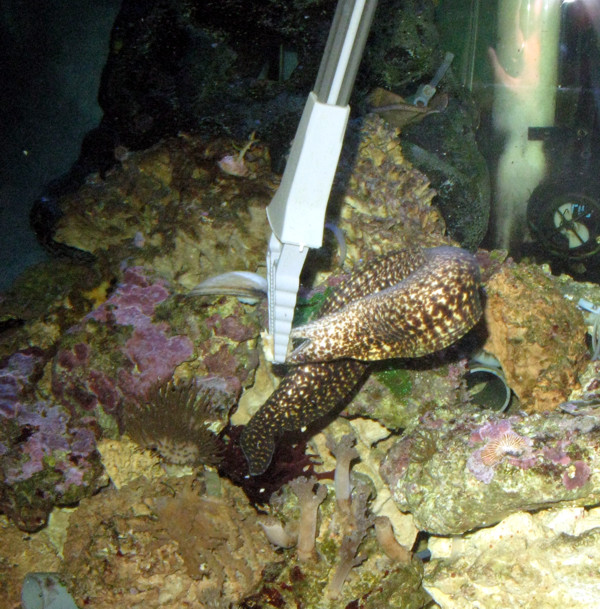
"Predatory fishes like this moray eel need a
fishy diet, but not all foods available in trade are equally safe with
regard to their thiaminase content."
What is thiaminase?
Thiaminase is an enzyme, a chemical compound that destroys or
inactivates thiamine. Thiamine is an important vitamin also known as Vitamin B1.
There is not just one type of thiaminase, but several different ones, some of
which can be produced by bacteria, fungi, plants and potentially animals.
The lack of Vitamin B1 in humans is called beriberi.
Thiamine Deficiency Syndrome and its symptoms
Vitamin B1 (also known as thiamine, thiamine
hydrochloride, and in older text books, as aneurine
hydrochloride) is an essential nutrient for most animals. It is a
colorless and water soluble chemical that helps to convert carbohydrates into
glucose. It is particularly important for the correct functioning of the nervous
system. A lack of Vitamin B1 is called a Thiamine Deficiency Syndrome.
Symptoms of this syndrome are well known from several commercially
important fish groups and can be confirmed using appropriate biochemical tests.
Flatfish fed exclusively with thiaminase-rich clams suffer and die from
paralysis and related physical shocks. Eels show a trunk-winding syndrome and
hemorrhages along the base of the fins (similar symptoms have been reported from
moray husbandry, too). Salmonids show nervous disorders, poor appetite, poor
growth and jumpiness (again, similar things have observed among a variety of
ornamental fish species). Skin congestion and haemorrhage have been reported
from carp and other cyprinids. In general then, excessive amounts of thiaminase
are connected with symptoms of sickness that include poor growth, loss of
appetite, abdominal swelling and hemorrhage, loss of equilibrum, convulsions,
muscle atrophy and a weak immune system.
While it has not yet been scientifically proven that pet fish suffering
from the above mentioned symptoms have Thiamine Deficiency Syndrome, the
parallels with their food fish relatives are striking. The problems of
thiaminase are now well known in the professional fields of animal nutrition
(e.g. fish farms), but so far this information has not been widely taken up by
aquarists and pet owners. But it is clear that those hobbyists keeping large
predatory fish and other carnivorous animals need to be familiar with the
problem of Thiamine Deficiency Syndrome, and use that information to make
sensible choices when selecting food for their livestock.
Aren't thiaminase containing fish eaten in the wild?
Yes, they are, and this can cause predatory fish massive problems. The
offspring of salmon from the Baltic Sea -- which apparently feed mostly on
thiaminase-rich herring and relatively little food that contains high levels of
Vitamin B1 -- were found to suffer from a condition called Reproduction Disorder
M74. This was later identified as being simply one particular form of Thiamine
Deficiency Syndrome. The eggs produced by adult salmon were provided with very
little thiamin, and the fry that emerged almost all died soon after hatching.
Comparable problems have been found among salmonids in the Great Lakes of North
America, and this has been hypothesized to be related to a diet containing a
large proportion of alewives, another type of thiaminase-rich fish.
However, most of the time predatory fishes maintain a kind of balance
between those prey fish rich in thiaminase and those fish rich in Vitamin B1. As
long as the predator has a reasonably varied diet, it should get enough Vitamin
B1 to stay healthy. It should be mentioned that in the examples of the sick
salmonids from the Baltic, the key problem was that they were not eating a
varied diet, but mostly consuming just one type of prey.
The big problem for captive fish is that they are fed frozen fish.
Thiaminase is not destroyed by freezing, and over time will break down whatever
Vitamin B1 is present in the frozen fish. The longer the fish is stored, the
less Vitamin B1 it will contain. Furthermore, any fish fed such frozen fish will
be consuming the thiaminase, and that will destroy some of the Vitamin B1 it
already has. Making things even worse, freezing and thawing both break down some
of the Vitamin B1 content of food as well.
While freezing does not destroy thiaminase, heating it will. This is why
cooked fish is not dangerous with regard to thiaminase for human or animal
nutrition. From the perspective of a fishkeeper, the big drawback to cooking
food is that heating destroys a lot of the useful nutrients as well. While
omnivorous humans compensate for that by eating a varied diet containing both
raw and cooked plant and animal foods, piscivorous fish have no such option.
They cannot be fed cooked fish and expected to stay healthy.
At least some types of live feeder fish will contain more Vitamin B1
than frozen foods, but the downside here is that the convenience of live foods
is accompanied by a major risk of introducing pathogenic microorganisms such as
mycobacteria and endoparasites. Feeder fish are also expensive compared with
frozen foods, and as will be described shortly, many of the types of feeder fish
widely sold contain a great deal of thiaminase anyway, dramatically reducing
their usefulness.
Which fish and other food of aquatic origin contains thiaminase?
A common generalisation often made by aquarists is that marine fish
don't contain much thiaminase while freshwater fish do. This is not the case at
all.
From my review of the literature, of the 32 species of freshwater fish
tested, 18 of them were found to contain thiaminase. Among the 61 marine fish
tested, 32 were found to contain thiaminase. In other words, 56% of the
freshwater fish examined contained thiaminase compared with 51% of the marine
fish species. If there is a difference between freshwater fish and marine fish
in terms of thiaminase content, any such difference appears to be rather small.
Among the food fish families consumed by man, species that contain
thiaminase include minnows, carps, herrings, anchovies, goatfishes and snappers.
Many different invertebrates have also been found to contain thiaminase,
including mussels, clams and shrimps/prawns such as those in the genus
Penaeus, sometimes in even higher concentrations than those found in fish.
In contrast several groups of fish have been generally found to be free
of thiaminase, including North American sunfishes, flounders, cods and croakers.
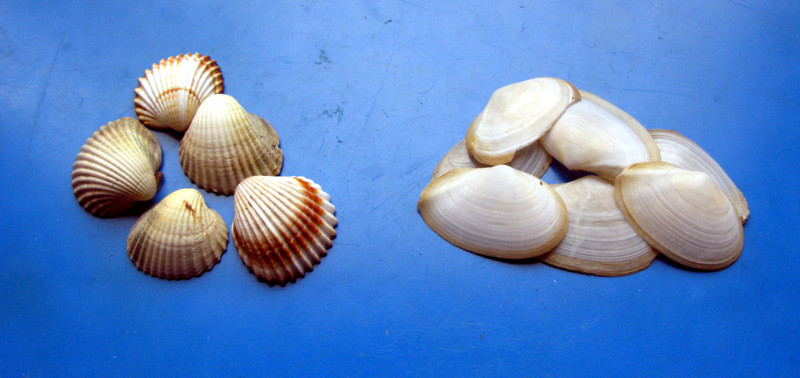
"Bivalves such as clams can are a good food within a varied diet, but many
contain a lot of thiaminase and
should not be used exclusively; some however, notably cockles, contain
little thiaminase and are consequently a better all-around food for
mollusk-feeding predators such as pufferfish."
Thiaminase content review
The data on thiaminase content comes from various sources, mostly from
the National research council (1982), Deutsch & Hasler (1943), Greig &
Gnaedinger (1971) and Hilker & Peter (1966); see also the literature list at the
end of the article. The lists are far from complete, but most of the usually
marketed and so far examined species are enlisted. Although primarily based on
coldwater food fish and invertebrates, thiaminase content information exists for
several tropical species widely marketed, and these been included accordingly.
Species that contain thiaminase
Freshwater fish
Family Cyprinidae (Minnows or carps):
Common bream (Abramis brama)
Central stoneroller (Campostoma anomalum)
Goldfish (Carassius auratus)
Common carp (Cyprinus carpio)
Emerald shiner (Notropis atherinoides)
Spottail shiner (Notropis hudsonius)
Rosy red, Fathead minnow (Pimephales promelas)
Olive barb (Puntius sarana)
Family Salmonidae (Salmonids):
Lake whitefish (Coregonus clupeaformis)
Round whitefish (Prosopium cylindraceum)
Family Catostomidae (Suckers):
White sucker (Catostomus commersonii)
Bigmouth buffalo (Ictiobus cyprinellus)
Family Ictaluridae (North American freshwater catfishes):
Brown bullhead catfish (Ameiurus nebulosus)
Channel catfish (Ictalurus punctatus)
Other families:
Bowfin (Amia calva) - family Amiidae (Bowfins)
Burbot (Lota lota) - family Lotidae (Hakes and burbots)
White bass (Morone chrysops) - family Moronidae (Temperate
basses)
Rainbow smelt (Osmerus mordax) - family Osmeridae (Smelts)
Loach, Weatherfish (Misgurnus sp.) - family Cobitidae (Loaches)
Brackish (freshwater to marine) fish
Family Clupeidae (Herrings):
Alewife (Alosa pseudoharengus)
Gizzard Shad (Dorosoma cepedianum)
Other families:
Sea lamprey (Petromyzon marinus) - family Petromyzontidae
(Lampreys)
Fourhorn Sculpin (Triglopsis quadricornis) - family Cottidae
(Sculpins)
Salmon (sp. indet., processed and salted, probably Oncorhynchus
sp.) - family Salmonidae (Salmonids)
Marine fish
Family Engraulidae (Anchovies):
Broad-striped anchovy (Anchoa hepsetus)
Californian anchovy (Engraulis mordax)
Goldspotted grenadier anchovy (Coilia dussumieri)
Family Clupeidae (Herrings):
Atlantic herring (Clupea harrengus)
Atlantik menhaden (Brevoortia tyrannus)
Gulf menhaden (Brevoortia patronus)
Razor belly sardine (Harengula jaguana)
Sauger (Harengula jaguana)
Family Scombridae (Mackerels, tunas, bonitos):
Chub mackerel (Scomber japonicus)
Skipjack tuna (Katsuwonus pelamis)
Yellowfin tuna (Neothunnus macropterus)
Family Lutjanidae (Snappers):
Green jobfish (Aprion virescens)
Ruby snapper (Etelis carbunculus)
Crimson jobfish (Pristipomoides filamentosus)
Family Carangidae (Jacks):
Giant trevally (Caranx ignobilis)
Doublespotted queenfish (Scomberoides lysan)
Bigeye scad (Selar crumenophthalmus)
Family Mullidae (Goatfishes):
Red Sea goatfish (Mulloidichthys auriflamma)
Yellowstripe goatfish (Mulloidichthys samoensis)
Manybar goatfish (Parupeneus multifasciatus)
Other families:
American butterfish (Peprilus triacanthus) - family
Stromateidae (Butterfishes)
Southern ocellated moray (Gymnothorax ocellatus) - family
Muraenidae (Moray eels)
Bonefish (Albula vulpes) - family Albulidae (Bonefishes)
Milkfish (Chanos chanos) - family Chanidae (Milkfish)
Common dolphinfish (Coryphaena hippurus) - family Coryphaenidae
(Dolphinfishes)
Hawaiian flagtail (Kuhlia sandvicensis) - family Kuhliidae
(Aholeholes)
Black cod (sp. indet.) - family Moridae (Morid cods)
Flathead mullet (Mugil cephalus) - family Mugilidae (Mullets)
Sixfinger threadfin (Polydactylus sexfilis) - family
Polynemidae (Threadfins)
Regal parrot (Scarus dubius) - family Scaridae (Parrotfishes)
Swordfish (Xiphias gladius) - family Xiphiidae (Swordfish)
Invertebrates
Bivalves:
Ocean quahog (Artica islandica)
Clam (Tellina spp.)
Cherrystone, Chowder, Steamer clams (family Veneridae)
Pigtoe mussel (Pleurobema cordatum)
Scallop (Pecten grandis)
Hawaiian clam (sp. indet.; extremely high in thiaminase)
Blue mussel (Mytilus galloprovincialis)
Gastropods:
Limpet (Helcioniscus sp.)
Cephalopods:
Hawaiian flying squid (Nototodarus hawaiiensis)
Crustaceans:
Prawn, Tiger shrimp (Penaeus spp.)
"The flesh of this Brazilian ocellated moray Gymnothorax ocellatus
contains thiaminase. Makes a better pet fish than food fish, anyway!"
Species that do not contain
thiaminaseFreshwater fish
Family Centrarchidae (North American Sunfishes):
Largemouth bass (Micropterus salmoides)
Northern rock bass (Ambloplites rupestris)
Northern smallmouth bass (Micropterus dolomieu)
Blue gill (Lepomis macrochirus)
Black crappie (Pomoxis nigromaculatus)
Pumpkinseed (Lepomis gibbosus)
Family Percidae (Perches):
Yellow perch (Perca flavescens)
Walleye (Sander vitreus)
Family Salmonidae (Salmonids):
Bloater (Coregonus hoyi)
Lake trout (Salvelinus namaycush)
Rainbow trout (Oncorhynchus mykiss)
Other families:
Ayu (Plecoglossus altivelis) - family Plecoglossidae (Ayu fish)
Longnose gar (Lepisosteus osseus) - family Lepisosteidae (Gars)
Northern Pike (Esox lucius) - family Esocidae (Pikes)
Brackish (freshwater to marine) fish
Family Salmonidae (Salmonids):
Cisco, Lake herring (Coregonus artedi)
Atlantic Salmon (Salmo salar)
Coho salmon (Oncorhynchus kisutch)
Sea trout (Salmo trutta)
Other families:
Common eel (Anguilla anguilla) - family Anguillidae (True eels)
Pond smelt (Hypomesus olidus) - family Osmeridae (Smelts)
Marine fish
Family Pleuronectidae (Righteye flounders):
Winter flounder (Pseudopleuronectes americanus)
Winter flounder, Lemon sole (Pseudopleuronectes americanus)
American plaice (Hippoglossoides platessoides)
Yellowtail flounder (Limanda ferruginea)
Atlantic halibut (Hippoglossus hippoglossus)
European plaice (Pleuronectes platessa)
Family Gadidae (Cods and haddocks)
Atlantic cod (Gadus morhua)
Haddock (Melanogrammus aeglefinus)
Saithe, Pollock (Pollachius spp.)
Family Sciaenidae (Drums or croakers):
Atlantic croaker (Micropogonias undulates)
Southern kingfish (Menticirrhus americanus)
Spot croaker (Leiostomus xanthurus)
Silver seatrout (Cynoscion nothus)
Sand weakfish (Cynoscion arenarius)
Family Carangidae (Jacks):
Greater amberjack (Seriola dumerilii)
Yellowtail scad (Atule mate)
Mackerel scad (Decapterus pinnulatus)
Family Labridae (Wrasses):
Cunner (Tautogolabrus adspersus)
Tautog (Tautoga onitis)
Family Scombridae (Mackerels, tunas, bonitos):
Atlantic mackerel (Scomber scombrus)
Kawakawa (Euthynnus affinis)
Other families:
Tusk (Brosme brosme) - family Lotidae (Hakes and burbots)
Largehead hairtail (Trichiurus lepturus) - family Trichiuridae
(Cutlassfishes)
Piked dogfish (Squalus acanthias) - family Squalidae (Dogfish
sharks)
Hake (Urophycis spp.) - family Phycidae (Phycid hakes)
Inshore lizardfish (Synodus foetens) - family Synodontidae
(Lizardfishes)
Mullet (Mugil spp.) - family Mugilidae (Mullets)
Scup, Southern porgy (Stenotomus chrysops) - family Sparidae
(Porgies)
Ocean perch, redfish (Sebastes marinus) - family Sebastidae
(Rockfishes)
Black seabass (Centropristis striata) - family Serranidae (Sea
basses and Groupers)
Hardhead sea catfish (Ariopsis felis) - family Ariidae (Sea
catfishes)
Searobin (Prionotus spp.) - family Triglidae (Searobins)
Silver hake (Merluccius bilinearis) - family Merlucciidae
(Merluccid hakes)
Eyestripe surgeonfish (Acanthurus dussumieri) - family
Acanthuridae (Surgeonfishes)
Atlantic blue marlin (Makaira nigricans) - family Istiophoridae
(Billfishes)
Blotcheye soldierfish (Myripristis berndti) - family
Holocentridae (Squirrelfishes, soldierfishes)
Glasseye (Heteropriacanthus cruentatus) - family Priacanthidae
(Bigeyes or catalufas)
Great barracuda (Sphyraena barracuda) - family Sphyraenidae
(Barracudas)
Invertebrates
Bivalves:
Cockle (Cardium spp.)
Crustaceans:
Marine shrimps (sp. indet.; Hawaii)
Portuguese crabs (sp. indet.)
Cephalopods:
Brief squid, calmar (Lolliguncula brevis)
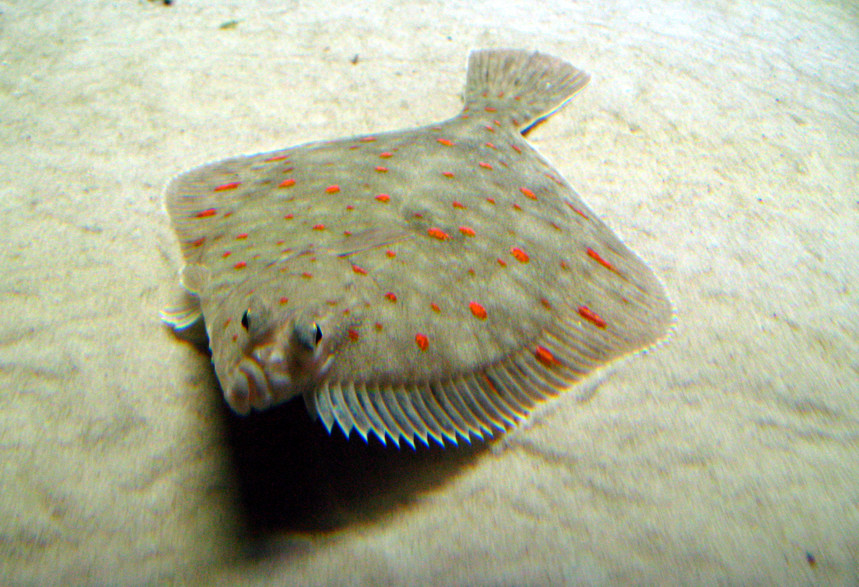
"All so far
examined flatfish like this European plaice (Pleuronectes platess)
are free of thiaminase."
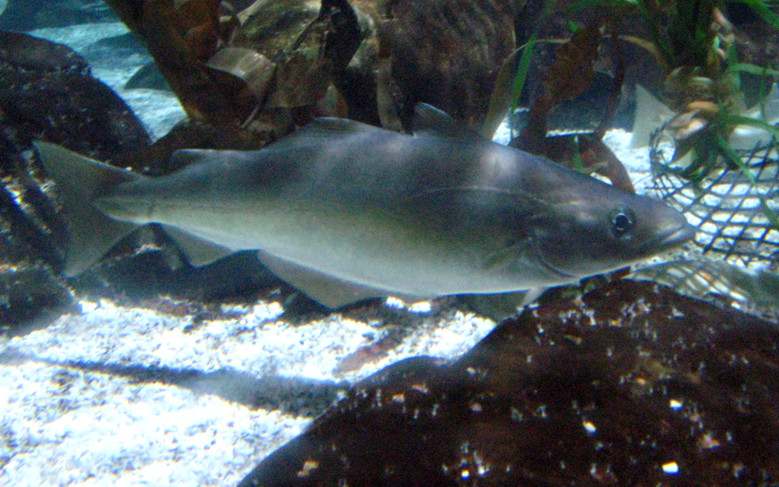
"So far examined fishes from the family Gadidae like this Pollock (Pollachius
pollachius) are free of thiaminase and a good choice for pet fish
nutrition."
What to do with fishes not mentioned in the lists above?
Certainly not every fishy food is included in the lists above. For many
food items probably no data exists, yet. What you can do if you are
missing a food fish in the list is:
1. Find out the scientific name of the food fish and compare it to the
list again. Many fish are traded under obscure names.
2. Try checking literature for the food species yourself. Search engines
are your friends. (If you are successful, reporting it back could help
other hobbyists).
3. If you fail to find information, treat the fish in question as if it
contained thiaminase.
What obviously won’t always work is to see if the fish in question
belongs to the same genus or family as one or more of the fish enlisted
(e.g. with fishbase.org). Related fish from the same genus or family may
have a similar composition in terms of protein or fat, but the
thiaminase content sometimes seems to vary greatly even between species
within a single genus, and may even vary from population to population.
Little or nothing is known about the thiaminase content of some of the
small ornamental fishes usually used as feeders. However, goldfish and
minnows (including rosy red minnows) definitely contain thiaminase and
consequently make very poor choices as feeders. On the other hand, the
Poeciliidae (e.g., guppies, mollies, mosquitofish) are often recommended
as safe feeder fishes for predators because of their presumed to be low
thiaminase content. Despite claims among aquarists that guppies contain
thiaminase producing bacteria, I am not aware of any scientific study
demonstrating this to be the case. Since poecilids are grazers, an
uptake of thiaminase-producing cyanobacteria would be possible, though
less probable in a freshwater aquarium where a much smaller variety of
algae are likely to be present than in the wild.
Anecdotal evidence that the notoriously delicate Ribbon Eel can live on
a diet of mostly gut loaded black mollies for more than 15 years would
seem to suggest that poeciliids are largely thiaminase-free and make a
safe choices for feeder fish. Of course this depends on the quality of
the feeder fish being used, and cheap feeder guppies from pet stores
might not contain any thiaminase but could certainly contain all sorts
of pathogenic bacteria and parasites! So when poeciliids are described
as being among the best feeder fish, this depends on them being bred at
home and gut loaded with Vitamin B1-enriched foods, such as a good
quality flake food. Because poeciliids have a high tolerance for
saltwater (mollies in particular can be maintained indefinitely under
marine conditions) they are equally useful in saltwater tanks as in
freshwater aquaria. But this said, avoidance of feeders is the best
option in terms of cost, convenience and safety, and the use of feeders
should be limited to those few obligate piscivores that will not take
dead food or for the acclimation of newly introduced livestock prior to
being trained to accept dead or frozen foods.
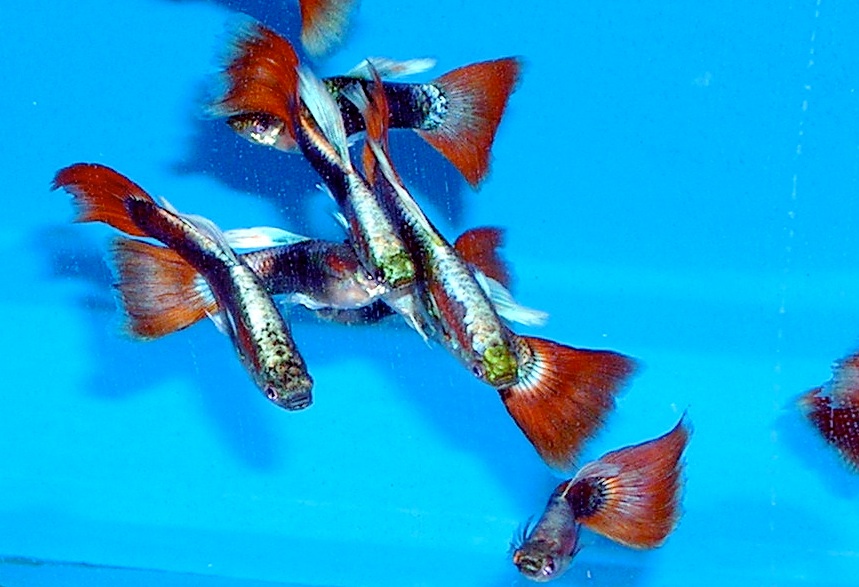
“The thiaminase content of guppies is
unknown, but considered low or negligible, making them much safer to use
than goldfish or minnow feeders.”
How can I avoid the thiamine deficiency syndrome?
Prevention is the best way to “treat” the thiamine deficiency syndrome.
Things to avoid include:
1. Restrict feeding thiaminase containing fish to no more than 20%
of all meals.
2. Avoid feeding exclusively frozen bivalves or shrimps, because
these potentially have very high thiaminase content.
3. Avoid fish that was frozen for long periods (several months).
Things to do:
1. Keep the diet generally as varied as possible! Remember,
nutritional shortcomings in one type of food will be cancelled out by
the other types of food, so the more types of food, the smaller the
chance of nutrient imbalances.
2. Soak food in a vitamin product intended for pet fish prior to
feeding at least once a week, more often when feeding lots of shrimps
and bivalves!
3. Get small packages of food, and use them up quickly.
Final words
Thiaminase-containing food will not be instantly lethal to your pets,
but over the long term can result in a slow decline in health. Simple
measures and a little conscientiousness when buying and preparing food
is all that is needed to easily avoid Thiamine Deficiency Syndrome.
References
Anglesea, J.D. & Jackson, A.J. (1985): Thiaminase activity in fish
silage and moist fish feed. Anim. Feed Sci. Tech. 13: 39-46.
Deutsch, H.F. & Hasler, A.D. (1943): Distribution of a Vitamin B1
destructive enzyme in fish.- Proc. Soc. Exp. Biol. Med. 53: 63-65.
Food and agriculture organization of the United Nations (1980):
ADCP/REP/80/11 - Fish Feed Technology. HYPERLINK
"http:]www.fao.org/docrep/X5738E/x5738e00.HTM#Contents"
http:]www.fao.org/docrep/X5738E/x5738e00.HTM#Contents
Greig, R.A. & Gnaedinger, R.H. (1971): Occurrence of thiaminase in some
common aquatic animals of the United States and Canada. Special
Scientific Report—Fish. U.S. Dept. Commer. Natl. Mar. Fish. Serv. 631:
1-7.
Hilker, D.M. & Peter, O.F. (1966): Anti-thiamine activity in Hawaii
fish.- J. Nutr. 89(4):419-421.
National Research Council (1981): Nutrient Requirements of Cold-water
Fishes. Washington, D.C.: National Academy Press.
National Research Council (1982): Nutrient Requirements of Mink and
Foxes, Washington, D.C.: National Academy Press.
National Research Council (1983): Nutrient Requirements of Warm-water
Fishes and Shellfishes. Washington, D.C.: National Academy Press.
National Research Council (1993): Nutrient Requirements of Fish.
National Academy Press. Washington DC, USA.
Royes, J.-A.B. & Chapman F.A.: Preparing your own fish feeds.-
University of Florida, 9 p. HYPERLINK
"http:]edis.ifas.ufl.edu/pdffiles/FA/FA09700.pdf"
http:]edis.ifas.ufl.edu/pdffiles/FA/FA09700.pdf
Scardi, V. & Magri, E. (1957): Thiaminase activity in Mytilus
galloprovincialis.- Boll Soc Ital Biol Sper. 33(7):1087-1089 (in
Italian).
Wistbacka, S.; Heinonen, A.; Bylund, G. (2002): Thiaminase activity of
gastrointestinal contents of salmon and herring from the Baltic Sea.-
Journal of Fish Biology 60(4), 1031-1042.
Yudkin, W.H. (1949): Thiaminase, the Chastek-paralysis factor.- Physiol.
Rev. 29: 389-402.
Thiaminase 1/4/12
Hello and Happy New
Year to the Wet Web Crew,
<Hi Richard and a happy new year to you, too.>
I've been doing research on Thiaminase in fish as it
relates to feeder fish and in so doing have contacted a
number of fish nutritionist and the author of a study on
Thiaminase in Lake Trout. Here are some
interesting facts:
1) Amazingly, there are no known examples of warm water
species of fish or reptiles suffering from thiamin
deficiency when consuming live prey. No references
period.
<No scientific references maybe, since there is little
interest in this topic so far. There is also no
scientific study showing that consuming live, Thiaminase
containing food has no impact on warm water fishes. What
we have is empirical evidence from decades of keeping
predatory fishes (including some mostly fed with
feeders, although is is done not that often and with a
lot of species), which can be linked to malnutrition and
at least symptoms similar of those suffering from a lack
of thiamin, just have a look on the disease FAQs of the
common predatory fishes at WWM.>
Thiaminase became a concern after it was discovered that
fish in the Great Lakes and Baltic suffered low
fertility rates as a result of consuming non-native
species of Thiaminase containing fish. This
phenomena is strictly limited to these studies and it is
postulated that it is temperature related and associated
with the amount of time prey is in the stomach prior to
digestion. Thiamin is released upon destruction of
tissue and will begin to degrade thiamin in the gut. In
warm-water species enough thiamin is absorbed in the gut
prior to its deactivation to make it a non-factor.
<If this was that simple no animal with a fast
metabolism would suffer from eating Thiaminase rich
food, but they do, even mammals with much faster
metabolisms than warm water fishes.>
Fish that contain Thiaminase are often actually rich
sources of B1. It is the digestion rate that effects
uptake of B1 in lake trout which is why you see higher
thiamin content in Lake Trout in the summer months even
though the Thiaminase levels in alewives are at their
highest.
2) Feeding an exclusive diet of frozen fish that contain Thiaminase over
many months will be the surest way to produce
B1deficiency.
<That's actually what can be observed most often in the
hobby.>
This has been demonstrated with mink, foxes and
alligators. All of which were fed frozen
Thiaminase containing fish and after a number of months
developed beriberi. However, if someone had to
feed frozen, simply using a varied diet of multiple
species of fish that included non-Thiaminase species
would prevent malnutrition.
<Just what is recommended in the WWM article.>
The mink and fox farmers learned to cook their fish soon
after landing to neutralize Thiaminase. Ice
crystals rupture cell structures that then releases
Thiaminase into the tissue. Even in a freezer
Thiaminase will deactivate thiamin rather quickly.
3) Thiaminase does not cross the blood barrier but remains in the gut.
Some species of fish appear to sequester Thiaminase in special cell
vacuoles, but with predatory fish the Thiaminase does
not cross the blood barrier and remains in the gut.
Thiaminase passes out of the gut with the undigested
food. Thiaminase does not build up in the system
and as long as a varied diet is followed that includes
non-Thiaminase containing species fed at different
times, even cold-water species will thrive. There is no
science or evidence that feeding live has ever caused
thiamin deficiency in warm-water species. The fish
nutritionist that I have contacted, the author of the
Lake Trout study and all the literature concur on this
point. Only feeding an exclusive diet of frozen
Thiaminase containing fish will cause vitamin B1
deficiency in
warm-water species. And, only if continued for prolonged
periods of time.
Your discussion on Thiaminase is extensive and mostly
accurate, but I do not believe that it takes these
subtleties into mind, which leads to consequential
conclusions on the part of the reader.
<We'll add your opinion to the FAQ.>
It is important to emphasize that this is a cold-water
disease as defined by the literature, and that there is
a monumental difference between feeding live vs. frozen
in regards to nutritional quality in many respects.
<See my opinion above.>
Thank you for your time.
<Welcome. Marco.>
Sincerely, Richard Rombold
Re: Thiaminase 1/5/12
Let me say first, you guys rock that you take this issue
so seriously.
<Thanks for your kind words. My intention was seeing
predatory aquarium fish suffering from symptoms known
from thiamin deficiency for many years.
Those belong to two groups: A big group being fed frozen
food (mostly one type of fish or shrimp or bivalve) and
a small group being fed goldfish and minnow feeders. I
am not aware of apparently Thiaminase related problems
with feeder mollies (as noted in the article), though.>
Let me try to review this article and put some thought
into your good points and get back to you in a couple of
days.
<OK.>
I greatly suspect that the Barramundi were not fed live
fish.
<That's probably right. My point in sending this article
citation was mostly to show a scientific study, which in
addition to empirical evidence, states if Thiaminase can
be a problem for tropical fish, since you suggested
their faster metabolism and faster uptake of thiamin
would prevent them from the consequences. Based on the
cited article and empirical evidence I cannot confirm
the idea of a fast metabolism making Thiaminase
completely harmless in tropical fishes, and it seems it
cannot be confirmed for reptiles and mammals. The
digestion period of small to medium sized morays for
example is between 24-72 hours depending on the food
composition and the activity and size of the fish (much
slower than in a mink, which can show Thiaminase related
diseases). Inside a tropical fish or warm blooded animal
the breakdown of thiamin by Thiaminase can be faster
than inside a cold water fish.
With regard to feeding live or fresh fish, I do concur
that the relation of thiamin to Thiaminase is better
than on frozen food (I stated this in the article).
However, I would not claim it to be safe. There is no
study I am aware of analyzing the use of e.g. minnows as
feeders and thiamin supply. I can only offer empirical
hobby evidence of fish being fed goldfish and minnows
leading to possibly/probably Thiaminase related diseases
with the known results. I did not observe this with
homebred mollies as feeders. My resulting measures and
recommendations from working on the Thiaminase topic
were simple: feed a varied diet, prefer Thiaminase poor
food when possible and add vitamins to frozen food. I
generally do not recommend feeder fish and rarely used
them myself. Neale has a good article about the feeder
fish topic:
http://www.wetwebmedia.com/fwsubwebindex/fdgfdrartneale.htm
.
I remember another study on tropical groupers, which
came to the conclusion that internal organs should be
removed of food fishes to avoid Thiaminase, this would
also indicate that using feeders is not considered safe
by the author, but I don't have it at hand right now. I
think it was by Sih-Yang Sim et al., who wrote the "A
Practical Guide to Feeds and Feed Management for
Cultured Groupers" in which the Thiaminase avoidance
recommendation is also briefly noted.>
Thanks for the quick response, Rich
<Welcome. Cheers, Marco.>
Re Thiaminase 1/5/12
PS: A quick look at my literature re thiamin deficiency
brought up a reference of a tropical fish species
showing symptoms of thiamin deficiency likely due
to high thiamine activity in a food fish. It's
Glezebrook an Campell "Diseases of Barramundi L.
calcarifer in Australia: A Review". I'm citing :
"Nutritional deficiencies have begun to appear in
cultured barramundi. Six out of a group of 60
fingerlings being reared in a plastic lined swimming
pool in Cairns were exhibiting abnormal swimming
behaviour, i.e. nearly vertical with exaggerated tail
movements. These fish were not interested in food and
showed no obvious internal or external lesions.
Microscopically, bilateral degenerative changes
(vacuolation) had occurred on both sides of the brain
and the peripheral nerves were also affected. In the
spinal cord, gliosis, i.e. swelling of the glial cells,
was evident, particularly ventrolaterally. There was
strong evidence to suggest that fish being fed to the
fingerlings was high in the enzyme Thiaminase. A dietary
change has since corrected the problem." So apparently
tropical predatory fishes can suffer from Thiaminase! I
don't know if they've been fed live or frozen fish,
though.
Re Thiaminase 1/7/12
This email was an addendum to an answer I send to
Richard re Thiaminase. It should go to where the earlier
answers went. I could not answer his original email at
this point, because I had it already answered and
deleted and couldn't find it in the deleted emails'
folder. Hope that's no problem.
Marco.
<Real good Marco. Will do. BobF>
Thiaminase... repeated
<PS: A quick look at my literature re thiamin deficiency
brought up a reference of a tropical fish species
showing symptoms of thiamin deficiency likely due
to high thiamine activity in a food fish. It's
Glezebrook an Campell "Diseases of Barramundi L.
calcarifer in Australia: A Review". I'm citing :
"Nutritional deficiencies have begun to appear in
cultured barramundi. Six out of a group of 60
fingerlings being reared in a plastic lined swimming
pool in Cairns were exhibiting abnormal swimming
behaviour, i.e. nearly vertical with exaggerated tail
movements. These fish were not interested in food and
showed no obvious internal or external lesions.
Microscopically, bilateral degenerative changes
(vacuolation) had occurred on both sides of the brain
and the peripheral nerves were also affected. In the
spinal cord, gliosis, i.e. swelling of the glial cells,
was evident, particularly ventrolaterally. There was
strong evidence to suggest that fish being fed to the
fingerlings was high in the enzyme Thiaminase. A dietary
change has since corrected the problem." So apparently
tropical predatory fishes can suffer from Thiaminase! I
don't know if they've been fed live or frozen fish,
though. Marco.>
Re: Thiaminase 1/7/12
Marco,
<Richard.>
I appreciate seeing others who take the responsibility
of keeping fish equally as seriously as I do. In
reading the wet web’s report on Thiaminase and other
topics I could tell how much thought and work went into
each report, which I respect. I have
a prejudice towards feeders, but if they truly are
harmful to a tank then I’ll beat that drum. I feel that
the problems associated with feeder fish are more
related to poor tank management and ignorance than in
the value of feeders. However, if
nutritionally they are inferior, or even just equal to,
pelleted diets, then there is no real use for them other
than to stimulate natural behavior. I think that
has to be the starting point.
<I agree.>
I found the paper you cited and yes there is no way of
knowing if the Barramundi were fed live or not. In my
experience older research did not see the relevance of
the distinction.
<No it didn't. The only thing you will find is that
fresh fish (and therefore feeders as well) has a higher
relation of thiamin to Thiaminase and therefore is
better than frozen food. The question is: is it safe?>
Several months ago I had a conversation with Jim Zajicek
of the USGS. He is a wealth of information on
Thiaminase research and was co-author of the Lake Trout
study. Very open individual and more than willing
to let you bend his ear. His email is
jzajicek@usgs.gov and I’d introduce yourself. His
bottom line was that unless you were interested in
breeding cold-water species, feeding live Thiaminase
containing fish was not a nutritional concern.
With regards to warm-water species, he
said it was a non-factor. I also contacted Andy Goodwin
at the Pine Bluff aquaculture facility and he put the
question to a panel of fish nutritionist and no one on
the panel voiced a concern. But, I fear you are correct
in saying that the research on the topic as it relates
to tropical fish is nonexistent.
<Yes, that's the problem. We have good points for both
opinions.>
This spring I am setting up an old tank system and should have some extra
space. I thought it would be fun to run a trial.
I want to take three groups of fingerling bluegill and
raise them on three unique diets and then compare the
results in the Fall. One group I would rear on
Gambusia (non-Thiaminase species), one on goldfish
(Thiaminase containing species) and a control on a
pelleted diet. Some feedback on what you think a
fair trail would look like, and any other comments,
would be very useful.
<This sounds like a very good idea. Results should be
published. Your control group will let you distinguish
between live vs. pelleted food, personally I'd add a
group fed with frozen, Thiaminase containing food to see
if the bluegill are affected at all during the
experiment (the barramundi apparently were affected much
quicker than trout). What also would be highly
interesting is the respective Thiaminase activities of
the food types used (I don't know if properly raised
goldfish fed with a healthy diet have a better
thiamin/Thiaminase relation than the ones you get from
crowded store tanks). I'd also add a second stage to the
experiment where fish showing symptoms are fed (if they
still accept food) a varied, thiamin rich and Thiaminase
poor diet to see if the deficiency diseases are
reversible at an early stage.>
Thanks. Sincerely, Richard
<Cheers, Marco.>
Re: Thiaminase
1/9/12
Marco,
<Richard.>
I’ll keep you informed on plans for a feed trial as they
develop. It is planned to begin in March when the
weather warms up. The first priority will be to
address Thiaminase. I like your idea of feeding
one group a diet known to be thiamin deficient. I
worry though as the number of unique diets increases
that the answers may get more muddled. I am
fortunate to have contact with some great people in the
industry. I don’t know where you are located
<Germany.>
but I spoke with Steve Lambourne from LA last week about
my plans. Steve’s family has been importing and
selling tropical fish wholesale for nearly 50 years.
He has one of the best reputations for quality on the
West Coast. He reminded me that for many years
goldfish were believed to be the perfect food.
Oscar owners fed their fish a goldfish exclusive diet
for years on end. This began to change when Jack
Gratzek and the University of Georgia linked a goldfish
exclusive diet to HITH. Adding variety to the diet
cured the symptoms. This is a point that we all
take for granted now. What is interesting though
is that we
forget that an all goldfish diet use to be the norm and
that it supported good health and achieved good
growth for many hobbyist. If Thiaminase is an issue with
feeding live then why did those keeping Oscars not then
find their fish lethargic, listless and dying after a
few months?
<A lot hobbyists did observe according symptoms... see
FAQs. Also, not all species are affected equally, we
don't even know if all goldfish contain thiamin and
Thiaminase and to what extent (this likely will depend
on the goldfish diet.>
What we have is a study of the effect of a Thiaminase
heavy diet on Lake Trout,
<and others...>
and an awareness that feeding frozen feeders leads to
thiamin deficient like symptoms, leading us to make the
illogical leap that feeders fed live will also cause a
thiamin deficiency. I say illogical because there
are decades of practical fish keeping experience which
say otherwise.
<Definitely disagree here as explained in detail
before.>
The problem is that in the absence of good information
we begin to draw conclusions that are not supported in
the literature
or in common practice, but that is the point and the
reason for the need for someone to step and start
conducting feed trials. Think about it though. Why
in the 80’s and 90’s were Oscars fed an all goldfish
diet able to
survive and grow to the size they did?
<Many did not.>
The symptoms of beriberi develop in months and are
pronounced. If thiamin deficiency was occurring it
would have been well documented, but it wasn’t. At
that time we didn’t know that goldfish contained
Thiaminase. If feeding live caused beriberi we
wouldn’t have needed to wait until 2005 for a study of
Lake Trout to bring it to our attention.
<It wasn't that study, which brought this to my
attention, but observed symptoms. The study along with
others only helped to explain the symptoms so far
without a definite cause.>
It would have been studied and we would already have the
data. The fact that the question hasn’t been asked has a
lot to do with the fact that the problem didn’t exist.
<Definitely disagree here, too, for the obvious reasons
written earlier.>
But, still the question has never been asked and studied
directly and until it is there are going to be
questions. Sincerely,
Rich
<Agree here. Cheers, Marco.>
Re: Thiaminase 1/10/12
Marco,
<Rich.>
Points well taken and I'll get started on a trial as
soon as the weather warms up.
I propose to use five unique diets on the trial:
Group A) Top quality commercial pellet
Group B) Exclusive Thiaminase containing live diet
(goldfish)
Group C) Exclusive Thiaminase containing frozen diet
(goldfish)
Group D) Exclusive non-Thiaminase containing live diet
(Gambusia)
Group E) Varied diet (goldfish, Gambusia, worms, snails
etc...)
Each group will contain 10 bluegill in 75 gallon plastic
tanks. Each group of ten will be weighed and
photographed prior to beginning the trial.
Periodically each group will be sampled. In the
Fall the entire group will be weighed and photographed
with an average weight and length given. If there is a
need individual fish can be dissected and inspected by a
vet.
I suspect that the live diets will outperform the
pellets.
<Bet the latter will be the most healthy group.>
That can't be assumed and I'll invest in an auto-feeder
to ensure the pelleted diet gets fed at regular
intervals. It will also be interesting to see how
the various live diets perform in relation to each other
and how long it will take for thiamin deficiency to
manifest in the frozen goldfish diet and or the live
goldfish diet.
<Yes, I'm very interested if/when fish show any
symptoms.>
The point of the trial is to get hard data. I
appreciate your interest and encouragement and will send
you updates as the trial develops. I also want to
encourage your sincere critique of the trial both as it
unfolds and in the planning stage.
<The only thing I can add at the moment is: With your
contacts to scientists that have worked on the topic, do
you have the possibility to get a measurement of
Thiaminase activity in one or two of your specific live
and frozen goldfish samples? In case symptoms occur one
could roughly compare them to other Thiaminase
containing types of food.>
You are not going to hurt my feelings by pointing out
something that I overlooked. Thanks.
<Kudos to you for undertaking such a study.>
Sincerely, Rich
<Cheers, Marco.>
Re: Thiaminase 1/10/12
<"Bet the latter will be the most healthy group." should
be the "last", being the varied diet (group E), not the
pellets. I don't know how good the pellets will perform,
but a varied diet in my opinion/experience should work
best.>
Re: Thiaminase 1/11/12
Marco,
<Rich.>
The author of the Lake Trout study said he could do the
testing for thiamin levels but that it was difficult and
expensive. Only maybe two labs in the world have
the experience to pull it off. You have to be able
to isolate the Thiaminase in the tissue so that it does
not interfere with the thiamin measurement. It is out of
my price range.
<Okay. So, let's assume the goldfish do contain a
similar activity as measured in earlier studies.>
However, most fish are a good source of protein and
muscle contains a lot of thiamin so it is assumed that
when feeding live of any species that there is an
abundance of thiamin available from muscle tissue.
It is simply a question of how much is absorbed in the
gut before Thiaminase deactivates it. As it was
described to me, "its all a matter of timing".
Also of note, fish require only a very small
amount of thiamin. Their needs are measured in
micro moles of B1. In your experience with thiamin
deficiency was it caused by using a frozen diet or did
you see a deficiency using a live diet?
<Mostly frozen (including various warm water aquarium
species). For live diets there are suspected cases of
Scorpaenoids, Morays and Antennariids and a small number
of freshwater predators such as Oscars fed exclusively
goldfish.>
Also, how long did it take for symptoms to appear?
<My final words in the article: "Thiaminase-containing
food will not be instantly lethal to your pets, but over
the long term can result in a slow decline in health." A
few months to about a year. I suppose with diets having
at least a very little variation, it could take longer.>
One more thing, I was rereading your article on
Thiaminase on the web last night. It is inaccurate
to say that Thiaminase will deplete existing B1 stores
in a predator fish (if I understood you correctly).
<I think you refer to the sentence: "Furthermore, any
fish fed such frozen fish will be consuming the
Thiaminase, and that will destroy some of the Vitamin B1
it already has." An "eaten" or "in the gut" at the end
would clarify that. This is about vit b1 in the stomach,
gut.>
Thiaminase does not cross the blood barrier and remains
in the gut where it passes out with the prey item.
<Yes, that's how I understood it.>
When feeding a varied diet it would then be important
not to feed Thiaminase containing diet at the same time
you feed a non-Thiaminase diet. Any B1 already in the
predator fish is unaffected. The concern with using
Thiaminase containing feeder fish is if enough B1 is
absorbed to meet the future metabolic needs.
<Yes. See the fish groups noted above: Scorpaenoids,
Morays and Antennariids: all have a slow digestion in
relation to the temperature they live in. Plenty of time
for Thiaminase to be active in the stomach. Barramundi
on the other hand as well as mammals seem to digest
faster compared to this group and still can suffer from
the deficiency syndrome ( I assume they were fed frozen
food, but don't know for sure for the barramundi). The
species seems to play a role with Thiaminase: I remember
a study where carp eggs (rich in Thiaminase) were fed to
catfishes and sunfishes, and only the catfishes
developed severe symptoms in the time of the study (a
few months as far as I remember, will look it up if you
want to read the study yourself). However, I have too
little information on specific pet fishes to make even
suggestions on which are more affected by a Thiaminase
rich diet and which are less.>
Rich
<Marco.>
Re: Thiaminase 1/11/12
Marco,
<Rich>
Sorry to have challenged some of what you wrote, but the
more we poke at this the more it make sense. That
is except for the barramundi paper which is an outlier.
I hadn't considered cold-water species of saltwater
fish.
<Me neither, the groups I named are subtropical to
tropical.>
That would be inline with the Lake Trout study. In
casual reading of claims of thiamin deficiency it would
also appear that juveniles are more susceptible than
adults. I haven't seen a paper supporting this, but it
would make sense too. With cold-water species it
would be important to not feed a continuous diet of
Thiaminase containing fish but to alternate weekly or
find an economical source of non-Thiaminase containing
fish. That seems to be a problem. Non-Thiaminase
containing species are usually more expensive and often
frozen which cause other nutritional concerns. For fry I
would recommend not feeding Thiaminase containing food.
Fry usually feed on insects and other high protein items
and don't have the opportunity to feed on other fish.
So there are good situations where Thiaminase can be a
problem. A manageable problem, but something that
we need to be aware of. But, I think we are
painting in very broad strokes because of a lack of
understanding of how Thiaminase works and that with
warm-water species Thiaminase is not an issue.
<I doubt the latter as explained earlier. Just think
about how long digestion takes at a frogfish or moray.>
Would you like me to recontact Jim at USGS and ask that
question of him specifically?
<Question? You mean if warm water fishes such as
barramundi or morays can be affected? Feel free to ask
for his opinion and maybe link him to the barramundi
study.>
I think he would be very interested in your observations
as well.
Sincerely, Rich
<Cheers, Marco.>
Re: Thiaminase 1/12/12
Marco,
<Rich.>
I'll put the question to him. It might be a while before
I get an answer.
<Okay.>
Should be interesting.
<Certainly.>
How are things in Germany?
<Quite fine. Thanks for asking. Surprising amount of
work even for geologists like me. Also an interesting
aquarium hobby scene with a lot in common to the US
scene, but also differences.>
I've never made it there. I bicycled once up from
Madrid to the edge of the Rhine but then headed back to
Paris for a flight out. I've always wanted to get back.
Rich
<Hopefully you'll find the possibility. Cheers, Marco.>
Re: Thiaminase 1/24/12
Marco,
<Rich.>
How are you? Hope all is well.
<Yes, thanks.>
Jim called from USGS and we talked about the barramundi
paper briefly before he had to go to an appointment.
As you know there is a lot of detail missing in the
account and he wasn't able to make much of it. He
is requesting the full article and some of the papers
cited but he noted that none of the cited literature
dealt with thiamin but rather B6 and B12.
<There are no citations within the paragraphs on
Thiaminase in this article...>
He wanted to be clear that I understood that even though
there was no definitive study that shows a link between
feeding tropical fish live Thiaminase containing fish
and thiamin deficiency that does not mean it does not
exist.
<As noted before I don't think there is such a study.>
He went further to explain that not all Thiaminase is
the same and its origins and purpose are very unclear as
well as how it is stored. In my opinion though, I
don't think the article should be elevated to the level
of being cited as a scientific reference to Thiaminase
as its conclusions are anecdotal and the literature
cited does not support the conclusion.
<I think you shouldn't simply exclude those references
of which you don't like the results... It's not much,
but it is as far as I know the only study at least
touching the topic of Thiaminase and tropical fishes.
And what needs to be noted, there is no study to my
knowledge (anecdotal or not) that shows Thiaminase is a
non-factor for tropical fishes.>
It gives the paper too much weight for what it is. If I
find a good citation that shows a link I will pass it on
to you.
<Okay.>
He agrees that feed trials would be a good place to
start and hopefully that will lead to a better
understanding of the utility of feeder fish and their
value. In reference to the saltwater species we didn't
discuss those. The reason I think was that he had no
experience and knew of no literature concerning them and
Thiaminase and so he saw no point in discussing it. We
are going to continue to communicate and I swap
citations. Take care, Rich
<Okay. Thanks for the update. Marco.>
PS: And again I have to send a second mail due to a
literature reference I did not mention: The book Marine
fish culture deals with Snooks and notes thiamin
deficiency (page 410). On page 515 it is also mentioned
that "Thiaminase-induced athiaminosis could occur in in
juveniles given fresh or frozen foods." I think more is
found in "Snook and Tarpon Snook Culture and Preliminary
Evaluation for Commercial Farming" by the same author
(1987), but I don't have it at hand at home (likely
would have to visit the lib). In addition to the one on
groupers (one of the earlier mails) this makes 3 studies
noting probable Thiaminase related problems with
tropical fishes.
Fresh Water Fish Roe as Food for
Salt Water Fish /RMF 7/19/11
Is fresh water fish roe a bad thing to feed to the inhabitants of a
reef?
<In general no; it's fine; though there are some toxic species...>
I ask because I want to start making my own fish/reef food and since I
like to fish, I would hate to waste the roe of fresh water fish that I
catch.
Thanks,
Chuck Furr
<If you/d eat it, it's fine for your marine fishes. Bob Fenner>
Fresh Water Fish Roe as Food for Salt Water Fish /Neale
7/19/11
Is fresh water fish roe a bad thing to feed to the inhabitants of a
reef? I ask because I want to start making my own fish/reef food and
since I like to fish, I would hate to waste the roe of fresh water fish
that I catch.
Thanks,
Chuck
<As an occasional addition it's unlikely to do harm and should provide
useful fats and proteins in particular. Certainly, feeding marine roe to
freshwater fish does no harm at all. But at a broader level, do
understand that many freshwater fish contain thiaminase, and that makes
them best used as occasional rather than regular additions to the diet,
and furthermore, there's a subtly distinct nutrient make-up in
freshwater animals when compared to saltwater ones. While freshwater
animals seem to be extremely
adaptable, many marine animals seem to depend on specific nutrients they
receive directly or indirectly from marine plankton, so foods with a
marine origin are crucial to the long-term success of marine livestock.
Hope this helps, Neale.>
|
|