|
FAQs on Freshwater Worm Parasitic Diseases:
Diagnosis/Identification
Related Articles:
Nematodes, Flatworms, Anchor
Worms and Other Worm Parasites of Freshwater Fish by Neale Monks,
Freshwater Diseases, FW Disease Troubleshooting, Ich/White Spot Disease, Choose Your
Weapon: Freshwater Fish Disease Treatment Options
by Neale Monks, Invertebrates for Freshwater
Aquariums by Neale Monks,
Related FAQs: Worm Parasites 1, Freshwater Worms, (Freshwater Worms of All
Kinds): & FAQs on: FW Worm
Disease Treatments, & FAQs on Parasitic Worms by Group:
Platyhelminths/Flatworms: ( Flukes,
Planaria, Tapeworms and Leeches), Acanthocephalans, Nematodes/Roundworms (e.g.
Camallanus),... Anchor "Worms": See FW Crustacean
Parasitic Disease, & Aquarium
Maintenance, Freshwater
Medications, Freshwater
Infectious Disease, Freshwater Fish Parasites, African Cichlid Disease 1, Cichlid Disease, Ich/White Spot Disease,
|
|
|
Need help with a fish problem 4/23/20
Hi there,
I’ve got a problem with one of my wagtail platy’s. Well, I say problem, it’s
dead and I’m not that up to speed with bringing things back from the dead.
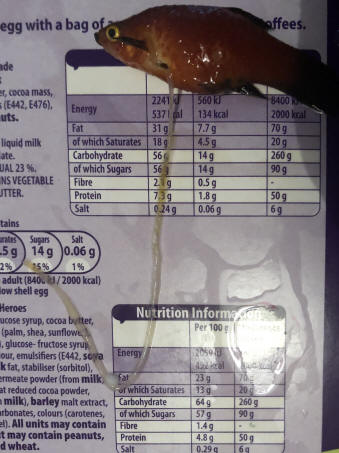
i woke up on Monday morning too see it was dead, but there was this huge
parasite looking thing coming out of it. I’ve called 5 different places and
they don’t really have an answers. Made an account on Fishlore.com to see if
they have any answers. They had none. But someone said I should email you
and see if you have any answers I’ve attached a picture to help.
I've been keeping fish all my life and I’ve never had this before.. all
parameters are fine and well within range.
it’s belly was bulging so I thought it was pregnant, I’ve had lots of fry in
this tank.
This thing wasn’t coming out of its gills or through its butt, it was come
out the side of the fish just behind the gills. It’s the black dot on side
of the fish just behind the gills.
I hope one of you lot can help me diagnose/identify what on Earth actually
happened, because I’m seriously stuck here. PS, I apologise for the fact the
picture was taken on an Easter egg box.. it was the first thing I had on
hand. Didn’t particularly want to handle it too much because a lot of
parasites can jump species
Cheers for reading, I hope you can help
<Evidently some sort of 'worm'. The problem is that it's hard to say whether
we're talking about an external parasite (which may not in fact be a true
worm, but a crustacean of some sort) or was this a worm inside the fish that
somehow got out through the wound. Very difficult to be sure without
actually having the fish in front of me, together with a decent dissecting
lens. In any event: certainly a good idea to treat your fish with
Praziquantel (such as PraziPro) or some other reliable anthelmintic.
Internal worms are quite common in livebearers, though rarely anything like
this. It's worth repeating the course after finishing the first course
because worms are difficult to shift. External parasites, particularly
crustaceans, are rare in aquaria and difficult to treat. Mostly, they can't
complete their life-cycle in aquaria, but some, notably Lernaea ("Anchor
Worm") can. Anchor Worms are distinctive because they have a dark, often
fork-shaped attachment head that digs into the flesh, as well as a
semi-transparent worm-like body that is visible outside the fish, often with
two egg-containing structures dangling even further. My gut feeling is that
we're dealing with something along those lines; if not actually Lernaea,
then some sort of crustacean external parasite. Cheers, Neale.>
|
 |
|
Re: Need help with a fish problem 4/23/20
Hi there
<Niall,>
That’s absolutely fantastic! Thank you so much for your help, I’ll start the
treatment right away!
<Glad to be offer some tentative help at least.>
Goodness you guys are good.
<That's very kind. But do check your photos against pictures of Anchor Worms
and suchlike, and see if it is a plausible explanation.>
Well you’re definitely better than the 7 fish shops I’ve emailed and the 4
different forums I’ve posted on.
<Oh!>
Can’t thank you enough for that!
Thanks again!
-Niall
<Most welcome. Cheers, Neale.>
|
|
Rosy Barb stringy droppings again (and weird male guppies)
7/28/15
Hi Crew! I've had some adventures in my aquariums since I last wrote, either the
new beacon tetras, or the guppies I got a bit later (or perhaps some plant-borne
copepods) brought in Camallanus worms which I did not notice during quarantine.
It probably would have gotten a lot worse if not for one of the guppy fry
getting infested. Because she was so small the worms became obvious a lot
sooner, so I was able to treat the fish sooner.
I knew what I was seeing straight away thanks to info I'd read on Wet Web Media.
Praziquantel had no effect on its own, but I had success with Levamisole.
<Correct. Prazi is rather less effective than people think.>
All the beacon tetras and all the female guppies shed dead worms, although sadly
the guppy fry was too small and weakened to pass the worms and didn't survive. I
saw no further sign of infestation even after the second dose a
couple of weeks later. To my surprise, throughout the infestation the rosy barbs
never showed signs that they had worms, and never shed any dead ones while
everyone else was passing them. I would have thought they would
easily get infected due to their habits of eating anything off the bottom of the
tank and taste testing every dropping in
case it's food in disguise.
<Fish are believed to be able to develop some resistance to parasites, including
worms.>
Anyway it has been a couple of weeks since the last worming and the affected
fish are looking much better. However this week I noticed a couple of the
smaller rosy barbs with long white streamers of droppings, much like
what caused me to write my original email. It's been a long time since I've seen
the rosy barbs with this issue and I had thought whatever the cause, it had long
passed by itself.
This time I was better prepared, and the streamers were longer and easier to
catch than last time. I'd bought myself a student microscope during the
Camallanus incident, very handy to identify a pink worm I had found in my
snail tank as being a ribbon worm, not a Camallanus worm. So tonight I had some
fun searching through the stringy poo looking for anything suspicious.
Once out of the bright lighting of the tank, the droppings do appear to be
coloured not white, but they seem to be coated in mucous. Mostly it looks like
plant matter with the occasional piece of insect-like particle, which
I am guessing might be pieces of brine shrimp, but in a piece that was mostly
mucous I spotted something moving. It looks very much like something wiggling
inside an egg. By eye I thought I saw eyespots, but then I wasn't sure any more.
Even zoomed in to x100 it's very hard to work out what is what, but I took a
picture (see attached) and managed to take a couple of videos, one in focus
where the critter doesn't move much, and one where I was trying to adjust the
focus and lighting, which makes for an awful video, but the critter moves a lot
more so maybe its easier to get an idea of what shape it is (this video gets a
bit better at the end).
https://www.youtube.com/v/fZ9F2_KeypM&vq=hd720
https://www.youtube.com/v/m07g3xHKV9U&vq=hd720
Any idea if this fellow or more likely, its parent, could be the cause of the
stringy poo in some of the rosy barbs? Whatever it is, it's survived the two
courses of Levamisole dosing (and I was soaking the food as well as treating the
tank water). If it's something that doesn't belong in the gut
of a fish, how do I treat it?
<The multiple eyes are curious, and suggest to me a Platyhelminth of some sort.
I don't see any hooks (typically seen among Cestoda) or suckers (Digenea,
Monogenea). So some sort of Trematoda seems probable to me. But really, this is
something you need to show a parasitologist. Multiple rounds of anti-helminthic
drugs should fix the problem, but at the same time, if the fish are otherwise
healthy, you might not need to worry about.
It's probably pretty common for wild-caught fish to have low level parasite
infections, and if other environmental and dietary parameters are good, these
parasites cause no harm.>
Now, on to the guppies. After 4 + 6 + 11 + 13 guppy fry I have separated the
females from the males; I have ended up with 3 female and 8 male adult guppies
so the poor females needed some respite. They aren't fancy guppies, they are
feral guppies collected from waterways around Darwin, NT and have reverted to a
mostly wild look after surviving predation from the local gudgeons, grunters and
Pest Management Department.
<Sounds like lovely fish, and I'm glad you could provide a nice home for them.>
Anyway, since the females have been removed, some of the male guppies have taken
to shooting up and down from the bottom to the surface in the corners of the
tank. I had thought they were evading each other or perhaps the
larger fish, but after watching it doesn't seem like they are reacting to a
threat inside the tank. Any idea why they're behaving like this? Perhaps looking
for an adjacent tank full of females to leap in to?
<Seems sensible... finding ways to move to somewhere with female fish. I have
some surplus male Limia (a close relation to Poecilia) in a catfish tank and
they often exhibit this sort of behaviour.>
My tank is fully covered so I'm not worried that I'll lose any, but I am worried
that they're acting a bit demented compared to usual. Is this behaviour
indicative that something could be wrong? Or are they just confused by the
corner and can't work out where to go?
<Well, yes, Guppies are pretty stupid.>
Thanks once again for providing such a great resource and so much good advice.
Cheers,
Bronwen
<Thanks for the kind words. Neale.>
|
.jpg)
.jpg)
|
|
Mysterious red "worms" 8/5/10
Hello Crew,
<Neale>
This time I'm asking the questions!
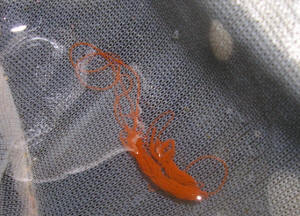
Three of my female Ameca splendens have spent the last few hours
producing masses of red threads from their vents. The threads
aren't wriggling but do seem scarily worm-like. The worms are
a few inches long, but as thin as hairs. Any ideas what they
might be?
Cheers, Neale
<Only guesses w/o images of higher resolution... These are
most likely Nematodes... though could be other worm groups. A
good idea to treat (through the foods) with an anthelminthic, and
of course NOT to mix these fishes with others till they're
rid of these lumenal parasites. BobF>
> Hello Bob,
> I've actually sent WWM a question today, about strange
red worms. It's in the FW inbox. Obviously I can't answer
this one or I wouldn't have sent it!
> Cheers, Neale
<Have just looked, responded... do you have a
"loupe" of ten power or so you could focus, take an
image through? Or better a 'scope of some sort? Need to see
the head/regions, perhaps make a cross-section through the
esophagus (tri-radiate in Nematodes...). B>
|
  |
Re: Mysterious red "worms"
8/5/10
Hello Bob,
<Neale>
I think I established what they are: algae.
<Hmm>
This morning I took an Anubias leaf from another tank and put into
the Ameca tank. The leaf was covered with really long thread algae.
I wanted to see if the Ameca would eat this stuff. Well, I took out
the leaf just now
and it was pretty well scrubbed of thread algae. My guess is that
whilst passing through the digestive system of the fish, the green
pigment is removed, and so the tell-tale red pigments of the
Rhodophyta becomes
obvious -- just as if you'd prepared them in the lab with
ethanol.
<Ahh!>
By eye at least, morphology is the same. Plus, this explains why
three fish are egesting red threads at exactly the same time, and
within a couple of hours of the Anubias lead being stuck in the
aquarium!
Since I've had these Ameca a year now, I'd expect to have
seen parasites before now, if Nematomorphs or whatever are the
issue.
<Agreed>
Cheers, Neale
<And you. B> |
|
Re: Tiny worm-like parasite, FW Angels
1/21/10
Dear Neale,
<Amy,>
I began treatment for parasite infestation Jan. 18 evening. I
used a medication containing Praziquantel, Diflubenzuron,
Metronidazole, and Acriflavine according to the instructions on
the packaging. It was the only medication at any nearby fish
stores that advertized to get rid of anchor worms and copepods.
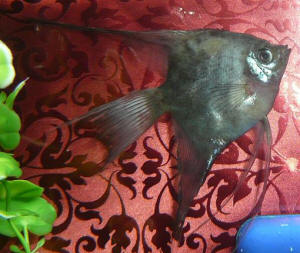
The parasite has cleared out (at least visibly), but there has
been drastic deterioration of the angel's fins. It looks like
he may have a secondary fin rot infection.
<Very probable. The anchor worms break the epidermis, and this
is how secondary infections get started.>
The dorsal and pectoral fins seem to have stabilized. However,
there is still some loss occurring on the anal fin and the caudal
fin is completely gone. Of the latter, all that remains are a few
rays and a very red and inflamed base.
<Yes, likely bacterial; treat promptly.>
Shortly after removing the carbon from my canister filter, the
ammonia and nitrate levels showed traces, but returned to normal
by morning.
<If the carbon was more than a couple of weeks old, it'd
be working as biological filter media (and the covering of
bacteria is precisely why carbon needs to be replaced with fresh
carbon every couple of weeks, at least, if you want it to work as
carbon). Removing biological media can knock back filter
efficiency if you don't leave enough live biological media
behind. Moreover, some medications can and do harm biological
filters, sometimes slightly, sometimes severely.>
All my other fish seem to be unaffected. Is it safe to do a
partial water change and start treating for fin rot (if that is
the problem)?
<Likely is.>
Should I try adding a bit of salt to the tank or dip?
<Salt pointless here. You do need a suitable anti-Finrot
medication.>
Any treatment suggestions would be greatly appreciated. Thank you
again for your time.
Sincerely,
Amy
<Good luck, Neale.>
|
|
Re: Tiny worm-like parasite --
1/22/10
Dear Neale,
<Amy,>
I would like to thank you again for all the time you have
invested in answering my questions. If I may be so bold,
there are a few more I would like to ask...
<Fire away.>
The instructions on the anti-parasite medications advise a
48 hour wait before medicating again. I looked up the
active ingredients and it appears that at least one causes
kidney damage with prolonged exposure.
<Not a problem in this case. For one thing, freshwater
fish's kidneys work rather differently to our own, so
problems detected when medications are used in humans may
not occur with fish. Moreover, most medications sold for
use in aquaria have a very short lifespan in the aquarium,
typically becoming metabolised within a day. So while all
medications are poisons at some level -- including those
doctors prescribe for humans -- if used as described by the
manufacturer, there's little risk of causing harm to
your fish. Indeed, not using the right medication can end
up doing far more harm by allowing the pathogen free rein
to harm your livestock. So, in short, use a medication for
the full duration as described by the manufacturer.
Don't do half doses and don't skip days of
treatment on a whim.>
So, I plan on treating for fin rot (with Maracyn unless
there is something else you recommend)
<A useful medication, but strictly for bacterial
infections rather than worms. Do also note that most
medications are formulated to be used ALONE.
Mixing multiple medications in one aquarium is unwise.
Standard operating practise is to complete one course of
medication, do a 50% water change, and then start another
course of medication the following day. Some aquarists like
to run carbon in the filter overnight between the two
courses. Carbon removes organic chemicals, including
medications, which is why you always remove carbon (if you
use it) while medicating. In practise the carbon step
isn't essential because the bacteria in the filter will
metabolise unused medications quite quickly.>
tomorrow afternoon in hopes to save the healthy fishes'
nephrons.
<!!!>
However, there is no longer caudal fin to treat on the
adult angelfish.
<Can grow back.>
In addition, The base of the caudal fin is sloughing scales
and the remaining scales are protruding. To top it all off,
the bloat around his belly has worsened, there is red
speckling below his right pectoral fin, and fine scales are
protruding along the ventral side (the attached photo shows
his current condition). Again, water conditions are good
and none of the other fish show any signs of illness.
<Unfortunately, septicaemia is quite common once Finrot
has progressed down to the base of fins. Since this is an
internal bacterial infection, this is best treated with
antibiotics, preferably via food rather than added to the
water.>
Is it in the angelfish's best interest to continue
medicating, or am I prolonging the inevitable?
<By no means; given treatment, there is a chance the
fish will recover.
Very small fish rarely do, but Angelfish are just large
enough they might pull through.>
If the infection has gone septic, will a fin rot treatment
be effective?
<Finrot medication that acts externally will not have
much impact on septicaemia. Maracyn by itself isn't
particularly useful, but Kanamycin Sulfate and Aquarium
Pharmaceuticals Triple Sulfa have both been used
successfully. Follow the instructions on these
carefully.>
If he does pull through, is there a reasonable chance that
he will see any regrowth?
<Fins can regrow provided at least some of the bony rays
remain.>
Lastly, does the bloat indicate that there is already
irreversible kidney damage?
<Not necessarily.>
Thank you again for your time and expertise.
Sincerely,
Amy
<Good luck. Cheers, Neale.>
|
 |
|
A worm question (Horsehair worms;
stingrays) 10/17/08 Hello, <Hi,> was
just wanted to know I notice some of my ghost shrimp have worms in
there intestines are to believe they are Gordian Worm, a.k.a. Horsehair
Worms...one died bc the worm killed it but I never notice them b4 on my
shrimp I feed these shrimp to my Motoro stingray which I have had for
about a week I know they are prone to roundworms and tapeworms but I
was wondering if I did feed some shrimp that had these in them can they
kill my ray I called the pet store where I got my ray and they never
really heard of these worms really and are not sure if they will harm
the ray they feed there ghost shrimp to there rays and had no prob but
they never looked at there shrimp to see if they had worms so they
could be feeding ones that do so I don't know what I should do I
don't want my ray to die and I don't know if I should get new
shrimp the other ones seem to not have these worms in them..should I
continue to feed them to my ray or go and get new ones??????
<Sheesh... not even a period or comma. Do please review our very
modest "fee" before writing: we expect e-mails to be spell
checked and written with proper grammar. Not much to ask, and the point
is that we depend on properly formatted messages so that we can share
them with other site visitors. The better Google can index our pages,
the more people will view our pages, and the more revenue our
advertising generates to pay for bandwidth. It's a simple deal
really.> HELP!!! PLEASE KINDA SCARED FOR MY RAY I LOVE HIM!!!
<Horsehair worms are not likely to cause your Ray any harm. Most
parasites are species-specific, and while they may be harmful to the
shrimp, they are unlikely to adapt to the particular anatomy of your
Stingray. If you're really that bothered, don't use the
shrimps. Earthworms are a very safe food if collected from an area that
is "organic", i.e., not sprayed with chemicals. Most rays
love earthworms. There's no reason to use live food with most
Stingrays anyway, and a varied diet of mussels, prawns and squid is
easily provided using foods sold for humans.> thanks Maria
<Cheers, Neale.>
|
Sick fish and some sort of
parasites 10/25/07 Hello. How is everything? I am once again,
in need of your guidance. I have a 55 gallon tank with 2 great
filters. I have 3 adult mollies, (5) 3 month old mollies, 2 dwarf
gouramis (male and female), and 7 adult mm platies and (2) 3
month mm platies. My tank is 6 months old and is well
established. On Saturday 10/20/07 I cleaned the tank out and
scrubbed the walls of it. There was some sort of white almost
microscopic worms all over it. Where could this come from??? I
use algae tablets and clean the walls every Saturday. I noticed
last night my molly with a beautiful tail has fin rot, so I began
treatment last night with some medicine. Maracyn. I removed
carbon from filters. This morning the white skurmmyworm things
are BACK....and are everywhere. Any advise. and 2 of my mm
platies are covered in slime...so they going to die Melissa
<Hi Melissa. The worms are either free-living nematodes
(thread worms) or free-living planarians (flatworms). In either
case, they're harmless. But they are an indication that your
tank has a lot of organic material lying about, because
that's what they eat. In a clean tank, these worms are simply
not a problem. So, given your other problems, I'd worry less
about the worms and more about the water quality. Mollies and
Platys are both sensitive to water quality, and Finrot and
Fungus, the problems you have, are caused directly by poor water
quality. Have you checked the nitrite and ammonia levels in your
aquarium? These need to be zero. Furthermore, Mollies have very
little tolerance for nitrate, so nitrate needs to be less than 20
mg/l. Regardless, "cleaning" an aquarium has very
little to do with scrubbing the glass. Indeed, tanks that are
covered in algae and look messy can have superb water quality.
Conversely, plenty of superficially clean aquaria have terrible
water quality. So, make sure you are doing all the basics:
Don't clean the filter too often, and when you do (maybe once
every 2-3 months) do no more than rinse the media in a bucket of
aquarium water. Don't waste your filter space with carbon;
instead, fill it with biological media. Sponge, filter wool and
ceramic media all work great. Make sure you do regular water
changes. 25-50% per week is a good amount. You tank isn't
heavily stocked, so you should be fine keeping these fish. One
last thing: Mollies do much better in brackish or salt water than
they do in freshwater. Adding 4-6 grammes of marine salt mix per
litre makes all the difference. If you absolutely must keep your
Mollies in freshwater, it is ESSENTIAL that the water is
spotlessly clean (zero ammonia and nitrite, and minimal nitrate)
and that the carbonate hardness is very high (at least 8-10
degrees KH). Otherwise, keeping Mollies becomes an uphill
struggle against disease. Platies tolerate slightly brackish
water very well, as will most other livebearers. But Dwarf
Gouramis not so much. For now, you need to treat your fish with a
combination Finrot/Fungus medication; Maracyn should do the
trick. Do make sure you remove carbon before using it though.
Lots of people forget this critical step, and wonder why their
fish medications never work! Once you're done, remember: Fish
are basically very healthy and trouble-free animals -- provided
you give them the water conditions they want! Cheers,
Neale.>
Re: Sick fish and some sort of
parasites 10/25/07 I should have mentioned that everything is
reading PERFECT. Zero ammonia and zero nitrate. The pH is
7.0....I really don't know what is wrong. I am using Maracyn
powder packets with carbon removed. How do I get rid of these
little white worm things. They are really grossin' me out and
are very unattractive. They have multiplied very fast.
Also.....my mollies had a ton of babies......they are doing well
it seems.....and have been in the tank for about 4 days. Thank
you so so much for all your time <Well, for a start, pH 7 is
way too low for livebearers, so that's likely a problem. What
this pH says is that your water likely lacks mineral content.
When keeping livebearers, the general hardness (dH) and carbonate
hardness (KH) are the keys to good health. Test the water and
find out. You want at least 5 degrees KH, 12 degrees dH, and
ideally above 10 degrees KH, 20 degrees dH if you want your
Mollies to do well. Nice and hard water should have a pH around
7.5-8.0. There are two approaches here. Firstly, you can add
Malawi salts to the water each time you do a water change. Malawi
salts are NOT tonic salts. Malawi salts are added to the water
like tonic salts though, and once dissolved into the bucket of
water will raise the hardness very effectively. A 50% dose
relative to what you need for Malawi cichlids should be fine, so
if the box says it'll treat 100 litres, it'll do 200
litres in your aquarium. Alternatively, you add crushed coral to
a filter. As the water washes past the crushed coral it will
absorb hardness minerals. Likely every month you'll need to
clean this crushed coral because bacterial slime makes it
ineffective over time. So compared with adding Malawi salts this
is "cheap and cheerful" but a little more work. It goes
without saying that while all livebearers like "rock
hard" water, not all other tropical fish do, so you need to
choose tankmates with care. This is why you have to research fish
before buying them. But please understand this: if your water
chemistry is too soft and acidic for livebearers (which it seems
to be) they will never stay healthy. Simple as that. Do you know
anything about gardening? It's like trying to grow heather in
an alkaline soil: the plant wants an acid soil, so however much
you try to help the heather, it'll just die. As for the worms
-- their numbers are directly proportional to the food in the
tank available to eat. Cut back on the food you give your fish,
and remove uneaten food at once, and Mother Nature will take care
of their numbers! They'll die back gradually. Really, these
worms aren't a problem, and in a stable, properly maintained
aquarium you hardly ever see them. Cheers, Neale>
|
|
Gourami with worms-- 09/17/07 Good
afternoon. Thank you for taking the time to answer my question. I
have found much information on my problem but I'm still not
sure exactly which action to take. I have a planted 75 gallon FW
tank. About 2 months ago I had a Rainbowfish that had a swim
bladder problem that turned out to be a very bad case of worms.
It happened right after I got back from a long weekend to find
out that my fish sitter didn't notice the filter had stopped
running. I was unable to save him using PraziPro. I was concerned
that the entire tank might have a problem but didn't want to
overreact so I did not treat the tank. <Ah, your first
mistake: you MUST treat the tank wherever communicable diseases
are suspected. Used properly, medications pose no risk to your
fish, filter, or plants.> Fast forward to last week and I had
a breeder net in to try and save some Cory cat eggs. They
didn't hatch but I did see worms on the netting after about 3
days. <Those wouldn't be intestinal worms. If anything,
they're more likely to be planarians (flatworms). These are
harmless as far as your fish go, being free-living scavengers,
but they will eat eggs and to a lesser extent very small fry.
Many ways to remove them, but the easiest is simply to keep some
sort of fish that eats them, such as gouramis or
Paradisefish.> I did a 25 gallon water change and treated the
tank with PraziPro. Within 24 hours one of my gouramis had
stringy white feces and stopped eating. The next morning his
belly was a little swollen. I was hoping that he would be able to
pass what I'm guessing must be worms. <Perhaps.> It has
been 5 days now and he is in no better shape. He is not eating
and I have not seen him pass anything since that first day. His
belly is now very swollen this morning. <Because you've
delayed treatment, the worms have become a worse problem.
There's nothing you can really do except treat the tank and
hope for the best. That said, worms by themselves don't
normally cause dramatically rapid loss of health. Usually what
you see is gradual emaciation of the body while the body cavity
itself (sometimes) swells up abnormally. Bacterial infections are
much more rapid, and tend not to be associated with gradual
emaciation (though they can be) but more normally things like
loss of colour, lethargic behaviour, loss of appetite, odd social
behaviour, and so on.> I'm not sure that Epsom salt would
work because from what I've read I think it must be a
bacterial infection. <Likely won't make any difference.
Epsom Salt is a muscle relaxant, and helps fix constipation, when
coupled with extra fibre in the diet. It isn't a miracle
cure.> The rest of the fish seem to have no issues from the
treatment. Could you please tell me what direction I should take?
<Re-dose the tank with anti-worming medication if you're
sure its worms. Otherwise, assume its an internal bacterial
infection, and use an antibiotic or antibacterial.> Other than
taking care of him, is there anything else I should do to the
tank? Should I remove the old plants or gravel? Should I treat
with a second round of PraziPro for good measure? <Do a big
water change to flush out any remaining medication, and then
repeat the PraziPro or add the antibiotic/antibacterial as you
decide is required. Unless stated to be safe, don't use two
medications at the same time. As ever, remove carbon from the
filter if you're using it.> Thank you for your time, Carol
<Hope this helps, Neale>
Re: Gourami with worms-- 09/17/07
Neale, Thank you so much for the quick response. I truly
don't know what to believe his problem is. Because he started
passing the white stringy feces and started to swell after using
the PraziPro should I assume it is worms? <Hmm... stringy
faeces usually indicate bacterial or more often protozoan
parasites. Hexamita is the classic example. PraziPro will do
little/nothing to help here, since it's an anti-helminth
drug. Erythromycin is a good starting place for internal
bacteria, but Hexamita and other Protozoans will need other
drugs, like Metronidazole. I think I'd tend to try the
Metronidazole first, and see what happens. My gut feeling is this
is a protozoan infection, but obviously without seeing the fish,
I can't be sure. Worms, you see, are relatively uncommon in
aquarium fish because they have complex life cycles that cannot
usually complete in an aquarium or fish farm. By contrast
protozoan gut parasites are quite common, and though usually
harmless, under certain conditions become a problem.> I'm
just not sure. What do you think is more likely due to the
timing, worms or internal infection? If you believe it is an
infection should I hospitalize and treat with Furan-2 or
something else? <Unless you're treating for physical
damage such that the fish needs to be isolated so it can rest or
feed, it's usually a good idea to treat the fish AND the
aquarium. For one thing, many fish get stressed when they're
moved about, especially schooling fish. Also, it's likely
anything that infected one fish has infected the others, even if
it isn't currently doing any harm.> Thank you again for
your time, Carol <Good luck, Neale>
Re: Gourami with worms-- 09/17/07
Neale, Thank you yet again for the quick response. I'm
curious, is it possible that my Rainbowfish had a parasite and
not worms? They came out of him everywhere (from under his scales
& he vomited them for lack of a better term) when I started
treatment with PraziPro. They looked like very short tan worms.
They moved around quite a bit once out of the fish until they
died. Bob Fenner had me treat him with Metronidazole first and it
did not help him. So he had me try the PraziPro and that's
when they started coming out of him. <Does indeed sound like
worms of some sort.> For my current treatment the bottle
suggests raising the temperature to 85 - 90 degrees for Cichlids
and Discus. Should I do the same? <Yes, worth a shot, but
raise the temperature a degree at a time per day, and don't
go above 85 until you're sure everything is happy. Boost the
aeration a bit, too.> Also, are there certain fish that
can't have the Metronidazole? I also have frogs in this tank.
<Don't know the answer to this. Should be fine, but keep
an eye open for any odd behaviour and act accordingly.>
Thanks, Carol <Good luck, Neale>
|
|
Help with internal parasites,
again... Mollies 9/1/07 Hello Crew! <Greetings.>
I've had a few long chats with Tom about my Mollies with
internal parasites. This has proven as hard to get rid of as ich
and killed many fish. <Curious. My first question when people
have problems with mollies is whether they are keeping them in
freshwater or in brackish/marine conditions. In the former case
they seem to me to be irredeemably delicate, and successful
maintenance requires excellent (i.e., zero nitrate) water
quality. In brackish/marine conditions mollies are basically
indestructible. For me, it's a no-brainer: if you want to
keep mollies with the minimum fuss, keep them at 25-100% seawater
salinity (~SG 1.005-1.018). Ich/Whitespot cannot survive under
such conditions, Finrot and fungal infections are extremely rare,
and internal parasite "spores" (or whatever) cannot
survive the saltwater conditions so cannot infect healthy
fish.> It all started when we lost one small black balloon
Molly, and then realized that her companion was getting way too
thin and had the red worm-thing sticking out her anus. We tried
Metronidazole and a variety of other medicines, but she died
despite our frantic attempts at a cure. <Why did you use
Metronidazole? That's a drug primarily for internal bacteria
and to a less extent protozoan parasites. As far as I know, it
has no effect on multicellular parasites such as worms. For
those, you need something worm-specific (i.e., an anti-helminth
drug) such as PraziPro or Sterazin.> So, when we got two new
balloon Mollies, we treated them in the quarantine tank with
PraziPro (which is supposed to be effective) before we let them
join the two remaining healthy fish. We added them to our
apparently unaffected two remaining bigger Mollies, who came from
a different dealer (one orange male and one spotted female). We
lost the male two weeks ago (within three days he stopped chasing
the females, then one morning was lying at the bottom of the tank
gasping, then he was dead, no symptoms of anything). My boyfriend
just called to tell me the spotted female died today, and
apparently she has this red worm-thing again. What's worse,
one of the two living Mollies has a distended anus with some
white tube-like stuff protruding. <This is a dumb question
perhaps, but are you sure the problem here is worms? Parasitic
worms generally don't cause quick deaths. What you tend to
see is a gradual loss of condition or a failure to grow or put on
weight. By their nature, most of these intestinal parasites have
evolved not to kill the host outright, since they die when the
host dies. Wild fish commonly carry a parasite load, but
otherwise aren't harmed. Nine times out of ten, mollies die
from nitrate poisoning, Finrot, fungal infections, or acidosis.
This is especially true when the die "quickly".
Gasping, for example, is a good sign of respiratory distress,
which can be caused by poor water quality and a too-low pH. Just
a reminder, mollies in freshwater conditions (if you're
foolish enough to keep them thus) need three specific things:
zero nitrate, pH 7.5-8.2, and hardness not less than 20 degrees
dH. In brackish/marine conditions, the sodium chloride will
detoxify the nitrate so that isn't an issue, and the other
salts in the marine salt mix will raise the pH and hardness
automatically. Please note that "tonic salt" or
"aquarium salt" won't do anything other than
mitigate the nitrate, so are a greatly inferior product when
keeping mollies.> He's moving them to our
quarantine/treatment tank as we speak and will start treating
with PraziPro again. Should I also give them Metronidazole? I
know they can be mixed, but it's not supposed to be super
effective against those kinds of parasites. In any case, I'll
follow your advice. <PraziPro yes, Metronidazole no. As a
rule, unless a qualified animal healthcare professional has said
otherwise, you should NEVER mix medications. The synergies
between two or more drugs are unknown, and potentially lethal.
But more importantly, sit down and review your water conditions
and chemistry. If you're keeping your mollies in freshwater,
please understand that you will always be fighting to keep them
healthy. It's just the way it is with mollies. While they are
certainly freshwater fish in the wild, in aquaria they just
don't do well kept thus. Spend any time reviewing the
livebearer e-mails here, or postings on fish forums, and
you'll see that there are always bucket-loads of messages
about sick mollies.> Now, the only remaining animals in the
tank are a Nerite snail and two Amano shrimp (maybe a few Cherry
shrimp too but we haven't seen them in a while). <Ah, now
the good news here is both Amano shrimps and Nerite snails are
salt-tolerant, so you can raise the salinity of the tank to SG
1.003-1.005 without problems, should you choose to do so.> Do
I need to treat the main tank to ensure that all parasites are
gone? The fish are apparently reinfecting each other, and I want
to ensure that they don't get sick again when I put them in
the main tank. Do I need to leave the aquarium fallow? If so, how
long? Do I hunt the shrimp and move them out, then treat the
whole tank? Help! <Yes, you need to treat the tank. Yes, you
will probably need to remove the shrimps, as they tend to be
sensitive to medications.> Do I need to treat the Betta and
his Eclipse III too? He used to be in the same aquarium as the
Mollies, he might have been exposed... <Probably not, unless
you see some symptoms.> I know many people say that healthy
fish "strike a balance" with their internal parasites
and live in apparent health for years with them. This hasn't
proven true for me, those are nasty little bugs (and tough too,
after a week of PraziPro the worm was still hanging on) and
I'd be extremely glad to be rid of them, once and for all.
<My suspicion is that you're dealing with mollies that are
fundamentally stressed, and the worms are at best an
"excuse" for them to wave a little white flag and give
up.> Those have to be from the LFS, and they must have lived
for months with the things in their digestive systems without
showing any signs, since we haven't given them anything else
but Nori, flakes, sinking pellets and bits of corn for about a
month. They also get frozen bloodworms, and occasionally brine
shrimp, but they're both Hikari brand that's supposed to
be well sterilized. <The foods you list should be fine. Do
bear in mind mollies are primarily herbivores, and the ratio of
green to meaty foods should be of the order 80% to 20%. In fact,
feeding them exclusively on vegetable-based fish foods
(livebearer flake, Spirulina flake, algae pellets) would be
entirely acceptable.> I really don't want to battle
internal parasites AGAIN!!! <If you want healthy mollies, keep
them in brackish/marine conditions. If you want to have to deal
with "disease of the month" with your mollies, keep
them in freshwater. That's Neale's sage advice for the
day.> Thank you so much for your advice... once again! Merci
beaucoup! <You're welcome.> Audrey
<Neale>
Re: Help with internal
parasites, again... -- 09/01/07 Hi again, Neale! <Hello
Audrey,> Thank you for such a detailed answer. It did make me
feel slightly like I was a bad fish owner, but maybe I deserve it
for waiting so long to do what I know I should be doing.... >
<Curious. My first question when people have problems with
mollies is whether they are keeping them in freshwater or in
brackish/marine conditions. *blushing*... I know, I know... All
right... I won't ask any questions again until I do the
switch to brackish... I've been planning on it for ages, but
I was waiting until after we got the new apartment more or less
organized so we could move everyone to a brand new 30 gallons...
Looks like this is the signal to get a move on... Incidentally,
we never detect any nitrates. We have plants and a healthy dose
of algae so I suspect they get used up before our test kit can
detect them. We also had a light fish load, four very small
Mollies (balloon variety, they never grew) in 10 gallons (I know,
too small, we'll wait until we get the 30 gal we're
planning on before we get any more fish, but with the move
we've had to buy essential furniture before we can think of a
new aquarium). The LFS tells us we can put 10 Mollies in a 10
gallons... (!?!?!?!?!?!) Let's just say we have learned very
quickly to take their advice with a big grain of salt :-) pH was
always at least 7.5 and climbed very slightly during the winter,
high enough that I didn't want to risk most of the fish they
sell in the LFS, who need neutral or slightly acidic water. I
guess the big problem is with (hardness? alkalinity?), I need to
learn what scale it is measured in but the water here is a steady
9. You're going to say too low, I know. We used to add
livebearer salt, but after reading your advice (worthless, waste
of money, etc. unless used for a specific problem), we stopped
adding it to the tank a few months ago. We'll drop by the
marine LFS this afternoon and pick up some marine salt. <Ah,
you seem to understand what's going on, so there's not
really much more to add. Mollies just aren't as easy as
everyone thinks, with the result that lots of them (most?) get
sick and die rather quickly. I'd compare them to goldfish in
this regard -- they seem easy, but they're not. For aquarists
who want to stick with freshwater, I always recommend platies or
swordtails instead. On the topic of pH and hardness, it's
almost always safe not to worry about these (within reason). Most
common freshwater fish (as opposed to brackish water ones!) can
adapt to a wide range of values, so Neons, for example, may
*prefer* pH 5.5, near-zero hardness, but they'll *thrive* at
pH 8, 20 degrees dH if acclimated to it carefully and otherwise
looked after properly. What matters isn't so much the values
as the *stability* -- what most fish hate is pH and hardness
levels that bounce around. In other words, get fish that are
already thriving at the retailer, keep them in your local water
conditions, and use good filtration and regular water changes to
optimise water quality while diluting the background water
chemistry changes that happen in freshwater tanks anyway.>
See... sometimes it takes fish dying so that we learn. Another
red flag should have been that they've never bred... we
thought our male was sterile because try as he may, he could
never get one of them pregnant. In retrospect, maybe they were
just in the wrong conditions to breed. <Quite possibly. But
just as likely the fry got eaten or sucked up the filter or
whatever.> > <Why did you use Metronidazole? Ah, well,
because the only symptom we had was one dead emaciated fish and
one very thin, formerly very plump, fish and we didn't know
what she had, and this was recommended by the marine LFS and was
the only thing we could find FAST! The local LFS have never heard
of a cure for internal parasites. They just let them be. We did
our best on short notice. And then we did more research, and
found out about Praziquantel and other medicines, and tried to
get some locally but *nobody* sells it around here, we called
about 6 places, so I tried to mail-order it, but the two Canadian
mail-order stores I know of didn't have it in stock, so we
ordered Jungle Labs medicated food, which they wouldn't eat,
and then we ordered Gel-Tek, which does contain some Prazi, but
that didn't work, and finally the mail-order place got some
PraziPro in stock, but by the time we tried that I think it was
too late and the fish died, with three very visible red tails
sticking out of her anus. But at least we'd finally got to
the right medicine - I think. <I see. Sounds rather bad
luck.> > <This is a dumb question perhaps, but are you
sure the problem here is worms? Parasitic worms generally
don't cause quick deaths. What you tend to see is a gradual
loss of condition or a failure to grow or put on weight. I think
this is exactly what we were seeing, but didn't recognize it
in time. We've had some of those fish for six months and they
haven't grown. It's just so gradual that we don't
notice until the fish are too feeble to function properly. They
seem fine, and then one morning they're not quite right, and
a week later, they're dying. They never get to the not eating
stage. I'm not saying their death can't be due to
something else, and it might be more than one factor, but my test
kit tells me the pH is steady at 7.5 and that there are no
nitrates. What I see is fish that won't grow, and that after
a few months just stop functioning. When the male died he
hadn't chased the females for about a week, maybe more, we
just didn't notice at first... I feel bad for not noticing
those things, but they happen so gradually... and when we did
notice something wasn't quite right we didn't know what
the problem was. <OK. Again, you seem to have a sense of
what's going on already, so all I can add here is a second
opinion. Often, fish deaths come about from multiple small
factors acting in concert. Much as with sickness in humans. So
you need to watch for the small signs and act swiftly. Odd
behaviour is often one of the very best clues, and a lot of
experienced fishkeepers will hardly ever need to use test kits
because they can spot when things aren't right in established
tanks because the fish aren't doing what they should be
doing. I don't recommend that approach for beginners of
course!> > <PraziPro yes, Metronidazole no. As a rule,
unless a qualified animal healthcare professional has said
otherwise, you should NEVER mix medications. Ah, but in this
case, we know they can be mixed safely because most general
anti-parasite medicines contain at least those two, and sometimes
other medicines too. But if you say Metro is worthless in this
case, I won't use it. This is my understanding as well, but
sometimes we bow to people of superior knowledge, so I was asking
just in case, because I have some in my fish medicine cabinet...
<I'm not an expert on antibiotics for fish -- they're
essentially prescription-only in the UK, so when you get them,
the vet will tell you exactly how to use them. I'm happy to
let others give you relevant advice here. But me, I prefer to use
medications sequentially. It's also important to identify the
problem before using the medication; scattergun approaches are
risky because many medications can stress the fish, and if they
aren't fixing one problem, they could end up causing another.
Mollies should be fine, but things like loaches and pufferfish
often react badly to medicines, and stingrays and invertebrates
can be killed outright. So you need to treat medications with
respect. Identify the disease, choose your drug, and look out for
side effects.> > <Ah, now the good news here is both
Amano shrimps and Nerite snails are salt-tolerant, so you can
raise the salinity of the tank to SG 1.003-1.005 without
problems, should you choose to do so.> Yup, that's exactly
what I was planning on when we got the 30 gal. I didn't want
to do it with the Cherries in there, because from what I read
they're not salt-tolerant at all, and I can't put them
with the Betta because he'd rip them apart (he did it before,
so we tried some cheap Ghost shrimp, and only found shrimp
bits...). I was also trying to find a supplier of Bumblebee
Gobies, for the future, and I have lists and lists of
salt-tolerant plants, and know the ones we have now *should* make
the switch (Bacopa, Anubias, Java fern, and Vallisneria in
"quarantine" so we can screen for snails). We're
all ready. We just haven't done it yet. <Very good.
I'm not sure whether Cherry shrimps are good in brackish or
not. I'd personally risk it, at least to SG 1.003. Shrimps
tend to be salt tolerant (many, though not Cherries) have a
marine stage in their life cycle, as is the case with Amano
shrimps. Acclimating slowly is perhaps the key. I keep (and
inevitably breed!) Cherry shrimps and have found them to be
rather robust animals, for their size. All your plants are good
brackish water denizens, and assuming you have enough light and
good substrate for them, will adapt readily. You've also got
a nice mix there. When people rely solely on slow-growers like
Java fern and Java moss, they end up with algae problems.
Throwing in some Bacopa and Vallis should help a great deal.
Indian fern is another good algae-beater that tolerates low-end
brackish.> > <My suspicion is that you're dealing
with mollies that are fundamentally stressed, and the worms are
at best an "excuse" for them to wave a little white
flag and give up.> Then I'll work under this assumption. I
promise not to bother you again with my Mollie troubles until
they're safely in brackish water. Then, if I'm still
having problems, I'll let you have a go at it :-) <Heh!
Brackish water doesn't fix everything, and it certainly
won't cure infected mollies of things like intestinal worms.
But what it does do is make them orders of magnitude more robust,
and the salinity also suppresses many external parasites as well
as the infective stages of certain internal parasites. This is
why brackish water fishes have a reputation for being so
hardy.> > <The foods you list should be fine. Do bear in
mind mollies are primarily herbivores, and the ratio of green to
meaty foods should be of the order 80% to 20%. In fact, feeding
them exclusively on vegetable-based fish foods (livebearer flake,
Spirulina flake, algae pellets) would be entirely acceptable.>
Yes, they've been getting Nori at least a day out of two. I
tried peas but they don't eat it, but they do like corn.
I'll try broccoli next. Can you believe I haven't ever
seen a vegetable-based flake around? Sometimes I feel aquarium
shops around here are 20 years behind the times... Even the
sinking "algae" pellets have fish flour in them,
sometimes even as the first ingredient, so they're not really
vegetarian... I've been looking for something called
"Spirulina flake" but haven't seen it, just regular
flakes with Spirulina among the other ingredients. *sigh*. Maybe
I'm simply not looking in the right places. In the meantime,
we got some Nori for free at the local sushi place, we just ask
for a sheet when we pick up some takeout and with only four small
fish, it lasts a long time... and the Amano love it too.
<Interesting. I picked up Spirulina in a grocery store called
Hy-Vee in Lincoln, Nebraska over Christmas. So I suspect it's
a case of looking out for the stuff while you're on your
travels. It isn't critical though. You might even grow your
own: a plastic goldfish bowl placed outdoors and filled with
water will quickly develop a nice flora and fauna including
insect larvae and thread algae. Yum, yum! I love taking this
approach, because my "live food ponds" become
interesting aquaria in their own right.> Interesting unrelated
tidbit, our Betta eats everything, either floating, sinking or
lying at the bottom of the tank (flake, sinking pellets, Betta
food, live shrimp, dead shrimp, bloodworms and brine shrimp,
peas, corn, everything we ever put in his tank). He even tried
Nori. Well... he tried it the first time we gave it to him, but
stubbornly refused to taste it ever again :-) I guess even the
most wide-ranging tastes have their limit :-) <Indeed! But
that's the right approach to feeding fish. Let them have a
little of everything.> Thank you again, and sorry to be such a
bother :-) Audrey <Not a problem. Good luck,
Neale>
|
Help with possible parasites 5/25/07 Good
Morning, <Its good evening here in Merrie Olde Englande.> I have
a question regarding one of my female neon swordtails. She is a full
grown adult that I have had approx. 6 months. First of all tank
parameters: Ammonia - 0 Nitrites - 0 pH - 7.4 Nitrates - 25 Tanks size
- 55gal, tankmates are platies, guppies, other swordtails, and one
Pleco. <All sounds fine.> I noticed a strange growth inside the
fish about 1/4" from her tail. It appears to be circular. The fish
swam next to the light and I could see through the tail and that's
the only reason I saw it. She has been acting very healthy and normal.
Eating very well, in fact just dropped about 15 fry. You can start to
see the lump on the outside if you look very carefully, however,
nothing is protruding outside the scales. The other fish in the tank
are doing very well and also the many fry are doing fine. <If the
swelling is inside the fish and in muscle tissue (rather than the
abdomen) then almost certainly a benign cyst or tumour. Quite common in
fish. No real cure, but no real threat to your fish either. But without
a picture, impossible to say for sure quite what this is.> I have
done considerable research to see what this may be and the only thing I
can come up with is a digenetic fluke. <Rather unlikely, because of
the complex life cycle most of these flukes have. Pond fish sometimes
get them, but indoor fish almost never.> Any suggestions will be
appreciated. I understand that if it is a fluke the life cycle requires
an intermediate host such as a snail. I do have a few snails in the
tank. <Indeed, but usually very specific snails. The chances of you
having a worm that worked in both the fishes and the snails in your
aquarium have to pretty small.> Doesn't look like there are many
reliable cures for this other than removing the fish and the
intermediate host. Can I expect to have a major problem from this or is
this something that healthy fish can live with or overcome. Thanks in
advance. <Since it's almost certainly just a cyst or benign
tumour, there's not much to be done. Provided the fish can swim
properly and the internal organs are impacted in any way by the cyst,
the fish should remain healthy. Cheers, Neale>
Worms in my tank 4/10/07 Hello, I have been reading
your site and it has been really helpful, but to be sure I just wanted
to explain my situation and see what you thought. I have a 75 gallon
freshwater tank with one Jack Dempsey cichlid and a algae eater (not
sure of the real name) <Algae eater is probably Gyrinocheilus
aymonieri, a nasty son-of-a-gun and a Jack Dempsey is one of the few
fish that would be able to handle it. Big (30 cm), greenish fish with
distinctive spiracle (opening) above each gill slit.> They both seem
very healthy, very vibrant in color. I was looking very closely and I
saw very thin hair looking worms that didn't really move. The only
reason I new they were living things is because I poked one with my
finger and it squiggled. There are only a few of these worm things and
I was wondering if it was a parasite from my Jacks stomach.
<Unlikely. If parasitic worms sometimes come in with wild-caught
fish, but they don't wiggle about in the gravel. If you see a
swollen belly and/or worms protruding from the anus, then parasite
worms are possible. Otherwise these are harmless nematodes or
Oligochaetes that have (for example) come in with live food.> The
only reason why I'm concerned with this is because lately he
hasn't had and appetite. Any thoughts on this? <Try using garlic
to stimulate appetite. You can even buy ready-garlicked frozen food!
Also try starving the fish for a few days, and then offering something
new. Maybe some seafood or a bit of whitebait instead of the usual
flake and pellets. One thing aquarists often overlook is dried food
loses its savour after a while. Though safe to use for months after
opening, after about 4 weeks it doesn't smell strong enough and
many fish ignore it. If you buy big tubs, divide it up, freeze most of
it in a dry container, and remove only a portion at a time. Maybe check
for constipation (yes, happens to fish too) a remedy by offering green
foods such as cooked peas.> Thanks for your time, <No probs.
Cheers, Neale> Jennifer
Wormy Arowana - 02/27/06 I have a 12"
Arowana that had a lump on his right side. I tried to treat it with
Prazi-pro, and salt but to no avail. I thought he may have developed
dropsy but that was his only symptom, so I treated him with Maracyn II
after the Prazi and salt but that didn't work either. So, I decided
to perform surgery. I used Eugenol as the anesthetic (clove bud oil)
then made a small incision under the scale at the backside of the lump.
I couldn't believe what I saw. I removed a 3-4" pink worm with
a white head all curled up in a ball. He is doing fine know and I am
using the Maracyn II as an antibiotic. I was wondering if you could
identify the worm and give me some tips on how to prevent this again?
My water is perfect and I also have a very healthy teacup ray and clown
knife. Thanx Mark Galary < These fish are always wild caught and
could have picked up all kinds of intestinal critters like flatworms or
tapeworms. Use a medication with Praziquantel in it like Parasite
clear, or PraziPro to prevent further problems.-Chuck>
Judging LFS, Fancy Rams 9/16/05 I usually
deal with saltwater aquariums and reef aquariums, but a particular fish
caught my attention one day while walking through my LFS. This is
generally a store that I hate as most the workers can't answer
questions and the animals always seems to be dying (fish) and the
mammals always suffering from dirty cage neglect. <It is usually
best to avoid purchasing from such places, as they will only continue
to replace the animals that you've bought....> Okay.. venting
over.. so I came across a fish which they referred to as a gold veil
angel ram. Basically a long-finned gold ram with an angel fish shaped
body. The colorations and disposition of the fish caused me to
immediately fall in love with the fish and I proceeded to plan my
future purchase. Originally I bought a few for my grandmothers aquarium
that I take care of.. the 3 I placed I've had for over 3-4 months
and they're doing great. I also moved my aquarium at my parents
house inside for my sister (as I don't live at my parents house)
and got it up and running with plants and driftwood and fish.. the
plants are really taking off.. but I have to focus on the pH as
it's a little too basic for Microgeophagus. <Okay> Here's
the problem.. I bought 5 of them from my LFS today and they came with a
problem. They have this little tumor like cysts in their bodies some of
them 1 or 2 .. but no more than 3.. they are about half the size of a
grain of rice.. probably even smaller, they react like normal and
don't show any signs of being sick.. now.. here's the reason I
bought them.. This fish I haven't been able to find online and this
is the only fish store on Oahu that gets them in stock. <Perhaps
another/better store would order them for you?> And worse.. they
only get them 1-2 times a year and normally by the time they get them
in stock they're sold out. So yeah.. I took the chance.. So.. back
to the tumor like things.. they appear to be brownish in color.. they
aren't translucent.. but you can see them clearly through the
fishes body.. at the moment I have the 5 in a 5 gallon hospital tank
being treated with paragon. I wish I could get a picture for you guys
but I don't have a digital camera. I can try an borrow one and get
one too you by next week.. but if anything I'm more curious as to
if this is something fatal, curable, or whatever other possibilities
there are. <Chuck's archived response to you can be found here:
http://www.wetwebmedia.com/FWSubWebIndex/ramfaqs.htm . Though
I agree with Chuck's suggestion that they are digenetic Trematodes
(that's, external parasites, similar to worms, that require
different animal hosts at different stages in development - the
snail/bird/fish parasite he suggests is one), I would also propose that
these things could in fact be tumors or granulomas, possibly even from
mycobacteriosis.... In any of these cases, treatment is of no help, and
in the case of mycobacteriosis, treatment is very, very unlikely to
effect a cure and may even be harmful.> Otherwise.. I'd also
like it if someone could give some background information on them as I
know they're probably a product of inbreeding. Either way. Any info
would be greatly appreciated. <Indeed, they are not natural in color
or shape. I can't find much on this "new" body shape;
though, I've seen "balloon" rams (similar to balloon
mollies) as well.> Thanks -Jonathan <Wishing you well,
-Sabrina>
Getting On the Right Track With Black Spots -
05/31/2004 Someone else has asked about this problem and wanted to
know what caused the black spots and the answer was about the quality
of the water. <Mm.... Might help to have more background on your
specific problem. Not having the other FAQ in front of me, I don't
know about the other person's scenario, but it will be difficult to
aid you without details of your situation.> I understand that
probably is the cause but the question of that person as well as myself
is are the black spots due to a fungus or a bacterial infection because
the treatment is different. <Really, without details, I can only
give you a generalized answer, based on assumptions.... I can assume
that you mean the "classic" 'black-spot' disease,
which is a digenetic fluke - a parasite, passed to the fish from
another animal - which appears as small, black spots, like bits of
pepper on the fish, almost. For this, there isn't really a great
deal you can do to treat, but it shouldn't be terribly
life-threatening. If the fish is horribly infested, it might be
worthwhile to try a Praziquantel bath, or try treating orally with
Levamisole or Piperazine, but I really don't know how effective
this would be. 'Course, with this assumption, I might be WAY off
track - perhaps you have some other disease in mind.... Ah, I realize
now, I don't even know if you're talking about a fresh or
saltwater tank.... If you can, please get back to me with more
information - fish affected, type & size of aquarium, other
inhabitants of the tank (especially presence of snails - the first host
of the fluke responsible for 'black spot'), how long the
tank's been established, how long you've had the affected fish
(newly acquired fish may bring along 'black spot' if they were
collected in the wild or raised in a pond), water parameters....
anything else of note.> Yes, I know to change the water and correct
the problem for the future, but I wish to treat specifically with
medication but don't know if I should use an antibiotic or an
antifungal???? <Again, without details of your situation, I cannot
give you an answer; without details to try to diagnose with, I
don't know if your fish has 'black spot' or a common
cold.> Please Help. <Would love to, really; please do get back to
us; I'd be delighted to give you a better answer, once I have a
better understanding of what's happening in the tank.> Thank you
<Thanks for writing in - wishing you and your fish well,
-Sabrina>
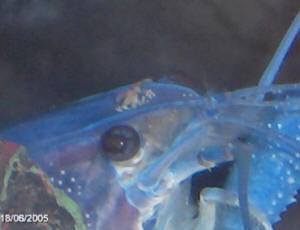
| Electric blue crayfish worms??? I have trying the
product Maracide now for the past seven days and the worms are
still on my electric blue lobster (crayfish). <Yes... this
product is for infectious disease agents...> I have tried to
take some pictures to show you <Very nice> but as I said
before the worms are so small you can't really see them. He has
a small white marking on the top of his head and near the bottom of
his tail were the worms stick out of. He also has about a hundred
or so on the bottom of his belly. The worms are not on anything
else in the tank. I also have a blue crayfish in with him and about
25 or so guppies. None of which are infected. I am sending a few
pictures and hopefully you will be able to see what I'm talking
about. The worms in the picture are located in the middle of his
eyes. Hoping to hear from you soon Thanks <Mmm, you can/could
try actual Anthelminthics, compounds that are toxic to worms, but
not (much) to other invertebrates. Please see here: http://www.wetwebmedia.com/fshwrmdisfaqs.htm and the next
Related FAQ file, and the links where they lead you. Bob
Fenner> |
|
|
Gourami with Swordtails Well, it's not
the Gourami's survival with the Jack Dempsey that I'm worried
about as much as the swordtail's survival with the Gourami. But you
don't sound too worried about it. < They should get along fine
as long as they are pretty close to being the same size.> I have a
new question though, I just brought in some (I think it was frog weed?
something like that, but its not duckweed) from a pond supply store and
I put it into a 10 gallon with snails only (gold and black mystery
snails (2)) and after a while I notice tiny white worms EVERY WHERE!!!!
Glad I didn't have any good fish in there. What are they? <
Probably plant leeches.> And how do you eliminate them? < Fluke
tabs will get rid of them fairly quickly.> The plant I have floats
on top of the water and is supposed to grow like crazy, didn't pay
much for it and I would like to keep it, but if its too much trouble
because of the worms I'm good with getting rid of it. < The
Fluke tabs will work and you can keep your plants.-Chuck>
Worms! Hello again. I have recently written
in about my Pleco and the headache I'm sure he gives himself. I
have a 90 gallon fresh water, with live plants and community fish. 16
gallon water changes every 2 weeks with aquarium salt added in. My new
problem is I came home this morning and I discovered that one of my
fish looked like it had a fire cracker explode in it. This is one of
the fish I brought home for feeders and it didn't get eaten. It
just grew. I thought that maybe some of the fish got at it, but this
was not a small fish. And I try to be as careful as possible when
getting new fish. That they aren't aggressive. So what I want to
ask is, is there a parasite that could make my fish
"explode"? It was the strangest thing I have seen. While
fishing out parts of the fish. I notice that there was a worm like
thing on the cover of the tank, on the under side. I have thought about
clearing out, the tank and starting over, this weekend. Would it be a
good idea to save about half the water in the tank, or should I start
right from scratch? I was going to turn off the filter and siphon out
the top part of the tank and reuse it and then take another 45 gallons,
and let it stand for a couple of days. Does that sound like a good
idea? I have no where to store 90 gallons of water and I don't have
a smaller tank to place my fish in, so I cant wait the 2 weeks to cycle
the tank. Thanks for your help Lukas <Sounds like your fish have
worms. These are common in wild caught fish, like most plec's or
fish bred outside, like most feeders. Breaking down the tank will not
help. Try here for medicated de-worming flake. http://flguppiesplus.safeshopper.com/31/cat31.htm?452 And
once again I warn about offering feeder fish unless you can QT them for
at least a month. Don>
|
|

