|
FAQs on Cichlid Disease
1
Related Articles: Cichlid Fishes, Freshwater Fish Diseases, Freshwater Diseases,
Ich/White Spot Disease, Freshwater
Medications,
FAQs on Cichlid Disease:
Cichlid Disease 2, Cichlid Disease 3, Cichlid Disease 4,
FAQs on Cichlid Disease by Category:
Diagnosis,
Environmental,
Nutritional,
Social,
Pathogenic,
Parasitic,
Trauma,
Treatments
Related FAQs:
African Cichlid Disease,
Oscar Disease/Health,
Aquarium Maintenance, Freshwater Medications,
Freshwater Infectious
Disease, Freshwater
Fish Parasites, Ich/White
Spot Disease, Cichlids
in General, Cichlid
Systems, Cichlid
Identification, Cichlid
Behavior, Cichlid
Compatibility, Cichlid
Selection, Cichlid
Feeding, Cichlid
Reproduction, Dwarf South American
Cichlids, African
Cichlids, Angelfishes,
Discus, Chromides, Neotropical Cichlids,
Oscars, Flowerhorns,
|
|
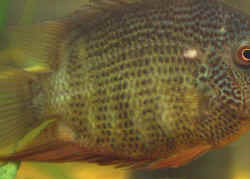
Hole in Severum hello please bear with
me as I ask this question as I am new to this ok I have a 55
gallon tank with a Severum in it that looks like an Oscar I have
a smaller version of him as well and two cat fish ones a shark
like and the other looks black velvet and one jaguar cichlid now
they have been awesome since January recently like oh maybe month
or 6 weeks ago I added the jaguar now my problem my bigger
Severum has these little holes that look like pinholes behind his
right eye and on the left eye tonight I noticed a larger hole
behind it the one behind the left eye is probably 7 mm in
diameter and the ones behind the right eye are problem 1-2 mm and
there's like 5-6 of them in a row like someone poked him
with a safety pin now he's my baby and I'm new
to the whole fish tank thing (I'm 34) love the aquarium its
my little place to watch another world and so far so good till
this can you please advise me on what this may be the only thing
new to my tank in the past 6-8 months are 2 things one the new
jaguar who is maybe 3 inches and my BioWheel has kind of stopped
spinning but I mess with it so it runs probably 12 of the 24
hours a day still filters water it just the wheel that
doesn't turn I feed the fish the normal medium sized pellet
food and also treat them to frozen brine shrimp 3-6 times a week
and also add feeder fish regularly and they eat em up so please
help and I hope I gave enough info look forward to your response
soon before anything goes awry thanks Dan <Do a 30% water
change and clean the filter. Take it all apart and rinse
everything off very thoroughly and reassemble it. It should be
working fine with the wheel continuously turning. Vacuum the
gravel when you do your water change to remove all the stuff that
has accumulated there. The hole-in-the head disease your fish has
does not have a specific cure. There are many medications that
say they cure it but none so far have been found to be
guaranteed. This condition is associated with poor water quality
or a vitamin deficiency. Regular weekly maintenance and a varied
diet should help. Try some washed earthworms instead of the
feeder goldfish.-Chuck> Dan Gies
Cichlid rubbing several of my cichlids
are rubbing against things what should I do? <Do a 30 % water
change and service the filter. When you change the water try and
vacuum the gravel to remove the crud that has accumulated there.
Check the nitrates too. Add a teaspoon of rock salt per 10
gallons of water to aid the fishes to create a protective slime
on their skin.-Chuck>
Holes in Severum head I have a
Green Severum and it has very small holes around its eyes and
face that just showed up what are they and what should I do? <
Do a 30% water change , service the filter and vacuum the gravel.
Change the diet and include some live food like washed
earthworms. Make sure your fish food has not gone stale and lost
some of its vitamins.-Chuck>
Blood Parrot Fish I have three blood
parrots that are about 10 years old so they are fairly good
size. Last week they started lying on the bottom of
the tank. If I feed them or knock on the glass they
swim and seem OK. On of the fish has a dark underside,
like something is dark and fairly good size under the
skin. I enjoy these fish and don't want to loose
them but haven't a clue as to what to do. I had the water
checked and it is good, no problem. I have started
raising the temp (I don't know what it was), it is hovering
around 76. Do you have any suggestions??? < Try raising the
water temp to 80 degrees and change the diet. Add some live
washed earthworms every once in awhile. If that doesn't get
them going then I would treat with Metronidazole and assume that
they have an internal bacterial infection. Ten years is a very
long time and you are to be congratulated for keeping them going
this long.-Chuck> Linda Bernard
Re: Blood Parrot Fish Thank you for the
assistance. Unfortunately, every fish including the
parrots, died over the weekend. < What happened? Did the
heater stick? -Chuck> Linda Bernard
Re: Blood Parrot Fish I really don't
know what happened. They all got the eye problem,
where they were bug eyed and glassed, laid around the bottom of
the tank. I put Epsom salt in trying to revive them
and they perked up for a day but then bit the dust. I lost two
Oscars, 3 kissing Gouramis, 2 sucker fish, 5 parrots, and a
couple of others. The only thing I can think of was I
had changed the water about a week and a half prior to the fish
getting sick, a day or so after changing the water I got a notice
from the city of bacteria in the water. I'm
guessing it was just too much. < I am guessing it may have
been a pH shock. An old established tank in an area with soft
water could have easily gotten very acidic in a short period of
time. When you changed the water the new water could have been
more alkaline and the pH shock weakened the fish and they began
to get sick. As the tank became acidic again the fish had a
difficult time adjusting to the change. On the other hand there
could have been something added to the water to treat the
bacteria that had an affect on the fish. Hopefully you will set
up the tank and be back at it in no time at all.-Chuck> Thank
you for your help. Linda Bernard
Oscar problems Hi, I think cichlid
fishes are cool, tough and colorful. When I bout 15 of cichlids
like 5 of them died and the remaining ones had some white spots
smaller that a cube of salt. Right now some are
surviving and eating while the other ones are not eating anything
and just lying on the rocks. They are also loosing their color. I
talked to the person who owns the store and he gave me a medicine
called "super ick cure" he told me it will cure that
parasite and if I put the heater higher they will be cured in no
time but that white thing still is there (locations I notice were
in there lips and next to there fins.). If u no what to do please
reply my mail. < Clean the filter and make sure that all the
carbon has been removed. Do a 30% water change. Follow the
directions on the bottle. Raising the water temp to 82 degrees F
will help but may take as long as a week to completely cure your
tank. In the meantime the medication may affect the good bacteria
that break down fish waste so watch for ammonia spike. Water
change done often will help.-Chuck>
My Ocellaris Hello WWM, I have a 72 Imp.
Gal. tank. its running for over 2 weeks now and I've
originally purchased 2 ocellaris the smaller one died because of
stress so I bought more ocellaris the three were in harmony for a
few days when I noticed one had his mouth wide open and looks
like he's in a lot of trouble. He wouldn't eat and days
later he died. Now a day after an ocellaris died
another ocellaris showing the same symptom-open mouth!- now
he's not eating.. it's almost a write off :( when my
fishes often show signs of stress they die. No ammonia is
present, low nitrite and nitrates all other fishes seem to do
just fine. I've lost so many fishes over the
couple of weeks (mainly due to the ammonia spike) that I'm
thinking of giving up the hobby! Just because i feel
like I'm a bad caretaker! But all i do is worry about them.
I'll send a picture < Cichla ocellaris (peacock bass) are
South American Cichlids that are actually quite sensitive to
water conditions. Just by looking at them you think they would be
bullet proof and easy to care for. Actually they are one of the
most difficult cichlids to keep. They require soft acidic water
similar to discus! Water temp should be around 80 F and a pH of 7
or lower. They almost always require live food and extremely
clean water with no ammonia or nitrites and a nitrate level no
higher than 25 ppm with 15 ppm and lower even better. These are
pretty tough requirements for a fish that gets close to 2 feet
long. Try and find an easier fish at first and work up to a
peacock bass later after you have become more
experienced.-Chuck>
Parasite in Parrot Gills Hello I
have lost two parrot fish in the last three
months. They all have long red tubular growths coming
from the inside of the gills. The gill area has busted
open since they got this and is growing out of the
gills. The aquarium store told me it was most likely
gill flukes and so I treated them repeatedly with no
cure. They told me that they were a hybrid fish and if
they appeared to be OK them let them go. I did and I
lost one parrot 3 months ago and 1 last night. I
noticed last week that the red tubular growths had purple tips on
them and that the rosy barb in the tank was sticking its head
into their gills and eating it. Please
help. I've had these fish for over three years and
I am very attached. The aquarium seems to think they
may be anchor worms. There are two angel fish, a Pleco
and a rosy barb in the tank and they do not have these
growths. Kathleen < To get rid of either
gill flukes or anchor worm I would recommend Fluke-Tabs. If your
local store does not carry them then you can order them online at
drsfostersmith.com.-Chuck>
Congo and a disease I have a 29 gal good
water quality, 4 fish in a tank one being a cichlid
(Conga) it recently grew a large "cyst" or
bump in it's belly. It's growing rapidly on
one side. This is day 3 and intense research has
produced no known cause or treatment. At first I
thought it'd eaten rocks but the Conga has not eaten in a few
days now and the tumor continues to grow. Can you
help? Also we noticed he has holes in his head but did not eat
any live fish lately(1yr) (as I was told this was the
cause of such an occurrence) Please respond
A.S.A.P. we are desperate for information and local
pet shops and vets are no help thus far. V. Michels, Florida <
Your white convict is commonly referred to in the aquarium trade
as a White Congo. The hole in the head disease and swollen belly
indicate that the water quality may not be as good as you think.
Do a 30% water change, service the filter and treat with
Metronidazole. Follow the directions on the package. When the
swelling goes down, after the internal bacteria have been killed,
and he begins to eat again try feeding some washed chopped
earthworms or brine shrimp.-Chuck>
Re: Congo and a disease Our
"convict" is doing better, we already considered and
did a water change, but his belly "burst" for better
lack of a term and he is still alive. Today I saw a thin string
hanging from the hole (about 1 -2 inches long) and some eroded
flesh I believe (about 2 millimeters in diameter and 3
millimeters long) from his side. He ate today and
appears healthy/active otherwise. His belly started to swell on
the other side yesterday but is better today. Swelling almost all
gone, The area where the large bump was is discolored blackish
now. The type of treatment is helpful though, we had
him on a different treatment. The bursting seem to be the turn
around, however, because nothing I did made it better. We do care
for our fish, I wonder why you referred to him as a
"convict" < Look at "Cichlasoma"
nigrofasciatum in a book and you will see a grey striped fish
that is the same as yours except he isn't white. This common
name for the striped fish is convict and the white version is
called the white Congo. It is a good thing that no internal
organs seemed to be affected. The white stringy stuff is
connective tissue as the fish begins to heal itself. Keep the
water clean so it doesn't fungus and there is a good chance
for a full recovery.-Chuck>
Re: Parrot cichlid extremely
bloated-can you please help? Thank you! I actually
treated the tank last night with Paragon II, which treats many
different kinds of bacteria and is supposed to be especially
effective on the cichlid family. I have used it before
to treat ich and white spot. I changed about 25% of the water,
prior to treating, per the instructions and will change it again
after treatment. I will get some fresh food
too. I keep the tank clean, and partially change
the water regularly, so the water wasn't dirty but it could
be the food or temp. I did notice the temp a few
degrees higher than I usually keep it, so I may have bumped the
heater and turned it up by accident. I will gradually
drop it down a couple degrees to see if that helps
too. Thank you so much for the response and
advice. I really appreciate it! Great
website by the way! < Check the label for the
medications in the paragon II. Metronidazole is very effective on
anaerobic bacteria. Hope this helps and thanks for your kind
words about the website.-Chuck>
| Sick
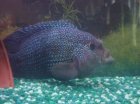
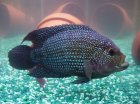
Dempsey lump between eyes our fish before
lump hi there...our Texas cichlid developed this fluid filled
lump between his eyes and appears to be under its
skin. any ideas as to what it is? we have had him
for 5 years. about a month ago he had orange stuff (looked
like the food we give him) come out of one of his nostrils.
we didn't treat it in any way and he seemed to get over
it. now this cyst or
something...the pet store said to look online at parasites,
but I can't find descriptions or pictures. just
microscope pictures of parasites... any help would be
appreciated. I will try to send a picture. <
Your old male jack Dempsey has a case of bloat. It is caused
by anaerobic bacteria that starts in the gut and has moved to
between the eyes. The only treatment is Metronidazole. Treat
the fish in a hospital tank if possible. Change 50% every
other day after treatment. When you fish begins to eat then
he is getting cured. You have an old fish an this may be hard
to cure.-Chuck> |
 |
 |
Angels can't swim! Hey there my angel fish have
stopped swimming. Their tails have folded up and there long fins
have gone thin and superficial. They just lie on the bottom, not
eating. What is wrong and how can I fix it? < You have a
bacterial infection. Do a 30% water change and clean the filter.
I would treat with a medication called Furanace. If that is not
available then try Maracyn. These medications also affect the
good bacteria that break down fish waste. Watch for ammonia
spikes. -Chuck>
Cichlid
disease, environmental Dear crew, I have only been into fish
for about 6 months. I have fresh water fish such as Electric Blue
cichlids, Electric Yellows, Ghost Knife, Livingstoni, Venustus,
two 20cm Oscars, and a colony of 20 fuscus (which I have been
successful in breeding!) I have 4, 4ftx2x2ft tanks, and 12,
3x1x2ft tanks as a breeding
bank. I've
learnt about temp, regular water changes and Ph testing but
unsure what else I need to check, (and how?) Also I have noticed
a cotton-wool type of growth in a filter. I use internal foam
filter/aerator.) And now on a rock in another tank. Please help
if you can!! <Check for nitrates. This will let
you know when and how much water to change. The cottony grow may
be from fungus attacking uneaten food like pellets. Feed only
enough so all the food is gone after a couple of
minutes.-Chuck>
Open mouthed
Oscars Hi, I have been looking for information on what could
be wrong with my Oscars. I have searched all your postings and
while I did find one that related to open mouthed Oscars, it did
not give me much information. I have a black Oscar and a white
one. The black one's mouth has been opened continuously for
about 6 weeks now. The white one for about a month. They are
hungry and try to eat but cannot close their mouths to keep the
food in. I have done a couple of 25% water changes in the past 2
weeks but no change in the fish. I have never tested the water as
I do not know how but am looking to learn. I must admit that I
have not changed filters and water at optimum rates in the past.
Any ideas? < If they are gasping for air then you probably
have some waste build up that needs to be addressed. Change the
filter and do a 30% water change every other day for a week. Next
week vacuum the gravel to get rid of all the junk accumulating in
the sand. Your water should be in pretty good shape by now. If no
improvement is seen then there may be an obstruction in their
throats. Catch one of the fish and look down the throat with a
flashlight and see if there is any visual signs of problems. If
not then their mouths may have been damaged from trying to eat
materials that are too hard to chew, then try and pre-moisten the
food to soften it up and see if that helps.-Chuck>
Thanks,
Brad
Re: Open mouthed Oscars Chuck, thanks for the quick
response. I went to my local fish & aquarium dealer today and
I told him about the open mouth symptoms that my Oscars are
displaying. He told me that they have developed a disease that is
similar to "Lock Jaw" and that it is rare but that he
himself has dealt with it. To his knowledge, there is no cure and
very little info out there on it. He also said that he did not
know it was contagious and could not understand why both had
developed the problem. In his experience just one Oscar in a tank
of several had developed the condition. He said that the Oscars
would eventually starve to death. Does this make sense to you
Chuck? Ever heard of "Lock Jaw" leading to starvation
in an Oscar? < Never heard of "Lock Jaw" disease
before in Oscars. Some cichlids with producible jaws I have seen
over extend their jaws and become stuck out but they are still
able to feed. This is a new one on me and my friends. Another
reason may be a damaged pharyngeal bone. These bones act as a
second set of jaws that may become damaged while eating hard
foods like pellets. Look down their throats and see if you find
anything .-Chuck> Thanks
again, Brad PS I am
beginning the treatments you prescribed to see if that will help.
Jack Dempsey Hello I have a Jack Dempsey's that is
very ill. I think he has pop-eye. His eyes
are bulging but he is also very bloated. I was gone
for several days and my grandson fed him frozen red worms but I
really don't think that is the problem. I moved
the tank out of bedroom into the living room. I
drained water level down and then refilled ...I took a female
smaller Dempsey out because the larger one was so
aggressive. He had a vase that he stayed in but now he
won't enter into it. He has labored breathing and mouth is
open. I changed air filters around when setting the
other tanks when I returned the air stone was not working
properly but filter was running. Everything I have
read so far says to use antibiotic such as penicillin where do I
get this? I have applied Melafix twice...1 teaspoon
each time. this is a ten gal. tank. I put
the female back in do to air problem in 2nd tank. there is also a
large catfish in the tank and he is fine < Your fish have been
suffering from poor water quality. Catfish in general are more
tolerant that some others. Overfeeding has caused the waste to
build up faster than the filter could handle it and it has made
your jack Dempsey sick. Change 30% of the water, vacuum the
gravel, and service the filter. Treat the tank with Metronidazole
and follow the directions on the package. You should see some
results one way or another in a few days.-Chuck> Open for any
suggestions thanks Coletha
Re: Jack
Dempsey Thank you for your reply. I had gotten some medicine
and treated the tank and then cleaned it out ..he is very much
back to normal, but I'm very glad to find out what caused the
problem. Will blood worms for fill the need for live
fish? < Live food always helps but you should also feed washes
earthworms too.> Do I need to leave the smaller Dempsey in the
tank? < As long as the fish are getting along then size is not
a problem. It is when the bigger one starts inflicting damage
that you have to keep them separate. Make sure the smaller fish
is getting enough to eat by spreading this food around.>
I'm not sure if she is a female or not. < Female Jack
Dempsey's Have lots of blue on the lower jaw while males have
hardly any at all. Males also get bigger and have more blue spots
on the body with longer fins. Females have less blue
speckling.-Chuck> Thanks again
Sick cichlids Hello, I have two cichlids...one a tiger
and the other one I am not sure of the type. They both
have large areas with a white, fuzzy substance in the
center. The areas are start between the eyes and
continue up the head to almost the top fin. The fish
appear to be lethargic and often lay on the bottom of the tank
floor. There are no other fish in the tank with them,
or any other species. Any ideas on what we can do to
make them feel and get better? I hope you can
help. Thank you, LB < Do a 30 % water change and
service the filters. Vacuum the gravel as you do your water
change. Treat with Furanace. This will kill the fungus (White
cottony stuff on the head), and treat any bacteria that may be
attacking the areas too. -Chuck>
Oscar's has ICH or HITH? Hi, MikeD here> My
Oscar still has his white spot O <--- about the size of that
zero and the Tiger Oscar is only about 4 inches
long.<Definitely not ick, which is a tiny white spot about the
size of a grain of salt or smaller> The spot hasn't grown
or healed and he's had it for at least 2 and a half
weeks.<Where is the spot located on the fish, and is it a
definite pit or hole?> I do water changes once a week and
vacuum once a week.<Not too much of a water change I hope?>
When do you think I should change the gravel.<Why would you
want to change the gravel, unless it's because you don't
like the color or stone size?> What should I treat his white
spot as ICH or HITH?<From the information you gave me,
it's definitely NOT ick, and maybe not HITH, at present
I'd hold off on treating with anything....any chance of
sending a photo?>
Re: Oscar's has ICH or HITH? <Hi, MikeD here
again> Ill send you a Photo Next E-mail (About 2
days)<OK> Its just a pit, not really a hole. Also it's
right above the gill. <Good. That would sound more like
lateral line erosion than HITH, which can often be made to
subside merely by improving water conditions and food quality. My
personal suggestion is to never use live goldfish as feeders,
BTW. It's also possible it MAY be just a scar, and until
you're sure WHAT you're treating, there's always the
chance of doing severe harm by using the wrong treatment.>
Re: Oscar's has ICH or HITH? <Hi again, MikeD
here> What do you recommend as food. Right now I'm using
Floating Pellets (Medium) made from Wardley.<Any good cichlid
pellet or such should be fine, preferably one made for
predators> Their quite old like a month. I feed him twice a
day<Great idea! It's a growing baby and once a day often
just keeps them alive, while more allows them enough extra energy
to grow> about 7 pellets each serving. Their bags zip lock
broke so I put it in a new Zip Lock Bag.<Good idea as they CAN
go stale and lose food value> All I feed him is pellets. How
do I know how much to feed him? I heard put in some pellets and
see how much he eats in several minutes, but is several minutes 2
or 3 or 4?<Basically, you can feed it all it will eat until it
quits eating, then stop. Any food left uneaten after 15 minutes
should be removed> If you have any Recommendations for food
I'll go out and grab some.<There are hundreds of predatory
cichlid foods on the market, with most being satisfactory. find
one that both of you seem to like and you should be fine. As
"treats" you can offer it live ghost shrimp, even small
earth worms if you so desire. some people feed live feeder fish,
but with that you always stand a good chance of picking up
parasites, so I'd suggest avoiding the practice to stay on
the safe side. Keep in mind that you'll need to
change the size of the food pellets/treats as it grows, plus
increase amounts according to its appetite>
Tiger Oscar Hey, my Oscar has this white little indent
right above his gill, theirs only one. I think I spotted it about
half a week ago as just a white spot, but now I think I notice a
little indent. I think it may be Hole In The Head Disease. I did
my gravel vacuuming and also a 30% water change with water
conditioner in the 30% new water and I also put in a new filter
in the filtration system ( Do you think that will fix the
indent?). < The improved water conditions can only help. It
may slow the disease down.> I don't have an
Ammonia and Nitrate kit but I think I will go out and buy one
tomorrow ( Can you give me a rough price ). < Each kit should
be under $10.> Do you think you can send me some pictures of
some fish with the Hole in the head disease just appearing if
that is possible. Also can you, if you think it is HITH disease
give me some information on treating it to get it to go away?
< I just had this discussion a couple of nights ago with a few
friends of mine at the local cichlid club. Unfortunately there
has been no real science done on hole-in the head. Many people
have done some lab work and found many things but no real
"smoking gun" has been found yet. Keep the water clean
and try to vary the diet to include some live food like
earthworms and brine shrimp. If the holes look like they are
getting bigger then you could try some Metronidazole at 250 mg
per 10 gallons and follow the directions on the package.
Prevention is much easier than treatment. Good Luck. Do a Google
search on Hole-in-the-head disease and you will find numerous
tips and theories on how this disease works and how to treat it.
Some saltwater fish get it too.-Chuck> Thank
you.
Re: Tiger Oscar Thanks for the information so quick.
Right before I got to bed, quick question? Its possible to cure
right? Like make the hole go away and stop it from spreading with
that medication? Or is he going to die?!.... Also when you said
the improvements I did can "help" ( new water, new
filter ), does this mean that it may cure it or does it mean it
will only slow the death down? < If you don't know the
specific cause of the stress then you don't know what needs
to be changed. In some fish it may be high nitrates. But I have
seen the disease in fully planted aquariums with no ammonia,
nitrite, or nitrate measured in the water. So then you have to
start looking at other things like pH and diet. Vitamin
deficiencies may be a cause too. No two aquarists keep two tanks
totally alike. So the same two aquarists may have the disuse but
the causes may be different depending on all the variables such
as food source, initial water chemistry and other fish. There are
no stone cold locks when it comes to treating Hole-in-the-head as
of yet. I gave you some generalities to increase your fishes
chances of survival. You may have to try some of these things and
see if they are effective. But be aware no matter what you do you
may never be able to cure your fish.-Chuck> Bye
Re: Tiger Oscar Also I read up that in most cases if it
is caused by stress or poor water quality it isn't contagious
meaning that it isn't bacteria and it wont spread and that
one particular dent will clear up on its own if you clean the
tank and such. I was just curious on your statement for that if
it is true or totally made up. Thanks bye. < You need three
things for a disease to occur. A parasite, a host ,and an
environment that at the same time weakens the fishes immunity
while at the same time enhances the reproductive behavior of the
parasite. If you have poor water quality in your tank then other
cichlids are likely to show the same symptoms because the
conditions are the same throughout the entire tank. Stress can
lead to all kinds of diseases not just hole in the head. I
don't just make things up. My answers are based on years of
experience with cichlids as well as attending seminars all over
the country on cichlids too. Of coarse I am always willing to
listen to something new on treatment for the problem,
unfortunately I have been lead up the golden path many times over
the years by "new " treatments that have never really
been panned out.-Chuck>
Damaged
Fins Help!!! Hi there just a quick one. I bought 4 red
Oscars (about 3-4cms long) and put them in my Cichlid tank till
morning when my new tank would be ready for them. As i found out
to my horror this morning the poor little Oscars never lasted as
well with them as i thought: 1 has only 1 fin intact and 2
have 1 shorter fin they were ok when i went to bed, they
had got them selves all laid together in the corner as per
usual but obviously their tankmates had set upon them when i shut
the door or before i got up! Do they grow back??? < Yes
the fins will grow back if they have not been fungused. Keep the
water clean and they should grow back although they may not be as
straight or as long as undamaged fins.-Chuck>
Oscars breathing one-sided. Hi, Just wondering if you
could possibly give me some insight as to what could be going on
with my 2 Oscars? I bought an adult pair of Golden Oscars
on March.25. They had a host of problems.. all are gone now
except for this gill issue. They seem to switch back and forth,
and then use both gills normally. No particular gill is favoured.
I thought they had gill flukes (although they are not breathing
heavily).. using one gill seems to be a classic symptom of
flukes. But they still continue to use one gill occasionally.
After the first treatment I figured maybe I didn't dose the
aquarium correctly. So I waited a few days, used carbon to remove
the medication and treated for flukes a second time. Still no
improvement. I'm completely stumped. They look and act
healthy otherwise. It just bothers me to see them breathing that
way. It's been just over 3 months now with no improvement.
Could this be some sort of gill damage? < Based on their
rather tough past it could be gill damage. Typically gills that
have been "burned" by excessive ammonia do grow back.
If they have been exposed to fungus as a secondary infection then
they might not. I would recommend keeping the water well aerated
so they don't have to labor to breath.> My water
parameters are.. Ammonia=0, Nitrite=0 and Nitrate=10ppm. PH is
6.6. Water changes are done frequently.. I was hoping it would
help. Aquarium is 75g and they are the only occupants. < Try
and keep the water as clean as possible. Your numbers look good.
Try and keep the nitrates under 25 ppm.-Chuck> Any help would
be greatly appreciated. Thanks, Linda
Terrified for my Terrors I have been viewing your site
for a few weeks now and it has been soooo helpful to me, however,
I can't seem to find the answer to what is wrong with my
Green Terrors. I have searched all over the web and one site says
one thing while another says something completely opposite! So I
came to you for help! The very first fish my husband and I
bought was a green terror. We had him in a 55gal. We fell in love
with him instantly and decided to by his tank mate at the store
we bought him. About a month after we started to noticed long
white stringy feces coming from one of them. We had other
cichlids in the tank at the time, but they did not seem affected.
They both had an excellent appetite. Then slowly, the smaller of
the two started refusing food. During this time we upgraded
to a 125 gallon and as soon as we transferred them, both their
appetites diminished. Slowly they started acting scared of us and
they started hiding in corners and rocks. Our LFS told us they
were probably a mating pair or they were stressed from moving and
that was the reason why they were acting strange. We questioned
them on the abnormal feces and they asked us if we had changed
their diet. We did try feeding them a variety of things just to
turn them back on to food. The LFS then told us the change in
fecal matter was most likely due to the change in food. Not
knowing at the time much about fish and sicknesses we thought the
LFS was right, after all, they make a living in the fish world.
Boy was I wrong! And needless to say, we have learned our lesson
that when it comes to the slightest change in fish behavior or
appearance, chances are something is wrong. I started doing
my research online a couple of weeks ago when I really started to
worry that they hadn't eaten in a long time. That is when we
also started treatments with Internal Parasite Clear after
finding the info online that we had internal parasites. During
this time, we had moved them both into a hospital tank. That was
3 weeks ago. After trying 3 other medications there is still no
improvement in the fish. I have called around to several
different fish suppliers, and found tons of info online on what
they could have. I was told they could have Hole in the Head,
Spironucleus, Hexamita, or wasting disease, and to treat with
treatments such as salts, Metro, Pimafix etc. I have tried them
all with no success. It has been well over a month since they
have eaten any food, yet they are still hanging on, although I
know they have got to be suffering. I am asking you please for
some advice on what I can do. Is it hopeless that these fish can
be treated? Do you know what they have? The symptoms other than
white stringy feces are not eating, and just basically lethargic.
We love these fish. They used to be so full of life and my heart
now goes out to them...please help :( < Green terrors are
really pretty hardy fish but I have an idea with others that have
written with similar problems with their green terrors. First of
all lets make sure that the tank is OK. Ammonia , nitrites should
be zero. Nitrates should be under 25 ppm. Service the filter and
do a 30% water change. The new water should perk them up. Make
sure you water temp is around 80 degrees. Then offer some washed
earthworms. If they mouth the earthworms but do not eat them then
there make be a problem with their pharyngeal bones. These act
like a second set of "jaws" and allows cichlids to chew
a large number of food items. If these jaws are damaged then they
would be reluctant to eat. Try and pre-soften the food by wetting
it slightly to make it softer and try that. If there is still no
appetite then they have an internal protozoa that has shut their
gut down. In a separate tank treat with Metronidazole as per the
directions on the box. If you can only treat them in the main
tank then I would watch for ammonia spikes because some
medications will harm the good bacteria that break down fish
wastes in an established tank. If they are intimidated by the
other fish then I would separate them until they were able to
build up their strength and return to the main
tank.-Chuck>
Terrified for my Terrors Thank you very much for your
help. I will try the earthworms. What would
cause the pharyngeal bones to become damaged and on both
fish? Their condition seems to be getting
worse. The feces is now about 6 inches hanging from
them. I just have one more question for you... do I
use straight Metro (if so how can I get it) or do I keep using
the Parasite guard which has Metro in it? I really
appreciate your help. Thank you so much! <The bones
may be damaged by the fish picking up pellets that are too hard
or else mistaking gravel for the pellets and trying to chew them.
The Metronidazole is found under a couple different trade names.
You will just have to look at the ingredients listed on the
package. Usually it is used at 250mg per 10 gallons of water.
Watch out for ammonia spikes because it may affect the good
bacteria in the tank. Remove the carbon in the filter too. If you
can't get the metro straight then you will have to use the
parasite guard.-Chuck>
Bloody Parrot seizures? Hi, I have had a Bloody Parrot
Cichlid for 19 months and he has never had any medical problems
before. Two days ago he started having what I can only describe
as "seizures". He starts to quiver and float funny,
then cowers in the corner of the tank shaking. He then
"SHOOTS" up to the top of the tank, slamming against
the glass tank top, and then as he is floating down towards the
bottom, he rams into the side glass. Then he basically sinks to
the bottom of the tank, breathing strangely. The gills? under his
"chin" are flapping back and forth and he appears to be
out of breath. The first few times that he did this, were at
feeding time, but now that I was home all day (Saturday) I see
that he does it even without eating. I love this fish dearly, as
he recognizes and can differentiate between members of our family
and strangers, and is especially attached to me as I am the one
who feeds him and gives him his treats. He also peers through the
glass of the tank, and if I wave to him, he does that funny
little dance that they do. I would like to know if there is
anything I can do to help him. Watching him smash up against the
glass is killing me, and I feel like it will eventually kill him.
He is in a 58 gallon aquarium, along with a smaller parrot,
convict, clown loaches, black skirt tetras, Bala shark,
red-tailed black shark, and gouramis. He is the king of the tank
and butts everyone out of his way. He is fed flake food, and is
treated with Tubifex, dried blood worms (not his favorite) and a
variety of romaine lettuce, peas, asparagus and broccoli. I
can't think of anything else except to say that the water in
my tank is in excellent condition. I clean the tank, the filter
and the tubes as necessary. Can you suggest anything to help me
or tell me what is happening to my "Baby"? < Your
fish may be affected by some unknown internal parasite or
bacteria. Your parrot cichlid is a hybrid between a few fish and
may have lost some of its natural defenses against disease. My
only recommendation would be to isolate the fish in separate tank
with lots of floating plastic plants to be use as a buffer
against the top of the tank. Treat with some Metronidazole
according to the directions on the package. If you see no
improvement after a week then I would try a strong antibiotic
like Kanamycin. These are "shotgun" attempts to help
your fish. maybe we will get lucky. Add a little rock salt to the
isolation tank too. Couldn't hurt.-Chuck> Thanks,
Donna
Re: Bloody Parrot seizures? Chuck, I wanted to reply as
I have more information that may be helpful to my Blood Parrot
Cichlid. Today is Sunday, and as of 6:00 PM EST, he had no
attacks today. I had fed him some peas, as he was asking for
food, and originally he had most of his attacks when he ate. The
two times that I gave him some peas today, he ate them and was
Ok, with no attacks. He was not his "Normal" self, but
at least no attacks. Then at 6:15 PM, the normal time that I feed
my fish, I fed them TetraMin Pro Tropical Crisps, which is a
flake food. He ate aggressively at the top of the tank for about
15 seconds, then the attack occurred. He got stuck in the cave at
the bottom of the tank, so he didn't manage to smash himself
against the glass, but he definitely had an attack. What makes
him have this problem every time I give him flake food now? Can I
feed him with just the peas for a few days? Should I still
quarantine him and get him the medication you suggested? If so,
the only extra tank we have is a 10 gallon tank. Is that big
enough for him for a while? I REALLY appreciate your help, as the
fish stores around here seem to be clueless as to what is
happening to him. One actually suggested that his tank mates are
nipping his fins making him slam against the glass. When I told
him that that is not happening, he nastily told me that I
can't watch them 24 hours a day. Anyone who has an aquarium
knows that after 2 years, you know what your fish do and
don't do and what is "Normal" for them. Once again,
Thanks So Much for your help! < With this new information I
have a couple of new theories. With the soft food such as peas he
had no attacks, but with dried foods he has the attacks. If am
thinking that maybe the dried foods are getting stuck in his
throat causing him to choke. Presoak the flake foods so it is
hydrated before feeding and see if it helps. If this is still
happening I would take the fish out of the water and look closely
down its throat with a strong flashlight and look for
obstructions. I once had a cichlid with a piece from a plastic
plant stuck down its throat. I removed it with a long pair of
tweezers and he was fine after that.-Chuck> Donna
Re: Bloody Parrot seizures? Chuck, THANKS SOOOO MUCH!!!
Once you mentioned about the flakes being dry, I noticed that
when he was busy eating the peas on Monday morning, while I fed
the other fish in the tank, by the time he ate the flakes they
had floated down into the water, and he ate them with NO PROBLEM!
When I fed him at 6:00 PM, I hydrated the flakes and gave him
peas first, then put the soaked flakes into the tank. Once again,
NO PROBLEM! He comes to the front of the tank whenever I go by,
so I sat on the floor with him in the tank in front of me, and
tried to look down his throat with a flashlight. I didn't see
anything that seemed to be blocking his throat, but since he
sucks at everything that goes into the tank, and helps the female
convict move the pebbles in the tank when she's going to lay
eggs, I was wondering if maybe he accidentally swallowed a
pebble, and hurt his throat. I'm going to continue feeding
him the hydrated flakes, peas, and broccoli, and hopefully he
will be OK. I am only worried because we leave on vacation for
three weeks, and I have an automatic feeder that can only
dispense the dry flakes, so I am hoping that he will be Ok by
then. Once again, THANKS SO MUCH for all your help. <
That's what we are here for. Have a good vacation.-Chuck>
Donna
Discomed Question Hi guys, Just wondering how much food
treated with Discomed has to be ingested to affect a cure? I have
a 5" gold Severum that will only eat one or two pellets, and
then begins to reject any additional ones. Will that be enough to
treat him? He still has a healthy appetite (without the
Discomed), although he is thinning down the spine, and has some
sporadic twitches and often pale and trailing feces which I
believe indicate internal parasites. I have read that injection
with syringe is an option, but the site didn't detail whether
it was just the solution, or the medicated food that was to be
forced? And would the manual handling of the fish cause more
stress than it would be worth? Well, I really love this
guy, and don't want to lose him. He's paired with my
female blood parrot, and they always pal around. Any advice would
be greatly appreciated. < Catch the fish in the net and use a
wet towel with water from the aquarium to hold him. Hold the head
up and look in his mouth for any obstructions. The mouth or
throat area may be damaged or infected by food objects in the
tank. Once you are certain that that pathway is clear then I
would try to prehydrate the food to make it softer and easier to
ingest. Don't soak it. Just wet down some pellets to soften
them up and see if he will eat more of them. If nothing is
working then I would place him in an isolation tank and treat
with Metronidazole at 250 mg per 10 gallons and change 30% of the
water every other day. It is bacterial then I would try a shotgun
approach with Kanamycin.-Chuck> Thanks again in advance, Corey
from Toronto, Canada
Re: Discomed Question Thanks for the quick response
Chuck. I took your advice about not soaking the pellets. If I
just immerse until they soften, the Severum will eat them just
like normal. And thanks for the info on handling a fish - it will
be good to know for future reference. Hopefully the 7 days
on Discomed will affect a cure. The package and their 1-800#
doesn't indicate how long to wait before doing another cycle,
or how to determine if it's even necessary. Do you think I
should be looking for weight gain as an indication of being
cured? < Try some washed earthworms to put on some quick
weight. If the appetite is up then you should start to see
something soon. -Chuck> Well, as always, thank you for your
sound advice. Corey.
Re: white patches: ich, velvet, both, neither? Before I
start, here's the background: Two 5-6" Oscars, one
5" Pleco, 39 g tank (which I now know is wayyyy too small
and am diligently saving toward obtaining a 120 g tank
ASAP). Two HOB filters (Penguin 125 w/BioWheel & a
Millennium 1000). Biweekly 25-50% water changes
depending on the amount of crud. Try to keep Ph no higher than
7.0 and ammonia is at a "safe" level according to the
ammonia alert card in the tank (can those be
trusted?). I put in 1 Tbls of aquarium salt for every
5 gallons of water I add during water changes. I use tap water
treated with aqua safe & try to get it as close to the tank
temp as possible. 1 or 2x daily feedings of Oscar
pellets, dried brine shrimp &/or occasional live earthworms
(rinsed). Please see the attached pics of my
Lilo's spots and tell me if this looks more like ich or
velvet or just injuries from fighting. <After reviewing the
photo it looks like wounds from fighting> It doesn't look
fluffy like velvet or pinpointy like ich. Stitch has
recently started ramming Lilo's sides and I noted a scale pop
off yesterday. Obviously I need to get a much bigger
tank ASAP. In the meantime, I put a plastic screen in
to separate them, which unfortunately only makes the habitat
smaller for each, but at least they aren't tormenting each
other at the moment. The pic has a greenish tint because I added
3 tabs of Tank Buddies Fungus Clear (Nitrofurazone, Furazolidone,
potassium dichromate) and per the instructions, took out the
carbon cartridges from the filters. < You should have removed
the BioWheel from the penguin filter too. Medications can kill
the bacteria on the wheel sometimes.> How soon
before I can put them back in? The box says do another
treatment and 25% water change in four days if it hasn't
cleared up. Does that mean the cartridges stay out for that long?
I don't want to poison them! They are each quite
lethargic right now & didn't swim up to greet me at
feeding but did each eat a red wiggler this
morning. Thanks in advance for your assistance. <
Do a partial water change and try using a conditioner with some
wound control in it. The Oscars will recover from the wounds
since they don't look too serious and Oscars are pretty tough
customers to begin with. I would not remedicate if the fungus
does not reappear. The fungus likes to live on dead tissue. Watch
you ammonia levels since the bacteria may have been harmed by the
medication. Add the carbon back after 24 hours to clear things up
and get you tank back on track.-Chuck>
Gold Severum- Clear Bubble near Anus I would very much
appreciate your feed back on the problem im having with one of my
Gold Severums. Severum is about 7-8 years old, avg
size, think its a male but not sure and i just noticed the last
couple of days that there is some kind of clear/cloudy bubble
growth, size of a dime in diameter near his anus or it might be
coming from his anus. It is bloody looking inside
looking like a embryo kinda i guess. Im really not sure if its
some kind of cyst, tumor, etc..... < Your fish have developed
an internal bacterial infection. An ulcer may have developed in
the fishes intestine an allowed the bacteria normally found in
the gut to escape outside the gut and start to feed on the fish
itself. As the bacteria grow and multiply they begin to produce
gas and cause the intestines of the fish to expand beyond the
fishes body cavity.> Usually I've tried calling a few
places here in town (KS) and nobody really knows. < This
condition is fairly rare so it is not unusual that the stores
have not encountered this before, but it does happen occasionally
in older fish.> This is really upsetting to me since I've
had my fish quite some time. (2-Gold Severums,
2-Convicts). I have transferred him to another tank
for which the other Severum was bothering, chasing, swimming next
to him, not really attacking in a way but i thought it would help
him with his problem, not being bothered... PLEASE HELP ME!!!! I
APPRECIATE YOUR PROMPT RESPONSE AND RECOMMENDATIONS. <
Isolating the fish is a good idea. Treat for fungal infections.
The extended intestine is damaged and begin to look fuzzy . This
is a fungal infection and needs to be treated or it will never
heal. Treat the internal problem with a medicated food with
Metronidazole. Follow the directions as recommended. If the fish
is not eating the you could try a Furanace type of antibiotic.
Change the water often. If the antibiotics work then the bacteria
will die off and the intestine may go back inside if it has not
been damaged by the fungus. Saving this fish is a long shot, but I
can tell by your writing that you have developed a attachment to
your fish and really want to save it. Good luck -Chuck> TODD
(KS)
Sick fish and cloudy water Hello All, <Hi. Steve
Allen tonight.> I have to say I love your guys' website. A
lot of useful information. I've gotten a lot of help
previously when I had an ich outbreak that wiped out half of my
tank. <Glad the site was helpful. It has certainly helped
me.> Which is the reason for me writing this to ensure I do
treat them in time and correctly and to find out some more
info. All 5 of my blood parrots have died but my cichlids
are still alive!!!! They were Jellybean parrots which I found out
later that they were all injected/dyed <A horrible, barbaric
practice indeed> which made them susceptible to disease, but
we won't get into that. They've been replaced by
more cichlids and catfish. With that said, I think I have too
much information stored in my brain in a short period of time and
now I'm somewhat lost in which direction to go. Let me
tell you what I have before I get started. I currently have a 90
gallon freshwater tank, nothing but fake plants, gravel and some
driftwood. Inhabitants are no more than 2 inches <Fish grow
you know.> big except for the catfish. I have 1 of each
species/genus: Electric Yellow, Cobalt Blue, Kenyi, Auratus, Red
Zebra, Bumble Bee, Snow White Socolofi, I think it's a
Labidochromis Textilis, can't really find much info on that
species though since it's not as popular, Albino Fairy
Cichlid, and Daffodil. <I'll be shocked if you can get
this many (10!) cichlids to grow and thrive and get along in a
tank of this size. You have too many.> I recently purchased 2
Synodontis upside down catfish about 2-3 inches big. A common
Pleco about 5 inches and a chocolate Pleco about 3 inches. (I
think it's a chocolate/rusty Pleco, it has the closest
resemblance to what I can find on the web) I had quarantined all
4 of them for about a week <1/4 of the time recommended.>
and acclimated them slowly into the main tank. They disappeared
for several days. They've been in the main tank for about a
week now. Didn't realize that they were nocturnal. <I
often didn't see my Synodontis for weeks at a time.>
I've had them for about 2 weeks. Up until a few days ago, I
started seeing them chase the cichlids out of the caves they were
hiding in. I was starting to get worried that they were dead or
something. I did have some algae growing on the wood, the
fake sword plant and along the sides of the tank, but now
they're spotless!! So I assume they're eating, not only
that, they're poop is soo long so they are definitely eating
something. Ammonia 0.25 ppm (probably due to overfeeding or from
adding the catfish) <And having too many messy fish in your
tank.> I did cut down feeding to half now and will
continue to do so until zero, maybe even stop feeding them if
anything. Nitrite 0 Nitrate 40 ppm Is this level okay or
should it be lower? <I'd try to keep it under 20 with a
good regimen of frequent water changes.> What is considered to
be a safe level of nitrate? What is enough to keep algae growing?
<Keep at 20 or less.> pH is at 7.6 Water temp is at 75-78
I've been doing weekly water changes since about 4 months ago
I tore down the main tank due to all the parrots dying. At the
time I had 5 cichlids left which I ended up using to get the tank
to start cycling again. After about a month, I purchased bumble
bee, snow white and the Textilis cichlid and added them to the
tank. (I know I shouldn't have done that because I didn't
know at the time that the tank hasn't fully cycled yet PLUS
me had no test kits either...I'm so bad...) A week later I
bought the 2 fairy cichlids and added them too. This is when I
started doing my research on the Nitrogen cycle and then I went
out and bought test kits. About 6 weeks went by and test readings
dropped to zero and Nitrate was at 20 ppm that's when I
started adding the quarantined catfish. I resisted the temptation
of adding more fish. yay!!! <Yes, you already have too
many.> I've been changing about 30% of the water weekly
<good>, vacuuming the gravel <good>, adding Amquel
<bad>, Stress Zyme <not very useful> and Stress Coat
<why?>. Last time I changed the water was on Monday
1/26/04, 2 days after the catfish were added. I WAS using
aquarium salt when ammonia and nitrite levels were peaking to aid
the cichlids in breathing. <not really much help> I knew
that this were to help during my research and the cichlids were
all at the surface gasping for air so I added extra aeration too.
<a better choice> But after getting the catfish I
wasn't too sure if they were sensitive to salt so I
didn't add any when doing the last water change. Up
until last night I noticed that my chocolate Pleco had one white
spot on his tail. I checked again today and it wasn't there.
Without panicking, I knew it was ich but the source of it was a
mystery to me. <One spot may not be ich, but wise to be
cautious.> I'll be trying to catch Mr. Pleco tonight and
move him to a separate hospital tank which is housing a baby
black Dalmatian molly (Nemo) about 1cm, the ONLY survivor out of
15-20 fry and the mommy died the day after. <What are you
going to do with the Molly?> All the other fry were probably
eaten by the bigger mollies or from the red worms hanging from
the mommy's butt. Eww I know. Sad to say I tried to save her
but I couldn't. I ended up inheriting her when all of my
boyfriend's family's fish had died except a few mollies
and gouramis. That's a whole different story, won't get
into that. Anyway the cichlids are displaying A LOT of
scratching which is starting to worry me. <I'd worry too.
Could be ich or perhaps irritation from high nitrate.>
Bumblebee is scratching itself against anything non-stop and
it's not looking too pretty. And the Lab Textilis is swimming
in a funny circular motion. A few of them also hang out by the
heater and water current. And they're colors have been
changing as well. The chocolate Pleco was the only one who had
any ich visible on his body but all other fish seem to be
displaying infection as well but no spots. Should I treat
the whole tank since they all seem to be showing signs of
distress or should I just remove my chocolate Pleco into a
hospital tank and treat him there for ich? <Start with the
Pleco and getting the nitrates way down with a big water change.
Stop using Amquel. It is only a stopgap measure.> I know if I
treat the whole tank, the meds might destroy most if not all of
my good bacteria but since I've been doing weekly water
changes and is in that MODE, <more like DAILY if you kill your
biofilter.> I wouldn't mind to continue for a few more
weeks...just a few weeks. <Do it forever.> BTW, I
haven't changed the filter in the water pump yet, but will do
so soon. It's been about 2 months since we cleaned it.
<Could be pumping out a lot of nitrate.> What about the
catfish, are they sensitive to medications or salt? <Salt is
not helpful in with this problem. I suggest you read through the
FW Ich FAQs for info on correct treatment.> They seem to be
fine, no scratching or spots. Can high levels of ammonia
cause ich outbreaks? <Can weaken fish immunity> Right now
it's at .25ppm What about cloudy water? <Bacterial bloom.
If green, then algae.>After I did the water change, my tank
got cloudy, it was cloudy even before the catfish were added....I
haven't used activated carbon before but I did purchase a box
of AmmoChips. Would this help? <Will absorb ammonia.> In
case the cause is from the ammonia. I know it might help with my
cloudy water situation. Can ich occur when other fish are
picking/nipping at the new inhabitants? <Yes, or perhaps they
already had it.> I'm asking this because I've been
seeing Bumble bee nip my Pleco's fins which are raggedy and
torn right now. Will Maracyn used to treat fin and tail rot help?
<Antibiotics will help with fin rot.> The catfish are good
"fighters" so none of the cichlids are bothering them
and the common Pleco is the biggest fish and I don't think
they bother him either. I do have Rid-Ich from my previous
experience, which didn't go too well because by the time I
found an answer, it was too late to save any parrots. <Check
the FW Ich FAQs for the best options.> But the cichlids still
lived through it!!! Poor fish, they've been through a lot in
the last few months...the good thing is that they're growing
pretty rapidly. <And soon will not fit in your tank.> I
apologize for slapping you guys with a rather long email and
it's been months since I've had an ich outbreak. I have
somewhat of a clue of what needs to be done but I'd rather be
safe than sorry. Any help or advice is greatly appreciated. Thank
you!!! Sandy <My main advice is to stay away from the fish
store. Don't buy any more fish until you have another or a
bigger tank. You are going to need one just for the fish you
already have. Do you have some good aquarium books to read? Hope
this helps.>
Oscar Dear WWM Crew, I have written in the past
regarding an "upside down" Oscar, who is still alive,
but seemingly not well. I strongly believe that he has
permanent swim bladder damage b/c he does not float and has been
on his side at the bottom of the tank for some time
now. < The swim bladder in cichlids is an open
system in which the fish can change the size depending on depth
and conditions. Deep water rift lake cichlids take a few days do
decompress like divers from deeper waters. The valve that
controls this can become infected and close permanently. It
appears your Oscar is in this category.> In addition, there is
a permanent small distended area around his rectal area, which
can vary slightly in size. < It appears there is or was a
definite internal infection with your Oscar> I clean the
tank one a week (30 gal.) and use Epsom salt each time because it
seems to help keep the distention at bay. I have not
tried any other treatments. < The damage is already done and
he will probably not get any better> He still eats very well
and can swim, although only with major effort and tires so
quickly that I often end up pushing the food toward him to
help. It is very upsetting to see him in this state
and I worry that he his suffering. I've considered
Euthanizing and you have suggested that freezing is the most
humane, but I don't see how since he will be removed from the
tank he has resided in for several years and placed in a dark
place that get progressively colder. Perhaps, I'm
thinking too much (my husband complaint). Any
suggestions? < Your fish will probably not get any better. If
you want to try to save him you can get some medicated food with
Metronidazole in it. Feed it to him for a couple of days, clean
the filter and vacuum the gravel to get rid of the built up
waste. Raise the water temperature to 82 degrees. Repeat the
medicated food in a week. It probably will not work since your
Oscar is a few years old and only live a couple of years in the
wild. An Oscar that is "several years old" probably has
his best years behind him. To euthanize you fish I would take
some water out of the aquarium and place it in a small bucket
with just enough water to cover the top of him. Place a few
Alka-Seltzer's?) tablets in the bucket. The kind you get at
the drug store for headaches. The tablets will foam when they hit
the water and put out Co2 gas. This will put him to sleep. He
will still be breathing but will be unconscious. Then put him in
a plastic fish bag with some of the water from the bucket and
place him in the freezer. The cold will slowly kill him and you
can then dispose of him. -Chuck>
Re: Oscar Chuck,
Thanks so much for your reply. I do want to clarify
that I have in the past tried to medicate. This condition has
been an issue for almost a year now and the last time I was in
contact with your awesome crew, he seemed to show promise after
the initial Epsom salt treatment, he was even floating on his
own. However, not too long after he took a sudden turn for the
worse and has never recovered! He is over five years old at this
point. Anyway, thanks for your advice. Would you agree that
he would be better off in the Seltzer-seltzer bath at this point?
< That is probably best for both you and the fish. A new fish
active in your tank would also be much more entertaining and make
things much easier to take care of. Hopefully another cichlid
since they are a personal favorite of mine. Good luck -Chuck>
Thanks much. Best, Kim
Parasite or worm infection in Blood Parrot I have a 5+
year old heart shaped Blood Parrot fish with a severe parasitic
worm infection. It has been ongoing for a few years, I thought it
was a fungus infection at first and treated it as such( the
symptoms were white puffy blister like sore that would peak, as
in come to a pointed shape after the eruption broke open). I
noticed the fungus guard med would make the things seem to go
away for a while. Now I think the worm was bothered by the med
and withdrew back in to the fish's body tissue. The eruptions
seemed to only appear on the meaty head area of the fish at
first. They have spread out to the scaled areas near the head
area. The Blood Parrott is a cross between a Cichlid and a Red
Devil I believe, <A cross from Amphilophus citrinellum (Midas
cichlid/Red Devil), and Cichlasoma synspilum (Redheaded cichlid),
perhaps also with some lineage from Heros severus (Severum) and
Amphilophus labiatum (another cichlid that goes by Red
Devil).> and has the same scaleless head area as the Cichlid.
<Not really scaleless; the scales are of a different shape and
size than elsewhere on the fish.> The problem is worse now and
I have noticed that it is definitely a roundworm of some sort.
<Having talked with Bob about this, we agree that this is more
likely a mono- or digenetic fluke (trematode) rather than a
roundworm (nematode). If it is a digenetic fluke, it
may have been brought in (and still being transmitted) by snails
- please look for and eradicate any snails in the tank, or if you
have pet-type snails, move them to a separate (fish-free)
tank.> The larger ones can be seen under the translucent
orange skin of the fish. they move around under the head skin,
they are white, from 1 to 2 or 3 centimeters long and 1/16 inch
thick or so. I have seen them retract under the skin, and coil up
when touched. They seem to stick out the nose or head section
from under the skin for a day or two and then burrow back under
for a few days and then do it again.
<Ugh. That's disgusting.> I have tried
Levamisole, 6-7 mg/l of water I think was the dosing I
used. I got the dosing info from the internet. The fish turned
pale, was skittish, would not eat till after the water was
changed. I have tried the dosing at somewhat higher levels with
same or worse reactions from the fish, with no results with the
worms except that they all go under the skin and remain until the
water is changed. I have left the medicine in for at least 7
days, with additional dosing on every other day. <At this
point, a salt bath may very well be in order, to see if that will
convince the parasites that your fish is an inhospitable place to
live. Evict them from their homes, I
say! Do the bath at full-strength saltwater (SG
1.024-ish), but use the stuff marketed as "freshwater"
salt, not marine aquarium salt (this would alter the
pH). The bath can last anywhere up to five minutes,
but you must be extremely observant of your fish, any signs of
trouble (redness, difficulty breathing), you should remove the
fish immediately. The forums have had a lot of
discussion on salt baths; you might want to come over and do a
search: http://wetwebfotos.com/talk/
. After the salt bath (or other than the salt bath,
should you not do it), I would recommend Levamisole or Piperazine
*in food* to try to help this situation. One med
available for use in food is "Discomed", made by
Aquatronics and containing Levamisole, which can be used with
live, frozen, or dried foods. Aquatronics also used to
make a medicated food with Piperazine, called
"Dewormex".> We really are attached to this fish, He
is alone in a 29 gallon tank, freshwater of course, and I am
afraid that he will die soon. The infestation is getting worse,
now his left eye is starting to protrude some, like the worms are
behind it and forcing it out. <It would be a very
good idea to add Epsom salt to the water in his tank, at a rate
of one tablespoon per ten gallons; this will help relieve
pressure on his eye, and has other benefits in his time of
illness, as well.> Is there any hope for this fish? <As
long as there's still fight left in him, there's always
hope.> Can you suggest any medications that might help and
dosing. <Just as above.> He is about 5"
long, 3" tall and 1 to 2 " thick. I would appreciate
any advice or help. I have no way to send a picture, I hope the
description is enough. <I hope so,
too. A very good description, indeed.> Thanks for
your consideration. <Sure thing. Please
keep us updated. Good luck to you and your hybrid
pal! Wishing you well, -Sabrina>
Say "Aah" Hi, <Hello.> I have a
Firemouth Cichlid who for the past 2 days has had it's mouth
open. Today I noticed that its open even wider and the skin right
behind it's mouth looks very thin. It also isn't eating.
Any thoughts? <Check closely to be sure that there is no
obstruction in his mouth preventing him from closing
it. Look for any visible growths or other
abnormalities, as well. It is possible that his jaw is
dislocated or injured, though, and there probably isn't much
of anything you can do for him, aside from a trip to the vet to
get the jaw relocated. Keep a close watch on your
water parameters (ammonia, nitrite, nitrate, pH). If
he is not alone in the tank, you may want to consider
transferring him to a quarantine tank to ensure that he has the
opportunity to rest without being harassed by
tankmates. Try to coax him into eating with especially
tasty foods like frozen bloodworms, or even small live
earthworms. Perhaps stimulating him into wanting to
eat will help him get his jaw back in place. It
certainly wouldn't hurt to give your vet a call and ask him
about dislocated fish jaws. Wishing you
well, -Sabrina.> Thanks, Cheryl
Say "Aah" again Thanks for the great
response. I'm really worried now as he does have some visible
large white cotton looking growths. <Can you describe in
greater detail? This could be a fungus, columnaris,
Lymphocystis.... do please look through this and
articles/FAQs linked to it: http://www.wetwebmedia.com/FWSubWebIndex/fwfshparasites.htm
and do some Google searches, especially on 'columnaris'
and 'Lymphocystis' and see if you can find any
similarities.> He is also just kinda floating but keeping his
mouth at the top of the tank. His buddy also a Firemouth is
starting to get what looks like ick. <Are the spots small,
like grains of sugar, or tufty/fuzzy?> I have treated the tank
<For what? With what medication?> and will have
my water tested tomorrow. <Definitely crucial.> Any other
info would be great. Thanks, Cheryl <As
far as that jaw goes, I still think it might be a good idea to
give your vet a call, ask him if he knows how to relocate
dislocated fish jaws, and if it's something he can tell you
how to do. Hope all goes
well, -Sabrina.>
Patchy Severum I have a
green Severum that has loss of color on his underside and fins in
a patchy pattern. I thought that it might be leeches
so I treated them for that but the patches are still there and
their not fuzzy or like cotton. <Though it is possible that
these patches were caused by leeches, leeches are pretty uncommon
in aquaria. Marks that they would leave would be
reddish and inflamed, and pretty uniform in size. What
did you try treating with?> The patches seem to be in
different places at different times. I would
appreciate some advice if you have some. <The
first thing to do is test your water for ammonia, nitrite,
nitrate, and pH; loss of color is often a sign of stress, which
usually comes back to water quality issues. There are
also quite a number of illnesses that cause a loss of coloration
or a patchy appearance, including some protozoan parasites and
many bacterial infections; more information is needed to help
with a diagnosis. Are the fish's fins
clamped? Breathing hard? Any other visible
signs of illness? Are the patchy spots sort of
"flaky" or "peeling" in
appearance? Are the marks uniform in
size/shape? How long has the fish been
sick? What other fish are in the tank with
it? How big is the tank? And again, test
your water for ammonia, nitrite, nitrate, and pH, let us know
those values. I know it's an awful lot of
questions, but it'll help us figure out what is wrong with
your fish and help you decide on a treatment.> I have been
working on water changes for the past 2 weeks. <Good to hear -
water changes never hurt, and almost always help. Hope
we can help you get this figured out. -Sabrina>
Thanks DEE
Eye damage I looked through most of the questions about
swollen eyes and couldn't find one that described this. I am
sorry if this is a repeat. I haven't been able to find
anything. <Well, we'll sure try to help
out.... Sabrina here on this one> We recently
"saved" a 6" Red Devil from a pet
store. This fish was obviously returned to the pet
store and is very timid and beat up. <Hopefully
he'll recover so he can live up to his name....> Currently
we have him in a 20 gal quarantine. <Excellent!> The
problem is, he had a white spot on the outer membrane of his eye.
It looked very much like ich. The eye and eye socket do not
appear swollen. Just the membrane. I'm sure I'm not
explaining this correctly, but I am not sure of the actual names.
<I *think* I get what you're saying.> The swelling
receded for a couple of days, but tonight it came back with a
vengeance. It looks like it could burst. Any ideas?
<Well Lisa, my best guess is that the eye was injured,
somehow; perhaps the white spot was a parasite like ich or
something (so keep a watch for more!) and caused damage, or
perhaps it was just damaged tissue from the
injury. Make sure there are no sharp things in the QT
for him to scratch against (this includes plastic plants); plain
terra cotta flowerpots or PVC pipes will provide cover for him
without giving him something to cause further damage to his
undoubtedly uncomfortable eye (which he probably wants to
scratch). I'd recommend treating with a medicated
food (perhaps with tetracycline) to prevent bacterial infection
as the eye (hopefully) heals; I recommend using medicated food
mostly because it will be easy to discontinue use if you end up
having to treat for ich.... I'm not entirely
certain that the antibiotic will help to fix his eye problem, but
hopefully, it will help. Wishing your little devil a
swift recovery, -Sabrina> Thanks Lisa
Eye Damage Two Thanks Sabrina <Sure thing.> I
should of let you know that we had already tried treating him for
ich as he showed the signs. He had discoloration from it and I
thought that was what the spot might be. I will try some
medicated food and some smoother tank items to keep him from
scratching. Thanks sooooo much. <You bet. Hope
everything goes well. -Sabrina> Lisa
Sick cichlid My red devil is very sick. He just lays
around the bottom of the tank. He does come to the top of the
tank to eat but just sinks right back down to the bottom. I am so
worried about losing him. I heard that you should put Epson salt
in the water but I also have a female in the same tank. If I add
the salt will it hurt her in anyway? <Won't hurt her,
no. If you do this, it should be at a rate of 1-2
tablespoons per ten gallons of water.> She is not sick. Please
help real soon. <First and foremost, check your water
parameters - ammonia, nitrite, nitrate, and pH. If you
don't have test kits, your local fish store should be willing
to test a sample of your water for you. A water change
(or several, if necessary) will help you fix anything that's
out of whack, and certainly won't hurt
anything. Can you tell us more about your fish and
your aquarium? Tank size, other fish in the
tank? Filtration? Water change schedule,
how much and how often do you change water? Also, what
else can you tell us about the sick fish? Any details
you can give us will help - color (is it normal, if not, what),
shape (is it bloated-looking, skinny, etc.), any physical damage,
gasping, anything else amiss. If the only problem is
that he keeps sinking to the bottom of the tank, it might be a
swim bladder issue, in which case you should try the Epsom salts,
but it may or may not have any
effect. -Sabrina>
Severums with HLLE? I have a gold and green Severum and
I notice they are slowly developing more holes (pit-like) around
their head regions. <Sounds like hole-in-the-head/HLLE (Head
and Lateral Line Erosion).> I treated them with fungus and
parasite tablets as well as Maracyn-two but no
improvement. <This condition is usually brought on
by either poor water quality or improper nutrition; can you tell
us more about your tank? What are your ammonia,
nitrite, nitrate, and pH levels? What other fish are
in there? How large is the tank? How
often/how much do you change water? Do you vacuum the
gravel? What do you feed? Lots of
questions, I know, but it'll help us help you if we know more
about your system.> However, the other fish in the tank appear
fine. Is there something I can do to treat the
Severums? <Not treat, really, but improving the water quality
will hopefully halt the pitting. Maintain excellent
water quality and feed with a good, varied diet, and you might
possibly see some improvement. Wishing you
well, -Sabrina>
Upside Down Oscar - Round 2! Dear Anthony/Crew, Kim
here again searching for more advice for my poor upside down
Oscar. : ( <Hmmm... not a good sign>
As you will recall, my Oscar was upside down for several weeks
over the summer due to a distention of the rectal area. In early
September, at your wise counsel, I stopped all meds and started
Epsom salt treatments (6 tablespoons for 30 gallons), which I
repeated in 3 days and have continued once a week with water
changes. For a long while, he was swelling free, but
laying at the bottom of the tank. Then he began to
hold himself upright and swimming normally for short periods of
time. <'tis the case for most... slow and
steady progress if the imbalance/blockage was minor> However,
in the last two weeks the area has become distended on a daily
basis, but only for short sporadic periods of time. When he made
the effort to swim, such as at feeding time, it would almost
instantly deflate. Unfortunately, this has changed in the last
two days. The distention has returned and is constant. He has
been upside down now for two days, floating at the top of the
tank. The good news (I guess) is that he is still eager as ever
to eat the brine shrimp and beef heart each night. Nonetheless
the bloated area has grown larger in the last 24 hours, and he
can not swim normally at
all. Help! Perhaps, I am not feeding him
enough (usually 3 brine shrimp gumdrops and two thumbnail size
chunks of beef heart once a day at night. The last two
or three water changes (w/Epsom), I slightly cleaned the
gravel. Could I have disrupted the beneficial bacteria
that I understand resides in the gravel? The Epsom
salt and food has been a constant, nothing else has changed
except that I started cleaning the gravel. Your
thoughts and advice would be very much
appreciated. Sincerely, Kim Olson <no worries on
the gravel cleaning... it is quite necessary. I fear at this
point that the problem with your Oscar is more serious. That
still does not mean incurable. Internal parasites may have
perforated organ/tissue walls internally and injured the swim
bladder. There may be a persistent infection too. Using medicated
pelleted foods (bacterial and parasitic) may help here. Else I
wonder if there isn't a congenital defect that has developed
or some irreparable damage. Alas, time will tell. Do try the
medicated food sticks/pellets. Hoping for the best :)
Anthony>
Blue Ram, Krib , swim bladder problems Hi Gage, Sabrina
Blue ram , then Krib going down with
'dropsy'. Been there with Apistos. When
various genera of dwarfs start 'popping' I'd be
really suspicious of an over deep substrate being a bit
dirty. I suffered this when I had a deep substrate for
aquascaping purposes, and slacked on
hoovering. Thinned the substrate, no more bacterial
problems (and my cories barbels regrew!). Before that I lost one
every day or so from a rather nice Apisto. 'colony' I had
running. Also as it was a bit of a nutrient trap my
water nitrate was zero, I was doing some big water changes, the
fish looked great, and the algae was horrific. Note
the pH dropped from 7 to 6 - I don't know what the hardness
is here, but to do that calls for some organic acids to appear
from somewhere. I've no idea of how
you'd reconcile a thinner gravel with UG filtration
though. More hoovering, and hard? <Thanks for the
input Wayne, good point, deeper substrates without good gravel
vacuuming will become nutrient traps. Gage>
Wayne
Constipated angelfish? Hi, <Hello,
Mark! Sabrina with you today> I have a large angel
fish that has developed a larger than normal stomach over the
last week or so. It is lethargic, is not eating or producing
waste. It also seems to be gulping. Otherwise it looks OK - no
external signs of infection, parasites, injury. Is this likely to
be constipation? <Sounds like it to me, or possibly the
beginnings of dropsy - are the scales sticking out, pinecone
fashion?> If so, I have been advised to try syringe feeding a
little natural yogurt as this could be more effective than Epsom
salts. Is this a good idea? <Personally, I've never heard
of using yogurt for constipation in fish.... I'd
be especially skeptical about it, to tell the
truth. If nothing more, handling out of water and then
force-feeding would be far more stressful to the fish than trying
Epsom salts. Epsom salts are effective, though, and
can be dosed at a rate of 1 tablespoon per 10 gallons, or even up
to 2 Tbs per 10g, if the lower dose doesn't do
it. If the fish looks to be tempted to eat, try
feeding a thawed frozen pea; squeeze the soft inside part out of
the shell before offering it.> Thanks, Mark.
<Any time. Good luck with your
angel. -Sabrina>
Veterinarian for a sick convict I am sorry if you are
not the right people for my question, but I was wondering if
there are any fish veterinarians in the bay area who make house
calls that you folks would know of. <I assume you
mean the San Francisco Bay Area, yes? I live in the SF
bay area, and I've been asking everyone that I know of to
ask, and haven't found anything about any vets that deal with
fish in our area. My best recommendation is to head
out to one of the local clubs and ask around; http://www.svas.info/ and http://www.cichlidworld.com/
are just a couple of them, both at which you'll run into me
if you attend.> My 12 year old Convict Cichlid has stopped
eating for a week, sits still all the time, without trying to
threaten anyone, and when I siphoned out a couple gallons of
water, and rinsed his filter sponge and charcoal there was none
of the orangey organic sludge I usually remove. I
can't get him medicine because he has no marks, coatings or
holes in his skin. I am really worried Stripey may die
if he doesn't see a vet, or if I try to transport him to
one. I would be most grateful for anything you could
recommend to me. <I'm afraid there's not a whole lot I
can tell you. Please bear in mind that twelve years is
a very long time for a convict to live; he's probably had a
great life with you. I'm afraid it may just be
that he's old. Though please do test your water
for pH, ammonia, nitrite, and nitrate, and see if
everything's okay; the lack of filter gunk may suggest that
your bacteria have suffered somehow, which would possibly leave
the door open for an ammonia spike.> Thank
You, -Margaret Green <Best wishes to you,
Margaret. -Sabrina>
Sick Midas Cichlid They get pellets from Hikari daily
and every other week they get rosy reds. I saw on your site that
it says not to feed them any goldfish. What about Rosies? <I
like the Hikari pellets, if they are a major part of their diet
you might want to soak them in water before tossing them into the
tank (also a great way to get medicine into the food), dry food
over a long period of time can cause digestive
problems. I would leave the live fish out entirely.
Pellets, beef heart, liver, earthworms, grass shrimp, and
crayfish are all yummy. -Gage> Amanda WWM FAQ Crew
<crew@mail.wetwebmedia.com> wrote: Sick Midas Cichlid I
have tested the nitrites and the ammonia and they were stable.
That is what confused me so much. It wasn't like the tank got
cloudy over time, it was the next morning after I put medication
in it. That is what made me think it was a bacteria bloom. I have
done several 50% water changes and that didn't seem to help.
I will try to get a picture of him. http://www.wetwebmedia.com/hllefaqs.htm
Gage> Amanda
|
FW Lymphocystis? Sabrina - I will try sending
these one at a time, Firemouth first, right now. If this
doesn't work, I will put them in a pdf file and send
that to you. <Bill, they got to me just fine, thanks -
and it does indeed look like Lymphocystis. As
said earlier, not much to be done except maintain excellent
water quality and possibly manually removing the
lumps. Do be right on top of water changes, keep
pH, ammonia, nitrite, nitrate where it should
be. -Sabrina> Thanks, Bill
|
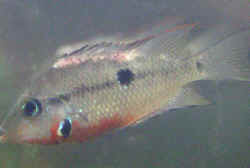 |
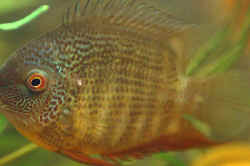 |
|
Lymphocystis again Thank you, Sabrina - As it happens,
the lumps on the Severum have shrunk dramatically and if one did
not know they had been there, one would probably not notice them
at all. <Excellent!> As for the affliction surrounding the
dorsal fin of the Firemouth, the crud might be looking a little
better but the fin itself looks awful - I think a couple of
spines may even be gone from it. <Darn.... Do keep
on top of water quality. It may be a good idea to
treat with something to prevent secondary bacterial
infection.> But there has been no change in the behavior of
the Firemouth - it is as feisty and voracious as ever. I went
back to the fish store today and a different expert was there and
she recommended Spectrogram, so I purchased enough to treat the
55. <A good med - Kanamycin sulfate and Nitrofurazone
combination. Will definitely kick a lot of nasties
that might set in (like fin rot) after/while the Lympho clears
up.> However, on Saturday I leave for a five day trip and my
fish will once again be under the care of my wife, so, based on
what you say, perhaps I will just do another good water change
before I go and hold off on the Spectrogram until I get
back. Bill <Most important is that water
quality. I cannot stress how important it
is. Do the water change, by all means, and depending
on the firemouth's condition and whether your wife can handle
it, you may want for her to go ahead and treat while you're
gone. -Sabrina>
Lymphocystis again, again Good advice! I don't know
what I'd do without you and the other members of your crew
who have helped me out. By the way, I have NPR's All Things
Considered on the radio and they just had a story stating that
fish are smart, and what a surprise that is. They mentioned
cichlids in particular. That, of course, has been
obvious to me since not long after I set up these tanks.
<Ah. This reminds me of the British study of
whether fish feel pain. Their conclusion (which was
yes, fish do feel pain), most certainly didn't surprise any
aquarists I know. Though, smart is most certainly a
relative term - but I do think mine give me a run for my money
from time to time ;) -Sabrina> Bill
- RE: Oscar Problems - Thanks for the advice. I tried
the Epsom salt (One tablespoon per five gallons the first day,
and then half the dose the second) and it didn't work. Some
days his bubble is smaller, but the next it's back to
it's large size. He has been making a little progress b/c
he's swimming now, but he hasn't eaten in about 3-4
weeks. Any other suggestions? It looks so painful! Thanks. -Mia
<This will take several weeks to heal up. Two days with Epsom
salts isn't going to do much/enough. Please continue the
treatment and be patient. Cheers, J -- >
Re: What's wrong with the eye of the cichlid?
Thanks a lot Sabrina, <Sure thing.> The bubble is gone! and
he is very well. I watched him closely for a few days, the bubble
disappeared in about three days. <Awesome!> Is it possible
that he got into a fight and got hit on the eye and got a fish
version of a purple eye? <Frankly, without having seen him,
it's hard to tell. It is a possibility.> Anyway
I'm happy that he's OK. I got into this hobby
about six months ago with a fish bowl and I have three tanks
running now. <Hmm, funny how tanks multiply so rampantly,
isn't it?? I'm running out of space,
myself.> My ahli had 12 babies on Friday, she already had 4
last month. Another ahli is about to have her babies in a few
weeks <Wonderful!> and one of my Aulonocara nyassae has her
mouth full again, I hope she doesn't swallow them this time.
<There is a practice of 'stripping' mouthbrooding
females - but it requires a lot of care/maintenance of the
embryos afterward - do a Google search, lots of info out
there.> It looks like this is getting out of control. :)
<Man.... I'm TOTALLY in control of my
addiction. I know when to quit. Really, I
do! After the next few tanks, some time....> If I
decide that the fry population is growing more than I like, may I
leave the females that have their mouths full of fry in the main
tank and let nature take its course? I am afraid they may get
dangerously harassed by the males. <If necessary, perhaps
remove the males, or reduce the number of males in the tank, or
remove the females individually to separate enclosures, or strip
the females. Good luck to you, sounds like you've
got a fun thing going on! -Sabrina>
Thanks, Husnu
Sick Midas Cichlid I hope you can help me. About four
months ago my cichlid tank got really cloudy. There are two 7 in
Oscars, 1 6 inch Midas and 1 4 inch Jack Dempsey in a 55 gallon.
I noticed that there were little brownish black
"moving" specks in the bottom of the tank clustered in
the gravel. I am pretty sure they are alive. I did a water change
and added some parasite clear but that didn't take care of
them. I saw them on the fish. I did another water change and they
seemed to be gone for awhile but the tank has not cleared up. It
was set up for 1 month before we added fish into it and it has
been a year since we first set it up. The Midas Cichlid now looks
as though there is something eating away at him. There are chunks
missing out of his face and he has turned from a bright orange to
a white color over most of his body. Do you know what this might
be caused from and what should I do? <Hi Amanda, I would be
willing to bet that all of these issues can be traced back to
water quality problems. Your tank is way over
stocked. A 55 gallon tank is a good home for 1 or 2
Oscars, until they get large. All of the fish that you
have are big, aggressive, messy eaters. The first
thing I would do is test your water for ph, ammonia, nitrite, and
nitrate. Some large water changes might be a good
place to start also. The holes in his face could be
from HLLE (head and lateral line erosion) caused by nutritional
deficiencies and poor water quality, if possible send us a
picture to help us identify the problem. You should
seriously consider a much larger tank (hundreds of gallons) if
you want to keep all of these fish, or reducing the number of
fish in your tank. You can also check out the cichlid
disease FAQs to see if any of those issues sound like what you
are experiencing http://www.wetwebmedia.com/FWSubWebIndex/cichliddisfaqs.htm
Best Regards, Gage> Thank you, Amanda Terwilleger
Jack Dempsey with a Swollen Belly Hi guys, <Hello,
Gage here this morning.> I have a question about my
Dempsey. He is quite large we have had him for about 4
years and he is sick. First he will not eat for almost 5 days
now, not interested in food. He has a swollen stomach and his
anus has a white fleshy something coming out, (doesn't look
like its moving) his anus is also getting larger it seems and may
be deteriorating, or maybe just very swollen, hard to tell a fish
to roll over to see, <agreed> I just wait till he swims
around and then I look under him. Doesn't look that good. I
was hoping for some scenarios that may be helpful to treatment...
<It sounds like he may be constipated or have a blockage of
some sort, this can usually be traced back the their
diet. A diet of strictly dry pellets, or feeder fish
are a common problem. I would start by adding some
Epsom salt to the tank water 1tablespoon per 5gallons of tank
water and repeat 3 days later. You will also want to
keep up on your water changes to ensure the best possible water
quality. If this does not help you might consider
antibiotics. Best Regards, Gage> Thanks, Dave
Lymphocystis? Hi - I just returned from two weeks
traveling during which time my wife kept the fish fed, but I have
found something terrible in the 55 gallon tank. All around the
base of the dorsal fin of one of my two Firemouths is a crusty,
ugly, raw-looking growth of some kind or another that has a
pinkish tone to it. The other Firemouth looks just fine, but
there was a bit of slim trailing off the dorsal fins of both of
my green Severums. Just above and behind the gills of one of the
green Severums was a white dot about an 1/8 of an inch in
diameter. The gold Severums looked fine. <Lots that could be
going on here. First to suspect would be water
quality. Can you give us ammonia, nitrite, nitrate, pH
readings for your tank? Are the Firemouths and the
Severums the only denizens? How many of
each? This might be a bit much bioload for a
55. As to the illness you're experiencing, I would
think, from the descriptions, it may be septicemia or
Lymphocystis. Though, possibly a fungus - is it
fluffy/fuzzy/cottony? I've found that septicemia
and fungus responds extremely well to Kanamycin sulfate (can be
found under proprietary name Kanacyn by one
manufacturer). Lymphocystis, on the other hand, is a
viral infection that is very hard to work with at
best. Maintain immaculate water quality. If
it is, in fact, Lymphocystis, you may have success manually
removing the growths - but do be careful. Do a Google
search on Lymphocystis for more info, as well, and take a look at
the Lymphocystis FAQs - http://www.wetwebmedia.com/lymphfaqs.htm
- these are marine FAQs, but there's a great pic on there of
a navarchus angel with the affliction. Might help in
your diagnosis.> I took the Firemouth into my local fish store
where even their resident expert was a bit puzzled, but they
recommended Ampicillex. So, last night, I gave the tank its first
treatment. This afternoon, I see no improvement in the
Firemouth, although it is so early that I would not necessarily
expect to. The two white spots on the green Severum are more
pronounced, having grown out kind of like a pimple and have a bit
of a moldy look to them. <This does sound much
like Lymphocystis.... it is often referred to as
'cauliflower' disease for its appearance.> Most of the
other fish still look okay, but they are swimming all about like
crazy, and several of them frequently rub themselves furiously
against gravel or decorations. Do you have any ideas?
Do you think I am on the right track with the
Ampicillex? <I'm not sure how septicemia would
respond to Ampicillex, really - it might do well for that; but it
does seem to me that you're not looking at
septicemia. A picture would be excellent, if you can
get it.> You once had me treat ick with salt. That was a slow
process but effective. Would salt help in this situation?
<Possibly. I keep all my freshwater tanks salted at
1 tablespoon per 10 gallons. Some people use twice
that. I use the higher amount (1 Tbs/5 gallons) when
dealing with illnesses.> If so, in conjunction with Ampicillex
or separate from it? While I was treating with salt, I frequently
had some low nitrite buildup, so I knew it had to be killing some
of my bio and so I am hesitant to use it unless it will truly be
beneficial. <A low amount of salt shouldn't
wipe out your bacteria. I always keep that one Tbs per
10g in my tanks, with no ill effects.> I have some beautiful
fish here and I do not want to lose them. -------------------- I
might add - I just gave the tank is afternoon feeding and it
seemed that everybody was eating normally, except for the
electric yellow. He looks just fine, but is swimming frenetically
all about. The other fish seem to have calmed down considerably
from when I wrote the last email. It is possible that the
electric yellow ate some a few pellets immediately after I put
them in, as my daughter and one of her friends came in at that
moment and distracted me from my observations for a bit.
-------------------- I just gave the tank its late night feeding.
The electric yellow was as voracious as ever. As for the green
Severum with the white, mold-like pimples, there is now a
protrusion from the larger of the two growths that, if it had
appeared elsewhere on the body, I would have immediately
suspected ick. <Again, sounding like Lymphocystis to
me. Good luck, and keep us
updated. -Sabrina> Bill
- Oscar Problems - Sorry, I may have sent this e-mail
already, but I wasn't sure if my mailbox was set up
correctly... I have an Oscar that has been sick for about 2 weeks
now. I think that I have the same problem as Lisa's e-mail
that was posted, "Bloated Oscar cichlid - Epsom salt
7/13/03" The conversation goes... "The roundness is
huge and has dropped even lower and now there is a clear bubble
looking (about 1 1/2") protruding around the anal
area. <hmmm... prolapsed rectum?> It appears to
be from outer tissue, not internal. I am
clueless!!! <I cannot explain it if external...
although I wonder if it isn't internal after all>" By
looking at the attached photos, do you think that my fish has the
same disease? (All other symptoms are similar to what she had
posted) I cannot find anything else on the internet. <Well,
it's not really a disease but a condition brought on by the
foods you have been feeding, and yes it does appear to be the
same thing. Do try the Epsom salts and if possible isolate the
fish so no one else can pick at it.> Thanks! -Mia <Cheers,
J -- >
Twitching Cichlids - 7/31/03 I have a 29G African
Cichlid tank that has been running for a couple of years.
<Very well.> The tank currently has 5 Cichlids
(It had 6 until last night). <Sorry to hear, my friend> Two
are approximately 2.5" long and the other three are just
over 1" (they are fairly new). All of the sudden
all of the fish have developed an uncontrollable twitch of the
whole body, not just the head or fins. <Whoa. When you say
uncontrollable should I take that to mean constantly? Do they
scrape against rocks or anything else (heater
maybe?)> Ammonia and PH are correct, but the
Nitrate level appears to be high. <Water changes my friend. Do
it ASAP! Condition your water and make sure PH and temp are
exactly the same. We don't want to stress the fish any more
than we have too. I keep a bucket of water aerating and
temp'ed constantly for my cichlid water changes. You should
look into what is causing the nitrates to climb. Change your
filter media and rinse the other filter medias that are not being
changed out in some tank water. If you have substrate it might be
time to start changing it out a bit at a time. The only thing is
be sure to keep your water changes as consistent as possible.
10-15 percent of the water.> There are also two
live plants in the tank. I don't know if the
Nitrate could be causing this, but I also don't know what
else to look at. <Possible. Nitrate is not an obligate killer
but could cause stress over time and exposure. Not sure what is
causing the twitching. Could be parasitic. If there are no other
outward signs of distress or parasites, then I would not treat
them if you don't have to. -Paul> Please help! Thank You,
Shad Steward
Follow up to gasping cichlid - 7/17/03 he has been
gasping for a couple months, <Hmmm> but it is getting
worse. he stopped eating about a week ago. <What has changed
in this time?? Water changes? Stress from moving to another tank?
Have you tried other foods? Live brine (just to see if he has the
will?> the medications I have used is Maracyn-two &
Naladin formula a-8-h) <What do these treat?>. the fish
that are in the tank I have had for 2+ years together.
<Cool> he seems to be the only one that seems sick. All the
fish have always shown some aggression to each other, but nothing
serious <Mine too, but every once and then, occasionally, I
will come in to feed and notice rapid breathing, and complete
destruction (shredded fins, torn mouth, missing scales) After
removal and healing time, all is well again. My point is the
Pseudotropheus zebra (is this the right fish?) are super
aggressive African cichlids, in my experience. Also very hardy.
So not to deny the fact that something is wrong.....cause there
are definitive and obvious changes....so a parasitic infection is
more than likely the result, but usually due to some stress.
Since no other fish are really suffering from the same outward
signs, then it could be likely that this guy has been harassed
for a very long time. (rapid breathing for some time right?)
Again hard to say what the problem is.....you have him
quarantined, try to get him to eat, lay off the meds for awhile,
change water frequently (you know the drill about leaving water a
minimum of 24 hours with an airstone (for off gassing))) and
heater) and hope for the best at this point. I can't think of
a medication that might help at this point. Do a search from our
main page with "rapid breathing" as the keyword and see
if someone might have mentioned a medication to use in this
situation. (one different from what you have already used. Good
luck! -Paul>
Rapid breathing in cichlids - 7/17/03 I think I might
have a problem with my blue zebra cichlid. <OK. Let's see
what we can do> he has been gasping (breathing hard) and he is
not eating. <How long has he been breathing hard? and how long
has he not been eating?> he also changed color a little.
<Probably much paler eh?> I have put him in a separate
tank, <Great idea> and have tried different medications,
<What medications?> but nothing has worked. <Well, to a
lesser degree, sometimes the rapid breathing is normal. The not
eating and color change may be due to some sort of possible
tankmate aggression. (Not knowing what else is in your tank)>
do you know what may be wrong. thank for your help. <Check out
these links: http://www.wetwebmedia.com/parasiti.htm
http://www.wetwebmedia.com/AqBizSubWebIndex/fishdisho.htm.
Also check your water parameters. So many things could be wrong
here. How long have you had this fish? Have you treated for gill
parasites by chance? -Paul> Michael
Cichlid disease Dear Crew members, <Good morning!
Ryan with you> I apologize that I have a limited knowledge in
fish terms, thus I may not be able to communicate my situation
precisely. <No problem! Shoot away> Scenario: I have 12
cichlids (1-2 inches, sorry I couldn't name them, but I guess
they are African) and 2 clown loaches (2-3 inches) in a 15 gal
tank. The loaches are suffering from white spots and I am
currently treating them. <15 Gallons? I hate to
tell you, but without DAILY water changes, this won't last
long. I don't know if I would recommend 1 African
for this tank. How are you treating this?> Question
1: This may sound silly, I notice that there are spots (some
white and some yellow) at the bottom rear fin on most of my
cichlids. Are they normal? or they are infected with the Ich too?
<Maybe normal. I had an Electric Lab that had tiny
yellow spots on his fins while a juvenile.> Question 2: 4 of
the cichlids are dark blue in colour. Their tail and rear bottom
fins started to turn bright yellow. Is this a sickness? or they
will turn yellow as they mature? <Could be normal, but
let's be real. These fish grow in the wild-15
gallons in not a reasonable amount of space for them to be
in. Africans can get large, and so do the
loaches. Both are highly interesting species, and a
good mix. But please, either upgrade to something
larger or remove the cichlids!> Thanks for reading. <Thanks
for asking! Ryan> Navy
Oscar and Myxosoma? <Hello!> I have searched the
archives and have found very little information about this. From
what I have read, I suspect that my Oscar may have this
"whirling disease". He has stopped eating for the last
week or so. I normally do weekly water changes of about 15%.
Because of his symptoms, I have done three water changes during
the last week totaling probably about 60% I have been using
Melafix for the last few days , but have seen no changes. He is
breathing heavy, mouth opening and closing. The other fish in the
tank (2 large tinfoil barbs and a Synodontis cat) remain normal.
During the day when I'm not home, I don't suspect that he
is doing the whirling thing because there is no water on the
floor. At night when the lights are on, he will do the quick, one
full turn around action, often splashing water out of the tank.
This goes on every few minutes while I'm watching. I have
done some research on the web and found that infected fish will
often do the whirl when they are startled or fed (connection with
the lights?). Almost no info exists on this disease in Oscars,
some in reference to Discus, but most are about Salmon and Trout.
There are no references to a cure. One site even said to
"immediately euthanize the infected fish and all other
inhabitants and sanitize the tank...there is no cure!"
...and that was a discus site! Heck, I don't think I'd
get too attached to a salmon or a trout, but Oscar is family! Do
you think that this is what I'm up against? Do you have any
information on this and a possible cure? I hate seeing this
graceful creature suffer like this. <I am sorry it took me a
while to get back with you! I also had problems finding
treatments for this disease. This seems to be fairly
rare infection in a warm water climate. Myxobolus
cerebralis is the parasite you're dealing with, and it seems
to find it's host initially in Tubifex worms. I
think the following course of action is in order: Quarantine the
Oscar in a sanitized tank. By medicating your other
fish, you're putting additional stress on their
environment. Keep his water in the QT changed as much
as you can, and feed him lighter than normal. You may
want to contact the nice folks at http://www.whirling-disease.org/
for more suggestions. I have a friend who is a
toxicologist for the Department of Fish and Game- I'll
forward your email and see if he has treatment ideas as
well. Sorry I can't be of more help! Ryan>
Thanks in advance for any assistance you can provide.
Jack Dempsey & Swim Bladder (06/29/03) Hi, <Hi!
Ananda here tonight...> I hope you can help me the way you
have helped so many of the people and fish from the letters
I've read. <I hope so too...> I have a 6 inch Jack
Dempsey (male). He's been staying in the corner of my 125
gallon tank for about a week standing on his nose. I went to the
pet store to ask about medications and the staff told me that he
might have swim bladder disease. I moved him to a Q/T tank this
evening. <Ah, good. Much better to treat in a hospital tank
than in a display tank....> Every now and then he'll be
belly up for a few seconds and then gets into his vertical
position. I've been reading in your Q&A's that Epsom
salt is good if there is a blockage. Would this apply to a fresh
water fish? <Most certainly. One tablespoon per five gallons
should do it.> Another site gave me info about feeding him a
defrosted frozen pea. Researchers at a N. Carolina Univ. found
that this moves out the blockage. Is there any hope for my fish
and if so can you give me some advice. I would greatly appreciate
it. <Give him a couple of peas and dose his hospital tank with
Epsom salts. If it's gas or a blockage, that should fix the
problem.> Thank you so much for having such an informative and
interesting site. Nancy <You're quite welcome.
--Ananda>
Open Mouth Albino Oscar Hi, <Hello> One of my
Albino Oscar's has been having an open mouth for almost a
month now. At first, I thought it was a fighting injury and
thought it would go away. However, it does not seem to be going
away and is starting to concern me. <What size tank and how
many fish?> My water parameters seem to be OK (pH ~ 6.7, NH4+
< 1 mg/l, NH3 0.01 mg/l, NO2- < 0.8 mg/l). However I
don't test for NO3- though (LFS was out of stock when I got
the other kits). <Actually, your water parameters are not OK
at all. NH3 (ammonia), NH4 (ammonium), and NO2 (nitrites) should
all be at 0ppm, anything above this is harmful to your fish.
Ammonium is less harmful than ammonia but its still not desirable
in your tank. You need to do water changes to get these levels
down to 0 and to keep them there. Once you get them down I think
you'll see an improvement in your fish.> Would appreciate any
experience/advice you may have on this. Thanks in advance &
Best Regards, KC Somaratne <You're welcome! Ronni>
Sluggish Angelfish Hello! <Greetings> I may have
a sick Angelfish! Suddenly he seems very sluggish and spending a
lot of time at the bottom of the tank. Normally he is very
active, so this is a strange behavior for him. He is also
wiggling/twitching a lot, but not scratching on anything. pH,
Ammonia and nitrite levels in my tank water are perfect. He still
gets excited when I am about to feed him, but he doesn't eat
the food! There are no physical symptoms on his body, no
protruding scales, no spots, growths, swelling or anything, but
he does seem to be breathing a little fast. I have a Krib in the
same tank who has gone into hiding and that shows the same quick
breathing, but I can't see her long enough to tell if she has
any other physical signs. The angel is my favorite and I would
like to catch the problem before it escalates. Should I treat the
tank with an antibiotic (I don't have a hospital tank!), or
would that be a hasty decision? The other angel seems to be
eating just fine. Do you have any suggestions? Could this be
early signs of Dropsy? Fish diseases are so difficult to
diagnose! I'd appreciate any help or insight. Thanks! Lindy
<You really do need to get a hospital tank ASAP so you don't
have to medicate your main tank and healthy fish. You should
isolate the sick fish but don't treat them until you know exactly
whats wrong. Reading http://www.wetwebmedia.com/FWSubWebIndex/fwfshparasites.htm
may help you determine what the problem is. It doesn't sound like
dropsy but could be the beginnings of several others.
Ronni>
Cichlids are twitching Hello there. <Hello!> I
have a few cichlids which have been really twitching
lately. Any idea what this could be? They
seem to be rubbing up against rocks as well, quite
often. <This isn't terribly uncommon behavior for
Cichlids. Many of them rub against things just to do it. If there
are no visible signs of other problems (visible white spots,
discolored spots, wounds, rabid breathing, etc) then I would just
keep an eye on them but not worry about it too much.> Thanks,
the people at the pet store are no help to me. Terry Maciuk
<You're welcome! Ronni>
Cichlids I read your Q&A's about copper in a
fish tank. I thought you might find this interesting. About a
year ago we had 7 cichlids in a 30 gallon tank. one at a time,
the fish would get sick and die slowly. With 2 fish left (Copora
nicaraguense pair) the larger got very ill, we decided we needed
to do something drastic. We removed the fish and gave the tank a
thorough cleaning. While cleaning the gravel we found a penny
which I think was thrown in by our autistic son. We put in 100%
new water and replaced the fish. It took about 2 weeks but the
Copora made a complete recovery. <Interesting.> We bought 3
jewels to round out the tank. About a month ago the 2 Coporas
turned up dead. we added 3 feisty Oscars which turned up dead,
then the third jewel died. <Its possible here that the Jewel
pair killed the other fish. These can be highly aggressive fish,
especially when they're spawning.> The 2 jewels left produced
about 60 fry. I told you all this to ask 2 questions. 1) A man at
the pet store said jewels can lay eggs about every 3 or 4 weeks.
Is this true? and for how long? <Actually, if the conditions
are right, they can spawn as frequently as every week. Since the
parents are the only fish in the tank, expect a lot of the fry to
survive and you may soon be overrun with fry!> 2) I miss my
Coporas and would like to find a new pair and put them in a tank
of their own but can't find any in this area. (Pgh. Pa.) any
ideas? <Sorry, I don't know of any shops in that area because
Im so far away. But keep checking around and if all else fails,
find a reputable mail order site and order some. I've had very
good success mail ordering Cichlids and have never had a single
loss.> Thanks for listening. In Christ service, Bob Ziegler
<You're welcome! Ronni>
Cichlid troubles Hi there I have just been reading some
of your mail and I have a question....one of my cichlids are I
think dying....it seems to be just lying on the rocks...I don't
know if its male or female and my father had suggested that it
was female and it is just laying eggs....every so often it gets
up and swims around then comes back down to the bottom.....can
you help me please..... Thank you Jennifer <I really need more
info. Such as the type of cichlid, tank size, ammonia, nitrites,
pH, etc This is most likely a problem with water quality but I
cant say without know the water parameters. Ronni>
Cichlids Dear Bob, I have a black and pink convict that
have mated and have a fry of about 90 youngsters that are three
months old. <Congratulations!> Everyone was doing
good up to a point, and then the male black cichlid started to
lose his dorsal fin. It seems that is being stripped of all
it's scales and the bones are starting to stick though.
<Not good> The rest of his scales look fine. He has also
taken to swimming on a vertical access with his head facing
straight up. <Very bad...> When he does this, he swims
though the fry and they pick away at his dorsal fin. Is this some
form of fin rot or ick? <Not likely... see below> How
would I medicate this condition and should I separate the father.
<Do separate them... better to raise the young separately
after just a couple of weeks... Maybe this is an
"older" fish that is just going through death throes...
perhaps poor water quality is contributing to its demise (do
check your pH and keep up a regular regimen of frequent partial
water changes... good practice for all. I wouldn't
"treat" this system, condition otherwise. Please see
the freshwater maintenance sections on the site:
www.WetWebMedia.com Bob Fenner>
Trouble with Cichlids Dear Bob, Thank you
very much for your e-mail dated 04/11/00. The reason I
couldn't respond was that I have been on holiday in Sri Lanka
and unfortunately I had no access to e-mails. By the way just in
case you are wondering I'm a Sri Lankan working in
Thailand. <How nice... was in the Maldives last year...
sending expensive emails through Colombo... and hope to be diving
in Sri Lanka next year (on a big trip through Goa with the
running group the Hash House Harriers> The good news is that
during my absence of over a month I lost just one fish. I
had a friend feed them and do the 25 % water replacement
regularly. The nitrite level and the ph values seem to be well
within limits and the fish have grown alarmingly large. Your
initial comment of the system not being able to cope up with the
number of fish is becoming apparent, pretty fast. ( I am toying
with the idea of another tank !!!!!!!!. Some of us never learn I
guess, ha ha ha) <Ah, you've got the pet-fish
madness all right!> I have a Aulonocara which was very
beautiful. Right now he has lost all his colour and his stomach
seems to have shrunken into a concave outline. He doesn't
look too healthy though he is moving around well. Please give me
a suggestion for treatment. <Foods laced/soaked in
vitamins are a good start... Do you add salts per the Great Lakes
of Africa? Can your other livestock handle these? I would at
least add a teaspoon of uniodized table salt or better synthetic
seawater mix per ten gallons to the system (all other livestock
should be fine with this)... and if the fish continues to wither,
do consider moving it to a smaller treatment tank and utilizing
the antiprotozoal Metronidazole (aka Flagyl) mixed in with its
food if still eating, otherwise 250 mg per ten gallons... changed
out once every three days for three treatments...> Once again
thanks for all the tips. They have helped me enormously and
I think eventually make me a somewhat decent fish keeper
who is not a danger to the fish. take care and best
regards Deega ah-you-sa( Long life in Srilankan),
Saranga and Jackie <and Kia orana (life to you in Cook
Islands Maori) to you and yours. Bob Fenner>
Trouble with
CichlidsDear Bob,Thankyou very much for the e-mail with
all the tips. As the root cause for the my problems seem to be
the excessive content on nitrite, I have been measuring it on a
daily basis using "tetra test for NO 2". The reading I
get now as per test result card is a value which indicates <
0.3 mg/l. I have consistently got this value for the past several
days.Please explain what you mean by dilution water
change.<Change half your water with that of no nitrite,
you cut the concentration by 50%...> My fish dealer keeps advising
me to add a small amount of salt about once a month during the
water change. Should I do this?<Yes, a good idea.>
I have not been
able to get anything to improve the bacterial growth in my filter
system, as you advised. Is there any additive I can buy over the
counter to assist?<Well, yes... products like
"Cycle" by Hagen do offer ancillary help in this
regard... but really, you want to just foster the bacterial
systems in your system. Do look into adding more mechanical
filtration, like a hang on filter, canister, even an inside box
filter or sponge type... and don't be too fastidious about
cleaning the media... especially not all of it in all filters at
once.> Thank you once again for your time and
advice.<You're welcome. Life to you (Kia orana in
the Cook Islands), Bob Fenner>
Trouble with Cichlids? Dear Bob HELP
!!!!!!!!!!!!!!!!!!!!!!!!!!!!!! I am very new at keeping fish. I
have a tank that holds about 265 litres. It has a submersible
pump and a air pump with mechanical and biological filtration.
The nitrite level my tank is about .3 to .4 mg/l, the ph is value
is about 7.4 and temperature is about 28 deg C. I change about
20% of the water every 04 days. <Hmm, the nitrite is
worrisome... I would hold off on doing water changes, or feeding
the tank till either the nitrite nears 1.0 ppm (at which point I
would execute a dilution/water change), or leave it be till it
cycles completely> I have a variety of cichlids. 05 fire
mouths, 04 jackdempsy,01 orange & 01 albino morph,02 blue
dolphins,01 electric blue,01 Labidochromis, and about 10 others
who I cant really identify but all cichlids. <This is going to
be a lot of fish for this system if/when they are larger>
Recently I have lost a few fish and I cant seem to identify the
reason. One of the Firemouths had what seems to be a dislocated
jaw and he couldn't eat. I assume two of the others are
constipated, as they have bloated stomachs and do not eat
any food, at feed times. I have now separated the
constipated ones into a hospital tank and added a bit of salt to
it. Couple of others have died with no reason. <The fact that
you state there is appreciable nitrite is troubling... you may
well need to add more biological filtration (another canister,
fluidized bed... hang on... filter) and or aeration,
circulation... Something is not sufficient in these categories:
biofiltration, aeration, circulation> Could you please help me
out with the following questions.. 1. Should I add any salt to my
tank, at all , and if so how often should I do so? 2. What kind
of medication should I use for constipation? I have changed the
substrate of the tank to be bigger gravel so that they cant dig
and get damaged or locked jaws. Please let me know some general
remedies I can apply. I feel I'm doing my best to maintain
the quality of the water. <I understand and will help you...
but I would not add salt or anything else at this point, largely
out of fear that this will forestall the establishment of cycling
(conversion of ammonia to nitrite to nitrate, and many other
cycles) and that this may be the principal cause of your woes...
do cut back or eliminate feeding, and don't change the water,
or add anything till the nitrite drops to zero. If you can, have
a friend with a clean tank that is cycled give you their old
filter media to add to your filters, some old gravel, even
siphoned water and mulm from gravel vacuuming their substrate...
And do this today. All will greatly "speed up" the
establishment of nutrient cycling. Bob Fenner>
Tiger Oscar Question How's it goin?? <Fine> I
have an almost full sized tiger Oscar that has developed some
strange marks on its head. At first I though he had just hit
something in the tank because it looks almost as if a shallow
chunk of skin is missing. Well this continued to spread, he now
has these patches in several spots on his head. Any ideas???
<Unfortunately yes. This does sound like a case of HLLE (Head
and Lateral Line Erosion), a nutritional disease for the most
part. Please read carefully about others problems, responses
here: http://wetwebmedia.com/cichlidfaqs.htm and follow the
links, FAQs suggested to them on our site. You want to develop a
plan now to halt this ugly erosive condition. Bob Fenner>
thanks Kyle
HLLE, Oscars, Etiology, Cures Hi Robert...
<Hello> I am sure with the volume of mail that you receive,
you don't recall who I am. I had the two gold Oscars that had
HLLE. <I recall> Though I followed everything that was
explained to do, tonight I lost one of them. For some reason,
this one just did not respond to anything I did. The other seems
to be at least remaining the same, if not slowly healing, it is
difficult to tell. I have some generic questions that I have
found no answer to. Is HLLE an actual disease, a skin condition,
a bacteria, or most importantly, contagious? <There are a few
theories as to root causes of HLLE... most favor nutritional
deficiency syndromes (mainly vitamins, iodide/ine)... some
suggest protozoan involvement (esp. Hexamita spp.), others stray
electrical potential (sellers of grounding probes), general
"poor water quality"... Myself? I believe the first is
a principal cause with all others being contributory. Please read
through "the three sets of factors that determine
health" piece here: http://wetwebmedia.com/mardisease.htm
For a "more rounded" view/glance of what goes on in the
real universe> Everything I've read says that it cropped
up about 15 years or so ago, and the likely hood of the causative
action being Hexamita is slim. <Was about way before this
time... know because I was there...> As this is what killed
one of my Oscars, I would like to know more about what it
actually is. <I understand your provocation... treatments more
often kill off livestock...> You spent a great deal of time
working with me on fixing this problem, and I truly do appreciate
it. <An honor to help> One just didn't have it in him
to make it though. I still have hope for the second one. Thank
you again cj. <Please do read over the HLLE FAQs and
environmental disease sections on the Marine Index part of our
site (WetWebMedia.com) as well. The same etiology/ies for marine
fishes pre-dispose them to this "disease". Bob
Fenner> C.J. Moody
Re: Cichlid i.d., Vitamins, Iodide/ine >>1 random
cichlid [about the size of a convict] >I would like to figure
out what this cichlid is. ><Oh yes: fishbase.org The family
Cichlidae is quite large... maybe >start >with
Spilurum, the various re-do's of the genus Cichlasoma... and
a >very >large pot of tea/coffee (to stay up late).
Have fun.> *Thank You*!! I may well find out what she is with
this:) <<Yes... a long, but fun search>> ><The
same causative mechanism/s exist in both marine and
>freshwater... >lack of essential nutrients> Can I
overdose them on vitamins? <<Yes, this is possible... not
practically though...>> ><There are prep.s that are
made/labeled for fishes et al. aquatics, >but >the
compounds involved are the same as for tetrapods (like you
and >me), so >"baby vitamins" (liquids)
will do... Do you mean that I can actually buy baby vitamins for
human babies and use them?? <<Yes, the actual molecules are
identical>> > or pet-fish ones like Micro-vit, Selcon...
Add these to the food a >few >minutes before
offering.> Yesterday I bought something called Hex-a-Vital,
and it is a vitamin product that specifies treatment for HLLE. I
can see a difference in one of them, but the other still looks
fairly nasty. <<This "curing process" takes weeks
to months generally. Be patient>> In this product is A, D3,
C, E, Calcium Phosphorous and Calcium Carbonate. There is no
iodine. <<I would find a source and apply it. Lugol's
Solution will do, potassium iodide would be better>>
However, I know that table salt does have iodine in it. If I were
to put a few teaspoons of table salt in there, would this be a
bad thing or a good thing? <<Better than nothing>> I
have always understood that iodine will kill fish, which is why
one should use rock or aquarium salt. <<Hmm, much to say
here... Iodine (the element) is indeed toxic... Iodide (same
element, different valence state) is a way to supply this
essential nutrient... not toxic in small concentrations>>
><Me too... do try the vitamins... they can/will effect a
reversal at >this >point. Bob Fenner> I can tell
there is an improvement. You are a wonderful person, taking the
time to work with me on this. Thank you so very much. cj. C.J.
Moody <You are welcome my friend. Bob Fenner>
Re: Cichlid i.d., Vitamins, Iodide/ine I am sure I am
about to drive you crazy.... but.... <<Mostly there
already, no worries>> >Do you mean that I can actually
buy baby vitamins for human babies >and use >them??
><<Yes, the actual molecules are identical>> How
do I know how much of this to give them? Should I treat the food
with the same amount as listed for an infant? <<Hmm, a
"few drops" total (irrespective of food amount, size of
system) will be sufficient and no problem...>> >However,
I know that table salt does have iodine in it. If I were to
>put a >few teaspoons of table salt in there, would this be
a bad thing or a >good >thing? ><<Better
than nothing>> Sounds a bit ominous... Will track down some
of the advised product:) <<Ah, good>> Thank you
again:) cj. C.J. Moody <Be chatting. Bob Fenner>
Please help!! (disoriented Parrot Cichlid) Dear Sir,
One of my 5 year old red parrots has what I believe is swim
bladder disease. <Unfortunately, a too-common difficulty
with this hybrid> For the past two weeks I have noticed that
he stays near the surface upside-down. At first it was just
occasional, he would swim down with the others and had a hearty
appetite. Now he just stays at the top, its a struggle for him to
swim down although he really tries. His belly is really swollen
as well which just started about 3 days ago. I have tried giving
him mashed peas as I read this might help, but he wont eat them
(spits them out). He will go after fish flakes though. I just
started him on some paragon II last night as I have also read
that this might help. I'm at a real loss. Can you help with
any suggestions? I would really appreciate it because I don't
know what else to do. I don't want him to suffer. Thank you!!
<Discontinue the Paragon, other medicine approaches here...
they're likely more toxic than helpful. Do consider placing
this specimen in shallower water and administering a small
concentration of Epsom salts (magnesium sulfate) to its water
(about a teaspoon per ten gallons of system water) to facilitate
muscle relaxation, possibly passing of material in its gut.
Perhaps with time, weight loss over the next several days it will
"right itself"... As stated this sport cross has an
inherent tendency to "tip" due to its shape... Be on
guard about how much, what types of foods you offer them... as
fatty degeneration can greatly increase this "problem".
Please write back if any of this is unclear or you desire more
input. Bob Fenner, WetWebMedia>
follow-up to "Please Help" email from 9/28
Dear Sir, I just found out that you were away (hope your trip
went well!). <Yes my friend, thank you. Very relaxing,
beautiful, productive> In regard to my 5 year old red parrot
with swim bladder problem and very swollen belly, I just wanted
to give you some more info: This morning his belly was even more
swollen that it looked as though he would explode. His anus was
blocked by a clear membrane which I believe was the swim bladder
which was causing the swelling. The only thing I could think of
was that I needed to try to relieve this pressure. So I got a
sterile syringe and as gently as I could, aspirated the
membrane. <A worthwhile effort.> Immediately, his
belly went back to normal. There was no blood or fluid that came
out, which I'm hoping is a good thing. He's still
upside-down, but is now swimming and attempting to dive which he
can do for a few seconds. His appetite is good. I don't know
if what I did was bad or good. I just couldn't let him stay
in that condition. I know he's "just a fish" but I
am very sensitive when it comes to animals. <As we
should be> If he winds up dying, at least I know I tried.
I'm still giving him the Paragon II for another 2 days and
then I'll put him back in the main tank and see how it goes.
Let me know what you think. Thanks again!! <Likely the
swim-bladder will heal itself... and I am hopeful that your
specimen may have changed body-make up wise to where the center
of mass will allow it to stay aright. Life to you my friend. Bob
Fenner>
How long should I wait? Hello and Good morning to
whichever "fountain of knowledge" reads this-
<Anthony Calfo... and this fountain is running at a trickle...
which reminds me... I think I drank to much tea (back in a
minute)> I was wondering if you could give me some guidance
with a freshwater tank I have. <yep, back already>
Back in Nov. I wrote to Bob about my sick Albino Jack Dempsey.
Here is part of that letter "... It started like 8 months
ago when I notice what looked like something growing inside the
tissue at the base of his dorsal fin and his tail fin. It looked
to me like some kind of egg cases or something INSIDE his
fins." Bob figured it was a trematode or nematode
infestation (you can find the whole email here
http://www.wetwebmedia.com/neotropcichfaqs.htm)... <I would
not argue with that... Bob has traveled extensively and really
knows a lot about diseases...er, whatever> Well, the Dempsey
didn't live much longer and the tank has been sitting
"empty" for 5 or 6 weeks now. It is a 50 gallon tank
and it is not "really" empty. There are many snails and
2 Kuhli (spelling?) loaches in there. (Somehow they have all
survived some heavy medication) My question is how much longer
should I wait before "restocking" the tank?
<alas... a moot point/question. The tank has not been kept
"empty" without a viable host (you have the loach).
Although the loach may not show symptoms, it can still be a
carrier. Still... after four weeks you are pretty safe> Is
there anything I should do to prevent whatever was affecting my
Dempsey from affecting the future tank residents? I am hoping to
re-stock the tank with a few Texas Cichlids. <beautiful
fish> Thank you for your time and knowledge! Ann <best of
luck to you. Anthony Calfo>
Parasite (worm inside cichlid eye) I was wondering if
you could help me. I have a Geophachromis Acii and she has a
small, white, "worm" inside her eye ball that I can see
moving around. It is not on the eye but IN it. Kind of like her
eye was a fish tank and the worm is swimming in it. I have been
trying to find out what it is and if there is anything I can do
but so far I have come up with nothing. It is a small flat white
worm with a grey band just behind the head section. If you could
help me out I would greatly appreciate it. <There are such
parasites of many fishes (even humans)... and as far as I'm
aware not much you can do about removing them. The good news is
that such obstructions don't appear to mal-affect their
hosts, or spread to other fishes in captivity (likely lacking the
means of completing their life cycles). I would ignore this worm
and enjoy your fish. More information on fish parasitology can be
found by visiting a large college library and seeking the help of
a reference librarian to aid you in conducting a computer search
bibliography and literature search. Bob Fenner> Thank You,
Stephanie
Possible Disease I have a mix of 9 African cichlids in
a 55 gallon tank with extensive rocks and caves. They all get
along pretty well, but recently my Tropheus (orange flame) had
white lips and was dead a few days latter. Now my Dubois has the
same white lips but is still fine. Is this a disease or what else
might it be? Brian <There are several bacterial or fungal
diseases which have a white growth around the lips. They are
generally referred to as cotton mouth. Take a look here
http://www.wetwebmedia.com/FWSubWebIndex/fwdis3setsfactors.htm
following on through the linked FAQ file for additional insight.
-Steven Pro>
Cichlids I have just taken over, taking care of my
partner's fish. We had two cichlids but the one
was a real bully so we gave it away and kept the placed one whom
I have named Joe. He does not seem very
well. I pay a great deal of attention to him, but when
he eats he starts to have a fit and jumps around in the
tank. It is upsetting me a lot as I just don't
know what's the matter with him, and I don't know what to
do to help him. Please can you help. Thank
you....... <Hmmm, not much information to go on other but
let's see if we can help you. You don't mention the type
of Cichlid, the size of your tank, your water chemistry, what you
feed, type of filtration and how often you change water and clean
the filtration. I wonder if this is behavioral, feeding related,
water quality related, or internal disease/parasites resulting
from overall poor water quality and diet. It is very difficult to
take over care for someone and not have some substantial changes
in husbandry. What if anything have you changed besides placing
the other fish? To get started, identify the exact fish you have
and then go to the following pages to find the conditions your
cichlid needs to thrive. I would recommend testing water for
ammonia/nitrites/nitrates/pH and change water and regularly
maintain filtration/vacuum tank to lower wastes. Maintain pH in
correct range for your cichlids (Africans need high pH/hardness
as opposed to others.. please see URL provided). Start here and
follow all the links at the top of the page. http://www.wetwebmedia.com/FWSubWebIndex/cichlids.htm
If this doesn't help please write us back and include all of
the information above so we can help you narrow this down. If
this isn't behavioral, I suspect internal problems resulting
from water quality/diet. I would start there. Go for
it! Craig>
Cichlid I finally found my fish thanks to you! It is
this one, "Amphilophus citrinellus (Gunther 1864), the Midas
Cichlid, aka one of the Mesoamerican Cichlids called the Red
Devil. Nicaragua and Costa Rica, and the world through the
aquarium trade. To about ten inches in length. Can be a real
terror, bully with other livestock." Finally, thanks.
I'm having problems with him, though. He has a swim bladder
disorder. He lies on bottom and doesn't do a darn thing. If
you have time to answer, you think Epsom salt is safe for a bath
of some kind? <It is safe, but I would ballpark at less than a
50/50 shot at making him better. It is hard to diagnose the exact
cause of swim bladder disorders.> I've heard to use it.
<As have I for primarily goldfish suffering from constipation
and floating disorders.> Thanks for the website. Parthina
<You are welcome. -Steven Pro>
Cichlid & Water Quality Hi ya! (Love your q&a
area!) I have a question for ya that I'm hoping you can
answer. I've noticed that when I mess with my tank
too much I kill my fish so I don't touch it much but I did do
a partial water change not long ago and had to add a chemical to
the tank to clear up the cloudiness and noticed my fish develop
symptoms of the gold fish one had written of earlier. You'd
requested not to "repost" so I
didn't. But you had mentioned that it likely had a
gas bladder disorder, common in fancy goldfish. My
fish though is a cichlid. It is an antique white color
with normal fish eyes (no pink or red or
anything). I've tried to find out what he is, I
got him from a friend about 4 years ago. He's been
lying on the bottom for about 2 weeks and I can't find
anything on it. He could be sucking the crap from
under the gravel into his lungs if I'm not mistaking. What do
you suppose I should do? The tank could use a cleaning
but darn I think I'm jinxed. I can keep a fish for at least 6
years even but I kill them if I mess with their tank too
much. I suppose I'm not too good at
that. His belly did swell in the beginning and at that
time he was actually swimming upside down!! He'd only turn
upright to eat! I was so shocked! I've got about 8
minnows (from fishing last year, I couldn't kill them) and
they stay near my cichlid like it's their mother. Anyway,
anything would be helpful! I've noticed you are excellent
with your advice as I recognized a few diseases! Thanks in
advance for your assistance! Parthina <This
isn't difficult. First, fish don't have lungs! Surely the
crap is a big problem. Get over your jinx or you are
going to kill your fish in sewage! Vacuum the gravel *really
well* and do a substantial water change afterward. Clean the
filter in old tank water. Go over to WetWebMedia.com scroll down
to the Google search engine and type in "cichlid" and
find your cichlid in the cichlid pages. Match or
approximate water conditions (pH and hardness) as provided for
your fish. Proper water quality, food, filtration, pH
and hardness should resolve health and cloudiness problems.
Please read more on keeping freshwater fish here: http://www.wetwebmedia.com/FWSubWebIndex/fwsubwebindex.htm
You need to resolve your jinx! Craig>
|