|
|
| Home | Marine Aquariums |
Freshwater Aquariums |
Planted Aquariums |
Brackish Systems |
Ponds,
lakes & fountains |
Turtles & Amphibians |
Aquatic Business |
Aquatic Science |
Ask the WWM Crew a Question |
| Please visit our Sponsors | ||||
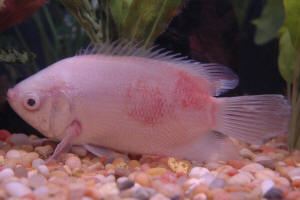
Gourami laying on the bottom - 6/7/07 Hi, <Hello to you!> Your website is wonderful; <Thank you:-)> I have been reading the Gourami Disease section in search of ideas for my situation, but didn't quite find what I might do next, so here goes: <OK- ready> My urgent concern is our dwarf red honey Gourami: last night he was at the top of the tank in the corner near the heater, barely moving and not interested in food; now, he is laying on the bottom, breathing heavily. I cannot see any obvious symptoms (no white spots, no injuries, scales look OK...) <First thing to check is environmental conditions.> I have had him (?) one week. <Did you quarantine this fish prior to adding him to your aquarium? You should always, always, ALWAYS QT new livestock for 2-4 weeks, to observe for signs of illness and to prevent bringing any diseases or parasites into your main tank. With regard to whether you've got a boy or girl, usually the coloration is the best way to tell- the males are much more vibrantly colored, whereas the girls are paler...I suggest doing an image search on Google to see the difference for yourself.> Aquarium details: it is an Eclipse 12 (12 gallon), with 2 live plants (Amazon sword, pennywort), 2 rock features, and currently has 3 zebra Danios, 4 platies, 1 small sucker fish, the one Gourami. Current readings are PH 7.6, ammonia 0, nitrites 0, nitrates 40, temperature 78. <A 12 gallon tank isn't much room to play with stocking schemes. Although the dwarf Gourami (Colisa lalia) doesn't reach much over 2", it does require very good water conditions to stay healthy, and this is harder to achieve in small systems. I'm glad both the ammonia and nitrite levels are at zero, but nitrates should be no more than 20 ppm. You should do a water change ASAP to lower the nitrates. Question: did you cycle this tank prior to adding fish? How long has the tank been established? If you don't know what I'm referring to, please read here for a helpful introduction: http://www.tropicalfishcentre.co.uk/Cycle.htm With regard to the "sucker fish", do you have any idea of the fish's scientific name? Is it a common Pleco (Hypostomus plecostomus)? If so, be aware this fish should reach over 12", possibly up to 18" in its adulthood...a 12 gal. tank is way too small to accommodate it. I can't say for certain this is what you have, but many times when folks say "sucker fish", this is what they mean. The zebra Danios (Danio rerio) also cannot tolerate poor water conditions at all, and will succumb to bleeding or ulceration of the gills if they are exposed to ammonia even in the slightest. These fish prefer being kept in schools, but you obviously must have the space for this. Also, the zebra Danios can be nippy...keep an eye out for unduly aggressive behavior, which can be exacerbated by small living quarters.> I'll give a bit of history, as there has been a lot going on in this last week. A week ago, we had the 3 zebra Danios, 2 platies, 4 serpae tetras. One of the tetras died. A water test showed our nitrates too high (80) so we did a 25% water change (we usually do this every 3 weeks, we've had the tank since January). <OK- let's pause here. In a fully stocked 12 gallon, I would suggest doing a 50% water change weekly. You must ensure that ammonia and nitrites do not ever exceed zero, and again, nitrates can only safely be as high as 20 ppm (but lower is obviously preferable). I imagine that there's been a good deal of toxic buildup during the 3-weeks before your water change is due. I highly recommend you step up the amount and frequency of water changes ASAP. Also, how often do you change the carbon filters? These should be swapped out at least every month.> We add 2T of aquarium salt, <OK- can promote fish slime coat production, helping keep everyone healthy> and got 2 new fish, <Why would you do this when your water conditions weren't pristine? Not a smart idea...> the Gourami and the sucker fish (and the pennywort). About 5 days later, one of the platies was dead (we think she had been pregnant as she was quite tubby for about a month, then a day or so before she died, she wasn't so tubby). <She could well have been pregnant, and I would imagine the Gourami would have consumed the fry. Pregnancy and giving birth will cause some level of stress in fish (just like humans!), making the fish more likely to succumb to disease caused by poor environmental conditions.> The 3 remaining tetras were not getting along -- one was being a bully chasing after the others to where fins were getting frayed (in fact, the fins of the platies were too so maybe the tetra was after them). <Yes- not a good mix, especially in such a small tank. Did you research the compatibility prior to purchasing the fish? In the future, I do suggest doing so. In fact, when stocking a tank, it's best to pick one fish you "must" have, then plan tankmates around what the best companions will be. Obviously, you must consider environmental as well as temperament compatibility. I like to suggest David E. Boruchowitz's The Simple Guide to Freshwater Aquariums for a helpful section on stocking (not to mention cycling, disease, etc. I must say, however, that I don't agree with that author's use of fish for cycling purposes...)> We returned all the tetras to our fish store; <Good.> they checked our water and found our PH at 8 (all other readings OK). <You truly should have your own quality liquid test kit, so that you can check ammonia, nitrite, nitrate and pH every week both prior to and after your water changes. Aquarium Pharmaceuticals puts out a good one which I personally use: http://www.drsfostersmith.com/Product/Prod_Display.cfm?pcatid=4454&N=2004+114130 When you bring a water sample to your fish store, chances are the water parameters have changed by the time you get to the store, so you aren't getting an accurate reading. Not to mention many fish shop employees don't perform tests properly, or don't use quality test kits, thus giving false results. Also, "the water was OK" is so highly subjective that it is of virtually no use.> They gave us Neutral Regulator which we used (and now are PH is at 7.6, they recommended we wait a week until we try to lower it more). <Don't muck about with the pH! Stability is much better than precision, when you are dealing with relatively small changes. If your tap water is so off-the-charts, then I suggest switching to de-ionized or reverse osmosis/de-ionized water, which produces water of a neutral pH that must then be adjusted; otherwise, adding all sorts of chemicals can only cause pollution and instability, in my opinion. My best advice here is to throw the stuff out, and start doing independent research via books, periodicals, the 'net, instead of the fish store...> About the time we adjusted the PH is when the Gourami began to act odd (in fact, as we added the regulator powder, the Gourami was trying to eat it). <Obviously not a good sign. Truly, you don't need this product the store likely "pushed" on you. So long as the fish have been properly acclimated, they can accept a range of pH conditions. Better to concentrate on the toxins your tank's water is accumulating, as this is the likely cause of the fish's woes.> This was also the same day we added the 3 new platies. <You *must* stop adding new fish until you've achieved stability in a fish tank! You are only looking for problems by adding new livestock to an instable tank.> Maybe we did too much at one time? <Yes. Simplify what you are doing. See above for suggestions re: weekly water changes, stocking, etc. And please stop purchasing new fish - your tank is fully stocked!> I called our fish store today; without seeing the fish they wondered if there might be a gill disease. They recommended a small water change, so I've just changed out 1.5 gallons (adding salt to the new water). Gourami is still laying on the bottom...we couldn't decide whether to take him to the fish store so they could look at him or if that might do him in...Anything you can suggest is welcome. <Get a test kit. Test the water. Make sure ammonia and nitrite are at zero and nitrates no more than 20 ppm. If you don't have a test kit readily on hand, I'd suggest doing a 50% water change. I'd be willing to bet this fish is suffering from poor environmental conditions, that's all. Once you've ensured the water parameters are good, re-assess the fish's condition. If he's still not better, I'd suggest isolating him into his own hospital/QT tank; bringing him to the fish store will likely just cause undue stress. In the meantime, while you are waiting for him to recover, the best thing you can do is educate yourself as to basic fish requirements. The book I recommend above is a good place to start, but there are many others. Also, see here: http://www.wetwebmedia.com/FWSubWebIndex/fwsetupindex.htm > Jana <Jana, start from the beginning. Re-assess what you are doing, since it isn't normal to lose so many fish in such a short period of time. Once you get the water parameters under control, I believe you'll have much more success in the hobby, and in turn, more enjoyment. Best of luck, Jorie> Re: Another case of poor environmental conditions doing the FW livestock in... f' Gourami laying on the bottom 6/10/07 Thanks so much for your reply. <You are welcome, Jana.> You've given us tons of useful information and links <Hope I've helped> (my 9-yr-old daughter is the "official" owner of the tank, but I am closely involved...). <Sounds good. Definitely great that your daughter is interested and wants to learn, but good that you are involved as well!> Our Gourami has since died -- we took him to our LFS and they examined him and researched on the web/in books and concluded it was a combo of parasites and a bacterial infection. <Did they give you specific reasons for their conclusion? Forgive me, but based on what you've told me of this store so far, I have less than great faith in their diagnosis. A truly good book to invest in is The Tropical Fishlopedia (authors Burgess and Bailey) - it is not as easy of a "read" as the previous book I suggested (Boruchowitz's Simple Guide to Freshwater Aquariums), but is very useful in helping to diagnose and treat illnesses. At this point, I would advise you to obtain as much information from independent sources as possible. This isn't to say the LFS (local fish store) is always wrong, but I've just found so many times it's safer to do your own research and be a non-reliant upon a store as possible.> They suggested we treat our entire tank <You don't ever want to medicate your entire tank - you will destroy your nitrogen cycle, and likely many of the fish in the process. This is another reason I suggest you try do educate yourself without the help of this LFS...this was truly bad advice on their part.> and gave us BettaMax blended antibiotic capsules (to be used for 3 total treatments, one every other day) and loaned us a oxygen pump to add more oxygen while we do this and told us to take our carbon filter out. <They are right that medication can rob the water of its oxygen content, and also right that the carbon will remove the medication. However, I do not believe they were correct to suggest you medicate the whole tank. Having said that, what's done is done and you may as well finish the treatment (same concept as human antibiotics; best not to stop mid-course). Be aware that you will have to re-cycle the tank, so you should be keeping a very close eye on water parameters via your own test kit.> We have given the tank one treatment; so far all remaining fish look happy. <Keep a close eye.> Readings: Ammonia 0, Nitrite 0, Nitrate 20 (guess that 1.5 gal water change yesterday helped). <Time to do another water change is the nitrates are at 20. I'd suggest a few gallons at least...> I think your conclusion that we let the nitrates get too high (and need to do water changes more often replacing more water) is indeed what got us into trouble. But shall we stop the medication treatment at this point? <I wouldn't - see above. But I would suggest continuing to do water changes during treatment; the directions may say something contrary, but you don't want to re-create the problem nitrate situation again. If you are treating every other day, I'd suggest doing water changes on the "off" days (caveat: you must test your water frequently and do more water changes if necessary - with livestock in the uncycled tank, it's a bit of a catch-22, but ultimately you must remember that fish cannot take buildups of toxins.) We do not QT our new fish; after this experience it shows that that is definitely a good idea. <Yes - so many of us have learned the "hard" way. I once purchased a couple dwarf rainbows that destroyed almost an entire tank worth of livestock by not using a QT...it truly is a must in this hobby. You don't need anything fancy, just a tank, some sort of filtration, plus a heater and thermometer.> I will research what we need to set up a QT tank. Do you suggest that we just basically always keep a QT tank at the ready to accept new (or sick) fish? <I do not keep my QT tank running at all times. Usually I will QT new arrivals for several weeks, making sure that all is well. I then transfer the new specimens into their "homes" and leave the QT up for a week or so just to make sure the transition goes well. Then, I'll break down the tank and clean it well (using bleach, and rinsing very very well, even adding a bit of chlorine remover for good measure!) to ensure that any parasites are eradicated. That's not to say I haven't had to "urgently" setup a hospital tank in emergency situations, but I don't really see how that can be avoided...> We did cycle the tank when we got it. This was in January -- we did the Fishless method of cycling (based on articles by Chris Cow and Rebecca Townsend; it took a bit over a month and worked exactly as they described and we really liked the idea of not using fish to do the cycling). <Wonderful - I am so happy to hear this!!> So we do have a Master Test Kit (Aquarium Pharmaceuticals) and are pretty good at testing our water; but didn't test often enough these last couple months I'm afraid which led to our high nitrates. <Okay - sounds good. Don't beat yourself up, just learn from your mistakes. Somehow I got the impression your fish store was testing water for you (perhaps that was just a one-time thing, when you asked them for help?) In any case, I'm so glad that you have your own kit. So many folks don't, and that really isn't a good idea...> We had been changing out our carbon filter every time we did a water change; with your recommendation that we change water more frequently we will modify this to change the filter monthly. When doing a 50% change every week, do we vacuum the gravel each time also? <You want to get any leftover food and obvious waste products out, but I don't think you need to do a thorough gravel vacuuming each week. In all honesty, my freshwater tank is heavily planted, so I really don't "vacuum" per se; I use a piece of flexible tubing to remove debris resting on the surface of the substrate, and that's about it. Maybe try doing your gravel vacuuming once a month or so, and adjust as dictated by test kit results?> We usually take the rocks out but leave the fish & plants in -- will this still work? <Unless you're seeing a huge algae buildup, I don't think you need to remove all the rocks on a weekly basis- this can be quite stressful on the fish. I'd say just use your best judgment...of course if the rocks need scrubbing, you'll have to remove them, but again, I don't think that'll be necessary each week. Most importantly, just keep the water clean - simply siphoning out the water into a 5 gal. bucket seems to work well for me/us> And I'll leave the pH alone now as you suggest. <I do think stability is key here...the fish you currently have are not so very sensitive that they can't live in the 7.8 (or even 8.0) pH you mention. You just want to avoid big ups and downs...> Our sucker fish is not a common Pleco -- they suggested this tiny guy who will not get very big but I can't read their writing as to what he is (looks like Ptoemclis? Ptounchs? -- maybe I'd better call them to find out!). <Hmmm...am looking in my freshwater encyclopedia, but cannot find what you are referring to. I would suggest calling (or perhaps Bob Fenner can offer an opinion when he posts this? In any case, I'm glad to hear this isn't a common Pleco. At least you weren't duped into buying one of the latter by your LFS...one point in their favor!> We had some brown algae growing on our rocks and acrylic walls and they suggested he would help clean it up. <Aha - a clue! I'm thinking Otocinclus affinis - does this look like your little aquatic friend? http://www.fishbase.org/Summary/speciesSummary.php?ID=11332&genusname=Otocinclus&speciesname=affinis (be patient, www.fishbase.org takes *forever* to load, but it's a great resource/internet site) If so, *when* your tank is re-cycled and all your problems solved, I would recommend getting a couple more of these, as they do best in trios or more. And, I think that'll keep you within an acceptable stocking range, based on your previous information...> (The brown algae appeared about a month ago; we scraped it off at first, some grew back though not as much, and the sucker fish is so far keeping it pretty clean). <The Otos will help with the algae, but a few additional pointers regarding algae control: don't overfeed, don't over light (and keep the tank away from direct sunlight), and regular water changes. If algae becomes a big problem, check the phosphate levels, as these will usually be off-the-charts. The above-mentioned remedies will usually control the situation, but there are also filter media available to help (I personally use and recommend the PolyFilter for assistance with phosphate control). So, we're left with our 3 zebra Danios, 4 platies, and the sucker fish. I'll read your suggested reference about stocking; my daughter is keen to get another fish or two but it sounds like your recommendation is that our tank is full (and in the future we will go slow on getting new additions -- I am disappointed that our LFS didn't slow us down on that). <Again, I do think a few more Otos (if that's indeed what you have) would work, but only after everything is stable and well. Also, re-assure your daughter that your platys, being livebearers, will likely reproduce again, and again, and again...in fact, a bit of "population control" may be needed. Once you get everything stabilized, a single dwarf Gourami may be OK, but again, these beautiful creatures do require very good water conditions. Just take it slow and you'll likely have much more success this second time around!> Thank you SO much for all your comments. Jana <Best of luck, Jorie>
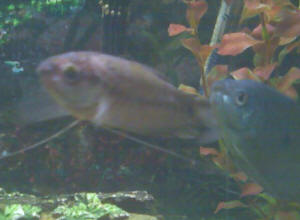
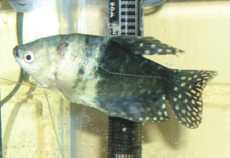
Blue Gourami turned black 5/30/07 Hi.. we got a large tank, like 64 gallons and a few kinds of fish several weeks ago, one was a fire Gourami and we diagnosed it with dropsy but it died. <Greetings. Dropsy is a symptom, not a disease. It can be caused by all kinds of stuff. I'd bet all the money in my pockets though that your fish actually died from Dwarf Gourami Disease, which is highly contagious and practically ubiquitous in factory-farmed dwarf Gouramis. Long term, your tank is unsafe for dwarf Gouramis, and any you buy will likely catch the bacteria or virus involved and die.> We put the proper medicine in but now one of our blue Gouramis turned almost completely black, we are still using the dropsy medicine as directed by the box and we cant figure out why he/she is turning black. <There's no such thing as Dropsy Medicine. Wish there was. Anything that says it fixes dropsy is being, let us say, a little generous with its marketing. It's about par with things from the drugstore that say they cure colds. They don't. Anyway, as a matter of course you should always finish the medication as directed on the packaging. Once finished, large scale water changes are an extremely good idea. I'd recommend at least a 50% water change this week.> Does anyone know why? or how to help him/her? or how to protect our other fish from the same thing? <It's difficult to know why your fish has turned black. Gouramis, like most other fish, can change colour to some degree, and often will when stressed. Now, the question here is whether your blue Gourami is Trichogaster trichopterus, the "true" blue Gourami, also known as the 3-spot Gourami; or merely a the all-blue version of the dwarf Gourami Colisa lalia. Trichogaster trichopterus is (apparently) immune or resistant to Dwarf Gourami Disease and generally a very, very hardy animal. It is a largish, elongate fish, around 10 cm or so, and has two black spots, one on its flank and one by the tail. Colisa lalia is a small (5 cm) fish that tends to skulk about the bottom of the tank. The all-blue variant has a neon or cobalt blue colour. If it is Colisa lalia, then chances are it has Dwarf Gourami Disease and will die shortly. A photograph, and some description of its behaviour and eating habits will help. Also, what's the water quality like?> kriebse <Cheers, Neale>
Dead Gourami 5/25/07 Hello, I have a 30 gallon tank it has been running for the better part of a year. In it I have 2 rainbow sharks (they are trying to spawn!), <Neat! Oh, they may be just playing... or fighting!> 3 adult mollies (2 of which are very pregnant) 12 molly fry, 1 guppy, 5 cardinal tetras, 1 bulldog Pleco, five gold barbs, 1 Kuhli loach, 3 mystery snails, 1 female gold Gourami (the male died this morning), some floating plants & a few that are rooted in gravel. I test the water quality every two days & do 25% water changes every 7-14 days. The water quality is good , although slightly acidic. I use a BioWheel filter. The temp is 78 degrees. About 2 weeks ago I noticed that my male Gourami was looking a little fatter than usual, so I decided to watch him & make sure he was alright. Over the next few days he started having difficulty swimming & would lay at the bottom of the tank. (he wasn't being bullied by any other fish) his stomach continued to get bigger , he stopped eating , & today I found him dead at the bottom of my tank. My question is, is this a common occurrence with this type of fish? <Actually, yes... Trichogaster and Colisa genera Gouramis are "not what they used to be"... and too often suffer such maladies...> I've never had any other problems with him. I had been feeding him tetra flakes & once a week I give them dried baby shrimp. So nothing crazy in his diet. I also was wondering if this could be something contagious? <I do hope not... In most cases, an individual will die as you relate here... For importers though, whole batches can go mysteriously... Bob Fenner> Thanks in advance. -Jenni
Yellow or Gold Gourami has spots 4/21/07 I'm hoping someone can help me. I have a fairly new 46 gallon freshwater tank that has an assortment of silver dollars, <Mmm, some of these species get quite large... please see fishbase.org, WWM for the genera Metynnis, Myleus, Mylossoma...> 3 kinds of Gouramis, tetras, head and tail lights, black barbs, pictus cats and a plecostomus. I have had the tank for over a month and was adding some new fish to the tank, as I was about to put a new yellow (or gold) Gourami in the tank I saw he had spots on his top fin and one side of his body (right behind his gill). Instead of putting him in the tank I put him in a ten gallon quarantine tank. <Good idea for all such newcomers...> Originally I thought it was ich so I treated it for that but no change other than the spots have gotten larger, more like little clumps. it hasn't spread anywhere else on the body but those spots seem to be more noticeable. He's active and no other problems, but I don't know what to treat him for. I've looked at so many pictures of diseases and it doesn't really look like anything I've seen. I want to say that the spots almost have a light bluish tint to them but that could be from the treatment for ich I was putting in the tank. Any help is greatly appreciated. Heather <Mmmm, might be encysted worms, microsporideans... other such organisms... You could try an anthelminthic like Prazi... perhaps followed by an anti-protozoal like Metronidazole... Both materia medica are discussed on WWM. Bob Fenner>
Gourami/Freshwater Tank Trouble Following Absence of Owner 4/10/07 Hello all! <Hi Mike.> I have a neon blue dwarf Gourami (whether it's a male or a female is beyond me). <Well Mike if by chance you can get a clear picture of your specimen I may be able to distinguish the gender for you. While Anabantoids and Gouramis are more difficult (for me anyway) to sex in comparison to many of the other common freshwater fair its sometimes possible. Generally speaking males have much more, sometime unpaired, elaborate finnage and their overall girth is typically smaller than that of their female counterparts.> His name is Freckles and I'm really worried about him. We recently went on a week long trip to Germany and quite obviously the fish had to stay at home. Before we left we put in a week long feeder. <Was it one of the old-school white pyramid shaped (Time-release) feeders. I personally do not like these, they seem not to dissolve or release on a reliable time-table (not to mention their nutritional value leaves something to be desired)..most of the time they just end up polluting the water, doing more damage than good. In all honesty, in short periods of absence, the animals may be better off foregoing nutritional intake than to be left with these.> When we came home one of my guppies was gone (my guess is that it died and one of the shrimp ate it. <Other fish would have picked at it as well.> Anyways the dwarf Gourami has been acting weird. The fin that runs across its spine was sticking straight up and its back fin was angled down a little. <He may be suffering from sub-par water quality, have you done a water change (a large one) since you have been home? Tested the water?> He is acting very lethargic. <Normal of animals when nutrient levels are high, oxygen content is low.> The other Gourami (a flame) has white spots appearing on it. <Possibly ich. See here: http://www.wetwebmedia.com/FWSubWebIndex/fwich.htm .> This is only the 2nd day we've been home and we've done 4 water changes including a very thorough gravel vacuuming. <Okay so that answers my above question> **tank info** size: 10 gallons age: 3 months (which makes the fish between 2-3 months old) water changes: usually once a week if I have time more (25% water changes) filter: whisper 5-15 plants: fake tank mates: 2 Gouramis (the sick ones; not sure on gender) 3 guppies (not including the dead one, 1 male and 2 females) 1 Oto cat (not sure on gender) 2 baby guppies (about 1 1/2 months old, thus not sure on gender) 2 cherry barbs (a guy and a gal) 5 Neons (not sure on genders) 3 ghost shrimp or I think so, they have a way of hiding from me (not sure on gender) 1 bamboo shrimp (not sure on gender) nitrates: 0 <Was this prior to the water changes or after? Also I believe the tank to be a little on the overstocked side. The cherry barbs and the Gouramis as well can get quite nippy and territorial as well. Other than that Mike I think you have been very meticulous and concerned in your husbandry, youve have done a lot with the water/changes and vacuum cleaning. My suggestion would be to monitor overall water quality, daily testing, over the next few days and maybe skip feeding for at least a few days until chemistry levels return to normal. And if you do determine your Gouramis is afflicted with an illness, as they commonly are, I can point you in the right direction with that too. Read this if you havent already: http://www.wetwebmedia.com/FWSubWebIndex/fwich.htm > nitrates: 0 total hardness: 200-300 alkalinity: 80 pH: 6.5 Please excuse me if I have put in too much info; <Not all.> I am 11 years old and new to this hobby thus not being able to sort out necessary info from unnecessary. <Youre doing quite well, just keep reading, researchingyoull be fine.> (The two baby guppies will be given to my friend when the are bigger he has bigger fish tank than I.) <May want to consider this with the bards as well as one of the Gouramis.> Thanks so much for your help, <Anytime.> Mike H. <Adam J.> Sick Red Honey Gourami : ( 4/4/07 Hello! <Hi there Krista> I hope that you can answer my question. I have looked every where for the answer. I have a sick Red Honey Gourami. <Sick? How?> He is in a hospital tank. I have checked both pH and nitrate levels and both are normal. <Think about what you have written here... This is not useful information... but your opinion re the facts that you should present...> I just started giving him/her Melafix and will do this for another 6 days. <This material is of little use> One thing I am not too sure about is, should I leave the tank light on or off for the fish? <Likely not important> Would having it off have less stress on the fish? <Perhaps> If you have any other tips on helping my fish that would be much appreciated! Thank you! Have a good day! Krista <... need more real data... Please read here: http://wetwebmedia.com/FWSubWebIndex/GouramiDisFAQs.htm and the linked files above. Bob Fenner> Pearl Gourami 3/30/07 Ok I have a question I have a pearl Gourami and for over a week now it has been laying on it's side. <Bad behavior... some Gouramis do "lay about" quite a bit, but not this genus, species> I believe she is pregnant as she has gotten very big. She's not acting any other way except to be laying on her side. It's almost as though she has no ability to stay upright. If any of the other fish in the aquarium try to pick at her the male comes and protects her. My question is what would make her lay on her side and why would the male be trying so hard to protect her, could it be because she possibly might be pregnant? also do they have live births or eggs? <Lay eggs... are bubble-nest builders... akin and kin to the more popular Betta (splendens)...> Any information would be helpful. Thank you <Mmm, please read here: http://wetwebmedia.com/FWSubWebIndex/anabantoids.htm and the linked files above... Something is amiss here... I suspect your Gourami is not "filled with eggs" but suffering from "bloat"... Read on. Bob Fenner> Dwarf Gourami disorder... and successful trtmt. 3/3/07 Hello BobF and crew, <Brian> I've seen a few reports of bloating in dwarf Gouramis on the WWM Daily pages lately and wanted to report a cure of this using Metronidazole/Praziquantel medicated food and erythromycin in the water. <Please do!> One of two dwarf Gouramis in a US 10 gal tank began showing symptoms. The tank is well planted, pH 7.0, 4*dKH, 8*dGH, 10mg/L nitrate and no detectable ammonia or nitrite (AP liquid test kits). Other inhabitants were four Brochis cats. <Need more room when grown...> The symptoms displayed (only the one male Gourami had symptoms) were: First, he hung out at the top of the tank, gulping air, and then seemingly almost floating himself out of the tank with each gulp of air. That lasted a day. The next day he began laying on the bottom on his side, at about a 20 degree angle from horizontal. This continued for a week during which I began a four week treatment with Jungle's anti-parasite food (Metronidazole/Praziquantel) consisting of three days feeding medicated food, then four days of regular food per week. Halfway through the treatment, the dwarf Gourami did not appear to be getting any better and had developed open sores on his side. After much frantic reading, I came to the conclusion he was experiencing "dwarf Gourami disease" a.k.a. "epizootic ulcerative syndrome", and expected to lose him very quickly. I performed seven days of dosing 200mg erythromycin/day into the tank, and by day six he was eating and defecating again. Completed the anti-parasite course, and he is looking very well -- no more lying on his side, very active and paying a lot of attention to the female dwarf Gourami. Through all of this, the female never displayed a single symptom that anything was wrong. <Interesting> Now, six months later, he is still doing well, only the slightest discoloration on his side where the sores were that I can only see in certain light. The Metronidazole/Praziquantel food plus erythromycin appears to be effective on this problem. He (Lazarus) went from nearly dead to a continued healthy life. Thank you for your efforts at WWM, -Brian <Thank you for this important sharing, relating... You have very likely saved MANY Colisa lalia and hobbyists! Bob Fenner> Re: Dwarf Gourami disorder 3/3/07 Hello again BobF, <Brian> I never meant for the Brochis to be in the 10gal for an extended period of time. It was a quarantine tank until the Gourami got sick and the 29 gal the Brochis were meant to go to lost nine Corydoras in a very short time, losing both new young ones and a beautiful six year old C. julii. Fearing a Corydoradinae-specific disorder the Brochis were never moved. <Ah, thank you for this. Understand that I (sense that I should) respond to such open statements for the sake of others reading... on the Net... all goes on for quite a while, circuitously... Just wanting to make useful remark re the genus...> Do you think the four fully-grown Brochis cats would be suitable tankmates for an 8" Chocolate Cichlid (H. temporalis) in a well-planted 75 gal tank? <Yes, likely so... This species of Neotropical Cichlid can be a "wild card"... some becoming quite agonistic... but the Brochis are indeed tough.... and I do think having a school of them will be useful here> The cichlid has been alone in the tank for 15 months, but seems friendly enough. I've had to move Corys in the past whose fins were being nipped by a territorial Blood Parrot cichlid they had lived with for years, so I want to make sure the cats will be safe with the big H. temporalis. I really do hope some dwarf Gouramis can be saved with the Metronidazole/Praziquantel + erythromycin treatment -- this fish's recovery was nothing short of miraculous. <I assure you... your observations will be of tremendous value to others> I also found a very interesting reference while trying to sort this out - the American Society for Microbiology's 1974 "Evaluation of Aquarium Antibiotic Formulations" (Trust and Chipman, http://aac.asm.org/cgi/content/abstract/6/4/379). Reading through the concentrations required for effective inhibition of particular organisms helps in treatment selection. Thanks again to all the crew! -Brian <Ah, yes... the industry has had this sort of "wake up" call before... the occasional challenge to prove the efficacy of such "med.s"... I do believe this (legislature) is due. BobF> Labyrinth dramas... Anabantoid dis. 2/26/07 Hello Crew, <Adam> Ok, I have some major (well at least to me) dramas with some of my fish. I woke up this morning to find my new (one day) turquoise male Betta with what appeared to be Finrot, grey patches on the fins and faded colours in the body (why I went back to that shop when I swore I'd never buy from there again I don't know). <Chalk it up to "human nature"... move on> I removed him from the tank and put him in a bucket with some triple sulfur (recommended dosage). 7 hours later he has gone a dull brown grey colour and the fins are looking much worse for wear. I bought some "special" Betta medicine containing Melaleuca extract <... "Fix", by AP... not a fan... Don't use such extracts if you yourself fall ill...> and added it to the water as well. In addition to this I also discovered that my beautiful male albino paradise fish had attempted suicide and jumped out of his tank (landing on the timber floor about 1.5m below). <Bummer!> I put him back he is floating at the surface but both pectoral fins and gills seem to be working although he does have a kind of bung eye. I have no idea how long he has been out for (thankfully its a humid day). <Yes! May well recover> I added some Melaleuca extract to his tank, is there anything else I can do for him or my sick Betta? <All sorts> Any advice is greatly appreciated. Adam H <Please read here: http://www.wetwebmedia.com/FWSubWebIndex/bettadiseases.htm and the linked files above. Bob Fenner> Re: labyrinth dramas 2/27/07 Thank you, <Welcome> Unfortunately it seems I was too late to save the Betta (and one of his tankmates who contracted the disease). The treatment I used was splendid Betta <... Aquarium Pharmaceuticals Splendid Betta BettaFix Remedy... More "Tea"... Melaleuca... worthless> but I fear I think it was too little too late. I've completely broken down and cleaned out the tank and isolated the other Bettas in salt added, medicated jars (the tank is one of those multi-chambered Betta arrangements). I will keep them out for a few days. What is a better antibacterial/fungal treatment to have on hand for such emergencies? <True fungal infections are rare... most Bettas can be kept healthy by regular water changes, good nutrition... Some salt, half Malachite (yes, is what is used in the orient where these fish originate almost entirely) dosing... and in dire emergencies, use of Furan Cpd.s, some antibiotics...> I've had Bettas with Finrot before, but they usually just healed on their own, I guess shops who run permanently medicated tanks are culturing some kind of super bugs. <Maybe> I'm going to get a friend to send me down some Indian almond leaves from up north to condition the water. <Ahh! Worthwhile> On a happier note my paradise appears to have made a full recovery, although it will take some time for his desiccated fins to repair themselves. Thanks again for your help. Adam <And you for sharing. Bob Fenner>
My Gourami has turned into a puffer! Help! 2/16/07 Looking in the tank yesterday I noticed that my orange Gourami looked a bit swollen in the belly, however, today it looks like a puffer fish! It is so swollen and the scales are really sticking out. Even it's eyes are popping out. It seriously looks like it's about to explode. <Sounds like dropsy - the scales sticking out like that are merely symptoms of an internal bacterial infection...see here: http://www.fishjunkies.com/Diseases/dropsy.php > It is still swimming around as normal and eating - that's the weird thing. What on earth can I do? <First thing to do is check environmental conditions - how large is the tank, how many (and what type of ) other fish are in there? What's your water change schedule like? What are the current ammonia, nitrite and nitrate readings? A bit more info. would be helpful here, as many times dropsy can be one of the first symptoms of a poor environment...> All the other fish are fine, including the other Gourami. This has come on so suddenly. The tank is healthy with regular water changes and some of the fish are or have been pregnant and we have babies in the tank. Please help! <OK, I'll agree that it doesn't sound to be environmental, but you never know - some fish can be more susceptible than others, and this could just be the first one affected. In any case, I would suggest removing the affected fish into its own quarantine tank. Then, I'd recommend treating with Epsom salt - 1 tsp. per 5 gal. See if this improves things, and some folks will dose up to 1 tsp. per gal. of water...I'd suggest trying less first, then re-evaluating. If this doesn't help, I'd suggest an antibiotic like Maracyn II, but I'd try the Epsom salt first, as it may help and will be less stressful to the fish. Best of luck, Jorie> Blue or 3 Spotted Dwarf Gourami problem 2/12/07 Hi crew, Craig here again have another Q I can't really find an answer to. I have like I have said before, 3 male Dwarf Gourami and 3 female, I also had until the other day 2, 3 spotted Gourami (other small fish too), 1 has died, I believe it was the male and the female is still going strong, I have no idea why it died the rest of the fish in my community tank are fine. The question I have for you is the 1, 3 spotted Gourami that is left has a large stomach, I have read that they can get bloated (common with all Gourami?) <Mmm... to an extent, yes... Mainly the females... with egg development principally> but none of the other fish seem to be suffering from this is this a sign that she could be carrying fry, <Not fry... gametes> I have looked for a white a spot- (not to sure where it should be but didn't think it would be that hard to notice) When I have been feeding my fish ,she doesn't seem to be eating (just sitting in the quite area of the tank close to the floor). No male has built a bubble nest, although before they seem to have built one for no reason (can all types of Gourami breed together?) <Mmm... no... by species... though, there are many "sports"... for instance the Blue and 3-Spot Gouramis are the same species, Trichogaster trichopterus... will inter-breed> if she is pregnant and there is no bubble nest is there anything I can do to help her? <Mmm... well, yes... I might well move this one fish to a treatment tank... administer Epsom Salt, feed foods of a more laxative nature (e.g. Artemia)... I do have a concern that this condition, and the loss of the conspecific may be more parasite involved, but I do NOT encourage you to treat for this as of now> Well hope you can help me with the few questions I have asked and my spelling/grammar are ok this time so you do not have to spend time fixing it before you post it on your web site. Thank you in advance for your help. <Thank you. Bob Fenner> Dwarf Gourami fins turning black - 02/09/2007 Hi, <Melissa> Love your site. I have 2 pair of dwarf Gouramis in a 37 gal tank. Two of them (one male, one female) have fins that are turning black. They are not torn or frayed, just "ink stained". This is not normal, but I don't know what to treat for. Any suggestions? Thank you, Nalo Meli <Mmm... likely nothing amiss here... particularly if your other livestock appear fine... This is likely a behavioral change, expression... the two may well be engaged in a bit of breeding... Bob Fenner> Sick Bettas And Gourami - 02/09/2007 Hi. I have been looking around for some answers about my sick fish and came across your site. You seem to give much better answers than other sites I have visited and thought you may be able to help. <Thanks for the kind words! You've got Jorie this afternoon, and I'll try to assist...> I have a 75 gallon tank with several different types of Gourami (flame, blue, Opaline, pearl) a couple of paradise fish, 1 male Betta and a few female Bettas. All of these fish have been in my tank for several months without any problems until the last couple of weeks. All of my water tests are ok (ammonia, nitrites, nitrates, and pH is steady) and I do a 20% - 30% water change every week. <By "OK", I hope you mean ammonia and nitrite readings are at zero, and nitrates is no higher than 20 ppm.> Now the problems. First on of my female Bettas got what first looked like pop eye but eventually turned into dropsy. <Separate issues, but both conditions are often caused by poor water quality.> I treated the fish with Maracyn 2 but it did eventually die. <Hopefully you isolated the sick Betta and treated her in a quarantine tank? If not, the medication likely destroyed your nitrogen cycle in the main tank, and you need to be especially vigilant about ammonia, nitrite and nitrate readings until the tank has "re-established" itself.> A few days later another female Betta started to swell up like it had dropsy. I isolated that fish and treated with Maracyn 2. The swelling has gone down on this fish but it still won't eat and lost a lot of scales on one side of its body. <Assuming that the water conditions have been good all along (again, I stress that the issues you are describing are usually caused by poor water quality, so that's the first thing you should look at), I'm curious what temperature you keep the tank at. Bettas like warm water (between 80-82 degrees F is ideal), and if they are kept in water that's too cool, that can compromise their immune systems and make them more susceptible to disease. Of course, since you have Gouramis in the tank also, you'll have to compromise - I'd suggest keeping the water temp. steady at around 78-79 degrees F.> Now I have a Gourami that will not eat and has some white fluffy spots on its fins and clear and white poop. <Classic signs of fungus and internal parasites, respectively.> I already have the sick Betta in my hospital tank and don't know what to do with the Gourami. I'm guessing it wouldn't be a good idea to put the Gourami into the tank with a Betta that possibly has dropsy. <No, not a great idea, but you do want to isolate the Gourami from the main tank. In a perfect world, two hospital tanks are in order, but I realize not everyone has that luxury. Otherwise, it's a bit of a catch-22, but if it were me (and assuming the QT is large enough to accommodate both sick fish), I'd put the Gourami into the Betta's hospital tank. The Gourami has already been exposed to whatever the Betta has, so in all likelihood, all these conditions are related. As for treatment, I'd suggest a course of Maracyn plus Maracyn-II (you've already begun treating with Maracyn-II, so I wouldn't suggest trying a new medication altogether, but you also have to deal with the fungus. You could also add Epsom salts to the water, approx. 1 tsp. per 5 gal. of H20.> Should I treat my entire tank or just remove this sick Gourami and hope that none of the other fish get sick? <I'd suggest the later. If you have a spare 5 gal. bucket and a submersible heater, that can even suffice as a second QT tank - it doesn't have to be anything fancy. However, if you have a choice between leaving the sick Gourami in the main tank and putting it with the sick Betta, I think the latter is the better option. Do keep a close eye on your water parameters, though, in both the main and hospital tank, as much of what you describe is often caused by a build-up of toxins or other pollutants. Good luck, Jorie> Any help would be appreciated. Thank you very much <You're welcome.> Re: Sick Bettas and Gourami PART 2 2/13/07 Thanks for the fast answer. Unfortunately the Gourami was dead the next morning. <Oh, I'm sorry to hear that.> I should have been more specific about the chemicals in my water. The ammonia and nitrites are 0 and the nitrates were around 10 ppm when I checked yesterday. PH is between 6.8 and 7.0 and the water temperature is 79. <All good.> I haven't added Epsom salt to the aquarium but did add aquarium salt when the tank was set up and do add salt to the new water when doing a water change. The direction say to add 1 tspn for every 5 gallons of new water. <Aquarium salt and Epsom salt are two different compounds, the latter being magnesium sulfate which aids in digestion and reducing swelling. This is the recommended treatment for both dropsy and pop-eye, in case you have one or more of these issues in the future.> My male Betta also died last night. It seemed fine last night swimming and eating normally but was dead this morning. I did not see any wounds or spots on the dead Betta. There is also another female Betta and Gourami that weren't moving around very much today but I can't see any external problems on them either. If this keeps up all of my fish will either be dead of in the hospital tank soon. Is there anything else I can try? <It seems as though you've got something very virulent in the main tank. I'd suggest putting the remaining fish into a clean, newly-cycled QT/hospital tank, and allowing the main tank to run fallow (without fish) for a month or two, in the hopes that whatever is so very quickly killing your fish will not have anything to "host" on, and thus die. If you have/want to invest in a UV sterilizer, that's something you could try running as well. I wish I could more specifically diagnose what is going on for you - are there any new physical and/or external symptoms? Best of luck, Jorie>
Sick dwarf Gourami Hi <Hello there> Your site is very informative. I have a sick dwarf Gourami who has been head standing for a week. <Yikes, not good> I have a 30 gallon tank with 2 Gourami's, 6 tetras. The water quality is normal. <...?> I've had these fish for a year with no issues. I noticed stringy white poop so I isolate the fish in a 5 gallon tank and treated with mashed peas first. No results. Then I tried Epsom salts, no result. I thought I may be a bacterial infection so I treated it with Maracyn for 3 days, did a 30% water change. The fish now has normal poop, however it is still head standing. I'm continuing to treat it with the Maracyn for 2 more days as prescribed, however, I don't know what else to do for this fish. Any help would be appreciated. Peggy <Mmm, could be the actual treatment/s that have led to this behavior, but if you'll give the WWM site a read over again for Gourami Disease, you'll see reference to an all-too-common incidence of a protozoan and treatment for same. I would do this here... Bob Fenner> Re: Sick dwarf Gourami 2/1/07 The head standing started BEFORE the treatments soooooooooooooo. I'll try the Flagyl <Real good. BobF> Gourami With A Sunken Head, Quarantine Tanks And Cycling - 01/24/2007 Hello, <Hi. Sabrina with you today.> Sorry this will be long, but you guys seem to prefer more info to less, <Most certainly!> so here's what I've got: I have a 46 gallon (bowfront) freshwater tank, purchased in early December. BioWheel filter with cartridge, as well as extra bag of carbon and Seachem "Purigen" pouch in second slot. Fluorescent lighting, glass cover. One large "tree root" ornament, and a large "rock" with a cave. Artificially planted, with large "Fancy Plants" giant bamboo providing some floating cover, also lots of other underwater artificial plants. Submerged heater maintaining at 78 degrees. Also large bubble wand running across the length of the back of the tank (36"). <All sounds great.> The week before Christmas, I purchased 4 elegant Cory cats from my local fish-specialty store and began cycling, adding Seachem "Stability" as directed on bottle for the first week. I conditioned the water with Seachem "Prime." On January 3rd, my special order (which was supposed to be on hold) of two pairs (male/female) Neon Blue Dwarf Gouramis had arrived. I advised that the tank wasn't quite all the way cycled yet, but LFS said as long as I checked the levels and did regular water changes, it should be fine. <Err, not cycled yet should imply no fish yet.... Adding fish to an uncycled or not-quite-cycled tank is asking for trouble. I'm also assuming here that you intend to not quarantine these animals....> Also added "NitroMax" bacteria supplement. All was well for a week and a half. All 4 Gouramis seemed healthy and well-adjusted. No fighting, colors good, getting along fine with the Corys, eating well, and the nitrite levels were dropping. <Toxic at anything above zero....> I looked forward to having a cycled tank and being able to add more fish. Then about a week ago, one of my female Gouramis started looking "tarnished." I observed this for 2 days over a weekend and it seemed to be getting worse (spreading). She was listless and hiding most of the time. I researched online and the best diagnosis I could come up with was velvet, most likely brought on by the stress of shipment and then moving into my not-quite-cycled tank. <Poor water quality alone may have been the issue - but the "tarnished" look you mention (good descriptive word!) does tend to make me think velvet/Oodinium.> LFS was closed on Monday so I had to go it alone, and I purchased Mardel "CopperSafe" from a pet store and dosed the tank according to the directions on the package (1 tsp per 4 gallons water; I added 11.5 tsp for 46-gallon tank). <Augh! Not in the main tank! Sigh.... You may forever in the future have trouble with keeping any invertebrates (snails, shrimp, etc.) healthy in this system.... Copper can be "absorbed" by your substrate, decor, filter media.... and is *highly* toxic to invertebrate life. Furthermore, there goes your cycle! I strongly, *strongly* recommend (A) Quarantining ALL new livestock, and (B) NEVER medicating your main tank - instead, remove fish to a hospital/quarantine tank for medication.> I removed everything from the filter box (cartridge - contained carbon - Purigen and bag of carbon) except the BioWheel. <Should have removed this as well.... It would have been better had it, too, not come in contact with the copper. Anyhow, any bacteria on it are toast now.> The pet store did not have a Copper test kit; I had to wait for LFS to get one in for me on Thursday (last week. <Yikes! Please don't use copper without testing properly.> The copper levels were higher than they should have been, <Dangerous....> and since Thursday I have done a water change every day: two 50% changes (Thursday night and Saturday) and the rest were 20-30% changes. Sunday I replaced the bag of carbon to try to pull some of the copper out of the water. The levels are coming down, but still a little elevated (I think 0.6-0.8 right now). <Do as much in the way of water changes as necessary to bring this to the correct levels, and urgently. Copper is toxic/deadly to fish as well as the protozoan Oodinium; it is just fortunate that it is *more* toxic to the parasites.> The pH was low - usually around 6.5 but sometimes drifting lower, and my KH was on the low end. I used API "pH Up" a few times over the last week to gradually bring it up, then added Seachem "Neutral Regulator" (3 tsp) to the big tank to bring the pH to 7.0 and add buffering capacity. <It is good that you've buffered the water a bit; I usually frown at altering the pH of an aquarium unless necessary, but you imply that the pH had been unstable; adding some buffering capability was a good move.> The sick female improved with the addition of the CopperSafe, losing the discoloration and becoming active again. It's been a week now and she looks great - perfectly normal. <Excellent.> Both male Gouramis are doing well - never had a problem. Also all 4 Corys are fine. But. The OTHER female Gourami - smaller and (I believe) younger than the first - who was fine this whole time, has a completely different problem now. On Saturday I noticed her abdomen slightly swollen. Dropsy, I thought, most likely brought on from the stress and the water conditions. <None of these somewhat delicate fish should have been subjected to a still-cycling tank; you are lucky to have come out with all but one still in relatively good/salvageable health. Toxic copper only added to the stress.> She never got to the "pinecone" stage; her abdomen just remained slightly swollen. I hoped that if I could get the water conditions stabilized it might resolve on its own. Yesterday I noticed she had developed Popeye (both eyes), <A sign of poor water quality, almost invariably.> and she was still slightly swollen - but no more than she was initially. <The swelling can be indicative of anything from simple constipation to organ failure from disease or toxins in the water; or her condition may have been present even before you got her.> She's been listless, alternately hanging out under the tree root and at the top of the tank near the filter outflow. She seems to be "breathing hard." <Possibly gill damage from the toxins in the water, or possibly from unseen Oodinium on her gills, possibly her gills healing from damage left by the Oodinium.... lots of "maybe's here.> She does come out to eat, but not as actively as the others. <If she's eating, that's a VERY good sign.> Interestingly, her colors have deepened - instead of silvery with slight stripes, she's light blue and yellow now. Then, last night I thought her head looked funny. This morning when I fed them, I saw that it was very pronounced - her whole forehead is sinking in and looks collapsed. <Hmm.... Collapsed like the muscle structure under the skin is poor, or eroded, like the flesh is eaten away? Can you describe this a little more for me?> I thought hole-in-head disease was primarily in marine tanks, <Oh no, often present in freshwater aquaria, usually in common with high nitrate levels and/or lots of decaying organic material, and sometimes due to Hexamita.> but that seems to be the closest diagnosis I can make. <Entirely possible.... but your description doesn't make me think that initially. Hole-in-the-head usually looks like pits of flesh eroding away.> Current conditions: pH 7.0, ammonia 0, nitrite 1, <Get this to zero with water changes, urgently.> nitrate 20-40, <Bring this below 20ppm ASAP, preferably closer to 5-10ppm.> GH 120-180 ppm, KH 120 ppm, copper 0.6-0.8, <If you're done treating, get this down to zero.> temp 78 degrees. Morning and evening I feed a mix of TetraMin flakes and Spectrum Thera+A (all natural anti-parasitic) small sinking pellets. Once a week or so I give them a pinch of TetraMin freeze-dried bloodworms or sun-dried baby shrimp. <All good.> Last week (before the other female looked ill) I started cycling a 10-gallon QT with 3 Danios, <Err.... Please take a look here, regarding cycling, and do a Google search as well on "fishless cycling" for some different options. http://www.wetwebmedia.com/FWSubWebIndex/fwestcycling.htm .> adding the Seachem "Stability" and using water from my big tank. I've done daily water changes on it (3 gallons at a time) and the Danios seem fine, but my "Ammonia Alert" is starting to show slightly elevated ammonia levels - normal for a start-up cycle. <I'd recommend using a liquid reagent test in addition to the Ammonia Alert. Though handy, it doesn't have the spot-on accuracy of a good test kit. And please reconsider using fish, Danios or otherwise, as a means for cycling a tank.> I didn't think it was ready for use yet. On the other hand, if I'm going to be medicating, so much for the cycle, eh? Should I move the Danios (they've showed no problems for almost a week) into the big tank and put the female Gourami in the QT? <No.... Whatever the animals in the big tank have been subjected to may yet be present; I would either remove the female to an entirely separate system for observation, or keep her where she is and hope for the best. Were it me, I would also be doing some frantic water changes on the Danios' tank to keep ammonia and nitrite at zero.... Though the cycle will be prolonged, the fish will be less damaged. Also, for future reference, it is usually not necessary to cycle a quarantine system. While a fish requires quarantine/treatment, you can do daily or twice-daily water changes and keep the water healthy. Medicating the water usually kills your biological filtration anyhow; trying to keep the tank cycled before use, and then cycling again after use is kind of an unnecessary pain. Just my thoughts.> Should I start with completely fresh (conditioned) water so there's no copper at all? <Maybe. Are you done treating for Oodinium/velvet?> On hand I have MelaFix and PimaFix, <Not really worthwhile, and possibly harmful, in my opinion.... I wouldn't add these.> but I should be able to get just about anything I'd need. Thanks for your help and sage advice, ~Jenny <All the best to you, -Sabrina> Damaged dwarf Gourami 1/24/07 I recently purchased a male dwarf Gourami and since he has been in my quarantine tank has done nothing but swim up and down one of the back corners. <Likely reacting to its reflection...> He is eating good <Well> but his mouth near his nostril looks like he has rubbed it until it made a sore. <Common injury... likely occurred during shipping from the Far East...> There also appears to be a couple of loose scales on the other side of his face near the edge of his mouth. It is reddish and a bit swollen. <Bad> The pH is slightly over 7.0 and the tank was filled with purified water when it was started. <Mmm, do need some mineral content... I'd blend in a little tap...> Does this sound like he has just injured himself or should I be leaning toward getting some antibiotic or anti fungal medicine? <Furan compound likely here... Look on WWM re Nitrofuranace use in FW> I only have one quarantine tank and I am getting new fish soon and have no place to put them till this little guy gets better. Please help. PS I rescued him from a college dorm room where a girl had him in a bowl with no filter or air. Stacey <I do wish you and your Gourami health, long lives. Bob Fenner> Sick Neon Blue Dwarf Gourami 1/21/07 Hello to whomever is reading this! I own a small (but good for a beginner like me) 10 gallon aquarium. I have had it for a week now. It is already cycled (thanks to the rock and driftwood that I purchased out of the tanks at the pet store) and seems to be doing well. <A good technique> My tank inhabitants include 1 veil angelfish (which I understand needs a bigger tank in about a year), <Mmm, before this...> 3 fancy guppies, <Whom the Angel will likely harass to worse> 2 Mickey mouse platies, 1 cherry barb, 1 bamboo shrimp, and finally, 1 neon blue dwarf Gourami. My dwarf Gourami seems to be getting aggressive and one of the Mickey mouse platies is missing a chunk of his tail. <Mmm... much more likely due to the Angel> When the dwarf Gourami goes after the other fish, he gets going really fast and then tips, but not totally on his side. The dwarf Gourami is in a 2 gallon tank now to make sure if he is somehow infected it does not spread to the rest of the bigger tank. I know that you have better things to do than read this so thanks a lot. Is there anything else you think I should do? Sincerely, Mike H. <It may be that this little Gourami is indeed a "rogue"... I would trade it in for another at the fish store (maybe a pair... male and female... to have something for them to focus on) and continue to keep your eye on the Angel. Bob Fenner> Re: Sick Neon Blue Dwarf Gourami 2 - 1/22/07 Hi Mr. Fenner Thank you very much for the quick response. I really appreciate it. In my last email I forgot to tell you what a great site you have! I got rid of the angel and am wondering with everything I have what other fish you would recommend. I'm looking for some schooling fish but really anything you recommend would be fine. The dwarf Gourami seems to be doing better. He is still in the 2 gal. tank I'll keep my eye on him. Thanks again! Mike H. <Mmm, some of my fave small barbs (gold, checker, cherry) or small Danios (pearl, zebra...) or... Please peruse the site... for, as you know... much, much more. Bob Fenner>
Paradise fish is ill 12/31/06 Hey guys, I need some advice, and my boyfriend said this would be the best site to find some good, professional help. I've had a Paradise fish for about 2 months. He's had no problems, health wise. Sometimes he's aggressive. About 2 days ago I bought two more Red Paradise fish. At first they both did pretty well. They were breathing fine. They swam around looking at the tank. Well, yesterday my boyfriend told me that one of them had died. He said that there didn't seem to be anything wrong with it. There were no bite marks, no obvious signs of illness or cause of death. When I got home from work, I noticed that the other one we got the other day was acting strange. He just sits at the bottom. When he goes up for air, he moves so slowly. Then he just kind of drifts back to the bottom. As he's going down, he just bumps into the decorations or the side of the tank. <Not good> Sometimes (but not very often) the first Paradise fish I got will come and nip at his sides. As for the tank itself, it's a 75 gallon. Decently planted with a small variety of plants. It's been set up for about a month and a half. It was cycled before we put anything in it. The pH is 6.8. Besides the 2 Paradise fish, we have 3 Gold Gourami's, 2 Giant Gourami's, 3 Plecos, 10 Red Eyed Tetras, 5 Glo-Lite Tetras, and one Peacock Eel. Right now we're setting up a quarantine tank for the little guy. <Too late to call this a quarantine tank... now it's a treatment tank... and you may have infested your main system...> We added some Aquarium Salt and some NovAqua Water Conditioner. We put an Activated Carbon filter, a heater, and an air stone in there. Any help would be greatly appreciated. Thank you guys in advance. Sincerely, Katie T. <... I would be on the look out for other evidence, symptoms of both Columnaris disease, Flukes (trematodes) and Hexamita/Octomita here... Unfortunately, w/o microscopic examination it is impossible to tell if any of these are involved... or to proceed with surety re treatment. I would do as you have at this point, move the remaining new Macropodus to the new tank (along with some old water to help speed up establishment of cycling)... And watch your "old" stock closely... Do read re these diseases, parasites... on the Net, WWM... Bob Fenner> My dwarf Gourami, Rumpelstilksen 12/19/06 Hello there! <And to you> I've had my 10 gallon tank with two Gouramis for about a month and a half. I made sure to use a water purifier and a stress zyme. Both fish were playful and very active. They picked on each other some, but for the most part, they were just happy fish. Four days ago I noticed that the more aggressive fish, Rumpelstilksen, was being lethargic--hanging out in the same spot all day. I thought it was weird, but assumed he was just resting or something. A day later I purchased two new fish, a blue coral Gourami <Mmm, these Gouramis are all the same species, Colisa lalia... may not mix in such a small volume> and some kind of dwarf catfish. Everyone seemed to get along fine but I noticed that Rumpy was still acting funny. He's been hiding out and today he didn't move at all! He does come up to eat, but seems to have a hard time actually getting anything--and I've noticed that he'll take something in and spit it back out too. I came home today and caught him leaning against the glass at the bottom of the tank, not moving his fins at all. I tapped on the glass and he perked up, but when right back into position. The catfish came over and gave him a boost, he got right under him and pushed him up to the middle of the tank, almost like making him go for a swim. <Neat!> When Rumpy departed back to his resting place, the catfish head butted him some, and seemed like he was attacking him. <Mmm, not likely> It does seem like he's sick or stressed, so I took him out with some of the fish water and put him in another big bowl. I put the live plant he was hiding with in too, and some of the gravel. After reading the other entries, I realize that Rumpy has been pooping long white strings-- but I thought that was normal, because he's done that ever since I got him. But now that I think about it, none of the other fish have done that at all. <They may...> So anyways, he's having a hard time eating, being anti social, and not moving really at all. Can you help us keep Rumpelstilksen alive? Its the first fish my boyfriend has ever named, and he will be devastated to lose him so soon. Cheers! Rachel <Well... this does read like a lumenal parasite issue... Octomita... and the usual treatment involves Metronidazole/Flagyl... Please do (re?) read here re: http://www.wetwebmedia.com/FWSubWebIndex/GouramiDisFAQs.htm and the next file on Gourami Disease linked above... To make known what your possible course of action might be. Bob Fenner> |
|

|
Features: |
|
| Featured Sponsors: |