|
FAQs on
Anabantoids/Gouramis & Relatives
Disease 4
FAQs on Gourami Disease:
Gourami Disease 1, Gourami Disease 2, Gourami Disease 3,
FAQs on Gourami Disease by Category:
Diagnosis,
Environmental,
Nutritional (e.g. HLLE),
Social, Infectious (Virus, Bacterial, Fungal),
Parasitic (Ich, Velvet...),
Genetic Treatments,
Related Articles:
Anabantoids/Gouramis &
Relatives, Genera Ctenopoma &
Microctenopoma, Betta splendens/Siamese
Fighting Fish,
Related FAQs: Gouramis 1, Gouramis 2, Gourami Identification, Gourami Behavior, Gourami Compatibility, Gourami Selection, Gourami Systems, Gourami Feeding, Gourami Reproduction,
Betta splendens/Siamese
Fighting Fish,
|
|
|
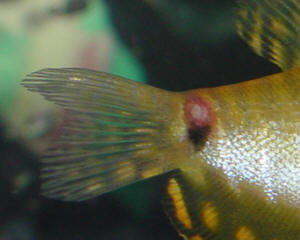
Can anyone tell me what the black spot is?
4/1/20
It a little spikey on top. Fish shows no adverse signs relating to health or
activity.
<Did this come out of nowhere? If so, then perhaps an ammonia burn or some
other type of physical damage. If it's always been there, likely genetic,
developmental, or even evidence of nerve damage. For now, observe, check
water quality and chemistry, and if needs be, slowly optimise living
conditions to better suit this species. Cheers, Neale.>
|
 |
|
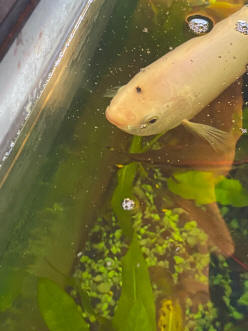
Sick giant gourami 11/14/19
Hi Neale
I recently rehomed a giant gourami into my monster tank.
The poor thing has a weird cut/chunk missing type thing on one side of him and
some white fungus looking spots on the other side. Pictures attached.
I have never seen anything like these white spots, I don’t think it’s ich. I am
halfway through a course of Waterlife Myaxin but doesn’t seem to help, it’s
actually getting worse I think.
He’s happily eating etc.
Any suggestions?
Thanks
<Hello Nathaniel. This is some sort of bacterial infection, though the white
specks are slightly mysterious. Do these look like bubbles of dead tissue? If
so, then yes, bacterial in origin more than likely. A decent antibacterial (such
as eSHa 2000) should do the trick, though if a vet can prescribe antibiotics for
you, so much the better. If the white things are more crusty, off-white in
colour, and look like drops of molten wax, then I'd lean towards a viral
infection as well. Some viral infections are rarely fatal in fish, such as
Lymphocystis, but are impossible to treat directly. They can heal after some
months (even years) of good conditions. A few viral infections, such as Carp
Pox, are potentially more immediately lethal and need veterinarian intervention.
Still, let's assume it's bacterial. The shape of the wound suggests physical
damage, and I wonder -- is there a Common Plec in the tank? These can (and do)
'latch' onto slab-sided fish given the chance, rasping away at the mucous.
Otocinclus are notorious for this, too, largely because they starve in most
tanks. Some Loricariidae are very safe, Panaque for example, being pretty much
herbivorous, but the more general purpose Plecs are distinctly hit-and-miss in
tanks with Oscars, or really anything big enough to support their weight.
Cheers, Neale.>
|
 |
|
Re: Sick giant gourami 11/14/19
Hi
Thanks for your reply,
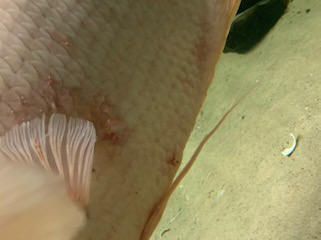
Nothing in the tank to latch on, having looked closely these white things look a
bit like blobs of cotton wool - does that sound bacterial?
<More like fungus. Very common on infected wounds. Distinctly tufty, furry
appearance. Do look at pictures online or in fish health books.>
Can I get antibiotics from any vet?
<In the UK, yes, absolutely. But finding a 'fish vet' locally is often hard.
https://www.fishvetsociety.org.uk/interest-areas/ornamentals/list-of-vets-willing-to-treat-pet-fish/
It's worth a call to your local vet if you already have one for a cat or dog,
and discussing the symptoms. I've done it once before, and got some erythromycin
this way. It's a hassle to be fair, and if the fish is hearty and feeding, I'd
probably try a course of eSHa 2000 first and see if it helps.>
Thank you
<Cheers, Neale.>
Re: Sick giant gourami 11/14/19
Thanks Neale,
<Welcome.>
I have been treating with Myaxin from Waterlife (anti bacterial), still have 2
more nights to treat. Should I discontinue now or finish the course first?
<If the fish isn't actively getting worse, you may as well finish the course and
see what happens.>
(Doesn’t seem to be doing much).
<My experiences with Myxazin have never been that great, to be honest. I find
eSHa 2000 a much better bet, perhaps because it targets bacteria and fungi
simultaneously.>
Would 3 days and 30% water change each day be a good enough separation?
<Likely so. Most fish medications are oxidised or otherwise metabolised by the
bacteria within a day, or so I understand.>
Thanks
<Cheers, Neale.>
Re: Sick giant gourami
11/20/19
Hi Neale,
I hope all is well,
<All good, thanks!>
I used the ESHA 2000 last night (first dose) and I can see already an
improvement this morning (thanks for the tip!).
<No problem.>
I wanted your advice,
<Sure.>
It basically works out per the instructions that I would do a 20ml dose on day 1
and then 10ml day 2 and 10 ml day 3. So 20:10:10
It says on the instructions that if needed one can double the dose.
<Indeed. Have never done so. But would not expect them to lie about this!>
I used 20 mil last night (so a single dose), however I am debating, given the
issue has been ongoing for a while, to use 20 mil tonight too? It says you can
also extend beyond days 2 and 3 too, so I am thinking instead of 20:10:10, to
maybe do 20:20:10:10?
<I would prefer to try the regular dose for the first 'course' of the
medications. If the fish doesn't get better, repeat for another dose, rather
than increase the dosages. The risk is that too much could stress
the filter bacteria, resulting in an ammonia or nitrite spike, which would undo
all your progress.>
There is a catfish in there too which I know are sometimes more sensitive as
they are scaleless but it says on the packet it should be fine and he doesn't
seem bothered so far.
<Indeed; I have never had problems using eSHa 2000 with catfish.>
Please let me know your thoughts.
Thanks!
<Repeating courses, rather than increasing dosages, is my gut reaction if the
fish is showing signs of recovery and still otherwise in good condition
(swimming, eating, etc.). But if you felt a higher dose was warranted, I would
not feel afraid to try, but would remove some filter media to a safe place just
in case something goes wrong. Cheers, Neale.>
Re: Sick giant gourami
11/21/19
Thanks Neale
<Most welcome, Nate.>
Re: Sick giant gourami
11/22/19
Hi Neale,
<Nat,>
Unfortunately whilst after day 1 things looked to be improving with eSHa, day 2
and 3 seem to have had little impact and in fact seems to have spread to mouth
fungus. Shall I try eSHa again next week with a stronger dose given that day 1
things seemed to get a bit better (the dose is twice as high on day 1)?
<Yep, sounds like a good plan to me. Do a water change before running the
medications though.>
Or is there anything else you can recommend?
Thanks
Nat
<Apart from visiting a fish vet, nope, nothing better. Cheers, Neale.>
|
My Gourami open wound 4/17/17
So I have a Gourami, he is in a tank with guppies and mollies.
<Mollies do have quite specific requirements; would not consider them good, or
safe, tankmates for Dwarf Gouramis. Would have you do some reading:
http://www.wetwebmedia.com/fwsubwebindex/mollies.htm
Pay scrupulous attention to water quality, including nitrate, if you insist on
keeping Mollies in freshwater tanks.>
He is perfectly fine with them. I recently found that my tank has an anchor worm
problem and I am taking care of it, by manually removing them, and treating the
water. I noticed that my Gourami hasn't had any anchor worms
on him, but instead has this open wound which is shown in the pictures attached.
But what is wrong with him? Could this wound be made by the anchor worms or
something else?
<Yes, could be damage, whether from Anchor Worms or from aggression by other
fish (male Mollies can be snappy) is hard to say. Would treat as per Finrot to
prevent infection; Dwarf Gouramis are VERY prone to bacterial and
viral infections; would have you do some further reading here:
http://www.wetwebmedia.com/fwsubwebindex/dwfgdis.htm
Should be plenty of informative examples there! Cheers, Neale.>
Reddish tint on gourami fins = ammonia issue?
2/1/16
Hi team, hope you had a great weekend. I added a nice set of 5 feisty cherry
barbs to my year-old aquarium last week--love them so far--and they acclimated
themselves very quickly.
<Would plan to get a few more unless the tank is tiny... Cherry Barbs look best
in largish groups, 8 or more, ideally half that group being females.
But yes, a great species.>
However, today I noticed my two gourami (one gold and one Opaline) are starting
to redden on their caudal fins, radiating from the body. I also noticed the
spots where their pectoral fins meet their bodies becoming red.
They are eating well but their fins are folding more than normal, and they are a
bit more lethargic than normal, although not laying on the bottom. Also, the
gold gourami's colors aren't as bold. No open stores tonight for a testing kit
but I read that this could be potential ammonia poisoning, possibly due to a
spike from adding so many fish at once and/or overfeeding?
<Could easily be, or fin-nipping, or fighting. So you need to review. Take an
ammonia test, though honestly, I prefer to use nitrite test kits because they
both reveal filter problems but nitrite is less likely to report a false
positive (neutralised chloramine for example can register as ammonia, so check
some tap water with water conditioner added, and compare to your aquarium water
ammonia test results).>
The gourami are occasionally gasping for air (more than just a typical anabantid
gulp) which furthers my thought that it's ammonia.
<Might be, but they do of course breathe air, as you state, and do so more often
the warmer the water.>
I skipped their meal tonight, did a 30% water change, and will get a testing kit
tomorrow. Is there anything else I can/should do? Is there any hope for my fish?
Also, if I should keep doing changes now, where can/should I get healthy water
in a pinch? The packaged "aquarium water" from the local big box?
Thanks in advance!
Matt
<For now, stick with daily water changes around 25% or so, until such time the
fish behave more normally. Medicating as per Finrot isn't a bad idea, but you
might find the fish heal under their own steam if conditions improve. Cheers,
Neale.>
Re: Reddish tint on gourami fins = ammonia issue?
2/3/16
Following up! Both conditioned water (used Prime) and tank water tested 0 for
all ammonia--no nitrite kits at LFS--so I guess that's not the problem?
<Looks like that's true, yes.>
Could last night's 25% have changed everything? 1 gourami looks a little better
but the other seems worse, jumpy and a bit of shimmy, if those terms are
correct.
<Water changes *do* indeed fix a lot of problems. A good rule of thumb is to see
what happens if you do a big water change, 25-50%, keeping temperature and water
chemistry the same. If the fish perk up, the problem is probably environmental,
and medicine might not be needed if you can fix things quickly enough. Perhaps
do a series of water changes, once every day or two, for a week, ten days. After
that, good chance everything will be fine.>
Cherries and Corys seem fine. Haven't fed in a day and doing another 25% as I
write, as you suggested.
<Cool; good luck! Neale.>
Re: Reddish tint on gourami fins = ammonia issue?
2/3/16
Thanks Neale! I'll report back in a week. You're awesome.
<Not sure the Mrs. agrees, but I try! Cheers, Neale.>
Re: Reddish tint on gourami fins = ammonia issue?
2/6/15
Reporting back again... You guys and ladies are amazing... I have done alternate
day 25% water changes this week like you suggested and have started feeding
slowly (once and then twice a day, smaller amounts, one pellet after lights out
for Corys instead of 2 at dinner) and everything is looking much better. Redness
in fins is almost gone, Opaline is unfolding fins more, is more active, and is
chasing the gold 3-spot relentlessly again (I know, only one per tank, I'm a
believer now), their normal
dynamic. Gold 3-spot is still a little frantic but has better coloration.
More water changes, test for ammonia, less food, and patience... And never ever
buy a vertical tank. I've learned my lessons from great teachers.
Thanks!
<Glad to be able to help you enjoy this hobby! Thanks for the kind words.
Cheers, Neale.>
|
Preventing future injury infection on pearl Gourami
1/4/15
Good afternoon,
Thank you in advance for reading my message.
<Most welcome.>
I am writing because (1) your site has been extremely useful in my
research--thank you--and (2) because I had a bit of trouble finding pictures
and/or descriptions regarding this particular issue, so I thought maybe I could
help someone else.
<Quite so.>
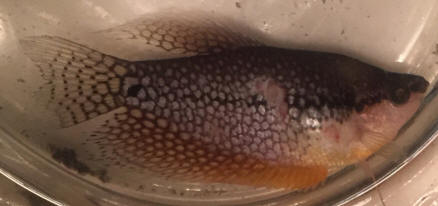
My male pearl Gourami seemed to have damaged his skin on (presumably) a sharp
decoration in my tank, as he chased my female Opaline.
<Yes; looks a clean wound, should heal nicely.>
I saw a whitish area on his side that seemed like a small loss of scales.
<White = dead tissue.>
I monitored it and watched his behavior for a week; he was eating well, he did
not lose coloring or have any indications of white spot, cotton mouth, or ragged
fins. I read on your site that injuries make fish more susceptible to diseases
so I was ready to take action, but I did not think there was a need at that
point.
<Indeed; in good water quality fish have an ASTONISHING ability to heal from
wounds such as these. If the wound stays "clean" ... without signs of fungal
threads or bacterial decay, treatment may indeed be unnecessary.>
Overnight into day 8, the pearl's injury enlarged and his front body inflated
like a balloon; posts on your site suggested this might be a sign of an internal
parasite. I QT'd him in cycled water and he died twelve hours later; I was not
surprised since he barely put up a fight when I netted him, he was not eating,
and he had suddenly relegated himself to the bottom of the community tank and
later the QT,
<Interesting.>
although he did remain buoyant.
<Good.>
Aside from alleviating the ornament situation, which I did, how can I prevent
the infection from an injury--if my diagnosis it correct--next time? When I see
the injury, should I separate and medicate right away?
If so, which medication should I use? I am not sure how to medicate
appropriately without knowing the nature of the secondary problem, yet I also
read that waiting to treat is often too late.
I attached a picture of him after he expired, showing the affected/infected
areas.
Many thanks again, Matt
<I would medicate as per Finrot; my favourite product is eSHa 2000 where
antibiotics aren't available, otherwise in the US, various antibiotics such as
Kanaplex should work well. On the other hand, while Epsom salt can be an
excellent addition where swelling and/or dropsy are indicated (1-3 teaspoons per
5 gallons/20 litres) by itself it has no impact on bacterial infections, and nor
does salt, which at a dose of 1-2 gram/litre can help minimise osmotic stress is
not in itself a medication against bacterial infections. So either might have
their place, or even used together, but
alongside, not as an alternative to an anti-Finrot medication. Make sense?
Cheers, Neale.>
|
 |
|
Dwarf Gourami illness
2/5/15
Hi.
<MP>
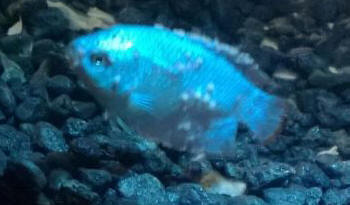
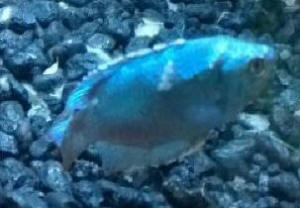
I’m hoping someone can help me figure out what is wrong with my Dwarf
Gourami. I really feel helpless not knowing what to do to help him. The
marks on him appeared within one day.
<?! Strange>
At first I thought maybe the second Dwarf Gourami had beat him up
because he was chasing him around the aquarium. The aquarium is a 75
gallon tank. Parameters are Ammonia 0ppm, Nitrite 0 ppm, Nitrates 10
ppm. temperature is 79-80 degrees.
<A bit warm; but okay>
Tank occupants are were two dwarf Gouramis, ten Cardinal Tetras, 8
Cherry Barbs, and a Bristlenose Pleco. Everyone else in the tank is fine
and seems healthy.
I fed them the evening before and watched them eat. He seemed fine. The
next morning I got up and turned their lights on and he was in his usual
sleeping spot so I didn’t pay much attention to him. That evening I came
home from work and went to feed them. After he came up to eat, I noticed
all the marks on him. I keep a quarantine tank ready so I pulled him and
put him in it. At first he ate, but after a couple days he stopped
eating. I had been treating him with Melafix
<Worse than worthless. See WWM re this sham; and stop pouring it in>
hoping he would show signs of improvement, but it appears he is getting
worse.
I appreciate any help you can give me.
<Please see the Net, WWM specifically re the viral condition broadly
labeled as "Lymphocystis"; and especially its prevalence in Colisa
lalia. Is this it? All that can be done for such is improved water
quality and nutrition. Unfortunately, as you'll soon more fully
understand, Dwarf Gouramis have a host of REAL troubles, are subject to
easily diseased conditions. Bob Fenner> |
 |
|
Re: Dwarf Gourami illness
This does appear to be it. Thank you. Is there anything I need to do to my
tank to make sure it's safe to ad other fish to it?
<Reading>
I'm not adding anything else until I know for sure there is nothing in there
to harm them. The existing fish in there still seem happy and healthy with
good appetites, but I'm going to continue to keep an eye on them for a while
to be safe.
<All... "stress-related"... too much... given genetic predisposition... No
more "Fix". BobF> Re:
Dwarf Gourami illness /Neale
2/6/15
This does appear to be it. Thank you. Is there anything I need to do to my tank
to make sure it's safe to ad other fish to it? I'm not adding anything else
until I know for sure there is nothing in there to harm them. The existing fish
in there still seem happy and healthy with good appetites, but I'm going to
continue to keep an eye on them for a while to be safe.
<<I do concur with Bob about Lymphocystis being likely, but the size of
the photos means I'm not 100% sure. At first glance I though serious
Finrot, which can form nasty lumps on the fins and skin. These can be
distinguished from Lymphocystis with a bit of care. Finrot is what it sounds
like, rotting, decaying skin and fin tissue. Often pinkish in colour, with
darker red bleeding and/or white dead patches nearby. Finrot usually begins with
fin membrane turning cloudy and eroding, leaving a distinctive cobweb appearance
as the transparent membranes decay faster than the bony fin rays. The dead
tissue lumps on the body only appear late in the infection.
Usually caused by physical damage, exacerbated by poor water quality.
Eminently treatable if caught early. Lymphocystis is more like warts. The lumps
are sometimes textured (similarities with cauliflower is often mentioned) and
there isn't normally any nearby sign of bleeding or dead skin. Lymphocystis
isn't treatable (it's viral), develops and progresses extremely slowly (unlike
Finrot, which can go from incipient to deadly serious within a week) and may
take months, even years to run its course.
Some individual fish seem to be prone to Lympho their entire lives, and may live
decades with the warts coming and going, seemingly without causing any serious
harm. Debate about the causes, but water quality, and in particular exposure to
toxins (such as heavy metals) at persistently low rather than fatal levels being
suggested. It does seem to be "higher" fish groups that are most prone --
perciformes, synbranchiformes, tetraodontiformes, etc. As Bob indicated in his
reply, and as you'll doubtless find out in your reading, the Dwarf Gourami is a
total nightmare so far as healthcare goes.
What was once an extremely hardy, extremely reliable community fish is now
probably the most difficult to keep "common" community fish in the trade.
If you can get locally bred ones, they're great (though sadly females are hardly
seen on sale). Once in a while, the farms in Southeast Asia send out some
healthy specimens, but more by luck than judgment. But most are virus-ridden and
juiced up on antibiotics before being sent out to the retailers. Do look out for
the much better Thick-Lipped Gourami and the
Banded Gourami, both of which look similar, if less strongly coloured, and
retain a much higher level of hardiness and disease-resistance. Cheers, Neale.>> |
Tropical Fish Problems 5/17/14
Hello
<Hello Sharon,>
IM hoping you can help me. I have a 65 gallon aquarium, with a
gourami who had a small lump on his side then opened into a red sore.
<Likely a bacterial infection that set in following some sort of
physical damage. If you can discount aggression or predation, in my
experience, these most often happen when fish throw themselves at sharp
objects, such as rocks or even the metal reflectors behind some aquarium
lights! Review, and act accordingly.>
I treated the tank with Melafix and it healed.
<Good. Though Melafix is unreliable as a cure. I'd suggest using it as a
preventative, after fish have hurt themselves but are not actually
showing signs of fungus or bacterial infection. Once you suspect an
infection has set in, go for something much more reliable, like the old
Maracyn 1 and Maracyn 2 combination that's popular in the US, or
something equivalent, such as KanaPlex or eSHa 2000.>
He now has a secondary infection on his one fin, looks like cotton
(fungus). I treated with Pimafix (did nothing)
<Not surprised.>
I treated with the fizzy tabs for fungus (did nothing).
<Again, you're likely using these that are too generalised and too
unreliable. A good rule of thumb is that if the medication is [a] cheap
and [b] promises to cure everything, it probably isn't all that useful.
Fungus is usually very obviously different to anything else because it
looks like cotton wool fluff. Finrot and Mouth "Fungus" (a bacterial
infection called Columnaris) usually look very different. While there
are some medications that promise to treat both fungal and bacterial
infections (such as KanaPlex), it's often better to identify which is
the problem with your fish, and choose something more specific.>
I switched to Paraguard from SeaChem).
<Again, this is something that promises a lot, but I'd tend to see it as
a general purpose preventative rather than a one-shot cure-all. KanaPlex
would be better if you can't be sure if fungal or bacterial infections
are to blame, as it will treat both, but unlike Paraguard it doesn't
promise to treat Whitespot, viruses and all sorts of other things!>
Did water changes in between treatments...All my water parameters are
correct. No ammonia, ph is 7.8 and everything else is normal. The tank
has been set up for 2 years. Last night the Gourami still has some fuzz
on same fin, but now I have white stringy stuff floating all over tank.
Not sure if I should do a water change (dosed with ParaGuard for 3 days
so far)...and then try another treatment like Jungle tabs or keep dosing
with SeaChem Paraguard.
Any help would be greatly appreciated.
Sharon
<Bottom line, identify the problem, and choose a more specific
medication for best results. The more a medicine promises to cure all
sorts of problems, the less likely it will cure any of them. As the old
saying goes, "Jack of all trades, but master of none". Do also remember
to remove carbon, if used, from the filter. Hope this clears things up
for you.
Cheers, Neale.>
Salt and Anabantoids 3/5/14
Hey, I was always under the impression that using salt on Anabantoids
was a bad idea and that it can hurt the labyrinth organ in some way.
<I know that many Anabantoids are routinely "salted" in the trade... Not
all though (e.g. Licorice, Chocolates...)>
Is this false? And are there any research articles or studies you are
aware of that I can read on the subject?
<Not w/o making a haul to an institution that allows (free) access to
searchable databases (e.g. BIOSIS, Zool. Abstracts)...>
Sorry to bug you, I know you have lots of ppl to help, you just seemed
like a good place to ask.
<You can search on WWM on how to do these searches in turn. Bob Fenner>
Bloated Gourami 1/13/13
Hello,
The severe bloating occurred in less than 48 hours. I
have a 55 gallon tank that has been established for about three years.
The residents are 4 Pearl Gouramis (one male, three female), 1 female
Moonlight Gourami, 1 Ctenopoma acutirostre, 1 African Knifefish, and 1
female Betta. The Betta and Ctenopoma were added about a year ago and
I've had the others for three years. There are no aggression issues,
everyone gets along. The water is 75F, 3GH, 3KH. I do 30% water changes
every week. I feed tropical crisps twice daily, and thawed bloodworms
three times a week. Two days ago all the fish were fine and normal.
Yesterday I fed them, but didn't look closely, so I don't know how she
was. Today, one of the female Pearl gouramis is extremely bloated. She
looks like she swallowed a golf ball!. Her abdomen is bulged out on both
sides so she is almost as wide as she is long. The bloating is bending
her back so her nose is pointing upwards. Despite this, she is swimming
around like normal, her colour is bright, eyes clear, fins not clamped
or ragged. Her scales are not protruding The other fish are not
harassing her. What could have caused her to bloat so extremely and
suddenly? I have clove oil in case I should euthanize her.
<Provided she is still active and feeding, there's a good chance she can
recover. Dropsy occurs when fluid accumulates within the body
cavity. Though often considered terminal, it can be cured if caught
early. Start by raising the water temperature to 28-30 degrees
C/82-86 degrees F, then add 1-3 teaspoons of Epsom salt (not tonic salt)
per 20 litres/5 gallons of water. Ideally, add an antibacterial
medication. After about a week, the swelling should subside. Since
dropsy is usually a sign the fish was stressed by its environment, this
would be a good time to review things like filtration and water changes.
Because Dropsy is almost always caused by some sort of environmental
stress, review the aquarium conditions.
Stocking, water changes, water quality, filtration, etc. Diet can be an
issue in herbivorous and omnivorous fish that aren't getting adequate
sources of fibre, such as algae, cooked peas, brine shrimp and daphnia.
Cheers, Neale.>
|
Possible Black Spot disease? (Bob, second opinion?)<<Agree w/
Neale; this is some melanization alone>> 11/29/12
Hello Crew!!! You guys are amazing and hoping you could help me once again.
I think I could possibly have black spot disease going on in my tank;
however, I am not 100% convinced as the spots don't look raised.
Quick background:
* 15 gallon tank that has been established 1+ years
* Planted tank (micro sword, Christmas moss, java fern, red Cabomba)
* Additives: Green Leaf Ultimate GH booster (7 degrees GH) (kH is <1)
* Additives recently stopped until this is dealt with: Excell, Kno3, KH2P04
* 50% weekly water changes
* Water quality (tested with API master) consistently: 0 ppm on Ammonia,
Nitrites, Nitrates. Ph constant at 7.5 (might be too high for croaking
gourami's?.. I get mixed answers I can definitely bring it down via acid if
necessary ... I try not to use chemicals though)
* Decor: Manzanita wood, rocks, onyx sand / fluorite sand, buried pvc that
was sanded for additional hiding places.
* Tank inhabitants: 4 croaking gourami's, 1 African dwarf frog (who loves
flake food randomly), 6 Aura Blue Shrimp, 3 kinds of snails for algae
(mystery, rams, trumpet)
Attached are the pictures and hopefully you can see they have black "areas"
on their body's and fins. However the spots don't look all raised like all
of the pictures I see for black spot so I am not 100% sure, but I also
haven't read anything else it can be. I have one croaking gourami that I
bought at the same time as these 4 and moved to a different tank due to
compatibility. This one is not displaying the same markings.
So my questions:
1) Do my gourami's have black spot?
<Very unlikely; Black Spot Disease is a temporary symptom that occurs when
parasitic organisms in their larval stage burrow into the skin of fish.
When the organism matures and leaves the fish, the spot usually heals over.
Now, the thing about this parasite is that it doesn't normally occur in
aquaria. The parasites have a complex life cycle that involves birds and
either snails or copepods, and because of this, it's hard for the parasite
to complete its life cycle in aquaria. Even if fish are infected when you
buy them, the parasite eventually dies out because it can't complete its
life cycle. So true Black Spot Disease is simply something you let run its
course; assuming the fish are otherwise healthy, the parasite doesn't do any
serious harm.>
a. Or something else, I can't imagine it's ammonia burn since I have never
measured ammonia over 0 ppm since adding them. I know the kit is OK because
I measured the cycle on another tank.
<Well that's promising. Most of the suppose Black Spot Disease outbreaks are
more to do with ammonia than anything else.>
b. Could it be due to ph / bullying, but I don't think that explains the
black spots in tail / anal / dorsal fins.
<Perhaps, but my feeling is that this is either genetic or idiopathic; I
wouldn't worry so long as the fish is happy and eating.>
2) Additionally do you know what the white specks on the wood are?
<White specks on wood can be a variety of things. Off-grey threads are
usually fungus or bacteria. Nondescript specks more likely to be silt
trapped on a bacterial or algal film. Basically, remove the wood and see if
the white stuff rinses off. If it does, then chances are its silt, and if
you don't want this to happen again, improve mechanical filtration.>
Based on my understanding I think I might have black spot from some of the
snails I added to the tank.
<Snails can only carry Black Spot if they come from a pond where birds had
access. Assuming you live in a temperate part of the world, the only snails
that might have been outdoors would be Physa and Physella type things, and
even then, only if they came into the tank on plants that were grown
outdoors in your area, which basically limits it down to stuff like Elodea
and Hornwort.>
I am perfectly ok killing all the snails via copper to break the cycle
(those things grow like weeds)
<Personally, I feel using copper to kill snails is more dangerous than
whatever (slight) problems this fish might have. Do remember snails are part
of a balanced aquarium, and marine aquarists positively encourage "clean-up
crew" that circulates the substrate and breaks down organic waste into the
ammonia and other soluble compounds the biological filter can process. Too
many snails can mean your tank is improperly maintained, so best to nix any
issues in that direction first. Restrict feeding, remove uneaten food, trim
away dead/dying foliage, etc., and the snail population will die back to a
sensible level.>
and allow them to heal if it is black spot, however, I'll have to set up a
new home for the frog and shrimp while that is happening so I wanted to make
sure.
<Ah yes, copper will be quickly lethal to frogs and shrimps, not to mention
most/all fish at some level. Copper is the "nuclear option" in aquarium
maintenance.>
Which is why I wanted to ask an expert.
<Good call, which is why I'm asking Bob!>
Thanks and please let me know,
-Dave
<Cheers, Neale.>
|
.jpg)
.jpg) |
|
Re: Possible Black Spot disease? (Bob, second
opinion?) - 11/30/2012
Awesome you guys have always been a huge help!!!
I was doubtful for all the same reasons, but couldn't explain the
pictures so wanted some expert reviews.
<Glad we could help.>
All the plants came from my own grow tank (where I juice with DIY CO2,
high ferts, etc.. but no fish so I don't have to worry about PH
swings, high nitrates, iron, etc..), so there is no way it could have
gotten black spots from that (unless the snails in that tank all have
it, but again no fish for the cycle). Yes I didn't want to do the
"nuclear" copper trick .. I like snails (hence 3 types .. and I do keep
them in check via avail food), they help keep everything so clean .. way
better than any algae scrubber 8-), but if it was the problem I can
always regrow the population easily especially from grow tank.
<For sure.>
Is there anything than could affect the melanization / idiopathic? (no
understanding about it so .. currently reading up on it)
<Not really, beyond ensuring optimal health. Random growth of dark
patches of pigment -- melanisation -- can follow on from injury to the
underlying nerves, genetics, exposure to the wrong level of light
intensity for that species, something lacking in the diet, etc., etc.
The species you have here isn't demanding, beyond the requirement for
small, peaceful tankmates and the need for lots of floating plants, so
it's hard to imagine precisely what you might be doing wrong.
(Interestingly, the Moonlight Gourami develops a black band along its
flanks if the light intensity is low; this may not be relevant here, but
it is something to think about.) May be nothing at all, and simply
genetic. The best approach is to keep the Gourami happy, keep looking
out for any odd behavioural changes or signs of bullying and such, and
make sure the fish is feeding on a good range of things.>
Thanks for all the help!!!
-Dave
<Cheers, Neale.>
|
|
Sick Gourami 8/4/12
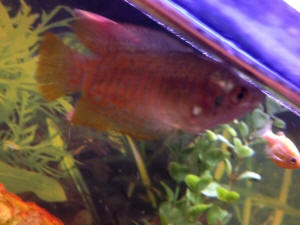
Hello, I have noticed that for the past week my Male Dwarf Gourami
<Not sure this is Colisa lalia at all; body shape looks "wrong" somehow;
are you sure it isn't Colisa fasciata?>
has been looking dull in color and seems smaller in size.
<Indeed?>
He has been for the past 3 days or so, just staying in the corner at the
top of the tank by the heater (The temp in the tank is 77).
<Kick the heater up a couple degrees if you can (though your mix of fish
won't be happy about this, long term). Gouramis are very much "hothouse
flowers" that enjoy the warmth. Take the heat up to, say, 28 C/82 F, and
see what happens. If the fish perks up, then there's your problem.>
Also, he seems to still get excited by food, but when he swims up to it
he doesn't really eat it, and then goes back over to the corner.
<A common problem. Can be it's bored with what you're offering. Try more
variety, especially live brine shrimps and daphnia that act as a pretty
good laxative too, clearing out the gut and making bloated fish feel
more frisky.>
A little about my Tank; I have a 36 gallon bow front tank with 9 Glow
Fish Danios, 3 Rainbowfish, 6 Neon Tetras, and 2 Male Gouramis (Which I
realize now it may not be the best idea to have 2 males.)
<For sure.>
Oh yeah and a Pleco.
<Who is/will soon be WAY too big for this aquarium.>
No one else is acting or looking strange. I have had the Gourami's for 3
months together. At first they would fight and get territorial, however,
after about a week and setting up the tank a little differently they
seemed to be living together fine.
<Can happen.>
I have attached a picture, besides the dullness his stomach seems a
little bloated and his back fins seems a little frayed.
<Could be "failure to thrive" -- a combination of stress (from the other
male); monotonous/wrong diet; too cold water…>
I took the picture with my iPhone so it may not be the best quality.
<Indeed! Can't really see much of anything.>
I hope you can give me some insight or advice.
Thank you,
Sarah
<Most welcome, Neale.>
|
 |
banded gouramis?...and an
angelfish not eating 1/21/12
hi,
i have a 35 gallon freshwater tropical aquarium that I have had running
since i was 10 ( I'm 12 now ) . the aquarium contains 2 black
tetras, 1 pearl gourami, 1 blue gourami, 2 harlequin Rasboras, one
honey gourami, and one large angelfish. I had wanted to add some
colorful Colisa gouramis to my tank and after reading about the
seemingly cursed dwarf gourami, ( I had to learn that the hard way
before i went and searched "dwarf gourami disease" online) i
decided on banded gouramis. Since they grow quite large, will they
bully the honey gourami? i think the banded gouramis would do this
because they are Colisa, like the honey. (if they were Trichogaster, i
would ask about the pearl and blue gourami).
<By their very nature, male Gouramis of all kinds are territorial
and can bully smaller Gouramis, whether of their own species or others.
In a big aquarium they may spread themselves out, but in your tank,
adding a second Gourami species could be risky. Females are not usually
aggressive, so they can be safer bets. But I'd recommend sticking
with Honey Gouramis, keeping either a single male or some odd number of
males 3 or above.>
also, i had purchased the angelfish about 8 days ago, and since i
introduced him into the tank, he has not been eating. I noticed white
stringy feces
<Ah, sounds like Hexamita infection.>
and he always hides behind an Amazon sword plant in the back. I have
tried to get him to eat by feeding him freeze dried Tubifex worms, live
brine shrimp, bloodworms, daphnia, and flakes, but he didn't eat
anything. he hasn't been eating for 8 days now, so I'm getting
worried. I thought maybe the angelfish is acting like this because he
might be annoyed by all the commotion that goes on around him ( the
Rasboras are extremely hyperactive). how could i get him to eat? any
help would be greatly appreciated. thanks Andy
<Do read here:
http://www.wetwebmedia.com/fwsubwebindex/hexoctfwfs.htm
Hexamita is quite common among farmed cichlids, and can only be cured
with Metronidazole. Cheers, Neale.>
Labyrinth fish - never-ending troubles - to
Mr. Monks if it is possible 8/10/10
Hello,
<Hello,>
Sorry for such a long message, but I would like to show my fishkeeping
problems well.
<OK.>
Long time ago I had some gouramis (Trichogaster leeri or trichopterus
-- I don't remember). It was successful hobby -- lots of fun and
even breeding successes. 3 years ago I decided to set up new tank
again. I bought new glass, all the equipment, plants etc. After cycling
water reached proper parameters. Naturally my first choice were
Labyrinth fish: Pearl Gouramis (Trichogaster leeri)
<An excellent fish.>
and Colisa lalia.
<One of the worst fish in the hobby.>
I wanted to set up biotope South-East Asia community tank. Along with
gouramis I introduced school (10) of Harlequin Rasboras and Pangio
kuhli (3 fish). Everything in 110 litres tank. First 2-3 months were
fantastic but after'¦ my never-ending problems began. Colisa
lalia died one after the other. Symptoms: lack of appetite, expanded
belly, gulping the air, swimming up-down just to take a breath.
<Indeed. Ironically, 50 years ago this fish was considered hardy and
easy to keep. Inbreeding, overuse of antibiotics, and rampant viral
infections have made the species worthless.>
I check the water regularly. Parameters of my tank water are:
pH -- 7.2--8.2 (at the beginning was close to 8 and 8.2, for last 1-2
years has been close to 7.5 -- perhaps it is now lower because of peat
filtration and bogwood influence),
GH -- 13-15
KH- 7-10
<OK, a bit on the hard, basic side for Southeast Asian fish, but
nothing adaptable species couldn't cope with. This is basically
what in England we call "Liquid Rock" so you need to be a bit
careful when choosing fish. Barbs tend to do better than Rasboras, but
really, it's not too bad.>
NH4 -- 0
NO2 -- 0
NO3 -- 40-100 (let's say about 50-60 -- these color indicators are
too similar)
<Again, on the high side, but very similar to London tap water. Not
ideal, but not a disaster either. I mix my tap water 50/50 with
rainwater. You can use RO water too. Either way, you get water that is
IDEAL for Southeast Asian fish.>
Temp -- 25-27 C
<Fine.>
I know that nitrate level is too high, but I can't lower it. Even
in my tap water nitrate level is more than 25. I can't use
rainwater (in the big city it is polluted).
<Ah, I see.>
Perhaps RO system I bought recently (for domestic purposes) will be
helpful.
<RO water is expensive, but safe and well worth using. Do remember a
domestic water softener that uses sodium salt IS NOT making RO
water.>
I change about 30% of water every second week. Aquarium (110 l.) is
fully planted.
<Good.>
I bought next C. lalia (1 male 2 females). After 2 or 3 months
situation repeated. Also T. leeri started to feel worse. I gave up
Colisa lalia but still hoped that I could successfully keep Pearl
Gouramis.
<Should do. Quite a hardy species.>
Unfortunately it wasn't better. The longest guest in my tank was
Pearl Gourami male, he lived in my house for over a year. But finally
did the same way as the others. For last 3 years I have lost 6 Colisa
specimen and about 10-12 T. leeri. First fish were bought in pet-shops,
so they could have been imported (even from infamous Far East farms).
But about 50% of gouramis were from local breeders. They didn't
mention any problems, except high sensitivity for some live food --
like Tubifex or red mosquito larvae. So I fed my fish with only
different type of flakes (including Spirulina) and frozen or
freeze-dried Artemia.
<Should be ideal.>
Disease had various profiles. But almost never started just after
introducing new fish - usually I noticed first signs after 2 months
from introduction. All the symptoms (which I remember or wrote down in
my tank diary) were following:
Lethargy, shyness, hiding -- always
Stop eating -- always
Expanded belly -- about 50% of sick fishes
Body deformation (something like backbone break, tail fin directed
down) -- 50%
Jagged fins -- 30%
Darkening -- 30%
Gulping -- 30%
Swimming up-down -- 30%
Lost of scales, wounds on the body -- no more than 20%
Small spots on the fins and on the head -- no more than 20%
Next info shows the time between first symptoms and death
Up to 3 days -- 20% of fish
3-7 days -- 50%
7-14 days -- 30%
It could be important that indicated symptoms were visible in different
sequences. The two most popular:
Shyness (1-2 days) -- Stop eating (3-4 day) -- belly expanded (4-5 day)
-- Gulping (5-6) -- Death (8)
Body deformation -- Stop eating (after 5 days) -- Shyness (6) -- Death
(10 day)
<Does sound like a Mycobacteria infection.>
Obviously I tried to cure with different diseases in my mind, like:
parasites, dropsy, mycobacteriosis, poisoning.
<Poisoning is an interesting one with Gouramis. Because they breathe
air, they're much more sensitive to airborne pollutants than other
fish. For example, tobacco smoke, or carbon monoxide, or paint
fumes.>
I used Salt dips, Omnipur and Bactopur by Sera, raised temperature. But
it never helped.
<Indeed not; wouldn't expect them to, to be honest. In Europe,
the "alternatives" to antibiotics sold in pet shops are
fairly useless. External infections can be treated with products such
as eSHa 2000 just fine. But anything internal needs an antibiotic. For
that, you need a vet.>
Also I'd like to mention that my other Asian fish were mostly
healthy, even Rasboras spawned 4-5 times. Even sensitive Amano shrimps
were and are lively and female is often full of eggs which she holds
thoughtfully under her belly. Up to now I have Amanos, Rasboras, Pangio
kuhli (which I bought at the beginning of my new tank) and Siamese
Algae Eaters. Only 1 Rasbora and 2 Barbus titteya died with similar
symptoms I mentioned above.
<Curious.>
10 months ago I almost set up (using about 40% of old water to
establish fast cycling) my tank again (but this change was made more
for cleaning environment than to kill invisible assassins living
somewhere inside). I put new bogwood, changed all the gravel and used
the pro-plant substrate. I also installed new internal filter only for
mechanical filtration and I filled external hang on the back filter
almost entirely with bio-balls and ceramics to establish more space for
useful nitro-bacteria. This internal filter had also anti-bacterial and
anti-parasite UV Led system but I'm not sure whether it really is
beneficial or just a marketing trick directed to aquamaniacs.
<UV light connected to the flow of water from a filter will REDUCE
waterborne parasites. But UV is NEVER a cure or 100% preventative. So,
not a "trick", but not a magic bullet either.>
I have to admit that I'm usually buying small fish (a bit bigger
than fry). They grow up and get bigger without troubles up to the
moment when symptoms of the disease occur.
<Curious.>
I started again to browse web and find (never heard before) info about
Iridovirus. Perhaps this is the reason of my problems. I started to
read and found (in many descriptions) symptoms and troubles similar to
my tank situation.
<Iridovirus has jumped species. It's not impossible other
Gouramis can, occasionally, catch it. This is one of the major problems
with viral infections, as humans have learned many times, e.g., with
Avian Flu.>
Despite that WWM informs that Iridovirus mostly hits the Colisa species
(and you even recommended other Labyrinth species instead of Colisa
lalia) I found other sources which show that this problem also refers
to Trichogaster family and even Cichlids (Angelfishes).
<Indeed. Colisa lalia is BY FAR the most likely species to suffer
from Dwarf Gourami Iridovirus. Whilst other Iridovirus species affect
different types of fish, these are VERY RARE. Buying Trichogaster
gouramis for example is generally very safe, and they almost never
suffer from viral infections. Likewise cichlids.>
Now in my tank are:
1 Pearl Gourami (female)
2 Trichogaster trichopterus -- gold morphs
4 Amano shrimps
6 Rasboras
3 SEA
I feel like I face a serious decision: what to do? In my (frustrated)
mind two scenarios:
1. Remove all the gouramis left in my aquarium and change mind to other
fish from Asia
<No need for this. But I would leave things be for 6 months. See
what happens. Not all fish are sensitive to one particular
virus.>
2. Change mind to other biotope and slowly change Asia fish for those
from new biotope.
<Interestingly, I don't think this is a cure. the Dwarf Gourami
Iridovirus is known to infect an Australian perch!>
It could be:
- South America -- Apistos or bigger but calm Cichlids together with
Tetras
<Possible. Apistogramma cacatuoides for example is a great species
for quiet community tanks.>
- Central America Cichlids and Livebearers
<Can be done, but most CA cichlids are fairly aggressive, and
wouldn't be my recommendation for less than 250 litres.>
- African biotope: Kribs + Bushfishes + some African Characines
<Also fun. Have done this several times.>
Do you think it would be a good idea to remove all fish, plants and
even equipment (to be sure that no dangerous viruses, bacteria etc.
survive) and start again?
<Killing viruses is practically impossible, so I wouldn't work
from that perspective. Short of sterilising everything, there's
always a risk.>
What do you think about this? I appreciate all your suggestions and
comments. Thanks for being patient reading my descriptions
Regards, Piotr
<Hope this helps. Cheers, Neale.>
Re: Labyrinth fish - never-ending troubles - to Mr. Monks if it is
possible 8/11/10
Hello again,
<Hello.>
Thanks a lot for your quick reply. It may not explain all the troubles
I have but I didn't expect that in one message you would save my
poor Labyrinth fish
<Indeed.>
You pointed out Mycobacteriosis as a diagnosis of the symptoms
(shyness, lethargy, body deformation etc) I listed in my previous
post.
<A possibility at least. Impossible to know for certain, without the
dead fish being examined by a vet.>
This disease (and similar like Flexibacteriosis and Fish Tuberculosis)
I had (and have) in my mind observing my fish. But finally I came to
the conclusion that it is rather Iridoviral infection than some
bacterial attack. Why? Because:
1. Almost only Labyrinth fishes were sick and died showing mentioned
symptoms
<Mycobacteriosis is more common among Labyrinth fish that most other
aquarium fish, so I don't think this proves anything.>
2. It wasn't epidemic -- it didn't happen that two or more fish
died at the same week.
<Mycobacteriosis is something triggered by external factors rather
than caught. So again, I think you have to be careful about drawing
conclusions.>
But now I think that both the diseases can be found at the same time.
Hypothetical scenario can be that immune system weakened by Iridovirus
is exposed to Mycobacterial infection which invades only the weak fish.
So I can have both Iridovirus and Mycobacteriosis in my tank. Am I
right? Is it possible?
<I'm sure it is.>
A month ago I introduced new Trichogaster trichopterus male. And after
first 3-4 days of hiding in the corners he started to be lively and
even to reign. But a few days ago I noticed some lesion on his body
(between lateral line and dorsal fin). It looks like jagged scales a
bit protruded and unstuck. I thought that it is a sort of some
mechanical injury (sometimes gouramis not seriously bite each other) or
the result of stress. But now I'm not sure whether it can be
beginning of some nasty Mycobacterial infection. How to cure it? Salt
dips? Something stronger? Do I need to disinfect the aquarium with
other fish and equipment?
<You can't really cure Mycobacteriosis. Do please read:
http://www.wetwebmedia.com/ca/volume_6/volume_6_2/mycobactera.htm
>
And next issue. Almost half a year ago I created the tank in my
workplace. It is about 70 l aquarium focused somewhat on South-American
(Amazon) biotope. Water parameters: pH -- 7-7.2. GH -- 10, KH -- 5-7,
NH4 and NO2 -- 0, NO3 -- 25-50, temp. -- 25-27 C. The tank was cycled
and now is partially planted and has several caves under lava rocks and
bogwood. 30% of the water is changed every second week.
<OK.>
Now we (I and my colleagues) keep there 9 Hyphessobrycon
herbertaxelrodi (Black Neon Tetra in English I suppose) and 2 Corydoras
paleatus. But we had also 3 (2 fem 1 male) Apistogramma cacatuoides,
but they have died in 3 months (but not together, the intervals were
about one month). Symptoms before death: lethargy, difficulties with
swimming, laying on the bottom, stop eating, some lesion on the body
(white color without blood injuries, looked like lost of scales).
<My money would be on Hexamita.>
The male has also one (only one) eye protrusion.
<Pop-eye usually indicates physical damage if one eye, environmental
problems if both.>
We treated him with Salt dips (twice) and this protrusion became
significantly smaller.
<Epsom salt or sodium chloride? Epsom salt is what you want for
Pop-eye.>
But it was a sham success because several days after this treatment
(almost healed) male died. And the question is: Is it possible that
there is the same Mycobacteriosis which I (probably) have in my home
tank?
<Mycobacteria are probably latent in all tanks, all the
time.>
I transfer some plants from home to my work. Could they carry some
nasty bacteria?
<Yes.>
All the other fish (Corys and Black Neons) are fine. And again, is it
normal that some fish infection attacks only one species (or family)
but doesn't hit the other?
<Can happen.>
What can I do to protect next fish (we plan to introduce some other
Dwarf-cichlids, perhaps M. altispinosa or Nannacara anomala) from
bacteria (or virus) if they are already there waiting for a next
victim?
<I would wait for a few months and see what happens. If the
remaining fish are healthy, then yes, try something else. 70 litre is
not much water, so I would be careful with cichlids.>
So my most important question is: How to remove all the disease
effectively?
<Bacterial infections are treated with antibiotics. Outside of the
US, you need to get these from a vet.>
Obviously I can wait and observe everything but I'm a bit tired
with fighting against the killer of my fish. Naturally dealing with
some troubles I learn more for the future but the tank has not only
educational aims but also (and even above all) should be a joy. For me
it is better than Animal Planet channel because it is still live
transmission
<Quite so!>
But I don't want to watch only bad news (like in real TV News).
<Indeed.>
So if I decide to set up my tank from the start (or almost form the
start), what would you suggest to do to be sure (almost sure) that I
did everything to remove danger of infection.
<You really can't. Most of these infections come with the fish
when you buy them. If the fish is healthy and the aquarium is good,
then the fish's immune system prevents harm. When fish develop
Mycobacteriosis or Hexamitiasis, it isn't because they have
"caught" something, but because their immune system has been
weakened.>
Can I use water from my current tank to establish cycling in the new
one? (probably not).
<As stated, you probably aren't dealing with a contagious
disease as such. Yes, you can avoid introducing new problems. Be more
careful buying fish in the first place, and quarantine them for a few
weeks before adding them to the new tank if you can.>
Can I use my present plants?
<Yes.>
I like them very much, especially Microsorum and Hygrophilia corymbosa
which grows very rapidly and beautifully. Is it possible to disinfect
plants completely? I used potassium permanganate for bathing the new
plants in order to remove the snail eggs. Do you think this method is
enough to kill the bacteria?
<No; anything that kills the bacteria will kill the plants, other
than antibiotics.>
And last question what do you suggest I should do with my old but still
alive fishes -- leave them in a small tank waiting for their days?
<I would return everyone to the right aquarium. Medicate if
possible. But otherwise observe and wait to see what happens.>
I appreciate any suggestions.
<Sometimes certain fish don't work. Instead of cichlids, why not
try Florida Flagfish or Badis badis? Both of these are cichlid-like,
but different enough they might not be so vulnerable.>
Thanks a lot for your time. Piotr
<Happy to help. Cheers, Neale.>
|
Moonlight Gourami Lesions [RMF, bit mystified here,
any comments to add?]<< I do not>>
6/21/10
Hello Team!
WetWebMedia has changed my life! Well done!
<Thanks.>
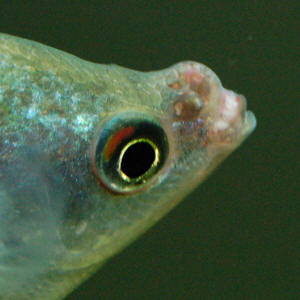
Anyway, I have some Moonlight Gourami that are developing pink
lumps on their snouts that then erupt through the skin.
<Yikes!>
I've had five Moonlight Gourami for about 7 months in a tank
that's been running for years and years.
They're fed quality flake food, cucumbers, algae wafers, and
brine shrimp as a treat.
They share a rather understocked 29 gallon with 4 other peaceful
fish.
I keep the Nitrates around 10 ppm with weekly water changes.
All the fish are eating healthily and are behaving normally.
<OK.>
I've noticed the lumps growing slowly over the past two weeks
or so and thought that maybe they were developing nuchal humps of
some sort. But when the skin started to break I knew that it
wasn't natural.
<Indeed not. My gut feeling here is that this is either viral,
something like Viral Hemorrhagic Septicaemia, if perhaps less
immediately lethal, or else a Mycobacteria infection. In either
case, no obvious cure, and isolation of infected fish would be
essential to break the cycle of infection. Once quarantined,
antibiotics may help. Worth trying, at least.
If two Moonlight Gouramis have both developed these lesions, but
none of the other fish, it's very likely the disease is
specific to them, or at least gouramis. Some gouramis are
moderately prone to Mycobacteria infections anyway, though to be
honest I've always found Moonlights to be among the hardier,
more reliable species.>
Two have broken skin, one of which is also beginning to develop a
similar bump near its eye. Another is just beginning to develop a
pink area, and the other two appear fine.
<For now...>
The only environmental change that I can think of is that I
upgraded the lighting to High Output florescent lamps. I noticed
the bumps about a week and a half after I installed the new
lights. But I can't imagine light doing this to my fish.
<Oh, hang on... are these fish able to breathe air easily,
without rubbing their snouts against hot glass or metal? If these
lamps are noticeably hot, then they should be at least 10 cm/4
inches above the waterline.>
There is, however, a plague of new brown fuzzy algae, that has
covered my decorations, but to tell you the truth, I can't
imagine that causing this either.
<The extra light will promote algae if there are no
fast-growing plants to outcompete for nutrients and hold back the
algae. Indian Fern will do the trick cheaply and easily, but
there are other options too.>
I'm stumped. Do you think it's bacterial, protozoal,
fungal, or even algal?
I've attached some pictures of the affected areas at various
stages. Notice the new lesion forming near an eye. I've also
attached a picture of the brown fuzz coating a (probably) dead
plant. Let me know if you'd like larger file sizes for
desktops and such.
<Ugh... be a pretty gross desktop pattern!><<A
red/Rhodophyte "Beard" algae... hard to control.
RMF>>
Thanks everyone!
-Joe
<Have cc'ed Bob Fenner here, in case he knows better.
Cheers, Neale.>
|
 |
Longstanding Gourami Illness 11/22/09
Hello My name is Vincent and my female pearl Gourami
has a few problems.
<Oh?>
I have a well established ten gallon tank that has been housing this
fish for about 3 years and her roommate, another male Gourami, for
4.
<This is rather small for Pearl Gouramis.>
I have never had any problems with water quality nor have there been
any pH spikes things of that nature.
<Good.>
The water in the tank is kept at 70-74 degrees F and is carbon filtered
as well as filtered by the resident Java ferns.
<Too cold. Pearl Gouramis should be at 25-30 degrees C, 77-86
degrees F.>
My female pearl is my favorite fish so I have always paid close
attention to her. The weirdness started about a year ago when I noticed
a white spot developing on her ventral fin.
<Often, long term exposure to environmental failings allow these
sorts of small, seemingly minor issues to become established. Because
the immune system is weakened, the fish's health is slowly
reduced.>
I watched it but it did not seem to do anything or harm her so I
chalked it up to her fin's natural growth. Then I started noticing
her swimming, it became weaker, more spastic, like she had to devote
more energy to swimming than a normal fish would.
<Indeed. Is "spastic" a word people still use in the US?
Over here in England it's considered very inappropriate. Actually,
just had a quick look on Wikipedia, and while in British English it is
considered (by linguists) "one of the most taboo insults to a
British ear" apparently Americans use it much more freely.
Interesting. Anyway, carry on...>
Her dorsal fin and tail fin have since been drawn in and folded and she
maintains her body at a strange bent angle as if she is constantly
avoiding something to one side.
<Sounds very much like chronic exposure to poor conditions have now
tipped the balance against her. These are fairly generic symptoms of
overall poor health and weak metabolism.>
Her pectoral fins, the ones that look like feelers, are no longer
straight and are kinked at odd angles to the point of not being
straight or rearward oriented. The fins adjacent to her gills are torn
and have small lumps on them and one of the fins looks bloodshot.
<Again, classic symptoms of a weak immune system allowing a
bacterial infection.>
I have tried several different treatment regimens, first under the
assumption that it was Ich then fungal infection then fin rot but
nothing has worked.
<Medications *won't* work if the underlying problems remain.
It's a bit like going to AA meetings while you're still downing
a bottle of Scotch every night...>
I have tried maracyn and TriSulfa to no success, with the carbon
removed.
The only thing those did was devastate the bacterial community in the
tank until the ammonia levels spiked.
<Hmm...>
I have no idea what this thing is at this point.
<I have a very good idea what's wrong.>
I know that it is slow acting and does not prevent her from feeding or
reduce her appetite but other than that I have no idea. Please
help.
<A bigger, and certainly warmer aquarium is required. With luck,
she'll recover if given good water quality, a balanced diet, and
some type of antibacterial or antibiotic treatment to stem the
infection. Otherwise, she's doomed. Cheers, Neale.>
Re: Longstanding Gourami Illness -- 11/23/09
Thanks for the assistance.
<Happy to help.>
I do have another tank that could house the fish, the only problem is
that the tank is maintained by my parents at home while I am away most
of the time at college.
<I see.>
As such I am hesitant to place her there as there since they are far
too preoccupied to actually invest the care that this fish needs and
she would likely die there as well.
<Oh. Well, she won't do well in a cold aquarium, and I'd put
her in a heated tank and hope for the best.>
I going to remove the tank mate when I go home for Thanksgiving break
raise the temperature and hope for the best since I cannot entrust her
to the care of people who have no experience with fish.
<Perhaps not.>
At any rate thank you for identifying the problem and I appreciate the
quick feedback. I only asked this because I did not see any other
references to this on your site and because all of the other fish I
have been fine in the tank and have suffered no problems.
<"Complex variables" as scientists say. Some tropical fish
actually like fairly cool conditions, like Neons, Corydoras and
Platies, and these are best kept around 23 C/74 F. But others, like
Gouramis, do need things a bit warmer.>
For a bit of lighter news yes I am American and spastic is not an
insult here rather a way of describing a motion that looks uncontrolled
or sudden or caused by pain.
<Interesting.>
You can use it as an insult though it is far down the line in terms of
offensiveness. We do not use the word to insult developmentally
disabled persons nor to connotate retardation. Spaz, the colloquial
term, refers to a clumsy or inept person and is not a slur.
<"Two nations separated by a common language" is what
Oscar Wilde (I think) said of the Americans and the Brits.>
Yours Truly
Vincent
<Good luck with the Gourami. Cheers, Neale.>
Sick Wasabi - HELP! Gourami dis., useful data, reading
-- 10/26/09
Please help!!!
<Will do>
Facts:
55 gallon fresh water tank
1 small tetra
2 small suckers
1 foot long shark
<?... What is this specifically? And really this size? In a system
four times its length?>
2 large, about 4.5"L (Opaline??? Kissing???) Gourami's (named
Wasabi and Energizer)
<... please look up what you have (on our site... or elsewhere) and
report back>
Purchased tank and fish from private owner and all fish have been
together for long time
Wasabi (4.5" Gourami) is looking unwell. Symptoms over the last 3
days:
Large bulge behind ventral fin
Gasping for breath
Lethargic, moving but slower, disoriented and having trouble swimming
straight
Abrasion on one side over the bulge
Today, fins look shorter and ragged, with small white bumps,
disintegrating
What's up? Tough pregnancy? Ick? Finrot? Old age?
Combination???
<... need data, on the set-up, water quality, maintenance,
foods/feeding... Pix would def. help>
His "mate" is perfectly fine and no other fish are
affected.
We have made no unusual changes to the water or feeding schedule.
Heater, lights, etc. maintained.
Regards,
Barbara
<Uhhh, read here:
http://wetwebmedia.com/FWSubWebIndex/GouramiDisFAQs.htm
and the linked files above. Bob Fenner>
Sparkling Gourami? Hlth./sel. --
10/20/09
Hey there!
<Hello,>
You have helped me in the past with Dwarf Gourami questions.
Unfortunately, I lost the 2nd one. As much as I love them, I'll
heed the warning and not try again.
<Indeed!>
My question today is about Sparkling Gouramis (Trichopsis pumilus) I
have the chance to get a few of these little beauties. Is this species
also susceptible to DGD?
<No.>
Say the word and I'll steer clear.
<Both Trichopsis species are very robust, Trichopsis pumilus and
Trichopsis vittatus. The main thing is that they're kept with
appropriate companions.
Being small and gentle, they're easily bullied by other fish, and
can lose out at feeding time.>
If they're safe, would they do ok in a 20g with 2 Corys and 5 male
guppies?
<Corydoras, yes. Male Guppies, maybe. Does depend on how
"feisty" your Guppies happen to be. In theory they should be
fine, and in a big tank with lots of floating plants, e.g., Indian
Fern, the Trichopsis should be okay.>
How many would you recommend?
<I'd allow 5 gallons or so per specimen, and that assumes
floating plants.
These fish stay close to the surface. They're air-breathers, and
very small, and can't hide away comfortably anywhere else.>
Again, many thanks for your website and advice. :)
<Happy to help. Cheers, Neale.>
re: Sparkling Gourami?
Awesome! It's great to know they're not susceptible to that
horrid disease.
<Indeed.>
My guppies are pretty rowdy. Sadly, they don't sound like a good
stock option for this tank.
<Perhaps not. As I say, it depends on how well the tank is planted
at the top level. In a 20-gallon tank your options are a bit limited,
to be honest. So if your Guppies are wont to throw their weight around,
you might
elect to either move them onto another, single-species tank, or else
leave the tank as it is.>
Thanks for the quick response!
<Cheers, Neale.>
Male Betta and dwarf Gourami problems
8/22/09
Hi there WWM,
<Hello,>
I have a 55g 4' aquarium. It runs a Marineland 350 magnum canister
filter with 2 BioWheels and a powerhead for the return. i also have an
air bar that provides a lot of bubbles across the whole back of the
tank. My aquarium has been cycling for 1 month, all my fish were
recently transferred from my 29g.
<Will likely take more than one month to complete cycling...>
Fish list,
1 Male beta (Crowntail)
<It's a Betta, to rhyme with Better, not Beater.>
2 Dwarf Gourami
9 Neon Tetra
1 feeder fish
1 Albino Plecostomus
2 Rainbow Sharks
2 Clown Loaches
Water quality, I test for ammonia, nitrate, nitrite, hardness,
chlorine, alkalinity, and PH. All are Optimal, the PH being
6.6-6.8.
<When you say "optimal", let's be clear that nitrite
and ammonia should be 0. Some folks think "small numbers" are
acceptable, and they're not.>
My beta problem (or at least i think its a problem) is that he sits at
the bottom of the tank a lot, and seems to really like my filter
intake. acts like he's stuck to it but when i approach the tank he
swims off like he's in
trouble. My intake doesn't seem to hold him there at all and in my
honest opinion doesn't have much suction. The beta eats fine
btw.
<...>
The Gourami has a fat lip, seems a lil red but not really fluffy just
slightly bigger. When i got him he had ick, cleared that up and then he
had some darker patches near his head... that cleared up on its own and
now the fat lip.
<Do review the health issues of this fish... Dwarf Gourami
Iridovirus, general sensitivity to bacterial infections...
http://www.wetwebmedia.com/fwsubwebindex/dwfgid.htm
Not a hardy species, and broadly speaking, best avoided unless you
quarantine them first, and then offer optimal conditions (pH 6.5-7.5,
5-15 degrees dH, 26-30 degrees C).>
He has always been very skittish compared to our other one.
<Likely two males, and these will be incompatible in one tanks...
territorial, aggressive...>
I do not have a second tank anymore to separate them.
Best Regards,
Matthew
<Cheers, Neale.>
Trouble diagnosing my Gourami 7/19/09
Hi,
I have read over most of the Gourami Disease pages of your site, but I
am still confused as to what my poor fish have.
<What sort of Gourami? A Dwarf Gourami, Colisa lalia? This is a
hopelessly feeble species nowadays thanks to chronic inbreeding and
horribly contagious viral infections. It's best avoided, and I
certainly don't recommend anyone keeping it.>
A little background on the tank: It is a cycled 29 gallon tank that has
been up for a few months with 0 ammonia, 0 nitrites, and around 40
nitrates (unfortunately my tap water comes out with 20 ppm of nitrates
so I am having a hard time keeping that down without doing daily water
changes), the pH is on the high end at 7.6 (I could lower this if
needed, but so far all the fish have been lively and don't seem to
mind it) and the temperature is at 82 F.
<Whatever your misgivings, this is actually all fine for
Gouramis.>
I do weekly water changes and frequently add fresh water to the tank
since my HOB filter makes loud splashing noises if the water level
becomes too low. There is currently carbon in the filter pads but I am
most likely going to stop the use of carbon unless necessary for
medication or other issues.
<Would tend to agree with you here; while carbon can be used for
certain things, in practise, plain biological media is a much better
use of space inside the filter.>
There are 4 Red Robin Gourami (they were sold as honey sunset, but
after doing research I found this not to be the case), 4 Peppered Cory
catfish, 3 Oto catfish, and 1 small Trumpet Snail (I think) which
caught a ride to my tank on some plants I bought. The tank is
moderately planted with bright lighting and a nice sized piece of
driftwood. The plants are Java Ferns, Val's, Red Ludwigia, and
Water Wisteria.
<All sounds lovely, except the water is a little on the warm side
for
That's perhaps a little cool for some Gouramis though, so I'd
perhaps split the difference and go for something around 26 C/79
F.>
Now, on to the problem currently. A few days ago I noticed that two of
my Gourami had off-white colored spots on their dorsal fins. These
spots are much larger than the white spots I have seen from Ich and are
just limited to one or two spots towards the back of the dorsal fin
with no other spots on the fish. A day or so later the fish began to
turn a darker color so that the bright red they usually are is now
mixed in with a brown/black shade on the top and bottom of the fish.
The tail fin is no longer clear looking and is turning a darker color
and is hazy/dirty looking.
<Hmm... doesn't sound obviously any one thing...>
This same situation has now spread to two of the other Gourami. The
dark color has now spread from just the tail fin to the back end of the
anal fin. Other than the discoloration, the fish are all behaving
normally.
<Very odd; really do need a photo. Finrot usually reveals itself as
off-white patches that yield to red inflammation and then the loss of
fin tissue, so it's usually quite obvious. Fungus looks like white,
cotton wool threads, while Lymphocystis forms cream- to brown-coloured
lumps with a distinctive cauliflower texture. If the fins are entire
and lacking bloody streaks, just an odd colour, that's something
I've never seen.>
They still eat like little pigs and swim actively in the tank. Even
though there are four of them (as far as I can tell they are all males)
they rarely fight and if they do there is never any damage. Last night
two of the Gourami decided to start building bubble nests at opposite
ends of the tank, but they seem to have given up after a couple of
hours and the nests are pretty much gone this morning. Their waste also
seems to be normal, not white or stringy like others have seen. While
this has happened to three of the Gourami, the fourth has yet to show
any symptoms.
<Hmm...>
I am about to take one of the fish in to my LFS to see if they can help
visual tell what is wrong with the fish. I am hesitant to start
treatment for anything without knowing what is wrong, but I also
don't want to sit here and watch my favorite fish die.
<Your water quality sounds good, and if the fish are happy and
healthy otherwise, I'd tend to hold off treating for now, and just
observe.>
Any advice you can give would be greatly appreciated. I only wish I
could attach a picture here but the fish do not stay still and my
camera can not get a decent picture of them.
<A photo really would help.>
Thanks,
Dan
<Sorry can't be any more helpful.
|
Gourami with large white swelling on side of lower
jaw 5/17/09
Hi,
My Gourami lives in a communal tank, (250l), with 15 other fish.
About 2 weeks ago I noticed a red patch on his lower jaw, which
has now progressed to a large white lump. I have been treating
the tank with Melafix with no change.
<Melafix is largely useless.>
There is no change in his behaviour, and he is still feeding. I
am concerned that if this is an infection it could be passed on
to the other inhabitants.
<No, I don't think that likely; this would appear to be a
secondary infection, an ulcer of some type perhaps, and the
infectious bacteria will be latent in all tanks anyway. So may as
well treat this Gourami in the display tank since the other fish
won't "catch" the problem. Use a decent, reliable
anti-bacterial or antibiotic medication. In the UK your options
are a bit limited because the antibiotics you need (such as
Erythromycin) can only be obtained from a vet. Not that this is
expensive, but it's not something UK aquarists tend to do
with small, low-value fish in my experience. For the time being,
try out eSHa 2000, an antibacterial I've found to be very
versatile and effective, and certainly more reliable than the
competing medications sold in England.>
The water quality is good, with no nitrates, nitrites, or
ammonia. The ph is slightly high (7.8), but the advice from the
fish shop was not to worry too much.
The fish are fed on flaked food, with sinking pellets for the
catfish.
Should I remove this fish from my tank immediately?
Please help
Many thanks
Steve
<Cheers, Neale.>
|
 |
Gourami Problem, HLLE 04/02/09
Hello,
<Julie>
This is a little note to inform your crew, Bob Fenner especially, of
important information regarding Gouramis and some other tropicals: An
open looking sore with creamy or whitish looking wormlike protrusions
is a form of Hole In The Head Disease
<But of what definitive etiology? Can be a deficiency syndrome,
evidence of Octomita, but not always...>
and is addressed well though diet, as it is commonly caused by a
deficiency in Vitamin A or C,
<Ah yes>
(sorry my book "Manual of Fish Health" is not here at my
workplace). I was reading one of your posts to someone who had a
Gouramis with this, and your staff was not aware of this prevalent
problem with the breed . It's likely the issue will reoccur for
them if the poor diet putting the fish at risk is not addressed .
<See WWM re marine HLLE:
http://wetwebmedia.com/HLLESWCauseF.htm>
I rescued a Gouramis with this issue from a Pet Store and immediate
results followed after balancing his diet, no meds were required. It
took only one week of better food which included a high source of the
needed vitamin. Tests were taken from the water he came from (which was
found to be fine), also the tank he was moved to was filled with 25% of
that water and all of the gravel was transported to the new tank to
facilitate quicker cycling. All 4 other breeds of fish from the tank
never displayed symptoms before or after changing tanks.
I highly recommend that a copy of the book I've mentioned be read
by all of your staff.
<Is worthwhile, but dated... See Ed Noga's works>
It is written by persons with doctorates in the field and is highly
informative. It gets quite technical, but provides all necessary
information to bring a good understanding of the solid study and
science it covers I found it a fabulous source for so many things, well
beyond hokey misinformation in internet searches (like the
misconception that fish don't feel pain as their bodies' cells
slowly explode by freezing for supposedly humane euthanasia). With all
of the poor information surrounding this hobby, it provides a needed
oasis. Another fabulous source would be to direct your staff to
www.fishyfarmacy.com where they have the most impressive and extensive
charts for diagnosis I have ever seen, they are extremely solid in
their science with major educational backgrounds.
<Thank you for this>
Another plus is that they don't suggest or expose fish to surgical
procedures such as the infamous Koi Doctor who follows his imagination
as much as he does science. The Koi Doctor should be advertised as a
present day Dr. Frankenstein for the poor fish who are unfortunate
enough to go from a bad aquarist to a fish witch doctor. I seriously
question the credibility of the education he boasts, especially given
that I've seen him prescribe antibiotic in the water for
exclusively internal infections, not even mentioning medicated
food.
I have bothered to write you regarding all this because I felt that
your staff, especially including Bob Fenner, truly care about what they
were doing and are making excellent efforts to diagnose the ailments or
problems brought forward to them. My intention is to support and
further your efforts, thank you for your time, Julie Wenzel
<Thank you again. Bob Fenner>
Re: Gourami Problem 04/02/09
Thank you very much for your recommendations and contributions Bob-
keep up your excellent work! For the sake of fish everywhere, I hope
more people end up on your website for their advise!
<Thank you Julie... do please consider joining us (the WWM Crew)
if/when you find you have the time, interest. BobF>
Bloated and listless female pearl Gourami
1/29/09 I have a bloated and listless female pearl Gourami.
Rests upright on the bottom, goes to the surface regularly for air,
settles back down. Has not taken assorted food for 3 weeks. My 110
gal., drip filter, community tank has a healthy large male pearl and a
female. I've had the three for about a year and a half. Water
quality is good, changed 15% overnight dechlorinated, and treated with
Kordon Amquel, every two weeks, I vacuum the bottom have pea size
gravel barely covering the bottom. I rinse three filters frequently,
use a turkey baster to remove sediment from the bottom of the filter
sump. I keep the PH close to the tap water 6.3 - 6-8 with a small nylon
bag of crushed lime under the bio balls in the filter. I treated the
male successfully for internal parasites 6 mos. ago with Metronidazole
in quarantine, tried it with this female with no improvement. I have
now treated her with "Jungle" Lifeguard all-in-one
(1-chloro-2,2,5,5-tetramethyl-4-imidaxolidinone) for 5 days with no
change, as recommended by the local fish store. This fish is in a 2.5
gal barren hospital tank, 80 degree, small filter with no media to
maintain oxygen. I started a 25% water change today in the 2.5 gal tank
and am extending the "Lifeguard" treatment cycle. A friend
who formerly owned a fish store told me the three Hatchetfish I
recently lost (after 6-8 mo.s, one every couple weeks), typically can
arrive infected with gill flukes. I have three other hatchets with no
apparent prob.s, from a different store. All other fish are healthy and
behaving normally. 4 Lg Congo Tetras, 1 Lg. Angel, 6 neon, 1 blue ram,
1 dwarf Gourami, 3 hatchet, 4 threadfin rainbow, 2 med. Pleco, 1 Lg
spotted African catfish. Would appreciate your advice. Thank you for
maintaining your web site, I refer to it frequently, have it
"bookmarked" at home and at work. Jeff <Hello Jeff. The
first thing to decide is whether the fish has Dropsy or not. Look from
above and see if the scales on the body stick outwards, so that it has
a bristly, pine cone-like appearance. If it does, then the chances are
the fish has severe organ failure and there's really not much hope
of recovery. While bigger fish (like Koi) sometimes recover when
treated with erythromycin or Minocycline, I've yet to hear stories
of small ornamental fish species recovering when so treated. So
painless destruction is usually required.
http://www.wetwebmedia.com/euthanasia.htm If the fish doesn't have
Dropsy, then we can think about other things. Egg-binding is possible
with fish, though rare. Since there's a male in the tank, I think
we can rule this one out. Another possibility is constipation, which in
severe cases causes bloating. This is quite common, and the usual
solution is to switch to high-fibre food while adding 1-3 teaspoons of
Epsom salt per 5 gallons of water. Tinned peas and spinach are good
foods, but failing that, brine shrimp and daphnia work as well.
Don't feed any dried foods during this time as they'll have the
opposite effect! By all means let your other fish go hungry while
treating this Gourami; it will do them no harm. Do avoid randomly
adding medications, as you seem to have done here. Unless you can
diagnose a problem, you can't treat it, and most medications are
poisons at some level, so careless use can cause problems. As
you've discovered, scattergun approaches rarely lead to cures.
Cheers, Neale.>
Gourami Sudden Deaths 8/26/08 Hi &
respect to the crew. <And to you> I am new to this site, but what
a rich store of useful information, for which I have already found
useful and informative. <Ah, good> I have an issue that occurred
over the last two days, which I will try to describe in detail. Sat pm:
Gravel vacuuming & snail removal (mechanical, not chemical) 20%
water change with DI water & re-mineralised/aquarium salts Fish fed
with frozen bloodworm/Mysis/ tablet(defrosted 1st mind you in the
aquarium water) Same evening later, 2 hours after water change &
feed, small male honey Gourami darts around the tank sinking to the
bottom, then flicking up turning around on itself, darting around the
tank, died within approx 5-10 min.s. <Yikes!> Non external
injuries evident or attacking from other fish. Same evening 1 after
this event our male dwarf Gourami displayed exactly the same symptoms
and also died. We still have another honey (female that has not died)
We thought originally that may have been frozen fish feed had given
them (has been kept and given to the fish over a period of 8-9months)
Mon am: Replaced the filter floss, rinsed the foam in tank water, added
additional beneficial bacteria Mon pm: bought another new male dwarf
Gourami & another honey from the pet store- same happened, cant
believe it, no frozen food given this time!!! Treated the shop tank
water in the bag with 1 drop of ESHa 2000 antibacterial/fungicidal
treatment for plants and fish. with the tanks lights off, netted the
fish from the bag after stabilisation, into the tank, after 3-3/2 hours
the same thing happened All the other fish seem OK, the 3 Corys we have
laid eggs recently in the tank and sometimes swim fast around the tank
I had also made changes to a CO system i built to benefit the plants
and has been running OK for 9 months. This was originally a micro
diffuser that allows the CO micro bubbles to enter the tank via yeast
& sugar mixture in an fermentation tank, that has a one-way valve.
But recently I changed this, by removing the micro diffuser (got
blocked), replaced with a small upside clear container that catches the
CO bubbles within the container and which is dissolved gradually in the
water. We were wonder if the fish swam to inside of the CO chamber and
surfaced & breathed it, would this have caused the mentioned
effects above, like suffocation, hope not....... <Mmm, me too...
seems unlikely> Have filled the CO collection chamber with
wool/floss to prevent fish swimming up inside the chamber. I monitor
the CO amount in the tank water via coloured changeable dye in a small
capsule that allows for display of PH & CO. <And this
capsule-mixed water does not get into/with the fishes I take it> It
does seem to be affecting only the Gouramis, but the problem seemed to
have started after the frozen food & water change/gravel clean. My
wife bought the new male dwarf & honey today and is very upset,
cant think of anything else to add except if you have any further
suggestions relating to similar issue, please, please help!!!!!
Parameters: (current) Temp = 74-78 Ammonia = 0 Nitrite = 0 Nitrate =
20-40ppm <Mmm, a bit high... I'd keep under 20 ppm> PH = 7.2
KH = 12-16 every 2 weeks R/O water change with remineral salts <Is
your tap/source/mains water "that" bad? I would just use it
over RO and salts... What are the salts for?> Tank stocked with live
plants, mosses. Fish: Normans Lampeyes 3 Rummy nose tetra 6 Cherry
Barbs 4 Corys 3 Pleco 1 Black Neons 7 Amano shrimp 1 Honey Gourami 1
Kind regards M. Atkinson <Mmm, from the excellent accounting of your
system, its occupants above, I am at a loss to explain the curious twin
deaths of the male Colisa chuna here... Perhaps this is/was a bizarre
coincidence. Again, about the only two items that raise concern
potentially are the high NO3 and your use of RO water and
"salts". I would look into, correct these and go forward. Bob
Fenner>
Re: Gourami Sudden Deaths 8/26/08 Hi Bob
<Mark> Thanks for your initial & fast reply. Just to answer
the few points you've enquired of: The CO capsule that monitors the
PH & CO - No, the liquid is a mix of reagent & aquarium water
that is kept within capsule and liquid does not enter the water. <Ah
good... some reagents are quite toxic> The bottom of this capsule
does have an opening, so it has to be placed in the tank about 10cm
from the surface carefully, so there is a small risk of chemical
leakage if the instructions are not followed. <I see. Thank you>
And yes the mains tap water here in Hants UK is really nasty to fish
untreated (heavy metals, nitrates chlorines, chloramines) with RO water
I can reduce phosphates, zero nitrates & so-on. (great for Algae
problems) The re-minineralisation salts is ("Tropic Marin" -
adds the natural minerals & substances removed by the RO unit,
& raises carbonate hardness) <Ah, yes. Am familiar with this
fine product> The other is "Aqualibrium" physiological
salt- Aquarium tonic, helps minimise stress on fish and can be used as
a supportive measure for treating disease. ( I don't add this as
well as the Tropic Marin would put the PH through the roof)
<Good> Will also take your kind advice and Lower the NO3 to 20ppm
or less with more frequent water changes but less amount of water, so
as not to stress the fish. <Also good... do see WWM re other means
of controlling Nitrates> Discussing what happened at the fish shop
with my wife today, as I was elsewhere in another part of the shop
while my wife asked the shop attendant to get our selections. She tells
me, that the boy who caught the Gouramis for us was clumsy to say the
least. It appears that when he netted the fish, instead of lowering the
net into the bag to release the fish, he tapped the net from approx
10cm height to bag water surface, and when the fish didn't fall
immediately from the net, he proceeded to nudge the side of the net
with his fingers until the fish fell into bag....cowboys!!!!! <Shall
we name him Geo. Bush Jr. II?> I guess that really didn't help
the situation. In future we will request that another shop attendant
serve us instead <Yes, I would> Today the other two Gouramis (1 x
honey male, 1x Dwarf female - still seem OK as well as the other fish)
Will monitor and keep you informed Regards Mark <Thank you for this
further info. Mike. BobF>
Today I woke up and my pearl Gourami looked faded and his spots
were slowing turning gray. -- 07/21/08 My other Gourami has
been looking a little gray also. Oh I almost forgot, their eyes are
looking gray and bigger than usual. How can I prevent this from
spreading to my other gouramis? <Almost certainly the problem here
is water quality. When multiple fish get sick from seemingly random
symptoms (as these are) then the issue is environment, not a mystery
disease that snuck in through the night. So whip out your nitrite test
kit and establish whether there is any nitrite in the water (it should
be zero). Also reflect on maintenance and the size of the tank. These
fish need an at-least 20 gallon system, with a decent filter and water
changes of 25% per week. Overfeeding is obviously a bad thing and makes
a poorly maintained aquarium even worse, so stop feeding until
you've established the nature of the problem. Send us some details
of the aquarium, filter, water chemistry and water quality test kit
results and we can try and help you further. In the meantime, your fish
sound very sick and you will need to treat with some antibacterial or
antibiotic such as eSHa 2000 or Maracyn (but not Melafix, tonic salt,
etc.). Cheers, Neale.>
|
Fish inquiry... Tetra, small Characin sel., comp.
7/15/08 Dear Crew, I'm pretty new to the fish keeping
hobby but I have been researching online. Here is my dilemma. I
have a tank with Serpae tetras who keep to themselves (thank
god), zebra danios, a rubber lip Pleco, and platys. <A
"courageous" combination to say the least. Serpae
tetras aren't my recommendation for the community tank, as
you seem to realise.> I need a somewhat larger fish to be the
so-called "attraction" fish but I don't know which
kinds will live peacefully with my other fish. <With Serpae
tetras, not much! The obvious choices -- Angelfish, Gouramis,
etc. -- will simply be pecked to death.> I have a 26 gallon
tank, its pretty tall and its a bowfront. I've been deciding
between some kind(s) of gouramis, freshwater angels, or silver
dollars. <No, no and no respectively. The Gouramis and Angels
will be nibbled to pieces, and the Silver Dollars get far too
large for a tank this size.> Which species is best suited for
my tank and well get along with the tankmates; and if you have
any other suggestions about other species please let me know.
<To be honest, I'd not bother. I'd either up the
numbers of the species you already have, or perhaps add an
interesting catfish of some sort that can keep out of trouble.
Serpae tetras for example look their best in big swarms of dozens
of specimens, when their feeding frenzy behaviour becomes quite
something to watch. Of course any catfish that avoids trouble,
like a Synodontis, isn't going to be showpiece fish
you're after.> Also, ever since I transferred a red wag
platy over to the bigger tank, it has constantly been hiding even
though none of the other fish harass it. <Almost certainly it
has been nipped by the Serpae tetras and is keeping a low
profile. Serpae tetras don't just bite the fins from other
fish but also the scales, and such damage can be difficult to
see.> Is there any way I can solve this problem? <Not
really, no.> Thank you, Pierre <Hope this helps, Neale.>
Re: fish inquiry 7/15/08 Thank you for that info.
Do you think there are any tetras that I could replace the
Serpaes with that would get along with angels or gouramis? I
might decide to take them back to the pet store. Pierre
<Angelfish will simply view very small tetras, such as Neons,
as food, so you have to be careful. Certain other tetras, can be
just as nippy as Serpae tetras and will nibble on the Angels and
Gouramis. Black Widows (Gymnocorymbus ternetzi) and some of the
other Hyphessobrycon species fall into this category. My honest
recommendation would be to replace the Serpae tetras with more
Zebra Danios. Here's the thing: if you have one big school of
a schooling fish, it looks so much better than two small schools
of different schooling fish. You would then have one species at
the top (the Danios), one in the middle (perhaps a pair of Angels
or a pair of Lace Gouramis) and then your catfish at the bottom.
Instead of a jumble, you'll have an nice ordered arrangement.
Otherwise, consider X-Ray tetras (Pristella maxillaris), Diamond
tetras (Moenkhausia pittieri), or Lemon tetras (Hyphessobrycon
pulchripinnis) are excellent community tank tetras and the right
size for your aquarium. But as I say, better to have twelve
schooling fish of one type than six of two different types.
Cheers, Neale.>
Re: fish inquiry (Dwarf Gouramis, Angelfish, selection)
7/15/08 I'm going to exchange my Serpaes this
evening. I think I will most likely go with the large school or
danios and either dwarf gouramis or angelfish. I'll let my
little brother pick. Thanks so much for all your help! Pierre
<My advise to anyone is don't get Dwarf Gouramis (Colisa
lalia, including fancy forms like "neon gouramis",
"robin gouramis", and so on). Unless wild-caught or
locally bred, which the ones in shops most certainly are not,
these fish are extremely likely to carry an incurable viral
disease known as Dwarf Gourami Iridovirus. One estimate by vets
puts the incidence at 22% for Dwarf Gouramis exported from
Singapore. Because the virus is extremely contagious, you only
need one infected fish in a batch to ensure all the others get
sick too. The number of Dwarf Gourami e-mails we get would
astonish you, and they really are a complete waste of money.
Almost every retailer I know dislikes stocking them because so
many die in their tanks, but there is sufficient demand among
newbie aquarists who don't know better that they remain
profitable. It's a shame, because twenty years ago they were
quite good little fish. Nowadays, you're better off with the
hardier (if slightly bigger) Colisa fasciata and Colisa labiosus.
http://www.wetwebmedia.com/FWsubwebindex/dwfgdis.htm If you buy
Angelfish, do remember these are territorial cichlids. You cannot
sex them. But if you have two males, in a small aquarium they are
very likely to become aggressive towards one another. If you buy
a singleton, then there's an increased chance that Angelfish
will "go rogue" and attack other fish in the tank, so
that approach is not without risks. The standard way to keep
Angels is to buy six specimens, let them pair off as they mature,
and remove the four surplus fish when the time comes. Because
Angels are such popular fish, rehoming adults is not difficult
and any half-decent aquarium shop will take them off your hands.
Cheers, Neale.>
Re: fish inquiry (Dwarf Gouramis, Angelfish, selection)
7/17/2008 Can the dwarf Gourami virus spread to other
species of fish or only the ones in the Gourami family? <This
is a complex question. The short answer is yes, the virus can
spread to other species in other families. But so far as I know,
the only scientifically documented example is where Dwarf
Gouramis Iridovirus appears to have infected Maccullochella
peelii, and Australian perch-like fish belonging to the
Percichthyidae family. There are no reports that I am aware of
where the virus has caused problems in other species of Gourami
though. Hence my recommendation that Colisa fasciata and Colisa
labiosus are safe, reliable alternatives. Yes, they aren't
quite as colourful, but they are still lovely fish and much, much
more likely to live long and happy lives. If you want a small,
non-aggressive Gourami for the community tank, these are the ones
to go for. Cheers, Neale.>
|
Kissing Gourami skin problem 7/12/08 Hello,
<Henk> I am currently looking after a small fishtank of a couple
of friends who are on holiday. There are two pink kissing Gouramis in
the tank, both have been dyed with bright pink color stripes on their
flanks. <...> Personally I would not buy such fish, and I talked
about it to my friends afterwards, but many people who like to keep
fish really think everything you need to provide a fish with is water.
<Too often the case> Anyways, one of the pink Gouramis had a
superficial wound on its side with some skin hanging loose. It looked
to me as if it had run against the filter, gravel, or something else,
which I would think possible since this fish is sometimes chased by the
other Gourami. The skin wound became bigger, so I took the fish out and
put it in a separate tank and performed daily water changes (about 90%
with water stored one day, since I have no filtration in this tank).
<Needs this> The part of loose skin became bigger, and finally
dropped off. Upon closer examination, dorsal fins and a small ridge of
skin on the top of the other side are also affected. <Yes... likely
bacterial> I have started medicating with an anti fungus product for
already 5 days now (started medication about 2 days before the skin
dropped off). The fish is not very active, but not lethargic either and
occasionally eats, although less than normally. The place where the
skin dropped off is now pink/fleshy in color, but it does not look like
all skin tissue (if you can call it like this, no idea) on the wound
has disappeared. I have a hard time verifying if the skin wound now is
slowly increasing or has stopped increasing. So what I would like to
know, should I have been medicating with antibiotics instead, <Yes,
I would... a Furan compound is my first choice, Furacyn if you can find
it... 250 mg./10 gal... protocol posted on WWM, the search tool...>
or should I continue the anti fungus treatment, or is there any other
treatment you can recommend? How long does it take to heal such
problems, if it will heal at all that is. Many thanks, Henk Naert OKAY
Beijing <And needs to be in a filtered system... Maybe a divider in
the main tank... or even moving the healthy individual... Bob
Fenner>
| FW: sick fish...need advice
7/5/08 Hello, Let me begin by saying that our fish tank and
fish were given to us by someone who didn't want it anymore
(something about their one year old, etc...). I am learning
everyday! The folks who gave us our tank said it was about 1 year
old (we have had it for a couple months) and came with two
Gouramis. Based on my internet research one is a pearl and the
other is a three spot (is that right?). <Not sure that it is.
The blue one is certainly Trichogaster trichopterus. The brownish
one doesn't look like Trichogaster leeri to me (lacking, for
example, the orange breast, frilly dorsal and anal fins, or orange
pelvic fin "feelers"). I think it is either a plain
vanilla wild-type Trichogaster trichopterus (rather than the yellow
or blue varieties more commonly sold) or otherwise the snakeskin
Gourami Trichogaster pectoralis. Trichogaster pectoralis isn't
commonly traded because it is quite big (around 15-20 cm when fully
grown in the wild) and not brightly coloured. On the other hand it
is peaceful, hardy, and long-lived, so there's nothing actually
wrong with it in terms of aquarium usefulness.> There are also
many tiny snails, three neon tetras, non-aquatic plants, a fake log
to hide in, gravel on the bottom, an aqua tech filter (i replace
charcoal cartridge every few weeks), the tank is 15 gallon (I
believe). <Ah, now this is one possible source of trouble. All
Trichogaster species are comparatively big fish by aquarium
standards, and need not less than 75 litres/20 gallons. Males of at
least some species are apt to be aggressive as well, and a small
aquarium will make this a real problem.> We feed TetraMin
tropical flakes twice a day (a pinch each feeding). All of this is
what the first owner advised me. I have done some research on my
own to try and help myself learn about being a fish owner! I am
totally open to sound advice and it sounds like this is the place.
<Very good!> So now that you have some background information
let me begin. The Pearl Gourami (our 4 year old has named it Ashes)
is not doing so well. After watching a great fireworks display we
came home and I noticed that Ashes was doing some pretty weird back
and forth movements. I came to find out (on your site) that this is
referred to as "rocking". After the kids passed out I
went in for a closer look and sure enough Ashes is looking a little
strange. Seeing as I am a beginner, I panicked and Googled
"Gourami illness" immediately. I am going to attach a
picture which didn't come out so great, but maybe you can
recognize the whitish (or lighter area) closer to the fishes back
(upper area?). (Oh, and by the way I have no clue of the sex). The
fish looks really patchy in the upper area, mostly behind the head.
It's eyes also look really cloudy and maybe a little yellow.
It's tail fin is also looking a little rough. Every once in a
while Ashes will do a fancy little spin to the top for a gulp and
then return to the lower third of the tank for some more
"rocking". <While there are a variety of things that
might cause these symptoms, I'd put my money on a secondary
bacterial infection. So you need to treat for Finrot. In the US,
Maracyn is the antibiotic drug of choice, while here in England I
recommend eSHa 2000, one of the more effective antibacterial
medications. Regardless, avoid home-brew or essentially worthless
treatments like aquarium salt and tea-tree oil (e.g., Melafix).
Note that medications won't (usually) work in tanks where
carbon is installed in the filter, so remove any of that stuff
before use. Also read the instructions on the medication carefully,
particularly with regard to dose, time between treatments, water
changes. Do understand that a secondary bacterial infection is
precisely what it sounds like -- an infection that *follows on*
from something else. In this case, I suspect marginal water
quality, and this has weakened the fish's immune system.
Typically small, overstocked tanks maintained by less experienced
fishkeepers quickly run into the problem of water quality. So, use
your nitrite (or ammonia) test kit to test for nitrite (or
ammonia).> The other Gourami, "Dan", looks fine to my
eyes. Dan does seem a little more freaked out than usual though.
Every so often Dan will come out and chase Ashes, but then hide
again. Oh, I also wanted to add that Ashes is usually very
personable and will often come to the side of the tank when someone
approaches. I did notice, however, that for the past few days Ashes
has seemed a little out of sorts and likes to hide. <Fish often
become withdrawn when they are sick... just like us. Experienced
aquarists use changes in behaviour as early warnings of fish health
problems.> I really hope that I have done a somewhat adequate
job of providing information. I just want to help the little guy!
If you could also suggest/recommend a good source of general
freshwater system and fish care information either on the web or on
paper, that would be greatly appreciated. <We've got plenty
of "starter" articles here at WWM:
http://www.wetwebmedia.com/FWSubWebIndex/fwsetupindex.htm Do see in
particular: http://www.wetwebmedia.com/FWSubWebIndex/fwset-up.htm
http://www.wetwebmedia.com/FWSubWebIndex/fwfiltrmedart.htm
http://www.wetwebmedia.com/FWSubWebIndex/fwlivestk.htm
http://www.wetwebmedia.com/FWSubWebIndex/anabantoids.htm There are
many good aquarium books out there, but one I happen to like is
'A Practical Guide to Setting Up Your Tropical Freshwater
Aquarium' by Gina Sandford, an attractive and inexpensive
little book aimed very much at newbie aquarists looking after
relatively small aquaria.> Also, if you could recommend a good
e-tailer, we live in a more remote area and the closest place to
buy aquarium supplies is Wal-mart, enough said. <Even Wal-Mart
should have anti-Finrot remedy, but if not, most online fish
retailers will sell you an appropriate drug such as Mardel
Freshwater Maracyn. Even Amazon.com has this stuff!> Thank you
for your time, our family greatly appreciates it! <Good luck,
Neale.> |
|
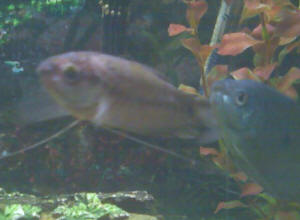
Re: sick fish...need advice 7/5/08 Neale, Thank you so
much for your prompt reply. <You are most welcome.> Today I
am going to attempt to purchase the Maracyn and start treatment.
I do have one question: If I remove the charcoal filter during
treatment, should I replace with a different type of filter for
that time period? I just want to make sure that I do this
properly. <Personally, I don't bother with carbon/charcoal
at all in standard freshwater aquaria. All carbon does is remove
organic compounds that accumulate in the water over time. These
are things that make "old" water in fish tanks yellow
and potentially acidic. In the old days people avoided doing
water changes, and so carbon was useful. But in the modern era of
fishkeeping we under stand that water changes are good, so you
can dilute any potential organic compounds in the water simply
with a weekly water change of 25-50%. Cheaper and easier and
better and safer than carbon! Problem solved. To actually work
"as advertised", carbon needs to be replaced every 2-4
weeks, something hardly anyone with carbon in their filter
actually does, underlining the pointlessness of the stuff. So
remove the carbon, and replace with something that will support
biological filtration, perhaps ceramic noodles or even filter
wool.> Also, in regards to your concern about the tank size,
would you suggest removing the tetras? <Neon tetras are ideal
fish for a 15 gallon system, so the short answer is no. Moreover,
compared with the Gouramis, their impact on water quality will be
minimal.> As of yet, none of the fish seem to be
"cramped", but what do I know! I have never seen the
Gouramis appear to be fighting, maybe playing from time to time.
<Fish will actually put up with a lot less than they actually
need to thrive. Human beings can survive in prison cells eating
nothing but porridge, but that isn't much of a life! The
thing with fish tank size is this: the bigger the tank, the
easier it is to maintain, and the less likely the fish are to get
sick. Newcomers to the hobby often assume a small tank is easier
to look after, perhaps for the same reasons that a small garden
is easier to maintain or a small car easier to drive. But the
analogy doesn't work, because the volume of the water is what
moderates the poisons produced by the fish over time (the
"sewage", if you like). The bigger the tank, the more
the poisons are diluted, so the more time you and your filter
have to keep things healthy. For newbie fishkeepers, a 20 gallon
system is really the ideal starting point, and anything smaller
just creating work for yourself. Even putting aside simple
maintenance, fish that get to 10-20 cm, as your Gouramis will,
just need more swimming space!> Oh, and after I wrote my last
message I was trying to do some more research and came across the
snakeskin Gourami. Our fish looks a lot like this type. I would
also like to thank you for pointing me in the right direction on
finding some reading information. I have already started in on
the links! <All sounds like good news! Trichogaster pectoralis
is a lovely aquarium fish, just a bit of a "Plain Jane"
compared with some of the other species in the genus. You have
probably come across it in another form though: it is, as I
understand it, one of the key species used in Thai Fish Sauce,
which you will certainly have consumed if you have ever eaten
Thai Food. Mostly it is farmed in rice paddies for the table or
for sauce making, but a few lucky ones get siphoned off into the
aquarium trade, and yours is one of those that escaped the
kitchen!> Have a great day (or maybe night for you). Shanah
<It's still day here! Cheers, Neale.>
|
Twitching Gourami - 7/1/08 Hi there. I have a question
I hope you can help... FW change induces Gourami beh. <Me too>
I've had my red dwarf for about 6 months, and have never had a
problem with cleaning the tank, and changing out the water. Yesterday I
had to break the tank down again, and change everything due to having
TONS of baby snails. Anyway, I changed his water, let it filter, and
put him and his tank mates back into the tank. Well today I noticed
that he twitches REALLY bad. Its really severe! I added "Aqua
safe" to the tank thinking that would help... But, he is still
twitching.. I don't know what to do for him. I don't have the
heart to flush him! What should I do... <Just wait here... likely
something re the change has triggered this... may well subside with
time> I have another Gourami in another tank that I've had for 3
years, and his owner before me had him 4 years, I've never had this
problem with him.. What have I done wrong?? <Not likely you so much
as the "times"... water quality, sanitizer use changes...>
NOTE: He's in a 10 gal. tank with 1 Pleco and 1 HUGE apple snail.
Thank you for your time! <Patience my friend. This fish has nothing
that is "catching". Bob Fenner>
POSSIBLE DISEASED GOURAMIS, HLLE --
06/28/08 Hi Team, I currently have a 35 gallon tropical tank, PH
7.2, Ammonia = 0, Nitrite = 0, Nitrates = 10-20. I have 2 Pearl
Gouramis, 1 male and one female and both have small holes around the
top half of their head around the eyes and 'nose'. They are not
filled with puss etc. They are empty like bore holes. <Sounds like
Head & Lateral Line Erosion disease (HLLE), a syndrome that may, or
may not, be related to the Hexamita parasite. I would treat for
Hexamita anyway, and also review water chemistry/quality.> The male
is a much paler colour than normal. <Again, consistent with
HLLE/Hexamita.> The female still looks a normal colour. The holes
are only on the Gouramis. All other fish seem unaffected (1 queen
arabesque Pleco, 1 Betta, 9 neon tetras, 1 swordtail).
<Hexamita/HLLE doesn't affect all fish species equally strongly.
Cichlids are by far the most prone, but Gouramis can develop the
symptoms too. I've never heard of Catfish, Livebearers or Characins
developing the disease. This isn't to say they don't, but it
isn't common.> I feed them on Tetra Pro flake food/varied
sinking pellets and a weekly treat of frozen daphnia or brine shrimp. I
would guess that this is hole in the head disease from the info on your
site but I change 10-20% water weekly and feed high quality and varied
food so I am not sure how this would have happened as this often
relates to poor water. <Indeed this is the case. But the infection
can be latent in store-bought fish, only to develop a few weeks or
months after purchase. Inbreeding may weaken the immune system of some
fish species. Nitrate is likely the triggering factor with cichlids,
but 20 mg/l nitrate is "safe", so not really sure what's
going on here. Regardless, treat first, worry about the science
later.> Is hole in the head disease infectious?? <Not really, no;
Hexamita quite probably sits inside the guts of most fish harmlessly,
and only causes problems when their immune systems are otherwise
impaired. If it is in your system, then all fish have been exposed, so
isolating any one fish won't make a huge difference. Since only
certain fish develop the disease (or diseases) there isn't any need
to worry about the catfish, tetras, or livebearers. By all means
isolate the fish if it makes treatment easier/cheaper, but beyond that
there's no overbearing reason to do so.> Are my other fish
likely to catch it from the Gouramis?? <Possibly the Betta.> Are
there any treatments available in the UK that you could recommend??
<Yes. eSHa make something specific for Hexamita/Discus Disease. Not
used it myself, but I rate their other medications very highly.
http://www.eshalabs.com/hexamita.htm > Or is it maybe too late to
save them?? <Fish can, do recover from Hexamita provided they are
treated and properly fed/maintained.> I would like to treat the
entire tank anyway if poss. as a precaution. Thanks Brian <Cheers,
Neale.>
|
Does my Gourami have dropsy or are they ready to spawn?
6/25/08 About a month ago, I inherited a "free"
fish tank for my daughter's birthday - 20 gal tank with 3
blue Gouramis- 1 male, 2 female, 1 Black Skirt Tetra, and 1 Pleco
- all are about 3 yrs old. <Hmm... at least some of these fish
don't belong here. The Pleco can, will, get very big assuming
it is one of the standard species. Expect 30+ cm, and obviously
such a fish will be totally unsuitable for a tank this size. It
will be a gross polluter, making the water filthy and this in
turn will stress the fish and cause algae problems. So he needs
to go. Black Skirt Tetras (Gymnocorymbus ternetzi) are nippy,
schooling fish. Singletons may or may not be "happy",
but they certainly have the potential to cause havoc. Gouramis
would be prime targets for their fin-nipping habits, so keep an
eye out. To round things off, male Blue Gouramis (Trichogaster
Trichopsis) are notoriously aggressive once sexually mature. I
personally don't rate the males at least as community fish,
and certainly not in small tanks.> This was the dirtiest fish
tank I have ever seen. Plastic plants and rock cave were almost
black. I threw them out. My mom used to breed angels and Discus,
and we checked out every Freshwater fish and aquarium reference
book from our library so I know just enough to be dangerous.
<Ah, no. Even a little knowledge is better than ignorance.>
To transport the tank, we had to drop the water level to just a
few inches. As soon as I got it home, I brought the water level
up again with de-chlorinated water and changed the filter - it
was completely clogged. Filter is just a Topfin 20. The gravel
was too large and was completely green and full of waste. Looked
like it hadn't been cleaned in 6 months. The water cleared
up, but the tank was so filthy, I had to do a complete gravel
change. <Gravel changes are rarely essential, but harmless
assuming the tank doesn't use an undergravel filter. Do bear
in mind that the "dirtiness" of a tank is a biological
thing. If the tank is inherently overstocked and under-filtered
(as yours is) the dirtiness will be right back again within
months, perhaps weeks.> I put the fish in a 10 gallon holding
tank with their "old" water, plus 80% water change
while I cleaned the 20 gallon tank. Also ran the original filter
and air pump. Fish seemed OK. Set up new tank with live plants
and new gravel and allowed to cycle for 2 days. Tested water at
LFS and all levels were good, except that ammonia was present -
harmful, but not dangerous. <According to whom? All ammonia is
dangerous. If you can detect it, you have a problem. My guess
here is too many fish, coupled with the fact that lots of big
fish = lots of food, so the filter can't cope either way. For
a 20 gallon tank, I'd honestly take in everything you have
and trade them in for something reasonable. Perhaps some nice
small livebearers, such as Platies, plus a group (4+) of
Corydoras catfish. I find a combination of understocking, healthy
plants, snails and shrimps beats the algae problem, and makes for
a very low maintenance, easy-on-the-eye aquarium.> I put the
fish in anyway, as they had been in the dirty water long enough!
Within hours of being in the new tank with plants, their color
stared to come back. In a few days they started being more
active. The male Gourami is now very aggressive and very
territorial. <And so it begins... This species isn't my
favourite by any means.> About a week ago, I noticed the water
temp went from its normal 78F to almost 84F. The heater was
broken, so I removed it altogether - home temp is usually around
76-78 anyway. Now - in the last week, one of the females seems to
have dropsy, but I am not sure. The male's color has really
deepened in the past week as well. He is dark blue and he is
displaying his fins a lot. I not sure if he is preparing to
spawn, because the bubbler moves the surface enough that he has a
hard time making a real nest. I did change their diet from just
flakes, to include dried bloodworms as well. One of the females
seems to be very pale to me, the other has the bloat around the
pectoral fin section that I see in many pictures on your website.
She seems to hang by herself more, and hides from the male by the
filter intake. He is pretty aggressive with the other two
Gouramis, but especially the swollen one. He nudges, more than
nips. My camera doesn't do a very good job, but I grabbed
these photos from the web and she looks just like this.
<<Stolen images not posted. RMF>> <It's
certainly possible they are preparing to spawn. It's
difficult to know, but if you see the male make his nest and then
the female spend time with him nearby, the chances are that they
are "in the mood for love". But do remember than male
Gouramis (of whatever species) rear the fry alone -- they will
drive away, even kill, the female after spawning because as far
as he is concerned, she's a potential predator. Fine in the
wild where the female goes off anyway, but in the confines of an
aquarium, potentially chaotic.> Oh - Water tests have been
good - all acceptable levels - Since the new arrivals in our
home, I think I have been to the fish shops at least every other
day picking up supplies, etc. They have been kind enough to test
our water each time and I think we're in good shape there.
<I do worry what you mean by "acceptable" levels.
Please understand that there is no "acceptable" level
of either ammonia or nitrite other than zero.> I do not have a
quarantine tank, in case she does have dropsy - I moved my Betta
from his half gallon plastic "tank" to the 10 gallon
tank. <For which your Betta is I'm surely eternally
grateful! Do consider expanding that tank a bit, by trying out
low-light plant species, shrimps, Nerite snails, maybe even some
dwarf catfish such as Corydoras hastatus.> What now? I
don't want to medicate if it isn't necessary, but how do
i know for sure? And what if they do spawn, can I safely put the
females with the Betta in the 10 gallon tank to separate them
from the male? <In theory, yes, but bizarrely enough the male
Betta might get a bit threatening. Conversely, some otherwise
community-safe fish nip the fins of Bettas just because they
can.> What do I do with the other 2 fish - the Tetra and
Pleco? <Trade 'em in.> If all is well, I would like to
upgrade the filter to an Eheim ECCO and change the Pleco for a
less "productive" algae-eater - any suggestions? - and
perhaps add a few Danios or Long-finned Rosy Barbs. <The Eheim
filter is excellent, though price-wise the 'Classic' line
is better value in terms of turnover (litres/hour) versus cost.
The big thing with the ECCO range is that they're easy to
set-up and use. That's a decision only you can make, knowing
your own budget. Either way, Eheim filters are superb. As for
algae-eaters, none of the fish sold as such are any good, at
least by themselves. Unless you have reasonably good plant
growth, algae is going to be a problem either way, and adding
extra fish just means there's more nitrate in the water, and
so the algae can grow faster. In a balanced aquarium, I find that
a combination of Nerite snails and algae-eating shrimps (such as
Cherry Shrimps) makes a FAR BETTER job of controlling algae than
any fish I've kept. And I say this as someone who's kept
fish for 25 years and tried out just about every type
algae-eating fish there is.> The tank is planted enough that
they will have refuge from the Gouramis. Would this be a good
combination? <Rosy Barbs are subtropical fish, and don't
really belong in this aquarium. Moreover at up to 12 cm long in
aquaria, they would need a tank twice the size as yours to have
anything like the swimming space they need. Danios are variable,
and some prefer relatively cool water (22-25C) compared with
"true" tropical fish, so research the species available
in your area carefully. They need lots of space, at least a tank
60 cm in length.> Also - how about Blue Emperor Tetras or Gold
Danios with the Betta - (Aqua Clear filter) <No, don't mix
these with Bettas; Bettas are too easily nipped. Instead go for
shrimps and/or inoffensive bottom feeders like dwarf
Corydoras.> Love, love love your forum. Thanks so much. Sandy
<Cheers, Neale.>
Follow up -with new problem... Re: Does my Gourami have
dropsy or are they ready to spawn? 6/27/08 <RMF in
for Neale...> So we traded for credit - the Pleco, the skirted
Tetra, and 1 Gourami yesterday - which we thought was a female,
but was in fact the second male Gourami - hence all the extra
aggression from the alpha male Gourami, which we kept with the
suspected gravid female (My daughter couldn't bear the
thought of missing the egg drama - so I decided to wait and see
how the pair does) they immediately seemed calmer - Last night I
noticed what I thought was a little bit of pink on the right fin
joint of the male Gourami - and decided to watch and wait.
<Good> This morning, his whole fin on that side is
decidedly pink-red - I'm not sure if this is an injury from
swimming between the rear glass and the filter intake - which he
does a lot - or if it is an infection, or an infection caused by
a injury? <Likely the latter> I am going to the LFS today
and will pick up some Melafix, <Mmm, I would not> in case
you advise me to use it, but will wait to hear back from you.
<See WWM re> Also - the male seems off today - even more
than just calm since we go rid of the other fish - even his color
seems off all of a sudden. They are hanging together a lot- seem
to be "cuddling" and swimming . I also notice him near
the top of the tank in "his corner" a lot, and she
rests at the bottom of the tank among the plants. I am very
suspicious that she actually has Dropsy and he has some other
kind of infection. <I would hold off on the use of any
"medicines"... wait and see if this all self-cures.
Much more trouble to be had by mis-medicating> My plan is to
wait and see if any spawning happens, and then to trade them in,
so my daughter can have her egg-sperience. If they are sick, then
I will have to treat them as well and then go from there. Took
your advice about the shrimp and snail. We already had a Yellow
Apple/Mystery Snail and we're looking for a Cherry Shrimp or
two - no one has them in Orlando - so we'll wait. Also
looking for a Zebra Nerite Snail - any ideas where to get them?
<Just to call about the local fish stores... They may be
able/willing to order for you> What do you think about the
Gouramis? Should I treat with salt bath, or Melafix? <Mmm, if
anything the salt> I am also doing a water change later this
evening. <Good> Thanks again, Sandy <Welcome. Bob
Fenner>
2nd follow up Re: Follow up -with new problem...Re: Does my
Gourami have dropsy or are they ready to spawn? Follow up to
follow up - -- 06/28/08 Today after last night's 40%
water change with 1 tsp aquarium salt/ gallon in the new water,
he is more himself again and fin seems improved. <Ah, good>
It is not quite as red, and he seems much more mobile. He's
swimming around quite normally and she is doing the same. Noticed
same fin irritation starting on hers - and just like his - only
on the right fin. But hers is just beginning like his was 2
nights ago. Will continue to watch and wait. Nothing happening as
far as nesting, but I guess he's not feeling 100% with the
fin. I moved some plants around to discourage them from swimming
behind the filter intake. I am amazed at how much calmer they
both are without the extra company in the tank. Would you advise
adding some Stress coat to the water, or just leave well enough
alone for now? <The last> Thanks again. Sandy <Welcome,
BobF>
|
Blue Gouramis Issues... Colisa lalia, GSP...
05/23/08 Hello, <Hi there> I have a 35 gallon tank. I
have a kissing Gouramis about 5 years old and a blue Gouramis the same
age. They were the only fish in my tank for about 1 1/2 years until
recently I decided to add a dwarf Gouramis, <Disease problems...>
Pleco, green spotted puffer, <Incompatible... a brackish species...
and nipper> and some ghost shrimp for the puffer to eat about 2
months ago. Starting approximately 4 days ago, I noticed my blue
Gouramis swimming in a back and forth motion into the wall of air
bubbles for hours at a time. When he's not doing that he is
swimming frantically around the tank. Today when I came home I noticed
all his fins were rust colored as well as the entire lower portion of
his body. He does discontinue his crazy behavior to eat but then
continues shortly after. He has hardly any interaction with the other
fish (at least that I have seen). He used to play or maybe fight,
I'm not sure, with the kissing Gouramis for many years but now
shows no interest at all. I purchased the new fish thinking the two of
them were board being alone and could use some new friends. I hate to
see my little blue - really big blue- friend so unhappy. I've tried
researching his behavior and color change on my own but can't find
any answers. I would greatly appreciate you help. Thank you kindly,
Little Blue's Mom <... the Trichogaster may have "caught
something" from the Colisa lalia... Please read re them on WWM...
and the GSP... You have induced troubles. Bob Fenner>
General questions about Gourami 4/19/08
Hello! I came across your website today while I was looking for
information about Gouramis. I'm quite new to fish ownership, so
please excuse any stupid questions I might pose. I started off with a
small tank, only 20L (which I believe is only about a really tiny 5
gallons...) <Way too small for practically any tropical fish. Almost
any problems you have will come down to the tank, so your NUMBER-1
priority is replacing this with a system at least 20 gallons in size.
Ten gallon and smaller tanks simply aren't easy for inexperienced
aquarists to maintain or stock properly.> I have a Silvertip Tetra,
2 Corys and a 'Gold' Three-Spot Gourami. <All completely
non-viable in here. While I'm happy to help explain any specific
problems, none of these fish will last long (or be happy!) in here for
any length of time. So "fixing" the problems is a waste of
your time (and likely their lives). The Silvertip tetra MUST be kept in
a group of six or more specimens and easily needs a "long" 20
gallon (in metric terms, that's something like a 75 gallon tank not
less than 60 cm in length). The Corydoras need something similar, and
should certainly be kept in groups of 4-6 specimens, minimum.
Three-spot Gouramis are BIG fish when mature, around 10-15 cm, and even
a 20 gallon tank is too small for a territorial male. When mature,
males of this species are incredibly aggressive and disruptive.>
P.H. level is 7.0 and has never gone more than 0.2 up or down.
<Still WAY more pH change than happens in an aquarium properly set
up; small tanks are intrinsically unstable, and this is one aspect of
the problem. Instability = dead fish.> There's only one plant as
previous ones were eaten... <No, not eaten. They died, and then
decayed. Tanks as small as the one you have almost never come with
strong enough lights for plants to grow. Furthermore, inexperienced
aquarists are often sold non-aquatic plants, often under such names as
"umbrella ferns" and "dragon plants" and the like.
As with fish, you need to research plants *before* purchase, otherwise
you WILL be sold junk. An informed shopper is a successful shopper.>
I have yet to pick up an ammonia kit, and should be getting one
tomorrow. Last week one Cory cat died, so I wanted to ask about that as
well. It just became quite listless, and would often 'fall
over' onto its side. It showed no signs of disease, and I did see
it eat, though perhaps not as much as it used to. <Likely
chronically bad water quality, insufficient water movement, inadequate
oxygenation. Or multiple causes. Anyway, no surprises here.> The
other fish seem fine though, which brings me to my actual question.
Near its tail, my Gourami seems to have some kind of 'bubble'
in its body. Like a clear lump that looks like a bubble...I was just
wondering whether it's something to worry about, <Yes... likely
an incipient bacterial infection of some kind.> or whether I just
haven't noticed that part of its anatomy. It's quite young, I
believe, only 6cm long (not even 3 inches), if that's any help.
<Still needs treating with a reliable antibacterial/antibiotic (NOT
Melafix/Pimafix).> I do water changes every week, and I always
remove uneaten food. Thanks, Kit. <Water changes every week
don't even begin to come close to solving the problems you have
here. If you're one of the people who gets offended by me saying
"everything you're doing is wrong" I apologise for
hurting your feelings in advance. But yes, you are doing everything
wrong, and the chances of success are virtually nil. None of these fish
will be happy in this system, even if by some miracle they survive.
They MUST HAVE a 20 gallon/75 litre aquarium to be even close to happy
and healthy. Your move. Cheers, Neale.>
|
Sick Gouramis... Pleco comp. -- 03/07/08 Hello, all.
I've read a great portion of your website, mainly the Q&A
section. I have searched in great lengths for problems similar to
mine, but to no avail. However, I have gathered a great deal of
knowledge about the hobby in general. <Very good; but please
don't think that replaces buying a book! Before you buy a
fish, buy a book -- there is so much to learn!> Apologies in
advance, this will most likely be fairly long. Also, I am at
great risk of sounding like some kind of *emo freak* as I never
imagined I would actually get so attached to fish. <I have no
idea what an "emo freak" is. Must be some sort of
American thing.> Here goes: My hobby started with a Christmas
gift. A 5 gal tank with built-in filter & light, hex shaped.
<5-gallon tanks are known in the trade as "buckets".
They're of no good for keeping fish, and certainly not by
beginners.> Being ambitious and completely ignorant, I filled
the tank and promptly added WAY too many fish. 2 Dwarf Gouramis,
which died within days of what I have read to be Dwarf Gourami
disease (brought on by ammonia poisoning, no doubt) and 5 (yes,
ridiculously, 5) Paradise Fish - Blue variety. <Oops.> I
did a very limited amount of research and learned that for the
fish I currently had still living, I needed at least 20gal.
<Not a chance. Paradisefish are mutually aggressive, and males
are very much "one to a tank". They will also fight
with other similar looking fish, including, I dare say, Gouramis.
Paradisefish are not community fish and are never, ever
recommended for beginners by sensible aquarists.> After
several fights with the hubby, he finally bought me a 29gal. I
filled it, moved the fish in, and started reading about the
cycling process. This is when I started to feel like a serial
killer. I read that Paradise fish are actually very forgiving in
regards to water quality, and if you are going to be cruel enough
to cycle with fish, they are ones to use. <Up to a point this
is true, but even hardy fish can be killed by high levels of
ammonia and nitrite. That's why you need to have your nitrite
and ammonia test kits, and as soon as you detect more than 0.5
mg/l of either, you do a BIG (i.e., 50%) water change. This may
well be as often as once a day for the first couple of weeks!>
So, I did frequent small water changes to keep the ammonia and
nitrites down, and eventually, the tank cycled. It has been
steadily 0 ammonia & nitrites, and low nitrates (10 or less)
for at least a month now. All my fish actually did great. I got a
black Sailfin Pleco for the algae problem. I read up on them, and
saw that they will "suck" on sick or slow fish, but
mine seem to be active and very quick. <The Sailfin Plec is
likely Pterygoplichthys pardalis or similar. These are HUGE fish
and require tanks 55 gallons upwards. Completely unsuitable for
this system. In any case, they have no positive impact on algae.
Think about it for just one second: algae grows when the water
has fertiliser added, i.e., nitrogenous wastes from the fish. Add
more fish, the water is more fertile, and the algae grows faster.
Add a huge catfish, and even though it's eating algae, it is
also eating catfish pellets and vegetables, so will be making the
water much more fertile. It's a case of one step forwards and
seventeen steps backwards. There are only TWO ways to control
algae: use lots of fast-growing plants, or use elbow grease and a
scraper. There is nothing else. Nada. Nix. Nyet. Non. Nein.>
Then... got up one morning, and one of my females looked like she
was missing scales. She was still acting normally, so I added
some Melafix, as it supposed to help with missing scales and
Finrot. <I'm not impressed with Melafix. Because it's
cheap and "New Age" people buy into it, but it
isn't any more effective than any other cheap, New Age
medication.> It only got worse from there. When I got home
that evening, it was an open (almost looked to bleeding) wound. I
searched the internet, and closest thing I could find was
AEROMONAS (hole in the side disease). <Hole-in-the-Head is not
caused by Aeromonas bacteria. These are different syndromes.
Almost certainly you're dealing with a plain vanilla
Aeromonas infection, what on a human would be considered sepsis.
The skin is damaged, and otherwise harmless Aeromonas bacteria
get into the wound and cause serious problems. Long term: death
through blood poisoning. Use something like Maracyn or eSHa 2000
to treat.> It seems, though, that this is more commonly
associated with wild or farm fish. <No, the problem here is
more than likely physical injury and/or poor water quality. I
hear what you say about the good water quality stats, but the
overwhelming experience of most newbie aquarists is variable to
poor water quality, e.g., by overfeeding, under-filtering, or
overstocking. So take a conservative approach, and assume the
worst case scenario.> I moved her to the 5gal (now hospital
tank, also cycled) and tried feeding her anti-bacterial food
(soaked and broken up first). She wouldn't touch it, and
developed dropsy that night. She was dead the next morning. <I
bet.> Next was one of the males. I tried parasite treatment on
him. Dropsy, and died within a day. <When masses of fish die
for seemingly random reasons, the problem is 99.99999% likely
water quality, water chemistry, or poisons. So: check water
quality, and do a 50% water change daily until thing settle down.
As for water chemistry, check the pH isn't fluctuating
wildly. Fish are somewhat tolerant of the "wrong" pH
and hardness relative to what they prefer, but what they
can't abide is changing water chemistry. Finally, consider
poisons. Things like paint fumes can quickly kill fish. Small
children are apt to dump things in fish tanks, so it's
important to make sure that doesn't happen.> Now my second
female has a hole on either side of her body, well behind her
gills, mid-body. Also - a large hole, as if something is eating
away at her, on her anal fin. it is near her tail. She is now in
the hospital tank, and I ordered Maracyn Two, which is on the
third day of treatment, and no change, only getting worse.
<Stop moving the fish to the 5 gallon tank. Pointless. Such a
tank is a death trap itself. Treat the whole tank with Maracyn.
Be aggressive with water changes (big, often). Study water
chemistry and quality closely. Above all: DO NOT FEED the
fish.> One of the males left in the main tank now has a hole
in his side, and the other has a hole in his anal fin, in the
same exact location as the female. I have tried to take photos,
and they just WILL NOT hold still long enough. If they won't
eat the anti-bacterial food, and the Maracyn doesn't help,
then I am at a loss. The girl in the hospital tank is developing
fungus, and I don't want to treat for the fungus while still
using the Maracyn, in case there would be a reaction. I am afraid
that they are developing secondary problems due to all the
HORRIBLE water conditions I subjected them to. If this is the
case, do they stand a chance at all? <If you do precisely what
I say, yes, some should recover, assuming any Finrot (for
that's the issue) is limited to superficial tissues. But if
the body cavity is infected, then realistically, no, the fish
aren't likely to survive.> Just a mention - the sick
female (now in hospital tank) was being harassed by the Pleco. He
would attach to her, and she would shake him off, but he probably
did the most harm while I was sleeping and could not monitor. Is
it possible this is what is happening to the other? I can't
imagine the Pleco would decide to attach to the anal fin,
though?? <Obviously this Plec needs to go back to the pet
store. This is non-negotiable. How, why it is sucking onto the
fish is largely academic (though I imagine it is hungry because
you are not providing the foods it needs).> OK, I drew a rough
image with Paint, which looks like a child created (hence the
file name "kindergarten fish") showing the same
location all fish are developing the hole in their sides and
fins. <Yikes!> I never dreamed I would feel so bad over
fish, but they are part of family now, and I really don't
want to lose them. What can I possibly do?? <Read, learn,
understand.> Thank you much, Jiffy <Cheers, Neale.>
Re: Gourami/Paradisefish problems --
03/07/08 Thank you, Neale, for your speedy response.
<You're welcome.> It seems my worst fears are realized
and I have done unrepairable damage to most of my fishy friends.
:( <Quite possibly.> Emo = emotional basket case, which is
what my hubby and most my friends think of me when I go on and on
about saving my fish. <I see.> As of tonight, the 5-day
Maracyn treatment will be completed in the 5 gal, and the girl is
not doing any better. The reason I have been moving them is
because the other fish seem to realize who is weak and pick on
them. <Oh dear.> Since the treatment did not work on her, I
will treat the remaining 2 (sadly, both males - maybe I need a
tank separator) in the large tank. <Does sound a short term
solution, at least.> The Pleco was purchased with the
understanding that it would eventually be returned, upon
aggression or growing to large for the tank, so he can easily be
returned to the pet store. Once he cleaned the tank, I started
feeding the sinking algae disks when I turned off the lights, and
witnessed him eating voraciously. I have read that they attack
sickly fish, and suspect this is the case here. <Loricariid
catfish are classic opportunists (like humans) and they will have
a go at whatever seems edible. That's their ecological niche.
While they rarely, if ever, cause problems in tanks with healthy
fish... in tanks where fish are dropping like flies, I dare say
even the best behaved Plec isn't above taking advantage of
the situation.> How long should I not feed? A couple days? the
duration of the Maracyn treatment? <The latter at minimum.
Fish can last a week without food, and after that week, feed
small amounts once per day. No more.> Finally, what book(s)
would you suggest? I will gladly purchase and read anything that
will help me to better care for my fish. <Many, many choices.
Go visit your local bookstore, and have a browse. Look for
something published reasonably recently so that it is up to date
in of filters, medications, etc. Don't be dazzled with pretty
pictures -- some aquarium books that are "coffee table"
type books look lovely to look at, but thin on information. Pick
something that clearly explains about filters, water chemistry,
disease and so on. If it has a section on community fish, listing
their water chemistry needs, preferred temperature, social
behaviour and diet then so much the better. You can use that to
decide what fish you want to get next. But right now your need
isn't for a book containing hundreds of fish or advanced
topics like plants or cichlids; you want something focusing on
the foundations of the hobby. Master them, and the rest of the
hobby is pretty straightforward.> Thank you so much for your
expertise, Jiffy <Cheers, Neale.>
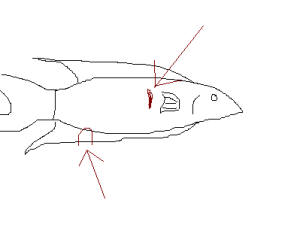
|
Gourami cannot swim... new-tank syndrome?
03/04/2008 I have a 20 gallon tank with 3 hatchet fish, 3 ghost
catfish, 3 neon tetras, and 1 Gourami. The tank is only about 2 weeks
old. <Yikes! I hope it is cycled... Do you know what this means?>
Two days ago I noticed that the Gourami was lying on the bottom of the
tank, but then he returned to acting normal. The next morning he could
not swim right, his head always seems to be above his body, like its
lighter than the rest of him. Later that day he could not eat and he
was doing spastic back flips and spiraling with no coordination. He
looks completely healthy. He seems to be going downhill. Any
suggestions that you have will be well appreciated. <... Please read
here: http://wetwebmedia.com/FWSubWebIndex/fwestcycling.htm and the
linked files above. You don't offer sufficient info. for a useful
response... I suspect this environment is not ready for fish life
period. Bob Fenner>
My Kissing Gourami is losing weight 03/04/2008
Hi, My pink kissing Gourami is loosing weight quickly. I have a 20
gallon aquarium with two kissing Gouramis (6 months), two gold Gouramis
(3 months), one fire Gourami (3 months), a leopard bush fish (5 days),
and a Chinese algae eater (three months) (Gyrinocheilus aymonieri).
Everyone is under 2 inches except the algae eater he is about 2 1/2
inches. About a week ago I noticed one of my kissing Gouramis was
loosing weight and yesterday I realized he was really skinny. Every so
often he will go to the back corner of the aquarium and sit on the
bottom. His eating habits haven't changed and I know that he eats
well because he eats on a separate side of the tank than the other
fish. He is not being picked on, and other than sitting on the bottom
at times he's not lethargic. I have a 20 gallon Penguin 100
Bio-Wheel Power Filter, two 20 gallon AquaClear submersible heaters (it
gets cold in my house and one was having trouble keeping up), and two
aerators. It is pretty well planted with a big rock that has caves in
it where the fire Gourami and bush fish like to hang out. I use API
aquarium salt (1 tablespoon per 5 gallons), and one a week I use API
Stress Coat and API Stress Zyme. My ammonia is 0, my nitrate is 0, my
nitrite is 0, and my pH varies between 7 and 7.6. I clean my aquarium
every other week and change 25% of the water using only distilled
water. I alternate my feeding between TetraMin Tropical Flakes and
frozen blood worms. I have had trouble with dwarf Gouramis in the past,
but this seems to be a good group that gets along well with one
another. I really love my aquarium and my fish and if I'm doing
something well I want to know so I can fix it. Thank you for any help
you can give me. Sorry if it's way to much information. Ryan
<Hello Ryan. First let's be clear that your tank is overstocked
with the wrong species. Gyrinocheilus aymonieri gets to about 25 cm and
is a completely psychotic, non-community fish once mature. If there is
a fish I would BAN from the trade, this would be it! Responsible for
more terrified community fish than anything else I can think of. A
nasty, nasty fish. The Pink Kissing Gourami Helostoma temminckii is
another big fish, potentially reaching 30 cm, though 15-20 cm is more
typical in captivity. While a tolerable community fish in jumbo
systems, it simply isn't viable in a 20-gallon tank. It needs a
tank something like 4 times bigger. Secondly, Helostoma temminckii is a
very difficult fish to maintain in aquaria; it is at least partially a
plankton feeder, and it needs to be fed a lot of food, more or less all
the time. In big tanks this isn't so much a problem because
there's enough filter capacity to compensate for that, as well as
algae-covered surfaces for grazing. But in small tanks if you provide
the fish enough food, you'll likely find water quality plummet.
When kept in mixed communities they also tend to lose out at feeding
time because they can't wolf down food as fast as the other fish.
Seriously, they need to be getting 3-4 meals per day, and those meals
need to be good quality algae-based flake foods. There must also be
constant supply of green foods, such as blanched curly lettuce (not
iceberg!) or Sushi Nori; tinned peas may be take, too. While it is
possible your fish has some other "wasting disease", my gut
feeling is that it is simply starving to death. You seem to be
suggesting one specimen is fine but the other one is thin; because
males are bullies, it is possible that the weaker fish doesn't get
access to food as often as it needs. One last thing: why are you using
distilled water in the aquarium? STOP! This is very bad for your fish.
Just use plain vanilla tap water (not water from a domestic water
softener) with suitable dechlorinator. There is no need to add salt.
Cheers, Neale.>
|
One skinny Gourami, one
bloated Gourami 3/3/08 Hello All! I'll try to
be as concise as possible, I have a 40 gallon freshwater
aquarium. The occupants are 4 adult platies, about 6 juvenile
platies, 1 Opaline Gourami (the other is in sick bay), a Pleco
and a Chinese algae eater (it was originally in a 10 gallon, but
I knew it needed more room so I moved him to the larger tank).
All water conditions are optimal, I do 25% water changes for 3
weekends , then a 50% on the fourth. I purchased these 2 Gouramis
about 6 weeks ago, put them in the quarantine tank, and well, the
bigger one started attacking the smaller one non-stop.
Wouldn't let it eat, etc...(turns out they are both males)
After a week of this I put the larger one in the 40 gallon. (I
know, a little too soon) I feed them flake food most of the time,
but every 3-4 days I give them blood worms and brine shrimp. I
also add algae disks for the algae eaters, which the other fish
eat on, too. Last week I noticed both Gouramis had long stringy
feces (no color to it, just transparent looking), so long it
would get caught on their feelers. Now the larger of the two is
bloated, but the smaller one looks normal (I've managed to
get him to eat some Tetracycline), but still no visible bowel
movement. The larger isn't eating at all, but is still
bloated, and I haven't seen any bowel movements from him in
about 3 days, either. My question is: Is he just
bloated/constipated, this all seemed to happen after the last
time I gave them the blood worms and brine shrimp. Or is it more
likely a bacterial infection? I've looked up Hexamita, and
that is another place where I'm finding some confusion. Some
sites list it as an intestinal bacterial infection with the
symptoms I've listed above, but other sites call it
"Hole in the Head" disease??? He doesn't have any
holes in his head or body. He's just "stuffed"
looking. No fins or scales are protruding, so I'm sure it
isn't Dropsy. And all the other fish seem healthy. Oh, and as
far as getting him to try a sweet pea, or eating medicine, he is
having NO part of eating anything! (Just an extra note, he seems
to be doing a lot more surface breathing than the smaller one.)
Thanks so so much, I LOVE YOUR SITE! Nicki <Hello Nicki. First
things first: when you say "Opaline Gourami" you mean
Trichogaster trichopterus rather than the small Gouramis (often
called Dwarf Gouramis) Colisa lalia? I only ask because the
latter are notoriously prone to a viral diseases called Dwarf
Gourami Disease that is incurable. The symptoms are very
consistent: lethargy, loss of colour/appetite, sores on the body,
swelling, then death. While it is possible that other Gouramis
might contract this disease, particularly Colisa hybrids, I have
not yet heard of Trichogaster spp. coming down with it. Now, I
will say a few things about food: Freeze-dried foods do tend to
cause constipation in some fish, particularly if used overly
often. Live foods can be a potential source of infections. So
while both these food items are popular with aquarists, they are
not without risks. Moderate feedings of dried foods (including
flake) with generous use of wet-frozen or fresh foods seems, to
me, to be the ideal. In any case, if constipation is the problem
(and it may well be) then use an approach similar to that
outlined here for Goldfish:
http://www.wetwebmedia.com/FWSubWebIndex/gldfshmalnut.htm You may
need to focus on daphnia rather than vegetables as laxative
foods, but tinned peas may be eaten. As for Hexamita or
Hole-in-the-Head -- these are arguably the same disease,
manifested in different ways. External infections cause pitting
in the surface of the fish, usually around the lateral line,
while internal infections cause wasting. Anyway, treatment is
very difficult, though there are Hexamita-specific medications
such as ESHa Hexamita Treatment (both forms), Metronidazole (for
internal infections) and Quinine Sulfate (external infections).
Treatment almost always depends on the fish being dealt with
promptly; once established this infection is very difficult to
cure. Hope this helps, Neale.>
Re: One skinny Gourami, one
bloated Gourami 3/6/08 Thank you Neale! Yes, they aren't
the Dwarf ones, they are a hybrid of the 3 spotted blue Gouramis.
<Okely dokely.> So, an update: I managed to get the one in
quarantine to eat the Tetracycline for 3 days as directed, and he
finally had a real fish poop, no longer stringy and transparent.
And he appears to be back to his old self again. <Sounds
positive.> The other isn't eating anything! But now, I can
see it is Dropsy, his scales are just now starting to stand out.
I still can't get him to eat the Tetracycline. So I'm
going to check out your site for more info, and make a trip to
the Pet store for something that can be added to the water (I
switched him into Quarantine, and the other is in the big tank
now.) <Start here:
http://www.wetwebmedia.com/FWSubWebIndex/dropsyfaqs.htm Though
realistically, getting small fish back from Dropsy infections is
very difficult. By the time you see the fluid build-up, the
damage has largely been done. I'd tend towards painlessly
destroying this fish now.> I really do appreciate your site,
it has been such a blessing! <Thanks!> I'll keep you
undated! Nicki <Good luck! Neale.>
Re: One skinny Gourami, one
bloated Gourami Hi Neale, I wanted to let you know that he
did pass the following day. It was pretty sad, I was watching him
and suddenly his swimming became "bobble" like, then he
was on his side, just like that. I'm happy to say that the
other is back to full health, and enjoying a life in the larger
tank. :) I think the fact that he'd eat the medicine is the
sole reason he made it. <Ah, too bad. Well, glad the other
fish is feeling better. Good luck! Neale.>
|
Dwarf Gourami Disease 2/25/08 Hello
again! <Ave,> Okay, I read up on the links, and now I am worried
for the rest of my Gouramis (dwarf and regular). <It's only
Colisa lalia and Colisa hybrids you need to worry about; other Colisa
and all Trichogaster seem resistant or immune to the Dwarf Gourami
Disease pathogen.> If I remove the sick fish, are the rest of them
going to catch it? <See above.> I just did a water test: my
nitrates are about 30ppm (I am due for a water change), nitrites are
0ppm, the water is testing at 150 (hard), 120 alkalinity and pH at 7.2
(neutral). Should I be adjusting anything? <Nope.> if Yes, how do
you advise as the best way? <Broad advice for water chemistry is
this: if you don't know how/why to adjust the water chemistry, you
probably shouldn't do it. It is easier to mess things up
completely. In fact, your water chemistry is just about perfect for a
broad range of community fish.> Sorry to keep asking, I do
appreciate the assistance! Cheryl <Happy to help, Neale.>
|
Blue Gourami with black head
-- is he sick? -02/20/08 I have a blue Gourami that is
at least 3 or 4 years old -- he's (I call him a he but have
no idea if he is a he or she) <Males have long, pointed dorsal
fins.> in a 10 gallon tank along with 2 goldfish, 2 neon
tetras, and 1 sucker fish. Has been in the same tank with these
fish for about 2-1/2 to 3 years. No problems so far. <All this
in a 10 gallon tank? Madness. The sucker fish is either a
Pterygoplichthys catfish (average size 30-45 cm at maturity) or
Gyrinocheilus aymonieri (only slightly smaller but infamous for
its aggression). The Goldfish need a tank at least three times
this size all by themselves. Oh, and Neons are schooling fish,
and are only happy when kept in schools of six or more. While you
might not have had problems yet, that's rather akin to a guy
not killing himself at the first round of Russian Roulette and so
declaring the game "safe".> We were away on vacation
for the past 3 days and when we returned home last night, we
noticed his head has turned black or maybe a really dark blue. It
covers his entire head back to his first set of fins on either
side. He is swimming around just fine and he is eating just fine
-- not acting like there is a problem. The only thing that we did
differently when we were away was that we: 1) fed them all using
a 3-day tablet feed; <No need to feed fish for a 3-day
vacation; in fact it is safer not to.> and 2) turned the
heater on in the tank since we'd be away and the house would
be slightly colder so the tank temperature was about 2 degrees F
higher than normal. <How warm is this aquarium otherwise? How
do you keep tropical fish in an aquarium without a heater? Unless
your home is constantly at around 25C/77F day in, day out then
these fish are not at all being kept correctly. Seriously: are
you winding me up? Big fish in a tiny, unheated tank!! This
sounds like someone trying to wind me up... everything is wronger
than the wrongest thing that anyone has ever gotten wrong.>
All the other fish are fine and he seems fine, I just do not know
what this color is. Should I be concerned? <Very, very,
concerned, though not specifically for the Gourami. Without a
photo, can't say what's going on. Could be viral or even
nerve damage (which affects the chromatophores) but this fish
sometimes change colours thanks to genetic abnormalities.> If
so, what should I be doing? <Buying a bigger tank and leaving
the heater on all year around would be a start.> Thanks ahead
of time for your help, Pam <Cheers,
Neale.> Re: Blue Gourami with black head -- is he
sick? 2/21/08 Thanks for your comments -- I get the
suggestion about the size of the tank and about not feeding them
when only away for 3 days. Will do. <Very good.> I need to
explain about the heater being off/on. The tank is located near a
heated radiator (yes, I live in a home that is 80 plus years old
and is heated with radiators, not vents or baseboard heating) and
it is located near a window that has sunlight coming in most of
the daytime. So, the heater is not always on because the
temperature spikes so severely in the winter daytime when it is
sunny. I've tried different heater types so that I do not
have this problem and it's the same. Moving the tank is not
an option -- no other location for it. When we go away, however,
the heater is always on. This was the case this past weekend when
we were away. <OK. So long as the tank doesn't go above
30C at its hottest or below 20C at its coolest, you're fine.
But I would try placing aluminum foil (for example) behind the
tank to reflect away some of the sunlight. If pasted behind the
aquarium backdrop you won't see the foil. Placing a fan above
the tank in summer, to increase evaporation, will also help cool
things down. Regardless, putting tanks on windowsills above
radiators isn't considered best practise!> Back to the
Gourami-- here are a few shots that I took just now. I have
inserted them into this email and am attaching them as well. I
hope you can get an idea of what I mean by his head being black
or dark blue with these. They are the best I could get with a not
so great camera -- sorry if they are not so great. <Odd, but I
don't think dangerous.><<Is not... just neurological
impairment. RMF>>999 Any ideas on what this is? <No
idea.> Thanks for your help. Pam <The fish is a male, by
the way. Cheers, Neale.>
|
|
.JPG)
Interesting comment on
Gourami... Darkening beh. 2/26/08 Hi there!
<Kerstin> I wanted to respond to an email sent in the other
day, where Pam had a Gourami that turned partially black. Your
comments were: Neale - Odd, but I don't think dangerous; Bob
- Is not... just neurological impairment. <Please do> I
wanted to write to you because I have seen this as well. Two
years ago I purchased a Blue Gourami and several Guppies for my
son's class aquarium. About one month after this purchase,
another mom also donated some fish. We never figured out the
exact type of fish, but we know that one of them was extremely
aggressive, to the point that every other fish in the tank lived
in a 2x2xtank-height column of the tank. By the time I saw this,
the front half of the Gourami had turned black, so I asked
another teacher (who had several guppy tanks) if she would take
the fish, which she happily did. When I saw Pam's query, I
asked the teacher if she still had the Gourami, and if he ever
turned all blue again. Her response was: "Yes, all the time!
I put him in my turtle tank because he tended to be aggressive
with any other fish. Any time that I add water, clean or feed,
the fish darkens. His whole body turns black -- not just his
head. Once I get away from the tank, he starts to lighten up. He
pretty much goes back to gray/white in about 30 minutes... No
response is necessary - I just thought it was interesting that
someone else wrote about this situation as well. Thanks for your
great website that lets us learn about cool things like this,
Kerstin <Thank you for sharing. Such darkening can be
temporary or not... depending on cause... Bob
Fenner>
|
Golden Gouramis, hlth. 1/27/08 Hi there! We
have a new 72 gallon tank. Set it up, left it for a week, tested the
water, and all seems perfect (nitrates, ammonia etc come up as ideal on
the test strips) except it may be just a bit alkaline. Bought our first
fish 3 golden gouramis, 5 rosy tetras and 3 long fin Serpae tetras.
<Serpae tetras -- Hyphessobrycon Serpae, plus related species in the
genus -- are notorious fin-nippers. You can probably already see their
raggedy fins. Anyway, they're not compatible with Gouramis. Unless
you want gouramis with nibbled fins, Finrot and Fungus. Please please
please research fish before buying them. Lots of so-called
"community fish" aren't.> Also moved a rather large
(6") Pleco from a previous tank. All seemed well until yesterday,
when one of the gouramis colours seemed to start fading and the bottom
edges of his bottom fins appear orangish. <Which "bottom
fins"? If the pelvic fins (the "feelers") those can
change colour according to sex. Certainly that's the case with
Trichogaster microlepis. Not sure about Trichogaster trichopterus
though. If the anal fin (the unpaired long fin between the
"feelers" and the tail fin) then I'd suspect Finrot. The
bacteria start by forming clots in the blood vessels, and these turn
pink. Eventually the surrounding tissue dies, and the fins rot away
from the trailing edge inwards. Treat at once, and remove the Serpae
tetras, since they're as likely as anything to start Finrot in
gouramis. Finrot is normally caused either by physical damage (e.g.,
nipping) or poor water quality, so do also check the nitrite just to be
sure.> Today, he didn't eat, even though he was at the surface
of the tank, and then he went and hid at the bottom of the tank. The
other two gouramis seem normal and are eating and I haven't seen
any sign of aggressive behaviour. I have no idea if these gouramis are
male or female or how to tell the difference. <Male Trichogaster
trichopterus have much longer dorsal fins; the female's dorsal fin
is about half the size, if that.> One other thing, the faded Gourami
seems to be trailing a thin white poop. don't know if this means
anything. <Can mean a variety of things. It isn't normal, but it
isn't necessarily a disaster either. A more varied, high-fibre diet
is probably the thing you need to do here.> Also wanted to ask about
the Pleco. He has always been somewhat reclusive, but now that he is in
the big tank, he has retreated into a hollow tower (I can see his fins,
and they do move) and hasn't come out in about 3 days. Should I be
worried about him, or is this normal? <Put some cucumber or
courgette in the tank tonight. If it's been eaten by the morning,
then all is well. If it's still there, then you may have a
problem.> I am still feeding him with Spirulina tabs. Looking
forward to your reply, Cheryl <Hope this helps, Neale.>
Gourami, Trichogaster, dis., reading
12/10/07 Hello, <Hi there> I have a blue Gourami that has a
slightly swollen mouth and is unable to eat. This fish was a
particularly aggressive fish in our 30 gallon tank and ate very well at
feeding times. Because of his aggressiveness I purchased a 10 gallon
tank to put him in. I let it cycle for one week <Mmm, not long
enough> and went out of town for Thanksgiving. When I returned, my
mother had put the fish in the 10 gallon tank because she was concerned
that he was becoming overly aggressive with the other fish. ( I have
since made my mother understand that she is NOT to handle the care of
my fish...lol!) <Mmm, better, in my estimation, to engage your
mother in this hobby interest... inform, educate her, enlist her
help/association> My tank has perfect PH and all of the levels are
fine. <What does this mean?> He has plenty of oxygen from a
bubbler, great filtration with carbon and a heater set to 80 degrees
and tank salt. <Don't need, "like" salt/s> I
noticed his mouth a little swollen about 3 weeks ago and he gradually
stopped eating. His mouth barely opens enough to get oxygen and he
certainly can not open it enough to inhale his food. He actively seeks
out food but can not eat. He pushes his lips out so far that I'm
able to see the muscles that attach his lips to his face. There are no
other changes to the fish that I can notice. His color is fine. I have
noticed that he hides a lot from me but I attribute that to his being
sick. He is currently living with 4 cherry barbs and they all seem to
be fine. No aggressiveness, and the barbs eat just fine. None of his
symptoms started until I introduced the barbs to his tank. Should I
take the barbs out? <No... I would leave all in> I did a 20
percent water change about a week ago and for 4 days now I've been
treating the tank with Pimafix. <Worthless> Per suggestion from
Petco. It's an antifungal all natural remedy. <Is a fake... a
tea... if you get sick...> It's not working. Now my fish have
Ich. <... likely bought on by stress... the "Fix"...>
I've treated the tank once yesterday for Ich but now I'm
worried that I have too much medication in the tank. <....> I
hate that my baby is not eating and per suggestion of another fish
store they suggested that I euthanize him by putting him a baggie of
water and putting him in the freezer....YIKES!!! Any suggestions? Thank
you kindly. Regards, Dolly Ruiz <Yes. For you to read re treating
Ich... and the diseases of this Gourami... Here:
http://wetwebmedia.com/FWSubWebIndex/gourdisfaq4.htm and here:
http://wetwebmedia.com/FWSubWebIndex/fwich.htm and the linked files
above. Bob Fenner>
| Millions of questions.. of course. Gourami
hlth., Betta comp. -- 12/6/07 Hey there, I currently have
a 10gal tank with 2 three spot gouramis, 1 African frog, 1 CAE and
3 male guppies. I have a couple rocks and plants as you can see.
It's set at a constant 78F and when I tested my water at the
pet store, everything looked good. My tank has gone through hell to
get to this fairly stable state, and there are two original
survivors: a fat and happy CAE who didn't seem to be affected
and a poor three spot Gourami who has been left slightly mangled.
She broke out with terrible Ich and her eyes swollen up on multiple
occasions. The rest of them I added a few weeks ago. One Gourami is
about 4 inches and a pig and the other (survivor) is about 2 inches
and doesn't seem to eat anything anymore. <Might be
consequent from the Ich treatment/disease, or perhaps its also
being bullied by the larger conspecific> My survivor used to eat
at the algae wafers I'd put in for my CAE, but now it
doesn't look like she eats anything. She's gotten thinner
and I'm wondering if she's gone blind because of the eye
swelling and just can't see the food? <Maybe> She sits at
the top of the tank during feeding and just gulps at air. I'll
crush up flakes and put them near her mouth but she only spits them
out. Do you think she's blind and if so, can I do anything to
help her? <Mmm, if you have another smaller tank, or even a
breeding net, or large hand net this fish can be kept in... it may
be able to find food easier...> I thought the larger Gourami
might be a good companion since it seemed so calm when I saved it,
but it's gone crazy since being moved and is terrorizing all
the fish. <This is bad... I would remove, trade in this
bully> I bet has even hit the tank cover a few times the way she
darts around. It was living with the frog and a Betta (in water
that smelled like gasoline) in a half-filled 10gal tank. Could it
be the fact that it has room and clean water now? <Mmm, no> I
know I'll need a bigger tank soon, but do you think it will
calm down over time or does she just need a new home? <This
behavior is generally persistent with Trichogaster, most
gouramis... Once a bully, they keep bullying. I would trade it
in> My last question is about a Betta that I got about a month
ago. It was in a tank with what I think was a ton of tin-foil
barbs? <I wonder how it managed to get any food...> and was
fine around all of them. I took him home, kept him in a Betta tank
for a few days and then tried to introduce him to the community
tank. Of all my fish I thought he'd attack the guppies, but
they were so busy darting about that he got bored with them. Upon
finding my tiny Gourami he flared and started circling her.
<Yes... the Betta considers the similar-looking Gourami as a
competitor> I didn't want to stress the poor girl out since
she's gone through enough so I immediately took him out. I
realize that flaring is normal with Bettas in new community tanks
like this but will it eventually calm down or will I just have to
see? <I agree with your statement, and your action... I would
keep them separated> Do you think he's spent too much time
out of a community tank, so that he won't behave in one
anymore? <Likely would be fine in a calm, uncrowded community
setting... w/o other like-appearing tankmates> Thanks for your
time. Sorry it's so long. <No worries. Bob Fenner> |
|
|
Gourami with worms-- 09/17/07 Good afternoon. Thank you for
taking the time to answer my question. I have found much information on
my problem but I'm still not sure exactly which action to take. I
have a planted 75 gallon FW tank. About 2 months ago I had a
rainbowfish that had a swim bladder problem that turned out to be a
very bad case of worms. It happened right after I got back from a long
weekend to find out that my fish sitter didn't notice the filter
had stopped running. I was unable to save him using PraziPro. I was
concerned that the entire tank might have a problem but didn't want
to overreact so I did not treat the tank. <Ah, your first mistake:
you MUST treat the tank wherever communicable diseases are suspected.
Used properly, medications pose no risk to your fish, filter, or
plants.> Fast forward to last week and I had a breeder net in to try
and save some Cory cat eggs. They didn't hatch but I did see worms
on the netting after about 3 days. <Those wouldn't be intestinal
worms. If anything, they're more likely to be planarians
(flatworms). These are harmless as far as your fish go, being
free-living scavengers, but they will eat eggs and to a lesser extent
very small fry. Many ways to remove them, but the easiest is simply to
keep some sort of fish that eats them, such as gouramis or
Paradisefish.> I did a 25 gallon water change and treated the tank
with PraziPro. Within 24 hours one of my gouramis had stringy white
feces and stopped eating. The next morning his belly was a little
swollen. I was hoping that he would be able to pass what I'm
guessing must be worms. <Perhaps.> It has been 5 days now and he
is in no better shape. He is not eating and I have not seen him pass
anything since that first day. His belly is now very swollen this
morning. <Because you've delayed treatment, the worms have
become a worse problem. There's nothing you can really do except
treat the tank and hope for the best. That said, worms by themselves
don't normally cause dramatically rapid loss of health. Usually
what you see is gradual emaciation of the body while the body cavity
itself (sometimes) swells up abnormally. Bacterial infections are much
more rapid, and tend not to be associated with gradual emaciation
(though they can be) but more normally things like loss of colour,
lethargic behaviour, loss of appetite, odd social behaviour, and so
on.> I'm not sure that Epsom salt would work because from what
I've read I think it must be a bacterial infection. <Likely
won't make any difference. Epsom Salt is a muscle relaxant, and
helps fix constipation, when coupled with extra fibre in the diet. It
isn't a miracle cure.> The rest of the fish seem to have no
issues from the treatment. Could you please tell me what direction I
should take? <Re-dose the tank with anti-worming medication if
you're sure its worms. Otherwise, assume its an internal bacterial
infection, and use an antibiotic or antibacterial.> Other than
taking care of him, is there anything else I should do to the tank?
Should I remove the old plants or gravel? Should I treat with a second
round of PraziPro for good measure? <Do a big water change to flush
out any remaining medication, and then repeat the PraziPro or add the
antibiotic/antibacterial as you decide is required. Unless stated to be
safe, don't use two medications at the same time. As ever, remove
carbon from the filter if you're using it.> Thank you for your
time, Carol <Hope this helps, Neale>
Re: Gourami with worms-- 09/17/07 Neale, Thank you so much
for the quick response. I truly don't know what to believe his
problem is. Because he started passing the white stringy feces and
started to swell after using the PraziPro should I assume it is worms?
<Hmm... stringy faeces usually indicate bacterial or more often
protozoan parasites. Hexamita is the classic example. PraziPro will do
little/nothing to help here, since it's an anti-helminth drug.
Erythromycin is a good starting place for internal bacteria, but
Hexamita and other Protozoans will need other drugs, like
Metronidazole. I think I'd tend to try the Metronidazole first, and
see what happens. My gut feeling is this is a protozoan infection, but
obviously without seeing the fish, I can't be sure. Worms, you see,
are relatively uncommon in aquarium fish because they have complex life
cycles that cannot usually complete in an aquarium or fish farm. By
contrast protozoan gut parasites are quite common, and though usually
harmless, under certain conditions become a problem.> I'm just
not sure. What do you think is more likely due to the timing, worms or
internal infection? If you believe it is an infection should I
hospitalize and treat with Furan-2 or something else? <Unless
you're treating for physical damage such that the fish needs to be
isolated so it can rest or feed, it's usually a good idea to treat
the fish AND the aquarium. For one thing, many fish get stressed when
they're moved about, especially schooling fish. Also, it's
likely anything that infected one fish has infected the others, even if
it isn't currently doing any harm.> Thank you again for your
time, Carol <Good luck, Neale>
Re: Gourami with worms-- 09/17/07 Neale, Thank you yet again
for the quick response. I'm curious, is it possible that my
rainbowfish had a parasite and not worms? They came out of him
everywhere (from under his scales & he vomited them for lack of a
better term) when I started treatment with PraziPro. They looked like
very short tan worms. They moved around quite a bit once out of the
fish until they died. Bob Fenner had me treat him with Metronidazole
first and it did not help him. So he had me try the PraziPro and
that's when they started coming out of him. <Does indeed sound
like worms of some sort.> For my current treatment the bottle
suggests raising the temperature to 85 - 90 degrees for Cichlids and
Discus. Should I do the same? <Yes, worth a shot, but raise the
temperature a degree at a time per day, and don't go above 85 until
you're sure everything is happy. Boost the aeration a bit, too.>
Also, are there certain fish that can't have the Metronidazole? I
also have frogs in this tank. <Don't know the answer to this.
Should be fine, but keep an eye open for any odd behaviour and act
accordingly.> Thanks, Carol <Good luck, Neale>
| Sick Gourami with red blotches. 9/2/07
Fist thank you for any help that you may give! I have read all four
pages on "FAQs on Anabantoids/Gouramis & Relatives
Disease". I have found a couple of entries that
"may" be what I am going through but none seem to fit
perfectly. This fish has had these red blotches for about a month
now but was otherwise acting perfectly normal. Now she seems to be
"ill". She is hanging out in the upper corner of the tank
constantly. She is not eating as she used to. She seems to be
breathing fast and the blotches which started as one on the side
and have progressively multiplied and now she even has one around
the bottom of her mouth. The blotches don't appear to be under
the scales like they originally did but now kind of a crusty like
surface appearance. We do 30% water changes and vacuum the gravel
every three weeks and add 1 tablespoon per 5 gallons of aquarium
salt after the water change. We feed mainly dry tropical fish food
and about once a week we give frozen blood worms. I have considered
an isolation tank and medication but honestly I don't know what
this is so I really can't treat it. I read on here before when
the marks were under the scales that this was something that
happened and it would get better but it doesn't seem to be
getting better. Here are the tank specs. 30 Gallons Couple of live
plants Carbon and natural media filtration 1 Gourami 1 Pleco 2 yoyo
loaches 3 gold barbs 2 Black ruby barbs 3 Rosy barbs 1 Rainbow
shark. Thanks again for any assistance that you may be able to
provide. Jeremy <Hi Jeremy, your blue gourami appears to have
septicaemia of some sort. Even if its something else, at this stage
in the game, it's likely to be untreatable. If it's a
bacterial infection, you could try some industrial-strength
antibiotic, such as Erythromycin, but obviously if its a viral
infection, that won't help. As always, take water quality as
the most likely "cause" of the problem, and review the
pH, hardness, nitrite, and ammonia levels in your aquarium, and
then act accordingly. An adult Plec, for example, will be heavily
loading the average 55 gallon tank, let alone a 30 gallon one. Salt
won't make a blind bit of difference and I have no idea why
you're adding salt routinely to a community of freshwater fish.
Not a one of those species wants salt, and most don't like it.
You need to do 50% water changes weekly, not 30% three-weekly.
Cleaning the gravel isn't something you should need to do that
often (your plants would prefer you didn't). Instead, just
"vacuum" up the detritus with the hose pipe as you siphon
out the water. One last thing: do remember carbon removes
medications from tanks. Unless you know (and understand) a reason
to use carbon, in a freshwater tank it's largely a waste of
space and money. Remove, and replace the space with something that
will actually do something useful, perhaps more filter wool or
ceramic media. Hope this helps, Neale> |
|
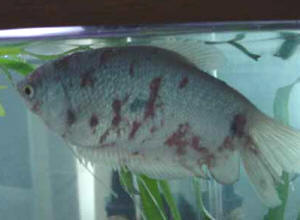 .jpg)
|
| Is there hope for my Gourami
8/15/07 Help! First I have a 30 gallon tank and all the reading
are where they are suppose to be. I have 3 angels and Gourami in
this tank. I don't know if this has anything to do with it but
7 weeks ago I gave my fish some frozen blood worms, within a week
my Gourami started to twist out of shape. <I... see this> I
went to a local mom and pop fish store and they weren't exactly
sure what was wrong and gave me some cure all capsules. <Were
there but such things> The Gourami started to straighten back
out during the treatment. About a week later he started twisting
again. I went to a different pet store where the people were a
little more knowledgeable about fish (or so I thought). When I told
him about the Gourami becoming disfigured he said that I should put
it out of its misery. I bought instead some antibiotic for the tank
thinking this might help. It did but as soon as treatment ended he
started to twist again. Help! I don't know what to do. He is
still eating and swimming but I feel so bad for it. He is getting
skinnier also and staying towards the top of the tank. None of the
other fish are having symptoms. Can he be saved? Do you know what
is wrong with him? <There are a few known "causes" of
such spinal curvature... all are incurable at present as far as
I'm aware... I would sacrifice (euthanize) this one animal
(please read here: http://www.wetwebmedia.com/euthanasiafaqs.htm )
and take care to wash your hands... as Mycobacteria may be involved
here. Bob Fenner> |
|
|
Gourami disease? 8/1/07 To Whom It May
Concern: <That would be me.> I have a 20-gallon tank with one
angel fish, one opal Gourami, and what I think was called a tropical
Gourami. <No idea what a "tropical Gourami" is because
they're all from the tropics! But my guess would be some variety of
dwarf Gourami, Colisa lalia or else a corruption of the name
Trichogaster trichopterus, the common three-spot Gourami usually sold
in its yellow or blue varieties. The Opaline Gourami is also
Trichogaster trichopterus.> My angel fish and tropical Gourami are
thriving, growing, and seem to be just fine. My opal, however, has been
covered in what I can only describe to be an ever-increasing patch of
fur for the past several weeks. <Fungus, Finrot, or "mouth
fungus" (the latter neither a fungus nor confined to the mouth).
Treat quickly, ideally with a combined anti-fungus/anti-Finrot
medication.> I've treated the tank with anti-fungal, and after
making two trips to the local fish store have come up empty-handed with
ideas as to what this could possibly be (the local fish experts had no
idea - they just kept giving me things to try). <Supplement the
treatment of the tank with saltwater dips. Take some sea salt or some
other non iodised cooking salt, add 35 grammes to 1 litre of aquarium
water, and stir well. When dissolved, dip the fish into the salt water
for anything from 1 minute to 10 minutes, depending on the size of the
fish. The idea is to dehydrate the external pathogens and cleanse the
skin (it's basically the same thing as doing a salt water gargle to
heal a mouth ulcer, for example).> The opal is tiny in comparison to
its tankmates (despite being brought into the tank at the same time),
the pH/nitrate/nitrite levels in my tank are testing fine, and I add
salt with every water change, as well as water balancing solution, and
this little one gets worse (again, despite the other fish growing
beautifully). <Please stop adding salt to the tank. It isn't
required and it isn't helping. Freshwater fish don't need salt
in their water (if they did, they'd be saltwater fish!). Now, what
do you mean by "fine" when it comes to water quality and
chemistry? Specifically, your fish need a pH between 6.5-7.5; 0 nitrite
and ammonia; and less than 50 mg/l nitrate. When fish get symptoms of
the sort you describe, it usually comes about one of two ways: poor
water quality or as a result of physical damage. So, check off water
quality first. Are the nitrite and ammonia values zero? Do you change
50% of the water each week? Do you add dechlorinator each time? As for
physical damage, either the fish are fighting or you're handling
the fish badly, e.g., when netting it. Fighting among Trichogaster
trichopterus is very common: the males are EXTREMELY aggressive, and
will attack most other gouramis, not just their own species.> The
opal eats little, sucks air from the surface occasionally, and has lost
all of its color except for red near the tail (which is covered in the
"fur"). The "fur" looks almost like spores of some
sort, however it doesn't match the descriptions for Ich (which
I've treated anyway with the anti-fungal), wiggly-worms, or any
other pictures I've found so far on the internet. <Well,
can't be certain without a photo, but highly likely one of the
three diseases mentioned earlier. Dwarf gouramis (Colisa lalia) also
suffer from 'Dwarf Gourami Disease' which is a bacterial or
viral problem (possibly both) and is incurable. Trichogaster
trichopterus doesn't tend to get this disease, so we can probably
cross that one off, but you might want to check out these two different
species and see if you (your fish shop) have identified them
correctly.> This brave little guy keeps fighting, and he moves quick
when he needs to, but mostly he's just lethargic and hangs out well
out of the way of the bigger two fish, either near the top or on the
bottom of the tank. <Doesn't sound all that promising, I
admit.> Any suggestions? Thank you! Amanda <Hope this helps,
Neale>
3 spot Gourami w/ pop-eye; not enough useful
information, poor grammar, etc... 7/28/07 Hi crew
<Hello there, Jorie here today.> i <I> ...was looking at my
fish today and I <I> saw my 3 spot Gourami as <with?>
...pop eye with blood at the bottom of the eye. is <Is> ...there
anything I <I> ...can do? What is happening none of my other fish
are all fine <I assume you mean none of your other fish are affected
or ill, right?> <OK, first off, when you write us, please take a
few additional moments to use proper grammar, capitalization, sentence
case, etc. Since your query was so short, I fixed it to make it
readable (we do publish our responses to queries on the Daily FAQs site
- see here: http://www.wetwebmedia.com/daily_faqs3.htm and in order to
make the Q&As understandable to all, we do request that our writers
comply with these requests: http://www.wetwebmedia.com/faqstips.htm
More to the point, now: I need a lot more information to be able to
help you here. Facts like how large your tank is, how long it has been
setup, what type of filtration is used, what livestock you have, water
temperature, pH, ammonia, nitrite and nitrate readings, water change
schedule, etc. are all necessary information. Generally speaking, what
I can tell you is that pop eye is caused by poor water quality, so do
check your water parameters with a quality liquid reagent test kit. I
suggest isolating the sick fish into its own hospital tank (filtered
and cycled; as to the latter, use water from the main tank so as not to
shock the ill fish's system) and treating with Epsom salt (1 tsp.
per 5 gallons of H20) and pristine water conditions. I'm betting
your tank has a harmful, if not lethal buildup of toxins which are
causing your problems. The Gourami may just be the first fish to
exhibit symptoms, but if the water quality's poor, the others will
soon follow suit... I can give you better/more specific suggestions if
you give me the information I've requested above... Best regards,
Jorie> thank you <Thank you!>
Re: 3-spot Gourami w/ pop-eye; still not much useful
info...recommend reading, increasing water changes -
08/05/07 Hi Jorie <Hi again; sorry for the delay in responding,
I've been traveling around a bit and haven't had much time to
check in here...> Ok, my tank is 5ft by 4ft <In order to
calculate the volume, I need the depth measurement as well; it does
sound like this is a good sized aquarium, though.> ...and it has
been set up for 4yrs now. <Great.> I have never had this problem
before. <Sometimes issues are cumulative...> I have one catfish,
4 barbs and the others are all types of tetras. <It would be helpful
to know the species of each here.> And I have fresh weeds in the
tank <Again, species?> The water gets changed every 3 months
<Ideally, once a tank has established its nitrogen cycle, you should
be performing a 10-20% water change every week or two (this depends on
how heavily stocked the tank is, how good the filtration is, how messy
the species of fish you have are, etc.; without more information,
it's impossible for me to make a more specific recommendation.)>
...and the temperature is 82 <A bit high, but so long as it is
stable, should be OK.> ...the pH and ammonia are good <Useless
info. I can't tell you what's an ideal pH for your tank, as I
don't know really what you are keeping. As for ammonia, it should
be at zero, as should nitrite levels.> ...nitrate is a bit low;
could this be the problem and if so how do I change it? <I think you
are confused. As far as nitrates go, the lower the better; as high as
20 ppm is acceptable, but more towards zero is ideal. Do read here for
info. on cycling a tank:
http://www.wetwebmedia.com/FWSubWebIndex/fwestcycling.htm Also, I
recommend getting a copy of David E. Boruchowitz's "Simple
Guide to the Freshwater Aquarium" - it's a very comprehensive,
clear book geared towards beginners. I know you have had your tank for
several years now, but you don't seem to have a good grasp on
Fishkeeping 101, which you and your fish could very much benefit from.
Also browse here for many helpful articles on freshwater fishkeeping:
http://www.wetwebmedia.com/FWSubWebIndex/fwsetupindex.htm > Thanks
<I don't know how much I've helped. Again, Popeye is
generally caused by poor environmental conditions. As recommend before,
I would isolate this fish into a cycled, heated, filtered aquarium and
treat with clean water and Epsom salt. Aside from that, the best thing
you can do for your critters is read and learn... Best wishes,
Jorie>
Blue Gourami - fin trouble! 7/28/07
Hi there. My husband and I are quite new to keeping tropical freshwater
fish, so a little help in diagnosing a problem with our blue Gourami
would be appreciated. Have searched the net and have found your site
and are hoping for some help. <OK, will do my best.> We have a 35
Gallon tank, have checked all water parameters and they are fine. In
fact we have baby fish (in a baby net 2 weeks old) which are thriving
at the moment, so the water is fine. <Can you define
"fine"? You see, not all tropical fish want the same things.
Some want warmer water, others cooler. Some want an acid pH, others a
basic pH. Some want hard water, others soft. Some are intolerant of low
levels of pollution, others will put up with it for a while. So we need
numbers -- at the very least, pH, hardness, nitrite, and temperature.
These 4 are usually pretty good indicators of conditions in the
aquarium, and are the essential ones every aquarist should have to
hand.> A couple of weeks ago we noticed our Blue Gourami had a small
white (pin head) spot on its side fin. <Almost certainly
Whitespot/ick. Treat on sight, because it is extremely contagious.>
Its appetite and activity levels are normal. We asked the LFS and they
said to keep an eye on it and that if it multiplied or the fishes
behaviour changed we would possibly need to treat for White Spot.
<Not brilliant advice.> Nothing changed for a week then another
white spot appeared on the opposite side fin! <It's Whitespot.
It spreads.> This one has since become red and inflamed. This fish
had a red spot near the base of its tail a few weeks ago, but this
disappeared after a couple of days. We have checked the red lump and it
does not seem to be a parasite (nothing to remove) just a red small
lumpy mass. Is it a tumour? The fish is absolutely fine in
himself...eating fine and swimming normally. Tumours are rare in
freshwater fish, though they happen. The red inflammation is unrelated
to the Whitespot. Almost certainly you have water quality issues, and
what you're seeing is the simultaneous appearance of Finrot (the
red) and Whitespot. These are both extremely common in new aquaria.
They must be treated immediately because both have the potential to
cause fatalities.> He has been chasing my Gold Gourami about so is
this maybe an injury sustained during courtship? They do get quite
frisky! <No, he's not courting. He's fighting. Blue and gold
gouramis are the same species (Trichogaster trichopterus) and the males
are legendarily aggressive and nasty fish. You would not believe the
number of times I've been asked to help out where someone has an
aquarium with this fish causing havoc. It's what they do. Males
have orange pelvic fins (the "feelers") and extra-long dorsal
fins, so are usually quite easy to sex.> No other fishes in the
aquarium seem to be having any problems. We have 6 danios, 2 goldfish,
1 Plec, 2 red Indian Gourami and a Japanese Weather loach who is a real
character!! <An interesting selection of fish. I happen to be a
great fan of weather loaches, so I'm sure he is fun to watch.>
All the fish are non aggressive and we have a lovely pleasant tank.
<Famous last words...> I am just worried about Bluey. I really
hope that you can help us. <Done my best. Hope this helps.> Many
thanks Louise & Ady <Good luck, Neale.>
Re: Blue Gourami - fin trouble! 7/29/07 Hi
Neale, <Hello Louise,> Should I treat the Whitespot and the fin
rot at the same time? Or give the tank chance to recover between the
two medications? <This depends on the medication used. In general
though you need to complete one treatment before doing another. In this
case, I'd tend to treat the Whitespot first and then the Finrot.
Between each "course" of treatment, do two 50% water changes
(one one evening, the other the next morning) so that you flush out
most of the first medication used. Oh, and one last thing: make sure
you remove carbon before using any medication. To be honest, I'd
recommend not using carbon at all unless you have a specific need for
it. The space in the filter where carbon goes is better used by extra
biological filter media.> Does this affect the filter, <No, not
if you follow the instructions.> And are there any tips on what I
should be looking for in the water chemistry, just in case I have
missed a test kit? <Not really sure what you mean here. What you
want are values within the range tolerated by the fish in question. So
a blue Gourami is good between pH 6 and 8, so if you have pH 7.5,
that's fine. Likewise they're good at medium hardness levels,
around 5-15 dH being about right, so if you have hardness 12 dH,
that's fine too.> Water temp is 27 degrees, ammonia within safe
levels indicated on test tube kit, as was nitrate and nitrite levels.
<Ah, now this is where things unwind. There is NO "safe"
range of either ammonia or nitrite. For your fish to be healthy, both
must be ZERO. While the test kit might suggest anything up to 0.5 mg/l
ammonia and 1.0 mg/l nitrite is acceptable, this is only true during
the cycling phase, and even then, it severely stresses the fish and can
kill them. At the least, it makes them more vulnerable to ambient
pathogens -- Whitespot and Finrot for example. So if your test kits
show ANY nitrite or ammonia, then you have problems; likely the tank is
either immature, overstocked, overfed, or under-filtered. Nitrate is
the ONLY one of these things that has a safe range. In general, up to
50 mg/l is safe for standard tropical fish, though rather less, around
20 mg/l, for more delicate things like dwarf cichlids and discus. In
other words, don't tell me you think the ammonia, nitrite, and
nitrate are "safe", tell me what the exact numbers are. If
they're not 0, 0, and <50 mg/l, then they're not safe.>
All very low levels, water hardness is a problem in this area but the
LFS said all the fish we have can deal with it. <Water chemistry is
almost never the issue people think it is. Admittedly, there are some
species than need either soft water or hard water. Mollies and other
livebearers need hard water and are sickly when kept in soft water. But
a lot of the standard stuff like gouramis, barbs, Corydoras, Plecs,
loaches, etc., adapt just fine to a wide range of conditions. Any
aquarium book will suggest values for any given species, and it's
always a good idea to choose your fish by selecting species that will
do well in your local water conditions. If your water is very hard and
has a high pH, then choosing things like rainbowfish and livebearers is
the way to go.> We condition any tap water we use and cycle
regularly. 20% water change every 2 weeks. <OK. Conditioning the
water is good. Adding Cycle (or any other bacteria supplement) is
pointless. Once the filter is established, it is self-maintaining.
Adding more bacteria is kind of like adding more grass seed every week
to a lawn. All the filter bacteria want is to be left alone and that
every month or so you gently clean the media in a bucket of aquarium
water (not fresh water!) to dislodge some of the silt and detritus. But
that's it. As for water changes, you need to raise your game. 50% a
week is a good amount. Water changes cost almost nothing to do, but
they make such a big difference to the health of the fish.> Gravel
clean every 3/4 weeks. Plastic plants only, internal filter, 200w
heater, kept lit for about 8 hours a day minimum. <All sounds
fine.> Many thanks, Louise <Good luck! Cheers, Neale>
| Golden Gourami with some strange problem,
infectious, pathogenic... 7/19/07 Hi, I was
wondering if you could take a look at the 2 pics I attached of my
Golden Gourami. She is acting fine but I noticed a red bump on her
side and her mouth looks like she has an open sore. <Yes... I
see this/these> Not sure what to treat her for and I was
wondering if you could steer me in the right direction. Thanks for
your kind help in advance! Cariann <Well... these markings on
Gouramis are all-too-common, and generally indicative of bacterial,
though possibly coupled with protozoan complaints (parasites)... I
would first try treating the former... by way of either an
immersion batch (250 mg. in a gallon or so of water, with aeration)
with an antimicrobial... My first try (as really, microscopic
examination, a bit of culture and staining work... along with
sensitivity testing... is called for to hone such a medicine
search) would be with a Furan compound... Please see WWM (the
indices, search tool) re "Gourami Disease" and
"Furan" use... Bob Fenner> |
|

|
|
|

