|
FAQs About Kuhlii Loaches
Related Articles: Loaches, A New Look At Loaches
By Neale Monks,
Related FAQs: Loaches
1, Loaches 2, Dojos/Weatherfishes, Clownloaches, & Loach Identification, Loach Behavior, Loach Compatibility, Loach Selection, Loach Systems, Loach Feeding, Loach Disease, Loach Reproduction,
|
|
Kuhlis on the run 4/7/17
Good evening,
<Hello Rose!>
There is no sign of six Kuhli loaches or their parts anywhere in the
aquarium, filters, floor, under the stand, etc.
<Oh, they're there somewhere! You would be amazed how often Kuhli
Loaches vanish! In the old days they usually found a way into the
undergravel filter. Today, they're more likely to be inside rocks and
bogwood,
underneath a plant, or somewhere like that. They don't normally jump out
of tanks the way Spiny Eels and Ropefish do, but it's possible I
suppose.>
Is it possible that Black Skirt Tetras could eat well-fed Kuhli loaches
that are easily three inches long?
<Not likely. For sure if the loaches all died their bodies could be
eaten, but you'd likely see a few scraps. Actually swallowing them
whole? Nope.>
Is it possible for six Kuhli loaches to have died in an aquarium, even
over a span of time (unsure because of their nocturnal habits, sand to
burrow in and hiding places), and then have water parameters that are:
pH the usual 6.6 to 6.5
Ammonia less than .25
Nitrate less than 5.0, looks to be 0
Nitrite less than .25, looks to be 0
(from API master test kit)
The tank has been the Skirt Tetras home for nine years with no trouble
if that matters. The loaches were added only six or seven months ago.
Thank you for your time,
Rose
<Frankly Rose, Kuhli Loaches are a "fire and forget" kind of fish. You
add them; they vanish; and that's that. You rarely, if ever, see them
during the day. I don't recommend them for that reason. I'd assume
they're in there, but otherwise forget about them except insofar as you
leave a bit of food for them a couple nights per week. Cheers, Neale.>
|
Kuhli Loach Question 3/14/17
Good Afternoon WWM Crew:
<Lor/Fuzzi>
Your help in the past has been invaluable, and I've had no issues since my
last correspondence in November, but now have a question about an injured
Kuhli loach.
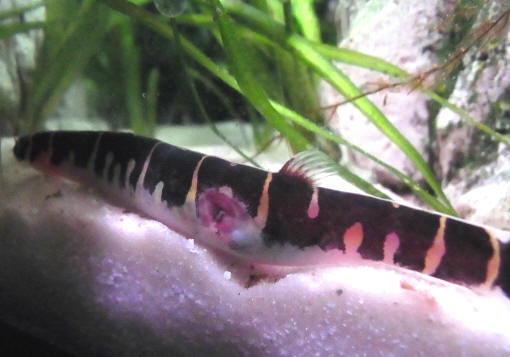
I'm attaching a photo of one of my Kuhlis (I have 3-5).
<I see your excellent pic and ouch!>
I have a 29 gallon freshwater setup, heavily planted with Java fern, Java
moss, and Anubias. I have white aquarium sand as a substrate.
Most of my fish have been in the tank for 1-2 years, with the exception of 2
Corys, 2 Albino BNP, 5 Nerite snails, and one Glowlight tetra that I added
in November 2016, and Red Cherry shrimp added in December.
On Saturday I did a 20%+ water change, routine, no issues, didn't dig in the
sand with the siphon, but I did pick up a plastic cave ornament to siphon
underneath, and seeing no fish underneath, put it back down and wiggled it a
little to settle it into the sand, just a bit, nothing really hard or
forceful.
The next day, on Sunday evening (about 24 hours later) I noticed one of my
Kuhlis lying against the side of the tank, which is unusual, as they usually
hide in the plants. Upon closer inspection, I saw what appears to be a bite
or gouge on her side, see photo.
<Yes; a physical trauma>
Two other Kuhlis were lying "in the open" very close to her, laying against
the outside of the "cave". They appeared to be fine, so I thought maybe they
were staying by their friend. This morning she was in a similar position,
but the other Kuhlis were not in view.
The tank mates in my 29g are as follows:
3-5 Kuhli loaches (I released 5, never see more than 3, they keep hidden)
4 Albino Corys
5 Glowlight tetras
5 Nerite snails
2 Albino Bristlenose Plecos (young, about 2-3" long)
1 Red Cherry shrimp (might be more, I released 4)
I have not read that Bristlenose Plecos are aggressive, but cannot imagine
any other fish in the aquarium biting my Kuhli. I added the BNP in November,
and have had no problems.
<Usually Ancistrus species aren't aggressive...>
I fear that I might have injured my Kuhli while cleaning yesterday.
<Possibly>
The tank is heavily planted, and removing the Kuhli for treatment is
probably not an option. I know adding salt is not an option, either, due to
the tank mates.
I keep the water clean (1 Eheim canister, 1 Aquaball, & 1 Marineland 200),
pH 7.0-7.2, Ammonia 0, Nitrites 0, Nitrates 20-40 (it's usually at 30-40
when I do a water change, every 3-4 days). Water temp is 74-76F.
I'd appreciate your input on what you think might be the cause of this
injury. I'm hoping my Kuhli survives, but if not, I want to prevent the
others from a similar injury.
Thank you.
Lor, aka Fuzzi
<If this were me, my system, fishes, I would leave all as is (not treat, not
move the fish...). Just maintain the system as you've been doing; and hope
this fish heals given time, good maintenance and nutrition.
Bob Fenner>
|
Kuhli Loach Question /Neale 3/15/17
Good Afternoon WWM Crew:
<Hello,>
Your help in the past has been invaluable, and I've had no issues since my
last correspondence in November, but now have a question about an injured
Kuhli loach.
<Indeed! Quite the wound.>
I'm attaching a photo of one of my Kuhlis (I have 3-5). I have a 29 gallon
freshwater setup, heavily planted with Java fern, Java moss, and Anubias. I
have white aquarium sand as a substrate.
<All sounds good.>
Most of my fish have been in the tank for 1-2 years, with the exception of 2
Corys, 2 Albino BNP, 5 Nerite snails, and one Glowlight tetra that I added
in November 2016, and Red Cherry shrimp added in December.
<Understood. Nothing here sounds risky.>
On Saturday I did a 20%+ water change, routine, no issues, didn't dig in the
sand with the siphon, but I did pick up a plastic cave ornament to siphon
underneath, and seeing no fish underneath, put it back down and wiggled it a
little to settle it into the sand, just a bit, nothing really hard or
forceful.
The next day, on Sunday evening (about 24 hours later) I noticed one of my
Kuhlis lying against the side of the tank, which is unusual, as they usually
hide in the plants. Upon closer inspection, I saw what appears to be a bite
or gouge on her side, see photo.
<Indeed. Looks like an ulcer, could be caused by the physical damage, could
be something else entirely coincidental with your tank cleaning exercise.>
Two other Kuhlis were lying "in the open" very close to her, laying against
the outside of the "cave". They appeared to be fine, so I thought maybe they
were staying by their friend. This morning she was in a similar position,
but the other Kuhlis were not in view.
The tank mates in my 29g are as follows:
3-5 Kuhli loaches (I released 5, never see more than 3, they keep hidden)
4 Albino Corys
5 Glowlight tetras
5 Nerite snails
2 Albino Bristlenose Plecos (young, about 2-3" long)
<Do watch these don't rasp on the sore; while Ancistrus are normally pretty
good, many Plecs will, given the chance, graze on wounded fish.>
1 Red Cherry shrimp (might be more, I released 4)
I have not read that Bristlenose Plecos are aggressive, but cannot imagine
any other fish in the aquarium biting my Kuhli. I added the BNP in November,
and have had no problems. I fear that I might have injured my Kuhli while
cleaning yesterday.
<See above.>
The tank is heavily planted, and removing the Kuhli for treatment is
probably not an option. I know adding salt is not an option, either, due to
the tank mates.
<Unlikely salt would make a huge difference anyway.>
I keep the water clean (1 Eheim canister, 1 Aquaball, & 1 Marineland 200),
pH 7.0-7.2, Ammonia 0, Nitrites 0, Nitrates 20-40 (it's usually at 30-40
when I do a water change, every 3-4 days). Water temp is 74-76F.
I'd appreciate your input on what you think might be the cause of this
injury. I'm hoping my Kuhli survives, but if not, I want to prevent the
others from a similar injury.
Thank you.
Lor, aka Fuzzi
<I'd be optimising water quality and using a good antibiotic or
antibacterial until such time as the wound was obviously healing over. Fish
*can* recover from flesh wounds like this rather well, all else being good.
So I'd be quite optimistic. Cheers, Neale.>
|
Kuhli Loach Question - Should I be worried? Beh. f'
4/7/16
Hello Crew (whatever kind volunteer receives this one!)
<Kris>
You're website has been invaluable to me over the last 6 months or so
since
I got into this wonderful hobby. Both Neale and Bob were very helpful
with helping me treat fin rot in my Betta (Thank you so much he's all
better now and as feisty as can be! Although NOT one of those laid back
Bettas who
can live in a community tank as I found out - much better off on his
own. lol)
I now have a question about some newly acquired kuhli loaches. I
recently upgraded from a 20 gallon to a 50 gallon long aquarium - it is
planted (java moss, some type of sword plant, Anubias and dwarf Hygro I
think it's called - love this plant)
<Hygrophila polysperma is one of my faves as well. A FAST grower under
good conditions>
with caves and hidey holes etc. Sand substrate.
I am running 2 filters (one new one when I upgraded, as well as my
filter from my 20 - originally for bacteria establishing purposes (along
with some added substrate from that tank as well) and now just for the
added
filtration - better to have too much than too little!. It's at 78
degrees, ammonia at 0, nitrite at 0 and nitrate at 10. Weekly 20% water
changes.
<Good>
Over the past weekend I added 2 kuhli loaches (the solid colour ones, if
that makes a difference). I know they need larger groups and the
intention
is to purchase 4 more - but prefer to add fish slowly, so only got 2 for
now and will get more after a week.
<Okay>
I know they are nocturnal and shy, but my concern is that when lights
are out I very very occasionally see a glimpse of one, but only one. The
sightings have been far and few between. At what point should I be
concerned about the other loach?
<Never... even if it perished in this volume, there would not be
negative consequences. They will be out more when you have several
specimens>
The tank is covered, and the filter intakes only have tiny slats much
too small for anything other than the tiniest of fry to get through. I
did a gentle stir around the sand and didn't turn up either of the
Kuhlis so clearly they are excellent hiders.
At what point should I move from they are just being shy to perhaps one
has died somewhere?
<I would not be concerned. Time will tell here>
Perhaps this is a silly question, but I thought it couldn't hurt to ask.
I am new to loaches and while I have read everything I can find, the
fact that I have only ever seen one at a time I am concerned that
something might be wrong.
Am I just being impatient?
<Are you?>
Every forum I have read is that once you have more than 5 Kuhlis you
will start seeing them all the time - I am really
looking forward to that. Such neat little fish. I have always wanted
loaches, but having only a 50 gallon I felt these were the most
appropriate ones for the size. I'd love some yoyos but I think they
might be too big.
Anyway I digress!
In case this is important, their tank mates are:
6 cories
4 guppies (1 male, 3 females & 2 tiny guppy fry)
2 female platies
2 female swordtails
6 black phantom tetras (3 males, 3 females)
1 African dwarf frog (hand fed so he doesn't have to compete with the
fish for food)
So no bullies, all are very peaceful.
Other than the 4 Kuhlis I am planning on adding I am not planning on
adding any other fish for now, perhaps ever. The tank is busy and active
without being crowded at present which is how I like it :)
Any advice for a new loach owner would be so appreciated, I know you are
all very busy.
Kind regards,
Kris
<Patience and the new additions. Bob Fenner>
Re: Kuhli Loach Question - Should I be worried?
4/7/16
Thank you Bob, sometimes one just need someone to tell you to relax!
haha
I appreciate you doing that for me here.
<Welcome>
And yes, that plant is just the easiest plant ever, the fish just love
swimming through it.
I appreciate you taking the time, yet again, to assist.
I hope you have a lovely rest of your week.
Kris
<And you; BobF>
Pictus, kuhli loaches <in>compatibility.
10/14/15
Hello, thanks for answering my earlier message.
<Welcome>
I have started gathering what few knowledge there is about the fish told you
about. ill get to you on that again in a few weeks, when i have done some
planning.
<Okay.... likely Neale Monks.... you don't include prev. corr.>
This time its a very straightforward question:
Can i have pictus catfish and kuhli loaches together?
<No; not compatible.... really the Pimelodelids will "over-run" the loaches....
eating all food; traumatizing them. Should be kept in separate systems>
do you have any experience with the combination or have you heard about it
working?
<You can see/read our bibliographies on WWM. Have a bunch of experience w/ these
species>
The lfs has brought in some pictus and i would like to get a pair,
<Better in larger groupings>
i have read they reach about 11 cm, and my Kuhlis right now range from 6 cm to
about 12 (15 or so of them....lost count really... i have myersi, oblonga and
the spotted type). They are around the same size but im asking because when i
got my spotted Raphael,
<Not compatible either>
at about 6 cm, it killed 3 of my Kuhlis in one night, this happened in the 40
gal planted tank and im sure it was the Raphael as it was added 3 days prior and
the Apistogrammas in there don't really pay attention to anything but each
other. The Kuhlis looked like they had been scratched on their faces and had
their tails bitten.
Can i expect the same result with the pictus?
<About; yes>
I wanted to add them to the planted tank first while they grew a bit, since they
are about 6 cm, very small, and then i would add them to the catfish tank
housing a 11 cm spotted Raphael, 15 cm stripped Raphael and the 8 cm or so
bumblebee catfish. Will the pictus, at their current size, be ok to be added
with the rest of the catfish then?
<Keep reading; better to consider a biotope for keeping these and all other
aquatic life>
Thanks again, Rob.
<Welcome. Bob Fenner>
Re: Pictus, kuhli loaches compatibility.
10/15/15
Oh yes, sorry, i just checked the earlier response and it was you who answered
Bob, in fact, it is you who has answered my many emails.
<Ahh!>
I asked information on breeding various fish on a new 125 gal planted tank i was
planning.
Hmm, in a previous conversation i told you i have my current 40 gallon tank with
the Kuhlis and Apistogrammas and also an 80 gallon for "catfishes",
<Heeeee! Some Siluiiforms are amongst the largest of fishes. See Siluris glanis>
sorry for not giving out these details again. This catfish tank is housing
Raphaels, bumblebees, ghost catfish, boesemanni rainbows and an African
butterfly fish, this is the tank the pictus is really intended to go, is it ok?
<Should go in here; with attention to make sure the other catfishes are getting
food, that they have sufficient habitat (likely hollow faux logs, what have you>
It is a slightly black water tank sparsely planted with crypts, Aponogetons and
Anubias and many caves.
<Ah, good>
At the time i thought the Raphael would not attack the Kuhlis as they were about
the same size long and the Raphaels seemed peaceful... So far my Raphaels and
bumblebees get along well but are they really aggressive to other bottom
dwelling fish or is it just that he mistook the Kuhlis for worms or something?
<Doradids are often mistaken... being sedentary, inactive by day... they are not
slow cleaner-uppers; but able competitors, meat seekers and eaters by night>
Thanks again.
<Welcome. Bob Fenner>
Re: Pictus, kuhli loaches compatibility. Neale's addn.s 10/16/15
<<Will somewhat echo Bob's comments that Pimelodus pictus is, at best, an
untrustworthy member of most community tanks. They can and will eat any
bite-sized prey (including juvenile Kuhli Loaches) and their restless activity
(especially at night) makes it difficult for slow-moving fish to compete for
food. Much better companions for medium-sized tetras, barbs, and things like
Anostomus that wouldn't be good choices for the average community tank. You
could combine them with similar sized Botiine loaches (Botia almorhae for
example) as well as Horseface Loaches, and they also do well with Clown Loaches.
But I'd reserve Pangio spp. for life alongside the smallest, most gentle
community species: Cardinal Tetras, Harlequin Rasboras, Cherry Barbs... that
sort of thing. Would also caution you that most Pimelodidae prefer brisk
currents and moderate temperatures (22-25 C) whereas Pangio species are mostly
fish for slow-moving water environments and do well at middling to warm
temperatures (24-28 C). Pimelodidae appreciate deep, open tanks and sandy
substrates, while your Pangio prefer shallow tanks with dense tangles of bogwood
roots and thickets of plants. Not much overlap between the two in terms of
biotope, so would plan accordingly. Cheers, Neale.>>
Re: Pictus, kuhli loaches compatibility. And now, used tank purchase
consideration 10/17/15
Yes, thank you both for answering. So i discarded the pictus for the time being,
i will probably get one of the Ancistrus varieties to expand my collection of
catfishes. However, i brought home to the 40 gallon planted tank (Apistogrammas
and Kuhlis), 5 Otocinclus, they look silvery-blue, probably vestitus? and also
Sturisoma aureum and Farlowella vittata. I figured these small, delicate
suckermouths would make good additions and be comfortable in the densely planted
aquarium with plenty of algae to eat, i have added blanched cucumber and romaine
lettuce but so far none of them have tried the vegetables. They don't look
malnourished and in fact have seen them poop (they must be eating something hu?).
Will keep adding vegetables on a regular basis as Ramshorn snails eventually get
to them.
Now, on a different question, as i told you a few messages before i am planning
on a new planted tank. I want something between 100 and 140 gallons. There is
someone who is selling his 125 (145cmx60cmx60cm) with a base of 12 mm glass, but
the rest of the panels are 6mm...
<Mmm; is this a commercially made aquarium? For Americans, this is quarter inch
nominal.... NOT what I'd use... 3/8, like 8, 10mm would be much better; perhaps
it's tempered plate>
it has 3 braces and it has reinforcements on the bottom, like braces too but on
the bottom panel and also some kind of diagonal reinforcement on each corner,
and has an extra piece of glass in and out of the corners, which makes it
thicker at the corners.
<Custom, DIY, home-made>
I don't have a camera right now but i will attach a photo in my next message (i
hope!). Anyway, he is selling the tank very cheap, he said he has used it for 8
months for his pair of Oscars without trouble, but said he would be upgrading
his tank size, and no kidding, he really has a new 200 or so gallon. Anyway,
what do you think of this?
<What little I've read; I'd give it a pass>
i feel it is risky, and that's being generous but im probably exaggerating, i am
somewhat knowledgeable on mechanics of materials and ran a few simulations if i
were to use this tank. All of the simulations (and hand calculations) said the
tank would not break, with a safety factor of around 1.25-1.5 for tempered
glass.
<Yes; agreed>
I wont be housing any tank busting species and while it may hold water, the
extra stress done on the walls by rocks, wood, other aquascaping stuff etc could
be different, and also i have no sure way to factor in these and the corner
reinforcements in my calculations so im very unsure.
<It's more the periodic shifting... earthquakes and jars; that concern me>
The tank sounds like a deal but i really DONT want to deal with cracks, leaks or
worse...sudden bursting of the tank... So i may just save money for a tank made
with the right thickness (8mm simulations threw out 1.8-1.93 in safety factor...
am i good here?), which may be 3x the price i would be paying for this one...
<I'd go commercial; new>
Anyway, thank you very much for your time, keep up the good work.
Rob
<Welcome. Bob Fenner>
PraziPro and delicate fish... Kuhliine loaches lost
11/5/13
Hi I have recently gotten a batch of meyersi and I noticed that they
aren't putting on any weight. And now I have lost a few of them.
I am pretty sure it's parasites.
<Do you have a 'scope? I'd open up some and look for gross signs,
lumenal....>
And I have some Prazi pro but before I treat the tank I need to be sure
it's safe for my other fish.
Heflin banded sharks
Black ghost knife
African brown knife
I just need to be sire t
<? Not particularly toxic to these fishes. Bob Fenner>
Re: PraziPro and delicate fish 11/5/13
I don't but I can take them to my school and have one of my professors
check it out. That is a good idea.
Thanks a ton for the info. Was worried to use it without being 100% sure
cus these fish mean a lot to me. My bgk is more like my dog than my fish
lol.
<Ahh; I understand. BobF>
Mysterious meyersi deaths 11/5/13
Ammonia 0
Nitrite 0
Nitrate below 5.0
Ph 7.2
Temp 74
I went through a period a few months back where within two weeks I went
from about 40 Kuhlis to 3. They showed no symptoms until all of the
sudden they had trouble swimming lay on there side and were dead within
minutes of symptoms showing.
<Mmm>
I have bgk, hifin shark, dojo, and Pygmy hovering loach in this tank as
well and none have ever showed any signs of anything.
My friend who owns an lfs ordered me another 25 and he quarantined them
for me for three weeks. They were skinny but seemed otherwise fine when
I put them in the tank. It's been a couple weeks and I haven't seen any
of the erratic swimming but am finding loach after loach dead. I am
stumped.
Before this happened the first time the loaches I had were 5 or six
years old never had a problem. I waited and watched the remaining ones
for almost two months before I put the new ones in.
<Something wrong in/with this tank/system>
I'm at my wits end. My heart can't take much more of this :(
I started them on Prazi today cause they aren't putting on weight so
maybe parasites. But if you have any ideas pleas let me know.
Thank you.
<Would like to see someone who knows what they're doing necropsy these
loaches. BobF>
Re: Mysterious meyersi deaths 11/7/13
I do not know of anyone who can do that. maybe one of my biology
professors.
But barring that do you have any suggestions as to how I should go about
helping these fish?
<I do; have been in the trade many years; had occasion/seen such massive
losses of these loaches... "Mysterious"; that is, of unknown source of
mortality. What I suggest, what we'd do, is take the "loss tank" down,
bleach it and all non-biological it contains; move the loaches
elsewhere>
I'm looking for a place I can send them away to have them autopsied as
well.
<Ask the bio. folks at school re would be my first choice. BobF>
"Issue" with Kuhli Loaches; beh. concern
10/1/13
Hi, I have had this new tank for about 2 months. It's planted and
cycled, and the first fish I bought was a group of 5 Rasbora
heteromorpha (planning to buy 5 more). I waited a week before buying a
group of Kuhli loaches (before I made sure the Rasboras were healthy).
After buying them I made a cave using a piece of driftwood I bought, and
naturally they hid right away. They were shy the first days, but
eventually they started coming out (I bought 6, because there didn't
have more, but anyways I read 6 is a decent number). The numbers helped,
as they were acting very natural and social.
The thing is, they did what some fish do when introduced to a new tank,
they swim against the wall and other behaviours like that. The fourth
day or so some of my Kuhlis started swimming against the left aquarium
wall, doing big circles. It was funny to watch, but they wouldn't stop,
and even drag the others to do the same thing! It's been two days now
and they don't seem to stop, even at night. They DO feed, so they are
definitely not that bad. I read that Kuhlis TEND to do this, depending
on each tank, but nobody knows exactly why. There are some threads
online discussing it, no one really got the definitive answer... Could
they be establishing some kind of hierarchy, like the "pecking order" in
schooling fish?
<A good speculation... there are fishes that are known to "select" an
area/wall of their tank and swim about it... in response to their own
reflections, in orientation to ambient light (sun mostly); even
electromagnetic sensation; change in barometric pressure... Nothing to
worry about; and does (after a few weeks) tend to become attenuated>
I look forward to your reply, thank you!
<Thank you for sharing. Bob Fenner>
Feeding Rainbow Shark and Kuhli Loaches 2/21/13
Hi, I was wondering what is a good food to feed my bottom dwelling fish
since my other fish seem to eat all the flake food before it gets down
to my shark and loaches. I was thinking either algae discs or
sinking shrimp pellets. Would these be ok, and if so which would be
better? Thanks
<Both these foods are good. In addition, remember to feed at night, when
the Kuhli Loaches will want to feed. One penny-sized wafer should
provide ample food for 3-4 Kuhli Loaches. The Rainbow Shark is a bit
more of a day-active animal and can compete with midwater fish quite
effectively, so one algae wafer dropped into the tank 3-4 times per week
should be sufficient for an adult specimen as a supplement to its usual
diet. Cheers, Neale.>
Ich with shrimp and Kuhli loaches
11/28/12
Hello,
<Howsit?>
I would really appreciate some advice on how to best go about treating
Ich in my 55 gallon freshwater planted tank (parameters being nitrite at
0ppm, nitrate under 20ppm, pH around 7. I got some new fish about a week
ago, and they all seemed healthy. Today I noticed that my new Madagascar
Rainbowfish, and my old ones (there's 9) have Ich, but it only seems to
be affecting them for the time being. I'm worried about one of the
Rainbowfish in particular because he has more white specks than the
others. More like 10 or 12 whereas the others have more like 4-5. So far
I've done a 25-30% water change, and right now I'm trying to figure out
the best way to go. I have 5 bamboo shrimp, 5 Kuhli loaches, and 8
Nerite snails that I don't want to lose. I don't want to use anything
harsh for medicating if I don't have to, and I was looking into the salt
and heat method, but I don't know that the bamboo shrimp would do well
with the heat. I am not opposed to taking my plants out if need be, but
of course it would be easier if I had some method to use that is safe
for snails, shrimp, Kuhlis, and plants. I think the salt would be okay
for everybody else, but I'll go ahead and make sure with you guys. My
stocking has Otocinclus catfish, a Bristlenose Pleco, Kuhli loaches,
neon Rainbowfish, harlequin Rasboras, ghost catfish, a dwarf gourami,
gardneri killifish, zebra danios, Madagascar Rainbowfish, and bamboo
flower shrimp.
Also, one of my ghost catfish kinda has a light gray somewhat cloudy
looking upper lip and instead of facing his whiskers forward, they're
kind of out and down. I'm not sure what that is, but I hope you can take
a guess at it.
Your advice is greatly appreciated.
Thanks,
Sarah
<Mmm, well; the best process would be to remove the fishes to another
system and treat there, but if it were me/mine, I might try simply
raising the temperature (but not adding salt/s) here. Read:
http://www.wetwebmedia.com/FWSubWebIndex/fwichremedyyes.htm
and the linked files above. All you list should tolerate 86 F., I'd
increase aeration if practical. Bob Fenner>
Ropefish? Nopefish - Maybe A Loach? - FW Fish ID - 10/04/12
Hi there all at WWM, love your informative site and snappy responses!
<Love your kind words! Sabrina here, who adores all things odd and
creepy!>
I've been running a well-planted 20ga for the last year or so, with a
dozen zebra/longfin Danios in there. All is pretty okay in terms of
water parameters (ammonia, nitrate, nitrite 0, ph 7.5).
<So far, very good.>
Now a friend is moving out of province and wants to give me some fish -
I said no to his convicts
<Good move - these would quickly outgrow (and overpopulate!) your 20g
tank.>
but there's a crazy looking fish in there I want. It didn't grow much
since he's had it in the last year and is quite small (good intentions,
poor husbandry skills) - is it possible he's stunted the fish?
<Mm, well, possible, but.... let's keep going....>
Fortunately it's mouth is too small (currently) to eat his or my Danios
<A Ropefish of almost any size would be "iffy" at VERY best with zebra
Danios.>
and I know that if it is indeed a Ropefish, I'll be able to upgrade to a
larger tank shortly.
<If it IS a Ropefish, Erpetoichthys calabaricus, and you DO take it,
you'd want to upgrade, well, urgently. They're rarely offered for sale
less than 8 or so inches in length, and at that size, and considering
their active, boisterous personalities, would need more than a 20g
tank.>
So: it's dark brown-black,
<Strike one.... A Ropefish would be "muddy" dorsally, paler ventrally;
not blackish.>
3-4 inches long,
<Strike two.... E. calabaricus is ALMOST never offered for sale at this
size. It does happen, but very seldomly.>
and about half the diameter of a ballpoint pen. What differentiates it
from all the Ropefish I've seen is, rather than no dorsal fin, it has a
short, rectangular dorsal fin, about a half inch long by a quarter inch
high, 2/3 down its length.
<Strike three.... This isn't a Ropefish.>
The caudal fin flares outward with stiff spines supporting a similarly
squared edge, like a shovel, instead of the diamond-shaped caudal fins I
see on other Ropefish and bichir. It does however have four small mouth
appendages and I have seen it burrowing in the substrate between making
occasional darts to the surface of the water. It definitely doesn't
resemble a caecilian, dragon goby, fire eel, or a bichir.
<Sounds identical, however, to a "black kuhli loach", which could be one
of a couple species, probably of genus Pangio.... links:
http://www.loaches.com/species-index/pangio-oblonga
http://www.loaches.com/species-index/pangio-pangia >
Forgive me if I'm mistaken, but I was under the impression that
Erpetoichthys was the only species in its genus?
<Well, E. calabaricus is the only species of the genus Erpetoichthys. I
think that's what you meant.>
Is there anything else that this wiggly, mellow little worm could be
that I missed?
<As above.... I think it's a loach. Especially now that you use the
terms "wiggly", "mellow", and "little worm".... very apt descriptors for
a black kuhli.>
And if I'm lucky and it actually is an Erpetoichthys,
<Aren't you lucky even if it's not?>
what will happen to the dorsal fin as it matures?
<If it is a Pangio, it's probably already mature.>
Should I expect this if/when I acquire more Ropefish?
<If you add an actual Ropefish, it will probably eat the loach first,
and snack on the Danios later. But fortunately, if it IS a loach, it is
pretty much compatible with the Danios - but would really appreciate
soft water with a pH 6.5-7.0 if possible.... Check out your friend's
tank's pH and see how far off it is from yours. Stability is most
important, so if your friend has had the little guy in a pH similar to
yours for an extended period of time, it may do quite well in your
tank's pH of 7.5. That is, however, higher than I'd like to keep this
sometimes delicate fish. Also, Pangio are gregarious. He wants
conspecific friends. If you can't find conspecifics, other Kuhlis will
do. In the US, it is easier to find some of the banded Pangio. Look
here:
http://www.loaches.com/species-index/pictorial-species-search-index/serpentine-striped-brown-to-black-bands-over-yellowish-ground-color
I'd recommend a minimum of five (though preferably more!) for most
Pangio.... The more the merrier. Plus, they are TONS of fun to watch.
You'll love this
fish.>
Sorry that I was unable to add a photo, thought I'd ask an expert
anyway!
<A photo would make for a more sure ID, but your description is very
good.
I hope I've landed this one, but if it does not resemble Pangio, do
please consider snapping a pic.>
Thanks again, Hilary
<Best wishes to you and your new Pangio pal, -Sabrina>
Re: Positive ID on a Ropefish? 10/5/12
Ah! A Kuhli? Thanks so much!
<Glad to help. -Sabrina>
|
Black Kuhli/Java Loach Fry
8/2/11
Howdy,
<Hello,>
My husband and I are definitely amateur aquarium keepers. We
found this site immensely helpful when we were trying to figure
out what fish to add to our tank. We received an already
established 20 gallon high tank, which had been established at
least 6 months when we got it, to total at least 8 months. We
don't currently have an adequate water testing kit. We have
dip strips with the 5 tests on one strip that tell us about where
it is, with plans to get a decent testing kit ASAP. We ran out of
funds before we realized how important it is to know your
parameters. It's currently reading pH between 7.2-7.8,
Alkalinity close to 180, Hardness a little above 'hard',
so probably around 200, Nitrite reading 0 and Nitrates close to
0, but less than 20.
<All sounds fine for a mixed community tank.>
We have 4 male guppies and 5 guppy fries about 5 weeks old. We,
as I stated, are amateur and accidentally ended up with a 4 to 1
balance of guppies. As we tried to remedy the situation the
female guppy had fries and died shortly after. Our levels were
testing fine and no other fish showed signs of
stress/illness.
<Likely a combination of stress from the males and the strain
of giving birth. Sadly, the death of a lone female Guppy or any
other livebearer isn't that rare when they're kept with
larger numbers of males. Just gone through much the same thing
with my Halfbeaks, so after having 6 females and 3 males, the
females have all died after 2-3 years of life, while the 3 males
seem right as rain. Frustrating.>
In our tank we also have 6 GloLite tetras, and 5 Black Kuhli
Loaches. We have a Tetra Whisper 20i and an underground filter of
unknown make and/or age which uses airlines and risers for the
filtration flow. We have gravel due to the UGF and knew it was
not ideal for the Kuhlis. We have created places to hide above
the gravel and have watched for signs of scratches, fin tears,
etc. We also have some live plants: 3 small Wisteria plants and a
few pieces of Anacharis floating on the top. The rest of the tank
has lava rock and fake plants.
<Nice, but do watch the lava rock -- it's scratchy, and
can damage fish sometimes.>
Our loaches were sold to us as Black Kuhli Loaches, which appears
to be accurate using the loaches.com species index. They match
the description of the Pangio Oblonga and the pictures as
well.
<Yes, would agree that the bigger of the two Loaches
you've sent me is a Pangio of some sort.>
However, we aren't able to tell the difference between the
Oblonga and the Pangia, so it might be that breed of loaches
instead.
<Indeed, and besides the hybrids and varieties, the true
species aren't easy to tell apart either.>
Now to the point of this e-mail. My husband was watching the tank
and thought he saw one of our guppy fry swim around on the bottom
of the tank.
He watched closer and saw the fry disappear under a rock, which
is abnormal behavior for our fry. He watched closer, and a small
but long and thin fish swam out from under a fake plant. It is
very distinctly a baby loach.
<Yes.>
Upon further observation we've been able to see at least one
other 'fry'.
We now accidentally have at least 2 loach fries. We do 40% water
changes once a week, and vacuum 1/3 of the gravel thoroughly each
time, so we're amazed any eggs survived. We did not expect to
have our Loaches breed.
<Indeed not. Pangio breed only very, very rarely in aquaria,
and always -- so far as I know -- by accident.>
We attempted to do some research, but not much is available on
how to care for the fries. I refer to this site frequently for
thorough information and hoped you might have some insight on how
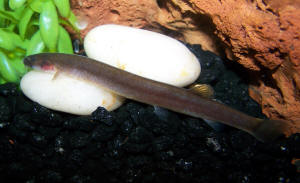
to best care for them. Attached is one picture of an adult loach,
and one picture of the loach fry. In the picture with the loach
fry, one of our guppy fry is in the foreground and is about 1 cm
long for a size comparison. Any help or advice you can give would
be great!
<The loach fry are clearly big enough to fend for themselves,
so there's nothing much you need to do. Your loach fry seem
to be at least a month old judging by their size, and really all
you need to ensure is that you don't add anything to the tank
likely to view them as food.>
Thanks for having such an informative site,
~Jamie
<In this instance, I'm going to recommend you take a look
at the excellent Loaches Online site, which has, among other
things, another, rather similar report on Pangio oblonga breeding
in an aquarium:
http://www.loaches.com/articles/breeding-experience-with-pangio-oblonga
>
PS. Here is a link to a video of the loaches doing a 'rain
dance' which we've read is probably more of a mating
dance than a celebration of coming rain. In case it's
helpful: http://www.youtube.com/watch?v=R0m4J9N8Uzw
<Well done, and thanks for writing. Cheers, Neale.>
|
|
|
Yoyo loaches becoming friends
with a zebra loach? And also, company for Kuhlis? 3/4/11
Hi! I've just found this excellent website and would love to get
some advice about my loaches. Have looked in the archives but to my
knowledge nobody has asked this question before so here we go:
<Ok!>
When I first set up my aquarium I was persuaded by the LFS to buy a
(one) zebra loach for the tank to keep any snails at bay.
<Mmm, like most Cobitids, social animals>
He seemed to be doing the job as I've never had an infestation yet,
but he also hid away all the time.
Sometimes I didn't see him for days on end and if I did he'd
very quickly scurry away again when he noticed my presence. So, very
skitty and scared. It was only months later that I realised that they
like to be in groups, and I only noticed this after I'd bought a
couple of yoyo loaches and one (again, one!) Kuhli
loach. The yoyos seemed happy enough - really gregarious and getting on
great.
The Kuhli immediately hid away not to be seen for weeks (I thought
he'd been eaten before he suddenly popped up again). I was a bit
worried when I realised what I'd done by just buying one of the
zebras and the Kuhli, because I have a 250l tank that is basically
fully stocked already (with Danios, Platies, guppies,
a frog and a couple of Corys). Still, I was willing to go to get at
least a couple of zebra and Kuhlis to make sure they didn't remain
totally traumatized by their enforced solitude. Went to the fish shop
and got a couple of Kuhlis that weren't stripy but which were, so I
was told, the same species (like for example Platies in different
colours are).
<Might be, might not>
Again, they get on great together, but it's not done anything for
the striped Kuhli, making me think that they
are not the same species after all. So now I've actually added to
my problem because I'm rapidly running out of space in the tank. So
my first question is - should I go and get more Kuhlis to give them all
a chance as separate species?
<I'd just wait, be patient for now>
My second question concerns my zebra loach. As I said, he didn't
mix at all with the yoyos, initially, but in the last week or so
he's suddenly emerged from his hiding place and seems to swim and
interact with them all the time. Is he accepting them as company?
<Appears to be>
Does this mean that he will be OK with the yoyos for company and
doesn't need more of his own type?
<Likely so>
Or is this stressing him out more?
<Not really>
Sorry for the long email - ideally I would of course just go out to buy
4 more of each species, but as it is that would totally overpopulate my
tank I think so I'm hoping that maybe I can at least have the zebra
and the yoyos as a team?
Maybe the striped Kuhli will come round to the idea of having
non-stripy mates too?!
<Probable>
I'd be grateful for any advice you may have
<Welcome. Bob Fenner>
|
Sick Pangio Loaches
8/11/10
Good evening.
<Hello,>
I'm really hoping someone can help my with a Pangio loach
problem.
First things first;
My tank is a Juwel Koralle 60 (54 litres), this was set up on
22/07/10 using the same filter media as was in my Fluval Edge (I
decided I needed to upgrade).
<Good move.>
The water is testing as 0 ammonia, 0 nitrite and 10ppm
nitrate.
<Fine.>
In the Juwel tank there are 4 Three-Stripe Corydoras, 4 Zebra
Danios, 5 Neon Tetras and 5 X Ray Tetras. There were also 9
"Kuhli" Loaches.(I put "Kuhli" in quotation
marks as there were 5 varieties of Pangio loach, all sold as
Kuhlis).
<Mostly a good mix of fish, but the Danios would be a dubious
choice in my opinion. They need a lot of swimming space, 60 cm
from left to right, and in smaller tanks can become
aggressive.>
I started adding Ferrol 24 plant fertiliser (one drop a day as
per the instructions). This may not be related to my current
problem, but thought I should better mention it.
<Shouldn't be an issue if used correctly.>
4 days later one of our striped Kuhlis was dead. I had not
noticed any problems with him (I don't know it was a him) the
day before, and he had lived in my tank for about 13 weeks. So it
wasn't old age.
<Indeed.>
The next day I noticed the other two Pangio Kuhlis were looking
very sluggish and twitching. I thought this might be something to
do with the plant fertiliser so I moved them, and the other
Pangios, to the Fluval Edge (I quickly set this up with some
filter media from my main tank). I also added carbon to the
filter in my main tank to help remove the plant fertiliser.
<The problem with carbon is that it also removes any
medications you might use.>
The smaller Pangio Kuhli died within the hour. But the larger one
made it to the next morning, when he also died. During this time
he seemed unable to swim and would just roll around when he
tried. It was very sad and
distressing to see. There were no visible signs of any problems
(apart from the inability to swim).
<Loaches are sensitive to copper and formalin. Have you used
any medications containing these? Do you use a water conditioner
that removes copper from tap water?>
It is now 6 days later, and the Pangios are still in the Fluval
Edge. The water in this tank is 0 ammonia, 0 nitrite and 5ppm
nitrate. Today, my silver Pangio (From what I can tell he is
Pangio Unknown, a panda face Kuhli), looks like he is fitting and
does not seem able to swim. I thought everything was fine now,
and was just waiting for a bit longer for the plant fertiliser to
be gone before I moved them to the main tank.
<OK.>
What could be wrong with my loaches please? This is really
distressing me as I love them so much, and hate to think I'm
doing something wrong with them. The 6 left are Pangio Unknown 01
(Silver Panda Face Loach), Pangio Doriae (Gold Loach), 3 x Pangio
Oblonga (Chocolate Kuhli Loach) and a Pangio alternans (Borneo
Kuhli Loach).
<It's very difficult to say for sure. My hunch would be
some sort of poison in the water, such as copper, that the other
fish aren't bothered by. Water quality appears to be fine,
but what about water chemistry? Do check it's
stable and within the comfort zone of these loaches, pH 6-7.5,
3-15 degrees dH. Most parasitic infections have fairly obvious
symptoms, for example wasting in the case of gut parasites. An
autopsy on dead fish can sometimes
be useful, though if you don't know what you're looking
for it probably won't be too informative. It's also
important to note individual Pangio species should be kept in
groups of their own kind, and while I doubt this
is what's killing them, in the long term you really do want
three or four of each species. If you haven't already seen
the excellent Loaches.com web site, you might want to hop across
there and canvas some opinions at their
forum.>
I hope I have mentioned enough detail (and not too much).
Thank you for any help you can give me.
Regards,
Natalie
<Good luck, Neale.>
Re: Sick Pangio Loaches 8/11/10
Hi Neale,
<Natalie,>
thank you for your response.
<No problem.>
Unfortunately my silver loach has passed away.
<Sorry to hear that.>
This happened in about 24 hours as yesterday morning he was
fine.
<Indeed.>
I have not used any medications ever, so it is not this, and I
use Tetra AquaSafe with all my water changes, which says
"heavy metals like copper, zinc and cadmium are bound
completely".
<Good.>
I cannot think what could be poisoning my loaches.
<It's a mystery. Did they all come from the same shop?
Perhaps the damage was done there.>
I do know they need to be in groups of 3 for the different
species, but unfortunately they have all been
"contaminants" in with the more common chocolate kuhli
and striped kuhli deliveries.
<I see. Well, it is what it is. You seem to know what
you're doing, so I'm not too worried.>
I bought the gold Pangio thinking it was silver in the shop's
light, but it was definitely gold when I got home, so not the
perfect friend for my silver loach as I had hoped, (Not a problem
anymore <sniff>).
<Indeed.>
Do you think I should keep the loaches in the Edge rather than my
main tank?
<Nope.>
Or shall I move them back? It obviously wasn't something in
the main tank, as my silver loach died a week after the move.
<I'd minimise any further trauma by *not* moving
them.>
I have attached 2 photos of the dead loach, in case there are any
visible signs you can see as an expert that I have missed?
<Nothing obvious, unfortunately. Kuhli Loaches are fairly easy
to keep normally, so I'm surprised you've had all this
trouble. That's why I'm wondering if they were poisoned
prior to purchase.>
(The Danios were sold to me to cycle the Fluval Edge, they are
the main reason I upgraded to a bigger tank, the Koralle is 60cm
long, so they do have the 60cm of swimming space).
<Cool.>
I will have a look on the loaches.com website, thank you for the
recommendation.
<It's a good site. Emma Turner is a noted loach expert who
hangs out there -- and the manager of Maidenhead Aquatics in
Peterborough -- and I'd trust her to give you good advice.
She sent someone across to me yesterday via Facebook about a
brackish water fish, so if you want to return the favour, go
ahead!>
Thanks again, your website is brilliant, I have learnt so much
from it.
<Glad to hear this.>
Natalie
<Good luck, Neale.>
|
  |
Different coloured Kuhli Loaches
- do they mix? 6/1/10
Hello,
<Hello,>
Before today I had one striped Kuhli Loach and one black Kuhli Loach.
They seemed to get on fine, but did not ever intertwine or group
together as I have read about on other sites.
<Too few of them. These loaches really need to be kept in a large
group, I'd recommend 5 or more. Since they add very little to the
aquarium loading, being so long and thin, you only need to set aside a
couple of gallons per loach.>
I was worried this was because I only had two, so today, I have
purchased another striped Kuhli Loach. My two striped loaches have
instantly become tight friends, and always seem to be together.
<Indeed.>
My question is, should my black Kuhli have another black Kuhli, or is
he/she just antisocial? I was told the two different colours would
group together, but it would seem they are a different species/genus,
(Not very good at biology, sorry).
<They are likely different species of Pangio, the Black Kuhli being
Pangio oblonga while the Common Kuhli is usually Pangio kuhlii. So yes,
they may well be unwilling to mix in much the same way as humans and
chimps don't
attend the same dinner parties, despite being closely related.>
They are in a 10 gallon tank with pea gravel, 4 zebra Danios and 5 neon
tetras. There are plants and caves for them to hide in. The ammonia and
nitrite are both 0, and the nitrate is 20-25ppm.
<Tank is a bit small for Danios... but otherwise sounds
fine.>
Thank you for any help you can offer. I just want to do what is best
for my loaches, they are definitely my favourite fish in my tank.
<I'd get some more of both kind, so you have at least three of
each, and hope for the best.>
Regards,
Natalie
<Cheers, Neale>
Re: Different coloured Kuhli Loaches - do they mix?
6/1/10
Neale,
<Natalie,>
thank you very much for your response. I will be getting more Kuhli
Loaches as soon as I can! I just wanted to double check I will not be
overstocked if I get three more loaches? It is only a 10 gallon tank,
and with 4 Zebra
Danios, 5 Neon Tetras and 6 Kuhli Loaches, would this not be
overstocked?
Brilliant if not.
<Certainly "well" stocked. But provided you have zero
nitrite/ammonia levels, you'll probably be okay. To be honest,
I'd swap the Danios for 4 more Neons, and you should be
fine.>
I do know the tank is too small for Zebra Danios, but they were sold to
me as good fish for cycling the tank before I had done any
research.
<Oh.>
I naively trusted my LFS. I have made sure to have as much swimming
space at the top of my tank as possible (i.e.. no high plants or
ornaments to get in their way), and they all seem healthy and
lively.
<Cool.>
Thanks again,
Natalie
<Cheers, Neale.>
Re: Different coloured Kuhli
Loaches - do they mix? - update 6/2/10
Neale,
<Natalie,>
Just a quick update email to let you know I have followed your advice,
and, even though the new loaches have only been in the tank for a few
hours, they all seem much "happier".
<Cool.>
The black Kuhlis have taken over the cave, and the stripey ones have
the ground covering plastic plant, (the new stripey one is so tiny, he
must be a baby!).
<Interesting that they've claimed different spots. I wonder if
one species is dominant and chose the best hiding place? Or do the two
species prefer different types of hiding places?>
My Kuhlis and I thank you for your quick response and much valued
help.
<No problems.>
Regards,
Natalie
<Cheers, Neale.>
Re: Different coloured Kuhli
Loaches - do they mix? - update 6/3/10
Hi Neale,
<Natalie,>
if it helps with the different spots conundrum, they are definitely
staying in their different claimed areas. They will mix when
they're swimming around, but not often.
<Indeed.>
When the Black Kuhli was on his own, he very rarely went in the cave
and lived under the plant (where the striped Kuhlis live now). It is
only now there are 3 black Kuhlis he has shown any interest in the
cave. This would leave me to believe, correctly or incorrectly, that
under the plant is the best hiding place, but maybe there are just too
many Kuhlis to all live under there. :-) They are wonderful creatures
and are keeping me very entertained.
<Yes, lovely fish.>
Thanks again for all your help with these critters,
Natalie
<Glad to help! Cheers, Neale.>
Kuhli Loach Question, low
supply/avail. - 4/19/10
Hello Gang,
<Kristine>
Just a quick question. For a few months now I have been searching high
and low for Kuhli loaches and I can't find any.
<Sometimes can be seasonal, spotty in their availability>
My recollection is that they used to be plentiful. Any ideas where a
hobbyist might buy a few these days? I know Live Aquaria lists them but
has been out of stock for eons...
Thanks as always,
Kris
<Just have to be patient... Pangio kuhlii (Valenciennes, 1846) are
all imported. Though they've been bred in captivity, most are
collected/shipped indirectly from Indonesia and Malay peninsula. Bob
Fenner>
Re: Sick molly fish, Kuhli
Loach, 3/31/10
Thanks for your help, will go brackish asap.
<Good>
I forgot to mention however that somewhere in the tank is a Kuhli
loach, he goes missing for days but he's definitely in there. Will
he fare okay in brackish if we phase it in slowly or will he not adapt
well?
<He will need to find a new home, he will not survive in brackish
conditions.>
Thanks again,
Carmen.
<Welcome>
<Chris>
Pangio spp.; basics
11/3/09
I am interested in getting Kuhli Loaches - but am having a hard time
nailing down their needs.
<Nice fish, easy to keep.>
The Petstore says to keep them individually yet online it says to keep
them in groups.
<Definitely schooling fish. Kept singly, they just hide all the
time. A group of five or more is best. For one thing, you might just
get to see them.>
I can not find anything about numbers to keep them in, tank size
requirements etc etc
<Pangio spp. are not fussy about water chemistry, but avoid very
hard water. Aim for around neutral (pH 6.5-7.5), and soft to moderately
hard water 5-15 degrees dH. Don't add salt. Since they're
burrowing fish, soft silica ("silica") sand is best.
They're fine with pea gravel too. Don't use abrasive sand
(e.g., Tahitian Moon Sand) or heavy gravel. Provide lots of hiding
places, including things like lumps of bogwood and hollow
ornaments.
Plants, real or plastic, are important for shade. Floating plants are
extremely useful, and inhibit their tendency to jump out of tanks.
Nocturnal (very, very nocturnal) so feed at nighttime with good quality
catfish pellets. Enjoy wet-frozen bloodworms and mosquito larvae
too.
Minimum aquarium size around 37 litres/10 US gallons. Generally hardy,
but often starve to death in tanks with too many nocturnal bottom
feeders.
Females to about 6-10 cm in length, depending on the species, males
smaller and thinner. Like all loaches, they're sensitive to
medications that contain copper and formalin, so avoid using these
where possible.>
Can you also tell me which fish etc make good tank mates and which fish
should be avoided?
<I'd limit the number of bottom feeders for a start. If the tank
is less than, say, 115 litres/30 US gallons, I'd suggest keeping a
group of them as the only bottom feeders, perhaps with an algae-eater
like a Bristlenose
Catfish but that's about it. Otherwise they mix extremely well with
midwater tetras, barbs and Danios. Might be kept with very peaceful
cichlids and gouramis, e.g., Angelfish or Pearl Gouramis. Very good
companions for Bettas, assuming the tank is big enough. Do well with
shrimps and snails. Hope this helps, Neale.>
Well Established Tank
7/1/09
Hi. I see this term *well established tank *often. Specifically
in regards to introducing Kuhli loaches. Can you
define this term's meaning for me?
<It means that the tank has gone through the cycling process, that
water chemistry is stable, that plant growth is good, and that most of
the fish and plants that are going to be added have been added.
Typically, it's a tank around 6 months old or more.>
Is there a time minimum?
<Certainly at least 3 months, and realistically 4-6 months.>
Algae growth?
<Green algae yes, but the diatom bloom should have been done by now,
and problem algae such as hair algae and blue-green algae should be
absent.>
Water parameters?
<Stable.>
Thanks in advance,
Gina
<Cheers, Neale.>
|
Kuhlii trouble 3/9/09 Hi Crew! I hope you can
help me with this, because I have no idea what it is. <Will
try my best!> 3 months ago I bought 7 Kuhli loaches (Pangio
kuhlii). Everything was great until a month ago when I noticed
that one of them is sometimes lying on his side. I couldn't
see anything else wrong with him, and I rarely see them anyway -
the aquarium is well planted, they have tons of places to hide
and they are difficult to tell apart so I didn't do anything.
<Hmm... sometimes loaches will lie on their sides, notably
Clown Loaches, but I've never seen Kuhli Loaches do this.>
Bad idea. Yesterday I saw him again. He has some kind of growth
on his belly, I hope you can see it well on the photo - about 2
mm long and 1 mm thick (sorry, English is not my mother
language). It is red, looks inflamed, I touched it and it is
harder than the rest of his body. It's not moving (first I
thought it was a small worm). It probably hurts and that's
why he's lying and moving on his side. He's also a bit
thinner than the rest of them, although he has grown. Do you have
any idea what this is, is that maybe a wound that won't heal?
What should I do, I moved him to the quarantine tank. Other than
that he looks fine, no other growths or spots, color is ok,
breathing is normal, he's eating. <Not sure that it's
a growth; actually think it's the pelvic fins, and the red is
evidence of Finrot. As ever, treat using either an antibiotic or
an antibacterial. I happen to find eSHa 2000 reliable and safe to
use with delicate fish, and would recommend it. Finrot rarely
comes out of nowhere, so review physical damage and water quality
issues. With benthic fish like these, sharp sand/gravel, or sharp
rocks, can cause scratches that result in infections.> The
tank is Juwel Rio180, 180 l. It was started a year ago, water
parameters are stable: temperature is 25 C, pH 7,2, nitrites 0,
nitrates around 25. I do 20% water change every 8-10 days. I feed
them with Nutrafin flakes, tablets for bottom feeders, frozen
bloodworms, frozen daphnia and frozen home made food (peas,
carrots, spinach, Tubifex, egg yolk and Spirulina). All other
fish (2 Trichogaster trichopterus, 4 Microgeophagus altispinosa,
4 Crossocheilus siamensis, 2 Botia histrionica, 2 big Ancistrus
and their "kids") are healthy. <All sounds good.>
Thank you! Morana <Good luck, Neale.>
|
 |
Dead Kuhli 02/08/09 Hi
Crew, Last night I found my beloved Kuhli had passed away! He/She had
apparently been swimming about happily earlier that morning (according
to my partner & kids) but alas! :( On retrieving the Kuhli I
noticed that it had a severely swollen abdomen (almost from gills to
vent) that appeared slightly greenish. I squeezed the poor thing in an
attempt to determine if it was pus, and indeed green goop appeared from
its vent. The goop sort of appeared like eggs from a spawning female,
but I didn't have the heart to start an autopsy on my pet. I have
recently added a smaller Kuhli to the tank and was wondering about the
probability of breeding? I had also added a Whitespot treatment after
the last 3/4 water change 2wks ago (as one of my goldfish looked
suspect). This was a single precautionary treatment follow up after the
initial dose before water change. I was wondering if Kuhlis perhaps
built up concentrations of malachite green internally - as the goop was
a pale green colour. The other chap is fine, as are my 9 white cloud
minnows, 2 red caps and 2 large goldfish. Any ideas? The tank has a
Fluval 4, traditional air pump (with airstone and charcoal/wool
filter), fitted with 2.5" of small pea gravel, stone, slate and
artificial plants. Feeding flake, pellets and
bloodworm/daphnia/brine-shrimp sachets as a treat a few times a week.
The late Kuhli was around 5yrs old, 4" long and quite broad around
the middle. Best Regards, -Steve <Hello Steve, it is just possible
that this fish was egg-bound and died because it failed to spawn. This
has been suspected with loaches of various types before. For whatever
reason, loaches refuse point-black to spawn in captivity, or home
aquaria at least. Maintaining Kuhlis in groups of 6+ is the best way to
ensure there would be at least one male in the group, since they cannot
be sexed as the juveniles you seen sold in shops. On the other hand,
certain medications have been reported to be toxic to loaches. Copper
is the one thing generally recommended not be used in loach aquaria,
but malachite green, despite its name, does not contain copper. But
whether it is toxic to loaches, I do not know. Ick medications,
however, usually do contain copper, so they shouldn't be used
around loaches, and the old salt/heat method used instead. All this
said, at five years the loach was probably in advanced years, and given
its size, full grown. It is equally possible she simply died of old
age, or at least some infection that killed her because she was too old
and weak to fight it off. Cheers, Neale.>
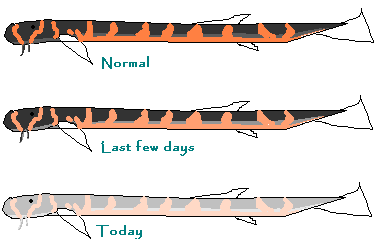
| Color loss in Kuhli loach 07/07/08
Hello there. I've been looking at your site, and you all really
seem to know what you're doing with Kuhli loaches, which is
rare. So I'm hoping you can help me. (I looked through the FAQ
about Kuhli loaches, but the only case regarding loss in
pigmentation didn't match mine.) But I digress. I have three
Kuhli loaches in a 10 gallon tank with around fourteen Cory catfish
of varying species (bronze, panda, peppered, and a few of those
black-spotted white ones that there are dozens of subspecies of).
It's a peaceful tank, and it's been healthy for a while,
though last week I had one of the spotted catfish die. <Note>
(The rest of the cories look fine though; I've noticed the
white catfish seem to be a lot weaker for some reason; perhaps I
should get some lighter gravel...) I'm not sure what killed it,
but the rest of the fish seem fine; no spots, no rotted fins (quite
the opposite, actually), no apathy. They've been doing a lot of
courting rituals, in fact. I feed them fish flakes and sinking
wafers and they all eat well. The pH is slightly alkaline (7.2),
which is normal for my tank. The temperature is 76 degrees, though
it can get as high as 80 when it gets humid up here. I've never
had problems with the tank when I've put the AC on before, but
now I'm starting to wonder, as the tank is very near it. But on
to the loach (I tend to babble, I fear) himself. Archipelago is a
he; I've had him and his sister Resin for about a year this
august; he's grown long and lithe while she's slightly
shorter and stockier. <Typical> I've noticed him being a
little lighter the last few days, mostly when I turn on the light,
which I don't find very strange, since all fish lighten when
the light goes on. Today, however, I noticed he has gone from being
a solid black with a pale orange belly to a pale, almost
transparent grey. I thought he was dead until I saw him breathe. He
isn't apethic; I dropped a few sinking wafers into the tank to
see if he would spaz out like he usually does (he did) or only
flutter and go back to lazing (as the deceased catfish had done).
He resumed swimming around the tank and exploring with his
brethren, and is currently on the other side of the tank, which
they do when they're sick of me looking at them. But yes. The
color change occurred extremely fast; within an hour or so, I
think. I know that sounds ridiculous, but I'm certain he
wasn't that light when I got home and fed them. I don't
think it's a fungus, <Mmm, no> as the black pigment in
his tail is still there. Unless it's just affected his whole
body? I'm at a loss at what to do.... He's transparent now,
and he never used to be anywhere near this light. I've had
loaches that were this transparent, but they were always that way.
They didn't suddenly turn transparent overnight. And I do mean
transparent; I can see his spine, and all his organs. It's
fascinating but worrisome. But yes. Have you ever heard of loaches
turning lighter like this? <Yes> Like with age? <Mmm,
other causes> 'Cause usually they get darker.... I've
had Salvador for two years he's absolutely velvety black, much
darker than the other two or any I've seen (he's much
longer too, I wonder if he's a different species). <Could
well be> Resin has also gotten darker over time, and so had
Archipelago. I'm wondering if it's stress from the AC
changing the temp.... <A good possibility; at least a co-factor
here> I put in two drops of Methylene blue, though I'm
hesitant to take out the charcoal and do a full treatment of the
tank. I'm debating doing a water change, as I don't want to
stress him more. I put a small pinch of salt in the tank; not much,
I don't want to burn him or the others. Should I not worry?
<Good to worry a little... if this brings you to consideration,
action ultimately> This is just a distressing thing... He looks
like a ghostloach.Thank you in advance for any help you can give
me, and sorry for the long babbling email. Sincerely, noisebeast.
P.S. I've included an MS Paint drawing of his change in
coloration...I don't know how helpful it'll be, but I
don't have a camera or anything, so I can't upload any
pics. ._. <A very nice rendering. Now... "stress" is
the root cause here... either from the thermal mix, whatever led to
or consequences of the Cory loss... I would do regular water
changes (with stored water...), and look to moving these Loaches to
their own systems... sans the Callichthyids. Bob Fenner> |
|
|
Black Kuhlii Loach,
comp. 6/7/08 Good morning, afternoon or evening what ever the case
maybe. <Morning here in England!> Can Black Kuhlii Loach live in
hard water with out suffering any health problem and be happy? Can one
keep red cherry shrimp and Black Kuhlii Loach in the same tank?
<Kuhli loaches and most species of algae-eating shrimp get along
just fine.> or will one have no shrimp and fat happy loaches? I know
the larger loaches would make a meal out of my shrimp but these guys
don't get very big. <You are correct that the "Botiine
loaches" (after the genus Botia to which may have been assigned at
one time or another) will indeed eat shrimps and snails. But the
loaches of the genus Pangio primarily feed on insect larvae, algae and
organic detritus. They have relatively small mouthparts, and while they
could eat newborn Cherry Shrimps, adults and even half-grown
individuals should be fine. I keep Cherry Shrimps with small fish all
the time, and while some baby shrimps might get eaten, Cherry Shrimps
breed so fast when properly kept that you will still get lots of extra
shrimps after just a few months.> I ask because I just discover a
small group of them in one of the 3 pet stores that exists near me and
would love to own such interesting fish, but my red cherry were in the
tank first and it would be unfair to put a shrimp hungry loach in with
them. <Indeed so. But in this case, I'd take the risk.> The
tank a 33 gallon tank that has a AquaClear power filter meant for a
40-70 US gallon Aquarium.... 40-70 just read the box one would think it
be a bit weak for a 70 gallon tank mind you in a 33 gallon tank I have
lovely current. So much so that the free duckweed that came with my red
cherry shrimp didn't have a hope. Even with a filter bag over my
intake to keep my filter from eating my baby shrimp my other plants
rock back in forth in the watery wind. <Don't put much (any)
store by quotes on the filter packaging about how big an aquarium these
can service -- like the "miles per gallon" ratings on cars,
or the "servings per box" on breakfast cereals, these numbers
bear absolutely no relation to the real world! Your safest approach is
to choose a filter that offers not less than 4 times the volume of the
tank in turnover per hour. So if you have a tank 33 gallons in size,
pick a filter with 4 x 33 = 132 gallons per hour turnover. Simple as
that. Anything smaller will become clogged too quickly, and you're
likely to find water quality poor unless the tank is understocked. Both
loaches and shrimps come from fast-flowing streams, so from their
perspective, the more water current, the better. The subtropical
shrimps we keep in aquaria (of which Cherry Shrimps are one species)
are rather sensitive to low oxygen concentration, especially when the
water gets much warmer than 25 C. Mind you, one tank I have on a
windowsill goes as high as 30 C for a couple of hours during the summer
months and the Cherry Shrimps there seem to be breeding happily
enough.> I would like to introduces a school of 6 Cory cats when my
shrimp numbers fill out. Would be nice to be able to introduce all 6 at
ones, but I am not sure if the tank could handle it with out going into
a new cycle. How many do you think would be a good number to introduces
at a time? The tank been cycle but with only shrimp in it the filter
remains not very grate. <Add Corydoras as a group, say 4 at one go,
and then 2 more later on. Again, Corydoras seem to get on fine with
Cherry Shrimps, especially if you pick the smaller Corydoras species
like C. panda.> The red cherry shrimp were to much of a pain to get
to have them all eaten by a Peaceful fish... Peaceful so long as your
not a snail or shrimp. <Hmm... do check the Cherry Shrimps
aren't dying for other reasons: I have found them to be very hardy.
I started off with 4 about a year ago, and have something like a
hundred now in two different tanks, plus any number that I've given
away to other people. Mostly fish don't eat them; at least, not
small fish like Cardinals, Limia, Bumblebee Gobies, Wrestling
Halfbeaks, Whiptail cats, etc. Do review issues like medication (copper
kills shrimps) and water chemistry stability. Shrimps are definitely
things to add to a tank *after* it has matured for at least 6 months,
since they feed primarily on micro-organisms that they find in the
algae and detritus around the tank. They seem to do best in
"messy" tanks with lots of plants, algae and things like
that. Cheers, Neale.> Are Kuhlii loaches compatible with
red tailed sharks and clown loaches. 4/9/08 <Broadly yes.
Potentially adult Clowns (30 cm/12") could eat small fish, but
I've not heard of this happen. Red-tailed Sharks generally ignore
tankmates that don't look like themselves. Do remember to keep
Kuhlii loaches in groups: at least 4 specimens, and ideally at least 6.
Otherwise they become very shy and you'll never see them. Cheers,
Neale.>
|
Sick Kuhli Loach 1/28/08 Hi. I have a
cycled 10 gallon planted with 4 wisteria, 2 Amazon swords, a
micro sword, dwarf baby tears and duck weed which houses 2 Kuhlis
and 4 narrow wedge Rasboras. This tank has been operating for
about 5 months. The loaches have been doing fine until Thursday
last week. One loach is very dark and small- slender and in
length. The other is large and perfect, just like you see in all
the aquarium photos. There are hidey pots in the tank, but they
don't use them much, prefer to be in the plant fronds or
around the base or snuggled up together, so I get to see them
quite a bit. Before leaving for the day I always do a check and
look in on the fish. This day I noticed that the small loach
looked sick....and I actually thought it was dead. It was ashen
looking, and looks somewhat emaciated. I went to scoop it out but
it swam all over the tank. I was behind by a few days (4) days on
my regular 25% a week water change (last one was the prior
Saturday), so I quickly did a water change with same temp Primed
water hoping that was the only problem. At the end of the day,
the ashen color on the body looked somewhat diminished. I just
observed it over the weekend and noticed that a small part of the
tail fin is missing, it is hiding more than usual, still looks
emaciated and the ashen color seems to be coming back. I feed a
pinch of flake food every morning, along with a few HBH frog and
tadpole bites, maybe once a week I will throw in a few frozen but
thawed blood worms. I try to supplement feeding of the pellets a
second time at night, but not always. I was worried when I first
got these fish that they weren't getting enough to eat, but
they have been alive for about 4 months in my tank, so Im not
worried about that anymore, and usually do a fast on Sundays. I
have no idea what is happening to the loach, but its condition
changed over a 24 hour time frame. One day it was hanging out
with its buddy looking great, the next day it looked almost dead.
Any idea? Kristen <Difficult to say without a photo. Male
kuhli loaches are much more slender than the females. Where males
look like worms, the females look quite robust, almost as if
they'd swallowed a male! The body is often twice as deep as a
male of similar length. On the other hand, if the thinner fish is
losing condition, i.e., it's fins are ragged and it
doesn't have great colours, then there may be something else
at work. Diet is certainly one thing to consider. Are you feeding
them enough? Do these fish have to compete with other fish? Kuhli
loaches tend to lose out in busy community tanks. They are best
kept as the only nocturnal bottom feeders -- i.e., they
shouldn't be mixed with other catfish or loaches. Anyway, if
you can send a photo, that would be great. Cheers, Neale.>
Re: Sick Kuhli Loach 1/29/08 Thank you for
your reply Neale. I will try to get a photo but as I am sure you
are aware, this can be quite hard. <I bet. Sometimes the best
approach is to net the fish, and photograph it at the
surface.> I don't want to move it until I decide it has to
go into a hospital tank, just to ease any more stress on it.
<Agree; with social fish, you do need to balance quarantining
something for medical purposes and the fact the fish won't
settle down if its on its own.> These two loaches are the only
bottom feeders in the tank. It could be that they haven't
eaten much, but Im pretty sure that with the food going into the
tank, they are at least getting something. <Sometimes easy to
get this wrong. I'd try switching to a solid pellet thing,
like Plecostomus algae wafers. Half one of these discs (each
about the size of a penny) should be adequate. Because these
things break apart slowly, they don't get sucked into the
filter, and catfish and loaches have ample time to feed.> The
other loach (from your description, most likely the female) has
not shown any signs such as this loachie is expressing. It might
be in his best interest to simply move to a hospital tank... but
then treat for what? <I'd stick with upping/varying the
food a bit.> Internal parasites? <Possible. You could try
something like PraziPro to see if it helps.> I don't think
its Ich, none of the other fish are showing any white dots...
except this loach, has white on its body. <OK.> It
doesn't look like wet or dry cotton, it pretty much looks
like lack of pigmentation. The skin seems to be sagging a little
bit too, which is why Im calling it emaciated looking. I will put
it in a hospital tank tonight and try to get you a pic. Thanks.
<Look forward to seeing the pictures. Cheers,
Neale.> Re: Sick Kuhli Loach 1/29/08 Here are some
photos of the sick loach. The ashen color between the stripes:
this fish has always been a deep, dark brown color with white or
creamish colored stripes. The photo looks washed out, but this is
what this fish looks like now. <This fish is emaciated but not
otherwise (obviously) sick. It may well have a "Wasting
Disease" including internal worms, so treating with PraziPro
is definitely a good idea. But I'd also step up the food.
This fish is in the sort of state where force-feeding might be
required, but if its foraging normally, I'd simply use a
solid pellet of food that lasts all night, and let it graze
freely. Force-feeding small fish is very difficult to do safely,
and does take a lot of care. I'm a bit worried about the
gravel: Loaches are never at their best in tanks with coarse
gravel, not least of all because if food sinks between the
"stones", they can't easily get it out. Sand is the
best for these fish.> The head appearing larger than the body:
emaciated. This fish has not always appeared to have a large
head. The body in relation to the head is larger and this makes
it appear emaciated. I have been caring for this fish for 4
months or more and was shocked by how skinny it looked, over
night. <Agreed.> Its hard to see in great detail and I cant
get any better photos at this time, but the tail piece missing.
It looks as if a corner of it was just torn off. <The tail
damage could indicate it is being harassed by something in the
tank, like nippy tetras or barbs or catfish. But given your
stocking, that doesn't seem to be likely. Finrot is
definitely on the cards though, so treating pro-actively, or at
least being prepared to treat Finrot, would be sensible.> The
only inhabitants of this tank are the 2 loaches and 4 Rasboras,
and a couple of errant snails. No sharp edges in the tank. I
added the sword plants about a month ago. <The gravel looks
plenty sharp.> I feed them sinking frog and tadpole pellets
every day, along with flake food and once a week throw in some
blood worms, but I will try to get them something more
substantial and see if that helps, too. Thanks again for the
response. <Yeah, I think you need to beef up the diet. Algae
pellets, catfish pellets, or about a half-cube of wet frozen
bloodworms would be a good idea. Try putting the food on
something like an up-turned peanut butter jar lid, so the food
doesn't fall straight into the gravel. This is a trick
seahorse keepers use, and once the fish figure out where the food
is, it works pretty well.> -Kristen <Cheers, Neale.>
Re: Sick Kuhli Loach 1/29/08 Neale, thank you so much,
again for all your wonderful suggestions. I am currently trying
to locate some medication, so in the meantime, I will get some
algae wafers and a "dinner table" for them to see if I
can entice the loach to eat more. I really have become taken with
these little creatures and now knowing that they were wild
caught, I am inspired to do what ever I possibly can to keep them
healthy. Even, I guess, if it means getting a new tank with sand
and getting them some more friends! :) <Cool. All sounds like
a good plan, and I'm glad you're enjoying the hobby.
Sandy substrates are a great investment of time. They're
cheap to do, and though a little work is involved, they can look
amazing. There's an article somewhere at Wet Web Media called
"Nice Bottoms" by my good self, and that's all
about this topic. Cheers, Neale.>
|
|
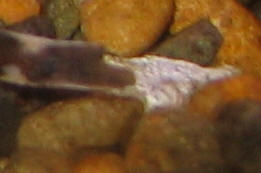
|
Kuhlii Loach 1/16/08 Hello, <Hi Jessi> I
recently purchased three small (about an inch and a half each) kuhlii
loaches. <Wow, tiny> They seem healthy as far as feeding and
activity levels, but I noticed last night as one did rested half of
it's body vertically against the tank wall that it's gills
seemed a little pink. <Mmm, these little loaches do/should appear
so...> I'm wondering if that means they have some sort of gill
irritation or if maybe it was just that the loaches are so tiny maybe
they're a bit transparent and showed up pink. <Yes, the
latter> I can only see this pink color when I view the loaches from
below or can get a glimpse at their bellies. Otherwise their coloration
seems normal. If this is something to be worried about, how should I
treat it? Thanks, Jessi <No need to treat. Cheers, Bob
Fenner>
About Kuhli loaches and snails Hi, I have a bit of a snail
problem in my 20-25gal tank. (size isn't 100% sure since it's
not a standard tank) I pick out snails whenever I see them and I
don't usually notice them much but sometimes it gets to be a
problem. Also on my java fern which is in separate living quarters at
the moment because of the education I am using) there are a ZILLION
baby snails. (not surprising - I noticed several snail egg sacs on the
fern when I moved it to its current quarters) I'm treating the
separate bucket with had-a-snail. oh yes and I am currently treating
the main tank with CopperSafe for Ich, which is supposed to be
'dangerous' to invertebrates but it doesn't seem to bother
the snails at all! <Figures! But it may be doing a number on your
filter. Please check for ammonia and nitrite spikes. Much better to QT
fish for treatment and allow the tank to be fish free for a month.
Treating the main tank can cause you more problems than snails.> (I
am using a half-strength dosage to be gentle on plants, tetras and
Otos) Anyway I am concerned about this as the last thing I want is a
big snail infestation. I'm wondering if Kuhli loaches might do the
trick? Obviously a clown loach would be the most effective, but I
don't want to have to trade the fish back again as I live over an
hour's drive from the nearest pet store. Also I was reading your
faq a bit and you guys mentioned zebra loaches - I've never seen
one but they also sound like a good option if I could actually find
them. <Hi, Don here. Please check the link below for an thread on
this subject going on in the forum right now. Please feel free to join
in. Aquabid.com is great for finding fish not stocked in most LFS. Of
course with the price of shipping added in, it can be costly. Perhaps
talk to the manager at a pet store. > [l]
http://wetwebfotos.com/talk/thread.jsp?forum=3&thread=23318&tstart=0&trange=30[/l]
Can you guys give any recommendations? a permanent, live in fish would
be best. If the Kuhli loaches might do it (I have heard in a few places
that they may eat snails) I have had them in the past and I quite enjoy
them :) If zebra loaches wouldn't get too big (the tank is around
36 inches long and about 15 wide, and 10-12 deep, I don't recall
exactly), and if I could find them, they seem like the best choice.
Thanks for any help you can give, your site has always been helpful :)
~Anna
Sick Kuhli Loaches Thank you for considering my question. I
actually have two which are related. 1) My local pet store used to be
able to get healthy Kuhli Loaches all the time. In recent years (no
matter the source) they arrive sick and the whole lot of them die. The
symptoms are reddish gill area, then swirling, then they die. Any
recommendations. We would love to be able to get some "new
stock" in our area. 2) This is my main question, the first is
background for what knowledge I do have. This morning I discovered one
of my Kuhli Loaches is pinkish around the gill area. I have had my
Kuhlis for quite a long time and have not introduced any new fish for -
6 weeks. What is my best bet for treatment? I don't want him to
follow the same fate as those at our pet store. <<Hello. Kuhli
loaches are a problem lately in most stores. The stock is just not
healthy anymore, and they seem particularly prone to bacterial
infections and gill flukes. Stores can treat them with antibiotics, and
if lucky, some may survive. Strong antibiotics will kill your
nitrifying bacteria, though, so be careful! For you, I would recommend
Melafix and salt (a teaspoon per gallon). Or you can try to find
yourself some Maracyn Two, which is a safer antibiotic to use since
it's relatively gentle, and not as much of a threat to your
nitrifying bacteria when used as directed. To prevent further Kuhli
problems in your tank, maintain good water quality and do regular
gravel cleaning. This will help keep the nasty bacteria levels in your
substrate under control, which promote infections, and prevent anoxic
areas from developing underneath your decorations and rocks. It's
hard to vacuum using a regular siphon, since cutting your Kuhlis in
half with the tube is always a possibility, so what I recommend is that
move the decorations around, and you "sift" the gravel with
your hands regularly to release the debris, and let your filter remove
it. Make sure you have good water circulation, so the suspended debris
is removed by your filter. If need be, you can add a powerhead to your
tank for circulating the dirty water during this cleaning process. Then
clean your filter floss and do a water change about an hour later.
Also, if you happen to see the solid black Kuhli loaches for sale, buy
them instead. They are (thus far) much hardier, easier to keep, and
just as entertaining. -Gwen>>
Loach Colored Loaches? - 11/02/2005 Hello, <Hi.> Can
you please email me with the name of the fish I had when I was younger?
<Umm, I hope you've got a description?> I am starting a new
tank and wanted to get him again. He had the loach colors
<"Loach colors"? There are many species of loaches in
many, many sizes, shapes, and colors....> but was long and tubular
like a worm, fast as hell and very good with other community fish. Have
any idea what he is??? <Your description seems to be of a Kuhlii
loach,
http://www.fishbase.org/Summary/SpeciesSummary.php?genusname=Pangio&speciesname=kuhlii
. Take a look here for just a few others: http://www.wetwebmedia.com/FWSubWebIndex/cobitids.htm
, and here for many more: http://www.loaches.com/ .> It's
driving me nuts and Petco and PetSmart are no help! <Hope this has
shed some light.> Thanks. -Angelo <Wishing you well,
-Sabrina>
|
Loach(?) ID 8/26/07 Hello I was just
wondering if you could ID this fish for me thanks Tom <Hello
Tom. That's a species of Pangio (formerly Acanthophthalmus).
Collectively, Pangio spp. are known as Kuhli loaches. The
orange-and-brown banded species (of which there are several) are
the most commonly traded. Yours is one of the
"unbanded" Kuhli loaches, quite possibly Pangio oblonga
known in the trade as the Java loach. Basic care is identical to
any of the other Kuhli loaches: soft sandy substrate, needs to be
kept in groups of 3 or more, keep water temperature at or below
25C, keep tank securely covered, etc. Cheers, Neale.>
|
|
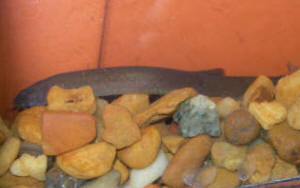
|
Loach ID, Kuhlis 7/25/07 Hi all, thanks for all
the help in the past. I have a very simple freshwater question for you
guys. I searched the FAQs and articles and couldn't find a
definitive answer and the necessary page on loaches.com, conveniently,
was down. It is long (5"-6") and serpentine like. He is
pinkish in color with 4 'whiskers' around his mouth. My LFS
called him a True Kuhli Loach but they have a bad history in correctly
identifying fish. Could you please tell me what this guy is and if he
needs any similar tankmates; I understand other types of Kuhlis need
groups of 3 or more? Also after several hours of web searching I found
that the same store had sold me a water bug and I believe it's a
'Dragonfly Nymph'; green, 1 1/2" long, big eyes and 6
legs. The same site mentioned nothing about these critters in captivity
and that they are predatory towards small fish and insects.
Non-coincidentally, I believe, one of my Glass Catfish had a an
(eventually) fatal bite taken out of him near his organs. I'm
leaning towards throwing him in the Cichlid tank if he keeps this up,
is unsuitable for captivity, or I can't feed him reasonably. Or
maybe I should quit being stubborn and setup a quarantine, but with
Cichlid, Reef, Catfish, and Community tanks it would be quite an
investment. I apologize as this was supposed to be a short letter, but
with a pension for diversity there's always something to talk
about! Thanks in advance -John <Hello John. Identifying species of
Pangio (the genus to which kuhli loaches belong) is difficult. There
are around 30 species, many of which are very similar to each other and
almost none of which are correctly identified by retailers. The problem
for me is the size of your specimen: most kuhli loaches are very small,
and even the biggest species in the genus, Pangio myersi, tops out at
around 5"/12 cm according to Fishbase. And such big specimens are
exceptional: around 4"/10 cm is much more typical. For this
reason, I'm wondering if you don't have a species of Misgurnis.
These are sometimes called weather loaches in the trade. They reach
around 6-8"/15-18 cm in length but have the same snake-like build
as kuhli loaches, though they are much more robust. They typically have
mottled brown bodies but there are albino and golden varieties in the
trade and you might have one of these. Alternatively, Horseface
loaches, Acantopsis spp., are also commonly traded. These are also
quite a bit larger than kuhli loaches, but they have very distinctive
long heads, uncannily like a horse's. The best thing to do is visit
Fishbase and research loaches. Go here: http://filaman.ifm-geomar.de/Summary/FamilySummary.cfm?ID=127 and
then where there is a link "Show Species" click on it and
review the photographs presented to find something similar to your
fish. As a general rule, all Pangio and Misgurnus are sociable, while
Acantopsis run the range from harmless and fairly sociable through to
territorial and waspish. Loaches in general are somewhat territorial,
which is why only Pangio and Misgurnus have really made it in the hobby
as community fish; even among the loaches formerly called
"Botia" most are pretty mean animals, the Clown Loach being
one of the rare exceptions. Now, Dragonfly nymphs are indeed highly
predatory and cannot be kept with fish. That said, they are extremely
cool animals, and far more interesting than most fish! They have
amazing jaws and some varieties get very large indeed. I HIGHLY
recommend setting aside a bowl or similar with some pondweed just for
the nymph. They don't really care about filtration being adapted to
stagnant ponds. Change some of the water every couple of days though.
Add small water creatures from any ditch or pond outdoors from time to
time. You can even hand feed them bloodworms using tweezers. Watching
them catch the worm and then suck out the juices is quite something.
They grow rapidly, and watching them metamorphose is truly a spectacle
of nature not to be missed. Enjoy! Neale>
Sick kuhli loach 8/29/07 Dear
Crew, I purchased a Kuhli loach about a week ago. He didn't look
terribly healthy to begin with, but I had him ordered and felt sorry
for him. So now he's in a 10 gallon tank by himself. The water
parameters are fine and the tank is 3 months old. He was sick to begin
with, I had hoped to cure him but failed thus far. His symptoms are
rapid breathing and whitish sickly looking patches on his skin, which
don't appear to be fungus but more like a there's a gap between
some surface layer and a subsurface layer, almost like a blister. I
finished a 5-day course with both Maracyn and Maracyn II and he's
about the same. I'm actually surprised he's still alive. Any
suggestions? Regards, Michelle <Hello Michelle. OK, the first rule
is don't buy sick-looking fish. Now, given you have the fish,
let's see what's going on. My guess is you have a fish with
some sort of "slime disease". This a catch-all name for a
variety of things. Basically you need to treat for an external
bacterial infection and hope for the best. There are some medications
designed specifically for slime disease, and those are the ones you
want; things like API Erythromycin and eSHa 2000 should do the trick.
If things still don't improve, saltwater dips can be very useful
for clearing up slime disease. But loaches aren't terribly salt
tolerant, so if you opt to supplement the slime disease medication with
saltwater dips, be careful. Adding salt directly to the aquarium
isn't recommend, either. Cheers, Neale>
Troubles with Ich 7/7/06 Hi, Larry here. My
son started a FW 20g planted tank with Cardinals, Blue Rams, Thread
fins and a Clown and Kuhli loach. Unfortunately the clown loach had
ich. < Common problem with this fish.> We treated with Maracide
which is basically Malachite green as directed on the bottle and the
ich disappeared for a few days only to come back. So we retreated 2
more times and the ich has returned. We raised the temp to 82F and
switched to Quick cure which is M.Green and formalin and have had no
luck in effecting a cure. The tank uses a Fluorite gravel. Do you think
the Fluorite is absorbing the malachite? < No but any organics would
absorb this medication.> <<Could easily be. RMF>> The
water does not stay blue green very long. Our plants by the way have
done very well through all this. We have now moved all the fish to a
29g QT tank that I normally use for my Marine fish. We are now treating
with Cupramine copper. Now how long do we have to leave the 20g fallow
before we can put our fish back into the tank? < At 82 F the ich
parasites need a host. They will die in 7 days without a host fish.>
I was also thinking about treating the 20g tank with Epsom salts as I
have read in WWM FAQ's that this can be effective, what's your
opinion on this? < Salt increases the slime coat on the fish and
make it more difficult for the parasite to get established on the fish.
You don't want to add too much because this will also increase the
slime coat over the gills and prevent the fish from breathing
properly.> We also have an African frog and some Japonica shrimp
which have survived the Malachite and formalin much to my surprise. It
is my understanding that they do not act as hosts or reservoirs for
ich. Will they be ok if we treat the tank with Epsom salts and what
dose do I use? < I think your problem is that you don't let the
medication stay in the water long enough. If I had ich in my tank I
would do the following. Raise the temp to 82 F. This makes it more
difficult for the parasite to survive because at higher temps, water
has less holding capacity for oxygen. Secondly I would do a 50% water
change. This automatically removes 50% of the free swimming parasites.
Third I would clean the filter and remove any carbon. Fourth I would
vacuum the gravel to remove any organics and make any medication more
effective. Then I would treat with Rid-Ich by Kordon. It is a
combination of malachite green and formalin. Follow the directions on
the package. I would add a teaspoon of rock salt per 5 gallons of
aquarium water. The ich should be gone for good in a week. Now to
prevent any further outbreaks I would get a quarantine tank. No fish
goes into the main tank without a minimum two week quarantine period.
Much easier and cheaper to medicate in the QT tank.-Chuck> What a
frustrating mess, I have a 120g FOWLR marine tank that I tore down
because of battling ich for over a year thanks to a blue tang that I FW
dipped and QT for 2 weeks. Thanks for the advice and all the wealth of
knowledge that the WWM crew supply. Larry, basking in the sun in
Minnesota! <<... need to remove the shrimp, frog... and I'd
raise the temp. to the mid to upper 80's F. RMF>>
|
|

