|
FAQs on Platy Diseases/Health
2
FAQs on Platy Disease:
Platy Disease 1,
Platy Disease 3, Platy Disease 4, Platy Disease 5, Platy Health 6,
Platy Health 7,
Platy Health 8,
Platy Health 9,
Platy Health 10,
Platy Health 11, Platy Health ,
FAQs on Platy Disease by Category:
Diagnosis,
Environmental,
Nutritional (e.g. HLLE),
Social, Infectious (Virus, Bacterial, Fungal),
Parasitic (Ich, Velvet...),
Genetic,
Treatments,
Related Articles: Platies, Poeciliids:
Guppies, Platies, Swordtails, Mollies by Neale Monks,
Livebearing Fishes by Bob
Fenner,
Related FAQs:
Platies 1, Platies
2, Platy Identification,
Platy Behavior, Platy Compatibility, Platy Selection, Platy Systems, Platy Feeding, Platy Reproduction, Livebearers, Guppies, Swordtails, Mollies,
|

|
Platies, Fast-Acting
Mystery Disease - 05/13/2006 Hi, I've had my 20 gallon tank set
up for about 2 weeks. I started with 4 platies and a striped Raphael
catfish. One of the 4 platies died within 3 days of purchase and had no
external symptoms except possible white, stringy poop. I
noticed she was swimming very close to the surface, and toward the end,
very close to the bottom. I've been testing the water
and doing water changes. Currently the nitrites are spiking (2.0).
<Bad news there. Do water changes, urgently, to keep
ammonia and nitrite at zero, even (especially) during the
cycle. Also, please do read on WWM regarding cycling,
fishless cycling....> Last night I noticed another platy acting
strangely. It was apparently hiding in a castle decoration and when I
lifted it so he could swim out, he was swimming very jerkily and had
that same stringy white poop. <This *can* be a symptom of internal
parasites.... but too little to go off to know for
sure. Any other fish exhibiting this?> I was convinced he
was sick but since it was midnight, I couldn't really do anything
about it. This morning at about 10:30 I found him swimming
upside down and kind of spiraling when he swam. <Wait - spiraling
listlessly, like he was just kind of unable to guide himself, or
spiraling like he was actually swimming in spirals?> He was also
crashing into the bottom of the tank and then holding still for a
while. Obviously not long for this world, I debated with my boyfriend
about what to do. I noticed he may have had two tiny white
bumps on his skin, but my boyfriend couldn't see them.
<Do please look VERY closely at your other
livestock. Look for white dots, and with the Raphael, look
for him to be doing a sort of a "swimmer" motion with his
pectoral fins, kind of rotating, and alternating left and right, like a
person swimming "freestyle". This is an indicator
of parasites on the gills, and is important to look for, as Ich will
rarely manifest on the skin of a plecostomus or Raphael.> About 20
minutes later we decided to move him to a bucket with some tank water
in it. By the time we got the water into the bucket and the fish into
the net, he was dead. We checked his body but nothing seemed unusual
except that he was dead! <That's unusual enough for
me, yikes.> From the visible behavioral symptoms until the death was
about 11 hours.... What kind of disease/condition moves this
swiftly? <A hearty handful, actually, especially in
smaller fish.> And are the rest of the fish in danger? <Quite
possibly. Are any of the remaining fish clamping their
fins? Swimming in circles? Shaking their heads
side-to-side? Shine a flashlight at each fish. Do
you see a milky quality to the animal? Grainy?> I'm
not sure how to treat and worried about what it could
be. Please help me out, any advice would be
appreciated, thanks! <More info to go off here would be of
help.... Though I am very much leaning toward this maybe
being a parasitic complaint, I'm very deeply concerned about the
spiraling you mentioned and the possibility of Myxobolus/whirling
disease, as I've seen this in other Poeciliids (mostly just
mollies).> Meg <Hoping for only the best, -Sabrina>
Platies, Fast-Acting
Mystery Disease - II - 05/15/2006 Thanks for your quick response! I
just got home from work and I'm noticing my other calico platy is
hiding and sticking near the bottom of the tank. He'll probably be
the next to go :( He wasn't acting strangely until after the other
fish died. I'm going to buy another 5 gallon bucket
tomorrow so I can do 50% water changes instead of just 25%.
<Good. It *is* possible that all you are seeing is
strictly environmental.> When the fish was spiraling he was trying
to swim straight (it seemed) but he was unable to control himself and
would spiral instead. Like a football when you throw it. He kept ending
up upside down and then crashing into the gravel. He would
move in spurts and then hold still. <This is VERY
disconcerting, and does sound perhaps like Myxobolus/whirling
disease. If you see these symptoms in any other fish, get
the fish with symptoms out of the tank PRONTO.> My boyfriend saw the
catfish swimming earlier and said he wasn't making that motion like
a swimmer. He said he was using his tail to swim mostly. <The
"swimmer" motion would only be seen when the fish is at
rest.> I haven't seen him swim lately cause he only comes out in
the dark. The red platy has one white dot right on its anus.
This is probably bad, Hm? <Mm,
maaaaaaybe.... And maybe not, too. Could just be
"normal", especially if the animal is female and
pregnant.> Ugh. I'm going to try to go to the pet store
tomorrow. If this is a parasite, how should I treat the
tank? <The stringy white poo still concerns
me. I would feed an antiparasitic medicated food, and not
consider treating the water.> I'm also worried that it will be
too late for the calico platy because he's hiding like the first
one did. I'm hoping maybe he's sleeping, I will try feeding
them and see if he picks up. Okay... with the food in the tank he
started zooming around. I don't think he actually ate any of the
food though. But I got to look at him since he came out of
hiding. He looks thinner than the red one, granted the red
one just ate most, if not all of the food. His gills look a little red
but he doesn't have any white spots. I don't think he looks
milky or grainy but its hard to tell. The red one looks wonderful
except for that white dot which comes and goes? Neither of
them are shaking their heads or clamping their fins or swimming in
circles... not yet anyway. <That, at least, is quite
good.> Thanks for your help. Meg <Watch for that spiraling
swimming behaviour, try to find an antiparasitic medicated food (Jungle
makes one you can get at PetSmart, a better one can be found at the
store of http://www.flguppiesplus.com ),
maintain perfect water quality, and watch the fish very, very
closely.... Hopefully all will be well with time as the tank
finishes cycling. Wishing you
well, -Sabrina>
Platies,
Fast-Acting Mystery Disease - III - 05/16/2006 Hi Sabrina,
<Hello again.> The pesticide man came today and that compounded
my fishy issues. <ARGH!> Hehe. We had to saran wrap all the tanks
cause he was doing major spraying and my boyfriend forgot to wrap my
poor Betta's bowl. <Oh dear - this could go very bad....> His
tank water actually had a film of yuck on it (it was old
water too). 100% water change and now he looks much
happier. <Good. Watch him VERY
closely. Do another water change if ANYTHING seems
amiss.> Back to the platies. I haven't had a chance for the
water change. <Please hurry with it; water quality is life or
death.> And I'm a tiny bit leery about it because I know this is
probably the peak of the nitrate cycle and I want to have it be over
because if it IS environmental, the stress of a cycling tank will be
gone. <Meanwhile that stress/damage from cycling can kill or
irreparably damage the fish. DO the water change, and
urgently. It will prolong the cycle, and you'll need to
KEEP doing water changes, but the alternative is perhaps killing ALL of
your livestock or having them have permanently damaged gills,
etc. A little work on your part, patience and lots of water
changes during this critical time is all the preventative you
need. If you are not willing to do the water changes, then
return the livestock until the tank has cycled.> The white platy is
still hiding and the catfish is too. I haven't seen him swim when
he's resting except he sometimes tries to bury himself face first
into the wall of his cave to escape the light when I go prodding in
there ;) The red platy still looks okay. She's swimming
around and she's very healthy looking... meaning,
colorful and fat, not like the white one that looks like its getting
smaller. <Disconcerting....> The red platy's poop is starting
to turn white. <Even more disconcerting....> Right now it's
got brown and white alternating in the same strand of poop. You know,
talking about fish poop is very odd. <Yeah, but it can
be very telling, too.> The white fish hides 24 hours a day in the
little castle in the complete darkness. I pick up the castle and rustle
him out about twice a day to make sure he's alive still. <Use
caution, here; disturbing him is pushing him closer to death's
door. If you can see him without disturbing him, that would
be best.> He has white stringy poop and when he comes out of the
castle he holds very still and rests against something (a plant, the
substrate, the castle) only his front fins move but he doesn't go
anywhere until he moves his tail. Then he goes right back into the
castle. <I do feel that the environment is partly if not
entirely the problem, but I am also not convinced that there is not a
parasitic complaint at play here. Fix the environment
(urgently!) and observe.> Nitrites are high in the tank.
<Deadly.> I'm hoping this is the major factor.
<Likely, but again, not certain.> I really don't want to have
to wash the whole tank out and basically re-cycle the damn thing
because the platy's had a parasite. <There are VERY rare
instances where this would be necessary. Yours is not one of
them. Do water changes, like NOW, as soon as you're done
reading this, and be sure to match the temperature and pH of the new
water to that of the tank, use a dechlorinator, etc.... You
will not halt the establishment of the nitrogen cycle, just prolong
it. Keep doing water changes, daily if necessary, to keep
your livestock safe.> The poop looks a lot like the white stuff that
was growing on all the decorations about a week ago. Ugh.
<White stuff growing on the decor? Maybe a diatom
algae? I don't recall discussing this in previous
correspondence with you.... In any case, do please try to
get hold of one of the anti-parasite foods I suggested, "just in
case", and start in with those water changes. Wishing
you well, -Sabrina> Platies, Velvet? -
05/13/2006 Hi guys, <Hi, Heather!> First off, I'd just
like to say that I love your website - very informative!
<Glad to hear it, thanks!> I searched through a lot of the
articles but unfortunately can't seem to find the answer to my
problem. We have a fully cycled 20 gallon tank with 3 adult
platies, 3 2 week-old fry, and 2 African dwarf frogs. The
platies were rubbing their abdomens on rocks, with clamped fins,
occasionally gasping for air, with shiny areas on their
abdomens. It seemed like this was a textbook case of
parasites. <Entirely possible. Or could be an
irritant in the water.... Ammonia or nitrite above zero,
nitrate above 20ppm....> We got Maracide and have given 2 doses so
far. Right after the first dose the female platy that had
looked really bad seemed quite a bit better, but the male went from
just having clamped fins to displaying all of the other symptoms I
listed. He barely moves off of the bottom at all, but will
still eat. The female that was originally sick now swims
around a bit but she hasn't eaten in days. <Very disconcerting
for these tiny, usually voracious, fish....> All of the fry seem
ok. Our water test readings are: Ammonia - 0, Nitrites - 0,
Nitrates - 15, PH - 7.2 (normal for our tanks), KH -
moderate. <Okay, that all sounds good.> Do you think
that they're showing symptoms of a secondary infection?
<Nothing you've stated leads me to believe so.> The Maracide
bottle says that it's ok to add Maracyn 1 or 2 while dosing with
Maracide, but I know that it's not recommended to just dose with
everything in the medicine cupboard.
<Right. I would not add Maracyn I or II at this
time. Any chance at an antiparasitic food? Jungle
makes one now that's available at PetSmart, I think; I had some
real success with this when I had guppies with velvet/Oodinium.> Any
help would be greatly appreciated! My fiancé© and
I are terrified that they're going to die. <I would finish the
round of Maracide, and perhaps even consider getting a hydrometer or
refractometer and use salt marketed for freshwater aquaria to raise the
salinity in the tank to 1.002 or 1.003; this will be tolerated by the
platies, but not the frogs. The frogs should NOT be present
while medicating in any case. Were it me/my fish, I'd
give the frogs their own, very clean space for now, and treat the tank
with salt.> Thanks, -Heather <wishing you
well, -Sabrina>
Platies, Velvet? - II -
05/13/2006 Thank you very much for all of your help,
Sabrina. <Glad to be of service!> I'm heading out
right now to get a hydrometer <Oh - a caution here - when you add
salt and raise the salinity, DO IT SLOWLY. Baby fish are
less tolerant of such changes than adult fish.> and we'll be
moving the frogs into their own space this afternoon.
<Great!> You guys are great! <Thank you very much for these
kind words, Heather. All the best to
you, -Sabrina>
'Wasting' platies
4/21/06 Greetings, I have 5 baby platies in a 15L tank, 2 sunset
platies who are 3-4 months, and 3 others who are about 2 months old.
Over the last two weeks, the two sunsets have appeared to lose interest
in food (crushed flake, twice daily) and are hanging around the bottom
of the tank. They seem to be getting worse and although try to get to
the top for food, they appear to have suddenly developed curved spines.
<... environmental, and/or nutritional...> The other 3 younger
platies are thriving and getting fat. Is there anything I can do about
this? <Need to know much more re your water quality, history of this
set-up. For one, I would broaden the diet here... to include some meaty
foods, live plant material... Please do read here: http://wetwebmedia.com/FWSubWebIndex/platyreprofaq2.htm and
the linked files above... in the hope that something will "pop
up" of use here. Bob Fenner>
Platy Problem - 03/13/2006 Bob, <Actually, Sabrina with
you today.> We have a male pineapple platy that has developed a
small red spot on his body. He has flashed a few times; otherwise he is
eating and poohing normal. <This could be most anything - from a
minor scrape or bite to the beginning of a parasitic or bacterial
disease. I would just wait and see for now, if it
doesn't look serious.> It is a 30 gallon tank with platys, some
mollies, glow light tetras, Pristella tetras, and cherry barbs. The
water is testing O for ammonia, nitrites, nitrates; <Somewhat
unusual that an established tank would test zero for nitrate.> the
PH and Hardness are fine. We have two air stones in the tank for
aeration. Do you have any idea what this could be? <Too many
possibilities, too little information to have an idea at this time.>
Ellen and Michael Gordon <Wishing you
well, -Sabrina>
Mickey Mouse Platy 03/9/06 Hello, thank you
very much in advance for your expertise. My 3 1/2 year
old daughter is obsessed with fish (thank you, Nemo) and she has 4
tanks. <It's good to see that that movie has had SOME good
effect in fishkeeping... I just shudder at the number of Clowns kept in
bowls because if it, though.> Her latest and greatest is a 16 gallon
tank that we started for Christmas. It has 4 male guppies, 1
red platy, 1 silver platy, 1 baby black molly (given to her by the fish
store,) 1 plecostomus, and 3 Mickey mouse platys. <Pretty good, the
Pleco will get far too big for her current tank... They can grow to be
a foot or longer!> One of the Mickey mouse platys gave birth to 2
(that we can find) fry today but the "Mama" who we just got a
few days ago is bent. She was fine when we got her, she almost looks
like a "z." <Bent spine? Could have hurt
herself birthing, could be a genetic defect -- genetic defects are very
common in livebearers. She may not make it, put her in a
cycled quarantine tank with very clean water; daily water
changes. There is little else you can do. If she
seems to be suffering, you should consider euthanizing her.> Why is
this? The babies are in the tank and the "Mama" is
in the breeding net. The tank has many hiding places and I
have been unable to catch the babies who were born today. <Baby
livebearers are likely to become lunch if you do not separate
them. Having an empty tank handy for raising baby
livebearers is a good idea if you want them to survive. It
is a fun hobby, and comparatively easier than raising egg laying
fish. If you do not want to keep the fry, it is humane to
allow them to be eaten by the parents; a large percentage of fry are
eaten in the wild.> I am a novice wondering how I let myself get
talked into this size tank!! Help, please. Thank
you. My daughter, Katee, is very concerned for
"Sunshine." Sincerely, Debby <If you end up
having to put your Molly to sleep, I suggest using clove
oil. It can be purchased at your drug store, several drops
in 1/2 gallon of water, mix it thoroughly. Clove oil is a
natural anesthetic, your fish will fall asleep and suffer respiratory
failure, very peaceful and not painful. Best of luck. Jason N.>
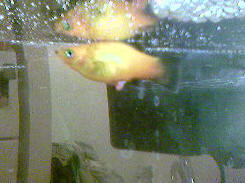
| Question about a growth? 2/22/06 I have a
small 10 gallon freshwater tank with 2 platys and 3
mollies. I've had them for about 3
months. Today I noticed that my female had
an abnormal growth on her belly between her pelvic
fins. It's bubbly and the same orange
color as she is. As first I though it was some kind of
fungus, but throughout the day it's grown to three
times the size. I have no clue what it is, or
if there is anything I can do for her. Please
help me. I hope the attached picture helps in
identifying what it going on. Thank you in
advance. Erin <Does appear to be some sort of
tumorous growth. Such things are largely untreatable, and hopefully
spontaneously remit. Not catching... maintain good water quality
and nutrition and hopefully this platy will self-cure. Bob
Fenner> |
|
|
Mother Platies dies - 2/4/2006 My fish is a
platy. She recently had her first fry. she stay close to the
breeder net because that is were i put her babies. Now tabo
has died. When tabo was born her mother also died. Is it
common for platys to die after giving birth? Sylvia <Mmm,
no... unless very old... Perhaps coincidence here, but please read on
WWM re platy systems, health... Bob Fenner>
Platy problems...
actually normal behavior - 01/12/2006 Hi, my name is Andy. I
am new to the aquarium thing, and I have purchased three platy's,
two female, and one male. the male tends to follow the
females around but not bite at them. <Normal...> but they run
from him , he keeps following and it seems the females are afraid of
him. What should I do? <Mmm, nothing> or is he just trying to
mate? <Yep> Please give all the info you have to give. thanks
dearly Andy <No worries Andy. Bob
Fenner>
|
|
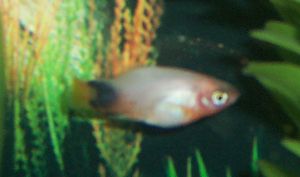
| Washed Out Mickey Mouse Platy - 12/01/2005
I really hope you can help me with this situation. <We
shall try.> I have a 55 gal tank that has fully cycled over the
past 3 months. At 2 weeks I started with 2 yellow Mickey mouse
platies (male and female), 1 red m.m. platy and 3 diamond tetras as
my starter fish. About 2 months into cycling I had to treat the
platies for a white dot fungus and was told to use a medication
which changed the water to a green tint and removed my carbon
filter cartridge and replaced it after 2 full treatments (4
days). <"White dot fungus".... I'm guessing,
here, but I think you might mean "Ich"/"White Spot
Disease"?> The 2 females showed the most signs but thought
it best to treat the entire tank. <If Ich, yes, almost
imperative that all fish be treated.> They definitely got better
but the red platy has since started to lose most of her color (as
you can see in the attachment) to where now she looks semi
transparent as if she were losing her scales or something (she used
to be bright orange red color). <Wow. That's quite a
significant change.> I still find her rubbing her side on some
of the decor and sometimes hides a lot behind some plants close to
the gravel bottom but don't see any sign of the same fungus
problem and comes out to eat. <Eating is a very good sign,
at least, but I don't like that she's hiding so much.> I
have done 25% water changes weekly and monitor my water chemistry
closely. My ammonia and nitrites read 0 ppm and nitrate levels read
almost 0 ppm but never reach the next color on the scale of my test
kit which is for 5 ppm. <Excellent.> I have searched
your site for my answer and have asked my local pet store for help
but told to isolate her and monitor her behavior but will that
really help?. <Isolating her in a tank of her own, with
lots of plants for cover, will help. At the very least, it will
ensure that she won't be "picked on" by other fish,
which may be very, very important right now.> I would really
like to cure what ails her but I don't know what it can
be. <There's really only one thing coming to mind as
to what's "going on" here.... I think (not sure, mind
you) that somehow this fish has suffered some sort of nerve damage
and can no longer control the chromatophores in its skin (those are
basically what makes the color show up). The few times that
I've seen something like this, though, the fish had portions
that had turned black, not colorless, so I'm not at all certain
that this is the case. It is possible that this is a result of the
medication that you used, though without knowing the ingredients, I
couldn't even begin to know if it was something that can be
harmful to fish. I really would quarantine the fish, give her lots
of plants (fake or real) to hide in, feed her if she's eating,
and see if a couple weeks of your good care will help her out. Be
sure to keep monitoring your ammonia, nitrite, and nitrate levels,
and we'll be hoping for the best for her.>
<<I've seen this very often in fish that have been
recently shipped and/or chilled - seems to be associated with
bacterial infection. The fishes' swimming motion can also
take on an odd "wagging" motion that gets it
nowhere. I might suggest a combination of salt and
Spectrogram here. Marina>> Please help!!
<Wishing you well, -Sabrina> |
Let Them Eat Rocks? Platy, Dropsy....
11/29/2005 I have a 10 gallon fish tank in my classroom with three
fish in it: one silvery Mickey Mouse platy, a 10 month old orange MM
platy, and a small algae eater (don't remember the species name).
The silver platy is the oldest...I think I've had her for about a
year and a half. She's definitely been the hardiest -- I'm
quite an amateur at keeping fish, and she's seen many newbies come
and go in her time. Anyway, I fed the fish some flakes and some algae
disks (both part of their regular diet) before Thanksgiving Break
(Wednesday) and today (Monday) when I came in Miss Molly was a swollen
as a blowfish. She's evenly swollen all the way around, not just
her abdomen, and her scales are poking out (yeck). <Yikes. A very
bad sign.> Her stomach area looks dark, but I can't remember if
it always looks like that or not. The other fish look normal. After
internet research, I figured she has dropsy <Mm, "dropsy"
is a collection of symptoms.... not a disease in and of itself. In this
case, the symptoms are likely from an internal bacterial infection....
perhaps something she's had since "day 1", or perhaps
from one of the fish she's seen come and go (might want to consider
quarantining new fish before adding them to your tank). It may have
been entirely unavoidable.> and called my local fish store to get
their opinion on what to do. My local fish store thinks the fish has
swallowed some gravel and will die since she can't pass it.
<Uhh, no. HIGHLY unlikely. Though it IS possible that a fish can get
a gut blockage from swallowing a piece of gravel, I have never, ever
seen nor heard of a platy doing so.... Furthermore, the scales sticking
out (pinecone fashion?) are a sure sign of fluid buildup in the fish -
typically a result of bacterial infection.> I can't imagine why
she would suddenly pick up a rock-swallowing habit unless she just got
really hungry (in which case I feel awful that I didn't put it one
of those time release tabs). <No - actually - it's best not to
use those time-release feeding blocks, as they can alter your pH....
Most fish can go many days without food. You didn't cause this by
not feeding, no worries.> Long story short, should I try the Epsom
salt, the antibiotic flakes, or anything else? <If you can locate
the antibiotic flakes (preferably medicated with Oxytetracycline, in my
experience), I would try both Epsom and the flakes, yes.> Will any
of the above hurt my other fish? Should I try to set up a
"hospital tank"? <I would definitely try to get her into a
hospital tank - though the Epsom and antibiotic flakes won't hurt
your other fish, she may be contagious. It's safest for the others
to remove her. I will also tell you that her prognosis isn't great.
It really is very rare for a fish to "come back" from such an
advanced state.... I do hate to bring bad news, but needed to let you
know this. When/if she dies, the other fish are likely to
"pick" at her. This could be bad indeed, if they were to
"catch" what she has/had. Please do separate her if you
can.> Thanks, -Janice <All the best to you, -Sabrina>
Sabrina, Let Them Eat Rocks? Platy, Dropsy.... - II -
12/06/2005 <Hi, Janice.> Thanks for your reply. I really
appreciate the advice! <Glad to be of service.> I am glad that I
was not totally nuts to think my fish was an unlikely rock-eater.
Unfortunately, your prognosis was correct, and she only lasted two days
after your email. I treated for a bacterial infection, but as you said,
it was a bit late for her advanced stage. <I am so sorry to hear
this....> Is there anything I should do for the other two remaining
fish, or are we past the point of preventative measures? <Just
maintain optimal water quality - zero ammonia and nitrite, 20ppm or
less of nitrate, steady, stable pH....> I am curious as to the cause
of the infection. I know that you said that it could be from exposure
to her other former tank mates, and that's certainly a possibility.
I'm wondering though if a drop in temperature could stimulate an
infection. <Can.... but I have to admit to you, the heater in my
upstairs tank failed last weekend - a 20 degree (or more) drop in
temperature did in everything but the platies, which are still all
going strong. Go figure. Platies are pretty tough when it comes to
temperature changes.> I have a feeling that our A/C system went on
standby over the Thanksgiving break, letting the temperature drop lower
than normal. I haven't yet bought a heater for the tank, since the
room usually stays at a fairly constant temperature...or so I thought.
Now that the weather has cooled, that will be a priority. <Good
plan.> That brings me to my next question, if you have time for
another. <Time? Whassat? No worries; this is why we're here!>
Every Christmas break, I am left in a quandary of what to do with my
fish. I am typically gone for almost 3 weeks, and in the past, I have
brought my fish home with me and put them into a smaller tank.
Unfortunately, this is very time-consuming, <And hazardous/stressful
for the fish, no doubt!> and I always have a problem finding a good
place to put the tank. Would it be feasible to leave them in their tank
at school with a heater, provided that I go in periodically to feed
them? <Oh, certainly. Aim for twice a week at a minimum, if you can;
or, you could even get a battery operated feeder - a device with a
"hopper" type bin, or compartments that you fill that will
release food for them periodically. Don't use the
"tablet"-style time-release feeders that you put right into
the tank - these can cause more harm than good.> Are there any other
preparations and/or supplies that they would need for this? <Just as
above - they'll probably be just fine with your good care.>
Thanks again, -Janice <All the best for you and your fish on the
holidays, -Sabrina>
|
|
| Wasting in a platy... A child?
11/14/05 Please have someone review your email before sending
for proper grammar. Hello. I have a 260 litre tropical tank. a
outside Fluval filter. I have 15 platys and 4 high fin mollies 1
black lyre tail molly. water is ph 7.6 nitrate and nitrite are zero
ammonia is 0.4 but I will water change tomorrow to bring this to
zero. Several of the platies are second and third generation fish
that have bred naturally in a larger tank. Over the last
several months one by one platys have been dying very slowly of a
strange "wasting away". They show classic signs of
stress clamped fins and hanging at the top of the tank. <Good
description> I think they still are eating but the females
slowly lose weight until they one day are dead. It seems only
ones that I have bred in the tank are affected and none of the
mollies have ever suffered. This only happens to one fish at a time
and the process seems to take several weeks. I have noticed that
only female platys seem to have been affected by this. Currently I
have one fish showing this symptom though it is not at a advanced
stage yet. I have not been able to find anything concrete on what
is causing this. Although I have tried anti bacterial and anti
fungal treatments in the past this has had no noticeable effect
. Do you have any ideas? Thank you very much Gareth
.Essex England. P.S The sick one is the Mickie mouse platy in
the middle of the picture. <Could be an internal complaint...
most likely. Able to be treated with one administration of
Metronidazole/Flagyl (covered on WWM)... As the males are not
afflicted, nor other fishes, perhaps these anomalous losses are
tied in with some aspect of water quality (insufficient calcium,
magnesium)... or nutritionally supplied biominerals. I would test
your water for pH, alkalinity and bolster if needed. Bob
Fenner> |
Platy Illnesses - 10/26/2005 I have a 10 gallon tank with 6
platies and one seemed to have dropsy <Note, please, that dropsy is
a collection of symptoms, not an actual illness. A number of things can
cause these symptoms.> on Saturday and died on Sunday night. It was
very quick. Today another one of the platies is dying on the bottom of
the tank and not showing any signs of dropsy or anything else. <This
symptom alone is not enough to go off.... Please try to observe this
fish very closely.... is he swimming oddly? Color wrong? Cloudy or torn
fins? Spots, lumps, lesions, or other abnormalities on the body?> Up
until this afternoon, he was swimming and eating as normal. The ammonia
is 0, nitrites are 0 and the nitrates around 10ppm. Temperature is
around 76-78, PH is 7.4. <When was the most recent addition to
the tank?> Should I be treating all of the fish in the tank for some
sort of parasite or is it possible that these two platies just were
susceptible to something? <Mm, tough to impossible to say at
this point. I would not advise medicating until you know what
you're treating - for now, I would immediately remove the ill fish
to a quarantine tank, both to observe the fish and also to protect your
other livestock.> I have had the tank running since June, and
added the six platies over time between the beginning of August until
the end of September. <Ah, so it's been a few weeks then,
since the latest addition, yes?> I am afraid that the rest of
platies are going to get sick as well seeing as the previous 2 got sick
and died so suddenly. So far, the remaining 4 are acting normally and
have good appetites. <Please be looking at them very, very
closely for anything at all out of the ordinary.> I do weekly water
changes of about 30%. <All sounds good, but obviously something is
amiss for the two to have fallen ill. I do suspect something
pathogenic, but without more symptoms described, I can't even begin
to guess. I'd like you to take a look here: http://www.wetwebmedia.com/FWSubWebIndex/mollydisfaqs.htm
and the other linked disease FAQ file at the top of that page, and also
here: http://www.wetwebmedia.com/FWSubWebIndex/fwmaintindex.htm
under Disease. Perhaps you'll find something that will help.
Wishing you well, -Sabrina>
My Paraplegic Platy 10/22/05 Hi there, <Hi Catherine
here!> I have a 10 gallon tank that contains 1 huge blue Gourami, 4
zebra Danios, and now 2 platys. I started out with 4, three of which
really looked pregnant, but I guess are not. 1 I found dead and the
other just disappeared. I want to blame my Gourami, but am trying not
to. Anyway, there are now 2 platys. 1 seems to be doing very
well. The other one as of late, who used to look pregnant, is now
awfully thin. I try to feed it alone even, but it barely eats. As of
today I have noticed it in the oddest of places in my tank, and realize
that it is balancing on leaves, caves, etc. because it is looking
paralyzed. I am so sad about it. I separated it tonight into a bowl and
fed it alone again but I don't know what to do. Thin and
paralyzed, this is my problem. Now if it dies, do I buy a couple more
as the 1 will be all alone? Or do I buy Danios, which seem happy and
healthy. My Gourami is about 4 inches long and pretty thick. It is not
very aggressive either, and the little guys seem to do well with it. So
it is the platy I worry about. What should I do? Thanks for your time.
Tracey <You have a teeny tiny tank for soooo many fish. Both the
Gourami and the Danios would really prefer to be in a 30 gallon.
Remember, fish poop. This makes waste which is toxic to the fish. You
don't provide ammonia, nitrite and nitrate levels. However, I
suspect that if you test your water these will be high. This is
probably stressing your fish and the platys are most susceptible.
The solution: big water changes frequently until you get a larger
tanks. About 1 tablespoon of either Epsom or Marine salt per gallon of
water may also help your platy perk up. As far as the isolated platy,
I'd keep it isolated until it is looking better in case it really
has a bacterial infection. I assume this "bowl" is heated and
filtered. If not, your fish probably won't do very well in it. Look
around WWM for more info on your fish. Catherine>
My Platy Follow-up 10/25/05 Hi Catherine,/Crew Do you really
think my tank is too small? I have 1 blue Gourami, 4 danios,1 (sigh)
platy and 2 of those Otocinclus (I think) algae eaters. They don't
look cramped at all, but do you think they are? If I want a larger
tank, my husband says I have to give the fish away. That I don't
want to do, especially because I like the danios a lot. I could get a
tank of 10 danios and be quite happy with just those. So do you
really think the fish are crowded? <Three things can make fish
crowded, in my opinion. 1) There are so many fish in the
aquarium, that you cannot keep ammonia at 0, nitrites at 0 and nitrate
under 20. Violation of any of those conditions is stressful/toxic for
the fish. 2) The fish don't really have enough room to swim
around. A 4 inch fish in a 10 gallon tank is a fairly tight fit,
especially a fat fish. 3) The fish like to swim fast and
don't have enough room. This may be the least important
consideration. However, the danios like to school and dart around the
tank. They'd probably prefer 30 gallons, but they'll be okay in
10, assuming the water quality is excellent. Look at www.liveaquaria.com for good
suggestions for tank sizes.> Thanks, Tracey <Anytime,
Catherine>
|
An amazingly accurate
"artistic representation" of bacterial infection of
platies.
|
| Platy Problems - Bacterial Illness -
10/10/2005 Hello and thank you for any help you are willing to
render. <Good morning.... Sabrina here, glad to be of
service.> Recently some of my platys began to develop white,
mucusy-moldy looking patches on their bodies, (mostly on their
fins, but some also up along their back). Reading through your
"FAQs on Platy Diseases/Health", and searching through
the internet I think that they either have "Columnaris
Disease", or a fungus of sorts. From what I have read however
the two are difficult to tell apart, and require separate
treatments. <Correct on both counts.> I have sent a picture
with this email showing what the fish look like (I couldn't get
a good picture of the infected fish so I Photoshopped a picture of
a healthy one, but it is a reasonable likeness, sorry if it is
pathetic.) <Not pathetic at all - and please do understand, with
only this and your description to go off, I would lean more toward
the guess that this is bacterial in nature....> Hoping for your
learned opinion. The infection has seemed to spread quickly and is
killing the fish. <Another good indicator that this is not
fungal, in my opinion.> It also seems to have spread to a Danio.
Thank you for any help. J Dunlap <My response would be to
treat with Kanamycin sulfate, or perhaps Oxytetracycline in
food.... And of course, maintain ammonia and nitrite at ZERO, and
nitrate below 20ppm, with water changes.... Wishing you the best,
-Sabrina> |
Platy Problems - 10/09/2005 Hi there! <Hello! Sabrina with
you, today.> I have a problem with one of my female platies. For the
last two days she's been sitting at the bottom of the tank behind
one of the ornaments. She's there in the morning and when I come
home in the afternoon she's still there and she also hasn't
been eating. <Is she capable of swimming? Or seem like she's
"sinking" if she swims? Could possibly be a swim bladder
issue. Many, many pathogenic/disease possibilities as well.> All the
other fish leave her alone and they all seem really happy and healthy.
I've had my tank for about 2 months, it's cycled, ph is 7.4,
temp is 80F. It's a ten gallon with 5 female platies, 2 males and
one female guppy. <A little overstocked, in my opinion, but
certainly not grievously so. I assume you've tested
ammonia/nitrite/nitrate? Maintain ammonia, nitrite at ZERO, nitrate
below 20ppm with water changes....> She's not very fat so I
don't think she's about to give birth. I am so worried and I
don't want to lose her, she's so pretty. Well I really hope you
can help. <Unfortunately, just not enough information to go off, and
too many possibilities.... Do please take a look at our diseases
sections: http://www.wetwebmedia.com/FWSubWebIndex/fwmaintindex.htm
.> Shelley <Wishing you and your platy well, -Sabrina>
Platy problem - II? Sorry to email again, So, like I said my
platy was sitting at the bottom of the tank, with her fins clamped to
her body, no outward signs of disease, she could swim, but chose to
just sit at the bottom of the tank. After two days of no eating and
sitting in the same spot, she died. When I found her she was standing
on her nose vertically at the bottom of the tank and the front of her
abdomen, close to her head, was really swollen, to the point of her
scales sticking out. My LFS never heard of this and didn't know
what I should do. <The swollen portion of the abdomen with the
scales sticking out imply an internal bacterial infection.... likely
nothing you could have done at that point. With all due luck, it
won't be something easily communicable.> My other fish are doing
great, they are all happy and energetic, one of them even had some
babies, which are hiding amongst the java ferns. The ph is 7.4,
ammonia, nitrates, and nitrites are zero, temp is 80F. I change 25% of
the water weekly and also clean the gravel weekly and I'm planning
on getting a bigger tank to accommodate the babies when they grow up.
So now I have 4 female and 2 male platies, one female guppy and a few
fry. When I get a bigger tank should I put the water from my current
tank into it? <Probably not a problem.> I was also wondering if
it is okay to feed them dried seaweed <Sure. Try to get it
unroasted, with no salt or flavoring.> because they don't really
pick at the algae and plants much. Thank you so much, Shelley. <All
the best, -Sabrina>
Sick platy? 9/24/05 Hi guys, I have scoured your site
for some clue to what might be ailing my platy but haven't had any
luck. I'm hoping you will help! <Will try> I have
a red platy (Mr. Orange--sorry it's not very imaginative but my 2
year old thinks it's appropriate) who is just over a year
old. Just over the past two weeks it seems that he has
developed a bit of a bump under his top fin. He seems to be
spending a bit more time at the bottom of the tank than usual and
getting to the top seems to be a little hard for him--almost like
he's top heavy. I also noticed on one occasion that he
had what looked like string rather than poop hanging! <Happens...
may not be indicative of trouble> He is eating well, socializing
with his tank mate (a black Molly--Mr.. Black), just a little less
vigorously. Otherwise, there are no physical symptoms I can
see other than he just seems off. I supplement his fish
flake diet with occasional spinach and (skinless) peas. <Good> We
have a new 10 gallon tank with a power filter and an
airstone. It has been cycling for the last 7 weeks so I have
been doing at least 25% water changes a week, using dechlorinator and
re-adding the aquarium salt, as necessary. The water is
stable at 0 nitrate and nitrite for the last 4 weeks. The pH
is a little high, about 7.8 but I understand that Mollies and Platys
prefer harder water. Today I changed out about 75% of the
water. <pH not a problem... I'd stick with 25% water changes>
He's a great fish--he and Mr. Black are a bit like the Odd Couple
and I would be very sad to lose him. Thank you for any advice! Jennifer
<Mmm, Platies do only live a few years... I suspect yours is
"just getting old"... would enjoy him/her as long as you are
both healthy. Bob Fenner>
Platy trouble, paucity of useful
info. 9/8/05 Please help me! I have 2 baby platies
in a breeding net that are not doing well. They are about 4
months old and the last 2 left out of the group. <... after four
months, they should be in the main tank...> I have been treating the
tank with penicillin for three days now. They both are on
their sides on the bottom of the net and seem to be
struggling. Is there anything else I can do to help them?
<... What is the history here? For what reasons did you move these
fish? What re their main system... filtration, water quality,
feeding... Bob Fenner>
|
|