|
FAQs on Bichirs, Family Polypteridae
Behavior
Related Articles: Bichirs,
Related FAQs: Bichirs 1, & Bichir Identification, Bichir Behavior, Bichir Compatibility, Bichir Selection, Bichir Systems, Bichir Feeding, Bichir Disease, Bichir Reproduction, & FAQs on:
Ropefish 1, Ropefish 2, & Ropefish ID, Ropefish Behavior, Ropefish Compatibility, Ropefish Selection, Ropefish Systems, Ropefish Feeding, Ropefish Health, Ropefish Reproduction,
|
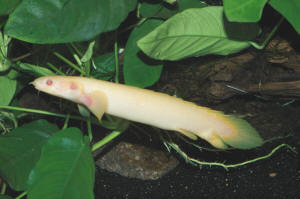
A Polypterus senegalus... doing with Bichirs
do most of the time... hang out.
|
Polypterus senegalus; stopped growing
10/23/13
Hi there.
I have a basically simple question. Have an albino senegalus that seems
to have stopped growing. she is currently around 6.5 inches and has not
grown in about a year now.
<Is rather small. May well be a (genetically) small specimen,
but more likely it isn't eating enough or else some other factor is
preventing its growth, such as high nitrate level.>
she shares a 125 gallon tank with a 10 inch jack Dempsey( i know to many
this is not ideal but they have shared a tank for two years and often
both bichirs share the Dempseys cave with him curling on his floor like
pets),
<Hmm...>
a 12.5 -14 inch male depending if you count the tail fin senegalus. 2 bn
Plecos (reg female albino male) and 14 giant danios (recent experiment
too liven up the tank... there were 24 3 weeks ago was hoping that 4
inch body and speed was enough.. I was wrong). will be adding 2
more female senegalus when they grow out enough as I am hoping for them
to breed
<A challenge. Do read up on this. Polypterus have been spawned in
captivity, but they "jump" a lot while displaying and spawning, and they
do need quite specific things in the tank, such as Java Moss, for the
eggs to be scattered in.>
The tank has live plants and loads of filtration and tons of caves. The
bichirs both eat very well. Shrimp pellets, algae tabs (they eat the
ones i put in for the Plecos on occasion), Blood worms (Dempseys are
sloppy), and beef liver cut very small (the albino loves this).
They also get a dozen feeder guppies dumped in every
couple weeks ( I raise them myself in a 40
gallon breeder with my blue florida crayfish so there should be no
disease issues to my knowledge)
<Ah! There's one thing you shouldn't have done. No wise fishkeeper uses
feeder fish. They provide NO benefits at all, but bring in many risks
and variables. A fish that eats and eats but doesn't grow could
well have gut parasites like worms... and where do you think they might
have got such parasites from? Correct: from their food, specifically,
feeder fish.>
Gonna start catching earth worms for them i think also.
<Much better option if you want to use live foods. Basically, live foods
should be species that can't/don't carry parasites that can infect fish,
so terrestrial prey (earthworms, crickets, mealworms, etc) are the
safest.>
My male has always grown consistently. The albino just stopped growing I
was not sure if there was a dwarfism in albinos?
<Not that I'm aware of. All Bichirs are fairly big fish, and your
species should get to at least 25 cm/10 inches, and often a little bit
more.>
Beyond this all my fish are very healthy and happy to my knowledge
Gary
<No single definite answer, but deworming your fish may be prudent, and
certainly stop using the feeders. If the feeders brought in something
more serious than worms, then treatment may be more difficult. Cheers,
Neale.>
<<Good questions and responses from you as always... Enjoying them. B>>
Re: Polypterus senegalus 10/23/13
Will look into deworming have not seen signs of parasites bulging tummy
stringy white stool etc. .
<Fair point, but not conclusive evidence either way. If you feel the
Bichir looks healthy, not skinny, and the amount it eats is reasonable,
then you might elect to observe for another few weeks or months before
doing anything. But deworming won't do any harm, so it's a safe
precaution with fish that have failed to thrive.>
Already working on the java moss have three large pads attaching to
driftwood and slate now. Tyty, G. Owens
Btw are you the same Neale that frequents the tff forums?
<Yes indeed, back in the day. Haven't been around much recently. Spend
most of my fish time here! Cheers, Neale.>
Re: Polypterus senegalus 10/24/13
ah recognized the "Cheers, Neale." lol used to be on there a fair bit
about 2 years ago myself as Binge we discussed my Procambarus Alleni a
fair bit and you always gave sound advice.
Thanks again.
<Ah yes, does sound like something I'd say! Anyway, thanks for the kind
words. Cheers, Neale.>
|
Mystery Bichir Disease 4-13-13
Hello WWM,
<Austin>
I'm sorry to take your time, but I have a suggestion regarding the
mysterious deaths that many folks seem to be experiencing. <Sure.>
My 2 year old bichir recently passed away in a much similar manner
(strange behaviour, followed by lack of appetite, then a bruised
stomach). I had mostly fed him shrimp pellets (a mistake) 3-4
times a week. I noticed him floating at the top of the tank by the
heater, which isn't unusual, but he was passing a whole, undigested
shrimp and there appeared to be blood around his anal fin.
<Undigested shrimp or shrimp pellet?>
From there it took him about a week to die. I don't have my exact
water conditions from the time but all other fish (including a smaller
female) were fine and still are. I'm thinking that possibly the shell
<exoskeleton> of the shrimp is cutting these animals stomachs or
intestines when
they eat them, leading the bruising (or as one person said exploding
stomach). <An interesting theory. If you think that's the case,
then perhaps try a different food regularly and see what happens.>
Again sorry for not really having a question and probably some poor
grammar here and there, but I really hate to hear about this happening
often.
<No problem, maybe this will help somebody solve a riddle in their own
tank.>
Thanks for your time, AA
<Welcome - Rick>
Thank you! Bichir assistance, fdg. f'
4/15/13
I know this isn't a question, but I just wanted to let you guys know:
Your website is invaluable. The information I received regarding my
Senegal bichir when I first got him wasn't accurate or knowledgeable,
and would surely have led to a slow and unpleasant death due to
malnourishment. He's picked up a lot now that we're alternating him
between chopped nightcrawlers and tilapia, with a beef heart snack every
few days, and seems a lot more active and cheerful! The advice was also
definitely helpful in connection to my other carnivorous fish. Anybody
who searches thoroughly can probably find exactly what they're looking
for.
<Ahh, thank you for this input. Will share. Bob Fenner>
Re: Thank you! Bichir assistance, hlth. concern
4/20/13
I do have a question about him now, though! I haven't been able to find
anything about this anywhere online.
<Let's see>
Like I said, his diet was recently corrected and he seems a lot happier
on it. He gets along well with the other fish in the tank (100 gallon,
small community, a couple youngish cichlids put there to grow alongside
him. They mostly leave each other alone, really only interact when
trying to eat the same food,
<Could prove problematical. Make sure the Bichir is getting food>
no fights, just greedy fish) and is reasonably active with lots of
burrowing, darting to the top for breaths of air, etc. However, it's his
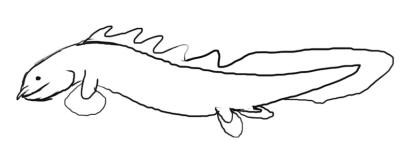
posture that I'm concerned about. He seems permanently bent at his neck.
He has no visible sores, bloating lumps or discoloration, and is eating
fine.
When he swims, he almost looks like he's running because his bent neck
arches back up and his bottom half powers along laterally, making a sort
of 'Z' shape.
<Mmm, have seen this in other specimens, particularly the smaller
species, like senegalensis>
I haven't got a camera that is capable of capturing a decent picture of
him with me at the moment, but I've included a quick sketch of what he
looks like when at rest. That bend in his neck doesn't go away, and it
almost seems like his head is fused that way. Aside from the worrisome
strangeness of his posture, he seems fine, and it doesn't appear to
inhibit his swimming capability at all. I'm afraid of what might happen
if this is something really bad, though, and if this is something I can
fix I'd love to find out what's wrong!
Thanks again for everything.
<I would not be concerned... as stated; this may well be "natural"...
Bob Fenner>
|
 |
do Polypteridae have equivalent
of REM sleep? 5/15/11
Hello, I had searched your wonderful site and have not found a clear
answer to this question. I could have missed something, and thus I
apologize if this question is something you get a lot. I'm starting
to wonder if fish experience something like REM sleep in mammals? I
know they don't have REM per se but on several occasions I saw what
I would interpret as "dreaming":
<I do recall some such study of these and related (Dipneustian)
fishes... they DO have REM-type sleep, do dream>
Polypterus endlicheri, 5-6 inches, year old, - often lays on the bottom
in front of the tank between 7 and 11 in the morning. When he is active
he enjoys slowly swimming in the growth of Val. gigantea or among the
driftwood, which I understand is a natural behavior. However, in the
morning he lays in a little driftwood enclosure close to front of the
tank and opens and closes his mouth and moves eyes. The motion of mouth
is not in sync with gill movement (gills move very very slowly).
Occasionally he flicks his tail or pectoral fins a bit, but never
strong enough to actually move himself.
I'm pretty sure he is asleep during that time, because: 1. he is
very active at night and in the afternoon; 2. once when I was yet
unfamiliar with this behavior I scooped him into a net to examine
closely (I though he was suffocating on a piece of gravel) he was
motionless for good 5 seconds and then did a full-body jerk and
promptly got out of the net and swam away. Once active he was not doing
anything unusual; 3. some fish in his tank are diurnal and get their
first of 2 daily feedings at 7-8 am and P. endli is never interested in
sinking pellets, even though in the afternoon/evening he is a pig.
So this leads me to conclude that he is sleeping. But is he actually
dreaming or mouth/eye/fin movement is something else? Similar behaviors
I saw in Weather Loach (now I have 2 and both are doing it) and Betta
splendis (when I had it).
What would be a good source to read on fish biology and brain
development?
It is not that I just realized the total lack of knowledge I have but
I'm amused that my sample of "dreaming" fishes so far
does not include any of the large cichlids I have had: Jack Dempsey,
Texas Cichlid, Salvini c., Jewel c. It looks like ability of fish to
display "dreaming" behavior is not connected to complexity of
it's behavior during the active hours. Or it manifests in the way
that I cannot recognize.
I had checked the water in both Loach and Polypteridae aquariums and it
looks nice - ammonia at 0, nitrates at 0. Water is filtered and
temperature is in range for both Misgurnis and Polypterus. Between 7
and 11 am tank pump is on to create current at the surface level
(outlet is tilted up). This of course stirs water at the bottom
somewhat, but neither fish nor snails seem to be disturbed
Thank you very much for you answer! Elena
<Thank you for your query/speculation. Perhaps a career in
neurophysiology is in your future. Bob Fenner>
do Polypteridae have equivalent of REM sleep?
5/15/11
Hello, I had searched your wonderful site and have not found a clear
answer to this question. I could have missed something, and thus I
apologize if this question is something you get a lot.
<Nope, not been asked before!>
I'm starting to wonder if fish experience something like REM sleep
in mammals?
<Supposedly not. There's not a lot of knowledge about how fish
sleep. Some clearly do sleep -- parrotfish produce little cocoons in
the sand or coral where they can sleep securely for the night, more or
less undetectable by nocturnal predators. But others don't seem to
sleep in any meaningful way because they need to swim constantly, as in
the case of herrings and anchovies. But whether even the sleeping fish
experience what we'd call REM sleep is impossible to say for sure,
though REM sleep is generally described as being an exclusive trait of
warm-blooded animals, i.e., birds and mammals, simply because these are
the only animals to have sufficiently complex brains.>
I know they don't have REM per se but on several occasions I saw
what I would interpret as "dreaming":
<Perhaps.>
Polypterus endlicheri, 5-6 inches, year old, - often lays on the bottom
in front of the tank between 7 and 11 in the morning. When he is active
he enjoys slowly swimming in the growth of Val. or among the driftwood,
which I understand is a natural behavior.
<Yes.>
However, in the morning he lays in a little driftwood enclosure close
to front of the tank and opens and closes his mouth and moves eyes. The
motion of mouth is not in sync with gill movement (gills move very very
slowly). Occasionally he flicks his tail or pectoral fins a bit, but
never strong enough to actually move himself.
<May be a variety of things, including tasting the water, exercising
stiff joints, dislodging silt or mucous'¦>
I'm pretty sure he is asleep during that time, because: 1. he is
very active at night and in the afternoon; 2. once when I was yet
unfamiliar with this behavior I scooped him into a net to examine
closely (I though he was suffocating on a piece of gravel) he was
motionless for good 5 seconds and then did a full-body jerk and
promptly got out of the net and swam away.
<Ah, now, this is tricky. Fish do learn to trust their keeper, and
may hold off "fight or flight" behaviours when handled by
their keeper, at least for longer than they would otherwise. Also, many
fish will "play dead" if molested in the wild, and won't
swim away until the last moment. So there may be alternative
explanations here.>
Once active he was not doing anything unusual; 3. some fish in his tank
are diurnal and get their first of 2 daily feedings at 7-8 am and P.
endli is never interested in sinking pellets, even though in the
afternoon/evening he is a pig.
<Could be, or simply he isn't hungry enough in the morning to
show much interest. Polypterus are dusk/dawn feeders, and it may well
be that their feeding behaviours don't kick in until the right
times of day. Or he may have learned that he can't compete with the
day-active fish for food, so waits until later on in the day or night
when he can feed more securely. Many explanations!>
So this leads me to conclude that he is sleeping. But is he actually
dreaming or mouth/eye/fin movement is something else?
<I'd guess "something else". These fish have very
small brains and limited intelligence.>
Similar behaviors I saw in Weather Loach (now I have 2 and both are
doing it) and Betta (when I had it). What would be a good source to
read on fish biology and brain development?
<Now, in my opinion the best book is "The Diversity of
Fishes", a college-grade ichthyology book that contains just about
everything you'd ever want to know about fishes and in a very
readable way. It's not cheap, but your library should be able to
get a copy, perhaps by inter-library loan.>
It is not that I just realized the total lack of knowledge I have but
I'm amused that my sample of "dreaming" fishes so far
does not include any of the large cichlids I have had: Jack Dempsey,
Texas Cichlid, Salvini c., Jewel c. It looks like ability of fish to
display "dreaming" behavior is not connected to complexity of
it's behavior during the active hours. Or it manifests in the way
that I cannot recognize.
<If dreaming does exist -- and so far as I know there's no
evidence either way -- detecting it would be difficult. It's
tempting to associate random movements with dreaming because that's
something humans do when they're dreaming. We often see our cats
and dogs twitch and assume they're dreaming. That may well be the
case. But fish have such different brains to our own, and live in such
a completely alien environment, that we daren't make the same
assumptions. Fish may well need to twitch or move when resting because
of the way water works compared to air, and to the way their gills work
compared to lung. It's a lot like play behaviour, which is
sometimes suspected among certain fish, specifically, the Mormyrids,
but is extremely difficult to demonstrate convincingly.>
I had checked the water in both Loach and Polypteridae aquariums and it
looks nice - ammonia at 0, nitrates at 0. Water is filtered and
temperature is in range for both Misgurnis and Polypterus. Between 7
and 11 am tank pump is on to create current at the surface level
(outlet is tilted up). This of course stirs water at the bottom
somewhat, but neither fish nor snails seem to be disturbed. Thank you
very much for you answer!
Elena
<An interesting question and one for which I have no answer. Like
much about fishes -- the dominant vertebrates on most of planet Earth
-- we're all reduced to speculating when thinking about their
biology. Save for a few tilapia, Salmonids and livebearers, you'd
be surprised how little we truly know about what fishes do, think, and
experience. Thanks for writing, Neale.>
Black Ghost
Knife fish and Bichir are lonely 8/18/10
Hi,
I have been investigating your forums and information and I find your
expertise quite useful.
<Only "quite"?>
I have a particular question regarding my current fish tank. I have a
Senegal Bichir (4 in.) and a Black Ghost Knife fish (4.5 in.) in a 30
gal tank, too small for them in the long run for sure, however they are
doing wonderfully right now.
<"For now" being the operating phrase. Whilst the Senegal
Bichir might be kept in a 30 gallon tank indefinitely, the Apteronotus
needs a much larger tank, and soon. Do understand that relatively few
specimens survive into middle age, and they die prematurely PRECISELY
because they're kept in the wrong environment. People promise
themselves they'll buy a bigger tank when the time comes, in
ignorance of the fact Apteronotus come from oxygen-rich, relatively
cool fast-water habitats around rapids and waterfalls. They have very
little tolerance for stagnant water conditions and high nitrate levels.
To keep this species in a tank smaller than 55 gallons is, to be frank,
dangerous.>
The BGK is very active, even during the day, swimming back and fourth
and all over the place especially during feeding times.
<What they do in small tanks.>
The Bichir is the "ruler" of the tank and he goes where he
wants with not much of a care in the world (with the exception of a log
inhabited by the BGK). Right now the tank seems quite sparse for
inhabitants I am looking for possible tank mates that will fit my plans
in the long run.
<Least of your problems. Neither of these species needs tankmates,
and indeed adding catfish or loaches would be foolish. A school of
midwater characins such as Congo Tetras or Bleeding Heart Tetras would
make the most sense.>
I plan on expanding to a 75 gallon tank within the next year or so,
which makes it important that I choose fish that will work together in
a tank of that size. I had a Corydoras Catfish for a while, however I
think that the BGK picked on him too much and the Cory didn't make
it possibly because he was the little one in the tank.
<Correct. Corydoras are inappropriate to this aquarium.>
Currently I am looking at different tank mate possibilities including
an Oscar,
<No. Much too messy. Even in 75 gallons you'd be providing
barely adequate conditions for an Oscar and a Bichir, and the poor
Apteronotus would eventually die from the poor conditions.>
Pleco,
<No. Too much competition for food. Small Loricariids like a
Bristlenose might be okay though.>
Loach,
<There's really no suitable Loach that you'd keep singly.
Most are gregarious, and in sufficient numbers a school of Yo-yo or
Clown Loaches would be far too much competition for the Knifefish and
Bichir.>
or an Angel fish,
<Requires completely different conditions: still water, much
warmer.
Remember, you're keeping Apteronotus albifrons at a MAXIMUM
temperature of 24 C/75 F, and anything warmer will soon kill it. The
Bichir will be fine at that, as will most midwater characins. Likewise,
water turnover needs to be at least 8 times the volume of the tank in
turnover per hour. For a 75 gallon tank, that's 75 x 8 = 600
gallons/hour. That's a big-ass filter, and Angels will not like the
current produced.>
however I am not sure what would work out best and if I could get more
than one of those choices for the tank.
<I think you need to do more reading. Understand virtually everyone
who buys Apteronotus albifrons kills it within a couple of years. When
was the last time you saw a specimen 10 years old and 50 cm/20 inches
long?
Paradoxically, what this species needs to survive is very well known,
and has been for decades. German aquarists for example have maintained
this species for more than 16 years! So why is their track record
elsewhere so dismal? Because people assume they're "community
fish". They are not. They need very specific conditions.>
I would like to have a number of smaller (7-8 in.) fish as opposed to 4
large (over 12 in) fish in one tank, but I am not sure what the best
route is for my tank.
<You certainly could add a school of dither fish like characins that
will encourage both the Bichir and the Knifefish to swim about in the
open.
Surface swimmers like Giant Danios would also be good. Anything else
would be foolish unless chosen extremely carefully. As for catfish,
I'd look at either Ancistrus spp. or small whiptails such as
Rineloricaria that could be kept in small groups without undue
competition. Anything else would be daft.>
Do you have any suggestions on fish species that would work out well
for my situation?
Thanks for any and all help,
Steve
<Hope this helps. Cheers, Neale.>
Senegal Bichirs, growth, beh.,
sys. -- 12/14/09
How fast would you say a 4in Senegal Bichir to reach full length on
average
<These fish grow quickly. Expect it to reach at least 20 cm/8 inches
within a year. Maximum size is a bit over 30 cm/12 inches. You'd be
very unwise keeping a juvenile specimen in anything less than 100
litres (25 US gallons) and an adult will need something around 180
litres (48 US gallons). These fish are hardy, and provided you
don't do something stupid like give them "feeder fish",
you can expect a Senegal Bichir to grow quickly, get to a decent size,
and live a long time (decades). Cheers, Neale.>
Re: Senegal Bichirs --
12/14/09
Thanks for answering! I have him in a 40g now I was just wondering how
fast I should buy a 75 ^^
<At you leisure, really. Wait until you find a particularly good
deal. 40 US gallons is healthy enough, though more space will allow
more tankmates and better decorations. But there's no rush.>
thanks for the help
<Happy to help. Cheers, Neale.>
Bichir question
11/13/08 Hi. I hope this is the correct area for this
question. Sorry, my Internet knowledge is fairly limited. I have
two young bichirs that I purchased in February. One is a Polypterus
delhezi and the other is a Polypterus palmas buttikoferi. While the
delhezi has doubled in length and girth, the buttikoferi hasn't
grown at all as far as I can tell. Still only about 4 inches long, and
not much thicker than a pencil. They're together in a 30 gallon
tank (with a 75 for future use), which gets twice monthly cleanings. I
feed them a combination of frozen silversides and Hikari carnivore
pellets. The delhezi is a pig, so I frequently get to see him eat, but
I have yet to actually observe my buttikoferi in the act of eating.
I'm assuming she (I have no idea of actual gender) must eat
something, as she is still alive. I would think that the delhezi is
hogging all the food, except I always overfeed, and have to clean extra
silversides out the next morning. My questions are these: do
palmas buttikoferi grow more slowly than other species? I can't find
much info online about "gold dust bichirs" in general. Or is
there some non-communicable disease that might slow down growth. Are
there maybe dwarves in the bichir world? She seems otherwise healthy.
Thanks, Danielle <Hello Danielle. There are a bunch of things going
on here. To start with, while Polypterus species generally grow slowly,
Polypterus delhezi is noted for having a rapid growth spurt when young,
getting to 20-30 cm quite quickly, but then growth rate slows down
considerably. Polypterus palmas has a slower, more uniform growth rate.
There are is considerable variation in temperament between different
Polypterus species, with some being much more aggressive feeders than
other. Polypterus palmas is a comparatively mild species, which is one
reason that the Polypterus palmas species complex has become popular
with aquarists. I suspect that there is some bullying going on in the
tank, and part of the problem may be that the Polypterus palmas just
can't get enough to eat. Using small food items (such as
bloodworms) would help by making it difficult for the larger Polypterus
delhezi to hog all the food. It's worth mentioning that Polypterus
palmas feeds extensively on insects and crustaceans in the wild, and
the calcium present in unshelled crustaceans such as krill is
especially important because it helps these fish to produce their hard
scales. In fact bichirs across the board do best when given a diet rich
in calcium, though in the larger species frozen whitebait and lancefish
should provide this in the form of bones and scales. Next up, do always
remember the golden rule: if (non-green) food isn't eaten in 5
minutes, remove it! Messing up water quality isn't going to help
the situation. I suspect that the problem here is social, and these two
fish will need to be either put into a much bigger tank, or else kept
in different tanks. Cheers, Neale.>
Re: Bichir question
11/13/08 Thanks so much for the info. I'm definitely going
to try the bloodworm suggestion. If that doesn't work, then
I'll separate them. <Suspect this may be on the cards anyway,
but certainly worth trying alternative foods. Bichirs don't
normally "play nicely" with each other, and all species can
exhibit some degree of snappiness as they mature.> But will that be
setting me up for aggression issues later on if I try to reintroduce
them? <Almost certainly yes; once territorial fish have established
their territories, adding rival fish to the tank, particularly
smaller/weaker ones, tends to work out badly.> They get along fine
(other than possible food fights) now. Thanks. <Bichirs are really
best kept one to a tank. Possibly in a larger group you might dilute
aggression, and if none could hold a territory, then no-one becomes the
bully. This is why fish in retailer's tanks often seem peaceful:
they're overcrowded. This isn't always viable in the home
aquarium though because of water quality issues. Life may be easier for
you to put one Bichir in each tank and be done with it. Cheers,
Neale.>
Re: Ornate Bichir; diet, social behaviour...
comp., sys. 8/8/08 Hello again, sorry for sending
so many e-mails... <Getting used to it!> You mentioned in the
previous e-mail that Oscars are good companions, yet when I read the
FAQ and profile section for the Oscar, they seem to be rather
aggressive. The Ornate Bichir is hardy, but I'm not sure if the
Oscar will constantly pester the Bichir, as it is slow compared to the
Cichlid. I'm also not sure if the 120 litre tank can hold the Oscar
when it grows larger (not sure how fast they grow). <Oscars are
territorial and aggressive when spawning. And by community fish
standards, they're entirely unsuitable for maintenance with, say,
Angelfish! But for a big fish they are relatively docile and work
perfectly well with anything they don't view as either food or a
rival. They mix well with large, peaceful Polypterus spp.> Also:-
<Hmm...?> "Oversized and tough are by-words here. Oscars are
messy fishes to put it gently... and destructive toward objects like
siphons and tubing in their systems. Outside power filters (more than
one) are fine IF they are of the type that pull water into their boxes
(versus gravity fed siphons), and even these are better retrofitted
with suction cups on their in-tank parts. Canister filters of good
design are fine, but must be regularly (as in weekly) removed for
cleaning. Ideal arrangements for Oscar systems include outside sump
type filtration fitted with external pumps and internal overflows and
returns. Whatever mechanical means you set upon, make the filtration
easy to maintain and over-size in terms of capacity and flow."
<All pretty accurate.> "Heaters, filter parts, tubing... are
all just play things to Oscars. Hide, remote, attach with suction
cups... anything you want to stay in place... for a while."
<Yep.> From the article on your website, they seem to cause
problems with the filter equipment. The 120 litre tank I have is run by
the "bubblelator" and box filter system with a UV light
attachment, that means the Oscar will/might disturb my filter system
right? <Oscars will move/uproot/destroy anything they can. Partly
its territorial, and partly its curiosity. In any case you need to use
robust equipment and put as much as you can *outside* the tank. For
example external heaters that you add to the external canister filter
return tube works better than sticking a glass heater inside the
tank.> Also you mentioned medium sized Severums would be good as
well, Heros Severus is quite peaceful from the article and it seems
relatively well sized as well as pH range, good to keep with Ornate
Bichir? <Would be ideal. Other Heros species likewise, such as the
amazing 'Rotkeil' (or "red head") Heros
appendiculatus if you can find it. Traded but expensive here in
England. But stunning fish.> Thanks. - Gene <Cheers,
Neale.>
Weird Bichir behavior -- 06/08/07 Hi,
<Hello.> As I understand it, Bichirs should be bottom-dwelling
fish, but my 4-inch Senegal Bichir is spending a surprising amount of
time at the top of the tank. <Not a problem. For a start, Bichirs
are obligate air breathers, and need to gulp air every few minutes.>
I'd say he spends about 1/4 of his time at the top, either actively
swimming or resting on some floating plants. <If your tank is
exceptionally deep, the Bichir may prefer to "perch" close to
the surface so he can get a gulp of air more easily. For a 4-inch
Bichir, the tank shouldn't be more than 18 inches deep, and ideally
rather less.> My guess is that he just wants some more distance
between himself and my small Cory & Pleco, but I wanted to make
sure this wasn't indicating some bigger problem. <I can't
imagine a Bichir being bothered by either of these species.> Other
than his love of floating plants, everything seems normal about him -
he's active and eating well. <Then probably nothing to worry
about. These are delightful fish, one of the nicest of all the Bichirs,
and generally hardy and long-lived. Enjoy your fish.> Thanks,
-Michael <Cheers, Neale>
Polypterus senegalus, beh., hlth.
5/20/07 Hi <Hello.> My Polypterus senegalus
has recently stared to eat the stones in the tank, I was just wondering
if this is natural or could there be a problem with my fish? <It is
extremely *unnatural*. Bichirs are predators that hunt by smell. So
they don't normally eat stones. Are you feeding it enough? If so,
what are you feeding it? The ideal diet for Bichirs are frozen
bloodworms, small pieces of mussel and prawn, and small amounts of
frozen fish such as whitebait. Some Bichirs will also eat pellets.
Unless you are breeding your own livebearers, do not use live feeder
fish and UNDER NO circumstances use goldfish/minnows bought from pet
stores, as these are parasite bombs. If you want to use live food,
things like mealworms and earthworms are ideal, being clean and easy to
obtain.> Hope to hear from you soon, <Well, here I am.> Dave.
<Cheers, Neale>
|
|

