|
|
| Home | Marine Aquariums |
Freshwater Aquariums |
Planted Aquariums |
Brackish Systems |
Ponds,
lakes & fountains |
Turtles & Amphibians |
Aquatic Business |
Aquatic Science |
Ask the WWM Crew a Question |
| Please visit our Sponsors | ||||
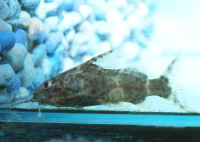
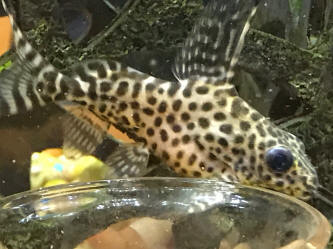
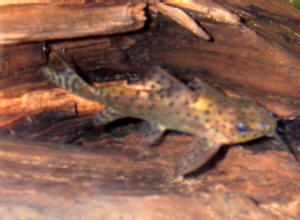
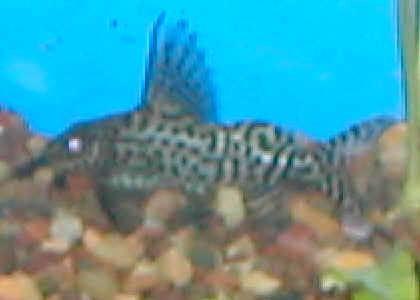
Synodontis petricola with fin damage
6/20/17 Re: Plecos/ and new tank. Actually.... 11/2/13 Re: rainbow /red finned / ruby shark + EEK
I need a bigger tank! 11/11/10 Upside Down Catfish I.D.-ing, Questions & Tip Requests 12/22/08 Hi I just purchased a fish earlier today that they had labeled as an upside down catfish. He/She (well we call it 'he') swims upside down (a lot but he'll also swim right side up) like his name says, but he's all black (with possibly a grey dot in between his eyes, he moves a lot so it's hard to tell but I'm almost positive it's there). Is he still an actual upside down catfish or is he a different breed? The lady at the store referred to him as an upside down catfish and he looks like a catfish but I haven't found any pictures of a black upside down catfish so I was wondering if he was a different kind of fish? <There are well over 100 species of Synodontis, and most of them look very similar. It is true that the majority don't swim upside-down, at least not when mature. But several do, and some of these are notorious look-alike species. In England for example, baby specimens of the large (20 cm) and rather territorial species Synodontis nigrita are quite commonly included in batches of Synodontis nigriventris, the true dwarf upside-down catfish. I'm one of the people who's fallen into that trap, and ended up with a "dwarf" catfish that just grew like Topsy! Your best bet is to go through the excellent gallery of Synodontis species at Planet Catfish: http://www.planetcatfish.com/catelog/genus.php?genus_id=29 Just in the off-chance its one of the related and similar genera, take a look at Brachysynodontis or Hemisynodontis: http://www.planetcatfish.com/catelog/genus.php?genus_id=219 http://www.planetcatfish.com/catelog/genus.php?genus_id=95 Synodontis nigriventris itself is relatively unusual in being gregarious and needs to be kept in groups of three or more. The other Synodontis species range from essentially gentle giants like Synodontis eupterus through to quite waspish species like Synodontis nigrita, so it's important to try and put a name of your fish. Not many species are uniformly coloured grey or brown, so you might look at Synodontis schall and Hemisynodontis membranaceus (a species with oddly webbed whiskers). Juvenile Synodontis nigriventris do have white spots, but usually all over their bodies, and the basic colour is mottled brown. Synodontis angelicus is black with lots of white spots; it's an expensive fish, and lovely, but unlikely (unless you have the luck of the devil!) to turn up in a batch of Synodontis nigriventris.> He's also acting weird in that he will lay on the bottom of the tank, not really in the corner but where the bottom meets the wall and then appear as if he has trouble swimming and seems to struggle a few moments before he completely rights himself (well upside down but you get my point) and then he'll be fine until he does it again. Is this normal for him being in the new tank? <Fish do sometimes behave oddly for a short while when moved to a new tank. But an issue with at least some Synodontis is that they're riverine fish used to fast-flowing water with lots of oxygen. All Synodontis need a reasonably big tank, certainly above 25-30 gallons even for the dwarf species, and 40 gallons or more for the regular size species. A decent filter, moderate temperature, and good water quality are all important.> And also I would appreciate care tips for him where I own two Betta fish (a crown tail and a regular one, each in their own 1 gallon tank) and have had little experience with other types of fish. I had had a 5 gallon tank last year but it was contaminated because it killed any fish I put in there (which resulted in about 10 or so dead fish) including 2 Betta fish (different times, one died and I replaced it) which the first Betta I had put in there had thrived in his old tank (one of the two 1 gallons my new Betta are currently in) and died a couple weeks or so after I changed him to the 5 gallon. <5 gallons is just fine for a Betta, and in all honesty 1 gallon is too small for anything but cut flowers. I have no idea why [a] people sell them and [b] why anyone buys them. They're useless.> So right now I have him in a little 1 gallon tank with only the water he came in (there was no room for more water the way this tank is designed) and I read on the site that he needs a little hide out (which I actually have a fish decoration kinda cave thing sitting on my desk which I can give him once I rinse it off) but what else does he require? <He's go one fin in the grave and another on a banana skin! Seriously, 1 gallon isn't even a bucket. Assuming he's some sort of unidentified Synodontis of average size, then your starting point is a 30 gallon tank. Nothing smaller; anything smaller would be a waste of your time/money because there's a good chance this catfish will outgrow it. Install a reasonably brisk filter that offers turnover of not less than 4 times the volume of the tank, and ideally (by which I mean, maximising the chance of success and reducing the chance of disease) turnover 6 times the volume of the tank is a good base line. So for a 30 gallon tank, the filter needs to be rated at 6 x 30 = 180 gallons per hour. This may sound a lot, but trust me, it isn't, and the few dollars extra it'll cost will be AMPLY repaid by the savings in dead fish, medication, and the option to add more fish without the tank being overloaded.> I believe I still have a fake plant or two that I could put in his tank and I'm sure my Betta wouldn't mind if I gave him the floating fake flower from each tank. Should I put some little marble rock things in his tank (they're like colored glass rocks) like I did for my Bettas or should I leave the bottom bare? <He doesn't want marble rock things. What he wants is a proper, regular-coloured (black, brown) cave, some soft sand or fine gravel, and lots of water current. He NEEDS space in the tank, and 1 gallon doesn't even begin to cover this.> Also, my Bettas eat TetraColor Granules extreme (they refuse to eat flakes for some reason), will he be ok to eat them? <They're fine, but supplement with other things. Hikari Algae Wafers and any catfish pellet of your choice would combine to make a good, balanced diet.> They do sink to the bottom of the tank after a short period of time. <Unless this fish gets a MUCH bigger tank or is returned to the pet store, it's unlikely to see the New Year. So with that in mind, I think we know what your Christmas gift from Santa needs to be! Cheers, Neale.> Synodontis eupterus in the corner 05/19/08 Hi there, I recently set up my old 55 gallon again for the first time in a few years after a good scrubbing. My buddy had a 5 inch Synodontis he could no longer keep with his other fish and needed a home for. Anything too gross to salvage got replaced, and I'm picking up a full test kit on Friday since I can't find most of my old set. Anyhow, everything seems fine so far, and my Syno has a little Raphael buddy I picked up at the pet store whilst shopping for supplies. I haven't gotten around to getting him a full size cave yet or put any fake plants in there, but there's plenty of coral rock and a bunch of old stuff in there from when I had it up before. I know these are nocturnal fish, and I can tell he doesn't like when I turn the tank lights on, so I got a little LCD light set instead. For the most part he hides behind the rocks and such, but every once in a while I'll see him lean against the corner of the tank in backslash position, mouth in the corner... and will just sit there for a while... his breathing has seemed a little erratic at times, but for the most part he seems to do well as long as the lights are out. Just wondering if this is normal behavior or not really, or if I should hurry up with the testing to see if there's some kinda serious problem. Thanks a bunch. -Eric <Greetings. Synodontis generally are very hardy. Usually they're the last fish to get ill! So unless you can see things like skin or fin damage, or signs of parasites, I'd not be overly concerned about variations in breathing rate. By default, they press themselves against solid objects, and this is especially true if they feel cramped or exposed. Make sure they have lots of hiding places. Synodontis eupterus (and indeed Synos generally) become more outgoing the more secure they feel. Coral rock isn't quite the right thing because anything calcareous will harden the water and raise the pH, but plastic plants, flowerpots, slate, granite, bogwood, etc can all be used successfully. Synodontis eupterus are territorial, so the idea this species needs a "buddy" is erroneous. In fact the Synodontis eupterus will view other catfish as potential rivals for hiding places. On the other hand, Platydoras costatus is a gregarious species and does well kept in groups, even though specimens will jostle with one another over the best hiding places. Single specimens are notoriously shy. Cheers, Neale.> 55 Gal Freshwater Synodontis Tank 12/15/2007 Hello, I have a 55 gallon freshwater tank that currently has a 6 inch common Pleco, 4 inch Bala, 2 spotted pictus cats appx 3"< and a young 3" horse face loach. I recently took a liking to The Synodontis species of catfish. How many could I put into my 55 Gal and which of the Synodontis get along with each other? I'd like to get 1 each of a couple different kinds. Thank you for your advice. <Greetings. Synodontis spp. vary considerably in size and temperament. As a rule, most species are very nocturnal, somewhat territorial, but not overtly aggressive. There are a few species that are particular about water chemistry. Synodontis multipunctatus from Lake Tanganyika needs hard, alkaline water to do well. But most are adaptable and will thrive at pH 6-8, 5-20 degrees dH. This being the case, you could choose a single specimen of one of the medium-sized, non-aggressive species. Synodontis angelicus has long been a favourite, but Synodontis eupterus, Synodontis decorus, and Synodontis flavitaeniatus are also colourful and peaceful. Some Synodontis thrive in groups provided there are adequate hiding places. Synodontis flavitaeniatus, Synodontis eupterus, and Synodontis nigriventris are particularly good in groups. I have a trio of Synodontis nigriventris in a community tank, and it is great fun watching them chase each other at feeding time. They will generally ignore other non-aggressive Synodontis species, but this varies, especially if the two fish fight over a hiding space. Other Synodontis are best thought of as one-to-a-tank fish, being short-tempered towards their own kind and other species of Synodontis; Synodontis nigrita is a good example of a species that can be territorial if crowded. Of all the Synodontis on sale, Synodontis nigriventris is probably the best all-round fish; at a modest size of about 10 cm when mature it is small enough to make maintenance in a big group viable. Four or five specimens work nicely in your tank and provide plenty of amusement. It is a very hardy, easy to keep species widely sold species. One last thing: Bala Sharks are schooling fish; please get your specimen a couple of pals. Cheers, Neale.> UD Cat w/no tail - 05/26/07 Hi folks, just recently went away no vacation and unfortunately my tank had a bout of Ich which reduced my tank (10 gallons) population to 2 Synodontis nigriventris. I was able to save these guys and they are now Ich free. I just took a look at my tank this evening however and I am very confused to find one of my UD cats to be missing his tail fin completely. I've seen fin rot before and this doesn't look like that, plus the fin was present yesterday. Could this be the other UD cat fin nipping? <Yes> I've never heard of this species being very prone to nipping, <Oh... most all Mochokid catfishes are nippy... especially when crowded> none the less entirely removing the fin. Do you recommend separating these two or should I look for another cause? <Likely whatever conditions that led to the Ich, the actual treatment itself... secondary effects, and the territorial interaction are all acting synergistically here> The poor guy can hardly swim, his tail (a bloody stump really) flaps as fast as it can go but he hardly moves. The other cat shows no signs of similar symptoms. Any advice you have for me would be greatly appreciated. -Jim <I would separate these two... Bob Fenner> "Upside Down" catfish --
05/07/07 Hello: <Hello!> I have an upside down catfish in a
20 gallon tank with a few other fish. He survived a bout of
Ich about six - eight months ago so much of his fins are missing.
<Why did he lose fins from Ich? Also bear in mind that these catfish
are reputed to be sensitive to copper-based medications, so such
treatments should be used with care, if at all.> He has been a fish
that we never saw. <Normal. They are nocturnal, and do best when
kept in groups; when kept singly they are *very* shy. My specimens
scoot about during the daytime, though only when there's food in
the tank.> Twice a month when I would clean the tank, I would have
to flush him out of his castle to make sure he was okay, which he has
been. <Fish aren't wild about being pushed out their
homes. Is there no way you can clean the tank without doing this? You
really shouldn't need to strip an aquarium down at water change
time. Simply siphoning out the crud should work fine.> About a month
ago he started to appear during the day and eat and hang out
some. I noticed though that he would wedge himself up
between the glass and the castle. <Normal.> Well yesterday he
started the most bizarre thing. His nose is in the gravel
with his body in the air and his tail hanging sideways.
<His body in the air? Or do you mean the water? Either way,
disorientation in fish is very often a sign of poor water quality, or
at least sudden changes in the environment, even temperature.> He
appears to have some labored breathing and also seems disoriented when
he does swim or maybe like he can't catch his balance. His color
seems good and I don't see anything on his little body that would
indicate parasites, fungus, etc. His gills don't look
red. I was thinking maybe he has a swim bladder infection
and I've read that that means a pretty sure death. <Swim bladder
infections *do not* mean death any more than fevers do in humans.
They're a symptom. Most frequently of poor diet (constipation), in
which case easily fixed by providing a high-fibre diet including
vegetable foods like cooked, squished peas and shell-on invertebrates
such as krill, daphnia, brine shrimp, etc.> I've been thinking
that maybe I need to put this little guy out of his misery buy I wanted
to see what you say first. <Non sequitur. If the fish is externally
healthy and feeding properly, he isn't in misery and doesn't
need to be destroyed. If he has any misery, its because you're
keeping him by himself, but that's another story...> Everybody
else is good. The tank water has had its bi-monthly cleaning
within the last couple of days. <I'm concerned about this a
little. Please tell me you aren't cleaning the filter out twice a
month. The ideal regimen is siphoning out 50% of the water per week,
and then cleaning the filter every 2-6 months depending on the tank
loading (some people don't even do the filter that often). When the
filter is cleaned, this is nothing more than gently squeezing out the
media in a bucket of aquarium water. NEVER, EVER clean filter media in
tap/faucet water.> I have to admit that I don't do any testing
but I am pretty faithful about my tank changes. <These two things
aren't related. You can clean the tank out perfectly and still have
dire water quality/chemistry. Please please please at least get a pH
test kit and a nitrite test kit. You can obtain very inexpensive dip
sticks that do the job nicely. Upside-down catfish are very hardy fish,
but if the water is too acidic or too alkaline, or the water quality is
too bad, they will not do well. Please also remember Ich often starts
because of poor water quality (in fact most diseases do) so when fish
get sick, water testing is the thing you do FIRST!!!> I have had no
problems since my Ich outbreak until now. Help. <Without
more info difficult to give advice. Please do the water tests, then get
back to us.> I kinda like this little guy and am hoping to find out
what's wrong <Synodontis spp. catfish are lovely
animals and justifiably among the most popular catfish in the trade.
The diversity is impressive, from species even smaller than yours (S.
nigriventris) through to giants a couple of feet long. They live in a
variety of habitats from mountain streams to Great Lakes to brackish
water estuaries. Really well worth getting to know better, so be sure
and read this: http://www.wetwebmedia.com/FWSubWebIndex/mochokids.htm for
more.> Thanks Rachel <Cheers, Neale> Catfish Ich 4/8/07 Hello! <<Hi, Victor. Tom here.>> I have a somewhat urgent question, since I just added fish to a tank that already had a Pleco in it, but one of them had Ich. <<Oops'¦>> Unfortunately one of the additions is an angel catfish (Synodontis angelicus) and I'm not sure what treatment to use so I do not harm him. Thank you for your time and best regards. <<Look into Kordon's Pond Rid-Ich+, Victor. It's a re-formulation of the original (excellent) product and can be both safe and effective when used to treat scaleless fish like your Synodontis. Obviously, you'll want to pay special note to any/all precautions and/or recommendations that the manufacturer makes in regard to treatment. As an aside, unless your tank is already heavily aerated, I would also look into providing for this in conjunction with the treatment. Best of luck.>> Victor Teran <<Tom>> Baby Eater, Guppies, Synodontis nigriventris comp. 3/19/07 Hi WWM crew, <Ben> I have a 46 gallon tank with two filters (I use charcoal) and an oxygen bubbler. I have assorted rocks and fake plants in my freshwater aquarium. Just yesterday I went to the fish store and bought 18 Guppies (8 male and 10 female). So now in my tank I have 1 Upside-Down Catfish, 2 Cardinal Neon Tetras <These are two different species> , and 18 Guppies. The Guppies always huddle at the top of the tank. I was wondering if once the Guppies had babies, if the Upside-Down Catfish would attack and eat them and if this is normal for an Upside-Down Catfish to do (even though it is usually unseen and hiding somewhere because it is nocturnal)? <Yes, might> I was also wondering if it would eat the adult Guppies. <Generally this small Synodontis doesn't bother such fishes, but it might, yes> My tank has very low pH and last night a Rummy Nose fish died suspected from a white growth (I don't know if this matters but it might help). <Need numbers... not opinions...> Thank you for your time, Benjamin <Data please... water quality tests, maintenance routine, foods/feeding... Bob Fenner> Need information about an Upside-down Catfish
12/31/06 Hey guys, <<Greetings and Happy New Year! Tom
here.>> Hope your holiday is going good! <<And
yours as well.>> I'm really stumped here. I just
purchased a pitch black upside down catfish of some
sort. He's about 8" long and swims upside down.
<<The Mochokidae family is occasionally referred to as the
Upside-Down Catfish family even though Synodontis is only one genus in
the group. Not the only genus in the family to display this swimming
behavior.>> No where could I find any information on him all over
the web and forums. <<There's tons of information regarding
Synodontis nigriventris, which is the most common and popular
Upside-Down Catfish among hobbyists, but I would suggest that your fish
is likely another member of the family. Eight inches long would be
about double the typical size of this animal, usually topping out at
four to five inches.>> Are you familiar with this catfish and can
it go with African Cichlids? <<I don't have any first-hand
experience with this group but they're African in origin and my
research suggests that, yes, most will go with African Rift Cichlids,
West African Cichlids and African Tetras. Larger varieties may make a
meal of small fish, though.>> I hope he's not too aggressive
for my smaller 3" Mbuna. <<As does your Mbuna,
I'm sure.>> The guy at the pet store told me he was a true
Synodontis upside down catfish, but like I said, I can't find any
info on him at all. <<As I said, it could very well
be of the Synodontis group but doubtful that it's a 'true'
Upside-Down Catfish as we commonly know them.>> Help me
out...............please!!! <<If you're using Google as a
search engine, I don't know how you couldn't find at least some
information on your fish. Check this site out and see if it doesn't
give you a leg up on what you need: http://fish.mongabay.com/mochocidae.htm.>>
Thanks <<You're more than welcome and enjoy the holiday.
Tom>> Catching A Syno Eupterus Good morning Crew! I have a quick question. What would be the best way to catch a Synodontis eupterus? (or Featherfin catfish, if that is correct) I bought a couple of them about 4 months ago from Pet Supermarket (much like a Petco) and put them in a now non-existent 20 gallon tank. They called them "Syno cats" and the description said they would only grow about 4". I moved them to my 29 gallon where they disappeared for months, although I could always see their barbels and tails poking out of the rock caves and driftwood. I put some Nori in the tank to see if anyone would enjoy grazing during the daytime, and much to my surprise the Featherfins came out... one is a good 5", the other one is almost 4"! I have now identified them properly and am sure they are Synodontis eupterus. They are so quick and stealthy. I am pretty sure I would have to break down the tank, or at least remove all the driftwood and rocks, to catch them. They quickly retreat the moment they feel a vibration near the tank, or when I open the top. I love them, they look so exotic, but I can see two of these are much too small for a 29 gallon. Any advice on how to net them? Their magnificent top fin looks so delicate, I am afraid it would get caught in a regular fish net. Thank you! Nicole < This is a very nice catfish that I have seen up to 9 inches. The dorsal fin is not as delicate as you think. Get a large cotton net and try and lift the catfish out of the tank and minimize the contact with the net and the dorsal fin. You could always get a big plastic bag, place it in the tank and chase the catfish into the bag. Then just lift him out with the water.-Chuck> Breeding blue tetras and cichlid problems. Mochokid comp. 7/12/06 Hello. I was wondering what I would have to do to breed the blue tetra (Boehlkea fredcochui), also what are the sex characteristics. <Cochu's Blue Tetra... have no personal experience with... you might peruse this search: http://www.google.com/search?q=Boehlkea+fredcochui> I am also having problems with one of my cichlids (Melanochromis auratus) and a Synodontis nigrita. whenever my poor cat tries to come out to eat he just get beat up by the one cichlid until he goes back to his hiding place. I kept my poor Syno. in my 55 gallon tetra tank and he prospered. now he looks like he came out of a boxing match. Any help would be appreciated. Thanks CJ <I'd move this Catfish, pronto... back in with the Tetras or somewhere more easygoing. The situation with the Cichlid is not going to improve... it will kill this cat if they are not separated. Bob Fenner> Plant sticks / golden apple snails / feeding... Synodontis comp., fdg. 7/5/06 Hallo. I think before I purchased three golden apple snails my plants were looking a little eaten / worn - some more than others. All I currently have is two Synodontis nigriventris which I feed every other day with one to two pinches of flakes (morning and evening for example). <This small African Catfish species can make plants ragged... chew small holes. Generally at night> To add variety I include frozen bloodworm / peas and greens. I think that I am feeding them enough, better to give too little than too much? <Hard to so... Mochokid catfishes are so active that they seem to "swim off" any excess food> I have three plant sticks embedded in the sand - should I stick one underneath each plant, if that's the case then I had better use the others as I have around eleven plants in my 18.6 gallon. <Mmm, worth trying... though it may be that you have "too many foxes, too few hens"... that the catfish will still be too much for the volume of plant material present> I expect the snails will accelerate the plant munching though one of the reasons I chose them was because I was informed that they weren't a major problem in this respect. <Mmm, generally not... though Pomacea/Ampullaria species are individualistic...> Please advise me. Many thanks team. Steve. <Best to keep your eyes on all, consider moving the Synodontis. Bob Fenner> Synodontis eupterus Featherfin catfish and Canister filter ratings 2/23/06 Bob Fenner First let me 'Thank You' for answering my last question I sent you. <Welcome> I have been offered 16 Synodontis eupterus catfish about 4 inches in length. <Neat... a community> The only tank I have available for them is a 125 gallon which contains no other fish. The question is how long could they be kept in such a tank with the appropriate rockwork i.e.: caves etc.? <Perhaps indefinitely... with good feeding, regular water changes...> That is until what length would they need to be separated if at all. I've read numerous articles and most agree that they can be kept in groups as they are not aggressive to each other. A few articles claim they are aggressive when two are kept in the same tank. <In small tanks, yes> Maybe you need more than two so they have a pecking order similar to angel fish. <They do indeed> Also what size filter would one need on this size tank for both the interim and long term? <I'd have two large outside power filters, some sort of internal circulation (powerheads, airstones...)> I was thinking of a Filstar 3 plus a trickle filter with a gallon of small bio balls. What about a Filstar 3 and an Aqua Clear 110? <These would do nicely> Water change of about 25% would be done weekly in either case. <Good> Reading answers to other peoples questions I've noticed that you prefer the Eheim 2028 [?] over the Filstar 3. <Yes> Could you give your reasons? <Eheims are superior in design, construction... use less power, are the most reliable...> I realize that the Eheim is a much larger filter but up here in Canada the Filstar 3 can be purchased on sale for $150 whereas the Eheim costs about $250 when on sale. Therefore for about $50 more you could purchase two Filstars. Thank You in advance Brian <I understand... do check the values however for flow per money for water movement... and understand the Eheim will likely be of service for a decade, two... A better value... Bob Fenner> Non-Stop Catfish - 02/16/2006 HELP! I have 2 Synodontis multipunctatus and 1 of them keeps swimming round and round the perimeter of the tank only stopping to rest awhile and to feed, is this normal behaviour? < This species is found only in Lake Tanganyika. They are a very active species and this behaviour sounds normal for this fish.> I have a 4 foot tank that holds approx. 140 litres of water, I do a 20% water change every week and regularly test the water for ammonia, nitrite and nitrate all are reading fine. I have 2 filters 1 is an under gravel filter and the other a Fluval canister filter and I syphon out the water with a gravel cleaner. I can see no signs of disease i.e.- white spot or reddened gills no ulcers or fluffy growths my ph is 7 and the temp is 26 degrees. I am worried that my Synodontis is going to die from exhaustion or am I being overall worried Ann < They actually like the pH a little higher but everything else sounds good.-Chuck> Small Synodontis behaviour - 2/15/2006 I have 2 what I think are squeaker catfish. <Mochokids...> They have black and white spots that look like leopard spots the fins all 7 (including tail) are black edged with white they have to long sharp looking barbels and approx. 4 smaller ones. One of these fish keeps swimming round and round the tank only stopping to feed and occasionally rest is this normal? <Yes, quite...> I can see no signs of disease i.e. Whitespot no reddened gills and no signs of ulcers. My tank is 4 foot long and holds approx. 140 litres of water my ph is 7 and temp is 25 degrees. I do a 20% water change every week and use a gravel cleaner. I have 2 filters one an under gravel filter and the other a Fluval canister filter. I am worried that my poor fish is going to exhaust itself and am trying to find the cause for this behaviour. should I be worried? <Mmm, no. If there's enough to feed on... will be fine. Will settle into a given routine, including rest, in time... and given a darkened tunnel like space to hide in. Bob Fenner> Upside down catfish suddenly died 2/9/06 Hi. I'm hoping you'll be able to tell me what went wrong, or at least give me some ideas. I bought an upside down catfish Saturday, the 4th to add to my 5 gallon tank. <Too small for this Synodontis...> I have 2 goldfish <Not good to mix tropicals with...> and a scavenger fish. The water temp is 75 degrees (warm for the goldfish, but it's the same temp as at the pet store). The catfish had been hiding out during the day and only coming out at night until today (the 8th). I noticed that it was out swimming around all day, even with the tank light on (normally, it would hide under the rock during the day and only come out when all the lights where off). I was watching it swim around tonight and didn't notice anything funny except that it was out and about while the tank light was on, and that there was an area on it's head that was pink in color normally, the fish was dark brown with light brown spots). I shut off the tank light and all the lights to the room. I went back out 5 minutes later and it was dead. I'm wondering if you could give me some ideas as to why it could be seemingly fine one minute and then dead the next. All the other fish are doing fine. Thank you for your help. Erin <Likely just "shock", stress... differences in the environment in the store and your tank... but, as stated, this is a mis-mix, and too small a world for S. nigriventris. Bob Fenner> Breeding Lake Malawi Catfish 7/7/05 Hello, I was interested in breeding S. njassae and I am in need of a protocol to follow. Do you have any idea where I can find this information? I Googled, but I did not find detailed information. Any help would be appreciated. < This fish is not being worked on by aquarists because there is more money in breeding other species from Lake Tanganyika. Look for articles on breeding Syn petricola and Syn multipunctatus. Other areas to check would be Planetcatfish.com.-Chuck> Vanessa
Bullying Multipunctatus Catfish Thanks again for all of your priceless assistance. I am not sure what to do with my Synod Multis. In a Malawi 90 gallon I have 3 Synos- a Eupterus and 2 Multis. The slightly smaller (3.5"), but longer resident, Multi seems to chase the more recently introduced Multi a lot. At first I thought, give it some time, but a few weeks later it is still going on as intensely. I have never noticed any scars or wounds on the Multi, just that lately it seems to rest more than usual in strange positions, leaning on things at times. At feeding time, he still swims around the bottom and eats. I am not sure what the best course to take is. There are definitely enough caves, but the bully Multi almost seems to seek him out at times. I have read they are schooling fish somewhat, would adding another Multi or two help? I also have a 55 Tanganyikan tank where I could move him, except this tank is full of 1-2" juveniles, including a 2" Syno Angelicus (which is my favorite catfish of all and I don't want to endanger him). Any advice greatly appreciated. >> It will help to add more Multis. I would try to have a group of 5 fish that are around the same size. They will chase each other also, but not only one fish will be under constant stress. Good Luck, Oliver Synodontis Catfish Bullying Cichlids I have had a four inch Synodontis petricola for about month now, this morning when I turned on the light she did something new. She chased all the Cichlids out of her cave, very aggressively. Normally she would basically ignore all the other fish in the tank. Then this evening when I fed her I noticed that her stomach was very bloated. I usually attempt to feed her with the other fish and then feed her specifically when I turn lamp out, it was after I turned the lamp out and fed her that I noticed her belly. She is still swimming around and she did seem to eat a little. Is she sick, what can I do? As for tank, it is a 30 gallon, 36 inch tank with an Emperor 400 filter. There are 8 small cichlids I believe they are all originally Malawian (4 of them came from my brother-in-laws tank--he has a fry problem,) they are all young the largest is maybe 1.5 inches. Then there is 1 common Pleco and the Petricola. The substrate is mixed coral and black pebbles. There are 3 Anubias plants, 3 Java ferns and a small piece of Amazon Sword. I keep the water at about 79 degrees, PH is 8, Nitrite and Ammonia are trace. I do weekly 7-10 gallon water changes. The tank finished cycling about a month ago and the fish were added a few at a time over a 10 day period. Until today everything seemed perfect. Any suggestions would be great. Thanks, Tony < In the wild, this catfish deals with cichlids all day long and doesn't back down very easily. I think what is going on here is the much larger catfish is pushing the smaller cichlids out of the way at dinner time. She is probably eating both during the day and at night. I would recommend just one feeding a day during the daylight hours. Fed only enough food so that all of it is gone in two minutes. If your fish is not eating then it could be an internal bacterial infection that needs to be treated with Metronidazole.-Chuck> Upside Down cat Hi, I have a fairly new tropical fish tank (less than a year) and a small catfish. I have just noticed it swimming upside down (it is not an upside-down catfish!). It will right itself but every now and then it turns over. Is this normal? It's swimming seems quite erratic. It floats around with the flow and jerks about. Does it have a swim bladder problem? I heard this could be caused by over feeding but seeing as it doesn't eat the food I put on the surface for the other fishes, rather being a catfish it roots around the bottom of the tank. Thanks, Alex <Many Synodontis catfish swim upside down at times , even though they are not called upside down cats. The floating and jerking sounds a little weird if it happens all the time. If you really think that there is an internal bacterial problem then treat the tank with Metronidazole.-Chuck> What Kind of Catfish? Stick not Poisonous, but Does Hurt Like the Devil! I bought a fish which I was told was a Synodontis from the pet shop recently. He is completely black with a sort of catfish mouth and likes to hide amongst the plants and wood in my aquarium. He looks really sleek and unusual and swims the right way up! He has a spiny fin which the pet shop said was poisonous and would feel like a bee sting if I touched it. When I looked up Synodontis I realized there are hundreds of them. I wondered if there is any way of knowing what type this is so I can check how big he will grow, what he likes to eat etc.? He is about 1 1/4 ins at the moment. Also will his poisonous spike kill my other fish as they brush against it a lot? < Go to Planetcatfish.com There you should be able to find your catfish. The spines may be covered with bacteria that can cause an infection but freshwater catfish do not have poisonous spines.-Chuck> Synodontis multipunctatus Spotted Hello, <Hi, Magnus on
duty.> My Synodontis catfish was caught underneath a
rock for awhile, not quite sure how long. When we discovered that we
didn't notice him in the tank we started moving rocks
and shells around and he came darting out. Very damaged, his long tail
has been eaten off to the base and he has all kinds of skin damage. The
skin has been torn off some parts of his belly. <ouch! Was he being
pestered by fish prior to this? I have seen many cichlid
tankmates be found "stuck" areas (under rocks, inside decor,
below driftwood, even inside filters), later to discover that the fish
was literally hiding for it's life! You might want to keep an eye
on your other Synodontis, just in case.> We put him into
our breeder net to isolate him from the other fish and I put some prime
in to help with his skin. Do you have some suggestions on what
treatments I should use for his skin? <If you can, I would set up a
quarantine tank (10 gallons would be fine) so you can move this fish
and medicate him that way. He'll be happier in a tank
rather than a breeder net. Some cichlids harass fish in
breeder nets when the lights go out, just something to
consider. As for medications, I have found that most of the
medicines produced by Mardel have worked wonders on the health of my
fish. Maracide would be a good addition to the tank to
ensure he doesn't have any secondary infections from his
wounds.> He seems to be doing okay but I would like to do whatever I
can do to have his belly heal faster. <making sure he doesn't
get any secondary infections will be the best you can
do. Can't really speed up the healing process, just make
sure that nothing else can do any more damage. During this
time make sure you keep up on water changes, and keep water parameters
at their optimal levels.> He is in a African Cichlid tank and was
doing fine until he got caught under a rock. All the other fish are
great and we have another Synodontis that is doing fine. Sandra Wunrow
<keep an eye on the other catfish, just in case you have a fin
nipping cichlid causing these problems. Good luck with your
fish, Separate and medicate, and keep an eye on him. They
are hardy fish and normally bounce back! -Magnus.> Catfish with missing fin Hello all, it's Sandy again.
Before I start, just wanted to thank you all for all your help in the
past....much appreciated. I've found myself seeking for
help once again. I'm not sure if this happens often but
here goes. I currently have a 90 gallon freshwater
aquarium. Inhabitants are 2 Synodontis catfish, 2 Plecos, 2
blood parrots, 3 fairy cichlids, 1 electric yellow and 1 bumble bee
cichlid. The cichlids are about 2 inches so far, a common
Pleco about 5 inches and a chocolate Pleco about 3
inches. The catfish are about 3-4 inches. I HAD a
red zebra and an auratus cichlid but had to trade them in because they
are waaaaay too aggressive. ammonia 0 nitrite 0 nitrate 20 pH 7.6 -
7.8 water temp 75-78 I'm performing a 30% water change every 2
weeks adding water conditioner. Last week, I had noticed
that one of my catfish had his left fin missing. At first I
wasn't sure, just thought he had them tucked in, but today, he
ended up coming out during feeding and I got a closer
look. It is totally gone. I'm pretty sure
it's either bitten off by the red zebra or auratus because none of
the other fish are as aggressive as these 2. I'm not
sure if he's able to swim either since he's been hanging out at
the same place these last few days. Should I remove him and
put him in a separate tank (which I do have) until he
recovers? Will he survive with just 1 fin? Will
it grow back and if so, how long? I'm really worried if he'll
survive or not. I sure hope so. Please help.
Thanks, Sandy <<Dear Sandy; Normally a Synodontis cat is more
than capable of handling itself in a tank full of cichlids. However,
accidents can happen! As long as you keep your nitrates low to help
ensure the fin doesn't become fungused, you shouldn't have to
worry. It may grow completely back, depending on the extent of the
damage. Even if it doesn't, the wound will heal, and the catfish
should (!) be able to swim normally with his stump. By the way, I would
blame the other Synodontis before the cichlids. They are notoriously
territorial towards each other starting at that size.. you might want
to watch the two signs for aggression towards each other. Telltale
scrape-marks on their sides are a dead give-away. -Gwen>> Please re-send your Synodontis query! Ok, I will hang onto this email, since he has added a snail mail addy, so perhaps I can send him a snail mail reply. A nice postcard from Montreal should brighten his day. :D -Gwen <I am sure you are correct. Bob> I can't find a return email addy for this? -Gwen <Yikes! Must've lost it somehow... Hope he'll write back! Bob> Dear Sir I am a young aquarist from Poland. I read your article about fish Synodontis. It is very interesting. Could You help me? Could You send me some more interesting information of this fish (Synodontis sp.- exactly Synodontis robianus). (Biology, spawning, fecundity etc.) My address is : Przemyslaw Czerniejewski ul. Dembowskiego 25/16 71-535 Szczecin Poland Thank You very much Przemyslaw Czerniejewski Re-Overloaded Thank you, Sabrina <You bet> I appreciate the info. I change the water in all my tanks weekly, about 20%. <Wonderful.> I have a question concerning the upside down catfish. These guys are about 1 1/2 to 2 inches in length. <Probably too small to be a terror right now, but it probably won't be too long.> I never seen them unless I look under the fake stump they hide under. Are these the same fish as the ones called butterfly catfish that hang at the top of the tank? <Umm, try though I might, I cannot find anything that goes by 'butterfly catfish'. Might you mean 'African Butterflyfish', Pantodon buchholzi? If so, well, these are *completely* different fish from the upside-down cats; African butterflies are not cats at all, and are actually closely related to Arowana. They are voracious eaters of anything small and live (crickets are one feeding option), and would certainly do in any small fish - but frankly, of freshwater fish, they are one of my favorites.> Also, my tetras are: 2 black phantoms, 2 white skirts, 3 Serpae, and 3 Pristellas. I live about 100 miles from the nearest LFS which is a Petco or Wal-Mart. They won't take trade ins. There is an private owned pet store close to my daughter, about 200 miles away that will take trades. But, transporting may be a problem. <Yes, understandable. Perhaps you can find some new homes for the somewhat-abandoned fish? Or again, there's always the large Rubbermaid container route if things get out of hand. Wishing you and your new charges well, -Sabrina> Upside-down Catfish Hello WWM crew, <Hello, Gage here, your friend in catfish.> I recently purchased a black upside down catfish that I have yet to identify online nor on your site. I just saw it swimming upside down in my LFS. They labeled it black upside down catfish. It is about 3.5" long and has 5 tiny spots on its side. It is not aggressive at all. The funny part: I have a semi-aggressive bumblebee catfish about the same size, and before I introduced the black ud cat I mixed the deco and land around to eliminate any territory of the bumblebee. When the ud cat went in, the bumblebee immediately went after it, however, it did not seem like it was attacking it. I kept watch for a good hour and all they did was what looked like nuzzling. No quick movements against each other, but just swimming in unison next to one another. What is going on? <They are probably just checking each other out, no worries.> They do look similar in appearance except one is striped and the other is black and swims upside down. Any ideas as to what is happening? To my knowledge, bumblebee's don't mate in captivity and I still have no idea what kind of ud cat the black one is. <Most likely some sort of Synodontis, possibly nigriventris, contractus, or batensoda. Check out Fishbase.org and the link below to help with the ID, Best Regards, Gage. http://www.planetcatfish.com/catelog/Mochokid/synodont/g_thumbs.htm > Very aggressive Synodontis upside-down catfish (05/30/03)
Hello, I have a question for you. <Hi, Ananda here
tonight...> I have a three year old Upside-down catfish that up
until this point has been a very peaceful fish. But a few
days ago I noticed that the top of my spotted Raphael fish was
white. After watching for a little while I noticed that it
was white because the Synodontis kept biting him there every time he
saw him. I moved him to another aquarium and he was fine for
one day (hiding in a cave) but after that he began attacking all of my
fish in that aquarium too. I have been looking on the
internet for possible reasons for this, and most sites I have seen have
said that it should be compatible with every type of fish.
<The book I have says that some Synodontis species are compatible
with other fish, while others aren't... do check out
www.planetcatfish.com and try to find details about your particular
species.> I was wondering if you knew what I could do to fix this
problem. <Hmmm... a new tank for the catfish,
perhaps....> Any help would be greatly appreciated! -Jeremy Oh, and
the first aquarium is a 29 gallon, the new one is a 55 in case that may
help you. <How large is the fish? Some Synodontis species get to be
a foot long, far too large for a 55 gallon tank. It may be that your
fish is just feeling cramped for space. --Ananda> Synodontis note Hi Jeremy, Ananda is correct, some of these guys don't get along with other fish, mainly those similar in feeding habits, living space (substrate and under rocks and logs) like Pleco's, other Catfish. Best to find a different home for one or the other. This is true of several of the cats, Plecos, etc. A group of two or three Synodontis is alright, but they will chase each other around too if it's too crowded or there is a pronounced size difference. I got around some of these issues by feeding in separate locations. Best of luck! Craig> Re: Seven-Inch Spotted Pleco BLOATED I'm
sorry. I don't understand what you're trying to tell
me. It's interesting that in your E-mail I only received
the <<>> for the second portion of what you said, and that
it only showed up in my reply to you. Sincerely, Marianne <<Sorry
about that! I'm not sure what happened! I've pasted my original
reply below. Just in case you have problems reading replies in the
future, all messages are posted daily at http://www.wetwebmedia.com/daily_faqs.htm>>
Re: Seven-Inch Spotted Pleco BLOATED I have a 29 gallon tropical fish
tank. For this tank, I have a Whisper 30-60 outside
filter. In this tank, I have four large (bodies bigger than
silver dollars) Veil-Tail Angel Fish, three green aeneus Corys, three
albino Corys, one male pearl Gourami, one nine-inch common Pleco, and
one seven-inch spotted Pleco (they get along great). <<Whew,
that's a lot of fish in this size tank.>> The problem is
this: Over the past seven or so days, we have seen my
seven-inch spotted Pleco get large, larger, and completely
humongous. Today is the worst. Today I knew there
was no way she (he/it) was pregnant. Today I knew there was
something horribly wrong. With advice from my local favorite
fish store person, I changed off 20% of the tank to lower the ammonia,
acidity, and nitrites. I added three teaspoons of AquaSafe
by Tetra Aqua to neutralize chlorine, chloramine, and heavy metals in
the water I added (half of the water had been sitting more than 48
hours). When I do the water change, I siphon the debris off
the bottom. At my fish store person's recommendation, I
also added a product called TLC that adds good bacteria. I
also added three teaspoons of StressCoat with Aloe Vera (one to two
teaspoons per gallon should be safe). I did this because
spotted Pleco is so bloated that her (his/its) sides are starting to
split. Please tell me if I'm doing the right
thing. Please advise me. Please help me save my
poor horribly bloated 7-inch spotted Pleco. I've had her
(him/it) since it was no more than one-half inch long. Can
you tell me if this has occurred because of the neglected condition of
my water. Please tell me what's wrong. All
the other fish are doing great. I changed the filters six
days ago, and changed them again today. That's how dirty
it had been -- that they needed changing again so soon. We
went away last week for three days. My fish-sitter may have
overfed them, I really don't know. My tank has been
established for however long it took my one-half inch spotted Pleco to
get to be seven inches long -- close to a year. I feed all
the fish Tetra-Min Tropical Fish flakes. I feed the Plecos
Wardley Algae discs. I know I haven't been changing off
the water, the filters, or monitoring the condition of my water nearly
often enough; however, none of the fish ever seemed stressed at
all. They've been thriving. Please help.
Sincerely, Marianne <<I would recommend immediately putting this
Pleco into a QT tank. It sounds as if he's possibly constipated but
it could be any one of a number of things, including the poor water
quality. Fast him for 3 days and then feed him the inside of a frozen
pea (thawed) and see if this helps. You will most likely also need to
do some drastic maintenance on your main tank to get your water quality
back into a normal (or at the very least safer) range. Three days of
overfeeding will affect your water quality but not to the extent that
it sounds like yours is currently at. What are your ammonia/nitrite/Ph
levels now that you've done the water change? The filters will help
some but large daily water changes are probably still in order.
Ronni>> Re: Synodontis eupterus with a cloudy eye Ronni, I had a
dilemma come up right after I emailed you. My Synodontis
Eupterus has a problem. One of his eyes is swollen and kind
of cloudy with even a bit of a film on it. I just read (as I
was looking for an answer to this) that at night they scavenge around
for food and sometimes have a tendency to bump into the
heater. <<Since it's only one eye it does indeed
sound like an injury of some sort. Either a burn from the heater or a
scratch from a rock or other decoration.>> Now I don't know
what a heater burn would look like but his eye is rather grotesque
looking right now and I really feel bad for him. Do you
think this is what it could be? How should I treat him not
knowing? I do have 3 medicines on hand, 1) a concoction that
my aquarium supplier has made (a kind of cure all she calls it), 2)
Melafix by Aquarium Pharmaceuticals which I have used in the past and
it has worked miracles and 3) Fungus Guard by Jungle. What
would your advice be? I really love this cat and don't
want him to suffer. <<I would recommend isolating him (geez, give
me another week and I'm going to have all of your fish in QT tanks!
*G*) and using the Melafix. It should help.>> Thanks once again,
Dave <<Thank you! Ronni>>
African Cichlids Anthony, Thanks for the prompt reply I will start setting up my shopping list. <quite welcome> Of the compatible fish, which would be the best to start with. Are there some that will tolerate the tank cycling process better than the others? <actually all are quite durable. Try to add more than one at a time to temper aggression> Also I was thinking of a Pleco and a couple small cats to help with the housekeeping. Any ideas? Thanks again for the really prompt reply. <Plecos and Corys are a bad choice for true African water... look instead at African Synodontis species... a little pricey for some, but beautiful. Anthony> Malachite green and Syno eupterus Mr. Fenner, My freshwater
African cichlid tank has caught Ich. I also keep a Syno Eupterus
catfish in the tank as well as the cichlids. I have some Malachite
green and would like to treat the tank. Would my Syno be better off in
a bucket with a heater and air bubbler for five days or in the tank
with the malachite green? <I would elevate the temperature (to 84 F.
or so...), make sure there's enough aeration... and use just a
standard dose per gallon (same ole deal, compute the gallonage for
real, L times W times height, divide by 231 (for cubic inches per
gallon) deduct for displacement on the rock, gravel... Re-medicate
probably every three days (per instructions)... and keep your eyes on
all... The Mochokid cat should do fine with this protocol. Bob
Fenner> Everett |
|

|
Features: |
|
| Featured Sponsors: |