|
FAQs on the Blue, Three-Spot, Gold/en, Opaline,
Even Albino! Gouramis, Yes, The Same Species, Trichogaster
trichopterus, Behavior
Related Articles:
Anabantoids/Gouramis &
Relatives, Genera Ctenopoma &
Microctenopoma, Betta splendens/Siamese
Fighting Fish,
Related FAQs: & FAQs on: Trichogaster
trichopterus 1, Trichogaster
trichopterus 2, T. trichopterus
ID, T. trichopterus
Compatibility, T. trichopterus
Selection, T. trichopterus
Systems, T. trichopterus Feeding,
T. trichopterus Disease, T. trichopterus Reproduction,
Gouramis 1, Gouramis 2, Gourami Identification, Gourami Behavior, Gourami Compatibility, Gourami Selection, Gourami Systems, Gourami Feeding, Gourami Disease, Gourami Reproduction,
Betta splendens/Siamese
Fighting Fish,
|
|
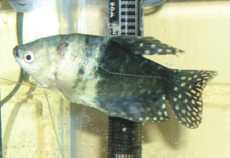
Jumpy Gourami 7/24/17
I'm back with another question. Thanks for continuing to help all of us
with our aquatic challenges! I have a 3-year established, 15-gal
column tank with an AquaClear 20 sponge/carbon/bio, housing one
3-spot Gourami, five cherry barbs, and one panda Cory with 3 bandit
corys in a QT almost ready to be added. My ammonia and nitrites are
zero. I feed flakes and float pellets most nights, a shrimp pellet at
lights out every few days, and swap flakes/pellets with freeze dried
bloodworm once a week.
<Ahh; do make sure sufficient high protein food is getting to your new
and old Corydoras cats on the bottom>
I change the water and swap out one of the media components regularly.
For the past few weeks, my 3-spot has become very jumpy.
This is new behavior since I have had her for three years. Whenever I
approach the tank, she cowers in the corner and/or darts to a corner.
She swims freely and openly at all strata otherwise and looks perfectly
healthy. Last night, she literally jumped out of the water in a frenzy
when I walked over. I do shower.
<Heee!>
Since the behavior has sustained for a few weeks, I suspect something is
up. Any ideas on how I can help her? Thanks in advance! -- Matt
<Perhaps adding another Trichogaster trichopterus... there are quite a
few "sports" of the 3-spot, blue, gold/en... can be the same sex...
Please read here re:
http://www.wetwebmedia.com/fwsubwebindex/ttricself.htm
Bob Fenner>
Re: Jumpy Gourami 7/24/17
My apologies, I did not include a salutation in my last email. How rude!
Hello, crew!
<Hey Matt>
Thanks,
Matt
<Cheers, BobF>
Re: Jumpy Gourami 7/25/17
Bob,
Thanks for the fast response. (1) When you mention high protein for the
corys, is the sinking shrimp pellet sufficient?
<Is a good start. I would offer other foods as well weekly>
I may increase to two once I add the others but I don't want to
overfeed.
(2) I'm leery of adding another 3-spot... I've done combos in the past
and one always takes over... I've had this one (female) drive two other
females into the ground and then I added a larger male pearl Gourami
which tried to mate with this one and then bullied her until he
sustained a physical injury chasing her, and died.
<Mmm; well; how about some ditherfish then? Perhaps a small school, five
individuals... of peaceful barbs (golds, checkers...), Danios or
Rasboras?>
I attributed the cause of this behavior to the limited horizontal space
at the top of this vertical tank. What do you think?
<Of a certainty, you are correct here>
Thank you,
Matt
<Welcome. BobF>
Re: Jumpy Gourami 7/25/17
Thanks Bob. I already have five cherry barbs in there and actually now
that I think about it, two of the males (there are 3 and two females)
have mysteriously "developed" nipped dorsal fins.
<Ahh; maybe from each other; perhaps the Gourami>
I would see one occasionally but never two. Wonder if this is part of
the equation? Also, what kind of protein do you recommend?
<Hikari and Spectrum sinking pellets of small size are faves. B>
Re: Jumpy Gourami 7/25/17
Thanks Bob. I'll give them a shot and let you know if things progress. I
very much appreciate your ideas and responses!
<Cheers Matt. B>
|
Gourami "begging" for food 3/5/16
Hello WWM crew, thanks for your hard work and for bailing me out of my
ammonia problem a few weeks back! I have a 15-gal Column (regretfully) setup
for a little under a year with an Opaline Gourami and a gold
3-spot--both female--three male and two female cherry barbs, and two julii
Corys. Everyone seems active, happy, and stable, ammonia and nitrites are 0,
bio-filtering with an Aquaclear 20, 25% water change bi-weekly with a drop
of Prime per new gallon before I add. I feed them flakes every evening with
a freeze-dried bloodworm treat (instead) one night a week, and I drop a
shrimp pellet in a few times a week after dark for the Corys.
After a few minutes of feeding flakes in waves so none drop and everyone
eats, my Opaline stays at the top and seems to "beg" for more food for
several minutes at a time.
<Mmm; your observation may be accurate. Flakes don't have much nourishment;
weight>
I'm not sure but I don't believe she is gasping for more air--she looks very
healthy otherwise, flowing fins unfolded and no signs of disease, bullying,
nipped fins, or stress that I can see--but I obviously could be wrong. When
in doubt, I always underfeed, as your writers suggest.
<Good>
Should I try something else or be concerned? I'm a little weary of frozen
foods because of the delicate chemistry of my water... and because I've
never tried using them :) Thank you!
<I'd try adding some more substantive floating pelleted food. New Life
Spectrum (small pellets) is a fave. Though the pic of your Opaline doesn't
show as skinny. Bob Fenner>
Re: Gourami "begging" for food 3/5/16
Thanks for the quick reply and for the idea, I will definitely look into it.
Enjoy your weekend, sir!
<Thank you Matt. You as well. BobF>
|
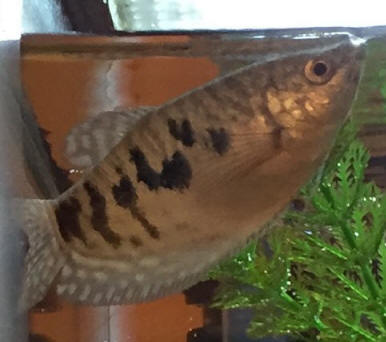 |
Gourami acting strange 2/12/13
Hello,
<Hi Deb>
I have 5 gallon tank with two plants in it and one opal Gourami.
<Mmm, luckily/happily, this is one somewhat larger fish that doesn't
need a good-sized system... as long as it is kept/maintained in a stable
fashion>
There is no light in the tank but there is a light standing next to the
tank.
<Hopefully enough for your plants needs>
Since yesterday, the fish started to swim forward en <and> backward in
short but fast movements. I changed the water today
<Good>
and cleaned the tank, but the behavior did not change. I have the fish
since Saturday but the behavior started Monday afternoon.
<Mmm, is this system thoroughly cycled? That is, is there measurable
ammonia or nitrite present?>
Please note that I am from Holland so it is Monday evening right now.
<Understood>
I really hope you can help me since there were not any Dutch sites that
could help me!
<Do answer the question re cycling... It may well that there is nothing
wrong w/ this fish (Trichogaster)... Sometimes they do just swim oddly.
I would not add medicine/s to the water, system here. Bob Fenner>
Re: Gourami acting strange 02/13/13
Hi Bob,
<Deb>
I have no nitrate or ammonia measurements.
<... should have Nitrate (w/ an "a"), but no Nitrite (w/ an "I")...>
I did clean everything thoroughly.
<Cleanliness is not sterility in biological systems>
Monday afternoon I placed a white background behind the tank, because it
was standing against a blue and brown print and I figured that it might
stressed him out.
<White is worse>
He seems much more calm now. Last thing, the water temperature is about
18 degrees Celsius, could it be that he is just cold and therefore
acting strange?
<Possibly; this is too cold for Trichogaster species... See the Net, WWM
re. BobF>
Thank you for your help!
Gold Gourami Staring at Corner
10/10/12
Hello,
<Nick>
I apologize, I could not find this issue on the site, although I felt
certain I would. I have a Gold Gourami that I've had for maybe a
year. In the mornings as I leave for work, the aquarium lights
have been on maybe half an hour, the Gourami stares at the same corner
of the tank near the top. (below the water line. It isn't
breathing at the surface) It's only in the same corner each morning.
It has done this for around a month.
There are zero other signs of anything. If I walk over, it swims
away and acts normal. It eats well, responds to people, and looks
like it is healthy. Is this an issue, or is the fish just prideful
of it's reflection?
<Yes; likely so>
(joke) Tank stats: 55 Gal, 1 Gourami, 1 One Stripe eel, 2 Rope Fish, 7
Giant Danios, 1 Dwarf Rainbow fish. I have never seen any of the
fish bother each other. Aquarium established 2 years ago, PH 8.6,
Ammonia & Nitrite 0 ppm, Nitrate 0-10 ppm.
Your response is greatly appreciated!
<I'd likely get another (depending on the sex of your present one) or
two female Trichogaster trichopterus, and definitely more Rainbows (are
social species). Bob Fenner>
Blue Gourami
behavior 11/5/11
Hi!
I just discovered your site and have poured over it in an attempt to
find out what to do for our male Blue Gourami.
He is leaping and crashing into the tank cover as well as the sides of
the tank, he must be knocking himself senseless because he will float
to the bottom and be curled in a circle or even upside down. He has no
Ich but now has bashed his face up pretty good with scales faking
around his snout from this. I don't know how often he may be doing
this when we aren't home but has done it at least a handful of
times that I am aware of over the last month. We always think he is
going to kill himself, then he rests and returns to normal.
<This does sound very odd. Seizures are not common among fish, but
do happen from time to time. If the fish is jumpy, but otherwise
normal, then it may simply have a reason to want to jump out of your
aquarium. That's a normal behaviour for some species. Bichirs and
Mudskippers jump to attract mates, Orfe and Archerfish jump to catch
flies, and almost any fish will try to jump out of an aquarium if it
thinks water conditions outside the tank are better (and they are,
obviously, mistaken in that, but in the wild jumping from one pool to
another may be key to survival). In all these cases you need to reflect
on possible causes and act accordingly. For a Blue Gourami, poor water
quality or aggression from another fish may be reasons why it might
want to jump to another "part of the world" however idiotic
that might seem to us. On the other hand, if a fish acts weird before
it jumps, perhaps spasming, floating weakly, or breathing heavily, then
the jumping may be part of a deeper problem. Neurological damage to
fish does happen, often associated with rocking motions (the
"Shimmies") or unusually coloured patches on the
body.>
This is a 30 gallon tank with a female blue as well, a large
Plecostomus (almost a foot), and a crawfish.
<Whatever retailers might suggest, Crayfish are opportunists, and
will eat a fish they can catch.>
Oh, and some snails from King's Bay in FL that we added probably at
least a year ago (and come to think of it, have blotchy areas on their
shells as if deficiency or something is leaching away their
integrity).
<Insufficient calcium and/or low pH.>
Their numbers come and go. The tank has a real lava rock, a fake plant
and fake log.
<The snails aren't an obvious danger, but there's always a
risk that wild-caught snails can bring in parasites, including
parasites dangerous to humans. So do approach with caution before
adding to your aquarium.>
We have had issues with nitrites in the past and recently can't get
the water to NOT be cloudy even with up to 50% changes with tap (well)
water once a week. Was worried to do more often and shock them. We even
added a second filter to the Tetra Whisper EX45 to help with no luck.
The temp seems to maintain a consistent 76 degrees.
<Now, if you don't have zero nitrite levels, there's
something amiss with the biological filter. The tank's either
overstocked or the fish overfed, or else the filter is maintained too
aggressively, or not equipped with sufficient capacity (or biological
media) to cope with the number of fish.>
I am out of test strips, can you suggest the best kind for me to buy so
I check the water again?
<Doesn't really matter, but liquid test kits are generally the
most accurate.>
Do you think the Gourami is ill?
<Could easily be, but impossible to say.>
We have had them and this tank since getting it from a friend who was
moving in the summer of '09, the Gourami and Pleco are the last
fish from the original group. The others and the original crawfish have
slowly one by one passed and this crawfish we've had since the
other died last spring. So no sweeping tank diseases have been
encountered that we know of given the length of time between the loss
of each fish.
Thank you for your time, so glad to have found your site!
Val
<Thanks for the kind words. Would not worry to much for now about
the fish.
Concentrate on the water quality issue. Do 10% water changes every day
or two until the nitrite level is at zero, and from then on, the usual
20% per week. Minimise feeding until nitrite is zero. Cheers,
Neale.>
Re: Blue Gourami behavior -- 11/08/11
Thank you so much,
I have been changing water by 10% over the weekend and will get new
test kit today. He has gone berserk every day since Thursday and
sometimes several times a day. It is so upsetting, I feel so helpless.
We have no hospital tank ability, or I would take him out.
The crawfish hasn't bothered them, although the previous one did
have a taste for fresh fish, but that was due to the friend we got that
tank from.
She fed it shrimp heads. In fact the female Gourami "lives"
with the crawfish on that side of the
<Glad to help. Do watch the Crayfish; wouldn't assume things
will stay so placid indefinitely! It is their nature to eat weakened
fish. Cheers,
Neale.>
Gourami behaviour
9/8/10
Hey guys!
<Hello,>
I have a pair of yellow gouramis in one of my freshwater tanks, Its
been cycled for about 2 years now and has been doing quite well. we
have a large cluster of hornwort in there that the smaller of the two
loves to hide and sleep in.
<Okay.>
The bigger of the pair however seems to rest on the substrate, but
still frequently lurks in it.
<Are you sure it's a "pair"? Gouramis generally
don't form pairs as such, and males tolerate females in their
territories only for as long as it takes to spawn. After spawning, he
kicks her out! Needless to say, territory-holding males are even less
tolerant of rival males.>
After some investigation I found the bigger one has slightly frayed
fins and what seems to resemble blood vessels near the surface of the
skin on the right side very close to the tail fin.
<Does sound like physical injury; assuming water quality is good,
should heal by itself, but treating as for Finrot wouldn't be bad
idea. Certainly do so if the injuries aren't healing.>
it might just be a normal part of the animal but I wasn't sure. The
fish is still very receptive to food items and people, immediately
getting up from its idle position to investigate however directly
afterward goes right back to being motionless. No other symptoms are
apparent. Thoughts?
<Given the belligerence of Trichogaster
trichopterus, I'd assume aggression first of all, and act
accordingly. One approach might be to remove both gouramis, move all
the rocks and plants around, reintroduce the "weaker" fish
first, and then an hour later place the other one in the tank. See what
happens. With luck, the weaker fish might be able to establish his own
territory before the other one gets a chance to do so, and things will
calm down a bit. Cheers, Neale.>
shy Gourami and vertical molly
8/22/10
Hi,
<Salve,>
I have a 72 gallon fresh water community tank. Tank is fully cycled and
established. Regular weekly maintenance (water change, gravel siphon,
glass cleaned with cleaning tool and all water conditions monitored and
within acceptable parameters.
<Meaning what, precisely? Mollies require very different water
conditions to South American tetras, and it's hard to see how you
can have "acceptable" water for both in one aquarium. Even if
you don't maintain Mollies in brackish water -- and to be fair,
some people manage to keep them in freshwater just fine -- they still
need warm, hard, basic water.
Danios require cooler water, and Tetras softer water.>
No live plants, though several fake plants and multiple hiding spots
for the varied fish There are 3 gouramis in the tanks (along with other
species - all community/peaceful -Danios/tetras/mollies/2 clown
loaches/Cory/Pleco).
<See above.>
Of the 3 gouramis, one is acting what I define as strange. During the
"daytime' or when daytime light is on the tank, it will
"hide" in one corner of the tank. However if I run the
"blue" light that I have for night time viewing, this Gourami
becomes active and swims throughout the whole tank and socializes with
the other fish. During the day or with day lights on this
Gourami will run from the other gouramis as if being chased, however
under the blue lights shows no such sign of submission and chases the
others as much as anything else. No obvious physical issues, and seems
to be eating regular.
<I do think this is aggression. Assuming this is Trichogaster
trichopterus,
the males -- which have longer dorsal fins -- are famously aggressive
towards one another. Adding more females might dilute things, and
keeping just two males within a group of three is bound to cause
problems because one male can always bully the other. Try keeping at
least equal number of females to males, and either one male or at least
three.>
Have also noticed that a silver molly (relatively new tank member - 2
weeks) swims around in a "vertical" posture, nose up/tail
down - almost like a rocket ship taking off.
<This is likely "the Shimmies", a neurological issue
related to poor environmental conditions. Mollies need 15+ degrees dH,
pH 7.5-8.5, and a temperature between 25-30 degrees C. Danios won't
enjoy water that warm, and neither will Corydoras or tetras such as
Neons; all of these are better kept at 22-24 C. Obviously, most
freshwater fish won't tolerate brackish water, but even the hard
water Mollies need will significantly shorten the life of the more
sensitive South American tetras such as Neons and Cardinals.>
It is capable of swimming horizontally, and will do so for a while and
then go vertical even though it is swimming along a horizontal plane.
My local fish supplier says that this is a common trait of this
species, but I have never seen so before. Again no obvious physical or
eating issues. Any thoughts/advice would be appreciated.
<It's possible the Molly has constipation or is simply
genetically deformed, especially if the thing is inbred or one of those
ghastly Balloon Mollies. But if the fins are clamped, or the fish rocks
when treading water, then Shimmies is very likely the problem.
Constipation can be cured using high-fibre foods such as peas and
spinach, together with Epsom salt if needs be:
http://www.wetwebmedia.com/fwsubwebindex/gldfshmalnut.htm
Genetic problems aren't fixable, and the Shimmies goes away usually
if the Molly is given good conditions:
http://www.wetwebmedia.com/fwsubwebindex/mollies.htm
>
Thanks
John
<Cheers, Neale.>
Re: shy Gourami and vertical molly
Thank you for your response,
<Glad to help.>
I will try provide the further information you require.
<OK.>
Maintenance: weekly water changes, approx 30%-40%, use floating glass
cleaner to clean glass and gravel siphon to suction gravel. Fluval 404
canister filter Water conditions: Ph maintained at 7.0 as much as
possible, checked twice a
week. Nitrates checked weekly usually around 5 (lowest number on
scale).
Ammonia tested weekly usually 0-0.25 (keep a hang in tank monitor in
the tank to visually check daily - unsure how accurate these are).
<Very inaccurate. Do have the water tested with a liquid test kit;
if not zero, then you have a problem with water quality.>
Also check Phosphates and usually 0-0.25. Haven't tested the water
hardness in a while, but believe it to be hard (will get test kit to
test). Usually test water 2-3 days after water change to give numbers a
chance to balance.
Is this the proper type schedule. Anything specific I should be
checking as well?
<What you're doing sounds fine.>
Sorry not sure what you refer to as "basic" water?
<Basic is the opposite of acidic; i.e., pH 7 upwards. At school you
might have learned "alkaline" for this, but actually alkaline
means something quite specific, though closely related.>
Usually attempt to maintain a water temp of 76F (24C)
Food: Tetra Algae vegetable enhanced chips. Nutrafin Max sinking pellets
(for bottom feeders (loaches) bloodworms (every 10 days or so as a
treat
<All sounds fine.>
Tank inhabitants:
1 Bristlenose Pleco (2yrs in tank )
2 Clown loaches (2 years in tank)
6 Zebra Danios (3 months to 1.5 years)
6 Cardinal Tetras (1 year)
1 Julii Cory (1.5 years old)
2 black and 2 silver mollies (1 silver molly 1 year, other 3 - 2 weeks
in tank). They are not balloon mollies.
<Good!>
3 Gouramis (1 moonlight and 2 sunburst - the moonlight Gourami is no
problem (except chases the air bubbles), the solitary Gourami is one of
the sunburst).
<Right, the Sunburst Gourami is, I believe, a variety of Colisa
lalia, a very risky species. Highly prone to Mycobacteria infections as
well as a viral infection all its own called Dwarf Gourami Iridovirus.
Not a species I ever recommend. Sad, because it's a nice fish. But
inbreeding and intensive farming has completely ruined this
species.>
Between my LFS and the web, I thought I had done my homework regarding
water/environment compatibility within the tank
(www.peteducation.com/article.cfm?c=16+1911+1957&aid=2572
- was one article that led me to believe mollies and gouramis were
compatible) - though I am sure there are others to indicate
non-compatibility. However your information indicates the mollies do
not fit within this grouping and I am willing to accept your
analysis.
<It's not that you can't keep Mollies with Gouramis;
it's that you can't *always* keep Mollies with Gouramis. About
50% of the time Mollies just don't do well in freshwater
communities. Some folks write that off, and say if the Mollies
aren't happy, take them out and try something else. Or
alternatively, keep medicating as often as required. Or worse, treat
them
as disposable fish, and when they're sick, euthanise them and buy
some more. My argument is towards providing such conditions for Mollies
that you have as near to 100% chance of success as possible. So
certainly that means the water should be hard and basic (alkaline) but
it also means keeping your options open so you can add some marine salt
mix. Some tropical fish don't mind a little marine salt mix, and
will thrive under those conditions. Most other livebearers for example,
as well as things like Australian Rainbowfish, many Killifish and
Cichlids, and certain catfish such as Brown Hoplos. But on the other
hand, there are fish that dislike salt immensely, including most
tetras, barbs and gouramis.>
You seem to indicate that the best move is to remove the mollies from
the mix and I will probably go that route.
<Does tend to be my recommendation. Mollies are fine fish, but you
need to work around them.>
In the interim, will the Epsom salt have any effect on the other fish
in the tank/ should Epsom salt be a regular addition to the tank?
<Epsom salt won't have any negative effects on the other fish.
It IS NOT an substitute for marine salt mix, but rather a laxative that
helps relieve constipation. It also raises general hardness, but
that's something different to salinity.>
If there are any other compatibility issues I would appreciate further
direction.
<I think we've covered everything!>
Not sure of the sex of the gouramis - I was not there when purchased -
will attempt to determine
<Your Colisa lalia are males if colourful, females if plain
silver.>
I do not use any aquarium salt, should I?
<Some folk do add "teaspoon per 5 gallon" amounts to
community tanks but there's not much reason to. Do read here:
http://www.wetwebmedia.com/fwsubwebindex/SaltUseFWArtNeale.htm
>
Also have not had much luck with live plants (mollies ate everything I
put in there - which I understand they do)
<Not normally. They much prefer algae, which is their natural diet.
But certain soft plants may be nibbled on. Try Indian Fern, a species
that is clearly good to eat but also fast-growing, so tends to hold its
own.>
plus most of the information I was given seemed to indicate the
conditions for healthy plants were not compatible with
my fish. How important are live plants?
<They aren't crucial at all. Plants provide shade, but you can
do that with plastic or silk plants. Plants remove nitrate of course if
growing fast, but water changes will do that too. Fast-growing plants
do prevent algae though, and that's difficult to do otherwise, so
again, clumps of floating Indian Fern can make a huge difference if
you're constantly wiping algae from the glass.>
Bubble wall - I am not a huge fan of it esthetically, however if its
good for the fish I'll keep it. Recommendations?
<If you don't like it, don't use it! Contrary to popular
misconception, bubbles don't "force" oxygen into the
water. What bubbles do is move the water from the bottom of the tank to
the top. If you do that using a good strong filter, then bubbles are
redundant. Switch the thing off, and see what happens. If the fish seem
just as perky as before, then leave the
bubble wall off, or perhaps switch it on during hot spells when you
worry the water might be holding less oxygen than it should -- you can
tell because the fish become sluggish or hang about close to the top of
the tank. Do note that Mollies and Gouramis do this naturally, Mollies
to breath the air/water mix, and Gouramis to breath air directly, so
just because they're at the top of the tank doesn't mean
something is wrong.>
Finally, if there are no further compatibility issues, are there any
fish species that you would recommend to me.
<I think you have a fine mix of fish! You should add some more Julii
Corydoras because they are sociable. Clown Loaches get very big, and
also eat soft plants, so I'd tend to recommend Yo-yo Loaches or
Dwarf Chain Loaches over Clown Loaches. If you want a livebearer, I
suspect either Platies or Swordtails will be better in this tank,
depending on its size and how strong the water current is, Swordtails
being bigger, more active, more aggressive, and preferring strong water
currents. Failing that, Wrestling Halfbeaks are weird and lively, if a
bit more difficult to keep.>
Thanks
John
<Cheers, Neale.>
Opaline Gouramis, beh., hlth.
8/11/10
Hi,
I just recently bought 3 Opaline gouramis from a pet store. They were
fine for 3 days. Now I've noticed 2 of them sit on the bottom a lot
and seem very lethargic. I have them in a 10 gallon right now. I'm
getting a 20 gallon or bigger on Friday. My question is this. They have
all started rocking back and forth. Is this normal behaviour? When they
aren't doing this the other 2 just sit on the bottom. To me it
looks like they don't have long to live. Please help me figure this
out.
Thanks in advance, Todd
<Hi Todd. We need more information than this. For one thing, how
long has this aquarium been running? In other words, did you cycle the
filter with an ammonia source for a few weeks before adding the fish?
If these fish
were dumped in a new aquarium, then water quality is very likely the
problem. Also understand that these are tropical fish, and in unheated
tanks won't last long. Start here:
http://www.wetwebmedia.com/fwsubwebindex/fwset-up.htm
http://www.wetwebmedia.com/fwsubwebindex/fwlivestk.htm
Do also note that male Trichogaster trichopterus are aggressive; in a
20 gallon tank keeping more than one male is bound to cause problems.
If you can, just choose females. Cheers, Neale.>
Mixing gouramis/Gourami aggression
Trichogaster trichopterus, behavior - 10/01/2009
Hello Crew,
<Hi, James!>
I am starting to get really frustrated here and I need some help,
please!
<Will do what I can.>
I have angels, cories and a pair of gold gouramis, 1 each of m and
f.
<I know where this is going.>
The male chases the female about 80% of the time and even though I have
been told that this is pretty much normal behavior,
<Oh yes. Often to the detriment - and even death - of the recipient
of the aggression.>
it drives me nuts to have this happen in an otherwise slow and peaceful
tank.
<Probably drives the female nuts, too.>
I decided to put the male in a breeders net or colander for a few days
to hopefully give him a "time out",
<This won't help.... Beware of anthropomorphizing too much; a
fish can't understand that "bad" (actually,
normal/natural) behavior leads to "punishment". A "time
out" holds no meaning for a fish at all. The
normal/natural behavior will resume immediately.>
but no matter how hard I try I cannot catch or trap him so my next
alternative is to get 2 more females.
<This may be an option, IF the tank in question is suitably
large.
Additional cover - plants, rockwork, decor - will help if you do go
this route.>
I wanted to know if this may help even if the other 2 new females were
pearl instead of gold.
<Likely not. In my not-so-humble opinion, were it me, I would remove
the offender from the tank, and avoid male Trichogaster trichopterus of
any color in a peaceful community.>
Thank you for your help. James
<Best of luck to you, James! -Sabrina>
Gourami Behavior, Trichogaster 9/30/09
Hello Crew, I have a gold Gourami question. About a month ago I bought
2 gold gouramis (1 male and 1 female). Sometimes they get along OK and
mingle and eat together with no problem. Other times the male chases
the female unmercifully. She then hides in a little cave until he finds
her and starts chasing her again until she gets really stressed out. Is
this normal for a male and a female?
<Yes; unfortunately. Thank goodness you have structure, space for
the female to get away>
If by some chance it were 2 males would that be the typical
behavior?
<Mmm, yes>
I even went about 4 days ago and bought 1 additional female to
hopefully spread the aggression.
<A good technique>
She was pregnant.
<Mmmm, you judge this how? The genital papilla? Roundness of the
abdomen?>
I didn't necessarily want a pregnant one, but she was the only
female that looked really hardy. The next day the one I had just bought
was gone and I have searched high and low. The only thing I can figure
is she jumped out of the tank somehow.
<Oh!>
If this aggressive one keeps bothering the other I am going to take
them back to the store.
<Good plan>
Thanks,
James
<Trichogaster are bubble nest builders... like the common Betta. Bob
Fenner>
Re: Gourami Behavior - 10/01/2009
Hello Bob, I feel like a real dummy, but I found the mysterious missing
Gourami.
<Ah, good>
She was stuck in the net I use to introduce fish into the tank after
drip acclimation. I can't believe I did that. I am usually so
careful and watch to make sure the fish goes in the tank. Oh well, I
hope I am not the
only one that has done this. Now I am still back to the one male who
chases the one female. In your expert opinion would adding 1 or even 2
cut down on the aggression by the male.
<Sometimes does... But another, usually better technique is to give
the bully a "time out" by floating it in a plastic colander
or sequestering it in a breeding net/trap for a few days... Typically
this takes the "spit and
vinegar" out of these fish>
I really do hate to take him out since he is large and very pretty. And
if I got say one or 2 more females would that still be OK to have 3
gouramis, 8 angels and about 12 cories in a 75 if I do not get any
more
fish? Thank you so much for all your help.
James
<Welcome. These all should go together fine in this size/shape
system.
BobF>
Re: Gourami Behavior
Thank you, I have never head of that technique. What if I put him in an
empty plastic coke bottle? (large one). I don't have a floating
colander with a top on it. And during this time out period will it help
to not feed
him or not?
<Uncovered is fine... needs to be fed. B>
Re: Gourami Behavior
Mr. Fenner, please be patient with me and forgive me for being so
ignorant, but it I put him in a floating colander what will prevent his
escape?
<Might "jump over the lip", but most all the plastic
colanders I've seen float well enough (have a lip that traps air).
Perhaps yours doesn't... The pop bottle/plastic will work if you
can devise some holes in it,
float/attach it to the side of the tank... These Anabantoids need to
get to the surface/air. B>
Shy Gouramis (Trichogaster trichopterus behaviour,
environment) 9/16/08
Hello!
For about 9 months, I had a 72 gallon tank running with assorted fish,
and all was well. Then, at the beginning of July, we had a disaster at
our house and I was forced to farm the fish out to friends with tanks
while our house was repaired. I have now cycled the tank (all readings
are good) and brought back first the 12 rummynosed tetras which seem to
be
perfectly happy and all. Next to come back, about a week later, were
the 5 gouramis (3 golden, 2 Opaline). Since they have been back (5
days), all they do is hide in the plants, all huddled together and
their markings are very dark (although they do come out briefly to
eat). They were never like this before the disaster, and the friend who
took care of them while they were away, said that they weren't like
that in his tank. Just wondering if this is normal? And, if yes, any
idea how long this will last for? Should I continue to reintroduce the
remaining fish to the tank? Would any kind of fish help them to settle
in better than another?
Looking forward to your reply.
Thank you!
Cheryl
<Hello Cheryl. The gouramis you are keeping -- varieties of
Trichogaster trichopterus -- are generally very outgoing animals.
However, there are a few things they can't stand, and so I'd
review these before anything else. They don't like strong water
currents, and they don't like nippy or aggressive tankmates (and
Rummynose tetras might be nippy, though they are usually well behaved).
They may simply not be settled into the tank; review in particular
water quality. Although you say the readings are good, repeat your test
two or three times across the day to see if it stays consistently good.
Adding food can alter the balance, so while nitrite might be zero first
thing in the morning, after you've fed the fish it can go up.
Nervousness in fish is commonly associated with water pollution and
also with unstable pH, so check the pH as well. In any case, since the
tank is new, leave things be, and do the usual water changes and
provide only small meals. Don't think about adding any more fish
for at least two weeks. As a rule of thumb, you should never add fish
to a tank if the existing fish aren't doing what they should be
doing. You could make things worse! Cheers, Neale.>
Trichogaster trichopterus; behaviour
8/31/08
I have a 40 gallon aquarium with a black
ghost,
<Your Apteronotus will quickly get too big for this tank, especially
if we're talking those paltry US gallons.>
3 leopard Cory's and I had a pair of Opaline Gourami but I returned
the male because seemed to aggressive toward the female Opaline.
<Absolutely normal for the species; Trichogaster trichopterus,
despite its wide sale, is rather aggressive, at least as far as the
males are concerned.>
I have since seen the gold Gourami which look pretty good but have read
they can be aggressive.
<Gold, Blue, and Opaline Gouramis are all the same species:
Trichogaster trichopterus, known among biologists as the Three-Spot
Gourami. See why we use Latin names? It's so much easier than
trying to keep track of common names.>
Is this just the males or females too?
<Generally only the males.>
I can't remember if I read there should be a ratio of one male to
two female or one male to three or more females for Gourami .
<Makes no odds, though two females to one male would work nicely.
The male is territorial and guards the eggs on his own. Therefore he
views any other fish in his patch as a potential threat, rival, or
waste of resources. So once a male becomes territorial, it doesn't
really matter what fish you keep with him: he'll chase
them.>
Please let me know what's correct.
<Done.>
Also would the female Opaline count in the needed ratio one male to
multiple females?
<Yes; all one species.>
Or do all need to be same type Gourami whether its gold or Opaline
etc?
<Nope.>
If I were to do the combination using the gold pair and the female
Opaline will I most likely be finding myself returning the gold male to
LFS? What are your thoughts about if there are any combination... male
plus certain (?) number of females or all females into the mix where
I
won't have worry about my Opaline? Should I just stay away from
gold altogether? Or what other Gourami should I be looking at instead
if any?
<There's really no "magic formula" because the male
Trichogaster trichopterus is just as like to chase, say, an Australian
Rainbowfish as another member of its own species. Keeping a single male
and as many females as you want is certainly safer than keeping
multiple males, because the males will fight over dominance. But
that's about all you do.>
Thank you
<Cheers, Neale.>
Gourami dilemma,
Trichogaster aggr. 5/1/08 Hi All,
<Kim> I recently purchased/set up a new 28 gal. freshwater tank.
After allowing the tank to cycle for what I thought was long enough
(although after reading your numerous posts/articles on water quality,
etc. realize it wasn't anywhere close) <Need to actually test...
for ammonia, nitrite...> I added two blue and two gold Gouramis.
<Ahh, both Trichogaster trichopterus species> Everybody was
pretty mellow at first but soon perked up and started exploring their
new surroundings. After about a day I noticed one of the blues spending
more time hiding in corners and not being as active as the others and
after further observation found the other blue to be chasing and
picking on her (I'm pretty sure from your descriptions that I have
a male and a female). This behavior continued off and on until this
morning my girl was hiding behind the filter intake and wasn't
coming up for air as often as it seems she was before. I had set up a
QT in anticipation of adding more fish soon so moved her into that to
recover. She really seems to be enjoying her solitude and is actively
exploring her new digs. So here's my problem (sorry for the long
intro): Prior to reading about cycling and adding new fish to the new
tank slowly I had ordered a few more Gouramis, 2 pearl and 2 flame
dwarf, some Cardinal Tetras, Danios and a couple of shrimp to do the
cleanup. My plan was to keep the new guys in the QT for a couple of
weeks to make sure everybody was ok but now Delilah is recovering in
there. I don't want to put her back in the community tank yet
because I'm afraid she'll go back to getting picked on
(incidentally he leaves the golds alone), but I also don't want to
risk her getting sick if the new fish have any problems. Any
suggestions? <Yes, "float" the bully in an all-plastic
colander for a week or so... in the same tank, but where he can't
get out, to the other fishes. If you want to splurge, you can get a
"breeding trap" or net... and use this instead> I tried to
delay shipment of the new fish but they were already on the way by the
time I realized I had a problem! Oh - and for those of you cringing
because I didn't let the tank cycle properly... don't worry,
I'm checking the water twice a day to make sure I don't poison
anybody. <Ah, goo> I've done two partial water changes ~25%
each time and am being *very* careful about how much I feed them. I did
have quite a problem with ammonia levels yesterday but the water
changes really helped. Thanks for all your advice! Kim <Welcome. Bob
Fenner>
Trichogaster trichopterus Hi, <Hello, Sabrina here> I
was unable to find any good documentation about my
Gourami. I have 2 female three spotted Gourami and they have
been living together for about 6 months. <Trichogaster
trichopterus is the Latin name - a Google search will yield great
results, and here's the WWM article: http://www.wetwebmedia.com/FWSubWebIndex/anabantoids.htm
.> Living with them, I have a small school of tiger
barbs. The other day I bought a pink kissing
Gourami. Now one of my three spotted Gourami has turned very
dark and his spots have faded out so that it appears as if it has no
spots. I suspect that it may be stress because the color
change occurred within about 3 hours. A bacteria
wouldn't act this fast without harming any of the other fish
right? <It's certainly possible, but you're
right on about stress, too. Now you've just got to
determine why the fish is stressed - illness, perhaps; or maybe being
bullied by that new kisser.> Anyway, that fish now hangs out in the
plants. How should I go about diagnosing what is wrong?
<A good starting point: http://www.wetwebmedia.com/FWSubWebIndex/fwfshparasites.htm Other
than that, observe the fish very closely, and separate to a quarantine
tank if at all possible, for better observation and to protect the
fish, also to prevent any possibility of spreading any illness to other
fish.> Thanks, Keeter <Wishing you
well, -Sabrina>
Spotted Fish Hi, I have a golden Gourami in my
tank and I have just noticed her having 2 black spots on her body, one
by the tail, another in the middle of her body. Those spots
are on both sides and exactly in the same place. I wonder whether
they should be there ( I haven't noticed them before) or it is a
disease. Other than that she seems fine. I will be waiting
for your answer <Lina, this is normal. The golden
Gourami, or Trichogaster trichopterus is almost always seen with black
spots at the middle of the side and at the caudal-fin
base. It sounds to me that you have a perfectly healthy
specimen.> Thank you, Lina
|
Cowardly Gourami I have two questions: 1) Tiny black
flying insects have shown up in the house and around the fish
tank. How do I eliminate them? <It's hard to
say without knowing exactly what they are.> 2) A Golden
Gourami in a 15 gallon tank with 5 small Corys and 3 Otos has
started hiding a lot in the past 2 weeks. He seems
easily startled now as well. He comes out to
eat. I test for ammonia and nitrite and its at zero
ppm. I do weekly to bi-weekly water changes because its a small
tank. Our water here is alkaline testing at 7.6
-7.8. I add a small amount of aquarium salt (1tbs per
5 gal). I have coconut shells driftwood and a big fake Bacopa for
shelter. what do you think he is scared of? <Have there been
any changes in or around the tank recently? A change in lighting
(in or out of the tank), tank position, tank decorations, new
fish, etc? Even something as simple as moving where the filtered
water flows back into the tank can cause this. I think that if
the problem is due to a recent change he should be back to normal
once he adjusts a bit. Ronni>
Re: Cowardly Gourami Hi Ronni! Of Course I don't
know what the insects are. I was hoping you might have
experienced this and have some idea. <Unfortunately, I have
never had this problem so don't know for sure. One thing to
check might be your food. The possibility of this being the cause
is pretty slim but it is something to consider. If you are
feeding a live larval type food there is the possibility of the
food actually maturing or just the scent of the food attracting
the insects. I remember once when I was a kid I left an apple
core in my bedroom. Within a few days I had a huge amount of tiny
black insects flying around all over the place.> About the
Gourami: I didn't think to mention that a few weeks back I
put a second power filter on the tank because I read that the
Penguin bio wheel mini I had on it was a little weak. When I did
the last water change I switched the position of the filters
around because the tank is slightly tilted. This is exactly when
he started hiding! The outlet of the filters reach the top of the
water better now but it occurs to me that I possibly now have
created too much current for the Gourami. Could this be a problem
too? <It is possible that there's too much current but
more likely is that he just plain doesn't like it. By adding
to and moving the current you disrupted his territory and
probably ticked him off. For the fish you have, a total turnover
of 2-3 times the tank volume every hour should be sufficient. A
little higher is better but probably not more than about 5 times
per hour max. Ronni>
Re: Cowardly Gourami Hi! Thank you for the advice, it
seems logical. I took the extra filter off of the tank and added
a floating plant. It's been almost a month and the Gourami is
more skittish than ever. In fact, all the fish in the tank have
started to go nuts every time I move near or walk by the tank!
They are all still eating. <Hmm'¦ something is
definitely bothering them but I'm at a loss as to what it
could be.> I think the Gourami hurt himself; I noticed a white
spot on his head that I hope is just a scrape. <Do keep an eye
on that spot and make sure it doesn't grow or begin to look
cottony. It may be a fungus if it does.> Could it be that the
tank is too close to the door? It's funny, I have a larger
tank with some of the same fish in the living room were
there's constant traffic and the fish are not scared at all.
<The door shouldn't be a problem unless it's causing
the tank temperature to fluctuate. Are you absolutely positive
that none of the fish in the tank are harassing the others and
causing this? Occasionally a fish will all of a sudden start
picking on others in the tank. Do you have a Pleco in the
tank?> I read something about using dither fish. A fish that
is real friendly like barbs. I don't have room for a school
of barbs in a 15 gallon tank. <Dither fish sometimes work but
you definitely don't have room to add a school of any that
would work.> I am running out of ideas, could you please help?
<Unfortunately, so am I! Keep a close watch on your water
quality, make sure that spot isn't a fungus, and make sure
that he's not getting picked on by anyone else, especially
when the lights are off. Ronni>
Re: Cowardly Gourami Ronni, Thanks. The spot on his
head is gone thanks to Melafix. No Pleco just 1 Gourami, 3 Otos
and 5 Corys. <Has he started acting any better since you got
the spot cleared up? If not, I'm really at a loss on what
could be causing this! Ronni>
|
Shy Gold Gouramis Hi there: I recently purchased
2 Gold Gouramis, both of which I believe are female, to cycle my new 20
gallon hexagonal aquarium. I heard that they were a hardy fish and I
enjoy their colors. Before I even bought my tank, I read 3 aquarium
books cover to cover to make sure I would have the best chances of
success. None of these books, though, contain sufficient information on
the "shyness" of certain fish. After combing your site, I was
wondering why my Gouramis are hiding from me! It's only been a few
days, but I know they are healthy (at least externally) and the water
quality is good. Are they just stressed from the big move? <Likely a
factor... as well as their general retiring nature> Will they come
out from behind the plants/rocks when I add more fish in the future?
<Likely much more so> One seems to be fairly stationary at the
bottom and is occasionally followed by the other, who stays near the
top. They sometimes come out in the open when they think I'm not
looking, but retreat as soon as they see me. Thanks for your time.....
Ben <Thank you for writing. Bob Fenner>
Why can't we Gouramis be friends? Hi there, <Hello
Ross> I have a small freshwater tropical tank with two blue [three
spot] Gouramis. I bought the first one a few days ago, and added the
second about 24 hours ago, thinking that the first one could be lonely,
and no-one likes to be lonely. <Mmm, not everyone...> However,
the first one [Mr. Fish], now just attacks and torments the new one
non-stop! I believe they may be a pair [purely by accident], as Mr.
Fish has a noticeably bigger, more pronounced dorsal fin, and his head
and back are more angular. <Good description... likely the first is
a male> When he attacks, he changes from a blue-tinged silver to
quite a deep blue marbling. Poor Mrs. Fish spends most of her time
trying to seek refuge behind the filter, and I think her tail fin may
be getting torn. Is there anything I can do to stop this quarrelling?
Or are they just sorting out who's the dominant one? I'm
reluctant to add more fish as the tank is only 30 litres. But at the
same time I don't think Mrs. Fish is going to last very long under
all this stress... Thanks for your help, Ross Dougall. <I would put
Mr. Fish in a floating contraption... a breeding trap or just an
all-plastic colander for a week or so and see if this calms him down...
do this NOW. Bob Fenner>
Gouramis strange behavior I have six Opaline
Gouramis in a 55 gal. tank with 10 Zebra Danios, 6 Black Skirt Tetras,
2 medium Plecos, 1 Apple Snail and 1 Baby Whale, my water parameters
are fine, I check them once a week. My question is the Gourami's
are displaying a behavior I have not seen before, they will gather in
the middle of the tank at the top and move back and forth, then one or
two will turn themselves straight up and down in the middle of the tank
and the others will swim over and nip at them. They will then all swim
around together for awhile, then they'll do the same thing, I was
wondering if this is normal or do I have something to worry about.
<Is normal, but rarely observed... as most folks keep just one,
perhaps two specimens> They get along with everybody in the tank in
fact they just ignore everybody else and do their own thing. One thing
I just noticed there is one blowing bubbles at the top of
the tank, am I looking at the possibility that they trying
to breed? <Yes indeed> Any help with these questions is greatly
appreciated and you guys have a wonderful and helpful site Thanks Jim
<Welcome. Thank you for writing. Bob Fenner>
| Opaline Gourami turning black
4/27/07 I've been searching for a week without help. I have
had an Opaline Gourami for a year. He is living in a 55 gallon tank
with tank mates; 2 angel fish, 8 Cory cats, a black shark, and 6
neon tetras. They all get along and no one is
stressed. I use a Fluval bio filter and do a 25% water
change weekly. He had a bout with Ick a few months ago but it was
short lived and one round of treatment did the job. This week I
noticed "Bob" my Gourami, had a sore behind his head. I
thought it looked like something had worked it's way
out through the skin so I kept a watch on it. It never
healed. It gets a white spot in the same location that looks like a
zit, then disappears and comes back within a few days. Yesterday,
he started turning black. Not lightly colored for a few minutes
like when he gets angry but half of him is totally black and has
been that way all night. I tried moving him to a sick tank where I
slowly added salt to help with the sore and kill any parasites, if
that's what they are. Up until now he was eating but now his
mouth is swollen and full of sores. Do you have any idea why Bob
would have changed color this way, and if this is caused by
illness, what can I do for him? Thanks for your help. <This sort
of complete, distal darkening is almost always due to "nervous
damage"... could be genetic or from a trauma (jumping
let's say)... no "cure" but likely not debilitating,
painful... Bob Fenner> |
| Re: Opaline Gourami turning black
4/30/07 thanks Bob, I'm pretty sure the damage was caused
by some internal problems (perhaps parasites). <Mmm, possibly,
but unlikely> He doesn't seem to be in distress even though
he's not eating much and still half black. I don't dare put
him back in his tank in case it keeps spreading so I will keep
treating him with MelaFix <Not worthwhile> for a while then
just a low salt concentrate in the sick tank. Then just wait and
see. Sue <This appearance, condition is not uncommon in this
species of Trichogaster... and as you and I have stated, not
apparently deleterious... Bob Fenner> |
|
|
Blue Gourami turned black 5/30/07 Hi.. we got a large
tank, like 64 gallons and a few kinds of fish several weeks ago, one
was a fire Gourami and we diagnosed it with dropsy but it died.
<Greetings. Dropsy is a symptom, not a disease. It can be caused by
all kinds of stuff. I'd bet all the money in my pockets though that
your fish actually died from Dwarf Gourami Disease, which is highly
contagious and practically ubiquitous in factory-farmed dwarf Gouramis.
Long term, your tank is unsafe for dwarf Gouramis, and any you buy will
likely catch the bacteria or virus involved and die.> We put the
proper medicine in but now one of our blue Gouramis turned almost
completely black, we are still using the dropsy medicine as directed by
the box and we cant figure out why he/she is turning black.
<There's no such thing as Dropsy Medicine. Wish there was.
Anything that says it fixes dropsy is being, let us say, a little
generous with its marketing. It's about par with things from the
drugstore that say they cure colds. They don't. Anyway, as a matter
of course you should always finish the medication as directed on the
packaging. Once finished, large scale water changes are an extremely
good idea. I'd recommend at least a 50% water change this week.>
Does anyone know why? or how to help him/her? or how to protect our
other fish from the same thing? <It's difficult to know why your
fish has turned black. Gouramis, like most other fish, can change
colour to some degree, and often will when stressed. Now, the question
here is whether your blue Gourami is Trichogaster trichopterus, the
"true" blue Gourami, also known as the 3-spot Gourami; or
merely a the all-blue version of the dwarf Gourami Colisa lalia.
Trichogaster trichopterus is (apparently) immune or resistant to Dwarf
Gourami Disease and generally a very, very hardy animal. It is a
largish, elongate fish, around 10 cm or so, and has two black spots,
one on its flank and one by the tail. Colisa lalia is a small (5 cm)
fish that tends to skulk about the bottom of the tank. The all-blue
variant has a neon or cobalt blue colour. If it is Colisa lalia, then
chances are it has Dwarf Gourami Disease and will die shortly. A
photograph, and some description of its behaviour and eating habits
will help. Also, what's the water quality like?> kriebse
<Cheers, Neale>
Gouramis weird behavior 8/5/07 My wife came
home last week with a surprise birthday present... a 5-gal tank setup,
with everything the (supposedly knowledgeable) pet store ppl said she
would need, plus 2 Gouramis, which after looking at a lot of online
pictures seem like they're blue Gouramis, although they look silver
to me. She doesn't know the first thing about fishkeeping, but she
knows I am into fish so she spent the 80 bucks on this whole thing,
which is an Eclipse hex5 complete aquarium kit, plus gravel, a heater,
and a couple of plastic plants. Fine. So I set everything up as
carefully as I could, added warm water and conditioner, started the
filter going, the temp was in the high 70s, floated the fish in the bag
and added them after 45-50 minutes. Temp stays between 77-80 even
though heater is only set to 73. Basically, since then they've been
exhibiting really weird behavior. First of all, one of them has from
the beginning been chasing and nipping at the other one. They alternate
between floating at the top, hiding behind the filter intake - or at
the bottom behind a plant. When they're not fighting they're
usually separate, one in each of the aforementioned locations. They
picked-on one looks like its dorsal and tailfins are starting to get
ripped. I still have one day left on the return policy. Is the best
thing to just let them be; return one (and hope to get some other kind
of compatible fish); or return both and start with some other fish?
Thanks so much. -Moshe <Hello Moshe, Although the fish you have may
well be blue Gouramis -- Trichogaster trichopterus -- this name
"blue Gourami" is merely applied to one variety within the
species. The natural forms are silvery, brownish, or light blue; the
artificial varieties come in bright yellow, lavender, and dark blue.
The give-away clue for most varieties is that there are three dark
spots on each flank: one spot is the eye, the second is halfway along
the body, and the third close to the tail. Right, now, having solved
the identity of the fish: heating. Ignore the number of the
heater-thermostat. These devices are very simple bi-metallic strips
used to cut off the power above a certain temperature. I remember
learning about how these worked at school in physics class, and I'm
sure you do to. All that happens is above a certain temperature one of
the metals in the strip expands further than the other, bending it away
from the contacts, breaking the circuit. These devices are very
inaccurate. So, if your heater is heating the tank too much, trust the
thermometer, and set the heater lower. In summer, I turn my heaters to
their minimum settings: the day/night cycle between around 25-18C /
77-64F is absolutely fine for most tropical fish and far closer to the
"wild" than the constant temperatures we usually aim for.
Second, the fighting: what you describe is 100% normal for Trichogaster
trichopterus. Males of this species are mutually antagonistic, and
males also tend to be bullies towards any other Gouramis or even
Gourami-looking fishes such as small cichlids or Bettas. Males can be
identified by their orange (rather than white) pelvic fins (the
"feelers") and their dorsal fins (which are longer than those
on the females). Thirdly, fin damage should be treated *on sight* with
anti-Finrot/fungus medication pre-emptively. Failing to do this often
leads to Finrot and fungus, and once you start having sick fish, the
hobby becomes a lot less fun. Finally, you have a 5 gallon tank. I
assume 5 US gallons, but 5 Imperial gallons would make any difference
to this comment either: Your tank is FAR TOO SMALL for anything much,
let alone a pair of Gouramis. With respect to your wife who doubtless
was trying to buy you a nice, fun present -- there's nothing more
difficult in this hobby than trying to make a stable aquarium in 5
gallons. It's too small. Conditions easily slip from safe to
dangerous, and very, very few fish are inactive and small enough to be
content in such tiny living quarters. Thing about it, 5 gallons is the
size of a bucket. Can you imagine many fishes living in such a small
"pond" in the wild? At best, you could keep a few gobies and
shrimps. Gobies are small (most around an inch) and don't stray far
from their chosen cave (like a seashell). Bumblebee gobies
(Brachygobius spp.) are the most popular gobies in the hobby, though
they will not eat flake and so come under the heading of "fish for
semi-experienced hobbyists" in all fairness. On the shrimp front,
there are these darling little cherry shrimps (Neocaridina denticulata
sinensis) that are bright red and very easy to breed, and kept on their
own with a few aquarium plants can make enchanting pets. But other
small things like guppies or Neons won't be happy in a 5 gallon
tank, whatever your pet store tells you. Now, if you ask me why do pet
shops sell tanks for $80 that can't be used to keep fish, the
answer is simple -- people buy them as impulse presents or without
knowing anything else about the hobby. But 99 times out of a 100, these
5 gallon tanks end up sinking into a morass of dead fish and bad water,
and the would-be hobbyist gives up. So, anyway, I hope this helps.
Cheers, Neale>
|
Three Spot Gourami Aggression 1/15/08 Hi
Bob, <It's Neale here tonight, actually.> I have read
many of your answers to questions on aggression often encountered
with the Three Spot Gourami and found them very informative.
<Yes, male Trichopterus Trichogaster are indeed very
aggressive fish. Not recommended for community tanks.>
However, there are some details I would like to be more clear on.
First, a bit about my tank. It is a 21 US Gal tank containing 3
Otos, 3 Zebra Danios, 1 Betta fish, 1 Three Spot Gourami and 1
Dwarf Gourami. There is a porous rock, a plastic plant (waiting
to introduce real plants) and a ornamental castle as well. The
Dwarf Gourami was added 2 months following the Three Spot
Gourami. Upon introduction of the Dwarf Gourami the Three Spot
was aggressive towards it almost instantaneously. <No
surprises there at all.> I let them be for about 20 min or so,
but the Three Spot was relentless in its pursuit of the Dwarf.
Finally, I had to separate the two since the Dwarf was beginning
to suffer immensely. <I bet.> I read on your site to
isolate the more aggressive fish for about a week and then see
what happens. <Hmm...> I am wondering how effective is
this? <With Trichopterus Trichogaster, not effective at
all.> Even in isolation in a homemade colander, you can see
the aggressive behavior of the Three Spot whenever the Dwarf is
close by. <Indeed.> If this does not work will heavily
planting the aquarium be beneficial to curb the Three Spot's
aggression? <Nope.> Or should I add a couple of Three Spot
females or instead add a couple more Dwarf's. <Nope. These
two species are simply not compatible. Certainly not in a 20
gallon tank.> In regards to the Dwarf, its tail fin is
severely damaged (~1/3 of it) as well there is some damage to its
ventral and dorsal fin. Will the fins heal and grow back? <In
theory, yes.> If so, how long on average does one expect the
healing process to take? <Couple months, assuming it
doesn't get Fin Rot in the time being.> I look forward to
your responses, you have a great site! Ryan <Hope this helps!
Neale.>
Re: Three Spot Gourami Aggression 1/15/08
Hi Neale, <Ryan,> Thank-you for your quick response. It is
too bad that some sites do say that the Dwarf and Three Spot
Gouramis are compatible, otherwise I would not have purchased the
Dwarf. <Indeed. Female specimens of Trichopterus Trichogaster
get along fine with the Dwarfs; it's the males that are
mean!> A couple more questions. <OK> Is the Dwarf
compatible with the Pearl Gourami? <Should be; these are
generally very mild animals.> What other Gouramis would go
well with the Three Spot? <Moonlight Gouramis (T. microlepis)
should work well, too. I'd avoid mixing Dwarfs with other
Colisa spp though.> Thanks Again, Ryan <Happy to help,
Neale.>
|

