|
FAQs on
the Blue, Three-Spot, Gold/en, Opaline,
Even Albino! Gouramis, Yes, The Same Species, Trichogaster
trichopterus, Disease/Health 1
FAQs on Trichogaster Disease:
T.
trichopterus Disease 1, T.
trichopterus Disease 2, T. trichopterus Disease
3, T. trichopterus
Disease 4,
FAQs on Trichogaster Disease by Category:
Diagnosis,
Environmental,
Nutritional,
Social,
Infectious,
Parasitic,
Trauma,
Treatments
Related Articles:
Anabantoids/Gouramis &
Relatives, Genera Ctenopoma &
Microctenopoma, Betta splendens/Siamese
Fighting Fish,
Related FAQs:
Trichogaster
trichopterus 1, Trichogaster
trichopterus 2, T. trichopterus
ID, T. trichopterus Behavior,
T. trichopterus Compatibility,
T. trichopterus Selection, T. trichopterus Systems, T. trichopterus Feeding, T. trichopterus Reproduction,
Gouramis 1, Gouramis 2, Gourami Identification, Gourami Behavior, Gourami Compatibility, Gourami Selection, Gourami Systems, Gourami Feeding, Gourami Disease, Gourami Reproduction,
Betta splendens/Siamese
Fighting Fish,
|
.JPG)
|
|
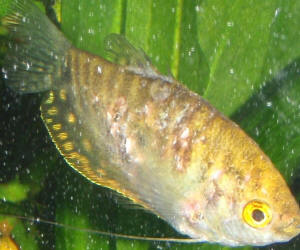
Sick Gourami 12/7/08 Hi! First, I have
to apologize for my English as it is not my mother language
(I'm from Croatia, Europe). <No problems. Your English is
certainly much better than my Croatian.> 3 months ago I bought
4 Trichogaster trichopterus. The Trichogaster that I want to ask
a question about had a small white bump at the base of the dorsal
fin which was damaged, but I didn't see it until I got home.
I put it in quarantine and treated it with 2 cycles of a wide
spectrum medicine called Medimor by Aquarium Muenster
(combination of Ethacidrinlactat, Tertamethyl-thioninchlorid and
Acraflavinchlorid). Didn't help. So I changed the water,
waited a week or so, and tried with Sera's Baktopur
(Acriflavine, Methylene blue, phenyglycol) and Mycopur
(Acriflavine, cupric chloride, cupric sulfate). <These are
various antiseptics, widely sold in Europe because antibiotics
aren't available in pet stores. To be brutally frank, they
only work up to a point, and aren't substitutes for
antibiotics at all. While useful for external infections during
the early stages, they won't cure everything, and won't
fix serious problems.> No use. Then I tried salt baths which
(I think) made the problem worse because those spots spread all
over her body, but then it might be from the stress. The disease
doesn't seem to be infectious, all other fish are fine (I put
her back into the main aquarium, because the small quarantine
surely wouldn't help, and was lucky, I know I shouldn't
do that). She has a very good appetite, swims well, doesn't
hide, doesn't scratch against objects, doesn't have
clamped fins, her faeces are fine. The spots are between 1mm and
4 mm big, they look like white lumps sticking out of her body and
there are about 15 of them (I hope the photos will help although
they're not very good), the skin around them looks pinkish.
Her skin on other parts of the body also looks a bit damaged, but
her fins (apart from the dorsal which didn't grow back) are
all ok. I read everything I could find, posted a question on
forums but I can't seem to find anything that looks like
this. Maybe Lymphocystis? <Could be; certainly, gouramis do
contract Lymphocystis on occasion, though not commonly. It could
be something else though. Perhaps another virus? It doesn't
look exactly like Finrot, though I'd be treating for
Finrot/Fungus before anything else. In Europe, I recommend a
product called eSHa 2000 for this; it's economical and very
effective, and seems to fix a lot of different problems,
including Finrot, Fungus and Columnaris.> The aquarium is 10
months old Juwel Rio 180, 180 l. It has 2 big Ancistrus and a lot
of their babies, 7 Kuhlii loaches, 4 Microgeophagus altispinosa,
2 Siamese algae eaters, 2 small Botia histrionica and those
Trichogasters. Water properties are stabile at: temp 25 C; pH
7,5; KH 10; GH 15, nitrites 0; nitrates 25. <One thing I would
consider is physical damage. Certain algae-eating fish will
"suck" at the bodies of other fish. In doing so, they
pull up the scales, exposing the flesh underneath. The skin
becomes infected, often looking "bubbly". Isolating the
injured fish and treating for Finrot/Fungus will help, but long
term the fish causing the damage will need to be rehomed. I'd
be watching your Ancistrus, Crossocheilus, and Botia in
particular.> I do 15 % water change weekly, with water that
was left for 24 hours and treated with Nutrafin's Aqua+. I
feed the fish with Nutrafin's Staple food in flakes, frozen
bloodworms and frozen daphnia and my own frozen food prepared
from cooked peas, carrots, hardboiled egg, bloodworms, powdered
Spirulina algae ( I plan to add some garlic next time), and
gelatin powder, all squashed into a paste. Please help as I (and
everybody else I asked) have no idea what to do. Thank you!
Morana
<Hope this helps, Neale.>
|
 |
|
Re: sick Gourami
12/9/08 Hi Neale, thanks for the quick response. Which
antibiotic would you recommend? Because I can buy an antibiotic
from my pharmacy if I say it is for my pet, or I can ask my vet
to write a prescription. <In my fish medication book, a
variety of antibiotics are recommended for ulcer-type infections:
Furazolidone (20 mg/l), Nifurpinol (0.1-0.2 mg/l) and
Oxytetracycline hydrochloride (20-100 mg/l). Use whichever, added
to the aquarium water, and always remember to remove carbon from
the filter while medicating fish. Use for 7-10 days, after which
do a decent (25-50%) water change, and repeat medicating as
required.> But if it is a virus, it won't help anyway.
<Quite.> Oh, those Botia are in the aquarium since
Saturday, so it couldn't be them, and I never saw either
Ancistrus or Crossocheilus picking on her. <May happen at
night, when you're at work... In any case, when I had
Otocinclus catfish doing this to a large Awaous goby, it was many
weeks after noticing the damage that I actually saw the fish
"in the act"!> She is now in a 30 l quarantine tank,
I'm treating her for fungus and Finrot, although not with
eSHa because it is not available here, but I will try to buy it
on the net. <Hope this helps, Neale.>
|
|
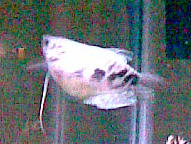
Puffy Stomach 11/29/08 Hello, how is
everyone? I was hoping that I could get a little help. I
apologize if this has already been asked. I tried to comb through
the previous questions but did not find an answer. I found my
Gourami today with an extremely puffed out stomach. I'm not
sure what type he is, I got him at the local pet store about two
years ago. He is, I think, in a 30 gallon tank with two tiger
barbs and two glass fish who have been in the tank for close to a
year and one plecostomus who has been in for over 5 years. He is
swimming, eating and acting completely normal. The feeding
schedule, food and everything else has stayed the same. Is my
little guy on his way out or can he be saved? Is there anything I
can do in the future to prevent this from happening to other
fish? I appreciate whatever info you can send me. We both thank
you for your time. -Alexandria <Your Gourami is what's
called a Three-spot Gourami, Trichopterus Trichogaster. There are
various colours, and yours is obviously the blue sort, sometimes
called the Blue Gourami. Anyway, it's difficult to be certain
about swollen bellies. If you're lucky, the problem is
constipation. Feeding with high-fibre foods (tinned peas are
ideal, otherwise live brine shrimp/daphnia can work) will clear
the blockage if you also add some Epsom salt to the water as a
muscle relaxant (one to two tablespoons per 10 US gallons,
dissolved into warm water, and then slowly added to the tank).
http://www.wetwebmedia.com/FWsubwebindex/gldfshmalnut.htm
If you're unlucky, the problem is organ failure, essentially
allowing fluids to collect in the body cavity. This condition is
often called Dropsy. You can sometimes improve the symptom by
using Epsom salt as described above, but the dropsy itself
isn't the disease, so you have to review conditions and try
to figure out why the fish is sick. Poor water quality is the
most common reason, with an internal bacterial infection being
the cause of the dropsy. If you can treat with an antibiotic
(such as Maracyn) while optimising water conditions, you may be
able to fix the problem.
http://www.wetwebmedia.com/FWSubWebIndex/dropsyfaqs.htm Cheers,
Neale.>
|
 |
Three Spot Gourami Gold Variation, dis.
11/26/08
I have a 55 gallon tank with 6 Gourami (2 gold, 2 blue, and 2
Opaline).
A rainbow shark and a Pleco. All the Gourami are female and have
appeared healthy until about 3 days ago. I first noticed then that the
one of the gold Gourami was not eating. The fish appears thin now and
almost bloated in the chest area. There are no other symptoms that are
physically noticeable. The other 5 appear healthy still and eat
voraciously. The rainbow and Pleco also appear healthy. The gold in
question has been in the tank about 3 weeks. It is not gulping air or
swimming odd other than swimming less than it used to. It just kind of
sits in the middle of the tank and occasionally going to the surface
for air. The other gouramis leave it alone and periodically chase each
other. The ammonia and nitrate are zero and the nitrates are at about
10 ppm. I have tried feeding brine shrimp and normally feed tetra min
tropical flakes. I have also done water changes and tried placing the
fish in water with aquarium salt added for an hour all to no avail. Any
help or ideas you can give me would be appreciated.
Dave
<Sad to state, but all these sports of Trichogaster trichopterus
have/show periodic "breakdown" syndromes... as yours seem to
be displaying... There are some records of effective treatments,
involving the use of gram negative and positive antibiotics... In the
West, the ingredients in Maracyn I and II esp.... I encourage either
just simple waiting or
treatment per your perusal here:
http://wetwebmedia.com/FWSubWebIndex/ttricdisf.htm
Bob Fenner>
Re: Three Spot Gourami Gold Variation 11/26/08
Thank you for your response. If he makes it through the thanksgiving
holiday I will get some Maracyn and hope for the best.
I find your site a great resource. Keep up the good work.
<Thank you David. Happy holidays to you and yours. BobF>
Bruised Gourami 11/11/08 Hi crew! I'm sorry if
there's a similar question already posted - I did try to check for
one. I have a sick Gourami - he looks like a blue Gourami
(Trichogaster trichopterus? - but he's only 3 in long and
definitely full grown - maybe he's a Dwarf? I included a picture of
him (in the middle & one of his tank mates on the right and just
barely one on the left of him). Also, I assume he's male because
he's bigger than the other blue Gourami in the 20 gal tank. There
is also one other honey Gourami(?) in the tank, some plastic plants
& a cave. I've had the fish for about 2 years. A quarter of the
water is changed every month or two - it's been about a month since
it was last changed. The tap water is treated with pH 7.0, a
chlorine/Chloramine treatment (Aquaplus), Cycle, and waste control
before it goes into the tank. (But no water quality data,
unfortunately). Today he's mellow (usually he's a bully), and
he has what looks like bruising near and on his anal fin and caudal fin
and he seems to be listing a little to one side. He is still eating.
Any ideas on what it could be and/or how to fix it? Thanks! Melissa
<Hello Melissa. The Gouramis in your photo are indeed both
Trichogaster trichopterus, the Three-spot Gourami. Males and females
are similar in size, but males have much longer dorsal fins, so are
usually easy to distinguish. In any case, the red patches on the body
and fins suggest Finrot. This is commonly caused by poor water quality.
What worries me is that you only change 25% of the water "every
month or two" -- this is not nearly enough! You should be changing
25% per week. I'm also concerned that you're randomly adding
stuff but don't know anything about the water quality or water
chemistry in the tank. Let's be crystal clear about this: adding
stuff doesn't remove the need to perform, at minimum, occasional pH
and nitrite tests. For example, adding a pH buffer is pointless and
potentially dangerous if you have no idea what the baseline pH of your
tap water is. If you're only changing tiny amounts of water, as you
are, the pH level can (and probably does) change dramatically between
water changes, even with the pH buffer added. "Waste control"
whatever the heck that is doesn't remove the need for decent
filtration and regular water changes. So, bottom line, this fish
needs treating for Finrot using something like Maracyn or eSHa 2000
(but not Melafix/Pimafix). Then you need to seriously review how
you're looking after your fish. Cheers, Neale.>
Re: Bruised Gourami 11/13/08 Hi Neale, Thanks for
the quick response. <You are most welcome.> I checked my water
today, and the nitrate levels were high (about 60 ppm - the tester said
to keep it under 40ppm) and the hardness is awful - the house water
softener must be on the fritz (I'll be getting a fix for the
aquarium tomorrow). <Do not EVER use water from a domestic water
softener in an aquarium. All domestic water softeners do is remove what
is called "temporary hardness" from water. This is the stuff
that makes limescale in pipes and appliances. It does this by
replacing temporary hardness with sodium salts. The resulting water is
a weird cocktail of minerals including sodium chloride that fish would
never experience in the wild. It is completely unsuitable for
fishkeeping. Do not confuse water from a domestic water softener with
actual soft water (rain water, RO water, or naturally soft water).
ALWAYS use water from the tap that bypasses the domestic water softener
-- likely the tap you get drinking water from. Three-spot Gouramis will
tolerate hard, basic water just fine.> But the nitrites, ammonia,
and chlorine were 0. You were right about the pH - the buffer
wasn't keeping the water at 7.0 (it was just below 6) - but the
changing the hardness of the water should help, right? <Provided you
switch back to the non-softened water, the pH will presumably be around
7.5 to 8.0, which if you have hard water will be alongside high levels
of hardness, in particular carbonate hardness. The pH will be very
stable because the carbonate hardness will buffer against pH changes.
So yes, I would expect 25-50% weekly water changes will keep the pH
stable. This is crucially important to understand: most freshwater fish
will adapt to any pH between 6 and 8, what they cannot stand is varying
pH because this has a severe effect on their internal physiology.>
After a water change the nitrates were around 20ppm & the pH was
back at 7 (for now). By the way, Waste Control says it's an organic
waste eliminator - I was told it was commonly used at the pet store.
<Most of these bold-on goodies may have some marginal usefulness or
no particular use at all. Buy them, don't buy them, as you prefer.
But the critical thing is that you understand the essentials: stable
pH, zero ammonia and nitrite, regular water changes. Get those things
in the bag and you're fine. Aquarists living in hardwater areas
have things easy, because hard water naturally prevents pH changes. So
all aquarists in hardwater areas need to worry about is doing regular
water changes and installing an adequate filter system.> I have
begun treatment with Maracyn & will do more regular water changes.
Me & my sick Gourami thank you very much for your help! <More
than welcome. Good luck, Neale.>
Blue Gourami Sick? 10/05/08 I have had a 20 gallon
tank for about a month and a half now. Since I've had it, it's
included 2 blue Gourami, 1 Pleco, 2 African dwarf frogs, 1 angelfish, 5
zebra Danios and 2 apple snails...also 1 neon tetra (the other 4 went
'missing'). Over the past week I have noticed that one Gourami
has turned VERY dark blue, doesn't seem to be eating, keeps its
mouth open most of the time and is very inactive. The other Gourami is
still light blue/white and is constantly harassing the dark blue one
(nipping at it). Is the dark blue Gourami sick? Should we put them in
separate tanks? If so, should they remain separate forever? I have
tested tank levels (KH, pH, NO2 and NO3 are all ok), GH is high and
we've had a very hard time trying it to lower... can't seem to
change it. We've changed out some water, added dechlorinator....
Please advise. <Hello Tiana. I can't answer this question easily
without numbers. That you say hardness, pH, nitrite and nitrate are
"OK" means, I'm afraid, nothing to me. Lots and lots of
aquarists have only the vaguest ideas about what these should be. One
issue in this community is temperature. Neons and Danios and Apple
snails need fairly cool conditions, around 22-24 C, whereas Angelfish
and Gouramis will be better at between 26-28 C. A middle value of 25 C
might work, but frankly at least one reason people experience such bad
luck with Neons is they keep them far too warm. (It's also worth
mentioning here that Neons are also known as Angelfish food, so that
combo isn't one I'd put money on...) Next up, Trichogaster
trichopterus Gourami can, do change colour. Sometimes its genetic,
sometimes follows on from nerve damage (oddly enough), and sometimes
it's a sign of stress or disease. The fact your Gourami is
"gasping" concerns me; usually fish only do this when
stressed somehow. There's no data here for me to diagnose the
problem, but I'd recommend you review the needs of Trichogaster
trichopterus and act accordingly. Give me some numbers and perhaps a
photo, and I can perhaps comment further. Do recall that male
Trichogaster trichopterus (which have longer dorsal fins than females)
are territorial and will fight in small tanks like yours. It is
possible the dark Trichogaster trichopterus is being bullied and trying
to hide away from the dominant male. Do always read up on the social
behaviour of fish PRIOR to purchase to avoid this sort of problem: it
is well known that Trichogaster trichopterus is aggressive. Finally,
unless you're an expert fishkeeper, LEAVE pH AND HARDNESS ALONE. It
is incredibly easy to severely stress, even kill, your fish by
manipulating water chemistry. All your fish will adapt to moderately
hard water with a basic pH (say, up to pH 8.0, 20 degrees dH) though
the Neons won't be thrilled about it. Inexperienced aquarists tend
to have no idea about how to change water chemistry safely, and what
kills their fish is CHANGES in pH and hardness happening rapidly. So,
back away from that topic. Instead concentrate on water quality, diet,
and social behaviour as the keys to successfully keeping your community
healthy. Cheers, Neale.>
|
Gold and Blue Gourami's are acting odd.
8/13/08 Hello, I have 45 gallon tank and currently there are
10 fish in it. Two of them are Gourami's (gold and blue) and
they are acting differently. I used to have two other
Gourami's (both gold) but sadly one received TB
(tuberculosis) and died, <Almost certainly didn't have
TB... who told you this?> and the other one we suspected was
pregnant but also soon died. <Gouramis don't get pregnant,
and certainly didn't die because of it!> Now the last
remaining gouramis are not eating as much, hiding in different
places, and they keep rising to the top. I checked the water and
everything is normal, but just in case I gave the water a 50%
change. What surprises me the most is that the blue Gourami and
the two deceased gouramis survived through a terrible case of
Ick, where every fish but them died. So could you please tell me
what is happening to my fish??Thanks,Scared4Gouramis
<There's no information here to work with. You say the
water is "normal". Meaning what? Let's review, you
need 0 ammonia, 0 nitrite, and ideally less than 50 mg/l nitrate.
The pH should be between 6 and 8, but must be stable whatever it
is. The hardness is not critical, but 5-20 degrees dH is
acceptable. Don't use salt, and don't use water from a
domestic water softener. Almost certainly if you have a bunch of
fish dying for no obvious reasons, or varying reasons, then your
problem is WATER QUALITY. Review, get back to me with the water
test results, and we can help further. Cheers, Neale.>
Re: Gold and Blue Gourami's are acting odd.
8/14//08 Hi, Sorry about the lack of information, the nitrite
and ammonia levels are at 0, pH is 7, and nitrate is low. As for
how I know that the Gourami received TB is that it started to
swim upright, stopped eating regularly, had a crooked spine, and
kept trying to swim to the top( which I thought was for air, even
though we have a curtain of bubbles flowing.) <No, that's
not confirmation of Fish TB. For a start, Fish TB is mostly a
marine fish problem. It's very scarce among freshwater fish.
Back when I started keeping fish in the 80s people often blamed
Fish TB for "mystery deaths" but we're now much
wiser about things like viruses and other sources of infection
among freshwater fish. Now, Trichogaster spp. gouramis are pretty
robust, but you can be unlucky and get one with Hexamita or some
other protozoan/bacterial infection. Happens to the best of us.
All gouramis breathe air, and they do so all the time. Completely
normal. In fact, making it difficult for them to breathe air,
e.g., but too strong a water current, will kill them.> Also I
would like to rephrase what I said about my other Gourami, she
was growing larger in the midsection but she was still eating and
swimming around. <Probably just fat! But they do swell up
somewhat with eggs once mature. Do take care not to overfeed
them, and these are omnivorous fish so some plant material (e.g.,
Sushi Nori, Spirulina flake, tinned peas) is essential to avoid
constipation, a very common cause of sickness.> I had called a
local specialty aquarium store and described the symptoms to them
and they gave me the "verdicts". I was unsure about the
diagnosis on my so called "pregnant" fish so I look up
some things and I found out that the rotting eggs could usually
float around on top as fuzzy white strips. <Never heard of
this. Can't comment. Sounds unlikely though.> Also I found
a small bubble nest. <Cool!> Now for the other fish (my
surviving Gold and Blue), they are not coming out to eat and are
hiding. <When fish become nervous, it's one of two things:
there's something frightening them, like a predator or bully,
or there's something wrong with the water. In the case of
something scaring them, Trichogaster trichopterus is a bullying
species. The dominant male WILL attack other males and
unreceptive females. That's why I don't recommend them as
community fish or fish for beginners. Your water quality sounds
fine, assuming that it's always at the values you give. Do
test at different times of the day just to be sure. Also be aware
that extrinsic factors like paint vapours and cooking fumes can
poison fish, especially air breathing species like Gouramis.
Anything added to the tank should also be reviewed: I've
poisoned fish by adding wood I thought was safe but had actually
been recently sprayed with pesticide.> As for the water
changes I change the water once a week 30-50% changes.
<OK.> So with all the information now, can you tell me what
is happening to all my Gourami's??~Scared4Gouramis <Not
easily, no. My suggestions are above. I suppose you could treat
with a broad spectrum antibiotic such as Maracyn, but beyond that
observe, review living conditions and compare them with what you
learn is appropriate for this species. Cheers, Neale.>
|
General questions about Gourami 4/19/08 Hello! I came across your website today
while I was looking for information about Gouramis. I'm quite new
to fish ownership, so please excuse any stupid questions I might pose.
I started off with a small tank, only 20L (which I believe is only
about a really tiny 5 gallons...) <Way too small for practically any
tropical fish. Almost any problems you have will come down to the tank,
so your NUMBER-1 priority is replacing this with a system at least 20
gallons in size. Ten gallon and smaller tanks simply aren't easy
for inexperienced aquarists to maintain or stock properly.> I have a
Silvertip Tetra, 2 Corys and a 'Gold' Three-Spot Gourami.
<All completely non-viable in here. While I'm happy to help
explain any specific problems, none of these fish will last long (or be
happy!) in here for any length of time. So "fixing" the
problems is a waste of your time (and likely their lives). The
Silvertip tetra MUST be kept in a group of six or more specimens and
easily needs a "long" 20 gallon (in metric terms, that's
something like a 75 liter tank not less than 60 cm in length). The
Corydoras need something similar, and should certainly be kept in
groups of 4-6 specimens, minimum. Three-spot Gouramis are BIG fish when
mature, around 10-15 cm, and even a 20 gallon tank is too small for a
territorial male. When mature, males of this species are incredibly
aggressive and disruptive.> P.H. level is 7.0 and has never gone
more than 0.2 up or down. <Still WAY more pH change than happens in
an aquarium properly set up; small tanks are intrinsically unstable,
and this is one aspect of the problem. Instability = dead fish.>
There's only one plant as previous ones were eaten... <No, not
eaten. They died, and then decayed. Tanks as small as the one you have
almost never come with strong enough lights for plants to grow.
Furthermore, inexperienced aquarists are often sold non-aquatic plants,
often under such names as "umbrella ferns" and "dragon
plants" and the like. As with fish, you need to research plants
*before* purchase, otherwise you WILL be sold junk. An informed shopper
is a successful shopper.> I have yet to pick up an ammonia kit, and
should be getting one tomorrow. Last week one Cory cat died, so I
wanted to ask about that as well. It just became quite listless, and
would often 'fall over' onto its side. It showed no signs of
disease, and I did see it eat, though perhaps not as much as it used
to. <Likely chronically bad water quality, insufficient water
movement, inadequate oxygenation. Or multiple causes. Anyway, no
surprises here.> The other fish seem fine though, which brings me to
my actual question. Near its tail, my Gourami seems to have some kind
of 'bubble' in its body. Like a clear lump that looks like a
bubble...I was just wondering whether it's something to worry
about, <Yes... likely an incipient bacterial infection of some
kind.> or whether I just haven't noticed that part of its
anatomy. It's quite young, I believe, only 6cm long (not even 3
inches), if that's any help. <Still needs treating with a
reliable antibacterial/antibiotic (NOT Melafix/Pimafix).> I do water
changes every week, and I always remove uneaten food. Thanks, Kit.
<Water changes every week don't even begin to come close to
solving the problems you have here. If you're one of the people who
gets offended by me saying "everything you're doing is
wrong" I apologise for hurting your feelings in advance. But yes,
you are doing everything wrong, and the chances of success are
virtually nil. None of these fish will be happy in this system, even if
by some miracle they survive. They MUST HAVE a 20 gallon/75 litre
aquarium to be even close to happy and healthy. Your move. Cheers,
Neale.>
|
One skinny Gourami, one bloated
Gourami 3/3/08 Hello All! I'll try to be as
concise as possible, I have a 40 gallon freshwater aquarium. The
occupants are 4 adult platies, about 6 juvenile platies, 1
Opaline Gourami (the other is in sick bay), a Pleco and a Chinese
algae eater (it was originally in a 10 gallon, but I knew it
needed more room so I moved him to the larger tank). All water
conditions are optimal, I do 25% water changes for 3 weekends ,
then a 50% on the fourth. I purchased these 2 Gouramis about 6
weeks ago, put them in the quarantine tank, and well, the bigger
one started attacking the smaller one non-stop. Wouldn't let
it eat, etc...(turns out they are both males) After a week of
this I put the larger one in the 40 gallon. (I know, a little too
soon) I feed them flake food most of the time, but every 3-4 days
I give them blood worms and brine shrimp. I also add algae disks
for the algae eaters, which the other fish eat on, too. Last week
I noticed both Gouramis had long stringy feces (no color to it,
just transparent looking), so long it would get caught on their
feelers. Now the larger of the two is bloated, but the smaller
one looks normal (I've managed to get him to eat some
Tetracycline), but still no visible bowel movement. The larger
isn't eating at all, but is still bloated, and I haven't
seen any bowel movements from him in about 3 days, either. My
question is: Is he just bloated/constipated, this all seemed to
happen after the last time I gave them the blood worms and brine
shrimp. Or is it more likely a bacterial infection? I've
looked up Hexamita, and that is another place where I'm
finding some confusion. Some sites list it as an intestinal
bacterial infection with the symptoms I've listed above, but
other sites call it "Hole in the Head" disease??? He
doesn't have any holes in his head or body. He's just
"stuffed" looking. No fins or scales are protruding, so
I'm sure it isn't Dropsy. And all the other fish seem
healthy. Oh, and as far as getting him to try a sweet pea, or
eating medicine, he is having NO part of eating anything! (Just
an extra note, he seems to be doing a lot more surface breathing
than the smaller one.) Thanks so so much, I LOVE YOUR SITE! Nicki
<Hello Nicki. First things first: when you say "Opaline
Gourami" you mean Trichogaster trichopterus rather than the
small Gouramis (often called Dwarf Gouramis) Colisa lalia? I only
ask because the latter are notoriously prone to a viral diseases
called Dwarf Gourami Disease that is incurable. The symptoms are
very consistent: lethargy, loss of colour/appetite, sores on the
body, swelling, then death. While it is possible that other
Gouramis might contract this disease, particularly Colisa
hybrids, I have not yet heard of Trichogaster spp. coming down
with it. Now, I will say a few things about food: Freeze-dried
foods do tend to cause constipation in some fish, particularly if
used overly often. Live foods can be a potential source of
infections. So while both these food items are popular with
aquarists, they are not without risks. Moderate feedings of dried
foods (including flake) with generous use of wet-frozen or fresh
foods seems, to me, to be the ideal. In any case, if constipation
is the problem (and it may well be) then use an approach similar
to that outlined here for Goldfish:
http://www.wetwebmedia.com/FWSubWebIndex/gldfshmalnut.htm You may
need to focus on daphnia rather than vegetables as laxative
foods, but tinned peas may be eaten. As for Hexamita or
Hole-in-the-Head -- these are arguably the same disease,
manifested in different ways. External infections cause pitting
in the surface of the fish, usually around the lateral line,
while internal infections cause wasting. Anyway, treatment is
very difficult, though there are Hexamita-specific medications
such as ESHa Hexamita Treatment (both forms), Metronidazole (for
internal infections) and Quinine Sulfate (external infections).
Treatment almost always depends on the fish being dealt with
promptly; once established this infection is very difficult to
cure. Hope this helps, Neale.>
Re: One skinny Gourami, one bloated Gourami
3/6/08 Thank you Neale! Yes, they aren't the Dwarf ones,
they are a hybrid of the 3 spotted blue Gouramis. <Okely
dokely.> So, an update: I managed to get the one in quarantine
to eat the Tetracycline for 3 days as directed, and he finally
had a real fish poop, no longer stringy and transparent. And he
appears to be back to his old self again. <Sounds
positive.> The other isn't eating anything! But now, I can
see it is Dropsy, his scales are just now starting to stand out.
I still can't get him to eat the Tetracycline. So I'm
going to check out your site for more info, and make a trip to
the Pet store for something that can be added to the water (I
switched him into Quarantine, and the other is in the big tank
now.) <Start here:
http://www.wetwebmedia.com/FWSubWebIndex/dropsyfaqs.htm Though
realistically, getting small fish back from Dropsy infections is
very difficult. By the time you see the fluid build-up, the
damage has largely been done. I'd tend towards painlessly
destroying this fish now.> I really do appreciate your site,
it has been such a blessing! <Thanks!> I'll keep you
undated! Nicki <Good luck! Neale.>
Re: One skinny Gourami, one bloated Gourami
Hi Neale, I wanted to let you know that he did pass the following
day. It was pretty sad, I was watching him and suddenly his
swimming became "bobble" like, then he was on his side,
just like that. I'm happy to say that the other is back to
full health, and enjoying a life in the larger tank. :) I think
the fact that he'd eat the medicine is the sole reason he
made it. <Ah, too bad. Well, glad the other fish is feeling
better. Good luck! Neale.>
|
|
Blue Gourami trouble swimming Hi Wet Crew, I have a 33 gal
tank (3 yrs). pH is around 7 and temp @ 74 degrees.
Penguin dual BioWheel filter, plants etc. I change
about 1/3 of the water every three weeks. <Hello, Jorie
here...sounds like your tank is well-established and stable -
good deal.> Fish are 2x Blue Gourami, 1x Black Angel, 1x
Chinese Algae Eater (who doesn't seem to eat algae), <LOL!
I've got a Siamese Algae Eater who pretty much eats
everything *except* algae!> and 1 or 2 glass
shrimp. All my fish seem to be fine except for one of
the Gouramis. It has trouble swimming and quite often
just sits on the bottom with it's tail spread on the bottom
of the tank. It is eating, but struggles when
swimming. There are no abnormal spots or any visible
fungus growth. It's been doing this for about a
week now. <First off, I'd suggest putting the affected
fish into a QT tank just in case it has something capable of
spreading to the others. Also, if he's
experiencing trouble swimming, a more peaceful environment
without other fish to eat his food, potentially bully him, etc.
would be good. Since there are no visible signs of illness except
for the trouble swimming, could he have somehow injured
himself...one of his pectoral fins, for instance? This once
happened to a molly of mine and it rendered her pretty much
incapable of swimming. It could also potentially be
constipation...is the fish pooping normally? You should be able
to better determine this once the fish is in QT. Fasting and/or
feeding a frozen, thawed pea works well for treating
constipation, if that's the problem. Finally,
worst case scenario, it could be swim bladder disorder, which can
be caused by bacterial or viral disease. After
you've ruled out the other ideas above, you may want to
consider treating the fish with a broad-spectrum antibiotic (but
only in the QT tank!) I would resort to this as a
"last ditch" effort...hopefully the fish is somehow
injured and just needs some healing time in his own
tank. And, by the way, if you do notice that one or
more fins are damaged, missing, once the fish is in QT, you could
add MelaFix to the water to aid in the affected part's
regeneration.> Thought the water change I did on the weekend
might help, but I was wrong. The tank does seem to be
producing a lot of algae - water has a slight green tinge and b4
I changed the water and cleaned, there was algae visible on the
glass. Any ideas? <With regards to the algae, I'd suggest
cutting down on feeding and stepping up the water
changes. I have a 29 gal. tank and I change 5 gallons
of the water every weekend. When I have algae bloom
problems, I'll even do 5 gal. twice per week. Also, is the
tank in direct sunlight? This will cause algae outgrowths.
Finally, what type of lighting is in this tank? Have the bulbs
been switched recently? You could always add more plants (you
mentioned this was a planed tank), as they'll use up more of
the nutrients the algae needs to survive.> Thanks, Derek Horne
<You're welcome. Good luck, Jorie.>
Re: Blue Gourami trouble swimming Hi Jorie, Thanks for
the help. I bought a small tank (5.5 gal) and half
filled with fresh water and half with water from my existing tank
(balanced up the salt as well, of course). Put in a
couple of peas - they are gone now. <Sounds good, Derek...glad
to hear it.> The Gourami didn't seem to be
damaged at all, nor did he seem constipated - seemed a bit thin
actually - and didn't appear to be eating much. It
seemed to be having trouble breathing, so I put in these drops
for fungus. I was told it wouldn't hurt him even
if he didn't have fungus issues. Anyway, he seems
to be doing much better now. Swimming a lot stronger
etc. I'll keep him separate for another few days
to see what happens.\ <Glad to hear he's
improved. Please consider keeping him separated for at
least a couple of weeks, more conservatively (and the choice I
would opt for) a month. If all's still well, then it's
definitely time to re-unite him with his fishy friends.>
Thanks again for your help!!!! Sincerely, Derek <Glad I could
help. Best, Jorie.>
|
Gourami Problem About a week after Christmas(2003), I
purchased two small Gold Gouramis a little under two inches, One
slightly larger than the other. They had been gobbling down their share
of Bloodworms and TetraMin flakes, the larger one had grown to about
three and a half inches while the smaller one still remained small, but
ate just as much as the other. About a week ago, the smaller one
stopped eating and just stared out the front of the tank. Four days
after he stopped eating, he/she just died, and I have No idea why. I
checked the water and ammonia and nitrate was 0 and Ph was 7.4- Is that
ok? They are in a 29 gallon tank with three platys, four mollies, two
Cory cats, and five tetras and they all get along, especially the live
bearers. We went to PetSmart to see if the lone Gourami
could survive by itself, and he said that they do MUCH better in pairs,
although not a schooling fish so he would be ok. So we bought another,
not knowing if it was a male or female. When we let it float in his
little plastic bag, we noticed that once again, the Gourami was smaller
than big fish of the tank. The new Gourami also had darker, more brown,
markings and redder eyes. When we let him out of the bag, the old
Gourami began rubbing against it and feeling of it with its little
feeler thingy ma bobbers (don't have a clue as to what they are!!)
Is that a way of breeding? I tried to find info on which ones are males
and which ones are females and the old Gourami had a longer dorsal fin
and it was kinda pointy, and the new one has a short fin. He did that
until I fed them that night and the old Gourami chased the new one away
from the food and hasn't had anything to do with the new one since
except chasing it and I noticed a small tear on the new one's tail.
Should I take the new one back before It kills or gets killed? Who
caused the tear? Thanks for all your help. You site is on my favorites
list! Rachel >>Dear Rachel; You mention testing your water for
ammonia and nitrate, did you also test nitrites? Nitrite and nitrate
are not the same thing, and I would recommend always testing for all
three. Ammonia, nitrite, and nitrate. You need to know the results for
ALL three tests. You pH sounds fine. How often are you doing partial
water changes? Please let me know all of this information :) Your gold
Gouramis have feelers, most Gouramis do, and they use these to inspect
other fish. It is quite normal, it's their way of communicating
with each other. The tear in her fins could be caused by aggression,
either from the other Gourami, or from one of your mollies. Just make
sure you test your water, and that your water tests indicate good water
quality, otherwise your fish can develop fin rot or fungus on the
damaged fins. Good luck! -Gwen<<
Gourami Troubles Hello - Hoping you can
help. We have just recovered from a case of Ich in our tank
- 2 survivors only. 1 Pearl Danio and 1 Gold
Gourami. After two weeks, we added a Pleco, 2 more Danios
and through the recommendation at the pet store, 3 white balloon
platys. Everyone seems happy except that the Gourami is
attacking the platys (one of them is pregnant). The pet
store staff suggested the Gourami would be fine on his
own. It has only been 24 hours since the platys went in the
tank but they already seem stressed. Should I rid of the
Gourami? Should I get a partner for him? Is it
too soon and give them a few more days to adjust to the new attendees?
Thanks for your help. Patty Despinic <<Dear Patty; what size is
the tank? Tank size does play an important role in the aggression
levels of fish. And gold Gouramis can be nasty. Adding another simply
means you are adding another potentially nasty fish. They each have
their own character, some are nasty, but some do fine in community
tanks. As for the balloon platies (are you sure they aren't balloon
mollies?) you need to make a judgment call...is the Gourami aggressing
them to the point where their fins are becoming shredded? If not, try
leaving them in there for a few more days, and see if the aggression
lessens. If it doesn't lessen, you will need to decide if you still
want to keep them, or return either them or the Gourami. -Gwen>>
Gourami Troubles II Sorry-the tank is 30
gallons. I have left them together for a few days and
they are not really any better. The balloon (mollies) do not
have any physical damage but they are huddled together in the plant in
the tank and won't swim the tank. I have tested it by
removing the Gourami for a short while and the balloon molly's
demeanor changes quickly and dramatically. They are obviously much
happier. If I decide to get rid of the Gourami - any
suggestions other than flushing him. He was purchased weeks
ago - I'm not sure they would take him back. Is it safe
to give him to a friend who also has a tank? Thanks for all your help.
Patty Despinic <<Hey Patty, you should phone your LFS and ask
them. Tell them the problem, and if they don't take back the
Gourami, would they know of any other stores that would? I don't
see a problem, most Serious Pet stores will take a healthy fish back.
But yes, it is probably safe to give him away to your friend, too. Good
luck! -Gwen>>
Re: Freshwater Tank question Chuck: In
reference to this answer on the website, "watch out that ventral
fin feelers don't get picked off by the faster moving
fish"...I've noticed that my blue Gourami seems to have a
section missing from his "plumage" Where is the ventral fin,
and are the Danios or blue tetras the likely culprit, as they are the
faster moving fish? Also, if I increase my Danio school (I
only have 3 now), do you think that stands a chance of decreasing the
chances of this happening again? < These "feelers" that
are characteristic of many Gourami species, are too tempting for other
species to leave alone. The Gouramis often use these to poke and prod
other things and they get picked off by the smaller faster fish like
the blue tetras in your case. Adding more fish won't prevent this
from happening again.-Chuck> Cyndy Monarez/Thomas Nelson
Trichogaster trichopterus Hi, <Hello, Sabrina here> I
was unable to find any good documentation about my
Gourami. I have 2 female three spotted Gourami and they have
been living together for about 6 months. <Trichogaster
trichopterus is the Latin name - a Google search will yield great
results, and here's the WWM article: http://www.wetwebmedia.com/FWSubWebIndex/anabantoids.htm
.> Living with them, I have a small school of tiger
barbs. The other day I bought a pink kissing
Gourami. Now one of my three spotted Gourami has turned very
dark and his spots have faded out so that it appears as if it has no
spots. I suspect that it may be stress because the color
change occurred within about 3 hours. A bacteria
wouldn't act this fast without harming any of the other fish
right? <It's certainly possible, but you're
right on about stress, too. Now you've just got to
determine why the fish is stressed - illness, perhaps; or maybe being
bullied by that new kisser.> Anyway, that fish now hangs out in the
plants. How should I go about diagnosing what is wrong?
<A good starting point: http://www.wetwebmedia.com/FWSubWebIndex/fwfshparasites.htm Other
than that, observe the fish very closely, and separate to a quarantine
tank if at all possible, for better observation and to protect the
fish, also to prevent any possibility of spreading any illness to other
fish.> Thanks, Keeter <Wishing you
well, -Sabrina>
Blue Gourami Question Hello. Recently bought a 55 gallon
tank, and got a variety of fish. <Greetings> 4 silver dollars 4
glass tetras 4 high finned tetras and 2 blue Gouramis I also have a
Plecostomus <OK> Everything was working fine, until I noticed Ich
on some of the fish (silver dollar and tetra). I treated the water
following the instructions, and still notice a white spot on one of the
glass tetras. I hope this resolves itself, but I worry about one of my
Gouramis. He lives around the plants, which is near the filter. He has
been fine there, but now he seems to be caught up in the current. He
tries to swim, but just lurches forward and back. The other Gourami
chases him sometimes, and then he can move just fine... I'm worried
if that is a problem with the Ich, or something else. <You may need
to re-medicate for the Ich again. I really don't think the Gourami
has a problem, most likely he just likes that spot and the feel of the
current there.> Ph is set at 7 and I've been pretty regular on
changing the water, although I haven't tested the ammonia. Any
advice you have for a new fish hobbyist. Adam Sutherland <You
probably should test the ammonia and nitrites but other than that, keep
up the good work! Ronni>
Yellow or Gold Gourami has spots
4/21/07 I'm hoping someone can help me. I have a fairly new 46
gallon freshwater tank that has an assortment of silver dollars,
<Mmm, some of these species get quite large... please see
fishbase.org, WWM for the genera Metynnis, Myleus, Mylossoma...> 3
kinds of Gouramis, tetras, head and tail lights, black barbs, pictus
cats and a plecostomus. I have had the tank for over a month and was
adding some new fish to the tank, as I was about to put a new yellow
(or gold) Gourami in the tank I saw he had spots on his top fin and one
side of his body (right behind his gill). Instead of putting him in the
tank I put him in a ten gallon quarantine tank. <Good idea for all
such newcomers...> Originally I thought it was Ich so I treated it
for that but no change other than the spots have gotten larger, more
like little clumps. it hasn't spread anywhere else on the body but
those spots seem to be more noticeable. He's active and no other
problems, but I don't know what to treat him for. I've looked
at so many pictures of diseases and it doesn't really look like
anything I've seen. I want to say that the spots almost have a
light bluish tint to them but that could be from the treatment for Ich
I was putting in the tank. Any help is greatly appreciated. Heather
<Mmmm, might be encysted worms, Microsporideans... other such
organisms... You could try an Anthelminthic like Prazi... perhaps
followed by an anti-protozoal like Metronidazole... Both materia medica
are discussed on WWM. Bob Fenner>
Happy aquarium with 1 sick golden Gourami 3/30/07 Hi I
am Isabelle from Mauritius and I am quite new to fish keeping.
<Hello Isabelle... I have never been, but intend to visit, dive the
Mascarenes one of these years...> First of all thank you guys for
the website!!!!!! I have downloaded recently the FAQs and I must admit
that its really useful. Thanks again! I have a 200 litres fresh water
tank. Bio sponge filter rock and plastic plants setting. No heater
working cause we are in summer and it's warm. <Mmm, still a good
idea to leave it in, and plugged in... set to a low temperature... Just
"in case" the water gets too cold... Won't cost you any
electricity if it doesn't...> The inhabitants are: 1 Black Angel
(female and DOMINANT), 1 (Lace Angel female), 2 Blue Gourami (males), 3
Golden Gourami (2males and 1 female), 2 pairs of platys and a pair of
white mollies. They all seem to be happy so far except that I have a
problem with the little male golden Gourami of about 7cm I introduced
along with a female about a month ago. The female is growing fast and
seem to be cheerful with the other golden male Gourami (no babies so
far). But the little male hasn't grown at all. <Mmm... well,
males of the Trichogaster genus do tend to grow slower, stay
smaller...> He is pretty thin and most of the time lay down on the
gravel on one side. He can barely keep his body straight even when he
tries to feed from the gravel. <Oh, this is not good> When he
does his tail can touch his head, he is kind of folded. He goes time to
time to the surface to eat micro pellets, I have bought for him and for
some oxygen. Please can you tell me what's wrong with him and what
should be done? <I think this individual may be
"defective"... perhaps genetically poorly endowed... does
happen with fishes much more than the case with mammals... A good
percent don't "make it" at a later stage of neuronal et
al. development...> I would also like to have a piece of advice. I
would like to introduce a male or two of Angels so as to experience
breeding. I would appreciate to know the steps to follow as I fear to
have a battlefield in my aquarium. <Mmm, really... to have a useful
divider handy... to partition off the breeders from the rest of your
fish livestock... or another system to move either set to> The
dominant female has her tube down as well as the other one. She
sometimes is mischievous and kind of bite the other female. And at
times they are side by side as nothing. I plan to set a second tank for
the breeding. <Oh, good> The third and last question is that I
plan to leave the country for 2-3 weeks and would like to know if
it's possible to leave the aquarium like this or if there is
something I can do to prevent any disease breakout. <If all is fine,
stable... no worries. I would train someone in your absence to do water
changes, some minimal feeding... and have at least Net access... should
they think something is awry> I have a person who can come to feed
the fishes daily but doubt if he can do water
change'¦'¦ Please advise if possible. Thanks in
advance Kind regards, Isabelle <Merci, Bob Fenner>
Re: Happy aquarium with 1 sick golden Gourami 3/30/07
Hi Bob, <Isabelle/Alain> Many thanks for your reply. <Welcome
my friend> Great to hear you want to come to this part of the
planet. And who knows if you can get to Mauritius for vacation, but
also get people here to know the wonderful work you guys are doing!!!
Keep in touch! <Our dear friend, Peter... who has lived with us some
fourteen years, had a farm implement (tractors...) business in
Swaziland for some fifteen years... and used to get out to play soccer
and rugby on Mauritius and Reunion... We have chatted many times re
going there (and Rodriquez) to dive, tourist about... visit with folks
at the new aquarium there...> If you think something can be done to
get people to know your work here, etc would be happy to help. <Ahh,
thank you... Mainly linking, doing your bit to help others...> In
fact, I have started to talk about your website. Not much, but it might
help some novice like me... sorry but it's even more work for you
guys :-) <Heeeee! No worries> My LFS told me the same thing as
regards the sick male Gourami. Still I didn't want to lose
faith.... Well guess it should be so.... <Don't lose faith...
Remember... very, make that VERY important... such negative thinking
leads to closing of your mind to infinite possibilities... Do not allow
yourself to sink, turn to such a waste of precious resources> I got
the heater back in the tank just in case.... <Ah, good> Think I
will try breeding Angels when I get back, they are my favourite. You
are all doing a wonderful job and please keep this up because God knows
it's hard when you feel helpless in front of the tank...... Kind
regards, Isabelle <Mmm, do also search a bit re the use, application
of Epsom Salt here... I do sense this might be useful. Bob Fenner>
Re: Happy aquarium with 1 sick golden Gourami
3/31/07 Bonjour Bob! <Isabelle!> So it won't be your
first visit!!! <Mmm, will be mine, not Pete's> Well I do
encourage you and your folks to come back anytime!! Let me know!
<Ah, appreciate this> Thanks for your encouraging words. It's
just that I wonder if the little guy is suffering. Don't have the
courage to put him down. <I understand...> Don't worries I
don't lose faith in fish keeping, these little guys help me a lot
out of stress! I think all the fish keepers will agree at least when
hooooooo trooooubles in the tank!!!!! Many thanks for the advice on the
Epsom salt. In fact, I have started to collect maximum info from the
FAQs on Fresh water Angels and doing some research work too. Actually
anthemia for hatching the baby brine are not available on the market.
My LFS guy suggested green water. I must first set the breeding tank I
think before jumping with both feet in this adventure, especially if I
have to leave the country for some weeks... <I see> But I will
surely try to make either the Angels or Gouramis to spawn. I think I
will like to watch them grow and turn into these amazing fishes.
<Agreed> Anyway, I think you will here me sooner or later,
especially when in trooooooubles..... Thanks again for your quick
replies. Kind regards, Isabelle <Welcome my friend. Bob
Fenner>
Dead Gourami 5/25/07 Hello, I have a
30 gallon tank it has been running for the better part of a year.
In it I have 2 rainbow sharks (they are trying to spawn!), <Neat!
Oh, they may be just playing... or fighting!> 3 adult
mollies (2 of which are very pregnant) 12 molly fry, 1
guppy, 5 cardinal tetras, 1 bulldog Pleco, five gold barbs, 1
Kuhli loach, 3 mystery snails, 1 female gold Gourami (the
male died this morning), some floating plants & a few that are
rooted in gravel. I test the water quality every two days & do 25%
water changes every 7-14 days. The water quality is good ,
although slightly acidic. I use a BioWheel filter. The temp is 78
degrees. About 2 weeks ago I noticed that my male Gourami
was looking a little fatter than usual, so I decided to
watch him & make sure he was alright. Over the next
few days he started having difficulty swimming & would
lay at the bottom of the tank. (he wasn't being bullied
by any other fish) his stomach continued to get bigger , he
stopped eating , & today I found him dead at
the bottom of my tank. My question is, is this a common
occurrence with this type of fish? <Actually, yes...
Trichogaster and Colisa genera Gouramis are "not what they used to
be"... and too often suffer such maladies...> I've never
had any other problems with him. I had been feeding him
tetra flakes & once a week I give them dried baby
shrimp. So nothing crazy in his diet. I also was wondering
if this could be something contagious? <I do hope not... In most
cases, an individual will die as you relate here... For importers
though, whole batches can go mysteriously... Bob Fenner>
Thanks in advance. -Jenni
Gourami disease? 8/1/07 To Whom It May
Concern: <That would be me.> I have a 20-gallon tank with one
angel fish, one opal Gourami, and what I think was called a tropical
Gourami. <No idea what a "tropical Gourami" is because
they're all from the tropics! But my guess would be some variety of
dwarf Gourami, Colisa lalia or else a corruption of the name
Trichogaster trichopterus, the common three-spot Gourami usually sold
in its yellow or blue varieties. The Opaline Gourami is also
Trichogaster trichopterus.> My angel fish and tropical Gourami are
thriving, growing, and seem to be just fine. My opal, however, has been
covered in what I can only describe to be an ever-increasing patch of
fur for the past several weeks. <Fungus, Finrot, or "mouth
fungus" (the latter neither a fungus nor confined to the mouth).
Treat quickly, ideally with a combined anti-fungus/anti-Finrot
medication.> I've treated the tank with anti-fungal, and after
making two trips to the local fish store have come up empty-handed with
ideas as to what this could possibly be (the local fish experts had no
idea - they just kept giving me things to try). <Supplement the
treatment of the tank with saltwater dips. Take some sea salt or some
other non iodised cooking salt, add 35 grammes to 1 litre of aquarium
water, and stir well. When dissolved, dip the fish into the salt water
for anything from 1 minute to 10 minutes, depending on the size of the
fish. The idea is to dehydrate the external pathogens and cleanse the
skin (it's basically the same thing as doing a salt water gargle to
heal a mouth ulcer, for example).> The opal is tiny in comparison to
its tankmates (despite being brought into the tank at the same time),
the pH/nitrate/nitrite levels in my tank are testing fine, and I add
salt with every water change, as well as water balancing solution, and
this little one gets worse (again, despite the other fish growing
beautifully). <Please stop adding salt to the tank. It isn't
required and it isn't helping. Freshwater fish don't need salt
in their water (if they did, they'd be saltwater fish!). Now, what
do you mean by "fine" when it comes to water quality and
chemistry? Specifically, your fish need a pH between 6.5-7.5; 0 nitrite
and ammonia; and less than 50 mg/l nitrate. When fish get symptoms of
the sort you describe, it usually comes about one of two ways: poor
water quality or as a result of physical damage. So, check off water
quality first. Are the nitrite and ammonia values zero? Do you change
50% of the water each week? Do you add dechlorinator each time? As for
physical damage, either the fish are fighting or you're handling
the fish badly, e.g., when netting it. Fighting among Trichogaster
trichopterus is very common: the males are EXTREMELY aggressive, and
will attack most other Gouramis, not just their own species.> The
opal eats little, sucks air from the surface occasionally, and has lost
all of its color except for red near the tail (which is covered in the
"fur"). The "fur" looks almost like spores of some
sort, however it doesn't match the descriptions for Ich (which
I've treated anyway with the anti-fungal), wiggly-worms, or any
other pictures I've found so far on the internet. <Well,
can't be certain without a photo, but highly likely one of the
three diseases mentioned earlier. Dwarf Gouramis (Colisa lalia) also
suffer from 'Dwarf Gourami Disease' which is a bacterial or
viral problem (possibly both) and is incurable. Trichogaster
trichopterus doesn't tend to get this disease, so we can probably
cross that one off, but you might want to check out these two different
species and see if you (your fish shop) have identified them
correctly.> This brave little guy keeps fighting, and he moves quick
when he needs to, but mostly he's just lethargic and hangs out well
out of the way of the bigger two fish, either near the top or on the
bottom of the tank. <Doesn't sound all that promising, I
admit.> Any suggestions? Thank you! Amanda <Hope this helps,
Neale>
3 spot Gourami w/ pop-eye; not enough useful
information, poor grammar, etc... 7/28/07 Hi crew
<Hello there, Jorie here today.> I <I> ...was looking at my
fish today and I <I> saw my 3 spot Gourami as <with?>
...pop eye with blood at the bottom of the eye. is <Is> ...there
anything I <I> ...can do? What is happening none of my other fish
are all fine <I assume you mean none of your other fish are affected
or ill, right?> <OK, first off, when you write us, please take a
few additional moments to use proper grammar, capitalization, sentence
case, etc. Since your query was so short, I fixed it to make it
readable (we do publish our responses to queries on the Daily FAQs site
- see here: http://www.wetwebmedia.com/daily_faqs3.htm and in order to
make the Q&As understandable to all, we do request that our writers
comply with these requests: http://www.wetwebmedia.com/faqstips.htm
More to the point, now: I need a lot more information to be able to
help you here. Facts like how large your tank is, how long it has been
setup, what type of filtration is used, what livestock you have, water
temperature, pH, ammonia, nitrite and nitrate readings, water change
schedule, etc. are all necessary information. Generally speaking, what
I can tell you is that pop eye is caused by poor water quality, so do
check your water parameters with a quality liquid reagent test kit. I
suggest isolating the sick fish into its own hospital tank (filtered
and cycled; as to the latter, use water from the main tank so as not to
shock the ill fish's system) and treating with Epsom salt (1 tsp.
per 5 gallons of H20) and pristine water conditions. I'm betting
your tank has a harmful, if not lethal buildup of toxins which are
causing your problems. The Gourami may just be the first fish to
exhibit symptoms, but if the water quality's poor, the others will
soon follow suit... I can give you better/more specific suggestions if
you give me the information I've requested above... Best regards,
Jorie> thank you <Thank you!>
Re: 3-spot Gourami w/ pop-eye; still not much useful
info...recommend reading, increasing water changes -
08/05/07 Hi Jorie <Hi again; sorry for the delay in responding,
I've been traveling around a bit and haven't had much time to
check in here...> Ok, my tank is 5ft by 4ft <In order to
calculate the volume, I need the depth measurement as well; it does
sound like this is a good sized aquarium, though.> ...and it has
been set up for 4yrs now. <Great.> I have never had this problem
before. <Sometimes issues are cumulative...> I have one catfish,
4 barbs and the others are all types of tetras. <It would be helpful
to know the species of each here.> And I have fresh weeds in the
tank <Again, species?> The water gets changed every 3 months
<Ideally, once a tank has established its nitrogen cycle, you should
be performing a 10-20% water change every week or two (this depends on
how heavily stocked the tank is, how good the filtration is, how messy
the species of fish you have are, etc.; without more information,
it's impossible for me to make a more specific recommendation.)>
...and the temperature is 82 <A bit high, but so long as it is
stable, should be OK.> ...the pH and ammonia are good <Useless
info. I can't tell you what's an ideal pH for your tank, as I
don't know really what you are keeping. As for ammonia, it should
be at zero, as should nitrite levels.> ...nitrate is a bit low;
could this be the problem and if so how do I change it? <I think you
are confused. As far as nitrates go, the lower the better; as high as
20 ppm is acceptable, but more towards zero is ideal. Do read here for
info. on cycling a tank:
http://www.wetwebmedia.com/FWSubWebIndex/fwestcycling.htm Also, I
recommend getting a copy of David E. Boruchowitz's "Simple
Guide to the Freshwater Aquarium" - it's a very comprehensive,
clear book geared towards beginners. I know you have had your tank for
several years now, but you don't seem to have a good grasp on
Fishkeeping 101, which you and your fish could very much benefit from.
Also browse here for many helpful articles on freshwater fishkeeping:
http://www.wetwebmedia.com/FWSubWebIndex/fwsetupindex.htm > Thanks
<I don't know how much I've helped. Again, Popeye is
generally caused by poor environmental conditions. As recommend before,
I would isolate this fish into a cycled, heated, filtered aquarium and
treat with clean water and Epsom salt. Aside from that, the best thing
you can do for your critters is read and learn... Best wishes,
Jorie>
Blue Gourami - fin trouble! 7/28/07
Hi there. My husband and I are quite new to keeping tropical freshwater
fish, so a little help in diagnosing a problem with our blue Gourami
would be appreciated. Have searched the net and have found your site
and are hoping for some help. <OK, will do my best.> We have a 35
Gallon tank, have checked all water parameters and they are fine. In
fact we have baby fish (in a baby net 2 weeks old) which are thriving
at the moment, so the water is fine. <Can you define
"fine"? You see, not all tropical fish want the same things.
Some want warmer water, others cooler. Some want an acid pH, others a
basic pH. Some want hard water, others soft. Some are intolerant of low
levels of pollution, others will put up with it for a while. So we need
numbers -- at the very least, pH, hardness, nitrite, and temperature.
These 4 are usually pretty good indicators of conditions in the
aquarium, and are the essential ones every aquarist should have to
hand.> A couple of weeks ago we noticed our Blue Gourami had a small
white (pin head) spot on its side fin. <Almost certainly
Whitespot/ick. Treat on sight, because it is extremely contagious.>
Its appetite and activity levels are normal. We asked the LFS and they
said to keep an eye on it and that if it multiplied or the fishes
behaviour changed we would possibly need to treat for White Spot.
<Not brilliant advice.> Nothing changed for a week then another
white spot appeared on the opposite side fin! <It's Whitespot.
It spreads.> This one has since become red and inflamed. This fish
had a red spot near the base of its tail a few weeks ago, but this
disappeared after a couple of days. We have checked the red lump and it
does not seem to be a parasite (nothing to remove) just a red small
lumpy mass. Is it a tumour? The fish is absolutely fine in
himself...eating fine and swimming normally. Tumours are rare in
freshwater fish, though they happen. The red inflammation is unrelated
to the Whitespot. Almost certainly you have water quality issues, and
what you're seeing is the simultaneous appearance of Finrot (the
red) and Whitespot. These are both extremely common in new aquaria.
They must be treated immediately because both have the potential to
cause fatalities.> He has been chasing my Gold Gourami about so is
this maybe an injury sustained during courtship? They do get quite
frisky! <No, he's not courting. He's fighting. Blue and gold
Gouramis are the same species (Trichogaster trichopterus) and the males
are legendarily aggressive and nasty fish. You would not believe the
number of times I've been asked to help out where someone has an
aquarium with this fish causing havoc. It's what they do. Males
have orange pelvic fins (the "feelers") and extra-long dorsal
fins, so are usually quite easy to sex.> No other fishes in the
aquarium seem to be having any problems. We have 6 Danios, 2 goldfish,
1 Plec, 2 red Indian Gourami and a Japanese Weather loach who is a real
character!! <An interesting selection of fish. I happen to be a
great fan of weather loaches, so I'm sure he is fun to watch.>
All the fish are non aggressive and we have a lovely pleasant tank.
<Famous last words...> I am just worried about Bluey. I really
hope that you can help us. <Done my best. Hope this helps.> Many
thanks Louise & Ady <Good luck, Neale.>
Re: Blue Gourami - fin trouble! 7/29/07 Hi
Neale, <Hello Louise,> Should I treat the Whitespot and the fin
rot at the same time? Or give the tank chance to recover between the
two medications? <This depends on the medication used. In general
though you need to complete one treatment before doing another. In this
case, I'd tend to treat the Whitespot first and then the Finrot.
Between each "course" of treatment, do two 50% water changes
(one one evening, the other the next morning) so that you flush out
most of the first medication used. Oh, and one last thing: make sure
you remove carbon before using any medication. To be honest, I'd
recommend not using carbon at all unless you have a specific need for
it. The space in the filter where carbon goes is better used by extra
biological filter media.> Does this affect the filter, <No, not
if you follow the instructions.> And are there any tips on what I
should be looking for in the water chemistry, just in case I have
missed a test kit? <Not really sure what you mean here. What you
want are values within the range tolerated by the fish in question. So
a blue Gourami is good between pH 6 and 8, so if you have pH 7.5,
that's fine. Likewise they're good at medium hardness levels,
around 5-15 dH being about right, so if you have hardness 12 dH,
that's fine too.> Water temp is 27 degrees, ammonia within safe
levels indicated on test tube kit, as was nitrate and nitrite levels.
<Ah, now this is where things unwind. There is NO "safe"
range of either ammonia or nitrite. For your fish to be healthy, both
must be ZERO. While the test kit might suggest anything up to 0.5 mg/l
ammonia and 1.0 mg/l nitrite is acceptable, this is only true during
the cycling phase, and even then, it severely stresses the fish and can
kill them. At the least, it makes them more vulnerable to ambient
pathogens -- Whitespot and Finrot for example. So if your test kits
show ANY nitrite or ammonia, then you have problems; likely the tank is
either immature, overstocked, overfed, or under-filtered. Nitrate is
the ONLY one of these things that has a safe range. In general, up to
50 mg/l is safe for standard tropical fish, though rather less, around
20 mg/l, for more delicate things like dwarf cichlids and discus. In
other words, don't tell me you think the ammonia, nitrite, and
nitrate are "safe", tell me what the exact numbers are. If
they're not 0, 0, and <50 mg/l, then they're not safe.>
All very low levels, water hardness is a problem in this area but the
LFS said all the fish we have can deal with it. <Water chemistry is
almost never the issue people think it is. Admittedly, there are some
species than need either soft water or hard water. Mollies and other
livebearers need hard water and are sickly when kept in soft water. But
a lot of the standard stuff like Gouramis, barbs, Corydoras, Plecs,
loaches, etc., adapt just fine to a wide range of conditions. Any
aquarium book will suggest values for any given species, and it's
always a good idea to choose your fish by selecting species that will
do well in your local water conditions. If your water is very hard and
has a high pH, then choosing things like Rainbowfish and livebearers is
the way to go.> We condition any tap water we use and cycle
regularly. 20% water change every 2 weeks. <OK. Conditioning the
water is good. Adding Cycle (or any other bacteria supplement) is
pointless. Once the filter is established, it is self-maintaining.
Adding more bacteria is kind of like adding more grass seed every week
to a lawn. All the filter bacteria want is to be left alone and that
every month or so you gently clean the media in a bucket of aquarium
water (not fresh water!) to dislodge some of the silt and detritus. But
that's it. As for water changes, you need to raise your game. 50% a
week is a good amount. Water changes cost almost nothing to do, but
they make such a big difference to the health of the fish.> Gravel
clean every 3/4 weeks. Plastic plants only, internal filter, 200w
heater, kept lit for about 8 hours a day minimum. <All sounds
fine.> Many thanks, Louise <Good luck! Cheers, Neale>
| Sick Gourami with red blotches. 9/2/07
Fist thank you for any help that you may give! I have read all four
pages on "FAQs on Anabantoids/Gouramis & Relatives
Disease". I have found a couple of entries that
"may" be what I am going through but none seem to fit
perfectly. This fish has had these red blotches for about a month
now but was otherwise acting perfectly normal. Now she seems to be
"ill". She is hanging out in the upper corner of the tank
constantly. She is not eating as she used to. She seems to be
breathing fast and the blotches which started as one on the side
and have progressively multiplied and now she even has one around
the bottom of her mouth. The blotches don't appear to be under
the scales like they originally did but now kind of a crusty like
surface appearance. We do 30% water changes and vacuum the gravel
every three weeks and add 1 tablespoon per 5 gallons of aquarium
salt after the water change. We feed mainly dry tropical fish food
and about once a week we give frozen blood worms. I have considered
an isolation tank and medication but honestly I don't know what
this is so I really can't treat it. I read on here before when
the marks were under the scales that this was something that
happened and it would get better but it doesn't seem to be
getting better. Here are the tank specs. 30 Gallons Couple of live
plants Carbon and natural media filtration 1 Gourami 1 Pleco 2 yoyo
loaches 3 gold barbs 2 Black ruby barbs 3 Rosy barbs 1 Rainbow
shark. Thanks again for any assistance that you may be able to
provide. Jeremy <Hi Jeremy, your blue Gourami appears to have
septicaemia of some sort. Even if its something else, at this stage
in the game, it's likely to be untreatable. If it's a
bacterial infection, you could try some industrial-strength
antibiotic, such as Erythromycin, but obviously if its a viral
infection, that won't help. As always, take water quality as
the most likely "cause" of the problem, and review the
pH, hardness, nitrite, and ammonia levels in your aquarium, and
then act accordingly. An adult Plec, for example, will be heavily
loading the average 55 gallon tank, let alone a 30 gallon one. Salt
won't make a blind bit of difference and I have no idea why
you're adding salt routinely to a community of freshwater fish.
Not a one of those species wants salt, and most don't like it.
You need to do 50% water changes weekly, not 30% three-weekly.
Cleaning the gravel isn't something you should need to do that
often (your plants would prefer you didn't). Instead, just
"vacuum" up the detritus with the hose pipe as you siphon
out the water. One last thing: do remember carbon removes
medications from tanks. Unless you know (and understand) a reason
to use carbon, in a freshwater tank it's largely a waste of
space and money. Remove, and replace the space with something that
will actually do something useful, perhaps more filter wool or
ceramic media. Hope this helps, Neale> |
|
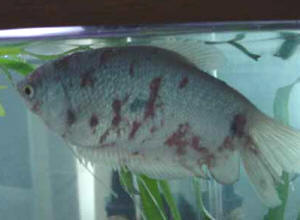 .jpg)
|
| Is there hope for my Gourami
8/15/07 Help! First I have a 30 gallon tank and all the reading
are where they are suppose to be. I have 3 angels and Gourami in
this tank. I don't know if this has anything to do with it but
7 weeks ago I gave my fish some frozen blood worms, within a week
my Gourami started to twist out of shape. <I... see this> I
went to a local mom and pop fish store and they weren't exactly
sure what was wrong and gave me some cure all capsules. <Were
there but such things> The Gourami started to straighten back
out during the treatment. About a week later he started twisting
again. I went to a different pet store where the people were a
little more knowledgeable about fish (or so I thought). When I told
him about the Gourami becoming disfigured he said that I should put
it out of its misery. I bought instead some antibiotic for the tank
thinking this might help. It did but as soon as treatment ended he
started to twist again. Help! I don't know what to do. He is
still eating and swimming but I feel so bad for it. He is getting
skinnier also and staying towards the top of the tank. None of the
other fish are having symptoms. Can he be saved? Do you know what
is wrong with him? <There are a few known "causes" of
such spinal curvature... all are incurable at present as far as
I'm aware... I would sacrifice (euthanize) this one animal
(please read here: http://www.wetwebmedia.com/euthanasiafaqs.htm )
and take care to wash your hands... as Mycobacteria may be involved
here. Bob Fenner> |
|
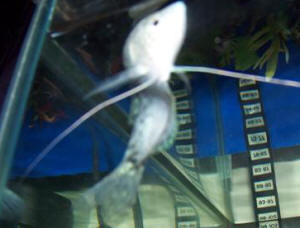
|
Golden Gouramis, hlth. 1/27/08 Hi there! We have a
new 72 gallon tank. Set it up, left it for a week, tested the water,
and all seems perfect (nitrates, ammonia etc come up as ideal on the
test strips) except it may be just a bit alkaline. Bought our first
fish 3 golden Gouramis, 5 rosy tetras and 3 long fin Serpae tetras.
<Serpae tetras -- Hyphessobrycon Serpae, plus related species in the
genus -- are notorious fin-nippers. You can probably already see their
raggedy fins. Anyway, they're not compatible with Gouramis. Unless
you want Gouramis with nibbled fins, Finrot and Fungus. Please please
please research fish before buying them. Lots of so-called
"community fish" aren't.> Also moved a rather large
(6") Pleco from a previous tank. All seemed well until yesterday,
when one of the Gouramis colours seemed to start fading and the bottom
edges of his bottom fins appear orangish. <Which "bottom
fins"? If the pelvic fins (the "feelers") those can
change colour according to sex. Certainly that's the case with
Trichogaster microlepis. Not sure about Trichogaster trichopterus
though. If the anal fin (the unpaired long fin between the
"feelers" and the tail fin) then I'd suspect Finrot. The
bacteria start by forming clots in the blood vessels, and these turn
pink. Eventually the surrounding tissue dies, and the fins rot away
from the trailing edge inwards. Treat at once, and remove the Serpae
tetras, since they're as likely as anything to start Finrot in
Gouramis. Finrot is normally caused either by physical damage (e.g.,
nipping) or poor water quality, so do also check the nitrite just to be
sure.> Today, he didn't eat, even though he was at the surface
of the tank, and then he went and hid at the bottom of the tank. The
other two Gouramis seem normal and are eating and I haven't seen
any sign of aggressive behaviour. I have no idea if these Gouramis are
male or female or how to tell the difference. <Male Trichogaster
trichopterus have much longer dorsal fins; the female's dorsal fin
is about half the size, if that.> One other thing, the faded Gourami
seems to be trailing a thin white poop. don't know if this means
anything. <Can mean a variety of things. It isn't normal, but it
isn't necessarily a disaster either. A more varied, high-fibre diet
is probably the thing you need to do here.> Also wanted to ask about
the Pleco. He has always been somewhat reclusive, but now that he is in
the big tank, he has retreated into a hollow tower (I can see his fins,
and they do move) and hasn't come out in about 3 days. Should I be
worried about him, or is this normal? <Put some cucumber or
courgette in the tank tonight. If it's been eaten by the morning,
then all is well. If it's still there, then you may have a
problem.> I am still feeding him with Spirulina tabs. Looking
forward to your reply, Cheryl <Hope this helps, Neale.>
|
Blue Gourami with black head
-- is he sick? -02/20/08 I have a blue Gourami that is
at least 3 or 4 years old -- he's (I call him a he but have
no idea if he is a he or she) <Males have long, pointed dorsal
fins.> in a 10 gallon tank along with 2 goldfish, 2 neon
tetras, and 1 sucker fish. Has been in the same tank with these
fish for about 2-1/2 to 3 years. No problems so far. <All this
in a 10 gallon tank? Madness. The sucker fish is either a
Pterygoplichthys catfish (average size 30-45 cm at maturity) or
Gyrinocheilus aymonieri (only slightly smaller but infamous for
its aggression). The Goldfish need a tank at least three times
this size all by themselves. Oh, and Neons are schooling fish,
and are only happy when kept in schools of six or more. While you
might not have had problems yet, that's rather akin to a guy
not killing himself at the first round of Russian Roulette and so
declaring the game "safe".> We were away on vacation
for the past 3 days and when we returned home last night, we
noticed his head has turned black or maybe a really dark blue. It
covers his entire head back to his first set of fins on either
side. He is swimming around just fine and he is eating just fine
-- not acting like there is a problem. The only thing that we did
differently when we were away was that we: 1) fed them all using
a 3-day tablet feed; <No need to feed fish for a 3-day
vacation; in fact it is safer not to.> and 2) turned the
heater on in the tank since we'd be away and the house would
be slightly colder so the tank temperature was about 2 degrees F
higher than normal. <How warm is this aquarium otherwise? How
do you keep tropical fish in an aquarium without a heater? Unless
your home is constantly at around 25C/77F day in, day out then
these fish are not at all being kept correctly. Seriously: are
you winding me up? Big fish in a tiny, unheated tank!! This
sounds like someone trying to wind me up... everything is wronger
than the wrongest thing that anyone has ever gotten wrong.>
All the other fish are fine and he seems fine, I just do not know
what this color is. Should I be concerned? <Very, very,
concerned, though not specifically for the Gourami. Without a
photo, can't say what's going on. Could be viral or even
nerve damage (which affects the chromatophores) but this fish
sometimes change colours thanks to genetic abnormalities.> If
so, what should I be doing? <Buying a bigger tank and leaving
the heater on all year around would be a start.> Thanks ahead
of time for your help, Pam <Cheers,
Neale.> Re: Blue Gourami with black head -- is he
sick? 2/21/08 Thanks for your comments -- I get the
suggestion about the size of the tank and about not feeding them
when only away for 3 days. Will do. <Very good.> I need to
explain about the heater being off/on. The tank is located near a
heated radiator (yes, I live in a home that is 80 plus years old
and is heated with radiators, not vents or baseboard heating) and
it is located near a window that has sunlight coming in most of
the daytime. So, the heater is not always on because the
temperature spikes so severely in the winter daytime when it is
sunny. I've tried different heater types so that I do not
have this problem and it's the same. Moving the tank is not
an option -- no other location for it. When we go away, however,
the heater is always on. This was the case this past weekend when
we were away. <OK. So long as the tank doesn't go above
30C at its hottest or below 20C at its coolest, you're fine.
But I would try placing aluminum foil (for example) behind the
tank to reflect away some of the sunlight. If pasted behind the
aquarium backdrop you won't see the foil. Placing a fan above
the tank in summer, to increase evaporation, will also help cool
things down. Regardless, putting tanks on windowsills above
radiators isn't considered best practise!> Back to the
Gourami-- here are a few shots that I took just now. I have
inserted them into this email and am attaching them as well. I
hope you can get an idea of what I mean by his head being black
or dark blue with these. They are the best I could get with a not
so great camera -- sorry if they are not so great. <Odd, but I
don't think dangerous.><<Is not... just neurological
impairment. RMF>> Any ideas on what this is? <No
idea.> Thanks for your help. Pam <The fish is a male, by
the way. Cheers, Neale.>
|
|
|
|
|