|
FAQs About Xenopus laevis, African Clawed Frogs,
Foods/Feeding/Nutrition
Related Articles: Keeping African Clawed Frogs and African
Dwarf Frogs by Neale Monks, Amphibians, Turtles,
Related FAQs: Xenopus in General,
Xenopus
Identification, Xenopus
Behavior, Xenopus
Compatibility, Xenopus
Selection, Xenopus Systems,
Xenopus Disease, Xenopus Reproduction, & Amphibians 1, Amphibians 2, Frogs Other Than African and Clawed,
African Dwarf Frogs, Turtles, Amphibian Identification, Amphibian Behavior, Amphibian Compatibility, Amphibian Selection, Amphibian Systems, Amphibian Feeding, Amphibian Disease, Amphibian Reproduction,
|
|
ACF Not Eating, Seeking Recommendations
1/4/17
Hello, I have a 15 year old African Clawed Frog that has lost its
appetite.
For about 3 weeks he showed a decreased appetite before simply refusing
to eat for the last, going on 4, weeks and has refused ReptoMin, several
types of worms, and pink salmon. For the last week, he's preferred to
nearly
exclusively float on top or lay on the suction cup platform we have that
lets him poke his nose out of the water. I've also seen him vomit more
than once in the last week. Additionally, he's developed a curious habit
of following us as we walk around the tank and swimming/diving away if
offered food. About a week ago, I noticed he we stress shedding and had
a tiny ammonia burn. After water changes and the use of API stress coat,
the burn's gone and his shedding is almost completely gone (there's a
minor bit on one of his toes) as of today.
When he first began to lose his appetite, ammonia levels were between
0.5 and 1.0 (for clarification, we use Seachem prime on our tap water
due to its natural 0.5 ammonia content, PH is 6.6 out of the tap). About
a week
ago, we had the ammonia spike to 2.0 and decided to move up the filter
maintenance schedule by 2 weeks and replace 1/2 of the foam sponges,
biological media, and carbon. In the meantime, we've conducted daily 30%
water changes to try to maintain consistent water conditions in case the
filter begins cycling.
The tank conditions for the past three days:
Date | Ammonia | Nitrites | Nitrates | PH
12/30 | 0.5<->1.0 | 0.25 | 0 | 6.0
12/31 | 0.5<->1.0 | 0.25<->0.5 | 0 | 6.0
01/01 | 0.5<->1.0 | 0.5 | 0 | 6.0
To me it looks like the filter's in the process of cycling. I'm
concerned about the PH, for months it was consistently at 6.5, which I
believe is on the lower end of the range for ACFs, and I'm not quite
sure what caused the decline.
Is there any way to induce the frog to feed? He's lost weight and seems
to be weaker than before. Both of the younger frogs are behaving
normally.
--A.
<15 years is a pretty good age for Xenopus, so you must be doing
everything right for the most part! But the issue here is surely water
quality and chemistry. Forcing animals to feed is rarely necessary -- if
they're 'happy', they'll eat. So let's review. Xenopus in the wild exist
in a variety of water chemistry conditions, but the farmed ones -- which
have been bred in captivity for decades now -- are much happier in
neutral to slightly alkaline conditions. Between pH 7 and 8 is about
right, with medium to high levels of hardness, recommended. Xenopus kept
in soft and/or acidic water do poorly, and older specimens may be more
sensitive than younger ones. So some attention to water chemistry will
be important here.
Given your water sounds soft if the pH is anything to go by, hardening
it slightly will be helpful. Per 10 gallons/40 litres, try adding 1
teaspoon baking soda and 1 tablespoon Epsom salt. This should provide
medium hardness water with a pH around 7.5; perfect for Xenopus! Do also
remember that biological filtration works more slowly below pH 7, and
below pH 6 may even stop altogether. Next up, the ammonia. Do make sure
you use water conditioner to neutralise ammonia in the tap water, but
also ensure the filter is up to the job. Really, there's no 'safe'
ammonia level -- anything above 0 is bad. While neutralised tap water
ammonia may still be detected, nitrite should certainly be zero (unless
of course there's nitrite in your tap water, but that's relatively
rare). Beef up the filter perhaps, replacing carbon (if used) with more
biological media. Hope this helps, Neale.>
African Claw Frog /RMF 8/16/17
Hi. I saved an African claw frog from impending doom and experimentation where I
work. I usually KILL living things like plants. My son is doing fine and growing
up tall and well. SO I did that right...anyways, I'm going
away for the week Sat. to Sat. and I wanted some advise.
The tank is a ten gallon. No filter mainly because I rather clean it then have
him bothered by vibration of it plus I couldn't afford one when I rescued
him..... anyways, couple weeks back, it lasted almost 1.5 weeks before getting
cloudy or dirty... I was surprised. Last week it was quicker. Anyways, he is
eating well it seems. I thought maybe hungry too much. He hasn't died though...
Can I leave him for the week foodless or will that be too stressful?
The other options are even more stressful, which is live in a small bucket at
work all day till like the day I rescued him from here then travel more and
further with my coworker to her house then when I get back repeat...
What is your best advice? I don't want to come home to the house smelling
terrible either....but if the food isn't in there making it smell it would be
ok.
can he survive or is it too cruel to make him wait a week foodless?
Also, I read that people have a fasting day for their ACF????? I did not know
this before hand. When is that? I feed him AM and PM daily.
<Given the above information; and having kept Xenopus for years... I
would go with your choice of not feeding for the week (actually eight days),
rather than the more stressful alternative you list. The eighth day is
to
allow you to clean the tank from the previous day/s feeding/s, leaving the water
clean/er. I encourage you to study up a bit re X. laevis husbandry and
save for a small internal power filter going forward. Bob Fenner>
African Claw Frog /Neale 8/16/17
Hi. I saved an African claw frog from impending doom and experimentation where I
work. I usually KILL living things like plants. My son is doing fine and growing
up tall and well. SO I did that right...anyways, I'm going
away for the week Sat. to Sat. and I wanted some advise.
<Meantime, let me direct you to some reading, here:
http://www.wetwebmedia.com/FWSubWebIndex/FrogsArtNeale.htm
Xenopus are easy to keep, but there are a few non-negotiables. Filtration,
regular water changes, and taking care to not overfeed all spring to mind.
Ambient room temperature is usually fine, so heaters may well be optional.
Substrate, decor, etc. can all be as your taste/budget dictates.>
The tank is a ten gallon. No filter mainly because I rather clean it then have
him bothered by vibration of it plus I couldn't afford one when I rescued
him..... anyways, couple weeks back, it lasted almost 1.5 weeks before getting
cloudy or dirty... I was surprised. Last week it was quicker.
<Needs a filter; even a simple internal canister filter, less
than $20, will do the trick, and don't vibrate like air pumps do. Of course
air-powered sponge filters are cheap and work well, so they are an option if you
can tolerate the noise. Without a filter, the water will go cloudy (polluted)
increasingly quickly as the frog grows, not least of all because these frogs go
through periodic "moults" when they shed skin.>
Anyways, he is eating well it seems. I thought maybe hungry too much. He hasn't
died though...
<Good sign!>
Can I leave him for the week foodless or will that be too stressful?
<Two, three weeks without food are fine! Provided, of course, he was
adequately fed beforehand and not skinny. Cold-blooded animals can go a LONG
TIME without food, far longer than us warm-bloods.>
The other options are even more stressful, which is live in a small bucket at
work all day till like the day I rescued him from here then travel more and
further with my coworker to her house then when I get back repeat...
<I would not keep any animal like this.>
What is your best advice? I don't want to come home to the house smelling
terrible either....but if the food isn't in there making it smell it would be
ok.
<Filtration is the best antidote to smelly fish/frog tanks, plus water changes
as often as practical, ideally 25% or so weekly, but a 2-3 week gap between
water changes is fine if you're on vacation and the frog isn't being fed.>
can he survive or is it too cruel to make him wait a week foodless?
<Yes; animals like frogs are adapted to do so.>
Also, I read that people have a fasting day for their ACF????? I did not know
this before hand. When is that? I feed him AM and PM daily.
<Fasting animals is standard practise in many places and situations. Few
reptiles or amphibians will eat every single day, and some big cold blooded
reptiles, such as pythons and crocs, may even eat just once or twice a month!
Fish are much the same. So such pets are FAR easier to maintain if you go on
vacation than, say, a dog or cat. No need for someone to feed them! Ideally,
have some come in to check the filter is running if needs be, but otherwise
don't fret. Cheers, Neale.>
Re: African Claw Frog /RMF 8/16/17
Thank you so much! What is the husbandry you speak of?
<General care... See WWM, the Net, books Re>
I will consider the filter too. Maybe I can afford one before my trip even. What
is the quietest one to use?
<As mentioned, a "small internal power filter"; these span the range of a few to
several tens of dollars. Use the string of words here in your search tool.>
Also, I won't be there to turn on and off the florescent lamp. Typically I have
it on till I get home than turn it off. I read 12 hours of light and 12 of
dark.... he'll be ok without the light then?
<Yes; Xenopus are fine in subdued (natural light). Bob Fenner>
Re: African Claw Frog 8/16/17
Someone from the UK replied that he can't go unfed for the week...... you
disagree correct?
<Yes; both Neale and I are confident that if this animal is in good "index of
fitness" (i.e., not skinny), going a week sans feeding will be fine>
Also, I got a filter. Hoping that helps.
Thank you for your advice!!!
<Cheers, B>
Re: African Claw Frog /Neale 8/18/17
Thank you! I have a heater and it maintains his water temp as it says it should
be. I will get a filter before I go away.
<Wise.>
Thank you so much!
<Most welcome.>
He has a mug and rocks and at this time fake plants in his tank. The sunlight
was too bright, I blocked the direct light with a pillow case for now. I don't
have another location to put the tank yet.
<Xenopus actually like to bask in bright light sometimes. So provided the tank
doesn't overheat, and the humidity of the air above the tank is sufficient
(e.g., the tank has a lid) the frogs don't mind light too
much.>
Again, thank you!
<Cheers! Neale.>
Re: African Claw Frog 8/18/17
I feel really terrible not being there at my usual times to feed him.... My son
doesn't believe he won't die while we are away..... Anything you can just say to
me to help me feel better about this?
<Frogs aren't humans. They're not even mammals. Unlike us, they don't expend
huge amounts of energy keeping warm. Frogs therefore need only a much smaller
amount of food, and being relatively inactive animals as well,
it's not as if they're burning many calories moving about. Assuming the frog is
well fed, its fat reserves will be adequate for many weeks, let alone a few
days. Indeed, hibernating frogs may well go 3-4 months without eating, perhaps
longer. It's very important when keeping animals to not think of them as "little
people" but for what they are. There are things frogs need, like filtration and
heat, and things they are completely indifferent to, such as being given a nice
name or told they're loved! By all means treat animals well, and with affection
if you want, but focusing
on their specific needs first. A week without food would be abuse to a human, or
a warm blooded pet like a cat or rabbit, but completely harmless to a cold
blooded pet like a snake or frog. Cheers, Neale.>
Re: African Claw Frog 8/18/17
I FEEL SO MUCH BETTER....thank you!
<Welcome.>
So he doesn't hear me when I tell him I love him? lol. I'm just kidding.....
<I think of it like this. True love for animals is about making an effort to
ensure their wellbeing. Providing what might be called their 'creature
comforts'. If you love a dog, you take it for long walks, ensure it eats healthy
meals, provide toys to keep its teeth clean, that kind of stuff. Giving it a
Facebook page, or cutsie hair cuts, or expensive collars might be a way a person
thinks they're expressing love -- but if the dog isn't getting walks, the right
food, etc., that's really an empty kind of love. Make sense?>
Thank you thank you thank you again...are you in the US?
<Nope, in England, and right now spending time in the picture-postcard beauty of
Nether Stowey in the Quantock Hills. Look 'em up! Cheers, Neale.>
Re: African Claw Frog
8/19/17
WOW it IS beautiful there. What time is it your time? It's 2:37pm here.
Which you may already know.
<UK is, what, 5 hours ahead of Eastern?>
Yes everything you said makes sense. I think it is best to get the information
from one source when possible on this type of thing. I rescued him from
impending doom. They are really amazing.
<Xenopus are neat animals indeed. Did you know the reason they're kept at all is
because they were used as pregnancy test kits? When exposed to the urine of
women who are pregnant, tiny amounts of the hormone HCG in the urine caused them
to lay eggs!>
I have to ask, how is the ACF eyesight???
<Mostly there to help them avoid predators, hence the eyes on the top of their
head. Amphibians have sensitive eyes (e.g., detect movement well) but poor
resolution (i.e., don't really see sharp images) so in general are
early-warning sensors rather than used to find food or probably mates.
Smell, touch and hearing are the key senses, as they are for most aquatic
animals.>
I feel like he can see me but at the same time, I sometimes feel like he's only
smelling out his food, which I had read about the sense of smell...
<Quite so.>
If I'm emailing too much or asking too many questions let me know.
<Nope, most welcome.>
Do you have castles there?
<In Nether Stowey? Sure, there's the ruins of one! England's littered with
castles, in all honesty. Cheers, Neale.>
Re: African Claw Frog
8/19/17
Actually what I had read was that the ACF was genetically modified at some time
by (idk whom) that their eyes would glow when pregnant.
<Nope. Xenopus were used at least as far back as the 1930s. No GMOs then!
It's simply the fact they were easily maintained in aquaria, and sensitive to
HCG, that made them special. Lots of animals tick one or other of those boxes,
but Xenopus ticked both. They are still extremely common organisms
for use in labs because they are so easy to keep.>
More questions for you too- What is the best way to go about catching him when I
change his tank full change.... I think I've traumatized him a couple times
trying to get him into his holding bucket. I don't want to do that but he's a
slippery sucker and fast too!
<As with active fish: use two nets, or a net plus a plastic container. Use the
net to drive the frog into the other net/plastic container. Then remove. While
the frog is aquatic, it is fine lifted out of the water for a few seconds, so
there's no risk carrying him out of his tank and into a bucket filled with
aquarium water.>
I would love to go to a country with castles....
<It'd be lovelier without quite so much rain...>
I am going away for a week but I'm not done asking questions so thank you for
dealing with me...
:)
<Glad to help, and have fun on your holiday! Cheers, Neale.>
Re: African Claw Frog
8/29/17
SO, I'm back and HE LIVES!!!!!!!!! He was skinnier, naturally I suppose, but
he is good!!!!
<Excellent news!>
Thank you so much for all your help!!!
<Most welcome. Cheers, Neale.>
|
X. Laevis Refusing Food / Reclusive 5/4/14
Hello, I just wanted to say I love your site and read it often and find
it most valuable resource. I have a two
year old female Xenopus which is housed in a
planted 40 gallon breeder (Eheim 2217 for filtration) with two
other females and she does not seem to be acting normal as of
late. She hasn't acted normally for the past
two weeks.
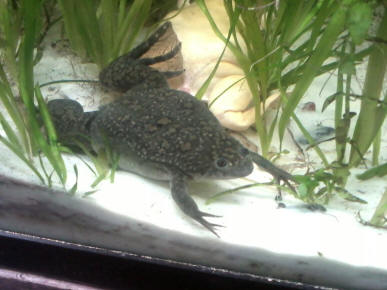
<Looks to be a fine specimen... and likely full of eggs!>
My other two frogs are very active and always hungry, however, my third
frog just not seem interested in food any longer. Also, she
appears to hide a lot and never seems to move
around as much as the other two, just seems
content to hide in the tank's vegetation in the rear of the tank. When I
do see her move, she seems to move about
normal, she has good reflexes still (like if I
turn a light on coming in to the room she bolts like the others
do). She does not appear unhealthy but feel something is going
wrong here as this is not their usual
behaviour. There is no excessive shedding and
she looks to be of a good weight still.
Their diet consists of two nightcrawlers each per week and the
occasional ReptoMin pellets (no better pellet
sold in my area sadly). As a treat I feed them
a few adult crickets about once a month (she completely ignored
them last time I fed these, the other two frogs went crazy for
them). I do 30% water changes per week, I use
SeaChem Prime as water conditioner, I leave my
water to stand for one week prior to using it (though this may be
useless with chloramines I've read). The temperature of the tank
is typically 20C-22C (I keep my home around
21C). I recently tested my water and I found
zero ammonia, nitrite and nitrate was around 10ppm which seems
normal as well.
<Outstanding maintenance/care>
Is it normal for these frogs to stop eating like this?
<Yes; not to worry>
I fed her an earthworm about 3 days ago and
she took it, but didn't seem to have the usual
enthusiasm about it as she usually does. I tried to feed her today
and she is just ignoring food again. I've included a picture but
as I stated previously, she appears pretty
normal at this point.
Any insight would be appreciated. I am hoping this is not the beginning
of something more serious.
Thank you,
Michael
<I would not be concerned unless this specimen was losing weight
precipitously. Do you have interest in breeding, rearing young? Bob
Fenner>
|
 |
Re: X. Laevis Refusing Food / Reclusive 5/4/14
Thank you for your response! I will adopt a wait and see attitude, perhaps
she is in "breeding mode"?
<Yes; likely>
Now that you mention it, I do also have a male
frog but he is housed separately. I've had him for about 8 months, he is
about one third the size of my females though and I have been waiting
for him to grow a bit more before introduction to
the other frogs.
<Xenopus are sexually dimorphic; males much smaller...>
He is constantly singing so imagine he would love
to meet the females, then again
I'd hate to see my female frogs devour him. I am hoping he grows a bit more.
<Yikes!>
I've considered breeding and rearing these frogs as I do enjoy them. I do
fear that I would be overrun with them though as they breed rapidly!
<This is so. Cheers, BobF> Re: X. Laevis Refusing Food / Reclusive
5/27/14
Hello Bob, just wanted to provide a small update on my female X. Laevis.
<Ah; thank you>
Unfortunately not much has changed in regards to her appetite, the frog
will only seldom eat and if she does, it is not much (usually half an
earthworm).
<Not to worry; again; these frogs do go for breaks on feeding>
I do not believe she has eaten for close to a week now, but thankfully
she still maintains her weight and has not become lethargic nor appears
sickly.
<All that's important>
One thing I did notice a while back was she appears to have difficulty
eating at times on the few occasions she will take food, she was unable
to swallow an entire nightcrawler and I wound up having to remove
it from the tank after she had given up on it. She seems able to eat
them when cut in half with some effort, when she will eat at all, seems
very unusual to me, this frog has suffered no physical damage. The only
real "trauma" this frog has experienced is I have moved recently to a
new house. I do remember this frog taking much longer to catch and
contain when I drained the tank than the others but no harm came to her.
I used my hands and scooped her in to a Tupperware container same as the
other frogs whom have
experienced no ill effects of the move.
Any insight or suggestions would be helpful.
<... what is the water temperature? Are the other livestock acting
normally?>
At this point I simply just try to feed her every couple of days hoping
she will eat. I tried to feed
her a small nightcrawler today and she had no interest.. the other frogs
are eating with the typical enthusiasm expected from this species.
<Oh... don't panic>
On a lighter note I have introduced my male frog to my females and it
has been successful thus far. He began to call out to the females and
performing amplexus literally within minutes of being moved to his new
home.
<A go-getter! Bob Fenner>
Re: X. Laevis Refusing Food / Reclusive
5/28/14
All livestock are acting 100% normally, all eat when presented food, save
for the one frog I've mentioned. The other frogs will "beg" for food (hand
waving gestures), will actively follow your fingers above the water surface
in hope of a meal, normal behavior.
Now my troubled frog has been reclusive for many months.. Prefers the rear
of the tank and is only noticeably active at night, my other frogs are
mostly diurnal which is typical in captive Xenopus, they are nocturnal in
the wild I believe?
<Mostly; yes>
The current temperature in my home is 68F and the tank is typically a few
degrees higher, right now the thermometer is dead on 70F.
<Fine. B>
|
African Clawed Frog Questions; fdg., sys., comp.
8/10/12
Hey WWM. Thanks for all the great info! I am usually on here looking for
information on my reef tank, but now I have some questions about my
African Clawed Frog. I got him about 2 years ago from a grow-a-frog kit
and he has always been quite amusing to me. After doing some research
recently, I think I may be doing some things wrong. I keep him alone in
a 5 gallon tank (his female partner jumped to her death from a tiny
hole, which has now been covered) with just some plastic tank
decorations and a basic foam filter. I would like to add a fine sand bed
and perhaps some more life to the tank. Firstly though, I think I may
need to change his feeding. Currently, he is only fed the grow-a-frog
pellets, a little bit twice a day. From what I have read, he needs more
diversity than this. I would love to get away without feeding him frozen
food (if possible) and was wondering if I could get away with feeding
him a variety of quality flakes and pellets (wondering if you could
suggest any)?
<In my experience these Hymenochirus aren't keen on flake, though they
may eat some now and again. Frog-specific pellets are readily accepted,
so by all means stick with those as a staple. You can also provide tiny
pieces of raw seafood and white fish fillet; slivers of raw shrimp for
example is thoroughly enjoyed, and makes a nice treat now and again.
There's no real need to provide anything on top of good quality pellets
except to avoid problems with constipation. To that end, live, frozen or
freeze-dried daphnia and brine shrimps are the two things to use.>
I am also looking to add some more life to this tank. It is my
understanding that fish are a no-no?
<Well, additional Dwarf African Frogs and Red Cherry Shrimps are the two
obvious additions for a tank this size. Red Cherry Shrimps are cheap,
pretty, active by day, and breed readily. They make excellent scavengers
and algae-eaters, and to some degree turn flake food into baby shrimps,
which the frogs will eat.>
If not could you recommend some plants or inverts or something else that
would go well with my frog? Also, my frog produces a lot of waste that
generally ends up as a kind of detritus of frog waste and uneaten food
at the bottom of the bare-bottom tank.
<Reduce feeding; increase filtration; clean the tank more often. These
are really very clean animals.>
I just siphon it out, but if I added a sand-bed how would I clean this?
<The thing with sand is that faeces don't sink into it. That means the
sand stays cleaner, and if you have good filtration, the faeces get
sucked into the filter which you can clean more easily (hopefully). But
if your filter "sucks" in a bad way, i.e., it doesn't suck the water
hard enough, the faeces just sit there. This is why some people think
sand is "dirtier" than gravel; it isn't, but it is less forgiving. A
turkey baster is a great tool for quickly pipetting out detritus such as
faeces without the whole chore of getting buckets and siphons out.>
Is there some kind of snail or other invert that would help clean this
up?
<No. By definition, adding any other animals will make your aquarium
dirtier. The whole idea of "cleaner fish" is a myth, perpetuated largely
by the retailers who are selling these supposed "cleaning" fish and
other animals. Hmm… keeping the aquarium clean is YOUR job, and if your
aquarium is dirty, it's either overstocked, overfed, or under-filtered;
quite likely a combination. Foam filters are only as good as the air
pump powering them, and if you have a poky (i.e., small, cheap) air
pump, the filter likely sucks up very little debris. Upgrade the air
pump if you can, preferably getting a reasonably large model with an
adjustable output (the Eheim ones feature these) so you can fine-tune
the air flow up or down as needed.>
Well, that's all the questions I can think of for now. I may think of
more later! Thanks for the help!
<Cheers, Neale.>
Re: re: African Clawed Frog Questions (Bob, you may need to
edit my previous reply!)<You're fine here>
8/10/12
Thanks for the quick reply! So basically I have a few questions that
were brought up by the answers to my previous questions! First of all,
when you were talking about adding something to avoid constipation you
mentioned brine shrimp.
<Yes.>
I have some frozen Spirulina enriched brine that I feed my fish
sometimes.
Could I use this with my African Clawed Frog?
<Yes.>
Secondly, for the tank mates, I did not know that I could mix
African Dwarf Frogs with my African Clawed Frog.
<Sorry, no, absolutely not. Misread your question. You're talking about
Xenopus; I was talking about Hymenochirus. I tend to use the Latin names
to avoid problems such as these -- their common names are so similar!>
Did I understand you right when I heard this? Also, the Red Cherry
Shrimp look really cool, but would my frog make quick meals of them?
<Xenopus, yes, will eat small shrimps.>
I was told they will eat practically anything they can fit in their
mouth!
What would be a good amount of shrimp for this tank? Finally, are there
any plants you could recommend for this tank? Thanks.
<Ah now, if you have Xenopus in 5 gallons, no wonder the tank is dirty!
These frogs need much more space than this, and a really beefy filter
too, I'd recommend a medium-sized internal canister filter of some sort,
something like a Fluval U3 for a 20-30 gallon aquarium. It's not that
Xenopus can't be kept in 5-10 gallon tanks -- they clearly are in
laboratory condition where the water is changed very frequently -- but
in an aquarium we expect clearer, cleaner water and for our frogs to
live much longer. As for tankmates, Xenopus need cooler water than most
tropical fish, and being so predatory, they're not good tankmates for
most invertebrates. Your best bets would be Apple Snails as they do well
in slightly cool (~22 C/72 F) water. Xenopus tend to uproot plants, but
epiphytes work well (i.e., Java fern and Anubias) while they absolutely
adore floating plants such as Indian Fern where they will rest and bask
under the lights. Plus, floating plants minimise jumping, which has to
be good! Cheers, Neale.>
Re: Re: re: African Clawed Frog Questions (Bob, you may need to edit my
previous reply!) 8/10/12
Ok, so I will start adding some Spirulina-enriched brine to its diet. I
just wasn't sure because of the Spirulina. Does once or twice a week
sound good? Also, how much should I be feeding this guy? The grow-a-frog
recommend twice a day. Does this sound right?
<Yes.>
Also contributing to a hard-to-keep-clean tank: I don't know if all
African Clawed Frogs are like this, but mine is...not very intelligent…
<"Dumb as stumps" is about right. Or rather, they have very poor vision,
and hunt by smell. My Hymenochirus seem to take mouthfuls of sand more
often than food.>
When I feed him if the pellet is not directly over his head, he will not
see it and won't eat it. It generally takes a couple times before I
finally get a pellet to land directly over his head, and he never eats
food off the bottom of the tank. I think this is definitely hurting the
water quality.
<Hmm… overfeeding? If he doesn't eat the food in front of him, don't add
more until that portion is gone. If it's still there 5, 10 minutes later
-- remove it!>
Plus, my frog is only getting 1-2 pellets each time I feed. Does this
sound normal?
<Yes. They don't need daily feeding.>
I think I remember reading something about them having terrible
eye-sight?
<Yes.>
So basically my only tank inhabitant option are apple snails? Ok, better
than nothing!
<Quite so.>
You think they will be safe from the frog?
<Should be.>
How many would you recommend for my 5 gallon tank?
<None; this aquarium is too small. Xenopus may tolerate poor water
quality, but the Apple Snail won't… will die, rot.>
Would I need to supplement feed them or would they eat the left-over
food, etc? There is little to no algae in my tank, but plenty of
detritus! I will also definitely look into the plants you recommended.
I'm inexperienced in the field of freshwater plants but I have a reef
tank so...how hard can it be?
<Not very.>
I don't think my light is very good...It is a Marineland fixture with 16
LEDs but I think each LED is like .1 or .2 watts. Is that enough to
support any of the recommended plants?
<Possibly not, but Anubias definitely worth a shot.>
Are the floating plants ok if I have an acrylic top on the tank?
<Depends on the plants, but Indian Fern should be. Plants that need cool
air above the water will be less good.>
I will also look into a canister filter. You think that would be better
than the Tetra Whisper HOB filter I currently have?
<Hmm… doesn't much matter, but the point being that if you get, say, a
15-20 gallon tank for one Xenopus, get a "generous" filter for that
tank, one rated at above that, 20-30 gallons say. Xenopus are
proportionally more messy than fish -- not only do they make solid waste
and urea, but also shed skin all the time.>
If I end up keeping all the equipment I currently have and not
upgrading, what does my maintenance (I.e. water changing regimen) look
like? Since I have a marine reef tank, I am definitely used to and ok
with some maintenance. Am I looking at weekly water changes?
<Yes.>
That's what I do with my fish tank so that would be fine. Also, I have
no idea why it would affect any of the answers you have given me so far,
but my frog is male, so he is smallerish... Thanks for all the help! I'm
really just looking for the most affective ways to turn a tank with a
frog and a plastic castle into some kind of ecosystem with other life,
plants, etc. and ways to better the health of this amusing creature!
<Do read:
http://www.wetwebmedia.com/fwsubwebindex/FrogsArtNeale.htm
Cheers, Neale.>
Re: Re: Re: re: African Clawed Frog Questions (Bob, you may need to edit
my previous reply!) 8/11/12
Thank you so much for the information I have gotten so far! Basically
what I have decided is that a tank upgrade is in store. Unfortunately
right now I really don't have the room or funds for a very large tank.
However, I have found one that would be an upgrade to the one I have
now. It is a 7-gallon bookshelf tank so it is more space, but the best
part is the dimensions. I know the African frogs like shallow tanks and
this one is perfect! It is 24" long and only 9" tall.
<Still quite small. You already know these frogs are dirty, and can see
why the size of the tank is important.>
It also comes with a very powerful filter. I am very excited. I am going
to add a 2" sand bed and was wondering if there is anything in
particular that I need to look for in a bag of sand that will be
suitable for my African Clawed Frog?
<I would not add 2 inches of sand; add just enough to cover the glass.
This will be much easier to clean (important!) and will ensure maximum
water volume. Assuming your tank is about 24 x 9 x 9 inches (which is
1944 cubic inches or 7 gallons) then even a 2-inch sand bed will be 24 x
9 x 2 will be 432 cubic inches or just under 2 gallons. Out of a
7-gallon tank, that's a fair amount of wastage, I think you'll agree.>
I will be adding some driftwood, decorations, and live plants.
<If you get driftwood and attach the Anubias to that (Anubias is an
epiphyte and hates being in pots or the substrate) you should be all
set.>
Lastly, I was wondering if this upgrade would now warrant the addition
of another ACF and/or an apple snail?
<Another 5-6 gallons, at least, for the frog, and about as much for the
snail. Seriously, these frogs need around 20 gallons to be kept in twos
or threes.>
If another ACF is ok does the gender and/or size and/or color matter?
Also, would it be okay to keep an ACF from my fish store with this ACF
even though he was part of a kit and I think may be slightly different
(as a tadpole his skin was transparent; are all ACFs like that?)?
<Xenopus laevis is the common species in the trade; it is available in
some variations, including an albino form.>
I was hoping to perhaps get an albino or some other color. What are your
thoughts? Regardless, I think this will be a cool tank!
<Do read where you were sent last time around, and digest that before
spending your money. If money is limited, then spend it on a bigger
aquarium not a second frog, and if space is limited, find a tall tank
with a smaller footprint that would offer extra volume of water. Cheers,
Neale.>
Re: Re: Re: African Clawed Frog Questions (Bob, you may need to edit my
previous reply!) 8/11/12
I have been to the article you directed me to and that definitely helped
a lot. Two ACFs in a 7-gallon is just not going to work. Scratch that.
Also, the sandbed thing makes a lot of sense. My question is, with a
small sandbed will this limit the types of plants I can put in my tank?
<Well, you can't add plants that have roots, but you wouldn't be growing
those in a small tank with Xenopus anyway! Stick with epiphytes
(Anubias, Java fern) and floating plants (Indian fern strongly
recommended) and you'll have a nice range of greenery that should do
well with the frogs.>
Also, I found a place online that sells large pieces of driftwood (15")
with Anubias already attached to it (perfect!).
<Good.>
The driftwood is long enough that I can add other plants in the future.
<Anubias grows steadily. I've got lumps of the stuff sitting in the
garden at the moment because I don't have anywhere else to put it!>
I want to try to add as many plants as possible to help with the water
quality.
<Don't rely on this. Think about this scientifically. Plants remove
ammonia and nitrate at a rate proportional to the rate at which they
grow. So, if you have weak lighting (less than, say, 2 watts per gallon)
plant growth will be very slow, and that in turn means they remove
ammonia and nitrate very slowly. Not nearly fast enough to make much
difference. About the best that can be said is that plants will bring in
helpful bacteria and provide additional surfaces for bacteria to grow,
but under weak lighting that's about it.>
I will definitely do floating plants as well. This is probably a dumb
question, but with the floating plants I assume you just drop them in
the aquarium and leave them there?
<Depends on the species. Mostly yes, this is what you do. But some
varieties grow above the waterline and are notoriously sensitive to the
hot, dry air inside the hood (Salvinia is the classic example, but also
things like Pistia). These usually die after a few months, or at least,
they never look nice because their leaves are either burned or rotting.
Indian Fern grows above and below the waterline, and so long as you trim
away the above-the-waterline stuff, it can be easily grown indefinitely
as a below-the-waterline floater. Amazon Frogbit is just as good, and
also recommended. For these two excellent plants, yes, add them to the
tank, and crop back every few weeks. Both can cover the aquarium in a
few weeks under even modest lighting. Aim for about 50% open water, 50%
floating plants, but feel free to crop back ruthlessly.>
I guess the real question for me is should I pay a lot more for a 10
gallon kit or will I be able to keep the 7 gallon adequately clean for
one ACF?
<For a few dollars, I don't see any benefit to going with 7 gallons.
Volume trumps everything else in keeping aquatic frogs, and money spent
on the biggest tank you can afford is money well spent. A smaller tank
is limiting and can't be upgraded or easily fixed if you find it still
has problems.
Why go from 5 gallons to 7 gallons when you can straightaway double the
volume with a 10 gallon tank! I don't know what prices are in your area,
but a quick online search revealed Wal-Mart 10-gallon tanks go for about
$12, which seems a steal.>
The funny thing is that the kit I bought this guy from actually expects
the adult ACF to live in like a 1/2 gallon cube its entire life! Had I
known more about these guys I would have just bought a big tank and a
couple ACFs at my fish store!
<Unfortunately both Xenopus and even more so Hymenochirus spp suffer
from being seen as "novelty" pets and are sold by retailers who have
absolutely no business selling livestock at all. It's a shame really
because both types of frog are very undemanding. But you do need some
understanding of their non-negotiable needs from which to work from.
There's a nice, readable book by Andrew Gray called "Keeping Amphibians"
available through Amazon for precisely 1 cent plus postage. It's not a
"deep science" book but it does cover all the basics and has quite a few
pages about Xenopus.
If you haven't got this book, let me recommend it as money well spent.
Besides Xenopus, it covers other fun species like Pac Man Frogs and
Axolotls that may appeal once you've mastered Xenopus. Cheers, Neale.>
Re: Re: re: African Clawed Frog Questions (Bob, you may need to edit my
previous reply!) 8/11/12
So I am thinking that getting all the parts separate might be less
expensive than getting a kit for my tank upgrade.
<Often can be. The downside is you don't necessarily get the best
selection of hardware for your money, and the brand may not be
particularly good (not so reliable, or tied to proprietary filter
modules for example). In my experience the cheap filters that come with
kits only last 2-4 years, which is far less than a value brand like
Eheim that may cost twice as much but will last 20 years if properly
maintained. Fluval is a good middle market brand that's a bit cheaper
than Eheim and adequately reliable. Same for Sera, Tetra and one or two
others. But once you hit the cheap Chinese "no name" stuff, reliability
plummets. So do bear in mind the balance between a rock-bottom prices
and long-term value. the budget aquarium from Wal-Mart will probably be
fine (at least here in the UK, you can't sell an aquarium without it
meeting some basic standard of safety in terms of holding water without
exploding) and repairing leaky glass tanks isn't that big of a deal. But
I'd be a little more careful with heaters and filters because you don't
want those to die on your -- they usually go bad when you're not
looking, or at a time when replacing them isn't convenient. "A poor man
can only afford the very best" is a piece of wisdom that often applies
here -- don't get the cheapest, but get something you can trust to last
for the next 10 years or longer.>
I am thinking of something like the Wal-Mart 10 gallon. I had a quick
question about filtration: Is there anything I should or shouldn't have
for filtration for ACFs?
<Some mechanical filtration to trap solid waste (faeces, shed skin) but
mostly biological filtration (sponges, ceramic noodles).>
Trying to decide on an HOB filter and I'm seeing cartridges, filter
floss, bio wheels, bioballs, ceramic rings, carbon, etc. Is there
something that would really be good/bad for an ACF tank? Specifically I
am concerned about chemical filtration.
<Don't be; you don't need either charcoal (carbon) or Zeolite. Both of
these are expensive to use (they need replacing every 2-4 weeks to work
as advertised) and serve little purpose in your sort of situation.>
What do you think? Thanks!
<Cheers, Neale.>
Albino African Clawed Frog, fdg.
mostly 1/16/12
I have a 20 gallon tank that houses 2 African Albino clawed frogs. I do
not have a heater but the water temperature does not seem to be an
issue as one is thriving and I have another tank right beside this one
that houses another frog.
<Could well be so. Room temperature, 18 C/64 F, is fine for Xenopus
laevis.
Xenopus tropicalis, on the other hand, does need tropical
conditions.
Review and act accordingly.>
One of the aforementioned albino frogs is growing at a regular speed
while the other one is not. I thought there might be an issues of one
hogging all the food ( I feed them frozen blood worms). To prevent this
I moved the smaller frog to another tank by himself so there would be
no issue of getting enough food. This did not seem to fix anything
though, he is still small and not eating but he is quite active and
otherwise acting quite normal.
<Sounds fine.>
Putting the food right in front of his face does nothing to encourage
him to eat, do you have any other tips I could try to get him to
eat?
<Variety? Alternatives? Try earthworms, small pieces of fish fillet
or prawn.>
Could this be cause by the early stages of an illness?
<If he's otherwise happy and active, and eats something, if not
loads, don't worry too much. Act proactively of course, checking
water quality and water chemistry.
http://www.wetwebmedia.com/fwsubwebindex/FrogsArtNeale.htm
As with any animal, there's variety between specimens in terms of
growth rate, behaviour, etc.>
Thank you in advance.
<Cheers, Neale.>
|
Skinny Xenopus 9/21/11
Hello,
<Hello,>
I have 4 ACF's (2 male and 2 female) that are all 4 - 4 1/2
years old, housed in a 30 gallon tank. (I realize this may be a
bit small for them, that they should be in at least 40
gallons).
<Indeed, but shouldn't be an immediate cause of
problems.>
They have been housed the same for at least 3 1/2 years, with 2
filtration systems and a water heater that is set to
75Ã'º.
<Sounds good, but do let them cool down in the winter a bit.
72 F/22 C is about right for the winter months. This replicates
the subtropical seasons a bit better, and ensures overall better
health. But again, unlikely to be a serious cause of
problems.>
They are fed both ReptoMin pellets and freeze-dried blood worms
about 2 - 3 times a week (read other places that we are not
supposed to feed every day/every other day?).
<I'm not too stringent on this aspect. Yes, daily feeding
is unnecessary, but at the same time, daily feeding won't
cause problems if the water quality is good. The main thing is
you have clean water (0 nitrite and 0 ammonia) and frogs that are
neither skinny nor fat, but gently rounded about the
abdomen.>
We recently started feeding, as a treat, frozen cubes of shrimp.
(Not sure what brand...bought at Petco. Tiny shrimp frozen into
cubes). We have also fed earthworms as a treat once every few
months or so. Their tank is also bedded with small gravel rocks
(the colored type). I know from reading about these frogs that
these types of rocks are not recommended, but we had never had
any problems with them before, so we never removed them.
<Again, rocks are unlikely to cause problems if they're
smooth. Jagged rocks are a serious risk, as is sharp gravel.
Rounded gravel might annoy the frogs because they can't dig,
but shouldn't cause problems. Occasionally frogs swallow
gravel, and that is serious, but it's a rare problem. Smooth
silica sand is the ideal.>
We also treat the water with Amquel Plus.
<Good.>
A few weeks ago, we noticed that one of our males was getting
unusually skinny. He had lost all of the black coloring on his
arms/fingers, and looked to be very emaciated. His veins also
appeared to be a much brighter red and more visible than the
veins on the other 3. We observed all 4 ACF's when we fed
them, and this particular frog seemed to be so lethargic that he
either refused to or could not swim to the top to feed.
<This sounds like a bacterial infection. "Red Leg"
is particularly common. See here for ideas on treatment:
http://www.xenopus.com/disease.htm
>
We tried doing a water change and tried to feed more of the
frozen shrimp cubes (once thawed, they would sink to the bottom)
in order to give him a fair chance to eat. It seemed like he was
hungry and searching for the food, but most of the time he
appeared to be lost. He would just keep swimming side to side,
but never up. (He would go up for air every once in a while, but
would never stay to eat). We decided to remove him from the
larger tank and quarantine him. The others are eating just fine
and do not appear to be acting strangely. They also appear normal
physically, except for our biggest female (please see last
picture attached - skin discoloration: might be hard to see. Her
skin has always been somewhat yellow compared to the others.
Picture is trying to show lighter/whiter spots on her skin. Look
between eyes and on her back, closer to the left arm.)
Thinking our quarantined frog had some sort of bacterial
infection, we began treating the water with Pimafix (made by API,
described as an Antifungal Fish Remedy...bottle indicates it also
treats internal and external bacterial infections.) I bought this
to try only after speaking to somebody at Petco. This did not
seem to help any.
<Pimafix won't help here. At best, this medication is a
preventative, like the sort of thing you'd add to a cut or
graze to prevent infection. It's a fairly mild medication and
doesn't do anything to treat bacterial infections once
established in the fish or frog.>
In the quarantine tank, he seems to be eating okay. He is now
going to the top to eat. In addition to pellets and blood worms,
we have also been feeding earth worms more often (not in the same
feeding), trying to bulk up his diet in order to put some more
weight back on him? He now has the black marks on his
fingers/arms again, but is still extremely thin. He has been in
this quarantine tank for approximately 2 weeks, and we do not
notice any poop in his tank. With the amount that we have been
feeding and watching him consume, if he was not pooping, I would
assume that he would be bloated, as if he were blocked. When he
has not eaten, he appears really thin around the waist/stomach
area. His legs also still look very thin (like you can see his
bones more).
I cannot seem to find any useful information on ACF's getting
thin while still eating plenty. I have attached several pictures
(best I could take at the moment). The lone frog is the skinny
one that I am emailing about. I have also included several
pictures of the other 3, to give you an idea of how big the
others are. The pictures of the lone frog are about 15-20 minutes
after a feeding of blood worms. I would assume that if he had
swallowed a gravel rock and was impacted, that he would be
getting bloated more and more after each meal? If you think this
is because of a swallowed rock, are there any ways that I can
help him pass it? If you think this is more of an internal
infection, can you recommend any treatments? Any advice or
suggestions that you could give would be more than
appreciated.
Thanks,
Rachel
<Do note that Red Leg is easier to prevent than cure. Xenopus
are hardy, and can live 20 years. But they have their limits, any
a combination of stress factors including physical damage can
make them vulnerable to Red Leg. Hope this helps. Cheers,
Neale.>
Re: Skinny Xenopus 9/22/11
Neale,
Thank you for the quick reply.
<You're most welcome.>
I plan on picking up some Maroxy 2 this evening/tomorrow.
Just a couple of side notes: I emailed you guys a couple of years
ago with a picture of my from with ammonia burns/septicemia. (The
homepage picture for Xenopus Disease). After a dose of Maroxy 2,
an added filtration system, and proper water changes, he healed
up just fine and is doing well!
<Always good to hear a positive outcome.>
Also, I was reading your Xenopus Reproduction section and noticed
that you didn't have any pictures up. It also sounds like
most people don't have any idea what the frogs will look like
when mating. I just wanted to send you a couple of pictures that
you could add to your site if you wish. Like I said, we have 2
males and 2 females. All 4 were going at it in these pics.
<Please do send those along! Would be happy to add them to
whichever article they'd fit best it!>
Again, thanks for your help.
Rachel
<Best wishes, Neale.>
Re: Skinny Xenopus
Hi Neale,
<Rachel,>
I was wondering if you could point me in the right direction. I
believe we have jacked up our tank cycle. I have two tanks setup.
The first is the 30 gallon that all 4 ACF's reside in. The
other is a 5 gallon quarantine tank.
(This tank was never properly cycled...trying to do that
now).
The 30 gallon tank is showing 0 Ammonia and Nitrites, somewhere
between 30-40 Nitrates, and the pH level, no matter what I do,
continues to plummet to 6.0 (possibly lower).
<Does sound as if the aquarium lacks carbonate hardness. Use a
carbonate hardness test kit (sometimes called a KH test kit and
more or less equivalent to an alkalinity test kit). Carbonate
hardness measures the amount of carbonate and bicarbonate in the
water, and it's these that prevent pH drops. Alkalinity
isn't quite the same thing -- water can be alkaline because
of things other than carbonate or bicarbonate -- but again, the
higher the alkalinity, the more the water resists pH drops. In
your case, you're after a moderately high carbonate hardness
or alkalinity.>
I have even tried pH 7.5 (API) to raise the pH level, but it
never holds.
<Often don't. These buffers tend to assume you already
have reasonably high levels of carbonate hardness. E.g., in a
Rift Valley aquarium, you've got a coral sand substrate and
Rift Valley salt mix in the water.>
I used the recommended dose for the 30 gallon and it raised the
pH from 6.0 (or whatever is was at prior, possibly in the
5's) to approximately 7.0.
Now, 3 days later, I am closer to 6.4 and dropping. From what I
have read, and from the local pet store owners I have spoken
with, Nitrates and pH go hand in hand.
<No, they don't. Nitrate can form nitric acid in water,
and yes, this lowers pH. But in most aquaria this effect is
trivial. The major sources of pH drop are accumulation of organic
acids from the biological filter and general decay of organic
material including plants within the tank. CO2 from livestock
will also lower pH.>
The higher Nitrates rise, the more unstable and acidic your pH
can be. I know that when a tank is properly cycled, Ammonia and
Nitrites will drop to 0 while Nitrates will start to rise. With
weekly and routine water changes, you should be able to keep
Nitrates in check.
The 5 gallon tank had housed the sickly frog, with a carbon
filter. When we began treating with Maracyn 2, we removed the
filter and did not replace.
The only filter cartridge in the filter system now is the black
filter that came with the system. I do not have any rocks or
livestock in this tank at this time. I assumed (and probably
incorrectly), that the bacteria that had grown on the black
filter would be sufficient to cycle this tank. We removed about
75-80% of the water that was treated with Maracyn 2 and replaced
with Amquel Plus conditioned water. After this, Ammonia and
Nitrites were reading 0.25, Nitrates were 5ppm, and pH was
approximately 7.4. Now, 3 days later, Ammonia and Nitrites are
closer to 0.50, Nitrates have remained constant at 5ppm, but pH
has plummeted to 6.0 (possibly lower).
pH straight out of our tap is above 8.0. From what I have heard,
from online and from pet store owners, Amquel Plus can lower pH
SOME, but not by this much. Do you have any ideas? Are you guys
available to speak with over the phone? I am getting mixed
messages from the local pet stores. Some say to add Nitrate
reducing chemicals and pH stabilizers while others say to do a
10% water change once a day for a week to lower Nitrates and
stabilize pH.
<Start reading here:
http://www.wetwebmedia.com/fwsubwebindex/fwh2oquality.htm
Have a look at the Rift Valley salt mix, and make up new water
using that, but to begin with, only use HALF the dosage
recommended, since you don't need water as hard as Rift
Valley cichlids. Another thing is to draw the water from the tap
and let it sit overnight, and ideally 24 hours, so that any
dissolved gases can evaporate. Some tap water is chemically
unstable.
In the morning add 50% the recommended dose of Epsom salt, baking
soda and marine aquarium salt mix, stir well, and then do your
water change. (As you'll notice, you're using fractions
of teaspoons of each chemical, so this is a really cheap way to
buffer water.) Do this for the next week, changing 20% of the
water in the aquarium each day. By the end of the week you should
find the aquarium is very much more stable, and you should have
water chemistry around about 10 degrees dH, 5-10 degrees KH, and
about pH 7.5. Perfect for your frogs!>
At this point in time, I do not have a "safe" place for
my frogs to live in if I have to cycle their tanks from scratch.
I cannot seem to find any consistent information for cycling with
livestock, or if this is even possible. Any suggestions or ideas
you have would be appreciated.
Thanks,
Rachel
<Cheers, Neale.>
Re: Skinny
Xenopus 10/21/11
Hi Neale,
<Rachel,>
Just wanted to follow-up with you guys. I have attached a series
of pictures. The first 4 are from when I first emailed you guys
about my frog looking emaciated, refusing to eat, and while he
was behaving as if he was lethargic (around Sept. 20, 2011). You
had responded that this sounded like red leg. I began treating
with Maracyn Two. (Treated for the full week and had removed the
carbon filter during that period). After the full week of
treatment, we replaced the carbon filter to end treatment. At
that time, he was only willing to eat nightcrawlers.
A few days after the first round of Maracyn Two treatment, he
took a turn for the worst. His toes/feet were tightly clamped. He
started getting open sores on his "knees" and the
webbing between his toes became infected and began to rot off. I
read a little more into red leg and found that in the later
stages, these frogs can start to develop open sores and their
limbs will rot off. I also read that once it gets to this point,
there is almost nothing you can do for the frog, that it is
already terminal. Sure enough, his toes started to slowly rot
away, down to the bone until the bones snapped off. Not willing
to accept the fact that our frog was probably past the point of
saving, we tried a full week of very aggressive antibiotic
treatment. Once again, we removed the carbon filter and we began
dosing with Maracyn Two AND Maracyn TC (Packages said both treat
the same things expect that TC also treats septicemia). The
packages for these medications say to dose once daily for a full
week. We were dosing every twelve hours with each. (Basically
quadrupling the recommended dosage - pet store owner suggested
that he doses his fish/frogs with medicine every twelve hours
when they are sick - he mentioned that after 12 hours, the
frog/fish has absorbed everything they can from that dose). The
next 4 pictures show his condition while treating with these two
medications. (Maracyn Two causes the water to turn cloudy while
the Maracyn TC turns the water orange).
While treating, the fuzziness on his toes went away (webbing
completely disappeared), his toes were less red, and his sores
actually started to heal. During this time, he also started to
eat frozen blood worms in addition to nightcrawlers. And then we
made a terrible decision....
We stopped treatment after a week. We were concerned with the
cloudy/orange state of the water for longer than a week,
especially since we were dosing him 4x the recommended dose. We
replaced the carbon filter to stop the treatment. He was still
eating at this point. We were (and still are) feeding him once a
day with the frozen blood worms. He was willing and able to eat a
whole cube. We figured as long as he was now eating and pooping
regularly, that maybe we were headed in a good direction. But
then his sores started to get worse, and he developed more. (One
behind each arm and one on his back side). His toes also began to
rot away more rapidly. During this period is when we noticed bare
bone exposed/snapped off on his toes.
The next 2 pictures show this condition.
Kicking ourselves in the rear for stopping the double treatment
with the Maracyn medications, we went back to the pet store to
get more of each.
While there, they recommended we try KanaPlex (made by Seachem -
active ingredient is Kanamycin). This medication says to dose
once every 2 days, for a maximum of 3 doses. Again, we went with
the more aggressive route.
Instead of every other day, we are treating with this medication
once a day. We are also not going to stop treatment until his
wounds are healed and he looks to be back to normal. We are on
day 5 of this treatment and everything seems to be getting MUCH
better. He has developed new webbing between his toes and it
looks like he might be regenerating skin/meat on his toes with
exposed bones. His sores also seem to be healing. During this
entire period, he had also became so skinny that he lost his
"fat packs", the large humps that these frogs use as
energy storage around each kidney.
With daily feeding and a daily dose of this medication, he has
"refilled" one pack and is working on the other.
With all of that being said, I do have a question or two.
1) Do you know at what point overdosing with any of these
medications might become an issue? They seem to be working and
not harming at this point, but is there a time limit that these
doses might be good for? Will they eventually begin to do more
harm than good? Also, have you had any experience with successful
treatment of red leg once it gets to the point of rotting limbs
off? From what I have read, a lot of websites recommend to
euthanize once it gets to this stage.
<It's crucial to finish off all courses of antibiotics.
Not only for your own use in a given situation, but because
incomplete usage of antibiotics is one of the major reasons why
so many dangerous bacteria have become antibiotic-resistant. Now,
in general, they rarely cause harm to animals, so you can use
them as often as you want. The only likely danger is to filter
bacteria, but if the filter bacteria are okay, or you're able
to keep the water clean in other ways (e.g., through use of
Zeolite or very regular water changes) then this won't be a
major worry. And yes, I agree:
once the bones are visible in the thigh or shins, it's time
to euthanise.
The odd lost toe isn't a big deal if the frog isn't
otherwise in trouble; amphibians may even regrow lost toes. But
if Red Leg is happening, and the main part of the leg is
infected, so much so the leg is clearly gangrenous, it's time
to painlessly destroy the frog. I'm not an expert on
euthanising frogs though. However, the RSPCA (the British
equivalent of the ASPCA in the US, publish a document on Xenopus
welfare that includes information on euthanasia.
http://www.rspca.org.uk/ImageLocator/LocateAsset?asset=document&assetId=1232712646624&mode=prd
In a nutshell, they recommend MS-222, which may involve talking
to a vet or animal rescue. A fish anesthetic like Clove Oil might
work, but because frogs breathe air, and can hold their breath
quite a long time, this isn't something I'd recommend
unless you understand what you're aiming to do and how
you'd prevent the frog from breathing.
http://www.wetwebmedia.com/euthanasia.htm
http://www.ncbi.nlm.nih.gov/pmc/articles/PMC2755021
http://www.ncbi.nlm.nih.gov/pmc/articles/PMC2919187/
Benzocaine has also been used to kill frogs humanely, and may be
worth considering. Benzocaine can be purchased from
drugstores.
http://www.wec.ufl.edu/extension/wildlife_info/frogstoads/osteopilus_septentrionalis.php
>
2) This frog is still quarantined from my other 3 ACF's. I
know that this disease is HIGHLY contagious. Our sick frog was
housed in the main tank with the other three for a long time
while he was emaciated and lethargic, before quarantined and
started treatment. The others have not shown any signs, except
for two days ago. I noticed that while they were stationed at the
bottom of their tank, (presumably sleeping/resting), all three
had clamped toes/feet. None of them are looking red, I cannot see
their veins as I could with the sickly one, and they are all
still very well rounded and eating normal. As soon as I turn
their light on, or disturb their tank in some other way, they
"awaken" and they spread their toes like normal. I
don't think I ever would have noticed their feet had I not
been caring for this sick one. Should I start treating their tank
with the normal recommended dosage incase they have the early
stages of red leg? Or is it normal for these frogs to have
clamped toes while they are sleeping?
<I would assume all frogs are infected and treat with
antibiotics. If nothing else, you'll prevent any spread of
infection, even if the frogs are healthy now.>
P.S. I have also attached a couple of pictures of the other 3
frogs. You can see that they look MUCH healthier than this sick
one.
Thanks,
Rachel
<Hope this helps, Neale.>
|
|
|
ACFs, no info., reading 7/2/10
Hello, I have 2 African clawed frogs, they are roughly a year old. One
is brown, and one is albino. The brown one has always been a little
finicky about eating, but the albino is quite a glutton!! She has
never, ever refused to eat. They appear healthy, no visible signs of
anything, and the water is fine..
<What does this mean exactly?>
But the past week and 1/2, they have both refused to eat. My question
is, do they go through a period like this? And if so, why? Thank
you
<Almost invariably environmental issue/s. Read here:
http://wetwebmedia.com/FWSubWebIndex/FrogsArtNeale.htm
and the linked files above. Bob Fenner>
|
Blind Albino African Clawed frog 6/3/10
Hi!
<Hello Danielle. Thanks for writing in. But please, don't
send 6 MB of photos next time. We do specifically ask for photos
around 500 KB in size, otherwise one or two people's messages
will fill up our e-mail space, causing other people's
messages to get bounced back unread.>
I have had my blind Albino African Clawed frog in a 10 gallon
tank with a couple of what were suppose to be feeder guppies
<Wrong food for this species, and a darn good way to introduce
parasites.>
but he can't see them to get to them so they are now pets I
suppose and live plants for about a month. I have been feeding
him feeder/ghost shrimp
<Not adequate food; shrimp contain thiaminase, and long-term,
this will cause all sorts of problems through Vitamin B1
deficiency. Good staples include earthworms, wet-frozen
bloodworms; in moderation, prepared dried foods may be accepted,
but used too often will cause constipation.>
because they hang out on the bottom of the tank so they are easy
for him to find. I have tried blood worms and of course he
can't see them so it is just a mess.
<Indeed. The blue and white pebbles aren't helping here
and were a really bad idea. If you use plain "smooth"
silica sand the bloodworms won't sink in, and the frog can
find them through touch and smell. With pebbles the bloodworms
will just fall into the cracks. I cannot stress too strongly how
important research is when keeping pet animals, and just because
a pet shop sells something it doesn't automatically mean
it's worth buying.>
A couple of days ago I got him a new bunch of shrimp and 1/2 of
them turned white and died.
<As they do.>
They weren't fuzzy or anything just not see through
anymore.
<Post-mortem...>
I don't know if it makes a difference but most of the shrimp
were pregnant.
<No difference.>
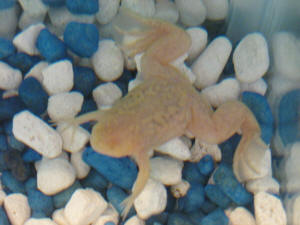
But before this my frog developed black spots which almost look
like markings on his back and hind legs.
<Looks normal to me.>
He eats fine and moves around just fine doesn't act sickly
anyway. The people at the pet store I got him from said that
without his eyes (which are completely missing BTW) they
couldn't for sure say he was Albino
<Is.>
so he might not be and was probably just his natural markings
coming in.
<Likely so.>
But I thought he was a little big for him not to have any
markings yet if he was going to have any. His Veins on his feet
and one very defined vein on his arms are visible too. I attached
a photo of him in the tank and out of the tank. If you could let
me know what you think about the pet stores response and what I
might need to do different if there is something wrong with him
and/or my tank and what it may be I would really appreciate
it.
<Read:
http://www.wetwebmedia.com/fwsubwebindex/FrogsArtNeale.htm
>
Thank you,
Danielle
<Cheers, Neale.>
|
|
Re: African clawed frogs... fdg., and ADF comp.
3/1/10
I'm sorry, I was asking about my second tank. My first is housing 2
Xenopus whom live alone. They are in a filtered unheated 20L.
<This is a "long" 20 gallon tank, or 20 litres?>
You think I should stay away from the feeder guppies?
<Yes. Nobody expect people selling feeder guppies thinks this a good
idea.
Any fish cheap enough to be a feeder will be maintained under pretty
basic conditions. Since Xenopus don't need live fish, why risk
it?>
As for this new second tank(20L), it will be filtered, heated (@78
degrees) and house 2 Hymenochirus. I thought
a nice small group of Danios up top and Corys on the bottom
wouldn't be too aggressive towards them.
<Danios in a long 20 gallon tank should be okay, though I will state
that Danios work best (are less likely to behave badly) in tanks at
least 60 cm/24 inches long, and absolutely must be in groups of 6 or
more.>
As for feeding the frogs, I will definitely hand feed with a turkey
baster, so the faster fish won't steal everything. I was just
trying to add a little color to the middle of the tank.
<I'd skip the Corydoras to be honest, unless you chose a very
small "dwarf" species like Corydoras hastatus or Corydoras
habrosus. The bigger Corydoras are simply too large and too
competitive. Hymenochirus are terribly easy to starve, so I
wouldn't risk it.>
Thanks Neale!
<Cheers, Neale.>
Fasting Xenopus; no real data
1/15/10
I have an African albino frog. She hasn't eaten in over two months.
At first I thought she was sick, so I used Maracyn two. She still
doesn't eat. There seems to be nothing wrong, I've looked at
pictures on different web sites for bloat, red leg, She doesn't
seem to have either. Could she just be hibernating? I clean the tank,
even though I am sure she is not producing waste..
what do you think??
<Michelle, we need much more information than this. How big is the
tank?
What are the water quality parameters (especially nitrite and
ammonia)?
What are the water chemistry parameters (especially pH and general
hardness)? What is the temperature? Does she live by herself? What sort
of aquarium filter are you using? Do you dechlorinated the water before
adding
it to the aquarium? Does your dechlorinator also remove chloramine,
copper, and ammonia from tap water? All these factors are important.
Just to recap, have a read of this:
http://www.wetwebmedia.com/FWSubWebIndex/FrogsArtNeale.htm
Xenopus frogs are very long lived and extremely hardy, but sadly
they're too often kept incorrectly, and even the toughest animal
will die if it is kept right. Cheers, Neale.>
African Clawed Frog Excessive Shedding & Loss
of Appetite 12/27/09
Hello. Zota is a female AFC just under 2 years old. I house her in a 10
gallon tank with a few live plants, a small terracotta flower pot &
a couple other ceramic (food safe) dishes for her to hide in, & a
few scattered large rocks. I use a heater which seems to keep the water
around 78 degrees, but after some recent reading I have dialed down the
temperature a bit and will be trying to keep it closer to 74-ish.
<Good>
I have been de-thawing a single frozen brine shrimp and feeding her one
daily, although after reading other posts it sounds like this may be
too frequent?
<I would use other food. Artemia are not sufficient nutritionally.
Please read here:
http://wetwebmedia.com/FWSubWebIndex/xenopusfdg.htm
<
As a tadpole, I fed her aquatic frog pellets in a little bowl in the
bottom of her tank. She does not seem to find/ eat food that floats so
I am limited to food that will sink and sit in her feeding bowl.
<Mmm, and feed her "in place"... in the main tank>
I sometimes hold food for her and she will take it from my hand, but I
have been unable to induce her to eat for a few days now...
For the past week or so, her skin shedding has increased dramatically
and I am very concerned. She does not seem to be eating her skin nor is
she interested in her shrimp (very odd). I do not see any visible
spots/ discoloration/ or sign of irritation on her body. I am wondering
if I should treat her with some sort of internal bacterial
medication
<I would Not>
even though I do not know what the problem is. If this sounds like the
best course of action, can you suggest a particular product to look for
in a pet store?
Also, I had heard these frogs were very sensitive to sounds and was
told using a filter was the equivalent of them listening to a jack
hammer all day.
<There are quiet filters available... an external canister or
internal power filter would be ideal>
I use a battery operated vacuum for quick upkeep/ removal of debris in
her tank and when I change her water, I usually change all of it and
rinse out her aquarium and I do this approximately every 3 weeks.
<I would not change all the water... I would change a third or so
every week. Read here:
http://wetwebmedia.com/FWSubWebIndex/fwh2ochgs.htm
<
I treat the water Aquasafe and use quick dip strips to reassure myself
that I do not have chlorine/ nitrate/ ammonia/ etc... issues. Your site
seems to recommend using a filter. I have a whisper filter for a
10-gallon tank that I could use if you don't think the sound is too
much?
<Should be fine. Do make sure the opening to the top is small enough
to keep your Frog from getting out>
Thank you in advance for your time & consideration. I adore my frog
& want to help her get healthy again.
Shannon
<I salute your efforts. Do change the food choice/s here and
discontinue the wholesale water changes and all should be fine. Bob
Fenner>
Re: African Clawed Frog Excessive Shedding &
Loss of Appetite 12/28/09
Wow! You are guys are great! Thanks so much for the quick response. I
made a donation to the site & will be telling others about you
all.
<Ahh, I thank you>
I did not mean "brine" shrimp... I meant to say I've been
feeding her one krill a day which are pretty large.
<Ahh! That's a "shrimp of a different colour!" And
nutritional value.
Euphausiids are fine as a supplementary food (not a staple)>
I'm going to look for earthworms at the pet store and try switching
between the 2 products. For a new food routine I thought 1 krill one
day, cut up worm the next day, followed with a food free day, then
repeat. Does this sound good?
<Mmm, actually, no... I'd feed a dried/prepared food
principally. Search the Net with the string: "foods for
Xenopus">
I changed her out to a 20 gallon tank I own which has a nice filter and
kept the 10 gallons worth of her old water to start it up along with
all of her old plants & goodies.
<Very good>
It was quite an adventure in my kitchen today moving fish between 3
tanks & a lot of 6 gallon buckets/ pots & pans full of water.
Several hours later & me with very pruny hands, everyone is in
their new homes. I will take your advice on how to change the water-
which sounds like what I do for my fish tanks.
<Yes. Identical>
There is so much information online, it is hard to know what to
follow.
<Best to try to understand underlying science, discern fact over
statements that are unfounded, untestable opinion>
I had read elsewhere that frog water should be completely changed out
instead of just 1/3 at a time, but you folks sound much more
knowledgeable.
<We/WWM do/es have a huge collective practical and scientific
experience>
Zota ate a krill tonight & seems to be feeling better. I'll
keep an eye on the skin shedding. I would love to find her a full-sized
(as opposed to "meal" sized) tank mate so she's not
alone. She was the only one in the biology lab at the university I
adopted her from. As a Washington state resident, I'm under the
impression that I cannot buy one and have it sent here. Any ideas on
how I could find her a buddy would be greatly appreciated.
<Mmm, Craig's List... an open statement of what you're
seeking... on "Pets Wanted"... letting the local livestock
fish stores know what you're looking for... An email to the few Net
"frog" groups>
Cheers,
Shannon
<Thank you for sharing Shannon. BobF>
AACF. Xenopus hlth., fdg. 11/10/09
I have a Albino African clawed frog in a ten gallon by her self with
natural river rocks and a cave. I feed her Tubifex worms and red
wigglers.
Recently I noticed that the one side of her stomach looks purple-ish
almost like from the inside out. I was wondering if this is normal. I
had a aacf when I was little and don't remember her ever looking
purple.
<Hello Faith. No, it's not normal. Do read here and see if the
symptoms you're seeing matches anything described.
http://www.wetwebmedia.com/FWSubWebIndex/FrogsArtNeale.htm
Note that bacterial infections of the skin (such as, but not limited
to, Red Leg) are usually caused by physical damage, poor environmental
conditions, or both. I'd also make the point that live Tubifex
worms are notoriously disease-laden and haven't been recommended as
"Safe" foods for decades. Bloodworms and mosquito larvae are
better, and small earthworms best of all. Wet-frozen foods should be
safe though, and while freeze-dried foods are safe, they should be used
only sparingly because they tend to cause digestive tract problems.
Cheers, Neale.>
Water issues -FW, frogs 11/03/08 What is
the best product to use to get rid of ammonia and other toxic
substances that are in the water? <Most modern dechlorinators should
remove chlorine, chloramine, ammonia and copper from tap (or well)
water. If yours doesn't, switch to a brand that does. Do understand
that no ammonia-removing water condition does ANYTHING about ammonia
from your fish or frogs. That's the job of the filter. All the
water conditioner does is remove any small traces of ammonia in your
water supply.> I have well water and I always use that without
adding in any dechlorinators. Is that water to hard for my ACF?
<Unless ridiculously high (i.e., above 25 degrees dH) hardness
shouldn't be an issue. If you have very hard water, you could mix
50/50 with rainwater; that's what I do. Otherwise, don't worry
about it: most fish and frogs can adapt to harder water in aquaria than
in the wild, provided water quality is good.> Plus his diet usually
consists of Reptomin Sticks, lean raw beef, and occasionally a worm if
I can find one. What types of foods do they like? <Aquatic frogs
mostly feed in invertebrates of various types, particularly aquatic
insect larvae. These are widely sold frozen.> Plus I think my frog
has seeing problems because his pupils are shaped like teardrops. Is
that normal? <The eyes should be bright and the pupil essentially
circular.> When he was little he used to nibble at my finger and eat
freeze-dried bloodworms. But that changed overtime. Then I had to start
wiggling my finger on the surface to get his attention. I don't
think that he has very good depth perception. I'll put a Reptomin
stick on the surface and wiggle my finger. At the time he acted like he
really wanted it but he'd always "pretend" like he was
getting it by shoving his little hands into his mouth but never
actually getting the food. That continued to happen so I switched to
beef, then I'd wiggle that in front of his face, he'd eat it
immediately. But now nothing. What's happening to him, he's
only 10 months old. <Do need information on the environment. Xenopus
are subtropical frogs that need a fair sized container containing clean
(zero ammonia/nitrite) water at around 18-22 degrees C; Hymenochirus
frogs are smaller and need tropical conditions, around 25 degrees C,
but still need clean water. So depending on the frog you have, you may
need to review environmental conditions. Almost always when frogs get
sick it's because of water quality issues. Take care not to
overfeed: these frogs need small amounts of food, around 2-3 times per
week. Change the water regularly, and make sure the filter is in good
condition, rinsing the media if required. The shed skin often clogs
small filters. Cheers, Neale.>
|
Smelly Xenopus Laevis
03/26/2008 Hi Crew, I have a question for you. I have
searched everywhere but am unable to find specific guidelines on
how much to feed my adult African Clawed Frog. Lot's of
information on how often, etc. . I had cycled a ten gallon tank
to move my little Dwarf frogs into and while out purchasing some
Corydoras for another tank we found Robin. She is just beautiful,
green with markings, the size of my fist. Sweet as a button, too.
Eats from your hand and will even let you rub her head. My whole
family loves her and everyone loves to watch her eat. We feed her
every other night a diet consisting of blood worms, Krill,
nightcrawlers and occasionally feeders (until I found out they
are hard for her to digest). Lately I have taken to the night
crawlers and krill as they are less messy. Usually I rotate what
I feed her Mondays are Krill, Wednesdays bloodworms and so on).
Here is my problem. After we had her a week and a half her tank
started to smell foul. Like urine. I have been doing 20%-50%
water changes every other day I have two other tanks I am cycling
with 1 small Danio each, so I am doing water changes anyway). I
started doing daily 80% water changes, with no improvement so I
moved herewith her substrate, cave and other content) to a 20
gallon long tank. Again after a week her tank smells foul again.
I use Prime as my water conditioner, pH is 7.8, KH is 180, GH is
150. Due to the move the tank is cycling again but with water
changes I am keeping Ammonia under 1ppm(still toxic I know). The
Nitrites are .5-1 and Nitrates are 20. I am worried I am over
feeding her, but her belly looks just bulgy when we are done. I
was concerned at first I wasn't feeding her enough. I feed
her 3-4 cubes of frozen Krill or Bloodworms or 2 good sized
Nightcrawlers. I watch her belly to decide how much is enough. So
all that being said, any idea's on my odor problem? I wanted
to get a male for her to hang out with but if one is stinking
what will two be? I will not be able to continue these water
changes endlessly. We love her very much my Pug is much consumed
with jealousy), and I don't want to lose her, but really
cannot tolerate a stinking tank in my Dining room! Nothing I have
read ever read mentions an odor in association with them. My
Dwarfs don't stink. Please could you help? Thanks so much
ahead of time. <Debbie, if the tank smells, it is GROSSLY
under-filtered, overstocked, or over-fed. Possibly a combination
of the three. Since you have ammonia and nitrite in the water (at
critically dangerous levels, by the way) you really need to ramp
up water changes and filtration. I'd be looking for a filter
that provides not less than 4 times the volume of the tank in
turnover per hour, and realistically at least 6 times.
Undergravel filters work great with Xenopus frogs. Water changes
should be 50% per week if filtration is adequate. Feeding can be
reduced: these frogs honestly don't need very much food.
I'd be feeding an adult Xenopus the equivalent of a small (5
cm) earthworm 2-3 times per week. Until you get water quality in
hand, I'd stop feeding altogether.> P.S. How many Hikari
sinking wafers should I feed 3 Corydoras schwartzi nightly? I am
feeding 3 and they eat them all overnight, but I am noticing
algae buildup on tank that isn't in sun. Once or twice a week
I throw in some (frozen) brine shrimp or blood worms. No other
tanks have this issue so I figure maybe overfeeding? It is very
hard not to overfeed. I am learning and getting much better.
<Are we talking about the small wafers about 10 mm across? One
of those four nights per week is ample. Remember: fish are cold
blooded. About 80% of all the food you eat goes into temperature
control, since you're a warm blooded animal. Cold blooded
animals need tiny amounts of food compared with warm blooded
animals. A good rule of thumb is this: feed only as much as your
fish can eat in 1-2 minutes, and ALWAYS remove uneaten food at
once. A turkey baster is a great tool for this if you don't
want to be messing about with nets and siphons. Fish that receive
enough food will have a gently convex belly but shouldn't
look fat or as if they have swallowed a bowling ball.> Thanks
again Debbie <Cheers, Neale.>
Re: Smelly Xenopus Laevis -03/27/08 Thanks
for the quick reply Neale. So I am over feeding her-very much, it
seems. She seems hungry all the time. I will quite feedings and
cut back to 1/4 of what I currently feed when I resume feeding
her. Can she eat Meal worms or wax worms? <Small mealworms
perhaps, but amphibians often find the larger ones too difficult
to deal with because they can't chew their food. You may
prefer to stick with (wet) frozen foods like bloodworms; half a
cube of bloodworms per meal should be ample for an adult frog.
There are also floating pellet foods on the market designed for
feeding frogs. While not to be used as a staple, once a week
these make a good adjunct to a balanced diet.> The night
crawlers I get are rather large. I do like to feed live foods as
much as possible and I can get the others easily as well. And
crickets of course-they kind freak me out. Suppose I could suck
it up, though. I did forget to mention I have a penguin 150 on
the tank with 2 cartridges in place. I used Bio-Spira at
introduction to both tanks as well. I have been doing daily water
changes with extra Prime for damage control. No other chemicals.
She seems alert and happy-and hungry! All the time. We really are
very attached to her so I will take extra care to correct my
mistakes-quickly. Surely the over feeding is responsible for the
toxins coming up in the tank even after water changes. <Sounds
likely.> I will also cut back immediately on the Hikari
pellets for my Cory cats as well. They are the round ones with
the picture of the julii on the front. I will also make sure if I
feed them brine shrimp or blood worms that I won't feed the
pellets. These I am sure I do good with as I share one frozen
piece among several tanks and have learned to be stingy from
feeding my dwarfs. It doesn't take much. I am stingy with
flake food as well (I only have the two Danios that eat that for
now-they will be dinner after my tanks cycle). My Xenopus just
seems so large that she must need a good amount to eat. Guess
not. <Indeed not. Many of us humans are overweight because
we're terrible at knowing how much food our species needs to
eat. We're even worse with animals!> Thanks again so much
and have a good night, Debbie <You're welcome,
Neale.>
|
Albino long clawed frog, hlth. 12/19/07 Hi You
helped me once before with advice for my African long clawed frog,
which worked and she recovered. She loved live earthworms and
couldn't get enough, and is now twice as big. All was well until
recently. She has trouble keeping a worm in her mouth, she keeps
stuffing it in with her hands but it wriggles out and she gets fed up.
So its been back to frozen bloodworm for a while. However, today when I
went to see her she is totally bloated. All her skin is distended by
air. She looks like a balloon. We have limited vets in the UK with
knowledge of these animals. Have you any clues? Any advice would be
appreciated. Thank you. Regards Jill <Sounds like a gut blockage
issue to me. Best to hold off on feeding for a few days, see if the
obstruction moves. Smaller food items might work better. Bob
Fenner>
African Clawed Frogs, gen. care
8/30/07Hello, <Hi there> I am writing with many, many
questions. Last year, when I lived in a college dorm, I found myself
really wanting a pet, but could not get one because of rules regarding
aquariums at school. Next year, I'm moving to an apartment, and
think that I am ready to start taking care of my first "solo"
pet (my family had a dog when I was a kid, but this will be the first
time I'm taking care of something on my own). <Can lead to
growth, reflection> I was originally going to get a couple of
low-maintenance fish because I wanted to ease myself into the
caretaking business, but a friend of mine asked if I would like to take
her two 3-year old African Clawed Frogs instead. <Neat animals
Xenopus...> I've met these frogs and they are kept by her
parents in pretty pitiful conditions (unfiltered, separate, very small
tanks in which they can barely extend their legs fully, and they
certainly can't swim around!, and they are only fed pellets). So
I've decided to take them and give them a better life. However, I
have to do this on a limited student budget. Additionally, school is in
Chicago, but during the summer and on breaks, I live in L.A. with my
family. <I see> I've found some conflicting reports about the
frogs online, so I'm going to say what my research has led me to
thinking is the way to provide for the frogs that strikes a balance
between proper care, cost, and time. <You are wise here> I would
appreciate it if you could correct me where my information is wrong, or
where I could save money, as well as where I shouldn't.
Additionally, if I am being too extravagant in terms of maintenance, it
would be great if you could let me know, because I am still a student,
and thus, have limited amounts of time (and, as I said, money).
<Okay> It seems like I should invest in a 20 gallon long tank, at
a minimum (unless completely wrong, this will probably be the size I
get, as it seems like the price goes up as the size goes up. <Is a
good size, shape> if I can go down, that's great, but i am
guessing it's not a good idea, as most estimate there should be 10
gallons/frog). Aquarium gravel depth should be 1 1/2 to 2 inches,
<I'd keep in shallow unless the grade is rather large... for
ease of cleaning> and water depth should be 6 to 12 inches, with
plenty of air on top. <Yes... among other things to prevent
escape> Plastic plants and a few good hiding places seem to be a
good idea. A non-escapable, netted top seems to be a must. A light is
not necessary. It is okay to keep these frogs together, but I probably
shouldn't put any other fish in there unless I want the frogs to
eat them. <Correct> A varied diet of bloodworms, shrimp, and
worms (Tubifex or earth?) is good. <Mmm, expensive, inconvenient,
unnecessary and too much likelihood of pest and disease introduction...
I'd settle on a bag of frutti de mar... mixed frozen seafood...
defrost bits of this...> Feeding them 3-4 times a week is good. I
can use pellets occasionally, but not all the time, as they will
probably be cheaper, but less nutritious than other food sources. Where
can I get these kinds of food? Do I have to go through mail order, or
will the local, independently owned pet store carry them? Any providers
that are particularly good and not expensive? <Again... I would get
the mixed seafood from the supermarket> This is my first time
keeping an aquarium, so I'm a little hazy (pun!) on how to take
care of the water. Here is what seems to be the case. I need to treat
the water before I put it in the tank with a dechlorinator (any brand
in particular?). <I like Novaqua or Amquel...> I should have a
filter that is not too loud, because ACFs have good hearing.
Additionally, I should be testing the water with a testing kit to make
sure ammonia, nitrate, and chlorine levels are, not just low, but at 0.
pH should be around 7.4. (I assume the filter and a dechlorinator take
care of these problems?). <Likely so and your tap is likely close
enough pH wise> Temperature should be between 68-75, though I've
seen you guys recommend raising the temperature up to 80. For a tank
located in a heated apartment in Chicago, will that require a heater?
<Mmm, depends on your room/setting... if there's money available
I would get/use a small submersible heater for sure> A 10-15% water
change every two weeks, or a 25-33% water change every month with a
gravel vacuum is enough to keep the water clean. How often should I
clean the tank itself (scrubbing the glass), and what should I clean it
with? <I would gravel vac once a week and do the water changes at
that time... about 25%... A dedicated clean sponge> Product
recommendations would be great, especially if you know of something
that is cheaper that doesn't sacrifice too much quality (especially
if you know where I can get the tank for not too much money, since that
seems to be the most important thing to buy). Do you know about how
much it is going to cost to get this tank up and running? How about
general maintenance once the tank is up? <Likely a hundred dollars
or so... and ten dollars a month or so for food, power...> Assuming
I keep the tank very clean, will it be smelly? <Hopefully not>
This question is to know whether to keep the frogs in my bedroom or in
the living room, where they might be more susceptible to my roommate
and guests doing something (I'm still a college student, and am
afraid that somehow things might get rowdy...I heard the frogs are
skittish, and I don't want to scare them with loud music or TV, and
I certainly don't want someone to break the tank or something like
that...is that likely?). <Mmm, depends on "friends"... Do
check re how noisy the proposed filter will be... perhaps an in-tank
power type will be best here...> What about tank setup? Should I
scrub the tank clean before I fill it? How? <Posted on WWM... just
no soap, detergent...> Do I need to put a bacterial start in the
water when I am first filling it up? <Not likely... the frogs will
bring their own> Do I need to let the tank sit for a day or two
before I move the frogs in? <Yes I would> When I leave for
university breaks, will there be a problem if the frogs aren't fed
for a bit? <Mmm how long> My breaks range from four days to 3
weeks. I am guessing the 3 weeks will be a problem, but four days
probably won't. <Correct> Is there a way to give them
staggered food, or will I need to find a frogsitter? <The latter is
a good idea... but barring this, an automated feeder to offer pellets
will work> I know that I will be taking the frogs for the next two
years while I finish college, and hope that I can take them with me
wherever I head after that. I know that the frogs will still have a
home with the parents they are with right now when I go home for the
summer, or after I am done with school. My hope is that after I get
them a nice new habitat with filters, new food, etc., they will receive
better care, because the family has just not spent the money on giving
them the right environment. My concern here is whether or not it will
be relatively easy to transport the aquarium back to the house (a 20
minute car ride) when I go home and come back for the summer, and
indeed, if it will be possible, though not easy, to fly the frogs
cross-country should I end up taking a job outside of Chicago when I
graduate. <Not impossible to take as carry on...> My last
questions are frog-specific. These two frogs have obviously not lived
in the best of conditions. Will it shock their systems to just move
them in together straight away? <Mmm, not likely> Should I
acclimate them to their new surroundings, and if so, how? <Move and
place their existing, yes stinky, water with them... change this out
weekly as stated above> Should I move one frog in first, let him get
used to the new place, then add the other frog? Or should I put them in
together for a day, and then move them back to their old tanks for a
day, before putting them in for good? <I'd move both in all at
once> What about acclimating them to the new food they are going to
eat? <Almost never fussy eaters> I am guessing since they are
really made to eat what I am going to give them that there won't be
any problems with changing their diet. Thanks for reading an e-mail
this long. I really want to make sure that these ACFs get the care they
deserve, and wouldn't want to just take them without taking care of
them. Best, Jessie <You have read the FAQs files here:
http://www.wetwebmedia.com/FWSubWebIndex/afclawedfrgfaqs.htm Above?
Good to peruse. Bob Fenner>
Feeding African Clawed Frogs 5/16/07 Hi, I'm
new to the African Clawed Frogs and I have a few questions. I have 2
Albino African Clawed Frogs along with 2 tiny black frogs. They were in
the same tank as the African Clawed Frogs in the pet store as well is
now, at my home. They are much smaller than the African Clawed Frogs. I
don't know what they are, if you can give me a name for them, that
would be great. < Look at the genus Xenopus online> Also, the pet
store gave me Newt and Salamander sinking pellets by HBH for my frogs.
I've had the frogs for about 5 days now, but they're not
eating. The food sinks to the bottom and stays there, dirtying their
tank. Do you have any suggestions on what I should feed them instead?
That would be a big help! -Adena < As far as food goes I would
recommend some "Tubifex worms" that they sell at the local
fish store. Frogs usually require moving prey items since they hunt by
site. Once they get going they will eat anything that
moves.-Chuck>
Albino African Clawed Frog
feeding/digesting problems 02-05-06 I recently bought an Albino
Clawed Frog about a week ago. I have had quite a few frogs, my last one
of six years died last month. I bought this small one now (about 3
inches) and she does not seem to want to eat anything I give her.
<Very unusual for Xenopus laevis not to feed> The shop I had
bought her from was feeding her cut up meal worms, and so I have
reluctantly started to feed her those. I was wondering if meal worms
are okay, seeing as my last Clawed frog had problems digesting them
when he was this small. <Not by themselves, no> I am also worried
because her stomach seems to be growing and I am worried about
intestinal blockage. How should I deal with this? and How would I know
if it is? Any help would be AMAZING. Thank you! Mallory Wynne
<Perhaps a level teaspoon of Epsom Salt per ten gallons of system
water will move this blockage. Bob Fenner>
|
|