|
FAQs about Abalone
Identification
Related Articles: Abalones, Gastropods, Mollusks,
Related FAQs: Abalones, Abalone Behavior, Abalone Compatibility, Abalone Selection, Abalone Systems, Abalone Feeding, Abalone Disease, Abalone Reproduction, Gastropods in
General: Gastropods/Snails,
Snail ID 1, Snail ID 2, Snail Behavior, Snail Selection, Snail Compatibility, Snail Systems, Snail Feeding, Snail Disease, Snail Reproduction, Mollusks, Sea
Slugs,
|
|
|
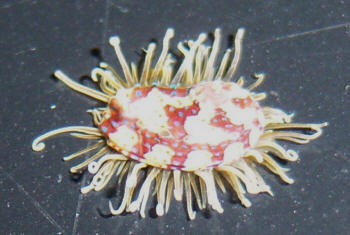
Re: Hitchhiker ID Please: Juvenile Abalone -- Haliotis
asinina 3/24/09
<Hello Matt>
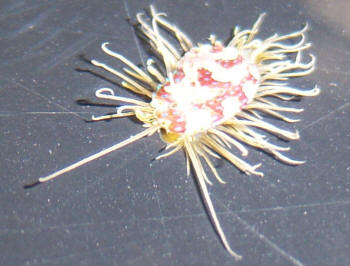
I pulled it out of the tank to get some better pictures.
<Thank you so much. What a beautiful little creature!>
To answer your questions, it has a hard shell almost completely
flat and a foot like a snail. It is almost completely round, but
when I photographed it, I noticed it is a little "U"
shaped, or maybe like a kidney bean shape but flat. The pattern
is on the shell part. It does not appear to bother any
livestock.
<Nope, these are herbivores, so no worries.>
It stays in a 1 inch radius of the small indention in the rock
that it is living in.
<Supposedly, these are nocturnal, so yours may well venture
about at night, but return to the same spot in the morning.
I've seen this sort of 'homing' behavior with
urchins. If you didn't know better you'd swear they never
left that one spot!>
It almost appears to filter feed, but definitely not sure about
that.
<They actually feed on various algae species. Apparently, they
prefer Rhodophytes (red algae) such as Coelothrix, Hypnea,
Laurencia and Amphiroa, but will also feed on
Gracilaria/Gracillariopsis. You could try offering yours some of
the commonly available dried (red) seaweed sheets. The easiest
way to present it is to tear off a piece and attach it to a rock
with a rubber band. Simply set it near the animal, either right
before the lights go out, or afterwards if you have any
herbivorous fishes that would tear the sheet apart.>
The tentacles resemble Aiptasia.
<Yep, what you're seeing is a perimeter of sensory
tentacles.>
Hope this helps.
<Yes indeed! These new photos are exactly what I needed. If
you look closely at the shell, you'll see a line of
respiratory holes (apertures) along the top edge facing the
camera. These are common to Abalone (Haliotis spp.). The really
neat thing, though, is the presence of those little blue spots.
That clinches the ID as a juvenile Haliotis asinina, aka the
Ass's Ear Abalone (because of the adult shell's supposed
resemblance to a donkey's ear). Personally, I think
that's an awful name for such a little beauty but oh well.
These are common shallow water inhabitants of reef edges, and
size-wise top out somewhere between ~2 3/8' and 4
¾' (6--12cm). For more information, please see the
following links:
http://www.animalpicturesarchive.com/view.php?tid=2&did=25332
This next link shows the progression of shell development:
http://www.biomedcentral.com/1471-2148/7/160/figure/F1?highres=y
http://www.gastropods.com/9/Shell_119.shtml
Take care and enjoy your Abalone! LynnZ >
|
<<Gorgeous!! -Sara M.>> |
|
|

