 |
|
| Home | Marine Aquariums |
Freshwater Aquariums |
Planted Aquariums |
Brackish Systems |
Ponds,
lakes & fountains |
Turtles & Amphibians |
Aquatic Business |
Aquatic Science |
Ask the WWM Crew a Question |
| Please visit our Sponsors | ||||
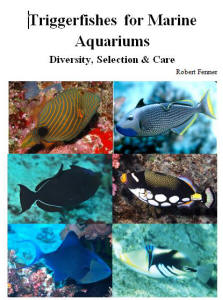
Undulate Triggerfish; comp. 7/29/17 Pair of undulated triggers? 11/21/06 Hi there, <Hi Kelly, Michelle here.> Considering that undulated triggers are sexually dichromatic, I am wondering whether it's possible to keep a male/female pair? Everything I've read says they are best kept solo, but I have not seen this possibility addressed. I have a 180-gal tank. <I do not have any personal experience related to your question, I did try to find any relevant info online without much luck. Your tank is a decent size. It may be worth trying. I think the best chance of success would be finding two smaller ones and introducing both fish at the same time, but it could be quite difficult to catch and remove one if there is a problem. I would definitely have a plan b and possible plan c ready to be put into motion. Good luck! Mich> Thanks! Kelly Dedicated Undulated trigger keeper A few questions for you if you would be so kind. I've been keeping fish for a very long time, and for years I've been toying with the idea of a dedicated undulatus tank. I had one for about 15 minutes, years ago. He was 3", and 30 seconds after hitting the water in the tank he proceeded to attack a 16" Queensland grouper. :) They are one of my favorite fish of all time, so I'm thinking of finally giving up some space to keep one. Anyway, this tank will be a dedicated 120 gallon. My questions are as follows 1. How would you characterize their growth rate? Ultra slow like a Huma Huma? Or faster like a clown? Faster still like a niger? <More like a Humu or other "Lagoon" trigger... slow and steady> 2. Are they sexually dimorphic? Do the males or females get larger? <Not sexually dimorphic, though I swear they are dichromic when larger, in good health... males are more "bright", and for specimens further into the Indian Ocean, Red Sea, more colorfully marked> 3. I'm looking for a Red Sea specimen, what are the telling chromatic differences between that and the other localities? <Much lighter in body color and the red vermiculations on the head much more prominent and wavy... especially under the jaw> Thanks for any help. I don't want to purchase a 3" specimen, and 2 years later only have a 5" specimen. I want a nice show animal in a few years. (Just because I'm an "expert" doesn't mean I'm always patient) If they are slow growers I'll be sure and start with at least a 5" individual. I've been doing my best to help out on your site, answering what questions I can. Great site! I've been keeping marine aquaria for 20 years, and I enjoy educating others on the subject. It feels oddly nice to ASK a question, I don't get to very often. :) <Do you have time to respond to queries here? Interest? Bob Fenner> More on undulated trigger, helping on WWM Thanks so much for the reply Bob! Hmmm...Huma Huma growth speed. In my experience you're lucky to have a 7" Huma Huma in 5 or 6 years if you start with a little guy. While I count that as a big plus for that fish when a keeper wants to put one in a 55 gallon tank, it stinks for the person with space wanting a show fish. :) Looks like I need a 5" Red Sea male undulatus. I forget off the top of my head, are the males the ones with or without stripes on the snout? <With... at least with more> Would this difference be apparent already in a 5" fish? <Should be, yes> I definitely have time, and would be interested in answering queries on your site. :) I'm a dyed in the wool fish geek. I can also answer freshwater questions, as I spent years keeping and breeding African, Central and South American cichlids. <Ahh! Would you please send a brief bio... something I can share with the existing WWM Crew, post for the public, re your experiences, abilities and desires? Thank you for your interest. Bob Fenner> Cheers Jim Pairing undulate triggerfish Dear Bob, I read in the net about the undulate trigger with great interest becausethey could identify the male from the female fish. It say that the male lacks the stripe between the eyes and mouth but thefemale have the both the stripe. If I could have both fishes, can I keep both in the tank? Will they pair ?Is it possible? Lastly I have decided to purchase the undulate this Saturday ( tired of waiting ). Keep in touch. David. >> <Maybe... starting with the two small... and keeping them in a very large... hundreds of gallons or more.... system... Only when spawning (male making a nest, dancing/swimming about to attract females... temporarily, do these fish associate as "pairs"... Hey, they're not us! Not human that is... and you're not Noah as in the Ark... You're looking for trouble, with the probable best outcome that one of these two will hide most all the time... but... it's your system. Bob Fenner> Don't Sweat The Aiptasia- He's "Trigger Happy"! Hello -- WWM Crew <Hey there- Scott F. with you today...Had server problems last night- I don't think that my reply got to you intact...Got me on the laptop in bed this AM (scary imagery, I know-but a great way to do WWM work!) trying again!> I have a 125 gallon tank with a Undulated Trigger and a Huma Huma both about 4.5 inches. I am aware of the potential of both Triggers particularly the Undulated. My intentions are to get a larger tank soon. <Very good intentions, indeed! These guys will get quite large, and quite boisterous down the line. The 120 should be okay for a while, though> However the two get along fine now an occasional snap by the Undulated during feeding but they typically swim right next to each other without confrontation. The tank is loaded with coralline encrusted live rock which provides plenty of hiding places. I have two questions the first is how do you tell a Red Sea Undulated from the more nasty/aggressive I guess Indo Pacific?? variety/subspecies? <As far as I know-this species does not have any instinct geographic color variations. I did check a number of non-aquarium resources for you, and was unable to find any information in regard to this.> I understand Undulated Triggers are sexually dichromic --- I have a female with orange lines down to her mouth. <Yep- the sexual color variation is a fact. And I concur- you seem to have a female, as males do lose the orange lines around the snout as they mature> Reason I am asking is that I read the Red Sea can possibly become a long time tank mate with other predatory types --- but the other subspecies? Makes survival of a tankmate highly unlikely --- is this accurate? <To be quite honest with you, in my experience with this fish, as well as the experience of a few friends who currently maintain them- they are just tough customers, regardless of where they hail from. They tend to become more feisty as they mature. However, triggers are notorious for being "non-conformists" to our behavioral expectations of them in captivity! I have seen 10 inch Clown Triggers that seemed very "tame", and small Crosshatch Triggers (reputed to be more "gentle") just beat the @#$% over anything that they were placed with!> The second question is I have live rock with what appears to be anemones growing on them. The anemones?? are small and not very colorful ---kind of a caramel brown color. Does this description sound familiar enough for you to guess if they are anemones? <Yep- all too familiar, actually! Sounds a lot to me like the famous (or infamous, depending upon how you look at them) Aiptasia anemones! They tend to come in on live rock, and proliferate with remarkable speed in tanks with higher nutrient levels or bioloads (such as...a trigger tank!). Reefers freak out when they see Aiptasia because they tend to overrun other (desirable) sessile inverts and corals. However, in a FOWLR tank like yours, I would not be too concerned, other than to see if they are indicative of sub-par water conditions (probably not, though). The anemones(?) are multiplying and the Triggers don't seem to bother them at all --- My question is can Anemones and Triggers co-exist for long or will the triggers likely damage the Anemones?? <Well, I wouldn't go out an by that tank-raised Bubble Tip Anemone just yet! My personal theorem on anemones and triggers is that the possibility of the anemone becoming a chew toy for the trigger is directly proportionate to the value and attractiveness of the anemone! Just not a great idea, IMO. I wouldn' worry about the Aiptasia, at this point, however...Sounds like your pals aren't too interested in them- yet...Aiptasia are interesting animals in their own right- very efficient at what they do best...eating. In fact, Anthony (Calfo) has even gone so far as to suggest that they could be harnessed in a special raceway as a natural biological filtration supplement! They are that good at eating!> Thanks in advance for your response <My pleasure! Thanks for stopping by! Regards, Scott F>
|
|

|
Features: |
|
| Featured Sponsors: |