 |
|
| Home | Marine Aquariums |
Freshwater Aquariums |
Planted Aquariums |
Brackish Systems |
Ponds,
lakes & fountains |
Turtles & Amphibians |
Aquatic Business |
Aquatic Science |
Ask the WWM Crew a Question |
| Please visit our Sponsors | ||||
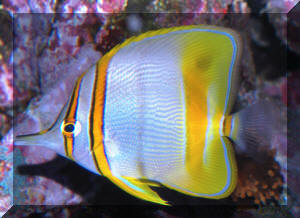
Copper band butterfly; sys., stkg. 8/22/18 Juvenile Butterflyfish. BF sel. f'
7/2/12 Copperband Butterfly death. Compatibility.
6/1/10 Copperband BF collection origins... 06/02/09 Re: Seahorse in refugium, and now Aiptasia contr. -11/27/2007 Thanks for the quick reply. We have decided, based on your advice, to not use sea horses in the refugium. Instead we will nano tank some dwarf seahorse in a separate tank. <cool> On another note, I have been battling Aiptasia anemone for quite some time to no avail. We got the problem from a friend who tore down his tank and gave me some live rock. Tried Joe's juice, <doesn't work> peppermint shrimp, and even removing bad bits of rock, but just couldn't get ahead of them. <In my experience, you need quite a few peppermint shrimp for this method to work at all...> I was considering a Copperband Butterflyfish when my LFS recommended a Slender Filefish (Monacanthus tuckeri). We were told he is reef safe, but will be a bit nippy and sample a few things. Sounded similar to the Copperband except this guy will eat readily. <Hmmm... I wouldn't put either in a reef thank. Please see here: http://www.wetwebmedia.com/BFsBestWrst.htm and here: http://www.wetwebmedia.com/fishfish.htm> We got him and he has cleaned almost every Aiptasia in the tank, doesn't seem to bother corals, nips a bit at various worms, <Doesn't mean he won't eventually... but too late now, let's hope he doesn't.> and will happily eat most frozen foods. I wonder why this fish is not mentioned in the control of Aiptasia? <Hmmm, I don't know, but I imagine that (as with most animals) they're not entirely consistent. Yours seems to be quite helpful for Aiptasia and harmless to corals. This might not always be the case for every fish.> I live in the Netherlands and they seem to be common in tanks here, however I rarely see them on American sites. <Thanks for sharing your experience. :-)> Anyway thanks again for the advice/education. Have a great day! <You too, thank you.> Layton <Best, Sara M.> Copperbanded Butterfly (Chelmon rostratus) Won't Touch Aiptasia -- 06/15/07 Hi guys, <Hi Mark, Mich with you tonight.> I have a quick question. I looked around and couldn't really find any other questions similar so here I go. We got a Copperbanded Butterfly 6 days ago and so far it's nipped a little at Mysis shrimp and angel/butterfly frozen food that we've been feeding. <These fish can be a challenge to feed, sometimes requiring live foods such as freshwater clams or black mussels with their shells broken open. More here and the related links in blue: http://www.wetwebmedia.com/Chelmon. htm > We chose this guy because he's such a nice looking fish and his ability to eat Aiptasia, as we have started getting some after purchasing a coral with one hidden on its rock. I am figuring he will start eating "normal" food in a day or two as he is showing signs, but he doesn't seem to care about Aiptasia. <I would be most concerned with just getting this fish to eat, period.> Is this something that is normal and he will eventually? Or do some just not eat Aiptasia? <Just like people, individuals vary. Some do, some don't. Akin to saying all women like chocolate, many do, many don't.> He is also spending less time hiding the past few days as we walk by the tank or stop by to visit the fish. <A positive sign. Get him eating well. There are many other means of Aiptasia control more here and the related links in blue: http://www.wetwebmedia.com/marine/inverts/cnidaria/anthozoa/Aiptasia/aiptasia.htm http://www.wetwebmedia.com/ca/cav1i3/aiptasia_impressions/aiptaisia_impressions.htm > Mark <Good luck with this beauty. Mich> Aiptasia vs. Chelmon testimonial 12/6/06 Good day all. <Greeting to you Pete, Mich here.> This is not a question, it is simply a comment. <Always welcome.> For quite some time I have had a problem with Aiptasia in my reef system. I had unfortunately and carelessly imported some with a piece of live rock. The rock was a wonderful shape and I could not pass it up. Over the course of a year or so the Aiptasia happily multiplied in my well stocked and well fed tank. <Yep, they do that.> I had tried many chemical and non chemical eradication techniques from injections to peppermint shrimp with no success, until I purchased a large copper banded butterfly fish. <Peppermint shrimp usually have to get pretty hungry before they will go after the Aiptasia. It's like eating bran flakes when you have other choices. Aquacultured Berghia Nudibranchs are another alternative. They are obligate Aiptasia eaters (i.e. bran flakes and nothing else). However, without Aiptasia they will quickly starve.> I was forced to keep him in a separate system due to aggression from my yellow and Naso tangs. I would take whatever rock had an infestation and place it in the other tank with the butterfly. He would scour the rock and I would return it to the main display. Unfortunately the Aiptasia would reproduce faster than I could move the rock. There was also the added problem of not wanting to breakdown all of the reefscape. <Breaking down reefscape... Yep, been there, done that, can be a most trying exercise in frustration. Understand wanting to avoid it.> I had informed WWM in a previous email that I had found a home for my big Blondie as well as the yellow, the problem had been catching them without destroying my setup. <Yep.> The solution to this came one day after a 2 hour power outage. When the power returned and my HQI lights came back on the fish were so stunned that I was able to pick them up with a gloved hand. They now have a 600 gallon new home. <Sweet!> Now that the main aggressors are out of my display tank, I have moved the butterfly in. Within 5 days he has eaten all of the thousand or so Aiptasia in the system. <Wow! Sweet again!> He seems to have no interest in my corals, clams or sponges. <Going for a sweet trifecta!> I think I have won. <I think you are correct!> This solution, however would not have been needed if I had just been more careful and patient with my original purchase. <Very wise words my friend.> I just wanted to let people know that at least in my situation the copper banded butterfly was a great success. <Thank you for sharing. It's really nice to hear success stories as many queries do not have happy endings. -Mich> Pete Faulty ORP Readings/Copperband for Aiptasia Control - 10/31/06 Hello, and thank you for all the information you provide. <<Howdy, and you're quite welcome...is a synergetic effort>> I have a 125 gallon saltwater reef tank and I am trying to get the Aiptasia under control as well as increase the quality of life for the species I already have. From my research, I felt that I would try the peppermint shrimp as a way to get the Aiptasia under control and also look at why I have them. <<Mmm...peppermint shrimp are less than reliable controls for Aiptasia anemones, and best utilized 'en masse' re which then leaves you with the problem of what to do with all the shrimp once they've completed their intended purpose...not to mention the expense of obtaining several dozen peppermint shrimp>> I read that the 6-line wrasse could eat them so I moved the wrasse to a fish only tank where he is doing fine. The next day all 3 peppermint shrimp were gone. <<Hmm...though I doubt three shrimp would have had much impact...at least not for a very long while (assuming they would eat the anemones to begin with)>> I watched my Sailfin tang and it did not seem interested in them. I only have fire fish, clowns, and an algae eating goby type fish. <<Mmm...how large is this 'goby?'>> With this trail ending in failure, I would like to try a Copperband butterfly. <<Not easily kept...and also no guarantee it will take to the Aiptasia any better than peppermint shrimp>> I read that they are difficult to keep. <<Ah yes>> I want to make sure that my tank conditions are up to standard before I purchase one. I use the Aquacontroller Pro to monitor the conductivity, pH, ORP, and temp. The temperature ranges from 74-78 degrees. The pH is at 8.28 but does fluctuate from 7.99 to 8.28 within a 24 hour period. The ORP is the strange reading because I show 572 through 678 in a 24 hour period. <<I think this is likely not an accurate reading. ORP readings this high would certainly have a deleterious affect on your system>> I test for nitrite, nitrate, and ammonia and they always test at or 0 or very close to the lowest scale on the chart. <<Ammonia/nitrite should 'always' be 'zero'. Do make sure you have fresh/reliable test kits>> I took a water sample to the fish store and he confirmed my readings. He also tested for phosphate and said it was minimal. <<Whatever his definition of 'minimal' is...>> The alkalinity was acceptable but the calcium was low. I tested the ORP in my filtered tap water through the Kold-Steril unit and the ORP showed 100. I tested the ORP of the tap water with the salt in a bucket and when agitated with the power head would reach up to 180. I tested the ORP in my fish only tank and it reads 174. I do not use ozone at all. I add the alkalinity supplement every other day and then the calcium supplement on the opposite days of the alkalinity supplement. I contacted Neptune systems and he said the probe and controller are probably correct and working as they should. <<I disagree...an ORP reading of 678 in your reef tank would definitely be mal-affecting your livestock. Anything over about 450 starts to become dangerous to your tank inhabitants. You need to obtain a calibration solution and check the probe's accuracy yourself>> I use a sump with an AquaC 180 protein skimmer and this works well. <<A good skimmer line>> I tested the returns and the water flow is 600 gallons per hour. I do get some green algae growth in the tank but only enough to clean off of the front glass every few days. What could cause the ORP to be so elevated without adding ozone? <<Ozone injection is not the only way to raise ORP (increased water flow or adding 'oxidizers' such as iodine can raise ORP levels), but I think in this instance the culprit is a faulty ORP meter/probe>> Do you think the water quality is acceptable for a Copperband butterfly with the ORP reading so high? <<I don't think the ORP is an issue, as I don't think the reading is accurate/that there is any hazard if you are not injecting ozone in this system. But being successful with the Copperband involves more than good water quality. You need to have adequate live rock in a 'mature' system (preferably augmented with a vegetable refugium) to provide grazing/browsing opportunities for the butterfly. You also need to find a healthy specimen that is feeding on frozen foods as getting them to eat is a common problem. Once you have an 'eating' fish, pay attention that it gets its share. These fish are designed for/adapted to browsing the reef for food and don't compete well with most other fishes when the hobbyist dumps in a meal...they even have trouble seeing/finding foods that are swept along in the current. Most will eventually learn that they need to 'be on the ball' at feeding time, but they will still have problems with the quicker and more agile fishes beating them to the food>> Before purchasing a Copperband, like my other fish, I will find one that has been in the store for at least 2 weeks and that is feeding. <<It will behoove you to set up a quarantine tank for this (all) fish to ensure that it is still feeding (without competition) once you bring it home. I have witnessed on more than one occasion where this fish stopped feeding after the stress of capture/relocation from the LFS>> Thank you everyone for the time you dedicate to helping me as well as many others. Darrell <<Is our pleasure to assist. EricR>> My new Copperband Hi Bob, I saw you at MACNA and really enjoyed your informative lecture I was one of the few teens there). <Ah, yes> Anyway, I am calling upon your advice as a ex collector/exporter/importer for nutritional needs of my new fish. I was planning on waiting a couple of weeks before buying my Copperband butterfly so I could establish more detritivores but I stopped by the LFS today and they had the Copperband I had my eye on for a while. I talked to my friend the manager and confirmed the fish had been there 3 weeks and that is was collected in Fiji by a professional collector. I watched him eat some brine shrimp, he didn't eat many pieces, just a few. My friend explained that they were not used to eating in the water column and that they are foragers by nature. <Mostly, yes> I have been keeping clowns, damsels, and Chromis for about a year and a half in reefs and wanted to step up to rarer, more needy fish. Anyways, I bought the healthy fish. I believe the main problem with Chelmon rostratus is feeding, correct? <Hmm, more often with rough handling, transport from the wild... but a lack of feeding, nutrition through this journey as well certainly> If so, what would be the best diet for my newest favorite fish? All I have right now is brine that is soaked in some nutrient stuff that I got free at MACNA. I have about 9 species of Macroalgae that I could offer. I was thinking about formula 1 or fresh clams. A mix of these sounds best to me, and you? Also, please mention some other foods that could be fed to offer variety. oh yeah, don't worry I am quarantining this fish in an environment with plenty of live rock. <Chelmons will learn in time to accept most all prepared, fresh and frozen foods... should they survive the first few weeks in captivity. Do try offering what mix you can of all food types... and with enough live rock, other fishes eating about it, your specimen will learn to accept foods even from your hand. Be chatting my new friend. Bob Fenner> thank you Andrew Copperband Butterfly Bob, I was reading your article on Butterfly fishes and didn't see mention of the Copper-banded Butterfly. I've read elsewhere that it eats Aiptasia and probably fits in your Medium category. What do you think? <You can read more about them beginning here http://www.wetwebmedia.com/BFsBestWrst.htm following onto the subsequent articles and FAQ files. There are placed in the "Questionable" category in TCMA. Some do eat Aiptasia, but are also capable of consuming various corals, too. -Steven Pro> Thanks, Mark <<The vast majority of Chelmons perish w/in a week of capture. RMF>> Copperband butterfly, tusk & pinecone. Hi Bob/Jason C, <<And hello to you.>> All is going excellent with my tank and the tusk. Pinecone still does not want to eat, at least I never saw him eating but the live feeder shrimp and fish and being reduced everyday. I am assuming that the pinecone is eating them. The only other fish in that 55qt tank is a female maroon clown and should not be able to eat 8 feeder shrimp and 10 feeder live fish. Right ? <<I wouldn't think so.>> Pinecone is not going to be placed in the main tank (reef) for at least another 2 weeks per your advise in other posts and mine that I read always. Main tank (150G with 150lb LR) has 4 damsels, a lot of corals and tusk. I saw a nice Copperband butterfly and am interested in this beauty. Is he reef safe. <<They "can be" but are also known to perish for lack of proper food.>> I have brains, polyps, mushrooms, elegance, gorgonians, leathers, flowerpot, torch, feather dusters, finger corals, red chili coral, pink carnation and others like colt in the tank. <<You do know that the carnation and flowerpot corals are almost impossible to keep in captivity? Some people have limited success, and none without a specific regimen dedicated to those particular species.>> I know he is difficult to feed and needs proper acclimation and quarantine. Can he be placed in a reef tank like mine with an Aussie tusk and pinecone? Tusk and pinecone should not bother him but to what extent will be cause coral destruction if any. Do you think it is safe to put him in a reef tank? <<There is no way to guarantee something like this, but of all the Butterflies available, the Copperband is one of the few that has a decent "reef-safe" success rate.>> Will not proceed unless advised by you. Many thanks, Razi Burney <<Cheers, J -- >> Chelmon rostratus Query Hello. <Hello! Ryan Bowen with you.> After proper acclimation and quarantine, I introduced 2" Copper-band into 180gal tank two days ago. The tank has been running for over a year with plenty of live rock, stable water chemistry and the only other fish are a 5" Sailfin Tang and five 1-1.5" Blue-green Chromis . First day, Copperband foraged well and looked like it was able to find food on the rocks although it left Aiptasia alone. By the end of the second day, it was no longer foraging and stayed in the upper corner of the tank. It looked a little battered, not bad, but made me suspicious that maybe tank mates were harassing it. Chromis would school up and sort of crowd him but were not overtly aggressive in other ways. Sailfin would brush by him as if to establish dominance, but nothing more than that. I only noticed this after coming home from work, but it was probably going on all day. As soon as I saw what was going on, I put the Copper-band back in the quarantine tank. I did not last the night. I thought the tank was large enough with plenty of hiding spots and docile tank-mates. Both SPS and LPS corals are doing well and the fish have been living happily since introducing them to cycle the tank a year ago. Assuming that all factors under my control are correct, should I chance another Copper-band introduction, or have the other fish made it clear that they will not allow that to succeed? <I'd say you had a relatively weak fish- Chelmon rostratus seems to be very hit or miss. If you'd like to retry one, try one that's a bit bigger, and try to rearrange your rockwork upon introduction. Perhaps a new source of livestock? This will throw the Sailfin off long enough to let the Copperband acclimate. Good luck, Ryan> Thanks, George. Should I? Shouldn't I? Copperband in Shop >Hi, Just a quick question about a Copperband at my LFS. >>Hello, yes, let's hear it. >He has been there a week and is eating brine shrimp, I've watched him forage around in the substrate looking for more food. >>Is brine the only thing they can get him to eat, or all they're offering? Are we talking live or frozen here? I'd like to know that he's ready to try *anything* when it comes to food. >He's about 4-4.5 inches and very nice color, good clear eyes and very responsive. >>Sounds like an animal to consider. >Is it safe to say that this was a well collected specimen? >>Possibly, but without knowing where he was collected, and better yet, by whom, no one but s/he who collected it can say. Shipping stress, it appears, is not a problem for this one. Handling and husbandry both in transit and while in holding facilities is just as important as methods used for collection, in my honest opinion. >I've have him on hold right now. Would it be better to get him and bring him home to my 135 gallon reef or wait awhile longer at the LFS. >>Neither - my preferred third option is to get him home into my OWN quarantine system. He's exposed to too much in shop, and there's little control over that. No shop owner, unless quarantining in their own facilities on site, can have any guarantee that they haven't introduced something (the most likely "something" being C. irritans - Ich) into their own system(s). There are those who treat with copper prophylactically, but that can be stressful as well. I'd put him into my own, hyposaline, quarantine. Search our site (via our Google bar) on quarantine procedures. >I probably think it would be better to get him here so I could get him better nutrition. What is your opinion? Thanks A lot. Tristan >>I agree wholeheartedly, but conditionally. First, IF you see him readily accept other, non-live foods. Second, if he's already clear-skinned/scaled and fat (sounds like that's not a problem), and third (AND ONLY), if you do not introduce him immediately into the reef. Marina Follow-up on Copperband in Shop >Marina, (love the name by the way) >>Thank you, and good morning, Tristan. >The Copperband is only eating frozen brine shrimp, He ate a little bit of squid but not much. >>Hhmm.. I'd really love to see him take some prepared foods - squid and brine are far too limited nutritionally, and the brine is ESPECIALLY deficit. This makes it a tough decision. >I already have my 55 gallon quarantine set up for him. Brine shrimp is the only shrimp he offered him while I was there. The saltwater guy is pretty good, but I'd rather have him here. He's in with Dottybacks and tangs at the store and probably gets bullied. He is clear skinned flat scales the hole shebang. >>Well, Tristan, then it's up to you. If you take him home, you're going to HAVE to get him onto other foods. He's feeding, not unusual for Copperbands, but can be tricky with other butterflies. I'm not surprised he's not crazy about squid, but if you let him see live bloodworms he'd likely go nuts. There's no need to give him bloodworms at this point, that's mostly to induce feeding. Try krill soaked in Selcon, and prepared foods, letting him go hungry a day or two before offering. If you're NOT confident about getting him to eat other foods (and I cannot stress how important this can be), then I say leave him. They are SO commonly offered that you'll not be missing anything. Should you decide to take him on, I hope all works well. You're on the right track with the q/t, that's for sure. Marina Tristan Got His Butterfly >Hi Marina, I sent you an email a while back about a nice looking Copperband in my LFS. >>Hi Tristan, I remember. >At $30 I couldn't resist him. I brought him home and placed him in my 55 quarantine with a regal tang. They're both getting along super. The Copperband has taken a fancy to fresh water clams. I chop up the clam meat really fine and feed 5-6 chunks to him twice a day. The blue tang doesn't like the clam so the Copperband has it all to himself. I was just wondering how Nutritious it is? >>I'd need to get that information from my mother (a registered dietician), but I generally avoid making freshwater flesh a staple for saltwater fishes. However, it's GOT to be better than brine shrimp, yeah? Every day, try new foods with him, and you should soon have him weaned onto a good prepared food and relishing every bit. >And also he twitches a little bit, I think its just normal but will keep my eye on it. Thanks for your advice, Tristan >>Yes, do keep an eye on it. You could also drop the salinity in that q/t, help force any external parasites to drop off. Daily siphoning of the bottom of the q/t is helpful in reducing numbers of dropped parasites. Otherwise, sounds very good! Marina - WWM Kudos - Hi Bob, <JasonC here in his stead.> Just wanted to drop a line to you to say thanks for all the great information on keeping saltwater fish. Because of your website I finally decided to give a Copperband butterfly a try in my reef tank. I have been keeping saltwater fish for over 15 years with moderate to great success. I read the FAQs about Copperbands and gave one a try. A good friend owns a large pet shop here and he got me a real nice fish. That was a month and a half ago. The Copperband has been in my reef tank for about 2 weeks ( after quarantining him ) and he has become buddies with my purple tang, of all fish, and comes the front of the tank whenever I come near. Never thought I would have this much success with a Copperband. Let's hope that I can maintain this fish long term. <Indeed.> I used Mysis shrimp to get him feeding but now he eats anything I put in the tank. I think people need a reliable source of information to be successful. Experience has shown me that pet shop owners tend to have conflicting ideas about the needs of saltwater fish, which is why this type of site is so important to fishkeepers. So thanks again for such a great website. I highly recommend this site to fishkeepers of all types. Rob M. - Syracuse, NY <Thank you for the kind words. Cheers, J -- > Impulse Buying - 11/14/2005 I have been a little hasty and
just purchased a Copperband butterfly, the tank is 23 gallons and
currently serves a damsel, puffer, and clown. <Poor choice. As
always, please research all purchases.> The butterfly is not yet
eating, although he is picking off the live rock. Should I wait to see
what happens or is the tank just to small? <Tank is too small
(overstocked). And the puffer? - Josh> <<Return this
fish, pronto. RMF>>
|
|

|
Features: |
|
| Featured Sponsors: |