|
FAQs on Delicate Anemone Use in Marine
Aquariums
Related Articles: Heteractis malu, Magnificent Anemones, Bubble Tip Anemones, Anemones, Cnidarians, Colored/Dyed Anemones,
Related FAQs: Anemones
in General, Caribbean
Anemones, Condylactis,
Aiptasia Anemones, Anemones and Clownfishes,
Anemone Reproduction, Anemone Lighting, Anemone
Identification, Anemone
Selection, Anemone Behavior,
Anemone Health, Anemone Placement, Anemone Feeding,
|
|
 |
New Print and
eBook on Amazon:
Anemone Success
Doing what it takes to keep Anemones healthy long-term
by Robert (Bob) Fenner
|
|
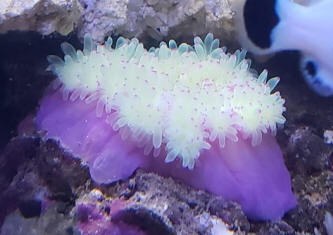
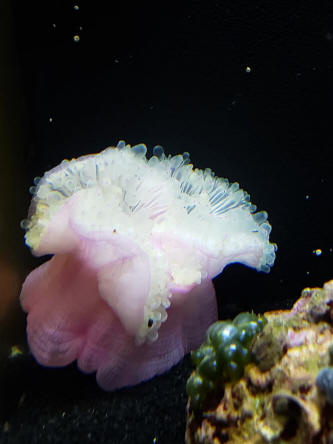
Sorry to bother you again, but.... H. malu hlth.
6/6/19
Hi again, I need advice. I read Dr. Fenner's EBook about Anemone care on Amazon.
(thank you for that!). But I still don't know for sure what kind of anemone I
have or the exact care it needs. Lighting especially.
<This appears to be a Heteractis malu; mostly by virtue of the shape and pink
tentacacular tips... the base appears healthy, but the tentacles, crown area
badly bleached>
I purchased this anemone, which was supposed to be a BTA from Saltwaterfishcom.
<Don't think this is an Entacmaea>
They listed it as a purple base bubble tip.
<? I've never heard of.>
I wanted it for my clown fish, whom I had separated because they were fighting
so badly over the
Quad BTA I bought for them. When it came it looked to me like they made a
mistake I would swear it is a H. Malu anemone. But they have argued and argued
with me that it is a special kind of BTA. OK. So I gave up fighting with them
and decided to try to keep it alive. I don't think it's a H. Crispa. But of
course, I don't know for certain which species it is,.....so what do you think?
And why does Saltwaterfish.com think it's a BTA?
<Can't respond to the last; perhaps just to make a sale>
Everything I've ever read about Sebae Anemones is that they are very hard to
keep.
<Initially healthy ones are not overly difficult; though not as hardy as
Bubble-tips>
When he got here he was in a very tiny bag,...but as I floated it he opened up
and look ok. I placed him on a rock after acclimating and he attached. Here his
is on the rock the first day. He is a beautiful
anemone, but I know that anemones aren't white unless they are bleached. So I
was worried. After a few days he just crawled into the back of the tank and got
as far from the LED lights as he could go. Facing the back wall of the tank.
<Not healthy>
I was afraid he might crawl back there and die! So I turned the rock so I could
see him at least. He still hated the light and crawled back to face the black
back of the tank. So, I decided to make a tank just for him temporarily, so if
he did die, he wouldn't take out my whole tank. I had a tank where I was growing
copepods, so I moved him there after doing a big water change,....at first he
seemed better. But not for long.
So, now he has been in that tank for about 1 week and I am having to do frequent
water changes to keep a small tank clean,....He is always better after a water
change, and then goes back to looking terrible after a day or 2.
He shrinks down to a very tiny size and then also flips over on his face.
I almost removed him yesterday because I was afraid he was dead! But he grabbed
on to the net and was not dead. When he is up and open, I have tried to give him
a few F/Thawed Mysis shrimp,....but he never holds on to them.
And I have read that if they don't grab the food they are not hungry. So don't
feed him. As you said " Underfeed!!". They are supposed to get their food from
the Zooxanthellae, but a bleached one shouldn't have many of them left.
I am not sure why he's not hungry.
<Not able to process food...>
I have purchased a bottle of Zooxanthellae to try to get him some to take in It
should be here tomorrow or the next day.
<Worth trying... or placing in a system w/ other photosynthetic life>
I also read that you can place the bleached one in a tank with another healthy
one, like my BTA and he can acquire Zooxanthellae that way. Have you heard that
too?
<Ah yes; tis so>
The thing I don't understand most is that he hates the lights. He's fine with
the blue ones on, but the white with the blue he doesn't like. He is on the
sand, which I have heard H. Malu likes better than sitting on a rock.
The live rock it right there if he chooses to move on to it. It's so light
colored now it's almost translucent,...like a ghost. I'm don't know what to do
to help it!
<You're doing, have done all I would have>
So, have you seen an anemone that looks like this one? Do you think it is a H.
Malu? Or is it a kind of BTA? And why doesn't it like light?
<See above...>
While searching your pages on Anemones. I read one of the people had one too
that kept hiding under the rock shelf.....it too didn't like the bright lights.
But theirs was eating. I'd really like to keep this beauty alive and make it
happy, but I don't know what exactly to do to help!
Any advice would be much appreciated.
Mandy in NJ
<I'd move this animal into a system w/ healthy photosynthates rather than keep
it where it is and rely on bottle Dinoflagellates... And I would take up
credit/replacement w/ Saltwaterfish.com. Bob Fenner>
|
  |
|
Re: Sorry to bother you again, but....
6/6/19
Thank you again so much Bob,....I will move the little guy immediately.
I'll let you know if he recovers!
Mandy in NJ
<Please do Mandy; thank you. BobF>
|
|
H. malu anemone mouth part protruding with body bloated
1/30/13
Hi Crew, we have had the H. malu anemone for 2 years and its been hosted
by a pair of percula clowns for about 20 months. We had it
in a 240l tank originally then upgraded to a 650l tank with a further
300l sump. The move went well with the anemone and clowns in one go. The
anemone is attached to a rock at the highest point in the tank so it was
repositioned in the new tank at the same height. The new tank has
approx 70kg of live rock and 5 inch of substrate. Lights are Chinese 120
w LED bars in blues and whites x 3.
<The blues are of no functional use>
After the move we did buy a few corals to add to the existing ones.
<Here's the issue little doubt: Allelopathy>
We have torch, button polyps, leather coral, xenia, frogspawn, mushroom
anemones, Duncans, to name few.
<See WWM re the Compatibility (FAQs) of each group>
Inhabitants are one spot Foxface, regal tang, Naso tang, 4 Chromis,
banded goby, algae blenny, Koran angel approx 1 year old rescued and I
know not reef safe, Lemonpeel dwarf angel, coral beauty, pajama cardinal
and Banggai cardinal as well as conch, snails, serpent starfish, cleaner
and fire shrimp.
The problem occurred after a 3 week holiday with no water changes but
water topped up regularly in that time. Was very cold, minus 10
outside and the pipes go under floor to sump, struggled to keep the temp
up. The anemones mouth has now protruded forward like the foot, and it
is grey in colour.
<I see this>
The body is boated slightly but is fully open, about 8 inches across.
Some of the tentacles have receded but the outer ones are fine and it
grabs for food but doesn't seem to take it to its mouth. (picture
attached hopefully).The clowns have always fed it before so I didn't.
Now some of the other soft corals have also bloated. I've lost 5 heads
from a Duncan, the torch and frogspawn are receding too.
Tank param.s are SG 1.025 PH 8.3 temp 24.7 at night to 25.8 in day. NO3
0.8 PO4 0.25 Cal 390. RedOx 328.
System is a bubblemagus skimmer, PhosBan reactor, NP reducing pellet
reactor, CO2 with carbon and calcium reactor yet to be connected.
Don't know where to go from here. Is the anemone dying? Thanks, Charlie
(from Scotland)
<This anemone is reacting to the presence of some of the other
Cnidarians here... Read:
http://www.wetwebmedia.com/cnidcompppt.htm
the linked files above... Bob Fenner>
|
 |
|
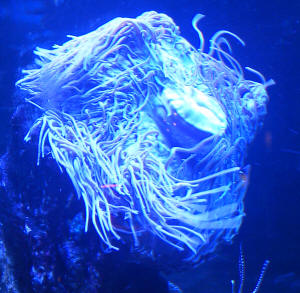
anemone ID 4/10/11
Hello, and thanks for the wonderful site.
<Ave and thank you>
I received this anemone from a fellow hobbyist on a trade and
having been trying to ID it since. I've looked through
countless faqs and pictures, but I can't settle on positive
ID. Every time I think I have it, I do some research and start
second guessing myself. Please check the picture and let me know
what you think.
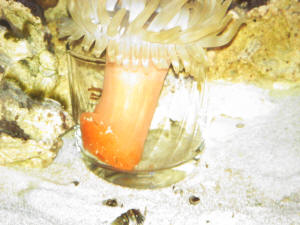
<Mmm, Heteractis malu. See here:
http://www.wetwebmedia.com/marine/inverts/cnidaria/anthozoa/anemones.htm
As you can see, it has attached itself to a drinking glass. I sat
it in there while moving some things around, and it quickly
attached itself. It is nice for getting pictures of the
foot/column though! Sorry for the poor quality of the picture,
it's from my phone.
Thanks,
Tom
<From the shape, smoothness of the pedicle, colour mostly.
Cheers! Bob Fenner>
|
|
|
|
Re: anemone ID 4/10/11
Thanks for quick response. Malu was my leading candidate, so
you've reassured me greatly. What would you suggest I do
about the glass?
<Mmm... I guess I'd leave it for now... this animal will
likely move elsewhere in time>
Before it attached there, it mostly just floundered around one
area of the tank. I had tried digging a hole so it could attach
to the tank bottom, but sand eventually got under the foot and it
let loose again.
I don't won't to damage it trying to remove it from the
glass, but it's too tall to bury it and leave it.
<Do read on WWM, books, elsewhere on the Net re this species.
BobF>
Re: anemone ID 4/10/11
Thanks again. I'll leave it as long as it's happy in
there.
<Ah good. BobF>
|
|
Re: BTA question, was H. malu
1/19/11
Dear WWM crew,
<John!>
Did I mention you guys are the best? Think I did. Having Bob
answer a question is kind of like getting soccer tips from
Pele.
<Heeee! And yes (!) we're both still alive!>
Digressions aside, the Heteractis anemone (certainly what he
is...was, sadly) has passed to that great aquarium in the sky; no
surprise as the requirements for E. quadricolor - which I could
handle - and H. malu - outside my ability - are not the same.
Fortunately diligent (obsessive) observation allowed me to remove
him almost immediately on expiration with no change in tank
parameters. New testing paraphernalia yielded good results with
phosphates at unmeasurable and calcium in the high 400's.
<Mmm, no bueno>
Now, the new issue. LiveAquaria, being as wonderful as they
always are with customer service, has sent the correct E.
quadricolor to arrive Thursday. I'm a bit worried still about
the allelopathy issue that Mr.
Fenner mentioned. E. quadricolor will also violate the Geneva
convention and conduct chemical warfare on his neighbors?
<Could well do so... best to greatly ameliorate this
possibility by separately housing (in isolation... quarantine)
and after a few days begin mixing some (a small percentage) of
water twixt the systems (with a
pitcher)... to allow both systems organisms to "get used to
each other">
I can try to alleviate this somewhat by overfiltering (say, a new
Biowheel or an extra skimmer), a small sump or reservoir, or
perhaps chemical filtration. Will any of those work out?
<All these will/do help, but do the isolating and water mixing
for a few weeks or more... you may well observe some behavioral
changes in the Cnidarians when you do these exchanges...>
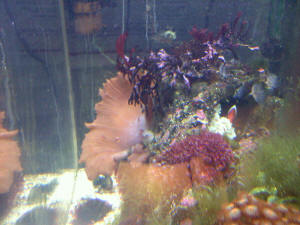
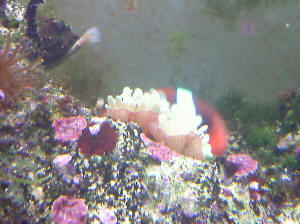
Thanks again. I've included two small pictures that
unfortunately are in violation of your size limitation - I tried
using iPhoto as suggested and failed utterly, so my apologies for
the file size and thanks again for
your help.
John
<Welcome. BobF>
|
|
|
|
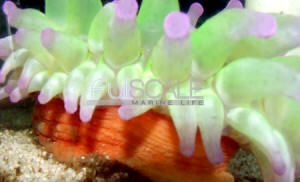
Anemone ID please? 4/14/10
Hi Crew,
(See attached pictures)
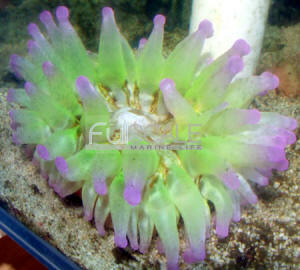
I received this anemone from a supplier last night,
inconveniently marked as "unknown anemone". Now I'm
not in the business of selling anything without knowing what it
is, so I've been trying to figure out what it is. It really
just doesn't seem like anything I've seen before, or any
images I have found. The orange base makes me think possibly a
/H. malu/?
<I agree>
I think it looks slightly like a /Condylactis sp./ but as far as
I'm aware we don't get them down here. Pretty much all
the info I can give you is that it was collected in Australian
waters, somewhere off the coast of Queensland.
Thanks heaps for your help,
Adam
<Is a beauty whatever it is. Bob Fenner>
|
  |
|
Moody Malu/Heteractis/Systems/Health
8/15/09
Can you help me. I have a lovely white malu that my Clarkes
Anemonefish has made his fortress!!.
<OK>
He's been in my tank for around 3 months, but in the last 3
weeks he decided to move across the tank (fair enough - let him
choose his spot), but at least twice a week he goes from being
big puffy & proud to a limp lump of an imitation (not fully
deflated for water exchange though but around a third of his
showy size).
Is there any preferred lighting or water flow area they
prefer.
<Your halides should be fine, 10-14K lamps is what I would
favor. A random turbulent water flow seems to work best for
both
corals and anemones alike, at least 10X the tank volume. A
wavemaker and three or four powerheads with protected intakes
will provide the effect.
This anemone prefers to attach firmly to a smooth surface with
its pedal disc and most of the column buried in a fine,
sandy substrate, about 4 inches deep. I might add that this is a
difficult anemone to keep for any length of time.>
If he wants to be higher in the tank I will move him as he
won't get there himself.
<Do read here and their care/systems.
http://www.wetwebmedia.com/marine/inverts/cnidaria/anthozoa/anemones.htm
The below link refers to Heteractis crispa, but most information
here can be used for
Heteractis malu as well.
http://www.wetwebmedia.com/marine/inverts/cnidaria/anthozoa/heteraccrispa.htm>
I tend to let the Clarkes feed him (she bites if you go near
anyway).
My system is 240ltr,
40kgs live rock, metal halide lighting. Strong to medium water
circulation,
Vector V2 protein skimmer, Marysis 240 filter system (I also have
Fluval canister filter running for ultraviolet steriliser and
fluidised sand bed filter)
Water parameters are Nitrite 0, Ammonia 0, Nitrate 5ppm,
Phosphate 0, SG 1.022,
<Too low for keeping this anemone, more like 1.025/6.>
Calcium 420, Carbonate 9, Ph 8.3.
Thanks for any help,
<You're welcome. James (Salty Dog)>
Simone
Re: Moody Malu 8/15/09
Desperate help.
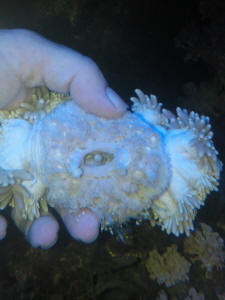
The anemone started moving around the tank and then look bit
rough in the night so lifted him
<Generally not a good idea>
to place in lower water flow and this is what I found.
It looks to me like something in the substrate has taken him for
dinner and eaten away his foot.
<Yikes!>
This can only of happened in the space of a couple of hours as he
showed no signs of any deterioration when placing him right side
up.
<Can rot quickly>
Is there anything that can be done to help him. (Needless to say
I have taken him off the sand and place him on a flattish rock to
try and stop him being eaten completely.)
Any help and advice would be gratefully received.
Thanks
Simone
<... read here: http://wetwebmedia.com/CnidIndex2.htm
the sections on Actinarians period; as James suggested
previously. Bob Fenner>
|
 |
| Malu or crispa? 4/13/08 Evening
folks! <And a good day to you! Mike I here with you> Great
site! (You know this already J) <We do, but we always like to
hear your feedback too!> I'm a long time reader. Thanks to
your site, various books written by WWM authors, and other media
outlets my friends consider me to be the most reputable person to
ask about a saltwater situation. I try to educate as much as I can
because the animals in our systems deserve the best care we can
offer. <Kudos to you for that as well!> Thanks for everything
you all do for us; the enthusiasts <Our pleasure, Steve> On
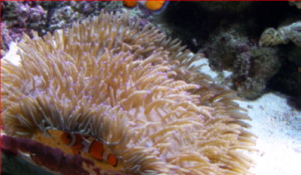
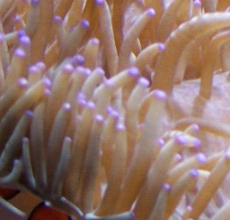
to the anemone.. <Yes, indeed> This is my Heteractis malu
(99.9% sure - at least that's what I've called it for the
last several years) that I've had in the 120G reef for 3 years
now. I wanted to share and get a positive/definitive identification
from the experts. Based on the tentacle length and rings on the
tentacles I'd say this is a Heteractis Malu but a few others
have seen it think it's a crispa. What do you think? <I
agree with you> A little about him: I acquired the specimen from
a LFS in the city in early 2005. The clowns that use him as a host
I've had even longer. Back then, his max expansion was maybe 3
inches. He lived with me for a while then I moved residences and
had to break down the 120 and move it across town. Luckily all was
well after the reconstruction of the system. During the day he can
expand to 15 inches in size. I feed him every few days with Mysis,
Cyclop-eeze and I stir the sand in the tank every few days until
there's a fine cloud of stuff in the water. Many corals in the
tank have seemed to benefit from this stirring of sand. Thanks for
your time and dedication to our hobby and passion. Steve Wright
<As I said above, Steve, I agree with you that is Heteractis
Malu. Tentacle structure, variety of length, markings etc, all lend
to this species. Looks like you're doing a great job keeping
him happy, and long may it last. Good job! Mike I> |
|
|
Unknown Anemone??? 3/15/08
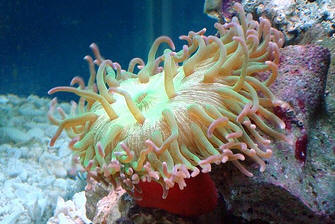
Hello there WWM Crew, <Ashley> We recently purchased a
beautiful anemone from a large chain pet store and unsurprisingly,
the staff there had no knowledge of the animal we wished to
purchase. It was just far too beautiful to pass on. That being
said, I will give a brief description and then also attach a photo
for your review. It has a bright reddish orange foot and a very
bright green body. The tentacles are also green and tipped in light
pink and form a spiral shape when not being moved by the current.
The body is shaped like a plate with most of the tentacles growing
from the edges with only 8 or so tentacles places just around its
mouth. I have spent several hours scouring the Internet in attempts
to identify it so we can understand it's wants and needs but
have not even been able to find a photo of one with a similar body
style! A huge thanks in advance, Ashley <Is very likely a
Heteractis malu... on the basis of the pedicle color, tentacular
structure... see here:
http://wetwebmedia.com/marine/inverts/cnidaria/anthozoa/anemones.htm
and the linked files above...
Bob Fenner> |
|
|
| Anemone ID - I've searched the site
and can't find a match 2/27/08 Hi - If you can help that
would be great. I've searched and searched and asked on other
forums and have gotten so many different answers I'm not sure
what's right! My LFS has this anemone and I'm very
interested in it - but want to be sure of its classification before
I buy so that I can ensure giving it proper care. So far I've
heard rock anemone, beaded anemone and H. malu anemone... What do
you think? And if you know - can you also provide a link to where I
can find more information on the species? Thank you! Kim <Hi,
Kim. Mike I with you here. I'm afraid I've given my opinion
on this one already, on a forum (I'm the one who asked if I
could use your pics!). My opinion hasn't changed I'm
afraid, in that it appears to be Heteractis malu. I know you want
more opinions, so hopefully Bob F may chip in as this is published.
All I can add is that if you can manage a picture of the underside
of the oral disc, and anything of the column, it may help seal the
deal. As for more info, searching the WWM files should bring you a
fair bit of information. Thanks. Mike I> |
|
Almost certainly H. malu. RMF
|
Malu Anemone... sel., gen.
2/10/08 I have seen a beautiful Malu in my local LFS and would like
to know a few things before I say yes to buying it. Its a creamy to
white colour with purple tips about 5-6" diameter and healthy
looking but I have heard they can be hard to keep. What I need to know
is what size tank and conditions it ideally likes and what kind of
water flow it prefers. Does it like higher spots in the tank or more
towards the bed - I've also read they tend to stay more or less
where placed rather than roam. I do weekly water changes of 20% and
have 0 in Nitrate, Nitrite and phosphate. S.G is 1.205 with temp of
80%. <Sorry to give such a bland reply, but if you use the search
function, you will find your answers. Specifically, start here:
http://www.wetwebmedia.com/sebaesysfaqs.htm and http://www.wetwebmedia.com/hetmalufaqs.htm.
What I will add is that the anemone is likely bleached, so makes the
challenge of keeping it successfully ever more hard right from the
beginning. If after searching you still have questions, then by all
means come back to us. Mike I>
Anemone Identification
10/20/07 Hello WetWebMedia Staff People! <Hi Kevin> As my
subject suggests, I need help in identifying an anemone that I am
attempting to purchase. I am trying to complete my fishtank with a
Heteractis malu, <Difficult critter to keep/acclimate.> but
I'm having issues going to different LFSs and finding the one I
want. I've seen different anemones that look like long tentacle
anemones, Heteractis crispa and Heteractis malu, but at some point they
all seem to be labeled as sebae anemones. <One and the same. Read
here.
http://www.wetwebmedia.com/marine/inverts/cnidaria/anthozoa/heteraccrispa.htm><<...
these are separate species... RMF>> I have tried doing picture
searches online to try and distinguish which anemone is which, but the
pictures seem to come up looking very much the same. The WWM pictures
are too small for me to effectively identify the anemone I'm
looking for. What are the clear differences between the three anemones
that can help me distinguish one from the other, including foot /
tentacle color, etc? <Oboy, as far as color, it will depend on how
healthy the anemone is. They generally do not ship to well. But
I'll give it my best. Heteractis Magnifica can grow to an enormous
size of about three foot and the tentacles are greenish in color with
purple tips. Heteractis Aurora, sometimes called the Beaded Anemone,
has characteristic knobs on the tentacles and a striped oral area. It
likes to bury it's column in the sand. Heteractis Malu likes to do
the same and has short tentacles creamy in color with small purple
tips. Heteractis Crispa has numerous long pointed tentacles creamy in
color, and is one of the more commonly found anemones.> The reason
for me attempting to get a Heteractis Malu is because its occasional
appearance in certain parts of Hawaii. I decided a while back that I
wanted to have a Hawaii themed aquarium, not including those pesky
triggers or butterflies that eat inverts. Thanks for all of your help!
<You're welcome. James (Salty Dog)> Kevin <<See here as
well:
http://www.wetwebmedia.com/marine/inverts/cnidaria/anthozoa/anemones.htm.
RMF>>
Malu Question 6/4/07 Hi WWM just firstly to
say what a sterling good site you have! right my problem, I have a Malu
Anemone which has been in my 180Lt Jewel Vision for over a year now and
feeds happily on cockles and shrimp, the problem is when I bought the
anemone he was a fantastic Vanilla with pink tips but has turned into a
not so pretty brown? the tentacles have also gone from thin flowing
tentacles to a short stubby ones, my Nitrite is at 0 Nitrate is at 0.10
Ammonia 0.1 <Mmm, do check this last... REALLY needs to be zip,
zero, nada... Check your checker...> and PH 8.5, The Malu is also
host to 2 common Perculas, I am running a UV Prizm skimmer Fluval 405
external, I have converted my lighting <Recently?> and currently
running 2 T4 which look very bright but the lighting has always been
good, any help would be appreciated, sorry fish in tank are 1* large
Yellow tank/1 orange spot goby/1 dart fish/1 devil blue/2 common
Perculas/ 1 cleaner wrasse & about 10 turbo snails and 2 cleaner
shrimps, all my soft coral look great and have grown a lot in a year
just the poor sad looking Malu !! any advise appreciated Regards Harvey
<Well... "something" is amiss here... perhaps circulation,
maybe the Clowns are brutalizing this specimen... could be water
quality of some sort... Nutrition... Incompatibility... Please read
here: http://www.wetwebmedia.com/marine/inverts/index.htm Scroll down
to the tray on Anemones... re their Systems... Compatibility... and
Malu's in general. Am hoping this "something" will become
live to your consciousness by this process. Bob Fenner>
Bleaching Malu Anemone Hi, First, I just want to
complement you and your crew on your wonderful site. I have
been an avid aquarist for over 25 years and I really enjoy & learn
a lot from your site. I have a question about a (what used
to be) very large malu anemone. This anemone has been alive
and well in my tank for more than 5 years. <How nice!> It is host
to a mating pair of tank raised ocellaris clowns who will occasionally
feed it. I only rarely provide supplemental
feeding. It has survived one previous bleaching episode when
our A/C broke (no chiller), it turned mostly white (from a usual creamy
mocha color) but recovered within 2 weeks after the A/C was
fixed. My wife and I recently had out first child, and due
to this event, my reef tank husbandry has been somewhat
lacking. I regretfully allowed an organic film to develop on
the surface of the water and also did not clean the glass canopies for
about 2 months. The resulting loss of light has taken
its' toll on the anemone, some star polyps, Zoanthids, and
mushrooms. I was recently able to restore the tank to
its' original state, new bulbs, new canopies, no film and now
plenty of light. The mushrooms, Zoanthids and star polyps
all appear to be recovering nicely. The anemone, however, is
still a completely creamy white color and only about 1/3 of its'
original size (it has been this way for about three
weeks). It appears to be feeding & still remains planted
in its' spot. My question is, should I increase
supplemental feedings (again, this anemone has survived and grown well
for 5 years with only about 2 monthly supplemental feedings of fresh
shrimp, as well as whatever the clowns bring). Also, is
there anything else I can do to help the recovery of this specimen?
<Mmm, not much more than you have done... keep feeding, stable...
and hopefully the animal will reincorporate zooxanthellae/color>
Any help would be greatly appreciated. The tank
specs are as follows: 55 gallon AGA w/overflow JBJ formosa dlx compact
PC lighting 20 gallon sump Urchin skimmer water parameters WNL 60 lbs
live rock sand bed inhabitants (all original 5 y/o fish): 1 Yellow Tang
3 Ocellaris clowns 1 Orchid Dottyback 1 Pygmy Angel 1 Firefish 1
Yellow-Tail Damsel Assorted soft corals, 1 open brain, 1 bubble coral
& 1 malu anemone. small hermits, brittle star, Astrea &
Nassarius snails for cleanup Small population of Aiptasia No new
additions for the last 18 months. Thanks you much for your time &
assistance. Have a great day! Rodney <Thank you, Bob
Fenner>
Re: Bleaching Malu Anemone Mr. Fenner, Thank you so
much for your fast reply! As of this morning, one tentacle appears to
be regaining some of the original color. <Ah, good> The central
disk also appears slightly darker. <Even better> Hopefully this
is the start of the road to recovery. I will take your advice and
continue feeding & maintaining stability. I really don't want
to lose our old friend. Thanks again and have a great day! Rodney
<Real good. Life to you my friend. Bob Fenner>
Anemone Division? - 9/24/03 Can a Heteractis malu be
safely divided by cutting in half? <the mortality rate is much
higher than with Entacmaea quadricolor it seems. Although not enough
folks have done both for the numbers/rates of success to be reliably
accurate> And also, how big does this species get? <a relative
answer: incalculably aged specimens in the wild may appear to approach
bath-tub sized. Well <G>... maybe not quite that big (but
24"+). But in captivity, the are slow to grow (poor husbandry in
part) and are not likely to see too far past 12" across> The
reason I originally went for this species is that I wanted a small
one, and the literature I read said this was a small species
that normally grows to about 10 inches. <agreed for most, yes>
The one I got was smaller than that, but has got bigger and bigger and
will now expand to 19 inches. <outstanding!> It has a good color
and seems very healthy, if it can be done with this species I would
like to divide it and start again. ( Yes, it is definitely a H. malu
).Thanks <I would not experiment with this one. Perhaps, rescue and
recover a bleached one from a pet shop... and try it on a smaller
specimen first after some months of nurturing. Please take pics along
the way and share your results too. Anthony>
|
|

