|
Related FAQs: Fishes of
Hawai'i, Articles on: The Best
Butterflyfishes of Hawai'i, Triggerfishes of
Hawai'i,
Related Articles: A
Fishwatcher's Guide to the Marine Aquarium Fishes of
Hawai'i, Introduction to
Fishwatcher's Guide Series
Pieces/Sections, Scott's Trip to
Maui/Hawai'i, Holualoa property,
A Fishwatcher's Guide to the
Marine Invertebrates of Hawai'i
Part 4 of 4, To: Part
3, Part 2, Part 1,
|
|
|
Bob Fenner
|
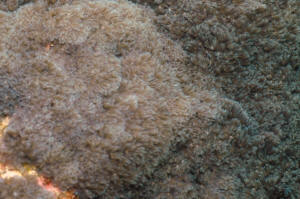
Anthelia
edmondsonii, the most common of the
few soft corals found in Hawai'i
|
Echinoderms
Sea Urchins:
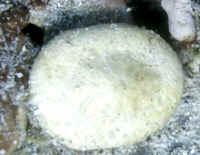
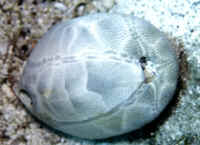
| Brissus latecarcinatus (test) Leske 1778,
the Keeled Heart Urchin. When live this urchin lives barely under
the sand and is covered with short brownish to pinkish spines.
Hawai'i pix of upper and obverse tests (exoskeletons), showing
the crescent mouth opening and anus at the other end.
|
|
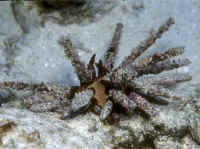
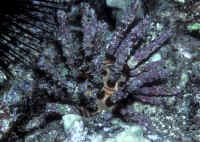
| Chondrocidaris gigantea, A. Agassiz 1863,
the Rough-Spined Urchin. Dark Larger outer spines covered with
fouling organisms (algae, sponges, bryozoans...). Relatively short,
secondary spines are clean. Hawai'i and New Caledonia at depths
of usually 30 meters plus. Hawai'i pix. |
|
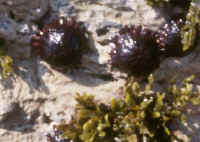
| Colobocentrotus altratus (Linnaeus 1758),
the Shield Urchin. Indo-Pacific; scattered from Africa to
Hawai'i. Intertidal to six feet of depth. Eats algae in the
surf/surge zone. Here above the water mark off of Kailua, Kona
(Hawai'i's Big Island) airport coast. |
|
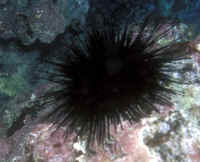
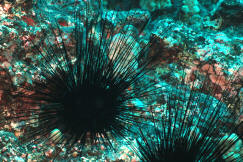
| Diadema paucispinum (A. Agassiz 1863), a
Long-Spined Sea Urchin. Pacific; Hawai'i and islands of the
South Pacific. To about twelve inches maximum diameter, with
spines. Usually in 60 or more feet of water on a vertical surface.
Common name means "few spines" which you may not agree
with if you get poked but good. Kona pix. |
|
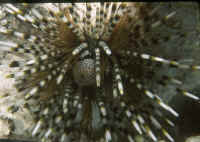
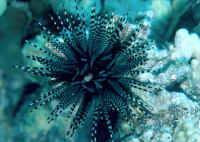
| Echinothrix calamaris (Pallas 1774), the
Hatpin Urchin. Indo-Pacific; Red Sea to Hawai'i. Should be kept
singly and may prey on cnidarian livestock. Need large spaces in
rock to hide amongst by day and coarse substrate. Cebu, Philippines
and Hawai'i images. |
|
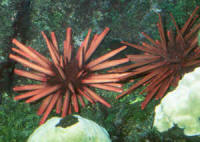
| Heterocentrotus mammillatus (Linnaeus 1758),
the (Red) Pencil Urchin. Indo-Pacific; Red Sea to Hawai'i.
Nocturnal, hiding in crevices by day in depths to thirty feet,
emerging at night to rasp rocks. To one foot overall diameter.
Hawai'i picture. |
|
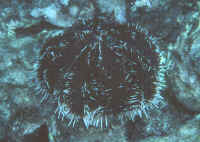
| Tripneustes gratilla (Linnaeus 1758), the
Priest-Hat or Collector Urchin. Family Toxopneustidae.
Indo-Pacific; Red Sea to Hawai'i. Toxic to the touch to sea
life. To about five inches in diameter overall. Mentioned so
hobbyists will avoid it. Shown: At right in Hawai'i. |
|
Sea Cucumbers:
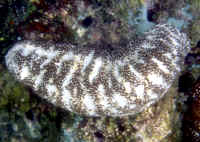
| Actinopyga mauritiana (Quoy & Gaimard
1833), the White-Spotted Sea Cucumber, loli (Hawaiian). Frequently
found in surgy, seaward, shallow water settings, holding on firmly
to the rocky substrate with their tube feet. To twelve inches.
Hawai'i pic. |
|
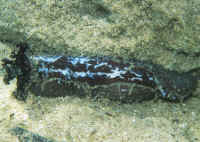
| Holothuria atra Jager 1833,
the Black Sea Cucumber. Indo-Pacific; Red Sea to Hawai'i.
Detritivore often found in shallows, close to shore. General
detritivore. To two feet in length. This one in
Hawai'i. |
|
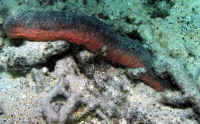
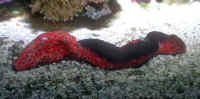
| Holothuria edulis Lesson
1830, the Edible Sea Cucumber. Indo-Pacific
including Hawai'i. Skin soft, pink underneath, blackish above.
Found in shallows, close to shore. General detritivore. To eight
inches in length. One in Fiji, another in captivity. Edible but not
considered delicious. |
|
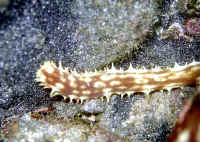
| Holothuria hilla Lesson 1830, the
Light-Spotted Sea Cucumber. Found partly exposed at night times in
rocky and sandy settings. Indo-Pacific. Hawai'i pic. |
|
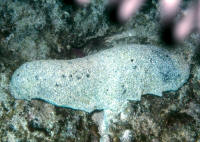
| Holothuria whitmaei Bell 1887, the Teated
Sea Cucumber. Indo-Pacific. To one foot plus. Hard black bodied
with light sand coating stuck to the outside. Called the
"Mammy Fish" for its nipple-like "feet". Prized
for the consumption of the outer body-wall as "beche de
mer". This "loli" in Hawaii. |
|
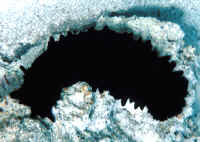
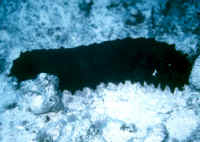
| Stichopus chloronotus Brandt 1835, the Black
Sea Cucumber. Indo-West Pacific; eastern Africa to Hawai'i and
the South Pacific. Useful for reef aquariums when small. To one
foot in length. One in Roratonga, Cook Islands, where it's
contents are often consumed as "rori" and another off of
Hawaii's Big Island. |
|
Sea Stars:
|
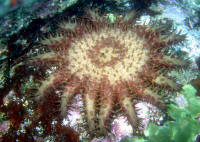
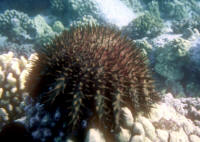
Acanthaster
planci, the Crown of Thorns Star. The
Triton Snail, Charonia tritonis is about the only predator
of this coral eater in Hawai'i. To about a foot
and a half across... and venomous! Do not touch. Here in
Hawai'i, moving and eating.
|
|
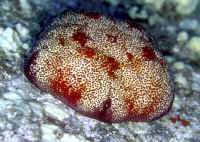
| Culcita novaeguineae Mullet & Troschel
1842, the Bun Starfish, Pincushion Star. Eastern Indian Ocean,
Western Pacific. To a foot in diameter. Though seemingly sessile,
this animal requires large quarters with plenty of open space, and
feeding of bivalves, snails, fish meat, tablets... and may eat your
corals! Images made in Hawai'i. |
|
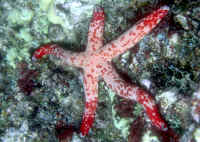
| Leiaster glaber Peters 1852, the Red Velvet
Star. Slender arms, irregular red blotching, small central disc. To
about 8 inches across. Indo-Pacific including eastern Pacific.
Nocturnal, unlike the similar Linckia guildingi of similar
coloring and markings. Here in Hawai'i. |
|
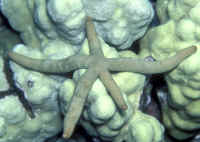
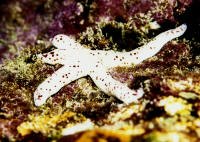
| Linckia guildingi Gray 1840, the Green
Linckia. Usually with five (sometimes 4 or 6) arms that are
cylindrical in cross section. Skin appears smooth but is coarse
with low, hard nodules. Though called "green" occurs in
other colors (tan, beige, brown, blue, reddish). Big Island Hawaii
pix. |
|
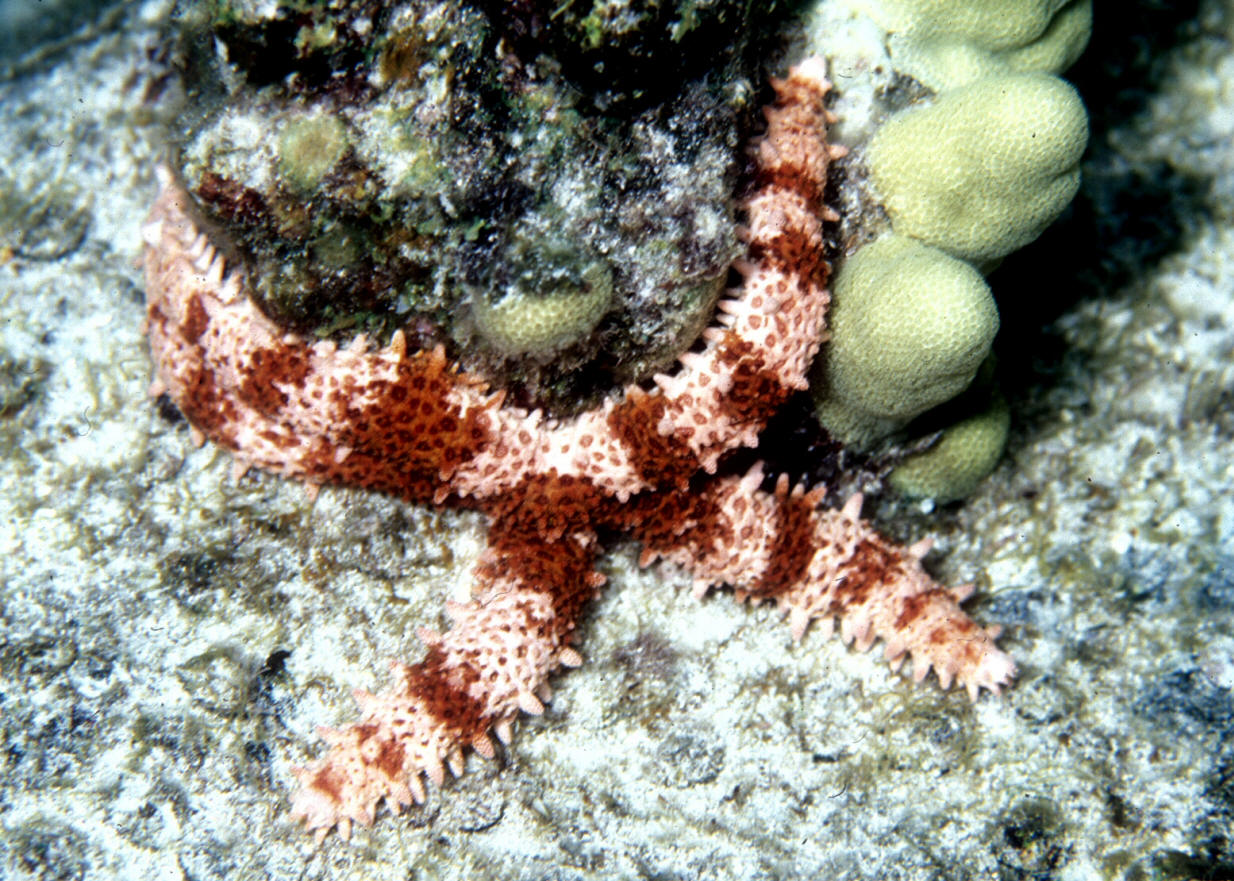
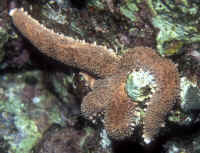
| Mithrodia fisheri Holly 1932, Fisher's
Star. Body covered with large bumps. Color variable; from white to
cinnamon, generally with dark banding on roundish arms that have a
lateral row of blunt spines. Feeds on sponges, bryozoans, other
sessile invertebrates. Most about 4-6 inches in diameter though
attains at least a foot. Daytime and nocturnal. Kona
pix. |
|
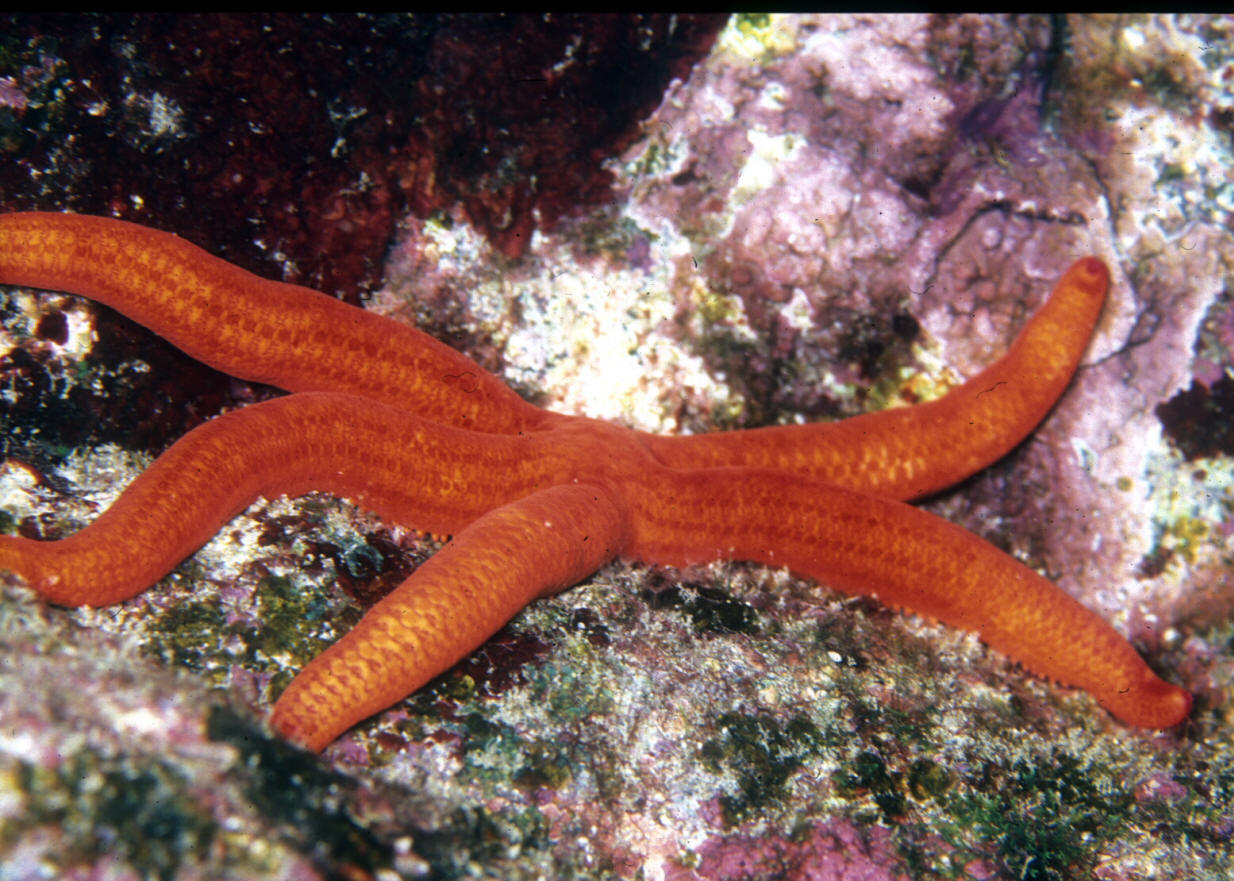
| Ophidiaster hemprichii Muller & Troschel
1842, Hemprich's Star. Legs round in cross section, of
variable color, usually reddish brown, with grey blotches. Body
made over with nine rows of articulating plates. To four inches
overall. Tropical Pacific. |
|
Brittlestars:
| Ophiocoma erinaceus Muller & Troschel
1842, the Spiny Brittle Star. Indo-Pacific. To 5.5 inches in
diameter. Dark by day, grayish bands by night. Found in association
with living corals. Hawai'i' pic at night. |
|
Ascidians/Sea Squirts:
| Ascidea sydneiensis Stimpson 1855.
Yellow-Green Sea Squirt. Solitary urn-shaped zooids of up to four
inches in height. Large and few oral siphons. Variable in color.
Worldwide in tropical seas. Hawai'i pic. |
|
To: Part 3, Part 2, Part
1,
Bibliography/Further Information:
|
|

