|
|
| Home | Marine Aquariums |
Freshwater Aquariums |
Planted Aquariums |
Brackish Systems |
Ponds,
lakes & fountains |
Turtles & Amphibians |
Aquatic Business |
Aquatic Science |
Ask the WWM Crew a Question |
| Please visit our Sponsors | ||||
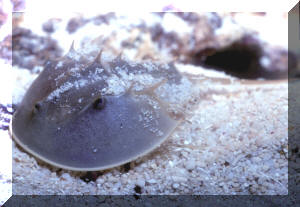
Horseshoe crab Overview 4/14/03 Hi I was looking around wet web media and didn't see any articles on horse shoe crabs like what they eat and size so I was wondering if you could tell me or point me in a direction of where it would be on your web site thanks JM <the following is a bit that Bob and I recently penned on this creature. Best regards, Anthony: Caption for photo: "Horseshoe crabs are not true crabs at all, but actually much more-closely related to spiders. They are also inappropriate for mixed invertebrate aquariums for many reasons. These "crabs" need to be kept in large, specialized (non-reef) systems that are have great open surface area and sand of depth. Definitely not recommended for casual keeping in small home aquaria with coarse sand and dense rockwork. The most commonly available species, Limulus polyphemus commonly ranges from Nova Scotia down to the Gulf of Mexico and grows to 2' long X 1' wide (60 cm X 30 cm). Several other species are seen in coastal waters from Japan to Indonesia, but do not appear in the US hobby." Overview of Limulus polyphemus By any definition, horseshoe crabs are ancient relics of the past. They have not changed much in the last several hundred million years dating back to the pre-Cambrian era (and are closely associated with their fossilized relatives, the Eurypterids). It is no wonder why they are described so often as "pre-historic". The design of their body has facilitated their long survival through the ages with its strategic and fully encompassing hard shell. Limulus are also extremely hardy in the present wild... enduring severe extremes of temperature and salinity. They are also said to be able to suffer seasonal famine and live without food for as much as a year! A year is also about how long it takes for these crabs to starve in mismatched marine aquariums. Too often, horseshoe crabs are placed in small aquaria with lots of live rock and not enough sand to burrow, forage and survive. Mind you that an abundance of live rock is very beneficial for reef aquariums. The problem is that these creatures, though, do not live on the reef proper. They do live near the reef, however, and will thank you very kindly if you provide a large open bed of deep fine sand for them to dig in. It takes perhaps 10 sq. ft per crab of more at >6"/15cm depth). It is interesting to note that horseshoe crabs may stay buried in the sand for days or even several weeks at a time. Let's be very clear that they live or die in captivity by the presence of deep fine sand and mud and the food they find within. We recommend using finely minced clams and clean Tubifex worms (live or thawed frozen) as part of the staple diet for this creature in captivity. Other ocean meats may be taken with equal enthusiasm. Be very mindful of the size and composition of food offered; Limulus have no jaws to chew or crush prey but instead process food with bristles at the base of their walking legs (yes... they must walk to feed, as the food is passed and mashed by these bristles). Although hardy and peaceful in their natural habitat, these "crabs" do not fare well in captivity outside of large, mature specialized aquaria. They tend to linger for some months in captivity, but again, do not survive past a few months with casual care. Limulus are not true crabs at all, they are rather distant relatives of the spiders, scorpions and even the lowly ticks. Aspects of their phylogenetic relationships are suggestive when you observe their anatomy. The most obvious similarity is their prominent pair of compound eyes. In fact, in addition to the conspicuous pair of compound eyes, these crabs have a second pair of simple eyes on the front side plane of the body. A horseshoe crabs vision is not for feeding however, but for evading predation and finding mates. It is estimated that their range of sight is about 3' (~ 1 meter). Limulus also have 5 pairs of "walking" legs and two specialized pair for feeding and pushing sand, the forward pair on males being distinctly thicker and larger. Perhaps the most distinguishing part of these creatures is their telson (tail). This aspect of their anatomy performs like a rudder for balance and navigation as well as providing ever-important leverage to right themselves from a vulnerable overturned position. Its also quite a formidable weapon (although not its primary purpose) with spines and "timeliness" when thrust erect to ward off a would-be attacker. Despite the armor, horseshoe crabs are in fact rather peaceful creatures. They seem to be fairly indifferent to each other and anything that's not interested in eating them. They are somewhat generalized scavengers that consume many different things strongly preferring polychaete worms and mollusks in the sand. Their natural feeding habits keep them very active at night though in captivity they are willing to feed most anytime of the day if stimulated. This is a large part of the reason why they starve in most aquaria- few are placed into systems with aged, deep mature sand beds that have adequate populations of food organisms to sustain them. It is estimated that Limulus grows approximately 25% with each successive molt for roughly the first decade of life until they reach maturity. Molts occur every 7-10 months naturally. Reproduction is a bit of a ritual during high tide (full and new moons) in the spring or early summer each year. Droves of Limulus migrate to the shoreline to spawn and lay staggering amounts of tiny green eggs. A large female may lay as many as 20,000 eggs which are deposited in a series of holes that she digs along the water line. Copulation is a bit of an interesting display. The males of this species (characteristically smaller than females by about 30%) grasp a hold of a female as she leaves the water to make this run. They are dragged along as the females climb up the shoreline and fertilize each batch of eggs as they are pulled across each pit dug by a female. Wave action covers over some of these nests but numerous Limulus eggs are contributed to the food web above and below the water (fish, birds, etc). In aquariums, many fish will prey on small and young horseshoe crabs. Their chitinous shells have not become sufficiently hardened and they will suffer from repetitive harassment of even curious fishes like large tangs and angels. It should be no surprise that triggers, puffers and eels will readily predate them. It is also quite unnatural for them to be kept with cnidarians and forced cohabitation will usually lead to Limulus dying in the tentacles of an anemone, or large polyped coral. Keeping these crabs in captivity also has very practical implications for their metabolism and increasing size. Before you purchase one, ask yourself if you have the means to keep them as an adult as 16"- 24" (40-60 cm) if and when they are ten years old? If you plan for a full healthy life and lifespan for this creature as you would for any other household pet like a dog or cat, you will quickly realize the very special needs of this fascinating "crab". Our purpose here is not to discourage the popular keeping of this marine creature, but to discourage the improper keeping of it. In a simple sandy lagoon or shoreline display, Limulus polyphemus are remarkably easy and entertaining to keep. Horseshoe crabs- beyond aquaristics: Although Limulus polyphemus are still observed in great numbers, natural plights and human activities have impacted their once abundant populations. Some states in the US have established protected Limulus sanctuaries on assigned beaches. These agencies have sadly followed the lead of governing bodies before them forced to protect their natural resources like the Japanese with now endangered Limulus. The US Federal government has even imposed regulations on the bleeding of horseshoe crabs for improved survivability on catch and release. The unique blue blood from horseshoe crabs has been studied for about fifty years for its remarkable medical properties. Research has focused on anti-bacterial and anti-clotting aspects and the substance known to medicine as Limulus amoebocyte lysate (AKA- LAL). An injured crab uses this substance to quickly clot and disinfect a wound. Medical science uses it to verify that human drugs are bacteria-free and safe. Blood harvested for this research is said to fetch $10,000-15,000 per quart! Sounds to us like somebody needs to either discover how to synthesize it, or how to breed Limulus commercially. Horseshoe crabs have other economic and research values. Their eyes have been studied to enhance our understanding of how the human eye works. Chitin (chitosan) in their shells can be used to manufacture contact lenses and cosmetics and is also said to have nutritive value in homeopathic treatments. Commercially is has been used as a metal sponge in waste water treatment, and medically is can be used to make hypo-allergenic sutures for surgery. Numerous other uses are being researched from this unassuming yet valuable creature. Conservation starts at home as they say. As aquarists, please be mindful of your contribution to the use of this precious living resource. Good aquarium husbandry of this and any animal we keep serves the species through improved awareness and understanding. Fenner and Calfo 2003 Re: horseshoe crabs Hi I read the paragraph it seems its directed at only one species. I'm not sure what I have its light tan and about 2-3 inches in length I have about 7 inches in the back of my tank with lots of sand that he has left trails through would this be a small one that don't get big or a gigantic one? I told the pet store lady my tank was 30 gall long and she recommended him? what do you think. Thanks guys for all my question. <Most all anyone sees in the trade in the U.S. is Limulus polyphemus... they do get large. Bob Fenner> |
|

|
Features: |
|
| Featured Sponsors: |