|
FAQs about Horseshoe Crabs,
Disease
Related FAQs: Horseshoe Crabs 1, Horseshoe Crabs 2, & FAQs on: Horseshoe Crab ID, Horseshoe Crab Behavior, Horseshoe Crab Compatibility, Horseshoe Crab Selection, Horseshoe Crab Systems, Horseshoe Crab Feeding, Horseshoe Crab Reproduction, & Crustaceans 1,
Micro-Crustaceans, Amphipods, Copepods, Mysids, Hermit
Crabs, Shrimps,
Cleaner
Shrimps, Banded Coral
Shrimp, Mantis
Shrimp, Anemone
Eating Shrimp,
Related Articles: Horseshoe Crabs: Latter Day Trilobites for
Some Systems & Crustaceans,
Micro-Crustaceans, Amphipods, Copepods, Mysids,
Isopods, Shrimps,
Coral
Banded Shrimp, Cleaner
Shrimp, P. holthuisi
Pix, Mantis
"Shrimp", Lobsters,
Slipper
Lobsters, Hermit
Crabs, Squat Lobsters, Crabs, Arthropods,
Pycnogonids (Sea Spiders),
|
|
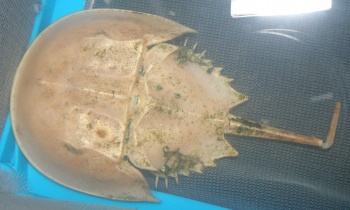
Horseshoe crab molting 4/5/17
To whom it may concern,
<Sara>
I'm a naturalist and we have a lot of aquariums at my nature center.
We've had a resident horseshoe crab (about 5-6" diameter) for some time,
but his last molt was unsuccessful and it seems to be in poor health
now. It's
limbs an carapace are deformed.
<Mmm; there are a few general "causes" for such: A lack of iodide-ate,
imbalance/deficiency in alkaline earth materials (mostly Calcium; to a
lesser degree Magnesium), "poor" water quality outright (e.g. too much
organic content); and lack of nutrition. You should look at all these
possibilities>
It's been flipping itself upside down repeatedly today with no success
in righting itself (I've tried righting it several times by hand). It
still eats fine and the water levels are all normal;
<.... data please; not impressions>
everything else in the tank is in fine health (urchins, another
horseshoe, etc.).
<Ahh; a good clue>
Is there anything that can be done to help ensure a successful molt?
<The above considerations. Do you have test gear for water parameters?
What are you feeding, using for supplements?>
Based on my observations, I think it should've molted again by now but
it just hasn't.
Thanks!
Sara Yinger
<Let's keep chatting till this is solved. Bob Fenner>
OUR HORSESHOE CRAB; hlth.
12/4/13
Hi Crew,
Our small, male horseshoe crab, who's in a touch tank, has lost
all its pedipalps and "pusher" feet, exposing tissue. We're
thinking that constant movement on the rough sides of the tank and
digging in the sand has caused this, but that's just a guess. Can you
help us?
<Possibly. Most limb losses are due to issues of nutrition or water
quality. Do read here re:
http://wetwebmedia.com/hshoedis.htm
and the linked files re Limulus above. Bob Fenner>
Brandis Hartsell, Ph.D
Dept. Chair and Curator
Marine and Earth Sciences
Roper Mountain Science Center
Greenville, SC 29687
Limulus polyphemus questions --
08/26/09
We have had six horseshoe crabs (Limulus polyphemus) for the past 6
years for our touch tank- two are out for touching, and the other four
are held and rotated periodically.
Our largest one (shell is approximately 6 inches across) molted 2 years
ago, but the new shell has never reached the normal level of hardness.
It seems to be thinner and gives to the touch. Calcium levels in the
tank are in the 330 to 360 range. Any ideas on why it has not hardened
up?
<Mmm, yes. Best guess is a disproportionality of Magnesium (should
be about 3X Ca) and/or low Alkalinity... in the water, though these can
be made up in foods>
Our other issue is on another crab in our holding tank has just
recently developed loss of color and hardness in portions of the last
half of its telson, with the last 2 cm breaking off. Anyone out there
have any experience with this sort of problem?
<Mmmm.. is there an excess of nitrogenous wastes, e.g. Nitrate
present?>
The crabs are fed either mussels or silversides. Tanks are kept around
14 C degrees, specific gravity 1.020,
<Too low... this may be a factor... I'd raise to 1.025>
Ammonia <.15, Nitrite .02,
<These should be 0.0 ppm>
Nitrate 0, Mg 1290, pH 8.4, Alkalinity 3.6. with algal scrubbers for
filtration.
<Likely NO3 issue with this form of filtering>
Thanks for any ideas.
Dave Sobal
CSC Aquaria & Animals
<... Catawba... Bob Fenner>
| Horseshoe Crab/Health 2/9/07 I'm hoping
you can help me out. <Hope so, Deborah> I have a 90 gallon
well-established salt tank that currently houses five yellow-tail
damsels, a striped damsel, and a horseshoe crab. We have
had the damsels for almost two years and the horseshoe crab for
almost a year now. We were lucky enough to watch our
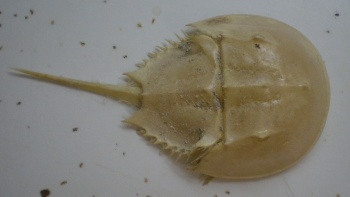
horseshoe crab molt and got to save the shell (see
attachments). We are currently fixing a poisonous algae
problem and I think it has affected the horseshoe
crab. I found her upside down under one of the filters
this morning and thought she was dead. When I netted her
and brought her to the surface, her gills were moving but very
slowly. I put her in an isolation/hatching net (see
attachments) and saw that she improved quickly. Her tail
is snapped at the end which I realize she will likely regenerate
during her next molt. Finally, I am getting to the point
of my letter. I don't want to release her until this
evening when the bulk of the algae is cleaned but, she has other
plans. In her attempts to free herself from
the isolation box, she keeps landing on her back and can't
right herself because of the snap in her tail. I have
spent the better part of the morning flipping her back
over. Do you think it's safe to release
her? How long can she stay on her back
safely? Thanks so much, in advance, for any help you can
provide. <I'd leave the crab in isolation until
health improves, eating, righting itself. Having gravel
in the isolation tank will help it right itself. If you
have treated the tank with an algae inhibitor, this very well could
have affected the crab's health. Read FAQ's here and linked
files above. Learn here from the experiences of other
Horseshoe Crab keepers. http://www.wetwebmedia.com/horseshoecrabfaqs.htm James
(Salty Dog)> Deborah |
|
|
| Re: Horseshoe Crab/Health 2/9/07
Thanks so much for sending such a fast response. <You're
welcome.> It's nice to know that there are volunteers taking
the time to help those of us who need it especially when the same
LFS who sell these little guys know nothing about
them. I ended up releasing the crab late last night
because the tank bottom was cleaned. A few months ago we
found that our substrate was too thick resulting in not enough
aeration and it was causing spots of anaerobic bacteria throughout
the tank. <Yes, can/will happen.> We removed a lot of the
substrate and the problem slowly subsided. Harry (the
horseshoe crab) <Skinhead would have been a better name:)>
also helped with that because she constantly moved the
substrate. Recently, the same bacteria came back with a
vengeance and we were concerned that Harry would be
affected. We were told by our LFS that we should replace
our lights. I have been telling my husband this for
months. Now, its just a waiting game. Harry
seems to be holding her own but insists on staying directly beneath
one of our filters. As for your response to my original
email, we don't use algae inhibitors because normally our tank
produces just enough of the good algae to keep our fish happy.
<My concern here is the chemical make-up of some of these
products that can affect the health of invertebrates.> I wish I
could have put gravel in the isolation tank. It would
have kept me from spending the day flipping Harry
over. Its a net tank and just can't handle the extra
weight of any gravel. I've decided to use my spare
10-gallon tank for all future isolation
issues. You're horseshoe crab FAQ's section has
been a lifesaver. We bought Harry on a whim, like so
many others mistakenly do (our first unresearched purchase) along
with a hermit crab from our LFS. We knew nothing and
could find no information anywhere. We even went to two
large local aquariums and they could not help us. After
many more long hours searching online, we finally found your
website! What a relief we felt. Your site has
been a constant source of valuable information for to
us. This reply needs no response. Thanks for
all that you do for us. <You're welcome, Deborah, and
continue reading/learning. James (Salty Dog)> Deborah
Rowe |
Horseshoe Crab Health and Cucumber Fission 4/5/07
Hello! <Hi Susan!> I just recently found your site and have
learned a great deal from it already. <Thank you! How may we help
you today?>. I have a 30 gallon tank that I have had for about 4
years. I purchased a horseshoe crab, sadly, since I have read your
article, 3 years ago. <Wow, considering their specialized needs, 3
yrs in a 30g tank is a long time for one of these guys to survive!>
He has seemed to do well until the past week, he has molted twice
during the time I have had him. <Depending on his age, he should
have molted more than this over a three year period> He now has a
dark brown color to his back, his shell is soft and he does not seem to
be moving his gills very often.<Did he just molt in the last day? If
so, that would be normal. Their shell doesn't harden for around 24
hrs. If not, that combined with the slow gill action sounds like
he's in trouble. How is everything else in the tank? What are your
water parameters, including calcium? Have you ever tested for
Iodine/Iodide? Is he still eating and if so, what do you feed him?
Also, how large is he now?> He also is spending a lot of time upside
down.<Horseshoe crabs sometimes do odd things but all in all,
I'm concerned for the little guy> I do hope I have not starved
him or caused him other harm. <If he survives, he really needs to be
in a tank more equipped for his needs. Please read the FAQ listed as
'Horseshoe crab Overview 4/14/03' at this link: http://www.wetwebmedia.com/horseshoecrabfaqs.htm
> It is a shame that some fish dealers do not have the knowledge to
help educate people on purchases. <Agreed. Horseshoe crabs are
wonderfully interesting creatures that in the right setting, can be
very hardy. Unfortunately, they're not well suited to the warmer,
predominantly rock filled reef tanks that most saltwater enthusiasts
keep> I will not make another purchase without checking your site
first. <Yes, it's a difficult lesson that many of us have
learned the hard way, but the good news is that by you writing this,
you may be saving another life down the road> I also have a light
spotted sea cucumber that recently divided into two sea cucumbers. Both
"halves" seem to be doing fine but I have not been able to
find any information on this. I would appreciate any help you could
give me. <Ha! Thought you were seeing double, didn't you?
Actually, "fission", or splitting into two parts in this
case, is normal for some species of cucumber. Interestingly enough,
these species can reproduce sexually or asexually. What usually happens
is the Cuke will disappear for a bit, maybe a week or two, then
reappear as two separate entities! How neat is that? Here's a link
to our Faq's on Cuke reproduction: http://www.wetwebmedia.com/cukereprofaqs.htm
> Thank you for your time and expertise.<You're very welcome,
Susan! -Lynn>
Small SW... Horseshoe Crab... No useful info.
-- 06/08/07 Hello, I just recently found your site and have learned
a great deal from it already. It is a shame that some fish dealers
don't have the knowledge to advise people in their purchases in the
beginning. <Such is the nature of experience, reality... "Once
you get something wired... your chances are generally long
over"> I have a 30 gal tank, have had it for 4 years. I
purchased a horseshoe crab <What species? Might be at the end of its
lifespan for these circumstances...> three years ago. (sadly, after
reading your article). It has seemed to do well until the past week. It
has molted twice in the time I have had him. He now seems to be in
trouble, hopefully I am not starving him, but he is spending a lot of
time upside down, his gills do not seem to be moving very often and his
shell is soft and has a brown tint on the back that was not previously
there. Any help would be greatly appreciated. <Mmm...> I also
have a light spotted sea cucumber that I have had for about a year.
<Could be a factor here as well...> It recently divided into two
separated cucumbers. Both "ends" seem to be doing well but I
have not been able to find any information on this. <Need to
identify... Pix?> Thank you again for your time and expertise. I
will definitely see your page before any future purchases. <Uhh...
need more input... system make-up, maintenance, water quality
tests/history, foods/feeding... Bob Fenner>
|
|

