|
|
| Home | Marine Aquariums |
Freshwater Aquariums |
Planted Aquariums |
Brackish Systems |
Ponds,
lakes & fountains |
Turtles & Amphibians |
Aquatic Business |
Aquatic Science |
Ask the WWM Crew a Question |
| Please visit our Sponsors | ||||
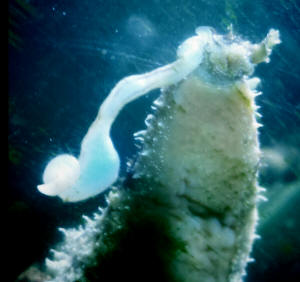
Colochirus robustus dropped a part of
itself 2/10/11
Indonesian Sea Apple 8/15/07 Hey guys,
love the website and the information you so kindly provide. With that
said, I work at my LFS and have been working in aquaria for about 4
years. I purchased an Indonesian Sea Apple for my 30-gallon community
tank, <... Yikes...> knowing (or at least thinking I did) the
inherent risks of the organism. I have had the Cuke for more than 4
months and he receives daily doses of Marine Snow <Of almost no
nutritive value> and has appeared to be doing well (no inflating
from stress, no loss of size, no moving in the tank once established).
Today however I came home and noticed that one of my favorite fish had
passed, one of the ones I had had in the tank for a while (5-6 months).
I peered into the tank and noticed what appeared to be little green
balls (about the size of a flea perhaps?) floating all around in the
water. I examined the Cuke closely and it appeared to have strings of
these little balls wrapped around a few of its feeding feathers.
Another reader had written you about a similar experience ("little
yellow balls" in his case) and I was wondering if this is in fact
the Cuke reproducing? <Possibly this... or fecal material... or?>
I couldn't find any info on how they reproduce. Is it common for
them to reproduce in captivity? <Not uncommon> Also, if so are
the eggs simply themselves toxic? <Can be, yes> I have never done
a full change on my tank and unless I notice labored breathing or
anything of the like I don't intend to, at least until I establish
that this did in fact come from the Sea Apple. <Good point... this
material could be unrelated to the Holothuroid> Aside from him the
only other inverts in the tank are a pair of Skunkback Cleaner Shrimp
and Peppermint Shrimp, <Could be their eggs... though unusual to be
released as such> Margarita Snails, Blue-legged hermit crabs and a
small Tiger-Tail Cuke and of course the corals (mostly Euphyllia,
Toadstools, Zoos and Mushrooms). Thank you for any insight into this
odd situation! Alec Parodi Valencia, CA <Do keep a close watch on
this system... "If" something goes sideways with the Sea
Apple... all could turn into bouillabaisse in minutes... Bob
Fenner> Horseshoe Crab Health and Cucumber Fission 4/5/07 Hello! <Hi Susan!> I just recently found your site and have learned a great deal from it already. <Thank you! How may we help you today?>. I have a 30 gallon tank that I have had for about 4 years. I purchased a horseshoe crab, sadly, since I have read your article, 3 years ago. <Wow, considering their specialized needs, 3 yrs in a 30g tank is a long time for one of these guys to survive!> He has seemed to do well until the past week, he has molted twice during the time I have had him. <Depending on his age, he should have molted more than this over a three year period> He now has a dark brown color to his back, his shell is soft and he does not seem to be moving his gills very often.<Did he just molt in the last day? If so, that would be normal. Their shell doesn't harden for around 24 hrs. If not, that combined with the slow gill action sounds like he's in trouble. How is everything else in the tank? What are your water parameters, including calcium? Have you ever tested for Iodine/Iodide? Is he still eating and if so, what do you feed him? Also, how large is he now?> He also is spending a lot of time upside down.<Horseshoe crabs sometimes do odd things but all in all, I'm concerned for the little guy> I do hope I have not starved him or caused him other harm. <If he survives, he really needs to be in a tank more equipped for his needs. Please read the FAQ listed as "Horseshoe crab Overview 4/14/03" at this link: http://www.wetwebmedia.com/horseshoecrabfaqs.htm > It is a shame that some fish dealers do not have the knowledge to help educate people on purchases. <Agreed. Horseshoe crabs are wonderfully interesting creatures that in the right setting, can be very hardy. Unfortunately, they're not well suited to the warmer, predominantly rock filled reef tanks that most saltwater enthusiasts keep> I will not make another purchase without checking your site first. <Yes, it's a difficult lesson that many of us have learned the hard way, but the good news is that by you writing this, you may be saving another life down the road> I also have a light spotted sea cucumber that recently divided into two sea cucumbers. Both "halves" seem to be doing fine but I have not been able to find any information on this. I would appreciate any help you could give me. <Ha! Thought you were seeing double, didn't you? Actually, "fission", or splitting into two parts in this case, is normal for some species of cucumber. Interestingly enough, these species can reproduce sexually or asexually. What usually happens is the Cuke will disappear for a bit, maybe a week or two, then reappear as two separate entities! How neat is that? Here's a link to our FAQs on Cuke reproduction: http://www.wetwebmedia.com/cukereprofaqs.htm > Thank you for your time and expertise.<You're very welcome, Susan! -Lynn> Sea Cucumber Worries, Nah, Just Fission. 2/23/07 Good day to all, <Hello Robert, Mich with you tonight.> I have what was sold to me as a Holothuria thomasi but I believe is actually a Holothuria hilla. <OK.> This interesting guy has been in the tank for about 8 months and has grown a good deal with no problems until now. I lost track of him about 2 weeks ago, last evening I noticed him on the left side of the tank. My wife mentioned she saw him on the right side. Hmmm, seems I now have two half cucumbers. I gave a nudge to each half and they reacted by recoiling. Not as quickly as I would have expected, but not dead either. I could not see any trauma, but I have only been able to find reference to sexual reproduction. Can these guys split? <Yep!> Would you assume the worst and pull it now? <Nope!> The only other thing in the tank that might have the pull to render the Cuke in two is a serpent star that was added about a month ago. <Most likely a natural event.> Thanks for your thoughts, excellent resource you have created. <Welcome! -Mich> Robert D Cucumber regeneration and Cleveland club Christmas party Gents: <hey... we work for a living <G>> No question this time, but a follow up to a previous question, prompted by Anthony's recent appearance as the featured speaker at Cleveland Saltwater Enthusiasts Assn. (C-SEA). Kudos for an excellent program Dr. C. Ha! Thank you... but I'm no doctor... I don't even play one on TV> About 3 months ago I wrote asking about the prognosis for a Turd cucumber (Please insert appropriate scientific name here) <yes... Cucumarid poop-a-loticus> that was caught in a powerhead. The cucumber lost his Cuke- as about the anterior fourth of him/her was ground up. I removed what was left from the powerhead inlet and put it into a quarantine tank. The ground up tissue became necrotic and sloughed off. The open wound healed over, and he/she <they> wandered around the tank with no sign of regeneration and differentiation of the anterior structures for about 6-8 weeks, during which time it lost about half of its body mass. Then there appeared to be some growth of branched structures over about 2 weeks. Last week I observed what appear to be tentacles that were moving sand grains. I placed it back in the main tank, and it continues to handle sand grains and move them towards the mouth. I have yet to see any production of fecal sand pellets, so I am not sure if it is really recovered, but here's hoping..... Thought someone might find this interesting. <an awesome story! Thanks for sharing. And ever more proof that cucumbers don't wipe out aquariums with toxin at whim. Such events are rare> PS. The Cleveland Saltwater Enthusiasts Assn. will be holding their annual December meeting/Holiday Party and Raffle extravaganza December 20th at 7:00PM in the Cleveland Zoo Aquatics/Cat/Primate Building. This is an excellent opportunity to met others in the hobby, win some great stuff, and support the club's ability to bring in superb speakers such as Mr. Calfo. AND you get a chance for behind the scenes tours of the Zoo Aquarium. A BARGAIN AT TWICE THE PRICE....Thanks Gents. Stan <best regards, my friend. Anthony> Sea Cucumber To whom: I have an orange and white cucumber I believe it is the species: Holothuria hilla. I noticed this week it had been split in half, each end looks fine, no damage, or leakage. Both halves are moving and looking normal. Is this normal? I heard these guys can regenerate their stomachs but what about this??? Please help, is the rest of my tank at risk?? all the levels are good. Anissa <hmm...this is curious. In general, echinoderms are amazing regenerators. If behaviors look normal, it (they) should be ok. keep a close eye on it for necrosis around the edge of separation. best, Chris> Sea apples -Nooooooooooooooooooooo!!!!!!!!!!!!!! - 11/24/03 Hello I believe I have a Australian Sea Apple, and the other day it was secreting yellow little balls, possibly eggs. <Possible...either way....not good!!!> But the next day 2 of my fish died. <Craaaaaap. Sorry to hear about that. Yes, well, this is why these are not good in mixed aquaria. Either dedicated tanks or not at all my friend.> I was curious if it was from eating those balls. <Absolutely, but just being in the tank with this noxious material would be enough to kill everything in the tank! Doesn't even take eating it. Do read about this on our site.> I did a 90% water change <More frequent water changes with about 30-50% daily might help. 90% percent was probably necessary though. Do read up before purchasing any inhabitant you are to take into your charge. Good luck ~Paul> Baby Sea Cucumbers Happy New Year! <To You as well!> I have a couple of 6 inch sea cucumbers (Holothuria spp) in a 20 gallon new fish quarantine tank for a couple of years (and no, I've never had a sea cucumber poison a tank). Nothing fancy, Bak-Pak skimmer hang-on system and monthly water changes with recycled "used" water from my reef tank (when I do that water change). About a month ago, my son saw this tiny 1/2 inch sea cucumber on the glass, and we've subsequently found about 20. <You probably don't want this many in your tank. Perhaps you can get someone to take some off of your hands for you as they grow.> The biggest is now about 1.5 inches. I've seen some stuff about commercial sea cucumber aquaculture, but haven't been able to find anything about this happening in a hobby aquarium. Have you heard of this? <Yes. I had 2 Yellow ones that became 4 by splitting. Fascinating to see. Others have been known to reproduce sexually.> BTW, I have no idea why this happened. <The birds and the bees...> The only thing I can think of is that the tank will occasionally heat up into the mid 80's (we live in Miami, and my mother-in-law likes to turn off the AC), and I've seen in the aquaculture literature that raising the temperatures will induce Cukes to spawn. <Perhaps that's it.> Thanks! Kelvin Lee <No worries. Steve Allen> Yellow Sea Cucumber Fission (11/28/04) Hello, <Hi. Steve Allen, echinoderm enthusiast, answering this evening.> I just got one Colochirus robustus 2 weeks ago and now it looks like it is splitting in to two parts? <Lucky you! Two for the price of one.> It just looks like the other part moves other direction than the other and between those parts there is like intestine or something like that? So what is happening it looks really strange, the cucumber looks otherwise o.k. Thank you in advance. John Hyttinen <It is very common for this species to multiply by fission. I bought 2 and now have 6. They split in the middle and the front part grows a new tail and the back part grows a new front. I suspect that what you are seeing that looks like intestine may be the tentacles of the back parts new front end. If all goes well, the two sea cucumbers will grow and thrive. Is there anything in your tank that might have bitten or cut it in half? This, of course, would be bad, but I'd bet your dealing with reproductive fission. Way cool. Let us know how it turns out.> |
|

|
Features: |
|
| Featured Sponsors: |
.jpg)